Cisco Internet Business Solutions Group (IBSG)
Smart City Framework
A Systematic Process for Enabling
Smart+Connected Communities
Authors
Gordon Falconer Shane Mitchell
Smart City Framework
A Systematic Process for Enabling Smart+Connected Communities
Introduction
Cities and communities around the world face intractable challenges, including:
● Increased populations: More than 50 percent of the world’s population lives in cities,1 placing massive pressure on city infrastructures (transportation, housing, water, power, and city services), many of which require enormous redesign and capital expenditure. ● Polarized economic growth: The 600 largest global cities will contribute 65 percent of
global GDP growth from 2010–2025.2
● Increased greenhouse-gas emissions (GHGs): GHGs are forcing cities to develop sustainability strategies for energy generation and distribution, transportation, water management, urban planning, and eco-friendly (green) buildings.
● Decreased budgets: The economic climate continues to place huge budgetary constraints on cities, which are becoming limited in their ability to respond to these pressures.
These issues, and others, can be mitigated through the adoption of scalable solutions that take advantage of information and communications technology (ICT) to increase efficiencies, reduce costs, and enhance quality of life. Cities that take this approach are commonly
referred to as Smart Cities, or Smart+Connected Communities (S+CC),3 a concept highly
discussed and often debated in urban planning and city policy circles worldwide.
Interest in Smart Cities has triggered plenty of theoretical and technology-led discussions, but not enough progress has been made in implementing related initiatives. In addition, there are a number of factors hindering adoption of Smart City solutions: scaling of newer technologies is unproven; technology challenges the existing status quo in how cities are run; and technology is not well-understood across city sectors.
However, the main barrier to adopting such solutions is the complexity of how cities are operated, financed, regulated, and planned. For instance, city operations are multi-dimensional and comprised of multiple stakeholders whose dependencies and
interdependencies affect and ultimately determine the built environment. Smart Cities, however, present an opportunity to integrate physical city infrastructures—from utilities, transportation, and real estate to city services.
1 “State of World Population 2007: Unleashing the Potential of Urban Growth,” United Nations Population Fund,
2007, www.unfpa.org/swp/
2 “Urban World: Cities and the Rise of the Consuming Class,” McKinsey Global Institute, June 2012,
www.mckinsey.com/insights/mgi/research/urbanization/urban_world_cities_and_the_rise_of_the_consuming_c lass
3 The Cisco Smart+Connected Communities initiative takes advantage of ICT to transform physical communities
into connected communities that can realize economic growth, enable environmental sustainability, and enhance quality of life. www.cisco.com/go/smartconnectedcommunities
This Point of View from the Cisco® Internet Business Solutions Group (IBSG) defines what
we call a “Smart City Framework” designed to move the Smart City debate from merely an academic or esoteric discussion to a call for action.
The Smart City Framework proposed in this paper describes a process that will help key stakeholders and city/community participants 1) understand how cities operate, 2) define city objectives and stakeholder roles, and 3) understand the role of ICT within physical city assets.
Furthermore, while there is a vast amount of information on cities, such information is frag-mented and incomplete. A Smart City Framework will enable cities to establish a standard “catalog” system for recording, measuring, and collating city data, and for making it easily accessible for efficient, effective implementation and management of Smart City solutions for economic, social, and environmental gain.
Smart City Movement
A complex mix of players has emerged in a worldwide Smart City movement. Each player sees the city through a different lens. In the private sector, city engineers and technology
companies view the city as a complex system with multiple layers.Architects and
non-governmental organizations (NGOs) see the city in terms of people, social inclusion, and a sense of space. Government leaders, on the other hand, view the city in terms of economic growth and new or improved city services supported by policy initiatives designed to effect change. Regardless of their viewpoint, most agree on a common vision: make cities smarter and more sustainable.
Cisco is one company that has ignited the Smart City debate. In 2006, Cisco, along with several innovative city leaders, launched “Connected Urban Development,” a program that demonstrates how to reduce carbon emissions by introducing fundamental improvements
in the efficiency of urban infrastructures through ICT.4 This program influenced the
develop-ment of many Cisco S+CC initiatives, engaging a global peer network of cities, companies, and NGOs in further developing ICT solutions to improve cities by increasing efficiencies and reducing costs, promoting economic growth, and enhancing quality of life.
Most Smart City constituents agree that it’s less expensive and easier to deploy ICT than to replace legacy city infrastructures. Furthermore, one of the most compelling pieces of evidence supporting ICT as a Smart City enabler is the estimated 15 percent savings in
global carbon emissions that it can deliver by 2020.5
While the Smart City movement is garnering much attention, a gap remains between rapid, widespread adoption of innovative solutions and actual implementations.
Smart City Solutions: Barriers to Implementation
To “kick start” significant change within a city, its leaders must be unhappy with the status quo and therefore capable of getting the populace to buy into its vision for a better future— in this case, a future enabled by smarter technology.
4 www.connectedurbandevelopment.org
5 “SMART 2020: Enabling the Low Carbon Economy in the Information Age,” a report by The Climate Group on
Based on engagements with city stakeholders worldwide, Cisco IBSG found that the complexity of cities (multiple parties, stakeholders, and processes) remains the most significant barrier to adopting Smart City solutions. This complexity manifests itself across many areas of local government—regulatory, governance, economic, systemic, policy, and organizational.
Faced with this complexity, city leaders and stakeholders struggle on how to agree on the methodologies for implementing Smart City solutions. What they lack is structured thinking:
1. Why is a Smart City initiative good for a city?
a. What is the value case that justifies the initiative or innovation?
2. What should we do?
a. Which solutions do we deploy?
b. Which actions do we take?
c. Which projects and components of the initiative are crucial?
3. How do we implement solutions?
a. Which policies and business models must we have in place?
Furthermore, the private and public sectors do not understand how each sector works within the context of city development and operations. It is difficult, to say the least, to craft
successful public-private partnerships (PPPs)—seen by stakeholders as the answer to implementing Smart City solutions—when both sectors do not “speak the same language.” In particular, the private sector does not comprehend how its technologies fit into this complex environment because it tends to view cities as just physical structures upon which to add ICT. Nor does it understand which city stakeholder, or combination of stakeholders, is responsible for which solution.
Unfortunately, the focus of various groups within the Smart City movement is split: Urban experts and academics think about the “why” at great length, while technology companies and consultants focus on the “what.” Overall, less time is spent discussing the “how,” which ironically is where city leaders need the most assistance.
A Smart City Framework ultimately can help solve the “how” through a process that enables cities to answer the following questions:
● Who operates the components of the city?
● Who controls and influences the behavior of the organizations that operate the
components?
● How do city components interact with each other and with other stakeholders?
● Which business models are required for deploying Smart City solutions
● What is the role of ICT?
● How are cities and initiatives measured?
Smart City Framework: Turning Talk into Action
At its core, a Smart City Framework is a simple decision methodology that enables both the public and private sectors to plan and implement Smart City initiatives more effectively. Most cities actually undergo this process in an intuitive way rather than in a clearly structured manner. A structured method not only will enable efficiencies in city infrastructures, but also transparencies into how cities work.
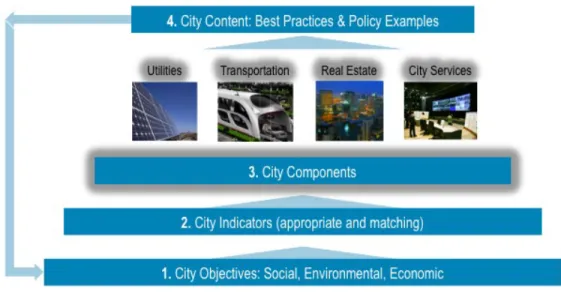
City leaders define actions or initiatives by their impact on stated city objectives. This is why the proposed Smart City Framework (see Figure 1) starts with city objectives as its base, against which all initiatives are then measured.
Figure 1. Smart City Framework Layers (from bottom to top).
The four layers of the framework provide a logical flow that enables stakeholders to “push” through and test initiatives. For example, let’s say a city leader is keen on promoting sustainability, which later becomes a high-level objective within Layer 1. And, let’s assume that the city has identified via international transportation indices that its bus system travel times are not ranked high (Layer 2). Given this information, stakeholders can then discuss a city initiative for a “connected bus fleet” (Layer 3) and requirements for designing and implementing the system. From there, city leaders can seek out best practices of similar initiatives worldwide: how such a system was financed and operated, and the policy and regulatory frameworks necessary for success (Layer 4).
The circular flow of information within the Smart City Framework results in a feedback loop that enables stakeholders to understand best practices of other Smart City initiatives. The components of each layer are further detailed for better understanding of the framework.
Layer 1: City Objectives—Improving Social, Environmental, and Economic Pillars
At a high level, most city discussions center on policy questions such as, “If we spend money on transportation, how will it improve the city?” Or, “How do we attract jobs and increase economic growth?” While these questions are common among city leaders and
stakeholders worldwide, they can change depending on the person’s role and perspective, and are often difficult to answer in anything but qualitative terms.
To understand how a city operates, a framework must ultimately link the city’s objectives (pillars) to projects, policies, and initiatives.
Layer 2: City Indicators—Matching Indicators to City Objectives
Because city objectives are high level and somewhat ephemeral, it is important to link them to existing, published “city indicators,” which measure and benchmark cities using defined and specific methodologies. The basis of, and methodology for, indicators such as The Global City Indicators Facility (GCIF),6 Mercer Quality of Living Survey,7 and Green City
Index8 vary widely, with different quantitative and qualitative approaches.
A different set of indicators may be required for different cities. For example, if a city's objectives focus on financial priorities, then the Green City Index would not be appropriate. Similarly, if a city’s objectives focus on sustainability, the Mercer Quality of Living Survey or Green City Index might be appropriate.
In an ideal world, there would be only one set of city indicators. Unfortunately, because the complexity of cities as well as their priorities and objectives differ, cities will naturally gravitate toward a city index whose indicator methodology closely matches their own objectives, and then benchmark themselves accordingly.
Layer 3: City Components—Detailing City Assets
Most Smart City initiatives manifest themselves in a city’s physical location (e.g., train station) and industry sector (e.g., transportation). This layer of the framework details the physical components of a city—utilities, transportation, real estate, and services—which are then linked to city objectives, indicators, and content.
The components reside at the top level, and a hierarchy is used to drill down into each sub-level. For example, transportation includes four subsections: rail, road, air, and logistics (see Figure 2). While there are other levels within the hierarchy, the one shown here is limited to four; their main subsections are for illustrative purposes only and to stimulate discussion.
Figure 2. Hierarchy of City Components.
6 www.cityindicators.org
7 www.mercer.com/surveys/quality-of-living-report 8 www.siemens.com/entry/cc/en/greencityindex.htm
Layer 4: City Content—Mapping Objectives to Best Practices and Policies
This layer encompasses the “how”—how Smart City solutions are implemented. It links directly to Layer 3 and then to Layer 1, as it provides information and enables the identification of information that is relevant to Layer 1 (city objectives).
Much of the detailed content written about cities outlines innovative solutions and ideas already deployed, but the content is written and recorded in different ways, without any real structure for understanding and replicating Smart City deployments, or for sharing content. For example, web searches based on “keywords” alone do not reveal relevant information. In particular, the way that the information is presented lacks consistency and clarity.
Therefore, replicating best practices and policies in other cities becomes problematic. Not having a consistent method for reporting successful Smart City solutions/case studies ultimately ends in confusion and an enormous amount of non-productive work, which delays implementations.
Subjects such as botany have had classification systems for more than 100 years, and environmental sustainability benchmarking and common standards have advanced
considerably over the last decade. However, there is no equivalent agreed-upon taxonomy for city information. A structured and well-defined template for best practices and policies will enable cities to identify and reuse information on stakeholder roles, policy requirements, and business models involved in Smart City initiatives.
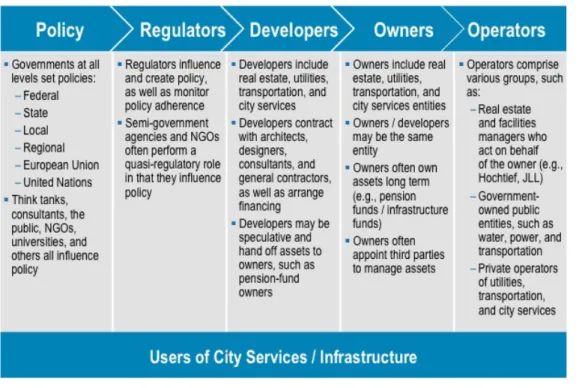
It is important to emphasize that stakeholder roles must be established prior to developing any Smart City plan because these players have the most influence on city initiatives and operations. Figure 3 outlines the relationship among five key stakeholders.
Figure 3. Stakeholder Roles and Responsibilities.
Smart City Framework: Key Outcomes and Benefits
A Smart City Framework not only provides a detailed view of how cities function, but also enables three major outcomes:
1. Taxonomy/typology that enables cities to benchmark relevant content based on the hierarchy of physical city components
2. Stakeholder roles that define who does what. Unfortunately, this part is missing from many city discussions; its omission creates a lack of understanding in how to
implement Smart City solutions.
3. Catalog system of city content that is easily accessible These outcomes will enable cities to:
● Customize a Smart City blueprint
● Identify where and how to implement ICT solutions in cities
● Develop government policy guidelines for enabling private-sector participation in city
projects
● Conduct a city gap analysis that enables cities to benchmark themselves, consistently
and accurately
● Create a structured case study template for collating multiple business models for
similar Smart City initiatives
Smart City Framework: Creating Awareness
While there are no examples to date of Smart City implementations based on a Smart City Framework approach, a number of current activities are enabling a better understanding of city dynamics in an effort to move forward on Smart City initiatives. One is the “City Protocol” program, initiated by the City of Barcelona and supported by Cisco, which recognizes the
need for incorporating elements of a Smart City Framework.9 The program is being
developed through the City Protocol Society, a community of partner cities, companies, academia, organizations, and key civil society players. The Society seeks to develop a science of cities—influenced in part by Internet standards bodies, namely the Internet Engineering Task Force (IETF), the Internet Society (ISOC), and the World Wide Web
Consortium (W3C)—to promote new leadership models, citizen engagement, and effective applications of ICT in delivering a process for developing Smart Cities.
Building from the SMART 2020 program10 and its partnership with Cisco to advance
sustainable ICT development in cities,11 The Climate Group (in collaboration with Arup,
Accenture, and Horizon at The University of Nottingham) in its report “Information
Marketplace: The New Economics of Cities”12 further investigates how technology can be
used in cities to meet the growing challenges of expanding urbanization. The report states that for the value of Smart City projects to be effectively compared, a common suite of
9 www.cityprotocol.org
10 www.theclimategroup.org/what-we-do/programs/SMART-2020/
11 “The Climate Group Calls on Cities and Companies To Partner on SMART 2020 Cities and Regions Initiative,”
Cisco, June 2010,http://newsroom.cisco.com/dlls/global/asiapac/news/2010/pr_06-16b.html
12 “Information Marketplaces: The New Economics of Cities”; The Climate Group, Arup, Accenture, and Horizon at
The University of Nottingham, November 2011, www.theclimategroup.org/what-we-do/publications/Information-Marketplaces-The-New-Economics-of-Cities/
metrics must be developed that ties the performance of individual initiatives to the city’s long-term strategic aims and enables comparisons on a like-for-like basis. By unlocking information, ideas, and energies, Smart City applications and services create more sustainable modes of living and working. However, The Climate Group’s research also revealed that there are no examples to date of cities launching fully integrated, strategically designed Smart City development programs.
A number of academic studies also explore the fundamental issues of realizing Smart City
visions. One recent study, “Understanding Smart Cities: Integrative Frameworks,”13 states the
need and the dynamics to consider in developing Smart City strategies.
These reports indicate that the debate is no longer about why a Smart City initiative is good
for a city or what to do (which available options to choose), but instead about how to implement Smart City infrastructures and services, including the importance of a common language and a structured approach to implementation.
Smart City Framework: Where to Start
Many cities have a Smart City vision and are taking steps toward creating blueprints. Unfortunately, some blueprints begin and end with a vision dominated by the physical design, resulting in a jumbled mess of engineering and architectural ideas supported by various technologies. Such visions are utopian and impossible to implement.
A Smart City Framework, however, can help stakeholders sift through this confusion. It is important to note that there will be many interpretations of a Smart City Framework, including the one outlined here. Regardless, Cisco IBSG believes that a framework should include the elements covered in this paper to enable discussion and subsequent action in co-developing a framework that is agreed upon by all stakeholders.
By providing a process for instigating Smart City initiatives, stakeholders can move their
ideas from mere vision to action. Here’s what they can do now—at a higher level—in
preparation of adopting a framework.
Government
● Support the City Protocol initiative. While fairly new, the City Protocol is a step in the right direction in bringing multiple groups together to establish common language for Smart Cities. Similarly, The British Standards Institution14 is developing standards for
Smart Cities in the United Kingdom. These types of initiatives need support and involvement not only from the government sector, but also from the wider Smart City community.
● Work more closely with the private sector to educate them on stakeholder roles and, in
particular, the “how”—policies and business models necessary for implementing Smart City solutions.
13 “Understanding Smart Cities: An Integrative Framework,” Hafedh Chourabi, Taewoo Nam, et al, IEEE Computer
Society, 2012, www.ctg.albany.edu/publications/journals/hicss_2012_smartcities
Private Sector
● Don’t start developing end-to-end solutions until there is a clear understanding of who
will pay for and operate them. Rather, develop processes to enable open and collabor-ative innovation with potential clients, NGOs, and academics to ensure solutions that are both functional and economically feasible.
Academics and NGOs
● Spend more time focusing on the “how” rather than on the “why.” Both, of course, are
important, but focusing too much on the “why” will hinder quick adoption of solutions and initiatives.
By taking these initial steps, Smart City stakeholders can work toward establishing a common set of standards and a comprehensive framework for implementing Smart City solutions.
For more information, please contact: Gordon Falconer, Director
Urban Innovation
Cisco Internet Business Solutions Group [email protected]
Shane Mitchell, Sr. Manager Urban Innovation
Cisco Internet Business Solutions Group [email protected]
The authors would like to thank Cynthia Bournellis of the Cisco IBSG Communications Strategy Practice for her contributions to the development, writing, and editing of this paper.