Knowledge Communication in Product Development Projects
Lisbeth Brøde Perttu Dietrich December 2010
© University of Southern Denmark, Esbjerg and the authors, 2010 Editor: Finn Olesen
Department of Environmental and Business Economics IME WORKING PAPER 105/10
ISSN 1399-3224
All rights reserved. No part of this WORKING PAPER may be used or repro-duced in any manner whatsoever without the written permission of IME except in the case of brief quotations embodied in critical articles and reviews.
Lisbeth Brøde
Department of Environmental and Business Economics University of Southern Denmark
Niels Bohrs Vej 9-10 DK-6700 Esbjerg
Tel.: +45 6550 4209 Fax: +45 6550 1091 E-mail: [email protected] Perttu Dietrich
Department of Environmental and Business Economics University of Southern Denmark
Niels Bohrs Vej 9-10 DK-6700 Esbjerg
Tel.: +45 6550 1526 Fax: +45 6550 1091 E-mail: [email protected]
Abstract
During the last decades, a number of studies have been concerned with com-munication related to new product development. These have looked at either in-tra-organizational communication between departments or communication be-tween new product development teams and external stakeholders such as cus-tomers or suppliers. Only little research, however, has combined internal and external stakeholder communication and explored the role of technology uncer-tainty on communication. The purpose of this study is to examine how technol-ogy uncertainty affects project manager communication behavior during new product development. We carried out an embedded case study of a major NPD project in the automation industry. The findings indicate that technology uncer-tainty is positively related to communication frequency between project man-ager and project stakeholders during the early phase of NPD project. In addition we found a negative association between technology uncertainty and the breadth and depth of communication between project manager and stakeholders in early phase of the NPD project. These findings indicate that under high tech-nology uncertainty, managers of NPD projects modify their communication be-havior not only with respect to how frequently they communicate with stake-holders, but also to which stakeholders they communicate and how deeply they engage different stakeholders in different phases of the new product develop-ment project.
Contents
1. Introduction ... 7
2. Literature review ... 10
2.1. Communication in New Product Development ... 10
2.1.1. Communication Media ... 10
2.1.2. The effects of internal and external communication on performance ... 12
2.1.3. The concepts of communication breadth and depth ... 13
2.2. Project Manager and Project Stakeholders ... 14
2.2.1. The Role of Project Manager ... 14
2.2.2. Communication with internal stakeholders ... 15
2.2.3. Communication with external Stakeholders ... 15
2.3. Technology Uncertainty and Stakeholder Communication during NPD projects ... 16
2.3.1. Technology Uncertainty ... 16
2.3.2. Stakeholder Communication during the NPD Project ... 19
3. Methods and data ... 21
3.1. Case Background ... 22
3.2. Case Description ... 24
3.3. Data ... 25
3.4. Validation of Case Selection ... 28
3.5. Concepts and Measures ... 32
4. Results ... 34
5. Discussion and Hypotheses ... 40
6. Contributions and Limitations ... 44
7. Conclusion and Managerial Implications ... 46
1.
Introduction
Communication and information processing activities are an extremely impor-tant part of the process of innovation. For some time now, several scholars in the field of innovation have viewed innovation as an information processing ac-tivity (Leonard-Barton, 1992; Fujimoto, 1995; Moenaert et al., 2000), where the innovation team (project team) obtains information on markets, technologies, competitors and resources, and translate this information into new product de-velopments (Moenaert et al., 2000).
It is well-known from the NPD literature that communication has a positive im-pact on the performance of innovation (Katz & Tushman, 1983). Prior studies have shown that cross-functional communication between different functions inside the organization has a positive impact on innovation success, e.g. (Garcia et al., 2008; Song et al., 1998a; Moenaert et al., 1994; Lee & Na, 1994; Brown & Eisenhardt, 1995; Sicotte & Langley, 2000). In addition, some NPD scholars have found a positive relationship between accessing knowledge from external channels and innovation performance (Chesbrough, 2003; Laursen & Salter, 2006; Yun-Hwa & Kuang-Peng, 2010). Moreover new product development is a very complex process, which requires cross-functional communication inside the company and with external partners, e.g. suppliers and customers (Calabrese, 1997; Kivimaki & Lansisalmi, 2000).
Project managers are often shown to play an important part in facilitating inter-action between stakeholders within and outside the company during NPD proc-esses (Fujimoto, 1995; Moenaert et al., 2000; Reid & de Brentani, 2004; Argote & Ingram, 2000). Moreover, it is argued that communication behavior of pro-ject managers should change during the phases of the NPD propro-ject (Veryzer, 2005; Reid & de Brentani, 2004), since the importance and the roles of different knowledge sources such as customers and suppliers (Chesbrough, 2003) and in-ternal functions (Song et al., 1998; Lee & Na, 1994; Moenaert & De Meyer,
1995) change accordingly. Several researchers have studied how different char-acteristics of (NPD) project such as market and technological uncertainty (Pearson, 1990; Song et al., 1998a), and degree of novelty (Freeman & Soete, 1997) or innovativeness (Verworn et al., 2008; Verworn et al., 2010) require different communication and knowledge gathering activities in NPD processes (Montoya-Weiss et al., 2001). It is argued that in the case of low uncertainty projects and incremental products, NPD activities may be performed more ef-fectively by exploiting existing knowledge of the personnel within and across the departments (R&D, marketing, manufacturing etc.) of an organization. Re-spectively in the case of high uncertainty projects and radical products, research and development within the boundaries of the company is often not enough, but companies must interact (communicate) with other actors (e.g. customers and suppliers) beyond the company boundaries (Urban & Von Hippel, 1988; Rosenkopf & Nerkar, 2001), and open up their innovation processes for exter-nal knowledge (Chesbrough, 2003).
Yet though prior empirical research has been valuable, unresolved issues re-main. First, existing empirical studies on innovations and NPD (Kivimaki & Lansisalmi, 2000; Johnsen et al., 2000) seems to focus on either intra-organizational communication (Song & Swink, 2009; Moenaert & De Meyer, 1995; Thieme et al., 2000; Hise et al., 1990) or communication between the de-veloping organization and external knowledge sources such as customers and suppliers (Von Hippel, 1986; Urban, 1988). Despite of the undeniable value of these studies on the management practice, they still provide overly simplified and narrow focused picture of the complex reality of communication taking place within the network of different stakeholders (Kivimaki & Lansisalmi, 2000). Second, it is argued that the existing studies on innovation often take an organizational level of analysis and thereby lack an in-depth understanding on how individual innovation projects are managed (Patrashkova & McComb, 2004). Thus, there is an identified need for studies using the individual project, instead of the whole organization, as the focus of an analysis. Third, most of the existing empirical studies have revealed the impact of technological uncertainty
on communication in front-end phase of innovation process (Zhang & Doll, 2001; Khurana & Rosenthal, 1997), but do not address how technology uncer-tainty influence different dimensions of communication during the whole NPD process. Fourth, empirical examinations on communication in innovation con-text have several methodological weaknesses. Many of the existing studies are based on cross-sectional data and are attributed by several dimensions of com-mon method variance (Podsakoff et al., 2003), such as social desirability due to single respondents (Lee & Na, 1994; Verworn et al., 2008; Song & Swink, 2009; Avlonitis et al., 2001) and measurement context effect due to simultane-ous measurement of predictor and criterion variables (Song & Swink, 2009; Lee & Na, 1994; Kivimaki & Lansisalmi, 2000; Avlonitis et al., 2001; Yun-Hwa & Kuang-Peng, 2010). Moreover, a vast variety of studies of communication in the context of innovation are based on perceptional measures rather than factual behavior during the NPD project (Lee & Na, 1994; Kivimaki & Lansisalmi, 2000).
In this article we attempt to cover the above mentioned gaps in the existing lit-erature. The objective of our study is to examine the effects of technology un-certainty on communication behavior between project manager and project stakeholders in different phases of innovation project
The rest of the paper is organized in 7 sections. In the following section we provide brief literature review on communication behavior between internal and external stakeholders in NPD projects as related to different phases of the NPD process and the degree of technology uncertainty. The third section includes de-scriptions on the case project, data collection and the initial data analysis. In the fourth section we summarize findings of the study. The fifth section includes the discussion and hypotheses generation, the sixth states limitations and future research and finally section seven presents the conclusions.
2.
Literature review
2.1.
Communication in New Product Development
According to different researchers, communication is essential to all organiza-tions and NDP projects, since communication is viewed as a process in which individuals or functions share (Weick & Quinn, 1999) and create valuable new knowledge (Song & Dyer, 1995) to reduce uncertainty and equivocality (Daft & Lengel, 1986). From the information processing perspective (Daft & Lengel, 1986), communication between different specialists is particularly relevant for reducing uncertainty in NPD projects. Successful NPD projects require the col-laboration between both internal and external stakeholders, and a variety of dif-ferent integration mechanisms can be used to achieve this.
2.1.1.
Communication Media
Researchers have studied different types of communication media for commu-nication in development projects (Daft & Lengel, 1986; McDonough III & Kahn, 1999). Media selection refers to the communication medium (e.g. tele-phone, email) chosen to transfer information and when selecting media, team members must decide how best to communicate the requested information (Patrashkova, 2004). Daft et al. (1986) suggest the utilization of “rich” commu-nication media (e.g. face-to-face meetings and telephone meetings) to facilitate communication in product development projects, since these projects require close cooperation between departments. Face-to-face meetings transfer more in-formation per message than an electronic mail, since facial expressions and the tone of the voice is revealed. Due to the linkage of tacit and explicit knowledge, Nonaka et al. (2000) argue that individuals can only create and exchange knowledge through social interactions and shared experience. However geo-graphical distance decreases the possibilities for team members to meet face to face on a regular basis. Telephone calls are also considered a rich communica-tion medium (Daft & Lengel, 1986), which reveals the tone of voice and
permitts imidiate verbal feedback. Nevertheless, time zone differences might also prevent spontaneously conversations.
McDonough et al. (1999) studied the use of information technology in global teams. They found that the higher performing teams used fax, email, phone calls, teleconferencing and postal mail to a much greater extent than the lower performing teams (McDonough III & Kahn, 1999). The chosen communication media did not have an impact on the performance, only the frequency with which they were used had an impact. The best teams in their study normally used two main communication media frequently and others more seldom. In particular, email and individual phone calls were seen as important technologies for the higher performance.
At this time, a lot of organizational communication between different stake-holders (individuals) takes place through emails. Email communication suffers from the lack of verbal and non-verbal feedback and limitations of written lan-guage. Knowledge management researchers have even questioned the applica-tion of IT on knowledge exchange (Alavi & Leidner, 2001). However, emails have an advantage when language is a barrier. Written communication is likely to be understood more completely than oral communication, since unknown words or phrases can be looked up (McDonough III & Kahn, 1999). Further-more, messages delivered by email can contain a lot of information, which is quickly available for the receiver.
Boutellier et al. (1998) argue that email communication cannot replace face-to-face meetings in transnational NPD projects, but during time periods when col-laborators are working apart, emails offers a good alternative. They found that in the stages of a NPD project, where planning and design activities are re-quired, communication media such as telephone calls and emails are suitable (Boutellier et al, 1998). However, face-to-face meetings are recommended dur-ing implementdur-ing and testdur-ing stages of the NPD project, where possible
prob-lems are discovered and must be pursued further (Boutellier, Gassmann, Macho, & Roux, 1998).
2.1.2.
The effects of internal and external communication on
perfor-mance
Existing research often makes a distinction between internal and external com-munication. The former deals with team members’ communication with each other and cross-functional communication between organizational units (Moenaert & Souder, 1990; Katz & Tushman, 1983) and the latter is related to communication crossing the company borders, e.g. communication between company and its customers (Laursen & Salter, 2006). Both focal areas of com-munication behavior have been studied extensively over the years.
It has been found that teams function more efficiently and perform better when members from different functions share information and understand different viewpoints (Hauser, Tellis, & Griffin, 2006; Song & Xie, 2000). This is not only applicable for internal cross-functional interaction. Brown et al. (1995), for example, found that communication among project members and “outsiders” stimulates the performance of development teams. The greater the extent to which members are connected with key outsiders, the more successful the NPD process. It is also shown that there is a positive relation between project man-ager´s communication frequency and NPD project performance (Katz & Tushman, 1983). Many of existing studies assume that there is a linear relation between communication frequency and NPD performance (Ancona & Caldwell, 1992). Some authors (Kahn, 1996), however, have found controver-sial results indicating that the relationship between communication frequency and performance resembles inverted U-shape. It is argued that team members participating in innovation project have limits on the amount of information they can process (Boisot, 1995). Overburden personnel who have to attend too many meetings and who get overloaded with information, can hinder innovative activities (Kivimaki & Lansisalmi, 2000). However, too little communication, conversely, will not enable emergence of mutual understanding (Patrashkova &
McComb, 2004a). As stated by Leonard-Barton (1992) bringing the marginally useful information or leaving out relevant information might be detrimental to NPD performance.
2.1.3.
The concepts of communication breadth and depth
Recent contributions to the strategic management literature (Laursen & Salter, 2006; Katila & Ahuja, 2002; Yun-Hwa & Kuang-Peng, 2010) has introduced two interesting concepts that contribute to our understanding on communication in innovation context: breadth and depth. Both of these terms are related to knowledge search activities and are thereby closely attached to communication behavior. Breadth refers to number of sources that are engaged in knowledge search activities e.g. through communication (Laursen & Salter, 2006), whereas depth refers to extent to which organization draw deeply from the different knowledge sources (Laursen & Salter, 2006). From the communication per-spective these two concepts provide a possibility to extend current communica-tion frequency focused (empirical) research. The breadth concept can be used to understand how widely NPD project managers communicate with the different stakeholders. Communication that is high in breadth reflects the need of acquir-ing differentiated knowledge from, and thereby communicatacquir-ing with, different stakeholder groups, whereas communication of low breadth relates to the need to communicate only with a few different stakeholder groups. The depth con-cept provides understanding on how extensive is the communication with the stakeholder environment. The more extensive the communication is the more individuals are involved.
Prior studies have shown that both breadth and depth communication has curvi-linear (inverted U-shape) relation with innovative performance (Laursen & Salter, 2006). It is argued that companies communicating broadly with different stakeholders have a greater potential to recombine different elements of the knowledge to improve opportunity recognition and creative potential (Kogut & Zander, 1992). Thus, a wide and diversified range of stakeholders provide a solid foundation for the successful NPD project. Some authors have, however,
stated that high degree of heterogeneity of knowledge elements, e.g. different stakeholders, complicates the communication process between different partici-pants and thereby might lead to problems in knowledge recombination (De Luca & Atuahene-Gima, 2007). Depth connotes deep communication. It refers to a need to communicate thoroughly with a number of people to achieve a more accurate and detailed understanding of complexity underlying the NPD project. However, too many contributions on the same topic might result in in-formation overload wasting too much time and effort on insignificant issues (Montoya-Weiss et al., 2001).
2.2.
Project Manager and Project Stakeholders
2.2.1.
The Role of Project Manager
Project managers play consequential role in the success of NPD project. Prior studies have emphasized their importance as boundary-spanning individuals fa-cilitating communication between different stakeholders (Reid & de Brentani, 2004). Research has shown that having individuals, who are able to bridge knowledge boundaries between stakeholders from various internal and external functions enable utilization of specialized knowledge and improve the innova-tiveness of the company (Moenart et al., 2000, Argote et al., 2003).
In order to bridge knowledge boundaries and communicate across internal and external functions, a project manager needs to possess multilingual (e.g. trans-late technical knowledge to the customer) and multidiscipline abilities (Clark & Fuijmoto, 1991). Among other functions, project manager has at least two in-tegrating roles in innovation context; First, as an external integrator (Iansiti & Clark, 1994) or gatekeeper (Katz & Tushman, 1983), who is responsible for in-tegrating customer insight and expectations into the details of development (In some situations the development engineer and the customer might not “speak the same language”, thus it becomes the projects managers’ task to “translate” e.g. technical information from the engineer to the customer or the market in-formation from the customer to the engineer). Second, as an internal integrator
the project manager is responsible for cross-functional coordination ensuring effective and frequent communication with project team, with sales, with de-velopment and with production for negotiating resources usage, aligning expec-tations and ensuring effective execution of the project (Lievens & Moenaert, 2000; Ancona & Caldwell, 1992).
2.2.2.
Communication with internal stakeholders
To develop successful NPD projects, the NPD team needs information from outside their team, e.g. from other departments. Departments that are involved in the NPD project are most often either R&D and marketing (or sales), or R&D and production or all three. Communication between R&D and marketing has received much research attention (Souder, 1992; Moenaert, 1994). The bar-riers of communication between these two functions are high, since these groups often have different educational backgrounds and lack of trust (Moe-naert, 1990). Studies concerning R&D and manufacturing have focused com-munication patterns between the two functions when activities in NPD projects are carried out in parallel (Clark & Wheelwright, 1992). Wheelwright and Clark (1992) have studied the pattern of communication between upstream and down-stream groups. According to them, only development projects carried out in a dynamic environment require deep, cross-functional integration, whereas pro-jects performed in a more stable environment can succeed with only a modest amount of coordination (Clark & Wheelwright, 1992).
2.2.3.
Communication with external Stakeholders
NPD scholars from the marketing literature (Urban & Von Hippel, 1988a), and from the innovation management literature (Chesbrough, 2003) redefines the boundary between organizations and suggests that innovation must rely heavily on the firms interaction with external stakeholders such as customers, referred to as lead users (Von Hippel, 1988; O'Hern & Rindfleisch, 2008; Prahalad & Ramaswamy, 2004), and suppliers (Clark & Fuijmoto, 1991; Ragatz, Handfield, & Scannell, 1997). Von Hippel (1988) showed that the value of a
product innovation increases when qualified customers bring their specialized know-how to the R&D process. Considering the reduction of uncertainty, Li and Calantone (1998) found that customer integration in the NPD process had a positive impact on product success because it enables the developer to explore innovative opportunities created by emerging market demands and thereby re-ducing the potential that it would misfit buyer needs by enhancing product-market fit (Brown & Eisenhardt, 1995). Furthermore, researchers have found that suppliers are important external sources of knowledge for innovative per-formance (Chesbrough, 2003), who can improve both project effectiveness, in terms of development costs and quality, and in terms of development cost and time (Clark, 1991; Ragatz, 1997).
2.3.
Technology Uncertainty and Stakeholder Communication during
NPD projects
It has been shown that the communication between different stakeholders in NPD project is dependent on the phase in which the NPD project is at any given time (Pearson, 1990), and on uncertainty involved in the project (Hutcheson, Pearson, & Ball, 1995).
2.3.1.
Technology Uncertainty
It is argued that the prevailing uncertainty in NPD project stems from two dif-ferent sources; from the market and from the technology (Garcia et al., 2008). Market uncertainty refers to the difficulties related to predicting current and fu-ture market needs (Utterback & Abernathy, 1975). Technology uncertainty re-fers to the extent to which product structure and functionalities are understood and may emerge from e.g. the choice of technology, the combination of product features, suppliers and customers technological capability (Moenaert & De Meyer, 1995).
Previous studies relate the level of market and technological uncertainty to product’s newness (Garcia et al., 2008) and use the concept of product´s
new-ness to distinguish radical innovations from incremental innovations. In fact in-novations have been suggested to originate from market pull or technology push forces (O'Connor, 1998). Thus, when both market and technological un-certainty is high, the innovation is typically called radical, and in the opposite case incremental (Avlonitis et al., 2001; Balachandra & Friar, 1997; Abernathy & Clark, 1985; Akgun, Byrne, Keskin, Lynn, & Imamoglu, 2005).
In literature there exist inadequate conceptual and methodological operationali-zations of “product newness”, which need to be taken into account when inves-tigating different communication patterns during new product development processes. The classic incremental-radical dichotomy has often been mentioned in the literature of technological innovation (Abernathy & Clark, 1985; Dewar & Dutton, 1986). As pointed out by Bessant & Tidd (2007) this distinction is important, because the ways in which we manage incremental change will dif-fer from the methods used occasionally to handle a radical innovation in prod-uct (or process). Researchers (Henderson & Clark, 1990) might rightly have pointed out that: “the distinction between radical and incremental innovations has produced important insights but is fundamentally incomplete”, but there is a lack of conformance and debate in defining innovativeness, and empirical re-sults based on different definitions of innovations, which lie between the two ends of the scale cannot be compared (Garcia & Calantone, 2002). Therefore we follow the stream of literature, which still identify and use this simple high-low distinction: Innovation versus reinnovation (Rothwell, Freeman, Horlsey, Jervis, Robertson, & Townsend, 1974); incrementally improving products ver-sus radical products (Lee & Na, 1994); Incremental versus discontinuous inno-vation (Reid & de Brentani, 2004); Incremental versus radical (Verworn et al., 2008), for identifying innovations types in research. Whereas there seems to be a consensus in literature about the definition of incremental innovations (Garcia & Calantone, 2002), the definition of radical innovations is much more blurred. Researchers (Utterback & Abernathy, 1975; Rothwell et al., 1974), have identi-fied various radical innovations types and named them differently. An innova-tion that one researcher (Henderson & Clark, 1990), may term “radical” is
termed “architectural” by another researcher (Abernathy & Clark, 1985) and “innovation” by a third researcher (Rothwell et al., 1974).
Rather than rely on an objective measurement of innovation, a more perceived or subjective construct has been suggested to distinguish between different radical (and incremental) innovation (Dewar & Dutton, 1986). Thus, the adopt-ing company’s (customer) perception of radicalness is argued to vary dependadopt-ing on the “newness-to-the-firm” and the experience and familiarity of the manag-ers (Dewar & Dutton, 1986), the risky departure from existing business prac-tices (Ettlie, Bridges, & O'Keefe, 1984); the changes in behavior resulting from using the innovation (Schiffman & Kanuk, 1997). Differences in perceptions of radicalness exist between development and/or creation of an innovation and its adoption and use. Certain innovations may be perceived as being highly radical in terms of creation but may not be perceived radical in their application and use. Ettlie et al. (1984) define an innovation as radical if it is new and intro-duces significant change in the “business activities” of the entire organization. For example if new marketing, production and research activities are required to accomplish the processes of the innovation. Furthermore, Reid and de Bren-tani (2004) state that the NPD’s degree of uncertainty is shaped by the percep-tion of the managers.
In this paper, to avoid confusion and inconsistency, we focus on technology un-certainty from the subjective perception of the customer and its implications on the communication behavior of the project manager. From the information processing perspective, the role of technology uncertainty is notable. In that case, the company can rely on in-house information. In contrast to a company facing low technology uncertainty, a company dealing with products of high technology uncertainty faces a much more challenging task in translating novel customer needs into new technical features of the project. As there is not as much existing information or knowledge available in-house, the company needs to involve itself in external information gathering as well as internal compe-tence development activities.
2.3.2.
Stakeholder Communication during the NPD Project
Uncertainty and complexity changes during the NPD process and therefore the timing (Gupta & Wilemon, 1990; Parry & Song, 1993) and the involvement of different stakeholders during the NPD process should also vary. Project man-ager can by involvement of all stakeholders in all phases of the new product de-velopment process actually decrease NPD performance (Song et al., 1998).
Unconventionally, Zang et al. (2001) considered both external and internal communication behavior in a NPD process, and they suggests that a robust product definition typically requires information and feedback from outside en-vironments and a number of corporate functions, including engineering, R&D, marketing and manufacturing (Zhang & Doll, 2001). However, their paper is theoretical and they only focus on the early “fuzzy” front end of the NPD proc-ess (Zhang & Doll, 2001). The main body of literature either considers external or internal communication during the NPD phases. Thus, some researchers (Khurana et at., 1997; Knudsen, 2007) have examined the external communica-tion with customer and supplier during different stage of the NPD process, and others the need for cross-functional communication at different stages of the NPD process (Moenaert & De Meyer, 1995).
In a Business-2-Business context, customer integration have been found to en-courage communication among stakeholders involved in the NPD project (Veryzer & Borja de Mozota, 2005). Especially during the early stages of the NPD process, customers are argued and found to play an important role (Khurana, 1997; Von Hippel, 1986). Even though the customer might not be able to predict in an accurate way how the market will respond to a potential product or articulate latent needs, the selection of the “right” customer provide the project manager and the developer organization with the opportunity to in-terpret latent customer needs and envision the future market. This can be done from direct experience with the customer and prototype testing (Brockhoff, 2003). Velhuizen et al. (2006) showed that companies interacting directly with
customers during a NPD project are directly associated with product advan-tages. They found that using market information for high-tech products is re-lated to financial success in the predevelopment stage and positively rere-lated to product advantage in commercialization stage of the NPD process (Veldhuizen et al., 2006). Verworn et al. (2008) investigated empirically the fuzzy front of innovation processes in manufacturing companies, and found no relation be-tween gathering relevant information/knowledge (about customers’ need and wants etc.) during the fuzzy front of innovations and the efficiency of NPD pro-jects. The suggested reason for these findings was that manufacturing compa-nies develop industrial goods in close cooperation with their customer (Verworn et al., 2008). Consequently, it can be argued that changing customer requirements during NPD processes plays a minor role in companies focusing on industrial goods than in companies focusing on consumer goods.
The communication behavior between project manager and supplier have also been shown to change during the NPD stages, thus some researchers have em-phasized the competitive importance of early supplier involvement in the NPD process (Spina et al., 2002).
Finally, research has addressed the relative importance of internal cross-functional communication during different stages. Song et al. (1998) found that the involvement of the following functions at the different stages are associated with NPD success: R&D-marketing in the early stages (market opportunity de-velopment and pretesting) of the NPD process; R&D-manufacturing in the early (planning, development) as well in the later stages (launch) of the NPD-process, and finally manufacturing-marketing involvement in early stages (planning and pretesting) of the NPD process. Lee and Na (1994) also studied interdepartmen-tal communication and found that knowledge communication concerning tech-nical and development issues are positive related to the techtech-nical performance during the development stage, and that knowledge communication concerning customer, competitors and market size, is not significantly related to technical performance during the idea generation stage. Moenaret et al. (1995) found that
reducing R&D and marketing uncertainty (more knowledge communication) during the planning stage as opposed to development stage, has a greater impact in innovation success. Their findings suggest that project teams should commu-nicate more with cross-functional departments during the planning stage than during the development stage. Hise et al. (1990) examined the marketing and R&D interface during three product development stages: input, design and evaluation stages. The results of their descriptive study suggest that knowledge communication (interaction) between marketing and R&D during the product design (development) is the most important factor in explaining new product success. Finally, Gupta and Wilemon (1990) argue that key groups, such as R&D, marketing, engineering and manufacturing need to be involved very early in the development process. However, according to Rochford and Rudelius (1992) only a small percentage of firms actually has more than one source of in-formation during the early stages of the new product project.
3.
Methods and data
We have utilized a longitudinal single case study with multiple embedded units of analysis as a research method in this paper. The single case study research strategy was preferred over multiple case study strategy because of the longitu-dinal nature of the research design (Yin, 2003). Longitulongitu-dinal examination of the case allows accurate analysis of the communication behavior that is likely to change in different phases of NPD project. Furthermore, within the case study attention is given to two embedded subunits (two different NPD sub-projects within the single turn-key project). According to Yin (2003), this is referred to as an embedded case study design and it can add significant opportunities for enhancing the insights into the single case.
3.1.
Case Background
The research is build around a turnkey project called “Cold-End” that is exe-cuted by a Danish medium-sized engineering and manufacturing company, hereafter called Omega. Omega has specialized in the development of process equipment for the world-wide mineral wool industry. Omega has a sales sub-sidiary in the US and manufacturing company in Poland. The company employs 80 people and the annual sale is approximately 30 million Euros. The history of company goes back to 1945, and at that time Omega did traditional forge work. Later Omega started the manufacturing and developing of conveyor systems. In 1984, the company started developing electronic control systems, robot tech-nology and similar state-of-the-art equipment to the mineral wool industry. Specializing in the development and manufacture of handling systems for min-eral wool industry became a world-wide success. The company has become a significant player in the mineral wool industry. Occasionally, as in the current Cold-End project, NPD projects in Omega are done in close collaboration with a selected industrial customer.
Company Alpha represents the customer in the Cold-End project. Alpha is one of the largest producer of mineral wool in the world and the world’s largest manufacturer of stone wool. It is an influential actor in the mineral wool market and possesses a dominating position with respect to suppliers like Omega.
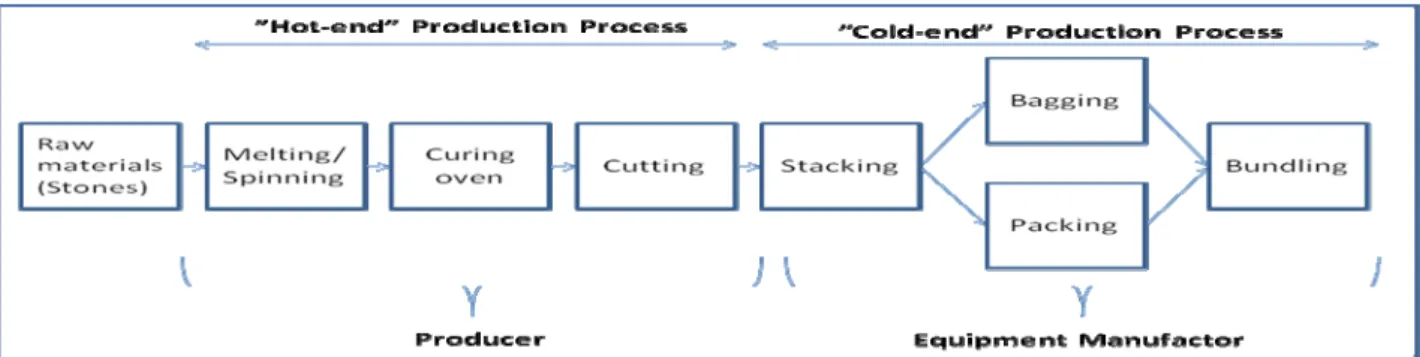
Alpha was founded in 1909, has currently a turnover of EUR 1.5 billion and employs over 8,500 people in 23 factories in three continents. In early 1980s, due to falling oil prices and stagnation in construction industry in Europe, the company experienced a strong competition at the insulation market. The prices for mineral wool droped and a number of insulation companies’ were closed down or sold to larger competitors. Alpha was forced to focus on costs and out-source the cold-end (see figure 1) production (at the time, the Omega became supplier of cold-end equipment). The production process of stone and glass wool is a sophisticated process (simplified and illustrated in figure 1). The
pro-duction process is split up into a so-called “hot-end” and “cold-end.” First the stone or glass is melted, spun and cured. The wool is then cut into bats, which are led to the “cold-end” of the production process. Here the bats are first stacked, either bagged or packed before bundled for transportation.
Figure 1. Production Process of Glass- and Stone Wool
As illustrated in figure 1, the development and construction of process equip-ment for the “hot-end” are typically taking care by the producer of mineral wool, since the technology for the “hot-end” of the production line is consi-dered as the “core” or the “secret” behind the manufacturing of stone- and glass wool. The “hot-end” production process of stone wool is different from the “hot-end” production process of glass wool. In contrast, the process equipment for the “cold end” is identical whether it is glass- or stone wool production. Alpha is in charge of purchasing new process equipment and provides technical assistance for development and optimization of production facilities for all the 23 factories. Alpha actually includes two independent companies, the product buyer and the product user, both being relevant in this study. Product buyer (purchase and R&D) is located in Denmark and provides technical assistance for the development and optimization of production facilities for all subsidiary companies. The product user is an independent manufacturing company (owned by the product buyer) located in Canada.
3.2.
Case Description
The objective of the Cold-End project was to develop and produce a completely new production line for the product buyer at the new plant in Canada. The Cold-End project was started in spring 2007 and was terminated in August 2009. The project included several sub-projects, each aiming at developing a new machine that was part of the novel production line. From the several sub-projects we selected two, Bagger and Stacker, for the purposes of this study. As the aim of our study was to analyze the effects of technology uncertainty on communication behavior in NPD project, we decided to select sub-projects that would represent two opposite poles of technology uncertainty involved. The sub-project Bagger involved significant development effort producing com-pletely new product, whereas sub-project Stacker represented a line extension of the existing product. In addition, we also wanted to select sub-projects from the turn-key project, which performance was regarded as a success.
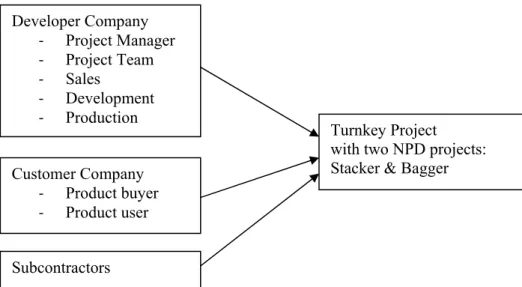
The goal of the sub-project Bagger was to develop a machine, which would not only improve the visual appearance of the product but also the entire logistics related to the product delivery. Sub-project Stacker was an improvement of an existing machine and its handling process. Project manager of the Cold-End project served also as a project manager for both sub-projects from the Omega´s side. In addition, as both of the sub-projects, Bagger and Stacker were part of the larger turnkey project Cold-End, they were part of the same stakeholder network. The key stakeholders for both Bagger and Stacker were Omega (as parent organization), customer and several suppliers. As seen from figure 2, several internal stakeholders from Omega are involved in the sub-projects. A temporary organizational unit was established for the Cold-End project and its sub-projects. However, the project manager was able to draw on specialists from the development and production department of Omega for limited periods during the sub-project execution and was constantly in contact with the sales department.
Figure 2. Stakeholders in Cold-End project
Both the product buyer and product user were involved in the development process in both Stacker and Bagger. The product buyer was responsible for the engineering, purchase, planning and budget and the product user for construct-ing a new buildconstruct-ing around the production line and the implementation of the machines. Finally, several different Danish and Canadian subcontractors or suppliers were involved in both of the NPD projects (Stacker and Bagger) dur-ing different phases of product development.
3.3.
Data
For this study the data was collected over a 2 years period between July 2007 and August 2009. In order to achieve triangulation, data were drawn from both quantitative sources such as records of emails and meetings, and from semi-structured interviews and observations, as suggested by Yin (1989).
The main source of data was emails send out and received by the project man-ager. In the Cold-End project, emails were used for both sending short mes-sages and for sharing document attachments such as quotations and memos from meetings. The project manager saved all the emails concerning the
turn-Developer Company ‐ Project Manager ‐ Project Team ‐ Sales ‐ Development ‐ Production Subcontractors Customer Company ‐ Product buyer ‐ Product user Turnkey Project with two NPD projects: Stacker & Bagger
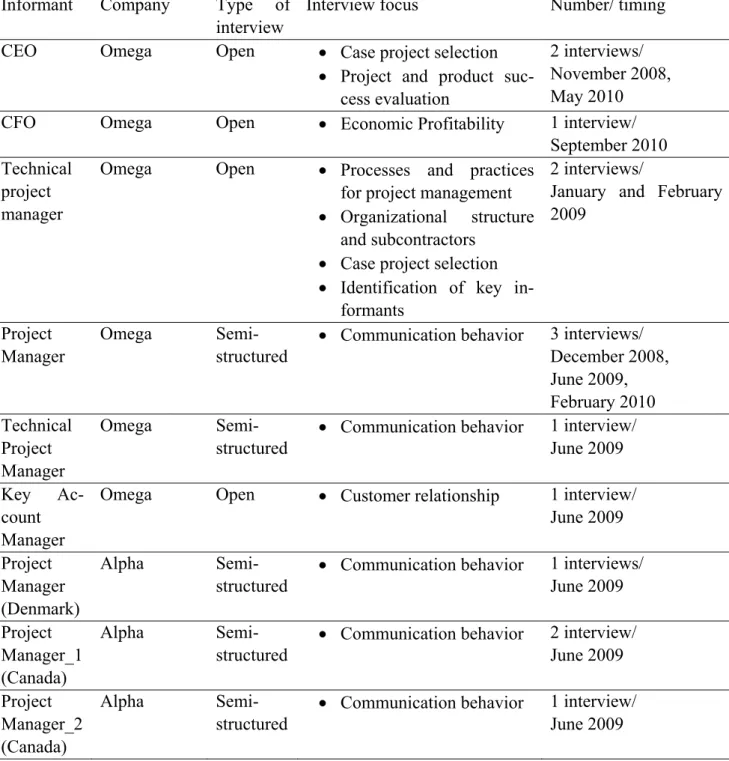
key-project and categorized them according to order number of the sub-project. This filing and categorization procedure made it possible for us to gather and analyze 3979 multiple emails communications, which were exchanged between the project manager and one or several stakeholders, throughout the entire pe-riod of turn-key project (25 month) from 2007 until 2009. The final sample consists of 601 e-mails that are related to sub-projects Stacker and Bagger. In addition to emails, we also analyzed records of all 96 meetings between pro-ject manager and both internal and external propro-ject stakeholders, which took place during the NPD project. Moreover, we conducted 14 interviews and sev-eral informal discussions with different participants of the Cold-End project (See Table 1). Interviews were held with 6 key informants representing the pro-ject and Omega organization as well as with 3 individuals representing product buyer and product user companies. Six of the interviews were explorative in nature (with CEO, CFO, Key Account Manager and Technical manager from Omega) and the rest eight interviews were semi-structured. All the interviews were audio taped and transcribed verbatim (around 100 pages). Finally, we vis-ited the product user company together with the CEO and the Project Manager (Omega) for making observations on the outcomes of the sub-projects.
Table 1. Interviewees
Informant Company Type of interview
Interview focus Number/ timing CEO Omega Open Case project selection
Project and product suc-cess evaluation
2 interviews/ November 2008, May 2010 CFO Omega Open Economic Profitability 1 interview/
September 2010 Technical
project manager
Omega Open Processes and practices for project management
Organizational structure and subcontractors
Case project selection
Identification of key in-formants
2 interviews/
January and February 2009
Project Manager
Omega Semi-structured
Communication behavior 3 interviews/ December 2008, June 2009, February 2010 Technical Project Manager Omega Semi-structured
Communication behavior 1 interview/ June 2009 Key
Ac-count Manager
Omega Open Customer relationship 1 interview/ June 2009 Project Manager (Denmark) Alpha Semi-structured
Communication behavior 1 interviews/ June 2009 Project Manager_1 (Canada) Alpha Semi-structured
Communication behavior 2 interview/ June 2009 Project Manager_2 (Canada) Alpha Semi-structured
Communication behavior 1 interview/ June 2009
3.4.
Validation of Case Selection
We assessed the technology uncertainty and project performance related to the selected cases in order to validate our a priori understanding and thereby justify the case selection.
Following the prior studies on innovation we used four dimensions to assess technology uncertainty in sub-projects Sacker and Bagger. First, the “newness-to-the-firm” indicated how much experience managers have and how familiar they are with the developed technology. The less experienced the managers are with the technology, the higher is the technology uncertainty. Second, “changes in behavior” describes how much use of the new technology changes the behav-ior of the customer. The more changes are expected to happen due to introduc-tion of new technology, the higher the technology uncertainty. Third, “changes in business” describes how much the new technology affects the existing busi-ness activities. High technology uncertainty is related to high amount of changes in business activities. Fourth, “Risk” describes how much risk there is related when implementing or using new technology. The more risk the higher the technology uncertainty.
The qualitative data (primary citations from semi-structured interviews and in-formal conversations during observations from the product user and buyer) was used to assess the degree of technology uncertainty concerning the two prod-ucts: the bagger and the stacker. The results are also shown in table 2.
Table 2. Technology Uncertainty
Authors Definition Quotation regarding the Bagger Quotation regarding the
stack-er Dewar et al.
(1986)
“... depends on the “newness-to-the-firm” and the experience and familiarity of the managers”
The project manager from the product buyer re-marks: “The bagger has been a 100% new ma-chine... and is unlike any other machine we have seen before.”
“Because the stacker has been manufactured 100 times before by the developer and this ma-chine only is a modified version for Canadian conditions, I con-sider the stacker a “no-brainer.” I have stood and watched the bagger many many many times…! Project manager at the product user
Ettlie et al. (1984)
How the innovation or product is new and introduces significant change in the”business activities” of the entire organization… For example if research activities, production and new marketing are required to accomplish the
processes of the innovation
“People in marketing had to launch a new logo to fit the new bags, thus two people from marketing participated in the initial brainstorming meetings”
Canadian project manager from the product user.
“Because the bagger is very important to us ... the development of the bagger has been the most com-plex machine of them all - note that the entire turn-key project involved 50 engineers”: Danish project manager from the product user
“The machine is not compli-cated; we can take care of main-tenance ourselves.” Danish project manager at the product user
Schiffman et al. (1997)
...The changes in behavior result-ing from usresult-ing the innovation...
Danish project manager from the product user in Canada: “For operation of the bagger we had to hire and educate a new employee…”
“It is easy to operate the stacker. It is the same people operating the stacker, who drove the trucks for the stacking before.” Danish project manager at the product user
Ettlie et al. (1986)
...The risky departure from exist-ing business practices ...
“If the bagger doesn’t work, we will have to close down the entire plant…The bagger has to work”
The Danish project manager from the product user. The Canadian project manager from the product user agree: “It has really been a high risk project for us... If we hadn’t succeeded with the machine, we would have had a useless production line.”
“We have build a”buffer”, which means in case the stacker don’t work, we are able stack the bats ourselves”. Danish project man-ager at the product user
The data shows that the customer company (product user and buyer) consider bagger as a machine of very high technology uncertainty. The machine is new to the customer company. Neither staff nor the project manager has past experi-ence with a similar machine. Moreover introducing the new machine has major impact on the behavior of employees in manufacturing, marketing and R&D units of the customer organization. In contrast, the Stacker is considered a product of very low technology uncertainty with low level of risk and only mi-nor changes in existing business practices in the customer organization.
Moreover, we used two different dimensions to assess performance of sub-projects: economic profitability and customer satisfaction, as suggested by Lam (2004). The economic profitability of the two sub-projects was assessed through contribution margin and return on investment. The contribution mar-gin1 for Stacker was 18,9% and for Bagger 21,2%. When compared to a contri-bution margin of 25% of all project executed by the company within 5-years period the figures seems to be approximately 5% below an average. However, when compared to earlier projects with the same customer, the figure seems to be above an average. In addition, the Return on investment2 figures for Stacker (ROI = 23,2%) and Backer (ROI = 26,9%) indicate that the sub-projects can be considered fairly profitable. Moreover, we used data from the informal talks as well as interviews to assess customer satisfaction for both sub-projects. The customers of both of the sub-projects seemed to be fairly satisfied with the out-comes. A machine operator, who represents the product user of the product developed in the Stacker-project stated: “I have never experienced that the stacker didn’t work” (the operator at the stacker). The Bagger was also seen as a success by the customer. The operator of the system developed in the Bagger has the following statement: “I have been employed at ... (the product user) for 6 years, handling the bags, and working with this new bagger system have been a revolutionary experience for me” (operator of the Bagger system). Moreover,
1 Contribution margin refers to marginal profit per product sale.
2 Return on Investment refers to profit from investment (sub-project delivering the product) divided by cost of investment (sub-project delivering the product).
the project manager at the product user, who was responsible for the project on customer side, had the following statement of overall performance of the whole Cold-End project: “... (The Cold-End project) has impressed each and everyone over here.” These quotations imply that customer satisfaction were high in both sub-projects.
3.5.
Concepts and Measures
Communication: Drawing on existing theory on communication (Katz & Kahn, 1978) & (Laursen & Salter, 2006), we analyzed three distinct dimensions of communication behavior: (1) Level of communication; (2) Communication depth and (3) Communication breadth. The Level of communication (Katz & Kahn, 1978) or the communication frequency, was measured by the number of electronic mails between the project manager and the different stakeholders during two stages in NPD process. Communication depth (Laursen & Salter, 2006) is referred to as extensiveness of communication network and measured by the number of individual participants involved in the email. (3) “Communi-cation breadth” (Laursen & Salter, 2006) refers to as diversity of communica-tion with different stakeholders and measured by the number of different stake-holder groups participating in the email communication.
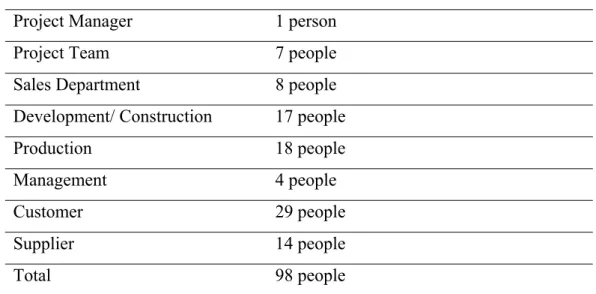
Project Stakeholders: From the email data, we identified 98 project stake-holders representing 7 different group/function (see table 3), with whom the project manager communicated during the NPD phases.
Table 3. Project Stakeholders
Stakeholder Groups Number of individual involved in the communication network
Project Manager 1 person Project Team 7 people Sales Department 8 people Development/ Construction 17 people
Production 18 people
Management 4 people
Customer 29 people
Supplier 14 people
Total 98 people
New product development phases: We initially divided the NPD process into six stages of the development process: Pre-project, Concept Generation, Devel-opment, Execution, Delivery and Ramp-Up. These stages were chosen to cap-ture the entire process from idea generation through termination. However, after intensive literature review, we chose and preferred to use a simple two-phase process; early and later phases of the NPD project, which is often used in previ-ous product innovation research (Moenaert & Souder, 1990; Moenaert & De Meyer, 1995). During the last years a lot of research have been conducted in this research topic but only for the “fuzzy front end” of the NPD process e.g. Reid & de Brentani (2004), so by choosing this rather simple framework, we argue for a possibility to compare some trends or results from existing litera-ture.
4.
Results
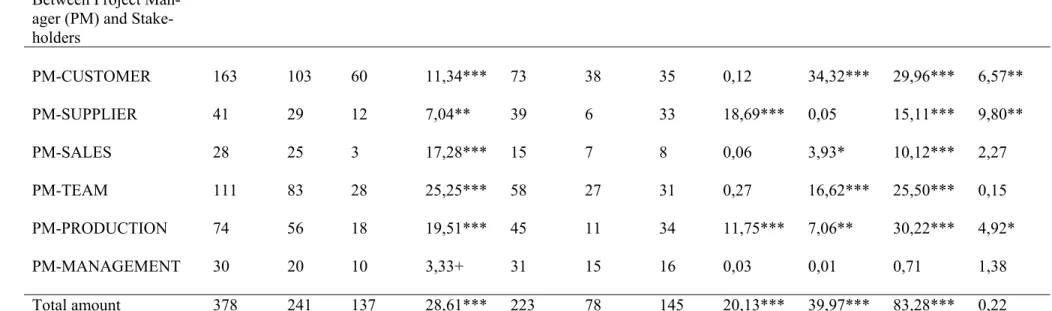
Were compared sub-projects representing high technology uncertainty case (Bagger) and low technology uncertainty case (Stacker) within three dimen-sions of communication: communication frequency, depth of communication and breadth of communication. Pearson´s χ²-test was used to compare observed communication frequencies between different phases of innovation project within both sub-projects, and between different sub-projects (Bagger and Stacker) in different phases of innovation project (see table 4).
Table 4. Level of Communication between Project Manager (PM) and Stakeholders in case of high and low Technology Uncertainty
Bagger (high technological uncertainty) Stacker (low technological uncertainty) Bagger vs. Stacker
Ob-served Ob-served Ob-served χ² Ob-served Ob-served Ob-served χ² χ² χ² χ² Whole Project Phase 1 Phase 2 Whole Project Phase 1 Phase 2 Whole Project Phase 1 Phase 2 Level of
Communica-tion (amount of emails) Between Project Man-ager (PM) and Stake-holders PM-CUSTOMER 163 103 60 11,34*** 73 38 35 0,12 34,32*** 29,96*** 6,57** PM-SUPPLIER 41 29 12 7,04** 39 6 33 18,69*** 0,05 15,11*** 9,80** PM-SALES 28 25 3 17,28*** 15 7 8 0,06 3,93* 10,12*** 2,27 PM-TEAM 111 83 28 25,25*** 58 27 31 0,27 16,62*** 25,50*** 0,15 PM-PRODUCTION 74 56 18 19,51*** 45 11 34 11,75*** 7,06** 30,22*** 4,92* PM-MANAGEMENT 30 20 10 3,33+ 31 15 16 0,03 0,01 0,71 1,38 Total amount 378 241 137 28,61*** 223 78 145 20,13*** 39,97*** 83,28*** 0,22 + p< 0,1: * p< 0,05; ** p< 0,01; *** p< 0,001. 35
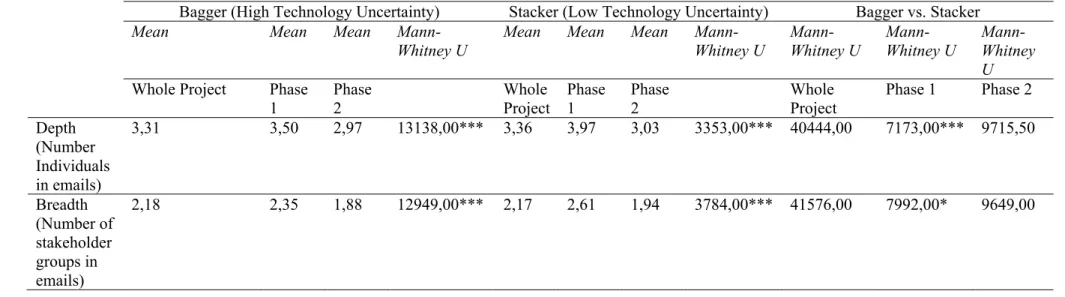
In addition, we utilized Mann-Whitney U-test to compare medians of observed depth and breadth of communication between two case projects in different phases of innovation project (see table 5). The statistical results are comple-mented with the observations from the interviews.
The comparison of communication between two sub-projects indicate that the overall level of interaction trough emails (χ² = 39.97, p < .001) was higher in case of high technology uncertainty (Bagger) than in the low technology uncer-tainty case (Stacker). In addition, the records of meetings show that in case Stacker no meetings were arranged, whereas in case Bagger we identified 12 meetings during the early phase and 7 meetings during the later phase of pro-ject. The analysis of meeting records reveal also that in phase 1 meetings were primarily for brainstorming and prototype testing purposes whereas in phase 2 meetings focused on factory tests and status review of the sub-project (Bagger). The findings propose that in high uncertainty case meetings represent necessary media for reduction of equivocality and uncertainty. Project manager from the
product buyer organization describes the utility of meetings in Bagger project as follows: “It was a very good thing for us all to meet and get to know each other during the brainstorming meetings. Particular one exercise was very valuable... each one of us had to explain a different function of the bagger for the rest of us. This way we learn how the other perceived the different functions and we had ourselves a long and technical discussion afterwards...” (Project manager of the product buyer organization).
Moreover, the results show that in the case Bagger (high technology uncer-tainty), email communication was focused in early phase of the innovation pro-ject, whereas in case Stacker (low technology uncertainty) the overall level of communication was more intense in late phase of the innovation project.
More in-depth examination of stakeholder group specific communication re-vealed that the frequency of communication between project manager and cus-tomer (χ² = 29.96, p < .001), supplier (χ² = 15.11, p < .001), sales (χ² = 10.12, p
< .001), project team (χ² = 25.50, p < .001), development & construction (χ² = 40.63, p < .001), and production (χ² = 30.22, p < .001) was higher in case Bag-ger than in case Stacker. These findings indicate that the higher the technology uncertainty the more frequent communication with stakeholders in early phase of innovation project.
In the late phase of NPD projects, the respective comparison of cases of high (Bagger) and low technology uncertainty (Stacker) provides only three interest-ing differences. First, the frequency of communication between project manager and customer was higher in the high uncertainty case (χ² = 6.57, p < .01). Sec-ond, in late phase of innovation project communication between project man-ager and supplier was higher in case of low technology uncertainty (χ² = 9.80, p < .01). Third, communication between project manager and production depart-ment was more frequent in late phase of innovation project in case of low tech-nology uncertainty than in case of high techtech-nology uncertainty (χ² = 4.92, p < .05).
Table 5. Depth and Breadth Stakeholder Communication in case of high and low Technology Uncertainty
Bagger (High Technology Uncertainty) Stacker (Low Technology Uncertainty) Bagger vs. Stacker
Mean Mean Mean Mann-
Whitney U
Mean Mean Mean Mann-Whitney U Mann-Whitney U Mann-Whitney U Mann-Whitney U
Whole Project Phase 1 Phase 2 Whole Project Phase 1 Phase 2 Whole Project Phase 1 Phase 2 Depth (Number Individuals in emails) 3,31 3,50 2,97 13138,00*** 3,36 3,97 3,03 3353,00*** 40444,00 7173,00*** 9715,50 Breadth (Number of stakeholder groups in emails) 2,18 2,35 1,88 12949,00*** 2,17 2,61 1,94 3784,00*** 41576,00 7992,00* 9649,00 * p< 0,05; ** p< 0,01; *** p< 0,001 38
We also compared the depth and breadth of communication between two case projects (Stacker and Bagger). The results are attached in Table 5. The analysis shows that in both projects the depth and breadth of stakeholder communication was higher in the early phase than in the later phase of the project. In other words, the project manager communicates more with both a higher number of people but also from a wider range of functions during the early phase of NPD process. Moreover, the results reveal that in early phase of innovation project both depth of stakeholder communication and breadth of communication be-tween project manager and stakeholders were higher in case of low technology uncertainty than in case of high technology uncertainty (U = 7173.00, p < 0.001 and respectively U = 7992.00, p < 0.05). The results related to breadth and depth of communication was especially interesting and somehow unexpected and thereby we discussed with the CEO of Omega to get further confirmation and explanation for our findings. He had the following remarks: "When involv-ing different people from different departments in the development of the Stacker, it is a sign of accumulated bad experience... a lot of people have previ-ous experience with the stacker and knows about different difficulties and dan-ger about the development of previous products like the Stacker. Thus, the pro-ject manager (wants to) involve a lot of people and different departments in the communication (in order to collect the experiences)” (CEO, Omega). The CEO also has the following remarks on the development of the Bagger: “The more radical the innovation, the less you know what to fear. We knew that production (in the customer organization) depended on the Bagger and would shut down if the bagger didn't work from the beginning. We talked about that - but what was there more to talk about? We didn't know the exact danger and the specific technical issues that could go wrong.” (CEO, Omega). All in all, the result seems to suggest that technology uncertainty is an important parameter that predicts not only the frequency of communication, but also depth and breadth of communication between project manager and stakeholders.
5.
Discussion and Hypotheses
In this chapter we discuss on the findings of our explorative study and compare them with the prior research in order to draw generalizable hypotheses for the further studies.
Technology Uncertainty and Stakeholder Communication
Our results revealed that technology uncertainty seems to have positive effect on communication frequency but negative impact on the breadth and depth of communication in early phases of NPD project. What comes to findings related to communication frequency our results are aligned with the prior studies of Verworn et al. (2010), Moenaert & De Meyer (1995), Brown et al. (1995) and Katz et al. (1983). Our results concerning the depth and breadth of communica-tion with stakeholders were unexpected, since it is typically under condicommunica-tions of high technology uncertainty, when project manager tries to reduce existing un-certainty by acquiring additional information and aligning expectations through communicating with wide variety of people from different disciplines and func-tions (Verworn, 2009). Our results suggest, however, that the opposite is the case in a situation of high technology uncertainty. Project manager delimits the communication with stakeholders and interacts more frequently, but with fewer stakeholder groups. A plausible explanation for our findings is that by limiting breadth and depth of communication a project manager aims to limit the ambi-guity among stakeholders that is evident when there is no clear and detailed un-derstanding on the end product and means to achieve it. On the other hand, in case of low technology uncertainty the broad and deep communication is suit-able in order to engage people when the outcome and methods for achieving it are clear and well defined. The innovation literature on organizational level provides distant support for our results. For example, Laursen et al. (2006) ar-gue that in the early stages of the product life cycle (when the state of technol-ogy is in flux) innovative firms need to draw intensively from a small number of key sources of innovation. Another explanation for the surprising finding of breadth and depth of communication is that when stakeholders are more aware
of what to expect (in case of low technology uncertainty) they are more willing to participate in the discussion with their own experience and opinions. This is reflected by our findings and supported CEO´s comments on “accumulated bad experience.” Based on our findings and discussion above we propose following:
Hypothesis 1a: The higher the technology uncertainty, the higher the level of
communication between project manager and the stakeholders
Hypothesis 1b: The lower the technology uncertainty, the higher the breadth of
communication between project manager and stakeholders in early phase of NPD project
Hypothesis 1c: The lower the technology uncertainty, the higher the depth of
communication between project manager and stakeholders in early phase of NPD project
Technology Uncertainty and Customer Involvement
Our study showed that technology uncertainty increases the frequency of inter-action between customer and project manager during the entire NPD project. This finding is well aligned with prior studies. For example Veldhuizen et al. (2006) found that using customer information for high-tech products is posi-tively related to financial success in the predevelopment stage and to product advantage in commercialization stage of the NPD process. In addition, it has been shown that especially in a B-2-B context customer integration encourage intensive and precocious communication among stakeholders which enables challenging existing assumptions and conventions (Veryzer & Borja de Mozota, 2005), the qualities that are necessary in order to produce radical innovations. Moreover, our findings get support from the lead user concept discussion in the literature (Lettl, Herstatt, & Gemuenden, 2006; Von Hippel, 1986), proposing that in case of high technology uncertainty technically competent customer can be viewed as an extended R&D resource (Verworn et al., 2010; Von Hippel, 1986), which can be involved in the problem definition and solutions
develop-ment phases of the NPD project (Leonard-Barton, 1995; Verworn et al., 2010; Von Hippel, 1986; Christensen, 1997). Thus, we propose following:
Hypothesis 2: The higher the technology uncertainty, the higher the level of
communication between project manager and the customer during both early and late phase of the NPD project
Technology Uncertainty and Supplier Involvement
The results of our study indicate that communication between project manager and suppliers is dependent on the technology uncertainty and phase of NPD project, so that in the case of high technology uncertainty the communication with supplier is more frequent. Even if the prior studies have not directly ad-dressed this issue it is shown that communication behavior between project manager and supplier changes during the NPD project phases and is dependent on the risk and responsibility (Johnsen et al., 2000). The higher the risks (and also technology uncertainty), the more communication with suppliers is needed in order to prevent problems caused by information asymmetry and misalign-ment of expectations. Prior literature has also emphasized the importance of early supplier involvement in NPD project (combined with intense patterns of communication flows) on competitiveness of the development organization (Spina, Verganti, & Zotteri, 2002; Knudsen, 2007). When dealing with highly uncertain technology, suppliers may possess specialized technical knowledge that is beyond the boundaries of the single project, or even developing organi-zation. In such case, well-functioning collaboration and frequent communica-tion with suppliers represent one of the key success dimensions that guarantee successful innovation activities (Blomqvist et al., 2004). Based our findings we propose the following:
Hypothesis 3a: The higher the technology uncertainty, the higher the level of
communication between project manager and suppliers in early phase of NPD project
Hypothesis 3b: The lower the technology uncertainty, the higher the level of
communication between project manager and suppliers at the late phase of the NPD project
Technology Uncertainty and the Level of Cross-functional Communication Our results indicate that communication between project manager and internal functions (sales, development and production) is higher during early phase of NPD project in case of high technology uncertainty, whereas in case of low technology uncertainty the communication between project manager and inter-nal functions was focused more on the late phase of NPD project. Prior studies have emphasized the early involvement of internal functions and its implication to NPD success (Hise et al., 1990; Gupta & Wilemon, 1990; Moenaert et al., 1994; Song et al., 1998). Even though many of these studies do not address the role of technology uncertainty in cross-functional communication, they provide support for our findings. For example, Moenaert et al. (1994) argue that the level of interaction between the R&D and the project manager will be less im-portant when the product specifications are known and have been formulated. In case of low technology uncertainty the formulation of product specifications is less complex and relatively fast process, whereas when the technology is un-known the development phase may require various discussions with experts from different functions and several design cycles (Verworn, 2009). Also the studies on fourth generation R&D have shown that disruptive innovations, characterized by high technological and market uncertainty, require involve-ment of several stakeholders that enable divergent thinking and discovery of new knowledge outside of mental and organizational boundaries (Blomqvist et al., 2004; Pfeffer & Sutton, 1999). Thus, when the technology uncertainty is high, the management of innovation project becomes more a management of network asymmetric actors. Based on our findings and discussion we propose following: