Framework
Faiza Khan Khattak
Submitted in partial fulfillment of the requirements for the degree
of Doctor of Philosophy
in the Graduate School of Arts and Sciences
COLUMBIA UNIVERSITY
c
2017
Faiza Khan Khattak All Rights Reserved
Toward a Robust and Universal Crowd Labeling
Framework
Faiza Khan Khattak
The advent of fast and economical computers with large electronic storage has led to a large volume of data, most of which is unlabeled. While computers provide expeditious, accurate and low-cost computation, they still lag behind in many tasks that require human intelligence such as labeling medical images, videos or text. Consequently, current research focuses on a combination of computer accuracy and human intelligence to complete labeling task. In most cases labeling needs to be done by domain experts, however, because of the variability in expertise, experience, and intelligence of human beings, experts can be scarce.
As an alternative to using domain experts, help is sought from non-experts, also known as Crowd, to complete tasks that cannot be readily automated. Since crowd labelers are non-expert, multiple labels per instance are acquired for quality purposes. The final label is obtained by com-bining these multiple labels. It is very common that the ground truth, instance difficulty, and the labeler ability are unknown entities. Therefore, the aggregation task becomes a “chicken and egg” problem to start with.
Despite the fact that much research using machine learning and statistical techniques has been conducted in this area (e.g., [Dekel and Shamir, 2009; Hovyet al., 2013a; Liuet al., 2012; Donmez and Carbonell, 2008]), many questions remain unresolved, these include: (a) What are the best ways to evaluate labelers? (b) It is common to use expert-labeled instances (ground truth) to evaluate la-beler ability (e.g., [Leet al., 2010; Khattak and Salleb-Aouissi, 2011; Khattak and Salleb-Aouissi, 2012; Khattak and Salleb-Aouissi, 2013]). The question is, what should be the cardinality of the set of expert-labeled instances to have an accurate evaluation? (c) Which factors other than labeler expertise (e.g., difficulty of instance, prevalence of class, bias of a labeler toward a particular class) can affect the labeling accuracy? (d) Is there any optimal way to combine multiple labels to get the
best labeling accuracy? (e) Should the labels provided by oppositional/malicious labelers be dis-carded and blocked? Or is there a way to use the “information” provided by oppositional/malicious labelers? (f) How can labelers and instances be evaluated if the ground truth is not known with certitude?
In this thesis, we investigate these questions. We present methods that rely on few expert-labeled instances (usually 0.1% -10% of the dataset) to evaluate various parameters using a frequentist and a Bayesian approach. The estimated parameters are then used for label aggregation to produce one final label per instance.
In the first part of this thesis, we propose a method called Expert Label Injected Crowd Esti-mation (ELICE) and extend it to different versions and variants. ELICE is based on a frequentist approach for estimating the underlying parameters. The first version of ELICE estimates the pa-rameters i.e., labeler expertise and data instance difficulty, using the accuracy of crowd labelers on expert-labeled instances [Khattak and Salleb-Aouissi, 2011; Khattak and Salleb-Aouissi, 2012]. The multiple labels for each instance are combined using weighted majority voting. These weights are the scores of labeler reliability on any given instance, which are obtained by inputting the pa-rameters in the logistic function.
In the second version of ELICE [Khattak and Salleb-Aouissi, 2013], we introduce entropy as a way to estimate the uncertainty of labeling. This provides an advantage of differentiating between good, random and oppositional/malicious labelers. The aggregation of labels for ELICE version 2 flips the label (for binary classification) provided by the oppositional/malicious labeler thus utilizing the information that is generally discarded by other labeling methodologies.
Both versions of ELICE have a cluster-based variant in which rather than making a random choice of instances from the whole dataset, clusters of data are first formed using any clustering approach e.g., K-means. Then an equal number of instances from each cluster are chosen randomly to get expert-labels. This is done to ensure equal representation of each class in the test dataset.
Besides taking advantage of expert-labeled instances, the third version of ELICE [Khattak and Salleb-Aouissi, 2016], incorporates pairwise/circular comparison of labelers to labelers and in-stances to inin-stances. The idea here is to improve accuracy by using the crowd labels, which unlike expert-labels, are available for the whole dataset and may provide a more comprehensive view of the labeler ability and instance difficulty. This is especially helpful for the case when the domain
more information beyond expert labels can provide better results.
We test the performance of ELICE on simulated labels as well as real labels obtained from Amazon Mechanical Turk. Results show that ELICE is effective as compared to state-of-the-art methods. All versions and variants of ELICE are capable of delaying phase transition. The main contribution of ELICE is that it makes the use of all possible information available from crowd and experts. Next, we also present a theoretical framework to estimate the number of expert-labeled instances needed to achieve certain labeling accuracy. Experiments are presented to demonstrate the utility of the theoretical bound.
In the second part of this thesis, we presentCrowd Labeling Using Bayesian Statistics(CLUBS) [Khattak and Salleb-Aouissi, 2015; Khattaket al., 2016b; Khattaket al., 2016a], a new approach for crowd labeling to estimate labeler and instance parameters along with label aggregation. Our approach is inspired by Item Response Theory (IRT). We introduce new parameters and refine the existing IRT parameters to fit the crowd labeling scenario. The main challenge is that unlike IRT, in the crowd labeling case, the ground truth is not known and has to be estimated based on the parameters. To overcome this challenge, we acquire expert-labels for a small fraction of instances in the dataset. Our model estimates the parameters based on the expert-labeled instances. The estimated parameters are used for weighted aggregation of crowd labels for the rest of the dataset. Experiments conducted on synthetic data and real datasets with heterogeneous quality crowd-labels show that our methods perform better than many state-of-the-art crowd labeling methods.
We also conduct significance tests between our methods and other state-of-the-art methods to check the significance of the accuracy of these methods. The results show the superiority of our method in most cases. Moreover, we present experiments to demonstrate the impact of the accuracy of final aggregated labels when used as training data. The results essentially emphasize the need for high accuracy of the aggregated labels.
In the last part of the thesis, we present past and contemporary research related to crowd la-beling. We conclude with future of crowd labeling and further research directions. To summarize, in this thesis, we have investigated different methods for estimating crowd labeling parameters and using them for label aggregation. We hope that our contribution will be useful to the crowd labeling community.
List of Figures vi
List of Tables x
1 Introduction to Crowd Labeling 1
1.1 Motivation of the Crowd . . . 3
1.2 Crowd Labeling Process . . . 3
1.2.1 Task Design . . . 4
1.2.2 Choice of a Crowd Labeling Platform . . . 7
1.2.3 Labeler Types . . . 7
1.2.4 Common Techniques for Quality Assurance . . . 8
1.3 Challenges and Phase Transition . . . 11
1.4 Summary of Contributions . . . 13
1.4.1 Frequentist Approach . . . 14
1.4.2 Bayesian Approach . . . 15
1.5 Thesis Outline . . . 16
I The Frequentist Approach 17 2 Expert Label Injected Crowd Estimation (ELICE) 18 2.1 Notation & Scenario . . . 18
2.2 Labeler Categories . . . 19
2.3 ELICE 1 Framework . . . 21
2.3.1 ELICE 1 . . . 21
2.3.2 ELICE 1 with Clustering . . . 22
2.3.3 Test case . . . 22
2.3.4 Summary . . . 23
2.4 ELICE 2 Framework . . . 24
2.4.1 ELICE 2 . . . 24
2.4.2 ELICE 2 with Clustering . . . 27
2.4.3 Test case . . . 27
2.4.4 Summary . . . 28
2.5 ELICE 3 Framework . . . 29
2.5.1 ELICE 3 with Pairwise Comparison . . . 29
2.5.2 ELICE 3 with Circular Comparison . . . 32
2.5.3 Test case . . . 33
2.5.4 Summary . . . 33
3 Empirical Evaluation 35 3.1 UCI Machine Learning Repository Datasets . . . 36
3.1.1 Experimental Design . . . 36
3.1.2 Results . . . 37
3.2 Race Recognition Dataset . . . 45
3.2.1 Experimental Design . . . 45
3.2.2 Results . . . 46
3.3 Tumor Identification Dataset . . . 46
3.3.1 Experimental Design . . . 47
3.3.2 Results . . . 47
3.4 Discussion . . . 49
3.4.1 Comparison of All Versions and Variants of ELICE . . . 49
3.4.2 Number of Expert-labels for Large Datasets . . . 50
3.4.3 Expert-labels and Ground Truth . . . 51
3.4.4 Cost-effectiveness of ELICE . . . 51
3.4.5 Choice of Crowd Labeling Platform . . . 52
3.4.7 Do we always have many oppositional labelers? . . . 53
3.5 Oppositional/Malicious Crowdsourcing . . . 53
3.5.1 Common Types of Oppositional/Malicious Crowdsourcing . . . 54
3.5.2 Oppositional/Malicious Crowdsourcing Structure . . . 54
3.5.3 Oppositional/Malicious Activities on Social Media . . . 55
3.5.4 Oppositional/Malicious Crowdsourcing Statistics . . . 55
3.5.5 Maliciousness in Buying and Selling Crowd Services . . . 55
3.5.6 Maliciousness in Binary Labeling . . . 56
3.5.7 Malicious Behavior in Online Surveys . . . 56
3.5.8 More Advanced Malicious Crowdworkers . . . 57
3.5.9 How Can Our Methodology Help? . . . 57
3.6 Conclusion . . . 58
4 Lower Bound on the Number of Expert Labels 59 4.1 Motivation & Introduction . . . 59
4.1.1 Quality of the Crowd (c) . . . 60
4.1.2 Difficulty of the Dataset (1−d) . . . 60
4.1.3 Judgment Error (e) . . . 60
4.2 Judgment Error Relation with Crowd Quality & Dataset Difficulty . . . 60
4.3 Intuitive Explanation . . . 61
4.3.1 Judgment Error Categories . . . 61
4.3.2 Analyzing Judgment Error . . . 62
4.4 Theoretical Bound . . . 64
4.5 Empirical Evaluation of Theoretical Bound . . . 65
4.6 Conclusion . . . 65
II The Bayesian Approach 70 5 Crowd Labeling Using Bayesian Statistics (CLUBS) 71 5.1 Bayesian Versus Frequentist . . . 72
5.1.1 The Bayesian Approach Advantages . . . 73
5.2 Our Approach . . . 73
5.2.1 Crowd Labeling Using Bayesian Statistics(CLUBS) . . . 75
5.2.2 Parameter Estimation . . . 77
5.2.3 Label Aggregation . . . 77
6 Empirical Evaluation 80 6.1 Synthetic Data . . . 81
6.2 Recognizing Textual Entailment Dataset . . . 83
6.2.1 Experimental Design . . . 83 6.2.2 Results . . . 85 6.3 Temporal Dataset . . . 89 6.3.1 Experimental Design . . . 89 6.3.2 Results . . . 89 6.4 Technical Details . . . 90 6.5 Discussion . . . 91 6.6 Significance Tests . . . 91
6.7 The Effect of Noisy Crowd-labeled Data . . . 96
6.8 Conclusion . . . 97
III Related Work & Conclusion 98 7 Research On Crowd Labeling 99 7.1 Crowd Labeling Design Related Research . . . 99
7.1.1 Crowd Labeling Workflow . . . 99
7.1.2 Effects of Clarity of Instructions . . . 100
7.1.3 Task Division Strategy . . . 100
7.1.4 Task Designing Toolkit . . . 101
7.1.5 Task Assignment According to Worker Expertise . . . 101
7.1.6 Solving Worker’s Problems . . . 101
7.1.7 Crowd Labeling Surveys . . . 102
7.1.9 Crowd Labeling Career Ladder . . . 102
7.1.10 Our Task Design . . . 103
7.2 Crowd Labeling Research about Quality Assurance . . . 103
7.2.1 Effects of Acquiring Multiple Labels . . . 104
7.2.2 Natural Language Processing (NLP) tasks . . . 104
7.2.3 Classifier Based Methods . . . 105
7.2.4 EM Based Method . . . 105
7.2.5 Iterative Methods . . . 107
7.2.6 Ground Truth Based Methods . . . 107
7.2.7 Active Learning Based Methods . . . 108
7.2.8 Classifier Based Methods . . . 109
7.2.9 Our Approaches . . . 110
8 Conclusion & Future Directions 111 8.1 Conclusion . . . 111
8.1.1 Unresolved Questions Revisited . . . 113
8.2 Future Directions . . . 114
8.2.1 Variability in Labeler Productivity . . . 114
8.3 Crowd Labeling Future: The Broader Picture . . . 115
8.4 Final Thoughts . . . 116
IV Bibliography 118
Bibliography 119
V Appendices 131
List of Figures
1.1 Keyword search on Google Scholar . . . 2 1.2 (Top) Sequential workflow (Bottom) Parallel workflow. . . 4 1.3 Crowd labeling Process . . . 6 1.4 Phase transition in the performance of majority voting, GLAD [Whitehill et al.,
2009], Dawid and Skene’s method [Dawid and Skene, 1979], Belief Propagation [Liuet al., 2012] and Karger’s iterative method [Kargeret al., 2014] on the Univer-sity of California Irvine (UCI) Machine Learning Repository Chess dataset. . . 12
2.1 Performance on the UCI Chess dataset. We start with all good labelers and keep on increasing the percentage of random and oppositional labelers. Number of expert labels used for ELICE and all its versions is 20. . . 23 2.2 Accuracy of state-of-the-art methods along with ELICE 1 and 2 on UCI chess dataset. 28 2.3 Accuracy of state-of-the-art methods along with ELICE 1, 2 and 3 on UCI chess
dataset. . . 33
3.1 (Top) IRIS dataset. (Bottom) UCI Breast Cancer dataset. Simulated labels represent good and oppositional labelers. . . 41 3.2 (Top) IRIS dataset. (Bottom) UCI Breast Cancer dataset. Simulated labels represent
random and oppositional labelers. . . 42 3.3 (Top) IRIS dataset. (Bottom) UCI Breast Cancer dataset. Simulated labels represent
good and random labelers. . . 43
sions and variants) is 20. Note: Code for Belief Propagation did not converge even after a long time. Code for ELICE pairwise was parallelized for datasets with more than 3000 instances therefore, we do not report its time as it is not comparable to the non-parallelized code. . . 44 3.5 Example images from the Race recognition task posted on Amazon Mechanical Turk (Left
to right): (Top) Black, Caucasian, Asian, Hispanic. (Bottom) Multiracial, Hispanic, Asian, Multiracial. . . 45 3.6 Example images of the Tumor Identification dataset. From left to right: First three are
Malignant and fourth is benign. . . 47 4.1 Graph of the normalized judgment error distribution. Quality of the crowd and
difficulty of the dataset versus judgment error. . . 62 4.2 Number of instancesN = 500, crowd labelsm= 6, crowd qualityc= 0.7842and
dataset difficulty(1−d) = 0.1680.The theoretical bound is calculated using Eq. 4.4 isnLB = 11,14,22for confidence level(1−δ) = 0.9,0.95,0.99respectively. It
is shown by the vertical lines and is denoted bynLB,(1−δ). The results are averaged over 100 runs. . . 66 4.3 Number of instancesN = 500, crowd labelsm= 6, crowd qualityc= 0.6019and
dataset difficulty(1−d) = 0.4713.The theoretical bound is calculated using Eq. 4.4 isnLB = 6,8,12for confidence level(1−δ) = 0.9,0.95,0.99respectively. It
is shown by the vertical lines and is denoted bynLB,(1−δ). The results are averaged over 100 runs. . . 66 4.4 Number of instancesN = 500, crowd labelsm= 6, crowd qualityc= 0.1894and
dataset difficulty(1−d) = 0.8248.The theoretical bound is calculated using Eq. 4.4 isnLB = 11,15,23for confidence level(1−δ) = 0.9,0.95,0.99respectively. It
is shown by the vertical lines and is denoted bynLB,(1−δ). The results are averaged over 100 runs. . . 67
4.5 Number of instancesN = 500, crowd labelsm= 6, crowd qualityc= 0.3617and dataset difficulty(1−d) = 0.4998.The theoretical bound is calculated using Eq. 4.4 isnLB = 6,8,12for confidence level(1−δ) = 0.9,0.95,0.99respectively. It
is shown by the vertical lines and is denoted bynLB,(1−δ). The results are averaged over 100 runs. . . 67 4.6 Number of instancesN = 500, crowd labelsm= 6, crowd qualityc= 0.2175and
dataset difficulty(1−d) = 0.6683.The theoretical bound is calculated using Eq. 4.4 isnLB = 8,10,16for confidence level(1−δ) = 0.9,0.95,0.99respectively. It
is shown by the vertical lines and is denoted bynLB,(1−δ). The results are averaged over 100 runs. . . 68 4.7 Number of instancesN = 500, crowd labelsm= 6, crowd qualityc= 0.7896and
dataset difficulty(1−d) = 0.4930.The theoretical bound is calculated using Eq. 4.4 isnLB = 6,8,12for confidence level(1−δ) = 0.9,0.95,0.99respectively. It
is shown by the vertical lines and is denoted bynLB,(1−δ). The results are averaged over 100 runs. . . 68 4.8 Number of instancesN = 500, crowd labelsm= 6, crowd qualityc= 0.2706and
dataset difficulty(1−d) = 0.6649.The theoretical bound is calculated using Eq. 4.4 isnLB = 11,15,23for confidence level(1−δ) = 0.9,0.95,0.99respectively. It
is shown by the vertical lines and is denoted bynLB,(1−δ). The results are averaged over 100 runs. . . 69 4.9 Number of instancesN = 500, crowd labelsm= 6, crowd qualityc= 0.1919and
dataset difficulty(1−d) = 0.4796.The theoretical bound is calculated using Eq. 4.4 isnLB = 6,8,12for confidence level(1−δ) = 0.9,0.95,0.99respectively. It
is shown by the vertical lines and is denoted bynLB,(1−δ). The results are averaged over 100 runs. . . 69
(Bottom) An example from UCI Sentence Classification Dataset ([Asuncion and Newman, 2007]). Answer: D. This dataset consists of sentences from research arti-cles to be classified as one of the given categories. This figure shows the similarity between test taking and crowd labeling scenarios. . . 74 5.2 Graphical model of CLUBS. (Top) Parameter estimation (Bottom) Label
aggrega-tion. Shaded nodes represent observed values. . . 78
List of Tables
2.1 Categorization of labelers . . . 20
3.1 Accuracy of state-of-the-art methods and ELICE (all versions and variants) for dif-ferent datasets averaged over 50 runs. Good labelers: 0-35% mistakes, Random labelers: 35-65% mistakes, Oppositional labelers: 65-100% mistakes. . . 40 3.2 Accuracy of different methods on Amazon Mechanical Turk datasets. The given
results are the average of 100 runs on 100 instances with 6 labels per instance. Randomly chosen 8 instances are used as expert labeled instances (the instances with ground truth.) ∗Since the features for these datasets are not available therefore the results of ELICE with clustering could not be calculated. . . 48
4.1 Judgment error distribution of the conjecture about the crowd and dataset. Crowd is categorized as very good, average, or very bad. Dataset is categorized as very easy, moderate, or very difficult. Judgment error can be high, medium, or low. . . 63
6.1 Synthetic Data generation parameters and estimated parameters for the labelers. For the sake of presenting the labeler ability impact, the other parameters are kept fixed that instance difficultyβ ∼ N(0, 2), instance question clarityδ ∼ N(0, 0.75) and prevalence of classγ = 0.5. . . 82 6.2 Labeler correctness rate for Dataset C. . . 82 6.3 Labeler correctness rate for Dataset D. . . 82
beled by four labelers. Ground truth for 20 instances was taken as expert-labels. ELICE with clustering results could not be calculated due to unavailability of the features for clustering.?Since the features for these datasets are not available there-fore the results of ELICE with clustering could not be calculated. . . 84 6.5 Labeler performance for RTE Data. . . 85 6.6 Labeler category for RTE Data. . . 85 6.7 Accuracy of final label for RTE Data.?Since the features for these datasets are not
available therefore the results of ELICE with clustering could not be calculated. . 86 6.8 Labeler performance for Temp Data. . . 87 6.9 Labeler category for Temp Data. . . 87 6.10 Accuracy of final label for Temp Data. ? Since the features for these datasets are
not available therefore the results of ELICE with clustering could not be calculated. 88 6.11 Paired t-tests results for the accuracy level of different methods: All labelers are
making less than 35% mistakes. . . 93 6.12 Paired t-tests results for the accuracy level of different methods: 50% labelers are
making less than 35% mistakes and 50% are making more than 65% mistakes. . . . 94 6.13 Paired t-tests results for the accuracy level of different methods: All labelers are
making more than 65% mistakes. . . 95 6.14 The effect of noisy crowd-labeled data for Breast Cancer dataset. Results using
decision trees, random forest, K-nearest neighbor and support vector machine for different noise levels. Results were averaged over 100 runs. . . 96
1 Paired t-tests results for the accuracy level of different methods: 90% labelers are making less than 35% mistakes and 10% are making more than 65% mistakes. . . . 133 2 Paired t-tests results for the accuracy level of different methods: 80% labelers are
making less than 35% mistakes and 20% are making more than 65% mistakes. . . . 134 3 Paired t-tests results for the accuracy level of different methods: 70% labelers are
making less than 35% mistakes and 30% are making more than 65% mistakes. . . . 135 4 Paired t-tests results for the accuracy level of different methods: 60% labelers are
making less than 35% mistakes and 40% are making more than 65% mistakes. . . . 136
5 Paired t-tests results for the accuracy level of different methods: 40% labelers are making less than 35% mistakes and 60% are making more than 65% mistakes. . . . 137 6 Paired t-tests results for the accuracy level of different methods: 30% labelers are
making less than 35% mistakes and 70% are making more than 65% mistakes. . . . 138 7 Paired t-tests results for the accuracy level of different methods: 20% labelers are
making less than 35% mistakes and 80% are making more than 65% mistakes. . . . 139 8 Paired t-tests results for the accuracy level of different methods: 10% labelers are
making less than 35% mistakes and 90% are making more than 65% mistakes. . . . 140
This thesis exists because of my honorable advisorAnsaf Salleb-Aouissi. There is no way it would have existed otherwise. I am really blessed to have her as my advisor. She has been the greatest source of inspiration and motivation. I really cannot thank her enough for believing in me when no one else did, not even myself. Had she not been my advisor, I might have quitted long ago. I cannot say enough to appreciate her, it is all beyond words, in undiscovered dimensions of heart and soul.
I also thank my thesis committee who agreed to spend their valuable time reviewing my thesis. I am truly grateful to Julia Hirschberg, Rebbecca Passonneau, Anita Raja, Panos Ipeirotis and Ansaf Salleb-Aouissi.
I am thankful to all my teachers from Kindergarten to Columbia University. I would also like to thank my friends everywhere and at Columbia including Tayyaba Sharif, Faiza Yousaf, Asma Tanvir, Ume Kalsoom, Summera Asif, Sara Alkuhlani, Heba Elfardy and Boyi Xie.
I also like to convey my special thanks to Dr. Matthews. I have learned so much from her during these years. She has made me a stronger human being and has changed the perception of life for me. It is a blessing that I have known her in this life time.
I would also thank my father for his prayers, my mother who did not live long enough to see me complete my thesis, my sister for cheering me up at all times, my brother for asking me that annoying question everyday “When are you completing your Ph.D.?”, my husband for living all the successes and disappointments with me and many thanks to my lifeline my beloved son.
Last but not least, I would like to thank God for brining all the above-mentioned people in my life and helping me through all hard times.
Dedicated to
my parents,
my sister,
my brother,
my husband,
and my beloved son.
Chapter 1
Introduction to Crowd Labeling
With the advent of digitization, Big Data became available everywhere, affecting almost every field in our daily life. While data is abundant, most of it still remains in an unlabeled form and not readily available for prediction tasks through machine learning algorithms. Although computers provide expeditious, accurate and low-cost computation, they still lag behind in many tasks that require human intelligence such as labeling medical images, videos or text to cite a few. In most cases labeling needs to be done by domain experts; however, because of the variability in expertise, experience and intelligence of human beings, experts can be scarce. As an alternative to using domain experts, help is sought from non-experts, also known asCrowd, to complete tasks that can’t be readily automated.
In a crowd labeling process, multiple labels are acquired for each data instance from the crowd workers (also called labelers or annotators). Labels can be binary, categorical, ordinal or continu-ous. Multiple labels are acquired for quality assurance and then aggregated to get one final label. Different approaches are commonly used in the aggregation process. Crowd labeling is generally done through an open call and nowadays on website platforms. Examples include labeling an im-age and choosing the meaning of a word on Amazon Mechanical Turk (AMT). In a typical crowd labeling scenario, the identity of the labeler and the requester of the task are not known to each other.
Crowd labeling is a subfield of crowdsourcing but mostly is referred to as crowdsourcing in the literature. While crowd labeling focuses on labeling task done by the crowd, crowdsourcing is the process of hiring crowd services for a variety of tasks including designing a logo, writing an essay
2 Year 2008 2009 2010 2011 2012 2013 2014 2015 2016 Number of papers 100 101 102 103 104 105
Google scholar keywords search
Crowdsourcing (Anywhere in the article) Crowdsourcing (In the title only)
Mechanical Turk (Anywhere in the article) Mechanical Turk (In the title only)
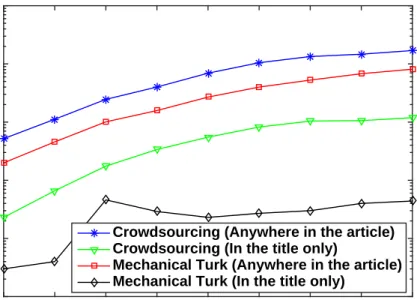
Figure 1.1: Keyword search on Google Scholar
other than usual labeling tasks [Doanet al., 2011].
The idea of crowd labeling is not new. In 1714, the British government offered a prize to invent a method to measure the longitude [Lynch, 2012]. Relatively recent historical evidence recorded by Nelson [Nelson, 2008], is from the 1880’s when Harvard Observatory in Cambridge, Massachusetts took the images of thousands of stars on photographic plates. A team of untrained women, hired at very low pay, labeled about half a million of such photographic plates. They analyzed these photographic plates using magnifying glass to catalog the stars [Nelson, 2008].
Due to the availability of crowd services at low rates, crowd labeling has attracted the attention of many researchers. Therefore, crowd labeling literature has increased at an exponential rate in the past few years (see Graph 1.1) and cannot be thoroughly summarized in one paper. In this chapter, we give a very general overview about the crowd labeling motivation, process, techniques, logistics and future.
1.1
Motivation of the Crowd
While crowd labeling is popular today, it is interesting to analyze what motivates the crowd to complete labeling tasks. Crowd motivation can be categorized as follows [Quinn and Bederson, 2011].
(i) Fun or Virtual Money: Many crowd labeling tasks are done just for enjoyment or virtual rewards e.g., ESP game [von Ahn and Dabbish, 2004] and FoldIt.
(ii) Embedded work:Sometimes the crowd labeling task is embedded in some other tasks, mak-ing labelmak-ing mandatory e.g., the reCAPTCHA project [Ahnet al., 2008].
(iii) Voluntary or Pastime: Sometimes crowd volunteer to work. For instance, Family Search Indexing aims to create searchable family history digital indexes from scanned images of his-torical documents. These include birth and death certificates, marriage licenses and property records.
(iv) Altruism: Another motivation for the crowd is altruism e.g., a search for a missing com-puter scientist Jim Gray [Hellerstein and Tennenhouse, 2010]. Satellite images of the area of disappearance were uploaded on AMT for labeling the possible locations to search.
(v) Reputation/Getting Noticed: Sometimes, crowd labeling is done to get recognition or earn reputation e.g., volunteer translators at childrenlibrary.org. Also many games come into this category for which getting a high score and publishing it on social media can be fulfilling.
(vi) Payment:A large part of crowd labeling is done for payment, e.g., Amazon Mechanical Turk (AMT), Crowdtask and Clickworkers.
(vii) Flexible job & Task Autonomy: Crowd labeling provides workers with a flexible work schedule without any pressure from an employer.
1.2
Crowd Labeling Process
1.2. CROWD LABELING PROCESS 4
Figure 1.2: (Top) Sequential workflow (Bottom) Parallel workflow.
1.2.1 Task Design
Task design is one of the crucial parts of crowd labeling process. While designing the task, the following points should be considered:
(a) Query Formulation:The query should be clearly stated and accompanied with instructions and examples. External links can be provided for more information especially when the problem is field-specific and labelers are not expected to know about it in advance. This reduces the chance of the task to be misunderstood and hence improve the labels accuracy [Kitturet al., 2008]. (b) Task DivisionIt is important to divide crowd tasks into smaller subsets so that a worker can do
it without being overwhelmed and many workers can work on the task in parallel. Task division is extra work on the requesters’ part, reducing the benefit obtained from utilizing the crowd. Some researchers have proposed methods for easier task division such as Turkomatic [Kulkarni et al., 2011] and Turkit [Littleet al., 2009; Littleet al., 2010b].
(c) Types of workflowThere are two main types of workflows for crowd labeling: parallel work-flow, and iterative workflow [Kulkarniet al., 2011]. In parallel workflow, all the workers do the tasks independently of each other, and tasks are combined afterwards. While in iterative work-flow, each worker completes his task, which is then passed on to another worker to improve the
outcome. This process goes on for a predefined number of iterations. A combination of the two workflows can also be used.
(d) Task AssignmentMost of the crowd labeling tasks are published as an open call. But some-times qualification tests for labelers are required for a more appropriate task assignment. More-over, research is also being done to improve the task assignment using optimization methods [Hoet al., 2013] . This adaptive task assignment can help in improving labeling accuracy and reducing the labeling cost.
(e) Number of labels needed Research shows that getting more crowd labels increases the cost but may lead to an improvement in accuracy [Sheng et al., 2008]. Therefore, care must be taken while deciding the number of requested crowd labels. Deciding on the number of labels depends on the task budget, task nature, quality of the crowd and the size of the dataset. There is no well-known general rule for deciding about the number of labels needed.
1.2.1.1 Worker Problems & Solutions
Sometimes crowd workers face labeling-related issues, which should be kept in mind while design-ing the task [Silbermanet al., 2010b; Irani and Silberman, 2013]. Worker problems include: (a) Low pay and Long pay delays:Payment for most of the tasks ranges from0.01−1.
(b) Work rejection: Requesters have the right to reject the work if it is below standard but some requesters may reject the work to avoid payment.
(c) Task time: Sometimes task completion time is too short and workers are not able to complete the task and do not get paid.
(d) Lack of communication:Uncommunicative requesters who do not resolve the issues discour-age the workers.
(e) Error in tasks: Sometimes task posted has some errors, e.g., worker is unable to submit the completed task due to a website issue. As a result the worker does not get paid and has to bear the cost of the requester’s mistake or technical issues.
1.2. CROWD LABELING PROCESS 6 (f) Fraudulent tasks: There is a minor but not negligible risk in tackling crowd labeling task as some may be fraudulent. These may damage the computer of the worker or cause other kinds of threats.
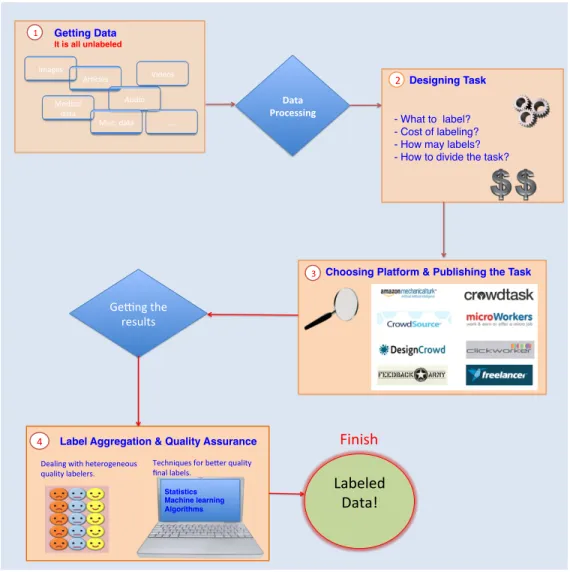
4 Label Aggregation & Quality Assurance Getting Data It is all unlabeled 1 Images Ar,cles Audio Videos Medical data … Misc. data Ge9ng the results Data Processing Statistics Machine learning Algorithms Labeled Data! 2 Designing Task - What to label? - Cost of labeling? - How may labels? - How to divide the task?
Finish Dealing with heterogeneous
quality labelers. Techniques for beGer quality final labels.
Choosing Platform & Publishing the Task
3
Figure 1.3: Crowd labeling Process
Proposed solutions to the worker problems [Bederson and Quinn, 2011; Donmez and Carbonell, 2008] include defining hourly pay, giving feedback about work quality, improving communication between requester and worker, providing more details about the task and limiting anonymity. A more practical solution to worker problems is Turkopticon [Kulkarniet al., 2011], which is used to get workers’ reviews about requesters. This feedback helps the workers to know about the requesters
beforehand and also helps the requesters improve the quality of the task design.
1.2.1.2 Demographics
Crowd demographics should be kept in mind while designing the tasks. The website MTurk Tracker (http://demographics.mturk-tracker.com/) provides live hourly and daily details of AMT crowd de-mographics. The information on this website shows that crowd labelers contribute from different parts of the world with a large percentage of workers from the United States and India. Since the crowd workers have different cultural and social background, their perception about the same problem can be quite different.
1.2.2 Choice of a Crowd Labeling Platform
Crowd labeling has led to the development of several websites, which provide many possibilities of a platform for publishing and accomplishing crowd work to choose from. There are many general-purpose platforms, such as Amazon Mechanical Turk (AMT) and CrowdFlower [Leet al., 2010]. AMT is a big market place for posting crowd labeling tasks and getting crowd labels. CrowdFlower is another website for posting tasks, but unlike many other platforms it provides aggregated labels as the final outcome. Some platforms are special-purpose and do not allow posting tasks by unautho-rized people. Examples include Galaxy zoo developed by Oxford university researchers for online classification of astronomical data. FoldIt [Cooperet al., 2010] is another example developed by the University of Washington researchers. FoldIt is a puzzle video game with the underlying purpose for folding the protein structure.
1.2.3 Labeler Types
Crowd labelers are non-experts. Hence, it is important to check the quality of the labeling work. In general, labelers can be categorized as follows [Raykar and Yu, 2012; Khattak and Salleb-Aouissi, 2013].
• Good/Trained: A labeler who is good at the labeling task as well as diligent is considered a good/trained worker.
1.2. CROWD LABELING PROCESS 8
• Untrained/Novice: A labeler who is new and inexperienced or does not have the enough knowledge to complete the task is considered to be untrained or novice worker.
• Random/Lazy: A random labeler is a careless labeler who chooses the labels randomly or semi-randomly without paying much attention to his task.
• Oppositional/Malicious/Biased: These are the workers who have a biased opinion maybe because of a misunderstanding of the task or due to personal preferences. This category also includes the workers who have an intention to make the labeling noisy.
Each type of labelers provides a certain amount of information about the instances through their labels. Good/trained workers are most informative while information level obtained from un-trained/novice labelers is low. Random/lazy workers do not provide any information at all and are merely wastage of resources. Oppositional/malicious/biased labelers provide labels, which are not good in their raw form but once adjusted can be as informative as the labels provided by the good/trained labelers. The reason is that oppositional/malicious/biased labelers work hard to iden-tify the instance and label it according to their inclination. Therefore, it is important to ideniden-tify the oppositional/malicious/biased labelers and correct their labels. Otherwise, they can be as non-informative as the random/lazy labelers.
1.2.4 Common Techniques for Quality Assurance
Quality assurance for crowd labeling has received a lot of attention from researchers. Many meth-ods have been developed for improving the accuracy of the final label. Generally, the proposed approaches use one or more of the following techniques [Quinn and Bederson, 2011].
1.2.4.1 Redundancy
Redundancy refers to acquiring multiple opinions for each instance to label to improve accuracy. We discuss two methods, which are based on redundancy.
• Majority Voting (MV):Multiple labels are acquired and majority wins. The main drawback of this method is assigning equal weights to the opinions of labelers regardless of the above-mentioned categories of workers. Moreover, in the case of even number of labelers with
evenly split votes, it becomes impossible to decide. Increasing the number of labels improves the final label quality only when labeler accuracy is above 50% while overall accuracy is deteriorated if the labelers have accuracy below 50%. For labelers with 50% accuracy, no improvement is observed and random results are obtained, which can be acquired just by tossing a coin [Shenget al., 2008].
• Inter-annotator Agreement (ITA):This method is widely used in Natural Language Pro-cessing (NLP). Two or more annotators work independently. If agreement [Passonneauet al., 2012] between any pair of workers is above a certain threshold, then each annotator in that pair is considered an expert. For the rest of the data, labeling of these annotators is considered as true labels. The main problem with this method is that only pairwise agreements are con-sidered while comparing each annotator to the majority of the other labelers can be a better option. Moreover, there is a high chance of agreement on wrong labels for difficult instances.
1.2.4.2 Ground Truth Seeding
To keep a check on the workers quality, an intuitive and straightforward method is to use the in-stances for which we have ground truth (true label). But generally, ground truth is not readily available. In most cases, it can be acquired from domain experts, who are scarce, busy, and expen-sive. Therefore, true labels are normally obtained only for a small subset of the data. The choice of the instances for acquiring ground truth is an interesting topic. Some researchers suggest active learning for making this choice [Yanet al., 2010] and some prefer randomly choosing the instances either from the whole dataset or its clusters [Khattak and Salleb-Aouissi, 2013]. Since only a small amount of true labels is available, these should be used intelligently.
CrowdFlower [Leet al., 2010] suggests testing the labelers using ground truth instances before the actual labeling task and rejecting the labelers who do not pass the test. But this approach has certain problems:
• Workers can perform well in the test and then can be careless or even oppositional/malicious while doing the actual task.
• Labelers are discouraged if rejected.
1.2. CROWD LABELING PROCESS 10
• Designing testing phase can take time and energy.
A solution to this problem is to embed the ground truth instances in the task itself such that labelers cannot identify them. In this case, the following challenges emerge.
• Deciding the number of ground truth instances.
• A composition of ground truth instances to make it balanced i.e., same amount of instances from each class.
• Ground truth instances should not be identifiable.
Some researchers have suggested making up the ground truth instances called Programmatic Gold[Oleson et al., 2011] . This is done by injecting known type of errors or using previously collected labels for which the workers have high confidence. This approach cannot be applied to all types of crowd labeling tasks e.g., ground truth data for cancer diagnosis cannot be created by injecting errors.
1.2.4.3 Labeler Ability
The ability of the labeler is a measure to identify the skill level and type of labeler. It can also be used for assigning weight to the labeler opinion in the process of label aggregation. One way to obtain the ability of a labeler is through ground truth [Khattak and Salleb-Aouissi, 2013]. But sometimes, obtaining ground truth is not possible either due to the experts’ disagreement or because alternative options for acquiring ground truth are not feasible or very expensive.
Researchers have tried to mediate this problem by developing Expectation Maximization (EM) based methods. It is a maximum likelihood method, which iteratively learns the unknown parame-ters and latent variables. In crowd labeling, EM is used to learn the final label and the ability of the labeler. In this context, a seminal paper was written by Dawid & Skene [Dawid and Skene, 1979]. EM can also be used when ground truth is available for few instances, which can help in boosting the accuracy. Other methods include message passing [von Ahn and Dabbish, 2004], variational in-ference [Liuet al., 2012], support vector machines [Dekel and Shamir, 2009] and proactive learning [Wallaceet al., 2011]. Another approach corrects the labels according to labeler category [Ipeirotis and Paritosh, 2011].
1.2.4.4 Instance Difficulty
While labeler ability is of crucial importance in the labeling process, there are other factors, which cannot be overlooked. These include the difficulty of the instance. Remarkably, this factor has received less attention in the crowd labeling literature, assuming that all instances in a dataset have the same difficulty level. This assumption is not always true. The difficulty of the instance may include the difficulty level of the question itself as well as the level of clarity of the question. Note that the ability of a labeler is also affected by the instance difficulty. The performance of a good labeler can decrease if the instances are really challenging or if the problem is not well formulated. Therefore, while aggregating the labels, instance difficulty should be taken into account [Whitehill et al., 2009]. The instance difficulty factor can be estimated through ground truth labels [Khattak and Salleb-Aouissi, 2013], by adding instance difficulty parameters into the EM method [Whitehill et al., 2009], using the features/attributes of the instances [Kargeret al., 2011] or acquiring feedback from labelers about difficult instances [Welinderet al., 2010a].
1.3
Challenges and Phase Transition
In a crowd labeling scene, an object is usually annotated by more than one labeler. The multi-ple labels obtained per object are then combined to produce one final label for quality assurance. Since the ground truth, instance difficulty and the labeler ability are generally unknown entities, the aggregation task becomes a “chicken and egg” problem to start with. While significant progress has been made on the process of aggregating crowd labeling results, e.g., [Karger et al., 2014; Shenget al., 2008; Whitehillet al., 2009], it is well-known that the precision and accuracy of label-ing can vary due to differlabel-ing skill sets. The labelers can begood/experienced,random/carelessor evenoppositional.
Oppositional labelers can include both intentionally or unintentionally oppositional. Intention-ally oppositional labelers are those who identify the correct labels and change them strategicIntention-ally while unintentionally oppositional labelers demonstrate the same labeling behavior due to some misunderstanding about the labeling task. Throughout the rest of this paper, we will refer to both kinds as oppositional labelers.
1.3. CHALLENGES AND PHASE TRANSITION 12
Percentage of random and oppositional labelers.
0 0.2 0.4 0.6 0.8 1 Accuracy 0 0.1 0.2 0.3 0.4 0.5 0.6 0.7 0.8 0.9 1 Chess dataset.
Good, random, and oppositional labelers.
Majority Voting. GLAD
Dawid & Skene Belief Propagation Karger
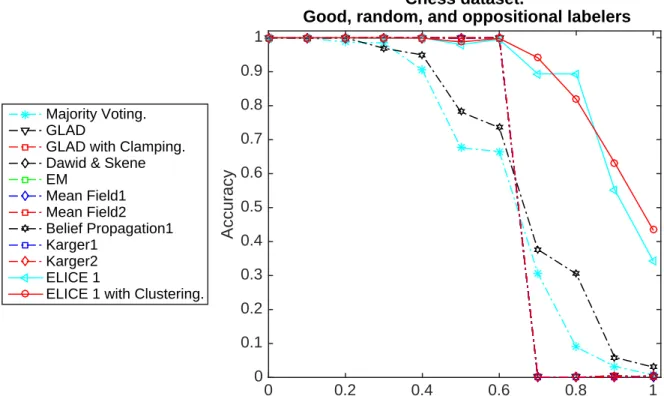
Figure 1.4: Phase transition in the performance of majority voting, GLAD [Whitehillet al., 2009], Dawid and Skene’s method [Dawid and Skene, 1979], Belief Propagation [Liu et al., 2012] and Karger’s iterative method [Kargeret al., 2014] on the University of California Irvine (UCI) Machine Learning Repository Chess dataset.
One of the main challenges in crowd labeling is that the proportion of low-quality/oppositional labelers is unknown. High proportion of low quality (random and oppositional) labelers can often result into aphase transitionleading to a steep, non-linear drop in labeling accuracy as noted by [Kargeret al., 2014].
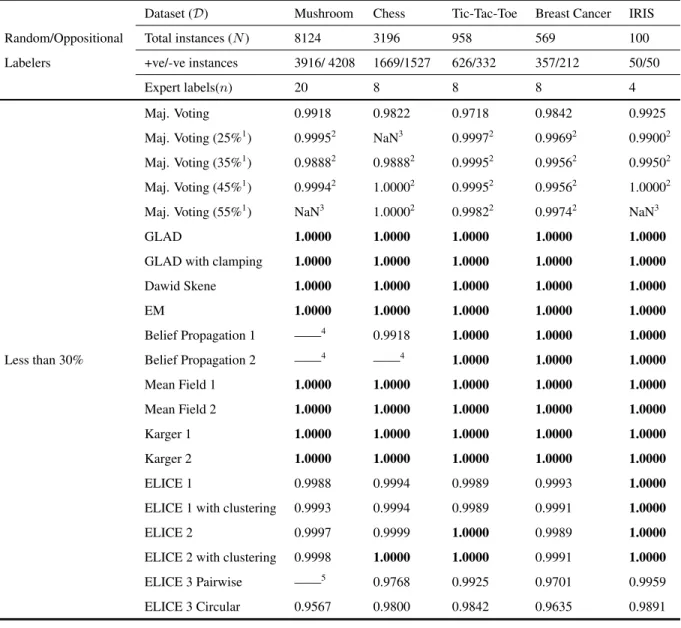
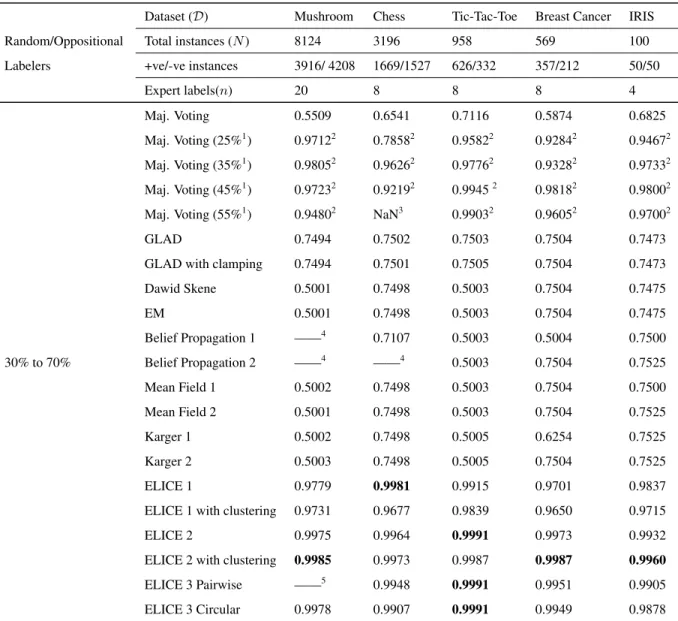
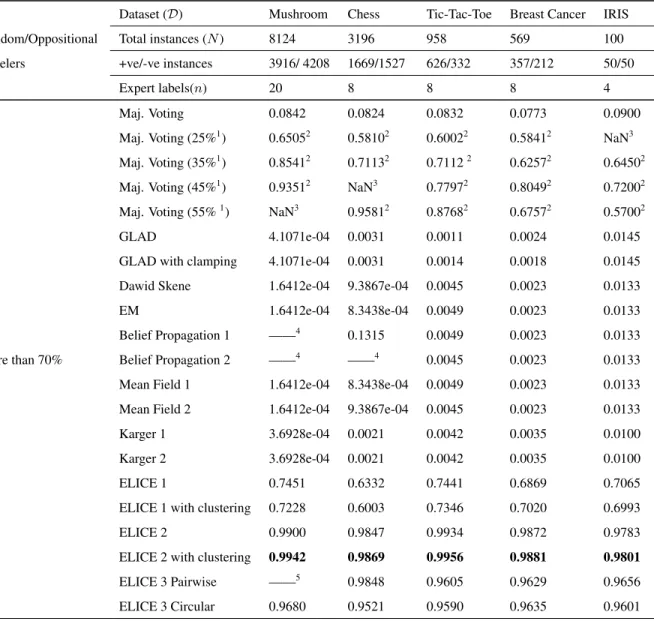
We observed a similar phenomenon in the experiments we conducted on five benchmark datasets from the University of California Irvine (UCI) Machine Learning Repository [Asuncion and New-man, 2007]. We used majority voting, GLAD (Generative model of Labels, Abilities, and Diffi-culties) by [Whitehillet al., 2009], Dawid and Skene’s method [Dawid and Skene, 1979], Karger’s iterative method [Kargeret al., 2014] and Belief Propagation [Liuet al., 2012]. The crowd labels for all these datasets were simulated. Figure 1 illustrates the phase transition for the UCI Chess dataset of 3,196 instances. We assume that agood labelermakes less than 35% mistakes, arandom
labelermakes between 35% to 65% mistakes, while abad labelermakes more than 65% mistakes. This highlights the larger challenge of producing an objective assessment to measure the quality of the crowd for a given task.
Other than phase transition, many basic questions remain unresolved that make crowd labeling a prevailing research topic, e.g., [Dekel and Shamir, 2009; Hovy et al., 2013a; Liu et al., 2012; Donmez and Carbonell, 2008]. The unresolved questions include:
1. What are the best ways to evaluate labeler ability and instance difficulty?
2. It is common to use expert-labeled instances or ground truth to evaluate labelers and in-stances [Leet al., 2010; Khattak and Salleb-Aouissi, 2011; Khattak and Salleb-Aouissi, 2012; Khattak and Salleb-Aouissi, 2013]. The question is, how many expert-labeled instances should be used in order to obtain an accurate evaluation?
3. How can labelers and instances be evaluated if ground truth is not known with certitude?
4. Is there any optimal way to combine multiple labels to get the best labeling accuracy?
5. Should the labels provided by oppositional labelers be discarded and blocked? Or is there a way to use the “information” provided by oppositional labelers?
1.4
Summary of Contributions
In this thesis, we have presented two different approaches to improve crowd labeling accuracy (a) A Frequentist Approach (b) A Bayesian Approach. Both of which are based on parameter estimation. In the first approach parameters are learned by taking the frequency of correct labels provided for the expert-labeled instances, therefore this approach is named as frequentist approach. The second approach involves parameter estimation using a Bayesian method. In both approaches, the following assumptions are made.
Through out this thesis we assume:
• Classes are predefined and presented to the labelers to choose from.
1.4. SUMMARY OF CONTRIBUTIONS 14
• Expert labels are assumed to be ground truth unless otherwise stated.
• We categorize the crowd labelers into three categories; good, random and oppositional. This is done based on their accuracy level. A good crowd labeler is assumed to make less than 35% mistakes, a random crowd labeler makes 35% to 65% mistakes and an oppositional crowd labeler makes 65% to 100% mistakes. Categorization is done for better visualization of results. More details about labeler categorization are available in Table 2.1.
A brief introduction of our frequentist and Bayesian approaches is given below.
1.4.1 Frequentist Approach
We present a framework called Expert Label Injected Crowd Estimation (ELICE). ELICE has three different versions along with their respective variants. The goal of ELICE is to provide better accuracy for the labeling/annotation tasks for which predefined options of answers are available. We have assumed the scenario of labeling to be questions with multiple choices provided to the labelers.
All versions of ELICE rely on expert labels for a small subset of randomly chosen instances from the dataset. However, it can be noted that instead of random choice of the instances, experts can also help in identifying the representative instances of each class. These expert-labeled instances are used to evaluate labeler ability and data instance difficulty that help to improve the accuracy of the final labels. For the first two versions of ELICE, we assume that expert-labels are ground truth labels. In the third version of ELICE however, we assume that expert-labels may not be ground truth either because the experts do not agree on the same label or because the instances are difficult and alternative methods to get ground truth are infeasible.
Earliest versions of ELICE were published in the workshop papers [Khattak and Salleb-Aouissi, 2011; Khattak and Salleb-Aouissi, 2012], which are presented as ELICE 1 in this thesis. ELICE 1 estimates the parameters, i.e., labeler expertise and data instance difficulty, using the accuracy of crowd labelers on expert-labeled instances [Khattak and Aouissi, 2011; Khattak and Salleb-Aouissi, 2012]. The multiple labels for each instance are combined using weighted majority voting. These weights are the scores of labeler reliability on any given instance, which are obtained by inputting the parameters in the logit function.
We also present ELICE 2 [Khattak and Salleb-Aouissi, 2013] with anew and improved aggre-gation method that genuinely takes advantage of the labels provided by oppositional labelers. In the second version of ELICE [Khattak and Salleb-Aouissi, 2013], we introduce entropy as a way to estimate the uncertainty of labeling. This provides an advantage of differentiating between good, random and oppositional labelers. The aggregation method for ELICE version 2 flips the label (for binary classification case) provided by the oppositional labeler thus utilizing the information that is generally discarded by many other labeling methods.
Both versions of ELICE have a cluster-based variant in which rather than making a random choice of instances from the whole dataset, clusters of data are first formed using any clustering approach e.g., K-means. Then equal number of instances from each cluster are chosen randomly to get expert-labels. This is done to ensure equal representation of each class in the test-dataset.
Besides taking advantage of expert-labeled instances, the third version of ELICE, incorporates pairwise/circular comparison of labelers to labelers and instances to instances. The idea here is to improve the accuracy by using the crowd-labels, which unlike expert-labels, are available for the whole dataset and may provide a more comprehensive view of the labeler ability and instance difficulty. This is especially helpful for the case when the domain experts do not agree on one label and ground truth is not known for certain. Therefore, incorporating more information beyond expert-labels can provide better results.
We show empirically that our approaches are robust even in the presence of a large proportion of low-quality labelers in the crowd. This procedure also helps in stabilizing labeling process and delaying the phase transition to inaccurate labels. Furthermore, we derive a lower bound of the number of expert labels needed [Khattak and Salleb-Aouissi, 2013]. This lower bound is a function of the overall quality of the crowd and difficulty of the dataset. We present experiments showing the effectiveness of the lower bound to get better accuracy of the final label.
1.4.2 Bayesian Approach
In the second part of this thesis, we explore a Bayesian approach to the labeling. We present Crowd Labeling Using Bayesian Statistics (CLUBS), a new approach for improved crowd labeling to esti-mate labeler and instance parameters along with label aggregation. Our approach is inspired by Item Response Theory (IRT) Lord [1952], which is used to design and analyze test scoring strategies to
1.5. THESIS OUTLINE 16 evaluate students. We introduce new parameters and refine the existing IRT model parameters to fit the crowd labeling scenario. The main challenge is that unlike IRT, in the crowd labeling case, the ground truth is not known and has to be estimated based on the parameters. To overcome this chal-lenge, we acquire expert labels (ground truth) for a small fraction of instances in the dataset. Our model estimates the parameters based on the expert-labeled instances. The estimated parameters are used to perform weighted aggregation of crowd labels for the rest of the dataset. Experiments are conducted on synthetic data and two real datasets, which show that overall our method performs better than state-of-the-art crowd labeling methods.
1.5
Thesis Outline
This thesis is summarized and organized as follows:
• We present the ELICE framework in chapter 2.
• Empirical evaluation of ELICE is reported in Chapter 3.
• In Chapter 4, we present the theoretical framework to derive a lower bound on the number of expert labels needed for ELICE along with empirical evaluation.
• We present the Bayesian framework CLUBS in Chapter 5.
• Results for experiments using CLUBS are presented in Chapter 6. This chapter also contains the significance test results to check the significance of the accuracy of different methods. Moreover, the impact of using noisy final-labels as training data is evaluated.
• Chapter 7 summarizes the past and contemporary work in the crowd labeling area.
Part I
18
Chapter 2
Expert Label Injected Crowd
Estimation (ELICE)
In this chapter, we present our frequentist approach called Expert Label Injected Crowd Estimation (ELICE). ELICE has three versions with two variants each. All versions of ELICE use expert labels. For the first two versions of ELICE, we assume that expert labels are equivalent to ground truth but for the third version, we assume that expert labels may not be gold labels. For all versions of ELICE labeling classes are pre-defined. We present empirical evaluations on different datasets with simulated and real labels in the next chapter.
2.1
Notation & Scenario
Throughout the first part of this thesis, the following notation and scenario are used. Dataset:D,
Cardinality of the datasetD:N, Label categories:{−1,1}, Number of crowd labelers:M,
Indexi:Represents instancesi∈ {1,2,3, ..., N}, Indexj:Represents labelersj∈ {1,2,3, ..., M}, Crowd label forithinstance by thejthlabeler:lij,
Number of expert-labeled instance:n << N, Expert-labels for instance i:Li,
Labeler ability of labelerj:αj, Instance difficulty of instancei:βi.
Scenario:
LetD be a dataset of N unlabeled instances. We assign M crowd labelers to label the whole dataset; each instance i will receive a label lij ∈ {±1} from labeler j, wherei∈ {1, . . . , N}andj ∈ {1, . . . , M}. To evaluate the performance of the labelers, we get “ground truth” labelsLi for a random sampleD0(⊂ D)of cardinalityn << N (usually 0.1% -10% of the
dataset). Instances ofD0are labeled by one or more experts getting one expert-label each.
2.2
Labeler Categories
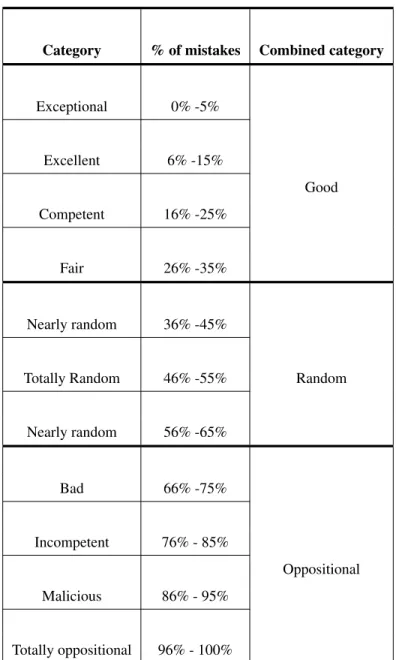
Labelers can be of different ability level and need to be categorized accordingly for a better under-standing of labeling process. Initially, we categorized the labelers into 11 different categories based on their performance, as given in the first column of Table 2.1. But for convenience and reduced complexity as well as a better understanding of the labeler performance, we reduced the categories to only three that is good, random and oppositional, mentioned in the third column of Table 2.1. Good labelers: It should be noted that the labeler categorized as “good” does not necessarily have the exceptional performance and can make up to 35% mistakes. The reason this labeler is catego-rized as “good” is because such labeler will be correct more than 65% of the time and the labels provided by this labeler can potentially help in the labeling task.
Random labelers: These labelers make 36% to 65% mistakes. Random labelers are labelers who randomly label without paying any attention to the instances. These labelers are either lazy or want to get more work done in a short time to be able to earn more money. They provide least or no information as their labeling is random (or nearly random) and cannot help in the labeling process. Oppositional labelers: Similarly, oppositional labeler category includes all the labelers with less than 65% of correct answers, which means these labelers provide wrong labels most of the time. It is important to note that this category can be subdivided into two kinds of labelers (a) the labelers being oppositional because they misunderstood the task (b) the labelers being oppositional because
2.2. LABELER CATEGORIES 20
Category % of mistakes Combined category
Exceptional 0% -5% Excellent 6% -15% Good Competent 16% -25% Fair 26% -35% Nearly random 36% -45%
Totally Random 46% -55% Random
Nearly random 56% -65% Bad 66% -75% Incompetent 76% - 85% Oppositional Malicious 86% - 95% Totally oppositional 96% - 100%
they are really malicious and deliberately provide wrong labels. The outcome of both subcategories is the same hence they are combined and dealt with in the same manner throughout this thesis. Since in this thesis, we have focused on binary labeling only, the oppositional labelers will be providing flipped labels, irrespective of the reason for their oppositional behavior.
It is also worth noting that in all our methods presented in this chapter, the labels provided by all the labelers categorized as “good” are not treated in the same way in the final aggregation. The higher the mistakes level of the labeler the lower weight his labels will have. This automatically adjusts the impact of any labeler in the final aggregation of labels. The same is true for the other two categories, that is random and oppositional labelers.
2.3
ELICE 1 Framework
In this section, we present the first version of ELICE [Khattak and Salleb-Aouissi, 2011] along with its variant called ELICE with clustering. The detailed methodology is described below.
2.3.1 ELICE 1
We start by calculating the parameters: labeler ability and instance difficulty based onn expert-labeled instances. The ability of labelerj, denoted byαj, can have a value between -1 and 1, where
1 is the score of a labeler who labels all instances correctly and -1 is the score of a labeler who labels everything incorrectly. This is because the expertise of a crowd labeler is penalized by subtracting 1 when he makes a mistake but it is incremented by 1 when he labels correctly. At the end, the sum is divided byn. Similarly,βi denotes the difficulty level of instancei, which is calculated by adding
1 when a crowd labeler labels that particular instance correctly. The sum is normalized by dividing byM. It can have a value between 0 and 1, where 0 is for difficult instances and 1 is for the easy ones. We calculateαj’s andβi’s as follows,
Labeler ability=αj = 1 n n X i=1 [1(Li =lij)−1(Li 6=lij)] (2.1) Instance difficulty=βi= 1 M M X j=1 [1(Li=lij)] (2.2)
2.3. ELICE 1 FRAMEWORK 22 wherej= 1, . . . , M andi= 1, . . . , n.
We infer the rest of the(N −n),β’s based onα’s . As the true labels for the rest of instances are not available, we try to find an approximation which we name ashypothesized label(HL),
HLi =sign( 1 M M X j=1 αj∗lij) (2.3)
These hypothesized labels are used to approximate theβ’s ,
βi = 1 M M X j=1 [1(HLi =lij)] (2.4)
The logistic function denoted byσis used to calculate the score associated with the correctness of a label, based on the level of expertise of the crowd labeler and the difficulty of the instance. This score gives us the approximation of the true labels (F) using the following formula:
Fi =sign( 1 M M X j=1 σ(αjβi)∗lij) (2.5)
Hereidenotes the instances for which expert-labels are not available.
2.3.2 ELICE 1 with Clustering
We propose a variation of ELICE called ELICE with clustering. Instead of picking the instances randomly from the whole dataset D to acquire expert labels, clusters of instances in D are first formed by applying k-means clustering using the features (if available); then equal numbers of instances are chosen from each cluster and given to the expert to label. This allows us to have expert-labeled instances from different groups in the data, particularly when the dataset is highly skewed. Another possibility is to use any other method of clustering, for instance, K-means++ [Arthur and Vassilvitskii, 2007].
2.3.3 Test case
We use the UCI Chess dataset as a test case to see the effectiveness of our method (see Figure 2.1). Chess dataset consists of 3196 instances out of which we used 20 as expert-labeled instances for ELICE 1. It can be seen that ELICE 1 performs better than state-of-the-art methods by delaying
Percentage of random and oppositional labelers. 0 0.2 0.4 0.6 0.8 1 Accuracy 0 0.1 0.2 0.3 0.4 0.5 0.6 0.7 0.8 0.9 1 Chess dataset.
Good, random, and oppositional labelers
Majority Voting. GLAD
GLAD with Clamping. Dawid & Skene EM Mean Field1 Mean Field2 Belief Propagation1 Karger1 Karger2 ELICE 1
ELICE 1 with Clustering.
Figure 2.1: Performance on the UCI Chess dataset. We start with all good labelers and keep on increasing the percentage of random and oppositional labelers. Number of expert labels used for ELICE and all its versions is 20.
phase transition. As the percentage of good labelers decreases the performance of state-of-the-art methods deteriorates while ELICE stays stable. State-of-the-art methods include majority voting, GLAD [Whitehillet al., 2009], Dawid and Skene’s method [Dawid and Skene, 1979], Belief Prop-agation [Liuet al., 2012], and Karger’s iterative method [Kargeret al., 2014].
2.3.4 Summary
This version of ELICE is simple and easy to implement. It provides better results than state-of-the-art methods. The key factor in this version of ELICE is that it relies on the judgment of the good labelers minimizing the effect of the random or oppositional labelers. This can especially be helpful when at least one good labeler is available. The low computational cost and effectiveness of the approach as compared to state-of-the-art methods are the main advantages of this methodology.
2.4. ELICE 2 FRAMEWORK 24
2.4
ELICE 2 Framework
In the first version of ELICE, the random and oppositional labelers are treated in the same way i.e., their opinion is weighted less than the good labelers. However, it is known from the crowd labeling literature, e.g., [Raykar and Yu, 2012] that oppositional labelers can be informative in their own way and once they are identified, their labels can be adjusted to get the underlying possibly correct labels.
The random labelers, on the other hand, are those who label without paying attention to in-stances. Therefore, their labels merely add noise to the labeling process. The oppositional labelers are not random in their labels. They take time to identify the instance, try to infer the correct la-bel and then flip it intentionally or unintentionally (assuming binary classification). Therefore, if we know the underlying intentions of a labeler in advance, we can obtain the correct label by decrypting the provided label.
In the second version of ELICE, we have incorporated the idea of utilizing the labels provided by the oppositional labelers. Just like the previous version of ELICE, the labeler ability and in-stance difficulty are evaluated but this time the evaluation involves the concept of entropy. Entropy measures the uncertainty of the information provided by the labelers (or uncertainty about the in-formation obtained for the instances). A random labeler will have a high entropy while the good or oppositional labeler will have a low entropy.
This lets us differentiate between random vs. oppositional or good labelers. Then the oppo-sitional and good labelers are separated. ELICE 2 assigns low weights to the labels of a random labeler and high weights to the labels of a good labeler. Oppositional labelers’ annotations are also highly weighted but after adjusting the labels provided by them. This helps us in using the informa-tion that is discarded by many other label aggregainforma-tion methods. Clustering method can also be used for this version of ELICE.
2.4.1 ELICE 2
2.4.1.1 Labeler Expertise
We use expert-labeled instances to evaluate the labelers by finding the probability of getting correct labels. This estimation of labeler’s performance has a factor of uncertainty since it is based on a sample. Therefore, the entropy function can be a natural way to measure this uncertainty. Entropy is high when the probability is around 0.5 as we are least certain about such a labeler and it is low when the probability is close to 0 or 1. The formula for the entropy for a workerjis given by:
Ej =−pjlog(pj)−qjlog(qj) such that, pj =
n+j
n qj = 1−pj (2.6) n+j =|correctly labeled instances fromD0by labeler j|
Since we are more interested in the reliability of the assessment, we take(1−Ej).In order to
differentiate between good and bad labelers, we multiply by(pj−qj). This assigns a negative value
to the bad labeler and positive value to the good one. We define the expertise of the labeler as
αj = (pj−qj)(1−Ej) (2.7)
whereαj ∈ [−1,1]. The multiplication by(pj −qj) also allows for less variability in αj when
the number of correct and incorrect labels is close, assuming that it can be due to the choice of the instances inD0.This Equation 2.7 is described as the difference of the probability of getting correct labels and probability of getting incorrect labels by labelerjtimes the measure of certainty of the label provided by labelerj.
We can useαto categorize the labelers as follows:
• Random guesseris the labeler withα close to zero. This labeler is either a lazy labeler who randomly assigns the labels without paying any attention to the instances or an inexperienced labeler.
• Good labeleris the labeler withαclose to 1. He does a good job of labeling.
• Oppositional labeleris the labeler withαclose to -1. He guesses the correct label and then flips it.
2.4. ELICE 2 FRAMEWORK 26 2.4.1.2 Instance Difficulty
Similarly, the difficulty of an instance is defined as:
βi= (p0i−q0i)(1−Ei0) + 1 (2.8) where p0i = M + i M q 0
i= 1−p0i,p0iis the probability of getting a correct label for instance
i, from the crowd labeler andMi+is the number of correct labels given to the instancei. Also,
Ei0 =−p0ilog(pi0)−qi0log(qi0) (2.9) represents the entropy for the instanceiwhich measures the uncertainty in our assessment of the difficulty of the instance. All these values are calculated using the expert labeled instances. We have added 1 to the formula in (2.8) because we find it more convenient mathematically to make the value ofβ positive. Another reason for adding 1 is that we cannot assume the difficulty level to be negative, just because the labelers did a bad job of labeling. This Equation 2.8 is described as the difference of the probability of getting correct labels and the probability of getting incorrect labels for instanceitimes the measure of certainty of the label provided for instanceiplus1.
We haveβi∈[0,2]which is used to categorize the instances as follows: • Easy instanceis the one withβ close to 2.
• Average difficulty instanceis the instance withβaround 1.
• Difficult instanceis the instance withβclose to 0.
To judge the difficulty level of the remaining(N −n)instances, we definehypothesized labels Wi as: HLi=sign( M X j=1 αj ∗lij) (2.10)
The rest ofβ’s are estimated by:
βi= (p00i −q 00
i)(1−E 00
i) + 1 (2.11)
2.4.1.3 Label Aggregation
The parameters α andβ are used to aggregate the labels. As a first step for this aggregation, we calculate the probability of getting a correct label for instanceifrom the labelerjdefined as
P(Li =lij|αj, βi) =σ(cαjβi), (2.12)
whereTiis the true but unknown label for the instancei. In this function, c is a scaling factor with
value 3. The reason for multiplying with this scaling factor is to span the range of the function to [0,1], otherwise the values only map to a subinterval of [0,1]. The value 3 is chosen due to the fact thatαjβi ∈[−2,2]andcαjβi∈[−6,6], the latter choice maps to all values in the interval [0,1].
Since in this version of ELICE, we are able to identify random and oppositional labelers sepa-rately, we can make use of this information. We have incorporated this aspect of knowledge in the aggregation formula. F Li=sign( M X j=1 σ(|cαjβi|)∗Lij∗sign(αjβi)) (2.13)
This formula flips the label when the productαβ is negative, which meansα is negative (asβ is always positive) and the labeler is on the oppositional side. If the product |αβ|has large value, logistic function will weight the label higher and for small value of|αβ|the weight is small. So for a given instance, when the labeler is random the weight assigned to the label will be low, when the labeler is good or oppositional the weight is high. But for the oppositional labeler, label is automatically flipped because of being multiplied tosign(αβ). This case is specially helpful when many labelers are oppositional.
2.4.2 ELICE 2 with Clustering
ELICE 2 also has a cluster-based variant. We cluster the data and choose equal number of instances from each cluster, to get expert-labels. The rest of the method remains the same.
2.4.3 Test case
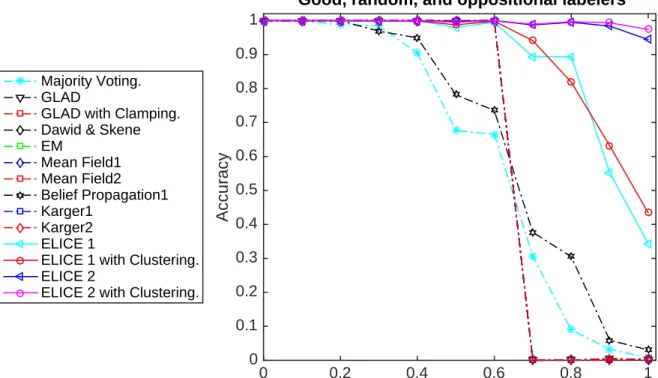
Figure 2.2 shows the performance of majority voting, GLAD [Whitehillet al., 2009], Dawid and Skene’s method [Dawid and Skene, 1979], Belief Propagation [Liuet al., 2012], Karger’s iterative
![Figure 1.4: Phase transition in the performance of majority voting, GLAD [Whitehill et al., 2009], Dawid and Skene’s method [Dawid and Skene, 1979], Belief Propagation [Liu et al., 2012] and Karger’s iterative method [Karger et al., 2014] on the University](https://thumb-us.123doks.com/thumbv2/123dok_us/1364132.2682620/32.918.233.725.165.573/figure-transition-performance-majority-whitehill-propagation-iterative-university.webp)
![Figure 2.3 presents the performance of majority voting, GLAD [Whitehill et al., 2009], Dawid and Skene’s method [Dawid and Skene, 1979], Belief Propagation [Liu et al., 2012], Karger’s iterative method [Karger et al., 2014], ELICE 1, ELICE 1 with clusterin](https://thumb-us.123doks.com/thumbv2/123dok_us/1364132.2682620/53.918.155.793.455.817/figure-presents-performance-majority-whitehill-propagation-iterative-clusterin.webp)