CITY OF ESCONDIDO SUSMP
Standard Urban Stormwater Mitigation Plan
Requirements for Development Projects
January 2011
Stormwater Mitigation Plan (SUSMP)
SUMMARY
In January 2007, the San Diego Regional Water Quality Control Board (San Diego RWQCB) reissued a municipal stormwater permit (Order R9-2007-0001, referred to in this document as the “Stormwater Permit”) that updates and expands stormwater requirements for new development and redevelopment projects. Stormwater treatment requirements have been made more widely applicable and more stringent; minimum standards for Low Impact Development (LID) have been added. LID is an integrated site design methodology that uses small-scale detention and retention to minimize pollutants conveyed by runoff and to mimic preproject site hydrological conditions. The City of Escondido (City) is required to develop and implement criteria for controlling the peaks and duration of runoff from development sites. As required by the Stormwater Permit, the City has updated this standard urban stormwater mitigation plan (SUSMP) to assist the land development community in streamlining project reviews and maximizing cost-effective environmental benefits. Moreover, this updated SUSMP incorporates a unified LID design procedure that integrates site planning and design measures with engineered, small-scale integrated management practices (IMPs) such as bioretention. This procedure is included within this manual. By following the procedure, applicants can develop a single integrated design that complies with the Stormwater Permit’s requirements for LID, stormwater treatment, and runoff peak-and-duration control (hydromodification management).
Along with the detailed design procedure, this document includes guidance and criteria for dispersing runoff to landscaped areas and for using permeable pavements, bioretention facilities, flow-through planters, dry wells, infiltration basins, and cisterns. Where feasible and allowed, water in cisterns may be directed to nonpotable uses, augmenting water supplies. Bioretention facilities and planter boxes can be designed with an impermeable barrier so that runoff does not saturate native soils; instead, runoff is filtered through an engineered soil mix before being captured in an underdrain and conveyed to off-site storm drains. This configuration may be needed where groundwater is high (many areas of Escondido have high [i.e., shallow] groundwater table elevations) or contaminated, or where increasing soil moisture may present a hazard to foundations or slope stability.
Applicants for development project approvals may choose not to use the unified LID design procedure; however, they must still comply with the applicable LID, stormwater treatment, and hydromodification management criteria. In accordance with the Stormwater Permit, the City requires that runoff be infiltrated or treated by bioretention facilities, planter boxes, filters,
where it can also be demonstrated that it is not feasible to construct any of these facilities, higher-rate surface biofilters or higher-rate vault-based filtration units may be used.
Applicants for approval of priority development projects must comply with the hydromodification management criteria in the Stormwater Permit. This SUSMP includes guidance for demonstrating compliance. Submittals for projects smaller than 50 acres may demonstrate compliance by using the integrated LID design procedure. For larger projects, the applicant may use a continuous-simulation hydrologic computer model to simulate the effects of LID facilities, detention basins, or other stormwater management facilities on preproject and postproject runoff, or may identify an exemption applicable to the site.
Applicants must also incorporate into their project designs features to control pollutants from specified on-site sources, such as refuse areas, outdoor storage areas, and vehicle washing and repair facilities. A table listing the types of sources to be controlled and the corresponding
source control measures required is presented within this SUSMP.
This SUSMP provides the applicant with step-by-step instructions for preparing a SUSMP project submittal for review by City staff. The following steps should be followed:
1. Assemble needed information.
2. Identify site opportunities and constraints.
3. Follow the LID design guidance to analyze the project for LID and to develop and document the drainage design.
4. Specify source controls using the sources/source control checklist in the appendix.
5. Plan for ongoing maintenance of treatment and flow control facilities.
6. Complete the SUSMP project submittal.
The step-by-step instructions are augmented by a checklist that City staff will use as a guide when reviewing the SUSMP project submittal. This manual also includes a sample outline and contents for a SUSMP project submittal.
As required by the reissued Stormwater Permit, the City implements a program to verify that approved stormwater treatment facilities are operating effectively. To facilitate implementation of these programs, applicants must prepare detailed maintenance plans for each proposed stormwater treatment facility.
HOW TO USE THE SUSMP ... 1
► Plan Ahead to Avoid the Three Most Common Mistakes ... 2
CHAPTER 1. POLICIES AND PROCEDURES ... 3
A Low Impact Development Design Procedure ... 3
Requirements for All Development Projects ... 3
Priority Development Projects ... 4
► New Development ... 4
► Previously Developed Sites ... 4
► Pollutant-generating projects that Disturb 1 acre or more of land ... 4
► The “50% Rule” for previously developed projects ... 6
Compliance Process at a Glance ... 6
Phased Projects ... 7
New Subdivisions ... 7
Compliance with Flow Control Requirements ... 8
► HMP Applicability Requirements ... 8
► FLOW Control Performance Criteria ... 10
Waivers from Numeric Sizing Criteria ... 11
CHAPTER 2. CONCEPTS AND CRITERIA ... 13
Water Quality Regulations ... 14
► Maximum Extent Practicable ... 14
► Best Management Practices ... 14
Pollutants of Concern ... 15
► Grouping of Potential Pollutants of Concern ... 15
► Identifying Pollutants of Concern Based on Land Uses ... 16
► Watersheds with Special Pollutant Concerns ... 17
Selection of Permanent Source Control BMPs ... 18
Selection of Stormwater Treatment Facilities ... 18
Hydrology for National Pollutant Discharge Elimination System Compliance ... 21
► Imperviousness ... 21
► Low Impact Development Requirements ... 21
► Sizing Requirements for Stormwater Treatment Facilities ... 22
► Flow Control (Hydromodification Management) ... 23
Criteria for Infiltration Devices ... 23
Environmental and Economic Benefit Perspective ... 24
CHAPTER 3. PREPARING THE SUSMP PROJECT SUBMITTAL ... 27
Step by Step ... 29
Step 1: Assemble Needed Information ... 29
Step 2: Identify Constraints and Opportunities ... 30
Step 3: Prepare and Document the Project’s LID Design ... 31
Step 4: Specify Source Control BMPs ... 32
► Identify Pollutant Sources ... 32
► Note Locations on Submittal Drawing ... 32
► Prepare a Table and Narrative ... 32
Step 5: Provide for Stormwater Facility Maintenance ... 33
Step 6: Complete the SUSMP Project Submittal ... 34
► Coordination with Site, Architectural, and Landscaping Plans ... 34
► Construction Plan SUSMP checklist ... 35
► Certification ... 35
► Example SUSMP Project Submittal Outline and Contents ... 36
► Example SUSMP Project Submittals ... 37
CHAPTER 4. LOW IMPACT DEVELOPMENT DESIGN GUIDE ... 39
Analyze Your Project for LID ... 40
► Optimize the Site Layout ... 41
► Use Pervious Surfaces ... 42
► Disperse Runoff to Adjacent Pervious Areas ... 43
► Direct runoff to Integrated Management Practices ... 43
Develop and Document Your Drainage Design ... 44
► Step 1: Delineate Drainage Management Areas ... 45
► Step 2: Classify Drainage Management Areas and determine runoff factors ... 45
► Step 3: Tabulate Drainage Management Areas ... 49
► Step 4: Select and Lay Out Integrated Management practices on Site Plan ... 49
► Step 5: Review Sizing for Each integrated Management Practice ... 50
► Step 6: Calculate minimum area and Volume of each IMP ... 50
► Step 7: Determine whether available space for the IMP is adequate ... 52
► Step 8: Complete the drainage management area and IMP Sizing Summary for incorporation into the Water Quality Technical Report ... 52
Specify Preliminary Design Details ... 53
Alternatives to Integrated LID Design ... 54
► Design of Alternative treatment Facilities ... 54
► Treatment Facilities for Special Circumstances ... 57
Self-Treating and Self-Retaining Areas ... 58
► Criteria ... 58
► Details ... 59
► Applications ... 59
► Design Checklist for Self-Treating Areas ... 60
► Design Checklist for Self-Retaining Areas ... 60
► Design Checklist for Areas draining to Self-Retaining Areas ... 60
Permeable Pavements ... 61
► Criteria ... 61
► Details ... 62
► Design Checklist for Permeable pavements ... 62
Bioretention Facilities ... 63 ► Criteria ... 63 ► Details ... 64 ► Applications ... 67 Flow-Through Planter ... 72 ► Criteria ... 73 ► Details ... 73 ► Applications ... 73
Dry Wells and Infiltration Basins ... 78
► Criteria ... 78
► Criteria ... 80
► Details ... 80
► Applications ... 81
CHAPTER 5. OPERATION AND MAINTENANCE OF STORMWATER FACILITIES ... 85
Stage 1: Ownership and Responsibility ... 86
► Private Ownership and Maintenance ... 86
► Transfer to Public Ownership ... 87
Stage 2: General Maintenance Requirements ... 87
Stage 3: Detailed Maintenance Plan ... 88
► The Detailed Maintenance Plan: Step by Step ... 88
► Step 1: Designate Responsible Individuals ... 88
► Step 2: Summarize Drainage and Best Management Practices ... 89
► Step 3: Document Facilities “As Built” ... 89
► Step 4: Prepare Maintenance Plans for Each Facility ... 90
► Step 5: Compile Maintenance Plan ... 90
► Step 6: Updates ... 92
Stage 4: Interim Maintenance ... 92
Stage 5: Transfer Responsibility ... 92
Stage 6: Verification of Operation and Maintenance ... 92
BIBLIOGRAPHY ... 89
GLOSSARY ... 91
APPENDIX A. STORMWATER POLLUTANT SOURCES/ SOURCE CONTROL CHECKLIST APPENDIX B. HYDROMODIFICATION MANAGEMENT PLAN
Figures
FIGURE 4-1 SELF-TREATING AREAS ... 45FIGURE 4-2 SELF-RETAINING AREAS ... 46
FIGURE 4-3 RELATIONSHIP OF IMPERVIOUS TO PERVIOUS AREA ... 47
FIGURE 4-4 MORE THAN ONE DMA CAN DRAIN TO ONE IMP ... 48
FIGURE 4-5 ONE DMA CANNOT DRAIN TO MORE THAN ONE IMP ... 48
Tables
TABLE 1-1 PRIORITY DEVELOPMENT PROJECTS ... 5TABLE 2-1 ANTICIPATED AND POTENTIAL POLLUTANTS BY LAND USE ... 18
TABLE 2-2 GROUPING OF POTENTIAL POLLUTANTS OF CONCERN ... 18
TABLE 3-1 FORMAT FOR TABLE OF SOURCE CONTROL MEASURES ... 33
TABLE 3-2 CONSTRUCTION PLAN CHECKLIST ... 36
TABLE 4-1 IDEAS FOR RUNOFF MANAGEMENT ... 41
TABLE 4-2 RUNOFF FACTORS ... 48
TABLE 4-4 FORMAT FOR TABULATING SELF-RETAINING AREAS ... 49
TABLE 4-5 FORMAT FOR TABULATING AREAS DRAINING TO SELF-RETAINING AREAS ... 49
TABLE 4-6 SIZING FACTORS ... 50
TABLE 4-7 FORMAT FOR PRESENTING CALCULATIONS OF IMP AREAS AND VOLUMES ... 51
TABLE 5-1 SCHEDULE FOR PLANNING BMP OPERATION AND MAINTENANCE ... 86
Checklists
SUBMITTAL CHECKLIST ... 28 STORMWATER POLLUTANT SOURCES/ SOURCE CONTROL CHECKLIST ... APPENDIX AGlossary
Best Management Practice (BMP)
Any procedure or device designed to minimize the quantity of pollutants that enter the storm drain system.
California Association of Stormwater Quality
Agencies (CASQA)
Publisher of the California Stormwater Best Management Practices Handbooks, available at www.cabmphandbooks.com. Successor to the Storm Water Quality Task Force (SWQTF).
California BMP Method A method for determining the required volume of stormwater treatment facilities. Described in Section 5.5.1 of the California Stormwater Best Management Practice Manual (New Development) (CASQA, 2003).
Conditions of Approval (COAs)
Requirements a municipality may adopt for a project in connection with a discretionary action (e.g., adoption of an EIR or negative declaration or issuance of a use permit). COAs may include features to be incorporated into the final plans for the project and may also specify uses, activities, and operational measures that must be observed over the life of the project.
Continuous Simulation Modeling
A method of hydrological analysis in which a set of rainfall data (typically hourly for 30 years or more) is used as input, and runoff rates are calculated on the same time step. The output is then analyzed statistically for the purposes of comparing runoff patterns under different conditions (for example, pre- and post-development-project).
Copermittees See Dischargers.
Detention
The practice of holding stormwater runoff in ponds, vaults, within berms, or in depressed areas and letting it discharge slowly to the storm drain system. See definitions of infiltration and retention.
Direct Discharge
Connection of project site runoff to an exempt receiving water body, which could include an exempt river reach, reservoir or lagoon. To qualify as a direct discharge, the discharge elevation from the project site outfall must be below the elevations detailed in the HMP Applicability section of this Model SUSMP.
Direct Infiltration
Infiltration via methods or devices, such as dry wells or infiltration trenches, designed to bypass unsaturated surface soils and transmit runoff directly to groundwater.
Directly Connected Impervious Area
Any impervious surface which drains into a catch basin, area drain, or other conveyance structure without first allowing flow across pervious areas (e.g. lawns).
Dischargers
The agencies named in the stormwater NPDES permit (see definition): the County of San Diego; the Cities of Carlsbad, El Cajon, La Mesa, Poway, Solana Beach, Chula Vista, Encinitas, Lemon Grove, San Diego, Vista, Coronado, Escondido, National City, San Marcos, Del Mar, Imperial Beach, Oceanside, and Santee; the San Diego Unified Port District, and the San Diego County Regional Airport Authority.
Drainage Management Areas
Areas delineated on a map of the development site showing how drainage is detained, dispersed, or directed to Integrated Management Practices. There are four types of Drainage Management Areas, and specific criteria apply to each type of area. See Chapter 4.
Drawdown time
The time required for a stormwater detention or infiltration facility to drain and return to the dry-weather condition. For detention facilities, drawdown time is a function of basin volume and outlet orifice size. For infiltration facilities, drawdown time is a function of basin volume and infiltration rate.
Environmentally Sensitive Areas
Areas that include but are not limited to all Clean Water Act Section 303(d) impaired water bodies; areas designated as Areas of Special Biological Significance by the State Water Resources Control Board (Water Quality Control Plan for the San Diego Basin [1994] and amendments); water bodies designated with the RARE beneficial use by the State Water Resources Control Board (Water Quality Control Plan for the San Diego Basin [1994] and amendments); areas designated as preserves or their equivalent under the Multi Species Conservation Program within the Cities and County of San Diego; and any other equivalent environmentally sensitive areas which have been identified by the Copermittees.
Flow Control Control of runoff rates and durations as required by the Hydromodification Management Plan. Head
In hydraulics, energy represented as a difference in elevation. In slow-flowing open systems, the difference in water surface elevation, e.g., between an inlet and outlet.
Higher-Rate Biofilter A biofilter with a design surface loading rate higher than the 5 inches per hour rate specified in this document for bioretention facilities and planter boxes. Hydrograph Runoff flow rate plotted as a function of time.
Hydromodification Management Plan (HMP)
A Plan implemented by the dischargers so that postproject runoff shall not exceed estimated preproject rates and/or durations, where increased runoff would result in increased potential for erosion or other adverse impacts to beneficial uses. Also see definition for flow control.
Hydrologic Soil Group Classification of soils by the Natural Resources Conservation Service (NRCS) into A, B, C, and D groups according to infiltration capacity. Impervious surface Any material that prevents or substantially reduces infiltration of water into the soil. See discussion of imperviousness in Chapter Two.
Infeasible As applied to best management practices, impossible to implement because of technical constraints specific to the site. Infiltration Seepage of runoff into soils underlying the site. See definition of retention. Infiltration Device
Any structure, such as a dry well, that is designed to infiltrate stormwater into the subsurface and, as designed, bypasses the natural groundwater protection afforded by surface or near-surface soil. See definition for direct infiltration.
Integrated Management Practice (IMP)
A facility (BMP) that provides small-scale treatment, retention, and/or detention and is integrated into site layout, landscaping and drainage design. See Low Impact Development.
Integrated Pest Management (IPM)
An approach to pest management that relies on information about the life cycles of pests and their interaction with the environment. Pest control methods are applied with the most economical means and with the least possible hazard to people, property, and the environment.
Jurisdictional Urban Runoff Management Plan (JURMP)
A written description of the specific jurisdictional urban runoff management measures and programs that each Copermittee implements to comply with the
stormwater NPDES permit and ensure pollutant discharges are reduced to the MEP and do not cause or contribute to a violation of water quality standards. See Stormwater Pollution Prevention Program.
Lead Agency The public agency that has the principal responsibility for carrying out or approving a project. (CEQA Guidelines §15367). Low Impact Development
An integrated site design methodology that uses small-scale detention and retention (Integrated Management Practices, or IMPs) to mimic pre-existing site hydrological conditions.
Maximum Extent Practicable (MEP)
Standard, established by the 1987 amendments to the Clean Water Act, for the implementation of municipal stormwater pollution prevention programs
(see definition). According to the Act, municipal stormwater NPDES permits “shall require controls to reduce the discharge of pollutants to the maximum extent practicable, including management practices, control techniques and system, design and engineering methods, and such other provisions as the Administrator or the State determines appropriate for the control of such pollutants.”
National Pollutant Discharge Elimination System (NPDES)
As part of the 1972 Clean Water Act, Congress established the NPDES
permitting system to regulate the discharge of pollutants from municipal sanitary sewers and industries. The NPDES was expanded in 1987 to incorporate permits for stormwater discharges as well.
Numeric Criteria Sizing requirements for stormwater treatment facilities established in Provision D.1.d.(6)(c) of the San Diego RWQCB’s stormwater NPDES permit. Operation and Maintenance
(O&M)
Refers to requirements in the Stormwater NPDES Permit to inspect treatment BMPs and implement preventative and corrective maintenance in perpetuity. See Chapter Five.
Parking Lot A land area or facility for the temporary parking or storage of motor vehicles used personally, for business, or for commerce. Permeable Pavements Pavements for roadways, sidewalks, or plazas that are designed to infiltrate a portion of rainfall, including pervious concrete, pervious asphalt,
unit-pavers-on-sand, and crushed gravel.
Priority Development Project A project subject to SUSMP requirements. Defined in Permit Provision D.1.d.(1). See Chapter One. Stormwater NPDES Project Area
The entire project area comprises all areas to be altered or developed by the project, plus any additional areas that drain on to areas to be altered or developed.
Project Submittal
Documents submitted to a municipality in connection with an application for development approval and demonstrating compliance with Stormwater NPDES Permit requirements for the project. Specific requirements vary from
Proprietary A proprietary device is one marketed under legal right of the manufacturer.
Redevelopment
The creation, addition, and or replacement of impervious surface on an already developed site. Examples include the expansion of a building footprint, road widening, the addition to or replacement of a structure, and creation or addition of impervious surfaces.
Replacement of impervious surfaces includes any activity that is not part of a routine maintenance activity where impervious material(s) are removed, exposing underlying soil during construction. Redevelopment does not include trenching and resurfacing associated with utility work; resurfacing and
reconfiguring surface parking lots and existing roadways; new sidewalk construction, pedestrian ramps, or bikelane on existing roads; and routine replacement of damaged pavement, such as pothole repair.
Rational Method A method of calculating runoff flows based on rainfall intensity, tributary area, and a factor representing the proportion of rainfall that runs off. Regional (or Watershed)
Stormwater Treatment Facility
A facility that treats runoff from more than one project or parcel.
Regional Water Quality Control Board (Regional Water Board or RWQCB)
California RWQCBs are responsible for implementing pollution control provisions of the Clean Water Act and California Water Code within their jurisdiction. There are nine California RWQCBs.
Retention
The practice of holding stormwater in ponds or basins, or within berms or depressed areas, and allowing it to slowly infiltrate into underlying soils. Some portion will evaporate. See definitions for infiltration and detention.
Self-retaining area An area designed to retain runoff. Self-retaining areas may include graded depressions with landscaping or pervious pavements and may also include tributary impervious areas up to a 2:1 impervious-to-pervious ratio.
Self-treating area A natural, landscaped, or turf area drains directly off site or to the public storm drain system.
Source Control
Land use or site planning practices, or structural or nonstructural measures that aim to prevent urban runoff pollution by reducing the potential for
contamination at the source of pollution. Source control BMPs minimize the contact between pollutants and urban runoff.
Standard Industrial Classification (SIC)
A Federal government system for classifying industries by 4-digit code. It is being supplanted by the North American Industrial Classification System but SIC codes are still referenced by the Regional Water Board in identifying development sites subject to regulation under the NPDES permit. Information and an SIC search function are available at
http://www.bls.gov/bls/NAICS.htm. Stormwater
NPDES Permit
A permit issued by a Regional Water Quality Control Board (see definition) to local government agencies (Dischargers) placing provisions on allowable discharges of municipal stormwater to waters of the state.
Storm Water Pollution Prevention Plan (SWPPP)
A plan providing for temporary measures to control sediment and other pollutants during construction as required by the statewide stormwater NPDES permit for construction activities.
Stormwater Pollution Prevention Program
A comprehensive program of activities designed to minimize the quantity of pollutants entering storm drains. See Jurisdictional Urban Runoff Management Plan.
Standard Urban Stormwater Mitigation Plan (SUSMP)
Refers to various documents prepared in connection with implementation of the stormwater NPDES permit mandate to control pollutants from new
development and redevelopment. Each discharger will adapt this model countywide SUSMP to create a local SUSMP for their respective jurisdiction. Applicants for development project approvals will use the local SUSMP to prepare a submittal for each Priority Development Project they propose.
Treatment Removal of pollutants from runoff, typically by filtration or settling.
Water Board See Regional Water Quality Control Board. Water Quality Volume (WQV)
For stormwater treatment facilities that depend on detention to work, the volume of water that must be detained to achieve maximum extent practicable pollutant removal. This volume of water must be detained for a specified
How to Use
the Standard Urban Stormwater
Mitigation Plan
Review Chapters 1 and 2 to get a general understanding of the requirements.
Then follow step-by-step instructions in Chapter 3 to prepare the SUSMP
project submittal.
HIS Standard Urban Stormwater Mitigation Plan (SUSMP) will help ensure that your project complies with requirements established by the San Diego Regional Water Quality Control Board (San Diego RWQCB). Most applicants will require the assistance of a qualified civil engineer, architect, and/or landscape architect. Because every project is different, begin by checking specific requirements with City of Escondido (City) staff.
It is important to note that projects that disturb 1 acre or more must also comply with the Construction General Permit (Order 2009-0009-DWQ), which sets forth requirements for construction activities and includes preparation of a storm water pollution prevention plan (SWPPP) to provide for temporary measures to control sediment and other pollutants during construction. The SUSMP project submittal, as described herein, is a separate document from the project’s SWPPP. The Construction General Permit can be found at the State Water Resources Control Board web site at
http://www.swrcb.ca.gov/water_issues/programs/stormwater/construction.shtml. For more information on SWPPPs, refer to the Construction Handbook (subscription only) at http://www.cabmphandbooks.org.
To use this SUSMP, first review Chapter 1, “Policies and Procedures,” to find out whether and how stormwater quality requirements apply to your project. Chapter 1 also provides an overview of the process of planning, design, construction, operation, and maintenance leading to compliance.
For explanations of any puzzling terms and issues, review Chapter 2, “Concepts and Criteria.” Chapter 2 provides background on key stormwater concepts and water quality regulations, including design criteria. Terms in bold are defined in the glossary.
Then proceed to Chapter 3, “Preparing the Standard Urban Stormwater Management Plan Project Submittal,” and follow the step-by-step guidance to prepare a SUSMP project submittal for your site.
Chapter 4, “Low Impact Development Design Guide,” includes design procedures, calculation procedures, and instructions for presenting designs and calculations in a SUSMP project submittal.
Chapter 5, “Operation and Maintenance of Stormwater Facilities,” describes in detail the process for ensuring operation and maintenance of stormwater facilities over the life of the project. The chapter includes step-by-step instructions for preparing a stormwater facilities operation and maintenance plan.
Throughout each chapter, references and resources are listed to help you understand the regulations, complete a SUSMP project submittal, and design stormwater control measures for your project.
► PLAN AHEAD TO AVOID THE THREE MOST COMMON MISTAKES
The following are the most common (and costly) errors made by applicants for development approvals with respect to stormwater quality compliance:
1. Not planning for compliance early enough. Think about a strategy for stormwater quality compliance before completing a conceptual site design or sketching a layout of subdivision lots (Chapter 3).
2. Assuming that proprietary stormwater treatment facilities are adequate for
compliance; most are not (Chapter 2).
3. Not planning for periodic inspections and maintenance of treatment and flow control facilities. Consider who will own and who will maintain the facilities in perpetuity and how they will obtain access, and identify which arrangements are acceptable to the City (Chapter 5).
Policies and Procedures
Determining whether a development project must comply with stormwater
quality requirements, and the steps to compliance.
A Low Impact Development Design Procedure
The San Diego RWQCB reissued a municipal stormwater permit to the City of Escondido in January 2007 (i.e., Order R9-2007-0001, hereafter called the “Stormwater Permit”). The permit updates and expands stormwater requirements for new development and redevelopment projects. Stormwater treatment requirements have been made more stringent, minimum standards for Low Impact Development (LID) have been added, and the City is required to develop and implement criteria controlling the peaks and duration of runoff from development sites.
To assist the land development community, streamline project reviews, and maximize cost-effective environmental benefits, a unified LID design procedure has been developed, as detailed in Chapter 4. This design procedure integrates site planning and design measures with engineered, small-scale integrated management practices (IMPs) such as bioretention. By following the procedure, applicants can develop a single integrated design that complies with the Stormwater Permit’s requirements for LID, stormwater treatment, and flow control (hydromodification management).
Applicants may choose not to use this design procedure. In this case they must demonstrate in their submittal the project’s compliance with applicable criteria for LID, stormwater treatment, and flow control. These criteria are described in Chapter 2 and in the Stormwater Permit.
Requirements for All Development Projects
All development projects must include control measures to reduce the discharge of stormwater pollutants to the maximum extent practicable. In general, all development projects must include:
implementation of source-control best management practices (BMPs) as listed in Appendix A;
inclusion of some LID features that conserve natural features, set back development from natural water bodies, minimize imperviousness, maximize infiltration, and retain and slow runoff; and
compliance with requirements for construction-phase controls on sediment and other pollutants for all phases of construction. In addition, an emergency cash clean-up deposit will be collected for all projects.
The City may also require additional controls appropriate to the project, which may include stormwater treatment controls. LID treatment controls such as infiltration or bioretention are preferred. See “Selection of Stormwater Treatment Facilities” on page 18. If treatment facilities are included, provisions must be made to ensure their long-term maintenance.
Priority Development Projects
The National Pollutant Discharge Elimination System (NPDES) permit requires that more specific runoff treatment controls be incorporated into priority development projects (i.e., Table 1-1).
► NEW DEVELOPMENT
Projects on previously undeveloped land are priority development projects if they are in one or more of the categories listed in Table 1-1. If a project feature such as a parking lot falls into a priority development project category, then the entire project footprint is subject to the requirements for priority development projects. To use the table, review definitions A–I. If any of the definitions match, the project is a priority development project. Note that some thresholds are defined by square footage of impervious surface created, others by the total area of the development.
► PREVIOUSLY DEVELOPED SITES
Projects on previously developed sites (“redevelopment projects”) are priority development projects if they would create, add, or replace 5,000 square feet or more of impervious surface and are in one of the categories listed in Table 1-1.
► POLLUTANT-GENERATING PROJECTS THAT DISTURB 1 ACRE OR MORE OF LAND
Projects that generate pollutants at levels greater than background levels and disturb 1 acre or more of land are considered priority development projects. In most cases linear pathway projects that are for infrequent vehicle use (such as emergency or maintenance access) or for pedestrian or bicycle use are not considered pollutant generating above background levels if they are built with pervious surfaces or if they allow runoff to sheet flow to surrounding pervious surfaces.
Table 1-1. Priority Development/SUSMP Projects
Is the project in any of these categories?
Yes
No A Housing subdivisions of 10 or more dwelling units.homes, multifamily homes, condominiums, and apartments. Examples: Single-family
Yes
No
B Pollutant-generating projects that disturb 1 acre or more of land. Projects that generate pollutants at levels greater than background levels and disturb 1 acre or more of land are considered priority development projects. In most cases linear pathway projects that are for infrequent vehicle use (such as emergency or maintenance access) or for pedestrian or bicycle use are not considered pollutant generating above background levels if they are built with pervious surfaces, or if they allow runoff to sheet flow to surrounding pervious surfaces.
Yes
No
C Automotive repair shop. A facility categorized in any one of Standard Industrial Classification (SIC) codes 5013, 5014, 5541, 7532–7534, or 7536–7539.
Yes
No
D Restaurant. Any facility that sells prepared foods and drinks for consumption, including stationary lunch counters and refreshment stands selling prepared foods and drinks for immediate consumption (SIC code 5812), where the land area for development is greater than 5,000 square feet. Restaurants where land development is less than 5,000 square feet shall meet all SUSMP requirements except the requirements for structural treatment best management practices and numeric sizing criteria and hydromodification.
Yes
No
E Hillside development greater than 5,000 square feet. Any development that would create 5,000 square feet of impervious surface and is located in an area with known erosive soil conditions, where the development would grade on any natural slope that is 25% or greater.
Yes
No
F Environmentally sensitive areas. All development located within or directly adjacent to, or discharging directly to, an environmentally sensitive area (ESA) (where discharges from the development or redevelopment would enter receiving waters within the ESA) that would either create 2,500 square feet of impervious surface on a proposed project site or increase the area of imperviousness of a proposed project site to 10% or more of its naturally occurring condition. “Directly adjacent” means situated within 200 feet of the ESA. “Discharging directly to” means outflow from a drainage conveyance system that is composed entirely of flows from the subject development or redevelopment site, and not commingled with flows from adjacent lands.
Yes
No G Parking lots 5,000 square feet or morepotentially exposed to urban runoff. or with 15 or more parking spaces and Yes
No I Retail gasoline outletsprojected average daily traffic of 100 or more vehicles per day. that (a) are 5,000 square feet or larger or (b) support Yes
No
H Streets, roads, highways, and freeways. Any paved surface that is 5,000 square feet or greater used to transport automobiles, trucks, motorcycles, and other vehicles.
► THE “50% RULE” FOR PREVIOUSLY DEVELOPED PROJECTS
Projects on previously developed sites may also need to retrofit drainage of all impervious areas of the entire site. The following requirements apply to sites creating or replacing more than 5,000 square feet of impervious area:
If the new project would result in an increase of, or the replacement of, 50% or more of the previously existing impervious surface, and the existing development was not subject to SUSMP requirements, then the entire project must be included in the treatment measure design.
If less than 50% of the previously impervious surface would be affected, only that portion must be included in the treatment measure design.
If a new development project feature such as a parking lot falls into a priority development project category, then the entire project footprint is subject to SUSMP requirements.
Projects are not subject to treatment requirements if they are limited to interior remodels; routine maintenance or repair; replacement of roofs or exterior surfaces; resurfacing and reconfiguring of surface parking lots and existing roadways; construction of new sidewalks, pedestrian ramps, or bike lanes on existing roads; and routine replacement of damaged pavement, such as pothole repair. However, other requirements, including incorporation of appropriate source controls, still apply.
Compliance Process at a Glance
Applicants for development project approval must follow these general steps for stormwater compliance:
1. Discuss requirements during a preapplication meeting with City staff.
2. Review the instructions in this SUSMP before preparing the project’s tentative map, preliminary site plan, drainage plan, and landscaping plan.
3. Prepare the SUSMP project submittal with the application for development approvals (entitlements). The SUSMP project submittal consists of the project’s Water Quality Technical Report (WQTR) and project drawings.
4. Create the detailed project design, incorporating the features described in the SUSMP project submittal.
5. In a table on the project construction plans, list each stormwater compliance feature and facility and the plan sheet where it appears.
6. Prepare a draft stormwater facility operation and maintenance plan and submit it as part of the project WQTR.
7. Maintain stormwater facilities during and after construction in accordance with required warranties.
8. After construction, formally transfer responsibility for maintenance to the owner. 9. Periodically verify that stormwater facilities are properly maintained and must provide
the City with maintenance records annually.
Preparation of a complete and detailed SUSMP project submittal is the key to cost-effective stormwater compliance and expeditious review of a project. Instructions for preparing the SUSMP project submittal are in Chapter 3.
Phased Projects
When determining whether SUSMP requirements apply, a project should be defined consistent with California Environmental Quality Act (CEQA) definitions of “project.” That is, the project is the whole of an action that has the potential to add or replace or to result in the addition or replacement of roofs, pavement, or other impervious surfaces, thereby resulting in increased flows and stormwater pollutants. “Whole of an action” means that the project may not be segmented or piecemealed into small parts if the effect is to reduce the quantity of impervious area for any part to below the SUSMP thresholds.
City staff may request, as part of an application for approval of a phased development project, a conceptual or master SUSMP project submittal that describes and illustrates, in broad outline, how the project’s drainage will comply with the SUSMP requirements. The level of detail in the conceptual or master SUSMP project submittal should be consistent with the scope and level of detail of the development approval being considered. The conceptual or master SUSMP project submittal should specify that a more detailed SUSMP project submittal for each later phase or portion of the project will be submitted with subsequent applications for discretionary actions.
New Subdivisions
If approval of a tentative map would potentially entitle future owners to construct new or replace impervious area that, in aggregate, could exceed one of the SUSMP thresholds (Table 1-1), then the applicant must take steps to ensure that SUSMP requirements can and will be implemented as the subdivision is built out.
If the tentative-map application does not include plans for site improvements, the applicant should nevertheless identify the type, size, location, and final ownership of stormwater treatment and flow control facilities adequate to serve common private roadways and any other common areas, and to manage runoff from an expected reasonable estimate of the square footage of future roofs, driveways, and other impervious surfaces on each individual lot. The City may condition approval of the map on implementation of stormwater treatment and other SUSMP measures when construction occurs on the individual lots. At the City’s discretion, this condition may be enforced by a grant deed of development rights or by a development agreement.
The future impervious area of one or more lots may be limited by a deed restriction, if the City deems it necessary. This might be the case when a project is exempted from one or all SUSMP provisions because the total impervious area is below a threshold, or to ensure that runoff from impervious areas added after project approval does not overload a stormwater treatment and flow control facility.
The City may require subdivision maps to dedicate an open space easement, as defined by California Government Code Section 51075, to suitably restrict the future building of structures at each stormwater facility location if necessary.
In general, in new subdivisions stormwater treatment, infiltration, or flow control facilities should not be located on individual single-family residential lots, particularly when those facilities manage runoff from other lots, streets, or common areas. A better alternative is to locate stormwater facilities on one or more separate, jointly owned parcels.
After consulting with City staff, applicants for subdivision approvals must propose one of the following four options, depending on project characteristics and City policies:
1. Show that the number of parcels and the total impervious area to be created on all parcels could not, in the future, exceed any of the thresholds in Table 1-1.
2. Show that, for each and every lot, the intended use can be achieved with a design that disperses runoff from roofs, driveways, streets, and other impervious areas to self-retaining pervious areas, using the criteria in Chapter 4.
3. Prepare improvement plans showing drainage to treatment and/or flow control facilities designed in accordance with this SUSMP, and commit to constructing the facilities before transferring the lots.
4. Prepare improvement plans showing drainage to treatment and/or flow control facilities designed in accordance with this SUSMP, and provide appropriate legal instruments to ensure that the proposed facilities will be constructed and maintained by subsequent owners.
For the option selected, City staff will determine the appropriate conditions of approval, easements, deed restrictions, or other legal instruments necessary to assure future compliance.
Compliance with Flow Control Requirements
Priority development projects (Section 6.1 of Appendix B) must be designed so that runoff rates and durations are controlled to maintain or reduce preproject downstream erosion conditions and protect stream habitat.
► HMP APPLICABILITY REQUIREMENTS
The HMP Decision Matrix can be used for all projects. For redevelopment projects, flow controls would only be required if the redevelopment project increases impervious area or peak flow rates as compared to preproject conditions.
It should be noted that all Priority Development Projects will be subject to the Permit’s LID and water quality treatment requirements even if hydromodification flow controls are not required. As noted in Figure 6-1, projects may be exempt from HMP criteria under the following conditions.
If the project is not a Priority Development Project.
If the proposed project does not increase the impervious area or peak flows to any discharge location.
If the proposed project discharges runoff directly to an exempt receiving water such as the Pacific Ocean, San Diego Bay, an exempt river reach, an exempt reservoir, or a tidally influenced area.
If the proposed project discharges to a stabilized conveyance system that extends to the Pacific Ocean, San Diego Bay, a tidally influenced area, an exempt river reach or reservoir.
If the contributing watershed area to which the project discharges has an impervious area percentage greater than 70%.
If an urban infill project discharges to an existing hardened or rehabilitated conveyance system that extends beyond the “domain of analysis,” the potential for cumulative impacts in the watershed are low, and the ultimate receiving channel has a low susceptibility to erosion as defined in the SCCWRP channel assessment tool.
If the proposed project decreases the preproject impervious area and peak flows to each discharge location, then a flow-duration analysis is implicitly not required. If continuous simulation flow-frequency and flow duration curves were developed for such a scenario, the unmitigated postproject flows and durations would be less as compared to preproject curves.
The Municipal Permit also contains language to support exemptions for projects located in highly urbanized areas defined as an existing, preproject impervious percentage greater than 70% (as calculated for the sub-watershed between the project outfall downstream to the exempt receiving water). For further detail on exemptions, please refer to the HMP, Section 6.1.
► FLOW CONTROL PERFORMANCE CRITERIA
Figures 6-2 and 6-3 of the HMP (Appendix B) are also part of the HMP Decision Matrix, and detail how lower flow thresholds would be determined for a project site. Figures 6-4 and 6-5 of the HMP, which detail the SCCWRP lateral and vertical channel susceptibility requirements, complete the HMP Decision Matrix.
For further detail on flow control performance criteria, channel screening tools and related project applicant requirements, please refer to Section 6.2 of the HMP.
The HMP recommends the use of LID facilities to satisfy both 85th percentile water quality treatment as well as HMP flow control criteria. Detailed LID standards are outlined in Chapter 4 of this SUSMP. Hydromodification flow control criteria are detailed in Section 6.2 of the HMP. The following methods may be used to meet mitigation requirements.
Install BMPs that meet design requirements to control runoff from new impervious areas. BMPs including bioretention basins, vegetated swales, planter boxes, extended detention basins, etc. shall be designed pursuant to standard sizing and specification criteria detailed in the SUSMP and the HMP Sizing Calculator to ensure compliance with hydromodification criteria.
Use of the automated HMP Sizing Calculator that will allow project applicants to select and size LID treatment devices or flow control basins. The tool, akin to the sizing calculator developed for compliance with the Contra Costa HMP, uses pre-calculated sizing factors to determine required footprint sizes for flow control BMPs. The HMP Sizing Calculator also includes an automated pond sizing tool to assist in the design of extended detention facilities for mitigation of hydromodification effects. Because of the HMP Sizing Calculator’s ease of implementation, and since hydromodification BMPs can also serve as treatment BMPs, it is anticipated that most project applicants will choose this option instead of seeking compliance through site-specific continuous simulation model preparation.
Prepare continuous simulation hydrologic models and compare the preproject and mitigated postproject runoff peaks and durations (with hydromodification flow controls) until compliance to flow control standards can be demonstrated. The project applicant will be required to quantify the long-term pre- and postproject runoff response from the site and establish runoff routing and stage-storage-discharge relationships for the planned flow control devices. Public domain software such as HSPF, HEC-HMS and
Grandfathering. Projects with prior lawful approval (such as a development agreement, vested tentative map, or a building or grading permit) that started construction before January 14, 2011 may not have to meet the hydromodification management requirements. Verify with City staff whether this applies to your project.
Waivers from Numeric Sizing Criteria
The Stormwater Permit allows for a project to be waived from numeric sizing criteria for stormwater treatment only if all available treatment facilities have been considered and found
infeasible. If a project is waived from these requirements, City staff will inform the San Diego RWQCB within 5 days of granting the waiver. Other SUSMP requirements—including site designs to minimize imperviousness and source control BMPs—will still apply.
Experience has shown that implementation of LID facilities, as described in Chapter 4, is feasible on nearly all development sites. However, using LID to retrofit existing drainage systems, to manage runoff from sites smaller than 1 acre in pedestrian-oriented developments, or to manage runoff from widened portions of roadways sometimes presents special challenges. In these special situations, see “Selection of Stormwater Treatment Facilities” on page 18 and evaluate the options described there in order (depending on the specific characteristics of the project and as determined by City staff). All the options listed meet the numeric sizing criteria in the Stormwater Permit.
If infeasibility of all these options can be established, City staff may determine the project’s eligibility for a waiver.
References and Resources
San Diego RWQCB Order R9-2007-0001 (Stormwater Permit) (San Diego RWQCB 2007)
Concepts and Criteria
Technical background and explanations of policies and design requirements.
he Stormwater Permit mandates a comprehensive program to prevent stormwater pollution. This program now includes street sweeping, maintenance of storm drains, business inspections, public outreach, construction site inspections, monitoring and studies of stream and ocean health, and control of runoff pollutants from new development and redevelopment projects.
Stormwater Permit Provision D.1.d requires the City to regulate projects in specific categories (Table 1-1) to reduce discharges of pollutants to the maximum extent practicable and prevent runoff discharges from causing or contributing to a violation of water quality standards. The LID design procedure (Chapter 4) serves to ensure a consistent and thorough implementation of the San Diego RWQCB’s requirements. This chapter explains the technical background of the LID approach and how it was derived.
The previous permit, issued in 2001, included a requirement to control postdevelopment peak stormwater runoff rates and velocities, to maintain or reduce downstream erosion relative to predevelopment levels, and to protect stream habitat. The 2007 Stormwater Permit added a new requirement to develop an HMP identifying and defining a methodology and performance criteria, to ensure that flow rates and duration do not exceed preproject runoff where increased runoff could cause erosion or other significant adverse impacts on beneficial uses.
As required by the Stormwater Permit, the City adopted final hydromodification criteria. See Chapter 1.
2
Water Quality Regulations
Stormwater Permit Provision D.1 requires applicable new development and redevelopment projects to take the following steps:
Design the site to conserve natural areas, existing trees, and vegetation and soils to maintain natural drainage patterns, minimize imperviousness, detain runoff, and infiltrate runoff where feasible.
Cover or control sources of stormwater pollutants.
Treat runoff before discharge. Stormwater Permit Provision E.10 states: “Urban runoff treatment and/or mitigation must occur prior to the discharge of urban runoff to receiving waters.” Federal regulations (40 Code of Federal Regulations [CFR] 131.10[a]) state that “in no case shall a state adopt waste transport or waste assimilation as a designated use for any waters of the U.S.”
Ensure that runoff does not exceed preproject peaks and duration where increases could affect downstream habitat or other beneficial uses.
Maintain treatment and flow control facilities. ► MAXIMUM EXTENT PRACTICABLE
Clean Water Act Section 402(p)(3)(iii) sets the standard for stormwater controls as “maximum extent practicable,” but does not define that term. As implemented, “maximum extent practicable” is ever-changing and varies with conditions.
Many stormwater controls, including LID facilities, have proven to be practicable in most site development projects. To achieve fair and effective implementation, criteria, and guidance, requirements for controls must be detailed and specific, while also offering the right amount of flexibility or exceptions for special cases. The Stormwater Permit includes various standards, including hydrologic criteria, that have been found to constitute the “maximum extent practicable.”
► BEST MANAGEMENT PRACTICES
Clean Water Act Section 402(p) and U.S. Environmental Protection Agency regulations (40 CFR 122.26) specify a municipal program of “management practices” to control stormwater pollutants. A BMP refers to any kind of procedure, activity, or device designed to minimize the quantity of pollutants that enter the storm drain system. BMPs are typically used in place of assigning numeric effluent limits. The criteria for source control BMPs and treatment and flow control facilities are crafted to fulfill the “maximum extent practicable.”
Within the context of this SUSMP, facilities, features, or controls to be incorporated into development projects are considered BMPs.
Pollutants of Concern
Applicants must identify pollutants of concern and select BMPs and facilities as described below. ► GROUPING OF POTENTIAL POLLUTANTS OF CONCERN
Urban runoff from a developed site has the potential to contribute pollutants (oil and grease, suspended solids, metals, gasoline, pesticides, and pathogens) to the stormwater conveyance system and receiving waters. For the purposes of identifying pollutants of concern and associated stormwater BMPs, pollutants are grouped into nine general categories as follows:
Sediments are soils or other surficial materials eroded and then transported or deposited by the action of wind, water, ice, or gravity. Sediments can increase turbidity, clog fish gills, reduce spawning habitat, lower the survival rates of young aquatic organisms, smother bottom-dwelling organisms, and suppress growth of aquatic vegetation.
Nutrients are inorganic substances, such as nitrogen and phosphorus. They commonly exist in the form of mineral salts that are either dissolved or suspended in water. Primary sources of nutrients in urban runoff are fertilizers and eroded soils. Excessive discharge of nutrients to water bodies and streams can cause excessive growth of aquatic algae and plants. Such excessive production, referred to as cultural eutrophication, may lead to excessive decay of organic matter in the water body, loss of oxygen in the water, release of toxins in sediment, and the eventual death of aquatic organisms.
Metals are raw material components in nonmetal products such as fuels, adhesives, paints, and other coatings. Primary sources of metal pollution in stormwater are typically commercially available metals and metal products. Metals of concern include cadmium, chromium, copper, lead, mercury, and zinc. Lead and chromium have been used as corrosion inhibitors in primer coatings and cooling-tower systems. At low concentrations naturally occurring in soil, metals are not toxic. However, at higher concentrations, certain metals can be toxic to aquatic life. Humans can be affected by contaminated groundwater resources and the bioaccumulation of metals in fish and shellfish. Environmental concerns regarding the potential for release of metals to the environment have already led to restricted usage of metals in certain applications. Organic compounds are carbon-based. Commercially available or naturally occurring
organic compounds are found in pesticides, solvents, and hydrocarbons. At certain concentrations, organic compounds can indirectly or directly constitute a hazard to life or health. When objects are rinsed off, toxic levels of solvents and cleaning compounds can be discharged to storm drains. Dirt, grease, and grime retained in the
cleaning fluid or rinse water may also adsorb levels of organic compounds that are harmful or hazardous to aquatic life.
Trash (such as paper, plastic, polystyrene packing foam, and aluminum materials) and biodegradable organic matter (such as leaves, grass cuttings, and food waste) are general waste products on the landscape. The presence of trash and debris may have a substantial effect on the recreational value of a water body and aquatic habitat. Excess organic matter can create high biochemical oxygen demand in a stream, thereby lowering its water quality. Also, in areas where stagnant water exists, the presence of excess organic matter can promote septic conditions, resulting in the growth of undesirable organisms and the release of odorous and hazardous compounds such as hydrogen sulfide.
Oxygen-demanding substances include biodegradable organic material as well as chemicals that react with dissolved oxygen in water to form other compounds. Proteins, carbohydrates, and fats are examples of biodegradable organic compounds. Compounds such as ammonia and hydrogen sulfide are examples of oxygen-demanding compounds. The oxygen demand of a substance can lead to depletion of dissolved oxygen in a water body and possibly the development of septic conditions. Primary sources of oil and grease are petroleum hydrocarbon products, motor
products from leaking vehicles, esters, oils, fats, waxes, and high-molecular-weight fatty acids. These pollutants can easily be introduced to the water bodies because of the wide uses and applications of some of these products in municipal, residential, commercial, industrial, and construction areas. Elevated oil and grease content can decrease the aesthetic value of the water body, as well as the water quality.
Bacteria and viruses are ubiquitous microorganisms that thrive under certain environmental conditions. Their proliferation is typically caused by the transport of animal or human fecal wastes from the watershed. Excessive bacteria and viruses in water can alter the aquatic habitat and create a harmful environment for humans and aquatic life. Also, the decomposition of excess organic waste causes increased growth of undesirable organisms in the water.
Pesticides (including herbicides) are chemical compounds commonly used to control nuisance growth or prevalence of organisms. Excessive application of a pesticide may result in runoff containing toxic levels of its active component.
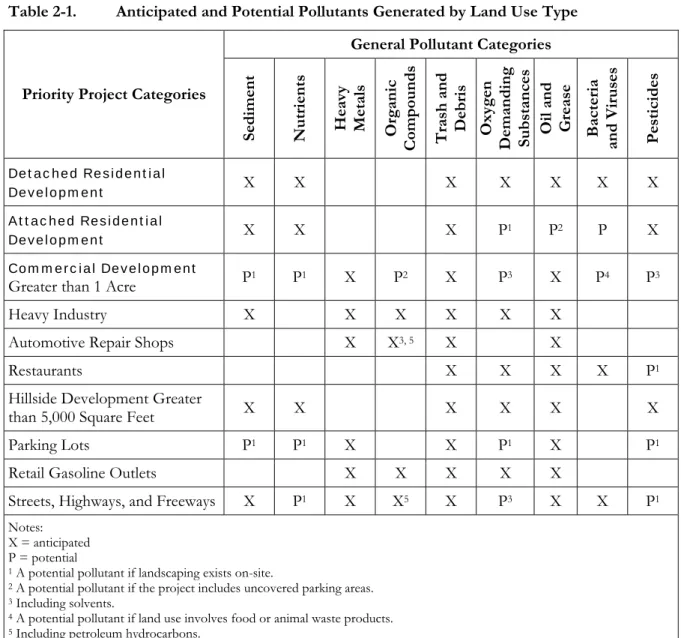
► IDENTIFYING POLLUTANTS OF CONCERN BASED ON LAND USES
Refer to Table 2-1 to identify which pollutant categories of priority development projects apply to your project. Pollutants associated with any hazardous materials sites that have been remediated or are not threatened by the proposed project are not considered pollutants of concern.
Table 2-1. Anticipated and Potential Pollutants Generated by Land Use Type
Priority Project Categories
General Pollutant Categories
Sediment Nutri
ent
s
Heavy Metals Organic
Compou
nds
Trash and Debris Oxygen Demanding Substances Oil and Grease Bacteria and Viruses Pesticides
Detached Residential
Development X X X X X X X
Attached Residential
Development X X X P1 P2 P X
Commercial Development
Greater than 1 Acre P1 P1 X P2 X P3 X P4 P3
Heavy Industry X X X X X X
Automotive Repair Shops X X3, 5 X X
Restaurants X X X X P1
Hillside Development Greater
than 5,000 Square Feet X X X X X X
Parking Lots P1 P1 X X P1 X P1
Retail Gasoline Outlets X X X X X
Streets, Highways, and Freeways X P1 X X5 X P3 X X P1
Notes:
X = anticipated P = potential
1 A potential pollutant if landscaping exists on-site.
2 A potential pollutant if the project includes uncovered parking areas. 3 Including solvents.
4 A potential pollutant if land use involves food or animal waste products. 5 Including petroleum hydrocarbons.
► WATERSHEDS WITH SPECIAL POLLUTANT CONCERNS
Local receiving water conditions may require specialized attention if they are 303(d)-listed waters and waters with established total maximum daily loads (TMDLs). The following receiving waters in Escondido currently require special pollutant protection because they are listed on the 303(d) list:
Escondido Creek Reidy Canyon Creek San Marcos Creek
Felicita Creek Lake Hodges Kit Carson Creek
The State Water Resources Control Board identifies receiving waters as impaired for constituents or water quality effects pursuant to Section 303(d) of the Clean Water Act. Placement of a surface water onto the list requires the San Diego RWQCB to analyze the impairment and develop TMDLs for addressing the impairment. The 303(d) listing in itself does not demand that a project applicant select BMPs on the basis of the impairment; however, the project applicant should be cognizant of the impairment and the future implications that a TMDL might have on the proposed land use.
Once a TMDL is established, it may impose conditions on development through either an implementation plan and schedule for the listed water, or special conditions required of the municipality affected by the TMDL’s numeric sizing criteria. At this time, several 303(d) listings in San Diego County are at various stages of TMDL development, with only four TMDLs having been adopted by the San Diego RWQCB. However, the ongoing development of TMDLs will likely impose conditions on development occurring within Escondido and will be evaluated accordingly. The project applicant should meet with City staff to determine whether any project characteristics or watershed characteristics affect selection and design of BMPs. Except in rare circumstances, using the LID design guide (Chapter 4) and the Pollutant Sources and Source Control Checklist (Appendix A) will ensure that the proposed project would comply with all stormwater requirements.
Selection of Permanent Source Control BMPs
Based on identification of potential pollutants of concern associated with various types of facilities, the Pollutant Sources and Source Control Checklist (Appendix A) lists “maximum extent practicable” source controls associated with each facility type to ensure that appropriate BMPs are applied to potential sources of each pollutant of concern.
Selection of Stormwater Treatment Facilities
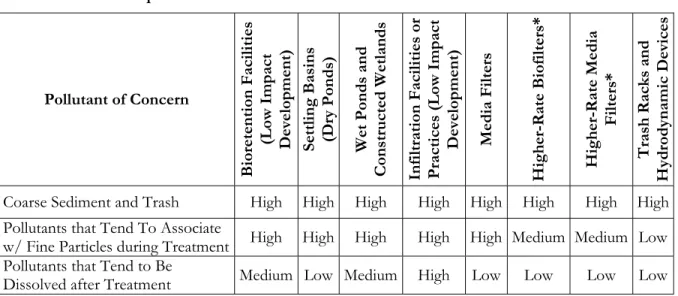
Table 2-2 generally compares the performances of various types of treatment facilities for each group of pollutants. This table should be used to select the appropriate BMP for the pollutant of concern at the project site, particularly for environmentally sensitive areas or sites adjacent to 303(d)-listed water bodies.
Table 2-2. Groups of Pollutants and Relative Effectiveness of Treatment Facilities
Pollutant of Concern
Bioretention Facilities
(Low Impact Development) Settling Basi
ns
(Dry Ponds) Wet Ponds a
nd
Constructed Wetlands Infiltration F
acilit
ies or
Practices (Low Impact
Development) Media Filters
Higher-Rate Biofilters* Higher-Rate Media Filters* Trash Racks and Hydrody namic Devices
Coarse Sediment and Trash High High High High High High High High
Pollutants that Tend To Associate
w/ Fine Particles during Treatment High High High High High Medium Medium Low Pollutants that Tend to Be
Dissolved after Treatment Medium Low Medium High Low Low Low Low
*See page 19 for a discussion of selection of stormwater treatment facilities in special situations.
The following types of facilities are generally appropriate for treatment of runoff and hydromodification flow control from all land uses in Escondido watersheds, except where site-specific constraints make them infeasible:
infiltration facilities or practices, including dry wells, infiltration trenches, infiltration basins, and other facilities that infiltrate runoff to native soils (sized to detain and infiltrate a volume equivalent to the 85th percentile 24-hour event water quality runoff
event – greater capacity required to provide hydromodification flow control);
bioretention facilities and media filters that detain stormwater and filter it slowly through soil or sand (sized with a surface area at least 0.04 times the effectively impervious tributary area for water quality treatment – a larger sizing factor is required to provide hydromodification flow control); and
extended detention basins, wet ponds, and wetlands or other facilities using settling (sized to detain a volume equivalent to runoff from the tributary area generated by the 85th percentile 24-hour event water quality runoff even – greater capacity required
to provide hydromodification flow control).
The recommended design procedure in Chapter 4 integrates LID practices (optimizing the site design, using pervious surfaces, and dispersing runoff to adjacent pervious areas) with the use of infiltration facilities, detention basins, and bioretention facilities to meet the Stormwater Permit’s requirements for LID, treatment, and flow control in a cost-effective, unified design.
Oil/water separators (“water quality inlets”), storm drain inlet filters, and hydrodynamic separators, including vortex separators and continuous deflection separators (“CDS units”), are less effective means of stormwater treatment, although they may be used in series with more effective facilities.