Research Report
2009-2011
~
Laboratoire Traitement et Communication de l’Information - UMR 5141
février 2012
Télécom ParisTech / LTCI
Research Report 2009–2011
Laboratoire Traitement et Communication de l’Information
D ´epartement TSI
T ´el ´ecom ParisTech & CNRS
F ´evrier 2012
Contents
I
Signal and Image Processing
5
1 Audio, Acoustics and waves (AAO) 9
1.1 Objectives . . . 10
1.2 Results . . . 10
1.2.1 Audio and multimedia scenes analysis and indexing . . . 10
1.2.2 Sound capture, separation and rendering . . . 12
1.2.3 Sound sources compression and informed source separation . . . 12
1.2.4 Biomedical signals analysis . . . 13
1.3 References . . . 14
1.3.1 ACLN: Articles in Refereed Journals . . . 14
1.3.2 OS: Books and Book Chapters . . . 15
1.3.3 THE: PhD Theses . . . 15
1.3.4 ACTI: Articles in Proceedings of International Conferences . . . 16
2 Multimedia (MM) 21 2.1 Objectives . . . 22
2.2 Main Results . . . 22
2.2.1 Robust Compression and Transmission of Visual Data . . . 22
2.2.2 Rich Media, Adaptation and Open Source Software . . . 25
2.2.3 Document Imaging and Interaction . . . 26
2.2.4 Audio-visual Identity/Imposture and Virtual Worlds . . . 27
2.3 References . . . 29
2.4 References . . . 29
2.4.1 ACL: Journal Papers . . . 29
2.4.2 ACTI: Articles in Proceedings of International Conferences . . . 31
2.4.3 BC: Book Chapters . . . 37
2.4.4 BP: Books and Proceedings Edition . . . 38
2.4.5 THE: PhD Theses . . . 38
3 Statistics and Applications (STA) 39 3.1 Objectives . . . 40
3.2 Main results . . . 41
3.2.1 Statistical Learning . . . 41
3.2.2 Blind Source Separation and Identification . . . 42
3.2.3 Sensor Networks . . . 42
3.2.4 Monte Carlo Methods . . . 43
3.2.5 Time Series . . . 44
3.3 References . . . 45
3.3.1 ACL: Articles in ISI-Indexed Journals . . . 45
3.3.2 ACTI: Articles in Proceedings of International Conferences . . . 49
3.3.3 COM: Talks in Conferences Which Do Not Publish Proceedings . . . 54
CONTENTS CONTENTS
4 Image processing and understanding (TII) 57
4.1 Objectives . . . 58
4.2 Main results . . . 59
4.2.1 Mathematical methods for images . . . 59
4.2.2 Image understanding and spatial reasoning . . . 62
4.2.3 Learning, indexing and retrieval . . . 62
4.2.4 Computer graphics, digital geometry and rendering . . . 63
4.2.5 Medical imaging . . . 64
4.2.6 Aerial and satellite imaging . . . 65
4.3 References . . . 67
4.3.1 ACL: Articles in ISI-Indexed Journals . . . 67
4.3.2 THE: Theses . . . 71
4.3.3 HDR: HDR Theses . . . 73
4.3.4 ACTI: Articles in Proceedings of International Conferences . . . 73
Part I
Signal and Image Processing (TSI)
The research topics covered by the Signal and Image Processing department at TELECOM Paris-Tech are: the study of image processing in its various formats, digital, optical... for different applications like medical imaging, remote sensing, fine arts..., the study of speech, music and sound, the study of the multimedia chain, from production to distribution. Our goal is to develop new mathematical tools to process all these kinds of signals, and to apply these tools to a large variety of concrete situations.
The department is organized into four groups:
• “Statistics and applications” - STA - is a group that is devoted to the applications of statistics and probability to the field of information society at large, which has become increasingly dependent on the collection and interpretation of data and, more generally, quantitative information. The research area covers a wide spectrum from the development of new tech-niques and new algorithms to various applications. The activities of the group comprises the following topics: statistical learning, blind sourrce identification and separation, distributed estimators for sensor networks, time series, independent data and complex random sys-tems, Markov Chain Monte-Carlo techniques, sequential Monte-Carlo techniques (particle filters), array processing, geolocalization, models estimation.
• “Image Processing and Interpretation” - TII - has, as its main purpose, the development of methodologies and theoretical tools for image processing, scene analysis and 3D objects. This implies global treatment of complex image processing problems, integrating multiple techniques that cover the path from raw data to high-level interpretation. The concerned applications are art items (sculptures, paintings), biomedical images, aerial and satellite images, natural image analysis. Contributions of the group can be found at theoretical level (knowledge and information representation and modeling, in 2D as well as 3D, processing, interpretation and reasoning on spatial data), at algorithmical level (in particular models for large and complex data sets), and at applicative level.
• “Audio, Acoustics and Waves” - AAO - develops signal processing techniques while keeping strong connections with the physical phenomenon that is at the source of the signals. In digital audio signal processing, the activities span the entire acquisition chain, from sound capture and transmission up to its restitution, with the goal of proposing solutions to the main problems centered around the sound, speech or music, in multimedia applications. Its contributions at the methodological level cover adaptive methods for high resolution sinuso¨ıd tracking, sparse representations, nonnegative matrix factorisations, source sep-aration. A central domain of applications is the analysis of audio and multimedia scenes: segmentation of broadcast streams, analysis of music, its decomposition and understand-ing (polyphonic separation, rythm, melody, chords). Research on biomedical signals has been recently reinforced in the group, and will be furtther stengenthed with the ongoing recruitment of an associate professor.
• “Multimedia” - MM- is a group that covers the life cycle of multimedia documents in the framework of a complete chain going from authoring tools for on-line and offline produc-tion of multimedia contents to multimodal interacproduc-tion for the final user; this also includes
automated processing like enhancement of degraded pictures, verification of the identity of the user, modification of auditive and visual appearance, image segmentation and pattern recognition. The group also works on techniques that allow the analysis, compression and robust transmission of these media in heterogeneous networks. It also works on the dy-namic and distributed adaptation of the transmitted data flow (including meta-data and in particular those concerning the digital rights management) with respect to context, transport conditions and terminal type.
One research topic is common to all groups, this is indexation and data mining. Summarizing and extracting informations from multimodal databases requires statistical tool for learning and mining, which are among the activities of the STA group with a particular focus on text indexa-tion and retrieval. Indexing satellite images, extricating informaindexa-tions from primitives to semantic annotations was the main goal of the “Center of Competence”, a joint lab between CNES, DLR and the TII group, until mid 2010. This group also develops the same kind of tools for biomedical images and for 3D objects. The AAO group is concerned by many aspects of music information retrieval: identification of rhythms, main melodies, instruments, styles, moods, tonalities either from plain audio or from mixed audio and video. Video signals are also a core activity in the MM group together with complex documents analysis (mixing printed texts, handwritten texts, pictures, graphics) and with multimodal analysis for biometry (voice, faces, fingerprints).
Our most recent recruitments were aimed towards the reinforcement of two topics: 3D images and virtual worlds on one hand, biomedical signals on the other hand.
Permanent staff [Institut ; CNRS] ; post-docs [39,8 ; 13.5] ; 30.5
PhDs 58.9
Defended PhDs 58
Defended HDR 11
Journal papers [published, in press] [238 ; 58]
Chapters and books [published, in press] [38 ; 9]
Conference papers 455
Patents and software 2
Chapter 1
Audio, Acoustics and waves (AAO)
Head G. Richard (P)Permanent staff R. Badeau (MC), B. David (MC), Y. Grenier (P), N. Moreau (P, until March 2010), S. Essid (IE), J. Prado (MC);
PhD students N. Bertin (10/05-10/09), J-L. Durrieu (01/07-05/10), M. Ramona (10/06-06/10), C. Joder (11/07-09/11), L. Oudre (10/07-11/10), F. Vallet (11/07-09/11), S. Gulluni (02/08-12/11), R. Hennequin (10/08-11/11), M. Maazaoui (01/09-), S. Fen ˆet (01/10-); B. Fuentes (10/09-); R. Foucard (10/09-); M. Moussalam (10/09-); G. Ladreyt (10/10-); F. Rigaud (10/10-); A. Liutkus (01/10-);N. Lopez (05/11-); A. Masurelle (10/11-); X. Jaureguiberry (10/11-);
PostDocs, engineers and sabbaticals M. Lagrange 09/09), T. Fillon (Postdoc,10/08-), B. Mathieu (Engineer,10/08-12/10(Postdoc,10/08-), A. Dielmann (PostDoc, 11/10-03/11(Postdoc,10/08-), A. Dr ´emeau (PostDoc, 09/11-).
External collaborators L. Daudet (ESPCI ParisTech), O. Derrien (LMA-Marseille), E. Vincent (IRISA), L. Devillers (LIMSI-CNRS), T. Sikora (Technical Univ. of Berlin), L. Girin (GIPSA-Lab), N. O’connor (Dublin City University).
Permanent staff [Institut ; CNRS] ; post-docs [6.3 ; 0] ; 1.9
PhDs 9.3
Defended PhDs 9
Defended HDR 1
Journal papers [published, in press] [24 ; 2]
Chapters and books [published, in press] [7 ; 1]
Conference papers 64
Patents and software [1 ; 1]
Contractual income 07/2009–12/2011 [Private ; Public ; European] (ke) [121 ; 673 ; 275]
The AAO (Audio, Acoustical and waves) research group is now focused on the activities previously reported under the Audio Signal Processing (AudioSig) project. The activities of the Optical Signal Processing (TOS) project have been transferred to the INFRES department in March 2009 and are entirely reported in section??.
1.1. OBJECTIVES CHAPTER 1. AUDIO, ACOUSTICS AND WAVES (AAO)
1.1
Objectives
The aim of this research group is to develop digital audio signal processing methods in order to propose innovative solutions to the main problems linked to audio (speech, music,. . . ) in multimedia applications. Our interests encompass the complete processing chain from sound capture and transmission to sound restitution. Work is conducted on a methodological level to develop new sound representations and models especially for musical signals on their application to practical problems. In particular, the group is interested in Adaptive methods for high resolu-tion sinusoidal components tracking, sparse representaresolu-tions, Non-Negative Matrix factorizaresolu-tion or hierarchical models and on their application to practical problems such as automatic indexing, compression or EEG signal processing.Source separationalso appears to be at the heart of this research group with contributions at the methodological level and with applications in nearly all the individual research themes. Audio and multimedia scenes analysis and indexing currently is the central research theme of the group and includes topics such as broadcast streams segmentation into broad classes of audio events (speech/music/silence/singing,. . . ), musical signals automatic analysis, decomposition and understanding (polyphonic audio source separation, rhythm extrac-tion, multiple fundamental frequencies estimaextrac-tion, main melody extracextrac-tion,. . . ). Concurrently, a novel research direction on biological signals for Brain computer Interfaces is receiving a growing interest and will be further strengthened with the arrival in march 2012 of a new associate profes-sor in the group.
On a different level, the group has initiated the development of a multimedia indexing and mining platform (called PLATO) which now involves several other groups and has developed a number of software tools, some of them being distributed in open source (YAAFE - an audio fea-ture extractor [90], DESAM toolbox - a set of tools for spectral analysis of musical audio [83, 15], . . . ).
The group is also maintaining tight links and collaborations with both academics (Queen Mary University of London, Dublin City University, Technical University of Berlin, Institut Langevin, IR-CAM, INRIA-IRISA, LABRI-CNRS, GIPSA-Lab,. . . ) and industry (RTL, INA, Audionamix, Arkamys, Parrot, . . . ).
1.2
Results
1.2.1
Audio and multimedia scenes analysis and indexing
Researchers R. Badeau, B. David, S. Essid, Y. Grenier, J. Prado, G. Richard;
Highlights :
Collaborations: With industry (RTL, INA, Audionamix) and academics (Queen Mary Uni-versity, Dublin City UniUni-versity, Institut Langevin, IRISA, IRCAM, LABRI,...)
ProjectsNetwork of Excellence IST-Kspace (Knowledge Space of Semantic Inference for Automatic Annotation and Retrieval of Multimedia Content), Network of Excellence 3DLife (Bringing the Media Internet to Life), OSEO-QUAERO (Towards multimedia and multilingual search engines for professional and general public applications); ANR DreAm (Active music listening);
PrizePhD prize in 2010 (jointly awarded by EEA club, GRETSI and ISIS) (N. Bertin)
Models and signal representations
This activity is following several research axes. The first direction, which is on a rather method-ological level, aims at developing generic signal models and representations with a specific focus on audio signals, recently extended to multimodal signals. An increased effort was dedicated to
CHAPTER 1. AUDIO, ACOUSTICS AND WAVES (AAO) 1.2. RESULTS
sparse signal representations with a particular interest on those based on Matching Pursuit (MP), Probabilistic Latent Component Analysis (PLCA) or Non-negative Matrix factorisation (NMF), that allow to decompose a signal using a limited number of atoms or basis functions. Several very interesting results were for example obtained for NMF concerning the stability of multiplicative update algorithms ([1, 47], or the description of beta-divergence as a subclass of Bregman di-vergence [10]. Several extensions of the NMF were also explored including the introduction of a new generalized model for High-Resolution NMF [45], the extension to multichannel [381], and the proposal of a general formulation of underdetermined source separation of Gaussian Pro-cesses [17]. The applicability of these methods to generic problems such as audio indexing in the (scalable) compressed domain [25], audio source separation or music signal indexing was demonstrated by introducing specific constraints deduced from the audio signal properties (use of harmonicity or temporal constraints for music transcription [2, 48, 26], use of source produc-tion or timbre models for source separaproduc-tion [4, 5], use of time-frequency activaproduc-tions to model non-stationary audio events [9],...). This methodological effort explores both deterministic and statistical approaches.
Audio indexing and blind source separation
The second direction concerns the different facets of audio indexing and audio source separa-tion which are two intricate problems. Indeed, efficient source separasepara-tion eases the transcripsepara-tion of the resulting sources and efficient audio indexing facilitates the source separation. In music signal transcription, the group is directly interested in the four main problems which are multi-ple fundamental frequencies estimation (e.g. detection of simultaneous notes in a polyphonic musical recording [8, 26, 64]),rhythmical information tracking (tempo and beat estimation [80], harmonic information estimation(recognition of the chords sequence [107, 379, 380]) andtimbre recognition (musical instrument recognition in polyphonic audio [11]). Whenever possible, the results obtained are submitted to national or international evaluation campaigns. In particular in 2011, our group has obtained the best results in several subtasks of the Quaero competitive internal evaluation campaigns.
Source separation approaches were developed for specific music transcription tasks such as piano transcription [8]) and main melody estimation (by use of a NMF-based source-filter model for separating the singing voice from the musical accompaniment [5]) but also for specific audio rendering tasks such as stereo signal remastering [381]. A novel research direction was also pursued along these lines for situations where prior information is available about the sources [18]. This so called Informed Source Separation problem bares several similarities with multi-channel audio coding in the extreme cases where the sources are available at the coding side and a novel framework was recently proposed to close the gap between audio source coding and source separation domains [99].
Multimedia streams segmentation
The third research direction is dedicated to the multimedia streams segmentation into broad classes of events with application tobroadcast multimedia streams(speech/music segmentation [100], TV show structuring [106, 35]) andmusical streams(Audio fingerprint [60], musical sound objects decomposition for electroacoustic music [68], music similarity [61, 62, 14], audio-to-score alignment [12] or more recently to dance performance analysis [215, 480]). At the methodologi-cal level, our efforts in this field are mostly based on statistimethodologi-cal discriminative approaches and a special interest has been directed to kernel-based methods (Support Vector Machines, sequence kernels, probabilistic distances, kernel change detection, kernel LDA,. . . ) and more recently to hybrid kernel and Bayesian network based methods. Our emphasis is targeted to the incorpora-tion of prior knowledge on the nature and structure of the streams processed, typically temporal
1.2. RESULTS CHAPTER 1. AUDIO, ACOUSTICS AND WAVES (AAO)
dependencies and/or inter-stream correlations/dependencies, both at the signal level and the se-mantic level, possibly using ancillary information attached to the content (available meta-data, tags, notices,. . . ) and/or user interaction (relevance feedback).
1.2.2
Sound capture, separation and rendering
Researchers B. David, Y. Grenier, J. Prado, S. Essid, G. Richard;
Highlights :
Collaborations:K. Abed-Meraim (STA), European project partners
ProjectsCapDigital-ROMEO (a project within ”¡p ˆole de comp ´etitivit ´e”¿ CapDigital, led by Aldebaran Robotics and aiming at creating a humanoid robot), Network of Excellence 3DLife (Bringing the Media Internet to Life), FP-7 Reverie (REal and Virtual Engagement in Realistic Immersive Environments)
The objective of this theme is to improve sound field analysis and synthesis capabilities by developing specific digital signal processing methods.
Current work tackles the difficult problem of humanoid robot audition which needs, using a limited number of sensors, to be robust to movements of the robot and to highly variable environ-ments.
This work is part of the Romeo project that aims at building a humanoid robot (Romeo) that can act as a comprehensive assistant for persons suffering from loss of autonomy. Our approach follows a two-stage blind source separation strategy. The first stage consists in a fixed beamform-ing preprocessbeamform-ing to reduce the reverberation and the environmental noise. Due to the highly constrained context of robot audition, pre-recorded Head Related Transfer Functions (HRTFs) are used to estimate the beamforming filters. The use of the HRTF to estimate the beamformers allows to capture the head and torso effect on the manifold of the microphone array. The second stage is a blind source separation algorithm based on al1norm minimization sparsity criterion.
Promising results were obtained with several different configurations and highlighted the merit of the fixed beamforming preprocessing for improving the separation performances [519, 377]. A recent extension was also proposed by using a modifiedlpnorm blind source separation criterion based on the source sparsity in the time-frequency domain. We followed a tempered approach where the sparsity constraint could be reinforced by varying the parameterpof thelp to dynam-ically change froml1 tol0 norm. This variation is driven by a sigmoid function which allows to
obtain smooth transition and to avoid the divergence of this tempered approach. The merits of this method were demonstrated and compared to more classical scheme [520].
Another axis in this domain relates to signal capture in reverberant environment using a sin-gle sensor and a dedicated collaboration with the company Arkamys has been recently started to develop novel dereverberation algorithms. Finally, under the framework of the two European projects 3Dlife and Reverie, a growing effort has been dedicated to multimedia scene capture (e.g. dance scenes) using a large variety of heterogeneous sensors. Such parallel heteroge-neous data captures imply complex synchronization mechanisms but permit to tackle unexplored directions for complex multimedia scenes analysis and interpretation. This was already high-lighted by the two preliminary studies on dance scene analysis that were selected as finalist for the 2011 Grand Challenge of the ACM Multimedia [215],[480].
1.2.3
Sound sources compression and informed source separation
Researchers N. Moreau, G. Richard, R. Badeau
Highlights ANR-Dream, academic collaborations (Univ. of Toulon, INPG Grenoble, ESPCI ParisTech, IRISA-Rennes)
CHAPTER 1. AUDIO, ACOUSTICS AND WAVES (AAO) 1.2. RESULTS
In audio compression, the work was mostly dedicated to low to medium bit rate parametric audio coding. For low bit rate music coding applications, parametric coders are an efficient alter-native to transform coders. In particular, sinusoidal modeling is widely used in response to the fact that most real-world audio signals are dominated by tonal components. Less used, the ex-ponentially damped sinusoidal model (EDS) combined with a variable-length time segmentation is however considered as more powerful, but at the cost of an increased number of parameters. Our work has shown, however, that it is possible to design a joint scalar quantizer for amplitude, damping and phase parameters and obtain increased coding capabilities compared to the more traditional sinusoidal model [53].
On the other hand, investigations were pursued to develop highly scalable transform coders which can seamlessly operate from very low bit rate up to transparency. To that aim, sparse overcomplete representations are used to decompose the audio signals over a redundant union of bases (such as Modified Discrete Cosine Transform bases at different scales). It was also shown that the high flexibility of the signal representations used in this coder allows to tackle various audio indexing tasks (such as beat tracking or musical genre recognition) directly in the transform domain [25] or to perform a large variety of music similarity tasks or structural-based audio coding [91, 94]. More recently, a novel Random Matching Pursuit algorithm was designed which allowed to simulate a local search in a larger dictionary while operating at the cost of a search in a sub-sampled dictionary. On a more transversal axis, a comparative study of sparse greedy algorithms that were separately introduced in speech and audio research communities was conducted. It was in particularly shown that the Matching Pursuit (MP) family of algorithms (MP, OMP, and OOMP) are equivalent to multi-stage gain-shape vector quantization algorithms previously designed for speech signals coding. Following this unified view, a new family of algo-rithms was introduced based on cyclic minimization principles and on the recent Cyclic Matching Pursuit [6].
In parallel, our work on Informed source separation allowed us to propose a novel framework to link the two domains by exploiting source separation models and principles for multichannel audio coding. This novel method led to higher performance than those possibly achievable by standard approaches such as the standardized Spatial Audio Object Coding (SAOC) [99].
1.2.4
Biomedical signals analysis
Researchers J. Prado, S. Essid, Y. Grenier;
Highlights DGA Project MEEGAPERF (Monitoring EEG pour l’Anticipation des PERFormances European Project FP7-Verve (Vanquishing fear and apathy through E-inclusion: Person-alised and populated Realistic Virtual Environments for clinical, home and mobile platforms) The other research direction is dedicated to the analysis of biomedical signals and especially electroencephalogram (EEG) signals recorded on asleep subjects using a single pair of sensors. Our approach to this problem has two technological breakthroughs since it aimed at an automated analysis (and not only visual) and uses a single channel EEG. The efficiency and robustness of the method developed have been measured and experimentally validated. Another application of interest concerned the analysis of biological data about colonic transit time (CTT). In particular, a dedicated approach was designed to robustly estimate this colonic transit time even in situations where the patient omits to ingest the radiopaque markers for one or two days [3].
The effort of the group in the domain of biological signals processing (and especially mul-tichannel EEG analysis) has been recently strengthened with the acceptation of two research projects. The first project (MEEGAPERF), started in september 2009, aims at automatically pro-viding information in real time on the psychological state of a patient from the analysis of cerebral activity using portable devices. The second project (FP7-Verve) aims at developing dedicated tools to support the treatment of people who are at risk of social exclusion due to fear and/or apathy associated with a disability. Our planed work is to automatically analyze the user’s emo-tional state based on the processing and fusion of various biological signals, be it the audio-visual
1.3. REFERENCES CHAPTER 1. AUDIO, ACOUSTICS AND WAVES (AAO)
stimuli presented to the patient, or the signals captured by the different audio-visual, motion and biological sensors (including EEG and ECG electrodes) used to monitor him/her. The arrival of a new associate professor in biomedical signal processing for Brain Computer interfaces will also allow to further develop this research direction.
1.3
References
1.3.1
ACLN: Articles in Refereed Journals
[1] R. Badeau, N. Bertin, and E. Vincent. Stability analysis of multiplicative update algorithms and ap-plication to non-negative matrix factorization. IEEE Transactions on Neural Networks, 21(12):1869– 1881, Dec. 2010.
[2] N. Bertin, R. Badeau, and E. Vincent. Enforcing harmonicity and smoothness in bayesian non-negative matrix factorization applied to polyphonic music transcription. IEEE Transactions on Audio, Speech and Language Processing, 18(3):538–549, Mar. 2010.
[3] M. Bouchoucha, J. Prado, L. Chtourou, G. Devroede, C. Atanassiu, and R. Benamouzig. Non-compliance does not impair qualitative evaluation of colonic transit time. Neurogastroenterology and Motility, 23(1):103–108, Jan. 2011.
[4] J.-L. Durrieu, G. Richard, B. David, and C. F ´evotte. Source/filter model for unsupervised main melody extraction from polyphonic audio signals. IEEE Transactions on Audio, Speech and Language Pro-cessing, Mar. 2010.
[5] J.-L. Durrieu, B. David, and G. Richard. A musically motivated mid-level representation for pitch esti-mation and musical audio source separation. IEEE Journal of Selected Topics in Signal Processing, 5(6):1180–1191, Oct. 2011.
[6] P. Dymarski, N. Moreau, and G. Richard. Greedy sparse decompositions: A comparative study.
EURASIP Journal on Advances in Signal Processing, Aug. 2011.
[7] K. Ege, X. Boutillon, and B. David. High-resolution modal analysis. Journal of Sound and Vibration, 325(4):852–869, May 2009.
[8] V. Emiya, R. Badeau, and B. David. Multipitch estimation of piano sounds using a new probabilistic spectral smoothness principle. IEEE Transactions on Audio, Speech and Language Processing, 18 (6):1643–1654, Aug. 2010.
[9] R. Hennequin, R. Badeau, and B. David. Nmf with time-frequency activations to model non stationary audio events. IEEE Transactions on Audio, Speech and Language Processing, 19(4):744–753, May 2011.
[10] R. Hennequin, B. David, and R. Badeau. Beta-divergence as a subclass of bregman divergence.
IEEE Signal Processing Letters, 18(2):83–86, Feb. 2011.
[11] C. Joder, S. Essid, and G. Richard. Temporal integration for audio classification with application to musical instrument classification. IEEE Transaction on Audio, Speech and Language Processing, 17 (1):174–186, Jan. 2009.
[12] C. Joder, S. Essid, and G. Richard. A conditional random field framework for robust and scalable audio-to-score matching.IEEE Transaction on Audio, Speech and Language Processing, 19(8):2385– 2397, Nov. 2011.
[13] M. Lagrange and M. Raspaud. Spectral similarity metrics for sound source formation based on the common variation cue.ACM Multimedia Tools and Applications Journal on Content-Based Multimedia Indexing, 48(1):185–205, 2010.
[14] M. Lagrange, M. Raspaud, R. Badeau, and G. Richard. Explicit modeling of temporal dynamics within musical signals for acoustical unit formation and similarity. Pattern Recognition Letters (PRNSA), 31 (12):1498–1506, Sept. 2010.
[15] M. Lagrange, R. Badeau, B. David, N. Bertin, O. Derrien, S. Marchand, and L. Daudet. D ´ecompositions en ´el ´ements sonores et applications musicales.Traitement du Signal, Oct. 2011. [16] J.-L. Le Carrou, F. Gautier, and R. Badeau. Sympathetic string modes in the concert harp. Acta
Acustica united with Acustica, 95(4):744–752, July 2009.
[17] A. Liutkus, R. Badeau, and G. Richard. Gaussian processes for underdetermined source separation.
IEEE Transactions on Signal Processing, 59(7):3155–3167, July 2011.
[18] A. Liutkus, J. Pinel, R. Badeau, L. Girin, and G. Richard. Informed source separation through spec-trogram coding and data embedding.Signal Processing, Sept. 2011.
CHAPTER 1. AUDIO, ACOUSTICS AND WAVES (AAO) 1.3. REFERENCES
[377] M. Maazaoui, Y. Grenier, and K. Abed-Meraim. Blind source separation for robot audition using fixed hrtf beamforming.Eurasip Journals, Jan. 2012.
[20] M. Mueller, D. Ellis, A. Klapuri, and G. Richard. Signal processing for music analysis. IEEE Journal of Selected Topics in Signal Processing, 5(6):1088–1110, Oct. 2011.
[379] L. Oudre, C. F ´evotte, and Y. Grenier. Probabilistic template-based chord recognition. IEEE Transac-tions on Audio, Speech and Language Processing, 19(8):2249–2259, Nov. 2011.
[380] L. Oudre, Y. Grenier, and C. F ´evotte. Chord recognition by fitting rescaled chroma vectors to chord templates. IEEE Transactions on Audio, Speech and Language Processing, 19(7):2222–2233, Sept. 2011.
[381] A. Ozerov and C. F ´evotte. Multichannel nonnegative matrix factorization in convolutive mixtures for audio source separation. IEEE Trans. Audio, Speech and Language Processing, 3(18), Mar. 2010. [24] M. Ramona, S. Fenet, R. Blouet, H. Bredin, T. Fillon, and G. Peeters. A public audio identification
evaluation framework for broadcast monitoring. Applied Artificial Intelligence, Sept. 2011.
[25] E. Ravelli, G. Richard, and L. Daudet. Audio signal representations for indexing in the transform domain.IEEE Transactions on Audio, Speech and Language Processing, Mar. 2010.
[26] E. Vincent, N. Bertin, and R. Badeau. Adaptive harmonic spectral decomposition for multiple pitch estimation. IEEE Transactions on Audio, Speech and Language Processing, 18(3):528–537, Mar. 2010.
1.3.2
OS: Books and Book Chapters
[27] G. Adda, G. Chollet, S. Essid, T. Fillon, M. Garnier-Rizet, C. Hory, and L. Zouari. Traitement des modalit ´es “audio” et “parole”. InS ´emantique et multimodalit ´e en analyse de l’information, chapter 4. Hermes/Lavoisier, 2011.
[28] C. Baras, N. Moreau, and T. Dutoit. How could music contain hidden information. InApplied Signal Processing, chapter 7, pages 223 – 264. Springer, 2009.
[29] R. Benmokhtar, B. Huet, G. Richard, T. Declerck, and S. Essid. Feature extraction for multimedia analysis. InMultimedia Semantics: Metadata, Analysis and Interaction, chapter 4. Wiley, 2011. [30] C. Clavel and G. Richard. Reconnaissance acoustique des ´emotions,. In Syst `emes d’Interaction
Emotionnelle, chapter 5. Herm `es, 2010.
[31] T. Dutoit and N. Moreau. How is sound processed in an mp3 player. InApplied Signal Processing, chapter 3, pages 65–101. springer, 2009.
[32] T. Dutoit, N. Moreau, and P. Kroon. How is speech processed in a cell phone conversation. InApplied Signal Processing, chapter 1, pages 1–31. Springer, 2009.
[914] S. Essid, M. Campedel, G. Richard, T. Piatrik, R. Benmokhtar, and B. Huet. Machine learning tech-niques for multimedia analysis. InMultimedia Semantics: Metadata, Analysis and Interaction, chap-ter 5. Wiley, 2011.
[34] N. Moreau. Outils pour la compression des signaux, applications aux signaux audio. Herm `es Lavoisier, Paris, 2009.
[35] F. Vallet, S. Essid, J. Carrive, and G. Richard. High-Level TV talk show structuring centered on speakers’ interventions”. CRC Press, Taylor Francis LLC, 2012.
1.3.3
THE: PhD Theses
[36] N. Bertin. Les factorisations en matrices non-n ´egatives. Approches contraintes et probabilistes, ap-plication `a la transcription automatique de musique polyphonique. PhD thesis, T ´el ´ecom ParisTech, Oct. 2009.
[37] J.-L. Durrieu. Transcription et S ´eparation automatique de la m ´elodie principale dans les signaux de musique polyphoniques. PhD thesis, T ´el ´ecom ParisTech, May 2010.
[38] S. Gulluni. Un syst `eme interactif pour l’analyse des musiques ´electroacoustiques. PhD thesis, T ´el ´ecom ParisTech, Dec. 2011.
[39] R. Hennequin.D ´ecomposition de spectrogrammes musicaux inform ´ee par des mod `eles de synth `ese spectrale : mod ´elisation des variations temporelles dans les objets musicaux. PhD thesis, T ´el ´ecom ParisTech, Nov. 2011.
[40] C. Joder. Alignement temporel musique-sur-partition par mod `eles graphiques discriminatifs. PhD thesis, Telecom ParisTech, Sept. 2011.
1.3. REFERENCES CHAPTER 1. AUDIO, ACOUSTICS AND WAVES (AAO)
connaissance automatique. Aspects statiques et dynamiques. PhD thesis, T ´el ´ecom ParisTech, Dec. 2009.
[42] L. Oudre.Reconnaissance d’accords `a partir de signaux audio par l’utilisation de gabarits th ´eoriques. PhD thesis, TELECOM ParisTech, Nov. 2010.
[43] M. Ramona. classification automatique de flux radiophoniques par machines `a vecteurs de support. PhD thesis, T ´el ´ecom ParisTech, June 2010.
[44] F. Vallet. Structuration automatique de talk shows t ´el ´evis ´es. PhD thesis, T ´el ´ecom ParisTech, Sept. 2011.
1.3.4
ACTI: Articles in Proceedings of International Conferences
[45] R. Badeau. Gaussian modeling of mixtures of non-stationary signals in the time-frequency domain (hr-nmf). InWorkshop on Applications of Signal Processing to Audio and Acoustics (WASPAA), pages 253–256, New Paltz, New York, USA, Oct. 2011. IEEE.
[46] R. Badeau, V. Emiya, and B. David. Expectation-maximization algorithm for multi-pitch estimation and separation of overlapping harmonic spectra. InICASSP’09, pages 3073–3076, Taipei, Taiwan, Apr. 2009.
[47] R. Badeau, N. Bertin, and E. Vincent. Stability analysis of multiplicative update algorithms for non-negative matrix factorization. In 36th International Conference on Acoustics, Speech, and Signal Processing ICASSP’11, Prague, Czech Republic, May 2011. IEEE.
[48] N. Bertin, R. Badeau, and E. Vincent. Fast bayesian NMF algorithms enforcing harmonicity and temporal continuity in polyphonic music transcription. In IEEE Workshop on Applications of Signal Processing to Audio and Acoustics (WASPAA), pages 29–32, New Paltz, New York, USA, Oct. 2009. [49] N. Bertin, C. F ´evotte, and R. Badeau. A tempering approach for Itakura-Saito non-negative matrix factorization. With application to music transcription. InIEEE International Conference on Acoustics, Speech, and Signal Processing (ICASSP’09), pages 1545–1548, Taipei, Taiwan, Apr. 2009.
[50] R. Boyer, R. Badeau, and G. Favier. Fast orthogonal decomposition of volterra cubic kernels using oblique unfolding. In 36th International Conference on Acoustics, Speech, and Signal Processing ICASSP’11, Prague, Czech Republic, May 2011. IEEE.
[51] S. Bozonnet, F. Vallet, N. Evans, S. Essid, J. Carrive, and G. Richard. A multimodal approach to initialisation for top-down speaker diarization of television shows. InEusipco, Aug. 2010.
[52] B. David, R. Hennequin, J.-L. Durrieu, and R. Badeau. Including parametric models in spectrogram decomposition. In2nd Pan-American/Iberian Meeting on Acoustics, Cancun, Mexique, Nov. 2010. [53] O. Derrien, R. Badeau, and G. Richard. Entropy-constrained quantization of exponentially damped
sinusoids parameters. In36th International Conference on Acoustics, Speech, and Signal Processing ICASSP’11, Prague, Czech Republic, May 2011. IEEE.
[54] E. Dupraz and G. Richard. Robust frequency-based audio fingerprinting. InICASSP, Dallas, USA, Mar. 2010.
[55] J.-L. Durrieu, A. Ozerov, C. F ´evotte, G. Richard, and B. David. Main instrument separation from stereophonic audio signals using a source/filter model. InEuropean Signal Processing Conference (EUSIPCO), Glasgow, Scotland, Aug. 2009.
[56] J.-L. Durrieu, G. Richard, and B. David. An iterative approach to monaural musical mixture de-soloing. InIEEE International Conference on Acoustics, Speech and Signal Processing, Taipei, Taiwan, Apr. 2009.
[480] S. Essid, Y. Grenier, M. Maazaoui, G. Richard, and R. Tournemenne. An audio-driven virtual dance-teaching assistant. InACM Multimedia, Scottsdale, Arizona, USA, Nov. 2011.
[58] S. Essid, X. Lin, M. Gowing, G. Kordelas, A. Aksay, P. Kelly, T. Fillon, Q. Zhang, A. Dielmann, V. Ki-tanovski, R. Tournemenne, N. E. O’Connor, P. Daras, and G. Richard. A multimodal dance corpus for research into real-time interaction between humans in online virtual environments. InICMI WORK-SHOP ON MULTIMODAL CORPORA FOR MACHINE LEARNING, Alicante, Spain, Nov. 2011. [59] S. Fenet, Y. Grenier, and G. Richard. Une empreinte audio `a base de cqt appliqu ´ee `a la surveillance
de flux radiophoniques. InGRETSI, page NA, Bordeaux, France, Sept. 2011.
[60] S. Fenet, G. Richard, and Y. Grenier. A scalable audio fingerprint method with robustness to pitch-shifting. InISMIR, pages 121–126, Miami, USA, Oct. 2011.
[61] R. Foucard, J.-L. Durrieu, M. Lagrange, and G. Richard. Multimodal similarity between musical streams for cover version detection. InICASSP, Dallas, USA, Mar. 2010.
[62] R. Foucard, S. Essid, M. Lagrange, and G. Richard. Multi-scale temporal fusion by boosting for music classification. InISMIR, pages 663–668, Miami, USA, Oct. 2011.
CHAPTER 1. AUDIO, ACOUSTICS AND WAVES (AAO) 1.3. REFERENCES
[63] B. Fuentes, R. Badeau, and G. Richard. Analyse des structures harmoniques dans les signaux audio : mod ´eliser les variations de hauteur et d’enveloppe spectrale. InXXIII `eme Colloque GRETSI, Bordeaux, France, Sept. 2011.
[64] B. Fuentes, R. Badeau, and G. Richard. Adaptive harmonic time-frequency decomposition of au-dio using shift-invariant plca. In 36th International Conference on Acoustics, Speech, and Signal Processing ICASSP’11, Prague, Czech Republic, May 2011. IEEE.
[215] M. Gowing, P. Kell, N. E. O’Connor, E. Izquierdo, V. Kitanovski, X. Lin, Q. Zhang, C. Concolato, S. Essid, J. Le Feuvre, and R. Tournemenne. Enhanced visualisation of dance performance from automatically synchronised multimodal recordings. In ACM Multimedia, Scottsdale, Arizona, USA, Nov. 2011.
[66] S. Gulluni, S. Essid, O. Buisson, E. Favreau, and G. Richard. Interactive segmentation of electro-acoustic music. In 2nd International Workshop on Machine Learning and Music (MML ECML -PKDD), Bled, Slovenia, Sept. 2009.
[67] S. Gulluni, S. Essid, O. Buisson, and G. Richard. Interactive classification of sound objects for poly-phonic electro-acoustic music annotation. InAES Conference, Ilmenau, Allemagne, July 2011. [68] S. Gulluni, S. Essid, O. Buisson, and G. Richard. An interactive system for electro-acoustic music
analysis. InISMIR, Miami, USA, Oct. 2011.
[492] Z. Harchaoui, F. Vallet, A. Lung-Yut-Fong, and O. Capp ´e. A regularized kernel-based approach to unsupervised audio segmentation. InICASSP 2009, pages 1665–1668, Taiwan, Apr. 2009.
[70] R. Hennequin, R. Badeau, and B. David. Spectral similarity measure invariant to pitch shifting and amplitude scaling. In10 `eme Congr `es Franc¸ais d’Acoustique (CFA), Lyon, France, Apr. 2010. [71] R. Hennequin, R. Badeau, and B. David. Time-dependent parametric and harmonic templates in
non-negative matrix factorization. In13th International Conference on Digital Audio Effects (DAFx 2010), Graz, Austria, Sept. 2010.
[72] R. Hennequin, R. Badeau, and B. David. NMF with time-frequency activations to model non-stationary audio events. InInternational Conference on Acoustics, Speech, and Signal Processing (ICASSP), pages 445–448, Dallas, Texas, USA, Mar. 2010. IEEE.
[73] R. Hennequin, R. Badeau, and B. David. Scale-invariant probabilistic latent component analysis. In
Workshop on Applications of Signal Processing to Audio and Acoustics (WASPAA), pages 129–132, New Paltz, New York, USA, Oct. 2011. IEEE.
[74] R. Hennequin, B. David, and R. Badeau. Score informed audio source separation using a parametric model of non-negative spectrogram. In 36th International Conference on Acoustics, Speech, and Signal Processing ICASSP’11, Prague, Czech Republic, May 2011. IEEE.
[75] C. Joder, S. Essid, and G. Richard. ´etude des descripteurs acoustiques pour l’alignement temporel audio-sur-partition musicale. InGRETSI, Dijon, Sept. 2009.
[76] C. Joder, S. Essid, and G. Richard. A conditional random field viewpoint of symbolic audio-to-score matching. InACM Multimedia, Florence, Italie, Oct. 2010.
[77] C. Joder, S. Essid, and G. Richard. Approche hi ´erarchique pour un alignement musique-sur-partition efficace. InCORESA 2010, Lyon, France, Apr. 2010.
[78] C. Joder, S. Essid, and G. Richard. A comparative study of tonal acoustic features for a symbolic level music-to-score alignment. InICASSP, Dallas, TX, E-U, Mar. 2010.
[79] C. Joder, S. Essid, and G. Richard. An improved hierarchical approach for music-to-symbolic score alignment. InISMIR, Utrecht, Holland, Aug. 2010.
[80] C. Joder, S. Essid, and G. Richard. Hidden discrete tempo model: a tempo-aware timing model for audio-to-score alignment. InICASSP, Prague, Rep. Tch `eque, May 2011.
[81] C. Joder, S. Essid, and G. Richard. Optimizing the mapping from a symbolic to an audio represen-tation for music-to-score alignment. InWorkshop on Applications of Signal Processing to Audio and Acoustics (WASPAA), New Paltz, New York, USA, Oct. 2011.
[82] M. Lagrange and M. Raspaud. Spectral similarity metrics for sound source formation based on the common variation cue. InSeventh International Workshop on Content- Based Multimedia Indexing (CBMI 2009), Chania (Greece), Sept. 2009. IEEE.
[83] M. Lagrange, R. Badeau, B. David, N. Bertin, J. Echeveste, O. Derrien, S. Marchand, and L. Daudet. The DESAM toolbox: spectral analysis of musical audio. In13th International Conference on Digital Audio Effects (DAFx 2010), Graz, Austria, Sept. 2010.
[84] M. Lagrange, R. Badeau, and G. Richard. Robust similarity metrics between audio signals based on asymmetrical spectral envelope matching. InInternational Conference on Acoustics, Speech, and Signal Processing (ICASSP), pages 405–408, Dallas, Texas, USA, Mar. 2010. IEEE.
1.3. REFERENCES CHAPTER 1. AUDIO, ACOUSTICS AND WAVES (AAO)
media creation process into audio classifiers. InIEEE International Conference on Acoustics, Speech and Signal Processing, Taipei, Taiwan, Apr. 2009.
[86] A. Liutkus, R. Badeau, and G. Richard. Informed source separation using latent components. InNinth International Conference on Latent Variable Analysis and Signal Separation (LVA/ICA), volume 6365, pages 498–505, Saint Malo, France, Sept. 2010. Springer.
[87] A. Liutkus, R. Badeau, and G. Richard. Multi-dimensional signal separation with gaussian processes. InIEEE Workshop on Statistical Signal Processing (SSP2011), Nice, France, June 2011. IEEE. [519] M. Maazaoui, Y. Grenier, and K. Abed-Meraim. Frequency domain blind source separation for robot
audition using a parameterized sparsity criterion. In The European Signal Processing Conference (EUSIPCO-2011), pages 1869–1873, Barcelone, Espagne, Sept. 2011.
[520] M. Maazaoui, Y. Grenier, and K. Abed-Meraim. Blind source separation for robot audition using fixed beamforming with hrtfs. In12th Annual Conference of the International Speech Communication Association (Interspeech-2011), Florence, Italie, Sept. 2011.
[90] B. Mathieu, S. Essid, T. Fillon, J. Prado, and G. Richard. Yaafe, an easy to use and efficient audio feature extraction software. InISMIR, Utrecht, Pays-bas, Aug. 2010.
[91] M. Moussalam, T. Fillon, G. Richard, and L. Daudet. How sparsely can a signal be approximated while keeping its class identity? InMML10 workshop, satellite to ACM MM 2010, firenze, Italy, Oct. 2010.
[92] M. Moussallam, P. Leveau, and S.-M. Aziz Sba¨ı. Sound enhancement using sparse approximation with speclets. InICASSP, Dallas - US, Mar. 2010.
[93] M. Moussallam, G. Richard, and L. Daudet. How sparsely can a signal be approximated while keeping its class identity? InACM 2010 : Workshop MML, Florence, Italie, Nov. 2010.
[94] M. Moussallam, L. Daudet, and G. Richard. Audio signal representations for factorization in the sparse domain. InICASSP, Prague, May 2011.
[95] L. Oudre, Y. Grenier, and C. F ´evotte. Template-based chord recognition : influence of the chord types. InInternational Symposium on Music Information Retrieval (ISMIR), pages 153–158, Kobe, Japan, Oct. 2009.
[96] L. Oudre, Y. Grenier, and C. F ´evotte. Chord recognition using measures of fit, chord templates and filtering methods. InIEEE Workshop on Applications of Signal Processing to Audio and Acoustics (WASPAA), pages 9–12, New York, USA, Oct. 2009.
[525] L. Oudre, C. F ´evotte, and Y. Grenier. Probabilistic framework for template-based chord recognition. InIEEE International Workshop on Multimedia Signal Processing (MMSP), pages 183–187, St Malo, France, Oct. 2010.
[98] A. Ozerov, C. F ´evotte, and M. Charbit. Factorial scaled hidden markov model for polyphonic audio representation and source separation. In IEEE Workshop on Applications of Signal Processing to Audio and Acoustics (WASPAA’09), Mohonk, NY, Oct. 2009.
[99] A. Ozerov, A. Liutkus, R. Badeau, and G. Richard. Informed source separation: source coding meets source separation. InWorkshop on Applications of Signal Processing to Audio and Acoustics (WAS-PAA), pages 257–260, New Paltz, New York, USA, Oct. 2011. IEEE.
[100] M. Ramona and G. Richard. Comparison of different strategies for a svm-based audio segmentation. InEuropean Signal Processing Conference (EUSIPCO), Glasgow, UK, Sept. 2009.
[101] F. Rigaud, B. David, and L. Daudet. A parametric model of piano tuning. InProc. of the 14th Conf. on Digital Audio Effects (DAFx-11), Paris, France, Sept. 2011.
[102] M. Robine, M. Lagrange, and P. Hanna. Meter class profile for music similarity and retrieval. In
Proceedings of the International Conference on Music Information Retrie- val (ISMIR), Sept. 2009. [103] T. Rocher, M. Robine, P. Hanna, and L. Oudre. Concurrent estimation of chords and keys from audio.
In International Society for Music Information Retrieval Conference (ISMIR), Utrecht, Netherlands, Nov. 2010.
[104] V. Y. F. Tan and C. F ´evotte. Automatic relevance determination in nonnegative matrix factorization. InWorkshop on Signal Processing with Adaptative Sparse Structured Representations (SPARS’09), St-Malo, France, Apr. 2009.
[105] F. Vallet, S. Essid, J. Carrive, and G. Richard. Descripteurs visuels robustes pour l’identification de locuteurs dans des ´emissions t ´el ´evis ´ees de talk-shows. InCORESA, Oct. 2010.
[106] F. Vallet, S. Essid, J. Carrive, and G. Richard. Robust visual features for the multimodal identification of unregistered speakers in tv talk-shows. InICIP, Sept. 2010.
[107] J. Weil, J.-L. Durrieu, G. Richard, and T. Sikora. Automatic generation of lead sheets from polyphonic music signals. InInternational Society for Music Information Retrieval Conference, pages 603–608, Kobe, Japon, Oct. 2009.
CHAPTER 1. AUDIO, ACOUSTICS AND WAVES (AAO) 1.3. REFERENCES
[108] F. Weninger, J.-L. Durrieu, F. Eyben, G. Richard, and B. Sch ¨uller. Combining monaural source separa-tion with long short-term memory for increased robustness in vocalist gender recognisepara-tion. InICASSP 2011, Prague, May 2011.
Chapter 2
Multimedia (MM)
Team leader B. Pesquet-Popescu (P).Faculty M. Cagnazzo (MC), G. Chollet (DR CNRS), C. Concolato (MC), F. Dufaux (DR CNRS 10/10 –), J.-C. Dufourd (DE), C. Faure (CR CNRS), J. LeFeuvre (IE), L. Likforman-Sulem (MC), J.-C. Moissinac (MC), C. Pelachaud (DR CNRS), M. Sigelle (MC)
PhD students M. Abid (05/09–), A.B. El Ailah (10/09–), S. Ben Fredj (), G. Chierchia (10/11– ), M. Chollet (10/11–), M. Decombas (11/10–), Y. Ding (10/10-), N. Fourati (10/11–), H. Khemiri (05/10–), P. Lauga (10/11–), H. Medina (10/10–), E. Mora (12/10–), O. Morillot (10/11–), I. Nemoianu (10/09–), C. Oprean (10/11 –), G. Petrazzuoli (11/09–), T. Maugey (10/07–11/10), M. Kaaniche (10/06–12/10), S. Hyniewska (10/08– ), Q. Anh Le (07/09 –), J. Huang (10/09 –), C. Greco (09/08 –), R. de Oliveira (01/09 – ), A-L Bianne (09/08–11/11), B. Rodriguez (02/09–),
Post-docs, engineers and sabbaticals R. Niewiadomski (01/09 – ), M. Kieffer, Univ. Paris Sud (sabbatical, 10/09 –), A.-M. Pez(10/08 –01/10), P. Philippe (10/10–), K. Prepin (01/09-08/11), E. de Sevin (01/09 – 06/10), Cong Kinh Nguyen (01/11–12/11), Vlad Atanasiu (08/10–04/11), J ´er ´emy Lardon (02/11–), C. Boufenar (sabbatical 1 month, 05/10), J. Le Tanou (11/11–), B. Qu (10/10–), M. Ochs (09/09 – ), E. Sanchez-Soto (05/09–12/09), J. Razik (02/08–08/09), C. Riedinger (11/08–12/09), G. Valenzise (07/11–), R. Gaetano (10/10–), M. Kaaniche (01/11–), P. Milhorat (10/11–), A. Koz (10/11–), E. D’Acunto (03/10– 12/10), A. Gnecchi (05/10–10/10), A. Amehraye (11/08–05/09), J.Lardon (02/11 –), S.Thomas (01/10 – 12/11), S.Stelle (01/10 – 11/11), L. Daud (01/10 – 12/11), J. Sillan (01/09 – 12/11), N. Mahler (), S. Pammi (11/11–), K. Bailly (10/10–09/11) Dirk Heylen, Twente University (sabbatical, 3 months, 2010), Candy Sidner, Worcester Polytechnic Institute (1 month, Oct. 2011)
External collaborators A. Bennazza (SupCom Tunis), C. Mokbel (UOB, Liban), C. Kermorvant (A2IA), I. Jermyn (INRIA Sophia), S. Perreau (ITR, Adelaide), E. Bratsolis (Univ. Athens), J. Farah (USEK, Liban), M. van der Schaar (UCLA, USA), C. Guillemot (INRIA Rennes), A. Esposito (Univ. Naples), T. Hueber and G. Bailly (GIPSA-Labs)
2.1. OBJECTIVES CHAPTER 2. MULTIMEDIA (MM)
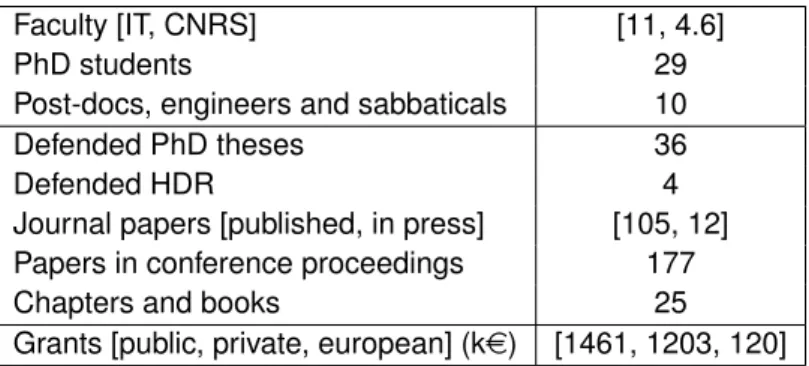
Faculty [IT, CNRS] [7, 3.6]
PhD students 13.6
Post-docs, engineers and sabbaticals 14.6
Defended PhD theses 7
Defended HDR 2
Journal papers [published, in press] [44, 13] Papers in conference proceedings 126 Chapters, edited books [6, 8] Standardization contributions 60 Grants [public, private, european] (ke) [3190; 455; 942]
2.1
Objectives
The research in the “Multimedia” (MM) group covers the life cycle of multimedia documents in the framework of a complete chain, going from authoring tools for on-line and off-line production of multimedia contents to multimodal interaction for the final user; this also includes automated processing like enhancement of degraded pictures, verification of the identity of the user, mod-ification of auditive and visual appearance, image segmentation and pattern recognition. The group also works on techniques that allow the analysis, compression and robust transmission of these media in heterogeneous networks. It also works on the dynamic and distributed adaptation of the transmitted data flow (including meta-data and in particular those concerning the digital rights management) with respect to context, transport conditions and terminal type.
2.2
Main Results
The main research results obtained during the period July 2009 - December 2011 are presented below for the research areas of the Multimedia team.
2.2.1
Robust Compression and Transmission of Visual Data
Faculty B. Pesquet-Popescu, F. Dufaux, M. Cagnazzo
Main events F. Dufaux is Editor-in-Chief of theElsevier Signal Processing: Image Communica-tion journal.
In this period, B. Pesquet-Popescu was a member of the IEEE SPS Image, Video and Mul-tidimensional Signal Processing (IVMSP) TC, of the IEEE SPS Industry DSP Technology (IDSP) standing TC, a member of the IEEE SPS Multumedia Signal Processing (MMSP) TC, Associate Editor forIEEE Trans.on Circuits and Systems for Video Technology,IEEE Trans. on Image Processing, IEEE Trans. on MultimediaandElsevier Signal Processing: Image Communicationjournals. She was also a General Co-Chair of the IEEE MMSP con-ference (Oct.2010).
M. Cagnazzo is Area Editor ofElsevier Signal Processing: Image Communication and of Elsevier Signal Processing.
Projects p ˆole CapDigital Sebastian2 (2008-2010), p ˆole CapDigital PINGO (2008-2010), CEDRE (2009-2010), ANR blanc PERSEE (2009-2012), ITEA2 AC/DC (2010-2012), FUI8 NEXEX (2011-2014)
CHAPTER 2. MULTIMEDIA (MM) 2.2. MAIN RESULTS
2D and 3D video coding
Even though traditional (or 2D) video coding has been studied by the research community for more than twenty years, new methods for improving the existing compression techniques steadily pop up. This is testified by the fact that a new coding standard is under development by ISO and ITU. Our group contributed to 2D video coding with new and efficient methods based on motion vector quantization [109], differential motion estimation [177], efficient lossless coding [114], adaptive wavelet coding [257, 178, 155].
However, much attention has been addressed to three-dimensional and multiview video, since they are theenabling technology of many exciting new applications, such as 3D TV, immersive communication, immersive gaming,etc.Our team has been studing novel representation formats for this kind of data, proposing new compression techniques.
We have designed novel techniques for disparity estimation and coding in multiview video (disparity describes the spatial relationships between a couple of images taken from different points of view), allowing improved performances with respect to standards for multiview video coding. [125, 117, 147]
We have also been considering an emerging representation format called multi-view plus depth (MVD). In MVD, for each view we have a traditional color image plus adepth image. The latter allows to synthesize new viewpoints at the decoder. We developed several techniques to ef-ficiently encode the depth information [147, 194, 179], or to use it to improve the user experience (jointly with distributed video coding techniques, see Section 2.2.1 [272]).
The research of the group in 2D and 3D video compression perfectly fits the framework of the projectANR Blanc PERSEE (PERceptual Scheme for 2D and 3D vidE(E)o coding), in which the members of the group are involved.
Robust video streaming through cooperative networks
Real-time multimedia streaming over computer networks is one of the most active research fields in the last years. The best performing solutions are based on the concept ofcooperative net-works, i.e. networks where each node contributes to the distribution of the content. We studied this problem in the cases of wired and wireless networks.
For the wired case, we built over an existing protocol with the aim of a system meeting video multicast requirements. We developed a new algorithm which mitigates the main problems of the previous one (slow overlay construction and potentially high end-to-end delay) [137].
For the wireless case, we considered mobile ad-hoc networks (MANETs), which are an active research field since they promise scalable and robust audio/video delivery without infrastructure. We studied the problem of real-time video streaming over MANETs and proposed a content routing/delivery protocol inherently designed for the ad-hoc wireless case, exploiting the intrinsic broadcast property of the medium [126]. This problem has several common features with peer-to-peer routing, but the additional sensible parameters of MANETs make wired solutions unfit to this case; therefore, we had to design a brand new protocol.
The resulting protocol is very effective in building and managing the overlay network. Never-theless, it can suffer from congestion if high density or sudden churns are considered. Therefore we designed and implemented a new version of the protocol that optimizes the rate/congestion trade off. The result is a remarkable reduction of delays and of undecodable images, with a clear improvement of the user’squality of experience.
All these systems for video streaming must face with the problem of unreliable connections. Packets can be lost on wireless networks, or can be too delayed on wired networks. In both cases, the video decoder must be able to cope with the case where not all data produced by the encoder are available at the play-back time. A common solution to mitigate this problem is multiple description coding (MDC). In MDC, the encoded stream is structured into indepen-dently decodable elements, called descriptions, such that the decoded video quality increases for any new description received. This robustness comes at the price of a reduced rate/distortion performance. All the proposed streaming protocols work on a MDC video stream. Instead of
2.2. MAIN RESULTS CHAPTER 2. MULTIMEDIA (MM)
using some existing MDC scheme, we proposed some new methods, based on temporal split and motion-compensated image interpolation [218].
Finally, MDC is not the only technique used to adapt a video stream to a lossy channel. Among the alternatives, network coding (NC) is gathering a lot of attention. We are working on the combination of MDC and NC to obtain a robust and low-delay technique for video streaming over unreliable networks [246].
Distributed video coding
Distributed video coding (DVC) is an emerging framework for video compression that allows to greatly reduce the encoder complexity provided that the decoder can sustain an increased com-putational burden. Theorems from information theory assure that this paradigm has the same performance bounds as the classical encoding schemes. Therefore DVC perfectly lends itself to applications such as low-complexity video communications, sensor networks, and, more recently interactive multiview video streaming [273, 272].
We have proposed several methods to improve the performance of DVC systems, based on high-order motion interpolation [271, 269, 270], resulting in considerable gains with respect to state-of-the-art solutions.
We also proposed a new approach that iteratively improves the side information after decoding of each DCT sub-band [164, 165]. This leads to significant rate-distortion gains compared to state-of-the-art, especially for video sequences with complex motion. Another direction explores the combination of global and local motion estimation to improve side information [236]. A second activity focuses on the multi-view distributed coding. In this context, we proposed the use of machine learning (Support Vector Machine) to fuse side information obtained from temporal and inter-view predictions [202].
Semantic Video Coding
Compression standards such as H.264/AVC encode video sequences to maximize fidelity at a given bitrate. However, semantic-oriented and content-aware compression remains a challenge. In this activity, which is part of a CIFRE thesis with Thales, we have developed a new semantic video compression method using seam carving [199]. Seam carving changes the dimension of an image/video with a non-uniform resampling of each row and column while keeping the rectangular shape of the image. Our main contribution is a new approach to identify areas where seams are concentrated. On the one hand, it allows to transmit supplemental seams data at low cost. On the other hand, seams can be synthesized at the decoder in order to recover the original frame size and to preserve the scene geometry. Experiments show that our seam carving method results in significant bitrate savings while maintaining the same quality in semantically significant regions. A patent has been filed.
High Dynamic Range Video
This activity is part of the FUI project NEVEX which began in October 2011. A complete HDR (High Dynamic Range) video system, from content creation to display offers the user the possibil-ity to receive more immersive images. Indeed, HDR images offer a wide range of brightness that can reproduce details in all areas of the image, even bright or dark. This more realistic rendering is closer to human vision than standard HDTV images.
A first objective is to develop new algorithms for inverse tone-mapping to convert existing videos to HDR. In the absence of sensor capable of directly acquiring HDR images, the operation of inverse tone-mapping is a method to create HDR content. Moreover, inverse tone-mapping is also interesting to view legacy video content on new HDR displays, which are now becoming commercially available, maximizing the potential of these screens and thus the quality of the rendered image.
CHAPTER 2. MULTIMEDIA (MM) 2.2. MAIN RESULTS
A second objective is to develop a specific coding scheme suitable for HDR video. It should take into account the constraints of backward compatibility with existing schemes. The standard-ization of such a format will also be explored.
Visual Quality Assessement
Research in the field of video quality assessment relies on the availability of subjective scores (Mean Opinion Scores or MOS), collected by means of experiments in which groups of people are asked to rate the quality of video sequences. The availability of subjective scores is funda-mental to enable validation and comparative benchmarking of the objective algorithms that try to predict human perception of video quality by automatically analyzing the video sequences. In this activity, a publicly available database of subjective quality scores and corrupted video sequences has been created, including 156 sequences at CIF and 4CIF spatial resolutions, encoded with H.264/AVC and corrupted by simulating the transmission over an error-prone network, along with MOS [121].
Current and future activities are looking into visual quality assessment for 3D video.
2.2.2
Rich Media, Adaptation and Open Source Software
Faculty C. Concolato, J.-C. Dufourd, J. LeFeuvre, J.-C. Moissinac
Main events Edition of several ISO and W3C standards, Organization of SVG Open 2010
Projects ANR Radio+(11/08–11/10), ANR HybRadio (), Cap Digital PINGO(04/08–04/10), IST FP6 NoE INTERMEDIA (10/06–10/10), ANR Georacing (01/07–03/09), FUI8 OpenHbb (10/09 – 02/12), SOA2M project/Alcatel Lucent/Institut Telecom joint laboratory (12/08– 12/11), FEDER Project VUE (11/10–11/11), FUI8 End2ToEnd, ANR Calder.
Rich Media Representation
The term ”Rich Media” designates the methods, algorithms, tools or technlogies required for the processing of the new generation of multimedia content, i.e. content that encompasses natural or synthetic audio-visual material but adds animation and interactive capabilities. Rich Media technologies target a wide range of application domains: from digital TV or radio, to mobile multimedia and the Web 2.0.
The research topic that the team pursued in this area are numerous. Some work has been done towards finding the best representation for such content, as well as designing compression approaches for multimedia scene description languages, with features such as error protection and scalability. Other works focused on improving the visualization of such content [144], in par-ticular on mobile phones. Finally, the problems related to the delivery of such content on diverse networks such as broadcast networks have been also investigated. As part of this work, the team is an active participant to standardization bodies such as W3C and ISO. The team has con-tributed (more than 80 contributiions) and participated to the editing of the following international standards: MPEG-4 Systems, MPEG-4 BIFS, MPEG-4 LASeR, and W3C SVG.
Interactive Services and Transmedia
New ways to structure, package and transport interactive content have been studied. The first form is ”widgets”: the team is an active contributor and implementer of the W3C Widgets suite of standards. In order to investigate the full potential of widgets, in particular in the home envi-ronment, the team has spearheaded the development of the MPEG-U standard, which extends W3C widgets to add communication capabilities between widgets and to/from external services. The team is now reformulating the developed concepts for use within the home network with web technologies, as part of the work in the W3C Web and TV IG and the Device API WG. The
2.2. MAIN RESULTS CHAPTER 2. MULTIMEDIA (MM)
second form is interactive TV: the team is active in the development and promotion of the Hybrib Broadband Broadcast TV standard, opening the way for a convergence of TV, Internet and mobile into a new model for distributed, communicating services [115].
Multimedia Adaptation and Multimodal Interaction
The adaptation of multimedia content to its context of use (terminal capabilities, network char-acteristics, user preference) is a very active research topic, with tight link with standardization activities such as MPEG-21 or W3C. The team explores specific problems in the adaptation of multimedia content: adaptation of protected content, adaptation of human-computer interface, and the authoring of adaptable services [144]. These problems are addressed along different axis either by defining software architectures for such adaptations (in relationship with the AS-TRE Team) or by defining methods and languages facilitating the adapation of multimedia docu-ments. A new form of multimedia consumption is emerging: our environment is days after days enriched by more and more multimedia capabilities -displays, sensors, speakers, microphones, touch screens... Our work places the user at the center of such environment and defines tools to get the best benefits of such environment when using multimedia services. Work has been done about implementation and extension of the MMI framework proposed by the W3C [192].
Multimedia Transport
Starting from 2010, the group has been actively involved in the MPEG standardization process of adaptive streaming over HTTP, through the MPEG DASH specification (Dynamic Adaptive Streaming over HTTP, ISO/IEC 23009-1). The group has proposed various modifications to the specification, published articles on the topic of DASH and interactive content delivery, and hosted one of the DASH standardization meeting in Paris. Technical tools helping creation and consump-tion of DASH content have been released as part of the GPAC project, and some of these tools will be given to MPEG as utility software. These tools will also be used to generate conformance sequences to be given to MPEG in early 2012.
GPAC Open Source Software
The team maintains an Open Source platform called GPAC [232], GPAC Project on Advanced Content (http://gpac.sourceforge.net), distributed under an LGPL license. This platform offers various tools for the encoding, the delivery and the playback of multimedia content, ranging from simple audio/video to full-fledge Rich Media. These tools implement state-of-the-art algorithms, methods and protocols from many standards organizations (MPEG, W3C, IETF, ETSI) and are kept in close sync with new industrial deployments. GPAC is used by the academic world (42 citations in journals or international conferences), the industrial world (integrated in several R&D projects) and the internet community (e.g. used for iPod file management). GPAC constitues the back-bone for the implementation of the team’s work (Rich Media representations and adaptation) and is often demonstrated in conferences or standardization meetings.
2.2.3
Document Imaging and Interaction
Faculty L. Likforman, M. Sigelle, C. Faure
Main events L. Likforman was the General Chair of the Document Recognition and Retrieval (DRR) DRR 2010 conference.
Projects FUI Rome Mobile (2010-2012), DGA and Futur et Ruptures (2010-2013), A2iA (2008-2010), Itesoft (2011-2014)
CHAPTER 2. MULTIMEDIA (MM) 2.2. MAIN RESULTS
The team has developed several HMM-based (Hidden Markov Models) approaches for hand-writing recognition (work performed within projects A2iA, DGA, Futur & Rupture and Itesoft). These approaches are based on the Hidden Markov Model framework, especially sliding win-dow systems. In such systems, it is not required to segment the word into smaller units (words or characters). Context-dependent character models have been constructed during the PhD of A-L Bianne for a word recognition approach. Parameter tying is performed through a clustering process based on binary decision trees. Original questions on characters’ shapes have been proposed [113]. The word recognition approach has been extended to text-line recognition [245]. Different language models have been constructed and the whole approach evaluated on a mail reading task (DGA, Futur & Rupture; PhD thesis Olivier Morillot).
A related and new study (started in 2010) is the characterisation of handwriting for retrieving similar documents (with respect to the handwriting). A retrieving application, REX, [163] has been developed which compares documents from orientation-based features [162]. Such features are extracted from normalized histograms of edge pixel orientations.
A new subject (within project Rome Mobile) started in 2010 which aims at decomposing web pages into functional blocs (header, content, footer, title...). Such decomposition is useful for web page adaptation to small screens and mobile phones. Our approach is based on machine learning (Support Vector Machines) using a set of efficient features (based on both content and typography) extracted from web page’s blocks.
Document Image restoration based on seminal work of J. Darbon and M. Sigelle on Total Variation has been applied to ancient documents [167]. A new approach resulting from the com-bination of Total Variation (TV) and Non Local Means has been proposed [133] in collaboration with J. Darbon (CMLA and UCLA) and E. Barney Smith (Boise State Univ.) TV was also used for image denoising, by exact sampling (CFTP) and a relation was highlighted with the submodularity for Markovien models by Marc Sigelle, in collaboration with J. Darbon (CMLA ENS Cachan) and S. Peyronnet (LRI Orsay).
M. Sigelle continued the collaboration with I. Jermyn (INRIA ARIANA) and S. Perreau (UNISA Adelaide Australia) on the topics of (discrete) diffusion processes, which can be applied both to modelling of traffic routing in ad hoc networks and to image restoration [282, 281]. The same techniques have been applied with success in stochastic and markovian optimization of the base station placement, in collaboration with M. Coupechoux (INFRES) and J-M. K ´elif (Orange Labs)
Finally, we continued the work on markovian segmentation of multispectral and multivariate images and Stochastic Expectation Maximization (SEM) hyperparameter estimation, with appli-cation in teledection (joint work with E. Bratsolis from Univ. of Athenes).
2.2.4
Audio-visual Identity/Imposture and Virtual Worlds
Faculty G. Chollet, C. Pelachaud, M. Sigelle, M. Charbit
Main events C. Pelachaud and T. Boubekeur, co-editors special issue on Facial Modeling, IEEE Computer Graphics and Applications, to appear in 2010; C. Pelachaud co-organizer of a Workshop held in conjunction with AAMAS 2009; she is since 2007 secretary of the Humaine association on emotion; she is part of the selection committee of ANR CONTINT (since 2008), ANR Blanc CSD9 Sciences Humaines et sociales (in 2009).
Projects ANR-SurfOnHertz (2010-2013), ANR-ORGAMI2 (2010-2013), AAL-vAssist (2011-2014), FUI-ARHOME (2011-2013), ANR KIVAOU (2008-2010), ANR MYBlog3D (2006-2010), Com-panionAble: IP de IST (2008-2012), ANR blanc OUISPER (2006-2009), IST IP-CALLAS (2006-2010), IST STREP-SEMAINE (2008-2011), IST NoE-SSPNet (2009-2013), COST Action 2102 (2006-2010), ANR CECIL (2009-2011), ANR GV-Lex (2009-2011), ANR IM-MEMO 2011), Projet Web2.0 MyPresenting Avatar 2011), ANR IMIM-MEMO (2009-2011), Bilateral Contract Dialonics (2011-2013), Feder Anipev (2011-2014), FUI Play Se-rious (2011-2014), ILHAIRE (2011-2014), TARDIS (2011-2014), REVERIE (2011-2014), VERVE (2011-2014), STIC-Asie IMEI (2011-2013)