Copyright by
Benjamin Mark Cochran 2012
The Report committee for Benjamin Mark Cochran
Certifies that this is the approved version of the following report:
A Framework for Spatio-Temporal Querying Amongst
Mobile Devices
APPROVED BY
SUPERVISING COMMITTEE:
Christine Julien, Supervisor William Bard
A Framework for Spatio-Temporal Querying Amongst
Mobile Devices
by
Benjamin Mark Cochran, B.S.C.E.
REPORT
Presented to the Faculty of the Graduate School of The University of Texas at Austin
in Partial Fulfillment of the Requirements
for the Degree of
Master of Science in Engineering
THE UNIVERSITY OF TEXAS AT AUSTIN May 2012
For Ashley √
Acknowledgments
I would like to send my appreciation and gratitude towards the Uni-versity of Texas faculty and staff who have made my adventure in graduate studies an enriching experience. In the time I have spent working towards my degree I have undertaken numerous challenges and projects that I normally would not be able to bring to completion. I especially would like to thank a few distinguished individuals starting with Professor Christine Julien for a rewarding exploration of Mobile Computing topics and for advising me on this project. Second, I’d like to thank Professor William Bard for the Advanced Embedded Systems course which was hands down my favorite course and also for serving on my report committee. Finally, I would like to thank Professor Joydeep Ghosh for adding some Data Mining techniques and tools to my tool belt for use in our heavily data-centric world.
A Framework for Spatio-Temporal Querying Amongst
Mobile Devices
Benjamin Mark Cochran, M.S.E. The University of Texas at Austin, 2012
Supervisor: Christine Julien
With mobile web browsers holding around eight percent of the global browser market share in terms of usage, web development for these platforms is becoming critically important as usage moves from the desktop towards mobile devices. Recent advances in client side browser technology like HTML5 and WebSockets have allowed web browser applications to approach feature parity with thick client desktop applications. This paper explores the possibility of a real-time online multiplayer game playable from just a mobile device’s web browser. It does not focus on gameplay or graphics, rather it focuses on the backend infrastructure needed to support such a game. The framework devised to support this sort of interaction, Marionette, is well suited towards addressing sharing of location-specific, short-lived information between people using their smartphones without the use of any external software or proprietary software packages on the client side.
Table of Contents
Acknowledgments v Abstract vi List of Tables ix List of Figures x 1. Introduction 1 2. Related Work 5 2.1 Cornerstone Work . . . 5 2.2 Other Work . . . 7 3. Technology 9 3.1 Architecture . . . 9 3.2 Server Side . . . 10 3.2.1 Juggernaut . . . 10 3.2.2 Node.js . . . 11 3.2.3 Redis . . . 11 3.2.4 Sinatra . . . 12 3.3 Client Side . . . 13 3.3.1 JavaScript . . . 13 3.3.2 AJAX . . . 13 3.3.3 jQuery . . . 14 3.3.4 WebSQL . . . 14 3.3.5 HTML5 . . . 15 3.3.6 Location Services . . . 15 3.3.7 iOS Customization . . . 164. Space Battle! 19 4.1 Basic Premise . . . 19
5. Overarching Design Considerations 21
6. Implementation 22 6.1 Marionette . . . 22 6.2 Space Battle! . . . 24 6.3 Screenshots . . . 25 7. Results 27 7.1 GitHub . . . 27 7.2 Test Harness . . . 27 8. Future Work 29 9. Conclusion 30 Bibliography 31 Vita 34
List of Tables
List of Figures
3.1 Marionette High Level Architecture . . . 9 3.2 Geolocation API functioning in iOS and Android Browsers . . 16 3.3 iOS Customized icon and splash screen . . . 18 6.1 Marionette and Space Battle! files . . . 22 6.2 iOS and Android Screenshots . . . 25
1
Introduction
This paper presents a framework called Marionette for the storage and querying of spatio-temporal events within the mobile computing domain. It leverages technology available in mobile browsers today, allowing them to serve as location aware clients that can execute queries and create events relative to a particular mobile device’s current position. The events are stored and queried within a network consisting of mobile device web browsers that are responsible for handling queries within a certain geographical area referred to as a zone. Bridging the gap between all the web based clients is a reliable soft real-time communications backbone called Juggernaut [4]. Juggernaut uses a channel-based pub-sub model that allows flexible levels of broadcast communication and even unicast communication to one subscriber.
Most mobile network enabled games on the market today have to be implemented at least twice, once for iOS and once for Android. Other devel-opers opt to support one platform or the other due to the differences of the respective platforms. Additionally, there are several other mobile platforms that games could be implemented in but frequently are skipped over in favor of a mobile OS with more market penetration. Most of the major players in
the mobile browser space use WebKit1 based implementations for their web browser, even those used in Blackberry and Symbian OS devices. The mobile browser space is becoming more attractive for game developers as well. The
<canvas>element in HTML52 along with support for Scalable Vector Graph-ics (SVG) within WebKit supported browsers allows for graphGraph-ics rendering capability previously unseen without proprietary plugins such as Adobe Flash Player. It is possible today to make a simple two dimensional game in a mobile web browser and have the experience comparable to a two dimensional game written in the device’s native OS thus making them acceptable candidates for mobile game development. This paper does not focus on graphics in lieu of what it would take to effectively communicate between these client mobile web browsers in spatio-temporal contexts.
Marionette aims to enable distributed spatio-temporal information ex-change via something as simple as opening a tab on a web browser on a mobile device. Current solutions in this area require native OS applications, special-ized hardware, or specialspecial-ized browser plugins. In the past, web browsers in general have historically been limited in their capability for persistent data storage3 and processing4 but are catching up to deliver rich interactive ex-periences that rival thick client applications. Additionally, many older web
1The WebKit Open Source Project
-http://www.webkit.org/ 2HTML5 Standard
-http://html5.org/
3Prior to WebSQL, web developers were constrained by HTTP cookies that had a
max-imum storage capacity of only 4 Kilobytes
4Javascript engines have improved through optimization, as well as libraries and best
browsers lacked the technology to allow the server to push data to the web client in soft real-time. Most mobile device browsers today have increased storage and access to increased processing power, which is advantageous for Marionette because it has virtually no installation requirements and can be run on stock mobile browsers where existing solutions can not. Marionette also adds soft real-time push data capabilities into mobile web development. It operates under the hood within a browser session and presents the potential for not only content delivery via a web portal, but also for the absorption of spatially contextual information based on the user’s location and activi-ties. Marionette opens the door for implementing applications in mobile web browsers instead of writing apps in multiple native operating systems.
Besides mobile gaming, Marionette has other potential uses. Picture a high profile public event such as Austin City Limits (ACL) or South by Southwest (SXSW), where event participants have a large thirst for knowl-edge. These example events are musical in nature and have a lineup with events happening at various times. The acts are relatively short, but there are many happening concurrently. Event goers tend to migrate towards better live performances discovered on-the-fly through word of mouth, primarily through social networks like Twitter. With Marionette one could provide a web portal specifically for attendees to create and distribute information in a grassroots fashion where they can get the latest updates and inform other attendees if there is an act near them that is exceeding expectations and should not be missed. An application using Marionette can provide static content similar to
what a typical website would provide such as a schedule and maps to draw attendees to participate. While visiting, the application can allow users to rate the experiences all around them which gets mixed into the static data dynam-ically in an asynchronous fashion. All of the dynamic data has an expiration date, which makes it short lived and meaningful only for a short period of time which is ideal for event attendees as they would not be interested in stale data about something that has already happened. The data is only available to those viewing the service and not shared publicly on a social network.
This paper also presents a mobile multiplayer online web game enti-tled Space Battle! which is built on top of Marionette to allow the game to be played amongst mobile browsers. The proposed method for information creation and retrieval presented in the next section works well towards de-termining the location of other players within the game. A mobile device’s physical location determines where it is located inside the game, and a player can interact with other players that are physically nearby. To accomplish these gameplay goals, Marionette is used as a medium for propagating in game events.
2
Related Work
2.1
Cornerstone Work
Marionette is based on the work presented in [13] and [12]. In [13] the authors create a Peer-to-Peer (P2P) network for the storage and query of short lived events with spatial context. The authors create a Voronoi tessellation based segmentation relative to the spatial locations of the nodes in its P2P overlay network. Marionette uses a similar construct with regards to the cre-ation of zones which, are created based on other mobile devices nearby, as well as adopting the same “range query” model. When resolving a range query, Marionette calculates a subset of zones where the circular query area with ra-diusr intersects and broadcasts the request to them. If a client node matches the query based on locality and object type requested, it sends the event(s) that matched to the node that originated the query. Where Marionette differs is in the use of a centralized message broker that keeps tabs on the state of each node in the network as opposed to being purely P2P. Another difference is that the mobile browsers themselves become peers without requiring proxy peers, meaning that they do not require an additional land-locked peer to fully participate in network operations. One disadvantage with Marionette’s methodology is that there is a dependency on the message broker in favor of
true P2P. The flow of events and then querying for them in [13] is important towards realizing spatio-temporal information exchange amongst users that share physical locality.
In [12], the authors create a Socio-Aware Overlay for Publish/Subscribe based communications for Delay Tolerant Networks (DTNs). It utilizes a con-cept known as “Node Centrality” to determine communities and broker nodes, those with the shortest path to all of the other nodes. The zones in Marionette (known as communities in [12]) are defined by the Voronoi tessellation as de-fined in [13], but the concept of using pub-sub to facilitate communication is prevalent in Marionette. In Marionette, mobile clients can publish informa-tion as well as be subscribers in a few different levels of spatially progressive granularity ranging from global subscriptions to subscriptions where only one client is subscribed. Distributing the events and queries within zones using a pub-sub methodology allows for more flexibility architecturally where other P2P based approaches have to choose their routing protocols carefully and tie it specifically to a usage model. Flexibility is gained through having the ability to tweak the maximum number of clients per zone and maximum zone size geographically to suit a plethora of different usage models. Flexibility is important towards utilizing Marionette for grassroots deployments and online web gaming as described in the introduction.
In [11], the authors define a spatio-temporal phenomenon as a collection of processes, entities, and events. Processes bind entities and events, and events cause changes in the system. A similar concept is presented in [1]. In
Marionette, events are linked to game entities as every event has an entity identifier. Game participants can then query for those events and use the results to discover how the system has changed over time.
2.2
Other Work
Other related work in the spatio-temporal area includes PeopleNet [7], where topic specific ‘bazaars’ are created with the intent of answering topic specific queries. As [13] mentions, this approach does not preserve locality in storage. The only commonality that Marionette has with the bazaar concept is locality in querying. FLORA [3] is similar in the sense that it uses a hybrid P2P and pub-sub architecture, but Marionette spreads the data throughout the client devices and only utilizes the message broker to pass messages. Ad-ditionally, Marionette does not focus on networking at the carrier level like FLORA does. It is assumed that the query propagation bandwidth in this work will be inconsequential next to audio and visual streaming allowed by most carriers today.
Gander [5] is a personalized search engine for discovering the “ground truth” i.e., short lived information with a spatio-temporal context. The au-thors insert a relevance component into their spatio-temporal data model which aims to rank the search results based on what the user is looking for. Gander shares a similar end goal with Marionette but their architecture is distributed and does not utilize a central message broker. GeoRel [9] is an extension on traditional location based information systems where spatial,
temporal, and motivational considerations are mixed in. GeoRel mainly fo-cuses on assigning relevance of static entities to mobile devices. Marionette differs because there are no static entities; all of the information contained within the system is dynamic.
WebPark [8] introduces post-query filters to traditional Global Infor-mation Retrieval (GIR) systems adding additional geographical context. The most interesting post-query filter added the notion of speed-heading to query results. Based on a mobile device’s current speed and heading, a user could retrieve results along his future path. Marionette does not currently imple-ment some of the extended querying capabilities presented in WebPark, opting for multiple successive range queries as the user’s location changes over time instead. In Secondo [10], the authors create a data model and query language for information retrieval of moving objects in time and space. The work fo-cuses on extending more traditional Database Management Systems (DBMS), which implies that the data be centrally located. With Marionette, the data is distributed amongst its client nodes, which are moving themselves and queried at successive time intervals.
3
Technology
Client Nodes Range Query Zone Query Response Redis 1 4 6 5 7 8 9 1 2 3 4 5 3 RQ(l,r) 2 Sinatra Zones Juggernaut marionette xZone Query published to Zones [1,2,3]
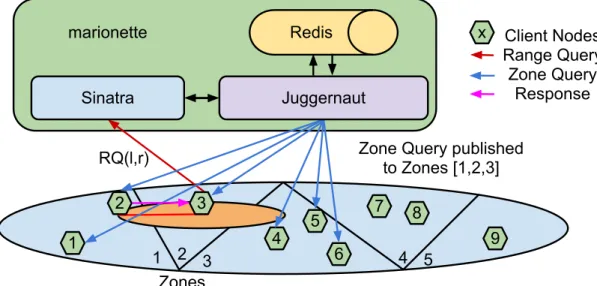
Figure 3.1: Marionette High Level Architecture
3.1
Architecture
Marionette consists of a pub-sub service provided by Juggernaut backed by a Redis1 data store, and a lightweight web application framework called Sinatra2. Together they allow soft real-time communication between the
mo-1Redis open source, advanced key-value store - http://redis.io/
bile devices that are playing the Space Battle! game. Figure 3.1 shows the High Level Architecture (HLA) of Marionette. It also outlines the concept of zones, which are polygons in the Voronoi tessellation, and clients distributed within them. Node three makes a range query with radius r and its current location l and executes a POST operation to the web server. The server cal-culates the zones that overlap the space defined by the range query in orange and publishes the query to them. The clients in the three zones are notified of the query and if any client has an event that matches the query, it gets sent back to node three. If there are multiple matches from different nodes, node three will also receive them. It is expected (but not ensured in the current implementation) that the node that generated the range query will receive the responses asynchronously within a set time window and can then act on any responses received at the end of that time interval.
3.2
Server Side
3.2.1 Juggernaut
Juggernaut is a pub-sub based communications mechanism based on Node.js which provides a soft real-time connection to clients. It is built on top of Node.js and is geared towards communication with client web browsers. It supports a myriad of different browser networking protocols through the use of Socket.IO, most notably WebSocket and Adobe Flash Socket. Socket.IO is an extension of WebSocket that adds support for heartbeats, timeouts, and dis-connection support for use in soft real-time web applications like Marionette.
If the client browser does not support WebSockets, it will fall back to a net-working protocol that is supported like Adobe Flash Socket with no impact on Juggernaut’s functionality. Clients can subscribe to multiple channels at once, each one having its own callback on the client side. In Marionette, Juggernaut is utilized as the central message broker.
3.2.2 Node.js
Node.js3is an event driven software system that is built from the ground up to have asynchronous I/O. This allows Node.js applications, which are mainly server based like Juggernaut, to be highly scalable while minimizing overhead with non-blocking I/O. Node.js excels at simple POST and GET processing and is ideal for the communications backbone of this framework. Additionally, Node.js can span multiple cores and even multiple machines pro-viding simple scalability.
3.2.3 Redis
Redis is a networked lightweight in-memory key-value data store. The whole dataset is stored in RAM, but Redis can optionally be configured for persistence, fulfilling durability requirements. Redis also supports master-slave replication, which allows Redis to become decentralized. Durability and replication are not used within Marionette. A unique aspect of Redis is that
3Node.js, a platform built for easily building fast, scalable network applications http://nodejs.org/
the values it stores can be more than just strings unlike LevelDB4. It can store data types such as lists of strings, sets of strings, sorted sets of strings, and hashes. There are commands that are available to each data type. For instance, you can perform operations like difference, union and intersection on lists, sets and sorted sets. Every Juggernaut instance uses Redis as its primary data storage mechanism such that it can provide channel/subscriber data quickly to Node.js connections.
3.2.4 Sinatra
Sinatra is a lightweight web application framework written in Ruby that abstracts server-side web development in a clean Domain Specific Language (DSL). It is widely regarded as a barebones Ruby on Rails (RoR). Sinatra is used to create simple web applications quickly without a lot of configuration. Several HTML templating options are available for use with Sinatra making it easy to create simple data and event driven websites. In this project, asyn-chronous POST requests from the client web browser are processed by Sinatra as well as generating the data and event driven HTML that is displayed. In Marionette, Sinatra is used to answer POST requests of the individual web clients such that events and queries can be propagated through Juggernaut.
4LevelDB, A fast and lightweight key/value database library by Google. http://code.google.com/p/leveldb/
3.3
Client Side
3.3.1 JavaScript
JavaScript is a dynamically typed scripting language found in any web browser created since 1996, when it was included in Netscape Navigator 2.0 and Internet Explorer 3.0. The language has been internationally standardized under the name EMCAScript since 1997. The usage of JavaScript on client-side web browsers has allowed the creation of many of the interactive web applications we enjoy today such as Gmail. Gmail was one of the first web applications to feature an extensive use of JavaScript, which dispatches user interface events and information queries back to the web server asynchronously without requiring a reload of the page. JavaScript is also the language that Node.js was written in, so it has some server side use cases. In Marionette, JavaScript handles the client side connection to Juggernaut and links button presses to asynchronous POST request generation.
3.3.2 AJAX
Asynchronous JavaScript and XML (AJAX) is a conglomeration of web development technologies used to create client-side asynchronous web ap-plications. These technologies include HTML, CSS, XML (mostly JSON is used now), the Document Object Model (DOM), and XMLHttpRequest with JavaScript to unify them. The term AJAX was derived based on the tech-nology used in implementing Google’s highly interactive web applications like Gmail and Google Maps in 2005. In Marionette, AJAX is used to inform
the web server that a client needs to propagate a new event or query through Juggernaut.
3.3.3 jQuery
jQuery is an efficient and concise JavaScript library which simplifies JavaScript programming for the client browser. It allows you to handle events, create animations, traverse HTML documents, and perform AJAX interactions with ease. It is one of the most popular JavaScript libraries in use today, being used by 52% of the 10,000 most visited websites. It is used in this project to write event handlers and asynchronously post data to the web server. In Mar-ionette, jQuery provides a convenience function for AJAX based postbacks. In Space Battle!, jQuery provides event handlers for UI events like button presses.
3.3.4 WebSQL
WebSQL is a web API that facilitates the creation of local client-side database tables that are queryable using a dialect of SQL. This is primarily used for persistent storage of more complex data that can not be contained within a web cookie due to storage limitations. WebSQL is based on SQLite and once was under consideration for inclusion into the HTML5 specification. Work on including it in HTML5 has since discontinued5, however the
We-5Work on the WebSQL specification ceased citing lack of independent implementations
bKit browsers still ship with the functionality included. The technology set to replace WebSQL is called Indexed Database API (IndexedDB) and does not have any stable support within any browsers currently. In Marionette, WebSQL is the primary event storage mechanism on the client web browser. Received query requests at a given client node searches its WebSQL database and the node returns its matches.
3.3.5 HTML5
HTML5 is a language and group of associated technologies used for the rendering of data on the World Wide Web. HTML5 is the fifth incarnation of the standard which is currently in Working Draft state, which aims to add multimedia support for video, audio and graphics, allowing web developers to depend less on proprietary API’s and plugins. Space Battle! uses HTML5 to render two simple graphical indicators in its UI.
3.3.6 Location Services
The client web browsers need to get their current GPS position to ef-fectively operate within Marionette. To this end, the mobile clients utilize the W3C Geolocation API, which is a standard set of EMCAScript compli-ant objects to get the browser’s physical location. On mobile phones it uses GPS, assisted GPS (aGPS), or WiFi based location services. On desktop web browsers, it attempts to determine the location based on the IP address the client is accessing from. This API always asks for permission to retrieve the
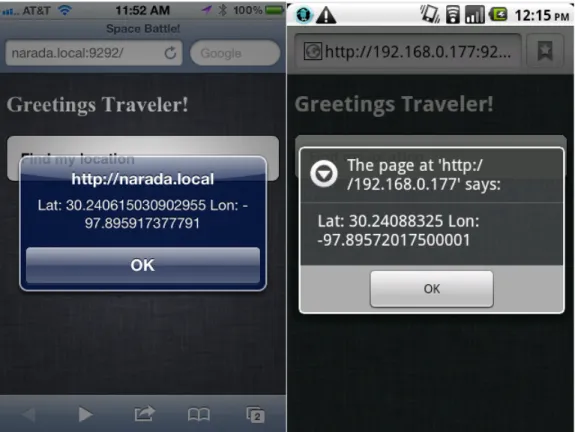
location, the user can optionally deny any request for this information. Figure 3.2 shows that an iOS and an Android web browser reports the device’s lo-cation with a similar fidelity using the Geololo-cation API. Marionette uses the W3C Geolocation API to find the device’s current latitude and longitude and uses that information to generate events and match queries.
Figure 3.2: Geolocation API functioning in iOS and Android Browsers
3.3.7 iOS Customization
Space Battle! is compatibile with most mobile web browsers, however there is some benefit to emulating a native app’s look and feel. To facilitate
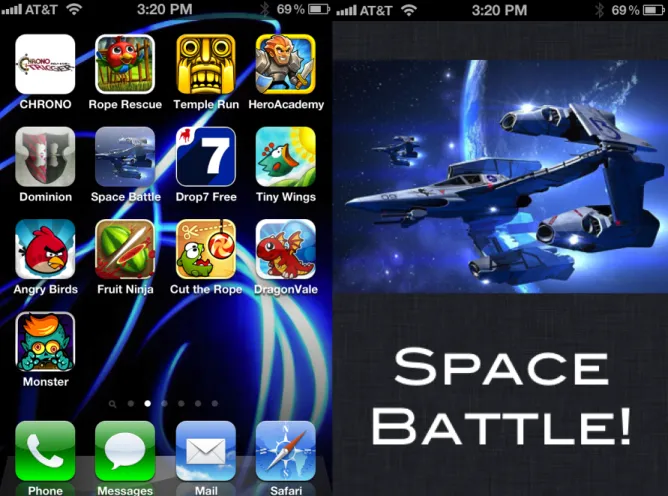
this, iOS allows you to add HTML meta tags that enable a web page bookmark to be saved to the device’s “home screen” and allow custom HTML rendering behavior when using an iOS web browser. Space Battle! adds a splash screen and creates a UI similar to what a native iOS app would look like. When viewing the same HTML on an Android phone, it looks similar, which allows for a solid cross platform interface. If a developer building an application with Marionette wants to have access to more of the native iOS capabilities (e.g., mobile push) you can package the HTML, CSS, and JavaScript together and create a native Objective-C app that exposes the webpage through a
UIWebView class. An in-depth tutorial of creating this support is available at [6].
4
Space Battle!
4.1
Basic Premise
The basic premise of Space Battle! is to demonstrate a subset of basic multiplayer online game mechanics within Marionette. Those mechanics are: location, trade, and player vs. player combat. Starting a new game, a player creates a new spaceship or if the player is returning, he can continue with a spaceship that already exists. To board a spacecraft, the client browser needs a location, which is provided by the Geolocation API. The latitude and longitude queried are normalized into coordinates in a reality overlay to where another player a mile or two away physically would be relatively close in the game. Determining the exact normalization factor would be an exercise best suited during gameplay testing; for now the normalization factor is arbitrary. The current implementation places starships within a 100x100 square grid for ease of prototyping.
The reality overlay is organized into sectors (20 light-year (ly) squares) and a given starship can perform long range sensor scans at a radius of approx-imately 17 light-years. A starship has short range sensors to about 500,000 kilometers (km). A given starship’s weapon range is 150,000 km. Firing on
other starships causes damage to a starship’s components, eventually neces-sitating repair at in-game starbases run by the game masters. Depending on a starship’s coordinates relative to other starships in the general vicinity, a player can perform a variety of actions. This is a perfect use for the range query presented in [13]. The current implementation scales down the vastness of space within a 100x100 2-D plane with 10x10 sectors; starships have a long range sensor scan radius of 8 and weapons range is within a radius of 1.
The data storage mechanism relies on the use of WebSQL on the client web browser instances. For purposes of replication, each client in a zone has a copy of each event such that if a client drops the browser connection the other nodes in the zone can potentially service the query. If a zone’s population approaches zero, it can instruct the remaining nodes to send a copy of the current events to neighboring zones. When a zone no longer has any occupants, it merges with an adjacent zone and queries resolve within the expanded zone. The current Marionette implementation does not support this level of fault tolerance, but it could be added as the framework develops.
5
Overarching Design Considerations
The communications backbone is centralized within Marionette because mobile web browser connections are only open for as long as you are viewing the page. On a mobile device, if a user context switches away from the web browser to a different application, the WebSocket may have disconnected temporarily and may be unable to answer queries. Utilizing a centralized communications backbone is the simplest way to maintain continuity between the web clients within the scope of this work. No game specific data is stored on the message broker. All pieces of the communications backbone (Sinatra, Juggernaut, and Redis) are capable of scaling allowing room to grow should the need arise. With Juggernaut and Sinatra, one can spawn more instances behind a load balancer, and Redis supports replication.
6
Implementation
Sinatra (game.rb) get '/' post '/queries/new' post '/events/new' Juggernaut Redis application.js (jug) jug.js game.js objects.js geo.js (lat, long) utilities.js s e r v e r c l i e n t game.cssFigure 6.1: Marionette and Space Battle! files
6.1
Marionette
The Marionette framework consists of both server and client code. The events and queries are sufficiently generalized to be utilized in a wide variety of applications. Specialization can be accomplished via object-oriented inher-itance or by injecting a serialized object inside an event itself. Space Battle! opted to use simple type inheritance to reduce the number of serialization and deserialization methods between Ruby and Javascript. A client web browser
pulls down all the javascript by visiting the website’s root with a GET request in HTML. Figure 6.1 shows the files that get pulled down by the client browser on the right and all of the server files on the left. The WebSQL database tables are created if they do not currently exist. The server holds static counters for client id, event id, and query id. Whenever the client browser makes a POST request intending for the action to be published via Juggernaut, the server tacks on the unique id and propagates the request to the applicable zones. The response to the POST request contains the id that was assigned so the originating client can update its records.
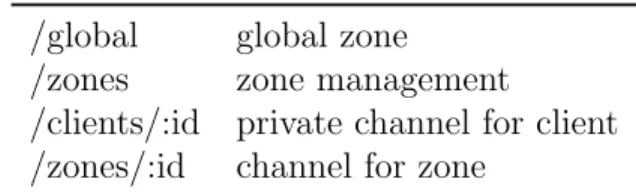
The jug.js file is responsible for instantiating the jug object defined from application.js, which handles interaction with the Juggernaut instance. The client browser can subscribe to any channel, and the current implementation subscribes automatically to the channels shown in Table 6.1.
/global global zone
/zones zone management
/clients/:id private channel for client /zones/:id channel for zone
Table 6.1: Client channel subscriptions in Juggernaut
Publishing to /global would send the content to all connected nodes. The /zones channel is also global but used more often to propagate zone up-dates. All nodes in a zone receive an event when a new zone is added, for example. When you subscribe to a channel, it executes a callback that the Ruby server can listen to. The Ruby server can then assign a zone id based
on the current topology of nodes, which will then trigger the web browser to subscribe to that zone. After the client has subscribed to its zone, it then starts receiving queries that the client can begin resolving.
6.2
Space Battle!
Space Battle! uses the Marionette framework to drive its gameplay events. In the current implementation, only the scanning of other starships is enabled via the use of the range query. Trade and combat mechanics were not able to be implemented, but can be added in very easily as they are built off the primitive query and event objects. Web clients pilot a starship that has a location normalized into a 100x100 grid based on the device’s geographic location. Once the ship is boarded, it can then begin scanning for nearby ships via a range query. The range query in this case contains client’s identification number, the device’s present location, the radius of its sensor sweep, and the type of the object the starship is querying which is other starships. This can be expressed in shorthand asRQ{client id, (x,y), sensor distance, typeof(Starship)} The results of that query will be a collection of other starships that matched and their locations. If a starship is within a radius of one it is considered to be within weapons range and can be fired upon. The implementation is currently very simplistic, however it can be expanded upon to increase gameplay and interaction value by adding more events that can be queried via range query.
6.3
Screenshots
Figure 6.2: iOS and Android Screenshots
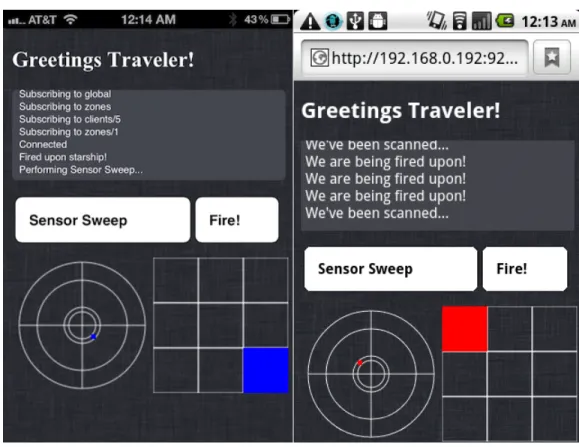
An example game of Space Battle! is shown in Figure 6.2. The simpli-fied game implementation has a few UI buttons, a text console, and a couple of graphical gauges. The gauge on the left shows the results of the sensor sweep, and the gauge on the right shows if there are any ships within attack range. Filled in squares on the right side indicate that there is a ship that could be attacked and serves as a warning that a ship could attack because they are within range themselves. The iOS customization discussed previously has re-moved the address bar and the bottom button bar shown in Figure 3.2 for a
more native feel. The Android screenshot shows that the game can run on Android web browsers released two years ago as the device is running Android 2.1.
7
Results
7.1
GitHub
The implementation of Marionette and Space Battle! is published to GitHub [2]. The implementation will be steadily enhanced over time as the framework matures as the concepts of mobile multiplayer online gaming and grassroots information sharing are explored. The code is licensed under a Cre-ative Commons Attribution-NonCommercial-ShareAlike (BY-NC-SA) license, which makes the code accessible to those interested in studying and enhancing the existing framework.
7.2
Test Harness
To test the interaction between multiple mobile clients, a test harness was constructed that replicated mobile device connections as desktop browser tabs. Using Watir bindings for Ruby, it is a fairly simple matter to create multiple instances of Google Chrome, open multiple tabs within each, and run a stress test that simulates user interaction. Chrome is WebKit based so it represents a natural analog to a mobile web browser. The only difference would be the processing power available to the browser would likely be higher on a
desktop than on a mobile device. The goal of the test harness is to perform concurrent Sinatra/Juggernaut accesses and see if the Marionette framework can handle some degree of request concurrency. Unfortunately, the Chromium web driver was not built to handle concurrent network accesses itself so the test randomly ends after 1200 button presses. For each browser tab the test harness provides a random location within the 100x100 grid and provides a predefined client id. The current implementation only mashes buttons to generate query and event traffic but could easily be modified towards representing a simple artificial intelligence (AI) whose goal it is to fire upon any starship within weapons range.
8
Future Work
There is a good deal of future work that builds on the progress from the early implementation of Marionette and Space Battle!. Marionette could be simplified to not build Ruby equivalent classes for the event and query objects in Javascript since they are just getting passed to Juggernaut. This was a remnant of an earlier idea that needs to be cleaned up and would reduce the complexity of the serialization and deserialization routines in Javascript. In the initial implementation, all of the locations were relatively unchanged in the test harness. Some work would need to be done towards deciding when to adjust the zone allocations after a client has physically moved out of its originating zone. The test harness can also be enhanced to move the starships around the 100x100 grid to discover how to best tackle client migration as well as outfit the simulated pilots with AI and tweak gameplay parameters from there. Fault tolerance of the client nodes is also an area that needs work based on the initial implementation.
9
Conclusion
This paper addressed the possibility of sharing of location-specific, short-lived information between people using the web browser on their mobile devices without requiring the installation of additional software or proprietary plugins. To enable this level of communication between mobile devices a new framework was presented, Marionette. It utilizes a pub-sub service in conjunc-tion with events distributed amongst the client devices that could be queried by means of a range query. This technique would allow the creation of grass-roots information sharing relative to the user’s surroundings. This paper also presented a mobile multiplayer online game called Space Battle!, which utilizes Marionette as a means of communicating game events to other mobile devices. Several multiplayer online game mechanics work well with the event and query model that Marionette provides. Explorations with respect to the Marionette framework need to be further explored in the future, however the Space Battle! game serves as an adequate basic implementation and demonstration of the ideas presented herein.
Bibliography
[1] J. Chen and J. Jiang. Event-based spatio-temporal database design. In Proceedings of ISPRS, 1998.
[2] B. Cochran. azurewraith/marionette. https://github.com/azurewraith/ marionette.
[3] R. Kokku, K. Sundaresan, and G. Jiang. Enabling location specific real-time mobile applications. In Proceedings of the 3rd international workshop on Mobility in the evolving internet architecture, pages 19–24. ACM, 2008.
[4] A. MacCaw. maccman/juggernaut. https://github.com/maccman/ juggernaut.
[5] J. Michel, C. Julien, J. Payton, and G.C. Roman. Gander: Personalizing search of the here and now. Technical report, Technical Report TR-ARiSE-2011-007, The University of Texas at Austin, 2011.
[6] M. Might. Howto: Create native-looking iPhone/iPad applications from HTML, CSS and Javascript. http://tinyurl.com/matt-might-ios-js. [7] M. Motani, V. Srinivasan, and P.S. Nuggehalli. Peoplenet: engineering a
inter-national conference on Mobile computing and networking, pages 243–257. ACM, 2005.
[8] D. Mountain and A. Macfarlane. Geographic information retrieval in a mobile environment: evaluating the needs of mobile individuals. Journal of Information Science, 33(5):515–530, 2007.
[9] T. Reichenbacher. Geographic relevance in mobile services. In Proceed-ings of the 2nd International Workshop on Location and the Web, page 10. ACM, 2009.
[10] V. Teixeira de Almeida, R. Hartmut Guting, and T. Behr. Querying moving objects in secondo. In Mobile Data Management, 2006. MDM 2006. 7th International Conference on, pages 47–47. IEEE, 2006.
[11] S. Wang, K. Nakayama, Y. Kobayashi, and M. Maekawa. An event-based spatiotemporal approach. ECTI Transactions on Computer and Information Technology, Thailand, 2005.
[12] E. Yoneki, P. Hui, S.Y. Chan, and J. Crowcroft. A socio-aware overlay for publish/subscribe communication in delay tolerant networks. In Proceed-ings of the 10th ACM Symposium on Modeling, analysis, and simulation of wireless and mobile systems, pages 225–234. ACM, 2007.
[13] A. Ziotopoulos and G. De Veciana. P2p network for storage and query of a spatio-temporal flow of events. In Pervasive Computing and
Commu-nications Workshops (PERCOM Workshops), 2011 IEEE International Conference on, pages 483–489. IEEE, 2011.
Vita
Benjamin Mark Cochran was born in northern Indiana in 1982. He graduated with honors from Penn High School in Mishawaka, IN in 2001 and was a member of the FIRST Robotics team his senior year. During undergrad-uate studies he was a member of Theta Tau, the oldest, largest and foremost Fraternity for Engineers. He received his Bachelor of Science degree in Com-puter Engineering from Purdue University in 2005. Shortly after graduation in early 2006 he accepted a position at Advanced Micro Devices (AMD) in Austin, TX as a Product Development Engineer focusing on DDR and Hy-perTransport I/O interfaces and test automation. In early 2010, he began graduate studies at the University of Texas at Austin, pursuing a Master of Science in Engineering degree. He is passionate about emerging web tech-nologies, mobile computing, test automation, and software engineering best practices. In his free time he enjoys fine beers, video games, mountain biking, and watching movies at the Alamo Drafthouse.
Permanent address: [email protected]
This report was typeset with LATEX† by the author.
†LATEX is a document preparation system developed by Leslie Lamport as a special