Contents lists available atScienceDirect
International Journal of Approximate Reasoning
j o u r n a l h o m e p a g e :w w w . e l s e v i e r . c o m / l o c a t e / i j a r
A genetic tuning to improve the performance of Fuzzy Rule-Based
Classification Systems with Interval-Valued Fuzzy Sets: Degree of ignorance
and lateral position
J. Sanz
a,∗, A. Fernández
b, H. Bustince
a, F. Herrera
caDepartamento de Automática y Computación, Universidad Pública de Navarra, Campus Arrosadía s/n, P.O. Box 31006, Pamplona, Spain bDepartment of Computer Science, University of Jaén, P.O. Box 23071, Jaén, Spain
cDepartment of Computer Science and Artificial Intelligence, CITIC-UGR (Research Center on Information and Communications Technology),
University of Granada, P.O. Box 18071, Granada, Spain
A R T I C L E I N F O A B S T R A C T
Article history:
Received 18 May 2010 Revised 24 January 2011 Accepted 27 January 2011 Available online 4 February 2011
Keywords:
Fuzzy Rule-Based Classification Systems Interval-Valued Fuzzy Sets
Ignorance functions
Linguistic 2-tuples representation Genetic Fuzzy Systems Tuning
Fuzzy rule-based systems are appropriate tools to deal with classification problems due to their good properties. However, they can suffer a lack of system accuracy as a result of the uncertainty inherent in the definition of the membership functions and the limitation of the homogeneous distribution of the linguistic labels.
The aim of the paper is to improve the performance of Fuzzy Rule-Based Classification Systems by means of the theory of Interval-Valued Fuzzy Sets and a post-processing ge-netic tuning step. In order to build the Interval-Valued Fuzzy Sets we define a new function called weak ignorance for modeling the uncertainty associated with the definition of the membership functions. Next, we adapt the fuzzy partitions to the problem in an optimal way through a cooperative evolutionary tuning in which we handle both the degree of ig-norance and the lateral position (based on the 2-tuples fuzzy linguistic representation) of the linguistic labels.
The experimental study is carried out over a large collection of data-sets and it is sup-ported by a statistical analysis. Our results show empirically that the use of our methodology outperforms the initial fuzzy rule-based classification system. The application of our coop-erative tuning enhances the results provided by the use of the isolated tuning approaches and also improves the behavior of the genetic tuning based on the 3-tuples fuzzy linguistic representation.
© 2011 Elsevier Inc. All rights reserved.
1. Introduction
Computational intelligence based methods have shown themselves to be useful tools to solve complex problems in classification tasks. Among them, Fuzzy Rule-Based Classification Systems (FRBCSs) [36] are widely employed since they allow us to deal with noisy, imprecise or incomplete information which is often present in many real world problems. They provide a good trade-off between the empirical precision of traditional engineering techniques and the interpretability achieved through the use of linguistic labels whose semantic is close to the natural language. The high number of real world applications (see [1,42,49,55]) in which these systems are employed supports their goodness in dealing with classification problems.
∗Corresponding author.
E-mail addresses: [email protected] (J. Sanz), [email protected] (A. Fernández), [email protected] (H. Bustince), herrera@ decsai.ugr.es (F. Herrera).
0888-613X/$ - see front matter © 2011 Elsevier Inc. All rights reserved. doi:10.1016/j.ijar.2011.01.011
Hybrid approaches are commonly applied to improve the behavior of fuzzy systems [8,20,24,46]. One of the most popular approaches is the hybridization of fuzzy logic and Genetic Algorithms (GAs) leading to Genetic Fuzzy Systems (GFSs) [17, 18,33]. A GFS is basically a fuzzy system augmented by a learning process based on evolutionary computation. The most extended GFS type is the genetic fuzzy rule-based system, where an evolutionary algorithm is employed to learn or tune different components of a fuzzy rule-based system. Specifically, the genetic tuning process consists of automatically selecting the best system parameters for improving the performance of the final model without modifying the existing rule base. The applicability of genetic tuning is clearly shown in the specialized literature, where we can find proposals that introduce linguistic modifiers for tuning the membership functions [12], approaches to perform lateral tuning [5,25], multiobjective approaches for rule reduction and parameter tuning [26], methods for tuning of Type-2 fuzzy systems [13,34,43,53] or applications to solve real world problems [45], among others.
The success of the methods previously presented depends, to a large degree, on the choice of the membership functions which model the linguistic labels. This choice is a complex problem as there is an inherent uncertainty in the definition of the membership functions, which are usually defined either homogeneously over the input space or by means of expert knowledge. In both cases, the uncertainty can be taken into account by employing the theory of Interval-Valued Fuzzy Sets (IVFSs) [47].
An IVFS provides a lower and an upper bound for the membership value. It defines a membership interval whose length can be seen as the degree of uncertainty when assigning the membership of the element to the set. In fact, one of the most recent construction methods of IVFSs is based on ignorance functions in order to model this uncertainty [11]. IVFSs have been applied successfully in classification tasks [48], approximate reasoning [9], decision making [14] and image processing [10], among others.
Following on from the above, we propose a methodology in which we use IVFSs to model the linguistic labels of the system. We define theweak ignorance function, based on the ignorance function [11] for computing the degree of ignorance (lack of information) associated with the definition of the membership functions. We also propose a new parametrized IVFS construction method. This method allows us to automatically construct an IVFS from a given fuzzy set using weak ignorance functions. In this manner, we can build the IVFSs model from any initial knowledge base in such a way that the length of each IVFS is proportional to the degree of ignorance. The IVFSs model maintains the interpretability of the system as it uses the same linguistic labels and also the same rules. The representation of the linguistic labels by means of IVFSs leads to a natural extension of both the Fuzzy Reasoning Method (FRM) and the computation of the rule weight.
Furthermore, we propose the definition of a single methodology that allows the simultaneous tuning of both the degree of ignorance and the lateral position (based on the 2-tuples fuzzy linguistic representation [31]) of the linguistic labels. This methodology can exploit the good features of both tuning approaches, leading to a better adaptation of the fuzzy partitions. Its final aim is to improve the performance of FRBCSs in a general framework.
In order to show the goodness of our proposed methodology, we will use the Fuzzy Hybrid Genetics-Based Machine Learning (FH-GBML) rule learning algorithm [37] in order to generate the initial knowledge base. This algorithm has been shown to be able to generate a robust FRBCS [25,41], offering a solid base on which to apply our methodology, and therefore allowing a high classification accuracy to be achieved.
The study is aimed to show whether the results obtained by the application of our methodology enhances the results of the base FH-GBML algorithm. Furthermore, we evaluate the differences in performance with respect to the two tuning approaches that compose our model when they are applied separately. Moreover, we show the good management of the uncertainty of our methodology with respect to the tuning model based on the linguistic 3-tuples representation [3], which performs a tuning of both the amplitude of the support and the lateral position of fuzzy sets but does not take into account the ignorance inherent in the definition of the linguistic labels. To do so, we perform the experimental study over 24 data-sets selected from the KEEL data-set repository [6,7] (http://www.keel.es/dataset.php). In order to give statistical support to the findings extracted from the experimental analysis, we carry out some non-parametric tests as suggested in the specialized literature [21,27,29].
This paper is organized as follows: in Section2we introduce some basic concepts of FRBCSs together with the description of the rule learning algorithm considered in this paper. In Section3we describe a procedure to build IVFSs starting from fuzzy sets and using weak ignorance functions. Section4describes in detail the FRBCS with the linguistic labels modeled by means of IVFSs and the modifications performed in the FRM in order to work with this representation of the linguistic terms. Then, in Section5we describe the methodology proposed for the cooperative evolutionary tuning approach. Finally, we show an experimental study in Section6and we summarize the paper with the main concluding remarks in Section7. 2. Fuzzy Rule-Based Classification Systems
In this section we present a brief introduction of FRBCSs. First, we will describe the type of fuzzy rules used in this work, together with the rule weight and the FRM. Next, we will present the FH-GBML rule learning algorithm [37].
2.1. Fuzzy Rule-Based Classification Systems
There are a lot of techniques in the Data Mining field to deal with the classification problem. Among them, FRBCSs provide an interpretable model by means of the use of linguistic labels in their rules.
Considermlabeled patternsxp
=
(
xp1, . . . ,
xpn)
,p=
1,
2, . . . ,
mwherexpiis theith attribute value(
i=
1,
2, . . . ,
n)
. We have a set of linguistic values (and their membership functions) describing each attribute. We use fuzzy rules of the following form:RuleRj
:
Ifx1isAj1and. . .
andxnisAjnthen Class =CjwithRWj,
(1) whereRjis the label of thejth rule,x=
(
x1, . . . ,
xn)
is ann-dimensional pattern vector,Ajiis an antecedent fuzzy set representing a linguistic term,Cjis a class label, andRWjis the rule weight [35]. Specifically, in this paper the rule weight is computed using the Penalized Certainty Factor defined in [38] as:PCFj
=
xp∈ClassCjμ
Aj(
xp)
−
xp∈/ClassCjμ
Aj(
xp)
m p=1μ
Aj(
xp)
.
(2)Letxp
=
(
xp1, . . . ,
xpn)
be a new pattern,Ldenote the number of rules in the rule base andMthe number of classes of the problem; then, the steps of the FRM [16] are as follows:(1) Matching degree, that is,the strength of activation of the if-part for all rules in the rule base with the pattern xp.A conjunction operator (t-norm) is applied in order to carry out this computation.
μ
Aj(
xp)
=
T(μ
Aj1(
xp1), . . . , μ
Ajn(
xpn)),
j=
1, . . . ,
L.
(3) (2) Association degree. To compute theassociation degree of the pattern xpwith the M classes according to each rule in therule base.When using rules in the form shown in (1) this association degree only refers to the consequent class of the rule (i.e.k
=
Class(
Rj)
).bkj
=
h(μ
Aj(
xp),
RW kj
),
k=
1, . . . ,
M,
j=
1, . . . ,
L.
(4)(3) Pattern classification soundness degree for all classes. We use an aggregation function that combines the positive degrees of association calculated in the previous step.
Yk
=
f(
bkj,
j=
1, . . . ,
Landbkj>
0),
k=
1, . . . ,
M.
(5) (4) Classification. We apply a decision functionFover the soundness degree of the system for the pattern classificationfor all classes. This function will determine the class labellcorresponding to the maximum value.
F
(
Y1, . . . ,
YM)
=
argmax(
Yk)
k=1,...,M.
(6)
2.2. Fuzzy hybrid genetic based machine learning rule generation algorithm
Different GFSs have been proposed in the specialized literature for designing fuzzy rule-based systems in order to avoid the necessity of linguistic knowledge from domain experts [18,26,33,44].
The basis of the method described here, the FH-GBML algorithm [37], consists of a Pittsburgh approach where each rule set is handled as an individual. It also contains a Genetic Cooperative Competitive Learning (GCCL) approach (an individual represents a unique rule), which is used as a kind of heuristic mutation for partially modifying each rule set, because of its high search ability to efficiently find good fuzzy rules.
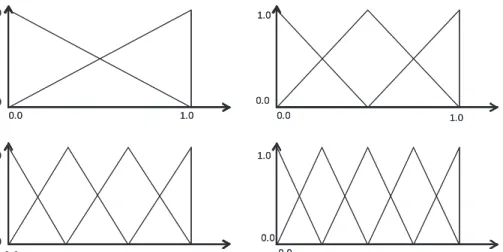
This method simultaneously uses four fuzzy set partitions for each attribute, as shown in Fig.1. As a result, each antecedent attribute is initially associated with 14 fuzzy sets generated by these four partitions as well as a special “do not care” set, i.e., 15 in total.
The main steps of this algorithm are described below: Step 1: GenerateNpoprule sets withNrulefuzzy rules.
Step 2: Calculate the fitness value of each rule set in the current population.
Step 3: Generate
(
Npop−
1)
rule sets by selection, crossover and mutation in the same manner as the Pittsburgh-style algorithm. Apply a single iteration of the GCCL-style algorithm (i.e., the rule generation and the replacement) to each of the generated rule sets with a pre-specified probability.Step 4: Add the best rule set in the current population to the newly generated
(
Npop−
1)
rule sets to form the next population. Step 5: Return to Step 2 if the pre-specified stopping condition is not satisfied.Next, we will describe every step of the algorithm:
•
Initialization:Nrule training patterns are randomly selected. Then, a fuzzy rule from each of the selected training patterns is generated by choosing probabilistically (as shown in (7)) an antecedent fuzzy set from the 14 candidates0.0 0.0 0.0 0.0 0.0 0.0 0.0 0.0 1.0 1.0 1.0 1.0 1.0 1.0 1.0 1.0 0.0 0.0 0.0 0.0 0.0 0.0 0.0 0.0 1.0 1.0 1.0 1.0 1.0 1.0 1.0 1.0
Fig. 1. Four fuzzy partitions for each attribute membership function.
replaced withdon’t careusing a pre-specified probabilityPdont care
P
(
Bk)
=
μ
Bk(xpi)
14
j=1
μ
Bj(
xpi)
.
(7)•
Fitness computation: The fitness value of each rule setSiin the current population is calculated as the number of correctly classified training patterns bySi. For the GCCL approach the computation follows the same scheme, counting the number of correct hits for each single rule.•
Selection: It is based on binary tournament.•
Crossover: The substring-wise and bit-wise uniform crossover are applied in the Pittsburgh part. In the case of the GCCL part only the bit-wise uniform crossover is considered.•
Mutation: Each fuzzy partition of the individuals is randomly replaced with a different fuzzy partition using a pre-specified mutation probability for both approaches.For more details about this proposal, please refer to [37].
3. Linguistic Labels Modeled by means of Interval-Valued Fuzzy Sets
In this section, we will recall the definitions of IVFS and ignorance functions [11]. Furthermore, we propose the use of the ignorance function depending on only one variable and we denote this new function as theweak ignorance function. Finally, we present a new construction method of IVFSs starting from fuzzy sets and using weak ignorance functions.
3.1. Interval-Valued Fuzzy Sets
In the introduction of this paper, we stressed the significance of selecting the membership functions for modeling the linguistic terms fitted as much as possible for a specific problem and, therefore, allowing a better representation of the knowledge. In particular, the selection of the membership function must be done while keeping as much information as possible. IVFSs allow us to do this because they assign as membership an interval instead of a single number. These sets were born in the 1970s with the work of Sambuc [47]. In the 80s, Gorzalczany denoted these sets for the first time as IVFSs [30].
We should point out that IVFSs are also known as Interval Type-2 Fuzzy Sets in the specialized literature. For example, Liang and Mendel have carried out a deep study about these sets in [40], Wu and Mendel gave uncertainty measures for these sets in [54] and also operations for type-2 fuzzy sets are given in [15,22,51,52].
Definition 1. An Interval-Valued Fuzzy Set (IVFS)Aon the universeU
= ∅
is given by:A
= {
(
u,
A(
u))
|
u∈
U}
,
where
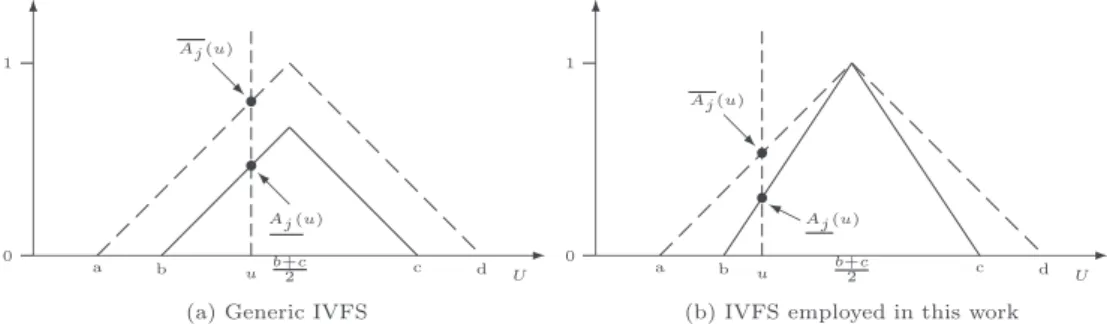
Fig. 2. Examples of IVFSs. The pointsa, b,b+2c, c, ddefine the bounds of the IVFS.
being
L
(
[
0,
1]
)
= {
x= [
x,
x]|
(
x,
x)
∈ [
0,
1]
2andx≤
x}
Obviously,A
(
u)
= [A(
u)
,A(
u)
] is the membership degree ofu∈
U. Fig.2depicts two examples of IVFSs: the interval[
Aj(
u),
Aj(
u)
]
and not a number from[
0,
1]
is assigned as the membership to each elementu∈
U.3.2. Weak ignorance function
The concept of ignorance functions is defined in [11] in order to quantify the uncertainty that an expert has when he or she assigns numerical values to the memberships of an element to two different classes.
Definition 2. An ignorance function is a continuous mappingGi
: [
0,
1]
2→ [
0,
1]
so that:(
Gi1)
Gi(
x,
y)
=
Gi(
y,
x)
for allx,
y∈ [
0,
1];
(
Gi2)
Gi(
x,
y)
=
0 if and only ifx=
1 ory=
1;
(
Gi3)
Ifx=
0.
5 andy=
0.
5, thenGi(
x,
y)
=
1;
(
Gi4)
Giis decreasing in[
0.
5,
1]
2;
(
Gi5)
Giis increasing in[
0,
0.
5]
2.
Observe that this definition implies that we have assumed that a value of 0.5 corresponds to the complete lack of knowledge of the expert on the membership of an element to a class. In [11] the five axioms in Definition2are justified. Proposition 1. LetGi
: [
0,
1]
2→ [
0,
1]
be an ignorance function. The mapping:g
: [
0,
1] → [
0,
1]
given byg
(
x)
=
Gi(
x,
1−
x)
is a continuous function that satisfies: (i) g
(
x)
=
g(
1−
x)
for allx∈ [
0,
1];
(ii) g(
x)
=
0 if and only ifx=
0 orx=
1;
(iii) g(
0.
5)
=
1.
Proof. It is enough to take into account Definition2.
Definition 3. A continuous mappingg
: [
0,
1] → [
0,
1]
is called weak ignorance function if it satisfies the items (i)–(iii) in Proposition1.The name is due to the fact that they are only associated with one element, in the sense that they depend on a single variable, and not on two. We will use weak ignorance functions in order to quantify the lack of knowledge that exists when assigning a numerical value to the membership of an element to a given linguistic label.
3.3. Construction of Interval-Valued Fuzzy Sets starting from fuzzy sets and weak ignorance functions
In this paper, we use bijections in order to construct IVFSs in such a way that their amplitude is proportional to the weak ignorance function having the maximum ignorance degree when the initial membership degree is 0. Therefore, we employ a bijectionh
: [
0,
1] → [
0.
5,
1]
so thath(
0)
=
0.
5 andh(
1)
=
1. Specifically, we employ the following one:h
(
x)
=
12x
+
1 2We build the upper bound of an IVFS (dashed line in Fig.2(b)) starting from a fuzzy set, like the one depicted with a solid line in Fig.2(b) where the membership function of this fuzzy set is:
μ
A(
x)
=
⎧ ⎪ ⎪ ⎪ ⎪ ⎨ ⎪ ⎪ ⎪ ⎪ ⎩ 0,
ifx<
b,
2 c−b(
x−
b),
ifb≤
x≤
b+c 2 andc=
b,
2 b−c(
x−
c),
if b+c 2<
x≤
candc=
b,
0,
ifc<
x.
(8)We must point out that we callr1the straight line that joins the points
(
b,
0)
andb+c 2
,
1 . r1≡
y=
2 c−
b(
x−
b).
(9)By symmetry, the study is only carried out for the left side of the triangular membership function, that is, for the values less than or equal tob+2c.
We can define the pointain function of the points of the previous straight line so thata
=
b−
W(
c−
b)
, whereW≥
0 stands for the displacement with respect to the pointb. Considering this fact, the equation of the straight line that joins the points(
a,
0)
and b+c 2,
1 is: r2≡
y=
2(
c−
b)(
1+
2W)
(
x−
b+
W(
c−
b)).
(10)Given the functionshandgpreviously defined, for simplicity we denoteH
=
h◦
g.In the following proposition we present the construction method of IVFSs from a fuzzy set and the weak ignorance function associated with this fuzzy set:
Proposition 2. Let the fuzzy set A given in Eq. (8) and let
β(
x)
,γ (
x)
∈ [
0,
1]
. Under these conditions:μ
A(
x), μ
A(
x)
1−
β(
x)
Hμ
A(
x)
+
γ (
x)
Hμ
A(
x)
∈
L(
[
0,
1]
)
if and only ifβ(
x)μ
A(
x)
≤
γ (
x)
≤
1 H(μ
A(
x))
1−
μ
A(
x)
1−
β(
x)
H(μ
A(
x))
for allx∈
.
Proof. Direct.Remark 1. Note that under the conditions of Proposition2:H
(μ
A(
x))
=
0 for allx∈
.We must point out that
μ
A(
x)
isr1(
x)
between (b, 0) and (b+2c,1) and therefore, the expression of the upper bound givenin Proposition2isr2
(
x)
between (a, 0) and (b+2c,1).It is easy to prove that in the construction method presented in Proposition2the length of the intervals,L, is always proportional to the weak ignorance function up to a bijection. In fact, we have the following result:
Proposition 3. The length of the interval built in Proposition2is:
L
(
x)
=
γ (
x)
−
μ
A(
x)β(
x)
H
(μ
A(
x))
for allx∈
.
Proof. Direct.4. Fuzzy Rule-Based Classification Systems based on Interval-Valued Fuzzy Sets
As we have stated in the introduction section, we propose to model the linguistic labels by means of IVFSs in order to take into account the uncertainty inherent in the definition of the membership functions. This modeling implies that the rule weight must be composed of two numbers and we also have to adapt the FRM to work with this representation.
According to these issues, the construction of the IVFS partition is explained in Section4.1and both the extension of the FRM and the computation of the rule weight are described in Section4.2.
4.1. Interval-Valued Fuzzy Sets based fuzzy partition
In this paper we employ fuzzy partitions composed of IVFSs with the structure that has been depicted in Fig.2(b) (Section3), where the solid line represents the lower bound (Aj) and the dashed line represents the upper bound (Aj).
The construction method of each IVFS is the one presented in Section3.3considering as the initial fuzzy sets those defined by expert knowledge or defined homogeneously over the input space. We must point out that the parameterWcan take values in the interval
[
0,
0.
5]
. The upper and the lower bounds of this interval correspond to the following notable situations:•
Total certainty (W= 0): the linguistic label is perfectly defined by means of the initial fuzzy set. That is, when the lower and the upper bounds of an IVFS are the same.•
Maximum uncertainty(
W=
0.
5)
: there is a huge lack of information in the definition of the linguistic label. So, the amplitude of the upper bound of the IVFS is twice the amplitude of the lower bound.Therefore, in the initial construction we set the parameterWto 0.25 since it is the intermediate situation between the ones previously described. In this manner, the amplitude of the upper bound is 50% greater than the one of the lower bound (details are given in Section5.1).
We will employ rules in the form presented in Section2.1where eachAjiwill be an IVFS instead of a fuzzy set.
4.2. Fuzzy reasoning method
The modifications in the structure of the fuzzy labels also imply an extension of the original FRM used for classifying new patterns. Letxp
=
(
xp1, . . . ,
xpn)
be a new pattern; the general model of fuzzy reasoning for classification, presented in Section2.1, will be modified in the following way:(1) We have twomatching degreesbecause we are working with an interval, each one will be associated with the lower and the upper bound respectively and will be calculated applying a T-norm in the following way:
μ
LAj(
xp)
=
T(
Aj1(
xp1), . . . ,
Ajn(
xpn)),
j=
1, . . . ,
L,
(11)μ
UAj(
xp)
=
T(
Aj1(
xp1), . . . ,
Ajn(
xpn)),
j=
1, . . . ,
L.
(12) We apply a T-norm to both lower and upper bounds. Therefore, the matching degrees obtained form the following interval:[
μ
LAj(
xp), μ
UAj(
xp)
]
.
(2) Asassociation degreewe take the mean of the product of the matching degree by the rule weight, which is composed of two numbers, associated with the lower and the upper bound respectively. The rule weights will be denoted as
PCFLjandPCFUjand their computation will be made following Expression (2), considering the lower and the upper bounds to be the terms in each case, that is:
PCFLj
=
xp∈ClassCjAj(
xp)
−
xp∈/ClassCjAj(
xp)
m p=1Aj(
xp)
,
(13) PCFUj=
xp∈ClassCjAj(
xp)
−
xp∈/ClassCjAj(
xp)
m p=1Aj(
xp)
.
(14)The final association degree will be computed as follows:
bkj
=
μ
LAj(
xp)
∗
PCFLjk
+
μ
UAj
(
xp)
∗
PCFUjkAt this point we already have a single value associated with the class. Accordingly, we can apply the rest of the method in the same way as in the general FRM presented in [16].
5. Genetic tuning of the data base for Interval-Valued Fuzzy Sets
Most of the FRBCSs proposed in the literature, in particular the FH-GBML algorithm, are mainly focused on determining the set of fuzzy rules composing the rule base of the model, rather than finding an optimal definition of the data base, which may cause the cooperative behavior of the rules to be less than optimal. Specifically, the membership functions that compose the data base are usually obtained by a normalization process and they remain fixed during the rule base derivation process. This fact usually implies that the membership functions are not properly adapted to the context of each variable, which limits the performance of the global rule set.
To solve this problem, a post-processing tuning step is often used. This methodology consists of refining the initial definition of the data base once the rule base has been obtained [2,4,39]. The tuning introduces a variation in the shape of the membership functions that improves their global interaction with the main aim of inducing better cooperation among the rules [5,12]. In this way, the real aim of the tuning is to find the best global configuration of the membership functions and not only to find specific membership functions in an independent way.
In order to carry out this tuning step, in our previous work on the topic we considered tuning the amplitude of the support of the upper bound [48] and in this way to manage the ignorance that each IVFS represents. Also, in the specialized literature we found an approach to make a lateral adjustment of the fuzzy labels based on the 2-tuples fuzzy linguistic representation which obtained very accurate models [5,25]. In this work we want to go one step further and combine these two approaches in a cooperative model.
In the remainder of this section we will first introduce the two tuning approaches and then we will present our proposal to carry out both tunings simultaneously. Finally, we will describe in detail the evolutionary process for tuning the membership functions.
5.1. Weak ignorance tuning of the linguistic labels
In Section4.1we have shown that the initial construction of the IVFSs is performed by associating an intermediate degree of uncertainty with the definition of the linguistic labels. In this manner, the amplitude of the support of the upper bound is fixed for all the IVFSs but, as the amount of uncertainty associated with the definition of each linguistic label can differ, the support of the upper bound of each IVFS is variable. In other words, the degree of ignorance each IVFS represents does not need to be the same for all IVFSs in the data base [48].
To deal with this problem, we apply a post-processing genetic tuning step in order to improve the behavior of the FRBCSs performing slight changes to the amplitude of the upper bound of the IVFSs. In this way, by varying the amplitude of the upper bound of the IVFS we vary the degree of ignorance for all the elements in the support of the linguistic label.
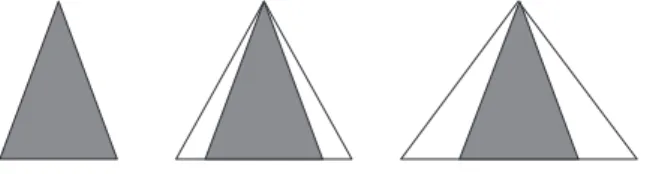
As we have stated in Section4.1, we can modify the amplitude of the upper bound of the IVFSs according to the value of the parameterW. The interval in whichWcan vary is
[
0,
0.
5]
, that is, from the situation without ignorance(
W=
0)
to the situation of maximum ignorance allowed in our model(
W=
0.
5)
. The degree of ignorance that each IVFS represents will be uniformly increased according to intermediate values beingW=
0.
25 the initial situation as we have explained in Section4. These situations are depicted in Fig.3.5.2. Lateral tuning of linguistic labels based on the 2-tuples fuzzy linguistic model
In our initial model we have fixed the position of the different labels in such a way that for each value of the input space of each variable the sum of the membership degrees of the different labels is 1. For example, any of the four fuzzy partitions depicted in Fig.1fulfills this condition. This label distribution does not need to be optimal as the data distribution is not usually uniform. Therefore, we use the genetic tuning based on the 2-tuples fuzzy linguistic model [31] to make the lateral displacements of the linguistic labels.
The symbolic translation of a linguistic term which is given by a number within the interval
[−
0.
5,
0.
5)
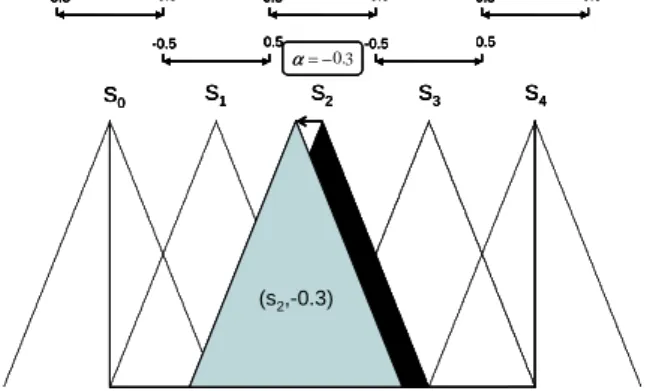
. This number expresses the bounds of the domain of a label when it is moving between its two lateral labels. Let us consider a set of labelsSrepresenting a fuzzy partition. Formally, we have the pair,
(
si, α
i),
si∈
S, α
i∈ [−
0.
5,
0.
5)
. An example is illustrated(b) W = 0.25 (c) W = 0.5
(a) W = 0.0
(s2,-0.3) S0 S1 S2 S3 S4 -0.5 0.5 -0.5 0.5 -0.5 0.5 -0.5 0.5 -0.5 0.5 − = α (s2,-0.3) S0 S1 S2 S3 S4 -0.5 0.5 -0.5 0.5 -0.5 0.5 -0.5 0.5 -0.5 0.5 (s2,-0.3) S0 S1 S2 S3 S4 S0 S1 S2 S3 S4 -0.5 0.5 -0.5 0.5 -0.5 0.5 -0.5 0.5 -0.5 0.5 -0.5 0.5 -0.5 0.5 -0.5 0.5 -0.5 0.5 -0.5 0.5 -0.5 0.5 -0.5 0.5 -0.5 0.5 -0.5-0.5 0.50.5 3 α 0.
Fig. 4. Lateral displacement of a membership function.
in Fig.4, where we show the symbolic translation of a label represented by the pair
(
S2,
−
0.
3)
together with the lateraldisplacement of the corresponding membership function.
We must point out that we use the Global Tuning of the Semantics method [5]. In this model, the tuning is applied at the data base level, maintaining the interpretability of the full system to a large degree. In other words, the pair
(
Xi,
label)
will take the same tuning value in all the rules where the linguistic partitionlabelis considered for the attributeXi. For example,Xiis(
Low,
0.
15)
will present the same value for those rules in which the couple “XiisLow” is initially considered. Therefore, only one displacement parameter is considered for each label in the data base.5.3. Cooperative tuning for both the weak ignorance and the lateral displacement
In this paper our aim is to achieve a positive synergy between the tuning of the weak ignorance and the lateral tuning. The motivation for this proposal lies in the following issue: the isolated use of each tuning approach might cause the system to reach a sub-optimal model. With this cooperative methodology, the GA search engine will be able to work at the same time with both characteristics, and this should lead us to discover solutions better adapted to the problem and therefore more accurate ones.
To do this, it is enough to define a unique representation inside the GA for both possibilities. However, we have to consider the size of the search space, since a high number of parameters can lead to poor solutions (e.g. in the case of performing the tuning taking into account the five parameters depicted in Fig.2(b) that define the bounds of the IVFS). Therefore, we propose to downsize the search space by decreasing the number of parameters (see Section5.4.1for details about the representation) in the following way:
(1) To perform the lateral displacement we consider one parameter representing each linguistic label within each variable. (2) To perform the weak ignorance tuning, we consider only one parameter for each linguistic label.
In order to illustrate the effect of the cooperative evolutionary tuning model in the fuzzy partitions, Table1depicts the results of the tuning process for theirisdata-set in columns. The first column refers to the variable studied, the second column shows the fuzzy partition in the initial FRBCS with IVFSs generated by the FH-GBML algorithm, the third presents the final values of the genes after the tuning process and the last column depicts the representation of each fuzzy partition after the post-processing step. We must point out that, for the sake of simplicity, from the four possible fuzzy partitions that the FH-GBML algorithm contemplates, we only depict the one corresponding to a degree of granularity of three labels per variable. First of all, the final values of the genes confirm the necessity of the contextualization of each linguistic label as no fuzzy partition remains in its initial state. Furthermore, we show the good choice of the third linguistic label, since after the application of the cooperative evolutionary tuning model the uncertainty that the IVFS represents is practically nil and most of the variables only have a slight lateral displacement. We observe that the most processed variable is thepetal length; this fact shows the goodness of the solution as, knowing the features of this data-set, this variable together with thepetal width
are enough to discriminate well among all the classes.
5.4. Evolutionary tuning
We must recall from the introduction to the paper that our aim is to use a hybridization of FRBCSs and GAs in order to look for the optimal configuration of the parameters of the knowledge base. From the optimization point of view, to find an appropriate fuzzy model is equivalent to coding it as a parameter structure and then finding the parameter values that give us the optimum for a specific fitness function.
In the remainder of this subsection, we introduce the features depending on the specific approach and then we describe the evolutionary method employed in this paper.
Table 1
Fuzzy partitions of theirisdata-set before and after of the cooperative evolutionary tuning model.
5.4.1. Representation and fitness function
The tuning of the membership functions’ parameters can be considered as a search problem to which GAs can be applied. To accomplish this, we take into account two important issues: the specification of the representation of the solutions and the definition of the fitness function.
•
Representation: In this paper we employ three different tuning approaches, introduced in the previous subsections, where a real coding is considered in all models. However, the representation of each gene of the chromosome depends on the approach. Let us consider the following number of labels per variable:(
m1,
m2, . . . ,
mn)
, with n being the number of variables. Then, the representations of the chromosome are as follows:– Weak ignorance tuning:Each gene represents the modification of the degree of ignorance of the linguistic labels in the data base as we have explained in Section5.1. The structure of the chromosome is:
CWI
=
(
a11, . . . ,
a1m1,
a21, . . . ,
a2m2, . . . ,
an1, . . . ,
anmn).
Then, the chromosome length is equal to the number of labels times the number of variables.
– Lateral tuning:Each gene represents the lateral displacement of the linguistic labels in the data base as we have explained in Section5.2. The structure of the chromosome is:
CLat
=
(
l11, . . . ,
l1m1,
l21, . . . ,
l2m2, . . . ,
ln1, . . . ,
lnmn).
Hence, the chromosome length is equal to the number of labels times the number of variables.
– Cooperative tuning:Each chromosome will be composed of two parts, one to perform the weak ignorance tuning and the other to perform the lateral tuning. Then, a chromosome has the structure:
Therefore, the chromosome length is equal to the number of variables times the number of linguistic labels plus the number of linguistic labels.
•
Fitness function: We employ the most common metric for classification, i.e. the accuracy rate.The generic code structure and independent performance features of GAs make them suitable candidates to incorporate a priori knowledge. In the case of FRBSs, this a priori knowledge may be in the form of linguistic variables, fuzzy membership function parameters, fuzzy rules, number of rules, etc. Therefore, we initialize the population of the different approaches considered in this paper in the following way:
•
Weak ignorance tuning:The initial pool is obtained with the first individual having all genes with a value of 0.25 (the initial FRBCS). The second and the third individuals have all genes with values of 0 and 0.5 respectively, whereas the remaining individuals are generated at random in[
0,
0.
5]
.•
Lateral tuning:The initial pool is obtained with the first individual having all genes with a value of 0.0 (the initial FRBCS), whereas the remaining individuals are generated at random in[−
0.
5,
0.
5)
.•
Cooperative tuning:In this model we initialize three individuals having all genes employed to perform the lateral tuning with a value of 0.0, whereas the genes used to carry out the weak ignorance tuning have values of 0, 0.25 and 0.5, respectively. The remaining individuals will have initialized all the genes randomly.5.4.2. Evolutionary model
CHC [23] is a classical evolutionary model that introduces different features to obtain a trade-off between exploration and exploitation; such as incest prevention, reinitialization of the search process when it becomes blocked and the competition between parents and offspring in the replacement process. In accordance with both these suitable features and with the models used in [5,25], we use CHC to deal with the evolutionary tuning.
During each generation the CHC algorithm develops the following steps.
•
It uses a parent population of sizeNto generate an intermediate population ofNindividuals that are randomly paired and used to generateNpotential offspring.•
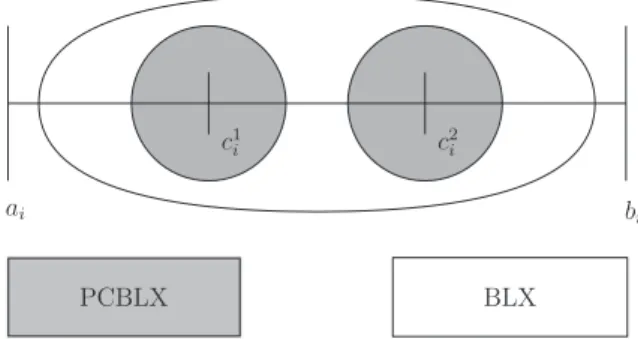
A survival competition is held where the bestNchromosomes from the parent and offspring populations are selected to form the next generation.In order to perform the crossover operator, we consider the Parent Centric BLX (PCBLX) operator [32], which is based on the BLX-
α
. Fig.5depicts the behavior of these kinds of operators.PCBLX is described as follows. Let us assume thatX
=
(
x1· · ·
xn)
andY=
(
y1· · ·
yn)
,(
xi,
yi∈ [
ai,
bi] ⊂
,
i=
1· · ·
n)
, are two real-coded chromosomes that are going to be crossed. PCBLX operator generates the two following offspring:•
O1=
(
o11· · ·
o1n)
, whereo1i is a randomly (uniformly) chosen number from the interval[
li1,
u1i]
, withl1i=
max
{
ai,
xi−
Ii}
,u1i=
min{
bi,
xi+
Ii}
, andIi=|
xi−
yi|
.•
O2=
(
o21· · ·
o2n)
, whereo2i is a randomly (uniformly) chosen number from the interval[
li2,
u2i]
, withl2i=
max
{
ai,
yi−
Ii}
andui2=
min{
bi,
yi+
Ii}
.On the other hand, the incest prevention mechanism will only be considered in order to apply the PCBLX operator. In our case, two parents are crossed if half their Hamming distance is above a predetermined threshold,L. Since we consider a real coding scheme, we have to transform each gene considering a Gray Code (binary code) with a fixed number of bits per gene (BITSGENE), which is determined by the system expert. In this way, the threshold value is initialized as:
L
=
(
#Genes·
BITSGENE)/
4.
0,
where #Genesstands for the total length of the chromosome. Following the original CHC scheme,Lis decremented by one (BITSGENEin this case) when there are no new individuals in the next generation.
In order to work with the cooperative evolutionary tuning model, we make the crossover in the following way:
•
We cross the parts of the chromosome representing the same kind of tuning among themselves. In this process we generate four offspring: they are all the possible combinations of the two offspring generated by the crossover of the lateral tuning part and two more created by the crossover of the weak ignorance tuning part.•
We select the two best ones to be included in the population.No mutation is applied during the recombination phase. Instead, when the threshold value is lower than zero, all the chromosomes are regenerated randomly to introduce new diversity to the search. The best global solution found is included in the population to increase the convergence of the algorithm as in the elitist scheme.
6. Experimental study
In this study, our aim is to show the improvement achieved in FRBCSs by means of the combination of the IVFSs model and the cooperative evolutionary tuning model. Specifically, we check the usefulness of our methodology by means of comparisons with respect to the achieved results by the initial FH-GBML FRBCS with and without lateral tuning. In addition, we study the behavior of the cooperative evolutionary tuning methodology with respect to the two tuning approaches when they are applied separately over the FRBCS with the linguistic labels modeled by means of IVFSs.
Moreover, we also include in the study the tuning approach based on the linguistic 3-tuples representation [3]. This approach performs both a lateral displacement and a modification of the amplitude of the support of the fuzzy sets but without taking into account the uncertainty inherent in the definition of the linguistic labels. The aim of this comparison is to show the good management of the uncertainty of our cooperative evolutionary tuning model leading to a global performance improvement.
In this section, first we describe the experimental set-up together with the parameters employed in the study and the statistical test considered in this paper. Next, we introduce the experimental study carried out.
6.1. Experimental set-up
We have selected a wide benchmark of 24 data-sets selected from the KEEL data-set repository [6,7] (http://www.keel.es/ dataset.php). Table2summarizes the properties of the selected data-sets, showing for each data-set the number of examples (#Ex.), the number of attributes (#Atts.), the number of numerical (#Num.) and nominal (#Nom.) features, and the number of classes (#Class.). Themagic, page-blocks, penbasedandringdata-sets have been stratified sampled at 10% in order to reduce their size for training. In the case of missing values (autos, cleveland, crx, hepatitisandwisconsin) we have removed those instances from the data-set.
Table 2
Summary description for the employed data-sets.
Id. Data-set #Ex. #Atts. #Num. #Nom. #Class.
aus Australian 690 14 8 6 2 aut Autos 150 25 15 10 6 bal Balance 625 4 4 0 3 bup Bupa 345 6 6 0 2 cle Cleveland 297 13 13 0 5 con Contraceptive 1,473 9 6 3 3 crx Crx 125 15 6 9 2 eco Ecoli 336 7 7 0 8 ger German 1000 20 6 14 2 gla Glass 214 9 9 0 6 hab Haberman 306 3 3 0 2 hea Heart 270 13 6 7 2 hep Hepatitis 80 19 6 13 2 iri Iris 150 4 4 0 3 mag Magic 1902 10 10 0 2 new New-Thyroid 215 5 5 0 3 pag Page-blocks 548 10 10 0 5 pen Penbased 1099 16 16 0 10 pim Pima 768 8 8 0 2 rin Ring 740 20 20 0 2 tae Tae 151 5 3 2 3 veh Vehicle 846 18 18 0 4 win Wine 178 13 13 0 3 wis Wisconsin 683 9 9 0 2
To carry out the different experiments we consider a5-folder cross-validation model, i.e., five random partitions of data (20% of the patterns), and the combination of four of them (80%) as training and the remainder as test. The process was repeated three times using different seeds. Therefore, for each data-set we consider the average result over 15 runs.
The selected configuration for the FH-GBML approach consists of product T-norm as conjunction operator, together with the Penalized Certainty Factor approach for the rule weight and FRM of the winning rule. Regarding the specific parameters for the genetic process, we have chosen the following values:
•
number of fuzzy rules: 5·
drules, being 50 the maximum number of fuzzy rules,•
number of rule sets: 200 rule sets,•
crossover probability: 0.9,•
mutation probability: 1/d,•
number of replaced rules: All rules except the best-one (Pittsburgh-part, elitist approach), number of rules/5 (GCCL-part),•
total number of generations: 1000 generations,•
don’t care probability: 0.5,•
probability of the application of the GCCL iteration: 0.5,wheredstands for the dimensionality of the problem (number of variables).
Next, we indicate the values that have been considered for the parameters of the genetic tuning:
•
Population size: 50 individuals.•
Number of evaluations: 5000·
d.•
Bits per gene for the Gray codification (for incest prevention): 30 bits.Finally, we must point out that statistical analysis needs to be carried out in order to find significant differences among the results [28]. We consider the use of non-parametric tests, according to the recommendations made in [21,27] where a set of simple, safe and robust non-parametric tests for statistical comparisons of classifiers is presented. In this empirical study we will apply pairwise comparisons between the algorithms using the Wilcoxon Signed-Ranks test [50] computing thep-value associated with each comparison, which represents the lowest level of significance of a hypothesis that re-sults in a rejection. In this manner, we can know whether two algorithms are significantly different and how different they are.
6.2. Analysis of the usefulness of the cooperative evolutionary tuning methodology based on IVFSs
Table3shows the results achieved by the different approaches, both in train and in test in each data-set. This table presents two different groups of results. The first one covers the approaches in which the data base is composed of standard fuzzy sets. They are:
•
The basic FH-GBML method (Base).•
The initial FH-GBML FRBCS postprocessed with lateral tuning (Lat).•
The initial FH-GBML FRBCS postprocessed with the tuning approach based on the linguistic 3-tuples representation (3-tuples).The second group is formed of the approaches in which the data base is composed of IVFSs. They are:
•
The weak ignorance tuning (IVFS_WI).•
The lateral displacement tuning (IVFS_Lat).•
The cooperative evolutionary tuning (IVFS_Coop).To start with, we analyze the results of our methodology with respect to the results of the approaches belonging to the first group. It is noteworthy that our methodology achieves a high global improvement with respect to the basic FH-GBML FRBCS, obtaining a higher accuracy value in test in 20 out of the 24 data-sets. Regarding the FH-GBML method using lateral tuning, we observe that our cooperative evolutionary tuning model has a better mean performance, increasing the classification accuracy in 16 data-sets. Finally, we observe that our methodology improves the performance of the 3-tuples tuning model in 14 out of the 24 data-sets. These findings are statistically confirmed in Table4where we carry out a pairwise comparison (applying a Wilcoxon test). Here, we observe a higher sum of ranks and a lowp-value in all cases, which allow us to determine the enhancement of our approach with the support of statistical differences in favour of our methodology with a high level of confidence.
The analysis of our methodology with respect to the tuning approaches applied to the FRBCSs with IVFSs yields similar results. The cooperative evolutionary tuning model obtains the best mean performance and, in particular, improves the accuracy in more than half of the data-sets, i.e. 16 in the case of the weak ignorance tuning and 14 in the case of the
Table 3
Results in train (Tr.) and test (Tst) achieved by the different approaches.
Data Base Lat 3-Tuples IVFS_WI IVFS_Lat IVFS_Coop Set Tr. Tst Tr. Tst Tr. Tst Tr. Tst Tr. Tst Tr. Tst aus 87.19 84.78 89.76 85.36 90.09 86.09 88.42 85.51 89.66 84.64 89.58 85.36 aut 61.02 45.34 80.82 54.07 80.35 57.26 75.92 54.74 80.03 58.49 80.82 62.90 bal 79.04 77.60 84.97 80.16 85.33 81.12 80.84 80.48 84.05 80.16 85.21 80.64 bup 70.62 63.48 80.07 64.06 80.29 63.77 74.33 62.61 77.89 66.67 78.98 65.51 cle 61.71 54.55 69.49 56.24 71.43 55.23 65.26 56.91 65.76 55.56 69.82 55.90 con 47.89 45.22 55.21 50.17 56.07 51.67 51.32 48.27 54.70 50.10 56.21 50.72 crx 88.30 86.68 89.38 86.53 89.49 86.53 88.72 87.29 89.30 87.14 89.38 86.83 eco 76.33 72.91 83.57 76.19 84.32 76.78 81.26 72.91 84.47 77.98 85.59 79.76 ger 73.82 71.30 76.62 71.70 77.20 71.80 75.04 71.60 75.72 72.30 77.07 72.10 gla 69.10 57.49 77.68 61.20 77.32 60.27 74.27 57.94 76.85 59.34 77.79 61.21 hab 78.26 71.89 80.39 71.89 80.80 72.23 78.75 72.22 78.67 72.22 80.39 70.59 hea 85.02 80.37 88.84 82.22 89.12 80.37 86.98 81.48 89.02 78.15 89.12 80.00 hep 91.75 81.25 92.70 81.25 92.70 85.00 92.06 83.75 92.70 85.00 92.70 85.00 iri 98.49 95.33 99.16 97.33 99.16 96.00 98.82 96.00 98.82 96.00 99.33 96.00 mag 79.02 78.49 82.23 78.81 83.01 79.76 81.19 79.18 82.70 79.92 83.15 80.18 new 95.32 92.56 98.71 91.63 99.30 94.42 97.66 93.49 98.95 94.88 99.53 95.81 pag 95.88 94.16 96.43 94.34 96.52 93.97 96.07 94.16 95.34 93.79 96.71 93.43 pen 69.83 67.18 84.73 76.36 87.21 80.91 83.85 78.27 86.62 81.00 88.62 83.00 pim 76.88 73.96 80.31 75.26 80.40 74.74 78.71 75.00 79.65 75.91 80.44 75.65 rin 84.97 82.84 92.52 87.30 93.37 86.35 88.43 83.11 92.35 85.54 93.30 87.43 tae 62.61 49.01 69.12 53.68 70.62 54.28 66.11 52.32 69.11 51.72 70.62 52.99 veh 61.47 58.52 75.94 64.78 76.83 66.43 69.46 62.30 75.55 65.49 75.50 67.15 win 97.45 90.97 99.58 91.52 99.86 90.40 98.87 90.97 99.72 93.79 99.72 93.76 wis 97.58 95.61 98.09 95.31 98.31 95.17 97.65 95.75 98.02 95.75 98.28 94.88 Mean 78.73 73.81 84.43 76.14 84.96 76.69 82.08 75.68 83.99 76.73 84.91 77.37 Table 4
Wilcoxon Test to compare the cooperative evolutionary tuning model (R+) with the basic FH-GBML with and without tuning (R−).
Comparison R+ R− p-value IVFS_Coop vs. Base 279 21 0.000 IVFS_Coop vs. Lat 219.5 80.5 0.048 IVFS_Coop vs. 3-tuples 209.5 90.5 0.082
Table 5
Wilcoxon Test to compare the cooperative evolutionary tuning model (R+) with the tuning approaches over the FRBCS with IVFSs (R−).
Comparison R+ R− p-value IVFS_Coop vs. IVFS_WI 238.5 61.5 0.011 IVFS_Coop vs. IVFS_Lat 225.5 74.5 0.024
lateral tuning. The statistical study shown in Table5(also carried out with a Wilcoxon test) shows that our methodology outperforms both tuning approaches applied to the FH-GBML model with IVFSs with a lowp-value.
These results allow us to stress the goodness of our cooperative evolutionary tuning model since it enhances the results provided by both the classical FH-GBML approach and the tuning approaches that compose our model when they are applied separately. Moreover, our proposed methodology enhances the results achieved by the 3-tuples tuning model, an approach which is conceptually similar, since it tunes both the amplitude of the support and the lateral position of fuzzy sets while, however, ignoring the uncertainty inherent in the definition of the membership functions. The improvement provided by our methodology with respect to the remaining ones proves that the good management of the uncertainty associated with the definition of the fuzzy terms has a positive synergy with the lateral tuning, leading to an improvement in the global behavior of the system.
7. Concluding remarks
In this paper we have introduced two main novelties. On the one hand, we have defined a new construction method of IVFSs starting from fuzzy sets and using weak ignorance functions. This construction method allows us to parametrize the amplitude of the upper bound of each IVFS in such a way that we can analyze the most appropriate set-up of the IVFSs partitions by means of a post-processing tuning step applied to FRBCSs. On the other hand, we have proposed a methodology that simultaneously tunes both the degree of ignorance and the lateral position of each linguistic label, which leads to a better contextualization of the data base.
From the experimental study carried out, we must highlight the good performance of our cooperative evolutionary tuning model since it enhances the performance of the approaches with and without IVFSs, that is: the basic FH-GBML FRBCS, the
initial FRBCS post-processed with lateral tuning and the two tuning approaches that compose our model when they are applied separately. The results obtained with this methodology allow us to determine, with the corresponding statistical support, that the combination of the selected tuning approaches is very useful to solve classification tasks by tuning the semantic of the fuzzy partitions in a more optimal way. Furthermore, the enhancement of the results provided by the cooperative evolutionary tuning model, especially with respect to the results of the tuning model based on the linguistic 3-tuples representation, reflects a good management of the uncertainties of the system leading to a global performance improvement.
Acknowledgements
This work was supported in part by the Spanish Ministry of Science and Technology under projects TIN2008-06681-C06-01 and TIN2TIN2008-06681-C06-010-15055.
References
[1] M.R. Akbarzadeh-Totonchi, M. Moshtagh-Khorasani, A hierarchical fuzzy rule-based approach to aphasia diagnosis, J. Biomed. Inform. 40 (5) (2007) 465–475. [2] R. Alcalá, J.M. Benítez, J. Casillas, O. Cordón, R. Pérez, Fuzzy control of HVAC systems optimized by genetic algorithms, Appl. Intell. 18 (2003) 155–177. [3] R. Alcalá, J. Alcalá-Fdez, M. Gacto, F. Herrera, Rule base reduction and genetic tuning of fuzzy systems based on the linguistic 3-tuples representation, Soft
Comput. 11 (5) (2007) 401–419.
[4] R. Alcalá, J. Alcalá-Fdez, M.J. Gacto, F. Herrera, Improving fuzzy logic controllers obtained by experts: a case study in HVAC systems, Appl. Intell. 31 (1) (2007) 15–30.
[5] R. Alcalá, J. Alcalá-Fdez, F. Herrera, A proposal for the genetic lateral tuning of linguistic fuzzy systems and its interaction with rule selection, IEEE Trans. Fuzzy Syst. 15 (4) (2007) 616–635.
[6] J. Alcalá-Fdez, L. Sánchez, S. García, M.J. del Jesus, S. Ventura, J.M. Garrell, J. Otero, J. Bacardit, V.M. Rivas, J.C. Fernández, F. Herrera, KEEL: a software tool to assess evolutionary algorithms for data mining problems, Soft Comput. 13 (3) (2009) 307–318.
[7] J. Alcalá-Fdez, A. Fernández, J. Luengo, J. Derrac, S. García, L. Sánchez, F. Herrera, KEEL data-mining software tool: data set repository, integration of algorithms and experimental analysis framework, J. Multi-Valued Log. S. 17 (2–3) (2011) 255–287.
[8] M. Antonelli, P. Ducange, B. Lazzerini, F. Marcelloni, Learning concurrently partition granularities and rule bases of Mamdani fuzzy systems in a multi-objective evolutionary framework, Int. J Approx. Reason. 50 (7) (2009) 1066–1080.
[9] H. Bustince, Indicator of inclusion grade for interval-valued fuzzy sets. Application to approximate reasoning based on interval-valued fuzzy sets, Int. J Approx. Reason. 23 (2000) 137–209.
[10] H. Bustince, E. Barrenechea, M. Pagola, J. Fernandez, Interval-valued fuzzy sets constructed from matrices: application to edge detection, Fuzzy Set Syst. 160 (13) (2009) 1819–1840.
[11] H. Bustince, M. Pagola, E. Barrenechea, J. Fernandez, P. Melo-Pinto, P. Couto, H.R. Tizhoosh, J. Montero, Ignorance functions. An application to the calculation of the threshold in prostate ultrasound images, Fuzzy Set Syst. 161 (1) (2010) 20–36.
[12] J. Casillas, O. Cordón, M.J. del Jesus, F. Herrera, Genetic tuning of fuzzy rule deep structures preserving interpretability for linguistic modeling, IEEE Trans. Fuzzy Syst. 13 (1) (2005) 13–29.
[13] N.R. Cazarez-Castro, L.T. Aguilar, O. Castillo, Fuzzy logic control with genetic membership function parameters optimization for the output regulation of a servomechanism with nonlinear backlash, Expert Syst. Appl. 37 (6) (2010) 4368–4378.
[14] A. Celikyilmaz, I.B. Turksen, Decision making with imprecise parameters, Int. J. Approx. Reason. 51 (8) (2010) 869–882. [15] S. Coupland, R. John, New geometric inference techniques for type-2 fuzzy sets, Int. J. Approx. Reason. 49 (1) (2008) 198–211.
[16] O. Cordón, M.J. del Jesus, F. Herrera, A proposal on reasoning methods in fuzzy rule-based classification systems, Int. J. Approx. Reason. 20 (1) (1999) 21–45. [17] O. Cordón, F. Herrera, F. Hoffmann, L. Magdalena, Genetic Fuzzy Systems. Evolutionary Tuning and Learning of Fuzzy Knowledge Bases, World Scientific,
Singapore, 2001.
[18] O. Cordón, F. Gomide, F. Herrera, F. Hoffmann, L. Magdalena, Ten years of genetic fuzzy systems: current framework and new trends, Fuzzy Set Syst. 141 (1) (2004) 5–31.
[19] C. Cortes, V. Vapnik, Support vector networks, Mach. Learn. 20 (1995) 273–297.
[20] L. delaOssa, J.A. Gámez, J.M. Puerta, Learning weighted linguistic fuzzy rules by using specifically-tailored hybrid estimation of distribution algorithms, Int. J. Approx. Reason. 50 (3) (2009) 541–560.
[21] J. Demšar, Statistical comparisons of classifiers over multiple data sets, J. Mach. Learn. Res. 7 (2006) 1–30.
[22] G. Deschrijver, Generalized arithmetic operators and their relationship to t-norms in interval-valued fuzzy set theory, Fuzzy Set Syst. 160 (21) (2009) 3080–3102.
[23] L.J. Eshelman, The CHC adaptive search algorithm: How to have safe search when engaging in nontraditional genetic recombination, Chapter: Foundations of Genetic Algorithms, Morgan Kaufmann, 1991, pp. 265–283.
[24] A. Fernández, M.J. del Jesus, F. Herrera, Hierarchical fuzzy rule based classification systems with genetic rule selection for imbalanced data-sets, Int. J. Approx. Reason. 50 (3) (2009) 561–577.
[25] A. Fernández, M.J. del Jesus, F. Herrera, On the 2-tuples based genetic tuning performance for fuzzy rule based classification systems in imbalanced data-sets, Inform. Sci. 180 (8) (2010) 1268–1291.
[26] M.J. Gacto, R. Alcalá, F. Herrera, Adaptation and application of multi-objective evolutionary algorithms for rule reduction and parameter tuning of fuzzy rule-based systems, Soft Comput. 13 (3) (2009) 419–436.
[27] S. García, F. Herrera, An extension on statistical comparisons of classifiers over multiple data sets for all pairwise comparisons, J. Mach. Learn. Res. 9 (2008) 2677–2694.
[28] S. García, A. Fernández, J. Luengo, F. Herrera, A study of statistical techniques and performance measures for genetics–based machine learning: accuracy and interpretability, Soft Comput. 13 (10) (2009) 959–977.
[29] S. García, A. Fernández, J. Luengo, F. Herrera, Advanced nonparametric tests for multiple comparisons in the design of experiments in computational intelligence and data mining: experimental analysis of power, Inform. Sci. 180 (10) (2010) 2044–2064.
[30] M.B. Gorlzakczany, A method of inference in approximate reasoning based on interval-valued fuzzy sets, Fuzzy Set Syst. 21 (1987) 1–17. [31] F. Herrera, L. Martínez, A 2-tuple fuzzy linguistic representation model for computing with words, IEEE Trans. Fuzzy Syst. 8 (6) (2000) 746–752. [32] F. Herrera, M. Lozano, A.M. Sánchez, A taxonomy for the crossover operator for real-coded genetic algorithms: an experimental study, Int. J. Intell. Syst. 18
(2003) 309–338.
[33] F. Herrera, Genetic fuzzy systems: taxonomy, current research trends and prospects, Evolution. Intell. 1 (2008) 27–46.
[34] D. Hidalgo, O. Castillo, P. Melin, Type-1 and type-2 fuzzy inference systems as integration methods in modular neural networks for multimodal biometry and its optimization with genetic algorithms, Inform. Sci. 179 (13) (2009) 2123–2145.
[36] H. Ishibuchi, T. Nakashima, M. Nii, Classification and Modeling with Linguistic Information Granules: Advanced Approaches to Linguistic Data Mining, Springer-Verlag, Berlin, 2004.
[37] H. Ishibuchi, T. Yamamoto, T. Nakashima, Hybridization of fuzzy GBML approaches for pattern classification problems, IEEE Trans. Syst. Man Cybern. B 35 (2) (2005) 359–365.
[38] H. Ishibuchi, T. Yamamoto, Rule weight specification in fuzzy rule-based classification systems, IEEE Trans. Fuzzy Syst. 13 (2005) 428–435.
[39] M. Kaya, R. Alhajj, Utilizing genetic algorithms to optimize membership functions for fuzzy weighted association rules mining, Appl. Intell. 24 (1) (2006) 7–15.
[40] Q. Liang, J.M. Mendel, Interval type-2 fuzzy logic systems: theory and design, IEEE Trans. Fuzzy Syst. 8 (2000) 535–549.
[41] J. Luengo, F. Herrera, Domains of competence of fuzzy rule based classification systems with data complexity measures: a case of study using a fuzzy hybrid genetic based machine learning method, Fuzzy Set Syst. 161 (1) (2010) 3–19.
[42] E.G. Mansoori, M.J. Zolghadri, S.D. Katebi, Protein superfamily classification using fuzzy rule-based classifier, IEEE Trans. Nanobiosci. 8 (1) (2009) 92–99. [43] S. Miller, R. John, An interval type-2 fuzzy multiple echelon supply chain model, Knowl.-Based Syst. 23 (4) (2010) 363–368.
[44] Y. Nojima, H. Ishibuchi, I. Kuwajima, Parallel distributed genetic fuzzy rule selection, Soft Comput. 13 (3) (2009) 511–519.
[45] A.M. Palacios, L. Sánchez, I. Couso, Diagnosis of dyslexia with low quality data with genetic fuzzy systems, Int. J. Approx. Reason. 51 (8) (2010) 993–1009. [46] B.-J. Park, W. Pedrycz, S. -K Oh, Simplified fuzzy inference rule-based genetically optimized Hybrid Fuzzy Neural Networks, Int. J. Uncertainity Fuzz. 16 (2)
(2008) 245–274.
[47] R. Sambuc, Functionφ-flous, application a l’aide au diagnostic en pathologie thyroidienne, Ph.D. Thesis, University of Marseille, 1975.
[48] J. Sanz, A. Fernandez, H. Bustince, F. Herrera, Improving the performance of fuzzy rule-based classification systems with interval-valued fuzzy sets and genetic amplitude tuning, Inform. Sci. 180 (19) (2010) 3674–3685.
[49] G. Schaefer, M. Závisek, T. Nakashima, Thermography based breast cancer analysis using statistical features and fuzzy classification, Pattern Recogn. 42 (6) (2009) 1133–1137.
[50] D. Sheskin, Handbook of Parametric and Nonparametric Statistical Procedures, second ed., Chapman & Hall/CRC, 2006. [51] J.T. Starczewski, Efficient triangular type-2 fuzzy logic systems, Int. J Approx. Reason. 50 (5) (2009) 799–811. [52] C.L. Walker, E.A. Walker, Sets with type-2 operations, Int. J. Approx. Reason. 50 (1) (2009) 63–71.
[53] D. Wu, W.W. Tan, Genetic learning and performance evaluation of interval type-2 fuzzy logic controllers, Eng. Appl. Artif. Intell. 19 (8) (2006) 829–841. [54] D. Wu, J.M. Mendel, Uncertainty measures for interval type-2 fuzzy sets, Inform. Sci. 177 (23) (2007) 5378–5393.