Sentic PROMs
: Application of sentic computing to the development of a novel
unified framework for measuring health-care quality
Erik Cambria
a,⇑, Tim Benson
b, Chris Eckl
c, Amir Hussain
d aTemasek Labs, National University of Singapore, 117411, Singapore b
Abies Ltd., Berkshire, RG18 9WL, United Kingdom c
Sitekit Solutions Ltd., Portree, IV51 9HL, United Kingdom d
COSIPRA Lab, University of Stirling, FK9 4LA, United Kingdom
a r t i c l e
i n f o
Keywords: AI E-Health
Natural language processing Opinion mining
Sentiment analysis
a b s t r a c t
Barriers to use health related quality of life measuring systems include the time needed to complete the forms and the need for staff to be trained to understand the results. An ideal system of health assessment needs to be clinically useful, timely, sensitive to change, culturally sensitive, low burden, low cost, involv-ing for the patient and built into standard procedures. A new generation of short and easy-to-use tools to monitor patient outcomes on a regular basis has been recently proposed. These tools are quick, effective and easy to understand, as they are very structured and rigid. Such structuredness, however, leaves no space to those patients who would like to say something more. Patients, in fact, are usually willing to express their opinions and feelings in free text, rather than simply filling in a questionnaire, for either speaking out their satisfaction or for cathartic complaining.Sentic PROMsallow patients to evaluate their health status and experience in a semi-structured way and accordingly aggregate input data by means of sentic computing, while tracking patients’ physio-emotional sensitivity.
Ó2012 Elsevier Ltd. All rights reserved.
1. Introduction
Public health measures such as better nutrition, greater access to medical care, improved sanitation and more widespread immu-nization, have produced a rapid decline in death rates in all age groups. Since there is no corresponding decline in birth rates, how-ever, the average age of population is increasing exponentially. If we want health services to keep up with such monotonic growth, we need to automatize as much as possible the way patients access the health-care system, in order to improve both its service quality and timeliness. Everything we do that does not provide benefit to patients or their families, in fact, is waste.
To this end, a new generation of short and easy-to-use tools to monitor patient outcomes and experience on a regular basis has
been recently proposed by Benson et al. (2010). Such tools are
quick, effective and easy to understand, as they are very structured. However, they leave no space to those patients who would like to say something more.
Patients, in fact, are usually keen on expressing their opinions and feelings in free text, especially if driven by particularly positive or negative emotions. They are often happy to share their
health-care experiences for different reasons, e.g., because they seek for a sense of togetherness in adversity, because they benefited from others’ opinions and want to give back to the community, for cathar-tic complaining, for supporting a service they really like, because it is a way to express themselves, because they think their opinions are important for others. When people have a strong feeling about a specific service they tried, they feel like speaking it out. If they loved it, they want others to enjoy it. If they hated it, they want to warn others away.
Standard patient reported outcome measures (PROMs) allow pa-tients to easily and efficiently measure their health related quality of life (HRQoL) but, at the same time, they limit patients’ capability and will to express their opinions about particular aspects of the health-care service that could be improved or important facets of their current health status. The framework developed within this work, in turn, exploits the ensemble application of standard PROMs
and sentic computing (Cambria and Hussain, 2012), a novel
ap-proach to opinion mining and sentiment analysis, to allow patients to evaluate their health status and experience in a semi-structured way, i.e., both through a fixed questionnaire and through free text. The structure of the paper is as follows: Section2provides some
background about HRQoL measurement, Section3explains in
de-tail sentic computing tools and techniques adopted in this work, Section4 illustrates the processes for the extraction of cognitive and affective information from patient opinions, Section5shows how such information can be exploited for monitoring patients’
0957-4174/$ - see front matterÓ2012 Elsevier Ltd. All rights reserved. http://dx.doi.org/10.1016/j.eswa.2012.02.120
⇑ Corresponding author. Tel.: +65 65165752.
E-mail addresses: [email protected] (E. Cambria), [email protected] (T. Benson),[email protected](C. Eckl),[email protected](A. Hussain).
URL:http://sentic.net(E. Cambria).
Contents lists available atSciVerse ScienceDirect
Expert Systems with Applications
physio-emotional sensitivity, Section 6 presents a preliminary
evaluation of the system and Section 7 comprises concluding
remarks and a description of future work.
2. Related work
In health-care, it has long been recognized that, although the health professional is the expert in diagnosing, offering help and giving support in managing a clinical condition, the patient is the expert in living with that condition. Next-generation patients are central to understanding the effectiveness and efficiency of ser-vices and how they can be improved. PROMs provide a means of gaining an insight into the way patients perceive their health and the impact that treatments or adjustments to lifestyle have on their quality of life.
Pioneered byDonabedian (1966), health status research began during the late 1960s with works focusing on health-care evalua-tion and resource allocaevalua-tion. In particular, early works mainly aimed to valuate health states for policy and economic evaluation of health-care programmes, but devoted little attention to the practicalities of data collection (Culyer et al., 1971; Fanshel and Bush, 1970; Torrance et al., 1972). Later works, in turn, aimed to develop lengthy health profiles to be completed by patients, lead-ing to the term patient reported outcome (Bergner et al., 1976; Ware, 1976). PROMs can provide a new category of real-time health information, which enables every level of the health service to focus on continuously improving those things that really matter to patients. The benefits of routine measurement of HRQoL include helping to screen for problems, promoting patient-centric care, aiding patients and doctors to take decisions, improving communi-cation amongst multi-disciplinary teams and monitoring progress of individual or groups of patients and the quality of care in a pop-ulation. However, in spite of demonstrated benefits, routine HRQoL assessment in day-to-day practice remains rare as few patients are willing to spend the time needed to daily fill-in questionnaires, such asSF-36(Ware and Sherbourne, 1992), SF-12(Ware et al., 1996),Euroqol EQ-5D (Brooks, 1996) or the Health Utilities Index
(Horsman, Furlong, Feeny, & Torrance, 2003).
To overcome this problem,howRu, a new generic PROM was
re-cently proposed byBenson et al. (2010)for recording the level of each patient’s physical and mental symptoms, limitations and dependency on four simple levels. The questionnaire was designed to take no more than a few seconds using electronic data collection and integration with electronic patient records as part of other rou-tine tasks that patients have to do, such as booking appointments, checking in on arrival at clinic, or ordering or collecting repeat
medication. The main aim ofhowRu is to use simple terms and
descriptions, in order to reduce the risk of ambiguity and to ensure that as many people as possible could use the measure reliably and consistently without training or support.
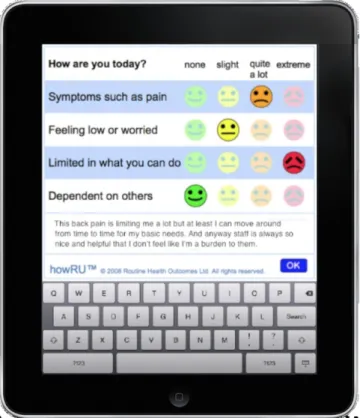
The same approach has been employed to monitor also patient experience (howRwe) and staff satisfaction (howRus) on a regular basis. These questionnaires have been proved to be quick, effective and easy to understand, as they are short, rigid and structured. However, such structuredness can be very limiting, as it leaves no space to those patients who would like to say something more about their health or the service they are receiving. Patients, espe-cially when driven by particularly positive or negative emotions, do want to express their opinions and feelings.Sentic PROMsallow patients to assess their health status and health-care experience in a semi-structured way by enriching the functionalities of the new PROM tools with the possibility of adding free text (Fig. 1).
This way, when patients are happy with simply filling-in the questionnaire, they can just leave the input text box blank but, when they feel like speaking out their opinions and feelings, e.g.,
in the occasion of a particularly positive or negative situation or event, they can now do it in their own words. Hence,Sentic PROMs
input data, although very similar at concept level, are on two com-pletely different structure levels – structured (questionnaire selec-tion) and unstructured (natural language). As we would like to extract meaningful information from such data, the final aim of
Sentic PROMsis to format the unstructured input and accordingly aggregate it with the structured data, in order to perform statistical analysis and pattern recognition. In particular, the gap between unstructured and structured data is bridged by means of sentic computing.
3. Sentic computing
Existing approaches to automatic identification and extraction of opinions and sentiments from text can be grouped into three main categories: keyword spotting (Elliott, 1992; Ortony et al., 1988; Wiebe et al., 2005), in which text is classified into categories based on the presence of fairly unambiguous affect words, lexical affinity (Rao and Ravichandran, 2009; Somasundaran et al., 2008; Stevenson et al., 2007; Wilson et al., 2005), which assigns arbitrary words a probabilistic affinity for a particular opinion or emotion, and statistical methods (Abbasi et al., 2008; Goertzel et al., 2000; Hu and Liu, 2004; Pang and Lee, 2005; Pang and Lee, 2002; Turney and Littman, 2003), which calculate the valence of keywords, punctuation and word co-occurrence frequencies on the base of a large training corpus. The problem with such approaches is that they mainly rely on parts of text in which opinions are explicitly expressed such as positive terms (e.g., good, nice, excellent, fortu-nate, correct, superior, best) and negative terms (e.g., bad, nasty, poor, unfortunate, wrong, inferior, worst). In general, in fact, opinions are expressed implicitly through context and domain dependent concepts, which make keyword-based approaches extremely ineffective.
Fig. 1.Sentic PROMsprototype on iPad. The new interface allows patients to assess
their health status and health-care experience both in a structured (questionnaire) and unstructured (free text) way.
Sentic computing is a multi-disciplinary approach to sentiment analysis that exploits both computer and social sciences to better recognize, interpret and process sentiments in natural language.
In sentic computing, whose term derives from the Latin sentire
(root of words such as sentiment and sentience) and sensus
(intended both as capability of feeling and as common sense), the analysis of natural language is based on affective ontologies (Cambria, Havasi, & Hussain, 2012; Cambria, Grassi, Hussain, & Havasi, 2011) and common sense reasoning tools (Cambria, Hussain, Havasi, & Eckl, 2009; Cambria, Song, Wang, & Hussain,
2011), which enable the analysis of text not only at document,
page or paragraph level but also at sentence and clause level. Specifically, sentic computing involves the use of AI and Seman-tic Web techniques, for knowledge representation and inference; mathematics, for carrying out tasks such as graph mining and mul-ti-dimensionality reduction; linguistics, for discourse analysis and pragmatics; psychology, for cognitive and affective modeling; soci-ology, for understanding social network dynamics and social influ-ence; finally ethics, for understanding related issues about the nature of mind and the creation of emotional machines.
In this work, we exploit sentic computing tools and techniques to extract the semantics and sentics (i.e., the cognitive and affec-tive information) associated with patient opinions and, hence, bridge the gap between the structuredness of questionnaire data and the unstructuredness of natural language. In particular, for the extraction of semantics, we use the following sentic computing tools and techniques:
1. A directed graph representation of common sense knowledge (Section3.1).
2. A statistical method for the identification of common semantics (Section3.2).
3. A technique that expands semantics through spreading activa-tion (Secactiva-tion3.3).
In turn, for the extraction of sentics, we use:
1. A language visualization and analysis system (Section3.4). 2. A novel emotion categorization model (Section3.5). 3. A technique for clustering sentics (Section3.6).
3.1. ConceptNet
ConceptNet (Liu & Singh, 2004) is a semantic resource structur-ally similar to WordNet, but whose scope of contents is general world knowledge, in the same vein as Cyc. Instead of insisting on formalizing common sense reasoning using mathematical logic (Mueller, 2006), ConceptNet uses a new approach: it represents data in the form of a semantic network and makes it available to be used in natural language processing. The prerogative of Con-ceptNet, in fact, is contextual common sense reasoning: while WordNet is optimized for lexical categorization and word-similar-ity determination, and Cyc is optimized for formalized logical rea-soning, ConceptNet is optimized for making practical context-based inferences over real-world texts.
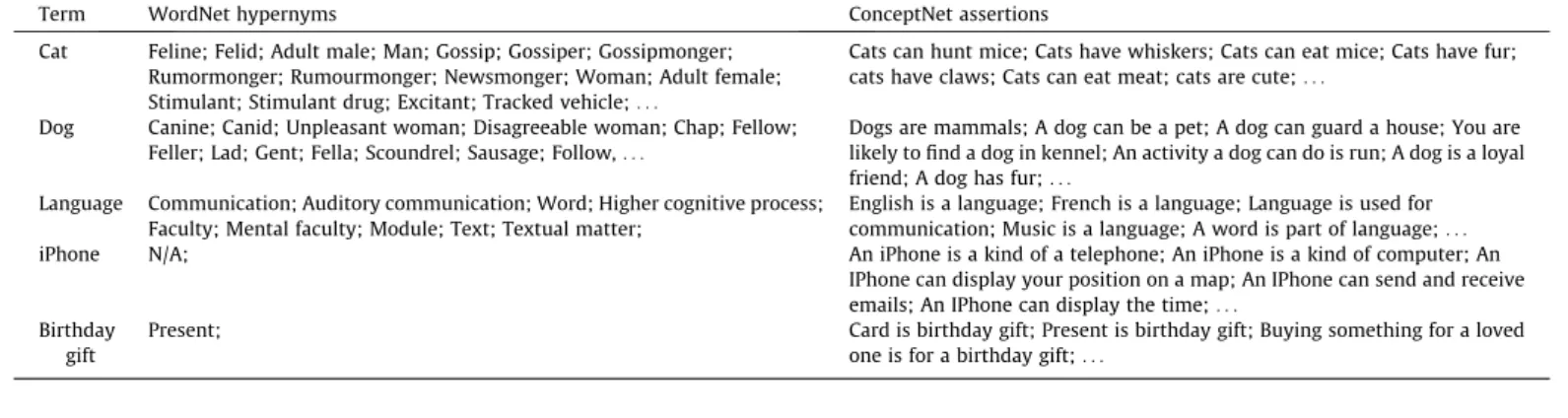
In ConceptNet, WordNet’s notion of node in the semantic net-work is extended from purely lexical items (words and simple phrases with atomic meaning) to include higher-order compound concepts, e.g., ‘satisfy hunger’, ‘follow recipe’, to represent knowl-edge around a greater range of concepts found in everyday life (seeTable 1). Moreover WordNet’s repertoire of semantic relations is extended from the triplet of synonym, is-a, and part-of, to a rep-ertoire of twenty semantic relations including, for example, Effec-tOf (causality), SubevenEffec-tOf (event hierarchy), CapableOf (agent’s ability), MotivationOf (affect), PropertyOf, LocationOf. Concept-Net’s knowledge is also of a more informal, defeasible and
practi-cally valued nature. For example, WordNet has formal taxonomic knowledge that ‘dog’ is a ‘canine’, which is a ‘carnivore’, which is a ‘placental mammal’; but it cannot make the practically oriented member-to-set association that ‘dog’ is a ‘pet’.
ConceptNet also contains a lot of knowledge that is defeasible, i.e., it describes something that is often true but not always, e.g., EffectOf (‘fall off bicycle’, ‘get hurt’), which is something we cannot leave aside in common sense reasoning. Most of the facts interre-lating ConceptNet’s semantic network are dedicated to making rather generic connections between concepts. This type of knowl-edge can be brought back to Minsky’s K-lines as it increases the connectivity of the semantic network and makes it more likely that concepts parsed out of a text document can be mapped into Con-ceptNet. ConceptNet is produced by an automatic process, which first applies a set of extraction rules to the semistructured English sentences of the Open Mind Common Sense (OMCS) corpus, and then applies an additional set of ‘relaxation’ procedures, i.e., filling in and smoothing over network gaps, to optimize the connectivity of the semantic network (Fig. 2).
In ConceptNet version 2.0, a new system for weighting knowl-edge was implemented, which scores each binary assertion based on how many times it was uttered in the OMCS corpus, and on how well it can be inferred indirectly from other facts in ConceptNet. In ConceptNet version 3.0 (Havasi et al., 2007), users can also partic-ipate in the process of refining knowledge by evaluating existing statements on Open Mind Commons (Speer, 2007), the new interface for collecting common sense knowledge from users over the Web.
By giving the user many forms of feedback and using inferences by analogy to find appropriate questions to ask, Open Mind Com-mons can learn well-connected structures of common sense knowledge, refine its existing knowledge, and build analogies that lead to even more powerful inferences. The pieces of common sense knowledge acquired through this interface are made publicly available in ConceptNet, which is released periodically both as an SQL database and through an API.
3.2. CF-IOF weighting
CF-IOF (concept frequency – inverse opinion frequency) (Cambria et al., 2010) is a technique that identifies common domain-dependent semantics, using an approach similar to TF-IDF weighting, in order to evaluate how important a concept is to a set of opinions concerning the same topic. Firstly, the frequency of a conceptcfor a given domaindis calculated by counting the occurrences of the conceptcin the set of availabled-tagged opin-ions and dividing the result by the sum of number of occurrences of all concepts in the set of opinions concerningd. This frequency is then multiplied by the logarithm of the inverse frequency of the concept in the whole collection of opinions, that is:
CFIOFc;d¼ nc;d P knk;d logP k nk nc
wherenc,dis the number of occurrences of conceptcin the set of opinions tagged asd,nkis the total number of concept occurrences andncis the number of occurrences ofcin the whole set of opin-ions. A high weight in CF-IOF is reached by a high concept frequency in a given domain and a low frequency of the concept in the whole collection of opinions. Therefore, thanks to CF-IOF weights, it is pos-sible to filter out common concepts and detect relevant domain-dependent semantics.
3.3. Spectral association
Spectral association (Havasi et al., 2010) is a technique that in-volves assigning values, or activations, to ‘seed concepts’ and apply-ing an operation that spreads their values across the ConceptNet
graph. This operation, an approximation of many steps of spreading activation, transfers the most activation to concepts that are con-nected to the key concepts by short paths or many different paths in common sense knowledge. In particular, we build a matrixCthat relates concepts to other concepts, instead of their features, and add up the scores over all relations that relate one concept to another, disregarding direction. ApplyingCto a vector containing a single concept spreads that concept’s value to its connected concepts. ApplyingC2spreads that value to concepts connected by two links (including back to the concept itself). But what we would really like is to spread the activation through any number of links, with dimin-ishing returns, so the operator we want is:
1þCþC 2 2!þ C3 3!þ ¼e C
We can calculate this odd operator,eC, because we can factorC.Cis already symmetric, so instead of applying Lanczos’ method toCCT and getting the singular value decomposition (SVD), we can apply it directly toCand get the spectral decompositionC=VKVT. As be-fore, we can raise this expression to any power and cancel every-thing but the power ofK. Therefore,eC=VeKVT. This simple twist on the SVD lets us calculate spreading activation over the whole matrix instantly. As with the SVD, we can truncate these matrices tokaxes and therefore save space while generalizing from similar concepts. We can also rescale the matrix so that activation values have a maximum of 1 and do not tend to collect in highly-connected concepts such as ‘person’, by normalizing the truncated rows of
VeK/2
to unit vectors, and multiplying that matrix by its transpose to get a rescaled version ofVeKVT.
3.4. AffectiveSpace
AffectiveSpace (Cambria et al., 2009) is a multi-dimensional vector space built by ‘blending’ (Havasi et al., 2009) ConceptNet with WordNet-Affect (WNA) (Strapparava and Valitutti, 2004), a linguistic resource for the lexical representation of affective knowl-edge. Blending is a technique that performs inference over multiple sources of data simultaneously, taking advantage of the overlap be-tween them. It basically combines two sparse matrices linearly into a single matrix in which the information between the two ini-tial sources is shared. When we perform SVD on a blended matrix, the result is that new connections are made in each source matrix taking into account information and connections present in the other matrix, originating from the information that overlaps. The alignment operation operated over ConceptNet and WNA yields a
new matrix,A, in which common sense and affective knowledge
coexist, i.e., a matrix 14,301117,365 whose rows are concepts
(e.g., ‘dog’ or ‘bake cake’), whose columns are either common sense and affective features (e.g., ‘isA-pet’ or ‘hasEmotion-joy’), and whose values indicate truth values of assertions. Therefore, inA, each concept is represented by a vector in the space of possible features whose values are positive for features that produce an assertion of positive valence (e.g., ‘a penguin is a bird’), negative for features that produce an assertion of negative valence (e.g., ‘a
Table 1
Comparing WordNet and ConceptNet: while WordNet synsets contain vocabulary knowledge associated with concepts, ConceptNet assertions convey generic knowledge about what such concepts are used for.
Term WordNet hypernyms ConceptNet assertions
Cat Feline; Felid; Adult male; Man; Gossip; Gossiper; Gossipmonger; Rumormonger; Rumourmonger; Newsmonger; Woman; Adult female; Stimulant; Stimulant drug; Excitant; Tracked vehicle;. . .
Cats can hunt mice; Cats have whiskers; Cats can eat mice; Cats have fur; cats have claws; Cats can eat meat; cats are cute;. . .
Dog Canine; Canid; Unpleasant woman; Disagreeable woman; Chap; Fellow; Feller; Lad; Gent; Fella; Scoundrel; Sausage; Follow,. . .
Dogs are mammals; A dog can be a pet; A dog can guard a house; You are likely to find a dog in kennel; An activity a dog can do is run; A dog is a loyal friend; A dog has fur;. . .
Language Communication; Auditory communication; Word; Higher cognitive process; Faculty; Mental faculty; Module; Text; Textual matter;
English is a language; French is a language; Language is used for communication; Music is a language; A word is part of language;. . .
iPhone N/A; An iPhone is a kind of a telephone; An iPhone is a kind of computer; An
IPhone can display your position on a map; An IPhone can send and receive emails; An IPhone can display the time;. . .
Birthday gift
Present; Card is birthday gift; Present is birthday gift; Buying something for a loved
one is for a birthday gift;. . .
Fig. 2.ConceptNet represents the information in the Open Mind corpus as a directed graph where nodes are concepts and labeled edges are assertions of common sense that
penguin cannot fly’) and zero when nothing is known about the assertion.
The degree of similarity between two concepts, then, is the dot product between their rows inA. The value of such a dot product increases whenever two concepts are described with the same fea-ture and decreases when they are described by feafea-tures that are negations of each other. In particular, we use truncated singular value decomposition (TSVD) (Wall et al., 2003) in order to obtain a new matrix containing both hierarchical affective knowledge
and common sense. The resulting matrix has the form
e
A¼UkRkVTkand is a low-rank approximation ofA, the original data. This approximation is based on minimizing the Frobenius
norm of the difference between A and eA under the constraint
rankðeAÞ ¼k. For the Eckart–Young theorem (Eckart and Young, 1936) it represents the best approximation ofAin the mean-square sense, in fact: min eAjrankðeAÞ¼k jAeAj ¼ min eAjrankðeAÞ¼k j
R
UAVe j ¼ min eAjrankðeAÞ¼k jR
Sjassuming thateAhas the formeA¼USV, whereSis diagonal. From
the rank constraint, i.e.,Shasknon-zero diagonal entries, the min-imum of the above statement is obtained as follows:
min si ffiffiffiffiffiffiffiffiffiffiffiffiffiffiffiffiffiffiffiffiffiffiffiffiffi Pn i¼1 ðrisiÞ 2 s ¼min si ffiffiffiffiffiffiffiffiffiffiffiffiffiffiffiffiffiffiffiffiffiffiffiffiffiffiffiffiffiffiffiffiffiffiffiffiffiffiffiffiffiffiffiffiffi Pk i¼1 ðrisiÞ 2 þ P n i¼kþ1
r
2 i s ¼ ffiffiffiffiffiffiffiffiffiffiffiffiffiffiffi Pn i¼kþ1r
2 i sTherefore, eA of rank k is the best approximation of A in the Frobenius norm sense when
r
i=si(i= 1,. . .,k) and the correspond-ing scorrespond-ingular vectors are the same as those ofA. If we choose todis-card all but the first k principal components, common sense
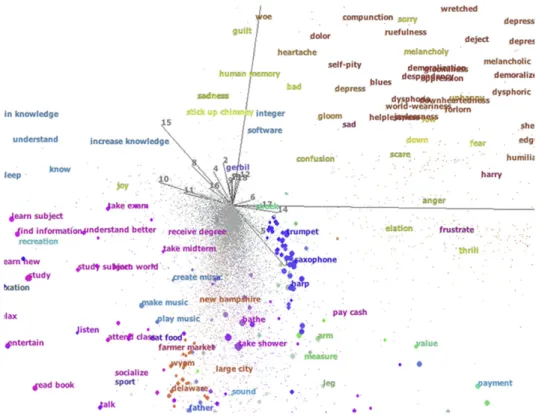
concepts and emotions are represented by vectors ofkcoordinates: these coordinates can be seen as describing concepts in terms of ‘eigenmoods’ that form the axes of AffectiveSpace, i.e., the basis
e0,. . .,ek1of the vector space (Fig. 3). For example, the most signif-icant eigenmood,e0, represents concepts with positive affective va-lence. That is, the larger a concept’s component in thee0direction
is, the more affectively positive it is likely to be. Concepts with neg-ative e0 components, then, are likely to have negative affective valence.
Thus, by exploiting the information sharing property of TSVD, concepts with the same affective valence are likely to have similar features – that is, concepts conveying the same emotion tend to fall near each other in AffectiveSpace. Concept similarity does not de-pend on their absolute positions in the vector space, but rather on the angle they make with the origin. For example we can find con-cepts such as ‘beautiful day’, ‘birthday party’, ‘laugh’ and ‘make person happy’ very close in direction in the vector space, while concepts like ‘sick’, ‘feel guilty’, ‘be laid off’ and ‘shed tear’ are found in a completely different direction (nearly opposite with re-spect to the centre of the space).
3.5. The Hourglass of emotions
This model is a variant of Plutchik’s emotion categorization (Plutchik, 2001) and constitutes an attempt to emulate Marvin Minsky’s theories on human emotions. Minsky sees the mind as made up of thousands of different resources and believes that our emotional states result from turning one set of these resources on and turning another set of them off (Minsky, 2006). Each such selection changes how we think by changing our brain’s activities: the state of anger, for example, appears to select a set of resources that help us react with more speed and strength while also sup-pressing some other resources that usually make us act prudently. The Hourglass of Emotions (Fig. 4) is specifically designed to recog-nize, understand and express emotions in the context of human– computer interaction (HCI). In the model, in fact, affective states are not classified, as often happens in the field of emotion analysis, into basic emotional categories, but rather into four concomitant but independent dimensions in order to understand how much respectively:
1. The user is happy with the service provided (Pleasantness). 2. The user is interested in the information supplied (Attention).
3. The user is comfortable with the interface (Sensitivity). 4. The user is disposed to use the application (Aptitude).
Each affective dimension is characterized by six levels of activa-tion, called ‘sentic levels’, which determine the intensity of the ex-pressed/perceived emotion as an int2[3, +3]. These levels are also labeled as a set of 24 basic emotions (six for each of the affec-tive dimensions) in a way that allows the model to specify the affective information associated with text both in a dimensional and in a discrete form. The dimensional form, in particular, is called ‘sentic vector’ and it is a four-dimensionalfloat vector that can potentially express any human emotion in terms of Pleasantness, Attention, Sensitivity and Aptitude. Some particular sets of sentic vectors have special names as they specify well-known compound emotions. For example the set of sentic vectors with a level of Pleasantness 2(+1, +2] (‘joy’), a null Attention, a null Sensitivity and a level of Aptitude2(+1, +2] (‘trust’) are called ‘love sentic vec-tors’ since they specify the compound emotion of ‘love’.
3.6. Sentic medoids
Sentic medoids (Cambria et al., 2011) is a clustering technique
that adopts a k-medoids approach (Kaufman and Rousseeuw,
1990) to partition affective common sense concepts in Affective-Space intokclusters around as many centroids, trying to minimize
a given cost function. Differently from the k-means algorithm
(Hartigan and Wong, 1979), which does not pose constraints on centroids,k-medoids do assume that centroids must coincide with
k observed points. Thek-means approach finds thek centroids,
where the coordinate of each centroid is the mean of the coordi-nates of the objects in the cluster and assigns every object to the nearest centroid. Unfortunately, k-means clustering is sensitive
to the outliers and a set of objects closest to a centroid may be empty, in which case centroids cannot be updated. For this reason,
k-medoids are sometimes used, where representative objects are
considered instead of centroids. In many clustering problems, in fact, one is interested in the characterization of the clusters by means of typical objects, which represent the various structural features of objects under investigation. Because it uses the most centrally located object in a cluster,k-medoids clustering is less sensitive to outliers compared withk-means.
Among many algorithms fork-medoids clustering, partitioning around medoids (PAM) is one of the most widely used. The
algo-rithm, proposed by Kaufman and Rousseeuw (Kaufman and
Rous-seeuw, 1990), first computes k representative objects, called medoids. A medoid can be defined as that object of a cluster, whose average dissimilarity to all the objects in the cluster is minimal. PAM determines a medoid for each cluster selecting the most cen-trally located centroid within the cluster. After selection of med-oids, clusters are rearranged so that each point is grouped with
the closest medoid. Compared tok-means, PAM operates on the
dissimilarity matrix of the given dataset. It is more robust, because it minimizes a sum of dissimilarities instead of a sum of squared Euclidean distances. A particularly nice property is that PAM al-lows clustering with respect to any specified distance metric. In addition, the medoids are robust representations of the cluster centers, which is particularly important in the common context that many elements do not belong well to any cluster. However, PAM works inefficiently for large data sets due to its complexity.
To this end, a modified version of the algorithm recently
pro-posed byPark and Jun (2009)was used, which runs similarly to
thek-means clustering algorithm. This has shown to have similar performance when compared to PAM algorithm while taking a
sig-nificantly reduced computational time. In particular, we have N
Fig. 4.The 3D model and the net of the Hourglass of Emotions. Dimensional and discrete forms of the different sentic levels are summarized in the proposed emotion
concepts (N= 14,301) encoded as pointsx2Rpðp¼50Þ. We want to group them intok clusters and, in our case, we can fixk= 24 as we are looking for one cluster for each sentic levelsof the Hour-glass model. Generally, the initialization of clusters for clustering algorithms is a problematic task as the process often risks to get stuck into local optimum points, depending on the initial choice
of centroids (Duda and Hart, 1973). However, we decide to use
as initial centroids the concepts that are currently used as cen-troids for clusters, as they specify the emotional categories we want to organize AffectiveSpace into. For this reason, what is usu-ally seen as a limitation of the algorithm can be seen as advantage for this approach, since we are not looking for the 24 centroids leading to the best 24 clusters but indeed for the 24 centroids iden-tifying the required 24 sentic levels (i.e., the centroids should not be ‘too far’ from the ones currently used).
In particular, as the Hourglass affective dimensions are indepen-dent but concomitant, we need to cluster AffectiveSpace four times, once for each dimension. According to the Hourglass categorization model, in fact, each concept can convey, at the same time, more than one emotion (which is why we get compound emotions) and this information can be expressed via a sentic vector specifying the con-cept’s affective valence in terms of Pleasantness, Attention, Sensitiv-ity and Aptitude. Therefore, given that the distance between two points in AffectiveSpace is defined as Dða;bÞ ¼
ffiffiffiffiffiffiffiffiffiffiffiffiffiffiffiffiffiffiffiffiffiffiffiffiffiffiffiffiffiffi Pp
i¼1ðaibiÞ2
q
(note that the choice of Euclidean distance is arbitrary), the used algorithm, applied for each of the four affective dimensions, can be summarized as follows:
1. Each centroidCn2R50ðn¼1;2;. . .;kÞis set as one of the six
concepts corresponding to each s in the current affective
dimension.
2. Assign each record x to a cluster N so that xi2Nn if
D(xi,Cn)6D(xi,Cm)m= 1, 2,. . .,k.
3. Find a new centroid C for each clusterNso thatCj=xi:
if P
xm2Nj
Dðxi;xmÞ6 P xm2Nj
Dðxh;xmÞ
8x
h2N
j4. Repeat step 2 and 3 until no changes on centroids are observed.
Note that condition posed on steps 2 and 3 may occasionally lead to more than one solution. Should this happen, our model will randomly choose one of them. This clusterization of AffectiveSpace
allows to calculate, for each common sense concept x, a
four-dimensional sentic vector that defines its affective valence in terms of a degree of fitnessf(x) wherefa=D(x,Cj)CjjD(x,Cj)6D(x,Ck)a= 1, 2, 3, 4k= 6a5, 6a4,. . ., 6a.
4. Structuring the unstructured
Among the benefits of questionnaires’ structuredness, there are the quickness, effectiveness and ease to use and understand. How-ever, such structuredness involves some drawbacks. A question-naire, in fact, can limit the possibility to discover new important patterns in the input data and can constrain users to omit impor-tant opinions that might be valuable for measuring service quality. In the medical sphere, in particular, patients driven by very posi-tive or very negaposi-tive emotions are usually willing to detailedly ex-press their point of view, which can be particularly valuable for assessing uncovered points, raising latent problems or redesigning
the questionnaire. To this end, Sentic PROMs adopt a
semi-structured approach that allows patients to assess their health status and health-care experience both by filling in a four-level questionnaire and by adding free text. The two different input methods are not mutually exclusive but complementary. When patients are happy with simply filling-in the questionnaire, they
can just leave the input text box blank but, when they feel like speaking out their opinions and feelings, e.g., in the occasion of a particularly positive or negative situation or event, they can do it in their own words.
As a result, the stored input data, although very similar at concept level, are on two completely different structure levels – structured (questionnaire selection) and unstructured (natural language).
Sentic PROMsaim to format the unstructured input and accordingly aggregate it with the structured data in order to perform statistical analysis and pattern recognition on these and, hence, extract mean-ingful information. In order to bridge such gap between unstruc-tured and strucunstruc-tured patient data, the semantics and sentics associated with natural language text are extracted by means of sen-tic computing. In parsen-ticular, semansen-tics are built on the top of patient data and metadata, while sentics are built on the top of semantics, as they the represent the emotions or the polarity conveyed by the detected concepts (Fig. 5). Specifically, given a free text patient input containing a set of opinionsOabout a set of topicsTwith different polarityp2[1, 1], we extract, for eacht2T, the subset of opinions
o#Oconcerningtand determinep.
In other words, since each patient opinion can regard more than one topic and the polarity values associated with each topic are often independent from each other, in order to perform the map-ping we need to extract, from each opinion, a set of topics and then, from each topic detected, the polarity associated with it. Since both the procedures work at semantic level, they can be combined in a unique process having patient opinions as input and both seman-tics and senseman-tics as outputs.
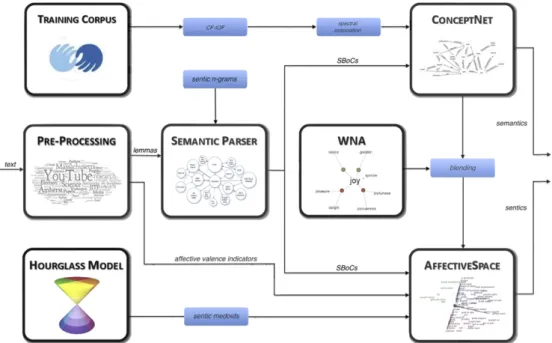
The developed patient opinion mining engine consists of four main components: a pre-processing module, which performs a first skim of the opinion, a semantic parser, whose aim is to extract con-cepts from the opinionated text, the ConceptNet module, for the inference of the semantics associated with the given concepts, and the AffectiveSpace module, for the extraction of sentics. The pre-processing module firstly interprets all the affective valence indicators usually contained in opinionated text such as special punctuation, complete upper-case words, onomatopoeic repeti-tions, exclamation words, negarepeti-tions, degree adverbs and emoticons. Secondly, it converts text to lower-case and, after lemmatizing it, splits the opinion into single clauses according to grammatical con-junctions and punctuation.
The semantic parser deconstructs text into concepts using a lex-icon based on sequences of lexemes that represent multiple-word concepts extracted from ConceptNet, WordNet and other linguistic resources. These n-grams are not used blindly as fixed word pat-terns but exploited as reference for the module, in order to extract multiple-word concepts from information-rich sentences. So, dif-ferently from other shallow parsers, the module can recognize complex concepts also when irregular verbs are used or when these are interspersed with adjective and adverbs, e.g., the concept ‘buy christmas present’ in the sentence ‘‘I bought a lot of very nice Christmas presents’’. The semantic parser, additionally, provides, for each retrieved concept, the relative frequency, valence and sta-tus, that is the concept’s occurrence in the text, its positive or neg-ative connotation and the degree of intensity with which the concept is expressed. For each clause, the module outputs a small
Fig. 5.The semantics and sentics stack. Semantics are built on the top of patient
data and the metadata associated with these. Sentics, in turn, are built on the top of semantics, as they the represent emotions (or polarity) conveyed by the detected concepts.
bag of concepts (SBoC), which is later on analyzed separately by the ConceptNet and AffectiveSpace modules to infer the cognitive and affective information associated with the input text, respec-tively (Fig. 6).
Specifically, the ConceptNet module employs spectral associa-tion for assigning activaassocia-tion to key concepts, that is nodes of the semantic network which are used as seeds for classification. Such seeds are found by applying CF-IOF on a set of 2000 topic-tagged posts extracted from PatientOpinion1, a social enterprise providing
an on-line feedback service for users of the UK National Health Ser-vice (NHS). Thanks to CF-IOF weights, it is possible to filter out com-mon concepts and detect domain dependent concepts that identify topics typically found in patient opinions, e.g., cleanliness, food, kindness of staff and timeliness. Such concepts represent seed con-cepts for spectral association, which spreads their values across the ConceptNet graph and, hence, detects semantically related con-cepts concerning the same topic, which are stored in a database to be accessed at run-time by the opinion analysis process. Therefore, the concepts of each SBoC provided by the semantic parser are pro-jected on the matrix resulting from spectral association in order to calculate their semantic relatedness to each seed concept and, hence, their degree of belonging to each different class. Such classification measure is directly proportional to the degree of connectivity be-tween the nodes representing the retrieved concepts and the seed concepts in the ConceptNet graph.
As for the extraction of sentics, the concepts output by the semantic parser are also given as input to the AffectiveSpace mod-ule, which employs dimensionality reduction techniques to infer the affective information associated with them. To this end, the concepts of each SBoC are projected into AffectiveSpace and, according to their position in the vector space representation of affective common sense knowledge, they are assigned to one of the 24 affective clusters defined through the sentic medoids tech-nique. In case any of the detected concepts is found more than once in the vector space (that is, any of the concepts has multiple senses), all the SBoC concepts are exploited for a context-dependent coarse sense disambiguation. In particular, to represent the
expected semantic value of the clause as a whole, we can average together the vectors corresponding to all concepts in the clause (in their ambiguous form). The resulting vector does not represent a single meaning but the ‘ad hoc category’ of meanings that are sim-ilar to the various possible meanings of concepts in the clause (Havasi et al., 2010). Then, to assign the correct sense to the ambig-uous concept, we find the sense of each concept that has the high-est dot product (stronghigh-est similarity) with the clause vector.
As well as in the ConceptNet module, the categorization does not consist in simply labeling each concept but also in assigning a confidence score to each emotional label, which is directly pro-portional to the degree of belonging to a specific affective cluster (dot product between the given concept and the relative sentic medoid). Such affective information, expressed in terms of sentic vector, can also be exploited to calculate a polarity value associated with each SBoC and, hence, detect the overall polarity associated with the opinionated text by averaging out all the SBoCs’ polarity values, according to the following formula:
p¼PN i¼1
PleasantnessðoiÞ þ jAttentionðoiÞj jSensitivityðoiÞj þAptitudeðoiÞ 9N
whereNis the total number of retrieved concepts and 9 is the nor-malization factor (as the maximum and minimum values of the numerator are given by the sentic vectors [3, ±3, 0,3] and [3, 0, ±3,3], respectively). In the formula, Attention and Sensitiv-ity are taken in absolute value since, from the point of view of polar-ity rather than affection, all of their sentic values represent positive and negative values respectively (e.g., ‘anger’ is positive in the sense of level of activation of Sensitivity but negative in terms of polarity and ‘surprise’ is negative in the sense of lack of Attention but posi-tive from a polarity point of view).
As an example of how the software engine works, we can exam-ine intermediate and final outputs obtaexam-ined when a natural lan-guage opinion is given as input to the system. We choose the patient opinion ‘‘This back pain is limiting me a lot but at least I can move around from time to time for my basic needs. And any-way staff is alany-ways so nice and helpful that I don’t feel like a burden to them’’. After the pre-processing and semantic parsing opera-tions, we obtain the following SBoCs:
Fig. 6.The patient opinion analysis process basically consists in firstly skimming input text, secondly extracting small sets of concepts, and eventually inferencing semantics
and sentics associated with these.
1
SBoC#1:
<Concept: ‘back pain’> <Concept: ‘limit’++>
SBoC#2:
<Concept: ‘able move’> <Concept: ‘basic need’>
SBoC#3:
<Concept: ‘staff’> <Concept: ‘nice’++> <Concept: ‘helpful’++>
SBoC#4:
<Concept:!‘feel like burden’>
These are then concurrently processed by the ConceptNet and the AffectiveSpace modules, which output the cognitive and affec-tive information associated with each SBoC, both in a discrete way, with one or more labels, and in a dimensional way, with a polarity value2[1, +1] (as shown inTable 2).
5. Monitoring patients’ physio-emotional sensitivity
The importance of physio-emotional sensitivity in humans has been proven by recent health research, which has shown that indi-viduals who feel loved and supported by friends and family, or even by a loving pet, tend to have higher survival rates following heart attacks than other cardiac patients who experience a sense of social isolation. Such concept is also reflected in natural lan-guage as we use terms such as ‘heartsick’, ‘broken-hearted’ and ‘heartache’ to describe extreme sadness and grief, idioms like ‘full of gall’ and ‘venting your spleen’ to describe anger, and expressions such as ‘gutless’, ‘yellow belly’ and ‘feeling kicked in the gut’ to de-scribe shame.
Human body contracts involuntarily when it feels emotional pain such as grief, fear, disapproval, shock, helplessness, shame, terror, in the same reflex it does if physically injured. Such gripping reflex normally releases slowly, but if a painful experience is in-tense, or happens repeatedly, the physio-emotional grip does not release, and constriction is retained in the body. Any repeated sim-ilar experience then layers on top of the original unreleased con-traction, until we are living with layers of chronic tension, which constricts our bodies. The mind, in fact, may forget the origin of pain and tension, but the body does not.
Besides HRQoL measurement,Sentic PROMsaim to monitor also
users’ physio-emotional sensitivity on a regular basis, as a means of patient affective modeling. In particular, the dimensional
affec-tive information coming from both questionnaire data (howRu
aggregated score) and natural language data (sentic vectors) is stored separately by the system every time patients conclude a
Sentic PROMssession and plotted on four different bi-dimensional diagrams (Fig. 7). Such diagrams represent the pairwise fusion of the four dimensions of the Hourglass model and allow to detect more complex (compound) emotions that can be particularly rele-vant for monitoring patients’ physio-emotional sensitivity, e.g., frustration, anxiety, optimism, disapproval and rejection.
6. Evaluation
SinceSentic PROMsinterface is still under-development, at the time of writing this article we had no consistent dataset of aggre-gated patient data available for thoroughly testing the system. Hence, a preliminary evaluation of the system had to be performed separately at two different levels: structured level (questionnaire data) and unstructured level (natural language data). As for the structured-level evaluation, a validation study was undertaken to examine the psychometric properties and construct validity of
howRuand to compare these withSF-12. In particular, 2751 sub-jects with long-term conditions (average age 62, female 62.8%), were classified byhowRuscore, primary condition, number of con-ditions suffered, age group, duration of illness and area of resi-dence. Across all six classifications, the correlation of the mean
howRu scores with the mean values of the Physical Components
Summary (PCS-12), the Mental Components Summary (MCS-12)
and the sum ofPCS-12 + MCS-12 were generally very high (0.91,
0.45 and 0.97 respectively) (Benson et al., 2010).
As for the unstructured-level evaluation, in turn, the engine’s capability to extract cognitive and affective information from nat-ural language opinions was tested. In particular, in order to calcu-late statistical classifications such as precision and recall of the semantics and sentics extraction process, we evaluated the system both with the PatientOpinion database and with a corpus of topic and mood tagged blogs from LiveJournal2(LJ). LJ is a virtual
com-munity of more than 23 million users who keep a blog, journal or diary.
One of the interesting features of this website is that LJ bloggers are allowed to label their posts not only with a topic tag but also with a mood label, by choosing from more than 130 predefined moods or by creating custom mood themes. Since the indication of the affec-tive status is optional, the mood-tagged posts are likely to reflect the true mood of the authors and, hence, form a good test-set for the opinion engine. However, since LJ mood themes do not perfectly match the sentic levels, we had to consider a reduced set of 10 moods, i.e., ‘ecstatic’, ‘happy’, ‘pensive’, ‘surprised’, ‘enraged’, ‘sad’, ‘angry’, ‘annoyed’, ‘scared’ and ‘bored’. Moreover we could not con-sider non-affective web-posts since mood-untagged blog entries do not necessarily lack emotions. As for the topic tags, in turn, we selected the LJ labels that match PatientOpinion topic-tags, e.g., ‘food’, ‘cleanliness’ or ‘communication’, in order to collect natural language text that is likely to have the same semantics as the cogni-tive information usually associated with patient opinions. All LJ accounts have Atom, RSS and other data feeds which show recent public entries, friend relationships and interests. Unfortunately the current LJ API allows retrieval of posts by topic only so, in order to also get mood-tagged posts, we had to design our own web crawler.
After retrieving and storing relevant data and metadata from 10,000 LJ posts, we extracted semantics and sentics through the opinion analysis process and compared the output with the rela-tive topic and mood tags, in order to calculate precision, recall and F-measure rates. On average, each post contained around
Table 2
Structured output example of the opinion mining engine: for each clause, the engine detects opinion target, category and affective information associated with it both in a textual form (emotional label) and in a dimensional form (polarity).
SBoC Opinion Target Category Moods Polarity
#1 ‘back pain’ ‘clinical’, ’symptom’ ‘annoyance’, ‘apprehension’ 0.85
#2 ‘back pain’ ‘limitation’, ‘symptom’ ‘acceptance’, ‘serenity’ +0.39
#3 ‘staff’ ‘staff’, ‘service’ ‘joy’, ‘trust’ +0.75
#4 ‘staff’ ‘dependency’ ‘joy’ +0.56
2
140 words, from which about 12 affective valence indicators and 60 concepts were extracted. From the retrieved concepts we in-ferred semantics and sentics associated with each of the selected posts and, hence, tagged them with topic and mood labels. We then compared these labels with the corresponding topic and mood LJ tags, obtaining very good accuracy in terms of both semantics and sentics extraction.
As for the detection of moods, for example, ‘happy’ and ‘sad’ posts were identified with particularly high precision (89% and 81% respectively) and good recall rates (76% and 68%). The F-mea-sure values obtained, hence, were significantly good (82% and 74% respectively), especially if compared to the corresponding F-mea-sure rates of existing approaches to automatic identification of emotions in text such as keyword spotting (53% F-measure for ‘happy’ posts and 51% for ‘sad’ posts), lexical affinity (63% and 58% F-measure rates respectively) and statistical methods (69% and 62% F-measure for ‘happy’ and ‘sad’ posts respectively). As for the detection of topics, in turn, the classification of ‘food’ and ‘communication’ posts was performed with a precision of 75% and 69% and recall rates of 65% and 58% respectively. The total F-measure rates, hence, were considerably good (70% for ‘food’ posts and 63% for ‘communication’ posts), particularly if compared to the corresponding F-measure rates of the baseline methods (44% and 35% for keyword spotting, 53% and 39% for lexical affinity, 61% and 52% for statistical methods).
We also performed an evaluation test on the 2000 topic- and polarity-tagged posts of the PatientOpinion database. Although CF-IOF has been applied on the database for extracting spectral association seeds, the polarity values of the dataset have not been exploited during the training phase. Hence, we could test the engine’s capability to infer the sentics associated with each of the 2000 patient opinions and, in particular, calculate polarity detection accuracy, which, thanks to a full correspondence of concepts, resulted to be very high (91%). As soon as a new ver-sion of PatientOpinion database is released, we plan to perform a more comprehensive evaluation at both topic and polarity level in order to test the system’s capability to discover all the differ-ent facets of the expressed opinion and the affective valence associated with each of these (feature-based sentiment analysis (Liu, 2010)). Further results will be submitted elsewhere for publication.
7. Conclusion and future work
Medicine is finally waking up to the use of novel technologies to listen to the ‘wisdom of the patient’. Health-care of the future will be based on community, collaboration, self-caring, co-creation and co-production using technologies delivered via the Web. Engaging patients in their health-care and encouraging people to take responsibility for protecting their health, in fact, are seen as the
best way to ensure the sustainability of health systems (WHO,
2000). Patients can play a distinct role in their own care by diag-nosing and treating minor, self-limiting conditions and by prevent-ing occurrence or recurrence of disease or harm, by selectprevent-ing the most appropriate form of treatment for acute conditions in part-nership with health professionals, and by actively managing chronic diseases.
Traditional paternalistic practice styles undermine people’s confidence in their ability to look after themselves, so replacing paternalism with a partnership approach could help to enhance a sense of self-efficacy (Coulter, 2011). A growing body of evidence demonstrates that patient engagement in treatment decisions and in managing their own health-care can lead to more appropri-ate and cost-effective utilization of health services and better health outcomes (Coulter and Ellins, 2006).
This shift in emphasis to e-health does not replace traditional health care models but rather complements them and will ideally become the prevailing model. To aid such process, we proposed
Sentic PROMsas a new framework for measuring health care qual-ity that exploits the ensemble application of standard PROMs and sentic computing to overcome the common barriers to the use of HRQoL measurement systems, such as the respondent burden (the time needed to complete the forms) and the need for staff to be trained to understand the results.
Sentic PROMs, in fact, aim to be clinically useful and timely, sen-sitive to change, culturally sensen-sitive, low burden, low cost, involve the patient and built into standard procedures and needs to meet the requirements of regulators, payers and continuous quality improvement. In particular, to bridge the gap between the struc-turedness of questionnaire data and the unstrucstruc-turedness of natu-ral language data, which are different at structure-level yet similar at concept-level,Sentic PROMsexploit both the semantics and sen-tics associated with patient opinions to accordingly aggregate such
Fig. 7.Hourglass pairwise fusion diagrams. PlottinghowRuaggregated score and sentic vectors allows to detect compound emotions that are particularly relevant for
data and, hence, evaluate patients’ health status and experience in a semi-structured way, while tracking their physio-emotional sensitivity.
Soon, we plan to conduct on-field usability and performance tests on different case-mixes in order to thoroughly evaluate the system and possibly discover new interesting patterns. We also plan to further develop sentic computing techniques in order to enable the system to make more sense of the collected health-care data and, hence, be adaptive, in order to pave the way for the development of next-generation intelligent personal e-doctors.
Acknowledgments
This work has been part-funded by the UK Engineering and Physical Sciences Research Council (EPSRC Grant Reference: EP/G501750/1), the UK Technology Strategy Board (TSB Grant Reference: 12074-75246) and Sitekit Solutions Ltd. (a Company Registered in Scotland: SC116007).
References
Abbasi, A., Chen, H., & Salem, A. (2008). Sentiment analysis in multiple languages: Feature selection for opinion classification in web forums.ACM Transactions on Information Systems, 26(3), 1–34.
Benson, T., Sizmur, S., Whatling, J., Arikan, S., McDonald, D., & Ingram, D. (2010). Evaluation of a new short generic measure of health status.Informatics in Primary Care, 18(2), 89–101.
Bergner, M., Bobbitt, R., Kressel, S., Pollard, W., Gilson, B., & Morris, J. (1976). The sickness impact profile: Conceptual formulation and methodology for the development of a health status measure.International Journal of Health Services, 6, 393–415.
Brooks, R. (1996). EuroQoL – the current state of play.Health Policy, 37, 53–72. Cambria, E., Hussain, A., Havasi, C., & Eckl, C. (2009). AffectiveSpace: Blending
common sense and affective knowledge to perform emotive reasoning. In Proceedings of CAEPIA, Seville,(pp. 32–41).
Cambria, E., Hussain, A., Durrani, T., Havasi, C., Eckl, C., & Munro, J. (2010). Sentic computing for patient centered application. InProceedings of IEEE ICSP, Beijing, (pp. 1279–1282).
Cambria, E., Song, Y., Wang, H., & Hussain, A. (2011). Isanette: A common and common sense knowledge base for opinion mining. InProceedings of ICDM, Vancouver.
Cambria, E., Havasi, C., & Hussain, A. (2012). SenticNet 2: A semantic and affective resource for opinion mining and sentiment analysis. InProceedings of FLAIRS, Marco Island.
Cambria, E., Grassi, M., Hussain, A., & Havasi, C. (2011). Sentic computing for social media marketing, Multimedia Tools and Applicationshttp://dx.doi.org/10.1007/ s11042-011-0815-0.
Cambria, E., & Hussain, A. (2012). Sentic computing: Techniques, tools, and applications. Berlin Heidelberg: Springer.
Cambria, E., Hussain, A., Havasi, C., & Eckl, C. (2009). Common sense computing: From the society of mind to digital intuition and beyond. In J. Fierrez, J. Ortega, A. Esposito, A. Drygajlo, & M. Faundez-Zanuy (Eds.),Biometric ID management and multimodal communication.Lecture notes in computer science(Vol. 5707, pp. 252–259). Berlin Heidelberg: Springer.
Cambria, E., Mazzocco, T., Hussain, A., & Eckl, C. (2011). Sentic medoids: Organizing affective common sense knowledge in a multi-dimensional vector space. In Advances in neural networks. Lecture notes in computer science (Vol. 6677, pp. 601–610). Berlin Heidelberg: Springer-Verlag.
Coulter, A. (2011).Engaging patients in healthcare. McGraw Hill.
Coulter, A., & Ellins, J. (2006). The quality enhancing interventions project: Patient-focused interventions.The Health Foundation.
Culyer, A., Lavers, R., & Williams, A. (1971). Social indicators: Health.Social Trends, 2, 31–42.
Donabedian, A. (1966). Evaluating the quality of medical care. The Millbank Memorial Fund Quarterly, 44, 166–203.
Duda, R., & Hart, P. (1973).Pattern classification and scene analysis. New York: John Wiley & Sons Inc.
Eckart, C., & Young, G. (1936). The approximation of one matrix by another of lower rank.Psychometrika, 1(3), 211–218.
Elliott, C. D. (1992). The affective reasoner: A process model of emotions in a multi-agent system, Ph.D. thesis. Northwestern University, Evanston.
Fanshel, S., & Bush, J. (1970). A health status index and its application to health-services outcomes.Operations Research, 18, 1021–1066.
Goertzel, B., Silverman, K., Hartley, C., Bugaj, S., & Ross, M. (2000). The Baby Webmind project. InProceedings of AISB, Birmingham.
Hartigan, J., & Wong, M. (1979). Algorithm AS 136: A k-means clustering algorithm. Journal of the Royal Statistical Society, 28(1), 100–108.
Havasi, C., Speer, R., & Alonso, J. (2007). ConceptNet 3: A flexible, multilingual semantic network for common sense knowledge. InProceedings of RANLP, Borovets.
Havasi, C., Speer, R., Holmgren, J. (2010). Automated color selection using semantic knowledge. InProceedings of AAAI CSK, Arlington.
Havasi, C., Speer, R., & Pustejovsky, J. (2010). Coarse word-sense disambiguation using common sense. InProceedings of AAAI CSK, Arlington, USA.
Havasi, C., Speer, R., Pustejovsky, J., & Lieberman, H. (2009). Digital intuition: Applying common sense using dimensionality reduction. IEEE Intelligent Systems, 24(4), 24–35.
Horsman, J., Furlong,W., Feeny, D., & Torrance, G. (2003) The health utility index (HUI): Concepts, measurement, properties and applications.Health and Quality of Life Outcomes 1(54).
Hu, M., & Liu, B. (2004). Mining opinion features in customer reviews. InProceedings of AAAI. San Jose.
Kaufman, L., & Rousseeuw, P. (1990).Finding groups in data: An introduction to cluster analysis. Wiley-Interscience.
Liu, B. (2010). Sentiment analysis and subjectivity. InHandbook of Natural Language Processing.
Liu, H., & Singh, P. (2004) ConceptNet: A practical commonsense reasoning toolkit. BT Technology Journal.
Minsky M. (2006). The emotion machine: Commonsense thinking, artificial intelligence, and the future of the human mind,Simon&Schuster.
Mueller, E. (2006).Commonsense reasoning. Morgan Kaufman.
Ortony, A., Clore, G., & Collins, A. (1988). The cognitive structure of emotions. Cambridge: Cambridge University Press.
Pang, B., Lee, L., & Vaithyanathan, S. (2002). Thumbs up? Sentiment classification using machine learning techniques. InProceedings of EMNLP, Philadelphia,(pp. 79–86.)
Pang, B., & Lee, L. (2005). Seeing stars: Exploiting class relationships for sentiment categorization with respect to rating scales. InProceedings of ACL, Ann Arbor,(pp. 115–124.)
Park, H., & Jun, C. (2009). A simple and fast algorithm for k-medoids clustering. Expert Systems with Applications, 36(2), 3336–3341.
Plutchik, R. (2001). The nature of emotions.American Scientist, 89(4), 344–350. Rao, D., & Ravichandran, D. (2009). Semi-supervised polarity lexicon induction. In
Proceedings of EACL, Athens,(pp. 675–682.)
Somasundaran, S., Wiebe, J., & Ruppenhofer, J. (2008). Discourse level opinion interpretation. InProceedings of COLING, Manchester.
Speer, R. (2007). Open mind commons: An inquisitive approach to learning common sense. In Proceedings of the Workshop on Common Sense and Interactive Applications, Honolulu.
Stevenson, R., Mikels, J., & James, T. (2007). Characterization of the affective norms for english words by discrete emotional categories.Behavior Research Methods, 39, 1020–1024.
Strapparava, C., & Valitutti, A. (2004). WordNet-Affect: An affective extension of WordNet. InProceedings of LREC, Lisbon.
Torrance, G., Thomas, W., & Sackett, D. (1972). A utility maximisation model for evaluation of health care programs.Health Services Research, 7, 118–133. Turney, P., & Littman, M. (2003). Measuring praise and criticism: Inference of
semantic orientation from association.ACM Transactions on Information Systems, 21(4), 315–346.
Wall, M., Rechtsteiner, A., & Rocha, L. (2003). Singular value decomposition and principal component analysis. In D. Berrar, W. Dubitzky, & M. Granzow (Eds.),A practical approach to microarray data analysis(pp. 91–109). Springer. Ware, J. (1976). Scales for measuring general health perceptions.Health Services
Research, 11, 396–415.
Ware, J., Kosinski, M., & Keller, S. (1996). A 12-item short-form health survey: Construction of scales and preliminary tests of reliability and validity.Medical Care, 34(3), 220–233.
Ware, J., & Sherbourne, C. (1992). The MOS 36-item short-form health survey (SF-36). Conceptual framework and item selection.Medical Care, 30, 473–483. WHO. The world health report 2000: Health systems - improving performance,
Technical report, World Health Organization (2000).
Wiebe, J., Wilson, T., & Cardie, C. (2005). Annotating expressions of opinions and emotions in language.Language Resources and Evaluation, 39(2), 165–210. Wilson, T., Wiebe, J., & Hoffmann, P. (2005). Recognizing contextual polarity in