Independent evaluatIon Group T h e W o r l d B a n k G r o u p 1818 H Street, N.W. Washington, D.C. 20433, U.S.A. Telephone: 202-477-1234 Facsimile: 202-477-6391 Internet: www.worldbank.org Independent Evaluation Group
Knowledge Programs and Evaluation Capacity Development (IEGKE) E-mail: [email protected]
Telephone: 202-458-4497 Facsimile: 202-522-3125
World Bank Independent evaluatIon Group and the thematIc Group for poverty analysIs, monItorInG and Impact evaluatIon ■ evaluatIon capacIty development
Program
ClassifiCation
for
PerformanCe-Based Budgeting:
How to struCture
Budgets to enaBle
tHe use of evidenCe
1
The World Bank Washington, D.C. Independent evaluatIon Group
Program ClassifiCation
for PerformanCe-Based
Budgeting:
How to struCture
Budgets to enaBle
tHe use of evidenCe
© 2013 Independent Evaluation Group Strategy, Learning, and Communication
International Bank for Reconstruction and Development/World Bank 1818 H Street, N.W. Washington, DC 20433 Email: [email protected] Telephone: 202-458-4497 Facsimile: 202-522-3125 Internet: http://ieg.worldbankgroup.org
Rights and Permissions
This work is available under the Creative Commons Attribution 3.0 Unported license (CC BY 3.0) http://creativecommons.org/licenses/by/3.0. Under the Creative Commons Attribution license, you are free to copy, distribute, transmit, and adapt this work, including for commercial purposes, under the following conditions:
Attribution – Please cite the work as follows: Robinson, Marc. 2013. Program
Classification for Performance-Based Budgeting: How to Structure Budgets to Enable the Use of Evidence. IEG Evaluation Capacity Development Series. Washington, DC:
World Bank. License: Creative Commons Attribution CC BY 3.0
Translations – If you create a translation of this work, please add the following disclaimer along with the attribution: This translation was not created by the
Independent Evaluation Group or the World Bank Group and should not be considered an official World Bank Group translation. IEG and the World Bank Group shall not be liable for any content or error in this translation.
All queries on rights and licenses should be addressed to IEG, 1818 H Street NW, Washington, DC 20433, USA; fax: 202-522-3125; e-mail: [email protected]. ISBN-13: 978-1-60244-238-2
ISBN-10: 1-60244-238-X
The opinions expressed in the report do not necessarily represent the views of IEG/ the World Bank Group or its member governments. IEG/the World Bank Group do not guarantee the accuracy of the data included in this publication and accept no responsibility whatsoever for any consequence of their use.
Acknowledgements
This IEG Blue Booklet was prepared by Marc Robinson, member, OECD Advisory Panel on Budgeting and Public Expenditures, and a former staff member of the International Monetary Fund. Peer review commments from Nidhi Khattri, Lead Evaluation Officer, and edits from Heather Dittbrenner are gratefully acknowledged. The task manager was Ximena Fernandez Ordonez, Evaluation Officer, IEG.
The IEG Blue Booklet series disseminates practical information on various aspects of monitoring and evaluation. An objective of the series is to focus on implementation aspects of monitoring and evaluation and to disseminate information on other sources of knowledge. The series is prepared under the team leadership of Nidhi Khattri and the overall guidance of Hans-Martin Boehmer, Senior Manager, IEGCS.
Table of Contents
1. Introduction and Overview ... 1
2. The Principle of Results-Based Programs ... 6
2.1 Programs and Intermediate Outcomes ... 8
2.2 Results-Based Subprograms ... 9
2.3 Results-Based versus Activity-Based Programs ... 9
2.4 Programs and Policy Priorities ... 11
3. Program Definition and Input Cost Allocation... 13
4. Programs and Organizational Structure ... 17
4.1 Splitting Organizational Units between Programs ... 20
4.2 Support Services and Programs ... 24
4.2.1 What Is a Support Services Program? ... 24
4.2.2 Why Support Programs? ... 25
4.2.3 Support Subprograms ... 29
4.2.4 Allocation of Support Costs for Information Purposes ... 29
4.2.5 Countries without Support Programs ... 30
4.3 Case Study: Education Inspection Services ... 31
4.4 One-Stop-Shops ... 32
4.5 Should Programs Be Aligned to Organizational Structure? ... 33
4.6 A Simplified Relationship between Organizational Units and Programs? ... ... 36
4.7 Ministry Boundaries and Programs ... 39
4.8 The Program Hierarchy: How Many Levels? ... 42
4.9 Number and Size of Programs ... 44
5. Programs and the Functional Classification of Expenditure ... 46
6. Conclusions and Rules ... 50
Glossary ... 52
References ... 54
1
1. Introduction and Overview
This guide provides practical guidance on program classification – that is, on how to define programs and their constituent elements under a program budgeting system.
Program budgeting is the most widespread form of performance budgeting as applied to the government budget as a whole (Robinson 2011). The defining characteristics of program budgeting are:
n Funds are allocated in the budget to results-based “programs.”
For example, the education ministry’s budget provides allocations of funds to a primary education program, a secondary education program, and a tertiary education program, while the environment ministry’s budget includes a nature conservation program and an anti-pollution program.
n “Line item” controls – limits imposed by the parliament or the
ministry of finance on the amounts ministries can spend on specific types of inputs (such as office supplies, travel, and utilities) – are radically reduced, although certainly not entirely eliminated.
n Good performance information on programs is collected and used
in the budget preparation process to assist budget decision makers to determine how much money is allocated to each program. The core objective of program budgeting is improved expenditure prioritization. Expenditure prioritization means that limited government resources are allocated to the programs that deliver the greatest benefits to the community given the money spent. By providing information on the costs and benefits of alternative programs, a program-budgeting system facilitates decisions about which areas of expenditure to cut back on and which to augment, to best meet community needs. By contrast, a traditional budget in which funds are mainly allocated by line item is of limited value as a vehicle for choices about expenditure priorities.
Expenditure prioritization is not, however, the only objective of program budgeting. By making program performance a systematically important factor in decisions on ministry budget allocations, program budgeting also aims to place significant pressure on ministries to improve the effectiveness and efficiency of their existing services.
The appropriate definition of programs – and other elements of the so-called program hierarchy – is central to a good program budgeting system. In almost all program budgeting systems, programs are comprised of a number of “subprograms,” which are defined according to the same principles as programs themselves. In some countries, subprograms are broken down even further into sub-subprograms and even (very rarely) into even smaller elements. At the other end of the spectrum, there are certain countries where programs themselves are grouped into broad results-based categories, which we will refer to in this guide as “super-programs.” The term “program hierarchy” refers
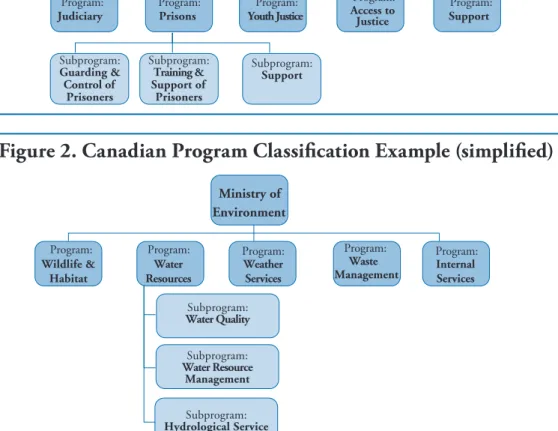
Figure 1. French Program Classification Example (simplified)
Figure 2. Canadian Program Classification Example (simplified)
Ministry of Justice Program: Judiciary Program: Prisons Subprogram: Guarding & Control of Prisoners Subprogram: Training & Support of Prisoners Subprogram: Support Program: Youth Justice Program: Access to Justice Program: Support Ministry of Environment Program: Wildlife & Habitat Program: Water Resources Program: Weather Services Program: Waste Management Program: Internal Services Subprogram: Water Quality Subprogram: Water Resource Management Subprogram: Hydrological ServiceIn t r o d u c t I o n a n d ov e r v I e w 3
to the hierarchical structure of program elements that prevails in any given country.
For ease, we assume – unless otherwise indicated – throughout this guide the existence of a simple two-level program hierarchy comprised solely of programs and subprograms. The merits of a more complicated structure hierarchy are, however, discussed toward the end of the guide. Programs and subprogram budgets represent allocations of budgetary funding which are used for budget planning and control purposes. At the program level, budget allocations are in most countries set by parliament in the budget law. They therefore constitute legal appropriations that spending ministries must (subject to certain qualifications) legally respect. At the subprogram level, funding allocations – the amount planned to be spent on each subprogram within a program – are usually decided internally by ministries, rather than being specified in the budget law. However, these arrangements vary between countries, and the details of who controls program and subprogram allocations in a specific country’s budgetary system do not affect the main point, which is that programs and subprograms are intended to be categories in terms of which budgetary resources are managed. This is, indeed, one of the key reasons that programs should cover all government expenditure, and not merely some portion of it.
Program classification is thus not merely a statistical/reporting classification of expenditure. That is, it is not a classification of expenditure that is intended to be used solely for reporting the composition of expenditure after the event. As emphasized above, programs are used for the planning and control of expenditure. This makes program classification completely different from statistical classifications like the “functional” Classification of the Functions of Government (COFOG) classification developed by the United Nations for international comparisons of expenditure composition.
Internationally, programs and their constituent elements go by many different names in different countries. Programs, for example, have been called “output classes,” “business lines,” “vote functions,” “strategic outcomes,” and a variety of other names, and a similar bewildering multiplicity of names can be observed for subprograms and (where they exist) lower levels in the program hierarchy. Sometimes, the names used are conceptually inappropriate and misleading – as, for example, in the use of the term “activity” to refer to sub-subprograms
in several countries. This terminological zoo is, however, of little or no consequence. Whatever the terminology used, the idea is broadly the same.
Although the broad idea of programs is the same throughout the world, many countries nevertheless make serious mistakes in the way they define programs. It is the objective of this guide to explain the proper way of defining programs and to explicitly identify the most common errors made, in order to assist countries to avoid these mistakes.
The most basic principle is that, to serve their intended purpose, programs should be results based, to the maximum possible extent. This means that they should be defined as groups of services delivered to external parties (“outputs”) or transfer payments which have common outcomes – “product lines” in the shorthand terminology used in this guide. By defining programs in this manner, the budget classifies expenditure in terms principally of services and the types of benefits those services are intended to generate. Basing programs on product lines makes the budget a useful tool for expenditure prioritization because prioritization is primarily about choosing how much to spend on tertiary education versus primary education, and how much to spend on preventative health interventions versus health treatments.
If program classification were simply a matter of applying the principle of results-based programs, a technical guide would need to be no longer than a couple of pages. However, in developing a program classification, it is necessary to take into account two important realities that, on one hand, influence the manner in which results-based programs are defined and, on the other hand, also force certain limited departures from the principle of results-based programs.
The first of these realities is the need to be able to accurately account for expenditure by program. Because programs are used to plan and control expenditure, it must be possible to monitor expenditure on a continuous basis by program so that, for example, ministries are able at any point during the financial year to know how much of a given program’s budget has been spent and how much remains to be spent. This means that the accounting system must record expenditure accurately, and in real time or frequent intervals, by program and subprogram. It is not sufficient, for example, to estimate program expenditure at the end of the year. This accounting imperative rules
In t r o d u c t I o n a n d ov e r v I e w 5
out defining programs in a way that makes it impossible or impractical to accurately account for expenditure on a program basis.
The second reality is that programs cannot disregard the structure of their government, because budgets are implemented by assigning resources to organizational units to use for activities designed to produce outputs. Program budgeting does not mean that allocations of resources to programs replace allocations to organizational units, but rather that resources are allocated to both programs and organizational units. As explained below, in the case of certain organizational units that contribute to multiple product lines, it makes sense to assign control of resources to the organizational unit without restricting the way in which the unit allocates these resources between product lines. Where this is the case, program structure will need to diverge from the results-based principle.
Acknowledging that organizational structure requires some limited departures from the principle of results-based programs is, however, not the same as arguing that program structure should simply follow – or be “aligned” with, in the vague terminology which is often used – organizational structure. This is a proposition that this guide rejects. It does so on the grounds that:
n Forcing program structure to simply follow whatever organizational
structure happens to be in place is inconsistent with the basic program budgeting objective of making budgeting as results-focused as possible.
n It is not true – as some would have it – that the need to budget
in terms of both programs and organizational units requires that programs be the same as organizational units.
This guide commences by outlining the basic principle of results-based program classification. It then explains the accounting and organizational structure “realities” that must also be considered in developing a sound program classification. In the subsequent sections, the guide then discusses sequentially the key specific issues that arise in developing a program classification.
2. The Principle of Results-Based
Programs
As indicated in the introductory section, the overarching principle guiding program classification is that programs should be, to the maximum degree possible, results based. This section elaborates the meaning of “results-based” programs.
Results-based programs are defined using the fundamental concepts of the results chain – also known as the logical framework. In this framework, inputs are used in carrying out activities in order to produce outputs and thereby achieve outcomes. Box 1 defines these concepts. (The reader may, however, find it useful to review the primer on these concepts provided in the manual Performance-Based Budgeting.)
Results-based programs bring together expenditures with a shared objective, the core of which is a common outcome which those expenditures are intended to achieve. Thus, for example, a preventive health program brings together a diverse range of outputs all of which aim at the outcome of the prevention of disease and injury. These
Box 1. Key Elements in the Results Chain
Inputs: Resources used in the carrying out of activities to produce outputs
(for example labor, equipment, buildings).
Activities: Types or categories of work process undertaken in the
production and delivery of outputs. Nursing and bus driving are examples of activities.
Outputs: A good or service provided by an agency to or for an external
party. For example, a hospital’s outputs are patient treatments, and the public transport systems outputs are bus and train rides taken by passengers. Outputs are the “products” of government agencies.
Outcomes: Changes brought about by public interventions upon
individuals, social structures, or the physical environment. A hospital’s outcomes include lives saved, and reduced air and water pollution are among the outcomes an environment agency seeks to achieve. Outcomes include what are sometimes referred to as “impacts.”
Th e Pr i n c i P l e o f re s u lT s-Ba s e d Pr o g r a m s 7
outputs might include sanitation promotion publicity campaigns; safe sex awareness campaigns; anti-diabetes television ads; antismoking pamphlets distributed in public health clinics; visits of nurses to schools to talk to children about healthy eating practices; the placement of notices warning people against swimming or washing in lakes or rivers with waterborne diseases; and the spraying of water sources that breed malaria-carrying mosquitoes.
As this indicates, programs are groups of outputs – that is, they group together a range of different types of services provided to external clients, which have a common intended outcome. For example, a public transport program brings together bus services, metro services, train services, and the regulation of taxi services, each of which is a different type of output. Similarly, a vocational education program brings together a range of vocational education outputs (formal courses, government support for apprenticeships etc) which all aim to ensure that the skilled labor requirements of the economy are met (the outcome). To be precise, results-based programs may include not only outputs, but also specific transfer payments made in pursuit of the program’s objectives – a point we abstract from in this guide for the sake of simplicity.1
The outputs grouped together under a program will often share not only a common outcome, but some other common characteristic such as a similar method of trying to achieve the outcome or a common client group. For example, a school education program has as its client group children in a specific age range.
A results-based program is therefore defined as a group of different types of output and/or transfer payments that have a common intended outcome together, possibly, with other common characteristics such as a single target client group. In this note, we also use the term product lines as shorthand to refer to groups of outputs which are related in this manner. This points to the analogy with the private sector, where for example a vehicle manufacturer might produce three product lines (programs) – namely, trucks, cars, and motor bikes – and within each
1. Transfer payments are payments to citizens such as social welfare benefits and industry subsidies. They are not outputs (which are services provided). However, just like outputs, transfer payments are also designed to achieve program outcomes, such as reduced poverty or the growth of an industry. Results-based programs may therefore include – or even be totally comprised of – specific types of transfer payments that are designed to achieve the program objective. Although this guide omits further reference to transfer payments, it will be clear that references to the outputs that comprise programs in most cases include transfer payments.
of these product lines would produce a number of different products (outputs). Thus, for example, the product line “cars” might cover five different models of car.
2.1 Programs and Intermediate Outcomes
In the results chain framework, a distinction is made between intermediate outcomes and high-level outcomes. Intermediate out- comes are the more direct or immediate outcomes achieved by the output, whereas the high-level outcome (sometimes referred to as the “impact”) is more like the ultimate result intended. Consider the example of school education. The most obvious direct outcome that school education aims to achieve is educated (that is, literate, numerate, and so forth) young people. However, by educating young people, government aims to achieve broader outcomes, including a more productive economy and higher living standards. “Educated young people” is therefore an intermediate outcome, whereas “economic productivity” and” higher living standards” are high-level outcomes.2 Education also has other intended outcomes. It aims to
directly contribute to socializing young people – that is, to increasing their respect for the law, the rights of others, and so forth. And to the extent that it achieves this intermediate outcome of socialized young people, it aims to contribute to the high-level outcome of a safer and more harmonious society.
The outcomes that define programs are intermediate outcomes. In other words, in saying that a program is a grouping of outputs with a “common intended outcome,” the outcome we are referring to is, in general, an intermediate outcome rather than a high-level outcome. Thus, the outcome of the school education program is appropriately defined as educated and socialized young people, and not as higher living standards and/or a safer and more harmonious society. This is because the more direct the outcome, the more specific it is to the program concerned. By contrast, high-level outcomes tend to be contributed to by multiple programs, and are therefore not specific to any individual program. For example, the outcomes of higher productivity and living standards are achieved not only through school education, but through a multiplicity of other government interventions in areas such
2. This distinction is, nevertheless, a matter of degree, and there is in fact a continuum of outcomes ranging from the most immediate to those that are higher level.
Th e Pr i n c i P l e o f re s u lT s-Ba s e d Pr o g r a m s 9
as support for science and technology, the provision of transport and other key infrastructure, support to particular industry sectors, and the provision of other types of education and training. It is good practice to make explicit the link between the intermediate outcome pursued by a program and the relevant high-level government-wide outcomes to which it is intended primarily to contribute. However, programs should in general be defined in terms of intermediate rather than high-level outcomes.
2.2 Results-Based Subprograms
In a program budgeting system, subprograms should also be results-based. That is, they should represent more disaggregated groupings of outputs within the program concerned. For example, a preventive health program might (purely illustratively) be broken into four subprograms: diabetes prevention, cancer screening and prevention, accident prevention, and infectious diseases prevention. Whereas a preventative health program typically brings together a large and diverse range of services and projects targeted at preventive health, subprograms bring order to this diversity by classifying the services into a number of specific types.
2.3 Results-Based versus Activity-Based Programs
It is important to distinguish clearly between a results-based program and an activity-based program. This distinction rests on the difference between outputs and activities. As noted above, an output is a good or service delivered by a ministry to an external party, whereas an activity is a particular type of work process performed in the production of an output. In a hospital, for example, anesthesia, nursing, medical records maintenance, and cleaning are activities, whereas the outputs are the complete treatments of various types that are provided to the hospital’s patients. So if the hospital were to develop the program classification with a nursing “program,” an anesthesia “program,” and so forth, it would have developed an activity-based program classification rather than a results-based program structure. A key element of getting program classification right is to avoid the mistake of confusing activity-based programs with results-based programs.
An important part of the distinction between activities and outputs is the recognition that services that one part of a ministry provides to
another part of the same ministry – for example, when the education ministry’s human resources group recruits teachers for the primary school group – are activities rather than outputs. More specifically, they are support services, which cannot be considered to be outputs because they are services provided to an internal rather than external party.
The logic of insisting that support services are not outputs can be seen more clearly if we remind ourselves that an “output” is the equivalent of a private sector company’s “product.” In the private sector context, where products are sold to customers, the distinction between products and support services is very clear. For example, the product of a car company is, obviously, cars, and no one would say that services provided by, say, the car company’s human resources group were company “products.” In a government context, insisting that the focus in defining programs should be on outcomes and outputs rather than on inputs and activities means focusing on what the government is doing for citizens rather than focusing inwardly on activities for their own sake.
This means that when a government ministry includes a support program – that is, a “program” that covers all of the ministry’s internal support services – in its program structure, it has deviated from the principle of results-based programs in favor of an activity-based program. Notwithstanding this, is it common internationally for support programs to be included in program classifications and there are persuasive reasons to regard this practice as entirely appropriate. But this does not change the fact that a support program is not a results-based program.
Support programs are one of a strictly limited number of justifiable exceptions to the general principle that programs should be results-based. To keep these exceptions to the minimum, and to avoid unnecessary or even wholesale departures from the principle of results-based programs, it is crucial to explicitly recognize these distinctions and to be clear about why they are necessary.
The key theme of this section can be summarized in the form of a rule – indeed, the most basic rule –governing program classification:
Rule 1: Programs and subprograms should to the maximum possible extent be results-based, grouping together outputs with a common intended outcome. This principle should be departed from only in specific cases with clear justification.
Th e Pr i n c i P l e o f re s u lT s-Ba s e d Pr o g r a m s 11
2.4 Programs and Policy Priorities
Programs and subprograms are, as has already been emphasized, expenditure categories used for budget planning and control. The choice of programs and subprograms should therefore depend on the nature of the key expenditure prioritization choices facing the government concerned. For example, in a country in Sub-Saharan Africa that is faced with a serious problem of desertification, the government and parliament may wish to make an explicit decision about the level of funding that should be dedicated to attacking the problem. It would then be appropriate to include a desertification program within the country’s program classification, whereas this would be entirely inappropriate in countries that do not face this problem. Similarly, a country that is facing a large-scale tuberculosis problem might choose to have an explicit tuberculosis subprogram within its preventive health program, whereas in most countries preventive measures in respect to tuberculosis would be included in the infectious diseases prevention subprogram.
Expressed differently, the choice of programs should reflect choices made by the government and parliament about the product lines in respect to which they wish to control expenditure. Analogously, and assuming (see above) that the allocation of budgets at the subprogram level is delegated to ministries, the definition of subprograms should reflect choices made by ministers and top ministry management about which of the ministry’s more detailed product lines they wish to exert direct expenditure control over.
It is therefore inappropriate to define programs covering product lines that the government does not wish to exert direct control over but is happy to leave to the spending ministries concerned. Similarly, it is inappropriate to define subprograms that cover product lines that the relevant minister and top ministry management do not wish to control, but are prepared to leave to the relevant ministry directorates or subdirectorates to determine.
This suggests the following rule:
Rule 2: In countries where funds are appropriated in the budget law by program, programs should be defined only for those broad product lines that are of sufficient importance in government-wide policy priorities for the government and/or parliament to wish to determine centrally the total resourcing that will be made available to them, rather than leaving this to be determined by the budget allocation decisions of relevant ministries/agencies.
The pertinence of this rule is not affected by the fact that countries that appropriate by program typically allow ministries to undertake marginal reallocations of funding between programs (for example, up to 5 percent of program allocations) without parliamentary approval.
An obvious implication of these principles is that program classifications should to some extent vary between countries, rather than being the same everywhere. One would nevertheless expect a considerable degree of similarity in program structures in many cases. For example, the program structure of education ministries will tend to be quite similar in different countries, generally including separate primary education and secondary education programs.
13
3. Program Definition and Input Cost
Allocation
The need to accurately account for expenditure by program and subprogram has implications for the program classification. This “reality” is the focus of this section. The essence of the section is that the following general rule should always and everywhere be followed when developing a program classification:
Rule 3: Programs should not be defined in a way that requires specific resources (inputs) – for example, specific employees or cars – to be split between several programs, unless it is feasible and practical to record the usage of these shared resources by each of the programs concerned with sufficient accuracy to produce reliable measures of expenditure by program in the accounting system.
This rule applies also to subprograms and any lower levels in the program hierarchy.
Why this caution about splitting the cost of specific inputs between programs? Essentially, it derives from the importance, under a program budgeting system, of being able to monitor and control expenditure by program during the financial year. As noted previously, this makes it essential that the accounting system record expenditure by program and subprogram on an ongoing basis.
Government budgets are to a large degree spent on the purchase of inputs, and program accounting therefore involves recording the expenditure on inputs against the program and subprogram for which the input is used. This is, at least in principle, not problematic when a specific resource is used wholly for a single subprogram and program. For example, if a particular health ministry employee works entirely on HIV/AIDS prevention, all remuneration is recorded against the infectious diseases subprogram, and therefore automatically scores as part of the expenditure on the preventative health program of which this subprogram is part.
The problem arises in respect to shared inputs. If a particular employee spends part of his time working for one subprogram and part working for another – or, in a more extreme case, shares his time
between different programs – then the only way to accurately account for the expenditure of the subprograms or programs concerned is to ensure that an accurate record is kept of the employee’s time allocation, and to use this to allocate their remuneration costs between these subprograms/programs. This requires not only the maintenance of timesheets by all of the employees concerned, but also careful management monitoring to ensure that the timesheets are filled in accurately. The same applies to other shared inputs. For example, if a car is shared between a number of subprograms or programs, its costs would need to be allocated based on reliable usage records.
There is nothing conceptually difficult or unusual about the maintenance of such records of the use of shared inputs. It is frequently done in the private sector. For example, in law firms, lawyers routinely record in detail the allocation of their time between cases. However, the maintenance of such records – and in particular, management monitoring to ensure their accuracy – is time-consuming and therefore has significant costs. The costs of accurate shared cost allocation between programs vary, but can sometimes be particularly high if, for example, it is difficult for management to observe and verify how employees actually allocate their time.
Because the accurate allocation of shared inputs can be quite costly, organizations sometimes have recourse to simplifying assumptions – which may be quite arbitrary – about the way in which shared inputs are used. The assumption might, for example, be that any employee contributing to several subprograms allocates their time equally between these subprograms. Such an assumption makes the task of cost allocation an easy one. However, it has the downside that the resulting cost estimates are unreliable. In the program budgeting context, unless the accounting system produces reasonably reliable estimates of program and subprogram expenditure, the usefulness of the whole system is called into question.
If, then, programs are defined in such a way as to require significant allocation of shared input costs, the question will always arise as to whether it is justifiable to incur the costs required to accurately allocate shared costs between programs. If not, it is better to reconsider the program classification so as to avoid the cost allocation challenge.
A practical example of this problem arose several decades ago when the police ministry in a particular Australian state developed a program
Pr o g r a m De f i n i t i o n a n D in P u t Co s t al l o C at i o n 15
classification that included a reactive policing program and a proactive policing program. The reactive policing program was intended to cover police work directly responding to crime – for example, intervening when an assault or burglary was in progress, or investigating such crimes after they were committed. The proactive policing program was intended to cover police work on crime prevention. This included police patrolling, police “walking the beat” at places and during events where their presence was likely to deter crime, and police anticrime educational work.
The practical problem to which this division between reactive and proactive policing gave rise was that the average uniformed policeman is typically engaged, during the course of any given working day, in both types of policing. For example, in the course of a daily “beat” on foot or bicycle, they would typically spend most of their time deterring crime by their presence (proactive policing) but would from time to time be required to intervene when they see a crime being committed or receive a call from the station (reactive policing). To accurately record expenditure against reactive and proactive policing programs, it was therefore necessary in principle to ensure that all officers maintain accurate records of the time spent on each of these two forms of police work. Note, again, that accuracy requires not simply that police fill in time records each day. These records have to be somehow monitored and checked by senior officers, because if this is not done, at least some policemen will find it easier to approximate – or even entirely make up – their time records.
In practice, the police ministry found that it was quite impractical to accurately record the allocation of police time between programs. After unsuccessfully attempting to do so, the ministry decided that it would take a survey of the way in which a small sample of police officers allocated their time over a three-month period and then use this as the basis for the accounting allocation of police remuneration between the two programs. What this necessarily meant, however, was that the reported expenditure on the programs was at best a rough approximation of the actual cost of the inputs devoted to each. It was therefore useless as a means of enforcing any budget planning decision about the level of resourcing to allocate to proactive versus reactive policy.
It would, under the circumstances, have been better to have avoided defining separate reactive and proactive policing programs. If, for
example, there had been a single policing crime program, this thorny shared cost allocation problem would not have arisen.
This example illustrates the inappropriateness of defining programs for which it is not feasible to account with reasonable accuracy. However, it should also be noted that the attempt to distinguish between the reactive and proactive work of police in the program classification probably also fails the test of desirability, which is discussed in the next two sections. In practice, the balance between the two types of work during the course of a policeman’s day is arguably not something that police ministry management can or would wish to plan in advance. Rather, it depends on the actual occurrence of crimes which call for prompt reaction.
Finally, it should be noted that the “feasibility” of splitting input costs between multiple programs or subprograms does not simply refer to whether or not it is in principle possible to record the allocation of shared resources with reasonable accuracy. It is, rather, a question of whether it is worth the government’s while to do so – in other words, whether the management benefits of having accurate cost information are considered to outweigh the costs of obtaining that information. In a low-income country, the expense involved in this type of management accounting is in general far harder to justify than in an advanced country. With a shortage not only of money, but also of trained accounting staff, low-income countries usually have more important priorities on which to spend their limited resources. This may lead to the adoption of a simplified approach to the relationship between program structure and organizational structure, which is discussed later.
17
4. Programs and Organizational
Structure
The question that gives rise to the most confusion and error in program classification is that of how program structure should relate to organizational structure. It is a key theme of this guide that program structure should not simply mirror organizational structure and programs should not simply be organizational units under a different name. Nevertheless, there are certain limited exceptions that should as a matter of principle be made to the principle of results-based programs in recognition of organizational structure. This part of the guide aims, first, to clearly define the nature of these exceptions and, subsequently, to explain why the proposition that program structure and organizational structure should be aligned is wrong.
To aid the discussion, we will assume (as we will do throughout this guide) that the organizational structure of government is one in which there are a number of ministries, and within each ministry there are a number of directorates that are in turn comprised of subdirectorates. The proposition that program structure should be “aligned” with organizational structure means, in this context, creating a program for each directorate and, within the program, a subprogram for each subdirectorate. No directorate or subdirectorate would then ever be split between two or more programs and no subdirectorate between two or more subprograms. Each program and subprogram would also be the direct responsibility of one and only one manager (either a directorate manger, or a subdirectorate manager), thus creating very clear performance accountability. (There would, for example, be no programs that amalgamated two or more directorates, where managerial responsibility would be divided between two directorate managers.)
Alignment of program structures to organizational structures is illustrated in Figure 3. The figure shows alignment at the level of an individual directorate and program, which would apply also to all other directorates and programs within ministry.
Such alignment would result in some violations of the principle of results-based programs, because organizational structures are never completely results-based – that is, they are never organized entirely on the principle of product lines. In some cases, two or more directorates
deliver the same or very similar product lines and the principle of results-based programs suggests that they should belong to the same program. The linking of two or more directorates to a single program – or two or more subdirectorates to a single subprogram – is referred to in this guide as the combining of organizational units. Figure 4 gives an example of such combining, at the level of subdirectorate.
Figure 3. Alignment of Program and Organizational
Structures
Subdirectorate 1 Sub-program A Sub-program B Sub-program C Program Directorate Subdirectorate 3 Subdirectorate 2 Subdirectorate 1 Subdirectorate 2 Subdirectorate 3 Subdirectorate 4 Sub-program A Sub-program B Sub-program C Program DirectorateFigure 4. Combining of Organizational Units at
Subprogram Level
Pr o g r a m sa n d or g a n i z at i o n a l st r u c t u r e 19
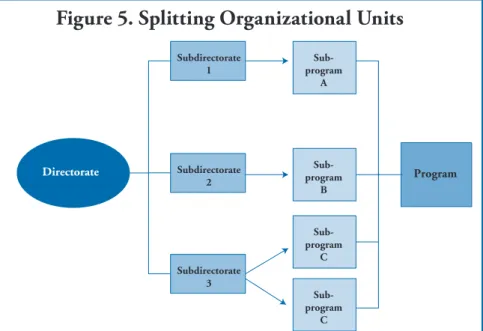
Aligning programs to organizational structures does not merely violate the results-based program principle by preventing the combination of organizational units, where appropriate, into single programs or subprograms. It also prevents the splitting of organizational units between programs or subprograms. Yet it is not uncommon to find a single directorate or subdirectorate that delivers or supports the delivery of two or more product lines that are so different that they should, if the principle is faithfully observed, belong to different programs or subprograms. The principle of results-based programs suggests that, in these cases, the organizational unit concerned should be split, as illustrated in Figure 5.
This guide rejects the view, implicit in the “alignment” thesis, that the principle of results-based programs should always come second to the cause of fitting programs to organizational structure. The view taken here is that, where required to preserve the coherence and results orientation of programs, it is entirely appropriate to combine several directorates into a single program (or several subdirectorates into a single subprogram). In addition, there is nothing necessarily wrong in splitting a subdirectorate (or directorate) that contributes to several product lines between two or more subprograms or programs.
Figure 5. Splitting Organizational Units
Subdirectorate 1 Subdirectorate 2 Subdirectorate 3 Sub-program A Sub-program B Sub-program C Sub-program C Program Directorate
The combination of several directorates raises questions of management and performance accountability, which are discussed later in this guide. With respect to splitting, the proposition that there is nothing in principle wrong with splitting subdirectorates or directorates that contribute to several different product lines between subprograms or programs does not mean that such splitting is always desirable. There are, in fact, specific limited circumstances where splitting organizational units between several subprograms or programs is inappropriate as a matter of principle. In these limited circumstances, deviations from the principle of results-based programs are justifiable. Sections 4.1–4.4 detail the circumstances under which splitting is inappropriate.
4.1 Splitting Organizational Units between Programs
The circumstances where it is inappropriate to split organizational units between programs or subprograms are captured in the following general rule:
Rule 4: Organizational units should not be split between programs if: • Neither government nor ministry management wish to plan and
control the way in which the organizational unit directs its resources between the programs concerned, and/or
• It is not feasible to accurately allocate record the organizational unit’s resource utilization by program in the accounting system.
The rule applies not only to programs, but also to subprograms and to any lower levels in the program hierarchy.
As noted previously, the adoption of a program budgeting system in no way changes the fact that, as in any budgeting system, resources are assigned to, and their use controlled by, organizational units. Ministries are given budget allocations to spend, and each ministry in turn assigns control and management of its available resources to internal organizational units. The fact that, under a program budgeting system, the budget law passed by the parliament will typically allocate funding to programs and not to ministries’ internal organizational units is irrelevant in this context – ministries still need to allocate funding to their organizational units.
In a program budgeting system, the way in which organizational units use the resources under their control must therefore be consistent with
Pr o g r a m sa n d or g a n i z at i o n a l st r u c t u r e 21
the allocation of the budget between programs. To ensure this, program budgets must clearly map to the allocation of resources to organizational units, and vice versa.This means, first, that it must be clear what portion of each program’s budget is directed to each of the organizational units that will implement that program. Second, each organizational unit must know how much of the cost of the resources it manages is covered by each of the programs that finance it. The requirement of clear mapping between program budgets and organizational unit resources applies not only to programs, but also to subprograms.3
In this context, it has to be clearly understood that to split an organizational unit’s resources between several programs (or subprograms) is to instruct the organizational unit that it must manage and control the use of the resources it controls so as to respect the program-specific allocations. Suppose, for example, that a specific organizational unit manages resources with a budget cost of $3 million, and that it is told that $2 million of that funding comes from program A and the other $1 million from program B. This is equivalent to instructing it to ensure that two-thirds of its resources are used to deliver program A, and the other third to deliver program B. In other words, rather than being given a single pool of resources to use, it is being given two separate pools of resources for the two programs.
It immediately follows that it is only desirable to split an organizational unit between several programs (or subprograms) if and when the government or top ministry management wants to control the way the unit allocates its resources between the programs (or subprograms) concerned. Assume, for example, that the health ministry has an infectious diseases directorate and, within that directorate, an insect-borne diseases subdirectorate that has responsibility for the preventative programs to fight malaria, yellow fever, and other insect-borne diseases such as dengue fever. If this is the case, a simple and straightforward approach to program classification – which is entirely consistent with the principle of results-based programs – is to create an insect-borne diseases subprogram that maps directly to the subdirectorate. One would only wish to create a separate malaria subprogram if the minister and top ministry management wished to control the level of resourcing that the subdirectorate applies to malaria prevention as opposed to its other responsibilities.
3. And, if they exist, to any lower levels in the program hierarchy – for example, sub-subprograms.
Even if top management would like to control the level of resources applied specifically to fighting malaria, it can only actually do so if the ministry accountants are able to monitor the actual allocation of resources between malaria and other diseases by the insect-borne diseases subdirectorate. Whether this is practical largely relates to whether, as discussed in the previous section, shared resources are used. For example, do a significant number of the staff of the insect-borne diseases subdirectorate work on both malaria prevention and, say, yellow fever prevention? If so, then the practicality of accurate cost allocation will need to be considered before deciding to create a separate malaria subprogram. In an advanced country with substantial money and skilled accounting resources to devote to this task, such cost allocation may be quite feasible. In a developing country, this is much less likely to be the case.
The general principle, therefore, is that one should avoid splitting between several programs (or subprograms) any organizational units that deliver, or contribute to, several different product lines if it is not considered desirable to tell the organizational unit how to allocate its resources between those product lines and/or it is not feasible to allocate the organizational unit’s costs between the product lines concerned.
In the case of the insect-borne diseases subdirectorate, if it is considered undesirable or impractical to split malaria prevention into a separate subprogram, no problem is created for the principle of results-based programs. The malaria prevention “product line” is so closely related to the yellow fever prevention “product line” that a single insect-borne diseases subprogram that includes them both in no way violates the principle of results-based programs.
The situation is different with respect to organizational units that contribute to several distinctly different product lines, and that should therefore – if the principle of results-based programs is to be completely respected – be split between several programs. The two most common examples of this are:
n Ministry-wide internal support service units – such as human
resources management, information technology, and finances. These units are not based on products lines, because “product” lines refer to types of outputs (that is, services to external clients). Support services are instead activities that support the delivery of all of the various types of outputs delivered by the ministry.
Pr o g r a m sa n d or g a n i z at i o n a l st r u c t u r e 23
n One-stop-shops – ministry client service centers, often regionally
based, that deliver a diverse range of the ministry’s product lines at the same location.
Some people suggest that it is essential that the costs of these types of organizational units be split between the results-based programs they support. For example, in an education ministry with a primary education program, a secondary education program, and a tertiary education program, expenditure on ministry-wide support services would be allocated between these three programs according to the use made by each program of those services. Similarly, the costs of a local government regional customer service center (a type of one-stop-shop) would be allocated between town planning services, water/sewage issues, and the other key product lines of local government. The argument that is usually presented to justify this is that it is essential that programs cover the “full cost” of producing the outputs they cover.
However, splitting support services or one-stop-shops between the multiple product lines they support in the budget could only be justified if the government or top ministry management wished to plan and control the way these units allocate their resources between product lines. This may not, however, be the case. Rather, the preference may be that the organizational unit concerned should be able to respond flexibly during the year by allocating staff time to where it is most needed. If this is the case, then it is not desirable to split such services between product lines. This question of the desirability of splitting support service costs is a quite distinct issue from the question of whether it is feasible in accounting terms to do so, given a particular country’s capacity level.
It is these considerations that lead to the widespread creation under program budgeting systems of artificial “programs” – such as support services programs, or regional services programs – to cover these types of organizational units even though this is a breach of the principle of “results-based” programs. These constitute justifiable, but strictly limited, exceptions to the results-based programs rule. The existence of such exceptions should not, however, be regarded as opening the door to the wholesale distortion of the program structure to fit whatever organizational structure may exist irrespective of how far removed that organizational structure may be from rational organizational principles and a results focus. We therefore discuss these exceptions in detail before critically examining the often-heard proposition that
program structure should as a matter of principle be “aligned” with organizational structure.
4.2 Support Services and Programs
Support programs – also known by other names, including administration programs and corporate services programs – are very common within program budgeting systems.
4.2.1 What Is a Support Services Program?
Support programs group together a ministry’s internal support services and corporate overheads such as human resource management, information technology and communications support, internal financial management, and top ministry-wide management. They also cover all support services and supplies that are managed as a ministry-wide pool, the allocation of which between directorates is left flexible to be determined on an “as needs” basis during the year. The support program would include, for example:
n A ministry-wide training budget
n Office supplies if they are purchased and managed as a
ministry-wide stock available to individual directorates during the year as needed
n A ministry-wide fleet of chauffeured cars, available to be used by
all when required.
Support programs can sometimes also cover support services which support some, but not all, of the ministry’s programs. Consider a Ministry of Environment with three programs – environment protection, protection of wildlife, and forest management. Suppose that the ministry operates a laboratory/testing center that provides services to the environment protection program and also to the protection of wildlife program, but not to the forest management program. Notwithstanding that the laboratory’s support services are not provided to all the ministry’s programs, it would still be included within the support program.
Unlike other programs, support programs are not results-based programs. They are not, in other words, groups of outputs with a
Pr o g r a m sa n d or g a n i z at i o n a l st r u c t u r e 25
common outcome. As previously explained, outputs are defined strictly as services provided by the ministry to external clients, whereas support services are services provided to internal clients within the ministry. For the same reason, support programs do not in general have program-specific outcomes. Instead, they contribute indirectly to achieving the outcomes of several or all of the other results-based programs of the ministry to which they provide support. Thus, for example, within the Ministry of Police, it is the “main” programs such as criminal policing that produce outcomes for the community such as lower crime rates. The services provided by the Police Ministry’s support services do not in themselves lead to lower crime rates or other police outcomes, but instead support the rest of the ministry in achieving this.
4.2.2 Why Support Programs?
The alternative to having a support program is to include budget funding for internal support services as part of the funding for the results-based programs for which they provide support. Thus, for example, the environment protection program of the Ministry of Environment would include its share of the Ministry’s human resources management budget, information technology budget, and so forth – as would the protection of the wildlife and the forestry management programs.
Including support service expenditure within the results-based programs they support would, obviously, create the need for cost allocation. It would become necessary, for example, to record how much of their time the human resource management staff of the Ministry of Environment allocate to filling job vacancies and providing other services for the environment protection program versus the other two programs. Information technology support staff would, similarly, need to keep accurate records of how much time they spend in providing assistance to staff in each of the three program areas. As discussed previously, ensuring the accuracy of such cost allocation records is not a trivial matter, and it may be beyond the capacity of many low-income countries. In the case of advanced countries, however, indirect cost allocation is generally possible if the government decides it is worth doing.
Some analysts regard the avoidance of indirect cost allocation as the only consideration potentially justifying the creation of support programs. On this basis, they readily accept that it is reasonable for low-income countries to create support programs, but hold that “best practice” – for
advanced countries with the technical and financial capacity to do so – is to eliminate support programs and to fully allocate all support service costs to results-based programs. From this point of view, support programs are seen as purely a stage in the evolution of a program budgeting system from its most simple form to a fully elaborated form.
However, this perspective misses an important consideration: namely, that for many support services, neither the government nor top ministry management wishes to decide in advance and control the way in which resources are allocated between the results-based programs they support. It is crucial, once again, to keep in mind that program budgeting is a system of budgeting by program, in which budgets are allocated to programs and the ministries and ministry organizational units that receive those program budgets are expected to stick to them. As previously emphasized, program budgets are not simply accounting measures of the cost of producing specific product lines. Thus, when the parliament approves a program budget, it is telling ministries that they are to spend no more than $x on program A, $y on program B, and so on. This means that if the expenditure of the ministry’s support services is included in the $x for program A, and the $y for program B, the government is in effect instructing the ministry about the extent of the support the ministry’s support services should provide to each of programs A and B.
Suppose, for example, the education ministry has only two programs – primary and secondary education – and no support program. Imagine, moreover, that the ministry’s organizational structure consists of a primary school department and a secondary school department – each of which is budgeted internally by the ministry to receive 40 percent of the ministry’s overall budget – and a support services department that is budgeted internally to receive 20 percent of the ministry’s budget. Suppose further that it is estimated at the time the budget is prepared that the support services department will provide equal levels of support to each of the two main departments. Suppose then that, reflecting this, the program budget approved by parliament allocates one-half of the ministry’s budget to each of the primary and secondary education programs, in each case including that program’s share of expenditure on support services.
To ensure that neither program outspends its expenditure authorization, the education ministry will then need to make sure that the support services department does not devote substantially more than one-half of
Pr o g r a m sa n d or g a n i z at i o n a l st r u c t u r e 27
its resources to supporting either of the two ministry programs. Herein lies the problem. Why would the political leadership or the ministry of finance wish to dictate the way in which education ministry support services allocate their efforts between supporting primary and secondary education during the year? If, for example, unexpected events mean that the primary school program has a greater than anticipated requirement for the support of the human resources group in staff recruitment during the year, shouldn’t the ministry be left with the flexibility to shift the disposition of its support services accordingly?
If one believes that ministries should retain the flexibility to allocate support services to where they are needed during the year, then it makes sense in principle to have a support program, even if accounting cost allocation between the programs does not present an insuperable problem. The support program should include all those ministry support services which are generic and which can be flexibly reallocated during the year from supporting one output-based program to another to meet shifting support requirements.
Under program budgeting, programs cannot be expected to budget for, or be held accountable for, expenditure from common pools the allocation of which they do not control. They can only realistically be held accountable for the budgeting and use of support services that are theirs alone and over which they therefore have control.
These considerations point to the following rule:
Rule 5: Ministries should establish support programs that include support services and other corporate overheads where:
• It is desirable to maintain flexibility in the deployment of these support services between the support of the ministry’s various results-based programs during the year, and/or when
• It is not feasible – that is, not regarded as possible at reasonable cost – to accurately allocate the support services costs between results-based programs in the accounting system.
It follows from this that only program support services that need to have flexibility in the way in which they allocate their assistance between “product lines” during budget execution should necessarily
have their expenditure allocated to the support program, and other multiprograms organizational units should – where the country is technical capable of doing this – have their expenditure allocated between the programs concerned.
Another implication is that support programs should only cover expenditure on support services which are ministry-wide or at least support several programs. Any support services expenditure that is focused on only one program should be included within that program. If within, say, the primary school education directorate of the Ministry of Education there was a small group of human resources professionals providing support services exclusively to the primary schools, they should be counted as part of the primary school education program, rather than included within the ministry-wide support program. Any expenditure directed toward support services that support one and only one program should be included within that program, and not within the support program. Similarly:
n If there is an aviation program run by the Aviation Directorate of the
Department of Transport, and that Directorate plans next year to hire trainers to provide aviation-specific training to its staff members, this should be included in the budget of the aviation program.
n If the customs service within the Ministry of Finance, which
operates separately and at a separate headquarters, has its own office supplies and its own car fleet, these should be included in the customs program rather than in the Ministry’s support program. The treatment of support costs therefore depends on whether they are considered at the time they are budgeted for as common resources or as earmarked program-specific resources. If they are common resources, they are part of the support program. If they are program-specific resources, they are part of the relevant program.
Another implication of the above is that, in small ministries with a single results-based program, there is no need for a support program. For example, an anticorruption commission might quite appropriately have only one program – an “anticorruption” program. Given that all of the commission’s support services support this single program, no problems arise in relation to the feasibility or desirability of allocating these costs between several programs.
Pr o g r a m sa n d or g a n i z at i o n a l st r u c t u r e 29
Rule 5 above should therefore be qualified as follows:
Rule 6: Ministries with a single results-based program do not need support programs.
There should, in general, be a single support program grouping together all of the standard support services found in all ministries. Support programs do not help central budget decision makers in making decisions about priorities in respect to the types of services to be offered to the public. There is therefore no advantage in fragmenting the support program into, say, an information technology and communications support program, a financial management program, and the like.
4.2.3 Support Subprograms
Within each program, there will always be some – usually much more limited – support services that are program-wide, or that at least cover more than one subprogram. The most obvious of these is directoratewide management in a program that corresponds to one directorate. In principle, therefore, the arguments presented above in relation to support programs also seem to justify creating support subprograms within each program. Some countries do precisely this.
Other countries, however, avoid support subprograms and instead employ an approximate solution – such as including such program overheads within the largest subprogram. This is quite reasonable where, as is usually the case, the support services expenditure concerned is quite small relative to the program’s expenditure as a whole (in particular, where most of the support services such as human resources, information technology, and so forth are provided by the ministry as a whole, rather than at the program level). However, in cases where there are relatively large program-level support services or other overheads, a support subprogram should be used. Essentially, it is a question of what the accountants call the “materiality” of the expenditure concerned.
4.2.4 Allocation of Support Costs for Information Purposes
As noted above, a key argument for the allocation of indirect costs is the desirability of knowing the “full” costs of outputs. It is important to
emphasize that such cost allocation can be carried out even if support programs are in place. In other words, there is nothing to stop ministry accountants undertaking, at the end of the financial year, a management costing exercise to allocate the costs of the support program to the various results-based programs of the ministry. If the ministry does this, it is a pure reporting/management information exercise and has nothing to do with budgetary control over how the support services allocate their efforts during the year between the results-based programs they support.
This is exactly what the French government does. Even though France carries out the accounting allocation of support service expenditure between results-based programs for management information purposes, it nevertheless makes use of support programs.
4.2.5 Countries without Support Programs
There are a few countries that have program budgeting systems but that do not use support programs. Australia is one prominent example. How do such countries fit into the analysis presented above?
A key feature of the Australian system is that, by contrast to predominant international practice, Parliament does not determine the budgets of programs. Rather, the annual budget passed by Parliament allocates global amounts to ministries, and the program allocations shown in the budget papers placed before the Parliament are there only for information purposes. Ministries and the executive government have full authority to vary the allocation of the budget by program in whatever way they wish. This type of arrangement means that the inflexibility in the use of support services which would otherwise arise – if programs were legal appropriation categories – is avoided. In other words, the inclusion of support services costs within results-based programs does not mean that it is necessary to go back to the Parliament and ask it to amend the annual budget in order to permit any significant shift of support service resources between results-based programs.
Even so, it is not clear how useful the Australian practice is. Comparing reported with budgeted expenditure at the program level in Australia does not show the extent of variance that would be expected from the flexible use of support services during the year. The strong suspicion arises, therefore, that the accounting allocation of support services between results-based programs may not be accurate.
Pr o g r a m sa n d or g a n i z at i o n a l st r u c t u r e 31
More generally, irrespective of whether the Parliament sets appropriations at the program level or not, the intention of the program budgeting system is that programs are budgeting categories and not merely accounting categories. Australian practice is not fully consistent with this objective.
4.3 Case Study: Education Inspection Services
In quite a few countries, education ministries have Inspectorate Directorates, which group together inspectors (usually experienced former senior teachers) who carry out on-the-spot monitoring of the classroom performance of practicing