1
RENEWABLE ENERGY
MASTER PLAN
EN ER GY COMMI SS I O N O F NI GERI AREVISED EDITION
ECN
UNDP
NOVEMBER 2012
ii
Contents
Acknowledgement iii
Foreword iv
Acronyms v
Executive Summary
viii
1.0 Introduction
11.1 Preamble 1
1.2 Energy Resources, Energy Supply and the Economy 1 1.3 Drivers of Renewable Energy Development in Nigeria 3 1.4 Objectives of the Renewable Energy Master Plan 3 1.5 Overview of the 1st Edition of the REMP 3 1.6 Overview of Renewable Energy Policies in Nigeria 4
2.0 Renewable Energy Programmes and Targets
6
2.1 Renewable Energy Programmes 6
2.2 Energy Demand and Supply Projections for Nigeria 6 2.3 Renewable Energy Targets/Milestones/Timelines 8
3.0 The Renewable Energy Action Plan
11
3.1 Introduction 11
3.2 Assessment of Resource Base/Data Acquisition 11
3.3 Renewable Energy Policies, Regulations and Institutional Framework 12 3.4 Capacity Building and Skills Development Program 15
3.5 Public Awareness/Sensitization 18
3.6 Development of Financing Options Program 20
3.7 Development of RE Projects 24
3.8 Incentives for RE Development 31
3.9 Research and Development 34
3.10 Standards, Codes of Practice and Specifications 37 3.11 Local Manufacturing & Commercialization 39
4.0
Economic and Fiscal Incentives
41
4.1 Introduction 41
4.2 Economic Incentives 41
4.3 Fiscal Incentives 42
5.0 Risk Identification and Analysis
44
5.1 Introduction 44
5.2 Policy and Political Risks 44
5.3 Market Risks 45
5.4 International Development Risks 47
5.5 Standards and Quality Control Risks 48
5.6 Research and Development Risks 49
5.7 Environmental Risks 49
iii
Acknowledgment
The Energy Commission of Nigeria wishes to express its sincere gratitude to the United Nations Development Programme (UNDP) for the financial support provided for the review of the 2005 draft Renewable Energy Master Plan (REMP). This draft review was therefore carried out in 2011 by the Grayfun International Limited under contract Number: ECN/UNDP/7CP/2011A of the UNDP. The invaluable criticisms by various national and other international stakeholders expressed and conveyed in various fora that added value to this review is also highly appreciated. Finally, the editorial work carried out by Prof. E. J. Bala, Director, Renewable Energy Department and Engr. O. N. Ekpenyong, Deputy Director, Energy Management, Training and Manpower Development Department of the Energy Commission of Nigeria is hereby duly acknowledged.
Prof. A. S. Sambo, OON, NPON
Director General/CEO,
iv
Foreword
The development of renewable energy is central in the National Energy Policy as well as the National Energy Master Plan (NEMP). Renewable energy reduces sole dependence on fossil fuels and thus improves security of energy supply, reduces greenhouse gas emissions creating environmental and social benefits, while delivering green jobs to the economy. The Renewable Energy Master Plan (REMP) sets out in the short, medium and long terms within the national energy supply mix as well as articulate strategic approach and measures to meet the targets.
The Nigerian government’s commitment to accelerating the development of renewable energy in the country is set out in the National Energy Policy and the Vision 2020-20. For Nigeria to be among the twenty (20) largest economies in the world by 2020, adequate and reliable energy supply, climate change mitigation and adaptation and creation of employment, which are inter-related challenges, must be addressed through the transformation of Nigeria’s economy from one based mainly on fossil fuel to a low carbon economy based around renewable energy and energy efficiency.
Government’s ambitions for renewable energy and the related national targets are in line with global quest for a long term energy security and clean environment for sustainable development.
An interrelated and integrated approach, involving all relevant public sector Ministries, Departments and Agencies in all tiers of government and the private sector will be critical for delivery of this plan over the next decade. In setting out to achieve a significant transformation of the energy landscape, Government recognizes the strategic role of the public and private sectors in supporting the new infrastructure required to deliver change. This challenge will need to be progressively addressed in the course of the implementation of the REMP.
This REMP is therefore a roadmap for actualization of Government’s commitment to create the necessary enabling environment for sustainable energy supply for national development with active participation of the private sector. It is divided in to programmes with targets, timelines and activities. Incentives to promote the attainment of the programmes as well as generally grow the renewable energy market are also provided. Some risks have been identified and highlighted.
Prof. Bassey Ewa Okon Honorable Minister,
Federal Ministry of Science and Technology Abuja
v
Acronyms
AC Alternating Current
ADP Agricultural Development Programme
AfDB African Development Bank
APPA African Petroleum Producers Association
ARCEDEM African Regional Centre for Engineering Design and Manufacture
ASDB Asian Development Bank
ASL Above Sea Level
AU African Union
BOI Bank of Industry
CASHPP Capital Alliance for Small Hydro Power
CBN Central Bank of Nigeria
CDA Caribbean Development Authority
CO2 Carbon dioxide
DC Direct Current
DPR Department of Petroleum Resources
DPs Development Partners
DTCD Department of Technical Cooperation for Development
ECN Energy Commission of Nigeria
ECOWAS Economic Community of West African States
EIA Environmental Impact Assessment
EIA Energy Information Administration (US Department of Energy)
EMV Expected Monetary Value
ERCs Energy Research Centres
FAO Food and Agricultural Organization
FCT Federal Capital Territory, Abuja
FEPA Federal Environmental Protection Agency
FIRS Federal Inland Revenue Service
FMA & RD Federal Ministry of Agriculture and Rural Development
FMAv Federal Ministry of Aviation
FMoD Federal Ministry of Defence
FMEd Federal Ministry of Education
FMEnv Federal Ministry of Environment
FMF Federal Ministry of Finance
FMH&UD Federal Ministry of Housing & Urban Development
FMoI Federal Ministry of Information
FMJ Federal Ministry of Justice
FMoN-D Federal Ministry of Niger Delta
FMoP Federal Ministry of Power
FMST Federal Ministry of Science and Technology
FMT&I Federal Ministry of Trade and Investment
FMW&SD Federal Ministry of Women Affairs and Social Development
FMWR Federal Ministry of Water Resources
FMYD Federal Ministry of Youth Development
FORMECU Forestry Monitoring and Evaluation Coordinating Unit
GEF Global Environmental Facility
GJ Giga Joule (Giga = 109)
GW Gigawatt
vi
Ha Hectares
HGS High growth scenario
IAEA International Atomic Energy Agency
ICRC Infrastructure Concession Regulatory Commission
IC – SHP International Centre for Small Hydro
IDB Inter-American Development Bank
IMF International Monetary Fund
IPP Independent Power Producer
ITF Inter-Tropical Front
Kg Kilogramme
kJ Kilojoule
Km/h Kilometre/hour
kW Kilowatt
KWh/m2 Kilowatt hour per square meter
kWh Kilowatt-hour
LHP Large Hydro Power
LGA Local Government Area
LGS Low growth scenario
M Metre
M3 Cubic Metre
M3/s Cubic Meter per Second
MAED Model for the Analysis of Energy Demand
MAN Manufacturers Association of Nigeria
MCM Million Cubic Meters
MESSAGE Model for the Energy Supply Strategy Alternatives & their General
Environmental Impact
MFO Market Facilitation Organization
MJ Megajoule
MOU Memorandum of Understanding
MPR Ministry of Petroleum Resources
MToe Million Tons of oil equivalent
MW Megawatt
MWh Megawatt-hour
NACCIMA Nigerian Assoc. of Chambers of Commerce, Industry, Mines & Agric.
NAPEP National Poverty Eradication Programme
NAPTIN National Power Training Institute of Nigeria
NARICT National Research Institute for Chemical Technology
NASENI National Agency for Science and Engineering Infrastructure
NASS National Assembly
NBRRI National Building and Roads Research Institute
NBS National Bureau of Statistics
NBTE National Board for Technical Education
NCAM National Centre for Agricultural Mechanization
NCCE Nigerian Commission for Colleges of Education
NCERD National Centre for Energy Research and Development
NDE National Directorate of Employment
NEEDS National Economic Empowerment and Development Strategy
NEP National Energy Policy
NEPA National Electric Power Authority
vii
NERC Nigerian Electricity Regulatory Commission
NERDP New Energy Research and Development Programme
NESREA National Environmental Standards and Regulations Enforcement Agency
NGO Non Governmental Organization
NIMET Nigerian Meteorological Agency
NIMOR Nigerian Institute of Marine and Oceanographic Research
NIPC Nigerian Invesment Promotion Commission
NIREDA Nigerian Renewable Energy Development Agency
NNPC Nigeria National Petroleum Corporation
NNRA Nigerian Nuclear Regulatory Authority
NOA National Orientation Agency
NPC National Planning Commission
NRSE New and Renewable Sources of Energy
NUC National Universities Commission
NYSC National Youth Service Corps
O & M Operation and Maintenance
OPEC Organization of Petroleum Exporting Countries
OTEC Ocean Thermal Energy Conversions
PJ Picojoule
PSP Private Sector Participation
PTDF Petroleum Technology Development Fund
PV Photo Voltaic
RBDA River Basin Development Authority
REA Rural Electrification Agency
RIs Research Institutes
R&D Research and Development
REMP Renewable Energy Master Plan
RET Renewable Energy Technology
RMRDC Raw Materials Research and Development Council
RS Reference scenario
SASSs State Assemblies
SERC Sokoto Energy Research Centre
SGs State Governments
SHESTCO Sheda Science & Technology Complex
SHP Small Hydro Power
SHS Solar Home Systems
SMEDAN Small and Medium Enterprises Development Agency of Nigeria
SON Standard Organization of Nigeria
TIs Tertiary Institutions
TJ Terajoule
Toe Tons of oil equivalent
TPES Total primary energy supply (demand)
TW Trillion Watt
TWh Trillion Watt Hour (Tera –1012)
UEMOA Economic and Monetary Union of West Africa
UN United Nations
UNCDF United Nations Capital Development Fund
UNDP United Nations Development Program
UNESCO United Nation Educational Scientific and Cultural Organization
viii
Executive Summary
The first draft of the Renewable Energy Master Plan (REMP) was produced in 2005 under the sponsorship of the United Nations Development Programme (UNDP). It has since created greater awareness on the benefits of renewable energy and its technologies. Greater contribution of renewable energy into the nation’s energy supply mix for sustainable socio-economic development has since began to be achieved at both federal and state levels.
However, seven years down the line, new policy guidelines and developments have taken place both locally and internationally. Secondly, the first edition was voluminous and needed to be concise and precise. This 2nd draft edition has therefore concentrated on concisely bringing out the renewable energy programmes of biomass, solar energy, hydropower, wind, emerging technologies and framework programmes with targets and timelines in the short (2013-2015), medium (2016-2020) and long term (2021-2030). The framework programme presented as action plan has articulated activities that are common to the other programmes and ensures that the activities are mutually supportive.
Economic and financial incentives required to specifically reduce the initially high investment cost of renewables and generally enhance penetration into the nation’s energy supply mix are proffered.
Finally, a risk analysis of factors that may stifle the activities in the action plan for attainment of the set targets are also provided. On the long term, renewable electricity is expected to contribute about 20% to the total electricity supply in the country; while the national fuel supply is to be supported by 10% - 20% renewable fuels (biofuels). Dependence on fuelwood as a source of fuel for cooking and heating is to decline over the years.
1
1.0 INTRODUCTION
1.1 IntroductionRenewable energy is energy derived from a source that regenerates itself within a relatively short time through natural process. This document is the revised version of the 1st draft Edition of the Renewable Energy Master Plan (REMP). In 2005, the United Nations Development Programme (UNDP) supported the Energy Commission of Nigeria (ECN) to produce the Renewable Energy Master Plan (REMP) for Nigeria to remove common barriers to renewable energy development in Nigeria. Greater awareness on the benefits of renewable energy and its technologies has since been created. To this effect, greater contribution of renewable energy into the nation’s energy supply mix for sustainable socio-economic development has been achieved.
However, seven years after the 1st draft Edition of the Renewable Energy Master Plan was produced, many developments have taken place within Nigeria and even globally. Secondly, the 1st Edition was voluminous and needed to be appropriately trimmed and made precise.
1.2 Energy Resources, Energy Supply and the Economy
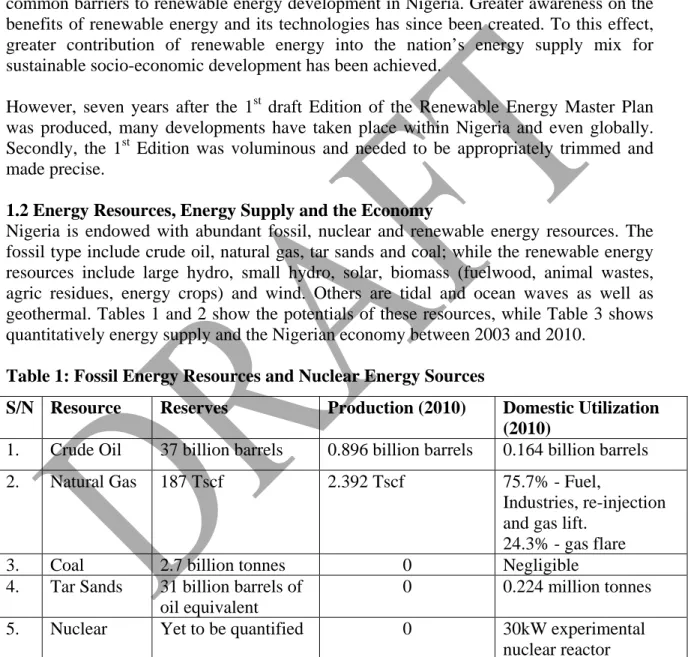
Nigeria is endowed with abundant fossil, nuclear and renewable energy resources. The fossil type include crude oil, natural gas, tar sands and coal; while the renewable energy resources include large hydro, small hydro, solar, biomass (fuelwood, animal wastes, agric residues, energy crops) and wind. Others are tidal and ocean waves as well as geothermal. Tables 1 and 2 show the potentials of these resources, while Table 3 shows quantitatively energy supply and the Nigerian economy between 2003 and 2010.
Table 1: Fossil Energy Resources and Nuclear Energy Sources
S/N Resource Reserves Production (2010) Domestic Utilization
(2010)
1. Crude Oil 37 billion barrels 0.896 billion barrels 0.164 billion barrels 2. Natural Gas 187 Tscf 2.392 Tscf 75.7% - Fuel,
Industries, re-injection and gas lift.
24.3% - gas flare
3. Coal 2.7 billion tonnes 0 Negligible
4. Tar Sands 31 billion barrels of oil equivalent
0 0.224 million tonnes 5. Nuclear Yet to be quantified 0 30kW experimental
nuclear reactor
2
Table 2: Renewable Energy (RE) Potentials
Resource Potential Remark
Large Hydropower 11,250 MW 1900 MW exploited Small Hydropower 3,500 MW 64.2 MW exploited Solar 4.0 kWh/m2/day - 6.5
kWh/m2/day
15 MW dispersed solar PV installations. (estimated)
Wind 2-4m/s @ 10m height
mainland
Electronic Wind Information System (WIS) available; 10 MW wind farm in Katsina in progress.
Biomass (non-fossil organic matter)
-Municipal waste -Fuelwood
- 18.5 million tonnes produced in 2005 and now estimated at 0.5kg/capita/day - 43.4 million tones/yr fuelwood consumption
Animal Waste 245 million assorted animals in 2001 -Agric Residue
-Energy crops
-91.4 million tonnes /yr produced -28.2 million hectares of arable land; 8.5% cultivated
Source: REMP (2005) and FMEnv.
Table 3: Energy Supply and the Nigerian Economy
S/N Items 2003 2004 2005 2006 2007 2008 2009 1. Electricity Generation (billion kWh) 22.03 23.9 24.22 (503)* (10,695)** 23.8 23.3 21.27 (562)* (18,603)** 20.8 2. Energy Consumption per capita (Kgoe/Capita) 151.3 125.5 132.6 (680)* (1,780)** 87.1 81.4 80.8 (670)* (18,603)** 83.1 3. Electricity Consumption per capita (kWh/Capita) 174.6 176.4 181.4 (563)* (2,596)** 167.6 161.2 142.9 (571)* (2,782)** 135.2 4. GDP per capita (US$/Capita) 620.7 658.0 826.3 (2,314)* (8,492)** 1030.3 1223.5 1,286.3 (2,540)* (9,550)** 1,106.8 5. Energy Intensity (Kgoe/US$) 0.244 0.191 0.161 (0.294)* (0.210)** 0.085 0.067 0.063 (0.264)* (0.192)** 0.075 6. GDP Growth Rate (%) 9.6 6.6 6.5 6.0 6.5 6.0 6.7 Source: CBN (2005 - 2010), NCC Osogbo (2009), *Africa Average – IEA (2007, 2010), **World Average – IEA (2007, 2010)
3
1.3 Drivers of Renewable Energy Development in Nigeria
Interest in the use of alternative energy in the form of renewable energy has increased substantially because of its potential to long term sustainable energy supply for the economy, since petroleum may not last beyond 80 years at the 2010 rate of production and reserves. There are also substantial environmental benefits in reduced GHG emissions as compared with conventional energy sources. Renewable energy has great potentials for job and employment creation.
1.4 Objectives of the Renewable Energy Master Plan
The specific objectives of the Renewable Energy Master Plan are to:
• Enhance national energy security;
• Expand access to energy especially in the rural areas;
• Stimulate employment, economic empowerment and growth and reduce poverty;
• Increase the scope and quality of rural services, including, schools, health services, water supply, information, entertainment and stemming the migration to urban areas;
• Reduce environmental degradation and health risks, particularly to vulnerable groups such as women and children;
• Improve learning, capacity-building, research and development on various renewable energy technologies in the country; and
1.5 Overview of the 1st Edition of the REMP
Contents and Structure
The first version of the Renewable Energy Master Plan (REMP) is a 235 – page booklet, broadly divided into three sections – Executive Summary, Main Body and Annexes. The main body consists of six chapters, 52 tables and 13 figures. It has several annexes and references.
1.5.1 Chapter 1: The first chapter is the introduction, which highlights the rationale for,
vision and objectives of REMP, under the following sub-headings: the Energy Situation in Nigeria; Development and Energy Challenges; Drivers for change; Rationale for the REMP; Nigeria’s Renewable Energy Vision; Objectives of the REMP; and Expected Outputs.
1.5.2 Chapter 2: The second chapter focused on the Renewable Energy Resources,
Technologies and Markets. This Chapter considered each renewable energy resource in this order: Hydro power, Solar, Biomass, Wind, Hydrogen Cell, Marine, Ocean and Geothermal Energy. For each renewable energy source, the chapter considered the resource base, status of data availability including its adequacy and gaps. Also, overview of the various technologies in each renewable energy type was extensively discussed. The market situation and the comparative international experiences were discussed in details, as well as the gaps and barriers to the development of each renewable energy technology market.
4
1.5.3 Chapter 3: Targets
Targets are critical tools in achieving the vision of the REMP. Since the major areas for the utilization of renewable energy are electricity, automotive fuel production and other thermal or heat production (cooking, heating, drying, etc.), targets were set for RE in the short (2005 – 2007), medium (2008 – 2015) and long (2016 – 2025) terms, guided by the energy demand and supply projections for the nation, produced by the Energy Commission of Nigeria, under various economic growth rates or scenarios from the reference or base.
1.5.4 Chapter 4: Planned Activities and Milestones
To ensure that the REMP targets outlined in chapter 3 were achieved, concrete activities and milestones were identified in the short, medium and long term. These activities and milestones were organized under specific sub-sectoral programmes: Framework Programme on Renewable Energy Promotion, National Biomass Energy Programme, National Solar Energy Programme, National Small Hydro Energy Programme, National Wind Energy Programme and Emerging Energy Research and Development Programme. The action plan was presented in tabular form featuring: Activity Area, Project, Description of activities, Year and Estimated cost and participating agencies. These activities are grouped into the short-term (2006 – 2007), Medium term (2008 – 2015) and Long-term (2016- 2025).
1.5.5 Chapter 5: Strategy and Implementation Issues
Key strategic implementation issues discussed in this chapter included Policy, Legal and Regulatory Framework; Institutional Framework; Economics and Financing; Capacity Building; Public Awareness; Inter-Agency Collaboration (including public-private partnership); Research and Development and Monitoring and Evaluation.
1.5.6 Chapter 6: Risk Identification and Analysis
This section discussed potential risk factors that may hinder the implementation of the REMP, which included Policy and Political risks; Market risks, Standards and Quality Control risks; Research and Development risks; and Environmental risks.
It is stressed that the identification and analysis of these risks will allow stakeholders in the renewable energy economy to factor in these risks, or seek alternative approaches to reaching national renewable energy targets and objectives.
1.6 Overview of Renewable Energy and Related Policies and Regulations in Nigeria
The main constraints in the rapid development and diffusion of technologies for the exploitation and utilization of renewable energy resources in the country are the absence of market and the lack of appropriate policy, regulatory and institutional framework to stimulate demand and attract investors. The comparative low quality of the systems developed and the high initial upfront cost also constitute barriers to the development of markets. Therefore, to unleash the enormous potential of its renewable energy resources
5
on its drive to achieve the MDG’s and NEEDS targets, the Federal Government of Nigeria has formulated many renewable energy related policies, namely:
• National Energy Policy, which contians renewable energy, initiated by the Energy Commission of Nigeria and approved by the Federal Government in 2003.
• Draft Renewable Energy Electricity Policy initiated by the Federal Ministry of Power in 2006.
• Nigerian Biofuels Policy Incentives initiated by the NNPC and approved by FEC in 2007.
• Vision 20-2020 Document initiated by National Planning Commission and approved by FEC in 2012.
• National Climate Change Policy initiated by the Federal Ministry of Environment and approved by FEC in 2011.
• National Environmental Regulations (2009, 2011) initiated by the National Environmental Standards and Regulations Enforcement Agency (NESREA)
• Electric Power Sector Reform (EPSR) Act of 2005, which libelarized the electricity sector, unbundled the PHCN in preparation to its privitization, and established the Nigerian Electricity Regulatory Commission (NERC) as the sector regulator.
• Regulation on Independent Electricity Distribution Networks (IEDN) and Embedded Generation initiated by NERC.
6
2.0 RENEWABLE ENERGY PROGRAMMES AND TARGETS
2.1 Renewable Energy ProgrammesThe Renewable Energy Master Plan (REMP) is basically structured into the following programmes with short (2013–2015), medium (2016–2020) and long term (2021–2030). The programme under the Master Plan includes:
National Biomass Energy Programme
National Solar Energy Programme
National Hydropower Programme
National Wind Energy Programme
Emerging Energy Programme
Framework Programme for Renewable Energy Promotion
The Framework programme articulates issues that are common to all other sub-sectoral programmes and ensures that activities within the sub-sectors are mutually supportive, e.g,
Legal, Regulatory and Institutional framework
Incentives (Financial and Fiscal)
Capacity Building (Human and Infrastructural)
Inter-Agency/Governmental Collaboration
Research and Development
Monitoring and Evaluation
RE Portfolios and Feed-in-Tariff
2.2 Energy Demand and Supply Projections for Nigeria
Nigeria has envisioned growing its economy at a rate of 11% - 13% so that it can be reckoned within the 20 largest economies in the world by 2020. Energy demand and supply studies conducted by the Energy Commission of Nigeria under various growth scenarios and taking into consideration the economic vision, demography, available energy resources and modern developmental path, using MAED and MESSAGE energy planning models of IAEA, has indicated that huge amount of energy in the form of electricity, fuel and heat would be required to meet this vision.
The following growth scenarios were considered:
Reference Growth Scenario:
• GDP grows by an average of 7% per annum
• The main driver of growth is the manufacturing sector
• Manufacturing accounts for 15% of GDP by 2020 from 4% in 2011
• Consistent with the MDG objective of reducing poverty by half by 2015
High Growth Scenario:
• GDP grows by an average of 10% per annum
• Manufacturing contributes 22% to GDP by 2030 from 4% in 2011
7
Optimistic Growth Scenario:
• GDP grows by an average of 13% per annum
• Manufacturing contributes 22% to GDP by 2030 from 4% in 2011
• Nigeria is transiting from an agrarian economy to an industrializing nation
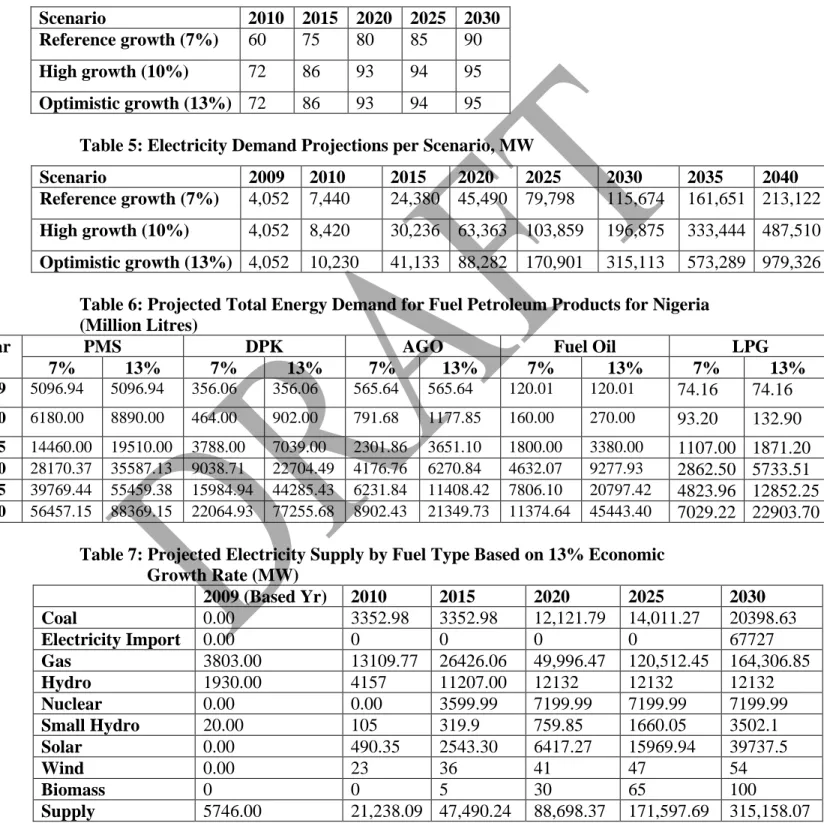
Table 4: Projected Access to Grid Electricity by Household for Nigeria
Scenario 2010 2015 2020 2025 2030
Reference growth (7%) 60 75 80 85 90
High growth (10%) 72 86 93 94 95
Optimistic growth (13%) 72 86 93 94 95
Table 5: Electricity Demand Projections per Scenario, MW
Scenario 2009 2010 2015 2020 2025 2030 2035 2040
Reference growth (7%) 4,052 7,440 24,380 45,490 79,798 115,674 161,651 213,122
High growth (10%) 4,052 8,420 30,236 63,363 103,859 196,875 333,444 487,510
Optimistic growth (13%) 4,052 10,230 41,133 88,282 170,901 315,113 573,289 979,326
Table 6: Projected Total Energy Demand for Fuel Petroleum Products for Nigeria (Million Litres)
Year PMS DPK AGO Fuel Oil LPG
7% 13% 7% 13% 7% 13% 7% 13% 7% 13% 2009 5096.94 5096.94 356.06 356.06 565.64 565.64 120.01 120.01 74.16 74.16 2010 6180.00 8890.00 464.00 902.00 791.68 1177.85 160.00 270.00 93.20 132.90 2015 14460.00 19510.00 3788.00 7039.00 2301.86 3651.10 1800.00 3380.00 1107.00 1871.20 2020 28170.37 35587.13 9038.71 22704.49 4176.76 6270.84 4632.07 9277.93 2862.50 5733.51 2025 39769.44 55459.38 15984.94 44285.43 6231.84 11408.42 7806.10 20797.42 4823.96 12852.25 2030 56457.15 88369.15 22064.93 77255.68 8902.43 21349.73 11374.64 45443.40 7029.22 22903.70
Table 7: Projected Electricity Supply by Fuel Type Based on 13% Economic Growth Rate (MW) 2009 (Based Yr) 2010 2015 2020 2025 2030 Coal 0.00 3352.98 3352.98 12,121.79 14,011.27 20398.63 Electricity Import 0.00 0 0 0 0 67727 Gas 3803.00 13109.77 26426.06 49,996.47 120,512.45 164,306.85 Hydro 1930.00 4157 11207.00 12132 12132 12132 Nuclear 0.00 0.00 3599.99 7199.99 7199.99 7199.99 Small Hydro 20.00 105 319.9 759.85 1660.05 3502.1 Solar 0.00 490.35 2543.30 6417.27 15969.94 39737.5 Wind 0.00 23 36 41 47 54 Biomass 0 0 5 30 65 100 Supply 5746.00 21,238.09 47,490.24 88,698.37 171,597.69 315,158.07
8
2. 3 Renewable Energy Targets/Milestones and Timelines
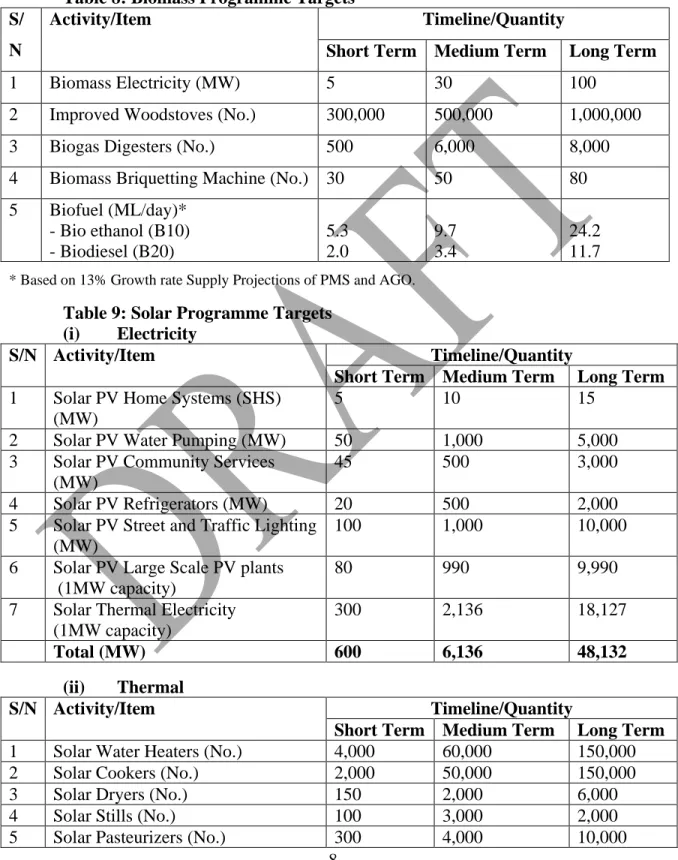
The renewable energy programmes’ activities with Targets/Milestones and Timelines are as follows:
Table 8: Biomass Programme Targets S/
N
Activity/Item Timeline/Quantity
Short Term Medium Term Long Term
1 Biomass Electricity (MW) 5 30 100
2 Improved Woodstoves (No.) 300,000 500,000 1,000,000
3 Biogas Digesters (No.) 500 6,000 8,000
4 Biomass Briquetting Machine (No.) 30 50 80
5 Biofuel (ML/day)* - Bio ethanol (B10) - Biodiesel (B20) 5.3 2.0 9.7 3.4 24.2 11.7
* Based on 13% Growth rate Supply Projections of PMS and AGO. Table 9: Solar Programme Targets
(i) Electricity
S/N Activity/Item Timeline/Quantity
Short Term Medium Term Long Term
1 Solar PV Home Systems (SHS) (MW)
5 10 15
2 Solar PV Water Pumping (MW) 50 1,000 5,000
3 Solar PV Community Services (MW)
45 500 3,000
4 Solar PV Refrigerators (MW) 20 500 2,000
5 Solar PV Street and Traffic Lighting (MW)
100 1,000 10,000
6 Solar PV Large Scale PV plants (1MW capacity)
80 990 9,990
7 Solar Thermal Electricity (1MW capacity)
300 2,136 18,127
Total (MW) 600 6,136 48,132
(ii) Thermal
S/N Activity/Item Timeline/Quantity
Short Term Medium Term Long Term
1 Solar Water Heaters (No.) 4,000 60,000 150,000
2 Solar Cookers (No.) 2,000 50,000 150,000
3 Solar Dryers (No.) 150 2,000 6,000
4 Solar Stills (No.) 100 3,000 2,000
9
Table 10: Hydropower Programme Targets
S/N Activity/Item Timeline/Quantity
Short Term Medium Term Long Term
1 Large Hydropower (MW) 4,000 9,000 11,250
2 Small Hydropower (MW) 100 760 3,500
Total (MW) 4,100 9,760 14,750
Table 11: Wind Programme Targets
S/N Activity/Item Timeline/Quantity
Short Term Medium Term Long Term
1 Wind Electricity (MW) 23 40 50
2 Windmill Water Pumping Systems (No.)
20 100 200
Table 12: Summary of Renewable Energy Targets
(i) Renewable Electricity Supply Projection in MW (13% GDP Growth Rate)1
S/N Resource Now Short Term Medium Term Long Term
1 Hydro (LHP) 1938 4,000 9,000 11,250 2 Hydro (SHP) 60.18 100 760 3,500 3 Solar PV 15.0 300 4,000 30,005 4 Solar Thermal - 300 2,136 18,127 5 Biomass - 5 30 100 6 Wind 10.0 23 40 50 All Renewables 1985.18 4,628 15,966 63,032
All Energy Resources 8,700 (installed capacity 2012) 47,490 88,698 315,158 % of Renewables 23% 10% 18% 20% % RE Less LHP 0.8% 1.3% 8% 16%
*From Supply Projections based on 13% GDP growth
1CBN, NPC
10 (ii) Non-Electricity (Thermal)
Activity/Item Timeline/Quantity
Short Term Medium Term Long Term
Total thermal Energy Production (GWh)
193,709 202,128 248,809
Renewable Energy Share (%) 85 80* 79*
Other non-renewable Share (%)
15 20 21
* Note that the decline over the years is due to the planned decrease in the consumption of fuelwood
(iii) Fuels (bio fuels) Targets*
Item Timeline/Quantity
Short Term Medium Term Long Term
Bio Ethanol (E10) 1935 3541 8833
Biodiesel (B20) 730 1251 4271
11
3.0 THE RENEWABLE ENERGY ACTION PLAN (REAP)
3.1 IntroductionTo ensure that the REMP targets outlined are achieved, concrete supportive activities are identified in the short, medium and long term. These activities are organized under the framework programme that makes it supportive to all other programmes.
• Assessment of Resource Base/Data Acquisition
• Renewable Energy Policies, Regulatory and Institutional Frameworks
• Capacity Building and Skill Development Programme
• Public Awareness/Sensitization
• Development of Financing Options Program
• Development of Renewable Projects
• Incentives for Renewable Energy Development
• Research and Development
• Standards, Codes of Practice & Specifications
• Local Manufacturing and Commercialization
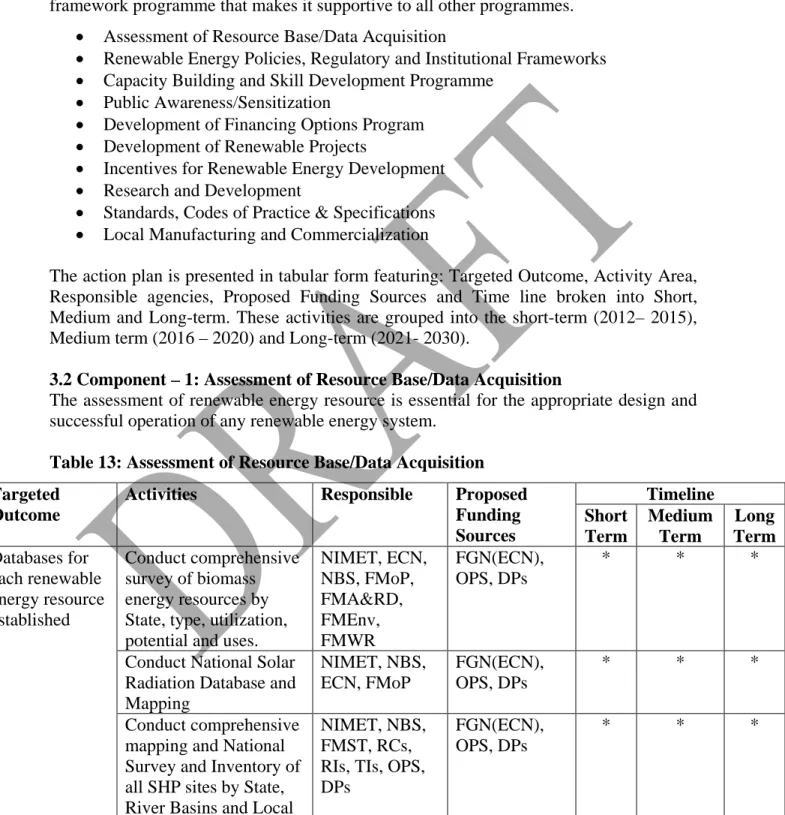
The action plan is presented in tabular form featuring: Targeted Outcome, Activity Area, Responsible agencies, Proposed Funding Sources and Time line broken into Short, Medium and Long-term. These activities are grouped into the short-term (2012– 2015), Medium term (2016 – 2020) and Long-term (2021- 2030).
3.2 Component – 1: Assessment of Resource Base/Data Acquisition
The assessment of renewable energy resource is essential for the appropriate design and successful operation of any renewable energy system.
Table 13: Assessment of Resource Base/Data Acquisition Targeted
Outcome
Activities Responsible Proposed
Funding Sources Timeline Short Term Medium Term Long Term Databases for each renewable energy resource established Conduct comprehensive survey of biomass energy resources by State, type, utilization, potential and uses.
NIMET, ECN, NBS, FMoP, FMA&RD, FMEnv, FMWR FGN(ECN), OPS, DPs * * *
Conduct National Solar Radiation Database and Mapping NIMET, NBS, ECN, FMoP FGN(ECN), OPS, DPs * * * Conduct comprehensive mapping and National Survey and Inventory of all SHP sites by State, River Basins and Local Government
NIMET, NBS, FMST, RCs, RIs, TIs, OPS, DPs
FGN(ECN), OPS, DPs
12 Establish Renewable
Energy Databank at Federal and State Levels
FMAv, NIMET, FMST, RCs, RIs, TIs, OPS, DPs
FGN(ECN), OPS, DPs
* * *
Review and Update the existing Wind Resource Map - National Wind Energy Information System (Wind Map)
FMAv, NIMET, FMST, RCs, RIs, TIs, OPS, DPs, FMoP
FGN(ECN), OPS, DPs
* * *
Collect, collate and analyze data from existing meteorological stations
FMAv, NIMET, FMST, RCs, RIs, TIs, OPS, DPs, FMA&RD, FMWR, RBDA FGN(ECN), OPS, DPs * * * Establish more meteorological stations FMAv, NIMET, FMST, RCs, RIs, TIs, OPS, DPs
FGN(ECN), OPS, DPs
* * *
Assess potentials of new and emerging RE
resources- hydrogen, ocean tides and geothermal in Nigeria
FMAv, NIMET, FMST, RCs, RIs, TIs, OPS, DPs, FMAv
FGN(ECN), OPS, DPs, NNPC
* * *
Periodic Review and Update of Databases of each RE resource
FMAv, NIMET, FMST, RCs, RIs, TIs, OPS, DPs
FGN(ECN), OPS, DPs
* *
3.3 Component – 2: Renewable Energy Policies, Regulations and Institutional Frameworks
Clear policies, regulations and institutional frameworks are essential in the attainment of renewable energy programmes. The following are thus, articulated in table 3.2.
Table 14: Renewable Energy Policies, Regulations and Institutional Frameworks Targeted
Outcome
Activities Responsible Proposed
Funding Sources Timeline Short Term Medium Term Long Term RE Policies, Regulations and Institutional Frameworks established Implementation of RE policies, programs and regulations to support large-scale renewable energy development FMST, FMEnv, NNRA, FMWR, DPR, MPR, DPs, NNPC, OPS, NERC, FMW&SD FGN(ECN), OPS, DPs * * *
13 Production of Draft
Legislation for a Solar Water Heating
Obligation in the residential, commercial & institutional sectors
FMST, FMEnv, NNRA, FMWR, DPR, MPR, DPs, NNPC, OPS, NERC, NASS FGN(ECN), OPS, DPs * * *
Advocacy to ensure the approval CBO, NGO, NIPC FGN (ECN), OPS, DPs * * * Strengthening of leadership and implementation capacity at Federal, State and Local governments levels FMST, FMEnv, MPR, FMWR, NNRA, NNPC, NERC, OPS, DPs FGN (ECN), OPS, DPs * * * Development of mechanisms to mobilize investments through financial and fiscal incentives, improve access to financing (microfinance) and provide targeted subsidies MPR, DPR, NNPC, OPS, DPs, FMF, BOI, NIPC FGN (ECN), OPS, DPs, FMF * * * Streamline and
harmonize all policies on renewable energy for a unified target setting
ECN, MPR, DPR, NNPC, OPS, DPs FGN (ECN), OPS, DPs * * * Enhance coordination of institutions involved in the development of renewable energy, and clearly define the roles of each institution and stakeholder. FMST, FMEnv, NNRA, FMWR, DPR, MPR, DPs, NNPC, OPS, NERC FGN(ECN), OPS, DPs * * * Pre-determine Feed – In Tariffs for Renewable energy
NERC NERC * * *
Conduct the assessment of Standard PPAs and Set up a standard PPAs (Power Purchase Agreements) for electricity from renewables, as well as other incentives
NERC, FMoP FGN(ECN), OPS, DPs
14 Compile directory of all
policy instruments on renewable energy in Nigeria
ECN FGN (ECN) * * *
Support existing nation-wide and sub-regional networks designed to promote the exchange of policy experiences, model policy case examples and lessons learned in renewables development FMST, ECN, FMEnv, NNRA, FMWR, DPR, MPR, DPs, NNPC, OPS, NERC FGN(ECN), OPS, SON * * *
Quality assurance and standards for the renewables sub-sector FMST, FMEnv, FMWR, DPR, MPR, DPs, NNPC, OPS, NERC, SON FGN(ECN), OPS, DPs * * *
Periodic Review of the Renewable Energy Master Plan FMST, FMEnv, FMWR, DPR, MPR, DPs, NNPC, OPS, NERC FGN(ECN), OPS, DPs * * * Institutional Framework established
Amend ECN law to make ECN National focal point for
Renewable Energy and Energy Efficiency FMST, FMEnv, FMW&SD, FMWR, DPR, MPR, DPs, NNPC, OPS, NGO, NERC, NASS FGN(ECN), OPS, DPs * * * Strengthen existing Renewable Energy Associations FMST, ECN, FMWR, DPR, MPR, DPs, NNPC, OPS, NERC FGN(ECN), OPS, DPs * * * Promote the establishment of more Renewable Energy Specific professional and industry associations FMST, FMEnv, FMWR, DPR, MPR, DPs, NNPC, OPS, NERC FGN(ECN), OPS, DPs * * *
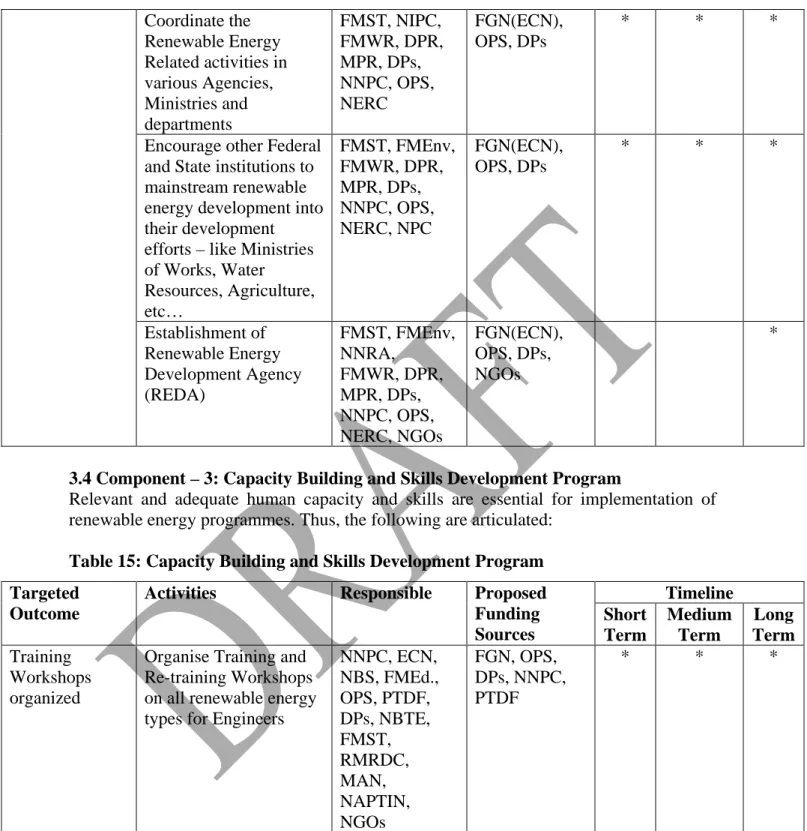
15 Coordinate the Renewable Energy Related activities in various Agencies, Ministries and departments FMST, NIPC, FMWR, DPR, MPR, DPs, NNPC, OPS, NERC FGN(ECN), OPS, DPs * * *
Encourage other Federal and State institutions to mainstream renewable energy development into their development efforts – like Ministries of Works, Water Resources, Agriculture, etc… FMST, FMEnv, FMWR, DPR, MPR, DPs, NNPC, OPS, NERC, NPC FGN(ECN), OPS, DPs * * * Establishment of Renewable Energy Development Agency (REDA) FMST, FMEnv, NNRA, FMWR, DPR, MPR, DPs, NNPC, OPS, NERC, NGOs FGN(ECN), OPS, DPs, NGOs *
3.4 Component – 3: Capacity Building and Skills Development Program
Relevant and adequate human capacity and skills are essential for implementation of renewable energy programmes. Thus, the following are articulated:
Table 15: Capacity Building and Skills Development Program Targeted
Outcome
Activities Responsible Proposed
Funding Sources Timeline Short Term Medium Term Long Term Training Workshops organized
Organise Training and Re-training Workshops on all renewable energy types for Engineers
NNPC, ECN, NBS, FMEd., OPS, PTDF, DPs, NBTE, FMST, RMRDC, MAN, NAPTIN, NGOs FGN, OPS, DPs, NNPC, PTDF * * *
16 Organise Training and
Re-training Workshops on all renewable energy types for Technicians and Craftsmen NNPC, ECN, NBS, FMEd., OPS, PTDF, DPs, NBTE, FMST, RMRDC, MAN, NAPTIN, NGOs FGN, OPS, DPs, NNPC, PTDF * * *
Organise Training and Re-training Workshops on all renewable energy types for relevant
Ministries, Agencies and Departments at Federal, State and Local
Governments NNPC, ECN, NBS, FMEd., OPS, PTDF, DPs, NBTE, FMST, RMRDC, MAN, NAPTIN, NGOs FGN, OPS, DPs, NNPC, PTDF * * *
Capacity and training to improve skills necessary for
local design and manufacture of renewable energy technologies NNPC, ECN, NBS, FMEd., OPS, PTDF, DPs, NBTE, FMST, RMRDC, MAN, NAPTIN, NGOs FGN, OPS, DPs, NNPC, PTDF * * *
Organise Training and Re-training Workshops on the Design, Construction and Installations and Maintenance of renewable energy technologies NNPC, ECN, NBS, FMEd., OPS, PTDF, DPs, NBTE, FMST, RMRDC, MAN, NAPTIN, NGOs FGN, OPS, DPs, NNPC, PTDF * * * Renewable Energy Mainstreamed into the Nation’s Education Curricula Organise On-the-Job Training for NYSC
NNPC, ECN, NBS, FMEd., OPS, PTDF, DPs, NBTE, FMoP, NGOs, FMST, FMYD, NAPEP, NYSC, NDE, NAPTIN FGN, OPS, DPs * * *
17 Organise Advanced
Training (Overseas and Local) Courses on specific renewable energy type NNPC, ECN, NBS, FMEd., OPS, PTDF, DPs, NBTE, FMoP, NGOs FGN, OPS, DPs * * *
Organise training on the preparation of pre-feasibility and feasibility assessments on viability of renewable projects NNPC, ECN, NBS, FMEd., OPS, PTDF, DPs, NBTE, FMoP, NGOs FGN, OPS, DPs * * *
Short Courses and postgraduate programs overseas on various renewable energy sources NNPC, ECN, NBS, FMEd., OPS, PTDF, DPs, NBTE, FMoP, NGOs FGN, OPS, DPs * * * Introduce Renewable Energy into the nation’s educational Curriculum NNPC, ECN, NBS, FMEd., OPS, PTDF, DPs, NBTE, FMoP, NGOs FGN, OPS, DPs * * * Developing indigenous human and institutional capacities in the genetic manipulation of fast growing tree species.
NNPC, ECN, NBS, FMEd., OPS, PTDF, DPs, NBTE, FMoP, NGOs, FMST FGN, OPS, DPs Conduct periodic national renewable energy manpower survey to determine the actual Re Expert base of the country NNPC, ECN, NBS, FMEd., OPS, PTDF, DPs, NBTE, FMoP, NGOs, SGs, LGAs FGN, OPS, DPs * * *
Develop and Implement Specialized Renewable Energy Curricula into the nation’s higher educational system NNPC, ECN, NBS, FMEd., OPS, PTDF, DPs, NBTE, FMoP, NGOs, FMST, NUC, NBTE, NCCE FGN, OPS, DPs * * *
Conduct a Study on the Nigeria’s Renewable Energy Manpower Stock and Needs
NNPC, ECN, NBS, FMEd., OPS, PTDF, DPs, NBTE FGN, OPS, DPs * * *
18 Develop Curricula for
primary, Secondary and Tertiary Institutions on different Renewable Sources NNPC, ECN, NBS, FMEd., OPS, PTDF, DPs, NBTE, FMoP, NGOs, FMST, NUC, NBTE, NCCE FGN, OPS, DPs * * * Establishment of
Barefoot-College for the training of local artisans and end users on the installation, utilization, maintenance and safety of renewable energy technologies NNPC, ECN, NBS, FMEd., OPS, PTDF, DPs, NBTE, FMoP, NGOs, FMST, NAPEP, NDE, FMoD, NBTE FGN, OPS, DPs * * * Establish linkages/collaboration between tertiary institutions, research centres and industries
NNPC, ECN, NBS, FMEd., OPS, PTDF, DPs, NBTE, FMoP, NGOs, BOI, NUC, NBTE, NCCE FGN, OPS, DPs * * *
3.5 Component – 4: Public Awareness/Sensitization
Even-though the Energy Commission of Nigeria and many other organizations have been organizing several workshops and sensitization programmes on renewable energy, many Nigerians are still ignorance of the benefits of renewable energy and its exploitation. The following are some of the awareness and sensitization activities and projects that should be embarked upon to create greater awareness.
Table 16: Public Awareness/Sensitization Targeted
Outcome
ACTIVITIES Responsible Proposed
Funding Sources TIMELINE Short Term Medium Term Long Term RE Awareness Created among Nigerians Setting up of renewable energy awareness programs (including solar villages in each state) ECN, NOA, NGOs, CBOs, DPs, OPS, FMST, FMoP, FMoI, RCs, Media FGN, OPS, DPs * * * Organise regular programs on radio and TV to demonstrate the role of renewable energy
FMST, FMoI, Media
FGN, OPS, DPs
19 Develop awareness
creation & public enlightenment
programmes on different renewable energy
technologies for the print and electronic media ECN, NOA, NGOs, CBOs, DPs, OPS, FMoP, FMoI, FMST, NESREA, ERCs, Media FGN, OPS, DPs * * * Develop awareness creation & public enlightenment programmes on different renewable energy technologies for primary, secondary schools ECN, NOA, NGOs, CBOs, DPs, OPS, FMoP, FMoI, FMST, FMYD, FMWA, FMoN-D, ERCs, Media FGN, OPS, DPs * * * Develop awareness creation & public enlightenment
programmes on different renewable energy
technologies for the Federal, State and governments assemblies ECN, NOA, NGOs, CBOs, DPs, OPS, FMoP, FMoI, FMST, ERCs, Media FGN, OPS, DPs * * * Develop awareness creation & public enlightenment
programmes on different renewable energy
technologies for the Fed. Ministry Officials, Youth & Women groups
ECN, NOA, NGOs, CBOs, DPs, OPS, FMoP, FMoI, ERCs, Media FGN, OPS, DPs * * * Publications in print media on renewable energy resources, development and technologies ECN, FMoI, DPs FGN, OPS, DPs * * * Institute periodic international fairs on specific renewable energy source ECN, NOA, NGOs, CBOs, DPs, OPS, FMoP, FMoI, Judiciary, NASS, SASSs, LGAs, ERCs, Media FGN, OPS, DPs * * *
20 Organize Awareness
and Sensitization Seminars for Law and Policy makers ECN, NOA, NGOs, CBOs, DPs, OPS, FMoP, FMoI, ERCs, Media FGN, OPS, DPs * * * Organise Annual Renewable Energy Week ECN, NOA, NGOs, CBOs, DPs, OPS, FMoP, FMoI, Energy Research Centres, Media FGN, OPS, DPs * * * Organize Community based information and communications technology dissemination training for NYSC ECN, NOA, NGOs, CBOs, DPs, OPS, FMoP, FMoI, ERCs, Media FGN, OPS, DPs * * * Organise Advanced Training (Overseas and Local) Courses on specific renewable energy type ECN, NOA, NGOs, CBOs, DPs, OPS, FMoP, FMoI, PTDF, ERCs, Media FGN, OPS, DPs, PTDF * * * Production of handbills, leaflets, postcards, calenders, jingles and documentaries on renewable energy technologies ECN, NOA, NGOs, CBOs, DPs, OPS, FMoP, FMoI, ICRC, FMST, Nollywood, ERCs, Media FGN, OPS, DPs * * * Build up partnerships between government, private sector and civil society for renewable energy development. ECN, NOA, NGOs, CBOs, DPs, OPS, FMoP, FMoI, FMT&I, ERCs, Media FGN, OPS, DPs * * *
3.6 Component – 5: Development of Financing Options Program
Renewable energy ventures often have high up-front cost, and many projects require government support in the initial start-up phases. Access to affordable finance is a major constraint. Traditional banks are often unwilling to finance renewable energy projects due to market uncertainties and perceived high risks, such as, high initial capital costs on a per kW basis; higher transaction costs in the case of smaller renewables; uncertainty of the resource base; limited number of developers with the skills to prepare financing packages that meet the requirements of financial institutions; price uncertainty in the
21
market for final renewable energy service; and, lack of off-takers for renewable energy produced. In some cases, there are limited data and information on the renewable energy industry to guide investors and financiers in making sound judgments and decisions in renewable energy projects development.
The activities in this component is geared towards increasing availability of information on renewable energy project investments, and enhancing collaboration between the various stakeholders, to ensure successful renewable energy project investments. Financing for RETs can be in the form of assets, venture capital, private equity, loans and grants, or multiple combinations of these.
The key question that needs to be addressed is: what are the options and strategies for mobilizing domestic and international capital to finance the investment requirements of sustaining long term energy and socio-economic development in Nigeria?
In the light of the above question, some measures need to be put in place in addressing the key issues. For instance, energy projects should be properly chosen, designed and packaged to be attractive to domestic and foreign investors. Moreover maximum advantage should be taken of the international funds available for environmentally sound energy projects.
In Nigeria access to energy finance is affected by:
• Inadequate national support system that guarantees the attraction and security of investment,
• Inadequate financial capacity for energy investment
• Slow judicial process in settling dispute
• Inadequate strategies for attracting offshore financing
• Political and regulatory risks for investment in energy infrastructure
• Inadequate incentives to business to invest in new technologies
Some of the remedial measures to counter these, especially for the energy sector, have been enumerated in this REAP such as establishing a tax holiday scheme, Introducing tariffs that guarantee good rate of return on investment etc. Moreover some of the identified niche products that could be employed in financing energy projects are Equity financing mechanism, bond market, financial collaboration between government/private with bilateral and multilateral institutions etc.
22
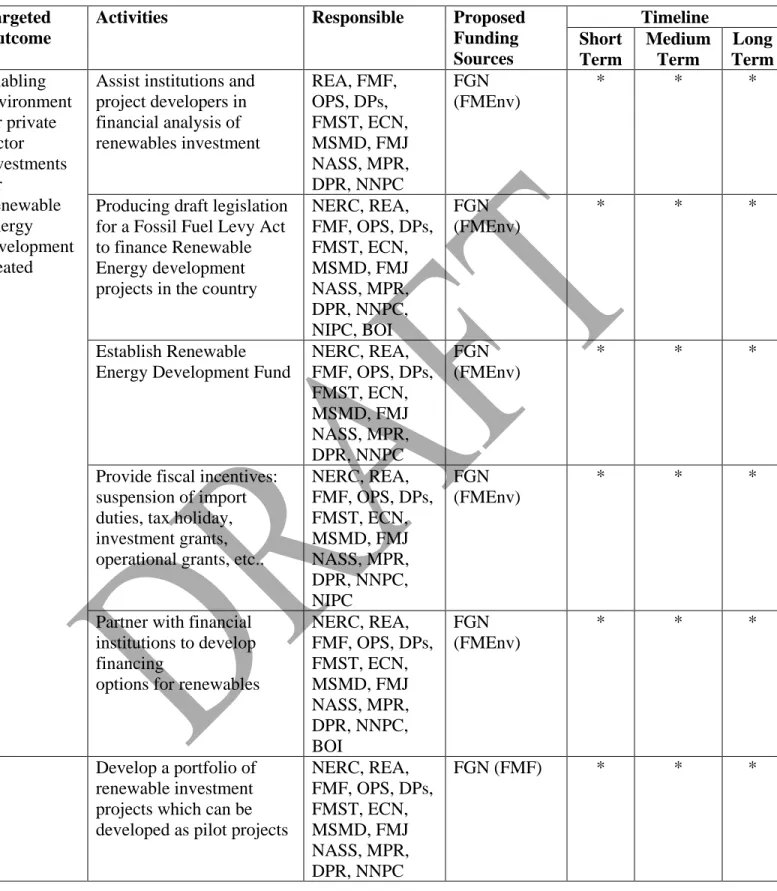
Table 17: Development of Financing Options Program Targeted
Outcome
Activities Responsible Proposed
Funding Sources Timeline Short Term Medium Term Long Term Enabling environment for private sector investments for Renewable Energy development created
Assist institutions and project developers in financial analysis of renewables investment REA, FMF, OPS, DPs, FMST, ECN, MSMD, FMJ NASS, MPR, DPR, NNPC FGN (FMEnv) * * *
Producing draft legislation for a Fossil Fuel Levy Act to finance Renewable Energy development projects in the country
NERC, REA, FMF, OPS, DPs, FMST, ECN, MSMD, FMJ NASS, MPR, DPR, NNPC, NIPC, BOI FGN (FMEnv) * * * Establish Renewable Energy Development Fund
NERC, REA, FMF, OPS, DPs, FMST, ECN, MSMD, FMJ NASS, MPR, DPR, NNPC FGN (FMEnv) * * *
Provide fiscal incentives: suspension of import duties, tax holiday, investment grants, operational grants, etc..
NERC, REA, FMF, OPS, DPs, FMST, ECN, MSMD, FMJ NASS, MPR, DPR, NNPC, NIPC FGN (FMEnv) * * *
Partner with financial institutions to develop financing
options for renewables
NERC, REA, FMF, OPS, DPs, FMST, ECN, MSMD, FMJ NASS, MPR, DPR, NNPC, BOI FGN (FMEnv) * * * Develop a portfolio of renewable investment projects which can be developed as pilot projects
NERC, REA, FMF, OPS, DPs, FMST, ECN, MSMD, FMJ NASS, MPR, DPR, NNPC FGN (FMF) * * *
23 Support training on
renewables project development targeted at accessing carbon finance
NERC, REA, FMF, OPS, DPs, FMST, ECN, MSMD, FMJ NASS, MPR, DPR, NNPC FGN (FMF) * * * Develop pipeline of projects that can access carbon financing NERC, REA, FMF, OPS, DPs, FMST, ECN, MSMD, FMJ NASS, MPR, DPR, NNPC FGN (FMF) * * *
Introducing tariffs that guarantee good rate of return on investment (E.G, Feed- In – Tariff, etc..)
NERC, REA, FMF, OPS, DPs, FMST, ECN, MSMD, FMJ NASS, MPR, DPR, NNPC FGN (FMF) * * *
Instituting a scheme for accelerated depreciation of equipment in respect of (foreign) loans invested in energy projects. NERC, REA, FMF, OPS, DPs, FMST, ECN, MSMD, FMJ NASS, MPR, DPR, NNPC FGN (FMF)
Establishing special risk fund scheme for
commercialization of new and emerging energy technologies such as RET
NERC, REA, FMF, OPS, DPs, FMST, ECN, MSMD, FMJ NASS, MPR, DPR, NNPC FGN (FMF) * * * Attracting long-term financing from international institutions NERC, REA, FMF, OPS, DPs, FMST, ECN, MSMD, FMJ NASS, MPR, DPR, NNPC FGN (FMF) Providing adequate security for energy infrastructural facilities NERC, REA, FMF, OPS, DPs, FMST, ECN, MSMD, FMJ NASS, MPR, DPR, NNPC FGN (FMF)
24 Ensuring the provision of
basic physical
infrastructural facilities to enterprises involved in the development of the energy sector. NERC, REA, FMF, OPS, DPs, FMST, ECN, MSMD, FMJ NASS, MPR, DPR, NNPC FGN (FMF) Introducing environmental regulations that encourage investment in environmental friendly technologies NERC, REA, FMF, OPS, DPs, FMST, ECN, MSMD, FMJ NASS, MPR, DPR, NNPC, NESREA FGN (FMF) Feed-In-Tariff
(i) Large Hydro Plant
2012 2013 2014 2015 2016
Wholesale contract prices
(N/MWh) 4,898 5,290 5,715 6,174 6,671
(ii) Small Hydropower (SHP)
2012 2013 2014 2015 2016
Wholesale contract prices
(N/MWh) 23,561 25,433 27,456 29,643 32,006
(iii)On-Shore Wind Plant
2012 2013 2014 2015 2016
Wholesale contract prices
(N/MWh) 24,543 26,512 28,641 30,943 33,433
(iv)Solar Power Plant
2012 2013 2014 2015 2016
Wholesale contract prices
(N/MWh) 67,917 73,300 79,116 85,401 92,192
(v) Biomass Power Plant
2012 2013 2014 2015 2016
Wholesale contract prices
(N/MWh) 27,426 29,623 32,000 34,572 37,357
25
3.7 Component – 6: Development of RE Projects
Nigeria is well endowed with a wide range of renewable energy resources, including hydro-electricity, biomass, solar, wind, and other renewables, most of which are currently under-exploited. Based on experience from various initiatives that have been undertaken to date, the use of these renewable energy resources could contribute significantly to the development of the energy sector in many African countries.
If successfully exploited, renewables can significantly contribute to addressing two key challenges facing the energy sector in Nigeria: Energy Access: Increasing access to modern energy for the wider majority in pursuit of poverty reduction, MDGs, and
more equitable socio-economic development; Energy Security: Responding to the increased burden of the high cost of fossil fuels compounded by power shortages triggered by lower investment flows to the power sector and drought.
Renewables can contribute to poverty alleviation and assist in addressing the Millennium Development Goals (MDGs), by providing modern improved energy services to the poor. Renewables are particularly suited to meet the decentralized energy needs of poor rural remote community institutions such as hospitals, dispensaries, schools, and farmer training centers. This is particularly true of small-scale renewables that are made locally and run on locally available resources. Such systems can provide energy that is both affordable and a source of employment and enterprise creation for both the rural and urban poor. Examples of such renewables include:
• Low cost more efficient biomass-based combustion technologies (e.g., improved cook stoves, efficient charcoal kilns, brick making kilns, fish smokers, tea dryers, and wood dryers);
• Pico and micro hydro for shaft power for processing agricultural produce and increasing its value, as well as for pumping water;
• Low cost efficient hand tools and animal drawn implements, to increase the agricultural productivity of rural areas;
• Treadle, wind, and ram pumps for irrigation to increase agricultural outputs and generate income for the farmer;
• Solar dryers that lower post-harvest losses enabling farmers to market their produce when prices are higher;
• Solar water purifiers to provide clean potable water and reduce water borne diseases, which translates to increased availability of labor and thus increases agricultural output and income.
Renewables offer diversification in energy generation and therefore can play a vital role in increasing energy security by minimizing risks related to high and unstable oil prices. Some renewables are not reliant on rainfall (e.g., geothermal, solar, wind) thereby reducing climate variability related risks.
In fact, it could be argued that in view of the continued and serious lack of access to energy in Nigeria and the increased energy security challenges, policy makers in the country now fully recognize the need to develop renewable energy as a matter of priority.
26
The widespread deployment of renewables in the region has also been constrained by other factors that include: poor institutional frameworks and infrastructure; inadequate planning; the lack of coordination and linkage in national renewables programs; pricing distortions that place renewable energy at a disadvantage; high initial capital costs; weak dissemination strategies; lack of skilled manpower; poor baseline information; and low maintenance capacity. Therefore, meaningful scaling up of the use of renewable energy resources can only be realized if these barriers are overcome through specific projects and programmes as outlined as follows:
Table 18: Development of RE Projects Targeted
Outcome
Activities Responsible Proposed
Funding Sources Timeline Short Term Medium Term Long Term Biomass Projects established
Identifying the fast growing indigenous trees species. ECN, NGOs, FMA&WR, FMEnv.,SGs, LGAs, OPS, DPs, FMST, FIRN FGN, OPS, DPs, NNPC, PTDF * * *
Identifying & sourcing foreign fast growing tree species NNPC, ECN, NGOs, FMA&WR, FMEnv.,SGs, LGAs, OPS, DPs FGN, OPS, DPs * * *
Creating nurseries and intensifying the
cultivation of plantation of fast growing trees
ECN, NGOs, FMA&WR, FMEnv.,SGs, LGAs, OPS, DPs FGN, OPS, DPs * * * Establishing more shelter belts in the semi-arid zones NNPC, ECN, NGOs, FMA&WR, FMEnv.,SGs, LGAs, OPS, DPs FGN, OPS, DPs * * * Establishment of Small-Scale Industries for the design and production of improved woodstoves NNPC, ECN, NGOs, FMA&WR, FMEnv.,SGs, LGAs, OPS, DPs, SMEDAN, FMST, RMRDC, NDE, NARICT NCAM FGN, OPS, DPs * * *
27 Construction of biodigester plants NNPC, ECN, NGOs, FMA&WR, FMEnv.,SGs, LGAs, OPS, DPs, FMoP, FMST, FMT&I, RMRDC, NDE, NARICT, NCAM FGN, OPS, DPs * * * Establishment of bio-fuels plants NNPC, ECN, NGOs, FMA&WR, FMEnv.,SGs, LGAs, OPS, DPs, FMT&I FGN, OPS, DPs * * * Establishment of energy farms NNPC, ECN, NGOs, FMA&WR, FMEnv.,SGs, LGAs, OPS, DPs FGN, OPS, DPs * * * Manufacture and dissemination of improved woodstoves NNPC, ECN, NGOs, FMA&WR, FMEnv.,SGs, LGAs, OPS, DPs FGN, OPS, DPs * * * Establishment of briquetting plants for fine particle of biomass
NNPC, ECN, NGOs, FMA&WR, FMEnv.,SGs, LGAs, OPS, DPs FGN, OPS, DPs * * * Blending of up to 10% of fuel ethanol with gasoline (E-10)
Develop local capacity for large scale
production of biofuels feedstock NNPC, ECN, NGOs, FMA&WR, FMEnv.,SGs, LGAs, OPS, DPs FGN, OPS, DPs * * * Establishment of plantations of energy crops and biofuels plants NNPC, ECN, NGOs, FMA&WR, FMEnv.,SGs, LGAs, OPS, DPs FGN, OPS, DPs * * *
28 Creating Market
Demand for Biofuels
NNPC, ECN, NGOs, FMA&WR, FMEnv.,SGs, LGAs, OPS, DPs, FMF, DPR, NIPC, FMT&I FGN, OPS, DPs * * * Registration of Biofuels Plants NNPC, ECN, NGOs, FMA&WR, FMEnv.,SGs, LGAs, OPS, DPs, FMF, DPR, NIPC, FMT&I FGN, OPS, DPs
Provide fiscal and economic incentives: Tax holiday, waiving VAT, etc… NNPC, ECN, NGOs, FMA&WR, FMEnv.,SGs, LGAs, OPS, DPs, FMF, DPR, NIPC, FMT&I FGN, OPS, DPs * * * Development of the Biofuels Industry Equity Fund NNPC, ECN, NGOs, FMA&WR, FMEnv.,SGs, LGAs, OPS, DPs, FMF, BOI, FMT&I FGN, OPS, DPs * * * Solar Energy Projects Construction of Solar Projects in the residential, commercial and industrial setors
ECN, NGOs, FMEnv., SGs, LGAs, OPS, DPs, FMST, FMT&I, RMRDC, NARICT FGN, OPS, DPs * * * Construction of Solar Thermal Projects in the residential, commercial and industrial setors
ECN, NGOs, FMEnv., SGs, LGAs, OPS, DPs, FMST, FMT&I, RMRDC, NARICT FGN, OPS, DPs * * *
Develop and site appropriate solar schemes ECN, NGOs, FMEnv., SGs, LGAs, OPS, DPs FGN, OPS, DPs * * *
29 Installation of Solar Home Systems ECN, NGOs, FMA&WR, FMEnv., SGs, LGAs, OPS, DPs, FMH&UD FGN, OPS, DPs * * * Installation of Solar Water Pumping ECN, NGOs, FMA&WR, FMEnv.,SGs, LGAs, OPS, DPs, FMoP, FMST FGN, OPS, DPs * * * Installation of Solar Street and traffic Lightings ECN, NGOs, FMEnv., SGs, LGAs, OPS, DPs, FMH&UD FGN, OPS, DPs * * * Construction of Large-Scale Solar PV plants
ECN, NGOs, FMEnv.,SGs, LGAs, OPS, DPs, FMoP, FMST FGN, OPS, DPs * * * Installation of Solar projects for community services ECN, NGOs, FMA&WR, FMEnv.,SGs, LGAs, OPS, DPs FGN, OPS, DPs * * * Installation of Solar Collectors ECN, NGOs, FMA&WR, FMEnv.,SGs, LGAs, OPS, DPs FGN, OPS, DPs * * * Installation of Solar Cookers ECN, NGOs, FMA&WR, FMEnv.,SGs, LGAs, OPS, DPs FGN, OPS, DPs * * * Installation of Solar Dryers, Chicken Brooders, etc… ECN, NGOs, FMA&WR, FMEnv.,SGs, LGAs, OPS, DPs FGN, OPS, DPs * * * Installation of Solar desalination, solar stills, etc.. ECN, NGOs, FMA&WR, FMEnv.,SGs, LGAs, OPS, DPs FGN, OPS, DPs * * * Installation of Solar efrigeration and A/C
ECN, NGOs, FMA&WR, FMEnv.,SGs, LGAs, OPS, DPs FGN, OPS, DPs * * *
30 Installation of Solar thermal electricity NNPC, ECN, NGOs, FMA&WR, FMEnv.,SGs, LGAs, OPS, DPs FGN, OPS, DPs * * * Installation of Solar pasteurization, sterilization NNPC, ECN, NGOs, FMA&WR, FMEnv.,SGs, LGAs, OPS, DPs FGN, OPS, DPs * * * Small Hydro Projects Construction of Small Hydropower Stations in each of the six
geopolitical zones of the country FMWR, FMP, FMEnv, ECN, OPS, DPs FGN, OPS, DPs * * * Refurbishment of abandoned SHP projects in the country, namely: - 6 MW Hydro project NNPC, ECN, NGOs, FMA&WR, FMEnv.,SGs, LGAs, OPS, DPs, FMoP FGN, OPS, DPs * * * Progressively increasing indigenous participation in the planning, design and construction of hydropower plants in a ratio that ensures full benefits to the country
NNPC, ECN, NGOs, FMA&WR, FMEnv.,SGs, LGAs, OPS, DPs, FMoP FGN, OPS, DPs * * * Promote local manufacturing & fabrication of turbines and other electro-mechanical compnents NNPC, ECN, NGOs, FMA&WR, FMEnv.,SGs, LGAs, OPS, DPs, FMoP FGN, OPS, DPs * * * Wind Energy Projects Installation of Wind Power Plant ECN, NGOs, FMA&WR, FMEnv.,SGs, LGAs, OPS, DPs, FMoP, FMST FGN, OPS, DPs * * *
Carry out feasibility study for a hybrid demonstration plants ECN, NGOs, FMA&WR, FMEnv.,SGs, LGAs, OPS, DPs, FMoP, FMST FGN, OPS, DPs * * *
31 Construction of Wind-Solar-Hydro hybrid plants ECN, NGOs, FMA&WR, FMEnv.,SGs, LGAs, OPS, DPs, FMoP, FMST FGN, OPS, DPs * * * Establishment of Wind Technology Centre ECN, NGOs, FMA&WR, FMEnv.,SGs, LGAs, OPS, DPs, FMoP, FMST, NUC, NBTE, NCCE, ERCs FGN, OPS, DPs * * * Construction of Wind Projects in the residential, commercial and industrial setors
ECN, NGOs, FMA&WR, FMEnv.,SGs, LGAs, OPS, DPs, FMoP, FMST, NUC, NBTE, NCCE, ERCs FGN, OPS, DPs * * *
Develop and site appropriate wind schemes ECN, NGOs, FMA&WR, FMEnv.,SGs, LGAs, OPS, DPs, FMoP, FMST FGN, OPS, DPs * * * Installation of wind Home Systems ECN, NGOs, FMA&WR, FMEnv.,SGs, LGAs, OPS, DPs, FMoP, FMST, FMH&UD FGN, OPS, DPs * * * Installation of Wind Water Pumping ECN, NGOs, FMA&WR, FMEnv.,SGs, LGAs, OPS, DPs, FMoP, FMST FGN, OPS, DPs * * * Construction of Large-Scale wind power plants
ECN, NGOs, FMEnv., SGs, LGAs, OPS, DPs, FMoP, FMST FGN, OPS, DPs * * *
32 Encouraging local and
foreign investors to establish factories for production of major components of wind energy systems (e.g. wind turbines, blades, deep cycle batteries, charge controllers ECN, NGOs, FMEnv., SGs, LGAs, OPS, DPs, FMoP, FMST, FMF, FMFA, NIPC, FMT&I FGN, OPS, DPs * * *
3.8 Component – 7: Incentives for RE Development
Governments should pursue investment incentives for the exploitation of renewable energy as a means to an end. Policy-makers attribute poor renewable energy development in most countries to a lack of investment. Incentives are used as a tool to boost investment and growth, even if the causal links between each of these stages is far from proven. Incentives work by changing the parameters of an investment project. Investors choose to make investments when the Net Present Value (NPV) of a project’s cash flows (suitably discounted) is greater than zero. In a world where companies face capital rationing, they choose the mix of projects with the greatest Internal Rate of Return. Incentives bias investors’ decision-making positively in favour of investments in certain sectors like renewables. By reducing the tax burden or providing cash incentives, there is increased expected profitability of projects in those sectors. Where investors have good access to finance, the introduction of special incentives to certain sectors should in theory lead to an overall increase in investment.
Experiences have shown that government policy support is the key to moving commercial renewable energy development forward in its initial stages. Government-supported financial and economic incentives, in particular, play an important role in helping to develop commercial markets and reduce the financial life-cycle costs of renewable energy technologies.
The governments also recognize that the financial life-cycle costs of today’s renewable energy systems often exceed those of conventional alternatives. As a result, governments are providing financial incentives to help overcome the financial incremental costs of renewable energy systems. In most cases, the financial incentives are structured and applied in ways that aim to reduce the cost of renewable energy systems, thereby building toward a future where the technologies are financially viable. Financial incentives are also being provided to counterbalance those provided to conventional alternatives (that is, to provide a level playing field), and to account for environmental costs and benefits not considered in conventional economic comparisons and pricing methodologies.
33
Table 19: Incentives for RE Development Targeted
Outcome
ACTIVITIES Responsible Proposed
Funding Sources Timeline Short Term Medium Term Long Term ECONOMIC INCENTIVES
Provision of low interest soft loans from special low interest development finance agencies such as Bank of Industry (BOI) and Community Bank should be reserved for Renewable Energy Supply and Utilization Projects, at interest rate not exceeding 5% p.a.
CBN, FMF, NCs, OPS, DPs
FGN, OPS, DPs
* * *
Subsidies and Grants:
Subsidies of up to 30% of initial costs of a RE utilization facility is to be granted to communities, enterprises and
individuals that embark on such projects. The subsidies should however be in kind, and should be subject to due processing by the responsible
administering agency, the ECN. CBN, FMF, NCs, OPS, DPs FGN, OPS, DPs * * * Waiver of Purchase Taxes: Individual, corporate or community consumers of RE technologies should benefit from a waiver of initial purchase taxes, such as VAT. CBN, FMF, NCs, OPS, DPs FGN, OPS, DPs * * *