Contents lists available at ScienceDirect
European
Journal
of
Operational
Research
journal homepage: www.elsevier.com/locate/ejor
Decision Support
A
multi-agent
based
cooperative
approach
to
scheduling
and
routing
Simon Martin
a,∗, Djamila Ouelhadj
b, Patrick Beullens
c, Ender Ozcan
d, Angel A. Juan
e,
Edmund K. Burke
fa ComputationalHeuristicsOperationalResearchDecisionSupport(CHORDS)Group,UniversityofStirling,DepartmentofMathematicsandComputer Science,UK
bCentreofOperationalResearchandLogistics,UniversityofPortsmouth,DepartmentofMathematics,UK cMathematicalSciencesandSouthamptonBusinessSchoolandCORMSIS,UniversityofSouthampton,SO171BJ,UK
d AutomatedScheduling,OptimisationandPlanningResearchGroup,UniversityofNottingham,DepartmentofComputerScience,UK e DepartmentofComputerScience– IN3,OpenUniversityofCatalonia,156RamblaPoblenou,Barcelona08018,Spain
f SchoolofElectronicEngineeringandComputerScience,QueenMaryUniversityofLondon,UK
a
r
t
i
c
l
e
i
n
f
o
Articlehistory:
Received10March2015 Accepted28February2016 Availableonline4March2016
Keywords: Combinatorialoptimization Scheduling Vehiclerouting Metaheuristics Cooperativesearch
a
b
s
t
r
a
c
t
In this paper, we propose a general agent-based distributed framework where each agent is implement- ing a different metaheuristic/local search combination. Moreover, an agent continuously adapts itself dur- ing the search process using a direct cooperation protocol based on reinforcement learning and pattern matching. Good patterns that make up improving solutions are identified and shared by the agents. This agent-based system aims to provide a modular flexible framework to deal with a variety of different problem domains. We have evaluated the performance of this approach using the proposed framework which embodies a set of well known metaheuristics with different configurations as agents on two prob- lem domains, Permutation Flow-shop Scheduling and Capacitated Vehicle Routing. The results show the success of the approach yielding three new best known results of the Capacitated Vehicle Routing bench- marks tested, whilst the results for Permutation Flow-shop Scheduling are commensurate with the best known values for all the benchmarks tested.
© 2016 The Authors. Published by Elsevier B.V. This is an open access article under the CC BY license ( http://creativecommons.org/licenses/by/4.0/).
1. Introduction
Heuristicsoftencomewithasetofparameters,eachrequiring tuning foran improved performance. Moreover, different heuris-ticscanperformwellondifferentprobleminstances.Hence,there is a growing number of studies on more general methodologies whichare applicableto differentproblemdomains fortuningthe parameters (Hutter, Babic, Hoos, & Hu, 2007; López-Ibánez, Dubois-Lacoste, Stützle, & Birattari, 2011; Ries& Beullens,2015), generating or mixing/controlling heuristics (Burke et al., 2013; Ross,2014).Inthisstudy,wetakeanalternativeapproachanduse cooperatingagents,whereeachagentisenabledtotakeadifferent methodwithdifferentparametersettings.
Bycooperativesearchwemeanthat(meta)heuristics,executed inparallel asagents,havetheability toshareinformationat var-ious pointsthroughouta search.To thisend,we propose a mod-ular agent-based framework where the agents cooperate using a
∗ Correspondingauthor.Tel.:+441786467462.
E-mailaddresses:[email protected](S.Martin),[email protected]
(D.Ouelhadj),[email protected](P.Beullens),[email protected]
(E.Ozcan),[email protected](A.A.Juan),[email protected](E.K.Burke).
directpeertopeerasynchronousmessagepassingprotocol.An is-landmodel isused whereeach agenthasits own representation ofthesearchenvironment.Eachagentisautonomousandcan ex-ecutedifferentmetaheuristic/localsearchcombinationswith differ-entparametersettings.Cooperationisbasedonthegeneral strate-gies of pattern matching and reinforcement learning where the agentssharepartialsolutionstoenhancetheiroverallperformance. Theframework hasthe followingadditionalcharacteristics. By using ontologies (see Section 3.2), we are aiming to provide a framework that is flexible enough to be used on morethan one type of combinatorialoptimisation problem withlittle or no pa-rametertuning.Thisisachievedbyusingourschedulingand rout-ing ontology to translate target problemsinto an internal format thattheagentscanusetosolveproblems.Sofar,thisapproachhas been applied successfully to Capacitated Vehicle Routing (CVRP), PermutationFlowshopScheduling(PFSP),reportedhereandNurse RosteringreportedinMartin,Ouelhadj,Smet,VandenBerghe,and Özcan(2013).
Theaimofthisstudyistodevelopamodularframeworkfor co-operativesearchthat canbe deployed, withlittlereconfiguration, tomorethanone type ofproblem. Wealsotest whether interac-tionbetween(meta)heuristicsleadstoimprovedperformanceand http://dx.doi.org/10.1016/j.ejor.2016.02.045
ifincreasing the number of agentsimproves the overall solution quality.
1.1.CooperativesearchinOR
The interest in cooperative search has risen due to successes infinding novel ways to combinesearch algorithms. Cooperative searchcanbeperformedbytheexchangeofstates,solutions, sub-problems, models, or search space characteristics. For a general introduction see, forexample, Blum and Roli (2003), Clearwater, Hogg, and Huberman (1992), Crainic and Toulouse (2008), Hogg andWilliams(1993),TalbiandBachelet(2006)andToulouse, Thu-lasiraman,andGlover(1999).Severalframeworkshave been pro-posedrecentlywhichincorporatemetaheuristicssuchasMeignan, Creput,andKoukam(2008),Meignan,Koukam,andCréput(2010), MilanoandRoli (2004) andTalbi and Bachelet(2006),or hyper-heuristics, as in Ouelhadj and Petrovic (2010). Also, El Hachemi, Crainic, Lahrichi, Rei, and Vidal (2014) explore a general agent-based framework for solution integration where distributed sys-temsusedifferentheuristicstodecomposeandthensolvea prob-lem.
Inanefforttofindwaystocombinedifferentmetaheuristicsin suchawaythattheycooperate witheachother duringtheir exe-cution,anumberofdesignchoiceshavetobemade. Accordingto CrainicandToulouse(2008)an asynchronousframeworkin partic-ularcouldresultinanimprovedsearchmethodology; communica-tioncantheneitherbe many-to-many(direct),whereeach meta-heuristic communicates with every other, or it can be memory based(indirect), whereinformation issent to apool that (other) metaheuristicscanmakeuseofasrequired.
Most cooperative search mechanisms in the OR literature deployindirectcommunicationthroughsomecentralpoolor adap-tive memory. Thiscan take the form ofpassing whole, or possi-blypartial, solutions, to the pool. Malek (2010),Milano andRoli (2004),Meignanetal.(2008,2010)andTalbiandBachelet(2006). Aydin and Fogarty (2004b) applied this approach to job shop scheduling. Recently, (Barbucha, 2014) has proposed an agent-basedsystemforVehicleRoutingProblemswhereagents instanti-atedifferentmetaheuristicswhichcommunicatethroughashared pool.
Direct communicationisusedonly inValladaandRuiz (2009) andAydinandFogarty(2004a),wherewholesolutionsarepassed fromone process to another inan island model executing a ge-netic or an evolutionary simulated annealing algorithm respec-tively,and inOuelhadj and Petrovic (2010),where a similar set-up is used for a hyper-heuristic. All three papers addressed the PFSP.Also,thisapproachistoanextentpresentintheevolutionary system of Xie and Liu (2009), who investigated the Travelling SalesmanProblem.Kouider andBouzouia(2012) propose a direct communicationmultiagentsystemforjobshopschedulingwhere eachagentisassociatedwithaspecificmachineinaproduction fa-cility.Hereaproblemisdecomposedintoseveralsub-problemsby a“supervisoragent”.Thesearepassedto“resourceagents” for ex-ecutionandthenpassedbacktothesupervisortobuildtheglobal solution.
Little workhasbeendone onasynchronous directcooperation wherepartial solutions are rated and their parameters are com-municated betweenautonomous agents all working on the total problem.Sofar,nodirectcooperationstrategyhasbeenappliedto morethan oneproblemdomainincombinatorialoptimisation.To thisend, the agentsare truly autonomousandnot synchronised. There is a gap in the literature regardingagents cooperating di-rectly andasynchronously where the communication is used for theadaptiveselectionofmoveswithparameters.
The outline for the rest of the paper is as follows. Section 2 provides formal problem statements for the two case studies. Section3describestheproposed modularmulti-agentframework
for cooperative search, while Section 4 describes how it is im-plemented. In Section 5 we discuss the experimental design. In Section 6 we report the results of the tests where, to the best ofourknowledge,forthreeoftheCapacitatedVehicleRouting in-stancesweachievedbetterresultsthanhavebeenreportedinthe literature. Finally, Section 7presents conclusionsand suggestions forfuturework.
2. Testcaseproblems
In this section we offer brief problem descriptions of the case studies applied to the agent-based framework proposed in this paper. We chose these instances as they are representative scheduling androuting problems. The algorithms instantiated by the framework are state-of-the-art implementations (Juan, Ruíz, Lourenço, Mateo,& Ionescu,2010b;Juan, Faulin,Jorba, Caceres,& Marquès, 2013;Juan, Faulin,Ruiz,Barrios, &Caballé,2010a; Juan, Lourenço,Mateo,Luo,&Castella, 2014).Theseare allexamplesof Simheuristics(Juan,Faulin, Grasman,Rabe,&Figueira,2015).This makesthemagoodfitwiththepartialsolutionsidentifiedbythe system.
2.1. Permutationflow-shopschedulingproblem
Letusassumethatwe haveasetofnjobs, J =
{
1,...,n}
, avail-able at a given time 0, and each to be processed on each of a set of m machines in the same order, M={
1,...,m}
.A job j ∈ J requiresafixed butjob-specificnon-negativeprocessingtime pj,ioneach machine i∈M.The objectiveofthePFSP istominimise themakespan.Thatis,tominimisethecompletiontimeofthelast jobonthelastmachineCmax(Pinedo,2002).Afeasiblescheduleis
henceuniquelyrepresentedbyapermutationofthejobs.Thereare n! possiblepermutationsandtheproblemisNP-complete(Garey, Johnson,&Sethi,1976).
Asolution can hencebe represented,uniquely, by a permuta-tion S=
(
σ
1,...,σ
j,...,σ
n)
, whereσ
j ∈ J indicates the job in thejthposition.Thecompletion timeCσ
j,iofjob
σ
jonmachineican becalculatedusingthefollowingformulae:Cσ1,1=pσ1,1 (1)
Cσ1,i=Cσ1,i−1+pσ1,i, wherei=2,...,m (2)
Cσj,i=max
(
Cσj,i−1,Cσj−1,i)
+pσj,i,wherei=2,...,m, and j=2,...,n (3)
Cmax=Cσn,m (4)
2.2. TheCapacitatedVehicleRoutingProblem
The Capacitated Vehicle Routing Problem (Dantzig & Ramser, 1959) can be defined in the following graph theoretic nota-tion. Let G(V, E) be an undirected complete graph where V=
{
v
0,v
1,v
2,...,v
n}
isthevertexsetandwhereEisasetofedges.Lettheset
v
i(
wherei={
1,...,n}
)
representthecustomerswhoareexpectingtobe servicedwithdeliveriesandlet
v
0bethe ser-vice depot. Alsoassociatedwitheach vertexv
j is anon-negativedemand dj.Thisvalue is giveneach time a delivery ismade. For thedepot
v
0thereisazerodemandd0.ThesetErepresentsthesetofroadsthatconnectthecustomers toeachotherandthedepot.Thuseachedgee∈Eisdefinedasa pairofvertices
(
v
i,v
j)
.Associatedwitheachedgeisacost ci,joftheroutebetweenthetwovertices.
Finallythere isalso a setofunlimited trucks each withsame loading capacity. The aim is to service all the customers visit-ing them once only and using as few trucks aspossible. In any
potentialdeliveryroundacustomer’sdemandhastobetakeninto account. The total demandsof customerson the roundmust not exceedthecapacityofthevehicle.Thismeans thatitisnormally not possible to visit all customers with one truck. As a conse-quenceeachdeliveryroundforatruckiscalledaroute.
ThegoaloftheCVRPproblemistominimisetheoverall travel-lingdistancetoserviceallcustomerswithvaryingdemandusinga givennumberoftrucks,eachwiththesamefixedcapacity.
ThisproblemisNP-HardGareyandJohnson(1979). 2.3. Benchmarkinstances
Weusedthefollowingbenchmarkinstancesfortestingthe ex-perimentsdescribedinSection5.ForPFSP,weselected12 bench-markproblemsfromTaillard(1993).EachTaillardPFSPbenchmark instanceis labelledastaiX_j_m,whereX istheinstance number and(j,m),wherej indicatesthenumberofjobs, andmthe num-berofmachines.Inordertofacilitateouranalysis,weselected12 oftheharderinstancesasfollows:twofromthe(50,20)pool,two from the (100, 20) pool and then three from the (200, 10) and (200, 20) pools and finally three from the (500, 20) pool of in-stancesforwhichanoptimalsolutionisnotknown.ForCVRP,we tested12problemsfromthebenchmarksofAugeratetal.(1995). EachinstanceofthisbenchmarkisdenotedasA-nM-kL,whereM andLindicate thenumberofdelivery pointsincludingthe depot andthetargetnumberofroutes,respectively.
3. Agent-basedframework
3.1. Frameworkarchitectureandoperation
We describe a general agent-based distributed framework where each agent implements a different metaheuristic/local searchcombination.Anagentcontinuouslyadaptsitselfduringthe searchprocessusingacooperationprotocolbasedontheretention partial solutions deemed as possible constituents of future good solutions.Thesearesharedwiththeotheragents.
Theframework makesuseoftwotypesofagent:launcherand metaheuristicagents.
• Thelauncheragentisresponsibleforqueueingtheproblem in-stancestobesolvedforagivendomain,configuringthe meta-heuristicagents,successivelypassing agivenprobleminstance to the metaheuristic agents and gathering the solutions from the metaheuristic agents. To achieve this it converts domain specific problem instances into the agent messaging protocol usinganontologyforschedulingandrouting(seeSection3.2). Howeverthelauncheragentplaysnoactualpartinthesearch, itsjobistoprepareandscheduleproblemstobesolvedbythe otheragents.
• A metaheuristic agentexecutes one of the metaheuristic/local search heuristiccombinations that areavailable. These combi-nationsandtheirparametersettingsarealldefinedon launch-ing. In thiswayeach agentis able toconduct searchesusing differentcombinations and parametersettings from the other agentsemployed inthe search. Eachmetaheuristicagent con-ducts its search using the messaging structure definedin the ontologyforschedulingandroutingandusesnoproblem spe-cificdataandassuchisgeneric.
Asearchproceedswiththelauncherreadinganumberof prob-leminstancesintomemory.Itconvertsthemintoobjectsthatcan bedefinedbytheOntologyforschedulingandrouting(Section3.2 below) and then sends each object, one at a time, to the meta-heuristic agents to be addressed. For a given problem instance, the metaheuristicagentsparticipatein acommunicationprotocol whichisineffectadistributedmetaheuristicthatenablesthemto
search collectively for good quality solutions. This is a sequence of messages passed between the metaheuristic agents and each messageissentasaconsequenceofinternalprocessingconducted byeach agent. One iterationof thisprotocoliscalleda conversa-tionandisbaseduponthewell-knowncontractnetprotocol(FIPA, 2009).Inordertoarriveatagoodsolutiontheagentswillconduct 10suchconversations.
To understand the pattern matching protocol it is necessary to explain the proposed model for scheduling and routing used throughouttheframework.
3.2.Schedulingandroutingontology
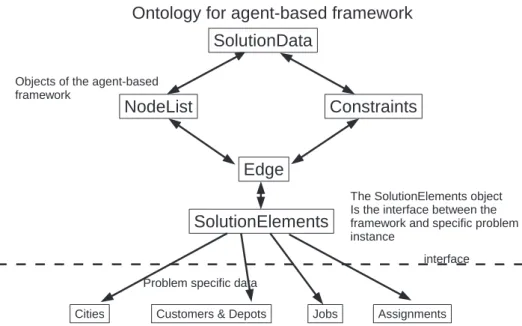
The ontology (Gruber, 1993) plays an important role within ourframework. It defines aset of generalrepresentational prim-itives that are used to model a number of scheduling and rout-ingproblems.The communicationprotocolandtheheuristicsare allbasedondatastructures developedfromtheseprimitives.This means the framework is modular in that new (meta)heuristics can be easily developed and then deployed on different problems.
Theontologyused bytheframeworkgeneralises thesenotions asabstractobjects.
• SolutionElements: A SolutionElementis an abstractobject that can representa problem specific objectsuch asa job in PFSP or,acustomerordepotinCVRP.
• Edge: An Edge object contains two SolutionElements objects. Theseareusedtorepresentpairsofjobsorcustomersina per-mutation that will be in the cooperation protocolto identify goodpatternsinimprovingpermutations.
• Constraints: TheConstraintsinterfaceisbetweenthehighlevel framework and the concrete constraints used by a specific problem.Theseareusedtoverifyavalidpermutation.
• NodeList:ANodeListobjectisalistofSolutionElementsobjects orEdges.ItrepresentsascheduleofjobsinthePFSP.Inthecase ofCVRP, aNodeListrepresentsa Routeandisthereforea sub-listofafullpermutation.
• SolutionData: A SolutionData object is a list of NodeList ob-jects andthereforeisthepermutationthatisoptimisedbythe framework.InthisstudyitrepresentsascheduleofjobsinPFSP, oracollectionofroutesinCVRP.
All message passing in the framework, including the whole ontology, is written in XML. This can be advantageous as many benchmark problems are also in XML making the interface be-tweenproblemdefinitionandontologyseamlessinpractice.Fig.1 showsthestructureoftheontologyandhowSolutionElementsare theinterfacebetweentheframeworkandaconcreteproblem. 3.3.Edgeselectionandshort-termmemory
TheframeworkfeaturesamethodofEdgeselection and short-termmemory. Aconversation, ashasbeenexplained already,isa typeofdistributedheuristic.Its purposeistoidentifyconstituent featuresofincumbentsolutionsthatarelikelytoleadtothe build-ingofimprovingsolutions.
This is achieved by using objects defined in the ontology. The solutionData object in the ontology is built from the sub-objectsofNodeListsandEdgesandSolutionElements.Thus,to rep-resent a permutation of n jobs for PFSP, a SolutionData object is built from one NodeList object and which itself is made up n−1Edgeobjectswhicharethemselvesbuiltfromn SolutionEle-ments.Similarlya CVRP representationofncustomersisone So-lutionData object withx (thisnumber is determinedduring the search) NodeLists. The NodeLists are built of n−1 Edges and n SolutionElements.
Fig.1. Thecombinatorialoptimisationontology.
IfwetakeapermutationoftheuniqueIDnumbersofeachthe SolutionElementsobjects we can representa SolutionData object with10elementsasfollows:(3,4,6,7,5,8,9,0,1,2).Furthermore wecanbreakthispermutationintoacollectionofEdgeobjects:
(
3,4)
,(
4,6)
,(
6,7)
,(
7,5)
,(
5,8)
,(
8,9)
,(
9,0)
,(
0,1)
,(
1,2)
,(
2,3)
During a conversation, each agent runs its metaheuristic and producesa new incumbentsolution.Each agentthen breaks this solution into Edge objects and sends then to one of the meta-heuristicagentsthathasbeendesignatedasthe“initiator” forthe durationofthatconversationonly.Allmetaheuristicagentsare ex-actly the same andhave the potential to take on the role of an initiatorinaconversation.
The initiator agent collects all the Edge objects from all the other agentsinto a list andscores them by frequency. Here, fre-quencyis thenumber oftimes an Edge appears in the initiators list.TheonlyEdgeobjectsthatareretainedaretheonesthathave thesamescore asthenumberof agentsthat areparticipating in theconversation.TheideahereisthatifanEdgeoccursfrequently inall incumbentsolutions, itis likelyto be an Edge that willbe partofanimprovingsolution.TheseretainedgoodEdgesarethen sharedbytheinitiatorwiththeotheragents.
Another feature is the learning mechanism where each agent keepsashort-termmemoryofgoodEdges.Thisisaqueueofgood Edgesthat operates somewhat like a Tabu list.An agent’s queue is populated during the first conversation with edges from the incumbentsolution producedby its metaheuristic. Thereafterthe queueismaintainedata factor,that is20 percent,ofthesize of thecandidate solution forthe probleminstance athand.In sub-sequentconversations,asnewedges notalreadyinthelistarrive, theyarepushedontothefrontofthequeuewhileotheredgesare removedfromthe back ofthe queue so that the size of the list doesnotchange.
The Edges in theshort-term memory are used atthe start of eachconversationtomodifytheperformanceoftheagent’s meta-heuristictoenableittofindbettersolutions.
The basic idea of this learning mechanism is that both the RandNEHandRandCWSheuristicsofJuanetal.(2015)usedinthis studymakeuseoforderedliststoconstructnewsolutions.These heuristicsusebiasedrandomfunctionstochooseitemsfromthese
lists.WeusetheEdgesidentifiedbythelearningmechanismto re-ordertheselistsandsoinfluencethe waynewsolutionsare con-structed.
4. Implementation
The frameworkis implementedusingJADE (Bellifemine, Caire, & Greenwood,2007). It allows adeveloperto concentrateon the functionandbehaviourofagentswhileithandlesinter-agentand inter-platformcommunication.
Theconfigurationfileofalauncheragentlistswhichproblems are to be solved. It also contains how many conversations the metaheuristicagentsaregoingtoconductforaparticularproblem. Atstart-up, parametersdeterminewhichmetaheuristicwill be employed as well as any parameter settings associated with it. Once the metaheuristic agents have completed the set number ofconversations they each send their bestresult tothe launcher agent.The launcherthenprintsanoutputfile withthebest solu-tionandobjectivefunctionvalue.
Theframeworkconductsasearchwhereeachagentislaunched and registers with the JADE platform that hosts the framework. Once thisis complete, the agentswait for the launcher agentto readinaproblemfromfile.Thelauncherwillthensendthe prob-lem to each of the metaheuristic agents. Only when the meta-heuristic agents receive that problem fromthe launcher do they embarkonasearch.
4.1. Heuristicsusedbytheagents
In thisstudy dependingon whether they are solving PFSP or VRP,theagentsinstantiatetheheuristicsdevelopedbyJuan etal. (2010b,2010a)respectively.
InthecaseofPFSP,themetaheuristic usedisthe Randomised NEH (RandNEH) algorithm ofJuan etal. (2010b). It isa stochas-tic version of the classic heuristic of Nawaz, Enscore, and Ham (1983). Justas the NEH algorithm creates an ordered list of jobs sorted fromtardiest to quickest, the RandNEH algorithm, instead of choosing jobs in order from the list, chooses them accord-ing to a randomisedprocess based on the Triangularprobability distribution.
WhilefortheCVRP,themetaheuristic usedistheRandomised ClarkeWrightSavings(RandCWS)algorithmofJuanetal.(2010a). It isa stochastic version ofthe classic savings heuristicof Clarke andWright (1964).Ratherthan generatingnewroutes by choos-ingthegreatestrelevantsavingfromthesavingslist,itchooses ac-cordingtoaGeometricdistributionwherethe jthsavingsfromthe list is chosen by a probabilistic function described in Juan et al. (2010a).
Both these algorithms have been integrated into our system according to our framework. This was quite a simple process wheretheheuristicsimplementtheabstractobjectsdefinedinthe scheduling and routing ontology.For example, the Edge and Job objectsoftheRandNEHalgorithmarenowsubclassesoftheEdge andSolutionElementsabstractclassesofthe framework.Similarly forVRPproblems,wheretheRoute,EdgeandCustomerobjectsare now subclasses of theNodeElements, Edge andSolutionElements objectsoftheframework.
This means we canuse the goodEdgesfound as aresult ofa conversation ofthe framework to modifythe Job lists andSaving listsoftheRandNEHandRandCWSalgorithmsrespectively.
In the case of PFSP, the list of Edges found by the agents is turned intoa listofSolutionElements(Jobs)wheretheir orderin theEdgelistispreserved.TheJobslistgeneratedbytheRandNEH algorithm is then reordered with respect to thelist of Jobs gen-erated fromtheEdge list,withthenewJobsbeingmoved tothe front of thelist. Thisaffects theoperation of theRandNEH algo-rithm wherethenewJobsarelikelybefavoured inthe construc-tionofanynewimprovingschedule.
ItisasimilarprocessfortheRandCWSalgorithm.However,this time theEdgesinEdgelistarealsoSuperClasses oftheEdgesin the SavingsList. Again,the Savings Listis reorderedwithrespect to theEdge listwheretheseEdgesare movedto theheadofthe Savings List. Thisagain affectsthe operation ofthe RandCWS al-gorithm favouringthegoodEdgesfoundasaresultoftheAgents’ conversations.
4.2. Descriptionofaconversation
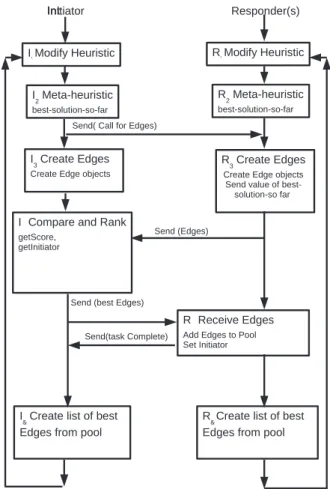
Fig. 2 shows the edge selection protocol used by the meta-heuristic agents. One complete execution of the algorithm illus-tratedisaconversation.Inanyconversation,therewillbeanagent that takes on the role of an initiator andthe others are respon-ders. Intheveryfirstconversationagent1willalwaystakeonthe roleofinitiator.Thereafter,anyagentcanbetheinitiator,butitis determined inthe previous conversationwhichagentwillbe the initiatorforthecurrentconversation(seebelow).
In Fig.2,an agenttakingonthe role ofinitiatorstartsa con-versation.Atthestartofaconversation,eachagenteithertakesa listofEdgeobjectsgeneratedfromapreviousconversationorfrom onegeneratedbythelaunchagent(seeI1andR1 inFig.2).
Theagentsthenfindnewincumbentsolutionsusingtheirgiven heuristicsinconjunctionwiththe edgesprovided intheprevious step(seeI2 andR2inFig.2).
Theinitiatorbreaksitsincumbentsolutionintoedgesandthen invitestheresponderagentstodothesameandsendthemtothe initiator,I3 andR3ofFig.2.
Thereceivingagentsalsosendthevalueoftheirbest-so-far so-lution.Thiswillbeusedbytheinitiatortodeterminewhichagent willbethenewinitiatorinthenextconversation(seeI4 inFig.2). InI4,theinitiatorreceivestheEdgeobjectsfromtheresponding agentsandcollectsthemtogether.EachEdge objectisscoredand rankedbasedonfrequency.ThiscanbeseeninboxI4 ofFig.2as thefunctiongetScore.
InI4ofFig.2,throughthefunctiongetInitiator,theinitiatoralso determines whichmetaheuristicagentis goingto bethe initiator inthenextconversation.Thisisachievedbychoosingthebest
ob-& &
' '
Int
Fig.2. Thecooperationprotocolshowingoneiterationofaconversation.
jectivefunction value to bethe initiator.In thecaseofa tie, the agentischosenarbitrarilyfromthesevalues.
The initiator then sends good Edge objects, found during this conversation,tothereceivingmetaheuristicagents.
Eachagentkeepsapoolorshort-termmemoryofhighscoring Edge objects. The pool acts as a sort of queue and its length is setwhenthe agentislaunched. Inthisstudyall theagentshave apoolsizeof20percentoflengthoftheinstancecurrentlybeing addressed. Duringthe firstconversation, each agentpopulatesits poolasgoodedgesareidentified.Oncethepoolisuptosize,itis maintainedasaqueueasdescribedinSection3.3.
TheothermetaheuristicagentsreceivethelistsofEdge objects fromtheinitiator(seeboxR4 inFig.2).Theyalsoupdatetheir in-ternalmemory’sorpoolsasdescribedabove. InboxI5 andR5 of Fig.2,bothinitiatorandrespondermetaheuristicagentstheneach createa newsolutionbyusingedges fromtheir updatedinternal pools.Thesegoodedgesarepassedtothemetaheuristictheagent isconfigured to execute in thecurrent search. The metaheuristic uses thesegood edges when it is next calledat the start of the next conversation (back to I1 and R1 of Fig. 2). This process re-peats and continues until the number of conversations set from thelauncheragentarecompleted.
5. Experimentaldesign
Inthissectionwediscusstheexperimentaldesign. 5.1. Launcheragent
One launcher agent is invoked in each run. The launcher agentreadsfroma configurationfile thenumberof agentstobe
0 50 100 150
3900
3940
3980
A typical solution trjectory for RandNEH
Instance−tai051_50_20 Time(s) Fitness V alues
(a) tai051-50-20
0 20 40 60 80 3880 3920 3960A typical solution trjectory for RandCWS
Instance−A−n45−k7Time(s)
Fitness V
alues
(b) A-n45-k7
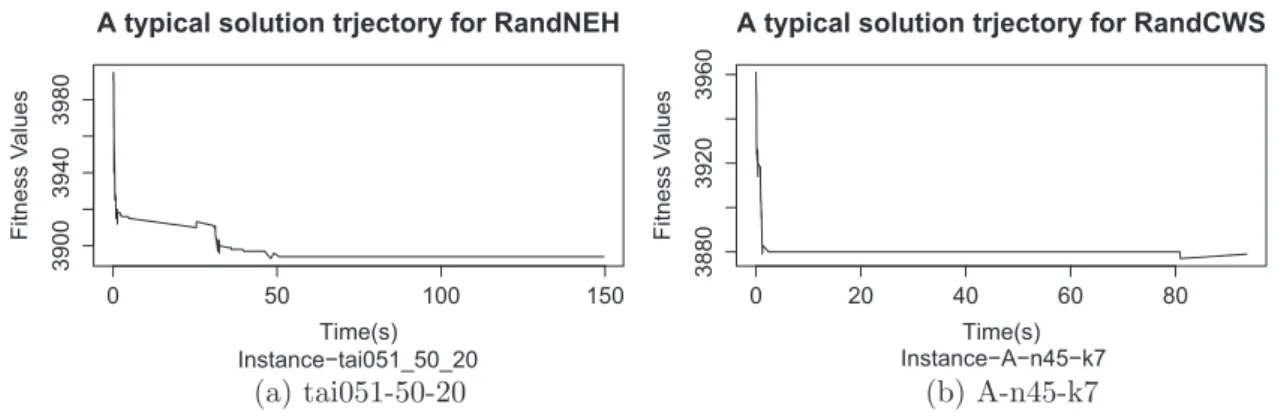
Fig.3. TypicalSolutiontrajectoriesoftheRandNEHandRandCWSalgorithms.instantiated(see Section 5.4) aswell asthe numberof conversa-tionsthatwillbeconductedduringthetest.
The launcher agent executes a construction heuristic to build an initial solution for each instance andrun: for PFSP a biased-randomisedversionoftheNEHalgorithm(Nawazetal.,1983)with Taillard’s speedups implemented by Juan et al. (2010b); and for CVRP,the Randomised CW Savings algorithm (Juan etal., 2010a; Juanetal.,2014).Thisinitial solutionispassedontoeach ofthe individualagents.
5.2.Thenumberofconversations
Using a standard computer, Juan et al. (2010a, 2010b); Juan etal. (2014) noticed that the RandNEH and RandCWS heuristics wereabletoprovidenear-optimalsolutionsformostinstancesina maximumtimeofabout2.5minutes.Webenchmarkedtheir code using a similar computer configuration and observed the same phenomena.Therefore, we decided touse thisrunningtime asa maximum-allowedcomputingtimeduringourexperiments,which wereruninamorepowerfulcomputingenvironment.
Thisgaveusa guideastohowlongoursystemshouldberun andtherefore determinethenumberof conversationsthat would be needed. The time takenfor the agentsto complete a conver-sationismainly governedby the timetaken foran agent’sgiven heuristictoexecute.Tothisend,weconductedtestsshowingthat bothheuristicstypically haveaperiodofmaximumimprovement ofabout12seconds.Asanexample,Fig.3plotsthesolution trajec-toriesofthePFSPinstancetai051andtheCVRPinstanceA-n45-k9 againsttime. We cansee thatthese algorithmshave their period ofgreatest improvementin about the first 12 seconds of opera-tion.Thus wedeterminedthatthesystemshouldexecute10 con-versations foroursystem to run foraboutthe sametime as the standaloneversionsoftheRandNEHandRandCWSheuristics.This wouldalsotake intoaccountanylagcausedbytheasynchronous natureofthesystem.
5.3.Parametersettings
Since theRandCWSandRandNEH methodsofJuan etal.were alreadywritteninJAVA,theywereintegratedwithminimumeffort asamoduleofouragentbasedsystem.Theyutilisetheedge selec-tionheuristicoftheagent-basedsystembytakingedgesidentified duringeachconversationandre-orderingthejobslistofthe Rand-NEHalgorithmsandthesavingslistoftheRandCWSalgorithmas explainedinSection4.1.
Bothalgorithmsusearandomseedwhichisanumberthat in-troducesabiastoarandomnumbergenerator.Inthetestsforboth thePFSPandCVRP,eachagentisconfiguredwithexactlythesame randomseeds(Juanetal.,2010a,2010b).
However, in their article (Juan et al., 2011) describe how theycombinedMonte-CarlosimulationtechniqueswiththeClarke WrightSavingsalgorithmtodeveloptheprobabilisticRandCWS al-gorithm. It wasdesigned so that it would requirelittle parame-ter tuning.To thisend, they describea parameter
α
that isused todefinedifferentgeometricdistributions.Suchadistributioncan then be usedby the RandCWSheuristic to choosethe next edge fromthe Clarke WrightSavings list as partof its solution build-ing process. Theα
-parameter is itself chosen at random from a uniformdistribution betweentwo values(a,b) where0< a ≤ b < 1. Intheir paper,Juan et alchooseα
-values fromthe intervalα
∈{
0.05−0.25}
.Theyshowthat foranyα
-value inthisinterval, the algorithm will give similar and good performance. In corre-spondence withtheauthors,it wasconfirmedthatthe algorithm willperformlesswellforα
-valuesofabove2.3,whileattheother endoftherangeα
-valuesclosetothe0.05willperformasanyin thecitedinterval.Theintuitiveideaforspreadingthe
α
-v
aluesistomaximisethe useofdifferentdistributions duringasearch. Whilethesechoices donotaffectthesolutionqualityitmeanstheagentswillproduce slightlydifferentsolutionswhichwillproducedifferentedges that willenhancetheperformanceofthedistributededgeselection al-gorithm.Inbothcasestudieseachmetaheuristicisallowedtorunfor12 secondseachtimeitiscalled.
Following(Juanetal., 2013;Juan etal., 2014) inwhatwe call our standalone experiments (that is the traditional case without cooperativesearchbeingused)wecompareourcooperatingagents with the standalone by running the experiments for each group for a maximumtime of40 minutes to match the computational effort of the system running 16 agents i.e. 16×150seconds= 2400seconds(40minutes).Thusallagentsvsstandalone compar-isonsaremadeagainstthisworstcasescenario.
5.4. Experimentalset-up
Themain hypothesisto betestedintheseexperimentsis that cooperating agents produce better results than their standalone equivalents.Theresultsarealsocomparedwithstate-of-the-art re-sultsforeachofthesebenchmarks.Tothisend, foreachinstance oftheteststhefollowingscenarioswererun:
The CVRP tests were conducted as follows with
α
-v
alues se-lectedon0.01incrementsfromtheset{0.03to0.18}• Standalone agent:1 metaheuristic agentwhere the
α
-v
alue= 0.03• 4agents:
α
∈{
0.03−0.06}
• 8agents:
α
∈{
0.03−0.1}
• 12agents:
α
∈{
0.03−0.14}
Table1
Theaverage(avr.)andbestpercentagedeviationfromtheupperboundover20runsforeachinstanceforPFSP.Thebestvaluesarehighlightedinbold. Instance BKS Zobolasetal. 1agent 4agents 8agents 12agents 16agents
(percent) Avr. Best Avr. Best Avr. Best Avr. Best Avr. Best (percent) (percent) (percent) (percent) (percent) (percent) (percent) (percent) (percent) (percent) tai051_50_20 3850 0.77 0.92 0.39 0.84 0.55 0.76 0.47 0.69 0.39 0.63 0.44 tai055_50_20 3610 1.03 0.54 0.44 0.67 0.50 0.62 0.28 0.57 0.36 0.50 0.30 tai081_100_20 6202 1.63 1.55 1.23 1.52 1.26 1.41 1.06 1.34 1.03 1.30 1.02 tai085_100_20 6314 1.57 1.39 1.00 1.34 1.11 1.22 0.97 1.15 1.00 1.11 0.89 tai091_200_10 10,862 0.24 0.12 0.09 0.09 0.09 0.09 0.09 0.09 0.09 0.09 0.09 tai095_200_10 10,524 0.03 0.10 0.03 0.09 0.03 0.05 0.03 0.03 0.03 0.03 0.03 tai101_200_20 11,195 1.34 1.49 1.30 1.38 1.09 1.25 1.01 1.22 1.06 1.19 0.93 tai105_200_20 11,259 1.04 1.08 0.70 1.02 0.89 0.94 0.78 0.94 0.83 0.88 0.71 tai106_200_20 11,176 1.11 1.60 1.25 1.55 1.35 1.44 1.27 1.43 1.25 1.42 1.33 tai111_500_20 26,059 0.73 0.99 0.74 1.01 0.88 0.95 0.86 0.92 0.87 0.88 0.69 tai115_500_20 26,334 0.82 0.99 0.74 1.01 0.88 0.95 0.86 0.92 0.87 0.88 0.69 tai116_500_20 26,477 0.49 0.72 0.56 0.69 0.56 0.67 0.60 0.62 0.57 0.61 0.54 Table2
Tableshowingcooperatingagentsperformingbetterthanthe standaloneequivalentatthe95%inPFSP.
Instance 4vs1 8vs1 12vs1 16vs1 tai051_50_20 ≥ > > > tai055_50_20 ≤ ≤ ≤ ≥ tai081_100_20 ≥ > > > tai085_100_20 ≥ > > > tai091_200_10 > > > > tai095_200_10 ≥ > > > tai101_200_20 > > > > tai105_200_20 ≥ > > > tai106_200_20 ≥ > > > tai111_500_20 ≤ ≥ > > tai115_500_20 ≤ > > > tai116_500_20 ≥ > > >
The PFSPtestswere conductedsimilarlybutwithouttheneed for
α
-v
alues.Theyweretestedinthiswaysothatstandaloneagentsrunning justonemetaheuristicatatimecanbecomparedstatisticallywith groupsofcooperatingagentsinordertotestthemainhypothesis.
Every instance was tested 20 times. The resulting values are thenusedtoevaluatetheperformanceofthetest.Inparticularthe average andminimum valueofthe 20runsforeachproblemare taken.Thesearecomparedwiththeknownoptimalorbestvalues foreachprobleminstance.
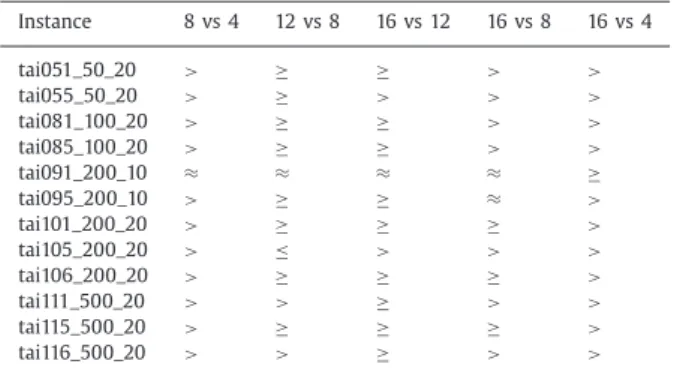
To test the hypothesis that agentscooperating by edge selec-tionperformbetterthanstandalone agents,Wilcoxonsignedrank testsare conducted foreach benchmark instance,witha 95 per-centconfidencelevel.WeusedtheWilcoxontestratherthant-test becausewecannotguaranteethatthetestresultswillbenormally distributed(Moore&McCabe, 1989).Thesetestscomparethe dif-ference between the distributions of 16, 12, 8, and 4 agents co-operating with the standalone agents.A secondary hypothesis is explored where the performances of groups of 4, 8, 12 and 16 agents are compared using the Wilcoxon signed ranktest to as-certain whetherincreasingthenumberofagentsresultsinbetter performance. Thefollowing notationisused inTables 2, 3,6and 7. Giventwo algorithms (or different settings forthe same algo-rithm);A vsB, >(<) denotesthat A(B)is betterthanB (A)and thisperformance difference isstatisticallysignificant ata95 per-cent confidence level.However, ≥ (≤) denotes that A (B) is bet-ter than B (A)although statisticalsignificance could not be sup-ported.Lastly,≈ denotesthe casewherebothapproaches consis-tentlyachievethesamevalue.
The results for each problem are averaged and the average percentagedeviationfromthe knownoptimumis calculated.The
Table3
Tableshowingdifferentgroupscooperatingagentsperformatthe95 per-centconfidencelevelinPFSP.
Instance 8vs4 12vs8 16vs12 16vs8 16vs4 tai051_50_20 > ≥ ≥ > > tai055_50_20 > ≥ > > > tai081_100_20 > ≥ ≥ > > tai085_100_20 > ≥ ≥ > > tai091_200_10 ≈ ≈ ≈ ≈ ≥ tai095_200_10 > ≥ ≥ ≈ > tai101_200_20 > ≥ ≥ ≥ > tai105_200_20 > ≤ > > > tai106_200_20 > ≥ ≥ ≥ > tai111_500_20 > > ≥ > > tai115_500_20 > ≥ ≥ ≥ > tai116_500_20 > > ≥ > >
percentagedeviationfroma knownoptimum iscalculatedin the standardmanner:
Methodsolution−Bestsolution
Bestsolution ×
100 (5)
The results are also analysed to find the best result of each group ofagentsover the20runsof each probleminstance(Juan etal.,2013;Juanetal.,2014).
5.5.Machines
Alltestswere runon thesameLinuxcluster using8identical machines;twoagentswererunper-nodeofthecluster.Theagents wereconfiguredtouse2gigabyteofmemory.
6. Resultsofexperiments
6.1. Permutationflow-shopschedulingresults
Table1showsthe averagepercentagedeviationfromthe best known or optimum value for each of the benchmark instances tested, as well as the percentage deviation for the best value foundacrossthe20runs.Thetablealsocomparesourresultswith the Hybrid Genetic algorithm of Zobolas, Tarantilis, andIoannou (2009).HeretheaveragevaluereportedbyZobolasetal.(2009)is givenasapercentagedeviationfromthebestknownsolution. De-spitethe factthat thisis a type ofhyper-heuristic systemwhere the only parameter tuning is the number of conversations exe-cuted, the PFSP results are competitive with the state-of-the-art resultsfor theseprobleminstances. It is only inthe larger three instances where our average deviationis not better than that of Zobolasetal.(2009).
Table4
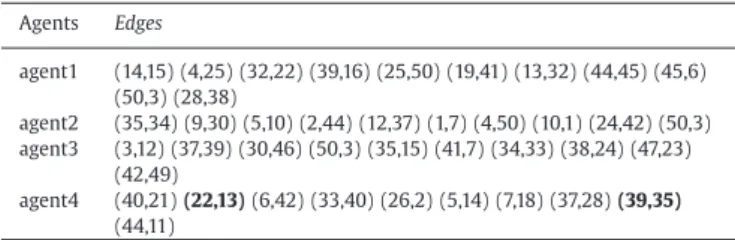
Patternsfoundby4cooperatingagentsPFSPforproblemtai051_50_20. Agents Edges agent1 (14,15)(4,25)(32,22)(39,16)(25,50)(19,41)(13,32)(44,45)(45,6) (50,3)(28,38) agent2 (35,34)(9,30)(5,10)(2,44)(12,37)(1,7)(4,50)(10,1)(24,42)(50,3) agent3 (3,12)(37,39)(30,46)(50,3)(35,15)(41,7)(34,33)(38,24)(47,23) (42,49) agent4 (40,21)(22,13)(6,42)(33,40)(26,2)(5,14)(7,18)(37,28)(39,35) (44,11)
Withrespecttoansweringourmainhypothesis:“iscooperation by patternmatching better than no cooperation?”, we compared 4agentscooperating againsta standaloneagent(seeSection 5.3). Inaddition,wewantedtotest ifincreasing thenumberofagents produced a statistically significant improvement in the results. Tables 2and 3list theseresults; in each casewe tested for sta-tisticalsignificance.
In Table 2, with the exception of the tai055_50_20 instance, it can be seen that groups of 812 and16 agents perform better thanthestandalone withstatisticalsignificance.However,forthe tai055_50_20instance,16agentsshow some improvement,ifnot statistically,overthe standalone. Furthermore,twoinstances of4 agentsperformstatisticallybetterthanthestandalonebuttherest allshowsomeimprovementbutnotatthe95percentlevel.
Table 3exploresthepossibility thatadding moreagentsleads to better results. Here we can see that 8 agents perform statis-tically better than 4, while 12 agents show some improvement, but not statistically, over 8. The same is true for 16 over 12 agents.However the instances tai091_200_10and tai105_200_20 achieve statistical significanceas well. By the time we getto 16 vs4 agents, 16 agents always perform statistically better except for tai091_200_10 where statistical significance is not reached. It should also be noted for tai091_200_10 while the cooperat-ingagentsperformbetter thanthestandalone,thereafterthey all achievethesamevalue.Itisclearthatprogressivelyincreasingthe numberofagentsfrom4to8to12to16resultsinanincreasein performance.Howeverthisimprovementisnotalwaysstatistically significant.Ifweconsiderthecolumnofthetablewhere16agents arecomparedwith8we seethatthe levelofimprovementgains moresignificance.Thisissuggestivethatitisbettertoincreasethe numberofagentsbyafactorof2.
The cooperationmechanismusedinthisstudyworksby iden-tifyingandsharinggoodpatternsthatformpartialsolutionstothe problemathand.Thesearethenpassedtoametaheuristictobuild anewputativesolutiontotheproblem.Giventhis,itisinteresting tostudythepatterns(edges)identifiedbyeachagentandcompare
Table6
Tableshowingcooperatingagentsperformingbetterthan thestandaloneequivalentatthe95percentinCVRP.
Instance 4vs1 8vs1 12vs1 16vs1 A-n38-k5 ≤ > > > A-n39-k6 ≤ ≥ ≥ ≥ A-n44-k7 ≤ > > > A-n45-k6 ≥ > > > A-n45-k7 ≤ ≥ ≥ > A-n55-k9 ≤ > > > A-n60-k9 ≤ > > > A-n61-k9 ≥ > > > A-n62-k8 ≤ > ≥ > A-n63-k9 ≤ ≥ > > A-n65-k9 ≥ > > > A-n80-k10 ≤ > > >
themtothefinalsolutionfoundbythesystem.Tothisend,the fi-nalpermutation(Edgeswhichappearinthefinalsolutionandare identified duringthe search (see Table4)are highlighted inbold)
< 12, 37, 20,31, 39, 35, 34,6, 40,5, 10,1, 7,15, 33, 43,24, 42,
27,29,46,47,36,23,14,2,44,8,45,17,13,22,21,48,18,28,16, 49,38,19,26,41,11,32,25,9,30,4,50,3>ofjobsfoundbythe systemduringone run ofthe tai051_50_20instanceis compared withthepatternsinTable4.Theseareall theunique edges iden-tifiedduringthissearch.Theseedgesareidentifiedmultipletimes butthetableonlyshowsthemonce.
Indeedsome edges(highlightedinbold)identifiedby the sys-temdoendup inthefinaljob permutation.Furthermore,we can identifylinked edges such as50, 3,12 atthe endandbeginning ofthepermutation.However,thesearenotasmanyasseenwith CVRP resultsbelowbecauseofthe waythe makespan4is calcu-latedasaspecialcumulativesumofcolumnsofjobs.
6.2. CapacitatedVehicleRoutingresults
Table5comparesthepercentagedeviationforaverageandbest results for the different groups of agents from the best known solution. The table also compares our percentage deviations for these probleminstances with those of Altınel andÖncan (2005) (donatedby A) and Juan etal.(2010b) (denotedby B). However, Juanetal.(2010b)onlyhasresultsforaselectionoftheinstances wetested.Theyrepresentthelatestworkonthesebenchmark in-stancessowehaveincludedthemforcomparison.Comparingour results with those of Altınel and Öncan (2005) and Juan et al. (2010b) we can see that agents improve on their results. Fur-thermore, to the best of our knowledge, in four cases we have found results that are better than the current best known solu-tions.A-n39-k6,A-n45-k7,A-n55-k9andA-n63-k9arehighlightedin
Table5
Theaverage(avr.)andbestpercentagedeviationfromtheoptimum/upperboundover20runsforeachinstanceforCVRP.
Instance BKS AandB Juanetal. 1agent 4agents 8agents 12agents 16agents (percent) (percent) Avr. Best Avr. Best Avr. Best Avr. Best Avr. Best
(percent) (percent) (percent) (percent) (percent) (percent) (percent) (percent) (percent) (percent) A-n38-k5 734.18 3.577 0.54 0.07 0.04 0.09 0.04 0.02 −0.03 −0.02 −0.03 −0.03 −0.03 A-n39-k6 833.14 2.233 – 0.01 0.01 0.01 0.01 0.01 0.01 0.01 0.01 0.01 0.01 A-n44-k6 939.33 2.394 – 0.63 0.57 0.70 0.57 0.55 0.39 0.40 0.29 0.32 −0.12 A-n45-k6 944.88 1.383 – 0.92 0.92 0.92 0.92 0.69 0.00 0.20 0.00 0.00 0.00 A-n45-k7 1147.28 1.842 0.07 0.05 −0.03 0.07 −0.02 0.03 −0.03 0.03 −0.03 −0.01 −0.48 A-n55-k9 1074.46 2.378 0.14 0.13 0.05 0.26 0.05 0.06 0.05 0.05 0.05 0.05 0.05 A-n60-k9 1355.80 1.64 0.13 0.50 0.50 0.50 0.50 0.46 0.22 0.40 0.22 0.37 0.22 A-n61-k9 1039.08 1.654 0.49 0.27 0.26 0.26 0.26 0.25 0.13 0.23 0.12 0.22 0.12 A-n62-k8 1294.28 4.648 – 0.70 0.62 0.76 0.62 0.62 0.62 0.65 0.62 0.62 0.62 A-n63-k9 1619.90 2.051 – 0.75 0.45 0.88 0.69 0.73 0.40 0.53 0.14 0.32 0.14 A-n65-k9 1181.69 2.392 0.66 1.06 1.05 1.05 0.72 0.92 0.28 0.82 0.64 0.61 0.14 A-n80-k10 1766.50 2.952 0.2 1.04 0.99 1.04 0.99 0.98 0.77 0.87 0.77 0.85 0.70
4 Agents 8 Agents 12 Agents 16 Agents 3865 3875 3885 No. of agents Obj function v alue
(a) tai50 20
4 Agents 8 Agents 12 Agents 16 Agents
1625 1630 1635 No. of agents Obj function v alue
(b) A-n63-k9
Fig.4. Boxplotsofobjectivevaluesobtainedin10runsfor16,12,8and4agentsonaselectedinstancefromthe(a)STSP,(b)PFSP,and(c)CVRPproblemdomains.
Table7
Tableshowingdifferentgroupscooperatingagentsperformatthe95 percentconfidencelevelinCVRP.
Instance 8vs4 12vs8 16vs12 16vs8 16vs4 A-n38-k5 > > > > > A-n39-k6 ≥ ≥ ≥ ≥ ≥ A-n44-k7 > > > > > A-n45-k6 > > > > > A-n45-k7 > ≥ ≥ ≥ > A-n55-k9 > ≥ ≥ ≥ > A-n60-k9 > ≥ ≥ > > A-n61-k9 > ≥ ≥ ≥ > A-n62-k8 > ≤ ≥ ≥ > A-n63-k9 > > > > > A-n65-k9 > ≥ > > > A-n80-k10 > > ≥ > > Table8
FinalSolutiontoCVRPproblemA-n38-k5. Routename Routes
Route1 [1,8,6,12,28,23,33,1] Route2 [1,27,13,4,2,5,17,26,7,30,1] Route3 [1,9,34,36,24,31,11,22,1] Route4 [1,10,18,37,14,16,3,15,25,1] Route5 [1,21,38,32,29,35,20,19,1] Table9
Patternsfoundby4cooperatingagentsforCVRPproblemA-n38-k5. Agents Edges
agent1 (35,20)(38,32)(29,35)(20,19)(21,38)(32,29)(1,21)(19,1) agent2 (30,31)(11,1)(1,19)(31,11)(35,30)(19,35)
agent3 (35,20)(29,19)(1,21)(20,1)(32,29)(38,32)(21,38)(19,35)(1,19) agent4 (19,1)(32,38)(38,29)(35,20)(21,32)(20,19)(29,35)
italics forthe best averagevalue and inbest forourbest overall score.
Againwetestedforthemainhypothesis.Wecomparedgroups of4,8,12,and16agentscooperating againstastandalone agent. Asbefore,wetestedforstatisticalsignificanceusingtheWilcoxon signed rank test at the 95percent confidence level.Table 6 lists theseresultusingthesamenotationasusedinTable2above.As with the PFSP, 4 agents cooperating do not show any improve-ment fromtheir standaloneequivalent. However, groupsof8, 12 and 16 agents with increasing certainty perform better than the standaloneagent.Indeed16agentsallperformbettera95percent confidencelevelexceptfortheA-n39-k6instance.
InTable7,wereporttheresultsofourtestsforthesecondary hypothesis. As with the PFSP results, we can see a gradual im-provementasmoreagentsareadded.However,againitseemsitis
necessaryto double the numberof agentseach time in order to observeimprovementinresults.Theadditionof4agentseachtime resultsin an improvement that is not always statistically signifi-cant. However, if the agents are doubled each time ingroups of 4,8and16thereisagreaterproportionofstatisticallysignificant improvementfromtheadditivecase.
Finally,we showthepatternsgeneratedfora sampleon prob-leminstance A-n38-k5in Table9 andcompare themto thefinal resultofthisruninTable8.Wehighlightinboldthoseedges iden-tifiedbytheagentsinTable9thatendupinthefinalsolutionin Table8.Ascan beseentherearemanymoresuch edgesthanfor thePFSP.Thisisbecausetherelationshipbetweenedgesandcities ismuchmoredirectinthecaseofCVRPascostsarecalculatedas 2D-euclideandistancesbetweencities.
From this study, we conclude that with no parameter tuning between casestudies our system can produce results which are commensuratewiththestate-of-the-artstudiesinbothfields. Fur-thermore,infour instanceswith theCVRP testswe were able to thebestofour knowledgebeatthe currentbestresultsforthese instances.We were alsoable toshow forgroups of8,12 and16 agentscomparedwiththestandalone equivalent,thatcooperation by pattern finding is better than no cooperation. Finally, we are alsoabletoshowthatdoublingthenumberagentseachtimeleads toimprovingresultsasshowninFig.4.
7. Conclusion
In this paper we proposed a general agent-based distributed framework whereeach agentimplementsa different metaheuris-tic/local search combination. An agent continuously adapts itself duringthe search process using a cooperationprotocol based on reinforcement learning and pattern finding. Good patterns that make up improving solutions are identified by frequency of oc-currenceinaconversationandsharedwiththeother agents.The framework has been testedon well known benchmark problems for two tests cases PFSP and CVRP. In both cases, with no pa-rametertuningbetweendomains,theplatformperformedatleast as well as the state-of-art. For CVRP, we were able, in cases of A-n38-k5,A-n44-k6andA-n45-k7to improveonthe bestknown solutionsfortheseinstances.1
Wehavealsoshowneightormoreagentsperformbetterthana standaloneagentwitha95percentconfidencelevel.Furthermore, wehaveshownwithareasonablelevelorcertainty,ifnotalways with95percentconfidence,that animprovementinperformance canbeachievedeachtimeyoudoublethenumber,upto16,agents used.
Thedistributedcomputingframeworkpresentedcanberunon alocalnetworkofpersonalcomputerseachusing2gigabyte mem-ory.
The framework also aims to be generic andmodular, needing verylittleparametertuning acrossdifferentproblemtypestested so far. It has beenapplied successfullyto PFSP and CVRP. It has alsobeenusedtomodelfairnessinNurseRostering(Martinetal., 2013)usingreal-worlddata.Thisflexibilityisachievedbymeansof anontologywhichenablestheagentstorepresenttheseproblems withthesameinternalstructure.
This isan interesting andlittleresearched topicthatwarrants furtherinvestigation suchas:extendingtheontologytoapplythe framework to new problems; adding more heuristics and meta-heuristicsandimprovingthepatternfindingprotocol.
Finally, this framework will be published as an open source projectsothatothermetaheuristicsandcooperationprotocolscan be added and tested by other researchers. The project is called MACS (Multi-agent CooperativeSearch) and will be published at thefollowingwebsite:http://simonpmartin.github.io/macs/. Acknowledgement
TheEngineeringandPhysicalSciencesResearchCouncil(EPSRC) supportedthisworkthroughthefollowingproject:Dynamic Adap-tiveAutomatedSoftwareEngineering(DAASE)EP/J017515/1. AppendixA. Supplementarymaterial
Supplementary material associated with this article can be found,intheonlineversion,at10.1016/j.ejor.2016.02.045.
References
Altınel,˙I.. K.,&Öncan,T.(2005).AnewenhancementoftheClarkeandWright savingsheuristicforthecapacitatedvehicleroutingproblem.Journalofthe
Op-erationalResearchSociety,56(8),954–961.
Augerat,P.,Belenguer,J.,Benavent,E.,Corberán,A.,Naddef,D.,&Rinaldi,G.(1995). Computationalresultswithabranchandcutcodeforthecapacitatedvehicle routingproblem.Rapportderecherche-IMAG.
Aydin,M.,&Fogarty,T.(2004a). Adistributedevolutionarysimulatedannealing algorithmforcombinatorialoptimisationproblems.JournalofHeuristics,10(3), 269–292.
Aydin,M.,&Fogarty,T.(2004b).Teamsofautonomousagentsforjob-shop schedul-ingproblems:Anexperimentalstudy.JournalofIntelligentManufacturing,15(4), 455–462.
Barbucha,D.(2014).Acooperativepopulationlearningalgorithmforvehiclerouting problemwithtimewindows.Neurocomputing,146,210–229.
Bellifemine,F.L.,Caire,G.,&Greenwood,D.(2007).Developingmulti-agentsystems withJADE.Wiley.
Blum,C.,&Roli,A.(2003).Metaheuristicsincombinatorialoptimization:Overview andconceptualcomparison.ACMComputingSurveys,35(3),268–308. Burke,E.,Gendreau,M.,Hyde,M.,Kendall,G.,Ochoa,G.,Özcan,E.,etal.(2013).
Hyper-heuristics:Asurveyofthestateoftheart.JournaloftheOperational
Re-searchSociety,64(12),1695–1724.
Clarke,G.,&Wright,J.(1964).Schedulingofvehiclesfromacentraldepottoa num-berofdeliverypoints.OperationsResearch,12(4),568–581.
Clearwater,S.H.,Hogg,T.,&Huberman,B.A.(1992).Cooperativeproblemsolving.
Computation:Themicroandthemacroview,33–70.
Crainic,T.,&Toulouse,M.(2008).Explicitandemergentcooperationschemesfor searchalgorithms.InProceedingsoftheinternationalconferenceonlearningand
intelligentoptimization(pp.95–109).
Dantzig,G.,&Ramser,J.(1959).Thetruckdispatchingproblem.ManagementScience, 6,80–91.
ElHachemi,N.,Crainic,T.G.,Lahrichi,N.,Rei,W.,&Vidal,T.(2014).Solution
inte-grationincombinatorialoptimizationwithapplicationstocooperativesearchand
richvehiclerouting.
FIPA(2009). FIPAiterated contract net interaction protocolspecification. http:// www.fipa.org/specs/fipa00030/index.html.
Garey,M.,&Johnson,D.(1979).Computersandintractability:Aguidetothetheoryof
NP-completeness.BellTelephoneLaboratoriesInc.
Garey,M.R.,Johnson,D.S.,&Sethi,R.(1976).Thecomplexityofflowshopand job-shopscheduling.MathematicsofOperationsResearch,1(2),117–129.
Gruber,T. R. (1993).A translation approachto portableontology specifications.
KnowledgeAcquisition,5(2),199–220.
Hogg,T.,&Williams,C.P.(1993).Solvingthereallyhardproblemswith cooper-ative search.In Proceedingsofthe nationalconferenceonartificial intelligence
(pp.231–236).
Hutter,F.,Babic,D.,Hoos,H.,&Hu,A.J.(2007).Boostingverificationbyautomatic tuningofdecisionprocedures.InProceedingsoftheformalmethodsincomputer
aideddesign,FMCAD’07(pp.27–34).IEEE.
Juan,A., Faulin,J.,Grasman, S.E., Rabe,M.,& Figueira, G.(2015). A review of simheuristics:Extendingmetaheuristicstodealwithstochasticcombinatorial optimizationproblems.OperationsResearchPerspectives,2,62–72.
Juan,A., Ruíz, R., Lourenço, H. R., Mateo, M., &Ionescu, D. (2010a). A simula-tion-basedapproach forsolving the flowshopproblem. InProceedingsof the
wintersimulationconference(pp.3384–3395).
Juan,A.A.,Faulin,J.,Jorba,J.,Caceres,J.,&Marquès,J.M.(2013).Usingparallel &distributedcomputingforreal-timesolvingofvehicleroutingproblemswith stochasticdemands.AnnalsofOperationsResearch,207(1),43–65.
Juan,A.A.,Faulín,J.,Jorba,J.,Riera,D.,Masip,D.,&Barrios,B.(2011).Ontheuse ofmontecarlosimulation,cacheandsplittingtechniquestoimprovetheclarke andwrightsavingsheuristics.JournaloftheOperationalResearchSociety,62(6), 1085–1097.
Juan,A.A.,Faulin,J.,Ruiz,R.,Barrios,B.,&Caballé,S.(2010b).TheSR-GCWS hy-bridalgorithmforsolvingthecapacitatedvehicleroutingproblem.AppliedSoft
Computing,10(1),215–224.
Juan,A.A.,Lourenço,H.R.,Mateo,M.,Luo,R.,&Castella,Q.(2014).Usingiterated localsearch for solving the flow-shop problem:Parallelization, parametriza-tion, and randomization issues.International Transactions in Operational
Re-search,21(1),103–126.
Kouider,A.,&Bouzouia,B.(2012).Multi-agentjobshopschedulingsystembased onco-operativeapproachofidletimeminimisation.InternationalJournalof
Pro-ductionResearch,50(2),409–424.
López-Ibánez, M., Dubois-Lacoste, J., Stützle, T., & Birattari, M. (2011). The IRACEpackage,iteratedracefor automaticalgorithmconfiguration.Tech.Rep.
TR/IRIDIA/2011-004.Belgium:IRIDIA,Université LibredeBruxelles.
Malek,R.(2010).Anagent-basedhyper-heuristicapproachtocombinatorial opti-mizationproblems.InProceedingsof2010IEEEinternationalconferenceon
Intel-ligentcomputingandintelligentsystems(ICIS):Vol.3(pp.428–434).
Martin,S.,Ouelhadj,D.,Smet,P.,VandenBerghe,G.,&Özcan,E.(2013).Cooperative searchforfairnurserosters.ExpertSystemswithApplications,40(16),6674–6683. Meignan,D.,Creput,J.,&Koukam,A.(2008).Acoalition-basedmetaheuristicfor the vehicle routing problem. In Proceedingsof IEEE congresson evolutionary
computation,2008,CEC2008.(IEEEworldcongressoncomputationalintelligence)
(pp.1176–1182).IEEE.
Meignan,D.,Koukam,A.,&Créput,J.C.(2010). Coalition-basedmetaheuristic:A self-adaptivemetaheuristicusingreinforcementlearningandmimetism.Journal
ofHeuristics,1–21.
Milano,M.,&Roli,A.(2004).Magma:A multiagentarchitecturefor metaheuris-tics.IEEETransactionsonSystems,Man,andCybernetics,PartB:Cybernetics,34(2), 925–941.
Moore,D.S.,&McCabe,G.P.(1989).Introductiontothepracticeofstatistics.WH Freeman/TimesBooks/HenryHolt&Co.
Nawaz,M.,Enscore,E.E.,Jr.,&Ham,I.(1983).Aheuristicalgorithmforthe m-ma-chine,n-jobflow-shopsequencingproblem.Omega,11(1),91–95.
Ouelhadj,D.,&Petrovic,S.(2010).Acooperativehyper-heuristicsearchframework.
JournalofHeuristics,16(6),835–857.
Pinedo,M.(2002).Scheduling:Theory,algorithms,andsystems.NewJersey: Pren-tice-Hall.
Ries,J.,&Beullens,P.(2015).Asemi-automateddesignofinstance-basedfuzzy pa-rametertuningformetaheuristicsbasedondecisiontreeinduction.Journalof
theOperationalResearchSociety,66(5),782–793.
Ross,P.(2014).Hyper-heuristics.InSearchmethodologies(pp.611–638).Springer. Taillard,E.(1993).Benchmarksforbasicschedulingproblems.EuropeanJournalof
OperationalResearch,64(2),278–285.
Talbi,E.G.,&Bachelet,V.(2006).Cosearch:Aparallelcooperativemetaheuristic.
JournalofMathematicalModellingandAlgorithms,5(1),5–22.
Toulouse,M.,Thulasiraman,K.,&Glover,F.(1999).Multi-levelcooperativesearch: Anewparadigmfor combinatorialoptimizationandanapplication tograph partitioning.Euro-Par’99parallelprocessing,533–542.
Vallada, E., & Ruiz, R. (2009). Cooperative metaheuristics for the permutation flowshopschedulingproblem.EuropeanJournalofOperationalResearch,193(2), 365–376.
Xie,X.F.,&Liu,J.(2009).Multiagentoptimizationsystemforsolvingthetraveling salesmanproblem(TSP).IEEETransactionsonSystems,Man,andCybernetics,Part
B:Cybernetics,39(2),489–502.
Zobolas,G.,Tarantilis,C.D.,&Ioannou,G.(2009).Minimizingmakespanin permu-tationflowshopschedulingproblemsusingahybridmetaheuristicalgorithm.