Cervantes-Godoy, D., S. Kimura and J. Antón (2013),
“Smallholder Risk Management in Developing Countries”,
OECD Food, Agriculture and Fisheries Papers
, No. 61, OECD
Publishing.
http://dx.doi.org/10.1787/5k452k28wljl-en
OECD Food, Agriculture and Fisheries
Papers No. 61
Smallholder Risk
Management in Developing
Countries
Dalila Cervantes-Godoy, Shingo Kimura,
Jesús Antón
JEL Classification: G21, G22, O13, Q10, Q11, Q12,
Q13, R38
AND FISHERIES PAPERS
The OECD Food, Agriculture and Fisheries Papers series is designed to make available to a wide readership selected studies by OECD staff or by outside consultants. This series continues that originally entitled OECD Food, Agriculture and Fisheries Working Papers. This document and any map included herein are without prejudice to the status of or sovereignty over any territory, to the delimitation of international frontiers and boundaries and to the name of any territory, city or area.
This document has been declassified on the responsibility of the Working Party on Agricultural Policies and Markets under OECD reference number TAD/CA/APM/WP(2012)17/FINAL.
Comments on the series are welcome and should be sent to [email protected].
OECD FOOD, AGRICULTURE AND FISHERIES PAPERS are published on www.oecd.org/agriculture
© OECD (2013)
You can copy, download or print OECD content for your own use, and you can include excerpts from OECD publications, databases and multimedia products in your own documents, presentations, blogs, websites and teaching materials, provided that suitable acknowledgment of OECD as source and copyright owner is given. All requests for commercial use and translation rights should be submitted to [email protected].
Abstract
SMALLHOLDER RISK MANAGEMENT
IN DEVELOPING COUNTRIES
Dalila Cervantes-Godoy, Shingo Kimura and Jesús Antón, OECD
This paper addresses various aspects of risk and risk management for smallholders in developing countries, and presents a quantitative assessment of farm-level risks and risk management strategies in three emerging economies: Brazil, China and Viet Nam. The analysis covers production, income, and poverty risks. Institutional and political settings in developing countries are frequently less developed and this contributes to a greater incidence of market imperfections in key areas such as credit and insurance, and which in turn lowers farmers’ access to risk management tools and strategies. The result is a widespread reliance on informal mechanisms and community strategies. The effects of risk and responses to risk are also different in developing countries, with smallholders often forced to rely on strategies that perpetuate poverty. When risk is an important consideration in a farm household’s decision on sector transition, insurance or safety-net mechanisms could assist these households to make that transition. The analysis of two regions in Viet Nam shows that those households able to successfully transit to the non-farm sector continued to maintain small plots of land for self-consumption, suggesting that agriculture remains a kind of safety net.
Keywords: Agricultural risk, smallholders, developing countries, risk management
strategies, agricultural policy.
JEL classification: O13, Q10, Q11, Q12, Q13, G21, G22, R38
Acknowledgements
The authors would like to thank Hiroaki Ogawa, Lee Crawfurd, Abhijeet Singh, Ke Wang and Alies Haveman for their contributions.
Table of contents
Executive Summary ... 5
1. Introduction ... 7
2. Conceptual underpinnings of risk and risk management ... 8
2.1. Types of agricultural risk faced by farmers ... 8
2.2. Risk management and risk-coping strategies ... 10
2.3. A review of risk management policies ... 16
2.4. Poverty traps, risk implications, investment and risk management policies ... 21
3. Quantitative assessment of farm household risk exposure and risk management strategies in developing countries: Evidence from Brazil, China and Viet Nam ... 28
3.1. Data source and methodology of risk assessment ... 28
3.2. Assessment of agricultural production risk and risk management strategies in Brazil, China and Viet Nam ... 31
3.3. Assessment of farm household income risk and risk management strategies in China and Viet Nam ... 34
3.4. Risk management strategies in the Red River and Mekong regions of Viet Nam ... 37
4. Conclusions and policy implications ... 46
References ... 48
Annex A. Technical Background of Risk Assessment Methodology Applied in Viet Nam ... 53
Tables Table 2.1. Risks in agriculture ... 9
Table 2.2. Farm risk management instruments and strategies ... 11
Table 2.3. Risk layering: Optimal pattern of risk management strategies and policies ... 18
Table 3.1. Data source ... 29
Table 3.2. Agricultural and poverty indicators in Brazil, China and Viet Nam ... 30
Table 3.3. Correlation of income components in China and Viet Nam ... 36
Table 3.4. Characteristics of eight geographical regions in Viet Nam ... 38
Table 3.5. Characteristics of farm household in Red river and Mekong regions ... 39
Figures
Figure 2.1. Climate shock impact on assets and income levels ... 22
Figure 2.2. The S-shape curve and the poverty trap ... 23
Figure 2.3. Household investment and insurance decisions... 26
Figure 3.1. Comparison of price and yield risk ... 32
Figure 3.2. Correlations of price and yield risk ... 33
Figure 3.3. Correlation of crop revenues ... 33
Figure 3.4. Comparison of wheat production risk between some OECD countries and Brazil and China ... 34
Figure 3.5. Composition of farm household income in China and Viet Nam ... 35
Figure 3.6. Variability of household income and its components ... 36
Figure 3.7. Dynamics of poverty incidence in 2004, 2006 and 2008... 40
Figure 3.8. Dynamics of poverty by household head age group ... 41
Figure 3.9. Poverty vulnerability of representative household by household type ... 43
Figure 3.10. Level and variability of income by household type ... 43
Figure 3.11. Decomposition of average income shock leading to scenarios of transitory poverty ... 44
Figure 3.12. Transitory poverty shock scenario: The production side ... 45
Figure 3.13. Transitory poverty shocks: The consumption side ... 46
Figure A.1. Detrend data ... 54
Boxes Box 1. A graphical representation of desperation and vulnerability poverty traps and household investment and insurance decisions ... 26
Executive Summary
OECD work on risk management in agriculture has focused on OECD member countries. The holistic framework developed to analyse risk management places great importance on the need for differentiated responses to different layers of risk. Several country reviews have been undertaken using this framework analysis, and also included quantitative assessments of farm-level risks and risk management strategies and policies. To undertake a similar analysis of developing and emerging economies, however, specificities in terms of the impact of risks and how they are linked to poverty deserve additional analysis. As such, this paper adapts and extends the OECD’s holistic approach to risk management by taking stock of the specific risks and consequences faced by smallholders in developing countries, and how the characteristics and implications of risks and risk management strategies differ from those in developed countries. It also examines the implications of risk management for household investment and provides a quantitative assessment of risk exposure at the most disaggregated level possible for three emerging economies: Brazil, China and Viet Nam. The application of the same risk analysis to different types of data available in these countries has highlighted the advantages of having household income and expenditure surveys available for risk analysis.
Most sources of agricultural risks affecting farmers in both developed and developing countries do not differ as they come basically from shocks in production (e.g. weather, pests, etc.), in prices (i.e. markets), and institutional and political settings, none of which are exclusive to any particular country. For instance, the quantitative analysis of the three emerging economies studied showed similar patterns (as the OECD countries studied before) of agricultural production and price risks for the crops analysed, where production and price risks have a similar dimension at the disaggregated or farm level and are negatively correlated. However, production and price risks can have different impacts on poverty: findings from the household survey analysis of the Red River and Mekong regions in Viet Nam showed that poverty shocks in farm households are driven more by yield shocks (decrease) than by price shocks (decrease), while poverty shocks in non-farm households are driven more by price shocks (increase) and subsequently low purchases of rice. In other words, for those households that fall into transitory poverty (less than five consecutive years), rice yield is a dominant source of agricultural risk, and not low prices. On the other hand, high rice price were observed to be an important source of risk for households that are net consumers of rice. These results could have important implications on the policy design of risk management.
The effects of risk and responses to risk are fundamentally different in developing countries. Smallholders are often forced to rely on strategies that perpetuate poverty. For example, households cope with shocks by depleting valuable assets which then causes it to fall into a poverty trap created by the resulting low level of assets. Risk and available risk management strategies play an important role to explain poverty traps as they could lead smallholders to select lower-risk/lower-return activities and undermine smallholders’
investment to move out of poverty. The risk assessment of China and Viet Nam suggests that there can be risks associated with non-farm opportunities. When risk is an important consideration in a farm household’s decision on sector transition, insurance or safety-net mechanisms could assist these households to make that transition. Furthermore, results from the two regions of Viet Nam identified that those households able to successfully transit to the non-farm sector continue to maintain small plots of land for self-consumption, suggesting that agricultural land plays a safety net role. Agriculture would then play a risk management role in facilitating the successful transition of farmers to non-farm sectors.
In terms of risk management (ex ante), smallholders in developing countries diversify their economic activity across farm and non-farm work, build up savings and assets to compensate for missing credit markets, limit their experimentation with profitable but risky new technologies, strategically choose the structure of production relations, and engage with various informal savings institutions. In terms of risk coping (ex post), households respond by changing their work effort and labour supply, selling assets and running up debt, relying on social networks or migration, and by simply reducing consumption.
Institutions and political settings are frequently less developed in developing countries and thus contribute to a greater incidence of market imperfections in key areas such as credit and insurance. This lowers farmers’ access to risk management tools and strategies, and, in turn, results in widespread reliance on informal mechanisms and community strategies, such as crop sharing, common property resource management, informal risk pooling. These strategies are crucial for smallholders to manage and cope with risk. In this sense, this paper has tried to extend the OECD holistic approach to include an informal - community risk layer of risk management strategies alongside with the household, market and government layers of risk management. Further analysis of this particular aspect would contribute to a better understanding of informal and community level strategies.
A reasonable policy objective would be to promote investments that help smallholders move out of poverty. Impediments to investment are highly related to access to financial services, in particular credit and insurance. Two types of constraints faced by smallholders have been identified: 1) limited access to credit; and 2) limited access to insurance or safety net. This latter constraint makes risk averse individuals restrain their demand for investment credit to avoid the risk of falling into an even worse poverty trap. The analysis of the two Vietnamese regions suggests that the incidence of poverty can be explained partly by limited access to credit and the lack of safety-net solutions.
1.
Introduction
Agriculture is characterised by a high variability of returns such that farmers cannot predict with certainty the amount of output they will produce. Thus agricultural risk is associated with unpredictable circumstances which determine the final output, value and cost of any agricultural production process. These risks are influenced by several factors, ranging from weather variability, natural disasters, uncertainties in yields and prices, imperfect markets of financial services, institutional settings, personal risks, etc. In the case of developing countries, and more specifically that of smallholders1, farmers are likely to be particularly vulnerable to certain risks and the consequences of these can be extreme, in some cases even pushing resource-limited smallholders into deeper poverty2.
OECD work on risk has focused on OECD countries. This paper will try to extend this work by focusing on developing countries within the scope of current OECD policy analysis and address an important policy concern in these countries. It examines the kinds of risks faced by smallholders and considers the role of policy to help smallholders manage those risks. Agricultural risks play an important role in explaining poverty traps as they could lead smallholders to select lower-risk/lower-return activities which undermine their potential to invest and eventually move out of poverty.
OECD (2011) proposes a framework to design an effective risk management system to understand the interactions between: 1) the characteristics of risks that households face; 2) the available risk management instruments and policies; and 3) the household’s choice of risk management strategies. The OECD framework also stresses the need for differentiated responses to different kinds of risks given that some risks can be managed by the household, some by the market, some may require government intervention, and
1. The definition varies enormously taking into consideration their revenues, socioeconomic characteristics, land size, regions, countries, etc. (Proctor and Lucchesi, 2010). For example, the average farm size in many Asian countries is less than a hectare, whereas much larger operations in Latin America (ten hectares or more) may be considered as small. Narayanan and Gulati (2002), definition considers “a small farmer is a farmer (crop or livestock) practicing a mix of commercial and subsistence production or either, where family provides the majority of labour and the farm provides the principal source of income. Sometimes farmers may fit this description actually possess little land and livestock as compared with the particular regional average”. For the purpose of this paper, a defining characteristic of smallholders is that they struggle to be competitive and hence to provide an income to support themselves and their families and often live in poverty or extreme poverty conditions (e.g. incomes of 1.25 USD PPP per day); they also possess limited resource endowments, in particular land, and normally confront missing or under-developed markets.
2. UN’s World Summit on Social Development in 1995, described poverty as a condition characterised by severe deprivation of basic human needs, including food, safe drinking water, sanitation facilities, health, shelter, education and information. To measure poverty in more quantitative terms, the World Bank developed a way of measuring poverty using a common international definition. This method defines a poverty line based on the estimated money cost of a basket of goods considered necessary to cover basic needs - enough food for adequate nutrition and a minimum allowance for clothing and shelter. Those individuals whose spending or income is not enough to cover basic needs are considered to be below the poverty line and consequently to be poor (Chen and Ravallion, 2008). To measure progress against the Millennium Development Goals (MDGs) it is used the reference poverty line set at USD 1.25 per day at 2005 PPP. This corresponds to the mean of the national poverty lines for the 10-20 poorest countries of the world.
many others, in the case of developing countries, make extensive use of informal/community mechanisms.
This paper is divided into two parts. Part I adapts and extends the OECD’s holistic approach to risk management to developing countries by taking stock of the specific risks and consequences faced by smallholders. It describes the characteristics and implications of risks and how risk management strategies may differ from those used by farmers in developed countries. The linkages between risk and farm household investment decisions that are at the core of some poverty traps and the role of policy to help smallholders manage those risks are also discussed.
In Part II, a quantitative assessment of farm-level risks and risk management strategies in a small selection of countries is undertaken. The analysis covers production, income, and poverty risks in three emerging economies: Brazil, China and Viet Nam. The results of this assessment are discussed in the light of the conceptual issues raised in Part I.
2.
Conceptual underpinnings of risk and risk management
2.1. Types of agricultural risk faced by farmers
Agriculture is characterised by high variability of production outcomes coming from unpredictable events. For agricultural producers it is difficult to predict with certainty the amount of output they will obtain, this is due mainly to several factors that are not within their control. Natural adversities like pests, diseases, weather, are a few examples.
Most sources of agricultural risks affecting farmers in both developed and developing countries do not differ as they come basically from weather, market, and institutional- and political-related risks and these are not exclusive to any particular country. However, agricultural risk implications and responses may differ fundamentally in developing countries. OECD (2009) presents an analytical framework for considering farm risk management strategies in OECD countries, with risks laid out as in (Table 2.1), the first distinction being the scope of the risk, whether it affects; a particular individual or household (micro); a group or community (meso), regions or nations (macro).
Table 2.1, developed by the OECD (2009), shows agricultural risks that combine the systemic characteristics from Holzmann and Jorgersen (2001), with four types of sources of risk identified in Harwood et al. (1999) covering most of the categories of risk identified by different authors. It singles out some events that could occur with some likelihood and affect the welfare of farm households. Idiosyncratic risks, such as personal hazards, are specific to individual farms or farmers and may actually be more important than systemic risks. Risks of a macroeconomic nature are typically systemic; they are often correlated across farms in a country and across sectors in the economy. They are not usually specific to agriculture. Macroeconomic risks can also be correlated with changes in input or output prices that may occur simultaneously with changes in interest rates (OECD, 2009).
Table 2.1. Risks in agriculture Micro (Idiosyncratic) Individuals / Households Meso (Covariant) Groups / Communities Macro (Systemic) Regions / Nations Market/prices - Changes in price of land, new requirements from food industry
- Changes in input/output prices due to shocks, trade policy, new markets, endogenous variability, exchange rates, etc.
Production
- Non contagious diseases, personal hazards (illness, death), etc.
- Rainfall, landslides, pollution
- Floods, droughts, hail, frost, pests, contagious diseases, technology, food shortage, etc.
Financial - Changes in income from other sources (non-farm)
-Informal credit and insurance systems
- Changes in interest rates/value of financial assets/access to credit Institutional/legal - Liability risk - Changes in local policy
or regulations
- Changes in regional or national policy and regulations, environmental law, agricultural payments
Source: OECD 2009, adapted from Harwood et al. 1999 and Holzmann and Jorgersen, 2001.
Risks that farmers face in developing countries can be categorised using a similar scheme to that in OECD countries (2009). The micro risks in developing country agriculture that have been studied extensively are similar to the risks listed in Table 2.1: individual illnesses, idiosyncratic crop and livestock losses, death or disability of household members, and loss of other (non-agricultural) income sources. Meso risks affect communities; while this includes localised environmental shocks, it can also include policy changes and localised conflict. Macro risks affect entire regions or nations: this can include large-scale environmental shocks such as the Ethiopian famine of 1984, large-scale policy changes such as the Great Leap Forward in China, or relatively large-scale incidence of conflict such as the civil war in Rwanda and Burundi. The second typology, classifying shocks on the basis of their source into price shocks, production shocks, financial shocks, and institutional shocks is sufficiently general to be applied to developing countries.
There have been other risk typologies used for developing countries that relate to the OECD typology. For instance, Romer Løvendal and Knowles (2005) characterise risks according to type, level, frequency, timing and severity. The type category includes political, social, economic, health natural and environmental risks. The level relates to where risks can occur: whether at the individual, household or smallholder (micro); the community and regional (meso) levels; or the national (macro) and global/regional (super-macro) levels. The frequency classifies risks in transitory; trend related or structural. Timing suggests that shocks may have a more severe impact in times of recession. A major concern is with compounded risks. Finally, severity relates to situations where the greater the severity of a risk, the greater the capacities needed to manage it.
Some risks may be negatively correlated, such as prices and yields in closed markets. Others may have compound impacts – for example, households affected by poor health may be more vulnerable to the effects of drought or price shocks. Private agents (individuals, households or communities) seek to reduce their expose and vulnerability to risk via risk management strategies.
While the typology of risk in developing countries is similar to that in OECD economies, the frequency of numerous hazards facing smallholders in developing countries, many potentially catastrophic, is considerably greater. For example, the institutional and political settings are often characterised by unstable political systems and weak institutions. This increases the range of risks faced by farmers. Institutional and political constraints could lead to farmers being significantly less able to cope with risks, even in the case of individual and household-level idiosyncratic shocks. Weaknesses in political institutions may also lead to substantial risks for the economy. Recent work has shown, for example, that exports by the Kenyan flower industry fell by 24% as a result of the election violence in 2007 (Ksoll, Macchiavello and Morjaria, 2009).
Another difference is that disease-related hazards are both more prevalent in developing countries and more intense when they do occur. Diseases such as tuberculosis, malaria and HIV/AIDS affect significant portions of the population, and remain an important and considerable risk for farmers and non-farmers alike. Tropical environments and poor animal/plant health systems contribute to a greater variety of pests that cause crop damages and storage losses. Therefore, even when sources of risk are the same, the frequency and range are not. Furthermore, as this paper will show, risk implications are quite different between, OECD and developing countries.
2.2. Risk management and risk-coping strategies
How households manage risks will be a function of various factors. These include: 1) their decisions on production and consumption (including which crops and livestock products to produce and in which proportions); 2) the allocation of household labour (diversifying income sources); 3) the management of household assets; 4) the use of informal institutional arrangements (e.g. community risk-sharing); 5) the use of insurance, credit or other market mechanisms; 6) the uptake of government programmes (including safety nets). A key point is that these decisions are inter-related, and specific decisions and outcomes are likely to vary according to a country’s structural and institutional characteristics, as well as its general level of development (Romer Løvendal and Knowles, 2005).
At the most general level there are two approaches to deal with risk: ex ante risk management and ex post risk coping. Measures taken to avoid, transfer or reduce risks or exposure to risk are considered ex ante risk strategies. Measures taken after the shocks to mitigate or insulate the welfare impacts of the shocks are called ex post shock coping strategies. While the ex ante risk coping strategies are long-term, the ex post shock coping strategies are short-term survival adjustment (Lekprichakul, 2009). Risk can be dealt through different types of agents or institutions such as the farm/household, the market, and the government. OECD (2009) presents a framework for an efficient management of risk across different actors (Table 2.2). The assumption is that normal and frequent risks which do not imply large losses should be retained by the farmer. Risks that are infrequent but generate a large amount of damage to farm income (i.e. farmers’ livelihood) are likely to fall under the catastrophic risk layer, for which market failure is most likely and government intervention is necessary. Between these two layers there are intermediate risks for which some insurance or market solutions can be developed. It is important to allow solutions to each type of layer to develop so that a variety of instruments is available to farmers.
Table 2.2. Farm risk management instruments and strategies Farm/ Household Market Community/ Informal Government Ex ante Risk Manage-ment Risk Reduction -Technological choice Developing countries -Avoiding risk -Household size -Income diversification -Low-risk, low-return cropping patterns -Production techniques -Training on risk management
Crop sharing - Macroeconomic policy
- Disaster prevention (e.g. flood control) - Prevention of animal diseases Risk Mitigation -Diversification in production Developing countries -Savings in the form of liquid assets (crops) and buffer stocks
-Crop diversification -Inter-cropping -Plot diversification
- Futures and options - Insurance - Vertical Integration - Production/marketing - Contracts - Spread sales - Diversified financial investment - Off-farm work Common property resource management -Social reciprocity -Informal risk pooling -Rotating savings/credit - Tax system income smoothing - Counter-cyclical programmes - Border and other measures in case of contagious disease outbreak Ex post Risk coping Risk Coping - Borrowing from neighbours / family - Intra-community charity Developing countries -Sale of assets -Reallocation of labour/child labour -Reduce consumption -Borrowing from relatives -Migration
- Selling financial assets - Saving/borrowing from banks - Off-farm income -Sale of assets -Transfers from mutual support networks - Disaster relief - Social assistance - Other agricultural support programmes
Source: Adapted from OECD (2009), based on Holzmann and Jorgersen (2001), OECD (2001), Jaffee et al. (2010), and World Bank (2001).
Smallholders in developing countries manage risk using formal and informal strategies. Informal strategies are usually characterised by arrangements between individuals or households, or groups as communities or villages. Formal strategies, on the other hand, are those market-based activities and/or publicly provided mechanisms. A new layer of informal strategies is added into the OECD framework in order to capture the rage of mechanisms used in developing countries (Table 2.2). The community/informal column represents community shared ex ante and ex post arrangements for dealing with risk, sharecropping, common property resource management, social reciprocity being some of the most frequent ex ante activities used. It has also been added to the framework informal mechanisms managed at the household level.
In terms of risk management, households in developing countries diversify their economic activity across farm and non-farm work, build up savings and assets to compensate for missing credit markets, limit their experimentation with profitable but risky new technologies, strategically choose the structure of production relations, and engage with various informal savings institutions. In terms of risk coping, households
respond by changing their work effort and labour supply, selling assets and running up debt, relying on social networks or migration, and by simply reducing consumption. Some ex ante and ex post risk management strategies are described next.
Ex ante strategies
Avoiding risk. One strategy producers can employ is simply to avoid specific risks. Given the poverty conditions under which poor farmers live they often avoid activities that involve more risk but which frequently could bring more income gains. This inability to manage risk and accumulate and retain wealth can lead to a poverty trap (World Bank, 2001).
Household size. The formation of households is by itself an important risk-sharing strategy. Single-person households are rare in rural areas of developing countries. It is common to observe high fertility rates in rural areas, and households often span several generations. Large households allow for economies of scale in food preparation, risk sharing in food production, and care in case of sickness. Subjective assessments of poverty are often associated with isolated individuals: orphans, widows, and disabled people (Fafchamps, 1999).
Diversification of economic activities. Different activities in both the farm and non-farm sectors are frequently taken up as a strategy to reduce total income risk through diversification (Reardon et al. 1992; Walker and Ryan, 1990). In general, farmers in developing countries are more likely to also engage in non-farm business and off-farm wage labour, part of which is due to considerations of risk management and, in some cases, ex post risk coping. Households in Burkina Faso that diversified their income into non-farm activities were better able to cope with droughts during the 1980s (Webb and Reardon 1992). Being able to mitigate risk in this way may allow, to a certain extent, farmers to adopt riskier high-return crops (Lanjouw and Lanjouw 1995, 2001). Income diversification is also part of risk management strategies observed in Viet Nam, as will be discussed in section 3 of the paper. Other informal mechanisms of risk management at the farm level are the inter-cropping where farmers produce in the same plot more than one single crop; the mixed farms where crop and livestock production activities are combined; spatial plot diversification; and crop diversification. These activities are a common means to reduce the risk of crop failure due to adverse weather events, crop pest or insect attacks.
Savings and asset accumulation. Deaton (1991) discussed the use of savings and asset holdings as a means to smooth consumption as an optimal response when agents face borrowing constraints. The underlying economic rationale behind these mechanisms is that households wish to have a smooth consumption pattern; to safeguard this, they save in good times in anticipation of bad times. The absence of formal savings mechanisms means that this precautionary saving is frequently in the form of assets and buffer stocks.
Fafchamps, Udry and Czukas (1998) found that, while the role of livestock was less prominent as a source of consumption smoothing in West Africa, there was evidence of it helping partial smoothing of consumption due to village-level shocks. Park (2006) similarly used Chinese data to study the household use of grain management as a strategy to cope with high yield and price risk coupled with high transactions costs. Giles and Yoo (2007) documented, also for rural China, that about 10% of total savings by rural farm households were accounted for precautionary motive; this rose to 15% of total savings for households with consumption per capita below the poverty line.
Technology and agricultural investment. Coupled with limited access of credit and insurance markets and the lack of other assets, risk in developing countries sometimes could act as a significant barrier to technology adoption (Jack, 2009). Households may not undertake technological investments that may be profitable in expectation of a bad harvest and subsequently low consumption. Dercon and Christiaensen (2011) looked at the adoption of fertiliser in rural Ethiopia and, using historical rainfall distributions to identify weather-linked consumption shocks combined with panel data on rural households, showed that not just ex ante credit constraints but also the possibly low consumption outcomes when harvests fail discourages the application of fertiliser. Fafchamps and Pender (1997) found for rural India that this effect was also present for large lumpy investments and disproportionately for those investments that were irreversible. While households may be able to sell bullocks to smooth consumption when shocks arise from yield risk (as in Rosenzweig and Wolpin, 1993), they are not able to sell wells and therefore well construction is likely to be under-invested even when the households may have had the resources to self-finance the construction.
Sharecropping and other production relationships. Sharecropping is an agricultural production system in which farmland is supplied by a landowner through leasing, licence, or the like to a tenant who farms the land, in return for a portion (e.g. 50%) of the crop harvested. Sharecropping has been used for a long time as a risk sharing strategy. Its efficiency has greatly been studied, and it appears to create some loss in total production, particularly because there are significant differences between the input and output intensities of owned plots and sharecropped plots, indicating a production inefficiency in the latter as the tenant seems to decrease his efforts (Shaban, 1987). However, it continues to be widely used in many countries. Sharecropping is only one specific example of production relations that could incorporate risk sharing; the set of such relations would also include other aspects such as cost-sharing, productive asset sharing, and bonded labour, and various types of tenancy agreements.
Informal risk-sharing institutions. The use of informal risk-sharing arrangements is widespread. Common institutions found in many countries are savings clubs, also known as Rotating Credit and Savings Associations (ROSCAs) (Besley, Coate and Loury, 1993) or Accumulating Savings and Credit Associations (ASCAs). In the simplest kind of group members come together once a week and deposit a certain amount of money, the total collected amount of which is given immediately to one member of the group. The fund thus “rotates,” with the first person to receive the collected funds effectively taking a loan, and the last making a saving. Where there is little access to financial services these groups allow for a way to build some capital, but they are not flexible instruments which can easily respond to an idiosyncratic shock facing one household, nor are they able to respond to a collective community-wide shock. More sophisticated groups may allow for some borrowing from the group account, but these face significant constraints inherent to informality in terms of trust and legal enforcement.
Market strategies are mostly formal mechanisms and usually less available to smallholders in developing countries. For example, futures markets which are used to deal with price risks are widespread across OECD countries. For the case of developing countries this instrument is not widely accessible and it is mostly used by commercial agriculture. Insurance is another instrument that helps to deal with production risks, less available but relevant for small-scale agriculture as seen in the next section. Contract farming has been used for many years as one market activity that helps to manage farm risk. It is understood as a relationship or co-ordination between farmers and buyers
(e.g. agribusiness firms) where the characteristics of the product, such as price, quantity, quality, are set by the parties involved before the time of delivery.
Ex post strategies
Sale of assets. Smallholders accumulate savings and assets in order to safeguard against economic shocks. The difference from OECD countries is only in the nature of the saving which is much less likely to be liquid financial saving and more likely to be in the form of assets such as livestock or grain reserves. Dissaving could potentially include the sale of productive assets, such as agricultural tools, land and livestock, which have long-term consequences for productivity and the welfare of the household. This strategy may be associated with the accumulation of debt which is a common coping response.
Labour supply. Households’ labour supply choices are dynamic and may change in response to shocks. To safeguard consumption levels in the face of a negative shock, previously economically inactive household members may choose to join the labour market, and previously active members may choose to increase the labour supplied and they may choose to change the nature of labour supplied, for example from a family farm to casual wage labour. For instance, Kochar (1995) documented that in India small negative agricultural shocks were correlated with an increase in the total reported wage incomes by households, indicating a labour supply response to the shock. In subsequent work, Kochar (1999) documented that males increased their hours of labour in response to unexpected variations in crop incomes.
A study on Ethiopia, Porter (2012) identified potential coping strategies of households in terms of their alternative earned income sources. She found that off-farm income played the role of insurance or that of a safety-net after a shock. While income from agricultural activities was negatively and significantly affected by agricultural shocks, the non-farm income (from wage labour or self-employment) rose. Non-farm income increments cancelled out the negative impacts of a shock on farm income. It is important to note that land, and more precisely, formal entitlements to land, could also play an important role as a safety net for farmers looking for non-farm incomes. These entitlements whether they are communal or individual could have a buffering role, allowing farmers to cover their needs if non-farm jobs ended or were not available. This is particularly true for the case of Viet Nam, where there is some evidence of this role (Section 3).
In the same fashion, Rose (2001) tested for both ex ante and ex post labour supply responses to risk by Indian farmers using the data of more than 2 000 households across 13 states. She documented that exante, households facing riskier distributions of rainfall were more likely to participate in the labour market; ex post, unexpected bad weather and low rainfall increased labour force participation. Similarly, Giles (2006) documented that exposure to shocks from agricultural production reduced autarkic village communities in China with greater integration to labour markets. Adjustments in labour supply in response to shocks were not restricted to adult members of the household; Beegle, Dehejia, and Gatti (2009), for instance, found an increase in child labour due to economic shocks in rural areas of Tanzania.
Changes in the institutional structure of rural economies also leads to changes in the instruments used for risk management and risk coping. Giles (2006) documented in China the process of integration of previously isolated villages into wider labour markets in the late-1980s and the 1990s allowed for more effective risk management in the face of adverse shocks through the access to off-farm opportunities. He showed that off-farm
labour markets were not only useful to smooth shocks ex post, but that increased access to the off-farm market led to reduced exposure to shocks. He interpreted these results as suggesting that policies which reduced the cost of participating in off-farm employment, or promoted circulation of information on opportunities to potential migrants, could be useful to reduce the vulnerability of farm households in poor areas and remote regions of the developing world. This will be corroborated in the quantitative section of this paper (Section 3), where the transition from farm to non-farm activities has played an important role in reducing poverty not only in China but also in Viet Nam.
Reduction in consumption. While households try to smooth income and, therefore, consumption, such smoothing is rarely perfect and expenditures often decline in the face of economic shocks. The reduction in expenditures can happen in areas with significant long-term implications, such as a reduction in schooling, a response documented for agricultural shocks in rural India by Jacoby and Skoufias (1996). If households are not able to manage ex post the consequences of agricultural shocks, they may be forced to enter into long-term contracts, such as debt and bonded labour which have lasting consequences (Fafchamps, 1999).
Support networks. A set of ex post risk-coping mechanisms utilises the social networks of the affected households; transfers from unaffected households to affected households help smooth out consumption in the face of income shocks from agriculture. These transfers are especially important in the context of migration from the original communities as shocks are less likely to be covariant. Yang and Choi, (2007) showed that remittances by international migrants to Filipino households served as insurance by moving in the opposite direction of income shocks. These networks are frequently purposively put in place by households as part of their ex ante risk management. Rosenzweig and Stark (1987), for example, found that daughters in rural India were frequently married to geographically dispersed yet kinship-related households as an implicit contractual arrangement geared towards risk sharing. Family networks provide a more credible network for risk sharing and reciprocal transfers over time and their use for risk sharing has been widely documented in a variety of contexts.
Furthermore, households in a community rely on one another for insurance, if a household encounters an idiosyncratic shock, the village (i.e. other households) helps this household to cope, and reciprocity is expected. Townsend (1994) found in some Indian villages that household consumptions co-moved with village average consumption. In other words, that household consumptions were not much influenced by contemporaneous own income, sickness, unemployment, or other idiosyncratic shocks, but by village consumption; showing the effective insurance provided at the community level. Households in poor villages do not completely share the risks they face, but they do achieve a significant amount of insurance (Chiappori, et. al. 2012).
Networks risk management activities are not limited to gift exchanges or loans between households in different communities; it is also used commonly as a response to cope with idiosyncratic shocks more generally. In another study of the Philippines, Fafchamps and Lund (2003) found that risk was shared between Filipino households through flexible zero-interest informal loans, rather than through gift exchanges. Similarly, Udry (1994) documented in northern Nigeria that credit contracts formed an important part of risk pooling arrangements between households. Repayment schedules and implicit interest rates responded to adverse shocks to either the borrowing or lending households and, importantly, these transactions were overwhelmingly carried out in the restricted social space of neighbours and relatives.
Migration may be a risk-coping mechanism after the incidence of a shock. While the link from an economic shock to out-migration may seem direct, it is frequently less evident than expected. Yang (2008), focusing on out-migration following earthquakes in El Salvador, showed that the link between risk and out-migration depends crucially on whether the shock is an aggregate shock or an idiosyncratic shock due to the high fixed costs of migration, which frequently require support from other network members. An aggregate economic shock by reducing the access to credit from other members of the community also leads to a decline in the total amount of migration. In the case of an idiosyncratic shock, out-migration increases.
In sum, which risk coping strategies (or combinations of strategies) are used depends crucially on the institutional features of the particular rural setting. As Fafchamps and Lund (2003) discussed, in the presence of complete and perfect markets, the choice between transfers, loans and credit as a means of risk sharing is irrelevant and indeterminate in theory. In real-world settings, however, the choice of instruments and the efficiency level that can be achieved depend on the nature of market imperfections and institutions; if insurance markets are absent, so is gift-giving, and thus risk management takes the form of precautionary savings. If accumulated savings are insufficient to smooth the shocks, then credit performs as an instrument of insurance, depending on the households’ capacity to borrow. Finally, when community or family networks work, transfers and remittances can act as a mechanism of informal insurance.
2.3. A review of risk management policies
The overall challenge for policy makers is to find the appropriate mix of policies that helps deal with farm risks. As noted in OECD (2001), there is a moral hazard issue in that the more government assumes a role in risk management, the lower the incentives for agents to manage their own risks. As a result, government schemes may “crowd out” private risk management arrangements (OECD, 2009). OECD (2009) identified roles for government support in risk management and risk coping based on policy measures used in OECD countries. OECD (2011) evaluated the appropriateness of specific measures in a selection of OECD countries.
Potential governmental interventions are indicated in OECD (2011) where the role of governments is divided into two main areas: 1) the development of market institutions; and 2) support for risk reduction, mitigation, and coping. Policies for the development of market institutions are based on the premise that missing markets for risk management can be improved by governments which provide a stable macroeconomic and business environment framework and regulations. Some examples of these policy measures are: risk management training for farmers; facilitating information sharing on risks; and increased competition in the insurance market. On the other hand, policies that support risk reduction, mitigation and coping, the OECD (2011) refer to the role of government in reducing the probability and/or the adverse impact of hazardous/catastrophic events. Some examples of such policy measures are: disaster prevention (e.g. flood control); prevention of animal diseases (domestic and border measures); legal form of farms; R&D of new varieties or breeds; countercyclical programmes; tax system for income smoothing; and ad hoc payments for quick recovery.
The OECD (2011) lays out a framework for good governance in the case of risk management strategies by the government. It suggests two main aspects that policy makers should consider. The first is that policy design must give attention to the interactions and trade-offs among all risks, strategies and policies, and avoid a narrow
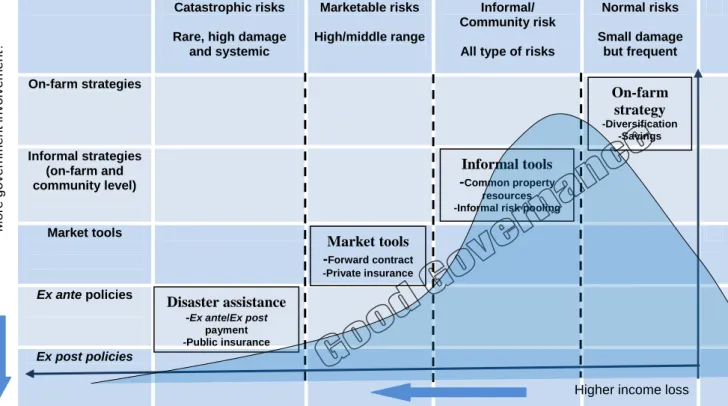
focus on a single risk or risk management tool as there is evidence of significant interaction between risks and responses. Secondly, is the need for a policy approach with differentiated responses to different types of risk. Not all risks require the same policy, and some may not require a policy response at all. Efficient policies for normal, marketable and catastrophic risk layers will differ. For example, normal risk is frequent but not too damaging and is typically managed at the farm or household level.
Table 2.3 shows the above mentioned framework where risks can be represented through a distribution of income loss with three risk layers: high frequency/low damage normal risk; low frequency/high damage catastrophic risks; and marketable risks with intermediate levels of frequency and damage. These layers are represented in the horizontal axis of the figure, while four categories of risk management responses are represented in the vertical axis. The most efficient responses is the “good governance” diagonal in the centre. There will always be normal risks that should remain the responsibility of a farmer and that need no policy response. There are also risks that can potentially be managed through market tools, such as insurance or futures markets, and for which the policy challenge is to create the conditions for the development of these markets. Finally, there are catastrophic risks to which market responses may fail and governments will need to respond to social demands for assistance.3 In this case, good policy governance is required.
A question that arises is the applicability of this framework to developing countries. In general terms, it could be suitable but with some caveats. Market imperfections are more likely to prompt the use of community/informal management mechanisms. As such, it is necessary to assess the robustness of institutional structures and government systems, and their influence on the prevalence of informal risk management strategies as these strategies play a crucial role for farmers. Therefore, managing and coping with risks, whether they are normal or catastrophic, may require a more nuanced balance between government intervention, market mechanisms and community/informal risk management tools. This may imply that the good governance diagonal of the OECD framework (Table 2.3) needs to be expanded to include a new layer in which these informal strategies are taken into account. Risks of all frequencies (from small damage but frequent, to rare high damage and systemic) and importance (from normal to catastrophic) are also dealt within these strategies. Public policies should note, consider and use when possible and suitable these informal risk management mechanisms.
Government intervention should consider that the ability of households to save and to access insurance and credit markets is often central to their ability to manage and cope with risk in any context. However, in many developing countries the existence of a complete set of markets cannot be taken for granted. Households may have very restrictive opportunities to save or borrow, insurance markets may be missing, and even land and asset markets may be very thin. For example, Chaia et al. (2010) and Demirguc-Kunt and Klapper (2012) estimated that approximately half of the world’s population is “unbanked,” or has no access to formal financial services of any kind. This figure is around 80% in Sub-Saharan Africa, 67% in Arab States, 65% in Latin America, 59% in East Asia, 58% in South Asia, 49% in Central Asia and Eastern Europe, and only 8% in OECD countries. The most commonly reported barriers to formal financial access
3. For example, the distribution of price risks can include frequent variations of prices, but only some of these shocks are downside and highly damaging in general. However, the distribution of prices is subject to uncertainty and sometimes difficult to infer from the information about the past (OECD 2009).
are high cost, physical distance, lack of proper documentation, and high transaction costs in general. CGAP (2010) reported that although financial inclusion and consumer protection are increasingly on the policy agenda, enforcement and implementation of regulations are still lacking.
Three main areas of government intervention for risk management and coping that have been studied broadly in developing countries are: insurance, saving/credit and safety nets. Next a brief review of the experience of these policies is presented.
Table 2.3. Risk layering: Optimal pattern of risk management strategies and policies Catastrophic risks
Rare, high damage and systemic
Marketable risks High/middle range
Informal/ Community risk All type of risks
Normal risks Small damage but frequent On-farm strategies Informal strategies (on-farm and community level) Market tools Ex ante policies Ex post policies Source: OECD (2011).
Insurance policies
Traditional public crop insurance schemes in developing countries (and in several developed countries) have been largely unsuccessful. Imperfect information and high transactions costs have proven to be destabilising, and there are no easy solutions. Subsidised insurance has been developed in several OECD countries as a devise to provide disaster assistance, but they have not fully substituted ad-hoc payments and they often cover non-catastrophic risks (OECD, 2011). A more recent and growing body of work looks at alternative mechanisms for the provision of insurance to farmers, and its potential to reduce risk exposure. One mechanism that has received much recent attention is the prospect of weather-indexed insurance. In this case, the insurer pays out in the event of adverse weather shocks, as measured objectively by meteorological stations. The indexing of insurance to the weather allows circumvention of the frequently severe problems of moral hazard that make traditional models of crop insurance difficult to implement in developing countries. Moreover, index insurance is unable to cover the basis risk, which reduces the demand. The goal of such insurance is to insulate income
M o re g o v e rn m e n t in v o lv e m e n t?
Higher income loss
Pro b a b ilit y Market tools -Forward contract -Private insurance Informal tools -Common property resources -Informal risk pooling
Disaster assistance -Ex ante/Ex post payment -Public insurance On-farm strategy -Diversification -Savings
and consumption against aggregate shocks that are plausibly exogenous to the household (Gine et al., 2007).
Weather-indexed insurance has seen a large increase in recent years. Cole et al. (2010) reported at least 36 pilot projects evaluating similar schemes across the world. However, despite its general appeal to policy makers and to development economists, take-up of these schemes has often been very low. Gine et al. (2007) reported a 4.6% take-up only among eligible households during the pilot programme of a rainfall insurance scheme in two districts of Andhra Pradesh state in India, an area dependent on timely and adequate rainfall for much of its agricultural production. They found that richer households (less credit constrained) and more risk-taking households (which grew riskier crops) were more likely to take the product. Participating households were likely to have better social networks, be less risk-averse, and more likely to have been a previous customer of the microfinance institution which administered the programme.
Cole et al. (2010) examined this evidence further, in addition to looking at pilot evidence from a different Indian state (Gujarat); they reported similar patterns. Specifically, they reported that trust in the agency providing the insurance is particularly important, especially given the low levels of financial literacy and education in the sample. They reported that take-up was higher when the insurance “educator” was referred to the household by a trusted local agent, when there was a previous history of payouts in the village, and when the household had previous experience with insurance. Each of these factors indicated that uncertainty about the product (and whether the provider was trusted to pay out) was a significant determinant of the low take-up rate of the financial product. Financial literacy was also important; take-up was higher among households with higher financial literacy and greater facility with probability concepts. The same is documented in Banerjee and Duflo (2011). Karlan et al. (2010) reported, for example, that the take-up of insurance and loans offered to Ghanaian farmers was significantly higher for farmers with higher cognitive scores and a previous history of having borrowed from a formal institution. Furthermore, liquidity constraints are also very important. In cross-sectional regressions in Cole et al. (2010), wealthier households were more likely to buy insurance.
There is also the possibility that as supply of formal insurance becomes more commonplace and farmers become more familiar with the concept, demand for insurance will increase. For supply to increase substantially there are important regulatory steps which need to be taken, including legal protection for policyholders and the development of reinsurance markets (Wiedmaier-Pfister and Chatterjee 2006 and Dercon 2005). Karlan and Morduch (2010) argued that the absence of insurance markets is primarily due to traditional supply-side constraints around asymmetric information (moral hazard and adverse selection), high transactions costs, and enforcement problems.
Savings/credit policies
While the direct provision of insurance is perhaps the most straight-forward policy intervention geared towards risk management, farmers in practice also use precautionary savings and credit as means to manage and cope with risks. One set of interventions looks at offering commitment savings to farmers. Being able to save for future consumption requires the ability to delay today’s spending; however, if preferences are present-biased, this may be difficult. Commitment savings products allow households to commit to saving by restricting their ability to withdraw their savings from their bank account until the maturation date or until a set goal is reached. Presenting evidence from the
Philippines, Ashraf et al. (2009) found out that take-up of commitment savings products was higher among women and access to the product resulted in significantly higher savings one year later. In a direct application of similar principles to smallholder farmers, Brune et al. (2011) offered commitment savings products to farmers in rural Malawi; they found that access to a commitment treatment led to increases in deposits at the partner bank, and over the next agricultural year caused increases in agricultural input use, crop sales, and household expenditures. Thus it seems that commitment savings devices could play a role in boosting agricultural households’ ability to save, which can play an important role in their ability to smooth consumption in the face of agricultural risk.
It is important, however, not to overstate the potential impact of this scheme. While the “lock-in” of funds may commit households to save more, this lack of flexibility could also lead to a lack of liquidity at a time of an adverse shock. The evidence in Brune et al. (2011) was particularly striking in this regard. Even households which opted to open commitment savings account put only a small portion of their savings in commitment accounts, preferring to use ordinary accounts for the larger share of their savings. Households seem to value the flexibility of withdrawal and it is plausible that this is due to considerations of risk.
Credit provision may also allow for better risk coping. However, the history of previous agricultural credit schemes has not been propitious and government action through the provision of credit, has a chequered history at best. Cole (2009), for example, studied agricultural lending by government banks in India and found significant election-year effects. As he comments, “Politically motivated loans are costly: they are less likely to be repaid, and election year credit booms do not measurably affect agricultural output.” On the other hand, Gertler and Gruber (2002) reported that households in rural Indonesia that were closer to financial institutions were better able to self-insure against severe health shocks. The effect is similar for private financial institutions and government microfinance institutions and they conclude that “government promotion of microfinance and microsaving programmes can be useful in helping families cope with major health shocks, especially in areas where private credit is not available.” Islam and Maitra (2012) showed, using panel data from Bangladesh, that households most commonly coped with health shocks through the sale of livestock but that households having access to microcredit were not likely to sell productive assets (livestock) in response to idiosyncratic health shocks. Microfinance institutions have recently faced a barrage of criticism from policy makers in Asia particularly, India and Bangladesh for leading farmers into debt-traps with long term welfare consequences (Banerjee et al., 2010).
Safety nets policies
Evidence on different social protection programmes in developing countries detail how the negative impacts of agricultural shocks can be ameliorated significantly through the availability of these programmes. Uninsured risk results in welfare losses and the poor usually do not have the opportunity to insure themselves, which, according to Dercon (2005), presents a justification for public action to foster more social protection. Ravallion (1988), reviewing evidence on the performance of workfare schemes in South Asia, discussed the stabilisation benefits of such schemes with universal coverage. He reported that rural public works have a long and generally successful history as instruments of seasonal stabilisation of incomes and famine relief in India. In bad years, such as the poor monsoon of 1987, demand for employment under such programmes rose dramatically.
Some evaluations of safety net programmes suggest a positive impact at the household level. For instance, Singh, Park and Dercon (2012) found in India that while a significant drought caused significant deterioration in the nutrition of young children in rural areas, this deterioration was entirely compensated for by a national school meals programme for the children who had access to it. A recent review of evidence on cash transfer programmes (DFID, 2011) found that “one of the strongest and most consistent findings regarding the impact of cash transfer programmes was their contribution to reducing hunger and food insecurity.”
Macours, Premand and Vakis (2012) also evaluated a safety net programme to better protect farmers against drought shocks using randomised control trials (RTC),4 in Nicaragua. They found that enhancing the basic cash transfers with productive interventions (i.e. the basic cash transfer programme with either a scholarship for training to develop new marketable skills or a lump-sum grant to develop a non-agricultural business), proved to be an effective strategy to help households successfully develop other income-generating activities to overcome bad weather and smooth out the shocks to consumption that occurred when crops fail. This new modality of productive safety nets helped households to protect against shocks and provide opportunities for higher earnings in the longer-term. On the other hand, the basic cash transfer scheme only helped households to maintain consumption in the short-run when the shock hit, but had no impact on future earnings.
It is also important to acknowledge the existence of policies beyond credit, insurance and safety nets that contribute directly or indirectly to reduce and better management of risk for smallholders. For instance, policies tied to good agricultural practices, sanitary and phytosanitary measures, extension services, technical assistance, rural infrastructure and more general policies that provide the right environment for agricultural development can have equal or sometimes greater positive impacts in the way poor small-scale farmers deal with risk.
Agricultural risk policies in developing countries have tried to address primarily the issue of imperfect markets, particularly in the financial sector. However, government interventions on insurance and credit markets have been, in several cases, inefficient and costly, which suggests a better policy design. Households whose consumption levels are close to subsistence tend to devote a larger share of land to safer, traditional varieties of crops than to riskier high-yielding varieties. Thus it may be the case that the vulnerability of poorer farm households, especially in the absence of credit and insurance markets and social security schemes, may lead to poverty traps.
2.4. Poverty traps, risk implications, investment and risk management policies
Risks in agriculture are usually more severe in developing countries than OECD countries. Smallholders in developing countries are often forced to rely on strategies that perpetuate poverty and households cope with shocks by depleting valuable assets to allow4. Randomised control trials (RTC), is a programme evaluation method, where groups of households or communities are randomly assigned to different “treatments” (different programmes or variations of the same programme); it usually incorporates the “control group” (the group of households that did not receive the benefit of the programme). The main argument with this method is that as households are randomly assigned the programme, and differences between groups is the effect of the treatment (Banerjee and Duflo, 2011; Macours, Premand and Vakis, 2012; Macours, 2012).
the family to maintain a certain level of consumption in the aftermath of a shock (e.g. floods or drought). This, however, can eventually cause the family to fall into a poverty trap created by low assets levels. The fear of being trapped in long-term destitution leads households to protect assets at all costs, and the cost can be very high. To maintain its assets, the household reduces consumption which can have long-term ill effects on the household’s health and capacity. Whether a shock is sudden or prolonged, most households, both the wealthiest and the poorest, experience a loss of assets and a reduction of disposable household income. In the case of smallholders, the main aspect to consider is that they are often mired in deep poverty and when shocks occur, they are likely to face the more devastating consequences. Such a situation calls for better and more efficient risk management tools.
According to Carter et al. (2005) poverty trap is a critical minimum asset threshold, below which households are unable to build up productive assets, educate their children, and improve economically over time. Poverty traps are most likely to be problematic in areas where markets are thin or weak and households are unable to borrow against future earnings to build up their assets. In the face of a poverty trap, short-lived shocks can have permanent long-term consequences. If an environmental shock destroys a family’s assets, it may push them below the minimum asset threshold and into a poverty trap from which they cannot escape, even over time. Figure 2.1 illustrates the effects of a shock like flooding or hurricane on a household, and how it can push a poor family’s asset stock below the poverty-trap threshold and may leave them in a permanently lower wealth situation, especially since the asset loss is usually combined with a corresponding loss of income.
Figure 2.1. Climate shock impact on assets and income levels
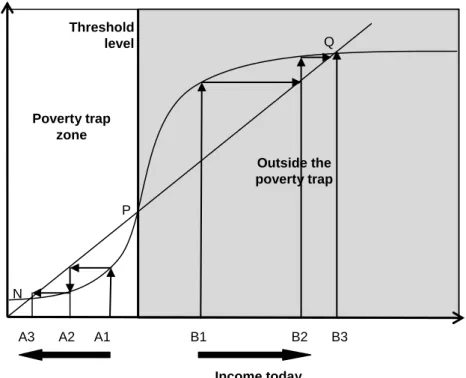
Banerjee and Duflo (2011) also describe the poverty trap. Their main argument is that income today influences the income of tomorrow. In other words, an individual’s income today determines how much he spends on food, medicine or on his children’s education, and whether or not he buys fertiliser or improved seeds for his farm. All of this determines his wellbeing of tomorrow. Therefore, if an individual’s current income is situated within the poverty trap zone of Figure 2.2, he will enter into a vicious circle of diminishing income. However, if an individual’s initial income is situated in the shaded area (outside the poverty trap), and if a positive event takes place, he could enter into a virtuous circle of increasing income and ultimately move away from poverty.
Figure 2.2. The S-shape curve and