FACTORS AFFECTING THE INTERNAL AUDIT EFFECTIVENESS
Adhista Cahya Mustika
Department Accounting Economics and Business Faculty of Diponegoro University Prof. Soedharto SH Street Tembalang. Semarang 50239. Phone: +622476486851
ABSTRACT
This study tests the factors that influence the internal audit effectiveness, including internal auditor competencies, internal auditor independence, auditee support to internal audit activity, and the internal and external auditor relationship. Using the internal auditor inspectorate in Java Province, Indonesia, we found that the internal audit effectiveness can be attained through increase internal audit competence, independence and strong relationship between internal and external auditor. However, this study found that auditee support has no effect on internal audit effectiveness.
Keywords: Internal audit effectiveness, competence, independence, auditee support, relationship between internal and external auditors.
INTRODUCTION
The main foccus of internal audit is monitoring the internal control and financial compliance of an organization. Internal audit is important not only for private sector entities but also for public sector organizations. In the public sector organizations or known as government, all the activities will be monitored easier by the internal audit function. We can know much more about what government do, whether all their activities are appropriate with the policy or not. The internal audit will support the good governance and clean governance to be achieved.
Based on the Act of Minister for the Empowerment of State Apparatus No: : PER/05/M.PAN/03/2008, Provincial Inspectorate is one of the organization which is included as Government Internal Control Officer (hereafter, Aparat Pengawasan Intern Pemerintah APIP). The main function of provincial inspectorate are planning the monitoring programs, making the policy and monitoring facility, investigating and evaluating the monitoring function.
Effectiveness is the measurement to evaluate whether the goals of the organization has been achieved or not. Effectiveness becomes the main aspect
that affect the goal achievement of an organization. So, the organization must deciding to do some activities which will help them to achieve the goals. The internal audit must be so effective that they could achieved the goals of their audit activity. Internal audit effectiveness is the measurement to evaluate whether the internal audit function is able to achieved the goal of that function.
There are a lot of factors affecting the internal audit effectiveness. Arena and Azone (2009) said that factors affecting the internal audit effectiveness are characteristic of the audit team, activity and audit process, and the organization relationship. Mihret and Yismaw (2007) said that organization characteristic would increasing or decreasing the internal audit effectiveness. Alzeban and Gwilliam (2014) said that competence of internal audit staf, independence of internal audit staf, management support, the size of internal audit department, and the relationship between internal and external auditor have positive correlation with the effectiveness of internal audit.
Point 2220 of APIP auditing standard stated that auditors must have competence and another skills that can support their works of audit. Auditor must have wide knowledge and another
competencies to fulfill their responsibilities. Auditor must have abilities in auditing, accounting, governmental administration, and communication. In the next point, APIP auditing standard stated that the auditors must be independent. Their position should be placed exactly and free from any intervention. If the auditors have any relationship with auditee, they should not be involved in the audit activities. However, the work of internal auditors need supports from the management or the organizations being audited. By supporting the internal auditors, the auditee will give all informations needed by the internal auditors with pleasure. This situation will make the internal auditors feel free to do their works. APIP auditing standard also gave explanation that to work properly, the internal audit team should have a good communication with the external auditor. The internal and external auditors should discuss the scope of their works so there is no repeating activities.
THEORITICAL FRAMEWORK
AND HYPOTHETICAL
DEVELOPMENT
Contingency theory is used in this research. Badara and Saidin (2014) said that contingency theory was able to help researchers to explain about one
phenomenon sitematically. This theory could explain the relationship between two or more variables. In this research, the internal audit effectiveness is something expected to be achieved. To achieve the internal audit effectiveness, we had to pay attention to the factors that might affect it. That internal audit effectiveness depended on contingency variables, they were competence of the internal auditor, independence of the internal auditor, auditee support to internal audit activities, and the relationship between internal and external auditors.
Competence of the internal auditor is auditor’s abilities to applied what he/ she knows to carry out audit activities properly. The Institute of Internal Audit claimed that auditors competencies is a key element in
effective internal audit activities. Having said that, internal auditors have to possess skills, knowledge and other competencies to engage in internal audit duties. Furthermore, work of internal audit is heavily used by external auditors and they tend to rely more if the the audit is made with high competencies (Al-Twaijry et al., 2004).
Researches have focused on the needs for audit personnel to attain high quality internal audit. Ahmad et al. (2009) and Ali et al. (2007) tested the importance of internal audit activities in Malaysia and they found that most of the qualified staff are observed on trainings, experience and knowledge about internal auditing negatively affected the role of the internal audit and suggested that training as an important requirement for improving internal audit work.
Model of The Research
Competence (+)
Independence (+)
Auditee Support (+)
Relationship between Internal and External Auditors (+)
Internal Audit Effectiveness
Similar results can also be observed in other studies. For instance, lack of qualified staff as one of important factors inhibiting the internal audit functions in Sudan (Brierley et al., 2001, 2003; Gwilliam & El-Nafabi,2002). Prior empirical evidences have also observed that lack of qualified staff impair the internal audit function in Ethiopian public sector (e.g., Mihret & Yismaw, 2007; Mulugeta, 2008; Wolderupheal, 1998) and continuous professional training should be enforced to encourage them to upgrade their skills.
Doing audit in public sector organizations, auditors need to understand every aspects related to the govermental activities, such as organizational structure, program function, also the rules to carry out their works. This would help the auditors to carry out their works in a good way.
Based on this background, the following hypothesis is formulated:
H1. Competences of the internal auditors have positive effect on the internal audit effectiveness.
International Standards for the Professional Practice of Internal Auditing (ISPPIA) said that internal auditors independences was the most important factors in achieving internal audit effectiveness. Internal auditors are
expected to have integrities and commitment to make unbiased opinion in every sircumstances. Every auditor must have independency in doing audit works. Previous research suggests that lack of independence is an obstacle to satisfactory internal audit performance. In the South African public sector, Schyf (2000) found that lack of independence of internal audit function. In particular, he identified issues pertaining to the communication and reporting and how they affect the auditor independence.
Based on this background, the following hypothesis is formulated:
H2 Internal auditors independence have positive effect on the internal audit effectivenes.
Alzeban and Gwilliam said that management support would give freedom for internal auditors to do their job. By this support, audit team will maximally accomplish their task related to their job. They explained that auditee support became one critical factor to the success of audit function.
Ahmed et al. (2009) claimed that management support is the second factor to achieved the audit internal effectiveness in Malaysian public sector. They said that by this support, the recomendation made by internal auditors
will more possible to be implemented. While, Mihret and Yismaw (2007) claimed that without this support will give negative effect to the internal audit effectiveness. Further more, they said that to be effective, internal audit function need to be appreciated by related organization or known as auditee.
Based on this background, the following hypothesis is formulated:
H3. Auditee support have positive
effect on the internal audit
effectiveness.
The well-maintained relationship between internal and external auditors has long been seen as important to the success of internal audit functions and provide numerous benefits to the organization and external stakeholders as well. The coordination and cooperation may include the planning, opinions, reporting, exchange of information that may facilitate higher quality audits and thus could prevent audit work duplication (i.e. internal vs external audit).
The cooperation and coordination increases the efficiency, effectivess and economy of audits and could help management to provide a high quality public service. Lack of cooperation between internal and external auditors are frequently regarded as a main factor that could reduce the quality of both forms of
audit in the public sector in developing countries. Furthermore, the main reason for the presence of financial errors and irregularities were the lack of cooperation between internal and external audit teams..
Based on this background, the following hypothesis is formulated:
H4. The relationship between internal auditors and external auditors have positive effect on internal audit effectiveness.
RESEARCH METHODOLOGY
Multiple regression was performed to estimate the magnitude of the effect of the four factors identified above (the independent variables) on internal audit effectiveness (the dependent variable), with responses from internal auditors oh Inspectorate of Central Java whic has 33 in numbers. The basic model of multiple regression was: Y’ = a + b1X1 + b2X2 + b3X3 + b4X4 + e
Y’ = Internal audit effectiveness X1 = Competence of internal
X2 = Independence of internal auditor
X3 = Auditee support to internal audit activity
X4 = Relationship between internal and external auditor
a = Contant
b1, b2, b3, b4, b5 = Coeffisien regression e = Error
Population and Sample
This research used the internal auditor of Inspectorate of Central Java as the population which has 33 total in number. Because of the small number of the population, the sample is taken by census method. The data were obtained by questionnaire. All variables were measured by internal auditors perception based on several indicators using 5 point Likert scale.
Measurement of Variables
Each variables was measured using five-point Likert scale, where 1 is the extent that the respondents strongly disagree, and 5 is the extent that the respondents strongly agree. There are several indicators used to measured each variables.
Competence of the internal auditors
This variables was measured based on internal auditors’ latest
education, their experience in audit works, and the duration of training they involved.
Independence of the internal auditors
Independence was measured by internal auditors’ independences when doing their works, their relationship with auditee, unrestricted access to all departments and employees, and interference of auditee.
Auditee support to internal audit activities
Auditee support was measured by supporting internal audit to perform its duties and responsibilities, providing information needed by the auditors, accepting and implementing the recomendation made by auditors.
Relationship between internal and external auditors
Relationship amongs internal and external auditors is defined as the attitude towards external auditors, co-ordination, including discussing mutual interests, discussion of the audit plan, external auditors’ reliance on the work of the internal
audit, and frequency of meetings (Alzeban and Gwilliam, 2014). Internal audit effectiveness
The internal audit effectiveness was measured by internal auditor perception based on these indicators, the ability to make a plan, improving organizations’ productivity, consistency with the goal, implementing internal audit recommendation, evaluating the risk management, evaluating the internal control system, reccomendation for improvement.
On the first stage, the pilot study was carried out to check the conformity of the instrument used in this research. The questionnaire were sent to several number of students from Departement Accounting of Diponegoro University. The result of this pilot study used to correct the items of questions that is difficult to understand by respondents. After that, the new questionaire were sent to the real respondents, the internal auditor of Inspectorate of Central Java.
RESULT
Table 1 provides description statistics for the survey respondents. From table 1, there are 60,6% male internal auditors, and 39,4% female internal auditors. They were divided into three level of auditors. 12 auditors are the first auditors, 15 auditors are young auditors, and 6 auditors are middle auditors. Their latest education are derived from different background. 14 respondents from accounting concentration, 8 from management concentration, 7 from public administration concentration, 3 from law concentration, and 1 from farm concentration. The majority of respondents had 5-10 years of work experience in internal auditing.While the majority duration of training they involved was 21-40 hours in one year.
Table 1
Professional Demographics of Respondents
Respondent Characteristic Criteria Sum Percentage
(%)
Gender Male 20 60,6
Female 13 39,4
Occupation First Auditor 12 36,6
Young Auditor 15 45,5
Middle Auditor 6 18,2
Latest Education Public Administration 7 21,3
Accounting 14 42,5
Law 3 9,1
Management 8 24,2
Farm 1 3,0
Experience in Audit Works < 1 year 2 6,1
> 15 years 4 12,1
1 – 5 years 6 18,2
10 - 15 years 10 30,3
5 - 10 years 11 33,3
Duration of Training in One Year < 20 hours 6 18,2
21 - 40 hours 13 39,4
41 - 80 hours 12 36,4
81 - 120 hours 2 6,1
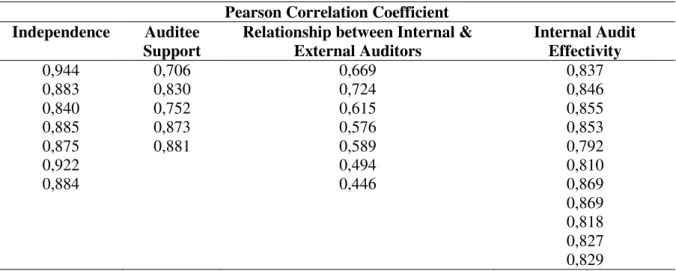
Table 2 presents validity test result. The result showed that each item of questions used in this reseacrh are valid. At the significant level of 0,05, the r value is 0,2913. While, the value of Pearson Correlation Coefficients for each variable
questions are more than 0,2913. This indicates that all the questions used in this research are valid and appropriate to analyze the factors that affect the internal audit effectiveness.
Table 2 Validity Test Result
Pearson Correlation Coefficient Independence Auditee
Support
Relationship between Internal & External Auditors Internal Audit Effectivity 0,944 0,706 0,669 0,837 0,883 0,830 0,724 0,846 0,840 0,752 0,615 0,855 0,885 0,873 0,576 0,853 0,875 0,881 0,589 0,792 0,922 0,494 0,810 0,884 0,446 0,869 0,869 0,818 0,827 0,829
Table 3 shows the reliabilty test result. This test is carried out by analyzing the value of Cronbach’s Alpha. The value
of Cronbach’s Alpha should be more than
0,6. It means that the data used in the research has no problem with the reliability.
Table 3
Reliability Test Result
Variable Cronbach’s alpha Items
Independence 0,955 7
Auditee Support 0,869 5
Relationship between Internal & External Auditors
0,691 7
Internal Audit Effectiveness 0,957 11
The result showed that the value of all questionnaire items are more than 0,6. It indicates that the data used in this researsh are consistent and has no problem with the relaiability.
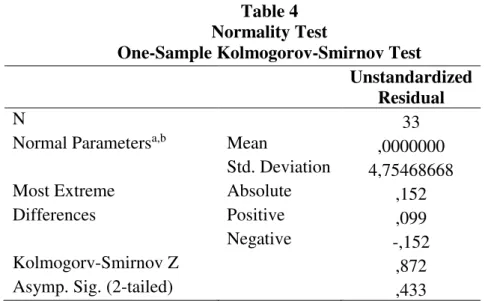
After doing quality data test that consists of validity and reliability test, the next one is classic assumption test. Table 4
shows the result of the first classic assumption test, normality test. The aim of this test is to analyze whether the data used in this research are normal ditributed or not. The data classified as normal if the p value of Kolmogorof-Smirnov is more than 0,05. From table 4 below, we knew that the p value is 0, 433 which means that the data used in this research are normal distributed.
Table 4 Normality Test
One-Sample Kolmogorov-Smirnov Test
Unstandardized Residual
N 33
Normal Parametersa,b Mean ,0000000
Std. Deviation 4,75468668
Most Extreme Absolute ,152
Differences Positive ,099
Negative -,152
Kolmogorv-Smirnov Z ,872
Another classic assumption done in this research is multicolinearity test. The aim of this test is to analyze whether the independent variables are correlated each
other. This test is done by analyzing the value of tolerance and variance inflation factor (VIF).
Table 5
Multicolinearity Test
Independent Variables Colinearity Statistics Tolerance VIF
Competence ,635 1,574
Independence ,297 3,364
Auditee support ,381 2,624
Relationship between internal & external auditors
,754 1,326
The value of tolerance from all independent variables are more than 0,1. While, the values of VIF are less than 10. It means that all independent variables are nor correlated each other and free from multicolinearity.
The last clasic assumption test in this research is heteoskedasticity test which done by glesjer test. Table 6 below, shows that p value of all variables are more than 0,05. It indicates that all independent variables has no problem with heteroskedasticity. Table 6 Heteroskedasticity Test Glesjer Test Model Standardized Coefficients t Sig. Beta 1 (Constant) 1,361 ,184 Competence -,124 -,615 ,544 Independence -,077 -,260 ,797 Auditee support ,317 1,221 ,232
Relationship between internal & external auditors
-,461 -2,496 ,062
The next table presents regression results. Table 7 shows that the 3 variable sare significant at p < ,05. The coefficient of competences shows a significant positive association (supporting H1),
suggesting that higher internal audit effectiveness is associated with greater competence of the internal auditors. This result is consictent with the research done by Alzeban and Gwilliam (2014). They
said that auditor who has knowledge, skills, and other competencies would be able to do their duties and responsibilties related to their audit works. While, Ali (2007) and Ahmad (2009) found some facts that auditor who has no appropriate qualifications would give negative effect to the internal audit function. Furthermore, APIP standard stated that an auditor must have knowledge about auditing standard, policy and audit procedure. Besides that, auditor must understand the nature of the organization being audited.
Results also indicate a positive and significant association between internal
audit effectiveness and independency of internal auditors with p < ,05 (supporting H2). This result is consistent with the research done by Alzeban and Gwilliam (2014). They said that higher independency of internal auditor would affect the greater internal audit effectiveness. Brierly (2001) claimed that internal auditor should reporting to the highest level of the organization to ensure that the auditor acts independently. APIP standard also stated that auditors must act independently towards the organizations being audited as the auditee. It means that, auditor must reporting the result of their works without any permission. Tabel 4 Regression Result Model Standardized Coefficient t Sig. (Beta) 1 (Constant) -1,681 ,104
Competence of Internal Auditor ,419 2,211 ,035
Independence of Internal Auditor ,643 2,323 ,028
Auditee Support to Audit Activity ,018 ,075 ,941
Relationship between Internal and External Auditor
,466 2,677 ,012
Furthermore, results show a positive and significant association between the relationship between internal and external auditors with internal audit effectiveness with p < ,05 (supporting H4), suggesting that higher internal audit effectiveness is associated with the nice
relationship between internal and external auditors. This result is consistent with the research done by Alzeban and Gwilliam (2014). They said that the nice relationship between those two auditors brought beneficity for their works. Proper
coordination would help the organization to improve public service.
In the other hand, one independent variable, auditee support, has no significant effect to the internal audit effectiveness with p > ,05 (rejecting H3), suggesting that higher internal audit effectiveness has no relationship with the support given by the auditee. This result is consistent with the reasearch done by Rahadhitya (2015). He said that management support from the
organization being audited (auditee) has no effect on the internal audit effectiveness. This is because of the lack of respond from auditee to the recommendations made by internal auditors.
Table 5 shows that the R2 value is 0,625. It means that the ability of independent variables to explain the dependent variable is 62,5 %. While, 37,5 % is affected by another factors beyond this research.
Table 5 Coefficient Determination
Model R R Square Adjusted R Square Std. Error of the
Estimate
1 ,793a ,625 ,458 ,48272
CONCLUSION
The aim of this research is to analyse the effect of the internal auditor competencies, the independency of internal auditor, auditee support to internal audit works, the relationship between internal and external auditor, to the internal audit effectiveness. The result showed that competences, independences, and the relationship between internal and external auditors have significant and positive effect on the internal audit effectiveness. While auditee support has no positive effect in the internal audit effectiveness. The ability of independent variables to explain the dependent variable is 62,5 %.
Inevitably, this study has methodological limitations. It is questionnaire-based, and a measure of the variables, both the dependent and independnent variable, is established according to the perceptions of the internal auditors. Besides that, this research used very small number of populations, so the result will be difficult to be generelized to measure factors affecting the internal audit effectiveness. Future research should pay attention to the number of the population and analyzing another factros that may affect the internal audit effectiveness.
REFERENCES
Ahmad, H. N., Othman, R., Othman, R. & Jusoff, K. (2009), “The Effectiveness of Internal Audit in Malaysian Public Sector”, Journal of Modern Accounting and Auditing, 5(9), 53- 62.
Al Tawaijry, A., Bierly, J., Gwilliam, D. 2004. An Examination of The Relationship Between Internal dan External Audit in The Saudi Arabian Corporate Sector. Journal of Managerial Auditing. 19 (7) : 929-944.
Ali, A. M., Gloeck, J. D., Ali, A., Ahmi, A. & Sahdan, M. H. (2007), “Internal Audit in the State and Local Governments of Malaysia”, Southern African Journal of Accountability and Auditing Research, 7(1), 25-57. Alzeban, Abdulaziz dan David G. 2014.
Factors Affecting The Internal Audit Effectiveness: A Survey of The Saudi Public Sector. Journal of International Acconting, Auditing and Taxation. 23 : 74-86.
Arena, M., Arnaboldi, M. & Azzone, G. (2006), “Internal Audit in Italian Organizations: A Multiple Case Study”, Managerial Auditing Journal, 21(3), 275-292.
Arens, A. A., R. J. Elder, dan Besley M. S. 2008. Auditing and Assurance Services. 12th edition. Prentice Hall. Brierly, J.A., El-Nafabi, H.M., and
Gwilliam, D.R. (2001). The Problems of Establishing Internal Audit in the Sudanese Public Sector. International Journal of Auditing, 5, 1, 73 - 87
Dabari, I.J., and Saidin, S.Z. (2014) A theoretical framework on the level of risk management implementation in
the Nigerian banking sector: The moderating effect of top management support. Procedia-Social and Behavioral Sciences, 164, 627 – 634 Halimah, N. A., and Radiah O. 2009. The
Effectiveness Internal Audit of Malaysian Sector Public. Journal of Modern Accounting and Auditing Serial no 52.
Mihret, D., and Yismaw, A. 2007. Internal Audit Effectiveness : An Ethiopian Public Sector Case Study. Journal of Managerial Auditing 22(5) 470- 484.
Mulugeta, S. (2008). Internal Audit: Reporting Relationship in Ethiopian Public Enterprises. M.Sc. Dissertation. Ethiopia: Addis Ababa University. Available online at: http://etd.aau.edu.et/dspace/bitstrea m/123456789/1966/1/Samuel%20M ulugeta.pdf
Peraturan Menteri Negara
Pendayagunaan Aparatur Negara Nomor: PER/05/M.PAN/03/2008. Standar Audit Aparat Pengawasan Intern Pemerintahan. Lembaran Negara RI Tahun 2008. Jakarta. Rahadhitya, Reza. 2015. Faktor yang
Berpengaruh terhadap Efektivitas Audit Internal. Diponegoro Journal of Accounting vol.4.
Schyf, D. B. Van Der. (2000). Obstacles in establishing and operating a public sector internal auditing function in a developing country: The South African experience. Meditari Accountancy Research, 8(1), 145-181.
http://dx.doi.org/10.1108/102225292 00000009