1 | P a g e
UAS deployment and data processing during the Balkans flooding
with the support to Mine Action
Haris Balta; Geert De Cubber; Yvan Baudoin and Daniela Doroftei
Department of Mechanics, Unmanned Vehicle Centre Avenue de la Renaissance 30, 1000 Brussels, Belgium
Email: [email protected]; [email protected]; [email protected] and [email protected]
ABSTRACT — In this paper, we provide a report on a real relief operation mission, jointly conducted by two European research projects, in response to the massive flooding in the Balkan in spring 2014. Un Unmanned Aerial System was deployed on-site in collaboration with traditional relief workers, to support them with damage assessment, area mapping, visual inspection and re-localizing the many explosive remnants of war which have been moved due to the flooding and landslides. The destructive impact of landslides, sediment torrents and floods on the mine fields and the change of mine action situation resulted with significant negative environmental and security consequences. Novel robotic technologies and data processing methodologies were brought from the research labs and directly applied onto the terrain in order to support the relief workers and minimize human suffering.
KEYWORDS: Unmanned Aerial System, Mine Action, Robotic Systems, Relief Mission Support
1. INTRODUCTION
In the period between end of May and beginning of June 2014, Bosnia and Herzegovina and Serbia were hit hard by catastrophic massive flooding after abundant rainfall over a few weeks causing floods and landslides. The countries suffered the greatest damage, as the rain was the heaviest in 120 years of recorded weather measurements. Only in Bosnia and Herzegovina, an estimated 1.5 million people were affected (39% of the population). Flooding has led to at least 53 deaths in both countries [1]. The EU Civil Protection Mechanism has been activated due to the catastrophic crisis 22 Member States have offered assistance through the Mechanism. Figure 1 show the flood situation (26 May 2014) and the deployment of international teams through the EU Civil Protection Mechanism.
Among many other international SAR teams the Belgian First Aid and Support Team (B-FAST) and the Belgian Royal Military Academy (RMA) sent the first author of this paper and an Unmanned Aerial System (UAS) along with 3D mapping tools, in order to assist the teams for task such as damage assessment, dike breach detection, mapping, aerial inspection and for re-localizing the many Explosive Remnants of War (ERW) which have been displaced due to the landslides. This mission fits in the framework of the European FP7 research projects ICARUS (search and rescue) [2] and TIRAMISU (on humanitarian demining) [3]. In Bosnia and Herzegovina, the presence of many ERW created an extremely dangerous situation for the local
2 | P a g e population and the relief workers. Therefore, on the field, the mission also assisted a team of the Bosnia and
Herzegovina Mine Action Centre
(BHMAC) which was deployed to multiple regions of the country in order to localize the displaced ERW.
Natural disasters (floods, torrents, landslides, land shifting) have had intensive destructive impact on suspected hazardous areas (SHA) and mine fields in Bosnia and Herzegovina. Only in Bosnia and Herzegovina, 831.4 km2 were flooded, 37.48 km2 of suspected hazardous area in 33 areas were under direct impact of torrents and landslides; by 4th July 2014, 1018 UXO, 92 mines and 3 cluster bombs were found, as well as 40.163 ammunition pieces. In addition, 80.2km2 of new areas which previously had not been mine suspected became potentially hazardous (Northern part of Bosnia and Herzegovina). BHMAC have provided data and information about the affected regions, the kinds of influence, the impact intensity and the spatial distribution, as well as the priorities [4].
2. UNMANNED AERIAL VEHICLES HARDWARE
The use of Unmanned Aerial Vehicles (UAV) for search and rescue missions provides benefits for users due to their low cost, portability, and potential fields of use [5]. In the context of search and rescues missions such systems can offer important support to human task forces in situation assessment and surveillance and in this way increasing the situational awareness of the environment from the air. The UAVs can be deployed without the need for extensive airstrips for take-off and landing. Operating costs are typically low, compared to conventional manned aircrafts. The use of small UAVs may improve the response time and coverage for search and rescue operations allowing search and
rescue teams to systematically survey and perform mapping of areas (high level of details and accuracy of ground pixel size 2-5 cm) of importance in real time without any physical interaction within dangerous zones [6].
In the context of this mission we used UAV system used in this work is a small vertical take-off aerial system md4-1000 from Microdrones as shown in Figure 2. This UAV is a quadrotor-based aerial system, with 1030 mm diameter and complete carbon body with a maximum payload of around 2kg. The four gearless brushless Figure 1 Bosnia and Herzegovina flood map (source: EU Commission)
Figure 2 Microdrones MD4-1000 quadrotor with field control
3 | P a g e electric motors are powered by lithium batteries. The autopilot is built on a small micro-processor collecting aerodynamics information through a set of tightly coupled sensors (GPS module, 3D-magnetometer, 3-axis gyroscope, 3-axis accelerometer and a barometric pressure sensor), allowing to fly autonomously waypoint based flights. Depending on the weight of the payload, state of the batteries, environmental and flight conditions the UAV can fly for about 35-40min. In additional the overall UAS (system comprises of a field control base station with high gain antenna for providing command, control and data recording to and from the UAV system. The field control base station is housed in a ruggedized case in order to protect the equipment. All data (GPS data, UAV position and attitude data, video data, flight time and battery level data) are transmitted in real-time to the ground receiver station via 5.8GHz wireless communication. The UAV system is equipped with a Sony NEX-7 24.3 megapixel digital camera with a Sigma 18mm lens. The camera is mounted below the UAV on a 2-axis gimbal with high precision tilt and roll stabilization (because of the strong and multi-direction wind) in real time to provide better images for aero triangulation and mapping. Moreover, it should be noted that the UAV does not fly if the wind speed is higher than 10 m/s. The digital camera was pre-calibrated in order to obtain good accuracy and results.
3. UAS RELIEF SUPPORT MISSION
The UAS mission received the full support from the Federal Civil Protection of Bosnia and Herzegovina, the Ministry of Security and the Bosnian Mine Action Centre (BHMAC). After a coordination meeting in the Bosnian capital Sarajevo with the Bosnian Ministry of Security. Flight permits up to a flight altitude ceiling of 150m for the complete Bosnia and Herzegovina territory were granted with the support of the Ministry of Security of Bosnia and Herzegovina and the national Directorate of Civil Aviation (BHDCA). Due to the crisis situation and thanks to the fact that all application documents for the flight permits were readily available (as they were already prepared for our activities within the EU FP7 projects), these flight permits were issued within half a day after a coordination meeting in the capital Sarajevo with the Bosnian Ministry of Security. In a period of two weeks, we operated with a Vertical Take-Off and Landing Remotely Piloted Aircraft System on 13 locations (in the north and central part of the country). We performed around 20 flights within Visual Line of Sight in urban and semi-urban areas. In general, two types of operations were performed:
Manual Flights. End-users (rescue or demining teams) indicated points of interest they wanted to see investigated by the UAV, mainly for damage assessment and visual inspection. The flights were then executed by a trained operator.
Waypoint-based mapping flights. An area to be mapped by the UAV was indicated by the end-users. A flight plan was then set up to map this area using an autonomous waypoint-based flight. Also under these conditions, a trained pilot always operated the remote control station.
A typical flight had a duration of 25 to 30 minutes, which enables to cover an area of about 1 hectare. Multiple mapping missions were performed, gathering 200 to maximum 500 images with a resolution of 24 megapixels and mapping areas not larger as 1km2.
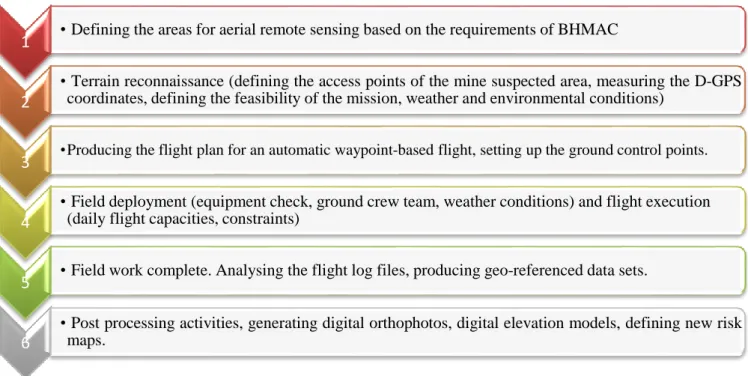
4 | P a g e Figure 3 shows the complete workflow process of the UAS flight mission. Starting from the definition of the affected mine suspected areas, terrain reconnaissance, producing a flight plan, measuring G-GPS ground control points through flight execution with data acquisition and finally post-processing activities.
Figure 4 shows example images for an automatic waypoint-based mapping flight acquired by the UAS. Example of the landslide, which crosses the mine field from the region Olovo (Central part of Bosnia and Herzegovina).
We generated the orthomosaic and DTM using an algorithm, which analyses all images of the aerial data set and searches for matching points. The most well-known feature matching algorithm is the scale-invariant feature transform approach. Those feature-matching points are combined with meta-data information from the autopilot (altitude, camera position and orientation) and are used in a bundle block adjustment in order to reconstruct the exact position and orientation of the camera for every acquired image. Based on this reconstruction the matching points are verified and their 3D coordinates calculated.
1 • Defining the areas for aerial remote sensing based on the requirements of BHMAC
2
• Terrain reconnaissance (defining the access points of the mine suspected area, measuring the D-GPS coordinates, defining the feasibility of the mission, weather and environmental conditions)
3 •Producing the flight plan for an automatic waypoint-based flight, setting up the ground control points.
4
• Field deployment (equipment check, ground crew team, weather conditions) and flight execution (daily flight capacities, constraints)
5 • Field work complete. Analysing the flight log files, producing geo-referenced data sets.
6
• Post processing activities, generating digital orthophotos, digital elevation models, defining new risk maps.
Figure 3 Workflow planning of the UAS flight mission
5 | P a g e Those 3D points are interpolated to form a triangulated irregular network in order to obtain a Digital Elevation Model (DEM). This DEM is used to project every image pixel and to calculate the geo-referenced orthomosaic of the area. The reconstructed DEM and the resulting orthomosaic are shown in Figure 5. The quality of digital orthomosaic and DEM depends on the accuracy of the Ground Control Points (GCPs). If the quality of GCPs is excellent, therefore the result of digital orthomosaic and DEM can be anticipated accurately too. In this case we could reach an accuracy within few cm per pixel.
The resulting models are fused with the mine action data and analyzed together with the domain experts from BHMAC in order to estimate the effects of intensive destructive impact of the landslides, sediment torrents and floods on the mine fields and ERW. The complete models are used for spatial estimation of new hazardous risk caused by the shifting of landmines and unexploded ordnance (UXO) to wider areas which had not been mine suspected before the disaster. Fusing the obtained data from the UAV (3D Digital Terrain Models) with pre-existing data (mine risk maps from satellite imaging and the Mine Action Centers), it was possible to predict the movement of the landmines and to generate updated mine risk maps and maps of mine-affected areas. To give an indication of the scale of the problem, it can be reported that mines were found up to 23 kilometers from their original location. This means that the search area is huge and that the effectiveness of area reduction techniques like the use of the UAS, combined with 3D mapping predicting the ERW-movement and thereby limiting the search area, can be dramatic.
Beside the mapping flight the UAS was used also for inspection and for aerial assessment fights, especially into areas where the relief teams could not access due to the high risks. The general approach was to find indicators of where the mine fields were shifted due to the floods and landslides. Figure 6 shows a re-allocated mine field due to landslides. The data of the UAV was mostly important in assessing the ground movement due to landslides
Figure 5 Post-processing of UAS image data for demining. left: high-resolution orthomosaic of a minefield affected by a landslide right: Corresponding digital elevation model
Figure 6 Left: Re-location of mines due the landslides Right: Detected Anti-Personal Mine (re-allocated mine due to the landslide)
6 | P a g e 4. CONCLUSION
In this paper, a report on the operational deployment of novel technological tools for crisis relief in an actual crisis situation has been presented. An unmanned aerial system equipped with sophisticated 3D data processing algorithms was deployed to help with the relief efforts after the 2014 floods in the Balkans. The tools were used in support of relief teams for damage assessment and for helping to localize landmine suspected areas. The response from the response teams brought into contact with the unmanned tools was very positive. As a closing remark, one of the end-users (the BHMAC Technical operation officer), noted that the rapid mapping activities and the results we get from the UAS mission are crucial for damage assessment, and for re-localizing the many explosive remnants of war which have been displaced due to the landslides and flooding water. In this case we did not risk to put humans in the dangerous zones. Such important operational deployment can be a matter of life and death in crisis response scenarios.
ACKNOWLEDGMENT
The authors specifically want to thank the Belgian First aid and Support Team (B-FAST) and the Bosnian Mine Action Centre (BHMAC) for their invaluable support during this operation. We also wish to thank the Bosnian Ministry of Security for their very open and collaborative attitude, which enabled us to conduct this quick response and fast deployment mission with novel technologies completely within the existing legal framework.
The research leading to these results has received funding from the European Union Seventh Framework Programme (FP7/2007-2013) under grant agreement number 285417 (ICARUS) and 284747 (TIRAMISU).
REFERENCES
[1] Assessment Capacities Project (ACAPS), “Briefing note - floods in Serbia, Bosnia and Herzegovina and Croatia,” May 2014.
[2] G. De Cubber, D. Doroftei, D. Serrano, K. Chintamani, R. Sabino, and S. Ourevitch, “The eu-icarus project: Developing assistive robotic tools for search and rescue operations,” in Safety, Security, and Rescue Robotics (SSRR), 2013 IEEE International Symposium on, Oct 2013, pp. 1–4.
[3] Y. Yvinec, Y. Baudoin, G. De Cubber, M. Armada, L. Marques, J.-M. Desaulniers, and M. Bajic, “Tiramisu : Fp7-project for an integrated toolbox in humanitarian demining,” in GICHD Technology Workshop, 2012.
[4] Mine action after the foods regional synergy in emergency response, technology development and capacity building, Sarajevo September 2014.
[5] Tomic, T., Schmid, K., Lutz, P., Domel, A., Kassecker, M., Mair, E., Grixa, I., Ruess, F., Suppa, M., and Burschka, D. (2012). Toward a fully autonomous uav: Research platform for indoor and outdoor urban search and rescue. Volume 19, pages 46-56. IEEE.
[6] Erdos, D., Erdos, A., and Watkins, S. E. (2013). An experimental UAV system for search and rescue challenge. IEEE A&E Systems Magazine