econ
stor
www.econstor.eu
Der Open-Access-Publikationsserver der ZBW – Leibniz-Informationszentrum WirtschaftThe Open Access Publication Server of the ZBW – Leibniz Information Centre for Economics
Nutzungsbedingungen:
Die ZBW räumt Ihnen als Nutzerin/Nutzer das unentgeltliche, räumlich unbeschränkte und zeitlich auf die Dauer des Schutzrechts beschränkte einfache Recht ein, das ausgewählte Werk im Rahmen der unter
→ http://www.econstor.eu/dspace/Nutzungsbedingungen nachzulesenden vollständigen Nutzungsbedingungen zu vervielfältigen, mit denen die Nutzerin/der Nutzer sich durch die erste Nutzung einverstanden erklärt.
Terms of use:
The ZBW grants you, the user, the non-exclusive right to use the selected work free of charge, territorially unrestricted and within the time limit of the term of the property rights according to the terms specified at
→ http://www.econstor.eu/dspace/Nutzungsbedingungen By the first use of the selected work the user agrees and declares to comply with these terms of use.
zbw
Leibniz-Informationszentrum Wirtschaft Leibniz Information Centre for EconomicsAchleitner, Ann-Kristin; Müller, Kay
Working Paper
Private equity entities and
conglomerates: what are the
differences?
CEFS working paper series, No. 2008-06
Provided in cooperation with:
Technische Universität München
Suggested citation: Achleitner, Ann-Kristin; Müller, Kay (2008) : Private equity entities and conglomerates: what are the differences?, CEFS working paper series, No. 2008-06, http:// hdl.handle.net/10419/48403
Electronic copy available at: http://ssrn.com/abstract=1140699
Working Paper
Private equity entities and conglomerates:
What are the differences?
Prof. Dr. Dr. Ann-Kristin Achleitner and Dr. Kay Müller
Center for Entrepreneurial and Financial Studies
Technische Universität München
TUM Business School
Arcisstr. 21
80333 München
Germany
http://www.ef.wi.tum.de/
Version: 07/04/2004 Revised: 01/06/2008Electronic copy available at: http://ssrn.com/abstract=1140699
Conglomerates and Private Equity Entities: What are the differences? 2
Private equity entities and conglomerates:
What are the differences?*
Ann-Kristin Achleitner and Kay Müller**
Abstract
We compare the characteristics of conglomerates and private equity entities. This is done by examining the differences among their business models. We analyze the relations of the two entity types to their investors on the one hand and to their investments on the other hand. The distinguishing characteristic of private equity entities is that they pursue a stand-alone-perspective with their investment policies, meaning that they treat each investment separately. Therefore, various linkages that exist in conglomerates do not occur in private equity entities. We describe these linkages in detail. We further argue that because of the lack of these linkages in private equity entities the shareholders and debtholders of a private equity entity and its portfolio companies are not faced with the following risks that are specific for a conglomerate: the asset shifting risk, the intra-group profit risk and the capital structure risk. Finally, we define crucial evaluation criteria for identifying a private equity entity and develop a way how regulators and other persons concerned with such a task could do so.
** ANN-KRISTIN ACHLEITNER is full professor, head of the Department for Entrepreneurial Finance and Scientific Director of the Center for Entrepreneurial and Financial Studies (CEFS), both at Technische Universität München). KAY MUELLER was research assistant with the Center for Entrepreneurial and Financial Studies (CEFS) at Munich University of Technology and is now with Allianz SE, Group Finance, Munich. * We would like to thank the following persons for the fruitful discussion and helpful comments while writing the paper: ALEXANDER BASSEN, DIETMAR BAUER, CHRISTIAN BÖHLER, HERVÉ CLAQUIN, HERMAN DAEMS, JAVIER ECHARRI,GUSTAV EGGER,MICHAEL ELIAS,HOLGER FROMMANN,LES GABB,ULRICH GLEISSNER,DIDIER
GUENNOC,THOMAS HUBER,ANNIE LAMBRECHT,MARCUS LUTTER,JAVIER LOIZAGA,MICHAEL MILLS,LORENZO
SATTIN,CHARLES SAYRE,MARTTI TIMGREN,KLAUS TRÜTZSCHLER,MICHAEL WEBER.
We also thank our colleagues MARTIN BRIXNER, CHRISTIAN H.FINGERLE, BENJAMIN MOLDENHAUER, EVA
Conglomerates and Private Equity Entities: What are the differences? 3
Contents
Executive Summary ... 4
1 Objectives of the Study ... 8
2 Definition of Terms ... 10
2.1 Conglomerates ... 10
2.2 Private Equity Entity ... 12
3 Business Model ... 16
4 Investment Selection ... 19
5 Intra-Group Linkages ... 25
5.1 Capital Linkages ... 26
5.2 Goods and Services Linkages... 28
5.3 Special Case: Corporate Venturers... 30
5.4 Special Case: Networked Incubators ... 31
6 Influence on Investments ... 32
6.1 Areas of Influence ... 32
6.2 Instruments of Influence ... 35
7 Risks through Dependence... 38
8 Criteria to Define a Private Equity Entity ... 41
9 Summary ... 45
Conglomerates and Private Equity Entities: What are the differences? 4
Executive Summary
At first glance, the structure of a private equity entity is very similar to that of a conglomerate. Therefore, equal treatment of both types by legislation or regulators seems to be conclusive. However, this approach fails to account for the significant differences between conglomerates and private equity entities. Due to the differences we conclude that regulation for conglomerates cannot be successfully transferred one-to-one to private equity entities. In this paper we analyze the differences. If legislators or regulators grant necessary exceptions to private equity entities the indisputable identification of the latter becomes a crucial issue. We therefore show a way to identify private equity entities in practice.
Conglomerates and private equity entities have a different business model. Conglomerates invest for strategic reasons with a focus on current income. They integrate the new company and initially plan to hold it for an unlimited period of time. Private equity entities in comparison invest for a limited period of time with solely financial interests. Their investment policies follow a stand-alone-perspective, treating each investment separately from the rest of their portfolios. Private equity entities keep the focus on the capital gain when exiting the investment. The current income of the investment is only of secondary importance (chapter 3).
The criteria conglomerates apply to select their investments vary with their strategic alignment. Generally speaking, a conglomerate’s management deliberately chooses the companies it invests in. In contrast managers of private equity entities have to comply with a tight framework that limits the scope of their investments. Often private equity houses decide to make joint investments. If a portfolio company has need for additional funding and the private equity entity could not or would not enlarge its equity stake, it may decide to bring in additional investors. As a result the number of equity holders in a company is likely to increase over time, which may lead to a fragmentation of ownership. In contrast a conglomerate is unlikely to involve other investors and thus ownership usually is less diluted (chapter 4).
Conglomerates regularly have internal capital markets. Their financial resources are centrally planned and allocated; cash or liquidity is centrally managed and controlled. Private equity
Conglomerates and Private Equity Entities: What are the differences? 5
entities in contrast do not have an internal capital market. There are neither mutual participations, meaning that no portfolio company invests in another portfolio company, nor is free cash flow allocated group-wide. There is no shared liquidity planning across the portfolio companies (chapter 5.1).
One of the key characteristics of a financial holding as one form of conglomerate is the regular exercise of raising and controlling capital resources centrally by using financial planning and controlling systems. A private equity entity does not centrally raise and control all capital resources or manage cash centrally. It rather provides its portfolio companies with capital at a specific point of time with the clear intention to be rewarded by a capital gain within a certain period of time. Financial holdings invest with an unlimited time horizon. Therefore, they focus mainly on current income.
There are multiple transactions going on between members of a conglomerate. Unless they are a financial holding, conglomerates show varied horizontal and vertical goods and services linkages. The conditions (i.e. the price) of these transactions are not always transparent for outsiders. Up to a certain degree they can be influenced by the conglomerate’s management. In private equity entities goods and services linkages are rare. If any transactions happen they are done at market prices (chapter 5.2).
Corporate venturers can have both, a strategic and/or a financial focus. Whether they are more comparable to a financial oriented private equity entity or to a strategic oriented conglomerate depends on what interests its capital provider, the industry company, follows. Often an industry company, that is financing the corporate venturers, wants to have a so-called window on technology. If the corporate venturer claims the same treatment as the private equity entity, it has to satisfactorily proof its pure financial interests (Chapter 5.3).
In comparison, the business model of a networked incubator has great similarities with the one of a conglomerate. Networked incubators invest long-term in a company. They do not have the intention to sell their shares in the short- or medium-term but engage in long-term investments for strategic reasons. Exiting the investment completely can have negative effects on the entire company because the preferred access to resources, which is critical for the success of networked incubators, may be affected. Regardless of the fact, that the ownership
Conglomerates and Private Equity Entities: What are the differences? 6
interests of the networked incubators get diluted over time, the portfolio companies stay in close economic relation (chapter 5.4).
Private equity entities usually are active investors. Depending on their strategic orientation, they more or less actively exercise influence on their portfolio companies. However, they do not intervene, compared to an operational holding, in the day-to-day business. They rather influence the normative and strategic management. They pursue, in contrast to the strategic holding, no superior group objective. Their influence aims at supporting solely the value creation of their portfolio companies. This is in line with the goal of the financial holding, neglecting its central financial planning characteristic. Private equity entities refrain from doing so (chapter 6.1).
By using incentive and control systems both conglomerates and private equity entities enforce their interests. The financial incentives of private equity entities are structured in a way that the entrepreneur as well as the private equity entity are encouraged to increase the value of the portfolio company. In contrast to conglomerates, the compensation of the portfolio company’s management is never bound to the success of the entire private equity entity. Even with minority stakes the private equity entity could have the right to influence the portfolio company’s course of business. Through the set-up of the financial contracts the rights are bound to the performance of the portfolio company. The enforcement of control is therefore not used to pursue strategic interests, but to minimize the risks and to increase the value of every single investment. This stands in contrast to the common relevance of control at a conglomerate (chapter 6.2).
As a result of the economic dependence, shareholders and debtholders of conglomerates are faced with specific risks. These risks are the asset shifting risk, the intra-group profit risks and the capital structure risk. The shareholders and the debtholders of private equity entities are not exposed to these risks due to the stand-alone perspective of their portfolio companies. The preparation of consolidated financial statements, which are meant to inform the bearers of these risks, is therefore not necessary for private equity entities (chapter 7).
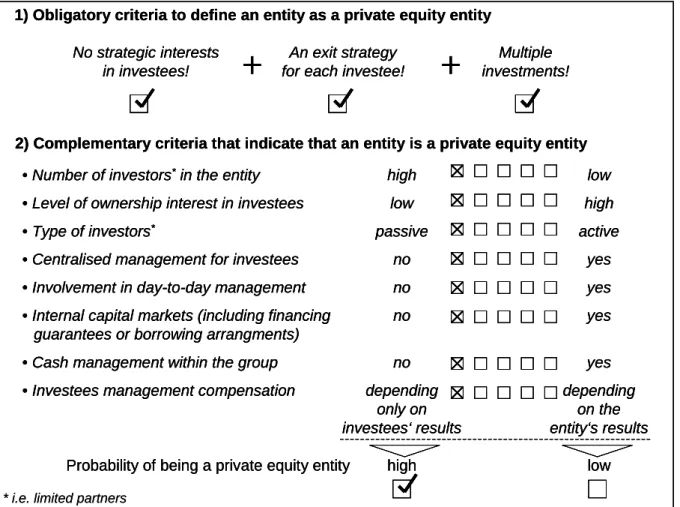
To define a private equity entity different criteria have to be met. A private equity entity has to have: no strategic interest in the investees, an exit strategy for each investment and multiple
Conglomerates and Private Equity Entities: What are the differences? 7
investments. Other criteria only indicate if an entity is a private equity entity. The more of them apply the higher is the probability, that the entity is a private equity entity. These criteria are: the number of investors in the entity, the level of ownership interest in investees, the type of its investors, the existence of any centralized management, the degree of involvement in the day-to-day management of its investees, the existence of an internal capital market or any centralized cash management and the design of the management compensation system. The following chart provides an illustration of the discussion (chapter 8).
1) Obligatory criteria to define an entity as a private equity entity
No strategic interests An exit strategy Multiple in investees! for each investee! investments!
2) Complementary criteria that indicate that an entity is a private equity entity
•Number of investors*in the entity high low
•Level of ownership interest in investees low high
•Type of investors* passive active
•Centralised management for investees no yes
•Involvement in day-to-day management no yes
•Internal capital markets (including financing no yes guarantees or borrowing arrangments)
•Cash management within the group no yes
•Investees management compensation depending depending only on on the investees‘ results entity‘s results
Probability of being a private equity entity high low
+
+
* i.e. limited partners
1) Obligatory criteria to define an entity as a private equity entity
No strategic interests An exit strategy Multiple in investees! for each investee! investments!
2) Complementary criteria that indicate that an entity is a private equity entity
•Number of investors*in the entity high low
•Level of ownership interest in investees low high
•Type of investors* passive active
•Centralised management for investees no yes
•Involvement in day-to-day management no yes
•Internal capital markets (including financing no yes guarantees or borrowing arrangments)
•Cash management within the group no yes
•Investees management compensation depending depending only on on the investees‘ results entity‘s results
Probability of being a private equity entity high low
+
+
1) Obligatory criteria to define an entity as a private equity entity
No strategic interests An exit strategy Multiple in investees! for each investee! investments!
2) Complementary criteria that indicate that an entity is a private equity entity
•Number of investors*in the entity high low
•Level of ownership interest in investees low high
•Type of investors* passive active
•Centralised management for investees no yes
•Involvement in day-to-day management no yes
•Internal capital markets (including financing no yes guarantees or borrowing arrangments)
•Cash management within the group no yes
•Investees management compensation depending depending only on on the investees‘ results entity‘s results
Probability of being a private equity entity high low
+
+
Conglomerates and Private Equity Entities: What are the differences? 8
1
Objectives of the Study
Between private equity entities1and conglomerates many parallels can be drawn. A conglomerate is typically formed when a company invests into another company through an acquisition or when it starts up a new company by itself. Characteristic for a conglomerate is that it consists of two or more separate legal entities which are economically not independent from each other as they are controlled by the same parent company. Similar to conglomerates, it is also the business of private equity entities to invest in other companies. They buy up companies in a wide range of industries and thereby construct large company empires. Private equity managers usually provide advisory support to their so-called portfolio companies and therefore - similar to a conglomerate management - claim that they are able to improve the companies they invest in through superior management. The dimension of the provided management support does not only depend on the economic development of the portfolio companies but also on the strategic orientation of the private equity house.2
Though there are similarities, private equity entities and conglomerates differ in many ways. In this paper, we elaborate these differences in detail. The reason for doing the research has been an issue in accounting practice: Whether private equity portfolio company investments that are subsidiaries of private equity entities should be consolidated or instead be measured at fair value in group accounts had been controversially discussed over the last years. Although industry associations, especially the European Venture Capital & Private Equity Association heavily intervened and brought forward their arguments against this regulation, the IASB as the standard setter for the International Financial Reporting Standards (IFRS) has not yet changed its position.3 Basically, two different lines of argumentation can be identified. The IASB focuses on the ability to control whereas the private equity industry points out the needs of its specific business model.
1
The technical term is venture capital companies and private equity companies (VC/PE companies). For the purpose of this paper we do mean as well private equity as venture capital when we speak of private equity.
2
In the context of this paper we speak of a private equity entity when we do refer to both the investment company (or private equity company or private equity house) and its investees (portfolio companies).
3
See EVCA (2002), pp. 1 et seq; EVCA (2003d); Anonymous author (2003), p. 410; Becker (2004), p. 46. For the position of the IASB see IASB (2002), pp. 8 et seq.
Conglomerates and Private Equity Entities: What are the differences? 9
Conglomerates require a different accounting treatment than economically independent companies. Certain information of the separate financial statements loses its expressiveness in the context of a conglomerate. This can only be compensated through additional regulation, i.e. the obligation to provide consolidated financial statements. As, at first glance, the structure of a private equity entity is very similar to that of a conglomerate an equal treatment of both types seems to be conclusive. Consolidated financial statements would then be obligatory.4
However, this approach fails to account for the significant differences between conglomerates and private equity entities. The obligation for solely financially oriented investment companies to consolidate their balance sheets generates information which is useless in the best case but misleading in the worst case.5
The quality of the debate may benefit from a better understanding of how private equity entities and conglomerates differ.6 The first objective of this paper is therefore to elaborate the differences between conglomerates and private equity entities. We examine the differences among the two business models; then, we analyze the relations of the two entity types to their investors on the one hand and to their investments on the other hand.7
If legislators or regulators decide to grant necessary exceptions to private equity entities the indisputable identification of those becomes a crucial issue. This identification is easy in the case of regulated private equity entities8
and will be indirectly done by the existing legal requirements.9
But the majority of private equity entities is designed beyond legally regulated
4
This opinion is for example put forward by the International Accounting Standards Board (IASB). In the revision of IAS 27 (Consolidated and Separate Financial Statements) published in December 2003 private equity entities are given the same status as conglomerates. In case of a parent-subsidiary relationship, the controlling entity has to prepare consolidated financial statements. According to IAS 27.19 this is explicitly also applicable for private equity entities.
5
Cf. Mueller (2008), p. 166 et seq. These facts are also exemplary shown by a case study of the European Private Equity & Venture Capital Association (EVCA). Cf. EVCA (2003c).
6
For the comparison of both organizational forms see also Baker/Montgomery (1994), Jensen (1989); Cheffins/Armour (2007), pp. 22 et seq.
7
This corresponds to the approach of the US Generally Accepted Accounting Principles (US-GAAP): The American Institute of Certified Public Accountants (AICPA) has published a Statement of Position (SOP Exposure Draft dated 17 December 2002), the aim of which is to define an investment company. It states that an applicable definition was the pre-requisite that investment companies could be exempted from the regulation of the recently enacted FIN 46. Their accounting will then be regulated by the AICPA Audit and Accounting Guide Audits of Investment Companies.
8
In Germany e.g. those of the Unternehmensbeteiligungsgesellschaft and Kapitalanlagegesellschaft.
9
In the proposed Statement of Position of AICPA (cf. fn 2) it is also suggested that already regulated investment companies do not have to furnish any additional proof for their investment activity.
Conglomerates and Private Equity Entities: What are the differences? 10
structures. Therefore, it is necessary to identify and define criteria by which conglomerates and private equity entities can be clearly differentiated. The compilation of a checklist, which summarizes the most important criteria, will be another objective of the following study.
The study is structured as follows: The following second chapter thoroughly defines the terms conglomerate and private equity entity. Then, in chapter three the different business models of the two will be worked out. This will result in significant differences with respect to the investment decisions, an aspect which will be described in more detail in chapter four. Chapter five will pursue the question, what types of linkages exist within conglomerates and within private equity entities. Chapter six analyses the influence, which conglomerates and private equity entities exercise on their investments before chapter seven discusses the resulting risks for shareholders and debtholders. Finally, chapter eight compiles criteria for a checklist by which private equity entities can be clearly identified.
2
Definition of Terms
2.1 Conglomerates
Economically, a conglomerate10
is the pooling of two or more legally independent companies under a common management. The parent exercises control over the subsidiary which usually results from a majority interest of a parent in a subsidiary company which causes the interpretation that both together form an economic entity. However, control can also be agreed upon by contractual agreements.11
The management of the conglomerate is exercised by the parent company.
Depending on the organization of the uniform management and its management characteristics, different types of conglomerates can be identified. In an operational holding, the conglomerate management is not a legally independent entity by itself but the management board of the dominating parent company. Apart from management, administration and financing of the subsidiaries the parent company carries out all important
10
In a narrow sense, a conglomerate is typically a large company that consists of seemingly unrelated business sections. However, we rather refer to it as a legal entity that consists of a parent and at least one subsidiary. Instead of conglomerates one could use the term corporate group, business group or simply group here.
11
Conglomerates and Private Equity Entities: What are the differences? 11
functions to render goods and services, i.e. it is to a considerable extent operational active. The main purpose of the subsidiaries is to complement the production and distribution process of the parent company.
If the conglomerate’s management entity does not carry out any operational tasks by itself and the day-to-day business remains in the hands of the subsidiaries two other types of conglomerates can be identified: the strategic holding and the financial holding. In the case of a strategic holding, the operational units are independent subsidiaries that enjoy a high degree of economic independence. The subsidiaries take responsibility for the day-to-day business. The strategic management of the whole conglomerate and, thus, also of the individual units, is part of the holding. The most vital strategic tasks include the allocation of funds, the decision to buy or sell subsidiaries, the management of the conglomerate’s research & development activities (R&D) and the selection and coaching of executives. As a result the strategic holding stands, as far as the competence areas are concerned, between the operational and the financial holding.
The financial holding holds and manages majority and minority interests. However, it does not carry out any management tasks. The financial holding does not aim to exercise coordinated influence on its subsidiaries but to achieve an optimal return on investment. Linkages among the individual units are not actively prompted by the holding. The conglomerate’s management restricts itself to compose the portfolio of individual businesses and to effectively distribute the available funds among the portfolio companies. Therefore, the main characteristic of a financial holding is the central raising and controlling of both invested capital and liquidity. This is done by using financial planning and controlling systems. 12
If diversification aspects play an important role for the investment selection, the term conglomerate is used. This term refers to heterogeneous conglomerates with no linkages among the group-owned companies. The key idea of a conglomerate is to spread the risk by putting companies together that do their business in different, not related markets. Regarding this, conglomerates correspond in their structure and conduct to financial holdings. Therefore, we will not pursue an in-depth differentiation between the two.
12
Conglomerates and Private Equity Entities: What are the differences? 12
The decision to choose one of the three organizational forms (operational holding, strategic and financial holding) is subject to various considerations. In case of the operational holding and the strategic holding these are for example:
• organizational reasons (definition of management areas, flexibility), • marketing or distribution reasons (development of new markets), • procurement reasons (protection of markets for raw material supply), • growth motives,
• the aim to realize synergies,
• financial reasons (admission of shareholders, liability reasons, support from a strong parent company) and
• political and legal considerations as well as fiscal reasons.
A financial holding aims at capitalizing on the advantages of internal capital markets and the risk balance between investments. Occasionally, fiscal reasons may play a vital role. Theoreti-cally, the aim is to compose and manage a balanced portfolio of investments. In practice, however, financial holdings are rather scarce in Continental Europe.13
The few existing ones tend to be part of an operational or strategic holding and have the purpose to manage the financial investments.
2.2 Private Equity Entity
Private equity entities are professional intermediaries that invest capital provided by outside investors. Normally, they invest in privately owned companies, i.e. non-listed companies with a high growth potential.14 The financed companies profit not only from the chance to raise capital at acceptable costs but also from the management support often provided by the private equity entity (the value added). The outside investors also benefit from the existence of these intermediaries: They get access to an asset class that is normally difficult to access. Hence, they can improve their asset allocation through the diversification of their investments.
13
Cf. Goold/Campbell/Alexander (1994), p. 416.
14
Conglomerates and Private Equity Entities: What are the differences? 13
Secondly, they expect higher returns of the invested companies due to the intense control and management support function.15
Depending on the development stage of the companies in which a private equity entity invests, one can differentiate between venture capital and buyout companies. Venture capital companies primarily invest in newly founded companies in the seed, start-up or expansion phase. Buyout companies invest in more established companies in later development stages.
The term organizational structure of private equity entities refers to the institutional aspects of the relation between investors and private equity entities. Because of the broad universe of different types of private equity entities and the multitude of corresponding national legal regulations, we will only elaborate on those criteria which are important with regard to the organizational structure of private equity entities in practice:
• influence of the investors on the investment policy • type of dominating investor
• type of financial instrument held by the investors • limitation of the volume and life of the investment fund • compensation of the management team
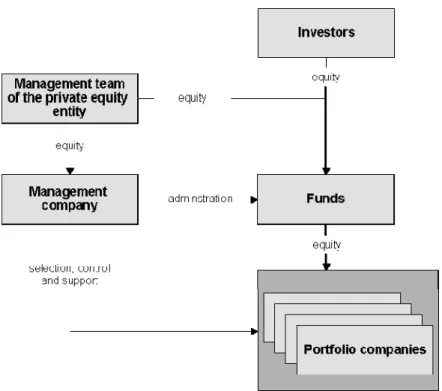
A private equity entity basically consists of two parts: a management company and one or more investment funds.16 The management company is responsible for the selection, control and support of the portfolio companies whereas the investment fund’s function is restricted to the holding of the various portfolio companies.17 This institutional separation between management company and investment fund is industry standard for private equity entities. However, sporadic exceptions can be found in practice.
Basically, it is attempted to structure a private equity entity in a way that double taxation in the form of income and capital gains tax is avoided; on the investment fund as well as on the personal level. Illustration 1 shows the generic structure of a private equity entity.
15
Brav/Gompers (1997), p. 1800 show that companies financed by venture capital realize an excess yield compared to companies not financed by venture capital.
16
Cf. Fenn/Liang/Prowse (1995).
17
Conglomerates and Private Equity Entities: What are the differences? 14
Illustration 1: Generic structure of a private equity entity
Differentiating private equity entities on the basis of how investors influence the investment policy of the fund, one can principally speak of independent and dependent private equity entities.18
An independent company receives capital through the market mechanism, i.e. demand and supply, from a large number of investors.19
Each investor only holds a small part of the capital and therefore cannot directly influence the investment policy.20
The dependent company, in comparison, has capital available due to the hierarchical decision process of the investor which often also holds shares of the management company. As a consequence, he usually can strongly influence the investment policy of the private equity entity.21
If one differentiates the dependent private equity entities by the type of the dominating investor one can differ between the so-called captives and corporate venture capital
18
In practice however, there also is a multitude of hybrid forms. Cf. in this context i.a. Röper (2003), pp. 43 et seq.
19
Typical investors in private equity entities are corporate pension funds, public pension funds, endowments and foundations, bank holding companies; wealthy families and individuals, insurance companies, invest-ment banks; non-financial corporations; private equity holdings of major investor groups. Cf. Fenn/Liang/Prowse (1995).
20
Within a limited partnership this is not only related to the small share but also by the fact that limited partners do not want to be exposed to liabilities.
21
Conglomerates and Private Equity Entities: What are the differences? 15
nies. The captives are exclusively financed by financial service companies, such as banks or insurance companies, and, hence, pursue financial goals.22
In contrast, corporate venture capital companies are financed by non-financial service companies, i.e. industrial companies. Besides financial goals industrial companies mostly also pursue strategic goals with their investments.23
Examples for such goals are the access to new technologies (window on technology), the access to new products and the access to potential takeover candidates.24
Another distinction of private equity entities can be made by the type of financial instruments the investor uses. One can differ between financial instruments traded on public or private capital markets. This ultimately results from the legal form of the investment fund as it will be illustrated using the typical legal forms which exist under German law: the Gesellschaft mit beschränkter Haftung (GmbH, limited liability corporation), the Aktiengesellschaft (AG, stock corporation) and the Kommanditgesellschaft (KG, limited partnership). In case of listed financial instruments, which document the claims to the cash flows generated by investment funds, investors have the advantage of being able to liquidate their claims at any time. Examples of this are the legally grounded Investment Trust in Great Britain and publicly listed investment stock corporations in Germany. Privately held financial instruments, however, are illiquid.
If one differentiates investment funds by limitations of the fund volume and the term of the fund, one can distinguish closed-end funds from open-end funds. In case of closed-end funds the volume of the fund is fixed and the subscription takes place during a certain period of time.25
After the subscription period normally no additional investors can enter. The life of a closed-end fund is normally limited to ten years. Often however, an option to extent the life for up to three years exists.26
The open-end fund in contrast is not fixed in its volume. The investors can invest into the fund at any time and the term of the open-end fund is unlimited. The private equity entity of a listed stock corporation represents a hybrid form. New capital
22
Cf. with regard to the following statements van Osnabrugge/Robinson (2001), p. 25 f.
23
Cf. Working Council for Chief Financial Officers (2000).
24
Cf. Working Council for Chief Financial Officers (2000).
25
Cf. with regard to the following statements Zehmke (1995), p. 25 f.
26
Conglomerates and Private Equity Entities: What are the differences? 16
from investors can only be raised after a resolution of the general meeting by way of a capital increase. The term of the fund is nevertheless unlimited.
The management compensation of the management team of a private equity entity is often divided into an annual fixed payment (management fee) and a single success related bonus (carried interest). The management fee usually ranges from 2.0% to 2.5% p.a. of the fund volume managed.27
This arrangement, however, is not true for all private equity entities. Listed private equity entities can for example receive their compensation from the funds provided by the shareholders. The carried interest from typical investment funds in Europe is almost always 20% of the realized fund return.28 Nevertheless, one should note that this compensation scheme cannot be found in every organizational form of private equity entities. For example, only 43% of all European corporate venture capital companies make use of this incentive compatible compensation.29
The limited partnership is one organization form of investment funds often found in practice. The management company, in form of a limited corporation or stock corporation, functions as a general partner meanwhile the investors only act as limited partners (LP). The owners and the management of the management company are called general partners (GP). Along with the limited partners they also invest in the fund and hold a small limited partner’s interest in the investment fund (typically about 1% of the fund volume).
The analysis in the second chapter revealed that private equity entities show several parallels to conglomerates. However, by focusing on the way both types do their business the differences become evident.
3
Business Model
A business model describes the way by which a company does business and how returns are generated. The business models of conglomerates and private equity entities are 27 Cf. Feinendegen/Schmidt/Wahrenburg (2003), p. 1176. 28 Cf. Feinendegen/Schmidt/Wahrenburg (2003), p. 1176. 29 Cf. EVCA (2003a), p. 14.
Conglomerates and Private Equity Entities: What are the differences? 17
fundamentally different. Firstly, they differ in the aspect how they add value through the holding of subsidiaries or portfolio companies respectively. Secondly - and as a consequence - the type and intensity of the relation among the associated companies is different. Finally, the role of the conglomerate’s parent company and the management company is different.
A conglomerate, with exception of the financial holding, pursues a superior strategic goal with its investment policy. This long-term strategy dominates the entire group and affects the way the business portfolio is built: either by internal (organic) or external growth (acquisitions). All portfolio companies have to promote the global strategy and will be built up, developed or acquired according to the long-term perspective of the group. A conglomerate does not invest in a company to sell it again in the short- or medium-term. Each investment is rather done with the objective to be a permanent asset of the group. This results from the strategic aim of the group to generate synergies in its operative businesses. As the investment period is indefinite, the conglomerate focuses on current income that is distributed by the investment in order to be rewarded for the investment.
Therefore, a conglomerate is more than the sum of its single companies. A whole network of group internal relations and synergies is part of it, i.e. by division of labour, specialization and the economies of scale.30
The associated companies form an economic unit. This view is supported by the fact that various transactions among the legally independent companies of the group are conducted. As a consequence, the splitting off a single unit usually has an effect on the entire conglomerate.31
This perspective of the business model of conglomerates also reflects the valuation practice of financial analysts. They analyse the company value of groups or parts of them on a going concern basis. The question of a possible company value on a sum-of-the parts basis, i.e. as if the single parts were sold separately, is normally only brought up when analysts think that the conglomerate should be broken up. Only in these cases the market values of the constituents of a conglomerate are assessed separately. For the management of a conglomerate, however,
30
Cf. Scheffler (1992), p. 1. A financial holding finally differs due to the lack of a higher strategic goal. However, the financial interests are in line and aim at a permanent creation of value and at a distribution of the current income.
31
Conglomerates and Private Equity Entities: What are the differences? 18
market values of the subsidiaries are only relevant in two cases. In case of a hostile take-over attempt, the management might use the market value to influence the initial take-over-bid. In other cases a conglomerate might decide on its own to either split off a subsidiary or to liquidate the whole group. In all cases strategic considerations play a dominant role. No conglomerate would communicate the assumed market values of its subsidiaries without an actual reason.
In comparison to a conglomerate, a private equity entity follows no strategic interests with its investments.32 The strategic interest of a private equity entity is to generate yields from exercising value adding influence on its various portfolio companies. The private equity entities therefore only have financial interests in their investments and focus on the current value of the portfolio companies.
A private equity house invests, independently of its focus, only temporarily in a portfolio company. It provides capital to the acquired portfolio company to finance for example a growth strategy or a restructuring with the aim of generating additional value at the end of the day. It can be argued that private equity entities can only create additional value through the investing in companies in a certain development stage. Selling the investment is therefore part of the strategy of a private equity entity. The market value or more precisely the capital gain from the investments therefore is where the value added for a private equity house comes from.
Selling the investment is necessary for the commonly structured private equity entities since the capital invested in the fund is only available for a limited period of time. However, exit-orientation is also normal for other investment structures like the evergreen funds or listed private equity entities. Those have less pressure to exit in a pre-defined time period. Nevertheless, the exit is still regularly planned and if it does not occur within a reasonable period of time the primary intention is not met. The exit-strategy is already set forth in the financing contracts at the point of time when the investment is made.33
However, it cannot be determined which exit channel will ultimately be used: either a going public, a trade sale,
32
For the special case of corporate venturers see chapter 5.3.
33
Conglomerates and Private Equity Entities: What are the differences? 19
more rarely a buy back or a secondary sale to a further financial investor. In all cases the planned exit is an integral part of the investment idea; the process is something that both the entrepreneur and the private equity house have to agree on.34
This business model of a private equity entity is also reflected in the way financial analysts value these companies. When analysing listed private equity entities they value the price of the single investments on an exit value basis. This approach is fundamentally different from the way conglomerates are valued. These differences in valuation practices prove again that from the institutional investor’s point of view, different standards are applied to conglomerates and private equity entities.
To sum up, conglomerates and private equity entities have a different business model. Conglomerates invest for strategic reasons with a focus on current income. They integrate the new company and initially plan to hold it for an unlimited period of time. Private equity entities in comparison invest for a limited period of time with solely financial interests. Their investment policies follow a stand-alone-perspective, treating each investment separately from the rest of their portfolios. Private equity entities keep the focus on the capital gain when exiting the investment. The current income of the investment is only of secondary importance.
4
Investment Selection
Depending on the different business model of conglomerates and private equity entities, the selection of subsidiaries or respectively portfolio companies is based on different decision parameters.
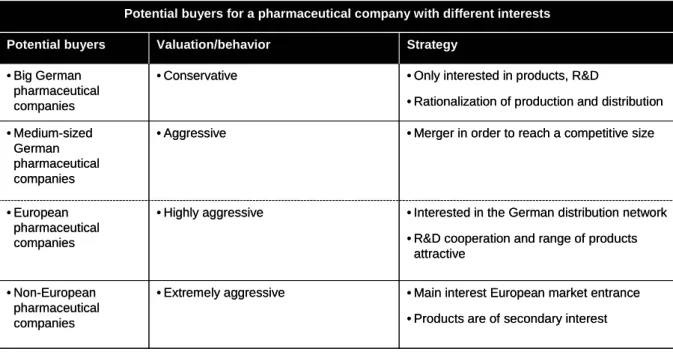
Within conglomerates the selection of subsidiaries is decided by the holding company. It takes its decision on the basis of strategic considerations. The maximum acquisition price the holding is willing to pay depends on the fit of its new investment with the requirements of the group. Illustration 3 visualizes this using an example from the pharmaceutical sector.
34
The guidelines of the European Venture Capital Association (EVCA) explicitly recommend to agree upon the exit strategy with other investors and management prior to the investment. Cf. EVCA (2003b).
Conglomerates and Private Equity Entities: What are the differences? 20
Potential buyers for a pharmaceutical company with different interests
• Interested in the German distribution network • R&D cooperation and range of products
attractive • Highly aggressive
• European pharmaceutical companies
• Only interested in products, R&D
• Rationalization of production and distribution • Conservative
• Big German pharmaceutical companies
• Merger in order to reach a competitive size • Aggressive
• Medium-sized German pharmaceutical companies
• Main interest European market entrance • Products are of secondary interest • Extremely aggressive • Non-European pharmaceutical companies Strategy Valuation/behavior Potential buyers
Potential buyers for a pharmaceutical company with different interests
• Interested in the German distribution network • R&D cooperation and range of products
attractive • Highly aggressive
• European pharmaceutical companies
• Only interested in products, R&D
• Rationalization of production and distribution • Conservative
• Big German pharmaceutical companies
• Merger in order to reach a competitive size • Aggressive
• Medium-sized German pharmaceutical companies
• Main interest European market entrance • Products are of secondary interest • Extremely aggressive • Non-European pharmaceutical companies Strategy Valuation/behavior Potential buyers
Illustration 3: Example of different strategies and resulting valuations (source: Goldman Sachs. Cf. Achleitner, A.-K. (2002b))
The need to bring the new company in line with the strategic objectives of the conglomerate often results in a high ownership interest up to one hundred percent. The ownership stake remains fixed unless an outsider wants to sell shares. A capital increase of the subsidiaries that results in a dilution of the conglomerate’s share will only take place out of strategic interest. Furthermore, it could happen if the strategic interest of the involved parent company has changed. Financial interests in the sense of capital increases only play a role in case of equity carve-outs or subsidiary IPOs. In the first case, public investors can invest a minority stake which is offered via a public share offering. In the latter a majority stake is offered. In both cases a rising degree of independency of the subsidiary from the conglomerate usually precedes the divestment decision. 35
The investee companies are selected according to financial factors only in case of financial holdings. Here, risk and yield considerations play a major role. Moreover, a high ownership interest is not a crucial condition. Consequently, both majority and minority stakes are common.
35
Conglomerates and Private Equity Entities: What are the differences? 21
The conglomerate’s management is autonomous in its investment policy; a formal agreement about the investment policy between the parent company and its investors does not exist. Material decisions, however, could require the approval of the advisory board or the shareholders. This right of the investors depends on national legislation and/or on contractual agreements. It is an instrument to control but does not intend to influence management’s decisions, i.e. which company it should buy, beforehand.
Private equity entities that act upon financial motives have to keep an eye on the yield and risk characteristics of their investments. Additionally, the anticipation of possible exit strategies, which heavily depend on the development of the capital markets, is of major importance. The risk and yield considerations not only come into play for each single investment object but also much more into a portfolio context. The fund’s management could be tempted to excessively increase the investment risk in order to raise the expected returns. A risk increase favors the management because it only holds a very small share of the fund and therefore only has to bear proportionally small losses. However, it substantially participates from the additional chances if one takes the typical carried interest of around 20% of net returns into account.36
Of course, this argument does not take into account that a management’s good reputation is necessary to raise a follow-on fund and that the management’s small share of the fund is relatively important to its private wealth. Nevertheless, investment principles limit the management’s scope of action to guarantee a certain degree of risk diversification for the other investors. Furthermore the management is bound to select investments under qualitative and quantitative criteria.37
These investment principles are an integral part of the contractual agreements between the investors and the management company upon the launch of a new fund.
Diversification according to life cycle stages, industries or geographic location belongs to the qualifying criteria.38
The main idea of diversification is that the correlation between companies of different sectors is smaller than the correlation of companies of the same sector. In spite of the existing diversification potential, a number of private equity houses target only
36
Cf. Möller (2003), p. 217.
37
Cf. in this regard the study by Gompers/Lerner (1996) for the American and Feinendegen/Schmidt/Wahrenburg (2003) for the European venture capital market.
38
Conglomerates and Private Equity Entities: What are the differences? 22
very specific companies for example within one industry. They hope that the disadvantages of a limited diversification are more than offset by the advantages of specialization (e.g. lower transaction costs as costs). Furthermore, through years of experience in one industry sector expertise can be built up. Thus, the search and selection of investments becomes easier and the loss risks can be assessed more accurately.39
In their investment policies private equity entities limit their commitment to a single portfolio company to a certain maximum share, e.g. 10% of the investment volume, right in the beginning; irrespective of whether they have a specialized investment approach or not. Furthermore the number of investments per fund is restricted to a maximum of for example 10-20 portfolio companies. A maximum limit is based on the consideration that the management is only capable of handling a limited number of investments. Otherwise, the investors of a private equity entity aim for a minimum number of portfolio companies to secure sufficient diversification.
Conflicts of interest can arise if a manager is responsible for several funds. The industry associations formulate recommendations in their guidelines to handle such conflicts of interests.40
For example they state that such conflicts should be reported to the investors or that portfolio companies are not allowed to receive capital from more than a single fund managed by the same private equity house.
Finally, the investment guidelines very often limit the scope of the fund managers. They include type of investments that may not be entered into, e.g. investments in other private equity entities, investments in listed instruments, leverage buyouts or possibly foreign investments.41
This is in clear contrast to conglomerates.
Due to these selection principles of private equity entities, the purchase price for an investment can only be determined by applying a stand-alone perspective to the valuation. Without the linkages among invested companies or the existence of synergies, the shown
39
Cf. Bigus (2003), p. 445.
40
Cf. in this connection e.g. the guidelines of EVCA (2003b).
41
Conglomerates and Private Equity Entities: What are the differences? 23
considerations in case of the pharmaceutical companies become useless.42
The few cases where a private equity entity acquires an investment with the prospect to merge it with another portfolio company constitute an exception to this. However, these incidences are either individual cases or can be attributed to the few private equity entities which expressively pursue so-called buy-and-build strategies. The latter are ultimately interested in establishing sector holdings.
In contrast to conglomerates, private equity entities do not regularly see one hundred per cent stakes in their investments as necessary. The substantial participation of the portfolio company’s management may already be a guarantor for value creation potential in the portfolio company. As a consequence, it is necessary for private equity entities to contractually design, when acquiring the investment, the conditions regarding the exit decision. A conglomerate does not have to do that.
Apart from the limits regarding the initial investment in a company, other limits concerning the participation in subsequent capital increases can be found. In the case of venture capital financing the existence of several financing rounds is industry standard, i.e. the capital supply is staggered (so-called staging). On the one hand this staging effectively limits investment risks. Via staging, the private equity house can re-evaluate the information on the portfolio company and the market setting, but also the behaviour of the entrepreneur prior to a new financing round. On the other hand stage financing motivates the entrepreneur to deliver good results by indirectly threatening that the portfolio company might not get further financing otherwise. This procedure also makes sense from the view of the portfolio company: In case of good performance, the valuation of the company will be adjusted and the conditions for raising capital will improve.
The conditions for future financing rounds normally will be tied to the achievement of certain monetary and non-monetary targets. Depending on the achievement of these certain targets, the private equity house’s share of its portfolio company changes. Due to the high uncertainty during the early life stages of the portfolio company the ownership interest of the venture
42
Conglomerates and Private Equity Entities: What are the differences? 24
capital company usually tends to be higher in the beginning than in later stages.43
In contrast to a conglomerate, the ownership interest of a private equity house in its portfolio company varies over time depending on the success of that investment.
The involvement of other investors in the portfolio companies may also be based on financial motives. Sometimes only a joint investment enables the realization of a specific transaction as private equity entities may have constraints on how much how money they can invest in a single company. Syndication may also increase the deal-flow. Other relevant advantages of the syndication of equity financings are both reputation transfer for the portfolio companies and an increase in exit options through a proliferated network.44 This is in contrast to a conglomerate where only strategic considerations dominate and joint investments rarely happen.
Private equity entities hold both, majority and minority stakes. But as discussed above, with subsequent financing rounds the size of the stakes usually diminishes. If two or more investors jointly invest in a company an alignment of their interests is essential. This might be a serious problem for strategically motivated investors. Private equity entities, however, easily achieve an agreement with other financially motivated investors over important issues as the contract regarding a future exit of the investment.
To summarizes, the criteria conglomerates apply to select their investments vary with their strategic alignment. Generally speaking, a conglomerate’s management deliberately chooses the companies it invests in. In contrast managers of private equity entities have to comply with a tight framework that limits the scope of their investments. Often private equity houses decide to make joint investments. If a portfolio company has need for additional funding and the private equity entity could not or would not enlarge its equity stake, it may decide to bring in additional investors. As a result the number of equity holders in a company is likely to increase over time, which may lead to a fragmentation of ownership. In contrast conglomerates are unlikely to involve other investors and thus ownership usually is less diluted. 43 Cf. Kaplan/Strömberg (2003). 44 Cf. Lerner (1994), p. 416.
Conglomerates and Private Equity Entities: What are the differences? 25
5
Intra-Group Linkages
As a result of the different business models of conglomerates and private equity entities the relationships among the individual associated companies deviate. The implementation of strategic goals of a conglomerate can only be realized when intra-group linkages are actively promoted. This has to happen on the one hand between the holding and the subsidiaries, and on the other hand between the subsidiaries themselves. However, as will be shown, these linkages create new forms of risks within a conglomerate.
Principally, two basic types of linkages can be differentiated: Linkages between subsidiaries may be called horizontal linkages. They exist at the operational holding as well as at the strategic holding, but not at the financial holding. The linkages between a holding and its subsidiaries are called vertical linkages. These have to be further differentiated according to the holding’s management function, which will be discussed in detail in chapter 6. Fundamentally, capital linkages in form of equity or borrowed capital and operative linkages in form of goods and services links can be differentiated. Illustration 4 provides an overview.
Conglomerates and Private Equity Entities: What are the differences? 26
Trade Group
Private Equity Group
Parent
S
S
S
PE-Fund
PC
PC
PC
Capital linkages (including possible financing guarantees or borrowing arrangements) Goods and services linkages
S = Subsidiaries PC = Portfolio companies
Trade Group
Private Equity Group
Parent
S
S
S
PE-Fund
PC
PC
PC
Capital linkages (including possible financing guarantees or borrowing arrangements) Goods and services linkages
S = Subsidiaries PC = Portfolio companies
Conglomerate
Private equity entity
Illustration 4: Horizontal and vertical linkages
5.1 Capital Linkages
The allocation of financial resources is the central coordination instrument of all conglomerates: the operational, strategic and financial holding. On the basis of a finance and investment strategy capital and liquidity is distributed from the parent company to the subsidiaries. Hence, the subsidiaries are in competition with each other.
The so-called internal capital market is a typical attribute of a conglomerate. The subsidiaries are provided with equity capital. Cash flows from the subsidiaries can then be used to finance other businesses of the conglomerate which might possess a more promising growth potential. Financing using the internal capital market is principally preferred to external financing. Firstly, managers of a conglomerate are supposed to possess superior knowledge about the prospects of the different companies than external investors and, secondly, the transaction costs of a subsidiary IPO can be avoided. However, the capital market rarely honours this theoretically supposed benefit by higher share prices.45
One possible explanation for this might be that internal capital markets do not function like real markets; they rather operate
45
According to a study, the average valuation markdown of a conglomerate on the capital market
(conglomerate discount) as compared to the individual valuation of the group companies amounts to 12 to 15%. Cf. Berger/Ofek (1995).
Conglomerates and Private Equity Entities: What are the differences? 27
like a mixture of central planning and company internal negotiations. Moreover, political decisions on the holding level might bias a fair competition among the subsidiaries.
External financing means funds provided to a company by third parties. Through the use of an internal capital market the conglomerate has, compared to individual companies, the possibility of an intra-group external financing. This means that each single company has access to capital from any of the conglomerate’s companies. In addition to any external financing partner outside of the group (i.e. banks), all the conglomerate’s companies are potential financing partners. This mentioned intra-group external financing can be equity as well as debt financing (inter-company loans).46
Additionally, cash management is an important short-term financial control instrument in a conglomerate. This should safeguard liquidity and increase profitability. A group wide cash management can be divided into the group clearing, where mutual receivables and liabilities of the group companies are balanced, and the cash pooling. The latter coordinates the short-term liquidity excesses and shortages of each single subsidiary in a central place. Thus, the liquidity excess of one subsidiary is withdrawn centrally and made available to another subsidiary.
A private equity entity neither has an internal capital market nor a central cash management. The private equity house invests with equity capital in the portfolio companies.47
There are usually no financial links between the individual portfolio companies. The individual portfolio companies finance themselves through loans or additional external equity.48
46
Cf. Theisen (2000), p. 460.
47
European venture capital financiers use classic equity in less than 60% of all cases, but also other mezzanine forms, such as preferential shares (25%), convertible bonds (10%) or classic debt (5%). Cf. Bottazzi/Da Rin/Hellmann (2004), p. 17.
48
KOHLBERG KRAVIS ROBERTS & CO., one of the best-known US private equity entities, pointedly formulates this as follows: "KKR operates as an investment firm, not as a conglomerate or a holding company. Each company in our portfolio is independently managed and financed. Each has its own board of directors, which includes KKR representatives. There are no cross-holdings. Cash flow from one company cannot be used in another company." Cf. in this context the internet pages of Kohlberg Kravis Roberts & Co.: www.kkr.com (15/12/2003).
Conglomerates and Private Equity Entities: What are the differences? 28
The investors of private equity entities commonly prevent the development of internal capital markets. Many contracts stipulate that proceeds from disinvestment of a portfolio company as well as returns from probable profit distribution have to be returned to the investors and cannot be reinvested.49
This is especially true for term limited funds.
Most agreements with investors constitute, that the private equity entities are not allowed to raise additional debt capital on the fund level.50
Otherwise, the management of private equity entities might be induced to excessively increase the risk for the investors because of the agency problems outlined in chapter 4. This regulation is not applicable for conglomerates. The stand-alone treatment of each portfolio company in a private equity entity also ensures that one portfolio company does not bail for or serves as collateral for credits of another portfolio companies. This is common practise in conglomerates.
It can be summarized that conglomerates regularly have internal capital markets. Their financial resources are centrally planned and allocate; cash or liquidity is centrally managed and controlled. Private equity entities in contrast do not have an internal capital market. There are neither mutual participations, meaning that no portfolio company invests in another portfolio company, nor is free cash flow allocated group-wide. There is no shared liquidity planning across the portfolio companies.
5.2 Goods and Services Linkages
The operational and strategic holdings are characterized by internal goods and services links. At operational holdings these links exist between the parent company and the subsidiaries. Strategic holdings only have links among their subsidiaries due to the lack of operational activity by the management company. The financial holding by definition totally lacks goods and services linkages, and if they happen, they are not centrally organized.
49
Gompers, P./Lerner, J. (1996) for example confirm that this clause was contained in more than 35% of the contracts between investors and private equity entities examined by them in the USA in the period of time from 1988-92. Feinendegen/Schmidt/Wahrenburg (2003) show that this clause can be found also in about 30% of the European contracts examined by them. Moreover, our discussion partners have confirmed this.
50
This is true for over 90% of US and over 65% of European partnership agreements. Cf. Gompers, P./Lerner, J. (1996) and Feinendegen, S./Schmidt, D./Wahrenburg, M (2003).
Conglomerates and Private Equity Entities: What are the differences? 29
Examples for goods and services linkages are the supply of goods, semi-finished goods and manufactured goods, the rendering of services, the transfer and sale of fixed assets, patents, licences, coordination and control services and even joint research & development activities.51
If a transaction between the subsidiaries of a conglomerate takes places, fictitious - fiscally reasonable - transfer prices are to be assessed. These transfer prices must bear up against the dealing at arm’s length principle whereby one has to distinguish between effective and hypothetical dealings. Often, no comparable transactions exist for the goods and services linkages of subsidiaries. Therefore, standard methods based on the dealing at arm’s length principle have to be used. These include the methods of price comparison, re-sale and cost mark-up. In practice the standard cost mark-up and the price comparison method dominate.
The transfer price policy of a conglomerate focuses on a possible reallocation of earnings from a financial and fiscal point of view. The transfer of earnings in low-tax countries is of special importance. However, numerous linkages among the subsidiaries and a central group policy have to exist in order to facilitate the shifting of earnings into another country. As a result operational and strategic holdings can optimize net profits via an adequate transfer price policy. Furthermore, the holding often uses the transfer prices to manage and to control its subsidiaries.
Private equity entities express their merely financial interest in the individual portfolio companies and their independence through the fact that goods and services linkages are generally rare. There are no regular shared services like purchase, administration or legal advice rendered. An exception to this is the special form of so-called networked incubators.52
Horizontal goods and services linkages on the portfolio level are possible, but the turnover seldom reaches a significant dimension.
If in individual cases portfolio companies render services to each other, the private equity entity only establishes the contact. The transactions among the involved portfolio companies will be negotiated without any influence of the private equity house. The price corresponds to
51
Cf. Meichelbeck (1997), p. 69.
52
Conglomerates and Private Equity Entities: What are the differences? 30
the market price for at least two reasons. Firstly, the management teams of the portfolio companies would not approve a disadvantageous transaction for the benefit of a higher profit for the entire group because they usually own substantial shares of their portfolio companies. Secondly, the private equity house would not enforce its control possibilites for reasons of reputation. The damage to its image, by acting against the interests of a portfolio company would be fatal and would make the search for new investments extremely difficult.
As a consequence, the private equity entity’s exit from one of its investments does not affect the other portfolio companies due to the lack of these linkages. This is necessary because the private equity houses plan, as described previously, their exit when entering into an investment. The only possible linkages can be continued without any restrictions and at the same conditions after the divestment of the private equity house.
There are multiple transactions going on between members of a conglomerate. Unless they are a financial holding, conglomerates show varied horizontal and vertical goods and services linkages. The conditions of these transactions are not always transparent for an outsider. Up to a certain degree they can be influenced by the conglomerate’s management. In private equity entities goods and services linkages are rare. If any transactions happen they are done at market prices.
5.3 Special Case: Corporate Venturers
The so-called corporate venture capital companies are a special type of private equity entities. They are often set up and/or funded by corporates with a strategic objective (window on technology). However, it has to be mentioned that not all private equity entities receiving capital from just one industrial company have to be automatically corporate venture capital companies. Decisive criterion is rather the underlying motive for the disposal of capital. In practice both can be found: Corporate venturers that invest with a strategic focus and others that invest solely with a financial focus. The latter act as far as the objective of this paper is concerned just like ordinary private equity entities.
At corporate venture capital companies, goods and services linkages among portfolio companies occur more frequently due to the strategic proximity of the portfolio companies and their corporate investor. Whether these linkages are priced at arm’s length depends on the
Conglomerates and Private Equity Entities: What are the differences? 31
holding’s influence on the portfolio company and the strategic orientation of the corporate venture capital company.
Corporate venturers commonly invest in both majority as well as minority stakes. Their strategic interest to control the portfolio company is rarely alignable with the interests of other investors. Nevertheless, they do syndicate their inves