IJREAT International Journal of Research in Engineering & Advanced Technology, Volume 1, Issue 5, Oct-Nov, 2013 ISSN: 2320 - 8791
www.ijreat.org
www.ijreat.org
Published by: PIONEER RESEARCH & DEVELOPMENT GROUP (www.prdg.org) 1
An ABC
An ABC
An ABC
An ABC----Analysis
Analysis
Analysis
Analysis ffffor
or
or
or tttthe Multiple
he Multiple
he Multiple
he Multiple---- Products Inventory
Products Inventory
Products Inventory
Products Inventory
Management
Management
Management
Management ---- Case Study
Case Study
Case Study
Case Study o
o
of
o
f
f Scooters India Limited
f
Scooters India Limited
Scooters India Limited
Scooters India Limited
Pramod Kumar
1, Mohd. Anas
21 P.G. Student, Integral University Lucknow -226026, Uttar Pradesh, India
2 Department of Mechanical Engineering, Integral University Lucknow -226026, Uttar Pradesh, India
Abstract : Inventory constitutes the most significant part of current assets of larger majority of Indian manufacturing industries. The main objective of this study is to determine whether or not multiple-products in the Manufacturing company can be evaluated and understood using inventory management techniques. The study is considered as qualitative single-case study.The study method employed includes ABC-analysis. Data collection is mainly through the interviews with the manager and other staff involved in inventory control operations. Secondary data is obtained from the information system to provide the annual reports, sales report, purchasing report of the company and the related journals.
The answer to the fundamental question of how best an organization handles inventories , is provided for the analysis and findings of the study. Good quantity, quality and timing of material are recommended in this research paper.
Key Words: multiple-Products, ABC- analysis, inventories, manufacturing
1
.Introduction
Inventory management is significant for effective and efficient organization. It is also important in the control of inventories that have to be stored for later use in case of production. According to S. L. Adeyemi and A. O. Salami (2010) , the principal goal of inventory management involves having to balance the conflicting economics of not wanting to hold too much stock. Inventory management is the activity involved in developing and managing the inventory levels of raw materials, semi-finished materials (work-in-process) and finished goods so that adequate supplies are available and the costs of over or under stocks are low. In a manufacturing system, even for a very complicate and flexible process of different
products, the physical arrangement and capabilities of machines usually determines, how production control should operate. The machines are not specified only for one task and the different tools need to be set up every time when the work changes. According to some research (Arnold, et al. 2008), they mentioned about the four main manufacturing strategies that were using in manufacturing such as: make-to-stock ,deliver-from- stock, make-to-order, and assemble-to-order. All the strategies are supposed to optimize the total production cost of inventory control system.
The studied Company , Scooters India Limited (SIL), Lucknow is a public sector undertaking. Sometime, the company does not produce the products on time. It also makes more parts damage and reduced company’s revenue.It was observed that company does not always adopt Inventory optimization model to evaluate their inventory using raw materials and finished products as a parameter for measurement. SIL's net loss (before tax) stood at about Rs 20 crore during the year 2011-12 fiscal.This paper intends to discuss the production control technique for a small manufacturing company by using the ABC analysis to promote a better material management policy that would affect the company’s profit.
Following are the objectives of this research
a) To describe the inventory management procedures currently used in Scooters India Limited (SIL), Lucknow .
b) To determine whether or not inventory management in Scooters India Limited , can be evaluated and understood using ABC-analysis in inventory management and,
c) To determine the optimality in the company inventory policies.
The research is quiet significant in following areas ; a) It will be vital to the management of Scooters India
Limited to improve the quality of inventory management system effectively .
b) It will benefit the management of Scooters India Limited to employ efficient/competent personnel in proper inventory management.
c) It will benefit other companies from different methods of managing inventory levels.
d) To act as a ground for the future scholars or academics in future research in the field of improving inventory management.
2. Literature Review
It is possible to utilize the concept of ABC model in formation of rational inventory policy which should give the best possible service level to production while minimizing investment costs (Fuller, 2000) .ABC analysis tends to measure the significance of each item of inventory in terms of value. According to Onwubolu and Dube (2006), when ABC analysis is applied to an inventory situation, it shows the importance of items and level of control placed on the items.
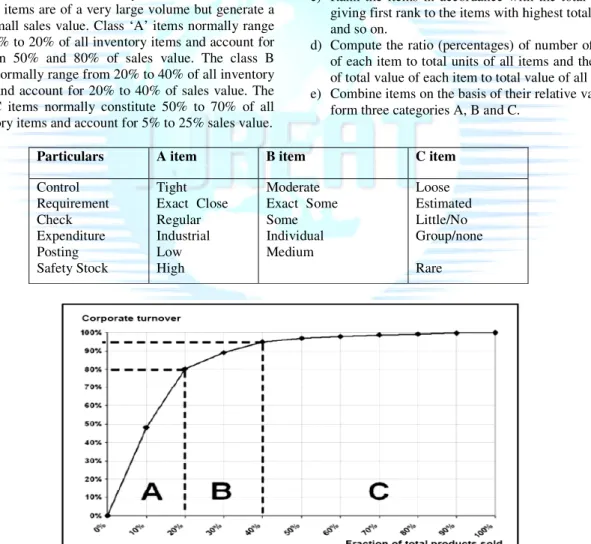
ABC classification is a method of classifying inventory items according to the money value to a firm. Class A items though smaller volumes but tends to generate higher sales value followed by the class B items. The class C items are of a very large volume but generate a very small sales value. Class ‘A’ items normally range from 5% to 20% of all inventory items and account for between 50% and 80% of sales value. The class B items normally range from 20% to 40% of all inventory items and account for 20% to 40% of sales value. The class C items normally constitute 50% to 70% of all inventory items and account for 5% to 25% sales va
Particulars A item Control Requirement Check Expenditure Posting Safety Stock Tight Exact Close Regular Industrial Low High Figure 1 Source : Wannenwetsch (
www.ijreat.org
It is possible to utilize the concept of ABC model in ry policy which should give the best possible service level to production while minimizing investment costs (Fuller, 2000) .ABC analysis tends to measure the significance of each item According to Onwubolu hen ABC analysis is applied to an ventory situation, it shows the importance of items ABC classification is a method of classifying inventory items according to the money value to a firm. Class A aller volumes but tends to generate higher sales value followed by the class B items. The class C items are of a very large volume but generate a items normally range from 5% to 20% of all inventory items and account for etween 50% and 80% of sales value. The class B items normally range from 20% to 40% of all inventory items and account for 20% to 40% of sales value. The class C items normally constitute 50% to 70% of all inventory items and account for 5% to 25% sales value.
Fitzsimmons (2004) ,Winston (1994) and Tanwari,
al. (2000) reported that is the basis for material management processes and help to define how stock is managed and is an appropriate technique for classifying inventory items according to the importance of their contribution to the annual cost of the entire
system.
Steps for implementation of ABC analysis are ,
a) Classify the items of inventories determining the expected use in units and the price per unit for each item.
b) Determine the total value for each item by multiplying the expected units by its unit price. c) Rank the items in accordance with the total value,
giving first rank to the items with highest total value and so on.
d) Compute the ratio (percentages) of number of units of each item to total units of all items and the ratio of total value of each item to total value of all items. e) Combine items on the basis of their relative value to
form three categories A, B and C.
B item C item Close Regular Industrial Moderate Exact Some Some Individual Medium Loose Estimated Little/No Group/none Rare
Figure 1- Presentation of ABC- Analysis , Source : Wannenwetsch (2006)
2.1 Advantages of ABC Analysis
a) It ensures a closer and a more strict control over such items, which have high investment .
Fitzsimmons (2004) ,Winston (1994) and Tanwari, et
. (2000) reported that is the basis for material management processes and help to define how stock is managed and is an appropriate technique for classifying inventory items according to the importance of their contribution to the annual cost of the entire inventory implementation of ABC analysis Classify the items of inventories determining the expected use in units and the price per unit for each Determine the total value for each item by
ected units by its unit price. Rank the items in accordance with the total value, giving first rank to the items with highest total value Compute the ratio (percentages) of number of units of each item to total units of all items and the ratio f total value of each item to total value of all items. Combine items on the basis of their relative value to
Advantages of ABC Analysis :
It ensures a closer and a more strict control over have high investment .
IJREAT International Journal of Research in Engineering & Advanced Technology, Volume 1, Issue 5, Oct-Nov, 2013 ISSN: 2320 - 8791
www.ijreat.org
www.ijreat.org
Published by: PIONEER RESEARCH & DEVELOPMENT GROUP (www.prdg.org) 3 b) It releases working capital, which would otherwise
have been locked up for a more profitable channel of investment.
c) It reduces inventory-carrying cost.
d) It enables the relaxation of control for the ‘C’ items and thus makes it possible for a sufficient buffer stock to be created.
3. Methodology
Research methodology represents the strategies involved in collecting and analyzing data . This section attempts to give a direction and manner for research work . This includes the mode of data collection, analysis and the research design.
3.1 Case Study Strategy
Robson (2002) defines case study as ‘a strategy for doing research which involves an empirical investigation of a particular contemporary phenomenon within its real life context using multiple sources of evidence’ .The researcher must be alert to the need for
multiple sources of evidence. ‘All evidence is of some use to the case study researcher: nothing is turned away.’ But this does not mean that it should talk to a lot of different people, but it needs to look for kinds of evidence: what people say, what they are doing, what they are making or producing, what documents and records show.
For research project, current situation of inventory management in Scooters India Limited ,Lucknow was investigated by using multiple sources of evidence, for instance, the interviews with the manager and other related staff at Scooters India Limited, Lucknow . Direct observation on warehousing operation was also conducted.
There are two major types of case study, single-case study and multiple-case study. According to Yin (2003) , ‘Single-case study is similar to a single experiment, and many of such conditions that justify a single experiment also justify a single-case study.’ Compared with single-case study, multiple cases’ evidence is often considered more compelling and the overall study is regarded as being more robust.
Single-case study approach was used to conduct the research project at Scooters India Limited (SIL) ,Lucknow. Single-case study strategy helped to understand the research context and acquire deep understanding about specific management issues.
3.2 Methods of Data collection
Primary and secondary sources provided essential information for this research work . These sources include:
a) Interview with some key personnel in the stores, purchasing, production and inventory departments of the company.
b) Observation of the production process was done to see the flow of goods in the conversion process. Materials handling and storage were also observed and so was the patrol /inspection procedures. c) Record analysis of relevant data was obtained from
the annual reports, product catalogue , sales reports, purchasing reports of the company and the related journals.
d) Theoretical background information was gathered through review of related literature on ABC-model..
e) E-mails were also used to send out questions and get responses.
4. Data Presentation, Analysis and
Findings
4.1 Inventory sales and management of
Scooters India Limited (SIL), Lucknow : A
case study
Scooters India Limited (SIL) is a small manufacturer in Lucknow . The company is an ISO 9001:2000 and ISO:14001 Company. The company is principally engaged in the business of manufacturing and sale of motor vehicles and spare-parts (Automobile). It designs, developes, manufactures and market a range of conventional and non-conventional fuel driven three-wheelers.
The company manufactures various models of 3-wheelers as both passengers and load carrier versions.There is a manufacturing plant of company at Lucknow . It has own marketing network of Regional Sales offices to fulfill customer's requirements in the areas of sales and services. a) Three-wheelers
The company make various types of three -wheelers, which includes Vikram 410G, Vikram 450D, Vikram 600G, Vikram 750D, Vikram 750D (WC) and Vikram EV. Vikram EV is an electrical three wheeler. These products are designed for local transportation. b) Spares
c) Petrol, Diesel and Lubricants
4.2 Policies & Objectives
Policies :
a) To improve the performance of the company so as to be competitive and profitable through constantly improving existing products, adding new products and expanding customer base.
b) To fulfill customers' needs for economic and safe mode of road transport and quality engineering products through contemporary technologies.
www.ijreat.org
Objectives :
a) To achieve 10% increase in production. b) To achieve 5% decrease in cost.
c) Rationalization of Manpower. d) To reduce energy input .
Analysis :
Table -1. ABC-classification of Multiple-Products in Company SIL
Source : Sales Report & End -selling price (SIL, 2012) Item
No. .
Product list Annual demand
Unit cost (Rupees) Annual Cost (Rupees in Million) Total annual Cost ( Rupees in Million) Region No. sold
1 2 3 4 5 750 DAC 450 DHB 450 DSTG 1500 CG 1000 CG CR NR ER WR SR CR NR ER WR SR CR NR ER WR SR CR NR NR WR 4553 1492 99 21 34 2645 1340 36 2332 50 1937 651 76 467 145 436 323 900 5 147671.94 148789.08 153699.31 147527.94 150967.58 114942.76 115408.72 111546.05 114894.76 111087.85 122834.77 123782.68 117389.75 122786.77 115847.16 184481.26 181983.72 128185.50 128611.21 672.35 221.99 15.22 3.10 5.13 304.02 154.65 4.02 267.93 5.55 237.93 80.58 8.92 57.34 16.80 80.43 58.78 115.37 0.64 917.79 736.17 401.57 139.21 116.01
No Product list Annual (No.)
demand 147 Unit cost (Rupees) Annual Cost ( Rupees in Million) Total Aannual cost ( Rupees in Million) 6 7 Spare parts Petrol,Diesel and Lubricant ___ ___ ___ ___ 65.44 136.41 65.44 136.41 Total 2512.6
IJREAT International Journal of Research in Engineering & Advanced Technology, Volume 1, Issue 5, Oct-Nov, 2013 ISSN: 2320 - 8791
www.ijreat.org
www.ijreat.org
Published by: PIONEER RESEARCH & DEVELOPMENT GROUP (www.prdg.org) 5 Table-2
Table-3 ABC classification
Category Items No Product list
Approximate percentage of items (%) Percentage usage (%) Action A B C 1,2 3,4 7,5,6 750 DAC, 450 DHB 450 DSTG, 1500CG (Petrol, Diesel and Lubricant),1000 CG Spare parts 30 % 30 % 40 % 65.83 % 21.52 % 12.65 % Close control Regular review Infrequent review
In accordance with the real situation of the sampled seven products in SIL, 30-30-40 classification was established as percentage of the products as shown in Table 3 .
Findings
Our analysis shows that company follows the ABC analysis for multiple- products. It was observed that
there is no relation between annual demand and total costs of the products . An inventory model based on projected sales, lead times and stock holding costs has not been established.
Item No
Product list Annual demand Cumulative % of items Annual Cost (Million Rupees) Percentage in total usage (%) Cumulative % of total usage 1 2 3 4 7 5 6 750 DAC 450 DHB 450 DSTG 1500 CG Petrol, Diesel and Lubricant 1000 CG Spare parts 6230 6403 3276 759 __ 905 __ 14 % 29 % 42 % 56 % 71 % 84 % 100 % 917.79 736.17 401.57 139.21 136.41 116.01 65.44 36.53 % 29.30 % 15.98 % 5.54 % 5.43 % 4.62 % 2.60 % 36.53 % 6 65.83 % 81.81 % 87.35 % 92.78 % 97.40 % 100 % Total annual cost 2512.60
www.ijreat.org
Conclusions
Company have problems in procurement and handling of raw materials not for finished products. Our analysis makes a contribution to the management of inventory in the company .It also developes an approach if adopted by company, would result in more efficient utilization of financial resources for finished inventories.
The study thus suggests some recommendations to improve certain things in the company inventory policy. If these recommendations are considered, the company's inventory management situation will rise a lot .
a)
Review of stock-levels
–There is no guarantee of future performance by following past results . However, “A” items have greater impact on projected investment and purchasing capacity, and therefore should be managed most in terms of minimum and maximum inventory levels.b)
Cycle counting –
For higher usable items , there is more possibility in inventory errors. Therefore higher priority items are cycle counted more frequently to ensure accurate record balances .c)
Identifying
items
for
potential
consignment –
Since “A” items tend to have a greater impact on investment, these would be the best inventories to investigate the potential for alternative stocking arrangements that would reduce investment liability and associated carrying costs.References
[1] Muller, Max. “Essentials of inventory management” , Amacom books, New York, 2003. [2] S. L. Adeyemi and A. O. Salami, “Inventory
Management: A Tool of Optimizing Resources in a manufacturing Industry -A Case Study of Coca-Cola Bottling Company, Ilorin Plant”, J Soc. Sci, Kamla-Raj,vol.2, 2010, pp 135-142 .
[3] Lining Bai and Ying Zhong, “Improving Inventory Management in Small Business: A Case Study”, Master Thesis, Jonkoping University, Sweden, 2008 .
[4] Wei-Zhen Chen, Lon-Chen Hung and Shih-Sen Peng . “An ABC Analysis Model for the Multiple Products Inventory Control - A Case Study of Company X ”,Proceedings of the Asia Pacific Industrial Engineering & Management Systems Conference, 2012, pp 495-503.
[5] Githendu David , Onserio Nyamwange and Ernest Akelo (2008) , “ Inventory management by
Simulation analysis – A case study of a Water Engineering Company”, Available : http://orsea.net/pastpapers, 2013, July 22 .
[6] A. Sahay and Sanjay Mohapatra (2001) , “Technology as A Tool for Turn around: A Case Case of Scooter India Limited”, Journal of Case Research ,Volume III ,Issue 1, pp 1-31.
[7] Krishna Kumar and Ritu Srivastava (2001) , “Management Case-Scooters India Limited”, Journal of DSpace at Indian Institute of Management, Kozhikode ,Vol. 26, No. 2, pp 1-14. [8] Scooters India Limited (SIL),2013, Sales report
(2011-12) ,Reference Manual and End-selling price (2012), Lucknow .
[9] Wannenwetsch (2006) , “ABC-analysis”, Available : http://johanneswoe.wordpress.com , 2013, August 16.