CLASSIFYING GOODS AND SERVICES
Ron Fisher, Department of Management, Griffith University, Gold Coast, Qld 4224 (617) 55529022, [email protected]
Rod Gapp, Department of Management, Griffith University, Gold Coast, Qld 4224 (617) 55528767, [email protected]
ABSTRACT
This paper reviews previous attempts to classify goods and services, in particular attempts at classification based on traditional manufacturing approaches. The research considers ways in which goods and services tasks may be hypothesized as “ideal types” when classified on a series of common dimensions. Goods and services tasks are mapped as ideal types on a framework using eight key dimensions, which are presented diagrammatically. The theoretical model developed in this research enables bundles of goods and services to be considered in terms of the attributes which they display. Use of the model is shown by two examples; the first considers the bundle of goods and services present in a restaurant meal; the second is based on the bundle of goods and services present in the manufacture of metal containers and shelving. The theoretical model developed in this paper provides utility in clarifying the composition of products containing a mixture of goods and services.
Key words: Goods, services, products, theoretical model, bundles INTRODUCTION
Attempts to classify goods and services have continued for more than 30 years. Early attempts at classification have been reviewed by Silvestro, Fitzgerald and Johnston [1] with a particular focus on considering services within a framework of manufacturing processes. One such approach [2] has attempted to align services with traditional types of manufacturing operations (e.g. management development aligned with job shop, preparation in fast food restaurants aligned with a production line etc). While it may be intuitively appealing to attempt to use the existing manufacturing framework to classify services, this approach has attracted criticism from two main areas. Firstly, criticism has been leveled on the grounds that using the manufacturing framework does not allow for the variability present in services as a result of the presence of the customer within, or in close proximity to, service processes [3]. Secondly, there is no service analogue for the manufacturing classification of continuous processing [1].
Given the perceived problematic nature of aligning services with manufacturing processes, other approaches to classification have been proposed [1]. These include levels of customer contact [4, 5], a focus on people and equipment [6], degree of customization [7, 8], use of judgment in dealing with customers [9], locus of value adding activities [10] and control mechanisms [8]. Further attempts to differentiate goods from services along the lines of mechanistic versus organic [11], degree of labor intensity [12] and divergence [13] have been made. However, attempts have failed to provide a model that compares with the robust, ubiquitous nature of the model of the production of physical products based on the five manufacturing processes [1].
In an attempt to address the deficiencies of previous approaches, Silvestro et al., [1] have proposed a typology that evaluates six generic dimensions (people/equipment, contact time,
customization, discretion, front/back office and process/product) in the context of three service types (professional services, service shop, and mass services). Typically, professional services experience relatively few transactions (e.g. management consultants), mass services many transactions (e.g. transport), with service shop (e.g. hotels) falling somewhere in between [1]. However, Silvestro et al.’s [1] typology only partly addresses the issues of customer proximity and continuous processing inherent in attempts to typify services in a manufacturing context. Building on the work of Gronroos [14], other research [15] have proposed an “ideal type” model [16] that differentiated tasks associated with goods and services on six key dimensions. Timo and Fisher’s [15] model provided an alternative means of classification to the traditional manufacturing model.
Some researchers [e.g. 17, 18] have suggested that businesses actually combine both manufacturing and service characteristics to offer a bundle of goods and services to customers as a complete offering . The degree of completeness of the offering relates to how well customer problems are addressed [19]. Complete offerings leave no work to be done by the customer, while incomplete offerings leave some measure of work to be done [19]. Recent research [20] has suggested that customers seek services that provide value rather than individual goods or services. Businesses now compete by providing integrated solutions rather than stand-alone products or services [21]. Integrated solutions are intended to enhance customer value by a change of focus away from the functionality of products themselves to the actual outcomes sought by customers [22]. Businesses moving from being predominantly product-based to offering integrated solutions can benefit from revenues that are 10-30 times the value of new product sales [21]. However, adopting integrated solutions presents challenges for businesses, with tension between maintaining traditional strengths while building capabilities to integrate products and services [21]. Challenges include the need to develop capabilities in the areas of systems design, maintenance and renovation throughout the product life cycle; consultancy through advice to customers; and the management of assets. Windahl and Lakemond [23] have identified an extended set of capabilities that businesses need to embrace as they move from single-item transactions towards long-term relationships with customers. Capabilities include a customer orientation based on what is the best solution for the customer, rather than what is the best product; operational services; financial services; and business consulting [23]. Other research [24] has indicated that new competencies and capabilities needed for integrated solutions include operational competence (i.e. maintaining, financing, renovating and operating systems for the whole life cycle), customer support through consultancy, and partnership competence (i.e. partnership and alliance building with customers and other suppliers).
Increasingly, authors [e.g. 25, 26] are suggesting that the distinction between goods and services is redundant, with customers buying trouble-free guaranteed business solutions [21] rather than physical products or services. The argument is that customers have little interest in whether their business solution is classified as a service or product, as long as it delivers value. The corollary to this is that there is now little need for businesses to be concerned with distinctions between goods and services either. The authors of this paper suggest that even if the classification of goods and services is not important from the customers’ perspective, it is arguably more important than it has ever been for businesses to understand clearly how the integrated solutions they offer are constituted, given the compelling need to develop new competencies and capabilities, most of which are service oriented. A further justification for the need to develop new models to establish how competencies could be established or acquired is provided by Windahl et al. [24, p. 227] who argue that these “…are essential to enable capital goods manufacturers to charge for the knowledge and ‘invisible’ values created
for customers…”. Identifying how integrated solutions are constituted, based on the mix of goods and services, is the first stage in understanding what competencies need to be developed or acquired.
The purpose of this paper is to propose a theoretical model of classifying goods and services based on eight characteristics of product types. In order to show how the model may be used, it is applied to two products which are bundles of goods and services. Testing the model with extensive empirical data is not the focus of the paper.
DEVELOPING A MODEL TO CLASSIFY GOODS AND SERVICES
The model to classify goods and services developed by the authors is based on a conceptual task-based model originally proposed by Silvestro et al., (1992) and further developed by Timo and Fisher [15]. The original model was based on several main dimensions distilled from the work of Mills and Moberg [27], Snyder, Cox and Jesse [28], and Littler [29, 30]. The conceptual model proposed by Timo and Fisher [15], presented by means of a table, depicted service and manufacturing tasks as “ideal types”. Ideal types are hypothetical constructs that conform to the main characteristics of real phenomena without necessarily corresponding to all of the characteristics [16]. Presenting service and manufacturing tasks as ideal types allows researchers to derive explanatory value from their use, although the precise relationship between the ideal types and the reality to which they refer remains unclear.
The six main dimensions identified in Timo and Fisher’s [15] conceptual model were customer contact/proximity, perishability, technology, tangibility/intangibility, observability and capital/labor ratio. The current research expands the categories proposed in Timo and Fisher’s [15] model to eight dimensions which are presented at Table 1 below. As previously discussed, the model has its genesis in the work of Silvestro et al., (1992), Timo and Fisher [15] together with that of Cloninger and Oviatt [31], the point of departure being development of the previous approaches into an eight-dimensional model (see Figure 1 below) that has utility in the workplace. Utility is shown by application of the model to a hypothetical “bundle of goods and services” (Figure 2 below), and a manufacturing situation where the customer is closely involved in design and production of the finished product (Figure 3 below).
Table 1 Characteristics of Services and Manufacturing Tasks
Dimensions Service Tasks Manufacturing Tasks
a. Distance of end-user from the task
Low – Consumer part of service production or in close proximity to it
High – Consumer and production are separated in space and/or time
b. Storability Low- Products of service tasks cannot be stored
High – Products of manufacturing tasks are storable
c. Use of Technology Low – Small work units often with decentralized control
High – large scale production with centralized control
d. Tangibility Low – Services are intangible High – Discrete or continuous products that can be counted/stored
e. Standardization Low – Services tend to be individual
High – Manufactured products tend to conform to a standard pattern f. Skills vested in product Low – Skills exchanged with
consumer
High – Skills vested in manufactured goods g. Observability Low – Difficult to observe or
measure service production
High – Easy to observe & measure manufactured goods
h. Capital/labor costs Low – Smaller units for services High – Larger units for manufactured goods Source: Silvestro et al., (1992), Timo and Fisher [15], Cloninger and Oviatt [31],
The eight dimensions are now briefly discussed. Distance represents the distance between the end-user and the task, low in the case of services which are often produced and consumed simultaneously, high in the case of goods which are often stored prior to usage [27, 32]. Storability represents the degree to which a product may be placed into inventory, a dimension that is low for services which cannot be stored and high for goods [20, 31, 33]. Use of technology is typified by the size of work units, tending to be small and people-focused for services [34], and large-scale for manufactured products. Locus of control is also a function of the use of technology, with services tending towards decentralized control and goods towards centralized control [28]. Tangibility is high for goods, low for services, the latter being typified by intangibility [35]. Standardization is a dimension that indicates the degree to which a product is tailored towards the needs of the individual, as in the case of services, or is produced to a pre-determined, standard pattern as in the case of goods [15, 36]. The degree to which skills are vested in the product is a dimension that is low in the case of services where skills form part of the exchange process with the consumer, whereas in the case of manufactured goods skills exist within the goods produced independent of the consumer [37]. Observability relates to the degree of control exercised by management over the production of goods or services [15]. In producing goods the actions of workers are mainly observable at all times. However, management is often not able to be present in the delivery of services. Observability of service tasks is low, while tasks associated with goods are high on this dimension. The final dimension involves the ratio between infrastructure costs (capital) and the operating costs of labor. In producing goods the capital/labor ratio tends to be high, while in the production of services the ratio tends to be low [15].
The ideal model detailed at Table 1, and briefly discussed above, differentiates service and manufacturing tasks as types that may be mapped on eight dimensions. “Pure” manufacturing tasks are hypothesized as being high on each dimension, being mapped as having the maximum value on each dimension, as shown at Figure 1 below. “Pure” service tasks are hypothesized as being low on each dimension, being mapped as having the minimum value on each dimension, as shown at Figure 1 below.
Figure 1 Hypothetical model of goods and services
APPLICATION OF THE MODEL TO A SERVICE ORGANIZATION
Modeling goods and services as ideal types, is a useful starting point in a discussion about differentiating goods and services. However, most products are typified as a mixture of the attributes of goods and services [18]. Products conceptualized as bundles of goods and services may be mapped in terms of the task variation on each of the eight dimensions.
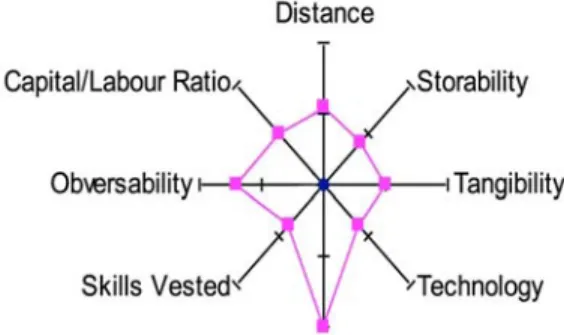
An example of mapping a bundle of goods and services is shown at Figure 2, below. Here, a hypothetical restaurant meal is mapped, in terms of goods and services tasks, onto the eight dimensions of the model. As with the ideal model presented at Figure 1 the constructs conform to the main characteristics of real phenomena without necessarily conforming to all of the characteristics [16]. The distance between production of the product and the customer is low and therefore closer to the service part of the bundle than to the goods and processes of production. The food itself has an element of storability and tangibility. However, the product is closer to service tasks than the goods involved, therefore storability and tangibility tend towards the service ideal type. Use of technology is relatively low. In terms of skills vested, these are close to the service encounter and therefore are low. Opportunities for standardization are high through menus, portion sizes and staff training. Observability is closer to the goods ideal type given the opportunities for quality control, process control and feedback from customers. The ratio of capital to labor is low given the relatively low capital costs of restaurant services compared with capital intensive manufacturing industries.
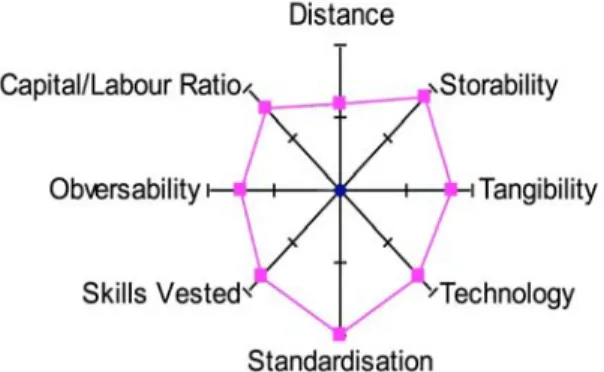
APPLICATION OF THE MODEL TO A MANUFACTURING ORGANIZATION The organization involved in an initial trial of the model was strongly manufacturing based. Located in South East Queensland and supplying electrical equipment throughout South East Asia, it is the major provider of metal containers and shelving in this region with 80% of the total market. At the start of this research the organization was at a crossroads, with a strategic plan that was leading towards establishing production offshore in China. Management regarded the organization as being engaged solely in manufacturing tasks, resembling the outer levels of the model (see Figure 1, above).
Senior management then developed an alternative approach to offshore production. This was achieved firstly through a number of workshops and seminars in the area of innovation and change management. Management action led to the application of a three-phased innovation model within a teams-based environment [38]. This approach was to be evaluated with the offshore production option. In order to gain further understanding of the alternative approach further study and research was undertaken by the organization, which included:
Study tour and field research
The CEO provided the management team with the opportunity to undertake a number of study tours to gain insights into work practices in other parts of the world. The first aim from the CEO’s perspective was to investigate strategies for increasing the profitability of the business through outsourcing areas of manufacturing to other parts of the world. This was a primary objective of the organization prior to the development of the innovation team.
The management team undertook studies of manufacturing processes in both Europe (the home of the multi-national partner) and Asia. The initial findings were collated. Findings included not only financial and production data but also knowledge gained through dialogue and observation of other companies involved in the production outsourcing process.
At this point it was decided to trial the application of an innovation model within the organization as an alternative to relocating production offshore. The following steps were undertaken to achieve this process were team development and thinking and creativity audits. Team development
The R&D manager on his return undertook a series of team development exercises with the R&D team, together with other interested parties, including customers. During this stage the service aspects of their role became very clear, not only to the team but also within a wider organizational context. The team was the organizational link to the customers and provided an internal service role to all aspects of the organization not just the manufacturing component. Thinking and creativity audits
An extension of the process suggested by the authors was the use of thinking and creativity audits. These audits provided a series of findings that were included in both team and organizational development. This led to a shift in management thinking and strategy with a move away from the more obvious actions such as the outsourcing of production, resulting in the tailoring of internal training and development for the R&D team, management and
customers. This shift in thinking and associated skills development became a key aspect in the successful uptake of the model and an improved level of innovation.
In order to achieve the realignment of the organization and to include services aspects within the organizational mix the concept of human technologies was applied within the innovation process. Achieving the shift and refocusing of soft and hard technologies is described below. The use of human technology
Given the desire to incorporate a “service” element into manufacturing processes the organization needed to learn more from service organizations. To this end, the management team responsible for the manufacturing organization project found that it was essential to view the increase in knowledge management as the “soft technology” of the creative capital of those within the organization. So-called “hard technology” should support this process rather than drive it. A physical application of this was the removal of the R&D team from within the confines of the organization to neutral, more stimulating surroundings. “The most valuable insights occurred at a meeting held in a nearby park that overlooked a lake …” “It seemed to give people the opportunity to discuss topics foreign to the workplace, but when understood were essential to better practice within the organization” (R&D manager).
The application of soft technology
Analysis of material from the study tours leading to a service focus from the application of teams based innovation within the organization are provided in the following outcomes:
The first question became what are the real benefits of outsourcing? More importantly are there any implications of adopting this process? This question placed more emphasis on the data gained from observation and discussion than on financial reports. The major findings from this were that very successful Japanese and Korean companies that outsourced were very particular in how this was managed, especially in what was actually outsourced. This was based on the importance of protecting intellectual property and operational and design knowledge, therefore limiting the type and amount of activities that could be outsourced. This is contrary to the organization’s previous examples and understanding of the process, which followed the outsourcing of entire products. On further investigation complete product outsourcing appeared to provide short-term benefit that did not always translate into long-term success. Associated issues were quality and quality control. The findings from the study appeared to be that the simpler the task the easier it is to manage in terms of obtaining the required quality. Also, using the skills of the outsourced organization in this area is important, rather than having to reveal internal organizational knowledge and competencies to the outsourced organization. This then raised a number of issues in terms of supply chain and logistics management and the use of agents versus the development of internal competencies to manage the process. Answers raised still more questions into the actual benefits of outsourcing.
The second question was what is the alternative to outsourcing production? When this was discussed areas of cost over-run, production difficulties and possible sources of improvement were identified. The answers to these issues overlapped with the components considered for outsourcing. After reviewing processes used in these areas, a process of innovation occurred through the discovery of more effective and efficient means of production. For the outlay of a small amount of money the team identified a production process that could produce the identified units at a cost saving of between $0.01 and $0.10 per unit in comparison with
overseas production costs. Annual demand for the units was in the range of tens of millions thereby providing significant savings. The additional benefits of keeping the production in-house addressed all the issues of intellectual capital, quality and logistics, while increasing the value of the decision to the organization.
Understanding the internal organizational changes in terms of the model
The manufacturing organization in response to market pressure investigated two alternatives, (1) to maintain a production focus and produce goods offshore, (2) to refocus the organization through innovation with a greater emphasis on services. The organization chose the second option and used innovation as a process to bundle its offerings through the application of soft technologies. In terms of the model proposed in this paper, we see the shift as shown in Figure 3, below, which indicates the repositioning of the organization after the intervention.
Figure 3 Hypothetical model of a bundle of manufactured goods and services
DISCUSSION
Literature suggests that differentiating products on the basis of whether they are predominantly goods or services is of little interest to customers. However, the ability to identify the goods and services characteristics of products is important for managers and decision makers. Firstly, modeling goods and services tasks along the eight dimensions proposed in this paper has strategic value as it enables organizations to benchmark products against the offerings of competitors, based on the mix of goods/services tasks involved. Secondly, modeling products may be used to identify which tasks would provide added value to an organization through greater customer involvement. Thirdly, understanding the mix of goods and services in products has strategic and tactical value, informing Human Resource Management in the areas of staff selection and training.
Modeling goods and services as ideal types provides opportunities for further research in the areas of strategic management and services marketing. Research in the areas of training and development may also be informed by appropriate use of the model.
CONCLUSION
The research provides a model for differentiating goods and services tasks as ideal types. The model is applied to a hypothetical bundle of goods and services based on a restaurant, before
moving to consider a manufacturing situation where staff and customers participate in formulating the final product.
Modeling goods and services tasks as outlined in the paper has utility to organizations, both at strategic and tactical levels. The model provides a platform for further organizational and management research.
REFERENCES
1. Silvestro, R., et al., Towards a classification of service processes. International Journal of Service Industry Management, 1992. 3(3): p. 62-76.
2. Sasser, W., R. Olsen, and D. Wyckoff, Management of service operations. 1982, Boston: Allyn and Bacon.
3. Morris, B. and R. Johnston, Dealing with inherent variability - The differences between service and manufacturing explained. International Journal of Operations & Production Management, 1987. 7(4): p. 13-22.
4. Chase, R., Where does the customer fit in a service operation. Harvard Business Review, 1978. 56(4): p. 137-142.
5. Chase, R., The customer contact approach to services: Theoretical bases and practical extensions. Operations Research, 1981. 29(4).
6. Kotler, P., Principles of Marketing. 1980, Englewood Cliffs, NJ: Prentice-Hall. 7. Maister, D. and C. Lovelock, Managing facilitator services. Sloan Management
Review, 1982. Summer: p. 19-31.
8. Johnston, R. and B. Morris, Monitoring and control in service operations. International Journal of Operations & Production Management, 1985. 5(1): p. 32-38.
9. Lovelock, C., Classifying services to gain strategic market insights. Journal of Marketing, 1983. 47: p. 9-20.
10. Maister, D. The defining qualities of four different managerial environments. in Research in service operations management, in the Proceedings of the workshop on teaching and research in Production and Operations Management. 1983. London Business School.
11. Haynes, R., Service typologies: A transaction modelling approach. International Journal of Service Industry Management, 1990. 1(1).
12. Schmenner, R., How can businesses survive and prosper? Sloan Management Review, 1986(Spring): p. 21–32.
13. Shostack, G., Service positioning through structural change. Journal of Marketing, 1987. 51.
14. Gronroos, C., Service management and marketing. 1990, Lexington, MA: Lexington Books.
15. Timo, N. and R. Fisher. The service - manufacturing conundrum: Investigating a new approach to understanding and classifying services and manufacturing. in British Academy of Management Conference. 2005. Oxford University.
16. Weber, M., Economy and Society. 1968, New York: Bedminster Press.
17. Bateson, J. and K. Hoffman, Managing services marketing. 1999, Fort Worth, Texas: The Dryden Press, Harcourt Brace College Publishers.
18. Penttinen, E. and J. Palmer, Improving firm positioning through enhanced offerings and buyer-seller relationships. Industrial Marketing Management, 2006. 36: p. 552-564. 19. Anderson, E., Sharing the wealth: When should firms treat customers as partners.
Management Science, 2002. 48(8): p. 955-971.
20. Correa, H., et al., An operations management view of the services and goods offering mix. International Journal of Operations & Production Management, 2007. 27(5): p. 444-461.
21. Davies, A., T. Brady, and M. Hobday, Charting a path toward integrated solutions. Sloan Management Review, 2006. 47(3): p. 39-48.
22. Davies, A., Moving base into high-value integrated solutions: A value stream approach. Industrial and Corporate Change, 2004. 13(5): p. 727-756.
23. Windahl, C. and N. Lakemond, Developing integrated solutions: The importance of relationships within the network. Industrial Marketing Management, 2006. 35: p. 806-818.
24. Windahl, C., et al., Manufacturing firms and integrated solutions: Characteristics and implications. European Journal of Innovation Management, 2004. 7(3): p. 218-228. 25. Araujo, L. and M. Spring, Services, products and the institutional structure of
production. Industrial Marketing Management, 2006. 35: p. 797-805.
26. Brady, T., A. Davies, and D. Gann, Creating value by delivering integrated solutions. International Journal of Project Management, 2005. 23: p. 360-365.
27. Mills, P. and D. Moberg, Perspectives on the technology of service operations. Academy of Management Review, 1982. 7(3): p. 467-478.
28. Snyder, C., J. Cox, and R. Jesse, A dependent demand approval to service
organisations planning and control. Academy of Management Review, 1982. 7(3): p. 455-466.
29. Littler, C., The development of the labour process in capitalist societies. 1982, London: Heinemann Educational Books Ltd.
30. Littler, C., The labour process debate: A theoretical review, in Labour process theory., D. Knights and H. Willmott, Editors. 1990, Macmillan: London.
31. Cloninger, P. and B. Oviatt, Measuring service content: A scale development. Thunderbird International Business, 2006. 48(5): p. 643.
32. Karmarkar, U. and R. Pitbladdo, Service markets and competition. Journal of Operations Management, 1995. 13(3): p. 397-412.
33. Sabolo, Y., The service industries. 1975, Geneva: International Labor Organisation. 34. Korczynski, M., Human resource management in service work. 2002, Basingstoke,
UK: Palgrave.
35. Tarn, D., Marketing-based tangibilisation for services. The Service Industries Journal, 2005. 25(6): p. 747-759.
36. Ouchi, W. and M. Maquire, Organisational control: Two functions. Administrative Science Quarterly, 1975. 20(3): p. 559-569.
37. Lusch, R., S. Vargo, and G. Wessels, Toward a conceptual foundation for service science: Contributions from service-dominant logic. IBM Systems Journal, 2008. 47(1): p. 5-14.
38. Gapp, R. and R. Fisher, Developing an intrapreneur led three phase model of innovation. International Journal of Entrepreneurial Behaviour and Research, 2007. 13(6): p. 330-348.