0099-2240/80/03-0480/08$02.00/0
Controlled Formaldehyde Fumigation System
N. R. ACKLAND,* M. R. HINTON, AND K. R. DENMEADEBioengineering Department, Research and Development Division,Commonwealth Serum Laboratories, Melbourne,Australia
Acomparative study of formaldehyde (HCHO) fumigation was carried out by controlledvaporization, using an electric vapor generator, and bythe Formalin-permanganate method. Determination of vapor levels as well as bactericidal actionshowed the generator to be more effective. Maximum achievablefumigant levels were temperature dependent andrelated to the equilibrium vapor concen-tration of HCHO. At a room temperature of21°C, vaporization ofmore than 2,000
ytg
ofHCHO per liter resulted in conversion of HCHO to paraformaldehyde, which condensed on surfaces and contributed to prolongedresidualvaporlevels. An electronic monitor is described which is capable of detecting HCHO levels as low as 10Ag/liter
and can be used to monitorthe complete fumigation process. Formaldehyde fumigation has long been anaccepted methodof sterilization for areas where microbiological cleanliness is required. Fumiga-tion is usually carried out bymixing potassium permanganate and an excessof Formalin (40% formaldehyde) solution in a suitable container; sufficient heat isgenerated byoxidation ofpart of the formaldehyde (HCHO) with permanga-nate to vaporize the remaining formaldehyde
and water(1, 6, 7, 10). This method offumigation
isviolent, messy, and potentially explosive (7). In this paper, an alternative procedure is de-scribed for fumigation by controlled vaporiza-tion, in an electrical vapor generator, of either Formalin or paraformaldehyde, a polymer of HCHO which is converted toHCHOvapor upon heating (8).Formaldehydelevels werecompared infumigations of several workareasby the
con-trolled vaporization and
Formalin-permanga-nate methods,and the effectiveness of each pro-cedure was determined from the survival of
re-sistant Bacillus subtilis spores (2, 5, 9, 12).
MATERIALS AND METHODS Reagents. A commercial Formalin solution con-sisting of 40% HCHO containing 10% methanol as a depolymerizing agent (Imperial Chemical Industries, Melbourne, Australia) was used throughout. Para-formaldehyde powder (Koch-Light) was a white pol-ymerconsisting of 95% paraformaldehyde.
Areasfumigated.Alow-security area and a high-security area were monitored throughout the study. Thelow-security area was a large processing labora-tory;duringfumigation the air conditioning was turned off, but no attempt was made to seal air supply or exhaust ducts. The high-security area was a large sealedlaboratorywhose air supply was carefully con-trolled; exhaust air was passed through a gas-fired furnace to ensure microbiological security. The air conditioning for this area was turned off during
fumi-gation, and the airsupplyand exhaust outlet valves wereclosed.
Assay of HCHO. Initially, formaldehyde vapor concentrationswere measured by takingairsamples through rubber tubes protruding into the room at
varioussample points. Foursamplesweretaken per sampling time, using an evacuated liter flask. Forty milliliters of0.5M (NH4)2SO4wasaddedtoeachflask,
whichwasthen cooledto4'Ctodissolvethe formal-dehyde. One milliliter of a suitable dilution of the resulting solutionwasthen mixedwith1mlofafreshly prepared chromotropic acidreagent(1% chromotropic acid in 18 M H2SO4), and8 ml of18 M H2SO4 was added. After standing for 10 min, the mixture was diluted to afinal volume of 25 ml, and the optical density wasdetermined at540 nm. HCHOwas esti-matedfromastandardcurvein the range5 to40yg/ ml,and themeanconcentrationfrom thefoursamples wasdetermined.
Biological test systems. The spore suspension usedthroughoutwaspreparedfrom B.subtilisNCTC 8233 prepared by culture for 7 days on sporulation
agar (3) and suspension of the resultant growth in water.Thesuspension wassubjectedto twocyclesof heatingto65°Cfor30minfollowedbycentrifugation andresuspensionindistilledwater.Asamplewasthen stained and examined microscopically for spores(4). Glassrods 5mmin diameter and150 mmlong,witha
loop atoneend and a graduation mark50 mmfrom theother, were dipped into the spore suspension to
the mark. They were then suspended in a laminar-flow cabinettodry and stored inasterilejar. Before fumigation, rodswereplaced in different parts of the
areas tobe tested and transferred toa sterile
screw-capped test tube at the end of each procedure, imme-diatelyafter evacuationof thefumigant. Twenty mil-liliters of salinewasaddedtoeach tube to removethe spores from therods, andanestimate ofviable spores was obtained by plating dilutions of the suspension
ontonutrientagar. This was carriedoutwithin2hof removal of rods from thearea. Plateswereincubated
at37°C,and then colonieswerecounted after3days and checked after7days.
vaporizedon a500-Wheating plateinastainless-steel beaker. The apparatus usedsubsequently, shown in Fig. 1, consistsofastainless-steel5-litervessel with a 1,200-Wheating element.Sufficientcapacitywas pres-entto allow the addition ofwaterfor humidification andtocontaintheresultingfoam. A copperplatewas interposed between the element andthe bottom of the vessel to ensure auniform distribution of heatat a
thermostatically controlled temperature of approxi-mately170°C.
Electronicformaldehyde monitor. The appara-tus used (Fig. 2) was based on a Figaro 812 N-type semiconductor device, the conductivity of which changes in the presence of adsorbed molecules. No significant interference was observed from substances otherthan HCHO in the areas fumigated or by tem-perature changes normally encountered. Response timeof the sensor, obtained from Digitron Engineer-ing, Sydney, Australia, was approximately 20 s. The monitorwascalibrated in an enclosed system against HCHO released by paraformaldehyde vaporization. Good agreement was obtained between the weight of paraformaldehyde vaporized and the HCHO concen-tration as measured by chemical assay, which indi-cated that there was no loss of vapor in the test system.
RESULTS
HCHO levels by the
Formalin-perman-ganateand hotplate
vaporization
methods. ForFormalin-permanganate
fumigations, quan-tities of Formalin recommended have rangedfrom 12 to 59 ml/m3 ofair space (6, 11), and
ratios forFormalin-permanganate have ranged from 3:1 to 5:3 (1, 10). In thefollowing experi-ments, fumigationswere carried out by using a
mixture of 17.8 ml of Formalin and 8.9 g of
potassiumpermanganate perm3 of airspace in alow-securityareaat room temperatures of 16, 24,and300C. In preliminaryexperiments, room airsamples weretaken from each of four
posi-tions, including the ceiling and the floor, and
HCHO levelswere determined by chemical as-say. Because no differences in concentration wereobserved betweenanyposition, allresults
from thesamplingpoints were averaged. HCHO
levelswerealso measured after vaporization of 12.5 ml of Formalin (70% of that used in the
Formalin-permanganate
fumigations
to allow forlosses duetopermanganate oxidation) on a hot
plateat a roomtemperature of27°C.
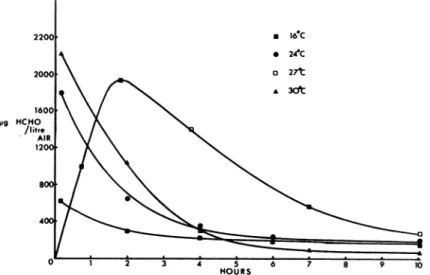
Results in Fig. 3 indicate that the highest levels ofHCHOwere obtained in the
Formalin-permanganate
method at thecommencement offumigation and then vapor levels dropped to base levels of 200 to 500 ug/liter by 4 h. The
initialconcentration of HCHO was temperature
dependent. Higherand morepersistent levels of HCHO were obtained aftervaporization by the hotplatemethod at aroomtemperature of 27°C,
FG. Electricvaporgenerator.
which could be
expected
to be a more efficientsterilizing procedure.
With theFormalin-per-manganate
method,
large
amountsofwater con-densate were observed onobjects
in the area aftervaporization.
Sur,vivalof B. subtilis after
ftumigation by
theFormalin-permanganate
method. B.subtilissporessurvivedonsomerodslocatedat various
places
inalow-security
areaduring
a 24-hFormnalin-permanganate
fumigation
atan ini-tial temperature of 1800. Viable counts of 2 x10⁶ were obtained from control
rods,
butonly
two of nine rods
exposed
in the treated areawere
sterile;
viable counts of 20 to 600 wereobtained from the others. It is clear
that,
al-though
thisprocedure
wasfairly
effective,
ster-ilizationwasnotachieved.482 ACKLAND, HINTON, AND DENMEADE
SENSOR
DR IV
VOLTlAGE I SENSOR - MNPUT
SENSOR HEATER SUPPLY BlJFFE R A PA$ P .'.. CCOMPA--RATOFO --REFERENCE VOLTAGE
FIG. 2. System block diagram of the electronic monitor with controller.
lC
24eC
27t 30t
FIG. 3. Comparison of Formalin-permanganatefumigationsat16, 24,and30°C andahot plate
vapori-zationofFormalinat27°C.
asealedjarat20°CincontrolledHCHOvapor
levels of 150and 300
Ag/liter
ofair,with relativehumidity maintained at approximately 100%.
The results inTable 1 show thatexposureto150 ,ug of HCHO per liter of air did not result in
sterilization even afterexposure for 6 h.
Expo-sure to 300 ,Ag/liter was much more effective,
andnoviablesporesweredetected at 3 h.
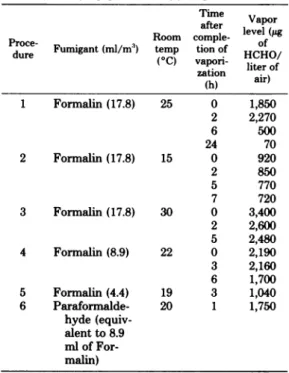
Use ofelectricvaporgenerator. In Table 2the resultsfromseveralfumigationsareshown
(procedures 1through 6), usingthe electric va-porgenerator (Fig. 1) and different amounts of Formalin inalow-securityareaatdifferent ini-tial temperatures. In procedure 1, persistent HCHO levels similar to those obtained bythe hot plate vaporization method (Fig. 3) were
achieved. No viableB. subtilisspores were de-tected after 24 h ofexposure on the 18 spore rods located inthe main laboratoryarea,buta
0.5% survivalwasdetectedon arodlocatedina
closedcupboard. Thefumigantlevel inthe
cup-boardwas160,ug/literafter 6 h.Procedure 2was
carried out with the same volume of Formalin
and an initial room temperature of 15°C. No
surviving spores could be detected after 7 h of exposure on 12 spore rods located around the room, but two located in cupboards showed a
survival of 1%.
Procedures 3 through 5, which were carried
out for different times and temperatures and withvaryingamountsofFormalin, are also de-scribed in Table 2. Inprocedure 6,a mixtureof
paraformaldehyde and water equivalent to8.9 ml of Formalinperm3of airwasused.Again,no
surviving spores could be detected from rods distributedthroughoutthe mainlaboratoryarea
inanyof theprocedures.
All subsequent fumigations were carried out with 3.7gofparaformaldehydeper m3ofroom
volume,which is converted toHCHO equivalent
tothatpresentin8.9mlof Formalin.Humidity
ineacharea wasincreasedto80%,alevel which
pg
fumigation by causing HCHO to dissolve in a
film ofmoisture aroundmicroorganisms, where it is more bactericidal than in vaporform (12). UseofFormalinat a room temperature of
200C
would have contributed approximately 30% to the relative humidity. More reliable humiditycontrol could be achieved with
paraformalde-hyde, which was also more convenient to use.
Use of electronic HCHO monitor. The
electronic monitor (Fig. 2) was developed be-causeofthetime involvedin chemical assays of
air samples. When the output of the monitor wasplottedagainstHCHOvaporlevelsobtained by chemical analysis, a power-law relationship was obtained (Fig. 4). Such a relationship is
particularly useful, since good sensitivity was
achievedatthelowervaporlevelsand the total
fumigationrange wascovered on the same scale.
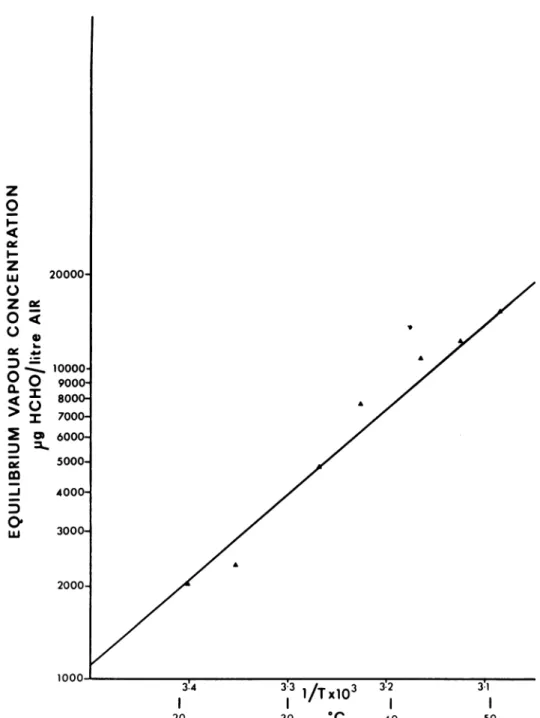
Relationship between temperature and
equilibrium vapor concentration. The rela-tionship between temperature and the
equilib-riumvapor concentration is shown in Fig. 5. For
normal air-conditioned laboratoriesat
200C,
theequilibrium vapor concentration is
approxi-mately2000
,ug
ofHCHOperliter.HCHOvaporinexcessof theequilibriumvaporconcentration
will recondenseon thecoldestsurfaces,
produc-inga
paraformaldehyde film
oversurfaceswithintheroom.This film slowlyevaporates,producing anunpleasant odor.
HCHO levels after fumigation. The
per-sistence of HCHOvaporaftercompletion of the
fumigation and restoration of ventilation is a
significant problem,
especially
in high-security laboratories. The extent of the problem can be seen from chartrecordings from the electronic monitorduringfumigation
ofa high-andalow-securityarea (Fig.6).
TABLE 1. Survivalof B. subtilis spores in controlled vapor levelsof 150 and 300pgof HCHO
perliterof air at 20°C yg of
Expo-HCHO/liter sure Total viable count %Survival of air time (h) Controls 0 2.5x 10⁶ 100 150 0.5 1.02x10⁶ 41 150 1.5 8.15x10⁴ 3.3 150 3.0 4.0x10² 0.02 150 6.0 1.0X10² 0.01 Controls 0 4.5x 10⁶ 100 300 0.5 4.0x10⁵ 8.9 300 1.0 6.5x 10² 0.02 300 1.5 2.0x10 0.003 300 3.0 Nonedetected <0.0001 300 6.0 Nonedetected <0.0001
fumigations with the electric vapor generator and varying quantities of fumigant
Time Vapor after level(,ug Room comple- of dure Fumigant (ml/m3) temp tionof HCfO/
(0C) vapori- literof zation ar (h) ar 1 Formalin (17.8) 25 0 1,850 2 2,270 6 500 24 70 2 Formalin (17.8) 15 0 920 2 850 5 770 7 720 3 Formalin (17.8) 30 0 3,400 2 2,600 5 2,480 4 Formalin (8.9) 22 0 2,190 3 2,160 6 1,700 5 Formalin (4.4) 19 3 1,040 6 Paraformalde- 20 1 1,750 hyde (equiv-alent to 8.9 ml of For-malin)
Clearly,
therewas arapid
lossoffumigant
in thelow-securityarea,throughvents,leaks,
etc.,butin thehigh-securityareaa
higher
levelwasmaintained. Although restoration of the venti-lationat 11h inthe
high-security
areaand12.5 hinthelow-securityarearapidly
removedmostof the vapor, aresidual
HCHO
odor remained which wasparalleled by
ahigh
monitor base level reading.WVhen
ventilation was again stopped,at14h in thelow-security
areaand 17h inthe
high-security
area, the level ofHCHO
rose,showing thatsomerevaporization
of form-aldehydewasoccurring.
The odorwasparticu-larly noticeablein the
high-security
area,wherea
vaporization
rateof40,ugofHCHO/liter
perhwasshownto occur
continuously.
Since 10air changesper houroccurred in the area,thelab-oratory
atmosphere
would have contained anaverage of 4 ,ug of HCHO per
liter,
a level in which it istoohigh
to work(Table
3).
Vapori-zation at 3.7 g ofparaformaldehyde
perm3re-sulted in
approximately
2g/m3
(2,000
,ug of HCHO perliter)
to condenseon walls andfit-tings of the area, and 2 to 3
days
would berequired for the
dissipation
of the residual HCHO.This has beenconfirmedby
observation. Attainment ofoptimal
levels of HCHOwithout
condensation. A controlled484 AND DENMEADE 10-OUTPUT
mv1.0-mV1 0-1* 10 100pgHCHO
Ilitre
AIR1000 10000
FIG. 4. Response of monitortoformaldehydevaporlevels.
where the vaporlevel wasmaintainedbelow the
equilibrium concentrationtoavoidcondensation
ofHCHO. The comparator circuit on the
moni-tor (Fig. 2) enabled a simple ON-OFF control of theelectricalgenerators when the vapor
concen-trationrose to apredeterminedlevel.
During fumigation, the generator vaporized 1.1 g ofparaformaldehyde perm3 of room vol-ume(equivalentto1,100
,tg
ofHCHOperliter), and the vapor level was controlledtoapproxi-mately 1,000 ,igofHCHO perliter over a 10-h
period. The lowestairtemperature recorded in
the room was 14°C, whereas the outside tem-perature dropped to 6°C. A slow rise in HCHO vaporlevel stilloccurred when the air condition-ing was turned off after 8 h ofventilation, and somecondensation ofHCHO appeared to have occurred on coldoutside surfaces.
Better results were obtained when the tem-perature was maintained above 20°C. The HCHO level wascontrolledat1,500,ug/liter, and vapor was quicklydistributed by a heating fan. Whenventilation was restored, the vapor level
dropped rapidly, and after 8 h there was no perceptibleHCHOodor.
DISCUSSION
The data presented above demonstrate sev-eraladvantagesoftheHCHOgenerator over the
Formalin-permanganate
method in HCHO fu-migation. Rapidly falling vapor levels in the permanganate method are due, in part, to theformation ofwatercondensate on cold surfaces
which,
because of thehigh partition
ofcoeffi-cient ofHCHO in water
(13), rapidly
takes upthe HCHO vapor.
High
localized HCHO levelsgenerated
by rapid
vaporization
in thismethod alsoleadtoexcessivecondensation ofparaform-aldehyde.
From the standpoints ofsafety,con-venience,
andeffectiveness,
theHCHOgenera-tor method was more
successful,
particularly
wherelarge
areasweretobefumigated.
It isnotnecessaryto
rapidly
leave theareaafteraddition of Formalin.Instead,
it isonly
necessary toadjust
atimer well in advance of thefumigation,
and any necessary
sealing
of doors and other outletscanthenproceedatleisure and without thediscomfort ofleaking
vapor.Theimportance
of
adequate sealing
is illustratedby
therapid
loss of
fumigant
from a low-security area(Fig.
6).
Slowdiffusion of vapor into closedcupboards
was demonstrated in procedure 1.Cupboards,
drawers,
and other suchfittings
in the roommust be
opened
to allow adequatepenetration
offumigant.
Results in
Fig.
3 show that effective HCHOfumigation
ismarkedlytemperaturedependent
andthat slow release offumigantisessential to maintaineffective levels within thearea.
Vapor-ization of HCHOtolevels above theequilibrium
vaporconcentrations,however,results inexten-sive condensation of paraformaldehyde on all coldsurfaces.
Figure
6 illustratesparticular problems asso-ciated withHCHOfumigationofsecurityareas.Although fumigant
was rapidly removed fromz
0
z
w0
20000-C.)x
O 6000 8000 4000 / > I 7000-2 6000 S 5000 -J 4000-Xi 3000- 2000-1000034
303 1/Tx103
32
3'1 20 30 °c 40 50FIG. 5. Relationship between equilibrium vapor concentration of formaldehydeoverparaformaldehyde and absolute temperature.
the areawhen the ventilation was restored, the amount of paraformaldehyde present.
increase of temperature which occurred after the The value of maintenance of a uniform tem-entry of warmer conditioned air allowed the perature was particularly apparent at a fumigant condensedparaformaldehyde to vaporize, lead- concentration of 1,500 ,ug of HCHO per liter. At ing to a slow rise in HCHO concentration. In the this level, the restoration ofventilation has
rap-high-securityarea, the rise in HCHO level was idly removed all traces of thefumigant down to
ac-486
uo0
uo0
(q)
l;o
*
(l) ;jo*
.. "aXtk
to3
.eO x4) 5.. sta3 .2 2b
_ Q- k A1..
p_
ed t.S * r(qle)uo
->standards in various countries
Maximum allowa-bleformaldehyde Country concn(pg/liter of
air) U.S.FederalStandard 4,timeweighted
avg 6,ceiling 12,30-minceiling Great Britain 12 Hungary 1 Italy 5 Japan 6 U.S.S.R. 0.5
FederalRepublicofGermany 6 GermanDemocratic Republic 5
cepted as 1 ug/liter (11). This level complies
with most of the international standards
cur-rently inuse (Table 3).
LITERATURE CITED
1. Bartzokas, C.A., K. McCarthy, W. B. Shackleton, and B. F. Baker. 1978. Observations of theeffectsof formaldehydeon cockroaches and their flora. 1. Sur-vival of vaccinia virus infected cockroachesduring fu-migation with formaldehyde. J. Hyg.80:125-129. 2. BraswelI, J. R., D. R. Spiner, and R. K. Hoffman.
1970.Adsorption offormaldehydeby varioussurfaces duringgaseous decontamination.Appl. Microbiol. 20: 765-769.
Office, London.
4. Collins, C.H., andP. M.Lyne.1976. Microbiological methods,4thed., p. 110.Laboratorytechniques series. Butterworth & Co.(Publishers) Ltd., London. 5. Hoffman, R. K., and D. R. Spiner. 1970. Effect of
relativehumidity on the penetrability and sporicidal activity offormaldehyde. Appl. Microbiol. 20:616-619. 6. Lapen, R. F., and S. G. Kenzy. 1975. Effect of selective environmental treatments on the incidence of gross Marek's diseaselesions in chickens.Poult. Sci. 54:659-663.
7.Robinson, P. J.1978. Fumigationincident. Chem. Ind. (London) 18:723-724.
8. Schifling,B., W. Weuffen, and H.Wigert. 1978. De-termination ofgaseous formaldehyde from
paraformal-dehyde tablets. 2. Studies on the use of
paraformalde-hyde tablets for bacterial count reduction, disinfection, coldsterilizationand sterile storage of medical instru-ments. Pharmazie33:103-104.
9. Stonehill, A. A., S. Krop, and P. M. Borich. 1963. Bufferedglutaraldehyde. Am. J. Hosp. Pharm.
20:458-465.
10. Tucker, J. F., E. G. Harry, and H. E.Wainman.1975. The effect offumigationwithmethyl bromide or form-aldehydeontheinfectivity of poultry house litter nat-urally contaminated withSalmonellavirchow. Br. Vet. J. 131:474-485.
11. U.S. Department of Health, Education and Welfare. 1976.Occupational exposure toformaldehyde.National InstituteofOccupational Safety and Health, publ. no. 77-126.U.S.Department of Health, Education and Wel-fare, Washington, D.C.
12.Wade,A. 1977. Disinfectants andantiseptics,p. 520. In W.Martindale(ed.),Theextrapharmacopoeia,27th ed. ThePhannaceuticalPress,London.
13. Walker, J. F. 1944.Formaldehyde,p. 52.Reinhold Pub-lishing Corp., New York.