DISSERTATION STYLE GUIDE
With Guidelines for Dissertation Proposal
Contents and Formatting
The Doctor of Philosophy Program
in
Biblical and Theological Studies
August 2015
Wheaton College
Wheaton, Illinois USA
Wheaton College 501 College Avenue
Wheaton, Illinois 60187-5593
Graduate Biblical and Theological Studies: 630-752-5197 Fax: 630-752-5902
E-Mail: [email protected] © 2015 by Wheaton College
Printed in the United States of America
Wheaton College reserves the right to change without notice any statement in this publication
concerning, but not limited to, citation and bibliography style, formatting, abbreviations, and shortened publisher names.
TABLE OF CONTENTS
PREFACE ... 10
1. GENERAL FORMATTING ... 11
1.1. Recommended Software ... 11 1.2. Paper ... 11 1.3. Fonts ... 11 1.4. Line Spacing ... 12 1.5. Margins ... 12 1.6. Page Numbers ... 13 1.7. Indentation ... 131.8. Widows and Orphans ... 13
2. GENERAL STYLE ... 14
2.1. Punctuation ... 14
2.2. Ellipses ... 14
2.3. Hyphens and Dashes ... 14
2.4. Parentheses and Brackets ... 15
2.5. Quotation Marks and Punctuation ... 15
2.6. Commas ... 16 2.7. Numbers ... 16 2.7.1. Nonscientific Numbers ... 16 2.7.2. Scientific Numbers ... 17 2.7.3. Numerical Sequences ... 17 2.8. Divisions of a Work ... 17
2.9. Spelling and Capitalization ... 18
2.10. Alphabetization ... 18
2.11. Abbreviations ... 18
2.13. Bible Versions and Versification ... 21
2.14. The Divine Name ... 21
2.15. Transcription and Transliteration ... 22
2.16. Illustrations ... 25
2.17. Tables ... 26
2.18. Internal Cross-References ... 26
2.19. Grammar ... 26
2.20. Plagiarism ... 26
2.21. Gender Neutral Language ... 27
2.22. See and Cf. ... 27
3. DISSERTATION CONTENTS ... 28
3.1. Front Matter... 28
3.1.1. Fly Leaf Page ... 28
3.1.2. Title Page ... 28 3.1.3. Signature Page ... 29 3.1.4. Disclaimer Page ... 30 3.1.5. Dedication Page... 30 3.1.6. Epigraph Page ... 30 3.1.7. Abstract... 30 3.1.8. Table of Contents ... 31
3.1.9. Lists of Illustrations or Tables... 32
3.1.10. Acknowledgements ... 32
3.1.11. List of Abbreviations ... 32
3.2. Body of the Document ... 35
3.2.1. Parts ... 35 3.2.2. Chapters ... 35 3.2.3. Subheadings ... 36 3.2.4.1. Introducing Quotations ... 37 3.2.4.2. Modifying Quotations ... 37 3.2.4.3. Block Quotations ... 38
3.2.5. Enumerated Lists ... 39 3.2.6. Non-enumerated Lists ... 40 3.2.7. Outline Lists ... 40 3.2.8. Excurses ... 41 3.2.9. Footnotes ... 41 3.2.9.1. Basic Formatting ... 41
3.2.9.2. Footnotes Combining Citations and Content ... 42
3.2.9.2.1. Option 1: Parenthetical Citation ... 42
3.2.9.2.2. Option 2: Inline Citation ... 42
3.2.9.3. Footnotes with Multiple Citations ... 43
3.3. Back Matter ... 44
3.3.1. Appendices ... 44
3.3.2. Bibliography ... 44
3.3.3. Fly Leaf Page ... 45
4. FOOTNOTE AND BIBLIOGRAPHIC STYLE ... 46
4.1. Books ... 46
4.1.1. Name(s) of Author(s) or Editor(s) ... 46
4.1.1.1. Name(s) of author(s)... 47
4.1.1.2. Name(s) of editor(s) ... 48
4.1.1.3. No author or editor ... 48
4.1.2. Title and (if any) Subtitle ... 48
4.1.3. Names of Editor(s), Compiler(s), or Translator(s) (if any), in Addition to an Author . 49 4.1.4. Name or Number of Edition ... 49
4.1.5. Name of Series (if any) with Series Number (if any) ... 50
4.1.6. Facts of Publication ... 51
4.1.7. Page Number (for footnotes) ... 52
4.1.8. Sample Footnote and Bibliography Entries ... 53
4.1.9. Subsequent and Shortened References ... 55
4.1.9.1. Ibid. and Idem ... 55
4.1.9.2. Shortened References ... 55
4.1.10. Multivolume Works ... 57
4.1.10.1. Volume Title and Number ... 57
4.1.10.2. Date of Publication ... 57
4.1.10.3. Page References in Footnotes ... 57
4.1.10.4. Single Author and Title ... 58
4.1.10.5. Single Author and Different Volume Titles ... 59
4.1.10.5.1. Reference to the Work as a Whole ... 59
4.1.10.5.2. Reference to an Individual Volume as a Whole ... 59
4.1.10.5.3. Reference to a Page Number or Essay in an Individual Volume ... 60
4.1.10.6. Sample Footnote and Bibliography Entries for a Multivolume Work ... 60
4.1.10.7. Other Types of Multivolume Works ... 62
4.1.11. Citing Quotations or Citations of One Work in Another Work ... 62
4.2. Journal and Serial Articles ... 63
4.2.1. Name of the Author(s) ... 63
4.2.2. Title of the Article ... 63
4.2.3. Title of the Journal or Serial ... 63
4.2.4. Volume or Issue Numbers, Publication Date, and Page Numbers ... 63
4.2.5. Sample Footnote and Bibliography Entries for Journal and Serial Articles ... 64
4.3. Component Part of a Book or Volume ... 66
4.3.1. Article or Essay in a Book with One Author ... 66
4.3.2. Article or Essay in a Book with an Editor ... 67
4.3.3 Multiple Articles or Essays in a Book ... 68
4.3.4. Article Reprinted in a Collection of Essays ... 69
4.3.5. Book-Length Biblical Commentary Published as a Component Part of a Single Volume in a Multivolume Set ... 69
4.3.6. Introduction, Preface, Foreword, or Note Written by Someone Other Than the Author ... 70
4.4. Encyclopedias, Dictionaries, and Lexicons ... 70
4.5. Dissertations, Theses, and Projects ... 72
4.6. Book Review ... 73
4.6.1. Untitled Review ... 73
4.6.2. Titled Review ... 74
4.8. Class Lecture ... 74
4.9. Ancient—Pre-Modern Works ... 75
4.9.1. General Guidelines for Critical Editions and other Ancient–Pre-Modern Sources ... 75
4.9.1.1. Choosing Sources ... 75
4.9.1.2. Classical Reference Form ... 75
4.9.1.2.1. Name of the Author ... 75
4.9.1.2.2. Classical Titles ... 76
4.9.1.2.3. Classical Divisions of the Work ... 76
4.9.1.3. First Reference to Critical Editions and Translations ... 77
4.9.1.3.1. The Primary Form... 77
4.9.1.3.2. The Secondary Form ... 79
4.9.1.4. Subsequent and Shortened References ... 79
4.9.1.5. Bibliography ... 81
4.9.1.6. Special Cases ... 81
4.9.1.6.1. Mere Citations of Ancient Texts ... 81
4.9.1.6.2. Citing or Quoting a Work that Spans Multiple Volumes ... 82
4.9.2. Specific Examples by Category ... 82
4.9.2.1. Ancient Near Eastern Sources ... 82
4.9.2.2. Apocrypha and Pseudepigrapha... 83
4.9.2.3. Dead Sea Scrolls ... 83
4.9.2.4. Rabbinic Texts ... 84
4.9.2.5. Classical and Pre-modern Christian Sources ... 84
4.9.2.5.1. Loeb Classical Library [LCL] ... 85
4.9.2.5.2. Die Griechischen christlichen Schriftsteller der ersten drei Jahrhunderte [GCS] ... 86
4.9.2.5.3. Patrologia Graeca [PG] ... 86
4.9.2.5.4. Sources chrétiennes [SC] ... 87
4.9.2.5.5. Ante-Nicene Fathers [ANF] ... 87
4.9.2.5.6. Nicene and Post-Nicene Fathers, Second Series [NPNF2] ... 88
4.9.2.5.7. Summa Theologiæ [ST] of Thomas Aquinas ... 88
4.9.2.5.8. D. Martin Luthers Werke: Kritische Gesamtausgabe [WA], Die Deutsche Bible [DB], and Luther’s Works [LW] ... 89
4.9.2.5.10. Johannis Calvini Opera Selecta [OS] ... 90
4.9.2.5.11. Martini Buceri Opera Latina [OL] ... 90
4.9.2.5.12. Melanchthons Werke in Auswahl [MW]... 91
4.9.2.5.13. Library of Christian Classics [LCC] ... 91
4.10. Internet Documentation ... 92
4.11. Published Electronic Sources ... 93
4.12. Electronic Text Databases ... 95
5. ABBREVIATIONS OF COMMONLY USED PERIODICALS, REFERENCE
WORKS, AND SERIALS ... 96
6. SHORTENED FORMS OF COMMON PUBLISHER NAMES ... 130
7. SAMPLE PAGES... 149
7.1. Sample Title Page ... 150
7.2. Sample Signature Page ... 151
7.3. Sample Disclaimer Page ... 152
7.4. Sample Dedication Page ... 153
7.5. Sample Epigraph Page ... 154
7.6. Sample First Abstract Page ... 155
7.7. Sample Subsequent Abstract Page ... 156
7.8. Sample Table of Contents and Parts ... 157
7.9. Sample List of Illustrations ... 158
7.10. Sample List of Tables ... 159
7.11. Sample Acknowledgements First Page ... 160
7.12. Sample Acknowledgements Subsequent Pages ... 161
7.13. Sample List of Abbreviations First Page ... 162
7.14. Sample List of Abbreviations Subsequent Pages ... 163
7.15. Sample Part Page ... 164
7.16. Sample Chapter First Page ... 165
7.17. Sample Chapter Pages Subsequent Pages ... 166
7.19. Sample Chapter First Page with Subheading after Chapter Title ... 168
7.20. Sample Appendix First Page ... 169
7.21. Sample Appendix Subsequent Pages ... 170
7.22. Sample Bibliography First Page ... 171
7.23. Sample Bibliography Subsequent Page ... 172
APPENDIX: DISSERTATION PROPOSAL CONTENTS AND
FORMATTING ... 173
1. Description and Requirements ... 173
2. Contents ... 173
2.1. Title Page ... 173
2.2. Body of the Proposal ... 174
2.3. Outline ... 174 2.4. Appendices ... 174 2.5. Bibliography ... 174 3. Formatting ... 174 3.1. Margins ... 174 3.2. Pagination ... 174
4. Sample Proposal Title Page ... 175
PREFACE
This style guide is meant to provide a standard for the consistent formatting and style of dissertations in the Wheaton College Ph.D. in Biblical and Theological Studies program. The citation and bibliography style in this style guide follows Turabian at many points, the SBL Handbook at several points, and departs from both on occasion. The style guide is based in part on The Southern Seminary Manual of Style, 3rd ed., edited by Craig Blaising, but through substantial modifications, reorganization, and additions, it is a style guide unique to this program.
Note that references to Turabian in this document refer to A Manual for Writers of Research Papers, Theses, and Dissertations: Chicago Style for Students and Researchers, 7th edition (Chicago: University of Chicago Press, 2007). References to the SBL Handbook refer to The SBL Handbook of Style: For Ancient Near Eastern, Biblical, and Early Christian Studies (Peabody, MA: Hendrickson, 1999).
Style and format issues distinctive to the dissertation not covered in this style guide may be treated in The Chicago Manual of Style, 16th ed. (Chicago: University of Chicago Press, 2010) and the SBL Handbook. The Ph.D. Program Administrator, under the authority of the Ph.D. Program Committee, serves as arbiter in all matters of dissertation style and format. Students must format their dissertations according to the style guide version under which they entered the program but may adapt revisions or updated format in a subsequent version without having to conform to any other changes in the newer edition. It is the student’s responsibility to declare to the technical reader the version(s) to which he or she is adhering.
An electronic copy of this Style Guide can be downloaded from the student helps tab on the program website at http://www.wheaton.edu/Academics/Departments/Theology/Graduate-Studies/PhD-in-Biblical-and-Theological-Studies. For unofficial student-produced Microsoft Word and OpenOffice Writer templates corresponding in almost all cases to the requirements set in this guide, see https://sites.google.com/site/wcdissertationhelp/.The Ph.D. Program Committee
1. GENERAL FORMATTING
1.1. RECOMMENDED SOFTWARE
Any recent version of Microsoft Word, Corel Word Perfect, Open Office, or Nota Bene is recommended for dissertations. The submission and final copies must be submitted in letter quality print, preferably using a laser printer. Inks that smudge or run are not acceptable. To ensure the accuracy of margin and other measurements, the student should print initial drafts of the dissertation on the printer that will be used for the final copies. Keep in mind that word processor measurement settings may not translate exactly onto the printed page. Adjust the settings if needed to produce the correct measurements on the hard copy.
1.2. PAPER
The dissertation must be printed on white bond, 20 pound weight, minimum 25 cotton/rag content, with a watermark.
Do not try to save paper by printing on two sides of the paper. The dissertation should be printed on one side only.
1.3. FONTS
Use a 12-point Times New Roman font throughout your document for the body of the paper, including the footnotes. As an exception,Greek and Hebrew fonts may be in another font (e.g., SBL Greek and Hebrew fonts, Bible Works), but they should be equivalent in size to your Times New Roman font. In addition, in tables a smaller font is permitted. Unicode Greek and Hebrew fonts are recommended since they are accessible to publishers if you seek to publish your dissertation. SBL offers two high quality unicode fonts which are free for academic use (http://www.sbl-site.org/educational/biblicalfonts.aspx): SBL Hebrew and SBL Greek. SIL also offers SIL Ezra for Hebrew and Gentium for Greek. For keyboard drivers and diagrams for various operating systems, see http://www.sbl-site.org/educational/Biblical. The Times New Roman font includes sufficient glyphs for transliteration when needed (See 2.15. Transcription and Transliteration for more on transliteration of Greek and Hebrew).
Regarding font styles:
Use bold for first-level subheadings. Use normal mode for main headings such as the table of contents, chapter headings, bibliography, etc.
Use italics for emphasis, foreign words, third level headings, and titles of bound, published works such as books and journals (but not journal article titles). Be sure not to italicize the punctuation after an italicized word. If emphasis is added to quoted material that does not appear in the original, the words “italics mine” must be noted either in brackets within the quote, in parentheses after the quote, or in a footnote following the citation, set off by a comma (e.g., Brueggemann, Genesis, 36, italics mine). Conversely, if an italicized word or phrase appears in the original the words “italics his” must be noted either in brackets within the quote, in parentheses after the quote, or in a footnote following the citation, set off by a comma (e.g., Brueggemann, Genesis, 36, italics his).
Do not use underlining unless it is to isolate textual parallels or for special cases noted in 2.15. Transcription and Transliteration.
Do not print the document in any color other than black. All text must be horizontal.
1.4. LINE SPACING
Use double spacing in the body of the dissertation. Use single spacing for the contents of each footnote (but double spacing or a carriage return between footnotes), each block quotation, each bibliography entry, and each multi-line heading (except for multi-line chapter titles, which are double-spaced). Spacing for title pages, for other special pages, and between subheadings and text in the body of your work is discussed below. For line spacing in appendices, see 3.3.1. Appendices
1.5. MARGINS
Use a 1 ½ inch left and 1 inch right and bottom margin for all pages. The bottom margin may vary slightly to accommodate footnotes. See below on Page Numbers. Use left justification only; do not use full justification. All pages are to use a 1 inch margin at the top, with the exception of the following:
2 inches from the top—Title, top line on signature page, “Abstract,” “Illustrations,” “Tables, “Acknowledgements,” “Abbreviations,” “Chapter [and number],” “Appendix [and number],” and “Bibliography”
3 inches from the top—“Disclaimer,” top line of dedication, top line of epigraph.
The table of contents title and all table of contents pages are spaced 1 inch from the top edge of the page. For margin samples, see 7. SAMPLE PAGES.
1.6. PAGE NUMBERS
All dissertations must use pagination. Page numbers must be the same font size and style as the text. Lower case Roman numerals (i, ii, iii, etc.) are used for front matter (such as the table of contents) and are centered at the bottom of the page. The title page, dedication page, and epigraph page do not display page numbers but all are counted in the pagination of the front matters. Arabic numerals (1, 2, 3, etc.) are used for the main body of the work and all sections subsequent to the main body. The first page of Chapter 1 is page 1. On a page on which a main section begins (such as the first page of a chapter or the bibliography), center the page number below the bottom margin. However, for all continuation pages of that main section, place the page number in the top right corner. When page numbers are in the footer, they should be 0.75 in from the bottom edge of the page. When they are in the header they should be flush with the right margin and 0.75 in from the top edge of the page. The top and bottom margins should remain consistent at 1 in (with the exceptions noted above). Page numbers at the bottom of the page should be separated from the text by a minimum of one blank line.
1.7. INDENTATION
The first line of paragraphs and footnotes are indented 0.5 in from the left margin. Block quotations are indented as far as the first line of a paragraph (i.e., 0.5 in), and if the quotation begins a paragraph, that line is indented 0.5 in further (1 in total). Bibliographic entries are not indented on the first line, but have a hanging indentation of 0.5 in.
1.8. WIDOWS AND ORPHANS
In the entire dissertation avoid widows and orphans, i.e., the last line of a paragraph that stands alone at the top of the page or the first line of a paragraph that stands alone at the bottom of a page (pay attention to this in particular in the abstract, chapters, and appendices). Avoid pages ending with an isolated subheading. There must be at least two lines of text with the subheading; otherwise the heading should be placed atop the next page. Reference lists and bibliographic entries must never be divided. If an entry cannot be included in its entirety at the bottom of the page, it must be moved to the next page. Some word processors allow you to adjust controls on widows and orphans.
2. GENERAL STYLE
2.1. PUNCTUATION
Terminal punctuation (periods, exclamation points, and question marks), quotation marks and footnote numbers following terminal punctuation, and colons may all be followed by one or two spaces as long as the document is consistent. However, in bibliographies and footnotes, only one space after punctuation marks (including periods and colons) is allowed.
See the following discussion of ellipses for cases where no space follows a period. A period and a space are used after the initials of personal names (e.g., C. S. Lewis), but no space is required for abbreviations such as B.C., A.D., or N.B. For punctuation generally, see Turabian 21.1–11.
Retain the Spanish form of question marks: ¿ . . . ?
For guidelines and examples of how to deal with a question mark in the title of a work, see 56 for a book, 65 for a journal article, and 68 for a component part of a volume.
2.2. ELLIPSES
Three periods are used in an ellipsis. Each period is separated by a space, and the ellipsis itself is preceded by and followed by one space (“and . . . she spoke”). If punctuation precedes an ellipsis (for example, a period, semicolon, etc.), the punctuation mark appears in a normal manner without any space between the word and the punctuation mark. Leave one space after the punctuation mark and begin the first period of the ellipsis (“after saying this, . . . she proceeded to”). If punctuation follows the ellipsis a space should be left between the ellipsis and the following punctuation, including terminal punctuation of a sentence (“she spoke the truth . . . .”). In general, no ellipsis points should be used (1) before or after a run-in quotation of one or more complete sentences, (2) before a block quotation, or (3) after a block quotation ending with a complete sentence. Also, use a non-breaking space between the periods of the ellipsis to avoid having the ellipsis broken up at the end of a line. See Turabian 25.3.2 for other rules.
2.3. HYPHENS AND DASHES
Use a hyphen to hyphenate a word (one-third). Use the en dash to signify the notion of “through” with verses (Rom 5:1–2), numbers (546–59), years (1961–1963), and chapters (Genesis 10–11). Use the em dash in a break of thought (today—but). Note that no space precedes or follows a hyphen or dash. To indicate missing letters or words, use two consecutive em-dashes (h——s). Combine two em dashes and an en dash to indicate a missing word (The ship left on the——–of July). Avoid automatic hyphenation
or hyphenated words in the right margin. See Turabian 21.7.1–3 for guidelines on the proper use of dashes.
2.4. PARENTHESES AND BRACKETS
Note Turabian 21.8.1: “Parentheses usually set off explanatory or interrupting elements of a sentence, much like paired commas (see 21.2) and dashes (21.7.2). . . . Parentheses can also be used with citations . . . and to set off the numbers or letters in a list or an outline.” Note Turabian 21.8.2: “Brackets are most often used in quotations, to indicate changes made to a quoted passage (see 25.3 for examples). They can also be used to enclose a second layer of parenthetical material within parentheses.”
2.5. QUOTATION MARKS AND PUNCTUATION
Note Turabian 21.11.2: “A final comma or period nearly always precedes a closing quotation mark, whether it is part of the quoted matter or not. . . . Question marks and exclamation points precede a closing quotation mark if they are part of the quoted matter. They follow the quotation mark if they apply to the entire sentence in which the quotation appears. . . . Semicolons and colons always follow quotation marks. If the quotation ends with a semicolon or a colon, change it to a period or a comma to fit the structure of the main sentence (see 25.3.1).” For example:
Westermann claims that “the prayer of repentance in its fully developed form is not to be found in the Psalter,” a claim that he substantiates by classifying it as a literary category.
MacIntyre summarizes, “Kant takes it to be that all genuine expressions of the moral law have an unconditional categorical character.”
Culpepper begins his article, “How does one speak of the identity and life of the God of Jesus Christ against the background of an awareness of the depth and extent of human suffering in the world?”
How is it that Jones concludes that during the reformation it was “no longer possible to accept the merger between the allegorical and literal approaches to the Bible”?
“The notion of singular definite reference is a very unsatisfactory one,” Searle notes, “but one we can hardly do without”; his first example is the proper name.
For additional explanation of the use of quotation marks, see Turabian 21.10 and the SBL Handbook 4.1.5, 7.
Note that you must use curly quotation marks and apostrophes. Also convert all French guillemets or “duck-foot quotes” (i.e., << >>) to English quotation marks.
2.6. COMMAS
Place a serial comma before “and” at the end of a series, e.g. item, item, and item.
Students often confuse restrictive and non-restrictive clauses/phrases. A restrictive clause/phrase is necessary to identify the noun it modifies and is not set off with commas, but a non-restrictive clause/phrase is not necessary to identify the noun and is set off with commas. A restrictive clause would be:
The person who wrote this epistle was well-acquainted with the Septuagint. A non-restrictive clause would be:
Augustine, who was a pastor and bishop during his career, is best known for his theological writings.
A rule of thumb is that if you can drop a clause or phrase, it is non-restrictive and should be set off with commas.
See Turabian 21.2.3 and the SBL Handbook 4.1.3 for more information.
2.7. NUMBERS
In general, numbers are spelled out as text. Pay attention to this especially at the beginning of a sentence (First Corinthians was written by Paul). Use 2nd, 3rd, 4th, etc.— not “d”(such as 2d or 3d) as in Turabian or 2nd or 3rd. For fractions, use the full-sized numerals (e.g., 1/2 and 3/4) rather than the
smaller ½ and ¾. Do not use # to abbreviate “number.” 2.7.1. Nonscientific Numbers
Numbers of one or two words are spelled out, as are whole numbers ending with hundred, thousand, hundred thousand, million, etc. Numbers that are three words are expressed as numerals. For example: fifty is one word and expressed as text; fifty-one is two words and is expressed as text; fifty-three thousand is three words but also a whole number ending with thousand, so it is expressed as text; five hundred one is three words, so it is expressed with numerals as 501. To avoid confusion, specify each set of numbers in an expression that involves two or more series of numbers. For example: “In this sentence there are 3 verbs and 5 nouns.” Express numbers in a series as numerals, such as, “Of the verbs in this chapter, 10 are perfects, 12 are imperfects, and 5 are participles,” or, “The most frequently missed questions were numbers 50, 51, and 52.” Multiple phases, stages, steps, tasks, etc. are numbered and referred to with Arabic numbers like chapters (e.g., Phase 1, Phase 2, etc., not Phase One or Phase II). Write out the word percent after numeric values except for statistical data from secondary sources or original research, which are treated below in 2.7.2. Scientific Numbers.
2.7.2. Scientific Numbers
Numbers are expressed as numerals when reporting statistical data from secondary literature or original research. Numbers expressed as percentages use the percent symbol following the numeral without an intervening space, e.g., 10% or 51%. The word percentage (not percent) is used when no number is given. Decimal fractions are expressed with one leading zero, and zeros following the decimal point as required for the statistical number being reported. For example: “a mean of 0.75 indicated,” or “the ratios of 1.80 and 2.81 were observed.” All numbers presented in tables must be decimal aligned.
2.7.3. Numerical Sequences
Use the following system for inclusive numbers with the exception that years are to appear in full (e.g., 1997–1999) and ranges in references to premodern texts (see the SBL Handbook 4.2.4). Note: an en dash is used to separate inclusive numbers (see 2.3. Hyphens and Dashes above).
Table 1: Abbreviations of Inclusive Numbers (See Turabian 23.2.4)
First Number Second Number Examples
Less than 100 Use all digits 5–8, 3–10, 71–72, 96–117
100 or multiples of 100 Use all digits 100–104, 600–613, 1100– 1123
101–109, 201–209, etc. Use changed part only; omit
unneeded zeros 106–7, 505–17, 1002–7 110–199, 210–299, etc. Use two digits, or more if
needed, to indicate changed part
321–25, 415–532, 1536–38, 1496–504, 14325–28, 11564–78, 13792–803
2.8. DIVISIONS OF A WORK
For biblical, classical, and many medieval references in the text, notes and bibliography, the different divisions of a work (such as the book, chapter, verse, section, etc.) are indicated by Arabic numerals. The different levels of division are separated by a colon in biblical references and a period in others, with no spaces preceding or following. In biblical references, commas are used to separate verses (John 1:3, 6, 9, 12), semi-colons are used to separate chapters (Gen 1:1, 4, 6; 3:1, 4), and an en dash is used between inclusive numbers (Exod 6:1–5). A space should follow commas and semi-colons but not the en dash. A volume number and page number(s) are separated by a colon with no intervening spaces (WA 31:368).
For particular cases see the section on multivolume works in 4.1.10.3. Page References in Footnotes and on ancient–pre-modern references in 4.9.1.2.3. Classical Divisions of the Work.
2.9. SPELLING AND CAPITALIZATION
For a list of proper spelling and standard capitalization of common biblical, theological, and religious terms, see the SBL Handbook of Style, Appendix A.
Do not capitalize personal pronouns for God. Instead of “He” or “Him” use “he” or “him.”
Do not capitalize the names of biblical, theological, or eschatological events and concepts: e.g., atonement, body and blood, body of Christ, creation, crucifixion, day of judgment, exile, exodus (from Egypt), fall, first missionary journey, kingdom of God (or heaven), man of sin, nativity (of Jesus), new covenant, passion (of Christ), resurrection, tabernacle, temple, virgin birth.
2.10. ALPHABETIZATION
For a list of examples of alphabetization of names, see SBL Handbook of Style, pp. 35–37.
2.11. ABBREVIATIONS
Abbreviations for journals and series are to be used in the footnotes unless there is no standard abbreviation. For the bibliography, abbreviations or full titles for journals and series may be used. Do not place a comma between the abbreviation of a journal or series and the volume number. With dictionaries, lexica, or other works, use a comma only with single-volume works (e.g., BDAG, 659; BDB, 398–401; ANET, 319). Otherwise, do not use a comma after an abbreviation (e.g., HALOT 1:24– 35; TDNT 2:22–47; COS 1.26:44–46; CD II/1, 56; 4QDa 15 XVI, 4–5).
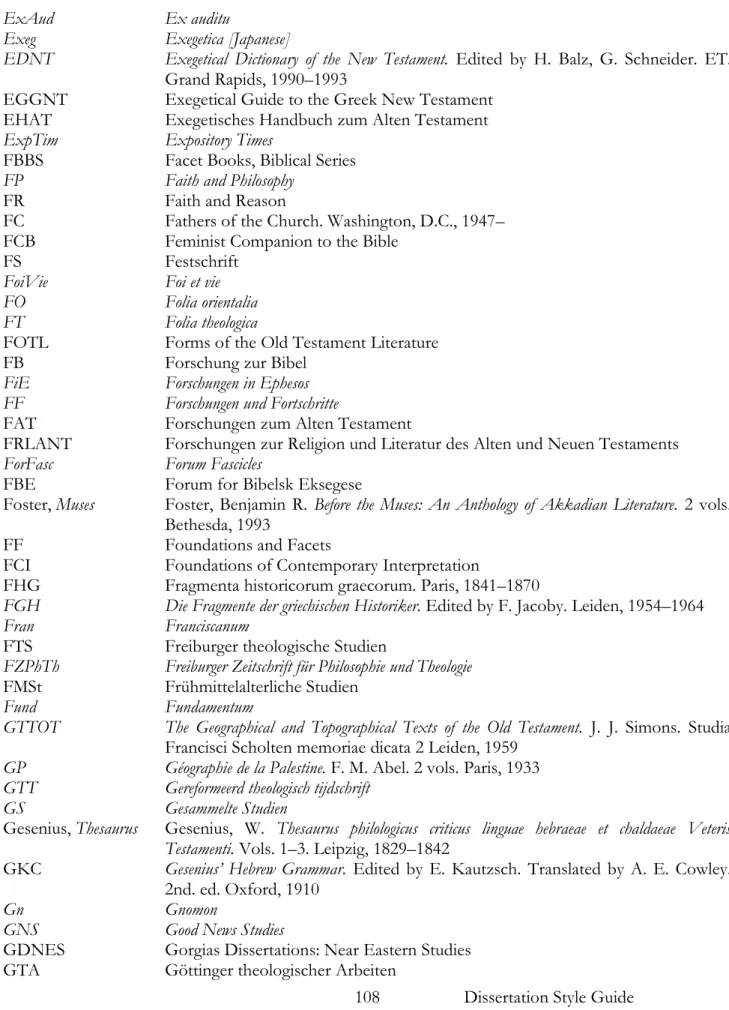
For biblical and theological-related abbreviations not specified in the style guide along with abbreviations of ancient and medieval works, follow the SBL Handbook, pp. 69–152, 178–263. See 5. ABBREVIATIONS OF COMMONLY USED PERIODICALS, REFERENCE WORKS, AND SERIALS below for a select list of abbreviations. For references not listed there or in the SBL Handbook, students can either spell out the title in full or create an abbreviation of their own (e.g., EGGNT—Exegetical Guide to the Greek New Testament). If you do the latter, be sure to list the abbreviation in the list of abbreviations, and be sure that the abbreviation does not replicate an abbreviation listed in 5. ABBREVIATIONS OF COMMONLY USED PERIODICALS, REFERENCE WORKS, AND SERIALS or the SBL Handbook.
Table 2: English Bible Versions
ASV American Standard Version
CEV Contemporary English Version ESV English Standard Version
GNB Good News Bible
JB Jerusalem Bible
KJV King James Version
LB Living Bible
MLB Modern Language Bible
MOFFATT The New Testament: A New Translation, James Moffatt
NAB New American Bible
NABRE New American Bible Revised Edition NASB New American Standard Bible
NAV New American Version
NEB New English Bible
NET New English Translation
NIV New International Version
NJB New Jerusalem Bible
NJPS Tanakh: The Holy Scriptures: The New JPS Translation according to the Traditional Hebrew Text
NKJV New King James Version
NLT New Living Translation
NRSV New Revised Standard Version
PHILLIPS The New Testament in Modern English, J. B. Phillips REB Revised English Bible
RSV Revised Standard Version
RV Revised Version
TEV Today’s English Version (= Good News Bible) TNIV Today’s New International Version
WEYMOUTH The New Testament in Modern Speech, R. F. Weymouth
If you cite earlier editions of translations such as NIV or NASB, you may need to indicate that edition using a superscripted numeral (NIV1 or NASB1).
For general abbreviations, see Turabian 24.1–7. Follow the SBL Handbook for all biblical or classical abbreviations (i.e., ignore Turabian 24.6). Latin abbreviations are found on pp. 84–88 of the SBL Handbook. For Qumran texts, see the SBL Handbook pp. 74–77 and 183–218. For papyri, ostraca, and other ANE texts, see the SBL Handbook, p. 89. General scholarly abbreviations should not appear in the front matter list of abbreviations (for example: i.e., ibid, et al., etc.). For abbreviations of states in the U.S., use the standard two-digit postal abbreviation (AL, AK, AZ, etc.; listed with Canadian abbreviations in 3.1.11. List of Abbreviations). The abbreviation [sic] marks an uncorrected error in
quoted material. In designating eras, students may use either B.C. and A.D. or BCE (Before Common Era) and CE (Common Era).
2.12. BOOKS OF THE OLD AND NEW TESTAMENTS AND THE APOCRYPHA
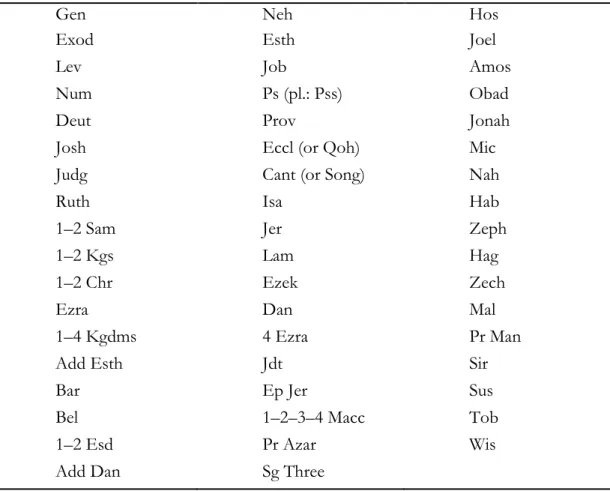
For abbreviations of Old and New Testament books and the Apocrypha, follow the SBL Handbook, pp. 73–74 and 87–88 (for Latin abbreviations). Use these abbreviations in the body of the dissertation, parenthetical references, parenthetical comments, or in footnotes when referring to a specific chapter and verse (such as Gen 1:1; or Ps 23:3). Do not use abbreviations when referring to a biblical or apocryphal book in a heading or subheading. Do not use abbreviations when referring to a biblical or apocryphal book as a whole (e.g., write Genesis in full, not Gen) or an entire chapter (Genesis 1, not Gen 1; Psalm 23, not Ps 23). Hint: the colon is the key; abbreviate only when there is a colon. When a direct quote from another author contains a biblical citation do not modify the form of that citation to conform to these guidelines.
Table 3: Old Testament and Apocrypha
Gen Neh Hos
Exod Esth Joel
Lev Job Amos
Num Ps (pl.: Pss) Obad
Deut Prov Jonah
Josh Eccl (or Qoh) Mic
Judg Cant (or Song) Nah
Ruth Isa Hab
1–2 Sam Jer Zeph
1–2 Kgs Lam Hag
1–2 Chr Ezek Zech
Ezra Dan Mal
1–4 Kgdms 4 Ezra Pr Man
Add Esth Jdt Sir
Bar Ep Jer Sus
Bel 1–2–3–4 Macc Tob
1–2 Esd Pr Azar Wis
Table 4: New Testament
Matt Gal Phlm
Mark Eph Heb
Luke Phil Jas
John Col 1–2 Pet
Acts 1–2 Thess 1–2–3 John
Rom 1–2 Tim Jude
1–2 Cor Titus Rev
As a general rule, avoid using f. when citing two verses (e.g., Exod 19:4f. = Exod 19:4–5) or ff. when citing more than two (e.g., Exod 19:4ff. = Exod 19:4 and following). Give the exact references (Exod 19:4–5; Exod 19:4–13, respectively). If you must use f. or ff., these letters must be followed by a period.
2.13. BIBLE VERSIONS AND VERSIFICATION
The student must indicate what Bible versions and versification schemes the dissertation uses. The information for the primary English translation used in the dissertation, as well as the primary versification system, should be indicated in a footnote with the first quotation. The exact wording of this is determined by the conditions detailed on the copyright page of that version. For example:
N: 1 Unless otherwise indicated, Scripture quotations are from the New Revised Standard
Version Bible, copyright 1989, Division of Christian Education of the National Council of the Churches of Christ in the United States of America. Scripture references follow the versification in the NRSV unless alternate versification is indicated.
Where an alternate versification scheme is referenced, indicate that scheme with an abbreviation (listed in the List of Abbreviations) for the manuscript or version employing that versification (1) after the reference when not in parentheses and (2) before the reference when in parentheses. For example:
Psalm 113:1 LXX (MT and NRSV 114:1) recalls the exodus from Egypt.
See “Appendix E: English/Hebrew/Greek Versification Compared” in the SBL Handbook for a table of versification differences.
2.14. THE DIVINE NAME
A student may decide, in consultation with his or her mentor, how to refer to the divine name in the Old Testament (such as YHWH, Yahweh, LORD).
2.15. TRANSCRIPTION AND TRANSLITERATION
Ordinarily, biblical languages should not be transliterated. Instead, use Hebrew and Greek script. For Hebrew you need not include accents and other cantillation markings unless they are important to the argument. Vowels may be omitted when appropriate, such as indicating a verb root or when giving the consonantal text is adequate for the argument. Greek accents and breathing marks must be included, but words standing alone must not have a grave accent (since the grave is only used when a word follows). If your word processor cannot insert diacritical marks, you must do so by hand with black ink.
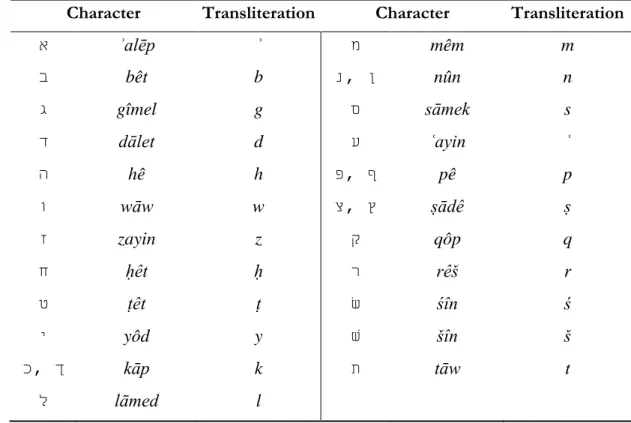
If for some reason it is necessary to transliterate Greek and Hebrew, use the following as a guide. Transliteration is to appear in lower case italic letters.
Table 5: Transliteration of Greek Letters (See SBL, 29)
Character Transliteration Character Transliteration
α a ξ x β b ο o γ g π p γ n (before γ, κ, ξ, or χ) ρ r δ d ῥ rh ε e σ, ς s ζ z τ t η ē υ y (not in diphthongs) θ th υ u (in diphthongs) ι i φ ph κ k χ ch λ l ψ ps μ m ω ō ν n ῾ h (with vowel or diphthong)
23 Dissertation Style Guide Table 6: Transliteration of Hebrew Consonants (See SBL, 26–27)
Character Transliteration Character Transliteration
א ʾalēp ʾ מ mêm m ב bêt b נ, ן nûn n ג gîmel g ס sāmek s ד dālet d ע ʿayin ʿ ה hê h פ, ף pê p ו wāw w צ, ץ ṣādê ṣ ז zayin z ק qôp q ח ḥêt ḥ ר rêš r ט ṭêt ṭ שׂ śîn ś י yôd y שׁ šîn š כ, ך kāp k ת tāw t ל lāmed l
Table 7: Transliteration of Hebrew Vowels (See SBL, 26–27)
Character Transliteration Character Transliteration ַ
א pataḥ a יִא ḥîreq yôd î/ îy
ַ
ה furtive pataḥ a ָא qāmeṣ ḥāṭûp o
ָ
א qāmeṣ ā ֹא ḥōlem ō
האָ final qāmeṣ hê â וֹ full ḥōlem ô
ואָ 3ms suffix āyw ֻא short qibbûṣ u
ֶ
א sĕgōl e ֻא long qibbûṣ ū
ֵ
א ṣĕrê ĕ וּ šûreq ȗ
יֵא ṣĕrê yôd ê/êy ֳא ḥāṭĕp qāmeṣ ō
יֶא sĕgōl yôd ê/êy ֲא ḥāṭĕp pataḥ ā
ִ
א short ḥîreq i ֱא ḥāṭĕp sĕgōl ĕ
ִ
Final forms—ך, ן, ף, ץ—are indicated by their position in the transliterated word. They are not indicated by a different form. Spirant forms of ב, ג, ד, כ, פ, ת (without dāgēš lene) are generally not indicated. If they must be indicated by underlining: b, g, d, k, p,t. Dāgēšforte is indicated by doubling the consonant (הֵּנִה = hinnēh). Accents are generally not indicated; if they are need use an acute accent ( ´ ) for the primary and a grave accent ( ` ) for the secondary accent. For a maqqēp use a hyphen. When embedding text (words, phrases, clauses, etc.) from a Hebrew program, be sure to wrap the words properly.
For transliteration of other ancient languages, see the SBL Handbook 5.4–7.
2.16. ILLUSTRATIONS
Illustrations may consist of drawings, charts, graphs, or maps. An illustration must appear as close to its first reference in the text as possible. Illustrations in the text require a corresponding entry in the LIST OF ILLUSTRATIONS in the front matter. Any illustrations must have a caption below the illustration preceded by the word Figure, a number, a colon, and a space. No final period is needed. For more information, see Turabian 26.3.
Example 1: Illustration
Figure 1: Babylonia at the Time of Hammurabi (Source: http:// commons.wikimedia.org/wiki/File:Hammurabi's_Babylonia_1.svg)
2.17. TABLES
Tables organize and compress data into a systematic form, generally numerical. A table must appear as close to its first reference in the text as possible. As a general rule, no font in the document may be smaller than 12 pt, but in tables a smaller font is permitted if it is necessary. All text must be horizontal, and tables must fit within page margins. Tables must have a caption at the top with a name for the table
preceded by the word Table, a number, a colon, and a space. For more information, see Turabian 26.2.
2.18. INTERNAL CROSS-REFERENCES
When making internal references to the dissertation itself, refer to pages using the form, “See below, p. 310.” This does not apply to citations in footnotes. For that see 4.1.7. Page Number (for footnotes).
2.19. GRAMMAR
For questions related to appropriate vocabulary, grammar and style the following volumes are helpful: Copperud, Roy H. American Usage and Style: The Consensus. New York: Van Nostrad Reinhold,
1980.
Johnson, Edward D. The Handbook of Good English: A Comprehensive, Easy-to use Guide to Modern Grammar, Punctuation, Usage and Style. New York: Washington Square Press, 1991.
2.20. PLAGIARISM
Plagiarism is the direct quotation or use of ideas or writings of another person without giving written acknowledgement of the source. The student is responsible for knowing the difference between the legitimate and illegitimate use of published and unpublished source material. If there is any doubt, counsel should be sought from the student’s mentor. Substantial penalties, including dismissal from the
Example 2: Table
Table 8. Distribution of Terms Translated “Rock” in the Psalms and Isaiah Lemma Psalms Isaiah
רוּצ 24 11
program, will be assessed if a student is found to be guilty of plagiarism. See the Wheaton College Catalog for more details.
2.21. GENDER NEUTRAL LANGUAGE
Since English is increasingly discarding the use of grammatically masculine terms to refer to men and women generally and such use can signal a masculine referent when none is intended, students are encouraged to use gender-neutral language. In addition to these suggestions, the use of “singular they/their”, which is becoming increasingly standard English, is also encouraged (e.g., “Each student who does well on the test will have their grade improved”). Students who choose to continue to use masculine terms in a generic sense should be able to articulate clearly to their mentors or other professors enquiring their reasons for doing so.
2.22. SEE AND CF.
Frequently dissertations refer to other works for further information or comparison. As a rule of thumb, when referring to another work for further information, illustration, or grounding, use the expression “see . . .” and for comparison use the expression “cf. . . . .” For example:
This fact is embraced by Paul (see Rom 5:1).
The internal orientation of a person to God is a key concept in Deuteronomy (cf. Ps 1:1–2, Proverbs 1:7).
Many scholars identify Psalm 34 as one of the wisdom psalms (see, e.g., R. B. Y. Scott, The Way of Wisdom in the Old Testament [New York: Macmillan, 1971], 198).
3. DISSERTATION CONTENTS
3.1. FRONT MATTER
Organize the front matter in the precise order in which the following components appear. All of the components listed below are required except for the Dedication Page and Epigraph Page. Lists of Illustrations and Tables are required only if you have illustrations or tables. No components may appear in the front matter besides those noted here. The contents of the introductory pages are not included in the dissertation word count.
3.1.1. Fly Leaf Page This is simply a blank page. 3.1.2. Title Page
The title page is counted as page i in the front matter, but does not display the page number and is not listed in the Table of Contents. All lines are to be centered between the left margin 1 ½ inches and the right margin 1 inch. The dissertation title should be in upper case and should contain no acronyms or abbreviations. The top line should be spaced 2 inches from the top edge. If the title is longer than 48 characters including spaces, it must be single-spaced and set in inverted pyramid form, unless it breaks at an illogical place. The word “by” should appear after eight blank lines below the title with the author’s name following after a single blank line. After one blank line list the accredited college and graduate degrees that the student earned followed by the schools (and their cities and states)from which the student graduated along with the years of graduation, with each degree listed on one line and single-spaced. After approximately eight blank lines below the last school list the word DISSERTATION followed by two blank lines and then the following text:
There are four concentrations: Biblical Theology—Old Testament; Biblical Theology—New Testament; Systematic Theology; Historical Theology. Following four to six blank lines type “Wheaton, Illinois” with the month and year of graduation on the following line. Defense drafts contain the month and year of submission. See 7.1. Sample Title Page and the dissertation template online.
Submitted to the Faculty
in partial fulfillment of the requirements for the degree of
DOCTOR OF PHILOSOPHY Concentration in _____________________
3.1.3. Signature Page
The student is responsible to obtain the required signatures for the signature page (usually at the dissertation defense). The signature page must be of the same font and quality paper as the final copies of the document and bear original signatures in black ink. The signature page is numbered as page ii but is not listed in the Table of Contents. The word “Accepted” should appear 2 inches from the top of the page and 1 ½ inches from the left edge. Beginning on the third single-spaced line below and at the left margin should be four solid underlines 3 inches long, one beneath the other. Centered underneath each solid underline is a Dissertation Defense Committee member title. Two space single-spaced lines appear between each committee member title and the next solid underline. There should be four solid lines. See 7.2. Sample Signature Page
Dissertation Defense Committee member titles should appear in the following order: Dissertation Supervisor
Second Reader External Reader
Dissertation Defense Committee Chair 3.1.4. Disclaimer Page
The “Disclaimer” page is counted as page iii, but it does not appear in the Table of Contents. The title “Disclaimer” should be centered 3 inches from the top of the page. The disclaimer should be centered one space below the title and expressed in the following manner:
See 7.3. Sample Disclaimer Page. 3.1.5. Dedication Page
The dedication page is optional. It is counted as page iv but displays no heading or page number, nor is it listed in the Table of Contents. The first line of text appears three inches from the top of the page. You need not use the words dedication or dedicated;you may simply write To. No concluding punctuation is used. In general, the dedication should brief. Successive lines are single-spaced and appear in inverted pyramid form. See 7.4. Sample Dedication Page.
3.1.6. Epigraph Page
The epigraph page is optional. An epigraph is a quotation of Scripture or of another author or speaker that expresses an idea that closely relates to the dissertation. It is counted but displays no heading or page number, nor is it listed in the Table of Contents. The epigraph should appear 3 inches from the top of the page. If it is one line, the epigraph should be centered. If the epigraph is a block quotation, indent it 1 inch from the left and right margins. The text should be left-aligned and ragged on the right. If there is a source, list it on the line following the quotation, flush right, listing the author’s full name or last name and, normally, the title of the work, in quotation marks or italicized. Place an em dash (—) before the author’s name. See 7.5. Sample Epigraph Page. For epigraphs used at the head of a chapter, see 3.2.2. Chapters.
3.1.7. Abstract
The title, ABSTRACT, should be centered and placed 2 inches from the top edge. Two blank single-spaced lines should follow it. The body of the abstract should be formatted like the body of the paper except no footnotes should appear in the abstract. The abstract pages are counted and numbered but
The views expressed in this dissertation are those of the student and do not necessarily express the views of Wheaton College.
not listed in the Table of Contents. Abstracts must be no longer than 350 words. See 7.6. Sample First Abstract Page for initial and subsequent pages.
3.1.8. Table of Contents
The words TABLE OF CONTENTS should appear 1 inch from the top of the page. Two blank single-spaced lines should follow with the entries beginning on the third line below. The major points of the Table of Contents must conform precisely to the content found in the body of the dissertation. The pages of the Table of Contents should be numbered with roman numerals. Note the following:
The Table of Contents should include only the Abstract, Acknowledgements, List of Abbreviations, Chapters, Headings, Appendices, and Bibliography.
Single-space entries and leave one blank line between entries.
Chapters should be listed in a manner analogous to enumerated lists (see 3.2.5. Enumerated Lists) but with different spacing. For the first chapter the Arabic numeral 1, a period, and a single space should be flush right 0.25 in from the left margin. Following the space the name of the chapter should appear. Thus the periods for the chapter numbers should line up vertically with each other, and successive chapters should follow this format with increasing Arabic numerals.
Indent successive levels of subheading 0.25 in further yet. Note in the sample below that successive lines of chapter headings that run over one line are indented 0.25 in further. This can be achieved by using the hanging indent setting for that paragraph style.
The capitalization and wording of headings must be exactly as they appear in the body of the document.
The number of levels of headings listed must include all levels appearing in the document. Page numbers should be flush with the right margin following a line of spaced periods or dot
leaders.
Headings that run to more than one line should not overlap with the page number. Biblical and Apocryphal books are never to be abbreviated.
Page numbers and dot leaders must appear for all levels, including parts, chapters and all subheadings.
If your dissertation contains parts, the word “PART” should be flush left, followed by a space and the Roman numeral of the part, a tab (with a tab stop of 3/8 in), and the title of the part. For style and format see 7.8. Sample Table of Contents and Parts.
For the final library copies, dot leaders are to be separated by 1/8 inch and lined up with the dots above and below. The first dot may vary in distance from the last letter of the heading on the left, but the last dot on each line must be 5.5 inches from the left margin, thus ensuring the dots above and below line up vertically with each other and leaving 0.5 in between the last dot leader and the right margin. This leaves room for the largest front matter roman numeral page number, which is likely to be xviii. The final digit of a page number on the right should be flush right. Many word processors generate spaced and aligned dot leaders (e.g., Nota Bene, LyX). Word users can manually line up the dots by the setting the tabs at 1/8 intervals.
Note that 3.2.3. Subheadings requires the following: “A section of text, if divided, should be divided into two or more subsections rather than adding an extra level of subheading for a single point.” That means the table of contents may not have an entry without a parallel at the same level.
For an example Table of Contents, see 7.8. Sample Table of Contents and Parts. 3.1.9. Lists of Illustrations or Tables
If the dissertation includes tables, examples, or figures, you must list these in the front matter. If your paper includes both illustrations and tables, list them in two separate lists on separate pages with the titles ILLUSTRATIONS and TABLES appearing 2 inches below the top edge of the respective pages. Two spaces below the titles in italics and justified left the word Figure should appear for the illustration page and Table for the tables page. The first entry in each list is placed one space line below. Entries should be single-spaced, with a single-spaced line intervening between individual entries. The Arabic number of each illustration or table is indented .25 in from the left margin with a .25 in hanging indent for subsequent lines of the same item. Page numbers should appear at the right margin (justified right). Use the same spacing and vertical alignment between dot leaders and page numbers used in the Table of Contents. See Table of Contents formatting instructions above. See also 7.9. Sample List of Illustrations and 7.10. Sample List of Tables. Note: do not list illustrations or tables within the Table of Contents. 3.1.10. Acknowledgements
An acknowledgements page need only appear in the final copy. ACKNOWLEDGEMENTS should be centered 2 inches below the top edge of the page. Two blank lines should follow the heading, and the text should be formatted like the main text of the document. Conclude with your name and date matching that on the title page single spaced and flush right with the margin, with a single spaced blank line above. See 7.11. Sample Acknowledgements for initial and subsequent pages.
3.1.11. List of Abbreviations
The words LIST OF ABBREVIATIONS should appear 2 inches below the top edge of the page. Subsequent pages are spaced 1 inch from the top of the page. Single-space entries, with a blank line between individual entries. Entries are arranged alphabetically by abbreviation. Follow the SBL Handbook (89–153) for format; e.g., vertically align the first letter of all spelled out terms and run over lines a half inch from the longest abbreviation. Do not end entries with a period. For guidelines and examples of listing publication information with abbreviations, see 5. ABBREVIATIONS OF COMMONLY USED PERIODICALS, REFERENCE WORKS, AND SERIALS.Be sure to include a
bibliographic entry with complete publishing information for all works listed in the List of Abbreviations.
The list should include all abbreviations used in the dissertation, even if listed in the SBL Handbook. Exceptions include English Bible versions, Old Testament, New Testament, and Apocryphal books, , Qumran texts, US states, and general scholarly abbreviations such as B.C., A.D., BCE., CE, i.e., ibid, et al., sic, etc. See 7.13. Sample List of Abbreviations for initial and subsequent pages.
Table 9: Abbreviations for U.S. States and the District of Columbia
AL Alabama MT Montana
AK Alaska NE Nebraska
AZ Arizona NV Nevada
AR Arkansas NH New Hampshire
CA California NJ New Jersey
CO Colorado NM New Mexico
CT Connecticut NY New York
DE Delaware NC North Carolina
DC District of Columbia ND North Dakota
FL Florida OH Ohio
GA Georgia OK Oklahoma
HI Hawaii OR Oregon
ID Idaho PA Pennsylvania
IL Illinois RI Rhode Island
IN Indiana SC South Carolina
IA Iowa SD South Dakota
KS Kansas TN Tennessee KY Kentucky TX Texas LA Louisiana UT Utah ME Maine VT Vermont MD Maryland VA Virginia MA Massachusetts WA Washington
MI Michigan WV West Virginia
MN Minnesota WI Wisconsin
MS Mississippi WY Wyoming
Table 10: Abbreviations of Canadian Provinces
AB Alberta NU Nunavut
BC British Columbia ON Ontario
MB Manitoba PE Prince Edward Island
NB New Brunswick QC Quebec
NL Newfoundland and Labrador SK Saskatchewan
NS Nova Scotia YT Yukon
3.2. BODY OF THE DOCUMENT
The body of the document includes all of your chapters. From this point on pages are numbered in Arabic numerals, starting with 1 on the first page of the first chapter. Some of the formatting listed below may apply to other sections of the document (e.g., appendices) if you use such elements there (e.g., subheadings).
According to the PhD program Handbook for Participants (all editions), the dissertation may be a maximum of 100,000 words. That word count includes footnotes in the body of the dissertation, but it does not include front matter, appendices and bibliography.
3.2.1. Parts
If your dissertation contains parts, the heading PART should appear on a separate page 2 inches from the top of the page and centered, followed by a space and the Roman numeral of the part, a tab (with a tab stop of 3/8 in), and the title of the part, which is also uppercase. The title should be no longer than 48 characters long, including spaces. Ordinarily, there will be no text here. If you have text, leave two two single space lines between the title and the first line of text. Text introducing a part should be relatively brief in length. If you have text introducing one part, you must have text introducing all. Parts pages are assigned page numbers. A page number should appear centered in the footer as in the first page of each chapter. See 7.15. Sample Part Page. Subsequent pages likewise follow the pattern of a chapter with the page number flush right in the header.
3.2.2. Chapters
For the first page of a chapter, the generic heading CHAPTER followed by an Arabic numeral should be placed 2 inches from the top of the page and centered. Add one blank single-spaced line and then the title of the chapter, which is also uppercase and centered. If the title is more than 48 characters long, including spaces, divide it into two or more double-spaced lines, ideally arranged in an inverted pyramid. Lines should be broken at logical places; e.g., prepositional phrases must always be together on one line, and a line may not end with a conjunction. If the title includes a subheading, the part before the colon should be on one line and the part after on the next line. The colon appears at the end of the line. Leave two single space lines between the title and the first line of text or the first subheading. Indent the first line of text.
An epigraph used at the head of a chapter should be indented 1 inch from the left margin and single-spaced. Leave two single space lines above and below the epigraph. The name of the author of the quotation and title should be flush right.
Pagination should follow the specifications in 1.6. Page Numbers. See 7.16. Sample Chapter First Page. Subsequent pages should have a 1 in top margin. The page numbers for these pages appear in the upper right corner, 0.75 in from the top. See 7.17. Sample Chapter Pages Subsequent Pages.
3.2.3. Subheadings
Up to four subhead levels are recommended. Leave two single space lines between the last line of text and a subheading (that is, two single lines; do not simply hit the enter key twice when you are in double space format). Leave one space between a subheading and subsequent text. Indent the first line of text after a subheading. Ordinarily, all subheadings will have intervening text. However, if two or more subheadings appear together without intervening text, leave one blank space line between them. If a subheading starts a page, leave it flush with the top margin, with no extra space between the top margin and the subhead. Format subheadings as follows:
A first-level subheading should be bold, centered and capitalized headline style (i.e., capitalize the first and last words and all nouns, pronouns, verbs, adjectives, and adverbs). If it is more than 48 characters, including spaces, divide it into two or more single-spaced lines arranged in an inverted pyramid. Lines should be broken at logical places; e.g., prepositional phrases must always be together on one line, and a line may not end with a conjunction. If the title includes a subheading, the part before the colon should be on one line and the part after on the next line. The colon appears at the end of the line.
A second-level subheading should be in text type, centered and capitalized headline style. If it is more than 48 characters, including spaces, divide it into two or more single-spaced lines arranged in an inverted pyramid. Lines should be broken at logical places; e.g., prepositional phrases must always be together on one line, and a line may not end with a conjunction. If the title includes a subheading, the part before the colon should be on one line and the part after on the next line. The colon appears at the end of the line.
A third-level subheading should be flush with the left margin. It is set in text type and italics font and is capitalized headline style. If it is more than half the width of the page, it should be divided into two single-spaced lines more or less equal in length, with the second line flush with the margin.
The fourth-level subheading also appears flush with the left margin. It is set in a text type and is capitalized headline style. If it is more than half the width of the page, it should be divided into two single-spaced lines more or less equal in length, with the second line flush with the margin. Example 3: Subheadings
Subheading Level 1 Subheading Level 2 Subheading Level 3
A section of text, if divided, should be divided into two or more subsections rather than adding an extra level of subheading for a single point. Subheadings at the bottom of a page having less than two lines of following text must be moved to the top of the next page. See Example 3: Subheadings
3.2.4. Quotations
3.2.4.1. Introducing Quotations
There are several ways to integrate a quotation into a sentence. You may (1) use an introductory verb such as notes, claims, argues, avers, etc., followed by a comma, (2) weave the quote into the syntax of the sentence and leave off the comma (perhaps introducing the quote with that), (3) place the attribution of the source in the middle of the quote with commas to separate it from the quote, or (4) separate two complete sentences, one your own and the other the quotation, with that and a colon.
Example of (1): MacIntyre summarizes, “Kant takes it to be that all genuine expressions of the moral law have an unconditional categorical character.”
Example of (2): Westermann claims that “the prayer of repentance in its fully developed form is not to be found in the Psalter,” a claim which he substantiates by classifying it as a literary category.
Example of (2): How is it that Jones concludes that during the reformation it was “no longer possible to accept the merger between the allegorical and literal approaches to the Bible”? Example of (3): “The notion of singular definite reference is a very unsatisfactory one,” Searle notes, “but one we can hardly do without”; his first example is the proper name.
Example of (4): In an article responding to Lyle Eslinger’s critique of Michael Fishbane’s Biblical Interpretation in Ancient Israel, Benjamin D. Sommer takes him to task for ignoring alternative theories about the composition of the Pentateuch to that of Wellhausen: “Generally, Eslinger seems to assume that any disagreement with Wellhausen’s dating of priestly material is a priori unlikely, as if Wellhausen’s dating were canonical. In so doing, he dismisses out of hand the wealth of material that argues for an earlier dating of Ρ on linguistic and historical grounds.” See Turabian 25.2 for more detail on all but the fourth type.
3.2.4.2. Modifying Quotations
Aside from the use of ellipses (see 2.2. Ellipses), there are a number of situations in which quotations need to be modified. Turabian 25.3 deals with a number of these cases. For the specific case of changing the capitalization of initial letters or the final punctuation of a quotation, these need not be indicated in brackets for the dissertation. For example:
Original Quote: “Religion was less a matter of holding beliefs than of observing annual festivals or public rituals, less concerned with conversion than adherence, of participating in local cults without, however, excluding others, of identifying with the traditions of the city in which one lived.”
Modified Quote: Wilken asks us to view religion on the ancient world differently from our idea of religion because “religion was less a matter of holding beliefs than of observing annual festivals or public rituals.”
3.2.4.3. Block Quotations
Introduce block quotations in the same manner as any other quotation except for the third method listed above in 3.2.4.1. Introducing Quotations.
For indentation format, see 1.7. Indentation above. A prose quotation of two or more sentences that runs to five or more lines of text is set in block quotation format: single-spaced with one blank line between the text above and below. Block quotations do not use opening and closing ellipses. Note Turabian 25.2 for correct and incorrect usage of block quotations.
Scripture quotations need not be two or more sentences long or run to five or more lines of text. The reference should be listed in parentheses following the final punctuation:
But be doers of the word, and not hearers only, deceiving yourselves. For if anyone is a hearer of the word and not a doer, he is like a man who looks intently at his natural face in a mirror. For he looks at himself and goes away and at once forgets what he was like. But the one who looks into the perfect law, the law of liberty, and perseveres, being no hearer who forgets but a doer who acts, he will be blessed in his doing. (Jas 1:22–25)
Use double quotation marks for a quotation within a block quote. 3.2.4.4. Quotations of Scriptural Text and Translation
Hebrew text and translation should be single-spaced with a blank line above and below. Poetry may be displayed in two columns as follows:
Text and translation may be displayed in two successive paragraph blocks. Be sure that the beginning of the Hebrew line is flush with the right margin:
Example 4: Hebrew and Translation in Two Columns
This is Psalm 1:1 with the NRSV translation: שׁיִאָה־י ֵרְשַׁא 1a Happy are those ךְַלָה אלֹ רֶשֲׁא
םיִעָשׁ ְר תַצֲעַב 1b who do not follow the advice of the wicked, דָמָע אלֹ םיִאָטַח ךְ ֶרֶדְבוּ 1c or take the path that sinners tread,
׃בָשָׁי אלֹ םיִצֵל בַשׁוֹמְבוּ 1d or sit in the seat of scoffers;
3.2.5. Enumerated Lists
Introduce enumerated lists with a complete sentence followed by a colon. Do not use bulleted lists. Use Example 5: Hebrew and Translation in Two Successive Paragraphs
This is Gen 12:1–3 with the NRSV translation:
ֶראָָה־לֶא ךָיִבאָ תיֵבִמוּ ךְָתְדַלוֹמִּמוּ ךְָצ ְראֵַמ ךְָל־ךְֶל ם ָרְבאַ־לֶא הָוהְי רֶמאֹיַו ךְָכ ֶרָבֲאַו לוֹדָג יוֹגְל ךְָשֶעֶאְו ׃ָךֶא ְראַ רֶשֲׁא ץ
ָמ ָדֲאָה תֹחְפְשִׁמ לֹכ ךְָב וּכ ְרְבִנְו רֹאאָ ךְָלֶלַקְמוּ ךָיֶכ ְרָבְמ הָכ ֲרָֽ ָבֲאַו ׃הָכ ָרְב הֵיְהֶו ךֶָמְשׁ הָלְדַגֲאַו ׃ה
Now the Lord said to Abram, “Go from your country and your kindred and your father’s house to the land that I will show you. I will make of you a great nation, and I will bless you, and make your name great, so that you will be a blessing. I will bless those who bless you, and the one who curses you I will curse; and in you all the families of the earth shall be blessed.”
And this is the text that follows.
Example 6: Enumerated Lists
The following is an enumerated list:
1. First item: This item has extra text to illustrate how to handle enumerated items that spill over to the second line.
2. Second item 3. Third item 4. Fourth item 5. Fifth item 6. Sixth item 7. Seventh item 8. Eighth item 9. Ninth item