Software System
Engineering:
A Tutorial
S
oftware systems have become larger and more complex than ever. We can attribute some of this growth to advances in hard-ware performance—advances that have reduced the need to limit a software sys-tem’s size and complexity as a primary design goal. Microsoft Word is a classic example: A product that would fit on a 360-Kbyte diskette 20 years ago now requires a 600-Mbyte CD.But there are other reasons for increased size and complexity. Specifically, software has become the dominant technology in many if not most techni-cal systems. It often provides the cohesiveness and data control that enable a complex system to solve problems.
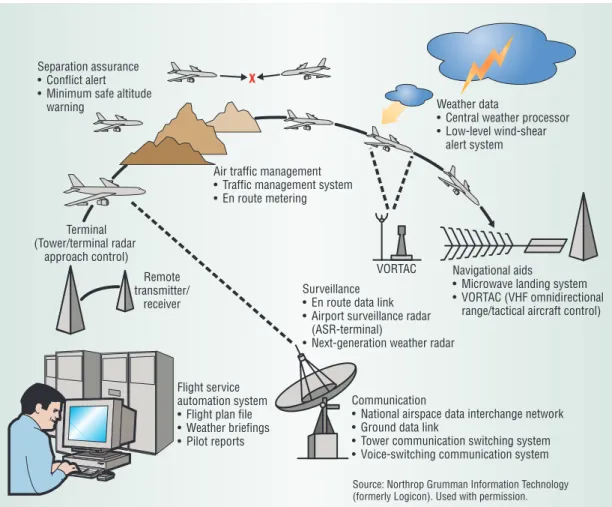
Figure 1 is a prime example of this concept. In an air traffic control system, software connects the air-planes, people, radar, communications, and other equipment that successfully guide an aircraft to its destination. Software provides the system’s major technical complexity.
The vast majority of large software systems do not meet their projected schedule or estimated cost, nor do they completely fulfill the system acquirer’s expectations. This phenomenon has long been known as the software crisis.1In response to this
crisis, software developers have introduced differ-ent engineering practices into product developmdiffer-ent. Simply tracking a development project’s man-agerial and technical status—resources used, mile-stones accomplished, requirements met, tests completed—does not provide sufficient feedback about its health. Instead, we must manage the tech-nical processes as well as its products. System
engi-neering provides the tools this technical manage-ment task requires.
The application of system engineering principles to the development of a computer software system produces activities, tasks, and procedures called soft-ware system engineering, or SwSE. Many practi-tioners consider SwSE to be a special case of system engineering, and others consider it to be part of soft-ware engineering. However, we can argue that SwSE is a distinct and powerful tool for managing the tech-nical development of large software projects.
This tutorial integrates the definitions and processes from the IEEE software engineering stan-dards2into the SwSE process. A longer version that
includes a detailed step-by-step approach for imple-menting SwSE is available in Software Engineering Volume 1: The Development Process,part of the IEEE Computer Society’s “best practices series.”3
SYSTEMS AND SYSTEM ENGINEERING
A system is a collection of elements related in a way that allows a common objective to be accom-plished. In computer systems, these elements include hardware, software, people, facilities, and processes.
System engineering is the practical application of scientific, engineering, and management skills nec-essary to transform an operational need into a description of a system configuration that best sat-isfies that need. It is a generic problem-solving process that applies to the overall technical man-agement of a system development project. This process provides the mechanism for identifying and evolving a system’s product and process definitions.
Applying system engineering principles specifically to the development of large, complex software systems provides a powerful tool for process and product management.
Richard H.
Thayer
California State University, SacramentoR E S E A R C H F E A T U R E
IEEE Std. 1220-1998describes the system engi-neering process and its application throughout the product life cycle.4System engineering produces
documents, not hardware. The documents associ-ate developmental processes with the project’s life-cycle model. They also define the expected process environments, interfaces, products, and risk man-agement tools throughout the project.
System engineering involves five functions: • Problem definitiondetermines the needs and
constraints through analyzing the require-ments and interfacing with the acquirer. • Solution analysisdetermines the set of
possi-ble ways to satisfy the requirements and con-straints, analyzes the possible solutions, and selects the optimum one.
• Process planningdetermines the tasks to be done, the size and effort to develop the prod-uct, the precedence between tasks, and the potential risks to the project.
• Process controldetermines the methods for controlling the project and the process, mea-sures progress, reviews intermediate products, and takes corrective action when necessary. • Product evaluationdetermines the quality and
quantity of the delivered product through eval-uation planning, testing, demonstration, analy-sis, examination, and inspection.
System engineering provides the baseline for all project development, as well as a mechanism for defining the solution space—that is, the systems and the interfaces with outside systems. The solu-tion space describes the product at the highest level—before the system requirements are parti-tioned into the hardware and software subsystems.
This approach is similar to the software engineer-ing practice of specifyengineer-ing constraints as late as pos-sible in the development process. The further into the process a project gets before defining a constraint, the more flexible the implemented solution will be. WHAT IS SOFTWARE SYSTEM ENGINEERING?
The term software system engineering dates from the early 1980s and is credited to Winston W. Royce,5an early leader in software engineering.
SwSE is responsible for the overall technical man-agement of the system and the verification of the final system products. As with system engineering, SwSE produces documents, not components. This differentiates it from software engineering (SwE), which produces computer programs and users’ manuals.
SwSE begins after the system requirements have been partitioned into hardware and software sub-systems. SwSE establishes the baseline for all project software development. Like SwE, it is both a nical and a management process. The SwSE tech-Separation assurance
• Conflict alert • Minimum safe altitude warning
Air traffic management • Traffic management system • En route metering
Weather data
• Central weather processor • Low-level wind-shear alert system
Navigational aids
• Microwave landing system • VORTAC (VHF omnidirectional range/tactical aircraft control) VORTAC
Surveillance • En route data link • Airport surveillance radar (ASR-terminal)
• Next-generation weather radar
Communication
• National airspace data interchange network • Ground data link
• Tower communication switching system • Voice-switching communication system Flight service
automation system • Flight plan file • Weather briefings • Pilot reports Remote transmitter/ receiver Terminal (Tower/terminal radar approach control) X
Source: Northrop Grumman Information Technology (formerly Logicon). Used with permission.
Figure 1. Air traffic control system envi-ronment. Software ties the elements of large systems together, and is frequently the most complex and techni-cally challenging part of the system.
Code and unit test Detailed software design Software subsystem testing Architectural software design Software requirements analysis System design System analysis Software integration testing Software system testing System integration testing System testing System engineering Software system engineering
Software engineering Software engineering
nical process is the analytical effort necessary to transform an operational need into
• a software system description;
• a software design of the proper size, configu-ration, and quality;
• software system documentation in require-ments and design specifications;
• the procedures necessary to verify, test, and accept the finished software product; and • the documentation necessary to use, operate,
and maintain it.
SwSE is not a job description. It is a process that many people and organizations perform: system engineers, managers, software engineers, program-mers, and—not to be ignored—acquirers and users.
As large system solutions become increasingly dependent on software, a system engineering approach to software development can help avoid the problems associated with the software crisis.
Software developers often overlook system engi-neering and SwSE in their projects. They consider systems that are all software or that run on com-mercial off-the-shelf computers to be just software projects, not system projects. Ignoring the systems aspects of software development contributes to our long-running software crisis.
SwSE and software engineering
Both SwSE and SwE are technical and manage-ment processes, but SwE produces software com-ponents and their supporting documentation. Specifically, software engineering is
• the practical application of computer science, management, and other sciences to the analy-sis, design, construction, and maintenance of software and its associated documentation; • an engineering science that applies the concepts
of analysis, design, coding, testing, documenta-tion, and management to the successful comple-tion of large, custom-built computer programs under time and budget constraints; and • the systematic application of methods, tools,
and techniques that achieve a stated require-ment or objective for an effective and efficient software system.
Figure 2 illustrates the engineering relationships between system engineering, SwSE, and SwE. Traditional system engineering does initial analy-sis and design as well as final system integration and testing.
During the initial stage of software development, SwSE is responsible for software requirements analysis and architectural design. SwSE also man-ages the final testing of the software system. Finally, SwE manages what system engineers call compo-nent engineering.
SwSE and project management
The project management process involves assess-ing the software system’s risks and costs, estab-lishing a schedule, integrating the various engi-neering specialties and design groups, maintaining configuration control, and continuously auditing Figure 2. Engineering relationships between system engineering, software system
engineering (SwSE), and software engineering. SwSE is responsible for require-ments analysis, architectural design, and final software-system testing.
• Planning • Organizing • Staffing • Directing • Controlling Project management • Requirements analysis • Software design • Process planning • Process control • Verification, validation, and testing
Software system engineering
• Software design • Coding • Unit testing • Software subsystem integration Software engineering
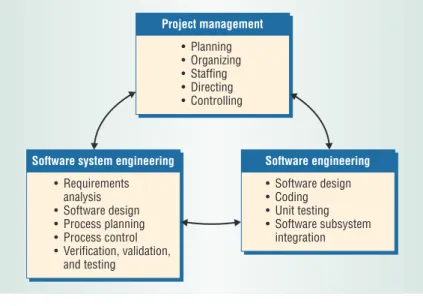
Figure 3. Management relationships between software system engineering (SwSE), software engineering, and project management. SwSE is responsible for determining the technical approach.
the effort to ensure that the project meets costs and schedules and satisfies technical requirements.6
Figure 3 illustrates the management relationships between project management, SwSE, and SwE. Project management has overall management responsibility for the project and the authority to commit resources. SwSE determines the technical approach, makes technical decisions, interfaces with the technical acquirer, and approves and accepts the final software product. SwE is respon-sible for developing the software design, coding the design, and developing software components. THE FUNCTIONS OF SOFTWARE
SYSTEM ENGINEERING
Table 1 lists the five main functions of system engineering correlated to SwSE, along with a brief general description of each SwSE function. Requirements analysis
The first step in any software development activ-ity is to determine and document the system-level requirements in either a system requirements speci-fication (SRS) or a software requirements specifica-tion or both. Software requirements include capa-bilities that a user needs to solve a problem or achieve an objective as well as capabilities that a sys-tem or component needs to satisfy a contract, stan-dard, or other formally imposed document.7
We can categorize software requirements as fol-lows:8
• Functional requirementsspecify functions that a system or system component must be capa-ble of performing.
• Performance requirements specify perfor-mance characteristics that a system or system component must possess, such as speed, accu-racy, and frequency.
• External interface requirementsspecify hard-ware, softhard-ware, or database elements with which a system or component must interface, or set forth constraints on formats, timing, or
other factors caused by such an interface. • Design constraints affect or constrain the
design of a software system or software sys-tem component, for example, language re-quirements, physical hardware rere-quirements, software development standards, and software quality assurance standards.
• Quality attributesspecify the degree to which software possesses attributes that affect qual-ity, such as correctness, reliabilqual-ity, maintain-ability, and portability.
Software requirements analysis begins after sys-tem engineering has defined the acquirer and user system requirements. Its functions include identi-fication of all—or as many as possible—software system requirements, and its conclusion marks the established requirements baseline, sometimes called the allocated baseline.2
Software design
Software design is the process of selecting and documenting the most effective and efficient sys-tem elements that together will implement the soft-ware system requirements.9The design represents
a specific, logical approach to meet the software requirements.
Software design is traditionally partitioned into two components:
• Architectural design is equivalent to system design, during which the developer selects the system-level structure and allocates the software requirements to the structure’s components. Architectural design—sometimes called top-level design or preliminary design—typically defines and structures computer program components and data, defines the interfaces, and prepares tim-ing and siztim-ing estimates. It includes information such as the overall processing architecture, func-tion allocafunc-tions (but not detailed descripfunc-tions), data flows, system utilities, operating system interfaces, and storage throughput.
Table 1. System engineering functions correlated to software system engineering (SwSE). System engineering SwSE function SwSE function description
function
Problem definition Requirements analysis Determine needs and constraints by analyzing system requirements allocated to software
Solution analysis Software design Determine ways to satisfy requirements and constraints, analyze possible solutions, and select the optimum one
Process planning Process planning Determine product development tasks, precedence, and potential risks to the project
Process control Process control Determine methods for controlling project and process, measure progress, and take corrective action where necessary
Product evaluation Verification, validation, Evaluate final product and documentation and testing
• Detailed design is equivalent to component engineering. The components in this case are independent software modules and artifacts. The methodology proposed here allocates archi-tectural design to SwSE and detailed design to SwE. Process planning
Planning specifies the project goals and objectives and the strategies, policies, plans, and procedures for achieving them. It defines in advance what to do, how to do it, when to do it, and who will do it.
Planning a SwE project consists of SwSE man-agement activities that lead to selecting a course of action from alternative possibilities and defining a program for completing those actions.
There is an erroneous assumption that project management performs all project planning. In real-ity, project planning has two components—one accomplished by project management and the other by SwSE—and the bulk of project planning is a SwSE function. (This is not to say that project
man-agers might not perform both functions.)
Table 2 shows an example partitioning of plan-ning functions for a software system project. Process control
Control is the collection of management activities used to ensure that the project goes according to plan. Process control measures performance and results against plans, notes deviations, and takes corrective actions to ensure conformance between plans and actual results.
Process control is a feedback system for how well the project is going. Process control asks questions such as: Are there any potential problems that will cause delays in meeting a particular requirement within the budget and schedule? Have any risks turned into problems? Is the design approach still doable?
Control must lead to corrective action—either bringing the status back into conformance with the plan, changing the plan, or terminating the project.
Project control also has two separate compo-nents: control that project management accom-plishes and control that software systems engineering accomplishes. Table 3 shows an exam-ple partitioning of control functions for a software system project.
Verification, validation, and testing
The verification, validation, and testing (VV&T) effort determines whether the engineering process is correct and the products are in compliance with their requirements.10The following critical
defini-tions apply:
• Verificationdetermines whether the products of a given phase of the software development cycle fulfill the requirements established during the previous phase. Verification answers the question, “Am I building the product right?” • Validationdetermines the correctness of the final
program or software with respect to the user’s needs and requirements. Validation answers the question, “Am I building the right product?” • Testingis the execution of a program or
par-tial program, with known inputs and outputs that are both predicted and observed, for the purpose of finding errors. Testing is frequently considered part of validation.
V&V is a continuous process of monitoring sys-tem engineering, SwSE, SwE, and project manage-ment activities to determine that they are following the technical and managerial plans, specifications,
Table 2. Process planning versus project planning.
Software system engineering Project management planning planning activities activities
Determine tasks to be done Determine skills necessary to do the tasks Establish order of precedence Establish schedule for completing the
between tasks project
Determine size of the effort Determine cost of the effort (in staff time)
Determine technical approach to Determine managerial approach to solving the problem monitoring the project’s status Select analysis and design tools Select planning tools Determine technical risks Determine management risks Define process model Define process model
Update plans when the requirements Update plans when the managerial or development environment change conditions and environment change
Table 3. Process control versus project control.
Software system engineering Project management control control activities activities
Determine the requirements to be met Determine the project plan to be followed Select technical standards to be Select managerial standards to be followed, for example, IEEE Std. 830 followed, for example, IEEE Std. 1058 Establish technical metrics to control Establish management metrics to control progress, for example, requirements progress, for example, cost growth, growth, errors reported, rework schedule slippage, staffing shortage Use peer reviews, in-process reviews, Use joint acquirer-developer (milestone) software quality assurance, VV&T, and reviews and SCM to determine adherence audits to determine adherence to to cost, schedule, and progress
requirements and design
Reengineer the software requirements Replan the project plan when necessary when necessary
standards, and procedures. V&V also evaluates the SwE project’s interim and final products. Interim products include requirements specifications, design descriptions, test plans, and review results. Final products include software, user’s manuals, training manuals, and so forth.
Any individual or functions within a software development project can do V&V. SwSE uses V&V techniques and tools to evaluate requirements spec-ifications, design descriptions, and other interim products of the SwSE process. It uses testing to determine if the final product meets the project requirements specifications.
The last step in any software development activ-ity is to validate and test the final software product against the software requirements specification and to validate and test the final system product against the SRS.
S
ystem engineering and SwSE are disciplines used primarily for technical planning in the front end of the system life cycle and for ver-ifying that the plans were met at the project’s end. Unfortunately, a project often overlooks these dis-ciplines, especially if it consists entirely of software or runs on commercial off-the-shelf computers.Ignoring the systems aspects of any software pro-ject can result in software that will not run on the hardware selected or will not integrate with other software systems. ■
References
1. W.W. Gibbs, “Software’s Chronic Crisis,” Scientific Am., Sept. 1994, pp. 86-95.
2. IEEE, Software Engineering Standards Collection, vols. 1-4, IEEE Press, Piscataway, N.J., 1999. 3. R.H. Thayer, “Software System Engineering: A
Tuto-rial,” Software Engineering Volume 1: The
Devel-opment Process, 2nd ed., R.H. Thayer and M.
Dorfman, eds., IEEE CS Press, Los Alamitos, Calif., 2002, pp. 97-116.
4. IEEE Std. 1220-1998, Standard for Application and
Management of the System Engineering Process,
IEEE Press, Piscataway, N.J., 1998.
5. W.W. Royce, “Software Systems Engineering,” sem-inar presented as part of the course titled Manage-ment of Software Acquisition, Defense Systems Management College, Fort Belvoir, Va., 1981-1988. 6.IEEE Std. 1058-1998, Standard for Software Project
Management Plans, IEEE Press, Piscataway, N.J.,
1998.
7. IEEE Std. 610.12-1990, Standard Glossary of Soft-ware Engineering Terminology, IEEE Press, Piscat-away, N.J., 1990.
8. IEEE Std. 830-1998, Recommended Practice for
Software Requirements Specifications, IEEE Press, Piscataway, N.J., 1998.
9. IEEE Std. 1016-1998, Recommended Practice for
Software Design Descriptions, IEEE Press, Piscat-away, N.J., 1998.
10.IEEE Std. 1012-1998, Standard for Software Verifi-cation and Validation, IEEE Press, Piscataway, N.J., 1998.
Richard H. Thayer is an emeritus professor in soft-ware engineering at California State University, Sacramento. He is also a consultant in software engineering and project management and a visit-ing researcher and lecturer at the University of Strathclyde, Glasgow, Scotland. He received a PhD in electrical engineering from the University of Cali-fornia at Santa Barbara. Thayer is a Fellow of the IEEE, an Associate Fellow of the American Insti-tute of Aeronautics and Astronautics, and a mem-ber of the IEEE Computer Society and the ACM. Contact him at [email protected].
I E E E D i s t r i b u t e d S y s t e m s O n l i n e b r i n g s y o u p e e r - r e v i e w e d f e a t u r e s , t u t o r i a l s , a n d e x p e r t - m o d e r a t e d p a g e s c o v e r i n g a g r o w i n g
s p e c t r u m o f i m p o r t a n t t o p i c s , i n c l u d i n g
To get regular updates, email [email protected]
✔
Grid Computing
✔
Security
✔
Distributed Agents
✔
Middleware
✔
Mobile and Wireless
✔
and more!
DS Onlinerecently relaunched with a new design. Check us out for news, book reviews, and more!
Distributed Systems Online
supplements the coverage in IEEE Internet Computing
and IEEE Pervasive Computing.
Each monthly issue includes magazine content and issue addenda such as source code, tutorial examples, and virtual tours. To keep up
with all that’s happening in distributed systems,
check out