Entrepreneurship Minor Proposal 1
Entrepreneurship Minor Proposal
March 26, 2009
Contact Person: Nassif Rayess, Associate Professor, Mechanical Engineering, [email protected]studies.
More recently a $50,000 KEEN II grant is supporting the institutionalization of the Entrepreneurship program in the form of the proposed Technical Entrepreneurship Minor. This grant covers all the developing expenses until August 2009. Five of the seven courses composing the planned Entrepreneurship curriculum are already in place and the remaining two are agreed upon and sufficient external grant funds are available to support their creation. Furthermore, a
A‐Executive Summary
Entrepreneurship has long been one of the strengths of the College of Business Administration and product design has long been one of the strengths of the College of Engineering and Science. In addition, the two colleges have partnered in the Masters in Product Development and are now engaged in the development and delivery of technical entrepreneurship curricula focusing on the creation of technology based products and services. To support both traditional business students desiring a focus in entrepreneurship and technical students interested in developing the mindset and competencies needed for technical venture creation, the Entrepreneurship Minor offers two possible tracks: Business Entrepreneurship or Technical Entrepreneurship. These two tracks share a common core of four courses with each track requiring an additional two courses.
There are two primary contexts to the interest in Entrepreneurship at UDM. There is a regional context borne out of the commitment that the University has to the City of Detroit. The University has always aimed at educating and training men and women to be leaders in all aspects of society. With the serious economic downturn experienced by Southeast Michigan, there is a pronounced need to graduate students who are adaptable, innovative and able to generate economic “waves” (e.g. start small businesses, develop ventures, thrive in high‐tech start‐ups, etc…).
There is also an institutional context related to UDM being a Catholic university in the tradition of the Jesuits and Sisters of Mercy. As such, our mission emphasizes not only a good, well‐rounded education but also a high level of awareness of social and ethical issues. Service learning and volunteerism are at the bedrock of the Jesuit and Mercy traditions at UDM. Entrepreneurship skills act as a great multiplier to any community service effort. A prototypical UDM Entrepreneurship student will seek to improve the lives and livelihoods of the underprivileged through a marriage of creativity, business and technology.
The College of Business Administration (CBA) has been teaching entrepreneurship for many decades. During much of that period CBA helped local small businesses and was aided in that effort with the financial support from the U.S. Small Business Administration. This involved asking those small business proprietors to spell out their problems and thus obtain advice from both CBA faculty and students.
The Technical Entrepreneurship thrust at UDM started in the winter of 2006 with a $50,000 Kern Entrepreneurship Education Network (KEEN) grant from the Kern Family Foundation and a $23,500 Lemelson Course and Program Grant administered by the National Collegiate Inventors and Innovators Alliance (NCIIA). Through these grants, faculty members from engineering and business have collaborated to develop and pilot four courses in entrepreneurship, plus several case
Entrepreneurship Minor Proposal 3
$200,000 KEEN III grant to UDM has just been announced. That grant will fund further faculty development, curriculum development and student projects.
Either track of the minor is open to students from any college across campus, resulting in a truly interdisciplinary experience. Thus far, there has been significant interest and participation from students of other disciplines in the course offerings. In all, students whose major is Architecture, Business, Psychology, Biology, Engineering and Digital Media have enrolled in the pilot Entrepreneurship courses.
B
‐Description of the Minor
Narrative
Description
of
Program
The Entrepreneurship minor is an 18 credit program of study that is open to undergraduate students of any discipline. Graduate students may also find the courses appropriate for their personal development and are also permitted to enroll in them. Students completing the minor will be exposed to techniques of innovation and creativity, product development, venture creation and business plan development. The theme of social entrepreneurship will be interwoven throughout
o
this minor and will be emphasized by the types of project w rk that will be undertaken.
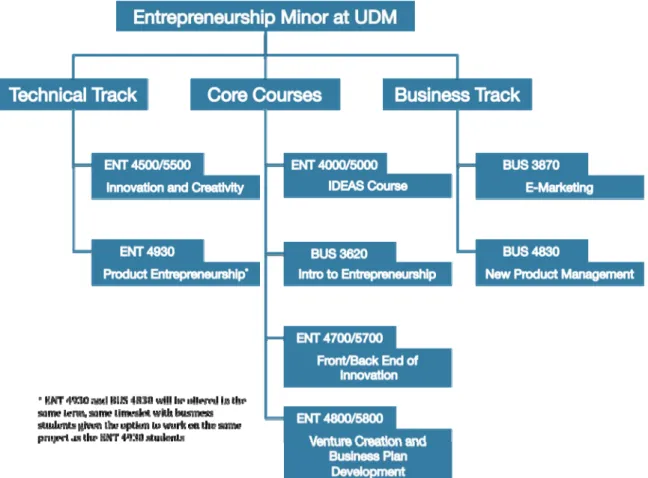
The Entrepreneurship Minor may be completed by one of two tracks: the Business Entrepreneurship Track or the Technical Entrepreneurship Track. As shown in Figure 1, the two tracks share a common core of 4 courses and each track requires an additional two courses.
Figure 1. Proposed Flowchart of Entrepreneurship Minor (Note: This figure does not imply a sequence; pre‐ requisites are given in subsequent sections)
Entrepreneurship Minor Proposal 5
Entrepreneurship
Minor
Curriculum
The minor was designed and agreed upon by a committee meeting consisting of the Deans of E&S and Business Administration as well as the two Kern Fellows (Jonathan Weaver of Mechanical En‐ gineering and Oswald Mascarenhas of Marketing). The committee also includes Nassif Rayess of Mechanical Engineering, and Ram Kesavan and Mary Higby from the College of Business Adminis‐ tration. The following is the agreed upon list of courses This same committee will be responsible for any future decisions to alter any of the minor courses or the minor requirements themselves, subject to the review and approval processes of the College of Engineering and Science and the Col‐ lege of Business Administration. The course descriptions follow.
Entrepreneurship
Minor
Core
Courses
BUS 3620 – Introduction to Entrepreneurship
This is a 3 credit course that is offered regularly through the College of Business Administration.
Course Description: This course is composed of lectures, case analysis, the development of a business plan by each student and classroom visits by entrepreneurs. Student teams act as consultants for existing businesses. Key course topics include: developing skills needed to initiate and sustain a business venture, conceptual aspects of building a business, financing alternatives, government regulations, management, customer relations, human resources and planning. The importance of individual leadership in developing and maintaining innovations in larger organizations is also addressed. Students majoring in business, engineering, liberal arts, health, education and architecture may consider this as an elective.
ENT 3000 Interdisciplinary Design, Entrepreneurship and Service (IDEAS)
This is a 3 credit course that was piloted in Fall of 2006 (T1 2007), offered again in Fall of 2007 and 2008, and scheduled for Fall of 2009. The course involves a studio instructor that oversees the daily instruction and seven guest lecturers from the colleges of Architecture, Business, Liberal Arts & Education and Engineering & Science. The main project in this course is based on service to the City of Detroit and the adjacent community.
Course Description: This single semester design course has a lecture/studio‐lab model. It consists of students in their sophomore or junior year from architecture, business administration, digital media, psychology, engineering and health professions forming teams to work on socially beneficial projects. It emphasizes social responsibility, teamwork and communication across disciplines and incorporation of digital media into successful presentations. Topics include the basics of product development, the different aspects of creative thinking in design and the basics of entrepreneurship and business plan development.
ENT 4700 – Front and Back Ends of Innovation
This is a 3 credit course that was piloted in Summer of 2007 and offered again in Summer of 2008. It is scheduled for Summer of 2009. The course is taught jointly by Engineering and Business faculty. One of the projects for this course involves social entrepreneurship.
Course Description: The biggest opportunities for innovation occur very early in the product creation process. This course focuses on the early steps in the product development process with an emphasis on tools and techniques that can lead to breakthrough innovations. The second part of the course focuses on the back end of innovation, namely, prototype testing, ad testing, test marketing, marketing‐mix testing, business forecasting, and elevator pitch and business plan preparation. Students will learn to be creative yet thorough and rigorous in the crucial activities of concept generation and selection. Project work involves traversing through the concept development activity on several potential new products plus developing a business case for one of the more promising ideas emerging from that work. Several short case studies are presented.
ENT 4800 – Venture Creation and Business Plan Development (Prerequisites: Minimum 2 of the three Entrepreneurship Minor Core courses)
This is a 3 credit course that is under development. The development and piloting of this course is supported by KEEN.
Course Description (under development): This course will be designed and taught by business faculty and will cover the various skills and decision making processes that would lead to the creation of a successful business plan. The structuring of successful technical ventures (i.e. how the business pieces fit together) is studied with the help of case studies and practiced with a term project. The final presentation would be attended by angel investors and successful entrepreneurs who would be asked to assess the outcomes of the course.
Technical
Entrepreneurship
Track
C
ourses
ENT 4500 – Innovation and Creativity
This is a 3 credit course that was piloted in Winter 2007 and offered again in Winter 2008 and 2009. The course is taught jointly by Engineering and Business faculty.
Course Description: There is a creativity and innovation crisis today. Lack of creativity that leads to little entrepreneurial innovation and market breakthrough can paralyze any economy. This course provides state‐of‐the‐art coverage on creativity and innovation effectiveness that leads to market success. The course discusses the latest concepts, theories, models, strategies and cases of market‐focused creativity and innovation. Various tools for technological innovation will be covered. Students will be actively involved in practical and challenging exercises of creativity and innovation that lead to market‐ready technology products and services.
ENT 4930 – Product Entrepreneurship (prerequisite ENT 4200/5200, junior or senior standing in a major within the College of Engineering and Science, or permission of instructor)
Entrepreneurship Minor Proposal 7
This is a 3 credit course that was piloted in Winter of 2007 and offered again in Winter of 2008. The course is taught jointly by Engineering and Business faculty.
Course Description: This project based interdisciplinary course involves engineering seniors taking the course as the engineering prototype design class and business administration and other seniors taking it as a general/technical elective course. Teams of engineering, business and other students work together to create a product, perform market analysis and develop a business plan. The course project involves stepping through the main product development activities from recognition of market need through development of one or more concepts ready for continued development. In addition to the engineering aspects of the project, many business‐related tasks will be performed resulting in the development of a business case.
ENT 4200 – Technology for nonengineers (The following course serves as prerequisite for ENT 4930 for majors outside of the College of Engineering and Science)
This will be a 0 credit preparatory course overviewing the key technologies that a student would need to know to be a valuable team contributor in the ENT 4930 course. The materials for this course will be at the discretion of the instructor for the upcoming ENT 4930 offering. The instructor for the ENT 4930 course will prepare the instructional materials and be the instructor for its delivery at a compensation of $100 per course offering – the first 4 offerings of which are budgeted in the KEEN II and KEEN III grants. Online delivery is being considered for this course and any development work on that front will be supported by KEEN III.
Course Description: This course is designed to convey the basics of technology and technology‐ based products and services to students that are outside of engineering or other technical fields.
Business
Entrepreneurship
Track
Courses
BUS 3870 Internet marketing (prerequisite BUS 3120)
Course Description: Investigates the newly developed Internet marketing opportunities in the cyberworld. The focus is on strategic Internet marketing. Major topics include: Internet market scanning, research and analysis; Internet market planning; developing and assessing corporate web sites; cyber‐writing; Internet trade shows, advertising and promotions; e‐mail marketing, and ethics of Internet marketing.
BUS 4830 New Product Management (prerequisite BUS 3120)
Course Description: Studies the new product/service development and marketing process from concept development and testing, pretest and test marketing, to forecasting national demand and national launch. Recent best new products and services are examined together with product failures. Exercises in creating, discovering, inventing and innovating new product/service ideas and market opportunities are emphasized.
Delivery
Format
Instruction can either take the form of traditional lectures or group‐centered recitations with a strong element of project oriented activities to apply the theories, tools and methods that are taught in the program.
Academic
Integrity
and
Intellectual
Merit
The Business Entrepreneurship Track brings an option for interdisciplinary learning for non‐ technical students. Growth of new jobs and the future of the economy seem inextricable tied to new venture creation. This minor provides the fundamental skill set to be a creative and socially responsible entrepreneur.
The Technical Entrepreneurship Track provides technical students the option to develop knowledge of business fundamentals needed to develop a technical product and take it to market. Many believe that the greatest stimulant to economic growth is technological innovation. Traditional technical degree programs are generally lacking in developing the business savvy a technical person may need to succeed in the new economy.
The minor was designed and modeled after similar programs by top schools in the country (e.g., Lehigh University and RPI). It draws upon the extensive literature on the subject. It has also been vetted through external reviews of several grant proposals (NCIIA $23,500, KEEN I $50,000, KEEN II $50,000 and KEEN III $200,000), internal proposal (Jesuit 100 Summer Stipend) and four refereed conference papers. The faculty involved has regularly attended three to four academic conferences per year under the auspices of the NCIIA, KEEN and the American Society of Engineering Educators ASEE to engage in the emerging national dialog on entrepreneurship and innovation education. The collection of courses required for the minor provide either introductory level or working knowledge level coverage of the majority of the entrepreneurship topics/skills identified by the Kauffman Foundation and the Primarily Undergraduate Institutions organization.
Relation
to
Related
Departments
The Entrepreneurship minor program is very synergistic to the parent engineering and business programs. This minor will bring increased enrollment to both colleges while offering more choices to students from all disciplines. Engineering students with the entrepreneurial spirit, business students who recognize that many potential business opportunities involve technology, and many traditional business students are likely to find this minor an attractive option. The multidisciplinary nature of the minor prepares students for success in real‐world experiences. In addition, several entrepreneurship cases have been developed (and more on the way) which are embedded into existing technical courses. These cases are intended to spark the entrepreneurial mindset in the exposed students, possibly stimulating their interest in pursuing the minor.
Entrepreneurship Minor Proposal • Create/pursue a business venture. • Conceive of and write a successful business plan. 9
C
‐Objectives, Outcomes and Assessment
Mission
The proposed Entrepreneurship Program aligns well with the UDM mission as an urban, Catholic university and builds upon strong foundations. Entrepreneurship is a powerful strategy in fulfilling that mission. The University lives this out through a growing interest in social entrepreneurship and the development of products that support the economic development, sustainability and community values of Detroit. The mission of UDM emphasizes not only a good, well‐rounded education but also a high level of awareness of social and ethical issues. Service learning and volunteerism are at the bedrock of the Jesuit and Mercy traditions at UDM. Yet, in reference to the analogy of “teaching a person how to fish instead of giving him/her a fish to eat,” it is important to instill in the students technology and business abilities to act as a multiplier for their volunteerism efforts. In essence, employ technology and business skills to help people help themselves. This minor will help to further the UDM mission primarily by instilling the desire for (and ability to) remedy social inequities. It will seek to improve the lives and livelihoods of the underprivileged through a marriage of creativity, business and technology.
Program
Objectives
• Educate minor recipients to be able to function and lead on entrepreneurial and intrapreneurial teams.
• Be an engine for economic development and social entrepreneurship in southeastern Michigan. • Create an entrepreneurial mindset that permeates the students, faculty and administration across the University of Detroit Mercy.
Learning
Outcomes
pon gr urship will be able to: U aduation, students receiving a minor in technical entreprene s. • Assemble and work on diverse and multidisciplinary team s. • Recognize and identify social/business/technical need . • Develop/acquire a product to address a certain need • Communicate effectively in a business environment. all business environment. • Function effectively in a start‐up/sm
• Make a business/product pitch to potential investors. • Manage and balance a fear of and tolerance for failure.
• Navigate the legal landscape of patent rights and intellectual property agreements.
Assessment
There are two indicators of success of the entrepreneurship program at UDM. The first is measured by the number of students that are reached by the entrepreneurship courses and activities. The second indicator is gauged by the transformative effects that such courses and activities have on the student participants (i.e. are those students being reached?). The first is rather easy to gauge since it involves discrete mathematical quantities (e.g. number of course, students, etc…). Assessing educational outcomes on the other hand is quite involved. Fortunately, the accreditation of the engineering and business programs are centered on assessment and as such the involved faculty members are quite versed on the subject. Furthermore, and more importantly, the infrastructure is already in place for assessing learning outcomes as mandated by the various accreditation agencies.
There are three levels to our evaluation plan. The first evaluation tool involves an assessment of the course educational outcomes related to the entrepreneurial mindset and this particular assessment is done at the end of each course. The evaluators are the faculty and any external guests that might be invited to the final presentation. The second evaluation tool is used while the students are still in the program and involves gauging activities such as writing proposals and patent applications, starting businesses, applying for business or entrepreneurship graduate programs and other such indicators. The third part of our evaluation strategy involves short on‐ line surveys that will be administered to the students three and five years after graduation and will solicit reflections about their experience and how that translates into entrepreneurship attempts. The follow up survey questions will specifically probe the graduates as to how well the program has developed their entrepreneurial mindset. The committee defined above is charged with the assessment of the minor and for any subsequent changes that may result there from. Curriculum changes are subject to all normal review and approval processes of the College of Engineering and Science and the College of Business Administration.
Entrepreneurship Minor Proposal 11
D
‐Analysis of Student Demand and Cost
The past successes obtaining external support ($350,000 through 2011) combined with the student feedback from the courses piloted thus far indicates sufficient demand to populate the various courses on a once‐per‐year basis. The external support also includes course development funding for any curriculum yet to be developed.Internal
Note
Regarding
Accounting
for
Team
Taught
Courses
As shown in Table 1, several courses in the area of entrepreneurship have been developed and deli‐ ered by interdisciplinary teams of faculty. v Course Faculty ENT 3000‐ IDEAS Architecture, Business, Digital Media, Engineering and Psychology (Wittig, Kesavan, A. Pitera, Hobak, Rayess, Weaver, Slowik) ENT 4700 Front and Back End of Innovation Weaver, Mascrenhas ENT 4500 Innovation and Creativity Weaver, Mascrenhas ENT 4930 Product Entrepreneurship Rayess, Higby Table 1. Interdisciplinary Instruction For each of these courses, one of the collaborating faculty members will be designated as the lead instructor/“instructor of record” and will receive the teaching load credit, and the full student credit hours for the course will be credited to his/her home department and college. The designation of lead instructor will rotate in a balanced and regular schedule between the co‐ instructors of the course. Table 2 shows past and near‐term planned course instructors by course. This is simply for internal planning purposes.
Course Past and Potential Instructor ENT 3000‐ IDEAS Rayess, Schumack ENT 4700‐ Front and Back End of Innovation Mascrenhas, Weaver ENT 4500‐ Innovation and Creativity Weaver, Mascrenhas ENT 4930 Product Entrepreneurship Rayess, Kleinke, Higby BUS 4830 New Product Management Higby or Mascarenhas (has taught grad version) ENT 4800 Technical Venture Creation and Business Plan Dev. Higby or Mascarenhas BUS 3620 Intro to Entrepreneurship Kesavan BUS 3870 Internet Marketing Mascrenhas Table 2. Possible Instructors for ENT and related BUS courses
Resources
Needed
This minor requires no additional resources. The courses have either all been developed or are being funded for development by the KEEN grant. No additional laboratory or library resources are needed. No new faculty slots will be required.