Kinematics in 2-D (and 3-D)
FromProblems and Solutions in Introductory Mechanics(Draft version, August 2014) David Morin, [email protected]3.1
Introduction
In this chapter, as in the previous chapter, we won’t be concerned with the actual forces that cause an object to move the way it is moving. We will simply take the motion as given, and our goal will be to relate positions, velocities, and accelerations as functions of time. However, since we are now dealing with more general motion in two and three dimensions, we will give one brief mention of forces:
Motion in more than one dimension
Newton’s second law (for objects with constant mass) isF =ma, wherea ≡ dv/dt. This law (which is the topic of Chapter 4) is avector equation. (See Appendix A in Section 13.1 for a review of vectors.) So it really stands for three different equations: Fx =max,Fy =may, and Fz = maz. In many cases, these three equations are “decoupled,” that is, the xequation has nothing to do with what is going on in theyandzequations, etc. In such cases, we simply have three copies of 1-D motion (or two copies if we’re dealing with only two dimensions). So we just need to solve for the threeindependentmotions along the three coordinate axes.
Projectile motion
The classic example of independent motions along different axes is projectile motion. Projectile motion is the combination of two separate linear motions. The horizontal motion doesn’t affect the vertical motion, and vice versa. Since there is no acceleration in the horizontal direction (ignoring air resistance), the projectile moves with constant velocity in the xdirection. And since there is an acceleration of−gin the vertical direction, we can simply copy the results from the previous chapter (in particular, Eq. (2.3) with ay = −g) for the motion in the ydirection. We therefore see that if the initial position is (X,Y) and the initial velocity is (Vx,Vy), then the acceleration components
ax =0 and ay =−g (3.1)
lead to velocity components
vx(t)=Vx and vy(t)=Vy−gt (3.2) and position components
x(t)=X+Vxt and y(t)=Y+Vyt− 1 2gt
2. (3.3)
Projectile motion is completely described by these equations for the velocity and position com-ponents.
3.1. INTRODUCTION 43
Standard projectile results
The initial velocityVof a projectile is often described in terms of the initial speedv0(we’ll use a lowercasevhere, since it looks a little nicer) and the launch angleθwith respect to the horizontal. From Fig. 3.1, the initial velocity components are thenVx =v0cosθandVy =v0sinθ, so the
v0 cosθ θ
v0
v0 sinθ
Figure3.1
velocity components in Eq. (3.2) become
vx(t)=v0cosθ and vy(t)=v0sinθ−gt, (3.4) and the positions in Eq. (3.3) become (assuming that the projectile is fired from the origin, so that (X,Y)=(0,0))
x(t)=(v0cosθ)t and y(t)=(v0sinθ)t− 1 2gt
2. (3.5)
A few results that follow from these expressions are that the time to the maximum height, the maximum height attained, and the total horizontal distance traveled are given by (see Prob-lem 3.1) ttop= v0sinθ g , ymax= v02sin2θ 2g , xmax= 2v02sinθcosθ g = v02sin 2θ g . (3.6) The last of these results holds only if the ground is level (more precisely, if the projectile returns to the height from which it was fired). As usual, we are ignoring air resistance.
Motion along a plane
If an object slides down a frictionless plane inclined at angleθ, the acceleration down the plane is gsinθ, because the component ofg(the downward acceleration due to gravity) that points along the plane is gsinθ; see Fig. 3.2. (There is no acceleration perpendicular to the plane because
θ θ g g cos θ g sin θ g sin θ Figure3.2
the normal force from the plane cancels the component of the gravitational force perpendicular to the plane. We’ll discuss forces in Chapter 4.) Even though the motion appears to take place in 2-D, we really just have a (tilted) 1-D setup. We effectively have “freefall” motion along the tilted axis, with the acceleration due to gravity beinggsinθinstead ofg. Ifθ=0, then thegsinθ acceleration along the plane equals 0, and ifθ=90◦it equalsg(downward), as expected.
More generally, if a projectile flies through the air above an inclined plane, the object’s accel-eration (which is the downward-pointing vectorg) can be viewed as the sum of its components along any choice of axes, in particular the gsinθ acceleration along the plane and thegcosθ acceleration perpendicular to the plane. This way of looking at the downwardgvector can be very helpful when solving projectile problems involving inclined planes. See Section 13.1.5 in Appendix A for further discussion of vector components.
Circular motion
Another type of 2-D motion is circular motion. If an object is moving in a circle of radiusrwith speedvat a given instant, then the (inward) radial component of the acceleration vectoraequals (see Problem 3.2(a))
ar= v2
r . (3.7)
This radially inward acceleration is called thecentripetalacceleration. If additionally the object is speeding up or slowing down as it moves around the circle, then there is also a tangential component ofagiven by (see Problem 3.2(b))
at= dv
dt . (3.8)
This tangential component is the more intuitive of the two components of the acceleration; it comes from the change in the speedv, just as in the simple case of 1-D motion. Thearcomponent
is the less intuitive one; it comes from the change in the direction of v. Remember that the accelerationa≡dv/dtinvolves the rate of change of the entire vectorv, not just the magnitude v≡ |v|. A vector can change because its magnitude changes or because its direction changes (or both). The former change is associated withat, while the latter is associated withar.
It is sometimes convenient to work with theangular frequencyω (also often called the an-gular speedorangular velocity), which is defined to be the rate at which the angleθaround the circle (measured in radians) is swept out. That is,ω ≡dθ/dt. If we multiply both sides of this equation by the radiusr, we obtainrω=d(rθ)/dt. Butrθis simply the distancestraveled along the circle,1so the right-hand side of this equation isds/dt, which is just the tangential speedv. Hencerω=v =⇒ ω=v/r. In terms ofω, the radial acceleration can be written as
ar= v2 r = (rω)2 r =ω 2r. (3.9)
Similarly, we can define theangular accelerationasα≡dω/dt ≡d2θ/dt2. If we multiply through byr, we obtainrα=d(rω)/dt. But from the preceding paragraph,rωis the tangential speed v. Therefore, rα = dv/dt. And since the right-hand side of this equation is just the tangential acceleration, we have
at=rα. (3.10)
We can summarize most of the results in the previous two paragraphs by saying that the “linear” quantities (distance s, speed v, tangential acceleration at) are related to the angular quantities (angleθ, angular speedω, angular accelerationα) by a factor ofr:
s=rθ, v=rω, at=rα. (3.11) However, the radial accelerationardoesn’t fit into this pattern.
3.2
Multiple-choice questions
3.1. A bullet is fired horizontally from a gun, and another bullet is simultaneously dropped from the same height. Which bullet hits the ground first? (Ignore air resistance, the curvature of the earth, etc.)
(a) the fired bullet (b) the dropped bullet
(c) They hit the ground at the same time.
3.2. A projectile is fired at an angleθwith respect to level ground. Is there a point in the motion where the velocity is perpendicular to the acceleration?
Yes No
3.3. A projectile is fired at an angleθwith respect to level ground. Does there exist aθsuch that the maximum height attained equals the total horizontal distance traveled?
Yes No
3.4. Is the following reasoning correct? If the launch angleθof a projectile is increased (while keepingv0the same), then the initialvyvelocity component increases, so the time in the air increases, so the total horizontal distance traveled increases.
Yes No
1This is true by the definition of a radian. If you take a piece of string with a length of one radius and lay it out along the circumference of a circle, then it subtends an angle of one radian, by definition. So each radian of angle is worth one radius of distance. The total distancesalong the circumference is therefore obtained by multiplying the number of radians (that is, the number of “radiuses”) by the length of the radius.
3.2. MULTIPLE-CHOICE QUESTIONS 45 3.5. A ball is thrown at an angleθ with speedv0. A second ball is simultaneously thrown straight upward from the point on the ground directly below the top of the first ball’s parabolic motion. How fast should this second ball be thrown if you want it to collide with the first ball?
(a)v0/2 (b)v0/ √
2 (c)v0 (d)v0cosθ (e)v0sinθ
3.6. A wall has heighthand is a distanceℓaway. You wish to throw a ball over the wall with a trajectory such that the ball barely clears the wall at the top of its parabolic motion. What initial speed is required? (Don’t solve this from scratch, just check special cases. See Problem 3.10 for a quantitative solution.)
(a) √2gh (b) √4gh (c) √gℓ2/2h (d) √2gh+gℓ2/2h (e) √4gh+gℓ2/2h
3.7. Two balls are thrown with the same speedv0from the top of a cliff. The angles of their initial velocities areθabove and below the horizontal, as shown in Fig. 3.3. How much
far-θ θ
Figure3.3
ther along the ground does the top ball hit than the bottom ball?Hint: The two trajectories have a part in common. No calculations necessary!
(a) 2v2 0/g (b) 2v02sinθ/g (c) 2v02cosθ/g (d) 2v2 0sinθcosθ/g (e) 2v02sin2θcos2θ/g
3.8. A racecar travels in a horizontal circle at constant speed around a circular banked track. A side view is shown in Fig. 3.4. (The triangle is a cross-sectional slice of the track; the car
θ
(side view) velocity into the page
Figure3.4
is heading into the page at the instant shown.) The direction of the racecar’s acceleration is
(a) horizontal rightward (b) horizontal leftward (c) downward along the plane (d) upward perpendicular to the plane (e) The acceleration is zero.
3.9. Which one of the following statements isnottrue foruniform(constant speed) circular motion?
(a) vis perpendicular tor. (b) vis perpendicular toa.
(c) vhas magnitudeRωand points in therdirection.
(d) ahas magnitudev2/Rand points in the negativerdirection. (e) ahas magnitudeω2Rand points in the negativerdirection.
3.10. A car travels around a horizontal circular track, notat constant speed. The acceleration
vectors at five different points are shown in Fig. 3.5 (the four nonzero vectors have equal (top view) a = 0 (a) (b) (c) (d) (e) Figure3.5
3.11. A bead is given an initial velocity and then circles indefinitely around a frictionless vertical hoop. Only one of the vectors in Fig. 3.6 is a possible acceleration vector at the given point.
(a) (b) (c) (d) (e) Figure3.6 Which one?
3.12. A pendulum is released from rest at an angle of 45◦with respect to the vertical, as shown below. Which vector shows the direction of the initial acceleration?
45 (a) (b) (c) (d) (e) a = 0 a a a a (side view)
3.13. A pendulum swings back and forth between the two horizontal positions shown in Fig. 3.7.
(side view)
Figure3.7
The acceleration is vertical (gdownward) at the highest points, and is also vertical (up-ward) at the lowest point.
(a) There is at least one additional point where the acceleration is vertical. (b) There is at least one point where the acceleration is horizontal. (c) There is at least one point where the acceleration is zero. (d) None of the above
3.3
Problems
The first three problems are foundational problems. 3.1. A few projectile results
On level ground, a projectile is fired at angleθ with speed v0. Derive the expressions in Eq. (3.6). That is, find (a) the time to the maximum height, (b) the maximum height attained, and (c) the total horizontal distance traveled.
3.2. Radial and tangential accelerations
(a) If an object moves in a circle at constant speed v(uniform circular motion), show that the acceleration points radially inward with magnitude ar = v2/r. Do this by drawing the position and velocity vectors at two nearby times and then making use of similar triangles.
(b) If the object speeds up or slows down as it moves around in the circle, then the acceleration also has a tangential component. Show that this component is given by at=dv/dt.
3.3. Radial and tangential accelerations, again
A particle moves in a circle, not necessarily at constant speed. Its coordinates are given by (x,y) =(Rcosθ,Rsinθ), whereθ ≡θ(t) is an arbitrary function oft. Take two time derivatives of these coordinates to find the acceleration vector, and then explain why the result is consistent with thearandatmagnitudes derived in Problem 3.2.
3.4. Movie replica
(a) A movie director wants to shoot a certain scene by building a detailed replica of the actual setup. The replica is 1/100 the size of the real thing. In the scene, a person jumps from rest from a tall building (into a net, so it has a happy ending). If the director films a tiny doll being dropped from the replica building, by what factor should the film be sped up or slowed down when played back, so that the falling person looks realistic to someone watching the movie? (Assume that the motion is essentially vertical.)
3.3. PROBLEMS 47 (b) The director now wants to have a little toy car zoom toward a cliffin the replica (with the same scale factor of 1/100) and then sail over the edge down to the ground below (don’t worry, the story has the driver bail out in time). Assume that the goal is to have the movie viewer think that the car is traveling at 50 mph before it goes over the cliff. As in part (a), by what factor should the film be sped up or slowed down when played back? What should the speed of the toy car be as it approaches the cliff in the replica?
3.5. Doubling gravity
A ball is thrown with speedvat an angleθwith respect to the horizontal ground. At the highest point in the motion, the strength of gravity is somehow magically doubled. What is the total horizontal distance traveled by the ball?
3.6. Ratio of heights
From the standardd =gt2/2 expression for freefall from rest, we see that if the falling time is doubled, the falling distance is quadrupled. Use this fact to find the ratio of the height of the top of projectile motion (pointAin Fig. 3.8) to the height where the projectile would
A B
Figure3.8
be if gravity were turned off(pointBin the figure). Two suggestive distances are drawn. 3.7. Hitting horizontally
A ball is thrown with speedv0 at an angleθwith respect to the horizontal. It is thrown from a point that is a distanceℓfrom the base of a cliffthat has a height also equal toℓ. What shouldθandv0be so that the ball hits the corner of the cliffmoving horizontally, as shown in Fig. 3.9? l l θ v0 Figure3.9
3.8. Projectile and tube
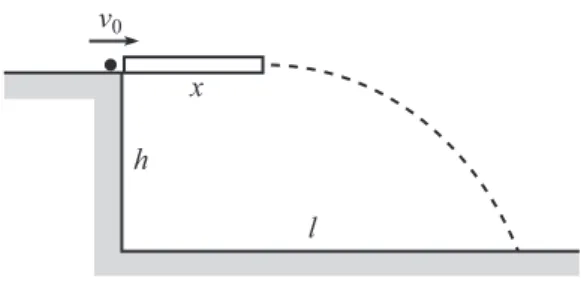
A projectile is fired horizontally with speed v0 from the top of a cliff of height h. It immediately enters a fixed tube with length x, as shown in Fig. 3.10. There is friction between the projectile and the tube, the effect of which is to make the projectile decelerate with constant acceleration−a(ais a positive quantity here). After the projectile leaves the tube, it undergoes normal projectile motion down to the ground.
v0
h
l x
Figure3.10
(a) What is the total horizontal distance (call itℓ) that the projectile travels, measured from the base of the cliff? Give your answer in terms ofx,h,v0,g, anda.
(b) What value ofxyields the maximum value ofℓ? 3.9. Car in the mud
A wheel is stuck in the mud, spinning in place. The radius is R, and the points on the rim are moving with speedv. Bits of the mud depart from the wheel at various random locations. In particular, some bits become unstuck from the rim in the upper left quadrant, as shown in Fig. 3.11. What shouldθbe so that the mud reaches the maximum possible
v
R
θ
Figure3.11
height (above the ground) as it flies through the air? What is this maximum height? You may assumev2 >gR.
3.10. Clearing a wall
(a) You wish to throw a ball to a friend who is a distance 2ℓaway, and you want the ball to just barely clear a wall of heighththat is located halfway to your friend, as shown in Fig. 3.12. At what angleθshould you throw the ball?
l l h
θ
Figure3.12
(b) What initial speedv0is required? What value ofh(in terms ofℓ) yields the minimum v0? What is the value ofθin this minimum case?
3.11. Bounce throw
A person throws a ball with speedv0 at a 45◦ angle and hits a given target. How much quicker does the ball get to the target if the person instead throws the ball with the same speedv0but at the angle that makes the trajectory consist of two identical bumps, as shown in Fig. 3.13? (Assume unrealistically that there is no loss in speed at the bounce.)
Figure3.13
3.12. Maximum bounce
A ball is dropped from rest at heighth. At heighty, it bounces elastically (that is, without losing any speed) offa board. The board is inclined at the angle (which happens to be 45◦) that makes the ball bounce offhorizontally. In terms ofh, what shouldybe so that the ball hits the ground as far offto the side as possible? What is the horizontal distance in this optimal case?
3.13. Falling along a right triangle
In the vertical right triangle shown in Fig. 3.14, a particle falls from AtoBeither along A B b a C (side view) Figure3.14
the hypotenuse, or along the two legs (lengthsaandb) via pointC. There is no friction anywhere.
(a) What is the time (call ittH) if the particle travels along the hypotenuse?
(b) What is the time (call ittL) if the particle travels along the legs? Assume that at pointCthere is an infinitesimal curved arc that allows the direction of the particle’s motion to change from vertical to horizontal without any change in speed.
(c) Verify thattH=tLwhena=0.
(d) How dotHandtLcompare in the limitb≪a?
(e) Excluding thea=0 case, what triangle shape yieldstH=tL? 3.14. Throwing to a cliff
A ball is thrown at an angleθup to the top of a cliffof heightL, from a point a distanceL from the base, as shown in Fig. 3.15.
θ L v L 0 Figure3.15
(a) As a function ofθ, what initial speed causes the ball to land right at the edge of the cliff?
(b) There are two special values ofθfor which you can check your result. Check these. 3.15. Throwing from a cliff
A ball is thrown with speedvat angle θ (with respect to horizontal) from the top of a cliffof height h. How far from the base of the cliffdoes the ball land? (The ground is horizontal below the cliff.)
3.16. Throwing on stairs
A ball is thrown horizontally with speedvfrom the floor at the top of some stairs. The width and height of each step are both equal toℓ.
(a) What shouldvbe so that the ball barely clears the corner of the step that isN steps down? Fig. 3.16 shows the case whereN =4.
N = 4
l l
v
d
3.3. PROBLEMS 49 (c) What isdin the limitN→ ∞?
(d) Find the components of the ball’s velocity when it grazes the corner, and then explain why their ratio is consistent with your answer to part (c).
3.17. Bullet and sphere
A bullet is fired horizontally with speedv0from the top of a fixed sphere with radiusR, as shown in Fig. 3.17. What is the minimum value ofv0 for which the bullet doesn’t touch
v0
R
Figure3.17
the sphere after it is fired? (Hint: Findyas a function ofxfor the projectile motion, and also findyas a function ofxfor the sphere near the top wherexis small; you’ll need to make a Taylor-series approximation. Then compare your two results.) For thev0you just found, where does the bullet hit the ground?
3.18. Throwing on an inclined plane
You throw a ball from a plane inclined at angleθ. The initial velocity is perpendicular to the plane, as shown in Fig. 3.18. Consider the point Pon the trajectory that is farthest
θ P v0
Figure3.18
from the plane. For what angleθdoesPhave the same height as the starting point? (For the case shown in the figure,Pis higher.) Answer this in two steps:
(a) Give a continuity argument that explains why such aθshould in fact exist.
(b) Findθ. In getting a handle on where (and when) Pis, it is helpful to use a tilted coordinate system and to isolate what is happening in the direction perpendicular to the plane.
3.19. Ball landing on a block
A block is fired up along a frictionless plane inclined at angle β, and a ball is simultane-ously thrown upward at angleθ(bothβandθare measured with respect to the horizontal). The objects start at the same location, as shown in Fig. 3.19. What shouldθbe in terms of
Figure3.19
βif you want the ball to land on the block at the instant the block reaches its maximum height on the plane? (An implicit equation is fine.) What isθifβequals 45◦? (You might think that we’ve forgotten to give you information about the initial speeds, but it turns out that you don’t need these to solve the problem.)
3.20. g’s in a washer
A typical front-loading washing machine might have a radius of 0.3 m and a spin cycle of 1000 revolutions per minute. What is the acceleration of a point on the surface of the drum at this spin rate? How manyg’s is this equivalent to?
3.21. Acceleration after one revolution
A car starts from rest on a circular track with radiusRand then accelerates with constant tangential accelerationat. At the moment the car has completed one revolution, what angle does the total acceleration vector make with the radial direction? You should find that your answer doesn’t depend onatorR. Explain why you don’t have to actually solve the problem to know this.
3.22. Equal acceleration components
An object moves in a circular path of radiusR. Att =0, it has speedv0. From this point on, the magnitudes of the radial and tangential accelerations are arranged to be equal at all times.
(a) As functions of time, find the speed and the distance traveled.
(b) If the tangential acceleration is positive (that is, if the object is speeding up), there is special value fort. What is it, and why is it special?
3.23. Horizontal acceleration
A bead is at rest at the top of a fixed frictionless hoop of radiusRthat lies in a vertical plane. The bead is given an infinitesimal push so that it slides down and around the hoop. Find all the points on the hoop where the bead’s acceleration is horizontal. (We haven’t covered conservation of energy yet, but use the fact that the bead’s speed after it has fallen through a heighthis given byv= √2gh.)
3.4
Multiple-choice answers
3.1. c This setup is perhaps the most direct example of the independence of horizontal and vertical motions, under the influence of only gravity. The horizontal motion doesn’t affect the vertical motion, and vice versa. The gravitational force causes both objects to have the same accelerationgdownward, so their heights are both given byh−gt2/2. The fired bullet might travel a mile before it hits the ground, but will still take a time oft= √2h/g, just like the dropped ball.
3.2. Yes At the highest point in the projectile motion, the velocity is sideways, and the acceleration is (always) downward.
Remark: Sincea(which isg=−gyˆ) is perpendicular tovat the top of the motion, the component ofain the direction ofvis zero. But this component is what causes a change in the speed (this is just theat=dv/dtstatement). Sodv/dt=0 at the top of the motion. This makes sense because on the way up, the speed decreases (from a tiltedv0to a horizontalv0cosθ);ahas a component in the negativevdirection. And on the way down, the speed increases (from a horizontalv0cosθto a tilted
v0);ahas a component in the positivevdirection. So at the top of the motion, the speed must be neither increasing nor decreasing. That is,dv/dt=0. On the other hand, the verticalvycomponent of the velocity steadily decreases (at a rate of−g) during the entire flight, fromv0sinθto−v0sinθ. 3.3. Yes Ifθis very small, then the projectile barely climbs above the ground, so the total horizontal distance traveled is much larger than the maximum height. In the other extreme whereθis close to 90◦, the projectile goes nearly straight up and down, so the maximum height is much larger than the total horizontal distance. By continuity, there must exist an intermediate angle for which the maximum height equals the total horizontal distance. As an exercise, you can show that this angle is given by tanθ=4=⇒θ≈76◦.
3.4. No The reasoning is not valid for allθ. For allθ, the reasoning is correct up until the last “so.” The timetin the air does indeed increase asθincreases (it equals 2v0sinθ/g). However, an additional consequence of increasing θis that the vx velocity component (which equalsv0cosθ)decreases. The total horizontal distance equalsvxt, so there are competing effects: increasingtvs. decreasingvx. If we invoke the standard result that the maximum distance is obtained whenθ=45◦(see the solution to Problem 3.1), we see that forθ <45◦, the increase intwins and the distance increases; but forθ >45◦, the decrease invxwins and the distance decreases.
3.5. e The vertical velocity component of the first ball isv0sinθ. If the second ball is thrown with this speed, then it will always have the same height as a function of time as the first ball. The balls will therefore collide when the first ball’s horizontal position coincides with the second ball’s (at the top of the parabolic motion).
Remark: The initial location of the second ball on the ground is actually irrelevant. As long as it is thrown simultaneously with speedv0sinθ, it can be thrown fromanypoint below the parabolic motion of the first ball, and the balls will still always have the same heights at any moment. They will therefore collide when the first ball’s horizontal position coincides with the second ball’s. If the collision occurs during the second half of the parabolic motion, the balls will be on their way down.
3.6. d The answer certainly depends onℓ, because the speed must be very large ifℓis very large. So choices (a) and (b) are ruled out. Alternatively, these two choices can be ruled
3.4. MULTIPLE-CHOICE ANSWERS 51 out by noting that in theh →0 limit, you must throw the ball infinitely fast. This is true because you must throw the ball at a very small angle; so if the speed weren’t large, the initial vertical velocity would be very small, which means that the top of the parabolic motion would occur too soon.
In theℓ → 0 limit, you are throwing the ball straight up. And the initial speed in this case is the standardv= √2gh. (This can be derived in many ways, for example by using Eq. (2.4).) So the answer must be (d).
3.7. d When the top ball returns to the initial height (the height of the cliff), its velocity (both magnitude and direction) will be the same as the initial velocity of the bottom ball (speedv0 at an angle θbelow the horizontal). So the trajectory from that point onward will look exactly the same as the entire trajectory of the bottom ball. So the difference in the trajectories is just the symmetric parabola that lies above the initial height. And from Eq. (3.6) we know that the horizontal distance traveled in this part is 2v02sinθcosθ/g.
Remark: The first three choices can be eliminated by checking limiting cases. The answer must be zero in both theθ =0 case (the trajectories are the same) and theθ =90◦case (both balls travel vertically and hence have the same horizontal distance of zero). So the answer must be (d) or (e). But it takes the above reasoning to show that (d) is correct.
3.8. b The acceleration has magnitude v2/r and points toward the center of the circular motion. Since the car is traveling in a horizontal circle, the radial direction is to the left. So the acceleration is horizontal leftward.
Remark: As long as we are told that the racecar is undergoing uniform (constant speed) circular motion, there is no need to know anything about the various forces acting on the car (which happen to be gravity, normal, and friction; we’ll discuss forces in Chapter 4). The acceleration for uniform circular motion, no matter what the cause of the motion, points radially inward with magnitudev2/r, period.
3.9. c The velocityvpoints in the tangential, not radial, direction. The other four statements are all true.
Remark: If you want to considernon-uniform(that is, changing speed) circular motion, then only statement (a) is always true. The acceleration can now have a tangential component, which ruins (b), (d), and (e). And statement (c) is still incorrect.
3.10. c The radial component of the acceleration has magnitudear = v2/r. So the largest speedvcorresponds to theawith the largest (inward) radial component, which is choice (c).
Remark: Note that the tangential component of the acceleration, which isat=dv/dt, has nothing to do with theinstantaneousvalue ofv, which is what we’re concerned with in this question. A large atcomponent (as in choices (a), (b), and (d)) does not imply a largev. On the other hand, a zeroar component (as in choices (a) and (e)) implies a zerov.
3.11. d The acceleration is the vector sum of the radially inwardar=v2/rcomponent and the tangentially downwardat =gsinθcomponent, whereθ=0 corresponds to the top of the hoop. (This is just the component ofgthat points in the tangential direction.) Only choice (d) satisfies both of these properties. Choice (e) is the trickiest. The acceleration can’t be horizontal there, because botharandathave downward components. Thereisa point in each lower quadrant where the acceleration is horizontal, because in the bottom half of the circle,arhas anupwardcomponent which can cancel the downward component ofatat two particular points.
Remark: Since the radialar=v2/rcomponent always points radiallyinward, the acceleration vector in any arbitrary circular motion can never have a radiallyoutwardcomponent. This immediately rules out choices (a) and (c). The borderline case occurs whenar = 0, that is, when apoints
tangentially. In this casev=0, so the bead is instantaneously at rest. But any nonzero speed at all will cause an inwardarcomponent.
3.12. d The tangential component of the acceleration isat=gsin 45◦. And the radial compo-nent isar=v2/r =0, sincev =0 at the start. No matter where the pendulum is released from rest, the initial acceleration is always tangential (or zero, if it is “released” when hanging vertically), becausear=0 whenv=0.
3.13. b Since the acceleration is negative vertical at the highest points and positive vertical at the lowest point, by continuity it must have zero vertical component somewhere in between. That is, it must be horizontal somewhere in between.
The acceleration is never vertical (except at the highest and lowest points), because thear andatvectors either both have rightward components, or both have leftward components, which means that thexcomponent of the total acceleration vectora is nonzero. This is consistent (if we invokeF = ma) with the fact that the tension in the tilted string has a nonzero horizontal component (except at the highest points where the tension is zero and the lowest point where the string is vertical).
3.5
Problem solutions
3.1. A few projectile results
(a) The components of the velocity and position are given in Eqs. (3.4) and (3.5). At the highest point in the motion, vy equals zero because the projectile is instanta-neously moving horizontally. So Eq. (3.4) gives the time to the highest point as ttop=v0sinθ/g.
(b) First solution: Pluggingttopinto Eq. (3.5) gives the maximum height as
ymax=v0sinθ ( v0sinθ g ) −1 2g ( v0sinθ g )2 =v 2 0sin 2θ 2g . (3.12) This is just the v2
0/2g result from Problem 2.3, withv0 replaced with the vertical component of the velocity,v0sinθ.
Second solution: We can imagine reversing time (or equivalently, looking at the second half of the motion), in which case the motion is equivalent to (at least as far as the ymotion is concerned) an object dropped from rest. We know that the time it takes to reach the ground is ttop = v0sinθ/g, so the distance is gttop2 /2 = g(v0sinθ/g)2/2=v02sin2θ/(2g), in agreement with Eq. (3.12).
(c) First solution: Because the ground is level, the up and down parts of the motion are symmetrical, so the total time t in the air is twice the time to the top, that is, t=2ttop=2v0sinθ/g. From Eq. (3.5) the total horizontal distance traveled is then
xmax=v0cosθ ( 2v0sinθ g ) =2v 2 0sinθcosθ g . (3.13)
Second solution: The total time in the air can be determined by finding the value of tfor whichy(t)=0. From Eq. (3.5), we quickly obtaint=2v0sinθ/g, as we found in the first solution. (A second value oftthat makesy=0 in Eq. (3.5) ist =0, of course, because the projectile is on the ground at the start.) Note that if the ground isn’t level, then the up and down parts of the motion arenotsymmetrical. So this alternative method of finding the total time (by finding the time for whichytakes on a particular value) must be used.
3.5. PROBLEM SOLUTIONS 53
Remark: If we use the double-angle formula sin 2θ =2 sinθcosθ, the expression forxmax in Eq. (3.13) can alternatively be written asxmax = v20sin 2θ/g. Since sin 2θachieves its maximum value when 2θ =90◦, this form makes it immediately clear that for a given speed
v0, the maximum horizontal distance is achieved whenθ =45◦. This maximum distance is
v20/g. Note that consideration of units tells us that the maximum distance must be proportional tov20/g. But a calculation is necessary to show that the multiplicative factor is 1.
Thev02sin 2θ/gform ofxmaxmakes it clear (although it is also clear from the 2v20sinθcosθ/g form) that the distance is symmetric on either side of 45◦. That is, 46◦yields the same distance as 44◦, and 80◦yields the same distance as 10◦, etc.
3.2. Radial and tangential accelerations
(a) The position and velocity vectors at two nearby times are shown in Fig. 3.20. Their
r1 r 2 v1 v2 Figure3.20
differences,∆r≡r2−r1and∆v≡v2−v1, are shown in Fig. 3.21. (See Figs. 13.9
r1 r ∆r 2 v1 v ∆v 2 θ θ Figure3.21
and 13.10 in Appendix A for a comment on this∆v.) The angle between thev’s is the same as the angle between ther’s, because eachvmakes a right angle with the correspondingr. Therefore, the triangles in Fig. 3.21 are similar, and we have
|∆v|
v =
|∆r|
r , (3.14)
wherev≡ |v|andr≡ |r|. Our goal is to obtain an expression fora≡ |a| ≡ |∆v/∆t|. The∆t here suggests that we should divide Eq. (3.14) through by ∆t. This gives (usingv≡ |v| ≡ |∆r/∆t|) 1 v ∆v ∆t = 1 r ∆r ∆t =⇒ |a| v = |v| r =⇒ a= v2 r , (3.15) as desired. We have assumed that∆tis infinitesimal here, which allows us to convert the above quotients into derivatives.
The direction of the acceleration vectorais radially inward, becausea≡dv/dthas the same direction asdv(or∆v), which points radially inward (leftward) in Fig. 3.21 (in the limit whereθis very small).
Remark: Thea =v2/r result involves thesquareofv. That is,vmatters twice ina. The physical reason for this is the following. The first effect is that the largervis, the larger the ∆vis for a given angleθin Fig. 3.21 (because the triangle is larger). The second effect is that the largervis, the faster the object moves around in the circle, so the larger the angleθis (and hence the larger the∆vis) for a given time∆t. Basically, ifvincreases, then thevtriangle in Fig. 3.21 gets both taller and wider. Each of these effects is proportional tov, so for a given time∆tthe change in velocity∆vis proportional tov2, as we wanted to show.
(b) If the speed isn’t constant, then the radial componentarstill equalsv2/r, because the velocity triangle in Fig. 3.21 becomes the triangle shown in Fig. 3.22 (for the
v1 v ∆v = v2-v1 2 θ length = v2-v1 Figure3.22
case where the speed increases, so thatv2 is longer thanv1). The lower part of this triangle is exactly the same as the triangle in Fig. 3.21 (or at least it would be, if we had drawnv1 with the same length). So all of the preceding reasoning carries through, leading again toar=v2/r. Thevhere could technically be eitherv1orv2. But in the∆t→0 limit, the angleθgoes to zero, and bothv1andv2are equal to the instantaneous speedv.
To obtain the tangential componentat, we can use the upper part of the triangle in Fig. 3.22. This is a right triangle in the∆t→0 limit, and it tells us thatat(which is the vertical component in Fig. 3.22) is
at= v2−v1 ∆t ≡ ∆v ∆t −→ dv dt , (3.16) as desired.
Remark: A word about the placement of absolute value signs (“| |”): The tangential com-ponent ofaisat = dv/dt ≡d|v|/dt, while the complete vectoraisa≡ dv/dt, which has magnitudea = |a| = |dv|/dt (which equalsa = √a2
r+a 2
t). The placement of the
abso-lute value signs is critical, becaused|v|, which is thechange in the magnitudeof the velocity vector, isnotequal to|dv|, which is themagnitude of the changein the velocity vector. The former is associated with the left leg of the right triangle in Fig. 3.22, while the latter is asso-ciated with the hypotenuse. The disparity betweend|v|and|dv|is most obvious in the case of uniform circular motion, where we haved|v|=0 and|dv|,0; the speed is constant, but the velocity is not. (The one exception to thed|v|,|dv|statement occurs when the speed is instantaneously zero, so thatar=0. Since the acceleration is only tangential in this case, we haved|v|=|dv|.)
3.3. Radial and tangential accelerations, again
When taking the time derivatives, we must be careful to use the chain rule and the prod-uct rule. Starting with (x,y) = R(cosθ,sinθ), the velocity is found by taking one time derivative:
( ˙x,y˙)=R(−θ˙sinθ,θ˙cosθ), (3.17) where the ˙θ’s come from the chain rule, becauseθis a function oft. Another time deriva-tive (using the chain rule again, along with the product rule) yields the acceleration:
( ¨x,y¨)=R(−θ¨sinθ−θ˙2cosθ, θ¨cosθ−θ˙2sinθ). (3.18) If we group the ¨θterms together, and likewise the ˙θ2terms, we find
( ¨x,y¨)=Rθ¨(−sinθ,cosθ)+Rθ˙2(−cosθ,−sinθ). (3.19) The first vector here is the tangential acceleration vector, because the magnitude isRθ¨≡ Rα=at, where we have used the fact that (−sinθ,cosθ) is a unit vector. And this vector (−sinθ,cosθ) points in the tangential direction, as shown in Fig. 3.23.
cos θ cos θ θ θ sin θ sin θ (-sin θ, cos θ) (-cos θ, -sin θ) Figure3.23
The second vector in Eq. (3.19) is the radial acceleration vector, because the magnitude is Rθ˙2 ≡Rω2=R(v/R)2=v2/R=a
r, where we have used the fact that (−cosθ,−sinθ) is a unit vector. And this vector (−cosθ,−sinθ) points radially inward.
Units: The units of all of the components in Eq. (3.19) are all correctly m/s2, because both ¨θand ˙θ2 have units of 1/s2. If you forgot to use the chain rule and omitted the ˙θ’s, the units wouldn’t work out.
Limits: If ¨θ=0 (uniform circular motion), then the first vector in Eq. (3.19) is zero, so the accelera-tion is only radial; this is correct. And if ˙θ=0 (the object is instantaneously at rest), then the second vector in Eq. (3.19) is zero, so the acceleration is only tangential; this is also correct.
3.4. Movie replica
(a) If the movie were played back at normal speed, the person would appear to fall unnaturally fast. To see why, let’s say that the doll falls for 1 s in the replica, which means that it falls a distance of 4.9 m (from d = gt2/2, and we’re neglecting air resistance, as usual). Since the scale factor is 100, someone watching the movie would think that the person falls 490 m in 1 s. This would look very strange, because it is far too large a distance; an object should fall only 4.9 m in 1 s. An object would fall 490 m in 1 s on a planet that hasg=980 m/s2, but not on the earth.
How long does it take something to fall 490 m on the earth? From d = gt2/2, we obtaint = 10 s. So the answer to this problem is that the movie should be slowed down by a factor of 10 when played back, so that the movie watcher sees a 490 m fall take the correct time of 10 s.
Remark: The factor of 10 here arises because it is the square root of the scale factor, 100. Mathematically, the 10 comes from the fact that the units ofginvolve s2, which leads to the t2in the expressiond=gt2/2. A factor of 10 in the time then leads to the desired factor of
3.5. PROBLEM SOLUTIONS 55
102 =100 in the distance. But more intuitively, the factor of 10 arises in the following way. If we don’t scale the time at all, then as we saw above, we basically end up on a planet with
g=980 m/s2. If we then slow down the movie by a factor of 10, this decreasesgby a factor of 102, because it causes the falling object to take10 times as longto fall a given distance, at which point it is going only1/10 as fast. So the factor of 10 matterstwice. The rate of change∆v/∆tof the velocity (that is, the acceleration) is therefore only (1/10)/10 =1/100 of theg=980 m/s2value that it would have been, so we end up with the desiredgvalue of 9.8 m/s2.
(b) The vertical motion must satisfy the same conditions as in part (a), because it is unaffected by the horizontal motion. So we again need to slow down the playback by a factor of 10.
We want the speed of the car to appear to be 50 mph. This means that if the movie weren’t slowed down by the required factor of 10, then the car’s speed in the movie would appear to be 500 mph. Due to the scale factor of 100, this would then require the speed in the replica to be 5 mph. So 5 mph is the desired answer.
Said in an equivalent way, starting from the replica: A speed of 5 mph in the replica translates to a speed of 500 mph in an unmodified movie, due to the scale factor of 100. But then slowing down the movie by a factor of 10 brings the apparent speed down to the desired 50 mph.
3.5. Doubling gravity
The horizontal distance traveled during the upward part of the motion is half the total dis-tance of normal projectile motion. Therefore, from Eq. (3.6) the disdis-tance traveled during the upward motion is (v02/g) sinθcosθ. We must now find the horizontal distance trav-eled during the downward motion. Since the horizontal velocity is constant throughout the entire motion, we just need to get a handle on the time of the downward part.
The time of the upward part is given byh =gt2u/2, wherehis the maximum height, be-cause we can imagine running time backwards, in which case the ball is dropped from rest, as far as the vertical motion is concerned. (The heighthequals (v20/2g) sin2θfrom Eq. (3.6), but we won’t need to use this.) The time of the downward part is given by h =(2g)td2/2, because gravity is doubled. Thereforetd =tu/
√
2. So the horizontal dis-tance traveled during the downward motion is 1/√2 times the horizontal distance traveled during the upward motion. The total distance is therefore
d=v 2 0sinθcosθ g ( 1+ √1 2 ) . (3.20) 3.6. Ratio of heights
The givengt2/2 expression holds for an object dropped from rest. But it is also a valid expression for the distance fallen relative to where the object would be if gravity were turned off. Mathematically, this is true because in Eq. (3.3),Y +Vytis the height of the object in the absence of gravity, andgt2/2 is what is subtracted from this.
The two vertical distances we drew in Fig. 3.8 are the distances fallen relative to the zero-gravity line of motion (the dotted line). Since the time of the entire projectile motion is twice the time to the top, the ratio of these two vertical distances is 22 = 4 (hence the
d and 4d labels in Fig. 3.24). This figure contains two similar right triangles, with one B d A
4d
h
Figure3.24
being twice the size of the other. Comparing the vertical legs of each triangle tells us that 4d/(h+d)=2. This yieldsh=d, which means that pointAhas half the height of point B. The answer to the problem is therefore 1/2.
3.7. Hitting horizontally
Ift is the time of flight, then we have three unknowns: t,v0, andθ. And we have three facts:
• The vertical speed is zero at the top, sov0sinθ−gt=0=⇒t=v0sinθ/g.
• The horizontal distance isℓ, so (v0cosθ)t=ℓ.
• The vertical distance isℓ, so (v0sinθ)t−gt2/2=ℓ. Plugging the value oftfrom the first fact into the other two gives
v20sinθcosθ
g =ℓ and
v02sin2θ
2g =ℓ. (3.21)
Dividing the second of these equations by the first gives sinθ
2 cosθ =1 =⇒ tanθ=2 =⇒ θ≈63.4
◦. (3.22)
(What we’ve done here is basically find the firing angle of a projectile that makes the maximum height be half of the total range.) This value ofθcorresponds to a 1-2-√5 right triangle, which yields sinθ=2/√5. The second of the equations in Eq. (3.21) (the first would work just as well) then gives
v02 2g ( 2 √ 5 )2 =ℓ =⇒ v0= √ 5gℓ 2 . (3.23)
3.8. Projectile and tube
(a) From the standardv2
f =vi2+2adformula, the speed of the projectile when it exits the tube isv= √v2
0−2ax. You can also obtain this by usingv =v0−at, wheret is found by solvingv0t−at2/2 = x. This quadratic equation has two solutions, of course. You want the “−” root. (What is the meaning of the “+” root?)
Since the projectile motion has zero initialvy, the time to reach the ground is given bygt2/2=h =⇒ t = √2h/g. The horizontal distance traveled in the air isvt, but we must add on the length of the tube to get the total distanceℓ. So we have
ℓ=x+vt=x+ √ v02−2ax √ 2h g . (3.24)
(b) Looking at the two terms in Eq. (3.24), we see that we have competing effects of x. Increasingxincreasesℓby having the projectile motion start farther to the right. But increasing xalso decreases the projectile motion’s initial speed and hence its horizontal distance. Maximizing the ℓ in Eq. (3.24) by taking the derivative with respect toxgives 0= dℓ dx =1+ 1 2 −2a √ v2 0−2ax √ 2h g =⇒ √v02−2ax=a √ 2h g =⇒ x= v 2 0 2a − ah g . (3.25)
Both terms here correctly have dimensions of length. This result for the optimal value of xis smaller thanv2
0/2a, as it should be, because otherwise the projectile would reach zero speed inside the tube (sincev= √v2
0−2ax) and never make it out. However, we aren’t quite done, because there are two cases to consider. To see why, note that if a = v0
√
3.5. PROBLEM SOLUTIONS 57 applicable only ifa≤v0
√
g/2h. Ifa ≥v0 √
g/2h, then Eq. (3.25) yields a negative value ofx, which isn’t physical. The optimalxin thea ≥v0
√
g/2hcase is therefore simplyx =0. Physically, ifais large then any nonzero value of xwill hurtℓ (by slowing down the initial projectile speed) more than it will help (by adding on the “head start” distance ofx). Mathematically, in this case the extremum ofℓ occurs at the boundary of the allowed values ofx(namely,x =0), as opposed to at a local maximum; a zero derivative therefore isn’t relevant.
Limits: Ifa→0 then Eq. (3.25) givesx → ∞, which is correct. We can make the tube be very long, and the projectile will keep sliding along; the projectile motion at the end is largely irrelevant. We also see that the optimalxincreases withv0andg, and decreases withaandh. You should convince yourself that these all make sense.
3.9. Car in the mud
At the instant the mud leaves the wheel, it is at heightR+Rsinθabove the ground. It then rises an extra height ofh = (vcosθ)2/2g during its projectile motion. This is true because the initialvyisvcosθ(because the initial velocity makes an angle of 90◦−θwith respect to the horizontal), so the time to the highest point is (vcosθ)/g; plugging this into h =(vcosθ)t−(1/2)gt2 givesh = (vcosθ)2/2g. The total height above the ground at the highest point is therefore
H=R+Rsinθ+v 2cos2θ
2g . (3.26)
Maximizing this by taking the derivative with respect toθgives Rcosθ−v
2
g sinθcosθ=0. (3.27) Since cosθis a factor of this equation, we see that there are two solutions. One is cosθ= 0=⇒θ=π/2, which corresponds to the top of the wheel. This is the maximum height if v2 <gR, because in this case the best the mud can do is stay in contact with the wheel the whole time. (After learning about forces in Chapter 4, you can show that ifv2 <gRthen the normal force between the wheel and the mud is always nonzero, so the mud will never fly offthe wheel.) But we are assumingv2>gR, so we want the other solution,
sinθ= gR
v2 . (3.28)
Note thatgR/v2is less than 1 ifv2 >gR, so such aθdoes indeed exist. (Forv2 =gRwe correctly obtainθ=π/2.) Plugging Eq. (3.28) into Eq. (3.26) gives a maximum height of
Hmax=R+Rsinθ+ v2 2g(1−sin 2θ) =R+R ( gR v2 ) + v2 2g*,1− ( gR v2 )2 + -=R+gR 2 2v2 + v2 2g . (3.29)
All three terms here correctly have dimensions of length. This result is valid ifv2 ≥gR. Ifv2 ≤gR, then the maximum height (at the top of the wheel) is 2R.
Limits: Ifvis large (more precisely, ifv2 ≫gR), then Eq. (3.29) givesHmax≈R+v2/2g. From Eq. (3.28) the mud leaves the wheel atθ ≈0 (the side point) and travels vertically an extra height ofv2/2g, which is the standard height achieved in vertical projectile motion. If v2 ≈ gR, then Eq. (3.29) givesHmax≈2R. The mud barely leaves the wheel at the top, so the maximum height is simply 2R. It doesn’t make sense to take the small-vlimit (more precisely,v2≪gR) of Eq. (3.29), because this result assumesv2>gR.
3.10. Clearing a wall
(a) The unknowns in this problem arev0 andθ. Problem 3.1(b) gives the maximum height of a projectile, so we want
h=v 2 0sin
2θ
2g . (3.30)
And Problem 3.1(c) gives the range of a projectile, so we want
2ℓ=2v 2
0sinθcosθ
g . (3.31)
Dividing Eq. (3.30) by Eq. (3.31) gives h ℓ = sinθ 2 cosθ =⇒ tanθ= 2h ℓ . (3.32)
This means that you should pretend that the wall is twice as tall as it is, and then aim for the top of that imaginary wall.
Limits: Ifh→0 thenθ→0. And ifh→ ∞thenθ→90◦. Both of these limits make sense.
(b) First solution: If tanθ = 2h/ℓ, then drawing a right triangle with legs of lengthℓ and 2htells us that sinθ=2h/√4h2+ℓ2. So Eq. (3.30) gives
h= v 2 0 2g · 4h2 4h2+ℓ2 =⇒ v 2 0 =g ( 4h2+ℓ2 2h ) . (3.33)
(Eq. (3.31) would give the same result.) We want to minimize this function of h. Setting the derivative equal to zero gives (ignoring the denominator of the derivative, since we’re setting the result equal to zero)
0=2h(8h)−(4h2+ℓ2)·2 =⇒ 0=4h2−ℓ2 =⇒ h= ℓ
2. (3.34) If htakes on this value, then Eq. (3.32) gives tanθ = 2(ℓ/2)/ℓ = 1 =⇒ θ = 45◦. You should convince yourself why this result is consistent with the familiar fact that θ=45◦gives the maximum range of a projectile.
Limits: Thev0 in Eq. (3.33) correctly goes to infinity ash → ∞. It also goes to infinity as h→0. This makes sense becauseh≈0 corresponds to a nearly horizontal “line drive.” If the speed weren’t large, then the ball would quickly hit the ground (since the initialvywould be very small). Note that sincev0 → ∞for bothh→ ∞andh→0, a continuity argument implies thatv0achieves a minimum for some intermediate value ofh. But it takes a little work to show that thishequalsℓ/2.
Second solution: A somewhat quicker way of obtainingv0(without first obtaining θin Eq. (3.32)) is the following. Lettbe the time to the top of the motion. Then the horizontal component ofv0 isℓ/t, and the vertical component isgt(becausevy is zero at the top). From the second half of the motion, we also know thatgt2/2 = h=⇒t2=2h/g. So v02=v2x+v2y=ℓ 2 t2 +g 2t2 = ℓ2 2h/g +g 22h g =g ( ℓ2+4h2 2h ) , (3.35) in agreement with Eq. (3.33).
3.5. PROBLEM SOLUTIONS 59 3.11. Bounce throw
From Eq. (3.6) we know that the total horizontal distance traveled for a 45◦throw isv2 0/g. (As always, we are ignoring air resistance, which is actually a pretty lousy approximation for thrown balls.) For the bounce throw, each of the two bumps has a horizontal span of v20/2g. The throwing speed is stillv0, so we want the sin 2θfactor in Eq. (3.6) to be 1/2. Hence 2θ = 30◦ =⇒ θ = 15◦. The (constant) horizontal component of the velocity is thereforev0cos 15◦ for the entire duration of the bounce throw, as opposed tov0cos 45◦ for the original throw. Since the time of flight is inversely proportional to the horizontal speed, the total time for the bounce throw is (v0cos 45◦)/(v0cos 15◦) ≈0.73 as long as the total time for the original throw.
Remarks: Since cos 15◦=cos(45◦−30◦), you can use the trig sum formula for cosine to show that the exact answer to this problem is 2/(√3+1), which can be written as√3−1.
In real life, air resistance makes the trajectory be nonparabolic, and there is also an abrupt decrease in speed at the bounce, due to friction with the ground. But it is still possible for a bounce throw to take less time than the no-bounce throw. This is particularly relevant in baseball games. If a player is making a long throw from the outfield (or even from third base to first base if the player is offbalance and the throwing speed is low), then a bounce throw is desirable. The advantage of throwing in a more direct line can outweigh the disadvantage of the loss in speed at the bounce. But the second bump in the throw needs to be relatively small.
3.12. Maximum bounce
The time it takes the ball to fall the distance h− y to the board is given bygt2/2 = h−y =⇒ t = √2(h−y)/g. The speed at this time isv = gt = √2g(h−y). (This is just the standardvf =
√
2adresult that follows from Eq. (2.4) whenvi =0.) Since the collision is elastic, this is also the horizontal speedvxright after the bounce.
The time to fall the remaining distanceyto the ground after the horizontal bounce is given bygt2/2=y=⇒t= √2y/g. The horizontal distance traveled is then
d=vxt = √2g(h−y) √ 2y g =2 √ y(h−y). (3.36)
Our goal is therefore to maximize the functionhy−y2. Setting the derivative equal to zero gives 0=h−2y=⇒ y=h/2. So the board should be at the halfway point. The desired horizontal distance is thend =2√(h/2)(h−h/2)=h.
Limits: The distancedin Eq. (3.36) goes to zero for bothy=0 andy=h. These limits make sense. In the first case, the board is on the ground, so there is no time after the collision for the ball to travel any horizontal distance. In the second case, the board is located right where the ball is released, so the horizontal speed after the “collision” is zero, and the ball falls straight down.
3.13. Falling along a right triangle
(a) Ifθis the inclination angle of the hypotenuse, then the component of the gravitational acceleration along the hypotenuse isgsinθ, where sinθ =b/√a2+b2. Usingd = at2/2 (thisais the acceleration, not the length of the lower leg!), the time to travel along the hypotenuse is given by
√ a2+b2= 1 2 ( g√ b a2+b2 ) t2H =⇒ tH= √ 2(a2+b2) gb . (3.37) Limits: Ifa→ ∞orb→ ∞orb→0, thentH→ ∞, which makes sense.
(b) The time to fall toCis given bygt21/2=b=⇒t1 = √
2b/g. The speed atCis then gt1 =
√
constant speed, which takes a time oft2=a/ √
2gb. The total time is therefore
tL=t1+t2= √ 2b g + a √ 2gb. (3.38)
Limits: Again, ifa→ ∞orb→ ∞orb→0, thentL→ ∞. (c) Ifa =0 then bothtHandtLreduce to
√ 2b/g. (d) Ifb ≪ athentH ≈
√
2a/√gb(theb2 term in Eq. (3.37) is negligible), andtL ≈ a/√2gb(the first term in Eq. (3.38) is negligible). So in this limit we have
tH≈2tL. (3.39)
This makes sense for the following reason. In the journey along the legs, the particle is moving at the maximum speed of √2gbfor essentially the entire time. But in the journey along the hypotenuse, the particle has the same maximum speed (as you can show with kinematics; this also follows quickly from conservation of energy, discussed in Chapter 5), and the average speed is half of the maximum speed, because the acceleration is constant.
(e) Setting thetHin Eq. (3.37) equal to thetLin Eq. (3.38) gives √ 2(a2+b2) gb = √ 2b g + a √ 2gb =⇒ 2 √ a2+b2=2b+a =⇒ 4(a2+b2)=4b2+4ba+a2 =⇒ 3a2=4ba =⇒ a=4b 3 . (3.40)
So the two times are equal if we have a 3-4-5 right triangle, with the bottom leg being the longer one.
Remarks: Without doing any calculations, the following continuity argument demonstrates that there must exist a triangle shape for whichtHequalstL. We found in part (d) thattH>tL (by a factor of 2) when b ≪ a. ButtH < tL whena ≪ b. This can be seen by noting thattH =tLwhena =0 and that aappears only at second order in the expression fortH in Eq. (3.37), but at first order in the expression fortLin Eq. (3.38). Whenais small, the second-ordera2term is much smaller than the first-orderaterm, makingtHsmaller thantL. The precedingtH > tLandtH < tLinequalities imply, by continuity, that there must exist some relation betweenaandbfor which the two times are equal.
Note that since the times are equal in both the 3-4-5 case and thea=0 case, the ratioR≡ tH/tLmust achieve an extremum (it’s a minimum) somewhere in between. As an exercise, you can show that this occurs whena=b/2. The associated minimum isR=2/√5≈0.89. The plot ofRvs.x ≡a/bis shown in Fig. 3.25. In terms of x, you can show thatR(x) =
0 1 2 3 4 5 6 0.5 1.0 1.5 2.0 x R Figure3.25
2√1+x2/(2+x). The valuex≡a/b=0 corresponds to a tall thin triangle (withR=1), and x≡a/b=∞corresponds to a wide squat triangle (withR=2). You should think physically about the competing effects that maketHlarger thantL(that is,R>1) in some (most) cases, but smaller in others.
3.14. Throwing to a cliff
(a) If t is the time to hit the edge of the cliff, then the standard expressions for the horizontal and vertical positions yield
L=(v0cosθ)t, L=(v0sinθ)t−
gt2
3.5. PROBLEM SOLUTIONS 61 Solving fort in the first equation and plugging the result into the second equation gives L=v0sinθ ( L v0cosθ ) −g 2 ( L v0cosθ )2 =Ltanθ− gL 2 2v2 0cos2θ . (3.42) Solving forv0yields
v0= √
gL
2 cosθ(sinθ−cosθ). (3.43) (b) Ifθ → 90◦ then cosθ → 0, so v0 → ∞. This makes sense, because the ball is essentially thrown straight up. The horizontal component of the velocity is very small, so the ball needs to spend a very long time in the air. It must therefore have a very large initial speed.
Ifθ→45◦then sinθ→cosθ, sov0 → ∞. This also makes sense, because the ball is aimed right at the corner of the cliff, so if it isn’t thrown infinitely fast, it will have time to fall down relative to the “zero-gravity” straight-line path and hence hit below the corner.
Remark: Since the speedv0goes to infinity for bothθ→45◦andθ→90◦, by continuity it must achieve a minimum value for some angle in between. As an exercise, you can show that
v0is minimum whenθ=3π/8=67.5◦, which happens to be exactly halfway between 45◦ and 90◦.
3.15. Throwing from a cliff
Withy=0 taken to correspond to the base of the cliff, the height of the ball as a function of time isy(t) =h+(vsinθ)t−gt2/2. The ball hits the ground when this equals zero, which gives g 2t 2−(vsinθ)t−h=0 =⇒ t=vsinθ+ √ v2sin2θ+2gh g , (3.44)
where we have chosen the “+” root becausetmust be positive. (The “−” root corresponds to the negative time at which the parabolic motion would hit y = 0 if it were extended backward through the cliff.) The desired horizontal position at this time is
x=(vcosθ)t= vcosθ g ( vsinθ+ √ v2sin2θ+2gh). (3.45)
Limits: Ifθ = π/2 then x =0, of course, because the ball is thrown straight up. Ifθ =0 then
x=v√2h/g. This is correct because the ball is fired horizontally, so the time to fall the heighthis the standard√2h/g. And since the horizontal speed is alwaysv, the horizontal distance isv√2h/g. Ifh=0 thenx=(2v2/g) sinθcosθ, which is the standard projectile range on flat ground. Ifh→ ∞ then we can ignore thev2sin2θunder the square root, and we end up with
x≈ v 2sinθcosθ g +(vcosθ) √ 2h g . (3.46)
The first term here is the horizontal distance traveled by the time the ball reaches the highest point in its motion. The second term is the horizontal distance traveled during the time it takes to fall a heighthfrom the highest point (because√2h/gis the time it takes to fall a heighth).
However, the reason why Eq. (3.46) isn’t exact is that after falling a distancehfrom the highest point, the ball hasn’t quite reached the ground, because there is still an extra distance to fall, corresponding to the initial gain in height from the top of the cliffto the highest point. From Eq. (3.6) this height is (v2/2g) sin2θ. But the ball is traveling so fast (assuminghis large) during this last stage of the motion that it takes a negligible time to fall through the last (v2/2g) sin2θinterval and hit the ground. The speed is essentiallygt = g√2h/g = √2ghat this point, so the additional time is
approximately (v2/2g) sin2θ/√2gh. You can show by using a Taylor series that the next term in the approximation to the time in Eq. (3.44) would yield this tiny additional time. (You will want to factor the 2ghout of the square root, to put it in the standard √1+ϵform.) Further corrections from additional terms in the Taylor series correspond to the fact that the speed isn’t constant during this final tiny time.
3.16. Throwing on stairs
(a) When the ball reaches the corner of theNth step, it has traveled a distance ofNℓboth sideways and downward. So iftis the time in the air, then looking at the horizontal distance gives vt = Nℓ, and looking at the vertical distance gives gt2/2 = Nℓ. Solving fortin the first of these equations and plugging the result into the second yields g 2 ( Nℓ v )2 =Nℓ =⇒ v= √ Nℓg 2 . (3.47)
Limits: BigN,ℓ, orgimplies bigv, as expected.
(b) As we noted above, the time needed to fall the distanceNℓto the corner of theNth step is given by 1 2gt 2 N =Nℓ =⇒ tN = √ 2Nℓ g . (3.48)
Likewise, the total time needed to fall to the (N+1)st step istN+1 = √
2(N+1)ℓ/g. The difference in these times is the time of flight from theNth corner to the (N+1)st step. So the horizontal distance along the (N+1)st step is (using the result forvfrom part (a)) d=v(tN+1−tN)= √ Nℓg 2 *. , √ 2(N+1)ℓ g − √ 2Nℓ g +/ -=ℓ( √N(N+1)−N). (3.49)
(c) We need to apply the Taylor series √1+ϵ ≈1+ϵ/2 to the above result ford. If we take out a factor of √N2from the square root, it will take the requisite √1+ϵform. We then have d=Nℓ* , √ 1+ 1 N −1+-≈Nℓ (( 1+ 1 2N ) −1 ) = ℓ 2. (3.50) (d) Thexcomponent of the velocity is (always)vx =v =
√
Nℓg/2. Theycomponent of the velocity at the corner of the Nth step isvy =gtN =g
√
2Nℓ/g = √2Nℓg. The ratio of these components isvy/vx=2.
This is consistent with the result in part (c), because for large N, the ball is moving very fast when it grazes the corner, so it travels essentially in a straight line in going to the next step; there’s basically no time to accelerate and have the trajectory bend. From part (c), we know that the ball goes down a distanceℓ, and sideways a distance ℓ/2. These distances imply (in the straight-line-trajectory approximation) that the ratio of the velocity components isvy/vx=ℓ/(ℓ/2)=2, in agreement with the ratio obtained directly from the components calculated at the corner.
Units: Note that this ratio of 2 is independent ofℓ,g, andN. It can’t depend ongdue to the seconds ing’s units. And then it can’t depend onℓdue to the meters inℓ’s units. The argument that eliminatesNis a little tricker, but it is short: The ratio of the velocity components can’t depend on N, because we could simply turn each step into many little ones. N therefore increases, but the velocity components are the same; the ball has no clue that we subdivided the steps, so the velocity components can’t change.