Hugh M. Pattinson (Australia), Arch G. Woodside (USA)
Mapping strategic thought and action in developing disruptive
software technology: advanced case study research on how the firm
crafts shared vision
Abstract
This case study uses two story-telling methods for analysis – an advanced hermeneutic framework and an extended form of decision systems analysis (DSA) incorporating cognitive mapping – to explore the strategic thought in building a software house around a philosophy of “best practice” application development. The paper explores decision-making for turning an ambitious vision (automation of enterprise-based sales and marketing activities) into a focused applica-tion (pricing configuraapplica-tion software), and then into a large software house (Trilogy) offering enterprise e-commerce suites. Trilogy’s management team’s decision-making was heavily influenced by a strong perception that the organiza-tion needed to take risks to achieve “critical mass” in anticipaorganiza-tion of a convergence of “back-office” and “front-office” applications into one market. The advanced case study also addresses Trilogy’s transition of its applications into Inter-net environments, plus the transformation of the organization from a product-orientation to a strictly industry-based business and application development perspective. Trilogy has not compromised its strict application development philosophies, but has incorporated its fast cycle time (FCT) methods into its industry-focused business divisions – and now actually offers the method as a set of services.
Keywords: mapping, strategic, thought, software, development, case study, hermeneutic, research, development,
commercialization, innovation.
Introduction14
The article presents and applies a hermeneutical framework (Arnold & Fischer, 1994; Thompson, Pollio, & Locander, 1994; Thompson, 1997) in re-search on B2B decision making. The case study research in the present report follows Woodside, Pattinson, and Miller’s (2005) hermeneutic template and Huff’s (1990; also see Huff & Huff, 2000) mapping strategic thought templates. The article describes conceptual and research tools for achiev-ing deep sensemakachiev-ing of what happened and why it happened — including how participants interpret outcomes of what happened and the dynamics of emic (i.e., transformations in informants’ own inter-pretations of what happened and why it happened) and etic (i.e., transformations in researchers’ views about what happened and why) sensemaking. This report includes doing fresh “re-research” — that is going back to original informants to learn their fur-ther reflections on what happened and why events happened, along with how these informants interpret earlier researchers’ reports that followed from ear-lier case research studies on the informants’ think-ing and behavior (cf. Langley, Mintzberg, Pitcher, Posada, & Saint-Macary, 1995).
Dynamic sensemaking relates to and advances from hermeneutical research. This article defines herme-neutic research as the inclusion of multiple rounds of informant-researcher interpretations of the dy-namics of a specific situation framing-problem-decision-action-outcome by reflective analysis of
© Hugh M. Pattinson, Arch G. Woodside, 2007.
autonomous text and multiple interviews of the same and different persons in different time periods. Table 1 outlines the main features of the Advanced Hermeneutic Analysis Framework. Table 2 presents the Framework in terms of multiple ETIC-EMIC interpretations.
Table 1. Advanced hermeneutic analysis frame-work
1. Hermeneutic analysis – written accounts, then revisitation, review and reinterpretation
2. Writing and revisitation using sensemaking “package”:
a) decision system analysis (DSA);
b) DSA models;
c) event chronology maps;
d) cognitive maps.
3. EMIC-ETIC iterations
Table 2. Advanced hermeneutic analysis frame-work – ETIC/ETIC iterations
A system for sensemaking – iterations
1. First level: EMIC1 (internal view of decision maker).
2. Second level: ETIC1 (researcher who wrote first story).
3. Third level: ETIC2 (researcher who developed DSA package).
4. Fourth level: EMIC2 (view of decision maker after reviewing DSA package).
5. Fifth level: ETIC3 (revision of DSA package by researcher who developed DSA package).
Harvard Business School (HBS) cases, describing the histories of enterprises along with specific prob-lems-actions-outcomes for these firms, are examples
of autonomous text that may be incorporated into a hermeneutic framework. The present article includes re-interviewing informants participating in interviews for the original HBS case report and reporting these informants’ interpretations of the original research-ers’ case report; the present article includes collecting additional data relating to the decision process and outcomes examined in the original case as well as relevant data from subsequent time periods.
Thus, the present report includes informants’ inter-pretations of researchers’ interpretation of prior informants’ decisions and actions. Prior reports of multiple rounds of interviewing informants that include informants interpreting researchers’ findings appear in B2B marketing literature (e.g., Howard and Morgenroth, 1968; Howard, Hulbert & Farley, 1975; Woodside and Samuel, 1981). The inclusion of different sets of researchers, the systematic col-lection of additional data not included in the original report, and the retrospective focus, represent a unique contribution by the present article.
1. Background on the firm
Trilogy Inc., of Austin Texas provides enterprise software focused on reducing the costs associated with “front-end” or “selling chain activities”, includ-ing sales and marketinclud-ing. Trilogy emerged in 1991 from a group of Stanford University students pursu-ing the development of software to configure and price computer hardware parts.
Trilogy was selected for research on mapping stra-tegic thought because the firm provides rich detail on software application development, both in the initial HBS case study accounts, and from the re-spondents within the company in follow-up personal interviews conducted for the present report. Strictly speaking, Trilogy’s software application is not clas-sified by Christensen and Raynor (2003) as a disrup-tive technology. However, Trilogy was a pioneer in developing applications to specifically reduce sales and marketing costs that evolved into B2B E-commerce systems that may in 2007, arguably be now classified as disruptive technology – or at the very least powerful sustaining technology.
The case study for the project traces Trilogy from its inception from an idea to address a specific market-ing problem through to competmarket-ing with large ERP organizations in the late 1990s and is extended to cover a new phase of industry-focused application development and delivery in 2001-2002.
The initial decision systems analysis (DSA, see Capon & Hulbert, 1975) model, events chronology map, and the three cognitive maps for this case were developed from extracts drawn from Austin’s (1998) HBS study “Trilogy (A)”. Austin, with
Mandel, wrote an additional short note for the Case study, “Trilogy (B)” addressing the spin-off of sev-eral Internet-based on “Dot.com” businesses from Trilogy in 1999-2000 (Mandel & Austin, 2000). The main purpose of Austin’s (1998) and Mandel & Austin’s (2000) case study was to explore risk-taking in terms of creating and rapidly growing a new business and instilling such a culture in the business, and particularly in software development. Austin outlined the creation and rapid development of Trilogy from 1991 to 1998, while Mandel & Aus-tin note a list of spin-off businesses out of Trilogy in 1999-2000. The case is relevant to this project be-cause Austin provides a substantial account of ap-plication development and its central role in Tril-ogy’s corporate culture. TrilTril-ogy’s early applications were developed mainly in C++ but were transitioned across to an Internet-based platform using Java and XML from 1997-1999.
Austin’s (1998) account of the application is suffi-cient for the development of a representative DSA model and to undertake further analysis on applica-tion development and delivery. The DSA model and maps for this case were updated, plus extension questions on dominant logic, shared vision, key leverage points and strategic marketing issues were addressed through interviews. The interview partici-pants were one of the key players in the HBS case study, who is still with Trilogy, and the current Vice President of Development at Trilogy (see Franke, 2002a, 2002b; Hyams, 2002).
2. Trilogy case study hermeneutic analysis
Five levels of hermeneutic analysis were developed to address decision-making issues, events, and link-ages in the Trilogy case study. Figure 1 (see Appen-dix A) provides a complete picture of analysis levels 1 through 5.
The original case study by Austin (1998) serves as the etic 1 report of the case study – although there are elements of emic 1 (i.e., reports by informants in the original case study report) reporting in the form of direct quotes from decision-makers in the ac-count. Quotes and perspectives from decision-makers were encapsulated the Level 1 emic analysis in Table 1. Key case study issues as articulated by Austin (1998) were added to the emic 1 data in the Level II analysis (see Table 2) and presented as etic 1 (reports by researchers in the original case study report) data. These issues include the following points:
i high risk-taking to rapidly develop a software
house capable of taking very large erp com-petitors;
i very strong focus on application development excellence;
i trilogy rated itself as superior to microsoft for application development;
i its application development approach focused
on rapid development in small teams of super-programmers specially developed by trilogy to maximize quality and speed of application de-velopment;
i trilogy programmers were rewarded highly and
encouraged to take risks with defined boundaries. The Level II analysis also explored mental models and decisions/actions associated with these issues. The third level of analysis is an etic 2 (new report-ing by new round of researchers) representation based on the current researcher’s summarization of event milestones and the emic 1 sensemaking views identified in the data in the Austin’s (1998) case study. Austin’s (1998) account focuses on the deci-sion-making associated with identifying the automa-tion and reducautoma-tion of sales and marketing costs as a major unmet enterprise need and developing a com-prehensive e-commerce application suite over time to address this need. The account also highlights application development excellence of a core value in Trilogy’s corporate culture. The account was sufficient for the development of an initial (etic 2) representative DSA model and to undertake further analysis on application development and delivery. The initial DSA, event chronology, and cognitive maps reported below offer details supporting the third level analysis. Etic 2 perspectives are mainly based on the initial DSA model, initial events chro-nology map, and initial cognitive maps.
Key etic 2 issues include the following points:
i a company with an unusually strong emphasis
on application development;
i focus on small team application development;
i not initially focused on internet-based
develop-ment but shifted quickly toward e-commerce in the late 1990s;
i focused on “anticipatory” competitive actions. The etic 2 DSA model and maps for the case were updated following extensive questioning of the accu-racy and completeness of the original Austin’s (1994) case – the collected data represent emic 2 material and were added during the fourth level of analysis. Thus, additional (emic 2) data were collected for etic 3 de-scription and interpretation of the decision-making process as reported in the original case study, and for the period of four years beyond that reported by Austin (1998) and three years beyond Mandel & Austin (2000). Emic 2 data consist of responses from inter-views with the principal developer of Trilogy’s
“SalesBuilder” application, and the current (as early 2003) VP of Development at Trilogy (see Franke 2002a & 2002b; Hyams, 2002a & 2002b).
The fifth and final level of the analysis (see full analysis in Table 3) with the addition of etic 3 data summarizing emic 2 interpretations of mental mod-els and events covered in the original case study as well as the work completed for the etic 2 interpreta-tion – including the DSA, event chronology, and cognitive maps developed for the etic 2 interpreta-tion. The revised DSA, event chronology, and cog-nitive maps presented in subsequent sections below follow from the emic 2 interpretations, and these maps are part of the etic 3 interpretation.
The new data from the emic 2 and etic 3 rounds of interpretation validated etic 2 data and highlighted new insights related to the following topics:
i transformation to vertical industry-focused divi-sions;
i trilogy application development philosophies
maintained in restructured divisions;
i trilogy actually turned its application
develop-ment philosophy into a product/methodology;
i can Trilogy’s philosophy of application
devel-opment excellence be successfully applied to developing and managing industry-specific ap-plications?;
i trilogy continues to battle with the erp vendors – sometimes in competition, sometimes in part-nership;
i new focus by trilogy on roi from software
pro-ductivity encourages measurement of the effec-tiveness of using front-end applications.
Overall, the five-level hermeneutic framework for the Trilogy case study provided a strong and comprehen-sive framework for capturing and extending dynamic sensemaking for Trilogy, for both the development of a pricing configurator application into a comprehen-sive front-end e-commerce application suite, in tan-dem with the rapid development of a small business into a robust medium-sized enterprise.
3. DSA model
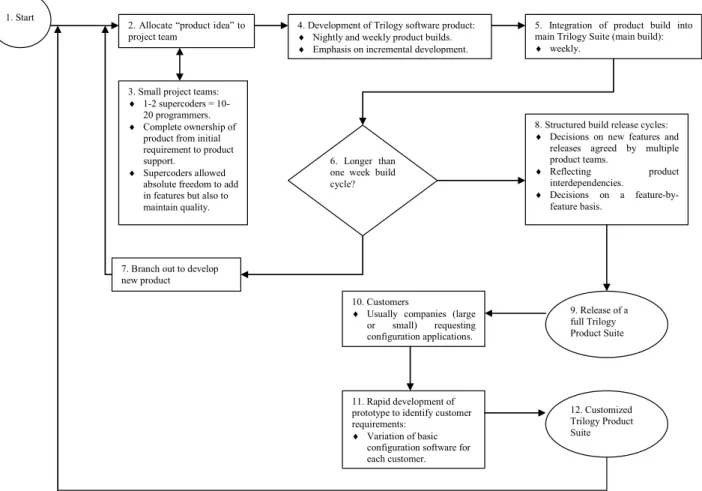
The first DSA model was developed from a review of the whole Austin (1998) case study. The support-ing note by Mandel & Austin (2000) was dropped from the analysis as it only addressed a list of new business ventures and not application development and delivery. The section in Austin’s (1998) case study under “Developing the Product” was the main source for developing a DSA model (see Austin, 1998, p. 7-8). The paper discusses development philosophies, issues and approaches that could be regarded as distinctive to Trilogy. Figure 1 presents the original DSA model and is representative of Trilogy application development during 1996-1999.
1. Start
2. Allocate “product idea” to project team
4. Development of Trilogy software product:
i Nightly and weekly product builds.
i Emphasis on incremental development.
5. Integration of product build into main Trilogy Suite (main build):
i weekly.
3. Small project teams:
i 1-2 supercoders = 10-20 programmers.
i Complete ownership of product from initial requirement to product support.
i Supercoders allowed absolute freedom to add in features but also to maintain quality.
6. Longer than one week build cycle?
8. Structured build release cycles:
i Decisions on new features and releases agreed by multiple product teams.
i Reflecting product
interdependencies.
i Decisions on a feature-by-feature basis.
7. Branch out to develop new product 9. Release of a full Trilogy Product Suite 12. Customized Trilogy Product Suite 10. Customers
i Usually companies (large or small) requesting configuration applications.
11. Rapid development of prototype to identify customer requirements:
i Variation of basic configuration software for each customer.
Source: Austin (1998).
Fig. 1. Summary DSA Model for trilogy application development (1998) The application development commenced with the
allocation of a “Product Idea” to a project team (box 2). A distinctive feature of Trilogy’s application development cycle is the concept of very small pro-jects composed of 1-2 “Supercoders” (box 3). Tril-ogy’s management believed that one to two highly experienced and motivated programmers could do the work of 10-20 standard programmers. These Supercoders were given complete ownership of a project right through the whole application devel-opment cycle. Trilogy also believed in high levels of remuneration, bonuses and compensation, and ongo-ing trainongo-ing for the Supercoders, who were also accorded superstar status within the organization. Components of the application were built or re-leased as new development versions either on a nightly or weekly frequency. Updates to the devel-opment version were usually incremental (box 4). Components were integrated into the application weekly (box 5). A significant decision-point each week for the project team was whether a component or application would be likely to take longer than a weekly build cycle (box 6). If “NO” then the project team(s) can go onto new product development (box 7).
If “YES” then the project teams developed struc-tured build release cycles incorporating decisions relating to new features and new releases (box 8). A set of collective decisions was made among a num-ber of project teams working on application compo-nents or full applications, understanding that there were significant interdependencies between their projects. It is likely that this collective decision-making approach was actually incorporated into the application development cycle right from the com-mencement of the cycle. A full Trilogy Product Suite was released (box 9). However, that was not the end of the development cycle. Customers often required major customization of Trilogy’s applica-tions into their own configuration systems (box 10). A significant number of these customer requests added up to an extension of the application devel-opment cycle, whereby Trilogy rapidly prototyped a variation of the basic configuration software tailored for a customer request (box 11). The customized application was in effect a new version of the appli-cation and could be regarded as a completion point in the application development cycle (box 12). Tril-ogy’s application development cycle was supported
by a rapid decision-making system with a mix of very small groups (one to two coders) working in concert, with high collective empowerment, with a vision of an integrated application suite. There was provision for rapid customization beyond the basic application, which is worthwhile being viewed as part of the overall application development cycle. Interviews with Franke (2002) and Hyams (2002) confirmed the DSA model for Trilogy without any modifications for Trilogy’s application development cycles up to 1999.
4. New DSA model (2001-2002)
The interviewees for the Trilogy case requested that a new DSA model be created for Trilogy’s
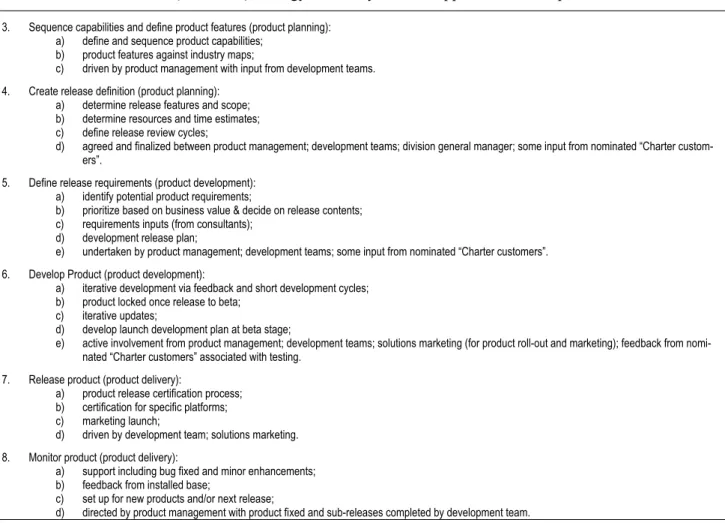
applica-tion development cycles from 2001-2002. The new DSA model reflects Trilogy’s commitment to verti-cal (industry) focused business management and product development. The interviewees provided substantial insights in the development of the new DSA model. Detailed product development cycle information was drawn from company documents on Trilogy Product Management Methodology, and is used but not directly referenced, with permission from the interviewees at Trilogy. These inputs were compiled into a vignette which is presented in Table 3with the new summary DSA model presented in Figure 2 (see Appendix A).
Table 3. Trilogy’s industry-focused application development
Trilogy goes vertical – industry-focused enterprise solutions
In 2000, Trilogy restructured from a horizontally focused application vendortoward using a Software Development Methodology designed to quickly con-ceptualize, create and deliver highly verticalized applications. Previously, from 1993-1999, Trilogy’s application development strategies were based on Trilogy Product Roadmaps.
The Executive Team established an Operations Group with five vertical divisions focused on key enterprise customers and products:
i Automotive.
i Computer.
i Telecommunications.
i Financial services.
i New business.
Trilogy has a two-dimensional matrix of management and delivery resources, located in Core company-wide Groups and within each Division with deep industry experience. These resources cover:
i General managers plus functional vice-presidents.
i Consulting.
i Human resources.
i Finance.
i Solutions marketing and business development.
i Product management and presales resources.
Trilogy’s Fast Cycle Time (FCT) Software Development Methodology is now based on delivering vertical applications within industry Maps set up for each division for a two-year timeframe. There are four phases in this methodology:
1. Product ideation
During this phase, Trilogy’s division managers with their Solutions Marketing and Product Marketing teams generate ideas for products, create a vision for the product and the Industry, apply an investment justification process to the vision and product, and develop an Industry Roadmap supported by a Business Case. All product conceptualization and development are driven with a vertical industry focus.
2. Product planning
During this phase, the capabilities of the product will be identified and sequenced for delivery. Product features will then be expanded into actual devel-opment schedules including actual release features and initial estimates release dates. During this phase, Product Management takes over with Develdevel-opment Teams in driving product planning.
3. Product development
This phase consists of gathering the detailed requirements for the product, and commencing development using Trilogy’s Fast Cycle Time methodology. Although Product Management and Development Teams are driving the product development process, chartered customers associated with specific Trilogy divi-sions may be involved in testing early verdivi-sions of the product.
An extended version of step in Trilogy’s Software Development Cycle is outlined below:
1. Identify and define product concepts (product ideation):
a) industry analysis;
b) analysis against current Trilogy industry/product maps;
c) driven by solutions marketing/product management; some input from division general management.
2. Evaluate product concepts (product ideation):
a) product vision and product concept;
b) validate product concepts against industry maps;
c) develop business case;
Table 3 (continued). Trilogy’s industry-focused application development
3. Sequence capabilities and define product features (product planning):
a) define and sequence product capabilities;
b) product features against industry maps;
c) driven by product management with input from development teams.
4. Create release definition (product planning):
a) determine release features and scope;
b) determine resources and time estimates;
c) define release review cycles;
d) agreed and finalized between product management; development teams; division general manager; some input from nominated “Charter
custom-ers”.
5. Define release requirements (product development):
a) identify potential product requirements;
b) prioritize based on business value & decide on release contents;
c) requirements inputs (from consultants);
d) development release plan;
e) undertaken by product management; development teams; some input from nominated “Charter customers”.
6. Develop Product (product development):
a) iterative development via feedback and short development cycles;
b) product locked once release to beta;
c) iterative updates;
d) develop launch development plan at beta stage;
e) active involvement from product management; development teams; solutions marketing (for product roll-out and marketing); feedback from
nomi-nated “Charter customers” associated with testing.
7. Release product (product delivery):
a) product release certification process;
b) certification for specific platforms;
c) marketing launch;
d) driven by development team; solutions marketing.
8. Monitor product (product delivery):
a) support including bug fixed and minor enhancements;
b) feedback from installed base;
c) set up for new products and/or next release;
d) directed by product management with product fixed and sub-releases completed by development team.
Source: Hyams, Chris (2002a & 2002b).
Trilogy’s industry-focused approach to application development is evident at the commencement of the application development cycle as all product con-cepts that are identified and defined subject to rigor-ous industry analysis (see box 2). Solutions Market-ing and Product Management are responsible for the decision-making associated with mapping concepts against existing Trilogy industry and product maps. Industry Group General Managers with Solutions Marketing and Product Management conduct further validation of concepts against industry maps and develop business cases for the concepts (box 3). Product concepts are transformed into actual prod-uct features and capabilities by Prodprod-uct Manage-ment (box 4). The defined product features are vali-dated against industry maps, reinforcing that each of the Trilogy industry-based business divisions are directly involved in specific application develop-ment. Several groups are involved in creating a Re-lease Definition, which includes reRe-lease features and scope, resource and time estimates, and release re-view cycles (box 5). Product Management and the Project Development Team will create the actual documentation and content, but will consult closely with the relevant industry group General Manager for specific release dates. Selected “Chartered
Cus-tomers” will also be consulted, particularly with regard to product features and scope.
Trilogy’s application development cycle has a spe-cific step for the definition of release requirements which has more detail and further prioritization of product features than the release definition (box 6). There is an additional assessment of product fea-tures based on business value, and inputs from Tril-ogy and other consultants. Outputs from these as-sessments are then finalized into a Development Release Plan. Product Managers working with the Project Team and “Chartered Customers” drive the finalization of the Development Release Plan. The actual product development phase is iterative and through short development cycles similar to the weekly/monthly build approach in the original DSA model (box 7). Product Management works with the Project Team, but also includes Solutions Marketing in this phase. The direct involvement of industry-based solutions marketing persons in the actual product development phase is a distinctive feature of Trilogy application development cycle, when compared with other software houses in this project. A distinct beta product milestone occurs where product features are locked in and a Launch
Devel-opment Plan is developed (box 8). There are still iterative updates based on testing the product at this stage. Product Management, with the Project Team and Solutions Marketing, are all active in beta test-ing and creattest-ing the Launch Development Plan. Trilogy has formal processes for product release (box 9). Trilogy’s products are formally certified for actual release and for specific platforms (specific operating systems and/or vendor’s computer sys-tems). A formal marketing launch occurred for the product release. Certification processes are driven by the development teams, while solutions market-ing drive the marketmarket-ing launch.
Trilogy has formal post-release processes for prod-uct monitoring, including bug fixes and minor en-hancements (box 10). Customers provide feedback on product performance and recommended fixes. Product Managers oversee product monitoring and take inputs for setting up the next application devel-opment cycle. The new DSA model represents a significant departure from the original DSA model in that it recognizes that almost all application de-velopment is undertaken within the Business Divi-sions and is focused right from conception on the industry map. Business requirements are focused within that Division, rather than being a generic application that was customized at the end of the application development cycle.
There are still some application development inputs from Trilogy executives in charge of development, but that is rapidly contextualized into indus-try/division-specific decision-making processes. The new DSA model still reflects an internal focus for applications required for Trilogy’s own application development. However, there is a significant third-party interaction between Trilogy and selected “chartered customers” and consultants.
5. Events chronology map
Austin’s (1998) “Trilogy (A)” case study provides a chronology of the genesis and rapid growth of Tril-ogy from 1990 through to 1998-1999. An events chronology map was created incorporating key events during this period (Figure 3, see Appendix A). Additional symbols were employed for the map including the flowchart symbol for a delay or prob-lem and a six-pronged box for a solution to the de-lay or problem.
Joe Liemandt recognized that, compared to other functions with large computer hardware companies, sales and marketing were relatively non-automated functions (box 1). Liemandt believed that software to assist with the configuration of complex com-puter systems could greatly contribute to cutting costs in the sales and marketing functions.
While at Stanford University, Liemandt, with some other students, began work on configuration soft-ware in 1990-1991 (box 2). Liemandt, Lynch, Jones, Porch and Carter set up Trilogy in 1990 (box 3). They sought funding from venture capitalists but were regarded as too young, and ended up leverag-ing their own credit cards up to almost half a million dollars (box 4). During 1991, Liemandt decided to move the new company to Austin, Texas, to be closer to his ill father (box 5). The move enabled Liemandt to more easily hire David Franke, who was an experienced and well-known software de-veloper (box 6). Franke’s strong reputation in soft-ware development was a contributor to Trilogy sign-ing up Hewlett-Packard (HP) as a customer in March 1992.
Trilogy rapidly built on its success with providing a configurator solution for HP, through signing up new customers including Boeing, AT&T, IBM and Chrysler in 1992-1993 (box 7). Trilogy gained extra business development knowledge through the ap-pointment of Joe Liemandt’s father, Greg, as Tril-ogy’s Chairman in 1992. Greg Liemandt had re-cently been a senior executive with GE and a Chairman of UCCELL. Trilogy turned down several venture capitalists’ offers of funding, but chose other specific VCs to gain expertise on how to grow a company rapidly (box 8). By 1994, Trilogy had grown to 100 employees, having hired experienced development, consulting and sales managers (box 9). However, Trilogy’s executives were struggling with establishing reasonable growth targets for the company – and when to go public (or to IPO), and where the company might go after an IPO (box 10). Through his father’s links with GE, Joe Liemandt was able to confer with Jack Welch the well-known CEO of General Electric (GE) about these issues (box 11).
Welch advised that Trilogy not to establish a tradi-tional organization structure, but to focus on hiring the best people to develop the best products. John Price was hired to set up the Trilogy University that would hire and train high-quality developers. Over the three years 1995-1998, Trilogy built a substantial customer base, while broadening its product line beyond configuration to cover all elements of sales and marketing (box 12). By 1998, Trilogy was gener-ating revenues of over $100 million, with over 400 employees whose average age was just 26 (box 13). Also, through the period of 1993-1998, Trilogy moved toward end-to-end solutions, working with indirect channels partners such as system integrators (box 14). Expansion from “front-office” into “Back-Office” activities put Trilogy on a collision course with ERP vendors (“Enterprise Resource Planning”
vendors) including SAP, PeopleSoft, Baan and Sie-bel (box 15). During 1998, Trilogy’s employee numbers doubled and were expected to double again in 1999 (box 16). Austin (1998) highlights several issues facing Trilogy’s executive team for 1999, around continued rapid growth, broadening product offerings, maintaining product quality, and main-taining business success and a risk-taking develop-ment culture (box 17). Trilogy also needed to dra-matically increase distribution of its products with-out adding fixed costs to its overall business model. It seemed that Trilogy had to stay on an exponential growth curve forever.
6. Updated events chronology map
The original events chronology map was validated during the interview stage without modification up to 1999, and includes reference to Mandel & Aus-tin’s (2000) Trilogy (B) case study. The map time-frame was extended to 2002, and, Figure 4 (see Ap-pendix A) presents an updated events chronology map.
During 1998-1999, Trilogy strove to extend its product range toward a full enterprise-wide com-mercial-off-the-shelf (COTS) e-commerce suite (box 18), through the establishment of an indirect business unit. Trilogy attempted to partner with developers to rapidly extend its application suite. Trilogy also attempted to tailor its packages for easier use by developers. Vantage was noted as a key partner in 1998-2000.
Trilogy established various Internet spin-off busi-nesses in car ordering, insurance ordering, appliance ordering and college hiring from 1999-2000 (box 19). These spin-offs leveraged off Trilogy’s con-figuration application knowledge, or developer training skills, or from enterprising Trilogy pro-grammers and executives, who wished to branch out into new business ventures.
However, by mid-2000, with the Internet “bubble” bursting, Trilogy closed or sold most of its Internet businesses (box 20). The indirect business unit was also abandoned, mainly because of the complexity of attempting to establish an extended COTS appli-cation suite. This experience reinforced a view within the company that developing a general COTS application suite just like the ERP suppliers was definitely not a path that Trilogy should travel on. Trilogy’s own growth was halted and the company undertook major restructuring and consolidation into 2001. Trilogy’s response to a falling informa-tion technology market was to restructure toward a vertical/industry focus in 2001-2002, creating five Business Divisions (box 21). Each Division
man-ages its own application development, consulting, marketing and its own business functions. The five Business Divisions created include Automotive, Computer/IT, Telecommunications, Financial Ser-vices, and New Business. Several issues emerging from the original and updated events chronology maps are explored further though cognitive maps.
7. Cognitive maps
Cognitive maps created for the Trilogy case study were designed to complement DSA models and events chronology maps through additional explora-tion of selected decision-making issues and con-texts. Three sections were extracted from Austin’s (1998) case study for further text analysis and crea-tion of cognitive maps to complement the analysis presented in the original DSA model and original events chronology map.
The three initial cognitive maps created for the Tril-ogy case study addressed the following themes:
i early development (1991-1994);
i industry and competition;
i software development.
During the interview process, requests were put forward for an additional cognitive map reflecting updated insights from 2000-2001: Industry-focused application development (2000-2001).
The first cognitive map is an extended insight into the creation and early growth of Trilogy. The second cognitive map provides insights into industry com-petition. Part of the second map parallels Trilogy’s early growth, but about half of the map focuses on Trilogy’s competition as it rapidly grew between 1993 and 1999. The third cognitive map amplifies logic and philosophy behind Trilogy’s distinctive application development methodology for 1993-1999, but is also relevant through to 2002. The addi-tional cognitive map highlights insights into Tril-ogy’s industry-focused application development in 2001-2002.
8. Cognitive map 1 – early development (1991-1994)
The cognitive map was developed from the “From founding to market leadership” section in “Com-pany Background” section (Austin, 1998, p. 2-3 see Table 4). Figure 5 (see Appendix A) presents this cognitive map. The map covers insights into the identification of an opportunity in 1990 to automate activities within sales and marketing functions, onto addressing the opportunity through the development of a configurator application, and the creation of a start-up company. The map also provides insights into rapid growth of Trilogy through to 1994.
Table 4. Text extract – Trilogy – early development (1991-1994)
Liemandt had come to Stanford knowing he wanted to start a software company. As an undergraduate, he had spent many hours researching the industry and thinking about where the best opportunities might be. In an around school work, he did consulting to pay bills and to stay on top of the latest in information technology practices. Eventually, experiences from consulting clicked with the research.
It seemed to Liemandt that hardware vendors had difficulty delivering their products with the right equipment. His consulting clients frequently received computers with missing or incompatible components. Selling and delivery processes for these complex products appeared to be largely manual and fraught with error. This observation prompted Liemandt to analyze the income statements of computer product companies, comparing spending patterns with the degree of automation in each company function. What he found surprised him (see Table 1).
Companies typically spent only 8 to 10 percent on General and Administrative costs, which had been extensively automated over the years. Research and Development, also highly automated in most high-tech companies, accounted for slightly more spending, about 10 to 15 percent. Manufacturing was a similar story: mature cost saving technologies had been applied to reduce spending (less cost of good sold) to 20 to 25 percent of the firm’s total expenses. What remained after deducting these major categories was more than 40 percent of expenditures that were mostly related to Sales and Marketing – an area which, surprisingly, was not very automated. If automation of the “selling chain” allowed companies to put an additional 12 percent of revenues on the bottom line (a number which Trilogy now considers reasonable), that would be worth literally billions of dollars. It was a potentially huge market that had not yet been targeted by anyone.
While still in school, Liemandt and the others had begun working on configuration software, which incorporated complex if-then rules into a tool that would prevent mismatches between incompatible product parts. They continued this work after school, into 1991, always sure they were on the verge of solving the configuration problem that would finally give them a completed product. Companies like Hewlett-Packard (HP) and Digital were working on their own “configurators”, which added urgency to Trilogy’s efforts. Liemandt presented their ideas to venture capitalists, but none would invest in a company composed entirely of barely 20-years-olds. To stay a float, the team leveraged more than 20 credit cards, managing to borrow almost half a million dollars in cash advances. Liemandt describes the mood in the days before the company had revenues or product:
At the beginning, nothing worked. We lived failure every quarter. The product never worked. We’d sit around thinking “This is just ridiculous, why are we continuing?” We were living in a state of failure, but we had this hope, this shining star that wouldn’t go out. What kept us together was the vision that this was a huge opportunity; we just needed to make it work. That, or the fact that we were yelling at each other the whole time.
In 1991 the company moved to Austin, Texas so that Liemandt could spend more time with his father, Greorgy Liemandt, who had been diagnosed with a fatal illness. By this time Trilogy had an early product and had applied for patents covering its algorithms, but the company still had no customers. They were working hard to generate interest in their software, but nothing was working. HP, a key potential customer, sent a particularly discouraging letter saying, in essence, “We already have a configurator and don’t need your product”.
Meanwhile, however, being in Austin enabled Trilogy to hire David France, a software developer with an industry-wide reputation, from a research consortium in Austin. With France on board, the company suddenly had new-found credibility. Silicon Graphics became the first customer, signing a small deal. Within months, HP was back, this time offering $ 3.5 million for software and support services. The deal was consummated in March of 1992. At the time, Trilogy had eight employees. When HP signed, everything changed for Trilogy. Software that was good enough for HP was good enough for a lot of other big companies, also. The floodgates opened and Boeing, AT&T, and, eventually, IBM and Chrysler became customers (the IBM deal alone was worth $25 million). Also significant: Liemandt’s father, a former GE executive and chairman of UCCELL, who had called his son a moron for squandering his Stratford education, greed to become Trilogy’s chairman, a position he needed the expertise on how to grow a company that those firms could offer. Venture investors who had refused to fund Trilogy in the early days came calling – and were turned a way. Liemandt retained more than 50 percent ownership.
As orders rolled in, Trilogy staffed up. The company grew rapidly to around 100 employees. They hired experienced executives to head development, Consulting, and Sales. But by late 1994, Liemandt was not happy with the things were going. Things were good at present, but he worried about the future.
Some of the factual material in this section was found in “Dream On”, by Karen E. Starr, Selling Power, October, 1997, Vol. 17, No. 8; and “Holy Cow, No One’s Done This!” by Josh McHugh, Forbes, June 3, 1996.
Source: Austin (1998, pp. 2-3).
While studying at Stanford University, Joseph Lie-mandt wanted to start up a software company. He had unearthed an opportunity where computer hardware vendors had difficulty delivering products with the correct parts and equipment. Their selling and delivery processes were mainly manual, and were error-prone. Liemandt conducted further analysis on the income statements of selected com-puter companies, finding a breakdown of costs into the following percentages:
i General and Administration (G&A) (8-10%).
i Research and Development (R&D) (10-15%).
i Manufacturing (20-25%).
i Sales and Marketing (40%).
G&A, R&D and Manufacturing had been exten-sively automated, but by 1990 there was very little automation within sales and marketing functions. Liemandt calculated that attempting to automate aspects of the “Selling Chain” (the sales and market-ing functions) to enable an additional 2% of reve-nues would be potentially worth billions of dollars – and was a new potential market not currently tar-geted by anyone. Austin (1998) indicated as an
ad-ditional note that the estimate of adding 2% to reve-nues was a figure considered as reasonable by Tril-ogy. Liemandt and some other students at Stanford started work on developing configuration software. Configuration software enables the user to incorpo-rate all essential features and equipment for a prod-uct, plus nomination of optional additional products and accessories.
In the late 1980s, most quotes for computer hard-ware were line-by-line items manually entered without any form of validation or checking. For complex large system quotes, such as for multimil-lion dollar tenders, hardware consultants were em-ployed to check system configurations and line-by-line. The author of this dissertation was a specialist consultant in the area of the configuration and pric-ing of complex computer systems in the late 1980s. Early configuration systems were developed by DEC and HP in the mid-to-late 1980s, but they both required mainframe computer power to run through complex if-then rules, and even then only standard-ized systems with few additional options could be processed into quotes in a reasonable turn-around
time. Nevertheless, as minicomputer and small server performance was rapidly increasing, these configura-tion systems had the potential to be placed on smaller very powerful UNIX-based systems emerging at that time, and eventually on Windows-based PCs.
Liemandt realized that Trilogy needed to bring its configuration software to market quickly to counter DEC and Hewlett-Packard’s early lead. Decision-making at this stage was all about evaluating options to commercialize and bring to an application rapidly to market. Trilogy needed capital to accelerate ap-plication development. Liemandt sought venture capital support but no venture capitalist was pre-pared to invest in a company with such a young group of developers. However, Trilogy’s founders had such a strong faith in its capability and vision for its application that they leveraged its own credit cards with cash advances of almost half a million dollars. Such an attitude to risk-taking, that is, risk enough money to hurt, but not to break the bank is a fundamental organizational value at Trilogy and is explored in more detail in other sections of Austin’s (1998) case study.
Liemandt described the atmosphere of Trilogy at the time (1990-1991) as a state of failure where nothing worked, but a strong vision kept the team together. Or the team seemed to stay together by “yelling at each other the whole time”. A “circuit-breaker” for Trilogy seems to be Liemandt’s decision to move Tril-ogy to Austin, Texas, in 1991. Liemandt wanted to spend more time with his ill father in Austin and moved there prior to his graduation from Stanford. Other members of the Trilogy gradually moved to Austin, some before graduation, some after graduation. By the time the move to Austin was completed, Trilogy had developed an early application. In an unusual move for software developers, Trilogy ap-plied early for patents – not so much for the actual application but for the algorithms used in the if-then rules within the application. Although Trilogy was trying hard to generate interest in its application, they had no customers. In a twist suggesting Trilogy knew that its application was superior to Hewlett-Packard’s existing configuration software, Trilogy was actively targeting Hewlett-Packard as a poten-tial customer. At the time, Hewlett-Packard rejected Trilogy’s overtures, claiming that it already had its own configuration software.
Moving Trilogy to Austin enabled Liemandt to hire David Franke from a research consortium in Austin in 1992. Franke was a well-known soft-ware developer with strong links to various hard-ware and softhard-ware suppliers and he gave Trilogy a substantial boost in industry credibility. Trilogy’s increased industry credibility through Franke
translated into new customers. Silicon Graphics (SGI) became Trilogy’s first customer, and within a few months Hewlett-Packard signed up in a $3.5 million deal for software and support services. Trilogy was still a small start-up company with eight employees, facing exponential demand for its application.
Securing Hewlett-Packard as a key customer ap-peared to legitimize Trilogy in the eyes of several large companies who soon also signed up with Trilogy – and for large contracts. Boeing, AT&T and Chrysler rapidly signed up, while IBM took on Trilogy’s software and support for over $25 million. Liemandt’s father Greg, although diag-nosed with a fatal illness, was appointed Chair-man of Trilogy during 1992-1993, sharing valu-able experience and knowledge from senior ex-ecutive roles at GE and being Chairman at UCCELL. Trilogy now needed knowledge and resources to turn into a large enterprise servicing large corporate customers.
Trilogy was seen in this period as a great invest-ment opportunity by several venture capitalists, but most were turned away as Liemandt really wanted expertise and resources to rapidly grow the company, and not just capital. Liemandt ac-cepted funding from two venture capitalists that provided these additional benefits, but maintained 50% ownership of the company. Trilogy grew rapidly through 1992-1994 to around 100 employ-ees and experienced executives were hired to es-tablish organizational structure for development, consulting and sales. Trilogy was growing strongly with a “killer application” for sales & marketing – and that was all before the Internet revolution arrived.
9. Updated cognitive map 1 – early develop-ment (1991-1994)
The cognitive map was revised through direct editing in PowerPoint with inputs from interviews with Franke (2002) and Hyams (2002). Several sections of the original map were validated with minimal changes, but there were some significant additional insights for other sections. Figure 6 (see Appendix A) presents the updated map. Sections 1 and 2, apart from some formatting ad-justments, were validated unchanged from the original cognitive map. Section 3, on “early con-figurator application development”, was updated to indicate that apart from Liemandt, the other early developers were Chris Porch, John Lynch, Tom Carter and Christy Jones. The actual con-figuration application was known as SalesBuilder and was based on an expert system with neural network capability. These features enabled the
setting up of complex rules for selection of fea-tures and options.
Section 4 was validated unchanged from the original map. Trilogy’s move to Austin covered in Section 5, was amplified to provide more insight into Franke’s move to Trilogy. Franke had worked with MCC in Austin, a company that was focused on developing new computing technolo-gies and software. Franke had substantial knowl-edge in software development, expert systems and he was already quite familiar with algorithms and developments related to configuration applica-tions. Franke helped Trilogy formalize Sales-Builder into a formal release SalesSales-Builder V1.0. Section 6, on New Credibility and New Business, was updated to incorporate additional insights.
Trilogy had eight employees in March 1992. Tril-ogy developed SalesBuilder V2.0 in mid-1992, using its own code and developers. NCR was identified an additional large new customer in 1992. Section 7, covering Rapid Growth, was vali-dated unchanged except that Joseph Liemandt became chairman in late 1993 (after his father Greg).
10. Cognitive map 2 – industry and competition
The cognitive map was developed from the “In-dustry and Competition” section in Austin (1998, pp. 4-5 – see Table 5. Figure 6 (see Appendix) presents this cognitive map. The map provides a cognitive description of Trilogy’s perception of its competition and industry space from the early 1990s to 1999.
Table 5. Text extract – Trilogy – industry and competition
Industry and Competition
Liemandt's original analysis of spending patterns versus degree of automation in computer product firms had identified a wide-open market worth at least $10 billion. The few companies that were in that market at the time were bit players, selling things like contact management software for salespeople. Most of the functionality that constitutes the bulk of the “selling chain” – catalog updating, configuration, pricing, bid preparation, commission calculation – was performed manually or by software written by product firms themselves. Trilogy had pushed rapidly and successfully into this mostly empty space.
But Trilogy’s success did not go unnoticed. Beginning in about 1993, new companies like Aurum, Brightware, Calico, Clarify, Remedy, Scopus, Siebel System, and Vantive entered area of sales and marketing automation. Some of these companies targeted niches that were not in immediate competition with Trilogy. But all were operating in the same general space, going after that 40 – plus percent of P&S spending that Liemandt had first noticed as a student. More worrying than these small players, however, was the awakening interest of the giants of Enterprise Resource Planning (ERP) – rapidly growing companies that were many times larger than Trilogy, such as SAP, Oracle, Peoplesoft, and Baan (see Figure 1 for profiles of these companies, see Appendix A).
Trilogy had intentionally positioned itself as an “enterprise software” company, meaning that its products were designed to work together to provide end-to-end functionality for a major segment of a customer’s business (see selling chain). This was necessary because Trilogy’s corporate customers were increasingly looking to build or buy integrated systems. Companies that did not sell enterprise products risked losing out to companies with more integrated and broader product offer-ings. But ERP vendors saw the enterprise software market as their turf. One company’s supply chain, reasoned the ERP giants, was another company’s selling chain. As the experts on integrating a customer’s “back office” – the value stream from procurement through production to delivery – it seemed only natural to the ERP vendors that they should also integrate the “front office” – the selling chain. Liemandt summarized the threat to his company in stark terms:
They decided that Trilogy had done some fantastic research for them and that they’d just come in and take it over. The question was (and still is), “Can we withstand the onslaught of giants ten times as big who want to move into our space?”
As early as 1993, Trilogy had realized that the number one threat to its long-term well-being was SAP, the largest of the ERP vendors, which by 1998 owned 70 percent of the back office automation business for Fortune 500 customers. In 1997 and 1998, the threat from SAP and other ERP vendors became more immediate. Baan purchased Aurum. Peoplesoft announced partnerships with Vantive and Siebel System (which itself bought Scopus). SAP pointedly failed to invite Trilogy to exhibit at Sapphire 1998, the Sap-sponsored tradeshow for its own customers, even though the company had participated in earlier years. At that same tradeshow, Hasso Plattner, SAP’s chairman and cofounder, announced to his customers that 80% of the company’s R&D going forward would be aimed at building front office products.
Trilogy had a considerable head start on ERP vendors in the development of key technologies, especially configuration software, some of which was by then protected by patents. But the protection provided by patents would be short-lived. Whether Trilogy would remain a factor would depend far less on past accomplishments than on what they could accomplish in the future.
Source: Austin (1998, pp. 4-5).
Liemandt identified an unmet market opportunity (see also first cognitive map) that he estimated to be at least $10 billion in the area of the sales & market-ing functions, or the “front-end” or “front-office” or the “selling chain”.
Most activity in the selling chain activities for computer hardware companies such as catalogue updating, configuration, pricing, bid preparation and sales/consulting commission calculations were processed manually. There were a few com-panies that sold software for specific activities in the selling chain such as contact management software. There were some forms of simple cus-tomer database applications available for direct
marketing programs but CRM as a concept emerged in the late 1990s.
Trilogy was one of the first companies with a solu-tion that went further than just one component of the “Selling Chain”. However, it was not long before Trilogy faced competition from several fronts. Sev-eral of the companies that we would now see as CRM vendors were created in the early 1990s. Eight com-panies are noted in the original cognitive map, of which probably Siebel Systems is best known for sales force management applications.
Most of the companies noted were not in immediate competition with Trilogy – but they all could be clas-sified as competition, depending on how an industry
space for a “selling chain” was defined. Trilogy faced more aggressive and powerful competition from a different front. Trilogy’s executive always saw the company as an “enterprise software” company that could address a full end-to-end “selling chain”. Tril-ogy was in part responding to customers who wanted to build or buy systems that at least integrated the selling chain. Such positioning put Trilogy directly in the path of large and rapidly growing enterprise re-source planning (ERP) vendors. Companies such as SAP and Oracle had been established at least 10 years longer than Trilogy and had grown rapidly through the 1980s and 1990s offering various key enterprise applications.
SAP had grown out of offering enterprise financial software, expanding into manufacturing and logistics in the early 1990s. SAP could be put on several com-puter hardware platforms but was often used on IBM systems through the 1980s and early 1990s. Oracle rode the Open Systems/UNIX boom of the late 1980s and early 1990s to be the major database application for various enterprise applications to run on UNIX hardware vendors including Sun, Hewlett-Packard, and DEC’s UNIX systems. Oracle was also early to position its applications as e-business solutions to work with the World-Wide Web. Peoplesoft was created in the late 1980s with Human Resource Man-agement (HRM) applications but spread quickly into other enterprise applications, working closely with UNIX computing vendors, but also with IBM and DEC’s VMS systems of the early 1990s. Baan was a Dutch company that emerged through enterprise fi-nancial applications in the early 1990s.
The ERP companies’ main focus was integration of “back-office” activities such as manufacturing, logis-tics, and financial management. However, it was logical for the ERP companies to expand its applica-tion suites right from procurement to delivery, includ-ing integration of front-office activities. Trilogy iden-tified SAP as its number one long-term competitor as early as 1993. SAP dominated the “back-office” ERP business with about 70% share of that business by 1999. However, for about five years Trilogy worked with SAP as a key ISV and regularly exhibited at Trilogy’s main tradeshow, SAPPHIRE.
SAP changed its strategy in 1998 to focus heavily on building front-office applications. One side-effect of that strategy was not to invite Trilogy to SAPPHIRE 1999. At that event SAP’s Chairman committed that 80% of SAP’s R&D would go to development of front-office applications. By 1997, competition be-tween the main ERP vendors and Trilogy was quite direct, as a number of ERP companies either acquired ISVs with front-office applications, or they attempted to develop their own applications.
Trilogy’s management believed that the company possessed a considerable lead over the ERP vendors in the selling-chain area. Trilogy was very strong in configuration technology, for which it held some significant patents. However, Trilogy needed to con-tinually develop new front-office-related applications and grow fast enough to gain sufficient critical mass to take on much larger companies pushing into the selling-chain space. Liemandt directly questioned whether Trilogy could survive as a key player at least in the selling chain industry that he had defined back in the early 1990s.
Liemandt was reflecting on a not uncommon problem for small start-up companies with strong new tech-nologies facing up to larger more established compa-nies attempting to break into its area of expertise. Other case-studies in this project and particularly those with enterprise software solutions have faced the same problem as Trilogy’s.
NetDynamics gained a strong early lead with its ap-plication to link WebPages with databases, but was then acquired by Sun, as it needed size and resources to support a rapidly growing enterprise customer base. Kana rapidly acquired ISVs to develop a full e-CRM solution. It moved from a focused application on e-mail communication management to a redefined and more integrated e-CRM and e-commerce appli-cations space.
Trilogy could see that they needed to at least strengthen its product offering for the selling chain, although at the same time, it was not committing to redefine its offerings to match the total ERP solu-tions. The overall cognitive map presents Trilogy’s management perceptions of competitive evolution through the 1990s. The map also highlights Trilogy’s executive team’s strategic mapping of its competitive position, initially in a new industry, but then in a more broad and redefined industry with much larger and more aggressive competitors on the same per-ceived turf.
11. Updated cognitive map 2 – industry and competition
The cognitive map was revised subsequent to inter-views with Franke (2002) and Hyams (2002) (Figure 8, see Appendix A). Most of the original cognitive map was validated unchanged, but there were some additional insights and structural updates incorpo-rated into the map.
The first section of the map covering “Early 1990s – Wide-open Market” (box 1) was validated with only two modifications. The first indicated that Trilogy released an application Selling Chain V1.0 in 1994-1995 with the functionality described in the original map. The second modification was the incorporation of the comment in the original map relating to
Trilogy’s moving into a mostly empty space, into the first section of the updated map. The second section, “Mid-1990s – New Companies Enter New Sales & Marketing Automation Market”, was validated with two modifications related to the same point. Franke (2002) noted that there were two or three vendors in the configuration space. Trilogy’s competitive advan-tage was based on the breadth of its new application suite (Selling Chain V1.0) and better point-by-point configuration capability. The third section on emerg-ing ERP companies as potential competitors was validated unmodified, but extended to highlight the ERP vendors’ strengths in Financials, Human Re-sources Management and Manufacturing suites. Trilogy’s positioning as an “Enterprise Software Company” (box 4) was validated without modifica-tions to content, except that the sub-section on ERP vendors seeing enterprise software as its turf was reformatted into a separate section (box 5 – ERP Companies Move From “Back-Office” to “front-office”). The original section on SAP being the Number One threat to Trilogy was slightly reformat-ted (see box 6) but content was validareformat-ted without modifications. An additional point was incorporated into the section indicating that, even by early 2002, SAP had still not delivered a complete Pricing and Configuration application similar to Trilogy.
The section on the consolidation of ERP Vendors with other “front-end” vendors through selected ac-quisitions was validated unchanged for content. However, this section, including the subsections on Liemandt’s view on the threat of from the ERP com-panies, and Trilogy’s competitive advantages over them, were split into three sections (see box 7 for Direct Competition, box 8 for Liemandt’s view of the ERP companies, and box 9 for Trilogy’s Competitive Advantages over the ERP Vendors).
The question at the end of the original map regarding whether or not Trilogy would remain a factor in the industry was reformatted as box 10. The revised cog-nitive map largely validates the original map, with some extra insights specific to Trilogy’s actual Sell-ing Chain application suite.
12. Cognitive map 3 – software development
The cognitive map was developed from the “Devel-oping the Product” section (Austin, 1998, pp. 7-8 – see Table 6). The cognitive map is presented in Fig-ure 9 (see Appendix A). The map provides further insights into Trilogy’s product development capabil-ity and its fundamental philosophies of software de-velopment.
Table 6. Text extract – Trilogy – software development
Developing the product
Trilogy’s marketing goals depended vitally on the company’s product development capability. Specifically, marketing objectives required that developers sustain the competitive advantage Trilogy enjoyed in configurator technology while dramatically broadening the product to fill the enterprise needs of large and small customers in a variety of industries.
Trilogy aspired to maintain a software development capability that was second to none. Their comparison set for evaluating themselves in this area was not their direct competitors, but other world class development organizations, especially Microsoft. In their aim to be the best, they believed that they had largely succeeded. Liemandt was convinced that no other enterprise software vendor was even a close second to Trilogy in development capability. Scott Snyder, Trilogy’s Senior Development VP, estimated that 15 or 20 successful software companies could be built around the talent in Trilogy’s development organization.
Central to the company’s development capability was the “rule of the super coders”, which held that one superstar programmer could do the work of ten average programmers. “Getting the most out of great developers”, remarked Snyder, “is one of the things Trilogy does amazingly well”. The development process was geared toward giving Trilogy’s superstar programmers the support and freedom they needed to produce great products. Snyder described some of the company’s fundamental philosophies of software development:
Our development is based around four basic philosophies. Small teams, very small from a traditional development standpoint. We expect entire new products to be created by one or two superstar programmers you can count on to deliver great products quickly. Complete ownership of the product at the developer level from initial product requirements gathering through product support. We don’t have a separate change team that insulates the developers from the impact of producing poor quality products. Intense focus on automation in order to free the developers (or anyone else) from having to spend their time manually performing frequently repeated tasks like regression tests. Finally, a focus on incremental development model that allows us to deliver new functionality quickly and provides us with the flexibility to react to changes in the market quickly.
A key feature of the development process was that it evolved to maintain in responsiveness to the market, becoming more structured as the product matured. As the product grew beyond a certain size, explained Snyder, maintaining responsiveness and high product quality depended on some key disciplines:
The goal is to maintain your code at ship level quality on a weekly basis. When a developer drops code for a new feature or bug fix into the build, it must be accompanied by the appropriate suite of automated tests to validate that the changes work as expected. These tests are added to the existing suite and the entire set is executed every time the product is built, whether that was a weekly or nightly build.
If you had to develop a feature that took longer than the weekly build cycle, you branch your development, develop the feature, develop tests, merge it all back into the main build, then rerun all the tests on the integrated code. In addition to the individual product tests, we also have automated system tests which test the interactions between products. The goal is to constantly improve the quality of the product as you increase its functionality. Again, a very incremental model. It’s awesome and brilliantly suited for an environment which requires you to react quickly to any new requirement or change in market direction as long as you maintain the quality discipline.
As the product grew in complexity, programmers retained absolute freedom to add features in whatever way they saw fit, but they were obliged to maintain in quality. As interdependencies developed between different developer’s programs, the build and release cycle became more structured, with decisions being made about the timing of the release of new features on a features-by-feature basis. New features were scheduled around a plan that used 60 to 70 percent of Trilogy’s development capacity with the remaining 30 to 40 percent held in reserve for late breaking and urgent fixes.
According to Austin (1998), Trilogy‘s marketing objectives focused heavily on the company’s
devel-opment capability. Trilogy’s developers had the goal of sustaining its competitive advantage in