Analysis of a social robot as a
tool for teaching and translating
a second language
Sergio Pau Alandi
AbstractLearning a second language can sometimes be boring or inefficient depending on the method used. There are numerous previous studies on the use of robotic systems in teaching and the motivation to learn languages, which have been taken as a reference throughout the project, but did not specifically deal with the subject in question. This research has attempted to test the efficiency of the use of a robotic system in learning Spanish for students who do not speak it compared to a theoretical online course, and thus adapt advances in technology to the needs of users. For this, two short Spanish courses have been held, specifically on the alphabet, vocabulary, grammar and verbs, and at the end of each of the sections they have raised the same questions in both. One of them had the presence of explanatory videos by the avatar, while the other only had the theoretical part written. From the results obtained, it has been possible to observe an improvement in the grades of the students who had taken the course with the avatar compared to those who had not. Therefore, these results have supported the hypothesis initially proposed and may serve as a basis for future research that seeks to expand the existing knowledge in this field, with better conditions and with more complete experiments. Direction
Contents 1 Introduction 1.1 Background 1.2 Normative 1.3 Objectives 1.4 Requirements 2 Blueprint 2.1 State of art 2.1.1 Robots 2.1.2 Virtual avatars 2.2 Study of proposals 2.2.1 Proposal 1 2.2.2 Proposal 2 2.3 Justification 2.3.1 Resource estimation 2.3.2 Economic impact 2.3.3 Final proposal 3 Implementation 3.1 Development environment 3.2 Practical implementation 3.2.1 Product design 3.2.2 Operation diagrams 3.3. Tests 3.3.1 Participants 3.3.2 Experimental design 3.3.3 Procedure 3.3.4 Materials
3.3.5 Data and analysis 4 Results
4.1 Statistics 4.2 Exploitation 5 Conclusions
5.1 Personal conclusions 5.2 Future lines of development 6 Bibliography
1 Introduction
New technologies have become a fundamental piece in people's lives due to the large number of opportunities they offer in the development and improvement of the quality of life. Therefore, it is necessary to adapt these advances in the sectors with more social influence and in this way optimize the results and allow expanding the possibilities that these have for the future.
Specifically, robotics is currently very widespread in the industrial and commercial field, where the functions that robots can perform in a more exact way than humans are used. Mainly they make a great difference in jobs in which humans are limited, such as very heavy or dangerous loads, and they serve as support in much of the manufacturing industry as well as in research, medicine and weapons, among others. However, there is some skepticism as to the benefit they could offer in jobs in which social interaction with humans is the predominant factor, since they need a great capacity for adaptation and adequate behavior.
Social robots are divided into three groups: education, healthcare and hospitality. In this case, the influence they can have on the education sector will be explored.
Today, economic and social factors are the main drivers of the demand for technological support in the classroom. In a world in constant change and advance, it is necessary to adapt all aspects to take full advantage of these technologies and for new generations to be in contact to take advantage of them in an optimal way in the future. Currently there are various problems that make it necessary for robots to enter the educational system, such as the high number of students per classroom or the need to offer more personalized attention to certain students with difficulties. These systems generally take the form of software systems that serve as support such as individual tutorials, and such social interaction has been shown to improve interpersonal learning in both cognitive and emotional outcomes.
1.1 Background
Many scientific studies have focused on the interaction between robots and humans. These investigations have proven that the morphology, appearance and behavior of robots have a great influence on the way in which robots are perceived by people and on their acceptability towards them. Furthermore, both embodiment and physical contact have been shown to enhance human-robot interaction. Regarding the expression of emotions, there is no tangible difference between physical robots and virtual avatars, the first ones have a greater capacity for interaction. Regarding appearance, this substantially affects the person's expectations of the robot's mentality and behavior, and this interaction grows with a more interesting and attractive appearance.
Although studies continue investigating the impact of avatar design on human interaction, most experts consider it an external limitation, and focus their experiment on other aspects. Currently,
different studies are being carried out using the same robot in all cases, such as the Nao (Fig. 1), due to the difficulties in terms of cost, reliability and the time that the construction of specific robots for each type of experiment.
Fig. 1. Humanoid robot Nao
Recently, the influence of open source methodologies in the field of robotics has been observed. There are projects that use these methods as building blocks designed to be integrated into broader robotic platforms, such as the OpenHand manipulator, the ROS operating system, and the TakkTile touch sensor. Additionally, there are complete robots with hardware design files that have been released under an open source license. The humanoid robot iCub and the quadruped Oncilla are some of these examples (Fig. 2 and 3). However, despite being designed in open source, these prototypes may not be easy to reproduce, for example the iCub robot has a large number of plastic parts molded and milled by CNC machines and therefore requires a sufficiently equipped laboratory to replicate the design. New platforms have emerged in recent years that more clearly emphasize community-driven mods and development.
Fig. 3. Quadruped Oncilla
A good example is the Poppy project (Fig. 4), which focuses on designing robots using 3D printed components and smart servers from the Dynamixel brand. The use of 3D printers for this type of purpose provides a series of very interesting advantages such as the possibility of being able to copy parts quickly and precisely and modify them. This project mainly features three designs: a 13-degree-of-freedom upper torso, a 6-degree-of-freedom arm, and a full 25-degree-of-freedom humanoid robot.
Fig. 4. Poppy Project
As has been observed, robotic kits have become increasingly popular as a tool for education in science, technology, engineering and mathematics. The best known example may be Mindstorms, which consists of a platform based on Lego construction toys and consists of a mobile mass-production unit that students must expand through the use of Lego bricks and paper accessories. In addition, Thymio is also considered a good example of open source
robots intended for education, through which students are allowed to learn to program, among other things.
1.2 Normative
Currently, social robotics in the European Union is within a framework where its use is governed by a series of norms, laws and considerations that are reflected in the document European Civil Law Rules in Robotics, drawn up by the European Parliament in 2017. The need to create regulation around robots is marked by the continuous growth of the sector and their presence in more and more situations in the lives of citizens. The text contains some basic norms regarding responsibility, ethics, education and the environment, and some of them are listed below: “1. Calls on the Commission to propose common Union definitions of cyber physical systems, autonomous systems, smart autonomous robots and their subcategories by taking into consideration the following characteristics of a smart robot:
2. Considers that a comprehensive Union system of registration of advanced robots should be introduced within the Union’s internal market where relevant and necessary for specific categories of robots, and calls on the Commission to establish criteria for the classification of robots that would need to be registered; in this context, calls on the Commission to investigate whether it would be desirable for the registration system and the register to be managed by a designated EU Agency for Robotics and Artificial Intelligence.
3. Stresses that the development of robot technology should focus on complementing human capabilities and not on replacing them; considers it essential, in the development of robotics and AI, to guarantee that humans have control over intelligent machines at all times; considers that special attention should be paid to the possible development of an emotional connection between humans and robots ‒particularly in vulnerable groups (children, the elderly and people with disabilities) ‒ and highlights the issues raised by the serious emotional or physical impact that this emotional attachment could have on humans.
6. Underlines that many robotic applications are still in an experimental phase; welcomes the fact that more and more research projects are being funded by the Member States and the – the acquisition of autonomy through sensors and/or by exchanging data with its
environment (inter-connectivity) and the trading and analysing of those data; – self-learning from experience and by interaction (optional criterion);
– at least a minor physical support;
– the adaptation of its behaviour and actions to the environment; – absence of life in the biological sense
public funding, remains a leader in research in robotics and AI; calls on the Commission and the Member States to strengthen financial instruments for research projects in robotics and ICT, including public-private partnerships, and to implement in their research policies the principles of open science and responsible ethical innovation; emphasises that sufficient resources need to be devoted to the search for solutions to the social, ethical, legal and economic challenges that the technological development and its applications raise.
8. Stresses that innovation in robotics and AI and the integration of robotics and AI technology within the economy and the society require digital infrastructure that provides ubiquitous connectivity; calls on the Commission to set a framework that will meet the connectivity requirements for the Union’s digital future and to ensure that access to broadband and 5G networks is fully in line with the net neutrality principle.
10. Notes that the potential for empowerment through the use of robotics is nuanced by a set of tensions or risks and should be seriously assessed from the point of view of human safety, health and security; freedom, privacy, integrity and dignity; self-determination and non-discrimination, and personal data protection.
12. Highlights the principle of transparency, namely that it should always be possible to supply the rationale behind any decision taken with the aid of AI that can have a substantive impact on one or more persons’ lives; considers that it must always be possible to reduce the AI system´s computations to a form comprehensible by humans; considers that advanced robots should be equipped with a ‘black box’ which records data on every transaction carried out by the machine, including the logic that contributed to its decisions.
22. Highlights that the issue of setting standards and granting interoperability is key for future competition in the field of AI and robotics technologies; calls on the Commission to continue to work on the international harmonisation of technical standards, in particular together with the European Standardisation Organisations and the International Standardisation Organisation, in order to foster innovation, to avoid fragmentation of the internal market and to guarantee a high level of product safety and consumer protection including where appropriate minimum safety standards in the work environment; stresses the importance of lawful reverse-engineering and open standards, in order to maximise the value of innovation and to ensure that robots can communicate with each other; welcomes, in this respect, the setting up of special technical committees, such as ISO/TC 299 Robotics, dedicated exclusively to developing standards on robotics.
23. Emphasises that testing robots in real-life scenarios is essential for the identification and assessment of the risks they might entail, as well as of their technological development beyond a pure experimental laboratory phase; underlines, in this regard, that testing of robots in real-life scenarios, in particular in cities and on roads, raises a large number of issues, including barriers that slow down the development of those testing phases and requires an effective strategy and monitoring mechanism; calls on the Commission to draw up uniform criteria across all Member States which individual Member States should use in order to identify areas where experiments with robots are permitted, in compliance with the precautionary principle.
41. Draws attention to the Commission's forecast that by 2020 Europe might be facing a shortage of up to 825 000 ICT professionals and that 90 % of jobs will require at least basic digital skills; welcomes the Commission’s initiative of proposing a roadmap for the possible use and revision of a Digital Competence framework and descriptors of Digital Competences for all levels of learners, and calls upon the Commission to provide significant support for the development of digital abilities in all age groups and irrespective of employment status, as a first step towards better aligning labour market shortages and demand; stresses that the growth in the robotics requires Member States to develop more flexible training and education systems so as to ensure that skill strategies match the needs of the robot economy.
42. Considers that getting more young women interested in a digital career and placing more women in digital jobs would benefit the digital industry, women themselves and Europe's economy; calls on the Commission and the Member States to launch initiatives in order to support women in ICT and to boost their e-skills.
43. Calls on the Commission to start analysing and monitoring medium- and long-term job trends more closely, with a special focus on the creation, displacement and loss of jobs in the different fields/areas of qualification in order to know in which fields jobs are being created and those in which jobs are being lost as a result of the increased use of robots.
44. Highlights the importance of foreseeing changes to society, bearing in mind the effect that the development and deployment of robotics and AI might have; asks the Commission to analyse different possible scenarios and their consequences on the viability of the social security systems of the Member States.
45. Emphasises the importance of the flexibility of skills and of social, creative and digital skills in education; is certain that, in addition to schools imparting academic knowledge, lifelong learning needs to be achieved through lifelong activity.
47. Notes that the development of robotics and AI should be done in such a manner that the environmental impact is limited through effective energy consumption, energy efficiency by promoting the use of renewable energy and of scarce materials, and minimal waste, such as electric and electronic waste, and reparability; therefore encourages the Commission to incorporate the principles of a circular economy into any Union policy on robotics; notes that the use of robotics will also have a positive impact on the environment, especially in the fields of agriculture, food supply and transport, notably through the reduced size of machinery and the reduced use of fertilizers, energy and water, as well as through precision farming and route optimisation.
50. Notes that development of robotics technology will require more understanding for the common ground needed around joint human-robot activity, which should be based on two core interdependent relationships, namely predictability and directability; points out that these two interdependent relationships are crucial for determining what information need to be shared
1.3 Objectives
The main objective sought to be achieved through this study is to verify the efficiency of a robotic system in teaching a second language, in this case Spanish, in comparison with a conventional online language course. From the present research, it is expected to be able to observe the most significant differences in the results of the users and to be able to implement an avant-garde, more attractive and personalized way of learning than traditional methods such as face-to-face teaching in the classroom or online courses. With this, individualized attention to the student would be achieved, more economical and practical, since the basic expressions of Spanish would be taught on campus and could serve as a basis for a future longer course or as a motivation to learn a new language and even travel to Spain.
Therefore, it seeks to achieve the main advantages of teaching with a teacher (face-to-face teaching, educational environment...) and of an online course (individualized attention, cheaper...), in addition to adding a technological touch taking advantage of the advances and resources available in the sector.
1.4 Requirements
First, the system must be made up of sound and image devices that make it possible to capture both the voice and the movements of the user and that in this way an effective interaction takes place. Also, the model must have facial and upper limb movements as this is a robotic teacher and this will help substantially in explanations.
Next, regarding software, it should have a programmable module interface for both movements and verbal responses. In the case described in the current project, an excessively complex program is not needed due to the basic movements and concepts that the robotic system must perform and pronounce.
Finally, a conditioned space is needed for its implementation and a group of professionals who continuously monitor the project.
2 Blueprint
2.1 State of art
2.1.1 Robots
Social robots are increasingly present in people's daily lives, and can be found in different settings. In the case of education, many are the studies that talk about the implantation of this type of robots in classes as help or support to young children, but few focus on teaching older students.
One of the problems that makes some students not study a second language is the lack of motivation, which is an important factor in this case. There is another research done by Kassim A. Shaaban and Ghazi Ghaith that talks about the motivation of students to learn a second language. They concluded that the characteristics of the learner and their interest in the study program are important to develop the motivation to learn a second language. Therefore, if the avatar manages to increase the interest of the students, the motivation on their part will grow and this question will be largely resolved.
A large proportion of high school students consider that learning a second language can be boring. According to a survey under students (N = 754), 25% of the students considered grammar exercises boring. In short, half of the learners who did that survey answered with negative comments, maybe by adding a complement like an avatar can make learning less boring.
Also, the teaching efficiency of the robots has been studied by Chin, Kai-Yi et al. in their paper, where the results showed that this method significantly improves the learning processes and problem-solving abilities compared to a web-based PowerPoint learning system.
Furthermore, a study by Mohammad Nur Azhar Mazlan and Liz Burd about motivation in using avatars concluded that the students who were accompanied by an avatar during their learning activities increased their interest in their learning.
2.1.2 Virtual avatars
The majority of second language studies that use avatars have been made to improve the learning of children but there are not many studies about learning a second language that talk about improving the knowledge of teenagers or adults.
A virtual avatar is a character or creature that you create to represent yourself in a computer game, on the internet, etc. In this case, with our avatar, we are not representing someone concretely. We are representing a person who helps to learn a language that can be a teacher, for example.
There are some studies that talk about avatars and its uses, for example, there are some of them that talk about “Second Life (SL)” and use them as a virtual environment used by nursing students to develop beginning interview skills for urological, genital, and sexual subjective assessments. Multigenerational, multicultural client scenarios were used as students collected data in the virtual environment. Videotaped interviews of community volunteers demonstrated an increased number of questions asked in these sensitive areas following the implementation of virtual experiences. Curriculum implication and student evaluations of the SL experience are shared. As seen, an online avatar can be used in fields as essential as health. Therefore, it can also play an important role in education.
2.2 Study of proposals
Once the needs of the project had been determined, the different options available to carry out the objectives were studied. The two most viable alternatives are listed below
2.2.1 Robot NAO
As previously mentioned, the NAO humanoid robot can be programmed using complete software to respond to the needs of the users within the project. Different compatible software is available on the HU University of Applied Sciences Utrecht campus and previous sessions were held to become familiar with the system environment.
The NAO robot has 25 degrees of freedom, through which it improves its ability to adapt to the work environment and allows its implementation in very diverse applications and functions. In addition, the version intended for education and research has an inertial measurement unit, integrated by accelerometers and gyroscopes, from which it is able to calibrate both the gravitational forces, the orientation and the speed of the system for an optimal location in the environment in which it is. Regarding the interaction with the user, its 7 touch sensors throughout its entire morphology, together with the 4 directional microphones, speakers and 2 cameras make communication to take place clearly, quickly and precisely. It is capable of recognizing 20 languages, including English and Spanish, so it would fit perfectly as the main element of the language teaching project to be carried out.
NAO programming software interface
2.2.2 Virtual Avatar
The second proposal is the use of a virtual avatar, which could be available to users on an online platform. The model will be chosen from a predetermined library offered by Blender, the program in which the avatar animation will be developed. For this, its design must be taken into account in addition to the characteristics and details that allow the movement of its joints. Since the project to be carried out will require extensive detail in the pronunciation of the words, it will be essential that the selected model has freedom of movement in many parts of the mouth, such as the lips, cheeks, teeth and tongue.
Once the avatar has been programmed, a web page associated with the HU University of Applied Sciences Utrecht would be created where the students of this institution can access to take the course. In this way, information and feedback can be collected directly to optimize the system, in addition to having an extract of the statistics that may be more relevant for the future of the project.
As can be seen in the following image, the design chosen for this proposal has a friendly and formal appearance and a large number of points from which the animation would be much more complete.
Blender interface with the avatar
2.3 Justification
2.3.1 Resource estimation
In order to carry out the indicated proposals, a series of elements and resources available on campus will be needed, and they are set out below:
● NAO robot: This proposal is the one that will require the most resources in terms of dedication time, materials and system maintenance. It will be convenient to have several of these models so that learning is effective and the number of people who follow the course can be greater. In addition, qualified personnel will be needed for a correct and safe programming of the system, who can solve any of the problems that may arise to users. These professionals will also be responsible for transporting the robot to the classrooms equipped for the course and carrying out daily maintenance in order to keep the project running in a sustainable way.
● Virtual avatar: In this case, the necessary resources will be less since the physical presence of the programming and maintenance professionals will not be required, and they will be able to follow up from any equipment that meets the requirements. However, it will be necessary to create an online platform associated with the HU University of Applied Sciences Utrecht where the course will be available by logging in with the appropriate credentials and where statistical data of the courses from which it can be obtained can be collected and conclusions can be enhanced to improve it.
2.3.2 Economic impact
The main purpose of this project is to provide educational value in the field of the university, so it will not seek to obtain direct economic benefits from this implementation. However, an investment will be necessary to guarantee an optimal implementation of the project, both in terms of hours of qualified personnel and available equipment.
● NAO robot: To install the system on campus, a certain number of professionals will be required to whom a reserved schedule must be adapted for the different functions that the robot will perform. In the first place, it must be programmed with all the pertinent characteristics in order to provide the model with the requested capabilities and an autonomy that allows effective interaction with the user. For this, the limitations and design and performance needs described later will be taken into account. Regarding the number of equipment available for the project, it will be determined once the interest and demand of the students has been implemented and seen, acquiring all that is necessary. All this entails a cost that, together with the salary of the professionals who would establish a weekly schedule dedicated to the operation of the robot with a certain number of hours, must be taken into account when choosing the correct proposal. ● Virtual avatar: The economic resources in this case will be notably less than in the
previous case, because no physical equipment will be used and an unlimited number of users could access the course from any computer. In addition, the professionals associated with the operation of the project would not have to dedicate so many hours once the avatar has been designed and the web page with it is launched. Therefore, the cost of this proposal would be reduced only to the computer maintenance of the avatar and the hours dedicated by the professionals.
2.3.3 Final proposal
Finally, once the proposals had been studied and the limitations and unforeseen events that occurred during the project were known, it was decided to opt for the virtual avatar option.
Especially, the consequences derived from the COVID-19 have prevented the experiment from being carried out in person, so the avatar has had to be programmed to carry out the language course.
3 Implementation
3.1 Development environment
The initial idea was to experiment with a NAO robot and program it so that it could help international students on the HU campus to take a short basic Spanish course. In addition, an online course would be created without the presence of the robot to later check, through a joint test for both groups, if there was a difference between the results and therefore the presence of the robot had a significant influence on learning.
However, due to the situation caused by the Covid-19 pandemic, the experiment had to be rethought since there was no access to the laboratories to program the robot or students on campus to take the courses and the corresponding test. Therefore, it was decided to use an online avatar to replace the NAO robot. This entailed a series of difficulties to take into account so that the results were reliable, and the carrying out of work not initially foreseen, such as the choice of the avatar according to its appearance and the computer performance in programming and animation software to create the avatar . Since virtual agents can provide some of the functions of robots but without the need to spend additional hardware or carry out maintenance, installation and distribution of the same, the educational environment must be controlled to some extent to guarantee similar conditions. In addition, this type of learning presents certain weaknesses with respect to that of the physical robot, such as less social behavior of the users that would help their learning.
3.2 Practical implementation
3.2.1 Product design
A fundamental part to take into account when using robots for social purposes is their design and structure. The behavior and values that these systems present must be as important as
their embodiment, and must show the corresponding responsibility, ethics and transparency.To
do this, a series of parameters must be followed in order to seek a better result in the interaction of robots with people.
● Accessibility: users must be able to freely modify any component of the system. There are some types of components or technologies, such as CNC milling, that allow a design with higher performance but are less accessible, making it difficult to replicate and adapt. ● Ease of construction: the fact that the user can build the system himself offers
experience in the field of robot design and use. To achieve this, it is desirable to reduce the minimum requirements in terms of skills and knowledge through an easy-to-build design.
● Low cost of the system: this is usually one of the main obstacles in the integration of robots. Most social robots are only suitable for universities and research centers, yet the number of robots is often limited, which in turn also limits large-scale experimentation. By using open source hardware, the cost of components can become an obstacle to copying and modifying robots, making it difficult for open source projects to evolve. ● Community Oriented: the purpose is for the system to become a truly self-sufficient
open source hardware project. Today, the majority of contributors are digital creators, although more contributions from the community are expected in the future. This is very important as it is not possible to predict all potential uses of the system, and the time spent by researchers on development work is limited.
In this case, the design should be aimed at an optimal interaction between the robot and the students on campus, making them only feel comfortable and make the most of their presence in the course. To do this, the 7 basic elements of user-centered design must be met:
1. Simultaneous use of knowledge of the world and self-knowledge. 2. Simplified structure of tasks.
3. Visibility of functions.
4. Use of graphics and visual resources.
5. Take advantage of limitations to show that the system is necessary. 6. Design for error.
7. Standardization in case all else fails.
One of the advantages of the user-centered design method is that you gain a deeper insight into organizational and psychological aspects. These are conditioned by the ergonomic and social factors associated with the users in each phase of the evaluation during the design. Therefore, the participation of the users themselves in the robot design phase is essential to acquire a more personal and advanced approach.
Continuing with this purpose, a small questionnaire was carried out to future users during the design phase of the courses described below, in order to know their impressions prior to the experiment and to be able to modify what is considered necessary in order to obtain the best efficiency possible.
3.3. Tests
3.3.1 Participants
The courses took longer than expected, so the participants have been more diverse, trying to reach the maximum number of people in the shortest time possible. Despite this, all participants of the course are non-Spanish speaking people and mostly students. To guarantee good representative results of the group of students, the minimum limit was put on 30 people per course, and finally the results were analyzed with 42 participants in each course.
Each of the two courses was sent to 42 international students from the HU campus, with the aim of being able to subsequently compare both with a considerable number of participants for conclusive results.
3.3.2 Experimental design
To carry out our study on virtual avatars a language course has been designed. In general terms of learning, any new knowledge acquired that determines the effectiveness of virtual avatars is valid, but we have focused on learning Spanish as a second language, which allows us to specify in this area and emphasize with the virtual avatar on specific characteristics such as pronunciation and phonetics. For example, if the course had been gymnastics, the characteristics would have had to be positioning.
Before the Spanish course, a test was done to ask the participants some questions related to virtual avatars and the structure of the course, and it also provided some information about users.
To analyze the impact of the virtual avatar through the Spanish course, two very similar courses have been carried out. One of them is simply an online language course like those traditionally found in Spanish language schools, such as the Cervantes institute. The other one has the same structure of exercises and the same content, but also has an avatar virtual that makes reminders and clarifications. In the course, students can go back to review the videos and grammar rules as many times as they want.
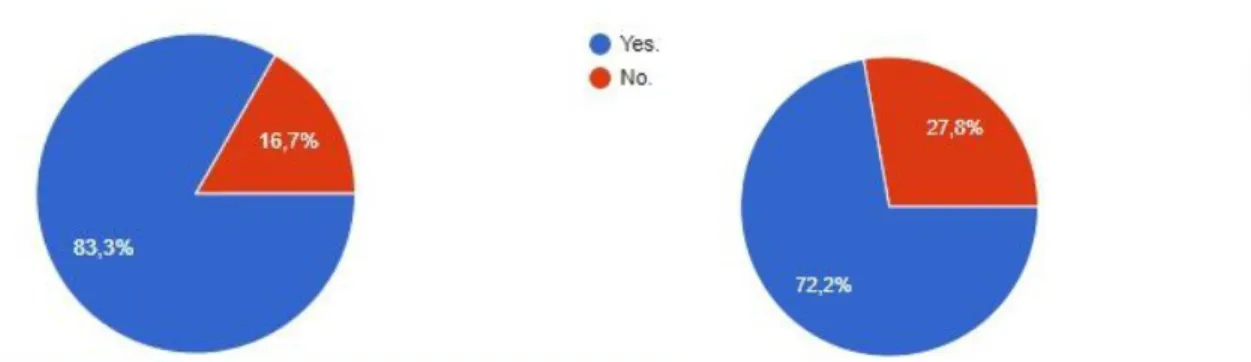
To design the course, we did a test that helped us develop a structure in accordance with the participants, taking into account their occupation (mainly if they had something to do in the educational sector) and their age range, we were also interested in technical aspects of the avatar virtual or if they had ever worked with some kind of similar technology. Thanks to the questionnaire and the opinion of the participants, we were able to determine aspects that we had anticipated, such as that Spanish is a very practical language or that the university is a good place to learn new languages.
Fig. 1. University is an appropriate place to learn a new language Fig. 2. Have you ever thought about learning Spanish?
We also specifically asked about the advantages of using a virtual avatar in the course and we got answers already studied in the social robotics course such as that it would increase motivation or that it could be more effective.
Based on the knowledge acquired in the Design Methods for Social Robots and Human Robot Interaction lessons at the HU University of Applied Sciences Utrecht campus, a model has been developed seeking the best fit for the established purposes. The selected model was obtained from the Blender Cloud design library of the animation software Blender, and can be seen in the following image:
Vincent, created by Andy Goralczyk
This model was chosen because of its neutral and friendly appearance, and the great diversity of options and details that its animation offers. Since it is going to be used as a language learning aid, the movements and mechanisms it allows in the mouth have been fundamental, being able to vary the position of the lips and teeth with great precision for a better understanding when pronouncing words.
The presence of the avatar in the experiment was made through animation videos created in the Blender program, in which the upper part of the torso and the head were used so that the details of the pronunciation could be appreciated. The voice was carefully matched to the avatar's
mouth movements and articulation. The course that contained the avatar consisted of the following sections:
3.3.3 Procedure
The Spanish course has been designed for people who are new to the language or who have learned very little Spanish. It is an introductory course that aims to give participants a Spanish base in a dynamic and effective way.
To complete the course the participant must go through 7 sections with an approximate time of 20 total minutes:
● Alphabet: A video is exhibited in which the avatar pronounces each of the letters of the alphabet together with an example of a word that begins with it and an image, which would also improve vocabulary. Furthermore, the user is advised to practice the pronunciation of each letter several times.
● Section 1: A presentation of what we are doing and what this course is about. ● Section 2: We begin by teaching the alphabet and the pronunciation of letters in
Spanish
● Grammar: Several videos appear that deal with the different important points, such as gender, number, articles, possessives, pronouns and verbs.
● Section 3: In this section the grammar contents begin with the nouns and the first exercises about it are presented
● Section 4: In section 4 we talk about articles, gender and number of words, and some exercises are also carried out.
● Section 5: Here we show different pronouns and make exercises to differentiate them.
● Section 6: The last grammar section is about verbs, with the most basic rules and conjugation exercises
● Final survey: To end the course there is a section of questions that will help us to get concrete opinions and results from the participants.
In the case of the language course without the presence of the avatar, it was divided into the same sections as in the previous case, but all the explanations prior to the exercises were theoretical and written.
The questions to be evaluated were exactly the same in both cases for the final comparison to be effective, and both include a small final satisfaction questionnaire to also compare the users' feelings.
3.3.4 Materials
To carry out the course, we have decided to take advantage of the tools offered by Google Forms, a familiar format could be easy and intuitive for the participants, and then they could be totally focused on the course and not on how they have to do it. Being in a comfortable environment improves the attention on the main objectives that this case is based on: to learn Spanish as much as possible.
The virtual avatar design is mainly focused on trying to improve the learning of Spanish by users, especially the part of the pronunciation of words while they learn grammar and reinforce what they have already learned in the explanations part of the course. To achieve this, with the help of Blender program, we took an open source avatar that we downloaded from Blender Cloud. Sony Vegas program has been used to mix the avatar videos and the previously recorded voice. The process we follow in each video made is the next one:
First, the virtual avatar we have used was not created by us. It is an open source avatar whose art is based on designs by conceptual artist Matias Mendiola (Cosmos Laundromat). Modeled and shaded by Andy Goralczyk and manipulated by Juan Pablo Bouza, the original name of the avatar is Vincent, he is a very complete avatar that has a skeleton and muscle system, thanks to this we can do countless poses. The reason why we have used this avatar among other things is because of the ability it has to move the jaw and various parts of the face to be able to articulate words, and for us this is a fundamental aspect that we need for our course.
First program used to animate the avatar was Blender, which is a program to design models and animations and render them. With this program we made all the animations of the movements of the avatar’s face, we had to position the parts that intervene in the speech in a specific position for each frame that the video has. How did we decide which position the mouth should be in when articulating words? Well, our first language is Spanish, and we have been speaking it our entire life, so we consider that we have an appropriate pronunciation, so we look at how we articulate the words and try to simulate that the avatar pronounces them in the same way.
Last program we used was Sony Vegas Pro, a program to edit and render videos. With this program, once we had the video of the avatar articulating the words, we recorded the audio with the words and phrases that the avatar had to say. Once we had the video and the audio recorded, with the Sony Vegas program, we put them together and synchronize the audio and video.
Finally, we added the annotations in the margins of the video to reinforce the explanations that were made in the course along with the words that the avatar said.
Fig. 3. Avatar used in the course
3.3.5 Data and analysis
Thanks to the option to go back in the course as many times as you want, participants can review the grammar and videos whenever they want. At the end of the course there are some questions about how many times they have reviewed and gone back in the course. We hope to get a response that indicates that the course with the virtual avatar has been reviewed fewer times than the course without the virtual avatar, which could be an indicator that the course with virtual avatar offers better learning results.
4 Results
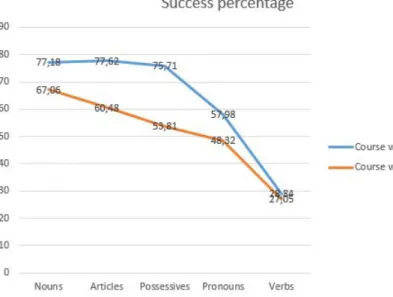
Once both tests were carried out by the students, the results obtained by each of the groups were compared and analyzed with the SPSS program. For this, the test was divided into the aforementioned sections: nouns, articles, possessives, pronouns and verbs, and thus clearer and more precise information was obtained on these results. Furthermore, during the tests, the participants’ previous knowledge of Spanish was taken into account, although in this case the vast majority of the users who responded had no knowledge of Spanish.
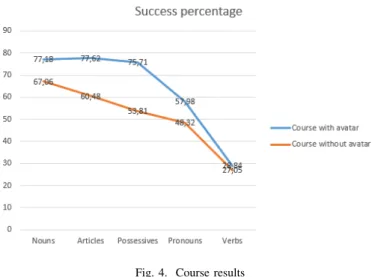
In each of the sections into which both courses are divided, course participants with avatar have obtained better grades than those without the course, with an average final score of 41.05 vs. 34.74, both out of a maximum of 80 points. This means that for the small number of participants that have taken place in these courses (42 in each one), the presence of the avatar has made a difference in results of 7.89% with respect to the course that did not have it.
Analyzing the results of each section individually, in both cases a considerable decrease in scores can be observed in the verbs part, and it may be due to the complexity and variety of verb tenses in Spanish, for which a more extensive course would be needed and with more hours of explanation and practice. In the first case, an average score of 10.38 is observed, which represents a 28.84% success rate in this section, while in the case of the course without avatar, an average of 9.74 has been obtained, being 27.05% of the maximum possible. In this section the presence of the avatar has only made a difference of 1.79%.
On the other hand, the highest scores were obtained in the initial sections of both tests (nouns and articles). This may be because a much broader explanation is not necessary than that offered by the simplicity of the proposed exercises and the ease of assimilating this basic knowledge. As for the nouns, in the course without the avatar an average score of 8.05 has been obtained, which represents 67.06% of the total in the section, compared to 9.26 average points in the course with the avatar (77.18% correct) . As you can see, the avatar improvement in this case is 10.12%. Regarding the articles section, a score of 6.05 has been obtained in the course without avatar, which represents a success rate of 60.48%, while in the course with the avatar the average score was 7.76, 77.62% of the total. Therefore, in this case, the presence of the avatar increased hits by 17.14%.
Continuing with the comparisons between the results of both courses, in the possessives section scores of 2.69 (53.81% correct) were obtained for the course without the avatar and 3.79 (75.71% correct) for the course with the avatar , which supposes an increase of the success of 21.9%.
Finally, the participants of the course without the avatar have obtained an average score of 8.21, being 48.32% of the maximum in the pronouns section, while the participants of the course with the avatar have answered on average 9.86 questions correctly, which is a hit rate of 57.98%. In this case the presence of the avatar has influenced the improvement of the results by 9.66%.
Finally, at the end of each of the courses a small survey has been included to find out the opinion of the participants and obtain feedback that can make the results of both tests understood. Firstly, participants have been asked to indicate, on a scale of 1 to 4, their level of Spanish prior to completing the course. A great majority of responses have been observed indicating some previous zero knowledge in Spanish. Specifically, an average of 1.37 for avatar users and 1.35 for others.
The main approach to investigate how to fill the gap was to seek through the course the efficiency of a learning in a faster way without losing quality in it. In other words, students acquire more knowledge in fewer sessions compared to a simple online theoretical course. As it has been observed in the results, despite the fact that the number of participants is not very high in each one of them, there is a tendency for the results to be better in students who have had the presence of the avatar with respect to those who have not done so, so the course with avatar has been more efficient. This agrees with what could be observed in the articles in which they had carried out studies related to the subject in question.
The results in general have been lower than expected and may be due to the fact that the verb section covered almost half of the maximum score of the courses, and has been the part where the participants have failed the most. This may be due to the fact that the conjugation of verbs (in this case indicative) requires a more extensive explanation and practice. Therefore, with more resources and time, the results would have been better in both cases. Furthermore, if there had been a much larger number of participants in both courses, more precise results and a clearer difference between the students in both courses could have been observed.
4.1 Statistics
Below is a summary of the statistics after the comparison of results:
The questions to be evaluated were exactly the same in both cases for the final comparison to be effective, and both include a small final satisfaction questionnaire to also compare the users' feelings.
In the following tables you can see the results of each section for users of both courses:
NOUNS (GENDER AND NUMBER)
Avatar course Non-Avatar course
On the other hand, the results of the final survey can be observed:
ARTICLES
Avatar course Non-Avatar course
Correct answers percentage: 77.62% Correct answers percentage: 60.48%
POSSESSIVES
Avatar course Non-Avatar course
Correct answers percentage: 75.71% Correct answers percentage: 53.81%
PRONOUNS
Avatar course Non-Avatar course
Correct answers percentage: 57.98% Correct answers percentage: 48.32%
VERBS
Avatar course Non-Avatar course
Correct answers percentage: 28.84% Correct answers percentage: 27.05%
FINAL SURVEY
Question Avatar course Non-Avatar course
Being 1 absolutely nothing and 5 completely
everything, I consider that I have learned in this course
In addition, users of the course with the avatar were asked other questions to know their opinion regarding its presence:
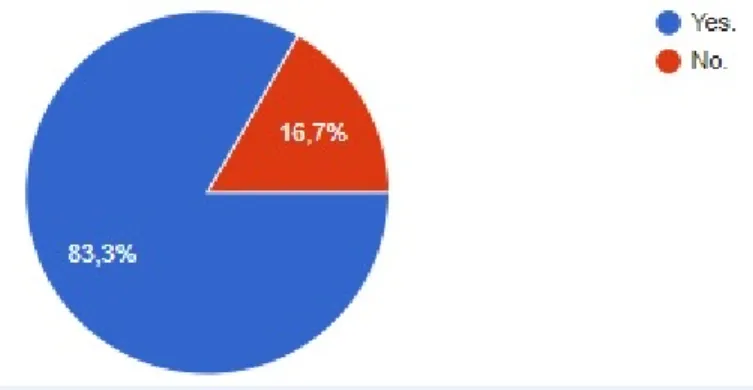
Did you find it helpful to be able to go back to review the rules?
Positive answers: 95.35% Positive answers: 90.70%
Being 1 very few times and 5 many times, how much have you checked to do the exercises?
Average: 1.81 Average: 3.81
Between very bad and very good, I consider this
course to be
Average: 4.02 Average: 3.19
Question Avatar course
Do you think the avatar videos have been useful?
Positive answers: 90.70%
Do you think the avatar helped you in your pronunciation of Spanish?
Positive answers: 69.77%
Being 1 very bad and 5 very good, I consider the quality of the avatar videos to be:
Fig. 4. Course results
4.2 Exploitation
The course that has the online avatar could be implemented as a free tool for the students of the HU University of Applied Sciences Utrecht and in this way put within their reach the possibility of learning one of the most spoken languages in the world in an innovative way. As mentioned above, the economic benefit is not the main motivation for the implementation of this service, since it would be carried out for educational purposes and as an extension of the students' knowledge, taking advantage of the advances in the technologies available to the university.
However, as it is a basic introductory course, it can also serve as a tool prior to future enrollment in a more advanced course taught by teachers, where they seek to learn Spanish in a more extensive way and improve their speaking level. This future course could be taught both on campus, if there is a notable growing interest on the part of students derived from the use of the avatar, as well as in an institution attached to the university.
5 Conclusions
5.1 Personal conclusions
The objective of this study was to determine if a virtual avatar can enhance the efficiency of learning a second language. A drawback of the course is that it was not possible to know the circumstances in which each participant carried out the test and how these circumstances have influenced the results. As the participants can go back to see the explanations as many times as they want, it has been assumed that the results of both courses were going to reflect that the participants had learned enough Spanish but the results are not as encouraging as we expected, probably because studying grammar rules is not very entertaining and the participants did not go back many times. The course with the avatar shows improvements in all sections of the course, since the virtual avatar reviews the contents of each section, we can determine that the number of times we study the theory directly influences the practice results. This study shows that a virtual avatar is a useful tool to promote learning and interest in Spanish compared to other theoretical courses and that the results are better.
5.2 Future lines of development
After having performed the tests, you can guess that this project has a lot of room for improvement and there are many methods that could be more interesting. First, we thought about the possibility of taking a full Spanish course instead of a small course, which would be very expensive to do, since Spanish has many rules to teach, but it would be very interesting. Secondly, improving the quality of the avatar and animations, perhaps animating more parts of the avatar’s body may give it more ability to express itself and, therefore, the explanations it makes are better. Also, we have thought that it would be a good idea to replace the avatar with a different one, perhaps with a more realistic appearance, since the one we have used is cartoon. Third, we thought about the possibility of making the avatar could teach a class explaining a part of the grammar as a teacher would and see if that could improve the learning of the course. Finally, the last aspect that we think could be improved, and we think that it would be the most important and the most interesting, is to be able to make the avatar interact with the user of the course, for example, being able to answer the questions that it asks about some part of the course that you have not understood and that the avatar make a different explanation of that part trying to clarify and resolve your doubts. We think that in order to do this, future researchers should change the methodology we have used and investigate advanced computer programming.
6 Bibliography
● Abras, C., Maloney-Krichmar, D., & Preece, J. (2004). User-centered design. Bainbridge,
W. Encyclopedia of Human-Computer Interaction. Thousand Oaks: Sage Publications ,
37(4), 445-456.https://www.academia.edu/download/6190316/10.1.1.94.381.pdf
● Ahmad, M. I., Mubin, O., & Orlando, J. (2016, October). Understanding behaviours and roles for social and adaptive robots in education: teacher's perspective. In Proceedings
of the fourth international conference on human agent interaction (pp. 297-304).
● Anzalone, S. M., Boucenna, S., Ivaldi, S., & Chetouani, M. (2015). Evaluating the engagement with social robots. International Journal of Social Robotics, 7(4), 465-478. ● Balch, T., Summet, J., Blank, D., Kumar, D., Guzdial, M., O'hara, K., ... & Jackson, J.
(2008). Designing personal robots for education: Hardware, software, and curriculum.
IEEE Pervasive Computing, 7(2), 5-9.
● Belpaeme, T., Vogt, P., Van den Berghe, R., Bergmann, K., Göksun, T., De Haas, M., ... & Papadopoulos, F. (2018). Guidelines for designing social robots as second language tutors. International Journal of Social Robotics, 10(3), 325-341.
● Berghe, Rianne van den, Josje Verhagen, Ora Oudgenoeg-Paz, Sanne van der Ven, and Paul Leseman. ‘Social Robots for Language Learning: A Review’. Review of
Educational Research 89, no. 2 (April 2019): 259–95.
https://doi.org/10.3102/0034654318821286.
● Blender Cloud https://cloud.blender.org/p/characters/5718a967c379cf04929a4247 ● Chin, Kai-Yi, Yen-Lin Chen, Jong-Shin Chen, Zeng-Wei Hong, and Jim-Min Lin.
‘Exploring the Teaching Efficiency of Integrating an Animated Agent into Web-Based Multimedia Learning System’. IEICE Transactions on Information and Systems E94-D, no. 4 (2011): 754–62. https://doi.org/10.1587/transinf.E94.D.754.
● Definition of avatar from the Cambridge Advanced Learner’s Dictionary Thesaurus © Cambridge University Press.
● Design for social robots
https://www.researchgate.net/publication/313872926_Do-It-Yourself_Design_for_Social_ Robots_A_Platform_of_Open-Source_Hardware_to_Encourage_Innovation
● European Civil Law Rules in Robotics - European Parliament
https://www.europarl.europa.eu/doceo/document/TA-8-2017-0051_EN.html?redirect. ● Han, J. (2012). Robot assisted language learning. Language Learning & Technology ,
● Instituto Cervantes. Initial Spanish level. https://www.cervantes.es/default.htm
● Jean, Gladys, and Daphn´ee Simard. ‘Grammar Teaching and Learning in L2: Necessary, but Boring?’ Foreign Language Annals 44, no. 3 (September 2011): 467–94.
https://doi.org/10.1111/j.1944-9720.2011.01143.x
●
Kanero, J., Geçkin, V., Oranç, C., Mamus, E., Küntay, A. C., & Göksun, T. (2018). Social robots for early language learning: Current evidence and future directions. ChildDevelopment Perspectives, 12(3), 146-151.
● Konijn, E. A., Smakman, M., & van den Berghe, R. (2020). Use of robots in education.
The International Encyclopedia of Media Psychology, 1-8.
● Lee, S., Noh, H., Lee, J., Lee, K., Lee, G. G., Sagong, S., & Kim, M. (2011). On the effectiveness of robot-assisted language learning. ReCALL: the Journal of EUROCALL, 23(1), 25.
● Liao, J., & Lu, X. (2018). Exploring the affordances of telepresence robots in foreign language learning. Language Learning & Technology, 22(3), 20-32.
● Lingolia, supérate con los idiomas: Gramática española
https://espanol.lingolia.com/es/gramatica
● Material from Design Methods for Social Robotics HU ● Material from Human Robot Interaction HU
● Mazlan, Mohammad Nur Azhar. ‘Students’ Perception of Motivation to Learn: Does an Avatar Motivate?’, n.d., 246.
● Ramachandran, Aditi, Chien-Ming Huang, Edward Gartland, and Brian Scassellati. ‘Thinking Aloud with a Tutoring Robot to Enhance Learning’. In Proceedings of the 2018 ACM/IEEE International Conference on Human-Robot Interaction, 59–68. Chicago IL USA: ACM, 2018. https://doi.org/10.1145/3171221.3171250
● Saerbeck, M., Schut, T., Bartneck, C., & Janse, M. D. (2010, April). Expressive robots in education: varying the degree of social supportive behavior of a robotic tutor. In
Proceedings of the SIGCHI conference on human factors in computing systems (pp. 1613-1622).
● Serholt, S., & Barendregt, W. (2014). Students’ attitudes towards the possible future of social robots in education. In Workshop proceedings of Ro-man.
● Shaaban, Kassim A., and Ghazi Ghaith. ‘Student Motivation to Learn English as a Foreign Language’. Foreign Language Annals 33, no. 6 (November 2000): 632–44.
● Shweta Singh, David H. Rylander and Tina C. Mims, Efficiency of Online vs. Offline Learning: A Comparison of Inputs and Outcomes. International Journal of Business, Humanities and Technology: Vol. 2No. 1; January 2012.
● Social robots for education https://robotics.sciencemag.org/content/3/21/eaat5954
● Steels, L. (2001). Language games for autonomous robots. IEEE Intelligent systems, 16(5), 16-22.
● Sweigart, Linda, and Kay Hodson-Carlton. ‘Improving Student Interview Skills: The
Virtual Avatar as Client’. Nurse Educator 38, no. 1 (2013): 11–15.
https://doi.org/10.1097/NNE.0b013e318276df2d. ● Thymio https://www.thymio.org/
● van den Berghe, R., Verhagen, J., Oudgenoeg-Paz, O., Van der Ven, S., & Leseman, P. (2019). Social robots for language learning: A review. Review of Educational Research , 89(2), 259-295. https://journals.sagepub.com/doi/full/10.3102/0034654318821286
● Winfield, A. F., & Jirotka, M. Ethical Governance is essential to building Trust in Robotics and AI Systems.
https://ora.ox.ac.uk/catalog/uuid:048d3f47-ccdf-40a1-a593-5540fa4147c9/download_file ?file_format=pdf&safe_filename=ethical-governance-essential.pdf&type_of_work=Journ al+article
●
Yang, G. Z., Dario, P., & Kragic, D. (2018). Social robotics-Trust, learning, and social interaction.7 Annexes
Below you can see some examples of the exercises used during the course. 1. Example of alphabet explanation.
3. Example of articles exercise.
5. Example of pronouns exercise.
7. Examples of final survey questions.
Finally, a research article was written based on the study carried out in relation to the aforementioned project, with the aim of being able to serve as an aid or basis for future research in the field of social robots within the university. This article was directed and reviewed by faculty members and researchers at the HU University of Applied Sciences Utrecht.
Antonio Gonz´alez Llinares Social Robotics Programme HU University of Applied Sciences
Utrecht, Netherlands
Sergio Pau Aland´ı Social Robotics Programme HU University of Applied Sciences
Utrecht, Netherlands
Jes´us Robles Mart´ınez Social Robotics Programme HU University of Applied Sciences
Utrecht, Netherlands
Abstract—Learning a second language can sometimes be bor-ing or inefficient dependbor-ing on the method used. There are numerous previous studies on the use of avatars in teaching and the motivation to learn languages, which have been taken as a reference throughout the article, but did not specifically deal with the subject in question. This research has attempted to test the efficiency of the use of an online avatar in learning Spanish for students who do not speak it compared to a theoretical online course, and thus adapt advances in technology to the needs of users. For this, two short Spanish courses have been held, specifically on the alphabet, vocabulary, grammar and verbs, and at the end of each of the sections they have raised the same questions in both. One of them had the presence of explanatory videos by the avatar, while the other only had the theoretical part written. From the results obtained, it has been possible to observe an improvement in the grades of the students who had taken the course with the avatar compared to those who had not. Therefore, these results have supported the hypothesis initially proposed and may serve as a basis for future research that seeks to expand the existing knowledge in this field, with better conditions and with more complete experiments.
I. INTRODUCTION
Nowadays, there are very common options to learn a secondary language: have a teacher who teaches you, to do an online course, or looking for exercises by yourself on the internet or with specialized books. There is research that tests the efficiency between learning online and learning offline, and concludes that students prefer to take the online course format because it is a more flexible option [1].
It has been shown in some studies that an assistance robot or a virtual avatar help against those who try it themselves without help [2], but in terms of learning a second language we still have to carry out studies to determine how much it is able to assist an online avatar, as shown in articles with inconclusive evidence [3]. It is known that it is possible to learn a language with a teacher, with an online course or by yourself using the internet or books, it is known that an online avatar is a good tool for teach a second language but in this project it will be tested if an online avatar could be a more efficient solution than other methods. Moreover, online avatars can be also used in learning systems such as
Using an avatar could be a more efficient and attractive option than doing an ordinary online course and can give the students more practical knowledge in less time. This, together with the fact that the majority of current students are digital natives, who learn and process information differently, makes them demand new didactic methodologies [4].
The aim of this paper is to test the efficiency of an online course with an avatar as a complement in front of an online language course. Some students will take a lesson with the avatar and others will follow an online course without the avatar, and at the end the results of both groups will be compared.
II. BACKGROUND
The majority of second language studies that use avatars have been made to improve the learning of children but there are not many studies about learning a second language that talk about improving the knowledge of teenagers or adults. A virtual avatar is a character or creature that you create to represent yourself in a computer game, on the internet, etc. [5] In this case, with our avatar, we are not representing someone concretely. We are representing a person who helps to learn a language that can be a teacher, for example.
There are some studies that talk about avatars and its uses, for example, there are some of them that talk about“Second Life (SL)” and use them as a virtual environment used by nursing students to develop beginning interview skills for urological, genital, and sexual subjective assessments. Multigenerational, multicultural client scenarios were used as students collected data in the virtual environment. Videotaped interviews of community volunteers demonstrated an increased number of questions asked in these sensitive areas following the implementation of virtual experiences. Curriculum implication and student evaluations of the SL experience are shared [6]. As seen, an online avatar can be used in fields as essential as health. Therefore, it can also