Transforming Care
at the Bedside
How-to Guide:
Developing Front-Line Nursing
Managers to Lead Innovation and
Improvement
Transforming Care at the Bedside (TCAB) is a national effort of the Robert Wood Johnson Foundation and Institute for Healthcare Improvement designed to improve the quality and safety of patient care on medical and surgical units, to increase the vitality and retention of nurses, and to improve the effectiveness of the entire care team. For more information, go to http://www.ihi.org/ or http://www.rwjf.org/goto/tcabtoolkit.
Copyright © 2008 Institute for Healthcare Improvement
All rights reserved. Individuals may photocopy these materials for educational, not-for-profit uses, provided that the contents are not altered in any way and that proper attribution is given to IHI as the source of the content. These materials may not be reproduced for commercial, for-profit use in any form or by any means, or republished under any circumstances, without the written permission of the Institute for Healthcare Improvement.
How to cite this document:
Lee B, Peck C, Rutherford P, Shannon D. Transforming Care at the Bedside How-to Guide: Developing Front-Line Nursing Managers to Lead Innovation and Improvement. Cambridge, MA: Institute for Healthcare Improvement; 2008. Available at: http://www.ihi.org.
Institute for Healthcare Improvement, 2008 2
Acknowledgements
Support for this publication was provided by a grant from the Robert Wood Johnson Foundation through Transforming Care at the Bedside, a national program of the Robert Wood Johnson Foundation and the Institute for Healthcare Improvement.
The Robert Wood Johnson Foundation (RWJF) focuses on the pressing health and health care issues facing our country. As the nation's largest philanthropy devoted exclusively to improving the health and health care of all Americans, the Foundation works with a diverse group of organizations and individuals to identify solutions and achieve comprehensive, meaningful, and timely change. For more than 30 years the Foundation has brought experience, commitment, and a rigorous, balanced approach to the problems that affect the health and health care of those it serves. When it comes to helping Americans lead healthier lives and get the care they need, the Foundation expects to make a difference in your lifetime.
The Institute for Healthcare Improvement (IHI) is a not-for-profit organization leading the improvement of health care throughout the world. Founded in 1991 and based in Cambridge, MA, IHI is a catalyst for change, cultivating innovative concepts for
improving patient care and implementing programs for putting those ideas into action. Thousands of health care providers, including many of the finest hospitals in the world, participate in IHI’s groundbreaking work.
Transforming Care at the Bedside Faculty/Co-Authors
Betsy Lee, RN, MSPH, Director, Indiana Hospital Association (Lead Author)
Carrie Peck, Project Manager, Institute for Healthcare Improvement
Pat Rutherford, MS, RN, Vice President, Institute for Healthcare Improvement Diane W. Shannon, MD, MPH, Writer
Institute for Healthcare Improvement, 2008 3
Contributors
The work of several individuals at leading organizations has informed the development of this guide.
Cedars-Sinai Medical Center, Los Angeles, California James A. Haley Veterans’ Hospital, Tampa, Florida
Kaiser Permanente Roseville Medical Center, Roseville, California Long Island Jewish Medical Center, New Hyde Park, New York Prairie Lakes Healthcare System, Watertown, South Dakota Seton Northwest Hospital, Austin, Texas
ThedaCare, Appleton, Wisconsin
University of Pittsburgh Medical Center Shadyside, Pittsburgh, Pennsylvania The University of Texas MD Anderson Cancer Center, Houston, Texas
How to cite this document
Lee B, Peck C, Rutherford P, Shannon D. Transforming Care at the Bedside How-to Guide: Developing Front-Line Managers to Lead Innovation and Improvement. Cambridge, MA: Institute for Healthcare Improvement; 2008. Available at:
http://www.ihi.org.
Institute for Healthcare Improvement, 2008 4
Introduction to TCAB
Launched in 2003, Transforming Care at the Bedside (TCAB) is a national program of the Robert Wood Johnson Foundation (RWJF) and the Institute for Healthcare
Improvement (IHI) that engages leaders at all levels of the health care organization to:
Improve the quality and safety of patient care on medical and surgical units;
Increase the vitality and retention of nurses;
Engage and improve the patient’s and family members’ experience of care; and
Improve the effectiveness of the entire care team.
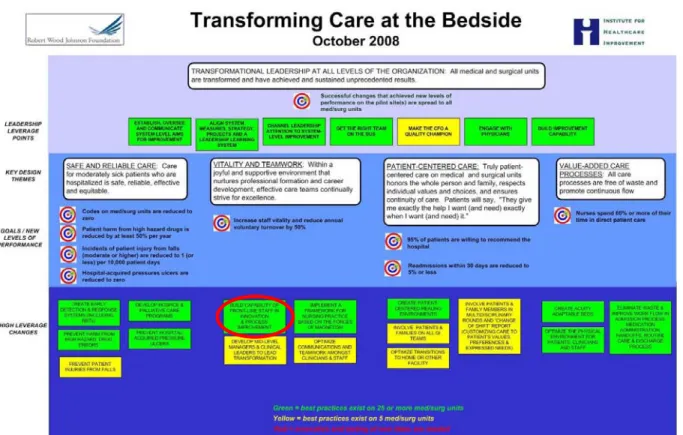
As of September 2007, the ten hospitals participating in phase III of TCAB received technical assistance from IHI faculty, which consisted of individuals selected for their expertise in quality improvement, innovation, change management, transformational learning, and change strategies. With the support of these faculty members, the TCAB hospitals were charged with dramatically improving performance through a focus on five design themes:
Transformational Leadership
Safe and Reliable Care
Vitality and Teamwork
Patient-Centered Care
Value-Added Care Processes
The hospitals participated in phase III of TCAB by creating and testing new concepts, developing exemplary care models on medical-surgical units, demonstrating institutional commitment to the program, and pledging resources to support and sustain these
innovations. A number of hospital teams across the United States have joined these ten initial participants in applying TCAB principles and processes to dramatically improve the quality of patient care on medical and surgical units. Newer participants include more than 60 hospitals in IHI’s Learning and Innovation Community, also called “Transforming Care at the Bedside,” and 67 hospitals in the American Organization of
Institute for Healthcare Improvement, 2008 5
Nurse Executives (AONE) TCAB program. For more information on the TCAB programs and participating sites, please see the following:
IHI website http://www.ihi.org/IHI/Programs/StrategicInitiatives/TransformingCareAtTheBedsi de.htm RWJF TCAB brochure http://www.rwjf.org/files/publications/other/TCABBrochure041007.pdf?gsa=1 RWJF TCAB Toolkit http://www.rwjf.org/qualityequality/product.jsp?id=30051 AONE website http://www.aone.org/aone_app/aonetcab/index.jsp
Figure 1: The Transforming Care at the Bedside Framework
This TCAB How-to Guide is one in a series of Guides describing improvements in the Vitality and Teamwork theme of Transforming Care at the Bedside. In TCAB “Vitality”
Institute for Healthcare Improvement, 2008 6
symbolizes far more than just staff satisfaction. Vitality includes a transformative shift in the attitudes and engagement of nurses and other staff on the TCAB units. The TCAB vision aims to re-capture true “joy in work” as well as enhanced teamwork, engagement, and commitment amongst the multidisciplinary team. In addition to promoting staff retention, a truly vital unit actually draws other staff to join its ranks, sometimes resulting in a waiting list of applicants and the virtual elimination of voluntary turnover.
This How-to Guide describes the innovative changes that hospitals tested and
implemented to develop the talent and competencies of their front-line nurse managers on the TCAB units. These changes focus on tactics to improve the abilities of managers to support transformational change, including strategies for manager self-assessment and development. Specifically, this Guide describes a four-pronged strategy for developing transformational leadership skills. This approach, based on knowledge gained from the experience of both participants and leaders in TCAB and the IHI Achieving Workforce Excellence Collaborative, requires that organizational leaders:
Use a talent management framework;
Provide access to formalized nursing leadership development programs;
Develop leaders’ emotional intelligence; and
Foster effective succession planning.
The Guide illustrates the practical implementation of this strategy for developing transformational leadership skills with a pair of case studies.
This How-to Guide is divided into three sections:
Section One provides the background and rationale for why it is so important to develop new types of skills and competencies for nurse leaders during periods of rapid change in health care. Lessons from other industries and the business literature provide a framework for the changes tested in the TCAB hospitals.
Institute for Healthcare Improvement, 2008 7
Section Two outlines key talent management steps to assist front-line managers with self-assessment, planning developmental opportunities, and the importance of enhancing emotional intelligence among nursing leaders.
Section Three includes case studies from Prairie Lakes Hospital and Long Island Jewish Medical Center.
Institute for Healthcare Improvement, 2008 8
Section One – The Rationale for Improving Front-line Leadership in
Medical-Surgical Units
Years ago staff nurses were promoted to management positions based on clinical skills and technical competencies. As a result, front-line managers were not adequately skilled to address the array of interpersonal issues and complex, ever-changing priorities. The selection process for today’s front-line nursing managers is far more robust than in years past, often requiring advanced degrees and leadership experience. Changes to the hiring and development models are imperative to address the rapid changes in the clinical, technical, and social changes in the health care workplace. Ill-prepared nursing leaders may negatively affect the vitality of staff. In their ground-breaking book First, Break All the Rules: What the World’s Greatest Managers Do Differently, Buckingham and Coffman stress the important role that front-line managers play in attracting and retaining talented employees. They emphasize that individuals may choose a job based on the position, but leave based on the actions, demeanor, and skills of their supervisor.
Buckingham M, Coffman C. First, Break All the Rules: What the World's Greatest Managers Do Differently.
New York, NY: Simon and Schuster; 1999.
Effective nursing front-line managers (e.g., unit managers and clinical directors) in TCAB units require leadership skills to supplement the requisite managerial skills. Nursing leaders with strong managerial skills may be effective in leading key business processes and transactions essential to unit operations, such as staffing, budgeting, measurement, tools, structures, policies, and procedures. However, without also having strong leadership skills, nursing leaders in TCAB units may be ineffective in inspiring necessary change, which involves achieving commitment through engendering positive attitudes and creativity, overcoming resistance to change, and demonstrating self-leadership. To achieve transformational change in the care provided in medical-surgical units, the leaders of health care organizations need to invest in enhancing the talent of front-line supervisors, particularly in the areas of leadership competencies. In particular, senior leaders in these organizations should support the development of nursing
Institute for Healthcare Improvement, 2008 9
ever-changing circumstances. These transformational leadership skills include the ability to influence the behavior and attitudes of others through the use of ideals, inspiration, intellectual stimulation, and individual consideration. [McGuire 2006]
McGuire E, Kennerly SM. Nurse managers as transformational and transactional leaders. Nursing Economics. 2006;24(4):179-85, 175.
TCAB leaders examined the leadership literature from other professions to develop a description of the core competencies nursing front-line managers are likely to need to effectively lead transformational change within medical-surgical units. The Heifetz model of adaptive leadership purports that because the essence of leadership in the 21st century is dealing with change, a key requirement of effective leaders is the ability to engage individuals in needed work while acknowledging the losses associated with change and incorporating the values individuals hold into the new environment. [Heifetz 2002; Heifetz 1994] Whereas technical leadership involves influencing a community to follow the leader’s vision using abilities that already exist within the group, adaptive leadership involves influencing a community to acknowledge its deficiencies and learn new capabilities. Because the underlying goal of TCAB is transformation, such adaptive leadership skills are well suited for the leaders of TCAB units.
Heifetz RA. Leadership Without Easy Answers. Cambridge, MA: Belknap/Harvard University Press. 1994. Heifetz A, Linsky A. Leadership on the Line: Staying Alive through the Dangers of Leading. Cambridge, MA: Harvard Business School Press. 2002.
In their descriptions of the key characteristics of effective leaders, researchers have emphasized key inspirational skills, such as the ability to encourage others. For example, one model includes the following in its list of five common practices of effective leaders. [Kouzes 2007]
Effective leaders: I. Model the Way
II. Inspire a Shared Vision III. Challenge the Process
Institute for Healthcare Improvement, 2008 10
IV. Enable Others to Act V. Encourage the Heart
Kouzes JM, Posner BZ. The Leadership Challenge, 4th Edition. San Francisco: Jossey-Bass. 2007.
Effective implementation of these practices requires skills that are less tangible than those required for the more technical aspects of leadership. The adeptness of a leader at using the less tangible skills of leadership has been termed “emotional intelligence.” Emotional intelligence includes a range of non-cognitive capabilities, competencies, and skills that affect the ability to cope successfully with environmental demands and
pressures. [Goleman 1995, 2002] In short, emotional intelligence is “how leaders handle themselves and their relationships.” Leaders with high emotional intelligence are able to access a central “mindfulness,” which allows them to keenly focus on the present
moment, remain undistracted and unconsumed by worries, and produce a calming effect. Emotional intelligence is especially important for leading complex adaptive systems, like medical-surgical units. Complex adaptive systems (CAS) are diverse systems composed of multiple interconnected components, yet have the capacity to “learn” from experience, and to change. Management of CAS requires an appreciation of the importance of patterns, a focus on the relationships between components of the system, and distributed, rather than centralized, control.
Goleman, DI. Emotional Intelligence. New York: Bantam Books. 1995.
Goleman Dl, Boyatizis R, McKee A. Primal Leadership. Boston: Harvard Business School Press. 2002. Zimmerman B, Lindberg C, Plsek P. Edgeware: lessons from complexity science for health care leaders.
Dallas, Texas: VHA, Inc. 1998.
In the course of a nursing leadership development project, which was a component of TCAB, a leadership expert conducted interviews and focus groups with more than 30 front-line nurses, TCAB unit managers, and chief nursing executives. Participants were asked to list the characteristics they believed to be most essential for nursing leaders charged with implementing transformational change in TCAB units. Many of the
characteristics identified related to emotional intelligence, such as being a visionary at the local level, resiliency, and self-awareness and development. Additionally, these
Institute for Healthcare Improvement, 2008 11
nurse managers identified as essential transformational leadership competencies, such as motivational skills, drive and personal perseverance, and integrity.
Both the professional literature and the experience of nursing staff who participated in TCAB substantiate the need for a particular set of leadership skills among nursing leaders in medical-surgical units. Section two outlines specific steps the leaders of health care organizations can take to assist front-line managers in assessing their leadership competencies and planning for skills development.
Institute for Healthcare Improvement, 2008 12
Section Two
–
Strategies for Improving Front-line Leadership
in Medical/Surgical Units
Based on the experience of TCAB participants and faculty, two basic steps form the foundation for improving front-line leadership in medical/surgical units: 1) effective assessment of leadership skills; and 2) development of leadership competencies.
Assessing Leadership Skills
The first step in developing leadership talent is evaluating the competencies of the individual managers or leaders against a set of competencies predetermined to be critical for the intended position. A variety of effective self-assessment tools is available for conducting these evaluations, some of which are detailed below. Senior leaders at some organizations acquire leadership self-assessments through proprietary or
membership organizations, whereas others develop assessments in-house. Whichever development process is used, system leaders and chief nurse executives must
customize the assessment tool to the specific leadership competencies that have been identified as being critical for the specific organization. While there may be some
overarching competencies required for all managers in the organization, senior nursing leaders must keep in mind that leadership competencies should be tailored to ensure leadership success in a particular clinical area, department, or role. One widely used approach to assessing leadership is the 360-degree evaluation. This type of
assessment involves obtaining feedback from a wide variety of individuals who work with the potential leader, including the individual himself or herself, peers, supervisors, and direct reports. Feedback is integrated into a report that provides an overall picture of past performance and identifies opportunities for improvement. Nursing leaders can adapt the 360-degree evaluation for their particular leadership assessment needs.
Assessment Tools
Based on literature review and their experience with collaborative participants, the TCAB faculty recommends a competency-based approach for assessing leadership skills. Available competency-based assessment tools include those created for use in any organization and those created specifically for development of nursing leaders.
Institute for Healthcare Improvement, 2008 13
The Lominger Leadership Architect® Series is a commercially available tool created for use in any organization. This research-based set of 67 management and leadership competencies provides the basis for determining the key competencies in any
managerial job. TCAB leaders used a component of the Series, the Lominger Card Sort process, to create an ideal “job profile” for the nursing manager of a TCAB unit. During the card sort process, the competencies identified by TCAB participants as being most essential correlated with emotional intelligence or “transformational leadership”
competencies, and included integrity and trust, approachability, and the ability to motivate others.
Lominger International.
http://www.lominger.com/la_sortcards.php
The American Organization of Nurse Executives (AONE) offers its members the Nurse Management Leadership Collaborative’s Learning Domain Framework—a leadership framework specifically designed to support the development of nursing leaders. Many of the competencies identified by TCAB participants as being critically important for
leaders of transformational units correspond to those in the AONE framework. The framework can be used in conjunction with specific assessment tools, such as the 360-degree evaluation approach or with a self-assessment, to evaluate the skills recognized in the AONE framework as being essential for nursing leaders.
Nurse Management Leadership Collaborative: Learning Domain Framework. http://www.aone.org/aone/resource/NMLC/nmlcLEARNING.html
Enhancing Leadership Competencies
Development of management skills for nursing leaders is a relatively straightforward process: unit leaders are evaluated on their ability to perform specific skills, such as time management, staffing, and hiring practices. In contrast, development of leadership skills, especially transformational leadership skills, is a more complex process that often requires self-assessment and a self-directed learning plan.
TCAB leaders recommended to participants the use of a four-pronged strategy for developing transformational leadership skills among nurse managers and unit directors:
Institute for Healthcare Improvement, 2008 14
1) using a talent management framework; 2) providing formalized nursing leadership development programs; 3) developing leaders’ emotional intelligence; and 4) fostering effective succession planning.
1. Using a talent management framework
Prior to TCAB, IHI and the American Hospital Association launched a two-year
collaborative called Achieving Workforce Excellence. A model developed by a faculty member was adapted for use in the collaborative and is relevant to the development of front-line nursing managers.
The model presents a competency-based talent management framework that consists of four domains: team performance; hiring and staffing; leadership development; and performance management. A visual representation of the model (see Figure 2) highlights the central placement of competencies for leadership development and emphasizes the core role of competencies for achieving other functions—functions that have traditionally been viewed as related strictly to human resources. The approach identifies specific areas for development that are related to competencies required for success in a particular position. The model helps to assess competencies and areas for development not only for an individual’s current position, but also for positions for which the individual might be well suited in the future, thus supporting succession planning.
Institute for Healthcare Improvement, 2008 15
Figure 2: Competency-based talent management framework
Source: IDX Systems Corp.
Using this leadership development approach as a conceptual framework, TCAB leaders applied a specific tool—the Lominger Leadership Architect® Card sort—to conduct a “job profile” and develop competency requirements for nurse managers in TCAB units. They evaluated responses from 69 individuals from nine TCAB teams, including chief nursing executives, nursing directors and managers, staff nurses, human resources professionals, and nursing educators, to the question: “What are the competencies of a unit manager of a TCAB unit that promote and facilitate transformation?” Respondents scored each of the 67 competencies listed on the Lominger cards with a point system:
3 points for Essential
2 points for Nice to Have
Institute for Healthcare Improvement, 2008 16
The process produced a ranked list of the competencies respondents believed nurses in transformational leadership positions should possess to support and enable change. Leaders at Seton Northwest Hospital (a participating TCAB site) then used the
Lominger Leadership Architect® Card Sort process to create a self-assessment tool for incumbent nurse managers on medical and surgical units. Nursing leaders used the list of only the most highly ranked competencies, as identified in the Lominger job profile exercise, to highlight the most essential competencies for nurse managers. They also used the card sort process to identify development opportunities for both individuals, and the nurse managers as a group. Individuals graded themselves on a subset of 30 skills. TCAB project leaders discussed the group’s results and worked with individual nurse leaders to identify opportunities for self-improvement.
2. Providing access to formalized nursing leadership development programs
Hospital decision makers who would like to access formalized programs for nursing leadership development can:
Partner with nursing schools in the local area to offer on-site degree programs. (For more information, see the Long Island Jewish Medical Center case study in
Section Three.)
Build a nursing leadership academy. Leaders at North Shore Long Island Jewish Health have created a program to train and develop emerging nurse leaders. (For more information, see the Long Island Jewish Medical Center case study in
Section Three.)
Send nurse leaders to an executive leadership program, such as the Robert Wood Johnson Foundation Executive Nurse Leadership Program (For more information, see the Prairie Lakes Health System case study in Section Three.)
3. Developing leaders’ emotional intelligence
The development of emotional intelligence (EI) competencies requires attention to all four domains of EI:
Institute for Healthcare Improvement, 2008 17
Self-awareness—self-awareness, accurate self-assessment, self-confidence
Self-management—self-control, transparency, adaptability, achievement, initiative, optimism
Social awareness—empathy, organizational awareness, service
Relationship management—inspiration, influence, developing others, change catalyst, conflict management, teamwork and collaboration
Because the nature of EI links to leadership rather than management competencies, development of EI requires a very different approach from the traditional performance improvement plans used in employee development programs. Research has shown that emotional intelligence competencies can be improved through individualized learning plans combined with objective assessments. [Goleman 2002]
Goleman Dl, Boyatizis R, McKee A. Primal Leadership. Boston: Harvard Business School Press. 2002.
Goleman, DI. Emotional Intelligence. New York: Bantam Books. 1995.
Leaders at the Seton Family of Hospitals have developed a multi-pronged approach to developing emotional intelligence among leaders at their hospitals. Two of the quarterly health system-wide TCAB meetings focused specifically on EI. The system also offers a two-hour course, open to all staff, on the subject. The TCAB project coordinators for the health system also offered direct coaching for developing EI. One-on-one coaching was made available either prior to, or just after each weekly TCAB team meeting.
4. Fostering effective succession planning
Based on a review of succession management practices in the business arena, faculty in the IHI Workforce Excellence Collaborative recommended a formalized process for proactive succession planning as part of the talent management model. For example, the practice at the pharmaceutical company Eli Lilly is for leaders to identify multiple positions for which a high-potential employee is a candidate. Leaders then develop a customized development plan with the goal of acquiring all the competencies listed for
Institute for Healthcare Improvement, 2008 18
possible future positions. In addition, to develop leaders for future leadership roles, the company executives create time-limited special “action-learning” teams composed of mixed groups to solve company-wide issues and develop experience in different areas within the company. [Conger 2003]
Another approach described by Conger and Fulmer is the strategy used by Dow
Chemical, in which managers are moved laterally across functions and business units to prepare them for future leadership roles. The process involves temporary transfer of an individual from one area of an organization to another. This process provides an
opportunity for cross-coverage training and new leadership experiences, and it supports knowledge transfer within the organization. Although this concept was not directly tested in TCAB, TCAB leaders believe the process could be adapted for development of
nursing leaders either by temporarily transferring leaders into other units or by having nursing leaders shadow other departments, such as pharmacy or radiology.
Conger JA, Fulmer RM. Developing your leadership pipeline. Harvard Business Review. 2003;81(12):76-84, 125.
Institute for Healthcare Improvement, 2008 19
Section Three – Case Studies
Section three includes case studies that examine how Prairie Lakes Health System and North Shore Long Island Jewish Health System used focused TCAB initiatives to
develop management skills among unit directors and nurse managers in medical-surgical units.
Case Study 1: Prairie Lakes Health System, Watertown, South Dakota
Case Study 2: North Shore Long Island Jewish Health System, Long Island, New York
Institute for Healthcare Improvement, 2008 20
Case Study 1: Prairie Lakes Health System, Watertown, South Dakota
Contact: Jill Fuller, RN, PhD, Chief Nursing Officer, Prairie Lakes Hospital, 605-882-7670, [email protected].About the organization
Prairie Lakes Healthcare System serves 85,000 residents in seven counties of northeastern South Dakota. Prairie Lakes Hospital, the 81-bed, acute-care flagship hospital of the system, joined TCAB at the inception of the project. The hospital already had in place the infrastructure needed for performance improvement, because of its prior involvement in the IHI Workforce Excellence Collaborative and other improvement initiatives. A 52-bed medical-surgical unit served as the pilot unit for TCAB initiatives. The leaders and staff at Prairie Lakes implemented all four components of the TCAB strategy for developing transformational leadership skills.
Using a talent management framework
As a result of the discovery process inherent in TCAB participation, staff and leaders at Prairie Lakes found that the most effective model for talent management at their
institution was application of management concepts based in complexity theory. Management based on complexity theory is a whole systems approach that involves decentralized experimentation, rather than central control and belief in the
self-organizing propensity of complex systems. (For more information on complexity theory, see Section 1.)
Leaders at Prairie Lakes discovered the utility of applying complexity theoryas they assessed how best to transform the pilot unit to improve care at the bedside. Nurse leaders were encouraged to manage through enabling and guiding rather than by
exerting control. The intense focus in TCAB on the opinions and needs of front-line staff inherently reinforced the bottom-up rather than the top-down leadership style.
Institute for Healthcare Improvement, 2008 21
Providing access to formalized nursing leadership development programs
Nurse leadership development at Prairie Lakes Hospital is directly influenced by the participation of its Chief Nursing Officer in the Robert Wood Johnson Foundation Executive Nurse Leadership Program. The three-year fellowship program accepts 20 nurse leaders each year, with an equal proportion of participants representing academic settings, public health organizations, and hospitals. The fellowship provides financial support for personal development and the conduction of a leadership project. The CNO at Prairie Lakes used the funds to contract with a personal coach, and to implement a care delivery model on a medical and surgical unit. She also had access to conferences on management topics, such as emotional intelligence, and selected a mentor with whom to work. As a result of her participation in the formalized program, the CNO’s leadership style became less control-focused. The management style of her direct reports subsequently changed, reflecting a shift to leadership through empowerment.
Developing leaders’ emotional intelligence
Leaders at Prairie Lakes fostered the development of emotional intelligence in potential nurse leaders through active participation in TCAB (TCAB prompts nurse leaders to empower clinical nurses to identify and test changes). Just prior to TCAB inception, the CNO, recognizing the need for a dedicated nurse manager for the 52-bed medical and surgical unit, hired a nurse leader for the pilot unit and restricted the prior nurse
manager’s duties to the obstetrical service alone. Focusing the nurse manager’s responsibilities on the medical and surgical unit allowed her to spend more time with clinical staff—rounding with the teams, spending time with the night shift prior to their leaving for the day, and simply being present to help identify problems and devise solutions. The physical presence of the nurse manager on the ward fostered many opportunities to strengthen her emotional intelligence as a leader.
Fostering effective succession planning
Leaders at Prairie Lakes take a proactive approach to succession planning. Because of the rural location, the hospital focuses on internal hiring whenever possible. Leaders identify potential candidates for promotion to management positions and support their
Institute for Healthcare Improvement, 2008 22
development through academic training and progressive leadership experience. The hospital provides both compensation and time off for nurses to pursue bachelors and masters level degrees. Nurse managers rotate throughout the service lines when coverage is needed, thus acquiring the broad-based management experience necessary for successful promotion to higher-level positions. In addition, the CNO assigns those nurse managers in line for promotion, responsibility for hospital-wide projects (e.g., improving the reliability of wristband barcode scanning at medication administration) in order to provide experience working across service lines.
Institute for Healthcare Improvement, 2008 23
Case Study 2: Long Island Jewish Medical Center, Great Neck, New
York
Contact: Barbara Popkin, RN, MA, Associate Executive Director, PCS, Franklin Hospital, Valley Stream, New York, 516 256-6504, [email protected]
About the organization
Long Island Jewish Medical Center (LIJMC) is an 827-bed tertiary care teaching hospital that serves the greater metropolitan New York area. The medical center is considered the academic and clinical hub of the 15-hospital North Shore Long Island Jewish Health System. LIJMC joined TCAB in 2004. Over the course of their
participation in TCAB, leaders and staff at LIJMC applied all four components of the TCAB strategy for developing transformational leadership skills.
Using a talent management framework
Leaders at all North Shore Long Island Jewish Health System hospitals use a similar framework for management, including the management of nursing leadership talent. The overall goals of the health system—improving quality, optimizing the patient
experience, and maintaining fiscally responsible operations—are the lens through which each initiative is viewed. Thus, meeting agendas, initiative plans, and performance appraisals at all hospitals within the system address these three organizational goals. Similarly, all North Shore Long Island Jewish Health System hospitals use a similar “dashboard” for assessing performance—one that is applied to the management of nursing leadership talent.
Providing access to formalized nursing leadership development programs
Potential nurse leaders within the North Shore Long Island Jewish Health System can gain leadership skills through a formalized nursing development program. Three times each year, The North Shore Long Island Jewish Health System’s Nursing Institute offers a program entitled “Basics in Nursing Leadership.” Nurses and nurse managers are relieved of work responsibilities to attend four-day offsite training sessions, which are offered free of charge. Although participation of nurse managers in the institute is
Institute for Healthcare Improvement, 2008 24
voluntary, it is highly encouraged by leaders and highly sought after by nurse managers. During the course of the four days, potential nurse leaders learn a range of leadership skills, including how to set budgets, address disciplinary issues, understand human resources issues, and meet and set unit goals. Most importantly, all topics are
presented using the “dashboard” of quality, patient experience, and operations. At the beginning of each program, the Chief Nurse Executive addresses the nurse leaders of the health system on the key goals of the program. The curriculum also includes instruction by one of the Chief Nursing Officers on “Creative Change,” which provides the managers with strategies to improve staff engagement in change and improvement initiatives.
The North Shore Long Island Jewish Health System also supports several degree programs. Through a partnership with Molloy College, located on Long Island, nurses with an associate degree can take their initial coursework toward a bachelors/masters degree onsite at facilities within the health system. The health system has also
partnered with Hofstra University on Long Island. Bachelors-prepared nurses can pursue a master’s degree in business administration (MBA) at the university at no cost—the health system covers all fees for coursework. Finally, the health system has partnered with Case Western Reserve University to provide advanced degree nurses with the opportunity to obtain their doctorate in nursing at no cost to the individual.
Developing leaders’ emotional intelligence
Leaders at LIJMC foster the development of emotional intelligence in nurse managers through mentoring experiences that emphasize active, hands-on leadership; and through formal education in the health system’s Nursing Institute (described above). The health system offers potential nurse leaders a variety of mentoring opportunities. Leaders at LIJMC model a hands-on leadership style to encourage the growth of emotional intelligence in nurse managers. At LIJMC, the CNO encourages nurse
managers to incorporate activities that make staff active participants in the unit activities, such as participating in team huddles (known there as “round ups”) or holding “wrap up”
Institute for Healthcare Improvement, 2008 25
sessions to allow the staff time to discuss tests of change and whether they should continue, tweak, or abort the initiative.
Fostering effective succession planning
To proactively plan for succession of managers, leaders at LIJMC regularly submit a list of “high performers,” i.e., individuals who can step into each managerial position. All “high performers”—from staff nurse through nurse executive—are paired with “system-level” mentors. Leaders carefully assess the strengths and weaknesses of each high performer and identify opportunities for these individuals to gain the expertise they need to thrive in the position identified. For example, the Chief Nursing Officer at LIJMC identified an emergency department nurse manager as a high performer. To expand the nurse manager’s expertise and leadership skills, the CNO expanded her role to include oversight of critical care and telemetry, thus providing her with experience beyond a single unit. In time, the nurse manager was promoted to CNO of another hospital within the system.