Flemming Sørensen, Jan Mattsson & Jon Sundbo
_________________________________
ICE and the Experiment Method
_________________________________ICE-Project
Working Paper
2009:01
Department of Communication, Business and Information Technologies Roskilde University
and
Center for Communication, Media and Information Technologies Aalborg University
Sørensen F., Mattsson J. & Sundbo J. (2009) ICE and the Experiment Method. ICE-Project Working Paper, 2009:01. Department of Communication, Business and Information Technologies: Roskilde University/Center for Communication, Media and Information Technologies: Aalborg University.
ISSN: 1903-5349
The ICE-project investigates user driven innovation processes in service businesses. The project aims at developing new tools and scripts that service companies can apply in order to introduce or enhance such innovation processes. The ICE-project is conducted collaboratively by the Department of Communication, Business and Information Technologies, Roskilde University, and the Centre for Communication, Media and Information Technologies, Aalborg University, both Denmark. The project is financed by the Danish Council for Strategic Research.
ICE and the Experiment Method
Abstract: This paper discusses the application of the experiment logic in the ICE project. The paper presents the experiment as an array of methods ranging from quantitative positiv ist laboratory experiments to qualitative hermeneutic quasiexperiments. Based on this dis cussion a taxonomy of experiments is suggested. The paper further suggests that the experi ment may itself be developed into a method that service companies can apply to develop themselves new innovative userdriven innovation processes.Introduction
The ICE project aims to investigate userdriven innovation processes related to encounters (facetoface or via ICT) between employees and customers (endusers or businesses) in ser vice companies. This includes investigating 1) how ideas are created in the encounters as well as 2) the processes that carry those ideas on to actual innovations. It is a central aim of the pro ject, in cooperation with different service companies to introduce and 'experiment' with new tools and procedures that are hypothesised to improve such user driven innovation processes. The project is subdivided in three phases: • An initial pilot phase in which a number of pilot casestudies of service companies and their user driven innovation processes are investigated, primarily in an inductive ap proach. From these casestudies a number of hypotheses suggesting how userdriven innovation processes may be initialised or improved in service companies will be de veloped. • In a second phase a number of 'experiments' based on the hypotheses developed in the first phase are carried through in a number of selected service companies. • Based on the results from the second phase, a third phase sets in motion another set of 'experiments' in service companies (see ICE 2008; Sundbo 2008)The final aim of the project is twofold and is, based on the above, a) to develop a number of tools, methods and/or scripts that service companies can apply in order to enhance or induce user driven innovation in their companies, and b) to contribute to (service) innovation research. This discussion paper focuses on the experimental method. It discusses how the experiment as a research method can be understood and applied in the context of the ICE project and con siders the experiments' role for achieving the double purpose of the project. The paper ap proaches the experiment as a broader array of methods quantitative as well qualitative. Thus, as described below, the ICE project does not confine the experiment to a research method of 'quantitative laboratory experiments' but applies the term in quite a broader sense.
ICE Experiments
An 'experiment' is typically presented as an investigation of the effects upon a dependent vari able caused by an investigatorcontrolled change of an independent variable within a controlled context. The investigator controls the phenomena of interest and sets the conditions under which they are observed (Willer & Walker 2007). However, manipulating independent variables, measuring the results of such changes and controlling contexts may be achieved in a number of ways. In the context of the ICEproject the independent variable is one in which a planned change is assumed to cause a change (preferably an improvement) in the userdriven innova tion processes in a service company, i.e. the dependent variable. However, the independent and dependent variables have not been determined specifically at the outset of the research project. Instead these are determined in an inductive way during the pilot case studies. This means that the exact method for carrying through the experiments can not be set in advance either. Thus, the approach of the ICE project is that the specific experiment method is not given in advance but will depend on the findings from the inductive pilot casestudies. That also forms the basic premise of the following discussion. Traditionally the experiment as a scientific method applied in the social sciences has been strongly influenced by the logics of natural sciences it relies on a positivist paradigm applying quantitative measures. From this positivist outlook the experiment has been argued to be the most efficient method for doing causal analysis in the social sciences: “The experiment offersan objective, unbiased and scientific way to study social life“ (Neuman 2000: 224). Such experi ments can be suitable when behaviour can be manipulated directly, precisely and systematically (Yin 2003) which is most efficiently done in 'laboratories' (Neuman 2000). It follows that only conditions that can be manipulated are researchable through an experiment. This type of exper iment typically select individuals that do not differ with regards to variables that offer alternative explanations and randomly assigns these in two (or more) groups. From larger populations out side laboratory settings samples can be randomly assigned in groups. The larger the sample the higher the probability that the means and variances of the groups are nearly equal to each other (Willer & Harry 2007) which allows to control statistically contextual variables also outside the laboratory setting. The two (or more) groups are treated identically with the exception that one group is given a special condition while the settings of the two groups are controlled. The reactions of both groups are measured precisely and it can, consequently, be concluded that any difference in reaction between the two groups is due to the changed condition (Neuman 2000). A number of derivatives of the above described 'true' experiment exist: experiments with only one group (no control group), without random assignment of groups, with more than one inde pendent variable, etc. (Neuman 2000). Common for these experiments is that they are typically justified as necessary compromises in given research contexts. These socalled quasi experi mental designs also cover an important array of experiments where researchers have less or no control over the independent variables, for example when measuring the effects of new laws (Yin 2003). Examples of such experiments include interrupted time series designs (c.f. Camp bell 2005). The positivist experiments are typically applied in psychology, education, journalism, marketing, social work and sociology (Neuman 2000). However, also 'experimental economics' (see e.g. Kagel and Roth 1995) and 'experimental business research' (see e.g. Zwick and Rapoport 2002) have been developed around topics that can be simulated in laboratory environments, e.g. concerning individual choice, coordination, cooperation and game theories. These experi ments literally applies a laboratory logic enclosing a number of persons in a room, setting out rules for their actions and then observing their choices, for example: how much of a given sum of money will they spend on public goods not knowing how much the others spent, only that they are rewarded equally (see Ledyard 1995: 112). Thus, focus is limited to relatively simple causeeffect relations and to behaviours that can be simulated in a laboratory. When more com
plex subjects such as industrial organisation, are dealt with, they must be simplified significantly, for example by introducing perfect product homogeneity as a rule of the game in the laboratory (Holt 1995). Whereas some processes of userdriven innovation may be isolated and simulated in such laboratory 'games', in most instances in the ICE project, the experiments will not seek to establish experiments that isolate the investigated processes from reality in a laboratory, but will instead carry through experiments within the context of real life situations related to employee customer encounters. Therefore the company or other settings where these encounters or re lated innovation processes take place will be the setting of the experiment. However, even in these situations it may plausible to carry through a sort of 'clean' positivist experiments by, for example, assigning employees in two groups, giving them different tools or procedures to apply when encountering customers while measuring the results statistically, e.g. as number of inter actions or number of new ideas. Nevertheless, the real life situation of the experiments means that most experiments in the ICE project will be of a quasiexperimental type as the content and the procedures of the experiments will have to be decided in a negotiation with and cocreated with the service companies and they will be carried out under their surveillance. Thus, complete researcher control is a utopian condition. In some cases the quasiexperimental design may even be the logical choice, for example when a decision of a company to introduce a specific new procedure is of interest. In such a case the new procedure may have been introduced to all employees and the experiment may therefore take the character of an interrupted time series design. For many research problems quantitative experiments may not grasp the complexities of the an swers to the problems, e.g. when complex processes are dealt with or when the context is an important part of the explanation. This is also the case of the ICE experiments. Though user driven innovation processes can be divided in different subprocesses, and though particular and relatively simple causeeffect relations could be extracted and isolated from the larger and more complex processes, the experiments can hardly be carried out under no influence of con texts. Additionally, if the purpose is to gain more holistic interpretations of such processes sim plifying the processes to simulate them in a laboratory setting is not a favourable strategy: such processes may not be measured, may not be (re)produced in a laboratory, and they and their contexts may not be controlled. In such cases more qualitative approaches will be appropriate. Applying a qualitative approach to the study of userdriven innovation should not outrule the possibility of using an experimental logic. Nevertheless, the approach changes from a positivist
to a hermeneutic one in which dialogue with participants is central in designing the experiment, collecting data and interpreting the results of the experiment. In such hermeneutic experiments researchers and participants in cooperation construct an 'innovation', leave it to function for some time and together evaluate and interpret the results of the experiment (Nielsen 2001). Such hermeneutic experiments may, just like their positivist counterparts, be (at least partly) controlled by the researcher or they may take a quasiexperimental character, casting light on the consequences of actions taken by other agents. The first type of qualitative experiment re sembles action research while the second type can be associated with certain types of case studies. Both provide the opportunity of creating more holistic interpretations of processes than the positivist experiment. They are for example suitable for studying change processes in busi ness firms (Gummesson 1988) and for establishing complex interpretations of causal links that are difficult to measure (Yin 1981). Action research can be seen as a means of integrating the work of the researcher and the change agent. Action research works with everyday needs of people working with reallife situ ations and it generates practical theory (McNiff & Whitehead 2000). This involves two goals: to solve a problem for a 'client' and to contribute to science. It requires cooperation between re searcher and client (Gummesson 1988) though the degree of this cooperation can vary; often it appears as a form of process management (McNiff and Whitehead 2000). The case study, on the other hand, in its pure form is distinguished from action research because it lacks the direct influence of the researcher. It is relevant in exactly such situations where the researcher has little or no control. In such situations where the case study seek to illuminate decisions, why they are taken, how they are implemented and which results they lead to the case study may be interpreted as the qualitative counterpart of the quantitative quasiexperiment. For this reason the single case study has been considered a 'oneshot posttest quasiexperimental design' (Yin 2003). It is analogous to a single experiment and often the conditions that justifies a single ex periment also makes a single case study relevant. In particular the longitudinal case study that follows a case over a period of time can reveal how conditions change over time. Such longitud inal case studies may be conducted as a single case study if a unique, critical, representative or revelatory case is accessible for research. For multiple case studies the cases can be chosen so as to allow for literal replication (i.e. cases that predict similar results) or theoretical replica tion (i.e. cases that predict contrasting results for predictable reasons). The strategy is similar to cross experiment designs and sustains the external validity of the study (ibid).
The limitation of a hermeneutic experiment is as in other hermeneutic studies argued to be the impossibility of statistically generalising its results. However, results can be analytically general ised, i.e. to develop theoretical propositions but not to enumerate frequencies (ibid). In other words, generalisations about how certain mechanisms tend to work in a particular way can be made but it can not be concluded how common such mechanisms are (Gummesson 1988). In the ICE project such qualitative experiments may become relevant in a number of situations due to the complexity of the processes investigated. Innovation takes the form of multidimen sional processes, for example defined as “The search for, and the discovery, experimentation, development, imitation, and adaptation of new products, new production processes and new or ganisational setups” (Dosi 1988). Qualitative approaches, such as the case study, are appropri ate for taking account of this multidimensionality of innovation processes (DeBresson 1996, Halinen and Törnroos 2004) in which causal variables are not independent, making their inde pendent contributions to an overall outcome (Becker 1992), but are only effective when they 'op erate in concert' (Ragin 1987). Consequently, qualitative methods provide powerful tools for re search in management and are appropriate for studying change processes in organisations (Gummesson 1988). In the ICE project such experiments, relying on a hermeneutic and phenomenological reason ing, can create knowledge through dialogue with individuals, be they employees, managers or users, who take part in the userdriven innovation processes. Experiments are carried through in – and not separated from – the lived life of the participants. It is the participants' perception of the changes of the user driven innovation processes and the importance of these changes that are detected. Again some experiments may be under no, or only little, influence of the research ers and can therefore be characterised as quasiexperimental case studies. An example of this may be when companies carry through innovations of the userdriven innovation processes, in novations and their results which are then investigated as actions and consequences by a re searcher acting only as observer. However, in most cases in the ICE project researchers and service businesses will combine knowledge and together develop a new tool or procedure which will then be applied in the given company. In cases where the researchers take a more active part in developing and carrying through the new procedure the experiments become similar to actionresearch.
A taxonomy and delimitation of experimental methods in the ICE project
From the above it can be suggested that experiments in the ICE project may potentially involve a number of methods that differ regarding their positivist/hermeneutic approach and to its set ting and control over actions – in laboratories or as quasiexperiment. This is illustrated in figure 1. The top right corner of the figure corresponds to the 'clean' positivist experiment carried though in a laboratory setting; the top left corner corresponds to the quantitative quasi experi ments, e.g. interrupted time series designs; methods similar to action research is situated in the bottom centralleft part; and in the bottom right quadrant, the hermeneutic case study experi ment may be situated. In reality, these different methods are overlapping and may be hard to distinguish from one another and, for example, the hermeneutic case study experiment does not rely on qualitative data only, but can include or even rely solely on the collection of statistical data. For the same reason, the four corners represent extreme interpretations of the experi mental method and most real life experiments will be situated closer to the centre of the figure. Figure 1: Taxonomy of ICEexperimentsQuantitative/positivist
Qualitative/hermeneutic
'Laboratory'
Quasiexperiment
Other authority controls independent variable, statistical control over context, no control group, large numbers Researcher controls independent variable and context, laboratory/random assignment, Large n's, quantitative measures Researcher controls independent variable, laboratory, small n's, qualitative measures Other authority controls independent variable, no control group, small n's, qualitative measuresThis approach to the experiment as a multidimensional method implies that none of the meth ods are compromises but that each one should instead be considered and chosen as the most optimal methodological possibility for a given research situation. On the other hand, none of the methods are “perfect” and even the often claimed objectivity of the positivist experiment can be questioned, e.g. because of the 'Hawthorne effect' (i.e. that the experiment itself creates its own reality) (e.g. Neumann 2000; Nielsen 2001). Figure 2: The Actionreflection cycle (based on McNiff & Whitehead J. 2002: 40) The danger of the experimental taxonomy is that the definition of the experimental method be comes too allembracing. However, all four quadrants of the figure share the same idea: the consequences (the change of a dependent variable) due to a planned/deliberate action (caused by the researcher or another agent) upon an independent variable is investigated. Consequent ly, the mentioned methods have in common, and are distinguished from nonexperimental meth ods in that they all embrace 'actionreflection cycles' (see figure 2), i.e. put simply – the experi ments observe and reflect upon planned actions of change. Thus in the experiment there exists a need/desire to act upon a given research object; planning decides what the action will include; and the acting phase actually carries through the action. Following (or accompanying) the plan ning and acting phases, the phases of observation and reflection center their focus specifically on observing the action and the consequences hereof. The one who plans and acts can be the researcher and/or some other agent. However, the researcher must be able to observe the planning and acting phases as a participant and/or as an observer, observing also their conse quences and reflecting upon the entire process. Therefore, the experiment method is distin guished from other similar and possible methods such as surveys, critical incident technique (Flanagan, 1954) or success factor analysis (Bullen and Rockart, 1981). As a contrast to these
Planning
Reflecting
Acting
Observing
the analysis here investigates in detail the consequences of specific actions rather than looking for a number of factors or incidents behind a successful process and compared to the more typi cal descriptive, exploratory or explanatory case study designs the analysis will have a stricter focus on consequences of actions.
The structure of experiments in the ICE project
and their expected outcomes
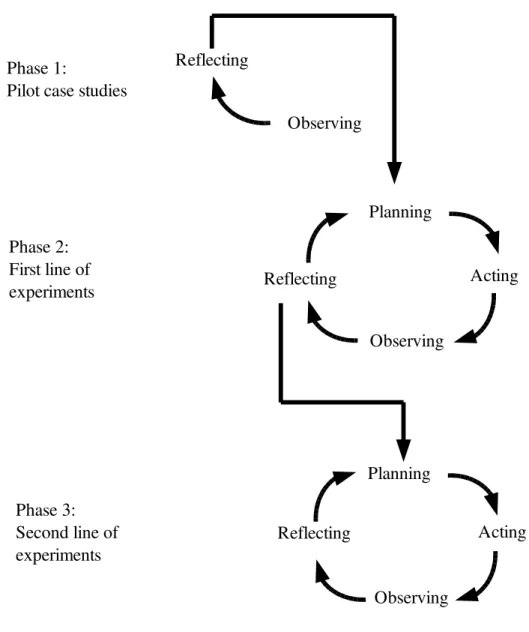
The entire research process of the ICE project may be illustrated as a number consecutive ac tionreflection cycles. In the first phase of the research project a number of explorative pilot case studies that cast light on earlier and present experiences of practices, forces and barriers of user driven innovation in service companies are carried through. Comparing with figure 2 these studies may be located within the observing and reflecting phases of the actionreflection cycle. The second phase of the ICE project then applies the actionreflection cycle to its full extent by carrying through a number of experiments in selected service companies. The experiments are developed on the basis of hypotheses developed from the pilot case studies from which also in dependent and dependent variables of the experiment are determined. As such they are a con tinuation of the actionreflection cycle initiated in the first research phase. Potentially, a third phase in which another number of experiments are carried through will be applied. Again these experiments are developed from the prior experiences and thus they represent a continuation of the actionreflection cycle. Consequently, the entire process may be illustrated simply as in fig ure 3. In each phase several cycles run simultaneously (i.e. a number of experiments are car ried through simultaneously in different service companies). Some of these may be chosen and result in literal and or theoretical replication – enhancing external validity. Objectivity is ap proached as an intersubjective approach is applied, i.e. more researchers come to similar res ults in the same experiments. As the exact setup of the experiments carried through in the actionreflection cycles are de veloped on the basis of the pilot cases this lets theories, hypotheses, and contexts of the experi ments determine the method, and not the method limit possible hypotheses, contexts and theor etical approaches. This also means that data and data collection techniques will vary and are not determined in advance. They may vary with the type of experiment and vary from statistical measures to observations, participant observations, diaries, or other types of reporting from in formants, collection of secondary data about the organisation and its contexts, etc.Figure 3: The ICE experiment structure
Observing
Reflecting
Acting
Planning
Observing
Reflecting
Acting
Planning
Observing
Reflecting
Phase 1:
Pilot case studies
Phase 2:
First line of
experiments
Phase 3:
Second line of
experiments
The final outcome of the experiments are eventually supposed to be tools, methods or scripts that can be applied in service companies so as to improve their userdriven innovation pro cesses and their outcomes. However, as described in the following, the tools can operate at two levels of abstraction and application: as specific tools, e.g. a blog, or as a tool or method that can be applied to create new tools.
Experimenting with tools – and with experiments
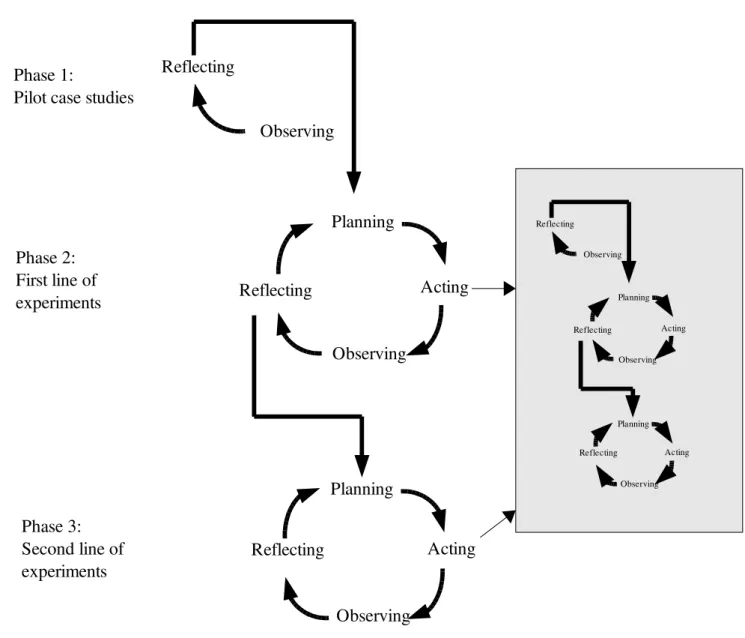
On a first level of abstraction the experiment method of the ICE project aims at developing spe cific tools or methods that service businesses can apply, e.g. a blog. The specific tools are sug gested from the pilot case studies and it is valued in experiments whether the tools function in order to enhance userdriven innovation processes. The experiments may, as earlier described, take any form between the quantitative laboratory experiment or the qualitative quasiexperi ment and the researcher may take a more or less active part, e.g. as a process facilitator, in the development, introduction and application of the tool/method. The result of the experiment will in broad terms be a validation of whether and how the tool can function as an initiator/enhancer of user driven innovation processes in service companies. The tools that these experiments will experiment with can broadly speaking be of two different sorts. The first consists of new techniques, tools, methods and/or procedures that can be ap plied in the encounter between customers and employees (e.g. a blog). The second consists of organisational tools or changes that may be hypothesised to activate/enhance the flow of ideas developed in the encounters into or upthrough the organisation. However, on a second level of abstraction, following the inherent logic of the experiment meth od, the ICE experiments can be seen as an experiment itself, i.e. if the experiment as a method succeeds in developing new tools that service companies can apply in order to enhance user driven innovation processes, then it is no longer only the individual tools that are interesting but the process behind the development of these tools and that is the experimental method. If the experiment method proves successful in developing new tools the question is how, and whether the method can be transferred to and be applied by service businesses themselves. Thus,Figure 4: Experimenting with the experiment method
Observing
Reflecting
Acting
Planning
Observing
Reflecting
Acting
Planning
Observing
Reflecting
Phase 1:
Pilot case studies
Phase 2:
First line of
experiments
Phase 3:
Second line of
experiments
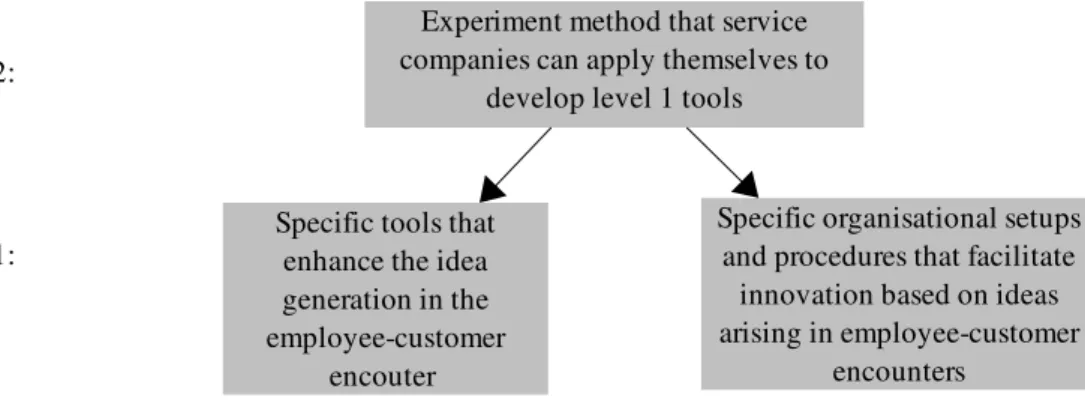
Observing Reflecting Acting Planning Observing Reflecting Acting Planning Observing ReflectingFigure 5: Expected results of the ICE experiments can be of both level 1 and level 2 based on a reflection of the experiments and how they led to the tools they did, the experiment logic may be developed into a tool itself that the service companies can apply to develop them selves their specific new tools (for example a particular type of blog) that matches the needs and contexts of the given company. From this point of view the experiment method becomes the tool that is tested in the ICE project. The logic is straightforward: if the experiment as a method is believed useful to develop new and improved processes of userdriven innovation then that method should be distributed to the companies to their own use. This may take the shape of a method or a script that companies can carry through themselves or as independently as possible e.g. with the help of a process facilitator. This could include for example preparing questionnaires that the companies can apply and interpret themselves in order to carry through a retrospective pilot study of their own company. This logic of the experiment may then be illus trated as in figure 4 as an experiment that operates at two levels: i.e. an experiment in which the acting phase of the experiment consists itself of carrying through an experiment – an experi ment embedded within the experiment. Thus, the ICE project could result in tools/methods at two levels. On the first level tools and methods are developed, either as A) specific tools, e.g. a blog to increase idea generation, or B) as organisational setups or procedures that facilitate that ideas emerged in employeecustomer encounters are carried on to innovations. At the second level an experiment method that com panies can apply so as to develop themselves their own innovative tools to enhance userdriven innovation processes in their own company may be developed. The two levels are illustrated in figure 5. Experiment method that service companies can apply themselves to develop level 1 tools Specific tools that enhance the idea generation in the employeecustomer encouter Specific organisational setups and procedures that facilitate innovation based on ideas arising in employeecustomer encounters Level 1: Level 2:
Conclusion
This paper has discussed the application of the experiment logic in the ICE project. The paper has opted for a taxonomy of the experiment as an array of methods ranging from quantitative positivist laboratory experiments to qualitative hermeneutic quasiexperiments. The exact char acter of the experiments in the ICE project is not determined in advance but depends on the results of an initial number of partly inductive pilot casestudies. The experiments are suggested to run through a number of actionreflection cycles. They focus on deliberately taken actions and their consequences which delimits the experiment method from other similar methods. Ad ditionally it has been suggested that the experiment may itself be developed as a method that service companies can apply to develop themselves new innovative userdriven innovation pro cesses. Thus the results of the experiment method should include a number of specific sugges ted tools and procedures that can be applied in service companies to enhance their user driven innovation processes (level one results) as well as an experimental method (level two results) that service companies can apply to experiment with and develop themselves their own innovat ive userdriven innovation procedures.References
Becker H.S. (1992) Cases, causes conjunctures, stories and imaginary. In Ragin C.C. and Becker H.S. (eds.) What is a Case – Exploring the foundation of social enquiry, pp. 205216 (Cambridge University Press).Bullen, C.V., and Rockart J.F. (1981). A Primer on Critical Success Factors, Working paper no. 69. Cam bridge, MA: Massachusetts Institute of Technology.
Campbell D.T. (2005) Reforms as Experiments. In Stern E. (ed.) Evaluation Research Methods, vol 3, pp. 171205 (London: Sage Publications) (first published 1969 in American Psychologist, 24, pp. 409429)
DeBresson C. (1996) The Measured Observation of Innovation or Innovative Activities, in: DeBresson C. (ed.) Economic Interdependence and Innovative Activity – An InputOutput Analysis, pp. 316 (Chel tenham: Edward Elgar).
Gummesson E. (1988) Qualitative Methods in Management Research (Bromley: ChartwellBratt) Gummesson E. (2000) Qualitative Methods in Management Research (London: Sage Publications Inc.) Halinen A, & Törnroos JÅ. (2004) Using Case Methods in the Study of Contemporary Business Networks,
Journal of Business Research, 58(9), pp. 12851297.
Holt C.A. (1995) Industrial Organisation: A Survey of Laboratory Research. In Kagel J.H. & Roth A.E. (eds.) The Handbook of Experimental Economics (Princeton University Press)
ICE (2008) When the customer encounters the employee Interactive userbased innovation in services. Unpublished paper: Project description of the ICEproject.
Kagel J.H. & Roth A.E. (eds.) (1995) The Handbook of Experimental Economics (Princeton University Press)
Ledyard J.O. (1995) Public Goods: A Survey of Experimental Research. In Kagel J.H. & Roth A.E. (eds.)
The Handbook of Experimental Economics (Princeton University Press)
McNiff J. & Whitehead J. (2002) Action Research – Principles and Practice (London: Routledge) McNiff J. & Whitehead J. (2000) Action Research in Organisations (London: Routledge)
Neuman (2000) Qualitative research methods...
Nielsen K.A. (2001) Eksperimentelle metoder og aktionsforskning – om sociale eksperimenter og ak tionsforskning som kvalitativ forskningsmetode I arbejdslivsforskning. In Pedersen K.B. & Nielsen L.D. (eds.) Kvalitative metoder – fra metateori til markarbejde, pp. 127152 (Roskilde Universitetsforlag) Ragin C.C. (1987) The Comparative Method: Moving beyond qualitative and quantitative strategies (Uni
versity of California Press).
Sundbo J. (2008) Interview guide for companies and public organisations, Internal paper, the ICE research project.
Willer D. & Harry A.W. (2007) Building Experiments – Testing social theory (Stanord University Press) Yin R.K. (1981) The Case Study as a Serious Research Strategy. In Knowledge: Creation, Diffusion, Utiliz
ation, 3(1): 97114.
Yin R.K. (2003) Case Study Research – Design and Methods, 3rd ed. (London: Sage Publications)
The ICE-Project
Department of Communication, Business and Information Technologies, Roskilde University
Center for Communication, Media and Information Technologies, Aalborg University Denmark
Working Paper 2009:01