Georgia State University
ScholarWorks @ Georgia State University
Mathematics Theses Department of Mathematics and Statistics
8-2-2007
Empirical Likelihood-Based NonParametric
Inference for the Difference between Two Partial
AUCS
Yan Yuan
Follow this and additional works at:https://scholarworks.gsu.edu/math_theses
Part of theMathematics Commons
This Thesis is brought to you for free and open access by the Department of Mathematics and Statistics at ScholarWorks @ Georgia State University. It has been accepted for inclusion in Mathematics Theses by an authorized administrator of ScholarWorks @ Georgia State University. For more information, please [email protected].
Recommended Citation
Yuan, Yan, "Empirical Likelihood-Based NonParametric Inference for the Difference between Two Partial AUCS." Thesis, Georgia State University, 2007.
EMPIRICAL LIKELIHOOD-BASED NONPARAMETRIC INFERENCE FOR THE DIFFERENCE BETWEEN TWO PARTIAL AUCS
by Yan Yuan
Under the direction of Gengsheng Qin
ABSTRACT
Compare the accuracy of two continuous-scale tests is increasing important when a new test is developed. The traditional approach that compares the entire areas under two Receiver Operating Characteristic (ROC) curves is not sensitive when two ROC curves cross each other. A better approach to compare the accuracy of two diagnostic tests is to compare the areas under two ROC curves (AUCs) in the interested specificity interval. In this thesis, we have proposed bootstrap and empirical likelihood (EL) approach for inference of the difference between two partial AUCs. The empirical likelihood ratio for the difference between two partial AUCs is defined and its limiting distribution is shown to be a scaled chi-square distribution. The EL based confidence intervals for the
difference between two partial AUCs are obtained. Additionally we have conducted simulation studies to compare four proposed EL and bootstrap based intervals.
INDEX WORDS: ROC curve, AUC, PAUC, Partial AUC, Empirical Likelihood, Bootstrap, Confidence Interval.
EMPIRICAL LIKELIHOOD-BASED NONPARAMETRIC INFERENCE FOR THE DIFFERENCE BETWEEN TWO PARTIAL AUCS
by
Yan Yuan
A Thesis submitted in partial Fulfillment of the Requirements for the Degree of Master of Science
In the College of Arts and Science Georgia State University
Copyright by Yan Yuan
EMPIRICAL LIKELIHOOD-BASED NONPARAMETRIC INFERENCE FOR THE DIFFERENCE BETWEEN TWO PARTIAL AUCS
by Yan Yuan
Major Professor: Dr. Gengsheng Qin Committee: Dr. Yu-Sheng Hsu
Dr. Xu Zhang
Electronic Version Approval:
Office of Graduate Studies College of Arts and Science Georgia State University August 2007
ACKNOWLEDGEMENTS
I would like to express my gratitude to my advisor Dr.Gengsheng Qin who directed and guided me through the whole process of this thesis. This thesis cannot be finished without him.
I would also like to thank the other members of my committee, Dr. Yu-Sheng Hsu and Dr. Xu Zhang who took the time to participate as proofreaders and committee members. I thank them very much for their comments and suggestions on the improvement of my thesis.
TABLE OF CONTENTS ABSTRACT...……….……….……….. i ACKNOWLEDGMENT...……….………... iv TABLE OF CONTENTS……..………... v LIST OF ABBREVIATION……..………. vi CHAPTER I INTRODUCTION……… 1
II BOOTSTRAP CONFIDENCE INTERVAL FOR THE DIFFERENCE BETWEEN TWO PARTIAL AUCS………..…… 5
III EMPIRICAL LIKELIHOOD BASED CONFIDENCE INTERVAL FOR THE DIFFERENCE BETWEEN TWO PARTIAL AUCS………... 9
IV SIMULATION STUDIES……….. 14 V DERMATOSCOPE EXAMPLE………17 VI DISCUSSION………... 19 REFERENCES……… 20 APPENDIX A SIMULATION TABLES……….. 22
B REAL DATA ANALYSIS TABLES………. 31
C S-PLUS CODE FOR SIMULATION……….. 34
LIST OF ABBREVIATION
AUC: Area under the ROC Curve
BS: Bootstrap Method
EL: Empirical Likelihood Method
FPR: False Positive Rate
PAUC: Partial Area under the ROC Curve
ROC: Receiver Operating Characteristic
TPR: True Positive Rate
1 0p
p
Δ : The difference between two partial AUCs
1 0p
p
CHAPTER I INTRODUCTION
The accuracy of a binary diagnostic test can be measured by its specificity and sensitivity. The sensitivity or true positive rate (TPR) of the test is the proportion of diseased patients who test positive. The specificity or true negative rate (TNR) of the test is the proportion of non-diseased patients who test negative.
When the outcome of a diagnostic test is continuous, a cut-off point for the positive of disease needs to be chosen to compute specificity and sensitivity of the test.
Let Y and X be the results of a continuous-scale test for a diseased and a non-diseased
subject with cumulative distribution function G and F, respectively. For a given cut-off
point c, the sensitivity and specificity of the test are defined as
) ( 1 ) (Y c G c P Se= ≥ = − ; Sp=P(X ≤c)=F(c)
respectively. When specificity is 1-p, the corresponding sensitivity of the test is
)) 1 ( ( 1 ) (p G F 1 p
R = − − − , where F−1 is the inverse function ofF.
The receiver operating characteristic (ROC) curve, denoted by R (p), is the plot
of sensitivity against the false positive rate (FPR or 1- specificity ) as the cut-off point runs through the whole range of possible test values. In fact, the non-diseased population is unknown, and the optimal cut-off point is unknown too. For a continuous-scale
diagnostic test, the area under the ROC curve (AUC), defined as 1
0R p dp( )
δ =
∫
, is
cut-off points. The larger is the AUC, the better the diagnostic test will be. Now, the AUC is a very popular tool in diagnostic medicine.
However, the AUC has several limitations that may make it less useful for continuous diagnostic tests (Hilden, 1991). When two ROC curves cross, the two diagnostic tests can have similar AUC even though one test has higher sensitivity for certain specificities while the other test has better sensitivity for other specificities. On the other hand, in diagnostic testing, it is critical to maintain a high sensitivity in order not to miss detecting subjects with “disease” and the interest would be in the region of ROC curve corresponding only to acceptable high sensitivities. For cancer screening, only the lower tail of the ROC curve is of interest because the FPR must be very small to be acceptable (Lilienfeld, 1974). For these reasons, the partial AUC (pAUC) has been proposed as an alternative measure to the full AUC. When using the pAUC, one considers only those regions of the ROC space where data have been observed, or which correspond to clinical relevant values of sensitivity or specificity. The pAUC over the interval )(p0,p1 of false positive rates, denoted by
1 0p p δ , is
∫
= 1 0 1 0 ) ( p p p p R p dp δ for 0≤ p0 < p1 ≤1.It can be described as the cumulative value of sensitivity for all possible values of the false positive rates in the interval(p0,p1) .
Let X1,X2, …,Xm be the test results from a random sample of non-diseased
population with distribution function F; let Y1, Y2,…,Yn be the test results from a
(2003) proposed the following nonparametric estimator for the pAUC. When the quantiles qi = F 1(1− pi)
−
(i=0, 1) are known, the pAUC can be estimated by
(
( , ))
) ( 1 ~ 0 1 1 1 1 0 q q X I X Y I mn i i n j j m i p p =∑
∑
≥ ∈ = = δ .When the quantile qi’s are unknown, the pAUC can be estimated by
(
(ˆ ,ˆ ))
) ( 1 ˆ 0 1 1 1 1 0 q q X I X Y I mn i i n j j m i p p =∑
∑
≥ ∈ = = δwhere qˆi =Fˆ−1(1− pi) (i=0,1) and Fˆ is the empirical distribution of F .
Many approaches have been proposed for constructing a confidence interval for the full or partial AUC. McClish (1989), Thompson and Zucchini (1989), and Jiang, Metz, and Nishikawa (1996) proposed parametric methods for the interval estimation of the pAUC using the bi-normal model. But Walsh (1997) found that the inferences for the pAUC are sensitive to the parametric model assumption. Wieand et al (1989) proposed a generalized nonparametric method for the inference of both the full and the partial AUC. However, their method is involved in density and distribution function estimations and mathematically too complicated to be well applied in practice. Qin and Zhou (2006) proposed an Empirical Likelihood (EL) based approach for the inference on the full AUC and recommended the use of an EL-based approach when the underlying distributions for diseased and non-diseased populations are unknown. Qin, Jin and Zhou (2006) developed bootstrap and EL-based inference for pAUC and did extensive simulation studies to compare three nonparametric confidence intervals (Normal Approximation, Bootstrap, and Empirical Likelihood) for the pAUC. They also recommended the use of EL-based
approach for pAUC when the underlying distributions for diseased and non-diseased populations are unknown.
Comparing two continuous-scale diagnostic tests is increasingly important when a new test is developed and marketed (Delong 1988). How can we know which diagnostic test is better? Investigators often compare the validity of two tests based on the estimated areas under the respective ROC curves. However, the traditional way of comparing entire areas under two ROC curves is not sensitive when two ROC curves cross each other (Zhang et al., 2002). In this thesis, we propose methods to compare the partial area under the curve within a specific range of specificity for two ROC curves, non-parametric methods based on EL and bootstrap have been developed.
This thesis is organized as follows: In Chapter II, we propose two bootstrap confidence intervals for the difference between two partial AUCs. In Chapter III, we propose the EL-based intervals for the difference between two partial AUCs. In Chapter IV, we conduct simulation study to evaluate the performances of these intervals. In Chapter V, we analyze Dermatoscope Example to illustrate the proposed intervals. Finally, the conclusions are discussed in Chapter VI.
CHAPTER II
Bootstrap Confidence Interval for the Difference between Two partial AUCS
Consider two diagnostic tests Tk (k=1, 2). Both tests yield continuous
measurements and are performed on the same m non-diseased and n diseased cases. Let
1
k
X ,Xk2…Xkm be i.i.d bivariate test results from a non-diseased population with joint
distribution functionF(x1,x2), and let Yk1, Yk2….., Ykn i.i.d bivariate test results from a
diseased population with joint distribution function G(y1,y2). Denote the marginal
distribution functions of Xki and Ykj by Fk and Gk, respectively. The pAUC of test
k
T (k=1, 2) over the interval (p0,p1) of false positive rates, denoted by
0 1 ( )k p p δ , is 1 0 1 0 ( ) ( ) p k k p p p R p dp δ =
∫
for 0≤ p0 < p1 ≤1,where R pk( ) 1= −G Fk( k−1(1−p)) is the ROC curve of test Tk (k=1, 2) . The difference between two pAUCS is
1 0p p Δ = 0 1 0 1 (2) (1) p p p p
δ −δ . Our goal is to construct confidence interval
for
1 0p
p
Δ based on test results Xki’s and Ykj’s.
2.1 Normal Approximation Method
For one diagnostic test, Let {Y1,Y2, …,Yn} and {X1 ,X2,…,Xm} be the results of a continuous-scale test for a diseased and a non-diseased subject with cumulative
distribution function F and G. Dodd and Pepe (2003) defined the restricted placement
value of X as ))V(X)=(1−G(x))I(X ∈(q1,q0 when assume the quantiles q1and q0 are
known. Let ˆ( ) 1 ( ) 1 y Y I n y G n j j ≤ =
∑
=)) , ( ( )) ( ˆ 1 ( ~ 0 1 q q X I X G Vi = − i i∈ , i=1, 2, …, m. Then, 0 1 ~ p p δ =
∑
= m i i V m 1 ~ 1 is the mean of m‘sample’ restricted placement valueV~i's. Noticing that
1 0 ~ p p δ is a two-sample U-statistic,
it follows from the asymptotic normality for U-statistic (Lehmann, 1998) that
−
∑
= m i i mn V m 1 ~ ( 1 σ δp0p1) ⎯⎯→ L N (0, 1), Where 2 2 2 1 0 1 1 mn m nσ = σ + σ , σ12=Var[V(X)], σ02=Var [F (min(Y,q ))].0
Since bothq1, q0are unknown, Vi
~
is still unknown. The above normal approximation cannot be directly used to produce a confidence interval for the pAUC. Therefore Qin, Jin and Zhou (2007) introduced a bootstrap method to produce a confidence interval for pAUC.
For two diagnostic tests Tk (k=1, 2), we can use Δˆp p0 1 =
0 1 0 1 (2) (1) ˆ ˆ p p p p δ −δ to estimate 1 0p p Δ , where ˆ 1 ( )
(
(ˆ 1, ˆ 0))
1 1 ) ( 1 0 ki ki k k n j kj m i k p p I Y X I X q q mn ≥ ∈ =∑
∑
= = δ , qˆkl =Fˆk−1(1−pl)(l = 0, 1) , and Fˆk is the empirical distribution of Fk. It can be proved that
(
0 1 0 1)
ˆ p p p p m+n Δ − Δ ⎯⎯→L N (0, 0 1 2 p p σ ), where 0 1 2 p pσ is the asymptotic variance of
0 1 ˆ p p Δ . Since 0 1 2 p p σ is an unknown function of k F , Gk, 1 k F− and Gk1 − , the estimation of 0 1 2 p p
σ involves in complex density and quantile
estimation. This normal approximation cannot be directly used to produce a confidence interval for the
1 0p
p
Zhou (2006) to construct confidence intervals for the difference between two partial AUCS.
2.2 Bootstrap Method
Bootstrap method is a popular non-parametric method for constructing confidence intervals of unknown parameter; it can be applied to very complex problems. In this chapter we will propose use bootstrap method to construct confidence interval for the difference between two partial AUCS.
We draw a bootstrap resample {Xk*1, Xk*2,…,Xkm* } of size m with replacement
from{Xk1 ,Xk2, …,Xkm} and a separate bootstrap resample { Yk*1, Yk*2, …, Ykn*} of size
n with replacement from {Yk1, Yk2, …, Ykn}. The partial AUC can be estimated by
(
(ˆ , ˆ ))
) ( 1 ˆ * 0 * 1 * * 1 * 1 )* ( 1 0 ki ki k k n j kj m i k p p I Y X I X q q mn ≥ ∈ =∑
∑
= = δ , k=1, 2, where ˆ* ˆ 1*(1 ) l k kl F pq = − − (l = 0, 1) is the (1−pl)-th sample quantile based on bootstrap
resample {Xk*1, Xk*2,…,Xkm* }. Then the bootstrap estimate for the difference of two
partial AUCs can be calculated as
= Δ* 1 0 ˆ p p )* 1 ( )* 2 ( 1 0 1 0 ˆ ˆ p p p p δ δ − .
After B repetitions of above process, B bootstrap copies of *
1 0 ˆ p p Δ are obtained { * ( ) 1 0 ˆ b p p Δ : b=1, 2, …, B}.
The bootstrap estimator for the variance of
0 1 ˆ p p Δ is given by 2 * 1 * ) ( * ) ˆ ( 1 1 1 0 1 0 p p B b b p p B V Δ −Δ − =
∑
= ,where
∑
= Δ = Δ B b b p p p p B 1 * ) ( * 1 0 1 0 ˆ 1 .Two bootstrap (1-α )100% confidence intervals for
1 0p
p
Δ can be proposed based
on the bootstrap variance estimator V*.
First one, called BS interval is defined as follows:
( * 1 /2 * 1 0p z V p − −α Δ , * 1 /2 * 1 0p z V p + −α Δ ).
Second one, called BT interval is given by (Δˆ p0p1 −z1−α/2 V* , * 2 / 1 1 0 ˆ z V p p + −α Δ ).
CHAPTER III
Empirical Likelihood Based Confidence Interval for The difference between two partial AUCs
In this chapter, we will use empirical likelihood method to construct the confidence interval for the difference between two partial AUCs.
Empirical likelihood (EL) (Owen, 1990, 2001) also is a popular non-parametric method traditionally used for providing confidence intervals. The EL method has many advantages over other non-parametric methods. For example, it has better small sample performance than approaches based on normal approximation, it studentizes internally, thereby eliminating the need for a pivot. But the applications of EL method to the ROC study are relatively few. The main challenge of developing the EL-based theory for the difference between two partial AUCs is the standard EL method can’t be applied directly when the underlying distributions are unknown (Qin and Zhou 2006) and the empirical log-likelihood ratio for the partial AUC is a sum of non-independent random variables (Qin, Jin and Zhou 2006). Hence, the standard EL theory cannot be directly applied in the partial AUC setting.
For test value Xk from a “non-diseased” subject, Dodd and Pepe (2003) defined
the restricted placement value of Xk as
)) , ( ( )) ( 1 ( ) ( k k k k k1 k2 k X G X I X q q V = − ∈ , k=1, 2, where qkl =Fk−1(1− pl), l = 1, 2.
When the quantiles are unknown, we can use
)) ˆ , ˆ ( ( )) ( ˆ 1 ( ) ( ˆ 2 1 k k k k k k k X G X I X q q V = − ∈ , k=1, 2,
whereqˆkl Fˆk1(1 pl)
−
= − , l = 1, 2.
k
V can be interpreted as the restricted placement value of a given “non-diseased”
test value Xk, in the survival function of the results of “diseased”. It is evident that
)} , ( , { )) ( (Vk Xk p Yk Xk Xk qk1 qk2 E = > ∈ =pAUCk(p0,p1)= ( ) 1 0 k p p δ Therefore, = Δ 1 0p p ) 1 ( ) 2 ( 1 0 1 0p p p p δ δ − =E(V2(X2)−V1(X1)).
Based on this relationship between the difference between two partial AUCs and the restricted placement valuesV X1( 1) and V X2( 2), the profile empirical likelihood for
1 0p p Δ can be defined as , 1 : sup{ ) ( 1 1 2 , 1 1 0 = = Δ
∏
∏
∑
= = = n j ki m i kj k p p p p L∑
− = ki m i ki V p (ˆ 1 ) ) ( 1 0 k p p δ ,∑
− = i m i iV p 2 1 2 ˆ i m i iV p 1 1 1 ˆ∑
= = } 1 0p p Δ , where Vˆki=Vˆk(Xki), i=1, 2, …, m, k=1, 2.Then the corresponding empirical log-likelihood ratio (ELR) for
1 0p p Δ is [ 2 ) ( 1 0 = Δp p l
∑
− − = i m i V1 1 ˆ ( 2 1 log( λ (1) )) 1 0p p δ +∑
+ − = i m i V2 1 ˆ ( 2 1 log( λ (2) ))] 1 0p p δ , where λ and ( ) 1 0 k p pδ (k=1, 2) are the solutions of the following equations:
0 ) ˆ ( 2 1 ˆ 1 1 1 (1) ) 1 ( 1 1 0 1 0 = − − −
∑
= m i i p p p p i V V m λ δ δ (1) 0 ) ˆ ( 2 1 ˆ 1 1 2 (2) ) 2 ( 2 1 0 1 0 = − + −∑
= m i i p p p p i V V m λ δ δ (2) − − +∑
= m i i p p i V V m 1 ) 2 ( 2 2 ) ˆ ( 2 1 ˆ 1 1 0 δ λ 0 1 1 0 1 ) 1 ( 1 1 ) ˆ ( 2 1 ˆ 1 p p m i i p p i V V m∑
= − λ −δ =Δ (3)
Theorem 3.1: If
1 0p
p
Δ is the true value of the difference between two partial AUCs, and
,
limm n m
n ρ
→∞ = is a constant, then the limiting distribution of l(Δp0p1) is a scaled
chi-square distribution with one degree of freedom.
) ( 1 0p p C Δ ( ) 1 0p p l Δ ⎯⎯→χ12 L , where ( ) 1 0p p C Δ = 0 1 0 1 0 1 (1) 2 (2) 2 2 ( ) / /( ) p p p p p p m m n σ σ σ + + , 0 1 ( ) 2 [ ( )] k p p Var V Xk k σ = , k = 1, 2.
Using Theorem 3.1, two empirical and bootstrap based intervals for the difference between two partial AUCs can be constructed as follows:
The first hybrid empirical and bootstrap interval (EL) is defined as
0 1 0 1 ( p p ) { p p : Rα Δ = Δ ˆ( ) 1 0p p C Δ ( ) 1 0p p l Δ ≤χ12(1−α)},
where )χ12(1−α is the (1-α )-th quantile of the chi-square distribution
2 1 χ , ˆ( ) 1 0p p C Δ is an estimate for ( ) 1 0p p C Δ : ) ( ˆ 1 0p p C Δ = * 2 ) 2 ( 2 ) 1 ( / ) ˆ ˆ ( 1 0 1 0 V m p p p p σ σ + , 2 1 1 2 ) ( ) ˆ 1 ˆ ( 1 1 ˆ 1 0
∑
∑
= = − − = m i ki m i ki k p p V m V m σ , k=1, 2,and V* is the bootstrap variance estimate defined in chapter II.
0 1
( p p )
Rα Δ is an approximate confidence intervals for the difference between two
partial AUCs with asymptotically correct coverage probability 1-α, i.e.,
∈ Δ 1 0 ( p p P 0 1 ( p p) Rα Δ ) = 1-α+ο(1).
We can solve the following equations to get the lower and upper bounds of the confidence interval for the difference between the two partial AUCs:
0 ) ˆ ( 2 1 ˆ 1 1 ) 1 ( 1 ) 1 ( 1 1 0 1 0 = − − −
∑
= m i i p p p p i V V m λ δ δ (1) 0 ) ˆ ( 2 1 ˆ 1 1 2 (2) ) 2 ( 2 1 0 1 0 = − + −∑
= m i i p p p p i V V m λ δ δ (2) − − +∑
= m i i p p i V V m 1 2 (2) 2 ) ˆ ( 2 1 ˆ 1 1 0 δ λ 0 1 1 0 1 1 (1) 1 ) ˆ ( 2 1 ˆ 1 p p m i i p p i V V m∑
= − λ −δ =Δ (3) ˆ( ) 1 0p p C Δ ( ) 1 0p p l Δ =χ12(1−α) (4)In these four equations, λ and ( )
1 0 k p p δ (k=1, 2) and 1 0p p
Δ are unknown and can be solved.
The
1 0p
p
Δ will have two solutions. The smaller one is the lower bound of the EL interval
and larger one is the upper bound of the EL interval.
The second hybrid empirical and bootstrap interval (HBEL) is given by
0 1 0 1 * ( p p) { p p : Rα Δ = Δ ˆ ( ) 1 0 * p p C Δ ( ) 1 0p p l Δ ≤χ12(1−α)}, where )ˆ ( 1 0 * p p C Δ = 0 1 0 1 *(1) 2 *(2) 2 * ˆ ˆ ( p p p p ) /m V σ +σ , 0 1 *( ) 2 ˆp pk
σ is the mean of B bootstrap copies of
0 1 ( ) 2
ˆ k p p
σ ( k=1,2), and V* is the bootstrap variance estimate defined in chapter II.
Similarly,
0 1 *
( p p )
Rα Δ is an approximate confidence intervals for the difference
between two partial AUCs with asymptotically correct coverage probability 1-α, i.e.,
∈ Δ 1 0 ( p p P 0 1 * ( p p ) Rα Δ ) = 1-α+ο(1).
The lower and upper bound of HBEL interval can be obtained by solving the following
equations: 0 ) ˆ ( 2 1 ˆ 1 1 ) 1 ( 1 ) 1 ( 1 1 0 1 0 = − − −
∑
= m i i p p p p i V V m λ δ δ (5) 0 ) ˆ ( 2 1 ˆ 1 1 2 (2) ) 2 ( 2 1 0 1 0 = − + −∑
= m i i p p p p i V V m λ δ δ (6) − − +∑
= m i i p p i V V m 1 2 (2) 2 ) ˆ ( 2 1 ˆ 1 1 0 δ λ 0 1 1 0 1 1 (1) 1 ) ˆ ( 2 1 ˆ 1 p p m i i p p i V V m∑
= − λ −δ =Δ (7) ) ( ˆ 1 0 * p p C Δ ( ) 1 0p p l Δ 2(1 ) 1 α χ − = (8)
CHAPTER IV Simulation Study
In this chapter, we conduct a simulation study to evaluate coverage accuracy and interval length of the newly proposed four intervals for the difference
1 0p
p
Δ of two
pAUCs. In the study, the difference
1 0p
p
Δ between two pAUCs is taken to be 0 and 0.2.
We generate 1000 random samples of size n from G(y1,y2) for test responses of
diseased patients, and another set of independent random samples of size m from
) , (x1 x2
F for test responses of non-diseased patients.
The distributionF(x1,x2) is chosen to be a bivariate normal distribution having
meansE(X1)=0, E(X2)=0 with a common standard deviation 1 and correlationρ.
The distribution G(y1,y2) is chosen to be a bivariate normal distribution having
meansE(Y1)=μ1, E(Y2)=μ2 with a common standard deviation 2 and correlationρ. μ1
and μ2 are calculated by solving the following equations
1 0 1 0 ( ) ( ) p k k p p p R p dp δ =
∫
with R pk( ) 1 G Fk( k1(1 p)) − = − − , k = 1, 2. When 1 0p pΔ = 0, we choose three groups of
0 1 0 1 (1) (2)
ˆ ˆ
(δp p ,δp p ) to calculate three groups of
(μ1, μ2) and generate random samples from the G(y1,y2): (i) δ(0,0.4)(2) =δ(0,0.4)(1) =0.2 with (p0,p1) = (0, 0.4), (ii) δ(0,0.7)(2) =δ(0,0.7)(1) =0.45 with (p0,p1) = (0, 0.7),
(iii) (2) (1)
(0.05,0.50) (0.05,0.50) 0.26
When
1 0p
p
Δ = 0.2, we also choose three groups of
0 1 0 1 (1) (2)
ˆ ˆ
(δp p ,δp p ) to calculate three groups
of (μ1, μ2) and generate random samples from the G(y1,y2): (i) δ(0,0.4)(2) =0.37,δ(0,0.4)(1) =0.17 with (p0,p1) = (0, 0.4), (ii) δ(0,0.7)(2) =0.61,δ(0,0.7)(1) =0.41 with (p0,p1) = (0, 0.7),
(iii) (2) (1)
(0.05,0.50) 0.39, (0.05,0.50) 0.19
δ = δ = with (p0,p1) = (0.05, 0.50).
In the bootstrap step, we draw B = 150 bootstrap re-samples from the original samples. We construct both 90% and 95% confidence intervals for
1 0p
p
Δ . The results of the
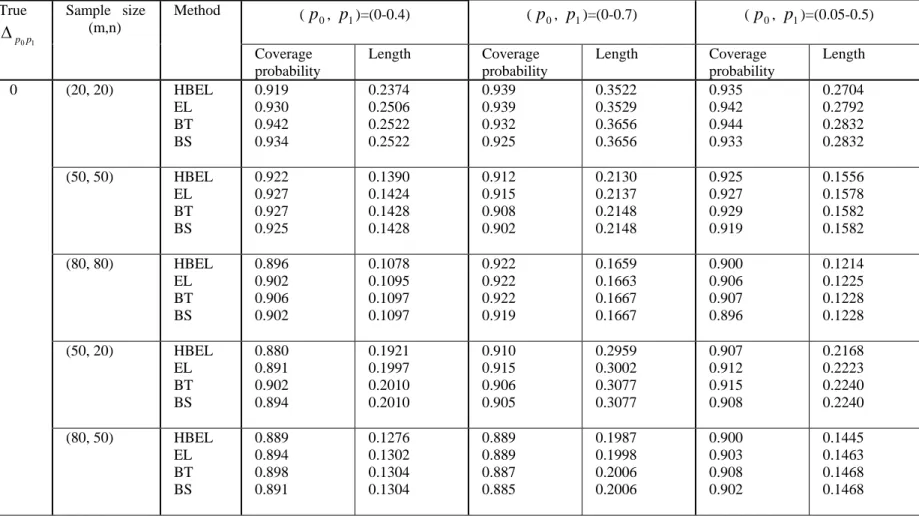
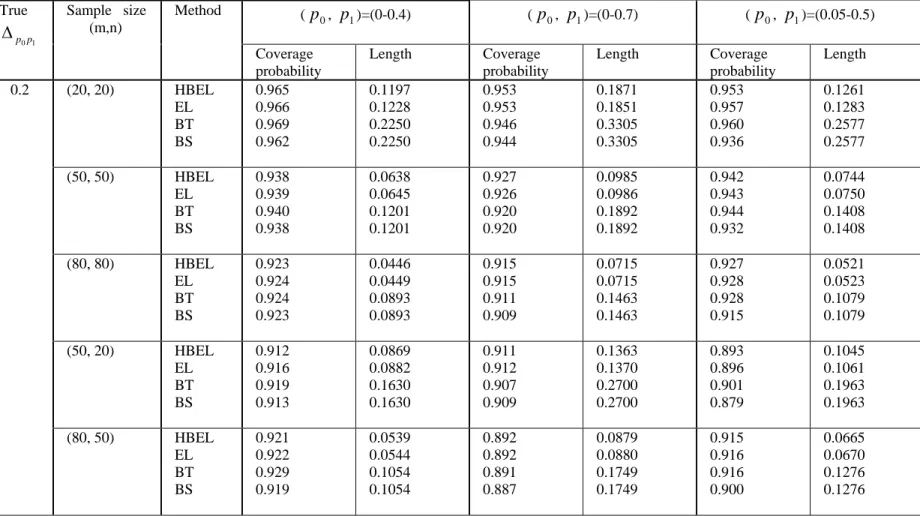
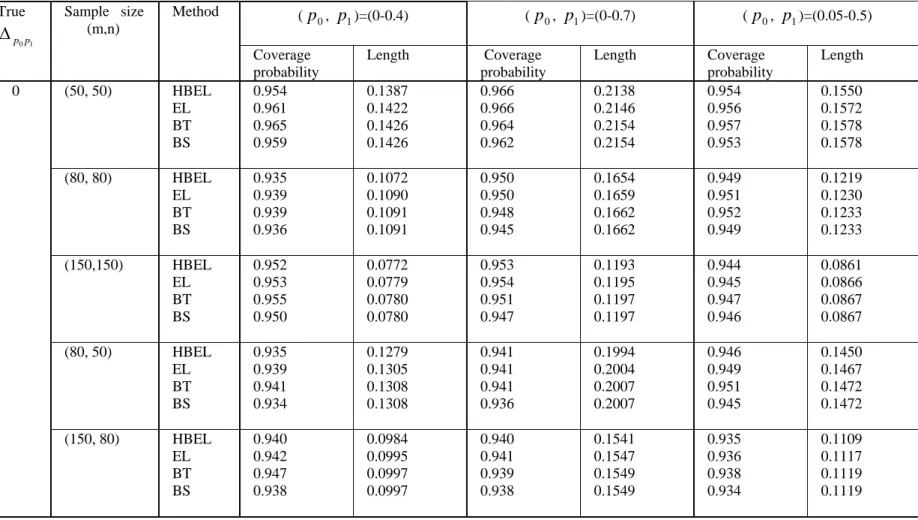
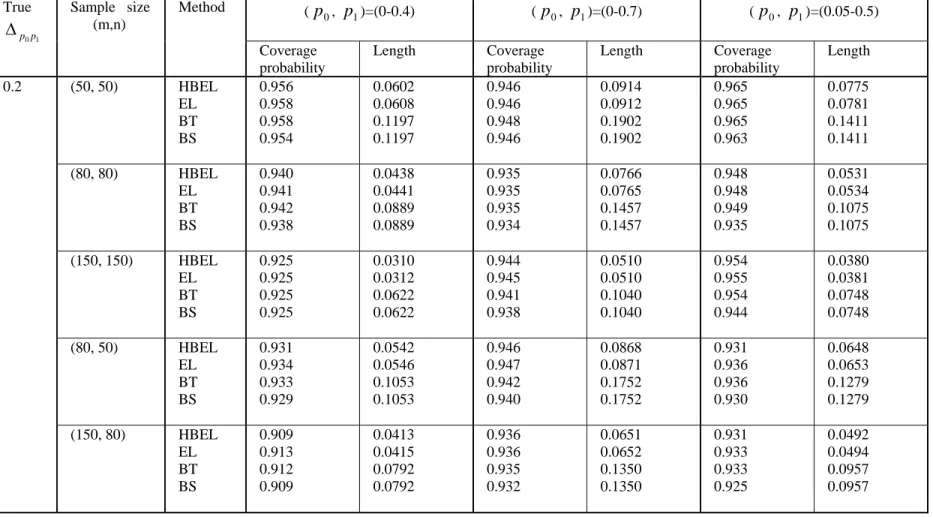
simulation study are shown in Table I to Table VIII. From these tables, the following observations were made.
(1) When the correlation ρ= 0 and
1 0p
p
Δ = 0, the four proposed intervals have
similar coverage probabilities but the hybrid empirical likelihood and bootstrap intervals (EL and HBEL) have slightly shorter interval length.
(2) When
1 0p
p
Δ > 0, all the intervals over-cover the true difference between two
pAUCs when sample sizes are small. As the sample sizes increase, the coverage probabilities of all the intervals approach to the nominal level. Although in most time all the interval have similar coverage probabilities, the EL and HBEL intervals have much shorter interval length than bootstrap (BS and BT) intervals.
(3) When the correlation is positive (ρ = 0.3), bigger sample sizes (m, n ≥ 150)
are needed to get better coverage accuracy for all the intervals.
In summary, the simulation study indicates that the hybrid empirical likelihood and bootstrap based intervals perform better than the bootstrap intervals when two partial AUCs are different. When there is no difference between two partial AUCs, the four
proposed intervals have similar performance. Therefore, we recommend the use of hybrid empirical likelihood and bootstrap method for construction of confidence interval of difference between two pAUCs when the underlying distributions for diseased and non-diseased populations are unknown.
CHAPTER V Dermatoscope Example
Malignant melanoma (MM) is one of the most deadly kinds of skin disease. Melanomas of less than 1mm are not likely to have spread to the lymph nodes or to other parts of the body, called early stage; they have a very good chance of cure. The thinner the melanoma, the better chance of a complete cure. Early diagnosis of malignant melanoma is essential for cure.
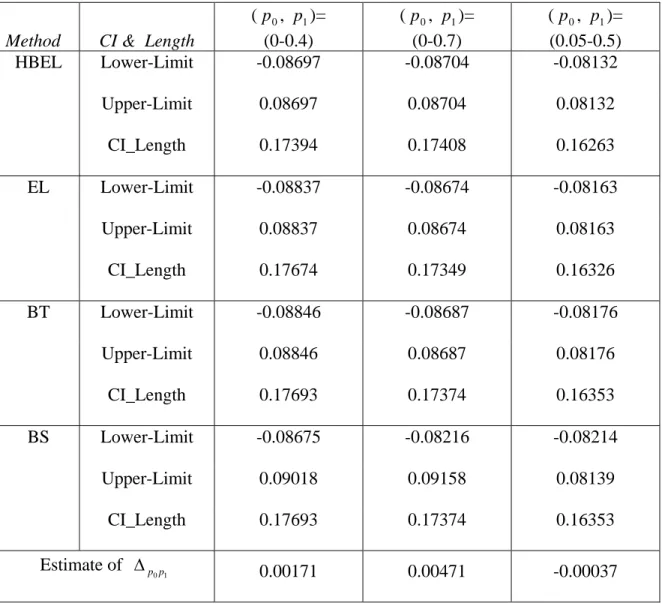
Dermatoscopy is a hand- held instrument for skin surface microscopy at 10 times magnification and is a noninvasive diagnostic technique for the early diagnosis of melanoma and the evaluation of other pigmented and non-pigmented lesions on the skin that are not as well seen with the unaided eye [www.medterms.com]. Stolz et al (1994) studied the accuracy of clinical evaluations with or without the aid of Dermatoscopy in detecting MM by using the ABCD rule (Asymmetry, irregular border, different colors, and Diameter larger than 6mm). In this study, two tests were applied for detecting MM; the first test is the clinical assessment without the aid of dermatoscopy, and the second test is the clinical assessment with the aid of dermatoscopy. The data set we used here includes 21 patients with MM and 51 patients with benign melanocytic lesions; all patients have both tests results. The objective of this study is to find out whether the aid of dermatoscopy can improve for detecting MM. We estimate the difference of two pAUCs of the two tests and construct confidence intervals for the difference by using the proposed methods. The 90% and 95% confidence intervals for the difference between two pAUCs over three intervals of FPR are shown in Table IX and Table X.
The estimates of the differences between two pAUCs over the three intervals (0, 0.4), (0, 0.7) and (0.05, 0.50) of FPR for the two tests are all close to 0. Also, all the confidence intervals for the differences contain zero. Therefore, we conclude that there is no significant advantage in adopting the clinical assessment with the aid of dermatoscopy in detecting MM. The same conclusion has been obtained in Qin, Hsu and Zhou (2006) where they compared those two tests by using the sensitivities at a fixed level of specificity.
CHAPTER VI Discussion and Conclusion
Comparing the accuracy of two continuous-scale tests is increasingly important when a new test is developed and marketed. There are many ways to do such a comparison. For example, we can compare the sensitivities at a fixed common specificity or we can compare the areas under the ROC curves. But traditional ways of comparing entire areas under two ROC curves are not sensitive when two ROC curves cross each other. Comparing the areas under two ROC curves on the interested FPR interval is a more appropriate way to compare the accuracy of two diagnostic tests. In this thesis, we have proposed two bootstrap based confidence intervals (BS and BT) and two hybrid empirical likelihood and bootstrap confidence intervals (EL and HBEL). The simulation study indicates that two hybrid empirical likelihood and bootstrap intervals performed better than the bootstrap intervals in most cases, especially when there is a difference between two pAUCs. The proposed hybrid empirical likelihood and bootstrap based method combines the power of both bootstrap and empirical likelihood methods. The unknown scale constant in the empirical likelihood theorem can be conveniently and accurately estimated by using bootstrap method. The confidence intervals can be constructed by using the empirical likelihood theorem. Based on this study, we recommend the use of the proposed hybrid empirical likelihood and bootstrap confidence intervals for the difference between two partial AUCs when the underlying distributions for diseased and non-diseased populations are unknown.
REFERENCES
Bamber DC (1975). The area above the ordinal dominance graph and the area below the
receiver operating characteristic curve graph. Journal of Mathematical Psychology,
12:387-415.
Cai T and Dodd L (2006). Regression analysis for the partial area under the ROC curve. Harvard University Biostatistics Working Paper Series.
DeLong ER, DeLong DM, Clarke-Pearson DL (1988). Comparing the areas under two or more correlated receiver operating characteristic curves: a nonparametric approach.
Biometrics. 44:837-45.
Dodd L and Pepe MS (2003). Partial AUC Estimation and Regression. Biometrics. 59:
614-623.
Hanley JA, McNeil BJ (1983). A method of comparing the areas under receiver
operating characteristic curves derived from the same cases. Radiology.148:839-43.
Hilden J (1991). The area under the ROC curve and its competitors. Medical Decision
making 11:95-101.
Jiang Y, Metz CE and Nishikawa RM (1996). A receiver operating characteristic partial
area index for highly sensitive diagnostic tests. Radiology 143:29-36.
Lilienfeld AM (1974). Some limitations and problems of screening for cancer. Cancer
36:1720-1724
McClish DK (1989). Analyzing a portion of the ROC curve. Medical Decision Making9:
190–195.
Molodianovitch K, Faraggi D, Reiser B (2006). Comparing the areas under two
correlated ROC curves: parametric and non-parametric approaches. Biom J.48:745-57
Owen A. (2001). Empirical likelihood. Chapman & Hall/CRC, New York.
Pepe MS and Cai T (2002). The analysis of placement values for evaluating
discriminatory measures. Biometrics60:528-535.
Pepe MS (2003). The statistical evaluation of medical tests for classification and biomarkers. Oxford University Press, Cary, NC.
Pepe MS (2003). The statistical evaluation of diagnostic tests and prediction. Oxford University Press, Cary, NC.
Qin, GS and Zhou XH (2006). Empirical Likelihood Inference for the Area Under the
ROC Curve. Biometrics 62: 613-622.
Qin, GS, Hsu, YS, and Zhou, XH (2006). New confidence intervals for the difference
between two sensitivities at a fixed level of specificity. Statistics in Medicine 25:
3487-3502.
Qin, GS, Jin, XP and Zhou, XH (2006). Bootstrap and Empirical Likelihood-based
inference for the Partial Area Under the ROC Curve. Manuscript.
Shapiro DE (1999). The Interpretation of Diagnostic Tests. Statistical Methods in
Medical Research,8:113-134
Thompson ML, and Zucchini W (1989). On the statistical analysis of ROC curvers.
Statistics in Medicine. 8:1277-1290.
Wieand S (1989). A Family of Non-Parametric Statistic for Comparing Diagnostic
Markers with Paired or Unpaired Data. Biometrika, 76:585-592
Walsh SJ(1997). Limitations to the robustness of binormal ROC curves: effects of model misspecification and location of the decision thresholds on bias, precision, size and
power. Statistics in Medicine. 16: 669-679
Zhang DD, Zhou XH, Freeman DH and Freeman JL(2002). A non-parametric method for the comparison of partial areas under ROC curves and its application to large health care data sets. Statistics in Medicine. 21:701-15
APPENDIX
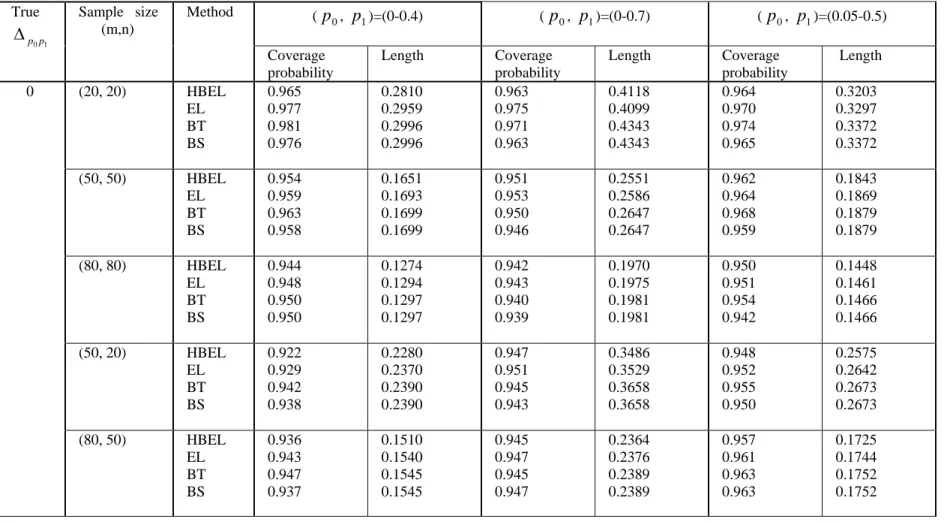
Table I: Level of 95 per cent confidence interval for
1 0p p
Δ . Bivariate normal distribution with ρ =0.
(p0, p1)=(0-0.4) (p0, p1)=(0-0.7) (p0, p1)=(0.05-0.5) True 1 0p p Δ Sample size (m,n) Method Coverage probability Length Coverage probability Length Coverage probability Length (20, 20) HBEL EL BT BS 0.965 0.977 0.981 0.976 0.2810 0.2959 0.2996 0.2996 0.963 0.975 0.971 0.963 0.4118 0.4099 0.4343 0.4343 0.964 0.970 0.974 0.965 0.3203 0.3297 0.3372 0.3372 (50, 50) HBEL EL BT BS 0.954 0.959 0.963 0.958 0.1651 0.1693 0.1699 0.1699 0.951 0.953 0.950 0.946 0.2551 0.2586 0.2647 0.2647 0.962 0.964 0.968 0.959 0.1843 0.1869 0.1879 0.1879 (80, 80) HBEL EL BT BS 0.944 0.948 0.950 0.950 0.1274 0.1294 0.1297 0.1297 0.942 0.943 0.940 0.939 0.1970 0.1975 0.1981 0.1981 0.950 0.951 0.954 0.942 0.1448 0.1461 0.1466 0.1466 (50, 20) HBEL EL BT BS 0.922 0.929 0.942 0.938 0.2280 0.2370 0.2390 0.2390 0.947 0.951 0.945 0.943 0.3486 0.3529 0.3658 0.3658 0.948 0.952 0.955 0.950 0.2575 0.2642 0.2673 0.2673 0 (80, 50) HBEL EL BT BS 0.936 0.943 0.947 0.937 0.1510 0.1540 0.1545 0.1545 0.945 0.947 0.945 0.947 0.2364 0.2376 0.2389 0.2389 0.957 0.961 0.963 0.963 0.1725 0.1744 0.1752 0.1752
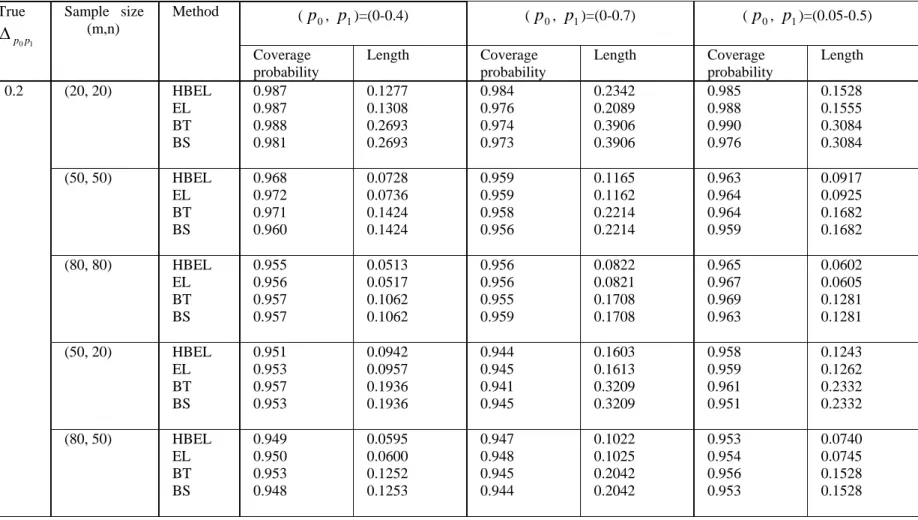
Table II: Level of 95 per cent confidence interval for
1 0p p
Δ . Bivariate normal distribution with ρ =0.
(p0, p1)=(0-0.4) (p0, p1)=(0-0.7) (p0, p1)=(0.05-0.5) True 1 0p p Δ Sample size (m,n) Method Coverage probability Length Coverage probability Length Coverage probability Length (20, 20) HBEL EL BT BS 0.987 0.987 0.988 0.981 0.1277 0.1308 0.2693 0.2693 0.984 0.976 0.974 0.973 0.2342 0.2089 0.3906 0.3906 0.985 0.988 0.990 0.976 0.1528 0.1555 0.3084 0.3084 (50, 50) HBEL EL BT BS 0.968 0.972 0.971 0.960 0.0728 0.0736 0.1424 0.1424 0.959 0.959 0.958 0.956 0.1165 0.1162 0.2214 0.2214 0.963 0.964 0.964 0.959 0.0917 0.0925 0.1682 0.1682 (80, 80) HBEL EL BT BS 0.955 0.956 0.957 0.957 0.0513 0.0517 0.1062 0.1062 0.956 0.956 0.955 0.959 0.0822 0.0821 0.1708 0.1708 0.965 0.967 0.969 0.963 0.0602 0.0605 0.1281 0.1281 (50, 20) HBEL EL BT BS 0.951 0.953 0.957 0.953 0.0942 0.0957 0.1936 0.1936 0.944 0.945 0.941 0.945 0.1603 0.1613 0.3209 0.3209 0.958 0.959 0.961 0.951 0.1243 0.1262 0.2332 0.2332 0.2 (80, 50) HBEL EL BT BS 0.949 0.950 0.953 0.948 0.0595 0.0600 0.1252 0.1253 0.947 0.948 0.945 0.944 0.1022 0.1025 0.2042 0.2042 0.953 0.954 0.956 0.953 0.0740 0.0745 0.1528 0.1528
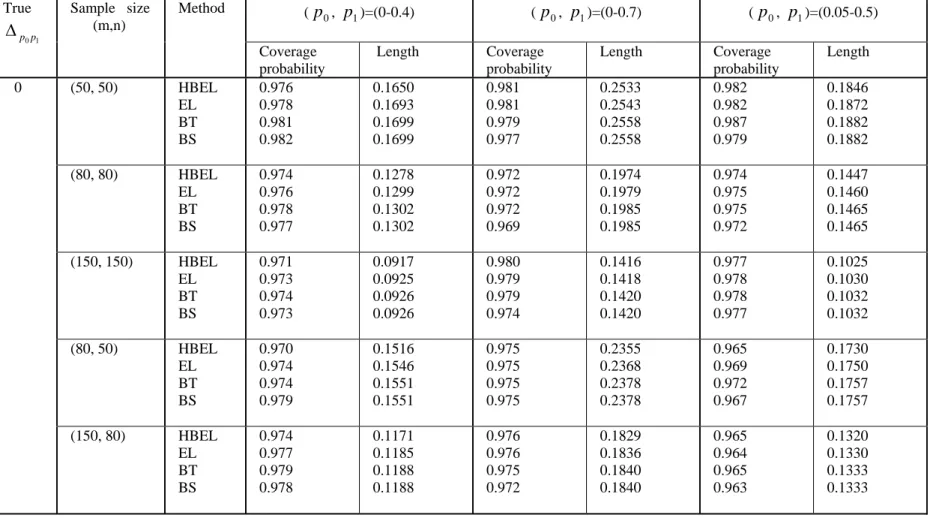
Table III: Level of 95 per cent confidence interval for
1 0p p
Δ . Bivariate normal distribution with ρ =0.3.
(p0, p1)=(0-0.4) (p0, p1)=(0-0.7) (p0, p1)=(0.05-0.5) True 1 0p p Δ Sample size (m,n) Method Coverage probability Length Coverage probability Length Coverage probability Length (50, 50) HBEL EL BT BS 0.976 0.978 0.981 0.982 0.1650 0.1693 0.1699 0.1699 0.981 0.981 0.979 0.977 0.2533 0.2543 0.2558 0.2558 0.982 0.982 0.987 0.979 0.1846 0.1872 0.1882 0.1882 (80, 80) HBEL EL BT BS 0.974 0.976 0.978 0.977 0.1278 0.1299 0.1302 0.1302 0.972 0.972 0.972 0.969 0.1974 0.1979 0.1985 0.1985 0.974 0.975 0.975 0.972 0.1447 0.1460 0.1465 0.1465 (150, 150) HBEL EL BT BS 0.971 0.973 0.974 0.973 0.0917 0.0925 0.0926 0.0926 0.980 0.979 0.979 0.974 0.1416 0.1418 0.1420 0.1420 0.977 0.978 0.978 0.977 0.1025 0.1030 0.1032 0.1032 (80, 50) HBEL EL BT BS 0.970 0.974 0.974 0.979 0.1516 0.1546 0.1551 0.1551 0.975 0.975 0.975 0.975 0.2355 0.2368 0.2378 0.2378 0.965 0.969 0.972 0.967 0.1730 0.1750 0.1757 0.1757 0 (150, 80) HBEL EL BT BS 0.974 0.977 0.979 0.978 0.1171 0.1185 0.1188 0.1188 0.976 0.976 0.975 0.972 0.1829 0.1836 0.1840 0.1840 0.965 0.964 0.965 0.963 0.1320 0.1330 0.1333 0.1333
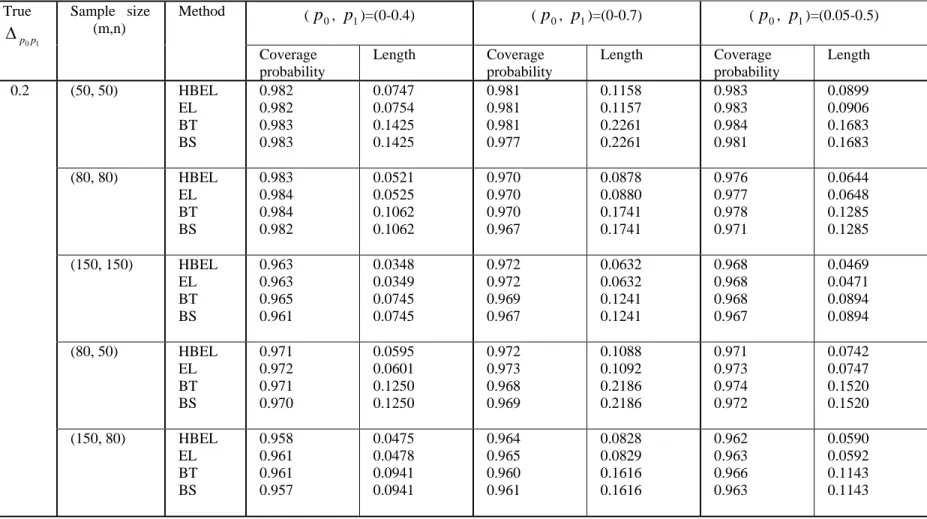
Table IV: Level of 95 per cent confidence interval for
1 0p p
Δ . Bivariate normal distribution with ρ =0.3.
(p0, p1)=(0-0.4) (p0, p1)=(0-0.7) (p0, p1)=(0.05-0.5) True 1 0p p Δ Sample size (m,n) Method Coverage probability Length Coverage probability Length Coverage probability Length (50, 50) HBEL EL BT BS 0.982 0.982 0.983 0.983 0.0747 0.0754 0.1425 0.1425 0.981 0.981 0.981 0.977 0.1158 0.1157 0.2261 0.2261 0.983 0.983 0.984 0.981 0.0899 0.0906 0.1683 0.1683 (80, 80) HBEL EL BT BS 0.983 0.984 0.984 0.982 0.0521 0.0525 0.1062 0.1062 0.970 0.970 0.970 0.967 0.0878 0.0880 0.1741 0.1741 0.976 0.977 0.978 0.971 0.0644 0.0648 0.1285 0.1285 (150, 150) HBEL EL BT BS 0.963 0.963 0.965 0.961 0.0348 0.0349 0.0745 0.0745 0.972 0.972 0.969 0.967 0.0632 0.0632 0.1241 0.1241 0.968 0.968 0.968 0.967 0.0469 0.0471 0.0894 0.0894 (80, 50) HBEL EL BT BS 0.971 0.972 0.971 0.970 0.0595 0.0601 0.1250 0.1250 0.972 0.973 0.968 0.969 0.1088 0.1092 0.2186 0.2186 0.971 0.973 0.974 0.972 0.0742 0.0747 0.1520 0.1520 0.2 (150, 80) HBEL EL BT BS 0.958 0.961 0.961 0.957 0.0475 0.0478 0.0941 0.0941 0.964 0.965 0.960 0.961 0.0828 0.0829 0.1616 0.1616 0.962 0.963 0.966 0.963 0.0590 0.0592 0.1143 0.1143
Table V: Level of 90 per cent confidence interval for
1 0p p
Δ . Bivariate normal distribution with ρ =0.
(p0, p1)=(0-0.4) (p0, p1)=(0-0.7) (p0, p1)=(0.05-0.5) True 1 0p p Δ Sample size (m,n) Method Coverage probability Length Coverage probability Length Coverage probability Length (20, 20) HBEL EL BT BS 0.919 0.930 0.942 0.934 0.2374 0.2506 0.2522 0.2522 0.939 0.939 0.932 0.925 0.3522 0.3529 0.3656 0.3656 0.935 0.942 0.944 0.933 0.2704 0.2792 0.2832 0.2832 (50, 50) HBEL EL BT BS 0.922 0.927 0.927 0.925 0.1390 0.1424 0.1428 0.1428 0.912 0.915 0.908 0.902 0.2130 0.2137 0.2148 0.2148 0.925 0.927 0.929 0.919 0.1556 0.1578 0.1582 0.1582 (80, 80) HBEL EL BT BS 0.896 0.902 0.906 0.902 0.1078 0.1095 0.1097 0.1097 0.922 0.922 0.922 0.919 0.1659 0.1663 0.1667 0.1667 0.900 0.906 0.907 0.896 0.1214 0.1225 0.1228 0.1228 (50, 20) HBEL EL BT BS 0.880 0.891 0.902 0.894 0.1921 0.1997 0.2010 0.2010 0.910 0.915 0.906 0.905 0.2959 0.3002 0.3077 0.3077 0.907 0.912 0.915 0.908 0.2168 0.2223 0.2240 0.2240 0 (80, 50) HBEL EL BT BS 0.889 0.894 0.898 0.891 0.1276 0.1302 0.1304 0.1304 0.889 0.889 0.887 0.885 0.1987 0.1998 0.2006 0.2006 0.900 0.903 0.908 0.902 0.1445 0.1463 0.1468 0.1468
Table VI: Level of 90 per cent confidence interval for
1 0p p
Δ . Bivariate normal distribution with ρ =0.
(p0, p1)=(0-0.4) (p0, p1)=(0-0.7) (p0, p1)=(0.05-0.5) True 1 0p p Δ Sample size (m,n) Method Coverage probability Length Coverage probability Length Coverage probability Length (20, 20) HBEL EL BT BS 0.965 0.966 0.969 0.962 0.1197 0.1228 0.2250 0.2250 0.953 0.953 0.946 0.944 0.1871 0.1851 0.3305 0.3305 0.953 0.957 0.960 0.936 0.1261 0.1283 0.2577 0.2577 (50, 50) HBEL EL BT BS 0.938 0.939 0.940 0.938 0.0638 0.0645 0.1201 0.1201 0.927 0.926 0.920 0.920 0.0985 0.0986 0.1892 0.1892 0.942 0.943 0.944 0.932 0.0744 0.0750 0.1408 0.1408 (80, 80) HBEL EL BT BS 0.923 0.924 0.924 0.923 0.0446 0.0449 0.0893 0.0893 0.915 0.915 0.911 0.909 0.0715 0.0715 0.1463 0.1463 0.927 0.928 0.928 0.915 0.0521 0.0523 0.1079 0.1079 (50, 20) HBEL EL BT BS 0.912 0.916 0.919 0.913 0.0869 0.0882 0.1630 0.1630 0.911 0.912 0.907 0.909 0.1363 0.1370 0.2700 0.2700 0.893 0.896 0.901 0.879 0.1045 0.1061 0.1963 0.1963 0.2 (80, 50) HBEL EL BT BS 0.921 0.922 0.929 0.919 0.0539 0.0544 0.1054 0.1054 0.892 0.892 0.891 0.887 0.0879 0.0880 0.1749 0.1749 0.915 0.916 0.916 0.900 0.0665 0.0670 0.1276 0.1276
Table VII: Level of 90 per cent confidence interval for
1 0p p
Δ . Bivariate normal distribution with ρ =0.3.
(p0, p1)=(0-0.4) (p0, p1)=(0-0.7) (p0, p1)=(0.05-0.5) True 1 0p p Δ Sample size (m,n) Method Coverage probability Length Coverage probability Length Coverage probability Length (50, 50) HBEL EL BT BS 0.954 0.961 0.965 0.959 0.1387 0.1422 0.1426 0.1426 0.966 0.966 0.964 0.962 0.2138 0.2146 0.2154 0.2154 0.954 0.956 0.957 0.953 0.1550 0.1572 0.1578 0.1578 (80, 80) HBEL EL BT BS 0.935 0.939 0.939 0.936 0.1072 0.1090 0.1091 0.1091 0.950 0.950 0.948 0.945 0.1654 0.1659 0.1662 0.1662 0.949 0.951 0.952 0.949 0.1219 0.1230 0.1233 0.1233 (150,150) HBEL EL BT BS 0.952 0.953 0.955 0.950 0.0772 0.0779 0.0780 0.0780 0.953 0.954 0.951 0.947 0.1193 0.1195 0.1197 0.1197 0.944 0.945 0.947 0.946 0.0861 0.0866 0.0867 0.0867 (80, 50) HBEL EL BT BS 0.935 0.939 0.941 0.934 0.1279 0.1305 0.1308 0.1308 0.941 0.941 0.941 0.936 0.1994 0.2004 0.2007 0.2007 0.946 0.949 0.951 0.945 0.1450 0.1467 0.1472 0.1472 0 (150, 80) HBEL EL BT BS 0.940 0.942 0.947 0.938 0.0984 0.0995 0.0997 0.0997 0.940 0.941 0.939 0.938 0.1541 0.1547 0.1549 0.1549 0.935 0.936 0.938 0.934 0.1109 0.1117 0.1119 0.1119
Table VIII: Level of 90 per cent confidence interval for
1 0p p
Δ . Bivariate normal distribution with ρ =0.3.
(p0, p1)=(0-0.4) (p0, p1)=(0-0.7) (p0, p1)=(0.05-0.5) True 1 0p p Δ Sample size (m,n) Method Coverage probability Length Coverage probability Length Coverage probability Length (50, 50) HBEL EL BT BS 0.956 0.958 0.958 0.954 0.0602 0.0608 0.1197 0.1197 0.946 0.946 0.948 0.946 0.0914 0.0912 0.1902 0.1902 0.965 0.965 0.965 0.963 0.0775 0.0781 0.1411 0.1411 (80, 80) HBEL EL BT BS 0.940 0.941 0.942 0.938 0.0438 0.0441 0.0889 0.0889 0.935 0.935 0.935 0.934 0.0766 0.0765 0.1457 0.1457 0.948 0.948 0.949 0.935 0.0531 0.0534 0.1075 0.1075 (150, 150) HBEL EL BT BS 0.925 0.925 0.925 0.925 0.0310 0.0312 0.0622 0.0622 0.944 0.945 0.941 0.938 0.0510 0.0510 0.1040 0.1040 0.954 0.955 0.954 0.944 0.0380 0.0381 0.0748 0.0748 (80, 50) HBEL EL BT BS 0.931 0.934 0.933 0.929 0.0542 0.0546 0.1053 0.1053 0.946 0.947 0.942 0.940 0.0868 0.0871 0.1752 0.1752 0.931 0.936 0.936 0.930 0.0648 0.0653 0.1279 0.1279 0.2 (150, 80) HBEL EL BT BS 0.909 0.913 0.912 0.909 0.0413 0.0415 0.0792 0.0792 0.936 0.936 0.935 0.932 0.0651 0.0652 0.1350 0.1350 0.931 0.933 0.933 0.925 0.0492 0.0494 0.0957 0.0957
Table IX: Dermatoscope Example Level of 95 per cent confidence interval for
1 0p
p
Δ
Method CI & Length
(p0, p1)= (0-0.4) (p0, p1)= (0-0.7) (p0, p1)= (0.05-0.5) HBEL Lower-Limit -0.10722 -0.11170 -0.09468 Upper-Limit 0.10722 0.11170 0.09468 CI_Length 0.21444 0.22340 0.18936 EL Lower-Limit -0.10913 -0.11129 -0.09512 Upper-Limit 0.10913 0.11129 0.09512 CI_Length 0.21826 0.22258 0.19024 BT Lower-Limit -0.10931 -0.11155 -0.09533 Upper-Limit 0.10931 0.11155 0.09533 CI_Length 0.21862 0.22310 0.19066 BS Lower-Limit -0.10945 -0.11714 -0.10025 Upper-Limit 0.10917 0.10596 0.09041 CI_Length 0.21862 0.22310 0.19066 Estimate of 1 0p p Δ -0.00014 -0.00559 -0.00492
Table X: Dermatoscope Example Level of 90 per cent confidence interval for
1 0p
p
Δ
Method CI & Length
(p0, p1)= (0-0.4) (p0, p1)= (0-0.7) (p0, p1)= (0.05-0.5) HBEL Lower-Limit -0.08697 -0.08704 -0.08132 Upper-Limit 0.08697 0.08704 0.08132 CI_Length 0.17394 0.17408 0.16263 EL Lower-Limit -0.08837 -0.08674 -0.08163 Upper-Limit 0.08837 0.08674 0.08163 CI_Length 0.17674 0.17349 0.16326 BT Lower-Limit -0.08846 -0.08687 -0.08176 Upper-Limit 0.08846 0.08687 0.08176 CI_Length 0.17693 0.17374 0.16353 BS Lower-Limit -0.08675 -0.08216 -0.08214 Upper-Limit 0.09018 0.09158 0.08139 CI_Length 0.17693 0.17374 0.16353 Estimate of 1 0p p Δ 0.00171 0.00471 -0.00037
APPENDIX C: The Splus code for simulation studies
#######################part 1: Functions#####################
## Function R(p)##
Rp<-function(p, muy, stdd) 1-pnorm(qnorm(1-p),muy, stdd)
## solveNonlinear##
##nlmin can be used to solve a system of nonlinear equations: solveNonlinear <- function(f, y0, x, ...){
# solve f(x) = y0
# x is vector of initial guesses, same length as y0 # ... are additional arguments to nlmin (not to f) g <- function(x, y0, f) sum((f(x) - y0)^2)
g$y0 <- y0 # set g's default value for y0 g$f <- f # set g's default value for f
nlmin(g, x, max.fcal = 10000, max.iter = 10000, ...) }
##calculate x[1]=y1.mean x[2]=y2.mean## mu <- function(x){
c( integrate(Rp, muy=x[1], stdd=y1.sd, lower=p0, upper = p1)$integral, integrate(Rp, muy=x[2], stdd=y2.sd, lower=p0, upper = p1)$integral ) }
##function for sigma##
my.mean <- function(vv) mean((vv-mean(vv))^2) ;
##solve x[1]: p0p1.1 x[2]: p0p1.2 x[3]: lamda
f <- function(x) c( mean((V.hat[,1]-x[1])/(1-2*x[3]*(V.hat[,1]-x[1]))), mean((V.hat[,2]-x[2])/(1+2*x[3]*(V.hat[,2]-x[2]))),
mean(V.hat[,2]/(1+2*x[3]*(V.hat[,2]-x[2])))-mean(V.hat[,1]/(1-2*x[3]*(V.hat[,1]-x[1]))))
##x[1]: p0p1.1 x[2]: p0p1.2 x[3]: lamda x[4]: delta using C.deltap0p1.hat g2 <- function(x) c( mean((V.hat[,1]-x[1])/(1-2*x[3]*(V.hat[,1]-x[1]))), mean((V.hat[,2]-x[2])/(1+2*x[3]*(V.hat[,2]-x[2]))), mean(V.hat[,2]/(1+2*x[3]*(V.hat[,2]-x[2])))-mean(V.hat[,1]/(1-2*x[3]*(V.hat[,1]-x[1])))-x[4], C.deltap0p1.hat*(2*(sum( log(abs(1-2*x[3]*(V.hat[,1]-x[1]))))+sum( log(abs(1+2*x[3]*(V.hat[,2]-x[2]))))))-CritVal)
##x[1]: p0p1.1 x[2]: p0p1.2 x[3]: lamda x[4]: delta using C.deltap0p1 g1 <- function(x) c( mean((V.hat[,1]-x[1])/(1-2*x[3]*(V.hat[,1]-x[1]))), mean((V.hat[,2]-x[2])/(1+2*x[3]*(V.hat[,2]-x[2]))), mean(V.hat[,2]/(1+2*x[3]*(V.hat[,2]-x[2])))-mean(V.hat[,1]/(1-2*x[3]*(V.hat[,1]-x[1])))-x[4], C.deltap0p1*(2*(sum( log(abs(1-2*x[3]*(V.hat[,1]-x[1]))))+sum( log(abs(1+2*x[3]*(V.hat[,2]-x[2]))))))-CritVal)
##function for deltapAUC.hat##
deltapAUC <- function(X1X2, Y1Y2, p0, p1, m){
# Caculate X Quantile of 1-pi (i=0,1) for q.hat q0.1.hat<-quantile(X1X2[,1],1-p0);
q1.1.hat<-quantile(X1X2[,1],1-p1); q1.2.hat<-quantile(X1X2[,2],1-p1);
# Caculate V(ki).hat & C(deltap0p1).hat V.hat<-matrix(, m, 2) for (i in 1 : m){ V.hat[i,1]<-(1-mean(Y1Y2[,1]<= X1X2[i,1]))*(q1.1.hat <= X1X2[i,1])*(X1X2[i,1]<=q0.1.hat) V.hat[i,2]<-(1-mean(Y1Y2[,2]<= X1X2[i,2]))*(q1.2.hat <= X1X2[i,2])*(X1X2[i,2]<=q0.2.hat) } delta.pAUC.hat<-mean(V.hat[,2])-mean(V.hat[,1]) C.deltap0p1.hat<-(my.mean(V.hat[,1])+my.mean(V.hat[,2]))/(m*Vstar)
list(delta.pAUC.hat, C.deltap0p1.hat, V.hat) }
##bootstrap function##
booth.trap <- function(B, X1X2, Y1Y2, m, n, p0, p1){ delta.pAUC<-0;
sigma <- matrix(,B, 2) for (b in 1:B) {
X1B <- sample(X1X2[,1], m, replace = T) X2B <- sample(X1X2[,2], m, replace = T) Y1B <- sample(Y1Y2[,1], n, replace = T) Y2B <- sample(Y1Y2[,2], n, replace = T)
q0B.1.hat<-quantile(X1B, c(1-p0)) # hatq0, hatq1: sample quantiles of F q0B.2.hat<-quantile(X2B, c(1-p0)) # hatq0, hatq1: sample quantiles of F q1B.1.hat<-quantile(X1B, c(1-p1)) q1B.2.hat<-quantile(X2B, c(1-p1)) VB <- matrix(,m, 2) for (i in 1:m) {
VB[i,1]<- (1-mean(Y1B <= X1B[i])) *(q1B.1.hat <= X1B[i])*(X1B[i] <= q0B.1.hat) VB[i,2]<- (1-mean(Y2B <= X2B[i])) *(q1B.2.hat <= X2B[i])*(X2B[i] <= q0B.2.hat) } sigma[b,1]<-my.mean(VB[,1]) sigma[b,2]<-my.mean(VB[,2]) delta.pAUC[b]<-mean(VB[,2])-mean(VB[,1]) } list(delta.pAUC, sigma) }
########################### End function part ####################
########################### Part2: initial value################## iter<-1000 B=150 rho=0 #rho=0.3 m<-50; n<-20; y1.sd<-2; y2.sd<-2; levelc<-0.95 #levelc<-0.90
CritVal<-qchisq(levelc,1) Z<-qnorm(1-(1-levelc)/2) y1.mean<-y2.mean<-0 p0<-0 ; p1<-0.4 pAUC1 <- 0.2 pAUC2 <- 0.2 deltapAUC.true<- pAUC2-pAUC1
S<-solveNonlinear(mu, c( pAUC1, pAUC2), c(0.1, 0.1)) y1.mean<-S$x[1] y2.mean<-S$x[2] #################### End part2 ####################### #################### Part3: Loop ################### CovCount<-c(0,0,0,0) CIL<-c(0,0,0) #LP<-c(0,0,0,0) #UP<-c(0,0,0,0)
for ( i12 in c(1:iter)){
# generate non-diseased population F(X1, X2)
# the sample from 2-dimensinal multinormal distribution with mean 0 and std=1 X1X2<-rmvnorm(m, mean=c(0,0), cov=matrix(c(1,rho,rho,1),2))
# generate diseased population G(Y1,Y2)
# the sample from 2-dimensinal multinormal distribution with mean #(y1.mean,y2.mean) and std=(y1.sd,y2.sd)
Y1Y2<-rmvnorm(n, mean=c(y1.mean,y2.mean),
cov=matrix(c(y1.sd^2,rho*y1.sd*y2.sd, rho*y1.sd*y2.sd, y2.sd^2),2))
##### 1. bootstrap ######
boot.list<- booth.trap(B, X1X2, Y1Y2, m, n, p0, p1)
delta.pAUC <- boot.list[[1]] sigma <- boot.list[[2]]
delta.pAUCbar.B<-mean(delta.pAUC); delta.pAUCbar.B # Estimate mean difference of two pAUCs by bootstrap
Vstar<-var(delta.pAUC); #Variance of delta.pAUC by bootstrap
C.deltap0p1<-(mean(sigma[,1])+mean(sigma[,2]))/(m*Vstar);
#####END OF BOOTSTRAP#######
###### 2. Caculate delta.pAUC.hat######
delta.pAUC.hat.list <- deltapAUC(X1X2, Y1Y2, p0, p1, m)
delta.pAUC.hat <- delta.pAUC.hat.list[[1]] C.deltap0p1.hat <- delta.pAUC.hat.list[[2]] V.hat <- delta.pAUC.hat.list[[3]]
###### 3. caculate L.deltap0p1###### # EL Method # #x[1]: p0p1.1 x[2]: p0p1.2 x[3]: lamda x<-solveNonlinear(f, c( 0,0, deltapAUC.true), c(0.1, 0.2, 0)) p0p1.1<-x$x[1]; p0p1.2<-x$x[2]; lamda<-x$x[3]; l.delta.p0p1<-2*(sum( log(1-2*lamda*(V.hat[,1]-p0p1.1)))+sum( log(1+2*lamda*(V.hat[,2]-p0p1.2)))) Vel<-C.deltap0p1*l.delta.p0p1; Vel.hat<-C.deltap0p1.hat*l.delta.p0p1; ####END OF 3. ######
###### 4. Caculate C.I and coverage######
## compute the HBEL interval(Vel from bootstrap)## if (Vel <= CritVal)
CovCount[1]<-CovCount[1]+1
#x[1]: p0p1.1 x[2]: p0p1.2 x[3]: lamda x[4]: delta
bd<-solveNonlinear(g1, c( 0,0,0,0), c(0.3, 0.1, 0.001, -0.9)) #low.HBEL<-bd$x[4] # lower limit of the CI
b<-solveNonlinear(g1, c( 0,0,0,0), c(0.1, 0.3, 0.001, 0.999)) #up.HBEL<-b$x[4] # upper limit of the CI
#low and up band HBEL #LP[1]<- LP[1]+bd$x[4] #UP[1]<- UP[1]+ b$x[4]
# The length of HBEL CI
CIL[1]<- CIL[1]+(b$x[4]- bd$x[4])
## compute the EL interval(Vel.hat)## if (Vel.hat <= CritVal)
CovCount[2]<-CovCount[2]+1
#x[1]: p0p1.1 x[2]: p0p1.2 x[3]: lamda x[4]: delta
lw<-solveNonlinear(g2, c( 0,0,0,0), c(0.3, 0.1, 0.001, -0.999)) #low.EL<-lw$x[4] # lower limit of the CI
upb<-solveNonlinear(g2, c( 0,0,0,0), c(0.1, 0.3, 0.001, 0.999)) #up.EL<-upb$x[4] # upper limit of the CI
#low and up band of El #LP[2]<- LP[2]+lw$x[4] #UP[2]<- UP[2]+ upb$x[4]
# The length of EL CI
CIL[2]<- CIL[2]+(upb$x[4]- lw$x[4])
## compute the BTI interval. hwidth<-Z*sqrt(Vstar)
# tlow<- delta.pAUC.hat-hwidth # lower limit of the CI
#tup<- delta.pAUC.hat+hwidth # upper limit of the CI
if (((delta.pAUC.hat-hwidth)<= deltapAUC.true) & ((delta.pAUC.hat+hwidth) >= deltapAUC.true)) CovCount[3]<-CovCount[3]+1
#low and up band
#LP[3]<-LP[3]+(delta.pAUC.hat-hwidth) #UP[3]<-UP[3]+(delta.pAUC.hat+hwidth)
CIL[3]<- CIL[3]+2*hwidth # The length of BT and BS CI
## compute the bootstrap(BS) interval
#bslow<- delta.pAUCbar.B-hwidth # lower limit of the CI
#bsup<- delta.pAUCbar.B+hwidth # upper limit of the CI
if (((delta.pAUCbar.B-hwidth) <= deltapAUC.true) &
((delta.pAUCbar.B+hwidth)>= deltapAUC.true)) CovCount[4]<-CovCount[4]+1 #low and up band
#LP[4]<-LP[4]+(delta.pAUCbar.B-hwidth) #UP[4]<-UP[4]+(delta.pAUCbar.B+hwidth) } cov<-CovCount/iter; cov #bound.L<-LP/iter #bound.U<-UP/iter wid<-CIL/iter;wid #Result Output sink("C:\\Temp\\new5020.txt",append = T)
cat("iter=", iter,"At level=", levelc, "m=", m, "n=",
n,"rho=",rho,"Delta=",deltapAUC.true, "p0=", p0, "p1=", p1, "\n")
cat("mean1=",y1.mean,"mean2=", y2.mean,"y1std=", y1.sd, "y2std=", y2.sd, "B=", B, "\n")
cat("Coverage of the (HBEL, EL, BT, BS) CI's for delta :", cov, "\n") cat("Average length of (HBEL,EL,BTI&BS):", wid, "\n")
cat("---","\n")
APPENDIX D: The Splus code for real data analysis
coln<-c("ID", "MTH1", "MTH2","GP") realdata<-read.table("C:\\TEMP\\Thesis\\exam3.dat",col.names=coln, header=F) realdata X1<-realdata$MTH1[realdata$GP==0]; X1 X2<-realdata$MTH2[realdata$GP==0]; X2 Y1<-realdata$MTH1[realdata$GP==1]; Y1 Y2<-realdata$MTH2[realdata$GP==1]; Y2 m=length(X1) n=length(Y1) levelc<-0.90; CritVal<-qchisq(levelc,1) #Z<-qnorm(levelc); Z<-qnorm(1-(1-levelc)/2) p0<-0.05; p1<-0.5; ###### part 1: Bootstrap ###### #### Bootstrap start #### B=500; sigma=pAUC=matrix(,B, 2) for (b in 1:B) { X1B <- sample(X1, m, replace = T) X2B <- sample(X2, m, replace = T) Y1B <- sample(Y1, n, replace = T) Y2B <- sample(Y2, n, replace = T)
q0B.1.hat<-quantile(X1B, c(1-p0)) # hatq0, hatq1: sample quantiles of F q0B.2.hat<-quantile(X2B, c(1-p0)) # hatq0, hatq1: sample quantiles of F q1B.1.hat<-quantile(X1B, c(1-p1)) q1B.2.hat<-quantile(X2B, c(1-p1)) VB <- matrix(,m,2) for (i in 1:m) {
VB[i,1]<- (1-mean(Y1B <= X1B[i])) *(q1B.1.hat <= X1B[i])*(X1B[i] <= q0B.1.hat)
VB[i,2]<- (1-mean(Y2B <= X2B[i]))*(q1B.2.hat <= X2B[i])*(X2B[i] <= q0B.2.hat)
}
sigma[b,1]<-mean((VB[,1]-mean(VB[,1]))^2) ##my.mean(VB[,1]) if using function sigma[b,2]<-mean((VB[,2]-mean(VB[,2]))^2) pAUC[b,1]<-mean(VB[,1]) pAUC[b,2]<-mean(VB[,2]) }
delta.pAUCbar.B<-mean(pAUC[,2]-pAUC[,1]) # Estimate mean difference of two pAUCs by bootstrap
#Vstar1<-var(pAUC[,1])+var(pAUC[,2]); #Vstar1
# V12<- sum((pAUC[,1]-mean(pAUC[,1]))*(pAUC[,2]-mean(pAUC[,2])))/(B-1) # Vstar2<-var(pAUC[,1])+var(pAUC[,2])-2*V12; #Vstar2
Vstar <- var(pAUC[,2]-pAUC[,1]); Vstar
C.deltap0p1<-(mean(sigma[,1])+mean(sigma[,2]))/(m*Vstar); C.deltap0p1; #bootstrap C.deltap0p1 to caculate HBEL
#######################Bootstrap end ##################
######Part 2: Caculate delta.pAUC.hat######
## Caculate X Quantile of 1-pi (i=0,1) for q.hat q0.1.hat<-quantile(X1,1-p0);q0.1.hat
q0.2.hat<-quantile(X2,1-p0);q0.2.hat q1.1.hat<-quantile(X1,1-p1); q1.1.hat q1.2.hat<-quantile(X2,1-p1); q1.2.hat
## Caculate V(ki).hat & C(deltap0p1).hat V1.hat<-V2.hat<-0
for (i in 1 : m){
V1.hat[i]<-(1-mean(Y1<= X1[i]))*(q1.1.hat <= X1[i])*(X1[i]<=q0.1.hat) V2.hat[i]<-(1-mean(Y2<= X2[i]))*(q1.2.hat <= X2[i])*(X2[i]<=q0.2.hat) } V1.hat V2.hat delta.pAUC.hat<-mean(V2.hat)-mean(V1.hat); delta.pAUC.hat #V1.hat; #V2.hat sigmap0p1.1.hat<-mean((V1.hat-mean(V1.hat))^2) sigmap0p1.2.hat<-mean((V2.hat-mean(V2.hat))^2) C.deltap0p1.hat<-(sigmap0p1.1.hat+sigmap0p1.2.hat)/(m*Vstar); C.deltap0p1.hat
######Part 3: Caculate C.I and coverage######
## compute the HBEL1 interval(Vel from bootstrap)## #x[1]: p0p1.1 x[2]: p0p1.2 x[3]: lamda x[4]: delta g1 <- function(x) c( mean((V1.hat-x[1])/(1-2*x[3]*(V1.hat-x[1]))), mean((V2.hat-x[2])/(1+2*x[3]*(V2.hat-x[2]))), mean(V2.hat/(1+2*x[3]*(V2.hat-x[2])))-mean(V1.hat/(1-2*x[3]*(V1.hat-x[1])))-x[4], C.deltap0p1*(2*(sum( log(abs(1-2*x[3]*(V1.hat-x[1]))))+sum( log(abs(1+2*x[3]*(V2.hat-x[2]))))))-CritVal) bd<-solveNonlinear(g1, c( 0,0,0,0), c(0.3, 0.1, 0.001, -0.9)) low.HBEL<-bd$x[4] # lower limit of the CI
b<-solveNonlinear(g1, c( 0,0,0,0), c(0.1, 0.3, 0.001, 0.999)) up.HBEL<-b$x[4] # upper limit of the CI
# The length of HBEL CI CIL.HBEL=up.HBEL- low.HBEL
## compute the EL interval(Vel.hat)## #x[1]: p0p1.1 x[2]: p0p1.2 x[3]: lamda x[4]: delta g2 <- function(x) c( mean((V1.hat-x[1])/(1-2*x[3]*(V1.hat-x[1]))), mean((V2.hat-x[2])/(1+2*x[3]*(V2.hat-x[2]))), mean(V2.hat/(1+2*x[3]*(V2.hat-x[2])))-mean(V1.hat/(1-2*x[3]*(V1.hat-x[1])))-x[4], C.deltap0p1.hat*(2*(sum( log(abs(1-2*x[3]*(V1.hat-x[1]))))+sum( log(abs(1+2*x[3]*(V2.hat-x[2]))))))-CritVal) lw<-solveNonlinear(g2, c( 0,0,0,0), c(0.3, 0.1, 0.001, -0.999)) low.EL<-lw$x[4]; # lower limit of the CI
up<-solveNonlinear(g2, c( 0,0,0,0), c(0.1, 0.3, 0.001, 0.999)) up.EL<-up$x[4]; # upper limit of the CI
# The length of EL CI CIL.EL=up.EL- low.EL
## compute the BT interval.
hwidth<-Z*sqrt(Vstar); hwidth
tlow<- delta.pAUC.hat-hwidth # lower limit of the CI
tup<- delta.pAUC.hat+hwidth # upper limit of the CI
CIL.BT<-2*hwidth # The length of BT and BS CI
## compute the bootstrap(BS) interval.
bslow<- delta.pAUCbar.B-hwidth # lower limit of the CI
bsup<- delta.pAUCbar.B+hwidth # upper limit of the CI
up=c(up.HBEL, up.EL, tup, bsup);up low=c(low.HBEL, low.EL, tlow, bslow);low wid=c(CIL.HBEL, CIL.EL, CIL.BT, CIL.BT);wid
#Result Output;
sink("C:\\temp\\real.txt", append = T)
cat("Real data At level=", levelc, "p0=", p0, "P1=", p1, "m=", m, "n=", n, "B=", B, "\n")
cat("delta.pAUCbar.B=", delta.pAUCbar.B, "delta.pAUC.hat=", delta.pAUC.hat, "\n" )
cat("upbound of the (HBEL, EL, BT, BS) CI's for real data are:", up , "\n")
cat("lowbound of the (HBEL, EL, BT, BS) CI's for real data are:", low , "\n")
cat("length of (HBEL,EL,BTI&BS):", wid, "\n")
cat("---","\n")