ADVANCED NATURAL LANGUAGE PROCESSING AND TEMPORAL MINING FOR CLINICAL DISCOVERY
Saeed Mehrabi
Submitted to the faculty of the University Graduate School in partial fulfillment of the requirements
for the degree Doctor of Philosophy
in the School of Informatics and Computing, Indiana University
Accepted by the Graduate Faculty, Indiana University, in partial fulfillment of the requirements for the degree of Doctor of Philosophy.
Doctoral Committee
Josette F. Jones, PhD, Chair
Mathew J. Palakal, PhD
Stanley Yung-Ping Chien, PhD
Xiaowen Liu, PhD
C. Max Schmidt, MD, MBA, PhD
© 2015 Saeed Mehrabi
DEDICATION Dedicated to my parents.
ACKNOWLEDGEMENTS
I would like to start by expressing my deepest gratitude to my advisor, Dr. Mathew Palakal, for his brilliant guidance, caring, patience, and providing me with an excellent atmosphere for doing research. I am sincerely grateful to all IUPUI faculties especially my thesis committee chair Dr. Josette Jones for her tremendous help during my PhD studies and thesis work. I also would like to thank my thesis committee members, Dr. Xiaowen Liu and Dr. Chen for accepting to be part of my thesis committee. I would like to thank Dr. Max Schmidt, Dr. Alex and Dr. Heidi Schmidt for their contribution and help in co-authoring various papers. The clinical significance of this work is indebted to Dr. Max Schmidt help and guidance. Special thanks to Regenstrief institute especially Dr. Paul Dexter, Joe Kesterson, and Chris Beesley. I acknowledge my gratitude to Anand Krishnan for his contribution and help. Finally, I would like to thank my colleagues at Mayo clinic especially Dr. Hongfang Liu, the NLP director at Mayo clinic for providing me with additional data to strengthen my explorations, Dr. Sunghwan Sohn for his help in comparison of our negation algorithm with his DepNeg algorithm and revising our Journal of Bioinformatics manuscript and Dr. Ravikumar Komandur Elayvilli for his feedbacks and suggestions.
Saeed Mehrabi
ADVANCED NATURAL LANGUAGE PROCESSING AND TEMPORAL MINING FOR CLINICAL DISCOVERY
There has been vast and growing amount of healthcare data especially with the rapid adoption of electronic health records (EHRs) as a result of the HITECH act of 2009. It is estimated that around 80% of the clinical information resides in the unstructured narrative of an EHR. Recently, natural language processing (NLP) techniques have offered opportunities to extract information from unstructured clinical texts needed for various clinical applications. A popular method for enabling secondary uses of EHRs is information or concept extraction, a subtask of NLP that seeks to locate and classify elements within text based on the context. Extraction of clinical concepts without considering the context has many complications, including inaccurate diagnosis of patients and contamination of study cohorts. Identifying the negation status and whether a clinical concept belongs to patients or his family members are two of the challenges faced in context detection. A negation algorithm called Dependency Parser Negation (DEEPEN) has been developed in this research study by taking into account the dependency relationship between negation words and concepts within a sentence using the Stanford Dependency Parser. The study results demonstrate that DEEPEN, can reduce the number of incorrect negation assignment for patients with positive findings, and therefore improve the identification of patients with the target clinical findings in EHRs. Additionally, an NLP system consisting of section segmentation and relation discovery was developed to identify patients’ family history. To assess the generalizability of the negation and family history algorithm, data from a different clinical institution was used in both algorithm evaluations.
The temporal dimension of extracted information from clinical records representing the trajectory of disease progression in patients was also studied in this project. Clinical data of patients who lived in Olmsted County (Rochester, MN) during
1966 to 2010 was analyzed in this work. The patient records were modeled by diagnosis matrices with clinical events as rows and their temporal information as columns. Deep learning algorithm was used to find common temporal patterns within these diagnosis matrices.
Table of Contents
LIST OF TABLES ... xi
LIST OF FIGURES ... xii
CHAPTER ONE: INTRODUCTION & BACKGROUND ...1
1.1 Problem Statement ...1
1.2 Clinical NLP Introduction and Background ...2
CHAPTER TWO: CONCEPT IDENTIFICATION ...4
2.1 Introduction ...4
2.1.1 Pancreatic Cyst ...6
2.2 Previous Works in Pancreatic Cyst Identification ...7
2.3 Methodology ...8
2.3.1 Pancreatic Cyst Identification ...8
2.3.2 Contextual Rule-Based Algorithm ...10
2.4 Datasets ...12 2.4.1 Development Dataset ...12 2.4.2 Monthly Dataset ...13 2.5 Results ...14 2.6 Discussion ...16 2.7 Conclusion ...18
CHAPTER THREE: NEGATION ...20
3.1 Introduction ...20
3.2 Previous Works ...21
3.3 DEpEndency ParsEr Negation (DEEPEN) ...25
3.4 Data Sources ...30
3.4.1 Indiana University Dataset ...30
3.4.2 Mayo Clinic Dataset ...30
3.5 Evaluation ...30
3.6 Results ...31
3.7 Discussion ...34
3.7.1 Error Analysis ...34
3.7.3 Future Work ...36
3.8 Conclusion ...36
CHAPTER FOUR: FAMILY HISTORY ...37
4.1 Introduction ...37
4.2 Related Works ...37
4.3 Methods...39
4.3.1 Section Header Detection ...40
4.3.2 Family Member and Diagnosis Identification ...44
4.3.3 Relation Between the Family Member and Diagnosis ...44
4.4 Dataset ...46
4.4.1 Indiana University (IU) ...46
4.4.2 Mayo Clinic ...46 4.5 Results ...46 4.6. Discussion ...49 4.6.1 Error Analysis ...49 4.6.2 Future Work ...51 4.7 Conclusion ...51
CHAPTER FIVE: TEMPORAL PATTERN DISCOVERY ...53
5.1 Introductions and Background ...53
5.1.1 Deep Learning ...55
5.1.2 ICD9 and HCUP CSS Diagnosis Codes ...55
5.2 Rochester Epidemiology Project ...56
5.3 Methods...58
5.3.1 Representation Model ...58
5.3.2 Deep Learning Algorithm for Temporal Pattern Discovery ...61
5.4 Results ...63
5.4.1 CCS-HCUP Diagnosis Codes ...63
5.4.2 ICD9 Diagnosis Codes ...66
5.5 Discussion ...68
5.5.1 Limitations ...69
5.6 Conclusion ...71
CHAPTER SIX: CLOSING REMARKS ...72
6.1 Summary of Contributions ...72
APPENDIX ...73
REFERENCES ...76 CURRICULUM VITAE
LIST OF TABLES
Table 2.1 Various Cyst Types and Their Associated Regular Expression Patterns ... 9
Table 2.2 Number of Patients and Their Reports in Each Month ... 13
Table 2.3 Number of Patients with Pancreatic Cyst in Each Month ... 14
Table 2.4 Number of Patients that Have Pancreatic Cyst, Family History of Pancreatic Cancer or Both ... 14
Table 2.5 Monthly Results of the Pancreatic Cyst Identification ... 15
Table 3.1 Example of Sentences Where NegEx Failed to Capture the Correct Negation Status of Concepts Denoted by Bold Letters ... 20
Table 3.2 DEEPEN Rules with Relevant Sentence Examples and Their SDP Relations, Concepts are shown in Bold and Negation Terms in Italic (See Appendix A for Detailed Dependency Relations) ... 29
Table 3.3 Comparison of the System's Result with Manually Annotated Sentences ... 31
Table 3.4 Comparison of DEEPEN and NegEx Algorithm on IU and Mayo Clinic Dataset ... 32
Table 3.5 Comparison of DEEPEN, DepNeg, and NegEx, on Sentences Reported in the DepNeg Paper (the bold words in the sentence column denoted concepts that were examined for negation status; gray cells denote correct cases for each column). .... 33
Table 4.1 Inter-Annotator Agreement for the Manual CRF Training Data Annotation ... 41
Table 4.2 List of Token Categories (Alias-i, 2008) ... 43
Table 4.3 Tokens of a Sentence with Their POS, Shallow Parser Generated by the System and Manually Tagged as BIO ... 44
Table 4.4 IU Dataset Evaluation ... 47
Table 4.5 Mayo Clinic Dataset Evaluation ... 47
Table 4.6 Results of Mayo Clinic Dataset Evaluation after System Customization ... 47
Table 4.7 Results of Family Member Identification ... 48
Table 5.1 Ten Most Frequent ICD9 Codes in the Cohort ... 59
LIST OF FIGURES
Figure 2.1 Regex Development Flowchart ... 5
Figure 2.2 Analysis Engines Used in the UIMA Pipeline ... 8
Figure 2.3 Contextual Rule-Based Flowchart ... 12
Figure 2.4 System Performance over the Study Period for Pancreatic Cyst Identification ... 16
Figure 3.1 Dependency Relations Between Tokens in a Sentence ... 25
Figure 3.2 Detailed Flowchart of the DEEPEN Algorithm ... 27
Figure 4.1 Analysis Engines Developed in the UIMA Pipeline to Identify Patients with FH of Pancreatic Cancer ... 46
Figure 4.2 Number of Identified Patients with one or more 1st, 2ed or 3rd Degree Relative ... 49
Figure 5.1 Patients Race Distribution ... 57
Figure 5.2 ICD9 Diagnosis Codes Histogram ... 58
Figure 5.3 HCUP Diagnosis Codes Histogram... 59
Figure 5.4 An Example of a Longitudinal Patient's Record Represented as a Matrix ... 61
Figure 5.5 The RBM Architecture with a Visible (v) and Hidden (h) Layer ... 62
Figure 5.6 Heatmaps of First Hidden Layer Weights ... 64
Figure 5.7 Heatmaps of Second Hidden Layer Weights ... 65
Figure 5.8 Heatmaps of Third Hidden Layer Weights ... 65
Figure 5.9 Heatmaps of First Hidden Layer Network with ICD9 Matrices as Inputs ... 66
Figure 5.10 Heatmaps of Second Hidden Layer Weights ... 67
Figure 5.11 Heatmaps of Third Hidden Layer Weights ... 67
CHAPTER ONE: INTRODUCTION & BACKGROUND 1.1Problem Statement
Electronic Health Records (EHR) contains valuable longitudinal clinical information that can be used for various applications such as Clinical Decision Support Systems (CDSS), medication reconciliation, public health emergency surveillance, quality measurements, etc. However these applications are not readily feasible due to unstructured nature of data represented in clinical documents. Natural Language Processing (NLP) has been used to extract and store clinical concepts in a structured format. Concept identification or extraction is one of the popular sub tasks of NLP in enabling secondary use of EHR. However this task is not easy because the meaning of a concept is significantly affected by modifiers such as negation (i.e. no symptom attributable to her pseudocyst) and family history (i.e. her father has diabetes). In this work, we have developed a novel negation algorithm to detect the negation status of clinical concept. The system was developed using the data of patients with pancreatic cyst and it was evaluated on any clinical disorder or sign and symptoms.
In the era of precision medicine, accurately identifying familial conditions is crucial for providing target treatment. Personalized medicine is defined as "the use of combined knowledge (genetic or otherwise) about a person to predict disease susceptibility, disease prognosis, or treatment response and thereby improve that person’s health" (Redekop & Mladsi, 2013). Personalized medicine could be misinterpreted as treatment developed uniquely for each individual therefore it is replaced with precision medicine in recent days.
Identification of familial conditions requires detailed family history information. The family history information can be available in clinical notes by “documenting parents’ and siblings’ age and health (or age and cause of death), as well as a checklist of conditions with environmental and hereditary etiologies” (Rich, et al., 2004). We have developed a rule-based NLP system to identify patients with family history of pancreatic cancer and evaluated our system on data of two institutions to assess its portability.
The extracted concepts across longitudinal patients’ records consist of phenotypic information, disease characteristics, treatment and outcome, which describe the patients’
course of disease. In order to represent the temporality of the extracted information from patients record, each patient’s records was modeled as a matrix of temporal clinical events where common pattern discovery methods can be applied to matrices representing a cohort of patients. In this work we developed a deep learning algorithm for temporal pattern discovery over longitudinal healthcare records.
Chapter two describes state of art concept identification and our experiments in detection of pancreatic cyst concepts from clinical records. Chapters three and four focus on two challenges of identification of concept within a sentence namely negation and family history. If we consider the temporal order of the extracted concepts, we can find common phenotypic patterns among cohort of patients with similar conditions. In chapter five, we describe our model to represent each patient records as a diagnosis matrix and a deep Boltzmann machines that was used to find common temporal patterns on a cohort of patients.
1.2 Clinical NLP Introduction and Background
NLP allows computers to understand natural language used by humans as opposed to artificial language used by computers and is defined as the “formulation and investigation of computationally effective mechanisms for communication through natural language” (Carbonell & Hayes, 1992).
Patients’ medical records (e.g. radiology reports, pathology reports, clinical notes, and discharge summaries) include wealth of information about patients that are in free text format. NLP can be very useful tool in extracting information from these free text format documents and creating structured information that can be used for further knowledge extraction by researchers. Research on processing of natural language in clinical notes has been slower in comparison to other domains such as biomedical or general English due to HIPAA privacy concerns in sharing clinical data and lack of common standards in annotation. One of the oldest and most studied clinical NLP systems is the Medical Language Extraction and Encoding System (MedLEE) developed by Carol Friedman et al at the Columbia University in the mid 90s (Friedman, Hripcsak, DuMouchel, Johnson, & Clayton, 1995). MedLEE was initially developed on chest radiology reports (Friedman, Alderson, Austin, Cimino, & Johnson, 1994), however it is
now, extended to any kind of clinical notes. Informatics for Integrating Biology and the Bedside (i2b2) is an NIH-funded national center that has organized shared tasks focusing on problems less studied in clinical NLP and sharing annotated clinical notes that removed some of barriers to the development of clinical NLP systems (Chapman, Nadkarni, Hirschman, W D'Avolio, Savova, & Uzuner, 2011). The first i2b2 challenge in 2006 was on automatic identification of smoking status of patients from information contained in discharge summaries (Uzuner, Goldstein, Luo, & Kohane, 2008). The second i2b2 challenge focused on obesity and its comorbidities (Uzuner Ö., 2009). It was a multi-label classification task that classified obesity and its comorbidities as present, absent, questionable or unmentioned in discharge summaries. The third i2b2-shared task (2009) was on medication extraction (Uzuner, Solti, & Cadag, 2010). Various NLP systems using regular expression, machine learning or hybrids of them were used to extract information such as medications, dosages, modes of administration, frequency of administration and the reason for administration. The fourth challenge (2010) was on extraction of concepts (problems, treatments or tests), assigning assertions (whether the concepts are present, absent associated with someone else, hypothetical, conditional or possible) and classifying relations between those concepts (with eight different types of relations, for instance: treatment worsened a medical problem, treatment improved a medical problem, etc.) (Uzuner, South, Shen, & DuVall, 2011). The fifth challenge (2011) was on anaphora resolution (Uzuner, Bodnari, Shen, Forbush, Pestian, & South, 2012). The sixth challenge was to correctly identify and interpret temporal relations. i2b2 provided a corpus of de-identified discharge summaries with annotated clinical events, temporal expressions and relations to the NLP community (Suna, Rumshisky, & Uzuner, 2013). The latest i2b2 challenge was on de-identification of medical records by removing protected health information (PHI) and identification of the risk factors of heart disease over time.
CHAPTER TWO: CONCEPT IDENTIFICATION 2.1 Introduction
Concept extraction or identification is a subtask of information extraction where phrases of interest are extracted from text. In clinical NLP, these concepts can be phrases referring to disorders (i.e. he had a hemiarthroplasty for osteonecrosis), sign and symptoms (i.e. His last seizure was on July), treatment or medication (hypertension was controlled on hydrochlorothiazide), etc.
Various tools have been developed for the recognition of diverse clinical entities including medications, dosages, anatomical sites, disease and disorders, etc. based on dictionaries (Eriksson, Jensen, Frankild, Jensen, & Brunak, 2013), rules (Sun & Nguyen, 2010) and machine learning algorithms (Jiang, et al., 2011) (Zhang & Elhadad, 2013) or combination of these methods (Xu, Hong, Tsujii, & Chang, 2012). However there is no single approach that is the Holy Grail for this problem. Domain adaptation is required in each approach for improved performance. Clinical terminologies are not only different across domains (cardiovascular versus orthopedics), but also distinctive from one type of clinical notes to the other, for instance the language used in radiology reports are unlike that of pathology reports. Therefore we can consider each particular domain of healthcare or type of clinical note as a sublanguage. Sublanguage is defined as "the specialized form of natural language which is used within a particular domain or subject matter" (Grishman & Kittredg, 1986). Sublanguage is characterized by a specialized vocabulary, syntax or semantic relationship.
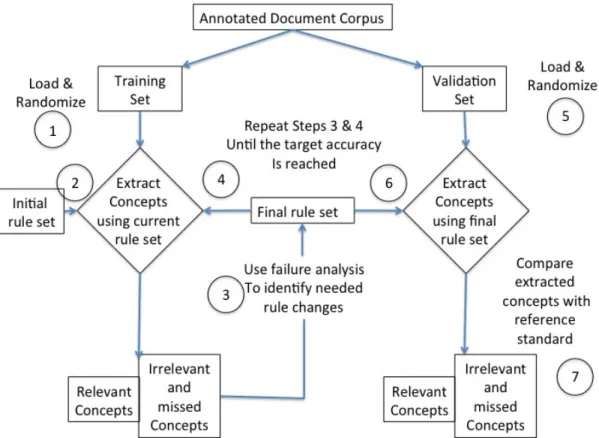
The pattern discovery in sublanguage analysis involves annotated corpora where concepts are marked based on their relevance or non-relevance to the extraction task. Normally pattern discovery starts with a set of initial patterns that are good candidates of the topic of interest. Figure 2.1 shows the regular expression pattern development flowchart where the annotated documents are divided into two parts of training and test sets and following steps are performed. Regular expression or regex is a pattern of characters matching specific strings of text.
1) Training set is loaded and randomized
3) The irrelevant extracted concepts and relevant missed concepts are used to modify the initial regex rules
4) Final rule set is applied to the train set (Steps 3 & 4 are repeated until the target accuracy is reached for the training data)
5) Test set is loaded and randomized 6) Final rule set is applied to the test set
7) Extracted concepts are compared to the reference standard to evaluate the accuracy of final regex rules.
Figure 2.1 Regex Development Flowchart
In this work, we built an NLP sublanguage model to identify patients with pancreatic cyst from unstructured clinical notes. In the followings, we provide a brief introduction on why identification of patients with pancreatic cyst is important and some of the previous works along with our methodology, dataset and results of our explorations.
2.1.1 Pancreatic Cyst
Cancer of pancreas is the fourth leading cause of death in the US (Howlader, et al., 2012) and eight in the world (Cancer Research UK, 2012). It is estimated that 48,960 (24,840 men and 24,120 women) will be diagnosed with and 40,560 (20,710 men and 19,850 women) will die of cancer of the pancreas in 2015. Although considerable progress has been made in cancer survival rates over the past decades, 5-year survival rate for pancreatic cancer has hardly changed, rising from 3% in 1975 to 5.8% in 2012 (Howlader, et al., 2012). The poor prognosis of pancreatic cancer is primarily due to its late stage diagnosis with more than 80% of patients presenting with locally advanced or metastatic disease where available systemic therapies remain largely ineffective (Howlader, et al., 2012). Therefore, the only chance for improving survival is to detect pancreatic cancer at an earlier stage (Cleary, et al., 2004).
Pancreatic cancer has several risk factors such as obesity, smoking, and alcohol intake but its exact causes are not yet known. Screening of general population for early identification of pancreatic cancer is not feasible because of its low incidence and lack of effective screening tests to identify patients at earlier stages of the disease. Yet, screening high-risk populations such as patients with a family history of pancreatic cancer and patients with pancreatic cysts represent two windows of opportunity for early detection of pancreatic cancer.
Family history of pancreatic cancer increases the risk of developing pancreatic cancer (Permuth-Wey & Egan, 2009). One first-degree relative (a parent or sibling) with pancreatic cancer increases the risk to 7 to 9-fold and three or more first-degree relatives with pancreatic cancer increase the risk to 17 to 32-fold (Klein, et al., 2004). Risk is also increased if a first-degree relative was diagnosed with pancreatic cancer before age 50 (Brune, et al., 2010).
Pancreatic cysts are well-recognized precancerous lesions. Several studies report their incidence in 2.6% of abdominal CTs and in up to 20% of MRI studies. (Laffan , et al., 2008), (Lee, Kim, Choi, Hong, & Kim, 2011) (Zhang, Mitchell, Dohke, Holland, & Parker, 2002). Pancreatic cysts have degrees of malignancy based upon their type and degree of dysplasia. There are various types of pancreatic cysts, which include pseudocysts, serous cystic neoplasms (SCN), mucinous cystic neoplasms (MCN) and
intraductal papillary mucinous neoplasms (IPMN). Only MCN and IPMN may progress to invasive pancreatic adenocarcinoma (Pandol, Gukovskaya, Edderkaoui, Dawson, Eibl, & Lugea, 2012). Because these lesions are typically asymptomatic and incidentally detected, they are mostly ignored, though they still may harbor a malignant potential of 20% to 90% (Schmidt, et al., 2007), (Lennon & Wolfgang, 2013). Additionally, 10% of pancreatic cancers have a familial or hereditary component (Shi, Hruban, & Klein, 2009), (Permuth-Wey & Egan, 2009).
Accurate identification, surveillance and treatment of patients with pancreatic cysts or family history of pancreatic cancer represent an opportunity to prevent pancreatic cancer. Much information about pancreatic cysts and patient’s family history can be found in free text format in various narrative medical reports including pathology, cytopathology, radiology (MRI, CT, EUS) and physician’s clinical reports. Therefore NLP is required to harness the information embedded in clinical narratives.
2.2 Previous Works in Pancreatic Cyst Identification
Al-Haddad et al. (2013) used Regenstrief EXtraction tool (REX) to identify patients with a confirmed, pathological, diagnostic report of IPMN. (Al-Haddad, Friedlin, Kesterson, Waters, Aguilar-Saavedra, & Schmidt, 2010) REX is a rule-based NLP method that uses a window of words before and after a medical concept to determine if the concept is negated, affirmed, related to a patient or his family members. REX was applied to 165,000 clinical reports of 5694 patients and validated by testing its performance against a manually created surgical database of patients who had a surgical resection of IPMN at Indiana University (IU) hospital during 1985-2009. The NLP system detected 208 out of 215 patients who had a confirmed pathology report of IPMN in the surgical database, and it found an additional 37 patients that were not included in the surgical database.
Friedlin et al. (2010) compared the identification of pancreatic cancer patients using ICD9 codes and NLP processing of clinical notes using REX (Friedlin, et al., 2010). Zhao et al used the PubMed knowledge and EHR data to develop a weighted Bayesian network (BN) to predict pancreatic cancer (Zhao & Weng, 2011). A weight score was calculated for twenty selected risk factors of pancreatic cancer based on the
positive, negative and neutral association between these risk factors and pancreatic cancer using PubMed articles. The risk factors were then used in construction of a BN with a weighted inference model. The EHR data of patients with and without pancreatic cancer were used to predict risk of pancreatic cancer patients. In another study, Markov chain model was used to compare four different management strategies (pancreaticoduodenectomy, yearly non-invasive surveillance, yearly invasive surveillance, do nothing) in patients with branch duct IPMN (Weinberg, Spiegel, Tomlinson, & Farrell, 2010). PancPRO is a Bayesian modeling framework used to assess the pancreatic cancer risk of patients with family history of pancreatic cancer (Wang, Chen, Brune, Hruban, Parmigiani, & Klein, 2007). A genetic model for mutation susceptibility was specified and prevalence associated with these mutations was estimated. Bay’s rule was used to convert the genotype probability given phenotypic information.
2.3Methodology 2.3.1 Pancreatic Cyst Identification
Unstructured Information Management Architecture (UIMA) was used as the framework for developing our text-mining system. UIMA is a software architecture developed by IBM for the analysis of unstructured content that includes text, audio or video data. It is openly available through the Apache software foundation (Ferrucci & Lally, 2004). UIMA is composed of processing units called analysis engine (AE) that analyze unstructured data and infers information from them. AEs are constructed from analysis logics called annotators. An AE may contain a single annotator (called primitive AE) or multiple annotators (called aggregate AE). Figure 2.2 shows the UIMA pipeline integrated to extract the information from medical reports. The input goes through a series of tasks depicted in each block. The input for every step is the output of its predecessor task.
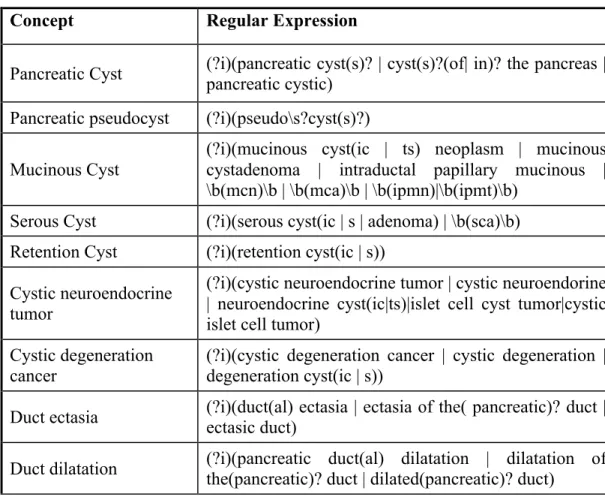
The initial input is a text file containing all the reports for all the patients. Report separator AE in this pipeline separates each report. Each report has Metadata information such as medical record number (MRN), report id, report name, report date and report body that is the notes dictated by physicians. Metadata annotator AE extracts these Metadata from each report using regular expressions. The next AE is the cTAKES sentence detector (Savova, et al., 2010). This is a UIMA wrapper around the openNLP sentence detector (OpenNLP), which was originally used during the first pass. Because sentences were breaking on new lines, it was replaced with Ytex sentence detector. Ytex sentence detector is a modified version of cTAKES to deal with breaking sentences on new lines (Garla, et al., 2011). The cyst annotator AE extracts cyst concepts within each report using regular expression. Table 2.1 shows each concept and the regular expression developed to extract it from the patients’ medical reports.
Table 2.1 Various Cyst Types and Their Associated Regular Expression Patterns
Concept Regular Expression
Pancreatic Cyst (?i)(pancreatic cyst(s)? | cyst(s)?(of| in)? the pancreas | pancreatic cystic) Pancreatic pseudocyst (?i)(pseudo\s?cyst(s)?)
Mucinous Cyst
(?i)(mucinous cyst(ic | ts) neoplasm | mucinous cystadenoma | intraductal papillary mucinous | \b(mcn)\b | \b(mca)\b | \b(ipmn)|\b(ipmt)\b)
Serous Cyst (?i)(serous cyst(ic | s | adenoma) | \b(sca)\b) Retention Cyst (?i)(retention cyst(ic | s))
Cystic neuroendocrine tumor
(?i)(cystic neuroendocrine tumor | cystic neuroendorine | neuroendocrine cyst(ic|ts)|islet cell cyst tumor|cystic islet cell tumor)
Cystic degeneration cancer
(?i)(cystic degeneration cancer | cystic degeneration | degeneration cyst(ic | s))
Duct ectasia (?i)(duct(al) ectasia | ectasia of the( pancreatic)? duct | ectasic duct) Duct dilatation (?i)(pancreatic duct(al) dilatation | dilatation of the(pancreatic)? duct | dilated(pancreatic)? duct)
Concepts that are used to identify pancreatic cysts in medical records were assembled by our medical team and additional keywords were added by searching through literature and Unified Medical Language System (UMLS) knowledge base (Al-Haddad, Friedlin, Kesterson, Waters, Aguilar-Saavedra, & Schmidt, 2010). The initial set of regular expressions based on these concepts was applied to the development dataset described in more detail in section 2.3.1. The false positives and false negative cases were analyzed and the regular expression patterns were modified accordingly. This process was repeated several times until we reached the target precision and recall on the training set. At the final step the algorithm was applied to the test set for evaluation.
The regular expressions shown in Table 2.1 only match text strings in clinical notes without considering the contextual information surrounding the concept of interest. For instance, the concept “ductal extasia” in the sentence “Chronic mastitis or ductal ectasia left breast” does not exist in pancreas or the concept “pancreatic ductal dilatation” identified in the following sentence “No pancreatic ductal dilatation is visualized.” is negated.
We developed a rule-based algorithm described in the next section to remove concepts that happened in other organ than pancreas. In order to identify the negation status of concepts, we used a widely used negation algorithm called NegEx (Chapman, Bridewell, Hanbury, Cooper, & Buchanan, 2001). NegEx is a string-matching algorithm that looks for negation terms such as ‘No’, ‘No evidence of’, ‘Rule out’, etc., within the sentence containing the concept. Because NegEx failed to consider the contextual relationship between negation words and concepts, we used Dependency parser on top of NegEx to improve its performance. Dependency parser is a binary asymmetric relation that holds between a token (word) and its dependents in a sentence. Chapter three provides more detailed on our negation methodology.
2.3.2 Contextual Rule-Based Algorithm
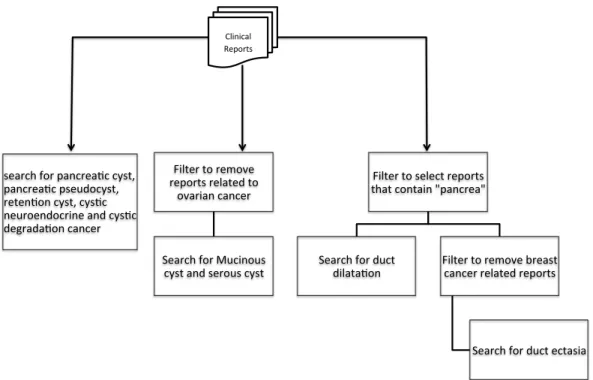
Sentences A to D in this section represent sentences that were extracted based on patterns listed in Table 2.1. Sentence “A” was extracted because it contained the keywords “dilated duct” which could identify the presence of pancreatic duct dilatation. However, duct dilatation can also occur in the biliary system or breast tissue therefore
only clinical records that contained the term “pancrea” were selected before searching for the pancreatic dilated duct concept.
A) “Additional views were obtained of the right breast in the retro-areolar region which demonstrate dilated ducts and increased nodularity as well as two coarse calcifications.”
Sentences “B” and “C” extracted because they contained the “ductal ectasia” concept. Both of these sentences are not related pancreatic ductal ectasia, therefore ductal ectasia was only searched in reports that contained the keyword “pancrea” but did not contain breast-related terms: “breast,” “nipple,” “areola,” or “mammogram,” or biliary-related terms: “biliary,” “bile” or “biloma.”
B) FINDINGS: The liver is of normal size without intraparenchymal mass or biliary ductal ectasia.
C) Chronic mastitis or ductal ectasia left breast.
Mucinous and serous cysts can occur in the ovary (Sentence D) as well as in the pancreas. Thus, a filter was applied to search for keyword “ovary” to remove reports pertaining to ovarian-specific mucinous and serous cysts.
D) POSTOPERATIVE DIAGNOSIS: Left ovarian mucinous cystadenoma.
And finally, in the “Impression” section of radiology notes, the radiologist typically reports the final diagnosis, conclusions of the radiographic study and recommendations for further evaluations. Such a report may contain a phrase like “evaluate for dilated ducts”, yet this recommendation does not mean that a patient has pancreatic dilated ducts. Therefore sentences that begin with “evaluate”, “assess” or “indicate” were removed.
Figure 2.3 shows a process that was adopted to remove unnecessary reports before applying the regex patterns.
Figure 2.3 Contextual Rule-Based Flowchart
2.4 Datasets
Longitudinal health records including discharge summary, surgical pathology document, imaging reports (abdominal MRI, CT with/without contrast, Ultrasound, etc.) and other clinical notes (procedure notes, visit notes, letter, consultation, etc.) of patients who visited the Sidney & Lois Eskenazi Hospital in Indianapolis was used in this study. The Eskenazi Hospital is a 316-bed hospital providing a comprehensive range of primary and specialty care services in central Indiana. It is comprised of providers who are faculty and residents of the IU School of Medicine. This study was conducted under an approved Institutional Review Board (IRB) protocol by IU.
2.4.1 Development Dataset
A random number of 44 patients were selected that contained the terms ‘pancreas’ and ‘cyst’ somewhere in their reports. From the patients with ‘pancreas’ and ‘cyst’ in a text report, all of their text reports of any type were extracted forming a corpus with 1064 reports.The average number of reports per patient in our corpus is 23.64 with minimum of 1 and maximum of 221 reports per patient. Pancreatic cysts were present in 28 out of
search'for'pancrea,c'cyst,' pancrea,c'pseudocyst,' reten,on'cyst,'cys,c' neuroendocrine'and'cys,c' degrada,on'cancer'' Filter'to'remove' reports'related'to' ovarian'cancer'' Search'for'Mucinous' cyst'and'serous'cyst' Filter'to'select'reports' that'contain'"pancrea"' Search'for'duct'
dilata,on' Filter'to'remove'breast'cancer'related'reports'
Search'for'duct'ectasia'
Clinical' Reports'
44 patients and absent in the remaining 16 patients’ records. The data set was randomly divided into two sets of train and test set, each containing 14 patients with pancreatic cyst and 8 patients with no pancreatic cysts. The test set is composed of 703 patient records, of which 509 belong to patients having pancreatic cysts and the remaining 194 records to patients without diagnosis of pancreatic cysts. The train set is composed of 316 patient records, of which 240 reports belong to patient having pancreatic cyst and the remaining 121 records to patients without pancreatic cysts. Two pancreatic-cyst surgeon experts created the gold standard data. The discrepancies between the two annotators were resolved by discussing the differences in annotation. Cohen’s kappa was used to measure the inter annotator agreement K=88% (Carletta, 1996)
2.4.2 Monthly Dataset
All patients who visited the Sidney & Lois Eskenazi Hospital in Indianapolis, Indiana for any reason during March-December 2013 were retrieved. Table 2.2 shows the number of patients and their reports for each month.
Table 2.2 Number of Patients and Their Reports in Each Month Month Total Number of
patients Total Number of reports March 7950 97535 April 6419 78451 May 6036 70100 June 7514 78110 July 7390 81991 August 7534 79072 September 7826 80973 October 7794 84868 November 7152 80916 December 7086 79957
2.5 Results
Table 2.3 shows the total number of patients identified with pancreatic cyst and their clinical records in each month.
Table 2.3 Number of Patients with Pancreatic Cyst in Each Month
Month #Identified Patients # Identified patients’ reports March 227 443 April 199 352 May 186 325 June 165 329 July 196 403 August 197 395 September 186 308 October 225 429 November 194 364 December 192 380
Table 2.4 shows the number of positively identified patients with pancreatic cysts, with a family history of pancreatic cancer and with both pancreatic cysts and a family history of pancreatic cancer.
Table 2.4 Number of Patients that Have Pancreatic Cyst, Family History of Pancreatic Cancer or Both
Months Pancreatic Cyst Family History of Pancreatic Cancer Pancreatic Cyst and FH of Pancreatic Cancer March 98 15 2 April 106 6 0 May 102 10 3 June 85 6 2 July 98 12 1 August 109 10 0 September 104 12 0 October 136 11 1 November 119 10 1 December 97 10 1
We used seven months of data from March to September 2013 in two rounds of evaluations to develop the pancreatic cyst detection algorithm. The last three months of data was used for final evaluation of the system. For each patient there would be either one or multiple sentences containing pancreatic cyst. The evaluation in Table 2.5 is based on patient level meaning that even if one sentence is affirmed, the patient is considered to be a positive case of pancreatic cyst. Conversely a patient does not have a cyst when the system correctly identifies all the sentences that are negated. We considered false positive and negative from a medical perspective (i.e., presence or absence of medical problem) meaning that if a patient has pancreatic cyst and the system considered that as a negative case (patient does not have pancreatic cyst), the result was evaluated as false negative. Similarly, if a patient does not have pancreatic cyst and the system result was affirmed (patient has pancreatic cyst), it was evaluated as false positive.
Table 2.5 Monthly Results of the Pancreatic Cyst Identification Month Ide nt if ie d P at ie nt s T rue P os it ive s T rue N ega ti ve s False N ega ti ve s False P os it ive s S ens it ivi ty S pe ci fi ci ty False P os it ive Ra te F irs t E va lua ti on Mar. 227 98 126 0 3 100 97.67 2.33 Apr. 199 93 104 0 2 100 98.11 1.89 May 186 83 100 0 3 100 97.09 2.91 Jun. 165 79 84 0 2 100 97.67 2.33 Jul. 196 97 96 1 2 98.9 8 97.96 2.04 Aug. 197 86 108 0 3 100 97.30 2.70 Sep. 186 78 103 0 5 100 95.37 4.63 S ec ond E va lua ti on Mar. 227 98 128 0 1 100 99.22 0.78 Apr. 199 93 106 0 0 100 100 0.00 May 186 83 102 0 1 100 99.03 0.97 Jun. 165 79 85 0 1 100 98.84 1.16 Jul. 196 97 97 1 1 98.9 8 98.98 1.02 Aug. 197 86 109 0 2 100 98.2 1.80 Sep. 186 78 104 0 4 100 96.3 3.7 Oct. 225 85 136 0 4 100 97.14 2.86 Nov. 194 73 119 0 2 100 98.35 1.65 Dec. 192 94 97 0 1 100 98.98 1.02
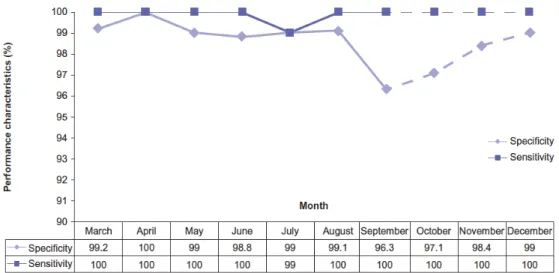
There were 1,359 patients with at least one mention of a ‘pancreatic cyst’ from March to September. Three of those identified patients were excluded (n = 1,356) because they were detected twice (one patient identified in June had previously been identified in March and two patients identified in August and September had previously been identified in July and August, respectively). The NLP algorithm identified 623 positive (patients with pancreatic cyst or pancreatic ductal dilation) patients. Manual (physician expert) review identified 615 positive patients (nine and one patients were found to be false positives and false negative, respectively). This resulted in a calculated prevalence of pancreatic cysts of 1.2%. Over the 7-month period, the mean sensitivity of the NLP algorithm for identification of a pancreatic cyst and/or ductal dilation was 99.85% (range 98.98–100). Similarly, the mean specificity was 98.8% (range 96.3–100) (Figure 2.4).
Figure 2.4 System Performance over the Study Period for Pancreatic Cyst Identification
2.6 Discussion
Pancreatic cancer is a deadly cancer due in part because it is typically diagnosed in advance stages when there is no effective treatment. Early detection of pancreatic cancer is possible through surveillance of patients at risk. Current strategies for early diagnosis of pancreatic cancer have focused on serum biomarkers. The most commonly used biomarker is serum carbohydrate antigen 19-9 (CA19-9). Its use as a screening tool in the general population, however, would be suboptimal because of its low sensitivity
(median 79%, range 70–90%) and specificity (median 82%, range 68–91%) (Goonetilleke & Siriwardena, 2007). Small studies have suggested that the use of a combination of biomarkers instead of an individual biomarker may improve sensitivity and specificity (Behnam & Smith, 2014) (Firpo, et al., 2009). Given the high genetic heterogeneity of pancreatic adenocarcinoma (Jones, et al., 2008), such may require a large number of biomarkers and is not likely to be routinely utilized soon. Similarly, cross-sectional imaging studies have low performance characteristics for screening pancreatic cancer in the general population (Sahani, Shah, Catalano, Boland, & Brugge, 2008) (Nabavizadeh, Greenleaf, Fatemi, & Urban, 2012).
Patients with pancreatic cysts or a hereditary predisposition to pancreatic cancer are considered to be at higher risk of developing cancer. Pancreatic cysts, especially mucinous cysts, are well-established precancerous lesions. As they have the potential to develop into invasive adenocarcinoma in a median of 5 years (range 2–20) (Tanaka, et al., 2006) (Tanaka, et al., 2012), tracking them closely for clinically relevant changes may represent a window of opportunity for pancreatic cancer prevention and early detection. This study showed that the NLP system could accurately detect patients with premalignant cysts (mucinous cysts), thus ensuring adequate management. Although ‘pseudocyst’ is a benign condition that alone does not require screening for pancreatic cancer, we included it in the final list of ‘pancreatic cyst’ concepts to be thorough and not miss patients with potentially other types of cysts. Our reasoning was based on manual review of multiple cross-sectional imaging studies reporting a pseudocyst in spite of the absence of clinical and radiological evidence of pancreatitis. Similarly, hypothetical terms, such as ‘may represent’, were considered affirmed to avoid missing patients with a potentially premalignant condition.
The present study, over a 10-month period, demonstrates that it is feasible and inexpensive to automate the identification of patients with pancreatic cyst(s) and/or pancreatic ductal dilation using NLP. Our algorithm allowed tracking of those patients with high sensitivity (99.9%) and specificity (98.8%). Although manual review remains an important part of the study, patient capture is easier, faster and more thorough when employing a NLP algorithm. Incidentally discovered pancreatic cysts may be inconsequential. The data currently available on the natural history of pancreatic cysts
and their malignant potential have some inherent selection/referral bias, and thus the percentage of truly consequential cysts might be lower in a general population screened by an automated process. The present study aimed to confirm feasibility of an automated process using NLP for pancreatic cyst screening. It accomplished this with high sensitivity and specificity. To analyze the potential for individual lives and cost-effectiveness, further studies including public health cost analyses would be needed to compare the cost of a preventive strategy with follow-up examinations versus the cost of pancreatic cancer treatment.
Once patients with pancreatic cysts are correctly identified, screening this ‘at risk’ subpopulation for pancreatic cancer may be more feasible because the pretest probability is increased, thus compensating for the suboptimal sensitivity/specificity of currently available biomarkers/imaging studies.
Beyond the identification and tracking of patients with pancreatic cysts, our system sets ground for improved pancreatic cancer screening. As this algorithm is adaptable, it can be incorporated into any hospital electronic system to help capture patients with pancreatic cysts. We anticipate the use of this algorithm as a template for other regional health information organizations (e.g. Boston, Utah, Stanford and Vanderbilt). The ultimate goal is to move towards establishment of a national pancreatic cyst registry. It may lead to a more organized national initiative for pancreatic cancer prevention and early detection, and optimal education of both healthcare providers and patients on current management and screening resources available.
2.7Conclusion
Patient care and clinical research up until the present are largely based on retrospective or prospective collection of data into databases, which is often done manually. The increased utilization of EHR by medical centers has created new patient care and clinical research possibilities. NLP helps researcher to automate the process of patient data extraction that eventually increases the research scope (data volume, time) and statistical power while decreasing the required manpower utilization. In this chapter, we described pancreatic cyst identification based on sublanguage analysis. We briefly touched on the importance of the contextual information surrounding a concept of interest
in concept identification task. For instance, the presence of a clinical finding in narrative patient’s report does not imply that the patient has the finding. In the next chapter, we describe our negation detection algorithm that is built on top of NegEx and compare its performance with NegEx on wide set of clinical concepts. Another contextual challenge is to determine if the identified concepts belong to patient or his family members. In chapter four we discuss our NLP system that is developed to identify patient with family history information.
CHAPTER THREE: NEGATION 3.1 Introduction
A study of negation has shown that clinical observations are frequently negated in clinical narratives (Chapman, Bridewell, Hanbury, Cooper, & Buchanan, 2001). For example, physicians often report that a condition is absent in a patient.
Negative clause is defined as “an assertion that some event, situation, or state of affairs does not hold. Negative clauses usually occur in the context of some presupposition, functioning to negate or counter-assert that presupposition” (Payne, 1997).
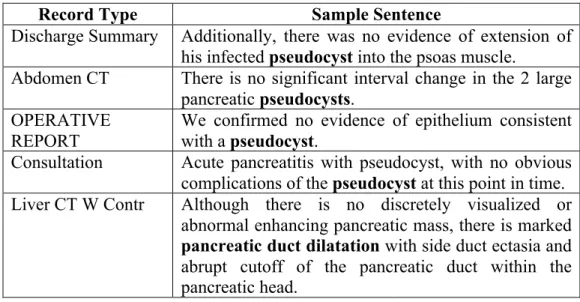
Negation detection in clinical language tends to be very trivial in sentences such as "no fracture", "patient denies headache", and “she does not have marked dysmenorrhea”. Therefore simplistic approaches such as NegEx (Chapman, Bridewell, Hanbury, Cooper, & Buchanan, 2001) that use negation cue words without considering the semantic of a sentence perform well. However, the simplistic approaches sometimes fail to correctly identify the negation status of clinical concepts in sentences with complex structure. We have faced with this problem while using NegEx in our NLP system that automates the identification and tracking of patients with pancreatic cysts described in the previous chapter (Roch, et al., 2015). Table 3.1 shows some examples of such sentences where NegEx incorrectly negates pancreatic cyst concepts.
Table 3.1 Example of Sentences Where NegEx Failed to Capture the Correct Negation Status of Concepts Denoted by Bold Letters
Record Type Sample Sentence
Discharge Summary Additionally, there was no evidence of extension of his infected pseudocyst into the psoas muscle.
Abdomen CT There is no significant interval change in the 2 large pancreatic pseudocysts.
OPERATIVE REPORT
We confirmed no evidence of epithelium consistent with a pseudocyst.
Consultation Acute pancreatitis with pseudocyst, with no obvious complications of the pseudocyst at this point in time. Liver CT W Contr Although there is no discretely visualized or
abnormal enhancing pancreatic mass, there is marked
pancreaticductdilatation with side duct ectasia and
abrupt cutoff of the pancreatic duct within the pancreatic head.
Aiming to reduce the number of missing pancreatic cyst patients in our NLP system inspired us to improve the negation assignment of NegEx by incorporating dependency parsing into NegEx. Dependency relation is a binary asymmetric relation between tokens within a sentence that has been shown to improve various NLP tasks including information extraction (Fundel, Küffner, & Zimmer, 2007), negation detection (Wilson, Wiebe, & Hoffmann, 2005), entity disambiguation (Finkel, Dingare, Nguyen, Nissim, Manning, & Sinclair, 2004) and many others (Cohen & Elhadad, 2012). We developed and tested our negation identification algorithm focusing on only pancreatic cyst concepts using a single institution data set. In order to evaluate its performance on other clinical concepts and dataset, we applied our system on 159 clinical notes from Mayo Clinic where clinical findings such as disorders and signs/symptoms have been annotated. We compared the performance of our algorithm on Mayo Clinic dataset with NegEx.
3.2 Previous Works
Negation detection has been the main or sub task of several challenges in NLP. Assertion classification was one of the three tasks in the 2010 i2b2/VA shared task where each medical concept had to be classified into one of six categories of “present”, “absent”, “possible”, “conditional”, “hypothetical”, and “not associated with the patient” (Uzuner, South, Shen, & DuVall, 2011). Processing modality and negation was the main task of Question Answering or Machine Reading Evaluation (QA4MRE) lab at CLEF 2011 (Morante & Daelemans, 2011). Negation and speculation in NLP (NeSp-NLP 2010) (Morante & Sporleder, 2010), identifying hedges and their scope in CoNLL-2010 shared task (Farkas, Vincze, Mora, Csirik, & Szarvas, 2010), and SEM 2012 shared task of resolving the scope and focus of negation (Morante & Blanco, 2012) are few other initiatives that show the growing importance of negation processing in the NLP research community.
Corpora used in 2010 i2b2/VA and CoNLL-2010 shared tasks are available to researcher with signing a data use agreement to facilitate the development and evaluation of clinical NLP algorithms. BioScope corpus that was used as part of the CoNLL-2010 shared task has been created by annotating negation and uncertainty in biomedical texts is
also publicly available (Vincze, Szarvas, Farkas, Móra, & Csirik, 2008). BioScope corpus consists of clinical text, abstract and full text of scientific articles. The free text clinical notes of BioScope corpus are the radiology reports from the 2007 ICD9 challenge of the Cincinnati children hospital (Pestian, et al., 2007). NegEx has released a de-identified physician annotated test set of 2,376 sentences from 120 clinical reports. Also an instruction on how to produce an annotation guideline for biomedical corpus with negation layer is available (Morante, 2010).
In negation detection, rule based techniques have been shown to be effective and widely used in many NLP systems (Savova, et al., 2010) (Friedman, Hripcsak, Shagina, & Liu H, 1999). Rule based negation systems can be token-based (e.g., NegEx (Chapman, Bridewell, Hanbury, Cooper, & Buchanan, 2001), NegExpander (Aronow, Feng, & Croft , 1999), NegFinder (Mutalik, Deshpande, & Nadkarni, 2001), NegHunter (Gindl, Kaiser, & Mik, 2008;)) ontology-based (Elkin, et al., 2005), or utilize syntactic parsing results (e.g., DepNeg (Sohn, Wu, & Chute, 2012), ChartIndex (Huang & Lowe, 2007), Ballesteros et al (Ballesteros, Francisco, Díaz, Herrera, & Gervás, 2012)). For example, NegEx processes one sentence at a time by finding negation and termination terms. Termination terms are conjunctions such as “but” that end the scope of negation terms. There are three types of negation in NegEx algorithm, pseudo negation terms that are similar to negation terms but do not negate clinical conditions, pre-condition negation terms that appear before the clinical findings, and post-condition negation terms that appear after the clinical findings. If a pseudo negation term is found, NegEx skips to the next negation term in the sentence and uses corresponding regular expressions based on pre/post negation terms. NegEx has been extended into an algorithm called ConText in order to determine if a clinical condition of interest is hypothetical, historical or experienced by someone other than patient in addition to negation identification (Harkema, Dowling, Thornblade, & Chapman, 2009). Both NegEx and ConText have been translated into other languages (Afzal, Pons, Kang, Sturkenboom, & Schuemie, 2014) (Skeppstedt, 2010).
There are some attempts to incorporate syntactic parsing to improve the negation detection (Sohn, Wu, & Chute, 2012) (Ballesteros, Francisco, Díaz, Herrera, & Gervás, 2012). For example, DepNeg is a dependency parser-based negation algorithm that
utilizes the dependency structure of a target named entity in the sentence instead of a fixed negation scope (Sohn, Wu, & Chute, 2012). DepNeg uses manual negation rules based on the patterns of dependency paths between the focus (i.e., named entity) and the potential negation terms in the text that enables correctly identifying problematic negations in the traditional negation algorithm, such as NegEx. Similarly, Ballesteros et al used Minipar dependency parser to determine the scope of negation terms by traversing the dependency path from sentence’s verb towards the end of the sentence. They could detect negation terms and their scope in clinical text of BioScope corpus with precision and recall of 0.958 and 0.906 respectively (Ballesteros, Francisco, Díaz, Herrera, & Gervás, 2012).
Machine learning has also been applied in negation detection. For instance, there are twenty-one systems developed for i2b2/VA assertion classification task where majority of them applied various machine learning algorithms including support vector machines (SVMs). The best system achieved 0.9326 micro-averaged F-measure using a 2-step approach. Where, in the first step, each word was represented as a feature vector consisting of n-gram, token category, and window of four tokens before and after the word, etc. and then a set of different classifiers were used to predict a score per class for each concept. In the second stage a multi-class SVM was used to predict the final assertion prediction for each token (de Bruijn, Cherry, Kiritchenko, Martin, & Zhu, 2011). Similar 2-step approach was applied to BioScope corpus by Diaz et al where each token in a sentence was classified as negation/speculation signal and a second classifier was used at a sentence level to determine the negation status of concept (Cruz Díaz, Maña López, Vázquez, & Álvarez V, 2012). Goldin and Champan compared Naïve Bayes and decision trees with default NegEx rule on 207 sentences of clinical records with negation “not”. The default NegEx rule negates any UMLS concept within six-word window of “not.” Naïve Bayes performed better than decision tree and baseline method with F-Measure of 0.90 (Goldin & Chapman, 2003).
Features used in machine learning algorithms may include results from rule-based systems as well as syntactic parsing results. For example, Grouin et al used SVM with NegEx and ConText dictionaries before or after a concept in a 5-word window (Grouin, et al., 2010). Wu et al (Wu, et al., 2014) also used SVM with following list of features, 1)
binary feature indicating if a given word appeared in a window size of 3,5 or 10 from the named entity 2) token in an exact distance from the named entity 3) negation terms 4) DepNeg dependency rules indicating whether a named entity is on the same dependency path as the negation word 5) constituency tree fragments to represent if a named entity is inside a phrase. They trained and test their system on four different corpora of SHARP NLP (Rea, et al., 2012), 2010 i2b2/VA, MiPACQ (Cairns, et al., 2011), and NegEx test sets and compared their system with YTEX (Garla, et al., 2011) implementation of NegEx algorithm. Their results were mixed and non conclusive, NegEx performed very well on NegEx test set (F-measure= 0.953) but the performance declined on other corpora with lowest F-measure of 0.623. Using a single versus all corpora for training the SVM has also generated mixed results that can be contributed to the diversity of their corpora.
As majority of the systems reviewed above are not publicly available, it is not feasible to compare various systems reported in the literature. Determining the scope of negation is a main challenge in most of rule based methods such as NegFinder that use a context free grammar parser especially when the distance between negation term and concept is more than a few words. For instance in the sentence “Based on this, he required no operative intervention for his pseudocyst.” Because of the negation term “no” NegEx will consider the concept “pseudocyst” as negated while “no” is associated with “operative intervention” and not the “pseudocyst”. DepNeg attempts to remove this deficiency using dependency parser and shows promising preliminary results while using a limited set of rules on 159 Mayo clinical notes. DepNeg was compared with cTAKES adoption of NegEx, which is customized to Mayo Clinic data. cTAKES is an open source natural language processing tool for information extraction from medical records developed by Mayo Clinic and released under Apache license (Savova, et al., 2010). DepNeg focused on improving the precision of NegEx therefore it decreased the number of false positives in comparison to cTAKES negation (cTAKES negation -FP: 34, DepNeg-FP: 6) but increased the number of false negatives (cTAKES negation-FN: 47, DepNeg-FN: 61) (Sohn, Wu, & Chute, 2012).
There are two approaches of graph-based and transition-based in dependency parser. DepNeg uses ClearParser (Choi & Palmer, 2011), which is a graph-based dependency parser to determine whether the negation words are on the same path as
clinical concepts and therefore negated. Unlike DepNeg, we use a transition-based dependency parser to find if there is any dependency relation between negation words and concepts. And because NegEx had low number of false negatives (high recall) in our training set, we only applied the dependency parser to concepts that are considered negated by NegEx unlike DepNeg that applies dependency parser to all sentences containing negation tokens.
3.3 DEpEndency ParsEr Negation (DEEPEN)
We have developed an algorithm called DEpEndency ParsEr Negation (DEEPEN) that uses a chain of nested dependency relations between the clinical findings and negation terms.DEEPEN evaluate concepts that are considered negated by NegEx algorithm; so if a concept is considered affirmed by NegEx, no action is taken. Stanford dependency parser (SDP) (de Marneffe, MacCartney, & Manning, 2006) is applied to sentences containing the negated concept. SDP comprises of 53 grammatical relations (det: determiner, infmod: infinitival modifier, etc.) that will be generated for words within a sentence (de Marneffe & Manning, 2008). The SDP output consists of dependency relation, governor term and dependent term. Dependency relation is the grammatical relation between dependent term and governor term. Governor term is the word in the sentence that the dependency relation is reported for and dependent term is the word that is dependent of the governor term. For instance as shown in Figure 3.1, in the sentence “Based on this, he required no operative intervention for his pseudocyst.”, det(intervention-9, no-7) “det” is the dependency relation, “intervention” is the governor term and “no” is the dependent term.
For every sentence with a concept that is considered negated by NegEx, a dependency chain is generated that is composed of three levels of token dependencies. First level token is governor of negation term, “evidence” in det (evidence-2, No-1). Second level tokens are dependents of first level tokens, “of” in prep (evidence-2, of-3). Third level tokens are dependents of second level tokens, “dilatation” pobj (of-3, dilatation-6). Dependency chain is the concatenation of these three levels of token dependencies, “evidence of dilatation”. If the concept is found in the dependency chain, it is negated otherwise it is affirmed. The concept “pancreatic duct dilatation” in the sentence “No evidence of pancreatic duct dilatation or common bile duct stones.” is in the dependency chain, therefore it is negated. For concepts that are noun phrase such as “pancreatic duct dilatation”, even if part of the noun phrase is in the dependency chain (dilatation), the concept is negated.
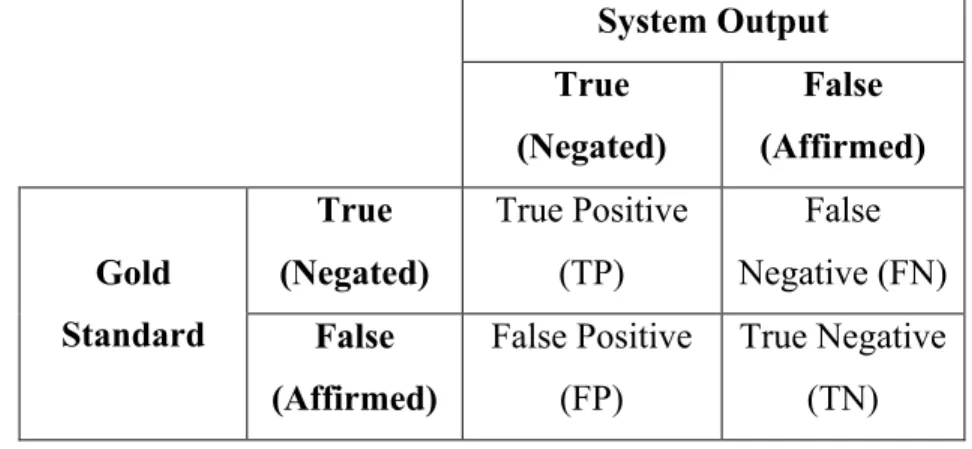
This basic rule fails in sentences with certain structures and therefore negated concepts are falsely identified as affirmed (i.e., false negative). We developed a set of rules to address the false negative results of applying DEEPEN on the IU training set. In the previous chapter, we considered false positive and negative from a medical perspective (i.e., presence or absence of medical problem) meaning that if a patient has pancreatic cyst and the system considered that as a negative case (patient does not have pancreatic cyst), the result was evaluated as false negative. Similarly, if a patient does not have pancreatic cyst and the system result was affirmed (patient has pancreatic cyst), it was evaluated as false positive. In information retrieval focusing on negation status, however, we evaluate True positive—both system and the gold standard negates the term; True negative—both system and the gold standard does not negate the term; False positive—System negates the term but the gold standard does not negate the term; False negative—System does not negate the term but the gold standard negates the term.
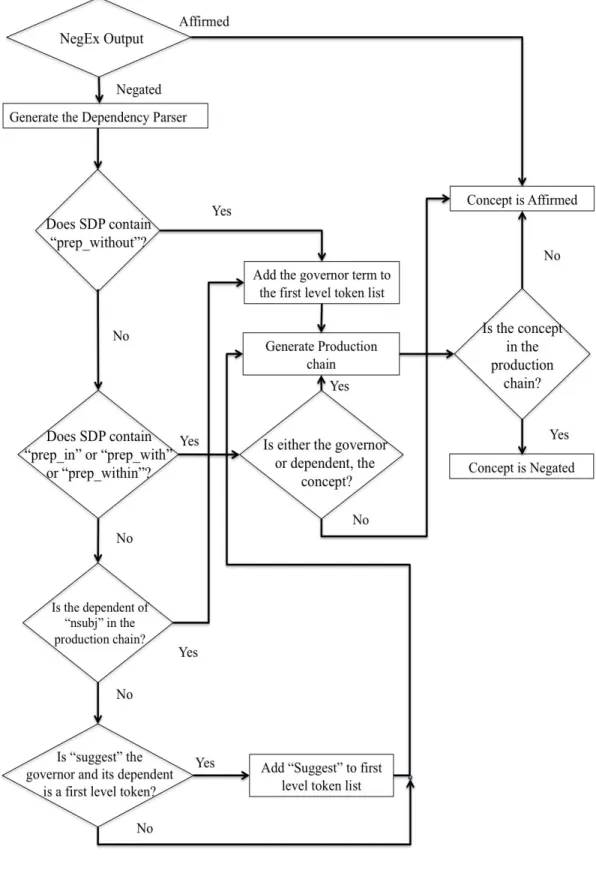
DEEPEN was developed with the mindset of decreasing the number of false positives, nonetheless we attempted to decrease the number of false negatives by addressing most common sentence structures seen in our IU training data set. Figure 3.2, shows the flowchart of the algorithm used in development of DEEPEN.
Table 3.2 shows some examples of various rules developed in DEEPEN. More details and examples of DEEPEN rules are provided in the appendix A. DEEPEN is written in java and is freely available for researchers to use1.
Conjunction And Rule: If there is a conjunction “and” in a sentence, it will be divided into two sub-sentences and negation is examined for both sub-sentences.
Preposition Within Rule: DEEPEN uses the collapsed representation of SDP where dependencies that involve propositions or conjunction are merged to create a direct dependency between content words. For instance, the dependencies involving prep (size-5, without-6) and pobj (without-6 inflammation-8) are collapsed into one single relation prep-without (size-5, inflammation-8). As we mentioned earlier first level token is the governor of negation term. In sentences where the negation term “without” is merged into the dependency relation, the governor of the relation “prep-without” is considered as first level token.
Preposition With/In/Within Rule: For propositions “in”, “within”, and “with” the SDP is only run when the concepts in these relations are part of the dependent or governor terms otherwise the concept is considered as “affirmed”.
Nominal Subject Rule: Nominal subject in SDP is a relationship in which the subject is a noun phrase such as “No abnormally”. If the governor of this relationship is a first level token then its dependent is added to the dependency chain.
Suggest Rule: in sentences that contain the term “suggest” if the dependent of the term “suggest” is a first level token then “suggest” will also be considered as a first level token.
1 http://svn.code.sf.net/p/ohnlp/code/trunk/DEEPEN
Table 3.2 DEEPEN Rules with Relevant Sentence Examples and Their SDP Relations, Concepts are shown in Bold and Negation Terms in Italic (See Appendix A for Detailed
Dependency Relations)
Rule Sentence Relevant Dependency
Relations
Dependency relation (governor index, dependent token-index)
Conjunction
and The main pancreatic duct does not appear disrupted and in continuity by a bridging
pseudocyst
pseudocyst is affirmed in the
sub-sentence “in continuity by a bridging pseudocyst” therefore SDP has not been applied. Preposition
without
The pancreas is normal size without perpancreatic inflammation or pancreatic
ductal dilatation.
First level token: prep (size-5, without-6) Second Level tokens: prep_without (size-5, inflammation-8)
nsubj (size-5, pancreas-2) cop (size-5, is-3)
amod (size-5, normal-4) Third level tokens: det (pancreas-2, The-1) conj_or (inflammation-8,
dilatation-12)
Preposition in, with, and within
An abdominal CT showed a normal pancreas and
gallbladder with no dilated ducts.
First level token: det (ducts-5, no-3) Second Level tokens: amod (ducts-5, dilated-4) Nominal
Subject
No abnormally dilated pancreatic duct.
First level token:
det (abnormally-2, No-1) nsubj (dilated-3, abnormally-2) Suggest No associated fluid collection
to suggest pseudocyst or abscess.
First level token: det (collection-4, No-1)
nsubj (suggest-6, collection-4) aux (suggest-6, to-5)
dobj (suggest-6, pseudocyst-7) dobj (suggest-6, abscess-9) Second Level tokens:
amod (collection-4, associated-2) nn (collection-4, fluid-3)
Third level tokens:
conj_or (pseudocyst-7, abscess-9)
These additional rules were added to the basic algorithm to decrease the number of incorrect assignment of present to concepts that were negated by NegEx.
We stopped the development of the algorithm as we reached acceptable precision and recall of 0.9839 and 0.9983 respectively on the training set and tested the final algorithm on the IU test set and Mayo Clinic dataset. Identified concepts and their negation status stored in the database were exported as spreadsheet to be reviewed by two domain experts independently at IU. The inter annotator agreement between the two reviewers was 95.6%. Any discrepancies regarding the negation status of a concept was discussed with the third medical expert by looking at the complete patient report. At Mayo Clinic, we used a gold-standard dataset that has been already annotated by four annotators, further details on annotation task and schema on this dataset can be found elsewhere (Ogren, Savova, & Chute, 2008).
3.4 Data Sources
This study was conducted under approved institutional review board at each institution.
3.4.1 Indiana University Dataset
The IU data was divided into two sets of training data of 664 patients consisting of 1136 reports with 1728 sentences with pancreatic cyst concept and test set of 452 patients with 793 reports and 1462 sentences.
3.4.2 Mayo Clinic Dataset
In order to evaluate the generalizability of our negation system, a set of 159 clinical notes with manual annotation of named entities and their negation status by four domain experts was used (Ogren, Savova, & Chute, 2008). There are total of 1,007 disorders with 426 unique UMLS concepts and 439 signs and symptoms with 129 unique UMLS concepts.
3.5 Evaluation
The system output was compared to the gold standard annotations to calculate the systems’ precision, recall, and F-measure. Table 3.3 shows the relationship between the