Workers' compensation:
1984 State enactments
Relatively few States took action
to increase benefits or broaden coverage;
several did raise the percentage of
the average weekly wage used to compute
compensation for disability or death
LAVERNE C. TINSLEYSignificant amendments to State workers' compensation laws were relatively few (136) in 1984, although 44 legislatures convened and numerous proposals were introduced .'
Most of the revisions affecting injured workers and their families related to benefits and coverage . For instance, Mis-sissippi enacted legislation which provides for a three-step increase in maximum weekly benefits and total maximum benefits for disability and death. Nearly one-third of the States raised the allowance for burial expenses .
Several other laws raised the percentage of the State av-erage weekly wage used in computing maximum weekly compensation for disability and death. In Illinois, the per-centage of the employee's wages which is used to determine compensation for permanent partial disability and for certain cases of serious and permanent disfigurement, was reduced from 66-2/s percent to 60 percent. Alaska changed its former method of using 66-2/3 percent of the employee's average weekly wages for disability and death to using 80 percent of the employee's spendable weekly wages.
Coverage was allowed for all farmworkers in Maryland, except those who work within 25 miles of their home for
LaVeme C. Tinsley is a State standards adviser in the Division of State Workers' Compensation Programs, Office of State Liaison and Legislative Analysis, Employment Standards Administration, U.S. Department of La-bor.
less than 13 weeks a year. North Carolina required coverage of agricultural employees when there are 10 or more full-time nonseasonal employees regularly employed by the same employer . The Commonwealth of Virginia reduced the nu-merical exemption for agricultural or horticultural employ-ment, from four to two full-time regularly employed employees.
Legislation in South Dakota set a waiting period of 7 consecutive days of continuous disability instead of the pre-viously set 7 calendar days, before retroactive payments must be made.
In Illinois, the filing time for claims where injury or disability is caused by exposure to asbestos was extended to 25 years after date of last exposure; the same as that for exposure to radiological materials or equipment . Formerly, the statue of limitations was 3 years after an accident, if no compensation was paid, or 2 years after the last compen-sation payment. Connecticut and Kentucky added provisions which prohibit employers from discriminating against em-ployees who file compensation claims.
The term "workmen's" compensation was deleted from the laws and replaced with "workers"' compensation in three States.
Following is a summary of legislation enacted by indi-vidual States.
MONTHLY LABOR REVIEW January 1985 0 Workers' Compensation Legislation in 1984
Alabama
Connecticut
greater permanent disability, or in a ueaf,when combined with a previous disability. Workers' compensation coverage was
re-quired for employees of county and city boards of education, the Alabama Institute for the Deaf and Blind, and employees of 2-year colleges under the control of the State Board of Education. Further, definitions of
"employee" and "workmen" were broad-ened to include employees of the Tannehill Furnace and Foundry Commission .
A joint legislative interim committee was established to study "co-employee"
law-suits .z
Alaska
The time was reduced from 20 days to 14 days within which a physician or employee must furnish notification of treatment to the employer and the Workers' Compensation Board for validating a claim, after treat-ment.
Arizona
The title of the law was changed from "Workmen's" Compensation Act to "Workers"' Compensation Act; and cor-responding changes were made throughout the law .
California
Recovery was permitted for reasonable and necessary medical and legal expenses in-curred to prove or defend a contested claim
for benefits .
The Self-Insurers' Security Fund was es-tablished as a nonprofit mutual benefit cor-poration to insure benefits for employees of defunct self-insured employers where se-curity funding is insufficient .
Insurers and self-insured employers were prohibited from refusing to pay pharmacy benefits for injured employees solely be-cause the claim form used by pharmacists is not an original .
Colorado
An additional sum of 50 percent of the com-pensation order or judgment, or $1,000,
whichever is greater, will be applied to a compensation award as a penalty against employers who default on compensation payments.
A workers' compensation self-insurance fund was created and will be administered by the Industrial Commission . The Com-mission was authorized to collect appro-priate fees when necessary to manage the fund.
On July 1, 1984, a surtax became effec-tive on new and renewal policies to support the Major Medical Fund.
The burial allowance was increased from $1,500 to $3,000.
Delay or denial of medical benefits and services by an employer's health insurer in contested cases was prohibited. Legislation also provided that discrimination by em-ployers against employees who file work-ers' compensation claims may result in payment of back wages or benefits that were wrongfully withheld, or reinstatement of the terminated employee. Also, informa-tion must now be provided to a recipient of workers' compensation concerning his or her rights to participation in a program of rehabilitation .
Delaware
The act was amended to allow elective cov-erage for sole proprietors and partners, and permit up to 4 corporate officers, who are also stockholders in a corporation, exemp-tion from coverage.
The maintenance levels of the Second Injury and Contingency Funds were raised from $85,000 to $750,000 . When funding levels decline below $250,000 (formerly $35,000), assessments on carriers and self-insured employers will resume.
Florida
Interlocal agreements are now permitted between employers and local governmental entities to establish local government in-surance pools to secure their worker's com-pensation liabilities .
Supplemental compensation will now be paid for permanent total disability occur-ring after July 1, 1984.
Nonresident aliens of the United States and Canada are allowed an exemption from the 6-month restriction applicable to lump-sum compensation settlements, once every 4 years, following maximum medical im-provement .
Georgia
Sole proprietors or partners who are ac-tively engaged in the operation of a busi-ness were given authority to elect coverage for themselves. The definition of "em-ployee" was broadened to include certified
volunteer law enforcement personnel en-gaged in performing services for a juris-diction ; however, coverage is effective only at the option of the jurisdiction .
Hawaii
Payment of compensation will now be made in all cases of subsequent injury occurring on or after May 15, 1982, that result in
Illinois
The method used in determining compen-sation for permanent partial disability and for serious and permanent disfigurement was reduced from 66-2/3 percent of the employ-ee's average weekly wage to 60 percent . Maximum weekly compensation in such cases will remain at $293.61, until June 30, 1987 . Effective July 1, 1987, and each July 1, thereafter, compensation will be pro-portionately elevated by increases in the State average weekly wage during the pre-ceding 12-month period .
The interest on lump-sum awards was changed from 3 percent to a maximum rate payable on passbook savings deposits by member banks of the Federal Reserve Sys-tem.
The filing time limit for compensation claims where disability or injury was caused by exposure to asbestos was extended to a maximum of 25 years after the claimant's last exposure; the same as that for exposure to radiological materials or equipment .
Iowa
Employers were prohibited from reducing an employee's sick leave, vacation leave, or earned compensatory time in order to supplement workers' compensation bene-fits, unless the employee is notified and elects to accept the supplement .
The special provisions applicable to compensation for pneumoconiosis were eliminated from the law; however, all other sections regarding the disease remain in-tact.
The term "inmate" was redefined to ex-clude from coverage persons performing community services without remuneration as a condition of probation, or persons per-forming specific public work assignments.
Kansas
Group self-insurance pools now have sub-rogation rights in workers' compensation cases.
Kentucky
A fine will now be levied on anyone who harasses, coerces, discharges, or discrim-inates against an employee in any manner for filing or pursuing a claim for compen-sation.
The Workers' Compensation Board was authorized to order reimbursement of costs for medical and rehabilitation services pro-vided injured workers by the Office of Vo-cational Rehabilitation or the Department of Employment Services, in cases where
the defendant has refused to provide such services .
All carriers providing liability coverage for personal injury or death in the State are newly required to pay a 2-percent premium tax for funding various appropriations and expenditures as reflected in the State bud-
get . Maine
The payment time on claims for impairment and medical only cases was changed from t4 days to 90 days after maximum medical improvement .
Maryland
Coverage was broadened to include all farmworkers except those who work within 25 miles of their home for less than 13 weeks a year. Corporate officers owning 20 percent or more of the outstanding capital stock of a farm corporation may now be exempt from coverage.
The Subsequent Injury Fund may recover monies paid for funeral expenses in third party cases.
Michigan
The occupational disease provisions were modified by extending the time and dollar limit to $25,000 or 104 weeks of benefits paid by carriers or self-insurers . Afterwards the trustees of the silicosis, dust disease, and logging industry compensation fund may compromise the liability of the fund, or may reimburse the carriers or self-insurers, or make a similar reimbursement on a pro rata basis when there is more than one cause of the disability .
Minnesota
Coverage was broadened to include mem-bers of the University of Minnesota faculty under certain conditions, who are employed during the current academic year (the
pe-riod between that academic year and the succeeding academic year) .
Volunteer ambulance drivers and atten-dants were included, for coverage pur-poses, as employees of a political subdivision, or other entity, where such workers perform volunteer services . Per-sons serving as volunteer uncompensated workers at the Department of Administra-tion were also covered . However, persons under the coverage of the Domestic Vol-unteer Service Act of 1973, and persons in fide-sharing arrangements are not covered under the workers' compensation law.
Employees who contract occupational diseases may now receive medical benefits regardless of their ability to earn full wages doing the same work at which such em-
ployees were last employed . Also, occu-pational disease recipients are eligible for supplementary benefits after 4 years from their last significant exposure to the hazard of an occupational disease (formerly, eli-gibility was immediate), if the employee's
weekly compensation rate is less than the current benefit rate (formerly, if less than 65 percent of the State average weekly wage) .
Mississippi
The maximum weekly compensation for disability and death, and total maximum compensation was increased in three steps . on July 1, 1984, maximum weekly com-pensation increased from $112 to $126, and total maximum increased to $56,700, from $50,400. Beginning July 1, 1985, weekly compensation will increase to $133 and to-tal maximum to $59,850. Finally, on July
1, 1986, weekly compensation will in-crease to $140 and the aggregate to $63,000. The funeral allowance was increased from $1,500 to $2,000.
Contributions by employers and carriers to the Second Injury Fund in each case of compensable death were raised from $150 to $300 . The Subsequent Injury Fund ceil-ing was also increased to $250,000, for-merly, $35,000; and the minimum from $20,000 to $150,000.
Noncontroverted medical and psycho-logical case reports of the Industrial Com-mission relative to work-related accidents, injuries, and settlements are now exempted from the Public Records Act.
The name of the law was changed from "Workmen's" Compensation Law to "Workers"' Compensation Law. All ref-erences to "workmen's" and "widow" or
"widower" were deleted and substituted with "workers"' and "surviving spouse" throughout the law .
Missouri
Legal advisers who serve as associate ad-ministrative law judges were given author-ity to hear and determine claims at original hearings .
Nebraska
Elective coverage is now permitted for any partner or self-employed person who is ac-tually engaged in a business full-time.
New Jersey
Judges of compensation were authorized to conduct hearings and render decisions on claims for benefits from the Subsequent In-jury Fund.
New Mexico
Foreign resident dependents are no longer excluded from eligibility for benefits under
the law .
New York
The allowance for specialist consultations, surgical operations, or physiotherapeutic procedures was increased from $75 to $150 above the amount for which certain ap-proval would otherwise be required . Sim-ilarly, allowances for x-ray examinations were increased to $150, previously $75 ; and costs for special diagnostic laboratory tests were increased to $70, from $35 .
The licensing period of persons repre-senting claimants or self-insurers was ex-tended from 1 year to 3 years.
A new requirement was enacted which requires a carrier or self-insured employer to inform injured workers, or the depen-dents in case of death, in writing of their rights under the law within a specified time period .
North Carolina
Coverage was extended to agricultural em-ployments where 10 or more full-time non-seasonal agricultural workers are regularly employed by the same employer.
Oklahoma
Protection against common law suits by employees and others was provided for any architect, professional engineer, or land surveyor who is retained to perform profes-sional services on a construction project, if the employer has secured his or her liability for workers' compensation.
Specific requirements were established that must be met by an individual self-in-sured, or own risk carrier, or a group-pool association for qualifying for self-insur-ance, pursuant to State Industrial Court rules, at the discretion of the administrator for workers' compensation.
South Carolina
An exception was made to the 500-week limit on compensation for permanent total disability by allowing lifetime benefits for paraplegics, guadraplegics, and for persons suffering from physical brain damage . However, no lump-sum compensation may be paid to recipients of lifetime benefits .
South Dakota
The waiting period for compensation was changed from 7 calendar days to 7 consec-utive days of continuous disability before retroactive benefits will be paid.
MONTHLY LABOR REVIEW January 1985
"
Workers' Compensation Legislation in 1984
Employers are now entitled toreimburse-ment from the Second Injury Fund for all excess medical and hospital expenses paid for subsequent injuries that result in a greater disability from a preexisting injury.
Tennessee
Workers' compensation coverage was ex-tended to services of chiropractors .
Utah
The burial allowance and cost for replace-ment of artificial means and appliances was increased to $1,800, previously $1,000.
A method was established for determin-ing the Second Injury Fund's liability for permanent impairment benefits.
The Default Indemnity Fund was created to assure and pay benefits to employees when an employer becomes insolvent, ap-points or has appointed a receiver, or oth-erwise does not have sufficient funds to cover his or her workers' compensation liabili-ties.
Vermont
Coverage was broadened to include mem-bers of any regularly organized private vol-unteer fire department and rescue or ambulance squad while acting in the line of duty .
Virginia
Farmworkers and horticultural laborers were exempted from coverage unless the em-ployer regularly has in service more than two full-time employees . Previously, the exemption was applicable to employments with fewer than four full-time employees, or a payroll of less than $15,000 during the previous calendar year. Real estate sales-people and brokers are now also excluded from coverage if their income is mostly derived from sales commissions and any other services performed as independent contractors .
The burial allowance for deceased em-ployees without dependents was increased from $2,000 to $3,000. The allowance for
transportation of the decedent's remains to place of burial was left at $500.
The Industrial Commission may now re-quire that any medical expenses incurred 15 days prior to first communication of a diagnosis of an occupational disease, be paid by the employer. Formerly, the em-ployer was liable from the first day that communication of disease was made to the employee or to the survivors in case of death.
Extension of the filing period was made for all compensation claims from 1 year to 2 years, after accident or death; and in ap-peals to the Supreme Court, from 30 days to 60 days after an award or receipt of notice of award by registered mail.
Tolling of the statute-of-limitations is now applicable where an employer, after being given notice of injury, has paid compen-sation without an award and such conduct has prejudiced the right of the employee to file a timely claim.
Premium taxes paid by carriers and self-insurers for funding the administrative funds will be modified in accordance with an eq-uitable premium modification plan ap-proved by the Commission, if they have
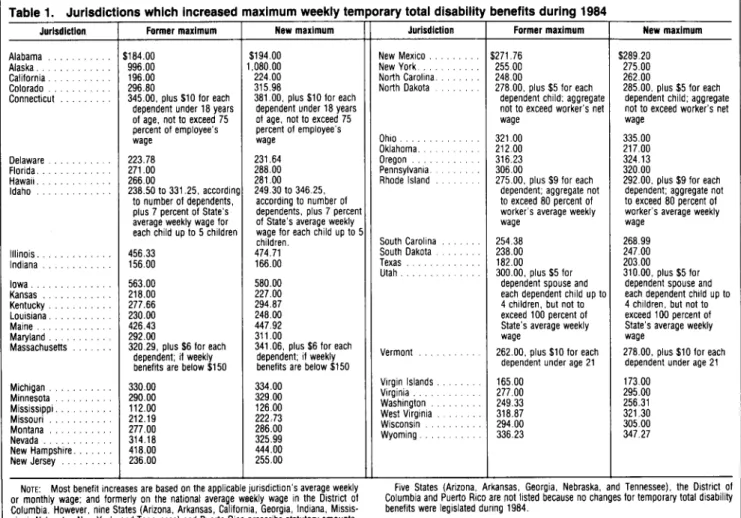
Table 1. Jurisdictions which increased maximum weekly temporary total disability benefits during 1984
Jurisdiction Former maximum New maximum Jurisdiction Former maximum New maximum Alabama . . . $184 .00 $194 .00 New Mexico . . . $271 .76 $289 .20
Alaska . . . 996.00 1,080.00 New York . . . 255.00 275.00 California . . . 196.00 224.00 North Carolina . . . 248.00 262.00
Colorado . . . 296.80 315.98 North Dakota . . . 278.00, plus $5 for each 285.00, plus $5 for each Connecticut . . . 345.00, plus $10 for each 381 .00, plus $10 for each dependent child; aggregate dependent child; aggregate
dependent under 18 years dependent under 18 years not to exceed worker's net not to exceed worker's net of age, not to exceed 75 of age, not to exceed 75 wage wage
percent of employee's percent of employee's
wage wage Ohio . . . 321 .00 335.00 Oklahoma . . . 212.00 217.00 Delaware . . . 223.78 231 .64 Oregon . . . 316.23 324.13 Florida . . . 271 .00 288.00 Pennsylvania . . . 306.00 320.00
Hawaii . . . 266.00 281 .00 Rhode Island . . . 275.00, plus $9 for each 292.00, plus $9 for each Idaho . . . 238.50 to 331 .25, according 249.30 to 346.25, dependent; aggregate not dependent; aggregate not
to number of dependents, according to number of to exceed 80 percent of to exceed 80 percent of
plus 7 percent of State's dependents, plus 7 percent worker's average weekly worker's average weekly
average weekly wage for of State's average weekly wage wage each child up to 5 children wage for each child up to 5
children . South Carolina . . . 254.38 268.99 Illinois . . . 456.33 474.71 South Dakota . . . 238.00 247.00 Indiana . . . 156.00 166.00 Texas . . . 182.00 203.00
Utah . . . 300.00, plus $5 for 310.00, plus $5 for Iowa . . . 563.00 580.00 dependent spouse and dependent spouse and Kansas . . . 218.00 227.00 each dependent child up to each dependent child up to Kentucky . . . 277.66 294.87 4 children, but not to 4 children, but not to Louisiana . . . 230.00 248.00 exceed 100 percent of exceed 100 percent of Maine . . . 426.43 447.92 State's average weekly State's average weekly Maryland . . . 292.00 311.00 wage wage
Massachusetts . . . 320.29, plus $6 for each 341.06, plus $6 for each Vermont . . . . 262.00 plus $10 for each 278.00 plus $10 for each dependent; if weekly
benefits are below $150 dependent; if weekly benefits are below $150 dependent under age 21 , dependent under age 21 , Michigan . . . 330.00 334.00 Virgin Islands . . . 165.00 173.00
Minnesota . . . 290.00 329.00 Virginia . . . . Washington . . . . . . . . . 277.00 249.33 295.00 256.31 Mississippi . . . . . . .
Missouri . . . 112.00 212 19 126.00 222:73 West Virginia . . . 318.87 321.30 Montana 277 00 . 286.00 Wisconsin . . . 294.00 305.00 Nevada . . . 314.18 . 325.99 Wyoming . . . 336.23 347.27 New Hampshire. . . 418.00 444.00
New Jersey . . . 236.00 255.00
NOTE : Most benefit increases are based on the applicable jurisdiction's average weekly Five States (Arizona, Arkansas, Georgia, Nebraska, and Tennessee), the District of or monthly wage; and formerly on the national average weekly wage in the District of Columbia and Puerto Rico are not listed because no changes for temporary total disability Columbia . However, nine States (Arizona, Arkansas, California, Georgia, Indiana, Missis- benefits were legislated during 1984 .
sippi, Nebraska, New York, and Tennessee) and Puerto Rico prescribe statutory amounts.
concurrent liability for coverage under the Federal Coal Mine Health and Safety Act of 1969, and the Virginia Workers' Com-pensation Act.
Washington
Claims for occupational diseases or death must now be filed within 2 years (formerly
The legislatures of Idaho, Indiana, Louisiana, Massachusetts, Nevada, New Hampshire, North Dakota, Ohio, Pennsylvania, Rhode Island, Texas, Wisconsin, Wyoming, and Puerto Rico, convened in 1984, however, changes in workers' compensation laws were generally minor and are not discussed
1 year) following receipt of a physician's diagnosis of a disease or from the date of death .
A joint select committee on workers' compensation was created to review the
State's industrial insurance system.
West Virginia
Elective coverage is now permitted for
FOOTNOTES
churches, employers engaged in organized professional sports activities (including em-ployers of trainers and jockeys in thor-oughbred horse racing), and for employers of certain employees in a corporation . Fur-ther, employers are allowed to cover their own risks upon compliance with insurance requirements in the law. 11
in the State-by-State summary. Six State legislatures (Arkansas, Montana, Nevada, North Dakota, Oregon, and Texas) did not meet in 1984 .
'Senate Joint Resolution Number 80-x, 1984 . A joint legislative interim committee was established to study proposed co-employees' lawsuits .
Labor-management health and safety activity
Collective bargaining is not a substitute for government regulation of job hazards. Scientific complexity renders negotiated standard setting for health hazards particularly impractical. Nonetheless, organized labor has the capacity to perform a number of quasiregulatory functions that, if conducted on a large scale, would significantly improve the performance of the Federal regulatory effort .
Specifically, unions are capable of pressuring management to comply with existing standards . This pressure can take many forms, ranging from gentle persuasion to slowdowns and strikes. Though union pressure will not ensure perfect compliance, it can dramatically supplement the minimal compliance incentives provided by the present system of inspections and fines . Moreover, unlike the threat of inspection, union pressure is im-mediate, potentially constant, and focused. Labor can also bargain directly for the abatement of some safety hazards . A union's familiarity with the workplace should give it an advantage over OSHA in dealing with inter-mittent and workplace-specific hazards . In addition, labor-management apprenticeship programs provide an opportunity for OSHA-specified health and safety training to be integrated into a worker's training . Finally, the arbitration system is a potential forum for quick resolution of disputes over an employee's right to refuse hazardous work .
-LAWRENCE S . BACOW Bargaining for Job Safety and Health
(Cambridge, Mass., The MIT Press, 1980), p. 103 .