SCHOOL OF ECONOMICS
Forecasting
book price changes
change point detection
LUND UNIVERSITYDEPARTMENT OF ECONOMICS SCHOOL OF ECONOMICS AND MANAGEMENT
Forecasting limit order
price changes using
change point detection
Master Thesis
Author: Sebastian Thorburn Supervisor: Hossein Asgharian
Spring 2015
limit order
using
change point detection
Title Forecasting limit order book price changes using change point detection
Course NEKN01 Master Essay
Author Sebastian Thorburn
Supervisor Hossein Asgharian
Purpose The main purpose of this thesis is to propose a method for using a change point detection algorithm to forecast short term limit order book price changes. The idea is to test whether a significant change of the shape of the limit order book contains any
information about impending price changes. Method Using a data set consisting of all the changes
of the limit order book throughout the trading day, a change point detection
algorithm is used to detect what is deemed to be significant changes. A measurement of the limit order imbalance is constructed as a proxy for the shape of the order book which then is used as input signal to the change point detection algorithm. A new data set is created based on the detected change points and a regression is run based on these to forecast impending price changes. To benchmark the results, the original data set is also sampled at a 5 minute interval and the limit order imbalance measurement is
calculated for each observation. A regression based on this data is then run to forecast impending price changes. Regression results from the two models are then compared. Conclusions When forecasting impending price changes,
regressions based on the change point data set yields better results than regressions based on the 5 minute interval sample. It is concluded that the data set created using change point detection contains a certain amount of information about impending price changes.
Keywords Change point detection, high frequency finance, limit order book, econometrics, market microstructure
Contents
List of figures ... 4
List of tables ... 4
1 Introduction ... 5
1.1 Background ... 5
1.2 Problem discussion and purpose ... 6
1.3 Focus and limitations ... 7
1.4 Outline of the thesis ... 8
2 Theoretical framework ... 9
3 Method... 12
3.1 The data set ... 12
3.2 Model specification ... 13
3.2.1 Stock filtering... 14
3.2.2 Constructing a limit order imbalance measure ... 15
3.2.3 Specification of change point detection algorithm ... 17
3.2.4 Specification of regression model ... 23
4 Results ... 26
5 Analysis ... 31
6 Conclusion ... 33
6.1 Discussion of findings ... 33
6.2 Suggestions for further research ... 34
7 References ... 36
7.1 Printed sources ... 36
7.2 Electronic sources ... 37
8 Appendix ... 38
List of figures
Figure 1 Information flow during online change point detection... 10
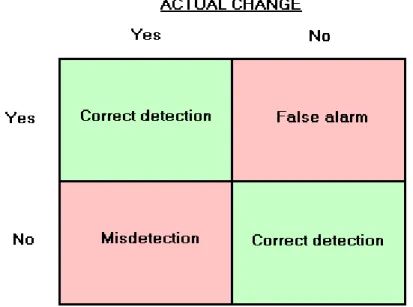
Figure 2 Matrix illustrating the four detection cases ... 10
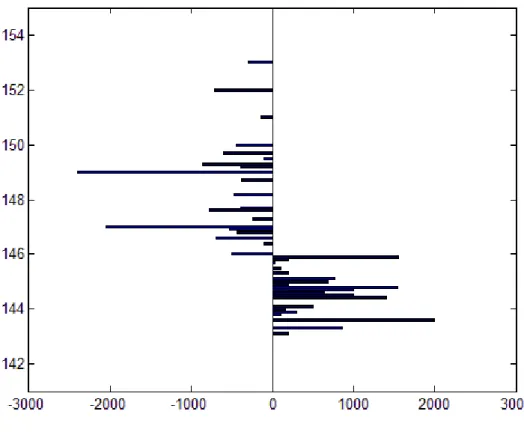
Figure 3 Illustration of a data point of the limit order book, symbol SCV B ... 13
Figure 4 Limit order imbalance measure, ticker symbol TOP, first trading day of data set .... 17
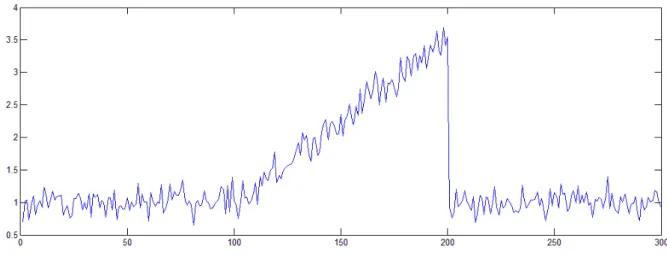
Figure 5 Simulated input signal; constant mean, drift in mean, constant mean ... 19
Figure 6 First example of the CUSUM algorithm in action ... 20
Figure 7 Simulated data series, sudden shift in mean ... 20
Figure 8 CUSUM algorithm on simulated series, simulated mean ... 21
Figure 9 Simulated data series, sine wave ... 21
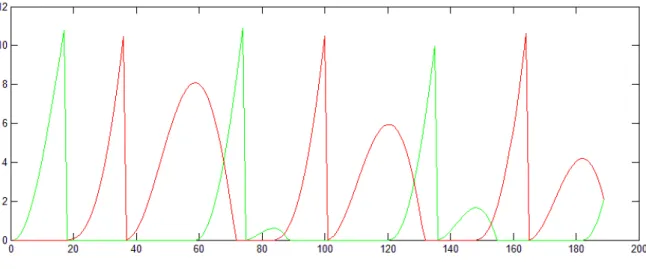
Figure 10 Third example of the CUSUM algorithm in action ... 22
Figure 11 Example of a CUSUM series for detecting an upward change ... 23
Figure 12 Example of a CUSUM series for detecting an downward change ... 23
List of tables
Table 1 Regression results, change point sample ... 27Table 2 Summary of regression results, change point sample ... 28
Table 3 Regression results, 5 minute interval sample ... 29
Table 4 Summary of regression results, 5 minute interval sample ... 30
1
Introduction
This chapter provides an introduction to the thesis with background, problem, purpose, limitations and outline.
1.1
Background
Financial markets have existed for a very long time. An example of an old financial market is that of tulip trading in the Netherlands, in which the infamous tulip bubble emerged in the first half of the 17th century. Along with the actual markets, time series of financial trading have also existed for a very long time. Historically, these have generally consisted of the last traded price at regular time intervals such as monthly, weekly or daily close prices.
Depending on the particular usage of the times series at hand, the interval has varied. Before computers revolutionized the financial markets, most of the trading volume occurred in open out-cry pits where humans would gesticulate and scream their trading intentions. With the advent of electronic marketplaces, when computers in the 1980s started becoming an integral part of financial markets, the data started becoming more available and at a finer resolution. Today trading almost exclusively occurs on electronic exchanges and as a result, the amount of data that is stored and subsequently available for study is very big. Along with technological advancements, the data not only becomes larger and larger in size, but also more complex. Today, it is not only the last traded price at a regular time interval that is available, but a plethora of information related to the matching process between buyers and sellers and thereby the price discovery process (Fadiman, 2004).
Many aspects of the financial markets are of interest for scientific study. One of them is the process of price discovery, but with the mentioned increased granularity of the data
available other methods than a simple linear regression of the last traded price are required. In recent years that study and application of high frequency finance has emerged. Different exchanges have different order types, different rules for the sequence in which orders are matched against each other, different rules for the minimum allowed price increments of the assets being traded, different opening hours, different rules for pre- and post-trade anonymity, et cetera. These are all features of the market microstructure, which in turn is much related to high frequency finance (Aldridge, 2010). It has been noted that market microstructure features such as the minimum allowed price increment of an asset is an integral part of short term price formation (Goldstein, 2000). At the core of all of this is the
essence of the actual facility for matching buyers and sellers; the limit order book. This is where all the unmatched orders rest. The study of the limit order book is at the foundation of this thesis.
1.2
Problem discussion and purpose
An arbitrary data set consisting of a million data points, where say 80% of them are pure noise, can hide a lot of information from standard statistical techniques. Furthermore, if the data points are complex in nature, perhaps in the form of an object rather than a scalar, this also increases the difficulty in the analysis. Adding to this, if the data points are
heterogeneous in time, i.e. not evenly spread out with a constant time interval in between them, this might add even more difficulty for the scientist about to study it.
Historically, initially just intraday data shed new light on the process of price discovery. Today a completely new paradigm has been reached in the world of financial data where not only the last transaction price is recorded, but also all available resting limit orders as well. This obviously presents opportunities for the researcher about to study price discovery and market microstructure in depth. However, how to handle such a data set is not as obvious as how to handle a time series of say monthly close price. With a data sample of reasonable size it’s fairly straight forward to run a regression. With the complete order book at the market open and each and every consecutive update of it during the rest of the day, it is an immense amount of data in comparison and not as straight forward how to approach it. Another issue is that the limit order book is a collection of data at each observation. It is not clear how the data should be represented in a model, as it no longer only consists of a closing price but rather a range of values. Also, when and how the order book updates is highly irregular and nonlinear (Cont, 2011). Furthermore, the sheer size of a high frequency financial data set makes it hard to analyze. Many of the observations could be referred to as noise (Aït-Sahalia, 2011). Data from a high frequency limit order book data set of one day of trading in a single stock can easily contain tens or even hundreds of thousands of
observations. There could be hundreds of tiny order book updates within either a very short time frame or very few within a comparably very long time frame. As an example, at one time there could be bursts of activity with many updates during one millisecond and at another time there might be no updates at all during several minutes (Cont, 2011). The
happen in a relatively small space of time, at the same time as very little can happen in a comparably long space of time, it is not entirely clear how one should approach the study of a high frequency limit order book data set. Notably Cao et al. (2009) found some interesting results with regards to the limit order book’s impact on short term price formation, and in their study they sampled the limit order book at 5 minute intervals. However, generally, if one samples the limit order book with a too wide interval much information could
potentially get lost. Also, the studied effects might only exist in the very short time frame – far below for example 5 minutes which in the world of high frequency trading could be seen as a very long time. If one samples the limit order book with a too narrow interval, the resultant data set could potentially contain too much noise. Another issue is that it is not entirely clear is how one should potentially perform an interpolation between two observations of the limit order book.
The main purpose of this thesis is to propose a method for using a change point detection algorithm to forecast short term limit order book price changes. The algorithm is used to detect what is deemed as significant changes to the shape of the limit order book. As mentioned above, there is likely a lot of noise in a high frequency limit order book data set. The reasoning behind choosing a change point detection algorithm is to reduce the sample size with as high information retention as possible. Specifically, a limit order imbalance measurement is constructed as a proxy for the shape of the order book and used as input signal to the change point algorithm. The change point detection algorithm is constructed to detect either an upward or downward change in the input signal. The detected change points form a new data series which are then used in a regression model to test the
forecasting power for impending changes to the mid market price. Intuitively, this could be seen as testing if a predictable price change follows a significant change of the shape of the limit order book. As a benchmark, the limit order book is also sampled at a 5 minute interval where the limit order imbalance measurement is calculated for each observation and used in a regression to forecast price changes. The results are then compared.
1.3
Focus and limitations
The main focus for this thesis is to design a model based on change point detection that forecasts short term price changes in the limit order book. The thesis is intended test the concept of applying a change detection algorithm to high frequency financial data. The data
set used in this study before filtering is limited to Nordic equity limit order book data for the month of February of 2012. Initial filtering of all the Nordic stocks is made so that only the constituents of the major national equity indices in Sweden, Finland and Denmark are selected. Following this, based on assumptions regarding liquidity and price discovery, a liquidity measurement is constructed to narrow down these stocks even further to a final data set of 30 stocks.
1.4
Outline of the thesis
The remainder of the thesis is organized as follows. Chapter 2 covers the theoretical framework behind the study. This chapter mainly discusses detection theory. Chapter 3 covers the methodological aspects of the study, where the data set is discussed and the model behind the study is specified. Chapter 4 presents the results. Chapter 5 covers
analysis of the results. Lastly, chapter 6 concludes the thesis with a discussion of findings and some suggestions for further research.
2
Theoretical framework
This chapter will describe detection theory from a general perspective. Detection theory, also known as signal detection theory, is about discerning between information bearing patterns and random patterns. A change point detection algorithm is an application of detection theory where the idea is to identify abrupt changes in a phenomenon. The input to the algorithm is usually known as signal and generally has a variance which is often referred to as noise. In other words, change point detection is concerned with separating a significant change of the input signal from background noise. The applications of change point
detection are many, for example in the field of electronics where the separation of patterns from a disguising background is specifically referred to as signal recovery. Other fields include quality control in manufacturing, intrusion detection, spam filtering, website
tracking, medical diagnostics and alarm management. Technically, different input signals can be used such as measurements like amplitude, mean, variance or frequency (Basseville, 1993; Gustafsson, 2000).
Change detection can either be performed online or offline. Using an online approach, an input signal is analyzed as it comes in. An online change point detection algorithm tries to identify when the probability distribution of an input signal of a stochastic process or time series has changed. Figure 1 shows the flow of information through an online change point detection algorithm. The online approach is related to what in statistics is known as
sequential analysis, which is where the sample size is not fixed in advance. Instead data is evaluated as it is collected. An online algorithm is one form of this and receives a sequence of inputs and performs an immediate action in response to each input. This may be
contrasted with offline algorithms which assume that the entire input data is available at the time of the decision making. An offline change point detection algorithm analyzes a
complete data set, i.e. no new data points added to the data set. Note that offline
algorithms also are required to take an action in response to each data point, but the choice of action can only be based on the entire sequence of data points. Note that online
algorithms provide a natural class of algorithms suitable for high frequency trading applications. As new values of the input variable are revealed sequentially, the high
frequency trading application makes a decision after each new input. This could for example be whether or not to submit a trade, or change the price of a working order. Also notably, in
practice many optimization problems in computer science are online problems (Albers, 2003).
Figure 1 Information flow during online change point detection
In an online change point detection algorithm, an alarm threshold must be set. This is the level where the change point algorithm triggers an alarm that a change in the input signal has occurred. The level at which the alarm threshold is set will impact the ability of the change detection algorithm to discern changes. As a result it will affect how adapted the detection system is to the task at which it is aimed. In general, one must make a tradeoff between false alarm rate, misdetection rate and detection delay. A false alarm is considered to have happened when a change point was detected without an actual change having occurred. A misdetection is considered to have happened when an actual change has occurred but no change point was detected. Figure 2 illustrates these two unsuccessful detection cases along with the two remaining cases for successful detection (Albers, 2003).
Along with consideration for an optimal tradeoff between these four cases, when setting the alarm threshold the concept of detection delay is also important. This is the time between an actual change happening and a change is detected. There is a certain amount of
discretion involved in setting the alarm threshold. The way to approach it depends on what the application of the change detection is. To illustrate this, consider that the input signal is information from a radar signal that potentially could contain information about an attacking enemy. A misdetection of a change point during war time, i.e. failure to detect an attacker, may have a detrimental effect. As a result, a liberal alarm threshold is likely better than a conservative threshold. In contrast, during peace time, setting off a false alarm too often may eventually make people less likely to respond properly, and also have a high cost due to all the false alarms. As a result, a conservative alarm threshold is likely better than a liberal threshold (Wilmshurst, 1990).
3
Method
In summary, using a data set consisting of all the changes of the limit order book throughout the trading day, a change point algorithm is used to detect what is deemed to be significant changes. To do this, a measurement of the limit order imbalance is constructed and used as input signal to the change point detection algorithm. A new data set is created based on the triggered change points, which then is used in a regression forecasting impending price changes. To benchmark the results the original data set is also sampled at a 5 minute
interval. The limit order imbalance measurement is calculated for each observation and then used in a regression to forecast price changes.
3.1
The data set
The data set was collected directly from NasdaqOMX and contains the twenty top price levels for both buy orders and sell orders in all shares in Sweden, Denmark and Finland. The data set is an official product from exchange operator NasdaqOMX and as such it is assumed that the quality of the data is high and therefore trustworthy to use for scientific study (Historical Nordic and Baltic Order Book Data, 2015). The formal name of the product is “Nordic Historical View”. The data set consists of complete limit order book data over the month of February in 2012. Specifically, each trading day consists of two subsets of data; combined they cover all transactions and all changes to the limit orders resting on the first twenty price levels. With regards to the party posting an order, there is pre-trade anonymity but after a trade has been executed there is full post-trade transparency. The counterparties behind both of the matched orders are shown. The data set is about 100GB in size in total. The data is heterogeneous in time, meaning that the data points are not evenly spaced in time. To illustrate a data point, figure 3 show an observation of the limit order book with the resting unmatched limit orders in one of the stocks during the first minute of the first trading day in the data set.
Figure 3 Illustration of a data point of the limit order book, symbol SCV B
The x-axis represents volume, where a negative number maps to a sell order with a volume of the absolute value of the negative quantity. A positive number maps to a buy order with a volume of that quantity. The y-axis represents the price each respective limit order is placed at.
As mentioned above, the data is assumed to be clean and contain accurate information so no search for abnormal outliers has been conducted. However the data set is still processed to get rid of any for this study superfluous information such opening auction activity, closing auction activity, et cetera.
3.2
Model specification
After selecting an initial set of stocks suitable for this study, a liquidity measurement is designed to further narrow down these based on liquidity. After that, as a proxy for the shape of the order book a measurement of the limit order imbalance is constructed. This is then is used as input signal to a change point detection algorithm. The algorithm will detect a change when the limit order imbalance measurement is deemed to have changed in a significant way. Every time a change has been detected, a value coding for either an upward
change or a downward change is stored in a new data series. Based on the change point data series, a regression model for forecasting impending price changes is then specified. To benchmark the results, another regression model which uses the limit order imbalance measurement to forecast price changes based on a 5 minute interval sampling is also specified.
3.2.1 Stock filtering
The constituents of the main national equity indices in Sweden, Finland and Denmark (specifically OMXS30, OMXH25 and OMXC20) are selected as the initial set of stocks for this study. Then another filtering based on liquidity will be performed. It is assumed that the resting limit orders potentially have an effect on price formation in the short term. The intuitive reasoning behind this is that the less liquid a stock is, i.e. less available volume resting in the limit order book, in merit of supply and demand the more likely it is to be moved by the arrival comparably large limit orders. With lower liquidity, the price is assumed to be more affected by the limit order book dynamic captured by the limit order imbalance measurement. As a result of this assumption, the ten stocks with the lowest liquidity from each national equity index will be selected for use in the change point detection model.
There are several definitions of liquidity. Aldridge (2010, pp.62-63) considers that liquidity can generally be measured by the limit order book. She writes that the market depth is the total volume of limit orders available at a specific price, and that the market breadth is number of different prices where limit orders exists. Another view of liquidity put forth by Easley (2002) is that it refers to the active matching of buyers and sellers. In this thesis a liquidity measurement is constructed based on the total value of the resting limit orders on the top 20 price levels. The liquidity measurement is constructed and calculated for the first trading day of the data set for all stocks in the major national stock indices of Sweden, Finland and Denmark. The ten stocks with least liquidity based on this measurement are then selected from each index. For each observation i of the limit order book at a 1 minute interval sampling during the first trading day, the liquidity is calculated as follows
pv
pv
where ! " " ## $ ! #% " ## $ & '$ " " ## $ & '$ #% " ## $
As one can see it’s the total nominal monetary value of all orders on the top 20 levels of the order book. The author of this thesis assumes this will suffice as an indicator of general liquidity. To calculate the final liquidity measurement, the average of all liquidity
observations ∑ is calculated to gauge the average liquidity during a day. Thus the liquidity measurement is calculated as follows
) ∑ *n
where ) is the liquidity measurement and n is the number of minutes during the trading day1.
3.2.2 Constructing a limit order imbalance measure
Examining data from the Australian Stock Exchange, Cao et al. (2009) assess the information content of a limit order book with a focus on the information contained in the limit orders behind the best bid and offer. They find that the limit order book beyond the first price level is informative. They also find that order imbalance information from the second price level to the tenth price level is related to future short term returns. They also find that market participants use the available information on the state of the book, including information about orders beyond the first price level, when deciding how to submit orders. Building on the work of Cao et al. (2009) with regards to information in the imbalance between buy orders and sell orders, a measurement of limit order imbalance is constructed to be used as input to the change point detection algorithm. To calculate this measurement, the volume
1
Note that as this study is carried out on stocks from three different exchanges – Stockholm, Copenhagen and Helsinki – the number of minutes of continuous trading per trading day is not the same for all stocks. However, this slight difference is assumed to be negligible for all methods used in this thesis.
weighted price of all bid and ask orders on the top twenty price levels of the order book is calculated and then compared to mid market. Based on general assumptions of supply and demand, one might expect that if the volume weighted price of all of the limit orders is higher than mid market, mid market would drift up, and vice versa.
Mid market at observation i is defined as follows
, -2
&-where
- / "
&- / $ "
The limit order imbalance measurement is defined as follows
І ∑ ∑&& ∑ ∑& 1 , where І % %#" ! " " ## $ ! #% " ## $ & '$ " " ## $ & '$ #% " ## $ , , %$
As can be seen, this is in essence the volume weighted average price of all the limit orders of the top twenty price levels minus the mid market price. Figure 4 shows an example of this measurement calculated for each observation of a stock during the first trading day of the data set.
Figure 4 Limit order imbalance measure, ticker symbol TOP, first trading day of data set
3.2.3 Specification of change point detection algorithm
When deciding for a change point algorithm to use to detect changes in the input signal, i.e. the previously constructed limit order imbalance measure, the author of this thesis decided to go for one of the most simple algorithms available; namely the CUSUM algorithm. The reason for going for simplicity is partly a merit of taste and partly to provide a clean and easy-to-understand model that can be improved later on should the results merit further investigation. The CUSUM algorithm is a classical algorithm for monitoring a process for changes. It was announced for the first time in Biometrika in 1954, developed by E. S. Page of the University of Cambridge. CUSUM is short for cumulative sum and as its name implies, CUSUM involves the calculation of a cumulative sum. Being used for statistical change detection by calculating a sum as new input arrives, it is a sequential analysis technique and an online algorithm. In describing the algorithm, Page refers to a quality number, by which he meant a parameter of the probability distribution of the input signal; which for example could be the mean of the distribution of the underlying process. The purpose of the CUSUM algorithm is to detect changes in the quality number. The CUSUM value, i.e. the cumulative sum, is calculated at each observation point of the input signal. A change is considered to have happened, and as such detected, when the CUSUM value reaches a pre-defined alarm threshold (Page, 1954; Barnard, 1959; Grigg, 2003).
There are a few implementations of the CUSUM algorithm available. One way to implement it involves calculation of the cumulative sum of both positive and negative changes in the input variable. The cumulative sum of positive changes is for comparing against a threshold for triggering an alarm for an upward change in the input variable, and vice versa for a
negative change. As a result, at each observation point, two CUSUM values are calculated and then compared against a pre-defined alarm threshold. When the value of either one of them exceeds the threshold value, an alarm is triggered and a change has thus been
detected. When a change has been detected, both cumulative sums restart from zero.
The CUSUM algorithm used in this thesis is given by the following
23456 %750, 2345 1 16 7 1 û6
2<=56 %7 50, 2<=5 1 16 7 1 û6
where 7 is the input signal, given by the limit order book imbalance measurement constructed in the previous section. Thus 7 І. Note that 23456 and 2<=56 are the cumulative sums at observation i for comparing against positive change threshold and negative change threshold respectively. The initial values are given by
234506 0 2<=506 0
Lastly, û is the estimate of the true value of the input signal and as such initially given by the initial limit order imbalance measurement, i.e. û І. Whenever either one of the cumulative sums S?@5i6 or SBC5i6 exceeds the alarm threshold, a change point is triggered. The input signal (i.e. the limit order imbalance measurement, which is a proxy for the shape of the order book) is then assumed to have changed and û is then reset to the latest limit order imbalance value. When a change has been detected, a binary value is stored in a new data series. A change point triggered by 234 is coded as 1 and a change point triggered by 2<= is coded as 0. All the change points form a strictly ordered sequence of binary alarms, which later on is used in a regression to forecast price changes. Note that the resultant data series is heterogeneous in time, i.e. there is not necessarily a strictly constant time interval between the observations. It could e.g. be less than one millisecond, five minutes or a completely different value between two arbitrary consecutive data points.
As long as the input signal is centered around û and remains in control – i.e. is assumed to not have shifted in a significant way – the CUSUM plot will show variation in a random
drift upwards and eventually trigger an alarm. Below follows three examples of the CUSUM algorithm in action processing simulated input data series. In each of the three figure pairs, the first figure is a chart of the simulated input signal and the second figure is a chart of the two cumulative sums 234 and 2<=. The green line is the cumulative sum tracking positive changes in the input signal, i.e. 234. The red line is the cumulative sum tracking negative changes in the input signal, i.e. 2<=. In other words, in these examples an upward change in the input signal has been detected when the green line reaches the top of the chart before resetting to zero, and a downward change in the input signal has been detected when the red line reaches the top of the chart before resetting to zero. The first example, shown in figure 5 and figure 6, is a series of 100 data points drawn from a normal distribution with constant mean and constant standard deviation, followed by 100 data points where the mean increases incrementally, followed by another 100 data points where the mean has reverted to its initial constant value.
Figure 6 First example of the CUSUM algorithm in action
The second example, shown in figure 7 and figure 8, is a series of 100 data points drawn from a normal distribution with constant mean and constant standard deviation, followed by 100 data points where the mean suddenly shifts upwards, followed by another 100 data points where the mean has reverted to its initial constant value.
Figure 8 CUSUM algorithm on simulated series, simulated mean
The third example, shown in figure 9 and figure 10, is simply a series of 190 data points consisting of a sine wave. These three examples are intended to give an intuitive idea of how the CUSUM algorithm operates on its input signal.
Figure 10 Third example of the CUSUM algorithm in action
As touched upon in the chapter covering the theoretical framework, setting the alarm threshold is a tradeoff between false alarms, misdetections and detection delay. A false alarm is considered to have happened when a change point was detected without an actual change having occurred. A misdetection is considered to have happened when an actual change has occurred but no change point was detected. Detection delay is the time between an actual change happening and the change point being detected. To strike a balance
between these caveats, and to avoid statistical biases, the alarm threshold for each stock is discretionary simply set to a tenth of the share price at the first available observation of continuous trading in the data set. Across all the selected stocks during the full 20 day sample, this on average generated roughly the same amount of change points, i.e. data points for the regression, as a 5 minute constant time interval sampling would generate observations. Once the alarm threshold is set, the model is ready for processing inputs.
Figure 11 and figure 12 illustrates the CUSUM value in live action processing inputs from the data set. Figure 11 contains a series of the CUSUM value for detecting upward changes, i.e. 234. Figure 12 contains a series of the cusum value for detecting downward changes, i.e. 2<=.
The charts are based on the CUSUM value for Securitas B, ticker SECU B, during the first trading day of the twenty day data set. Note how the CUSUM value is reset to zero whenever the alarm threshold is crossed. As is visible in the charts, the alarm threshold is roughly 7.5, which means that the initial share price of Securitas B during the first trading day was roughly SEK 75. As one can see on the x-axis, there are roughly 16000 observations
highly irregular, non linear behavior of the changes in the limit order book, the number of observations between different trading days and different stocks can vary a lot (Cont, 2011).
Figure 11 Example of a CUSUM series for detecting an upward change
Figure 12 Example of a CUSUM series for detecting an downward change
3.2.4 Specification of regression model
Once a series of change points have been produced, it will be used as input to a regression model that forecasts price changes. The dependant variable is the difference in mid market from the observed data point to the next. The mid market price difference is formally defined as follows
∆, ,E-1 ,
where
, % %$
In other words, ∆, is the difference of the mid market price between change point i and change point i+1. As mentioned, the change point data series are not homogenous in time,
i.e. although they do have a strict ordering they do not have a constant time interval between observations. Notably, the simple linear regression model does not make any assumptions about evenly spaced observations.
The independent variable is the alarm signals triggered by the change point detection algorithm. This data is binary; it is either 1 representing an upward change or 0 representing a downward change. As such a regression with an intercept and a binary variable as slope is run, which in essence is a simple dummy-variable regression. In actuality, when running the change point detection algorithm two series are initially generated; one binary series for upward changes and one binary series for downward changes. However, to avoid the infamous dummy variable trap and thereby perfect collinearity, these two series are combined into one. The resultant series is a binary series where 1 codes for an upward detected change and 0 for a downward detected change. As a result, the way the regression result is to be interpreted is as follows: the intercept will be the expected mid market price change until the next change point if the current change point indicated a downward change, and the slope coefficient plus the intercept will be the expected mid market price difference until the next change point if the current change point indicated an upward change. Formally, the regression model is specified as follows
F G7 H
where
∆,
7 I 1 / J "KL J "0 / JJ "KL J "M
As the reader can see, y is the price difference of mid market between change points i and i+1. Here the next data point simply refers to the next detected change point. As noted earlier, the temporal interval between the data points is as such not constant by definition. Note that the change point algorithm generates ∑ 7 from when either of the calculated CUSUM values crosses the alarm threshold.
data set used in this regression, the limit order book is simply observed once every 5 minutes. The independent variable is then at each observation calculated as the limit order imbalance measurement, i.e. the same type of information that the change point detection algorithm is based on. As mentioned earlier, the limit order imbalance measurement is a scalar that represents that difference between the volume weighted average price of all limit orders and the mid market price. The regression formula for the 5 minute interval sample is specified as follows
F G7 H
where
∆,
7 І
Thus the regression formula can be rewritten as the following
∆, F GІ H
where І, as defined earlier, is the limit order imbalance measurement at observation i and ∆, is the price difference of mid market between observation i and i+1. Here the next data
point simply refers to the next observation in the 5 minute data series. As the reader can see, it’s a simple linear regression with an intercept and a slope. The way the regression result is to be interpreted is as follows: the intercept will be the expected mid market price change until the next 5 minute data point if the limit order imbalance measurement is valued at zero. The slope coefficient will, in addition to the intercept, be the expected mid market price difference until the next 5 minute data point if the limit order imbalance measurement is valued at one. In essence, the regression tests the forecasting power of the limit order imbalance measurement.
4
Results
This chapter contains the results from the regressions based on both the change point data sample and on the 5 minute interval sample. A linear regression model is fitted to each stock using data generated by the change point algorithm to forecast impending changes in mid market. Another regression model is fitted to each stock using the limit order imbalance measurement sampled every 5 minutes. Both data sets contain roughly the same amount of observations over the same time period – however, the change point data set does not have a constant time interval between the data points.
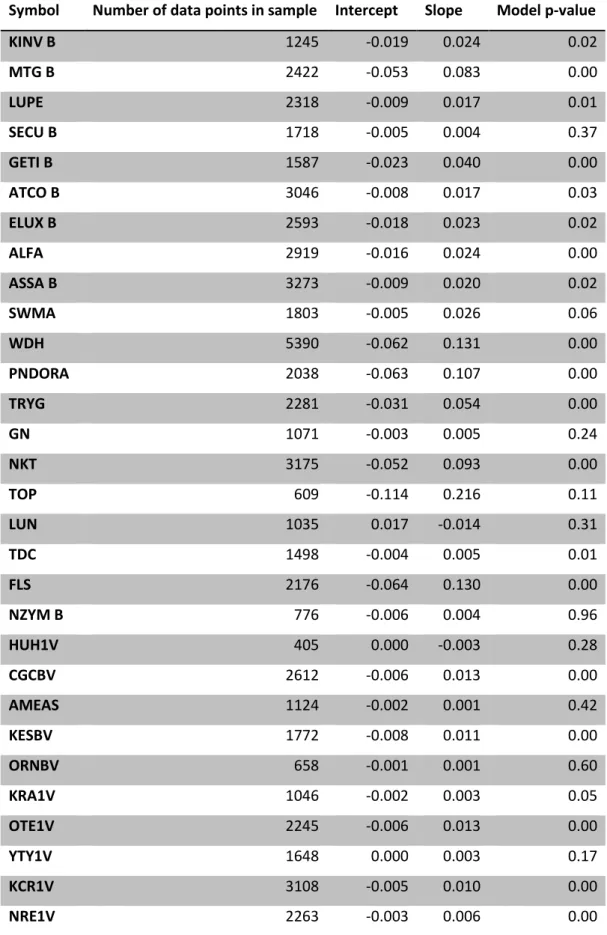
Table 1 shows the results from the regressions based on the change point data sample. The p-value refers to the full regression model, i.e. not individual coefficients. As mentioned earlier, the way the regression result is to be interpreted is as follows: the intercept will be the expected mid market price change until the next change point if the current change point indicated a downward change, and the slope coefficient plus the intercept will be the expected mid market price difference until the next change point if the current change point indicated an upward change. As the intuitive reasoning behind the limit order imbalance measurement is that the price might drift up if the limit order imbalance measurement changes upward, this implies a negative intercept and a positive slope is expected in the regression results.
Note that the change point data sample for each stock has a different number of data points. This is due to the fact that the change point algorithm triggers an alarm, and subsequently generates a data point, only when the CUSUM value reaches the alarm threshold. There is no way of knowing in advance how often this will happen.
Table 1 Regression results, change point sample
Symbol Number of data points in sample Intercept Slope Model p-value
KINV B 1245 -0.019 0.024 0.02 MTG B 2422 -0.053 0.083 0.00 LUPE 2318 -0.009 0.017 0.01 SECU B 1718 -0.005 0.004 0.37 GETI B 1587 -0.023 0.040 0.00 ATCO B 3046 -0.008 0.017 0.03 ELUX B 2593 -0.018 0.023 0.02 ALFA 2919 -0.016 0.024 0.00 ASSA B 3273 -0.009 0.020 0.02 SWMA 1803 -0.005 0.026 0.06 WDH 5390 -0.062 0.131 0.00 PNDORA 2038 -0.063 0.107 0.00 TRYG 2281 -0.031 0.054 0.00 GN 1071 -0.003 0.005 0.24 NKT 3175 -0.052 0.093 0.00 TOP 609 -0.114 0.216 0.11 LUN 1035 0.017 -0.014 0.31 TDC 1498 -0.004 0.005 0.01 FLS 2176 -0.064 0.130 0.00 NZYM B 776 -0.006 0.004 0.96 HUH1V 405 0.000 -0.003 0.28 CGCBV 2612 -0.006 0.013 0.00 AMEAS 1124 -0.002 0.001 0.42 KESBV 1772 -0.008 0.011 0.00 ORNBV 658 -0.001 0.001 0.60 KRA1V 1046 -0.002 0.003 0.05 OTE1V 2245 -0.006 0.013 0.00 YTY1V 1648 0.000 0.003 0.17 KCR1V 3108 -0.005 0.010 0.00 NRE1V 2263 -0.003 0.006 0.00
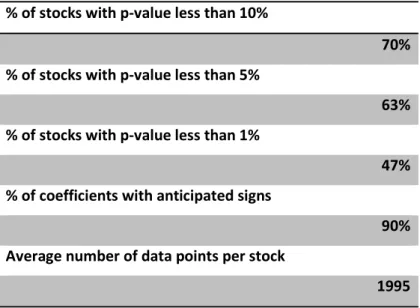
Table 2 shows a summary of the regression results based on the change point data sample. The percentage of coefficients with anticipated signs refers to the percentage of stocks that have estimated coefficients with signs in line with what would be expected from the intuitive reasoning behind the model, if it has any predictive power over impending price changes. Again, the p-value refers to the full regression model and not individual coefficients.
Table 2 Summary of regression results, change point sample
% of stocks with p-value less than 10%
70% % of stocks with p-value less than 5%
63% % of stocks with p-value less than 1%
47% % of coefficients with anticipated signs
90% Average number of data points per stock
1995
Table 3 shows the results from the regressions based on the 5 minute interval data sample. The p-value refers to the full regression model, i.e. not individual coefficients. If the limit order imbalance measurement has any predictive power over impending price changes and the effect is in line with the intuitive reasoning behind the measurement, a positive slope would be expected. Note that because of the constant time interval sampling of data points the number of observations in this data sample is constant for each stock.
Table 3 Regression results, 5 minute interval sample
Ticker Number of observations in sample Intercept Slope Model p-value
KINV B 2020 -0.006 0.027 0.00 MTG B 2020 -0.015 -0.013 0.29 LUPE 2020 -0.003 -0.013 0.26 SECU B 2020 -0.003 -0.012 0.05 GETI B 2020 0.000 -0.021 0.04 ATCO B 2020 0.001 -0.009 0.56 ELUX B 2020 -0.015 0.187 0.00 ALFA 2020 -0.014 0.025 0.05 ASSA B 2020 0.002 -0.003 0.69 SWMA 2020 0.008 -0.010 0.29 WDH 2020 0.002 0.005 0.10 PNDORA 2020 -0.004 0.090 0.00 TRYG 2020 0.014 0.073 0.00 GN 2020 0.000 0.013 0.01 NKT 2020 -0.014 0.001 0.78 TOP 2020 -0.073 0.102 0.00 LUN 2020 0.009 0.005 0.23 TDC 2020 0.001 0.018 0.00 FLS 2020 -0.037 0.380 0.00 NZYM B 2020 -0.051 0.044 0.00 HUH1V 2020 -0.001 0.023 0.04 CGCBV 2020 -0.001 -0.002 0.86 AMEAS 2020 -0.001 -0.001 0.81 KESBV 2020 -0.002 -0.011 0.29 ORNBV 2020 0.000 -0.010 0.54 KRA1V 2020 -0.001 -0.002 0.80 OTE1V 2020 -0.001 0.076 0.00 YTY1V 2020 0.001 0.010 0.52 KCR1V 2020 0.000 -0.013 0.23 NRE1V 2020 0.000 0.009 0.71
Table 4 shows a summary of the regression results based on the 5 minute interval data sample. The percentage of coefficients with anticipated signs refers to the percentage of stocks that have estimated coefficients with signs in line with what would be expected from the intuitive reasoning behind the model, if it has any predictive power over impending price changes.
Table 4 Summary of regression results, 5 minute interval sample
% of stocks with p-value less than 10%
50% % of stocks with p-value less than 5%
43% % of stocks with p-value less than 1%
33% % of coefficients with anticipated signs
57% Average number of data points per stock
5
Analysis
A summary of the regression results from the two models are shown in table 5. The main notable difference between the results of the two regressions is the difference in the percentage of anticipated signs. In the regression based on the change point sampling, the percentage of coefficients with anticipated signs is 90%. In other words, 27 out of the 30 stocks have estimated coefficients with signs in line with what would be expected if the model has any predictive power over impending price changes – i.e., an upward detected change point leads to an upward drift in price and vice versa. However the percentage of coefficients with anticipated signs in the regression model based on the 5 minute interval sampling is only 57%. As this is close to 50%, there is no indication as to whether a limit order imbalance would impact the price of a stock up or down. Furthermore, the p-values are worse across the board for the regressions based on the 5 minute interval sample. Considering this, it is clear that the regression based on the change point data sample performs better when forecasting impending price changes.
Table 5 Regression summary, both data samples
Change point sample regressions % of stocks with p-value less than 10%
70% % of stocks with p-value less than 5%
63% % of stocks with p-value less than 1%
47% % of coefficients with anticipated signs
90% Average number of data points per stock
1995
5 minute interval sample regressions % of stocks with p-value less than 10%
50% % of stocks with p-value less than 5%
43% % of stocks with p-value less than 1%
33% % of coefficients with anticipated signs
57% Average number of data points per stock
2020
In the results of the regressions based on the change point data sample, 70% of the stocks have a p-value of less than 10%. This suggests that there is a certain amount of information about impending price changes in the change point data set. Notably, 100% of the stocks that do not have coefficient signs in line with what would be expected from the intuitive
reasoning behind the model have a rather high p-value. If these stocks are considered
outliers, perhaps for some reason not well fitted to the model at hand, and thereby removed the aggregate results would be better with a higher percentage of stocks with anticipated coefficient signs and a higher percentage of stocks with a low regression model p-value. Notably all stocks with a relatively high p-value also have a relatively low number of detected change points. Perhaps lowering the alarm threshold for detecting limit order imbalance changes in these stocks would generate better regression results. Note that the alarm threshold was set completely discretionary. To avoid statistical biases, no
optimizations were made with regards to the alarm threshold.
Only 47% of the stocks in the change point data sample have estimated regression models with a p-value of less than 1%. However these are very significant – roughly 80% of these have a p-value of less than 0.1%. Why some stocks show significance at the 1% level and some not can be due to a number of reasons. As mentioned above, one of them is that the alarm threshold of 10% of the initial stock price simply fits well with some stocks and not as well with others. Another reason, of course, is randomness. Considering no optimizations have been made with regards to the stock selection procedure, order imbalance measure, alarm threshold, et cetera, there is probably room for improvement. A few ideas regarding this will be discussed in the next chapter.
The fact that there is a different number of data points for each stock in the change point sample is in line with the intuitive reasoning behind the model – if a sudden increase in buy limit orders triggers a change point, this could in essence be seen as a sudden increase in demand for the stock with an expected price increase to follow. As mentioned earlier, the different number of observations between stocks is due to the fact that the change point algorithm triggers an alarm, and subsequently generates a data point, only when the CUSUM value reaches the alarm threshold. As such there is no way of knowing in advance how often this will happen. As order arrival is a stochastic process (Cont, 2011), it makes intuitive sense to have a stochastic number of change points unevenly spaced in time.
Note that the expected price movement after a detected change point is small. However, as a part of a larger framework of automated liquidity provision, it still might be useful to know
6
Conclusion
This chapter summarizes the study. A conclusion of the thesis will be presented as well as thoughts about future research within this subject.
6.1
Discussion of findings
The main purpose of this thesis is to propose a method using change point detection to forecast short term limit order book price changes. Specifically, a change point detection algorithm is used to detect what is deemed to be significant changes of the shape of the limit order book. These detected change points are then used to forecast impending price changes. Regression results show that the change point data contains a certain amount of information about impending price movements. To benchmark the results, another
regression is run based on the same measurement that is used as input to the change point detection algorithm; a limit order imbalance measurement. The main difference is that the benchmarking regression uses constant time interval sampling of the limit order book. The regression based on the change point data set outperforms the regression one based on a regular time interval sampling. Overall, the results indicate that there is a certain amount of information about impending price changes in the data series generated by the change point detection algorithm. Even though the expected price movement after a detected change point is small, it seems that a data set based on an online change detection algorithm might be suitable for both practical and theoretical purposes. A potential practical use of the results in this thesis is in the domain of automated liquidity provision. Even information about a small impending change to the mid market price might be useful. Trading for alpha at the highest frequency naturally converges to liquidity provision as the bid-offer spread becomes such a major part of price changes. For theoretical purposes, if one wants to reduce the limit order book data set for further study, it might be worth considering sampling it using a change point detection algorithm rather than sampling it using some arbitrary time interval. It might also be useful in the general scientific study of price discovery and short term price formation. When studying high frequency limit order book data sets, often times economists choose to perform a time interval based sampling of it. This is for example done by Cao et al. (2009). When studying the limit order book, they sample a snapshot of the first twenty price levels for both buy orders and sell orders once every five minutes and perform regressions based on this data set. However, as the updates
of the limit order book is highly irregular in nature (Cont, 2011), it might preferable to use sampling based on change point detection rather than on some arbitrary time interval if one wants to reduce the data set for further study. There would likely be both pros and cons to using a change point detection algorithm; however one notably pro would be that there possibly is a higher level of information retention when sampling using change point detection than when sampling using a constant time interval.
6.2
Suggestions for further research
As the author of this thesis found no research applying change point detection algorithm on high frequency financial data, the model was specified as simple as possible, aiming more to test the concept rather than optimizing for results. All measurements and models in this thesis – the liquidity measurement, the limit order imbalance measurement, change point detection algorithm – are constructed in this sense. As a result there is probably room for improvement. This section covers a few ideas for further research.
There is likely room for improvement in the limit order imbalance measurement that the change point algorithm is based on. One idea with regards to limit order imbalance
specifically is to weigh the orders based on their distance to mid market. One might assume that orders far away from mid market might have less impact on short term price formation than orders closer to mid market. Another idea is to base the state of the order book on some sort of order flow. Here idiosyncrasies between various exchanges might come into question; e.g. the prevalence of post trade-anonymity or not, as counterparty information might potentially contribute to price formation.
The stock selection procedure could likely be improved. Price formation and asset fundamentals might not always have a clear connection on the smallest time scale. However, asset idiosyncrasies are still very much present in the form of various market microstructure features such as liquidity characteristics, tick size, order priority rules etc. Idiosyncrasies such as these might result in a difference in the price discovery process between two assets even though they might be very similar fundamentally and even traded on the same exchange. One example of this might be two shares from the same company but with different voting rights and a different number of shares issued – this could in
assets is fundamentally almost the same, and the price of these two shares will by market efficiency converge if they drift apart. However, the price formation on the very small time scale and characteristics of the limit order book including order flow during the price discovery process might be very different, due to the drastic difference in liquidity between them. As a result of this, selecting stocks based on other factors such as the market
microstructure idiosyncrasies mentioned above might yield more significant regression results. One idea is to investigate tick size. Another is to investigate average order size resting in the order book, average time an order is resting, and average size of arriving orders in relation to overall liquidity. Intuitively, these measures could be a proxy for the type of participants being active in the order book, which in turn might provide information about the price discovery process.
Different change detection algorithms can be tested; e.g. the CUSUM algorithm has different implementations. One example of an alternative CUSUM algorithm that could be of interest is one where a drift factor is incorporated. This factor takes into account that the parameter value that is monitored for change might have a natural drift. Also, depending on what in the state of the order book that is of interest, different measurements could be designed to be used as input signal. There are also other types of change point detection algorithms that could be of interest. Instead of deriving a simple number to represent the state of the order book, one can use more advanced, machine learning change point detection algorithms where the limit order book can be represented as a complete object instead of as a scalar. As machine learning algorithms generally can have complex inputs, one does not have to derive scalar measures of the order book to create an input. In this way there is a chance that more information could be recovered. One idea specifically would be to try the online kernel change detection algorithm proposed by Desobry (2005). As described, kernel change detection compares two sets of descriptors extracted online from a signal at each point in time. Based on a support vector machine, a dissimilarity measure in is constructed and compared between the set in the immediate past and in the immediate future. Perhaps this can capture features of the limit order book that otherwise might be hard to derive into a scalar measure. In general, machine learning algorithms are able capture non-linear relationships that other more simplistic models fail to recognize.
7
References
7.1
Printed sources
Y. Aït-Sahalia, P. A. Mykland, L. Zhang (2011). Ultra high frequency volatility estimation with dependent microstructure noise. Journal of Econometrics, 160-175.
Albers, S. (2003). Online algorithms: a survey. Mathematical Programming , 3-26.
Aldridge, I. (2010). High-Frequency Trading: A Practical Guide to Algorithmic Strategies and Trading Systems. Hoboken, NJ: John Wiley & Sons, Inc.
Barnard, G. (1959). Control charts and stochastic processes. Journal of the Royal Statistical Society , 239–71.
C. Cao, O. Hansch, and X. Wang (2009). The Information Content of an Open Limit-Order book. The Journal of Futures Markets, 16-41.
Cont, R. (March 2011). Statistical Modeling of High Frequency Financial Data: Facts, Models and Challenges. Imperial College London; CNRS.
David Easley, S. H. (October 2002). Is Information Risk a Determinant of Asset Returns? The Journal of Finance , 2185-2221.
Desobry, F. (August 2005). An online kernel change detection algorithm. IEEE Transactions on Signal Processing , 2961-2974.
Grigg, F. V. (2003). The Use of Risk-Adjusted CUSUM and RSPRT Charts for Monitoring in Medical Contexts. Statistical Methods in Medical Research , 147-170.
Gustafsson, F. (July 2000). Adaptive Filtering and Change Detection. West Sussex: John Wiley & Sons, ltd.
Mark Fadiman, J. K. (2004). The evolution of trading: how technology and governance are changing finance in the 21st Century. New York: Electronic-Boardroom TMVI Press. Michael A. Goldstein, K. A. (April 2000). Eighths, sixteenths, and market depth: changes in tick size and liquidity provision on the NYSE. Journal of Financial Economics , 125-149.
Michèle Basseville, I. V. (1993). Detection of Abrupt Changes - Theory and Application. Englewood Cliffs, N.J.: Prentice-Hall, Inc.
Page, E. S. (June 1954). Continuous Inspection Scheme. Biometrika , 100–115.
Wilmshurst, T. H. (1990). Signal Recovery from Noise in Electronic Instrumentation (2nd ed.). New York: CRC Press.
7.2
Electronic sources
Historical Nordic and Baltic Order Book Data (Accessed May, 2015). Retrieved from NasdaqOMX:
http://www.nasdaqomx.com/transactions/marketdata/europeanproducts/data-products/nordic-historical-view
8
Appendix
8.1
Source code
The code used for extracting and analyzing the data for this thesis is written in MatLab and will be made available upon request.