Faculty of Electronic and Computer Engineering
OPTIMIZATION METHOD USING MODIFIED HARMONY
SEARCH FOR COVERAGE AND ENERGY EFFICIENCY IN
WIRELESS SENSOR NETWORK
Nurul Hamimi binti Halim
Master of Science in Electronic Engineering
OPTIMIZATION METHOD USING MODIFIED HARMONY SEARCH FOR COVERAGE AND ENERGY EFFICIENCY IN WIRELESS SENSOR NETWORK
NURUL HAMIMI BINTI HALIM
A thesis submitted
in fulfillment of the requirements for the degree of Master of Science in Electronic Engineering
Faculty of Electronic and Computer Engineering
UNIVERSITI TEKNIKAL MALAYSIA MELAKA
DECLARATION
I declare that this thesis entitled “Optimization Method Using Modified Harmony Search for Coverage and Energy Efficiency in Wireless Sensor Network” is the result of my own research except as cited in the references. The thesis has not been accepted for any degree and is not concurrently submitted in the candidature of any other degree.
Signature : Name : Date :
APPROVAL
I hereby declare that I have read this thesis and in my opinion this thesis is sufficient in terms of scope and quality for the award of Master of Science in Electronic Engineering.
Signature : Name : Date :
DEDICATION
For the sake of Allah, my Creator and my Master,
My great messenger, Muhammad S.A.W who taught us the purposes of life, My beloved parents Halim Bin Karim and Rosnani Binti Om,
ABSTRACT
Coverage and energy efficiency metrics are two fundamental issues for almost all types of application in wireless sensor network (WSNs). Coverage reflects how well an area is monitored by sensor nodes and in energy efficient networks where less energy is consumed to provide the same level of services. These twin specifics are presented to evaluate the performance of a wireless sensor network. Due to its simplicity and ease of analysis, full coverage is widely implemented in many theoretical studies. However, sometimes full coverage is not the best way to represent some real-world application due to its strong restrictions and its deterministic characteristics. In this thesis, Modified Harmony Search algorithm (MHS) is proposed to achieve a sensor node deployment such that the covered area is optimal and data transfer has low energy consumption. Through computer simulations, experimental results verified that the proposed method improved the coverage of area in compare to some related methods. Based on the result obtain from every experiments, coverage area percentage performance is affected by the number of hotspots. This is shown by Harmony Search (HS) based method where the coverage area percentage increases as the number of hotspot increase. However, the sink node position and size of data transmitted will not affect the performance of coverage area. This is because the coverage area value is fluctuated as the parameters value increases. Throughout the experiment conducted, sensor nodes deployed using Modified Harmony Search algorithm (MHS) gives better coverage area compared to other existing methods. The average coverage area percentage obtained by Modified Harmony Search is 63 %. The average coverage area percentage obtained by Modified Random is 48 % and the average coverage area percentage obtained by Harmony Search is 46 %. The highest coverage area recorded for Modified Harmony Search is 70 %. To enhance the energy efficiency, shortest path distance finder is added to each method. Throughout the research, Modified Harmony Search with shortest path distance finder gives optimum results.
ABSTRAK
Litupan dan kecekapan tenaga adalah dua isu utama bagi hampir ke semua aplikasi Rangkaian Pengesanan Tanpa Wayar (WSN). Litupan mencerminkan sebaik mana sesebuah kawasan itu dipantau oleh nod pengesan dan berada dalam rangkaian kecekapan tenaga dimana kurang tenaga digunakan bagi menyediakan tahap servis yang sama. Kedua-dua spesifik ini dipersembahkan bagi menilai perlaksanaan Rangkaian Pengesan Tanpa Wayar. Disebabkan oleh faktor ringkas dan kemudahan untuk
menganalisis, litupan penuh banyak digunapakai dalam kajian teori.
Walaubagaimanapun, litupan penuh tidak sesuai untuk digunakan dalam beberapa aplikasi dunia sebenar berikutan beberapa sekatan dan ciri-ciri tertentu. Dalam tesis ini, algoritma Modified Harmony Search (MHS) diperkenalkan bagi mendapatkan satu atur kedudukan nod pengesan yang mampu memberikan liputan yang optimum disampaing penggunaan tenaga yang rendah bagi proses pemindahan data. Berdasarkan simulasi komputer, keputusan eksperimen mengesahkan bahawa kaedah yang diperkenalkan menambah baik liputan kawasan berbanding liputan kawasan bagi beberapa kaedah yang berkaitan. Berdasarkan keputusan diperoleh dari kesemua eksperimen, peratus liputan kawasan dipengaruhi oleh bilangan titik-titik panas. Hal ini dibuktikan oleh kaedah berdasarkan Harmony Search (HS) di mana peratusan litupan kawasan bertambah apabila bilangan titik-titik nod bertambah. Walaubagaimanapun, kedudukan nod tumpuan dan saiz data yang dipindahkan tidak mempengaruhi peratus litupan kawasan. Hal ini kerana nilai litupan kawasan turun naik apabila nilai parameter meningkat. Sepanjang eksperimen dijalankan, nod pengesan yang diatur menggunakan algoritma Modified Harmony Search memberikan litupan kawasan yang lebih baik berbanding kaedah yang sedia ada. Purata peratus litupan kawasan yang diperoleh kaedah Modified Harmony Search ialah 63%, 48% bagi kaedah Modified Random dan 46% untuk kaedah Harmony Search. Peratus tertinggi yang dicatatkan oleh kaedah Modified Harmony search ialah 70%. Bagi meningkatkan kecekapan tenaga, pencari jarak laluan terdekat ditambah pada setiap kaedah.Kaedah Modified Harmony Search dengan pencari jarak laluan terdekat memberikan keputusan yang optimum sepanjang penyelidikan.
ACKNOWLEDGEMENTS
First and foremost, I would like to give my highest gratitude to the Allah S.W.T for His blessings that I have now completed my Master of Science in Electronic Engineering. Special thanks also dedicated to my supervisors Associate Professor Dr. Azmi Bin Awang Md Isa, Dr. Afifah Maheran Binti Abdul Hamid and Mrs. Ida Syafiza Binti Isa for their supervisions during the duration of my research. They have helped and guided me very well regarding useful information and research techniques in order for me to complete this research project. Special dedications also to the authority of Universiti Teknikal Malaysia Melaka, especially to the Faculty of Electronic and Computer Engineering for the university research grant. The faculty had also provided useful and conductive facilities for me to conduct my research works. At last, I would like to extend my gratitude to my parents; Mr. Halim Bin Karim and Mrs Rosnani Binti Om, my siblings, and my friends for their encouragement, love and motivations throughout my whole journey. Once again, thank you so much.
TABLE OF CONTENTS PAGE DECLARATION APPROVAL DEDICATION ABSTRACT i ABSTRAK ii ACKNOWLEDGEMENTS iii TABLE OF CONTENTS iv LIST OF TABLES vi
LIST OF FIGURES viii
LIST OF ABBREVIATIONS xiv
LIST OF SYMBOLS xvi
LIST OF PUBLICATIONS xvii
CHAPTER 1. INTRODUCTION 1 1.1 Background 1 1.2 Problem Statement 2 1.3 Objectives 4 1.4 Scopes 4 1.5 Original Contribution 5 1.6 Thesis Organisation 5 2. LITERATURE REVIEW 7 2.1 Introduction 7
2.2 Wireless Sensor Network 7
2.3 Energy Efficiency 11
2.4 Extended Coverage Area 15
2.5 Review on Energy Efficiency and Extended Coverage Area in WSN 19 2.5.1 Energy Efficiency in WSN 20 2.5.2 Extended Coverage Area in WSN 23
2.6 Harmony Search Methods 27
2.6.1 Step 1: Initialize Harmony Search Memory (HM) 28 2.6.2 Step 2: Improve new harmony from Harmony Search memory 29 2.6.3 Step 3: Update Harmony Memory 30 2.6.4 Step 4: Repeat step 2 and 3 until termination criteria is
achieved 30
2.7 Review On Harmony Search method in WSN 31
2.8 Summary 34
3. METHODOLOGY 35
3.1 Introduction 35
3.2 Algorithm Development 35
3.3 Research Flowchart 36
3.4 Node Deployment Process 37
3.4.1.1 Improvisation 40 3.4.1.2 Identifying relocate_node 41
3.4.1.3 Identifying New Node Position 44
3.4.2 Modified Random 56
3.5 Calculation of Coverage Area 57 3.6 Calculation of Energy Consumption 60
3.7 Summary 64
4. RESULT ANALYSIS AND DISCUSSION 65
4.1 Introduction 65
4.2 Comparison between Random and Planning Deployment 66
4.3 Early Parameter Analysis 68
4.3.1 Modified Harmony Search (MHS) 68 4.3.1.1 Relocate Analysis 69 4.3.1.2 New Node Analysis 76 4.3.1.3 Initialisation of Parameter 79 4.3.1.4 Initialisation of Iteration Number 80
4.3.2 Modified Random (MR) 82
4.3.2.1 Number of backbone node 82
4.4 Performance Analysis 83
4.4.1 Coverage Area Results 83
4.4.1.1 Number of Hotspots 84 4.4.1.2 Sink Node Position 88
4.4.1.3 Sizes of Data 93
4.4.2 Energy Results 98
4.4.2.1 Number of Hotspots 99 4.4.2.2 Sink Node Position 105
4.4.2.3 Sizes of Data 112
4.5 Comparison between Proposed Method and Previous Researches
Methods 120
4.6 Summary 122
5. CONCLUSIONS AND RECOMMENDATIONS 123
5.1 Introduction 123
5.2 Conclusion 123
5.3 Recommendation 124
LIST OF TABLES
TABLE TITLE PAGE
2.1 Comparison between batteries 15 2.2 Limitation of techniques introduces by previous researchers 27
2.3 Review on HS method in WSN 33
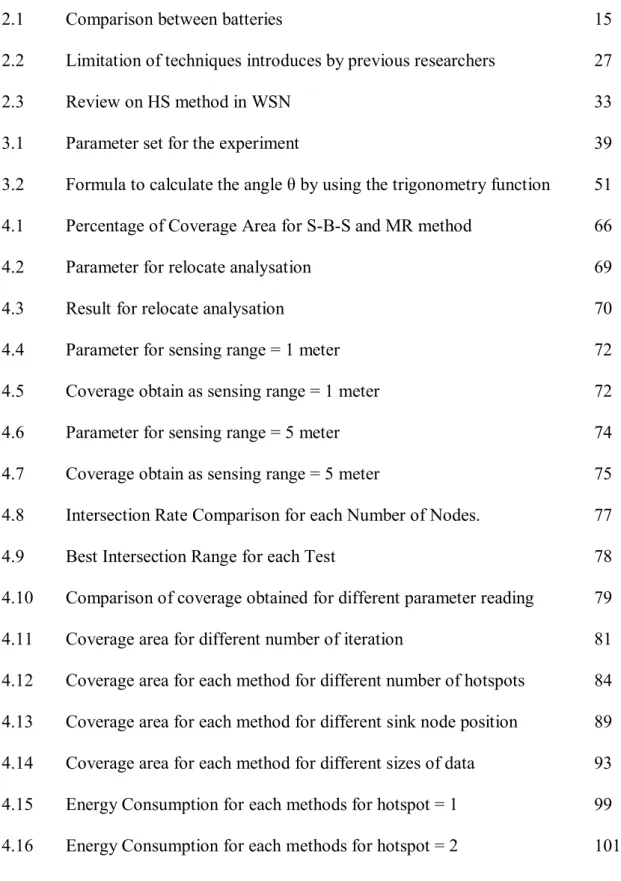
3.1 Parameter set for the experiment 39 3.2 Formula to calculate the angle θ by using the trigonometry function 51 4.1 Percentage of Coverage Area for S-B-S and MR method 66 4.2 Parameter for relocate analysation 69 4.3 Result for relocate analysation 70 4.4 Parameter for sensing range = 1 meter 72 4.5 Coverage obtain as sensing range = 1 meter 72 4.6 Parameter for sensing range = 5 meter 74 4.7 Coverage obtain as sensing range = 5 meter 75 4.8 Intersection Rate Comparison for each Number of Nodes. 77 4.9 Best Intersection Range for each Test 78 4.10 Comparison of coverage obtained for different parameter reading 79 4.11 Coverage area for different number of iteration 81 4.12 Coverage area for each method for different number of hotspots 84 4.13 Coverage area for each method for different sink node position 89 4.14 Coverage area for each method for different sizes of data 93 4.15 Energy Consumption for each methods for hotspot = 1 99 4.16 Energy Consumption for each methods for hotspot = 2 101
4.17 Energy Consumption for each methods for hotspot = 3 102 4.18 Energy Consumption for each methods for sink node position =
(100,100)
105
4.19 Energy Consumption for each methods for sink node position = (200,200)
107
4.20 Energy Consumption for each methods for sink node position = (300,300)
109
4.21 Energy Consumption for each methods for size of data = 10 bytes 112 4.22 Energy Consumption for each methods for size of data = 32 bytes 113 4.23 Energy Consumption for each methods for size of data = 64 bytes 113 4.24 Energy Consumption for each methods for size of data = 128 bytes 113 4.25 Energy Consumption for each methods for size of data = 256 bytes 114 4.26 Energy Consumption for each methods for size of data = 512 bytes 114 4.27 Energy Consumption for each methods for size of data = 1024 bytes 114 4.28 Coverage area percentage for readings with energy of 46 mJ 119 4.29 Energy reading for both methods with coverage of 53% 119 4.30 Coverage area comparison between Modified Harmony Search and
Existing method
LIST OF FIGURES
FIGURE TITLE PAGE
1.1 Block diagram of proposed method 3 2.1 Sensor nodes scattered on a sensor field 7 2.2 Architecture of a sensor node 1 2.3 WSN application in health field 11 2.4 WSN application in military field 11
2.5 Power consumption of sensor 12
2.6 Types of grid (a) Triangular lattice (b) Square grid (c) Hexagonal grid 18 2.7 (a)Voronoi diagram and (b) Delaunay diagram 19 2.8 Routing for general Wireless Sensor Network 22 2.9 Routing for dense Wireless Sensor Network 23 2.10 Flowchart of basic Harmony Search algorithm 28 2.11 Framework for designing the network protocol 33
3.1 Research flowchart 36
3.2 General process flows 37
3.3 Flowchart of the Modified Harmony Search 38 3.4 Flowchart of Improvisation of Modified Harmony Search 41 3.5 Flowchart of selecting relocate node 42 3.6 Two circles are intercept at two points 43 3.7 Flowchart of technique based on game behaviour 44 3.8 Illustration of fully utilized sensing ability of sensors 46 3.9 Illustration of not fully utilized sensing ability of sensors 46
3.10 Flowchart of new position identification process 47 3.11 Intersection area of two sensor nodes A and B 48 3.12 Distance between centre A and centre B 49
3.13 Centre point of line AB 50
3.14 Side of a right triangle 50
3.15 Angle a of right triangle 52
3.16 Segment and sector of a circle 53
3.17 Formation of triangle ACE 54
3.18 Flowchart of Modified Random process 56
3.19 Formation of the grid 58
3.20 Marking ‘1’ at (x,y) position and the grid around with sensing range distance
58
3.21 Process of area calculation process 59 3.22 Flowchart of the process of energy consumption calculation 60 3.23 Shortest path distance finder process 62 4.1 Comparison of coverage area percentage between Plan Deployment
and Random Deployment
67
4.2 Comparison of Initial area and new area after relocate node is applied for different number of node
71
4.3 Comparison of Initial area and new area after relocate node is applied as the sensing range = 1 meter
73
4.4 Comparison of Initial area and new area as number of relocate node increases
75
4.7 Comparison of Modified Harmony Search method, Modified Random method and Harmony Search method for different number of hotspot.
85
4.8 Picture of covered area of nodes deployment of (a) Harmony Search, (b) Modified Random, (c) Modified Harmony Search for hotspot = 1
86
4.9 Picture of covered area of nodes deployment of (a) Harmony Search, (b) Modified Random, (c) Modified Harmony Search for hotspot = 2
87
4.10 Picture of covered area of nodes deployment of (a) Harmony Search, (b) Modified Random, (c) Modified Harmony Search for hotspot = 3
88
4.11 Result comparison of Modified Harmony Search method, Modified Random method and Harmony Search method for different sink node position
89
4.12 Picture of covered area of nodes deployment of (a) Harmony Search, (b) Modified Random, (c) Modified Harmony Search for sink node position = (100,100)
91
4.13 Picture of covered area of nodes deployment of (a) Harmony Search, (b) Modified Random, (c) Modified Harmony Search for sink node position = (200,200)
91
4.14 Picture of covered area of nodes deployment of (a) Harmony Search, (b) Modified Random, (c) Modified Harmony Search for sink node position = (300,300)
92
4.15 Result comparison of Modified Harmony Search method, Modified Random method and Harmony Search method as sizes of data increases.
94
4.16 Picture of covered area of nodes deployment of (a) Harmony Search, (b) Modified Random, (c) Modified Harmony Search for 10 bytes data
sizes.
4.17 Picture of covered area of nodes deployment of (a) Harmony Search, (b) Modified Random, (c) Modified Harmony Search for 32 bytes data sizes.
96
4.18 Picture of covered area of nodes deployment of (a) Harmony Search, (b) Modified Random, (c) Modified Harmony Search for 64 bytes data sizes.
96
4.19 Picture of covered area of nodes deployment of (a) Harmony Search, (b) Modified Random, (c) Modified Harmony Search for 128 bytes data sizes.
97
4.20 Picture of covered area of nodes deployment of (a) Harmony Search, (b) Modified Random, (c) Modified Harmony Search for 256 bytes data sizes.
97
4.21 Picture of covered area of nodes deployment of (a) Harmony Search, (b) Modified Random, (c) Modified Harmony Search for 512 bytes data sizes.
97
4.22 Picture of covered area of nodes deployment of (a) Harmony Search, (b) Modified Random, (c) Modified Harmony Search for 1024 bytes data sizes.
98
4.23 Node deployment of (a) Harmony Search, (b) Modified Random, (c) Modified Harmony Search for hotspot = 1
100
4.24 Node deployment of (a) Harmony Search, (b) Modified Random, (c) Modified Harmony Search for hotspot = 2
102
4.26 Comparison of each method with and without shortest path distance finder for different number of hotspot
104
4.27 Node deployment of (a) Harmony Search, (b) Modified Random, (c) Modified Harmony Search for sink node location (100,100)
106
4.28 Node deployment of (a) Harmony Search, (b) Modified Random, (c) Modified Harmony Search for sink node location (200,200)
108
4.29 Node deployment of (a) Harmony Search, (b) Modified Random, (c) Modified Harmony Search for sink node location (300,300)
110
4.30 Comparison of each method with and without shortest path distance finder for different sink node position
111
4.31 Node deployment of (a) Harmony Search, (b) Modified Random, (c) Modified Harmony Search for size of data = 10 bytes
115
4.32 Node deployment of (a) Harmony Search, (b) Modified Random, (c) Modified Harmony Search for size of data = 32 bytes
115
4.33 Node deployment of (a) Harmony Search, (b) Modified Random, (c) Modified Harmony Search for size of data = 64 bytes
116
4.34 Node deployment of (a) Harmony Search, (b) Modified Random, (c) Modified Harmony Search for size of data = 128 bytes
116
4.35 Node deployment of (a) Harmony Search, (b) Modified Random, (c) Modified Harmony Search for size of data = 256 bytes
116
4.36 Node deployment of (a) Harmony Search, (b) Modified Random, (c) Modified Harmony Search for size of data = 512 bytes
117
4.37 Node deployment of (a) Harmony Search, (b) Modified Random, (c) Modified Harmony Search for size of data = 1024 bytes
117
finder for different sizes of data
4.39 Coverage area between Modified Harmony Search and existing method, Harmony Search and Particle Swam Optimization
LIST OF ABBREVIATIONS
NKRA - National Key Result Areas HS - Harmony Search
WSN - Wireless Sensor Network MHS - Modified Harmony Search MR - Modified Random
IR - Intersection Rate PAR - Pitch Adjustment Rate
HMCR - Harmony Memory Consideration Rate RR - Random Rate
QoS - Quality of Service
ADC - Analog Digital Converter MANET - Mobile Ad Hoc Networking NBC - Nuclear, Biological and Chemical DSN - Distributed Sensor Network CH - Cluster Head
VAP-E - Virtual Area Partition Enhancement WVD - Weighted Voronoi Diagram
SRA - Sensing Radius Adaptation MTC - Multiple Target Coverage
APTEEN - Adaptive Periodic Threshold-sensitive Energy Efficient Sensor Network
FSK - Frequency Shift Keying PPM - Pulse Position Modulation NLOS - Non-Line of Sight
LOS - Line of Sight AOA - Angle of Arrival
ANN - Artificial Neural Network HM - Harmony Memory
LIST OF SYMBOLS
d - Distance R - Radius
θ - Angle
h - height
B - number of backbone node N - Total number of nodes
n - Number of transmit
NI - Number of Iteration r1 - Random number 1 r2 - Random number 2
a - Intersection rate
b - Pitch Adjustment Rate value xi,yi - Node position selected from HM
xiN,yiN - Neighbour of selected node from HM
xnewlocate,ynewlocate - New node position
LIST OF PUBLICATIONS
1. N.H.Halim., A.A.M. Isa., Afifah Maheran A.M., 2015. Analysis on Energy and
Coverage Problem in Wireless Sensor Network. International Conference on Computer,Communication, and Control Technology (I4CT2016) . (Scopus) (Accepted)
2. N.H.Halim., A.A.M. Isa., Afifah Maheran A.M., 2016. A Pre-defined Scheme for
Optimum Energy Consumption in Wireless Sensor Network. Journal of Telecommunication, Electronic and Computer Engineering. (Scopus) (Accepted)
3. N.H.Halim., A.A.M. Isa., Afifah Maheran A.M., 2016. Effect of Modified
Harmony Search Towards Area Coverage in Wireless Sensor Network. Journal of Telecommunication, Electronic and Computer Engineering. (Scopus)
CHAPTER 1
INTRODUCTION
1.1 Background
Quite recently, due to the increase in the number of crimes throughout the nation, the government has taken the issue of crime prevention seriously and placed a priority in crime rate reduction as one of the NKRA (National Key Result Areas) under the Ministry of Home Affairs (Shahrudin, 2016). Wireless Sensor Network (WSN) application can be implemented to overcome this problem. However, using a big amounts of wireless sensor node may incur high cost (G.Thirumalaimuthu, Lawrence and S.Meenakshi, 2016). Hence, battery-powered wireless sensor nodes in a mesh network to provide extended coverage area for the system was deployed. In a mesh network, connectivity is an important issue for communication purpose between the nodes. Thus, this research focuses on exploring the performance of battery-powered wireless sensor nodes using Modified Harmony Search algorithm (MHS) for localization of the nodes with the possibility of achieving higher throughput and longer network lifetime. Therefore the objectives of this research are to study, deploy and analyse the WSN implementation with MHS in order to provide extended coverage area. The parameters that are being considered are node optimisation for localization and remaining battery level. Node optimization is important to achieve an excellent link quality between the nodes while remaining battery level prolongs network lifetime. This fundamental study can lead to an efficient security system using WSN with better performance of throughput and energy efficient of the nodes besides enhancing the coverage and network lifetime. This research is essential to support the government’s
initiative to reduce the crime rate in Malaysia. Moreover, this is a potential collaborative community project between the researchers and the industrial partners in order to transfer the knowledge to nearby communities.
Most of the residential areas are provided with a guard system. However, the system is inefficient because the guard cannot monitor the whole residential area at one time. Therefore, an alert wireless system to guard the houses is needed so that actions can be taken quickly if houses be robbed. WSN limitations include radio range, battery lifetime, and geographical area. Thus, a multi-hop transmission of data between sensor nodes is needed. An optimisation method for node localisation can be used as a solution.
1.2 Problem Statement
Recent advances in wireless communications and electronics have enabled the development of low-cost and low-power, yet multifunctional sensor nodes that are small in size and able to communicate untethered in short distances. These tiny sensor nodes, which consist of sensing, data processing, and communicating components, leverage the idea of sensor networks (Akyildiz, and Cayirci, 2002). WSN is a wireless network that usually consists of a great number of far distributed devices that are equipped with sensors that measure quantities in our environment to monitor physical or environmental phenomenon.
Coverage problem reflect how well an area is monitored by the sensors. Coverage is one of the elements in sensor network which determine the effectiveness of the sensor application. Previous researchers had come out with different techniques and methods in order to ensure higher coverage area performance. However, there are limitations for each method.