
Mid-Price Movement Prediction
in Limit Order Books Using
Feature Engineering and
Machine Learning
7DPSHUH8QLYHUVLW\'LVVHUWDWLRQV $'$0$17,2617$.$5,6
0LG3ULFH0RYHPHQW3UHGLFWLRQ
LQ/LPLW2UGHU%RRNV8VLQJ
)HDWXUH(QJLQHHULQJDQG
0DFKLQH/HDUQLQJ
$&$'(0,&',66(57$7,21 7REHSUHVHQWHGZLWKWKHSHUPLVVLRQRI WKH)DFXOW\RI,QIRUPDWLRQ7HFKQRORJ\DQG&RPPXQLFDWLRQ6FLHQFHV RI7DPSHUH8QLYHUVLW\ IRUSXEOLFGLVFXVVLRQLQWKH/HFWXUHURRP7% RIWKH7LHWRWDOREXLOGLQJ.RUNHDNRXOXQNDWX7DPSHUH$&$'(0,&',66(57$7,21 7DPSHUH8QLYHUVLW\ )DFXOW\RI,QIRUPDWLRQ7HFKQRORJ\DQG&RPPXQLFDWLRQ6FLHQFHV )LQODQG Responsible supervisor and Custos 3URIHVVRU 0RQFHI*DEERXM 7DPSHUH8QLYHUVLW\ )LQODQG Supervisors 3URIHVVRU -XKR.DQQLDLQHQ 7DPSHUH8QLYHUVLW\ )LQODQG $GMXQFW3URIHVVRU $OH[DQGURV,RVLILGLV 7DPSHUH8QLYHUVLW\ )LQODQG $VVRFLDWH3URIHVVRU $DUKXV8QLYHUVLW\ 'HQPDUN Pre-examiners 3URIHVVRU $OHF1.HUFKHYDO )ORULGD6WDWH8QLYHUVLW\ 86$ $VVRFLDWH3URIHVVRU 3HNND0DOR $DOWR8QLYHUVLW\ )LQODQG Opponent 3URIHVVRU 3HWHU6DUOLQ +DQNHQ6FKRRORI(FRQRPLFV )LQODQG 7KHRULJLQDOLW\RIWKLVWKHVLVKDVEHHQFKHFNHGXVLQJWKH7XUQLWLQ2ULJLQDOLW\&KHFNVHUYLFH &RS\ULJKW$GDPDQWLRV1WDNDULV &RYHUGHVLJQ5RLKX,QF ,6%1SULQW ,6%1SGI ,661SULQW ,661SGI KWWSXUQIL851,6%1 3XQD0XVWD2\±<OLRSLVWRSDLQR 7DPSHUH
ABSTRACT
The increasing complexity of financial trading in recent years revealed the need for methods that can capture its underlying dynamics. An efficient way to organize this chaotic system is by contracting limit order book ordering mechanisms that operate under price and time filters. Limit order book can be analyzed using linear and non-linear models.
The thesis develops novel methods for the identification of limit order book char-acteristics which provide traders and market makers an information edge in their trading. A good proxy for traders and market makers is the prediction of mid-price movement, which is the main target of this thesis. The contributions of this thesis are categorized chronologically into three parts. The first part refers to the intro-duction in the literature of the first publicly available limit order book dataset for high-frequency trading for the task of mid-price movement prediction. This dataset comes together with the development of an experimental protocol that utilizes meth-ods inspired by ridge regression and a single layer feed-forward neural network as classifiers. These classifiers use state-of-the-art limit order book features as inputs for the target task.
The next contribution of this thesis is the use and development of a wide range of technical and quantitative indicators for the task of mid-price movement predic-tion via an extensive feature selecpredic-tion process. This feature selecpredic-tion process iden-tifies which features improve predictability performance. The results suggest that the newly introduced quantitative feature based on an adaptive logistic regression model for online learning was selected first according to several criteria. These crite-ria operate according to entropy, linear discriminant analysis, and least mean square error.
The third contribution is the introduction of econometric features as inputs to deep learning models for the task of mid-price movement prediction. An extensive comparison against other state-of-the-art hand-crafted features and fully automated
feature extraction processes is provided. Furthermore, a new experimental proto-col is developed for the task of mid-price prediction, to overcome the problem of time irregularities, which characterizes high-frequency data. Results suggest that ad-vanced hand-crafted features such as econometric indicators can predict movements of proxies, such as mid-price.
PREFACE
The work presented in this thesis has been carried out at Tampere University, Fin-land, during the years 2016-2019.
First and foremost, I would like to thank my supervisor, Professor Moncef Gabbouj, for his endless support, patience, and help throughout this project. His academic genius and rigorous teaching have not only been invaluable but also inspirational. I would also like to thank my second supervisor Professor Juho Kanniainen, for his constant support as well as his technical supervision for the numerous researches that we have conducted.
I would also like to acknowledge a special debt to my advisor and immensely tal-ented Professor Alexandros Iosifidis, who helped me to run the extra mile during this project.
I also gratefully acknowledge the funding that I received from Marie Sklodowska-Curie Innovative Training Network for the entire duration of my Ph.D. studies. To my co-authors, Giorgio Mirone and Martin Magris: thank you for your gen-erous collaboration on our shared projects. I would also like to thank BigDataFi-nance ESRs, MUVIS group researchers, Milla Mäkinen, Jaakko Valli, Kestutis Bal-takys, Milla Siikanen, Jenni Raitoharju, Nikolaos Passalis, Vivi Nousi, Avraam Tsan-tekidis, and George Kanellis for all the discussions we had during these three years of my doctoral education.
I also want to express my profound appreciation to my colleague, Morteza Zabihi, for his help.
My family deserves all the credits as the steady base that has given me the spiritual and material means to accomplish my goals. I feel deeply grateful to my parents,
Maroula and Yannis, as well as my grandparents, Despina and Kostas. My sister and my best friend, Dr. Virginia Dakari, has always been there for me, believing in me and cheering me up at times when I felt my courage failing. As for my Alina, for her enduring love, affection, and sunny optimism, I thank her deeply.
CONTENTS
1 Introduction . . . 19
1.1 Objectives and Outline of the Thesis . . . 21
1.2 Publications and Author’s Contribution . . . 22
2 Background Work . . . 23
2.1 High Frequency Data . . . 23
2.1.1 High-Frequency Data Properties . . . 24
2.2 Limit Order Book . . . 27
2.2.1 Modelling Limit Order Book Dynamics . . . 29
2.3 Machine and Deep Learning . . . 32
2.3.1 Ridge Regression . . . 32
2.3.2 Single-Hidden Layer Feedforward Neural Network . . . 33
2.3.3 Multilayer Perceptron . . . 35
2.3.4 Convolutional Neural Network . . . 36
2.3.5 Long Short-Term Memory . . . 37
2.4 Feature Engineering . . . 38
2.4.1 Limit Order Book Features . . . 39
2.4.2 Technical Analysis . . . 40
2.4.3 Quantitative Analysis . . . 43
2.4.4 Econometrics . . . 45
2.4.5 Fully Automated Feature Extraction . . . 47
3 Datasets, Protocols and Metrics . . . 49
3.2 Normalization . . . 50
3.3 Protocols . . . 52
3.4 Performance Evaluation . . . 54
4 Contributions . . . 57
4.1 Nordic Benchmark Dataset . . . 57
4.2 Feature Selection for Technical and Quantitative Indicators . . . 59
4.2.1 Adaptive Logistic Regression Feature . . . 62
4.2.2 Selection Criteria . . . 63
4.2.3 Feature Selection - Performance . . . 65
4.3 Econometric Features for Online Deep Learning . . . 67
4.3.1 Econometric Features Performance . . . 68
5 Conclusions . . . 71
References . . . 75
Publication 1 . . . 81
Publication 2 . . . 100
List of Figures
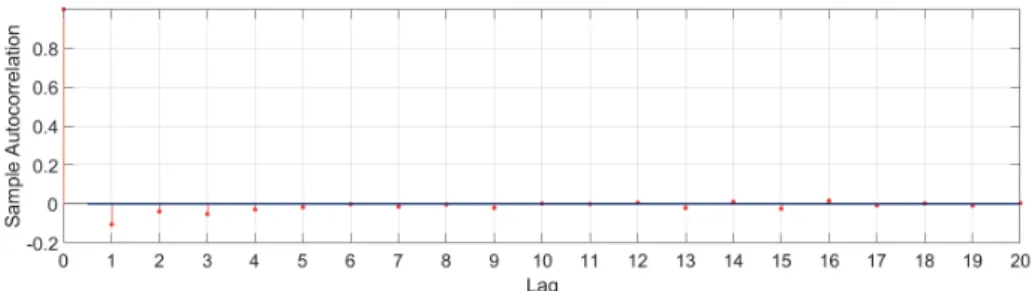
2.1 Correlogram up to 20 lags based on Amazon returns for the trading
session on 9/22/15. Correlogram shows the existence of negative
first-order autocorrelation with tight confidence intervals (blue lines). 25 2.2 High-frequency data-based Amazon returns can be better described
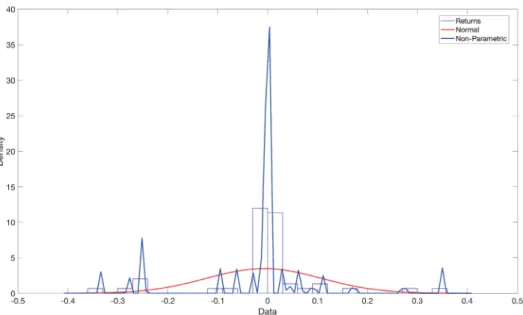
by a non-parametric distribution compared to the normal distribution. 26 2.3 Q-Q plot of Amazon returns against normal distribution where
pres-ence of heavy tails is obvious in both extremes. . . 26
2.4 Amazon’s intraday (9/22/15) bid-ask spread fluctuations . . . 27
2.5 SLFN example with several input units (left), one hidden layer (mid-dle) and an output layer with four units(right)[P1]. . . 34 2.6 MLP with two hidden layers (the graph was created in NN-SVG). . . 35 2.7 Example of a basic CNN architect (the graph was created in NN-SVG) 36 2.8 LSTM internal structure which shows how the information flows
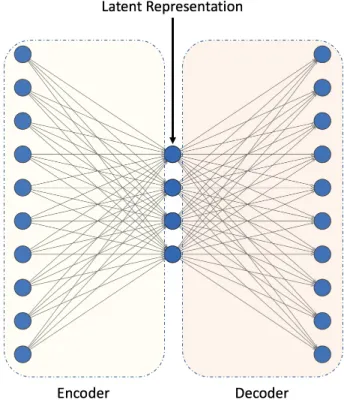
through gates. . . 39 2.9 Example of a symmetrical undercomplete AE . . . 47 3.1 Experimental Setup Framework based on an Anchored Forward
cross-validation format ([P1]). . . 52 3.2 Experimental Setup Framework based on independent feature blocks
(i.e.,t1, ...,t10, t11, ...,t20, ..., etc) format. This format constructs the input feature representations (FR) ([P3]). . . 53
3.3 Experimental Setup Framework based on online learning format ([P3]).
4.1 Bar plots with variance present the average (i.e. average F1 perfor-mance for the 9-fold protocol for all the features) F1 score of the 12 different models for the cases of 5, 50, 100, 200, and 273 number of best features. The order of the models from the left to the right col-umn is (1) feature list sorted based on entropy and classified based on LMS, (2) feature list sorted based on LMS1 and classified based on LMS, (3) feature list sorted based on LMS2 and classified based on LMS, (4) feature list sorted based on LDA1 and classified based on LDA, (5) feature list sorted based on LDA2 and classified based on LDA, (6) feature list sorted based on LDA1 and classified based on LMS, (7) feature list sorted based on LDA2 and classified based on LMS, (8) feature list sorted based on LDA2 and classified based on LMS, (9) feature list sorted based on entropy and classified based on RBFN, (10) feature list sorted based on LMS2 and classified based on RBFN, (11) feature list sorted based on LDA1 and classified based on RBFN, and (12) feature list sorted based on LDA2 and classified based on RBFN ([P2]). . . 67 4.2 F1 (left column plots) and RMSE (right column plots) scores for the
List of Tables
2.1 Amazon’s message list example from 11:27:45:289 to 11:27:45:305 on 22.09.15, where time is expressed in UNIX format and price is
mul-tiplied by 10,000 . . . 24
2.2 LOB feature sets (obtained from[P1]) . . . 40
3.1 Nordic Stocks . . . 49
3.2 Trading activity of the five Nordic stocks . . . 50
3.3 US Stocks . . . 50
3.4 Trading activity of the two US stocks . . . 50
4.1 HF Dataset Examples ([P1]) . . . 58
4.2 Results based on Unfiltered Representations ([P1]) . . . 59
4.3 Results based on Z-score Normalization ([P1]) . . . 59
4.4 Feature list of the three groups (description and calculations in[P2]). 61 4.5 List of the first 10 best features for the 5 sorting methods ([P2]) . . . . 66
4.6 Feature list of the three feature sets: Description for the newly in-troduced, Econometrics-based, handcrafted features can be found in [P3]; where description for the Tech & Quant and LOB feature sets can be found in[P2] . . . 69
List of Symbols
A Reaction-Diffusion Particle
α Limit Orders Arrival Rate
A(t) Set Of Sell Orders
B(t) Set Of Buy Orders
B Reaction-Diffusion Particle
Cit LSTM’s Cell Gate
e(i) Error Function at time instancei
E[·] Expected Value
ft
i LSTM’s Forget Gate fT(t) Poisson Process at time t
ˆ
fh(·) Kernel Density Function
gt
i LSTM’s Input Gate
h Activation’s Function Vectors
h Bandwidth
H† Moore-Penrose Pseudoinverse Matrix H Network’s Hidden Layer Outputs Matrix
ht LSTM’s Hidden State Output
k Time Series Lag
lx Maximal Output Value
nb(·) Bid-Side Depth na(·) Ask-Side Depth ot
i LSTM’s Output Gate o Neural Network Output
pa
x− Before Change Ask Price px New Order’s Price
pxb− Before Change Bid Price
pax New Ask Price
pb
x New Bid Price pa
j Ask Agent’s LOB Price pb
j Bid Agent’s LOB Price
¯
p Upper Bounded Price Particle
Ri Stationarity Process ˜
Ri Stationarity Process After Price Change
S Random Variable
tx New Order’s Arrival Time
T TargetstiMatrix
ti Target Vector At Time Instance
va
x− Before Change Ask Volume vb
x− Before Change Bid Volume Vb
x− Before Change Bid Volume vt New Order’s Volume
Va
x− Before Change Ask Volume Va
x New Ask Volume Order Vxb New Bid Volume Order
V Hidden’s Layer Weights
W Weights’ Matrix
X Time Series
X SamplesxiMatrix
xi Sample At Time Instancei
x New Orders
xi Set Of Vectors
Z(t) Statistical Criterion
z Cut-off Point
Δp(t) Price Variation At Time t
η Market Orders Arrival Rate
λ Regularization Penalty
μ Mean
π Tick Size
σ Smallest Traded Amount
σg Sigmoid Function σ2
z Constant Variance
List of Abbreviations
ADX Average Directional Index AE Autoencoder
CNN Convolutional Neural Network DM Directional Movement
EG Engle-Granger Statistical Test ELM Extreme Learning Machine FN False Negatives
FP False Positives
FR Feature Representation HF High Frequency
i.i.d. Independent and Identical Distributed IV Integrated Variance
LDA Linear Discriminant Analysis LMS Least Mean Squares
LOB Limit Order Book LRL Linear Regression Line LSTM Long Short-Term Memory MB Message Book
MLP Multilayer Perceptron PA Pre-averaged Variance QV Quadratic Variation
RBFN Radial Basis Function Neural Network ReLU Rectified Linear Activation Function RK Realized Kernel
RMSE Root Mean Squared Error RNN Recurrent Neural Network RV Realized Variance
RR Ridge Regression SAR Stop And Reverse
SLFN Single-Hidden Layer Feedforward Neural Network TF True Negatives
TP True Positives TR True Range
LIST OF PUBLICATIONS
[P 1] A. Ntakaris, M. Magris, J. Kanniainen, M. Gabbouj and A. Iosifidis.
Bench-mark dataset for mid-price forecasting of limit order book data with machine
learning methods.Journal of Forecasting37.8 (2018), 852–866.
[P 2] A. Ntakaris, J. Kanniainen, M. Gabbouj and A. Iosifidis. Mid-Price
Predic-tion Based on Machine Learning Methods with Technical and Quantitative
Indicators.PLOS ONE(under review).
[P 3] A. Ntakaris, G. Mirone, J. Kanniainen, M. Gabbouj and A. Iosifidis.
Fea-ture Engineering for Mid-Price Prediction With Deep Learning.IEEE Access
7 (2019), 82390–82412.
Preliminary results of[P1]were presented at the 10t h International Conference on
Computational and Financial Econometrics (CFE 2016)in Seville, Spain, on
1
INTRODUCTION
Trading started several centuries ago. The Dutch East India was the first publicly traded company in 1602, while the New York Stock Exchange (NYSE) was created in 1817 and became the most dominant stock ex-change in the USA. Nasdaq, the second-biggest stock exchange after NYSE, was founded in 1971 and acquired other
stock exchanges such as the Finnish stock exchange in Helsinki1in 2003. However,
it was not until 1967 that electronic trading platforms were introduced as an alterna-tive trading system by Instinet in New York. Since then, electronic and automated trading increased their impact on the trading floor and nowadays, this type of trad-ing is the only possible way to exchange stocks. Electronic platforms created a very complex and remarkably fast system which offers instant access to several stock ex-changes. This dynamic system is able to trade large volumes in milliseconds or even nanoseconds. Transaction speed and complexity of this trading universe created the need for efficient analysis of its dynamics.
One way to formulate and organize such a complex system is the so-called limit order book (LOB). LOB is the way that stock exchanges organize their trading ac-tivity. It is a mechanism that sorts trades on a price-time sequence, which means that LOB prioritizes orders first according to the price level and next according to arrival time. LOB has two sides: the ask side and the bid side. Ask refers to the minimum price someone is willing to sell a given stock at, while bid refers to the maximum price that someone is willing to pay for a stock. Every LOB’s ask and bid side is divided into several price levels. Every price level comes together with the
volume/number of available stock pieces. Both LOB sides (i.e., ask and bid) have
their best ask and bid prices, respectively. The average of the best ask and bid price constitutes the so-called mid-price. Even though mid-price cannot be traded directly, many investors use it as a proxy to identify potential movements of the actual ask and bid stock prices.
Movement prediction of proxies like LOB’s mid-price is a challenging task due to several reasons such as data complexity and availability, identification of factors that explain the source of uncertainty, and assumption elimination of every possi-ble underline process. Another challenge that makes LOB’s mid-price movement prediction even more complicated is the size of intraday trading activity in a high-frequency environment. Under these challenges, a critical question arises: is LOB’s mid-price predictable? The present thesis proposes a coherent answer to this ques-tion by connecting machine and deep learning methods with state-of-the-art feature engineering as part of several experimental protocols.
Machine and deep learning methods are capable of analyzing linear and non-linear complex systems. An example of a complex system is the LOB. Such methods were extensively used in image and video applications for data parsing (e.g., filtering) via numerous model options, mainly based on functions-kernels used for classifica-tion or predicclassifica-tion. Machine and deep learning aim to learn from the data (e.g., LOB dataset), and, together with recent computational advancements, they offer efficient analysis methods for financial applications, such as mid-price movement prediction. Besides their ability to learn from data, these methods are competent enough to uti-lize representations effectively as inputs. These inputs are usually handcrafted fea-tures, and their purpose is to transform raw data into meaningful signals. That being said, development of state-of-the-art handcrafted features comes with challenges as they require an in-depth analysis of data and understanding of any underlying pro-cess that may be attached to it.
In this thesis, such in-depth analysis is proposed as a result of the extensive ex-perimental basis for the task of LOB’s mid-price movement prediction. First, an experimental protocol for high-frequency LOB data is developed and made publicly available. What is more, state-of-the-art LOB hand-crafted features and linear and non-linear classifiers utilized and developed for LOB dynamics analysis. The solu-tions have proven that mid-price’s movements can be predictable. Next, feature en-gineering exploitation based on technical and quantitative indicators as extensions of the existing LOB features provides insight via an extensive study, whose features are suitable for the task of mid-price movement prediction. This study is based on the conversion of entropy, linear discriminant analysis, and least mean square as feature sorting methods. This analysis reveals that mid-price movements could be predicted by means of the best subset selection of advanced hand-crafted features. Last, one
more hand-crafted econometric-based feature set is presented as input to a wide range of deep learning models. Its aim is to offer a fair evaluation against LOB, technical, quantitative and fully automated features. The output of this analysis led to highly accurate estimation of when the next mid-price movement will happen.
1.1 Objectives and Outline of the Thesis
In this thesis, the focus is placed on capturing, via feature engineering, LOB dynam-ics by utilizing machine and deep learning methods. The objectives of this thesis addressing the research problem stated above are the following:
• To investigate whether state-of-the-art features can predict, with the use of ma-chine learning models, mid-price movements based on high-frequency LOB data.
• To develop state-of-the-art handcrafted features and scrutinize their effective-ness for the task of mid-price movement prediction through the development of experimental protocols which they can be publicly available.
• To determine the effectiveness of deep learning for online mid-price movement
prediction via feature engineering.
The thesis is organized as follows. In Chapter 2 an overview of the key concepts of interest are provided. This background section contains the main ideas of High-frequency (HF) Data properties (Section 2.1), Limit Order Books (Section 2.2), Ma-chine and Deep Learning (Section 2.3), and Feature Engineering (Section 2.4). Chap-ter 3 presents the datasets, experimental protocols and metrics used in the analysis. The contributions of this thesis are discussed in Chapter 4. Section 4.1 presents a novel approach to predicting mid-price movements based on state-of-the-art hand-crafted features. In Section 4.2 an extensive analysis for feature engineering is de-veloped together with a novel set of handcrafted features for online learning for the task of mid-price movement prediction. In Section 4.3 the development of econo-metric features for deep learning is introduced via an experimental protocol suitable for online learning for the task of mid-price movement prediction. Finally, Chap-ter 5 summarizes the most important findings of the thesis along with concluding remarks and topics for future research.
1.2 Publications and Author’s Contribution
In[P1], a benchmark LOB dataset was published for the task of mid-price movement
prediction. The major contribution of this paper is the very first detailed experimen-tal protocol for a LOB benchmark dataset based on Nordic stocks. State-of-the-art handcrafted features were tested through linear and non-linear classifiers for the pre-diction of several projected horizons of future mid-price movements. Baseline mod-els set up on ridge regression and a single-hidden layer feedforward neural network (SLFN) with k-means were suggested in this task. The candidate is the main author of the publication and is responsible for developing and implementing the suggested models and protocol as well as writing the initial draft of the paper.
In [P2], an extensive feature selection evaluation was performed for the task of mid-price prediction. The evaluation was based on the majority of technical indi-cators together with quantitative indiindi-cators and LOB features. Under a wrapper method, the best sets of features were suggested as optimal selection for the classifi-cation task of mid-price movement prediction. Three methods, entropy, linear dis-criminant analysis (LDA), and least mean squares (LMS), converted into feature se-lection criteria where the majority of them selected first the newly introduced adap-tive logistic regression feature. Testing the majority of basic and advanced technical indicators, the development of an adaptive logistic feature and the conversions of en-tropy, LDA, and LMS as feature selection criteria constitue the main contribution of this publication. The candidate developed and implemented the suggested models and protocol and wrote the initial draft of the paper.
In[P3], econometrics features were suggested as inputs to several deep learning models, like multilayer perceptrons (MLP), convolutional neural networks (CNN), and long short-term memory (LSTM) neural networks, for the task of mid-price movement prediction. Introduction of econometrics features is one the main con-tributions of this publication since they performed, in some cases, much better than technical, quantitative, LOB and fully automated features. Another contribution of this publication is the development of a new experimental protocol to overcome the problem of time irregularities of HF data. The candidate is the first author of this publication and is responsible for developing and implementing the suggested models and protocol. He also wrote the first draft of the paper.
2
BACKGROUND WORK
This thesis introduces feature engineering for LOB high-frequency trading data by utilizing machine and deep learning for the task of mid-price movement prediction. We will first introduce the main concepts of High-Frequency Data, Limit Order Book, Feature Engineering, and Machine and Deep Learning.
2.1 High Frequency Data
Algorithmic trading is a computer-based trading mechanism of selling and buying stocks depending on computerized instructions. High-frequency trading is a type of algorithmic trading that operates under low-latency setting. This low-latency set-ting refers to a system that operates under a single digit millisecond round-trip time
for a packet of data/orders. These data packets, named high-frequency data,
pro-vide records of the intraday trading activity (i.e., message book (MB)). These records contain information regarding:
• Security’s ID code
• Timestamp
• Price
• Volume
• Side (Ask or Bid)
• Type of Order (Submission, Cancellation, Execution)
• Full or Partial Cancellation or Execution
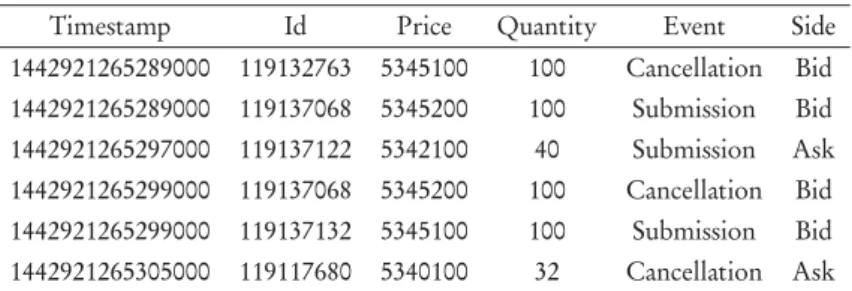
These details are an example (e.g., Table 2.1) of the available trading information and can be extended according to the level of the subscription fee. The flow of intraday information creates the need for analysis of its dynamics.
Table 2.1 Amazon’s message list example from 11:27:45:289 to 11:27:45:305 on 22.09.15, where time is expressed in UNIX
format and price is multiplied by 10,000
Timestamp Id Price Quantity Event Side 1442921265289000 119132763 5345100 100 Cancellation Bid 1442921265289000 119137068 5345200 100 Submission Bid 1442921265297000 119137122 5342100 40 Submission Ask 1442921265299000 119137068 5345200 100 Cancellation Bid 1442921265299000 119137132 5345100 100 Submission Bid 1442921265305000 119117680 5340100 32 Cancellation Ask
2.1.1 High-Frequency Data Properties
High-frequency data creates the need for analysis due to its complex nature and dynamics. The analysis can be based on the following general properties of high-frequency data:
• Negative Autocorrelation
Asset’s returns1in a high frequency environment exhibit negative first-order
autocorrelation. Autocorrelation measures the cor- relation between a time
series with a lagged version of itself. More specifically, for anN-sample time
series X={x1,x2, ...,xN} ∈N ofN samples the autocorrelation with lag k at time instanceiis defined as:
rX,k= E[(xi−μ)(xi+k−μ)] E[(xi−μ)2]E[(x
i+k−μ)2]
(2.1) whereE[(xi−μ)(xi+k−μ)]is the covariance between the time series and its lagged version, and E[(xi−μ)2] and E[(x
i+k −μ)2] are the corresponding variances.
Many authors (e.g. [3],[15],[28]) found evidence of the existence of negative autocorrelation in high-frequency data. An example of the presence of nega-tive correlation can be seen in Figure 2.1 which is based on Amazon trading on 9/22/2015. One can clearly see the presence of negative first-order (i.e., lag 1) autocerralation which gradually disappears as the lag increases.
Figure 2.1 Correlogram up to 20 lags based on Amazon returns for the trading session on 9/22/15. Correlogram shows the existence of negative first-order autocorrelation with tight confidence
intervals (blue lines).
• Absence of Normality or Lognormality with Heavy Tails
Stock prices in financial markets follow a lognormal distribution (e.g., [49]) under the condition that sequential price changes are normally distributed. This does not hold for the case of high-frequency data where the differenc-ing interval2becomes shorter (e.g.,[3],[15],[24]) and data loses its normal-ity in the case of a heavy tailed distribution. Figure 2.2 shows that returns’ histograms are not normally distributed and a non-parametric statistical dis-tribution describes better the data (i.e., stock returns). The non-parametric statistical distribution is based on the following kernel density estimator:
ˆ fh(x) = 1 N h N i=1 K x−x i h (2.2) wherehis the bandwidth adjusted to the data (i.e., Amazon returns) andK(·)is the Gaussian kernel smoothing functionK(x,xi) =e−(x−xi)
2
2h2 . Heavy tails can
be seen in Figure 2.3, where a Q-Q3provides evidence regarding the existence
of heavy tails in both extremes. • Bid-Ask Bounce
Bid and ask data arrive asynchronously, which means that the quoting process is exposed to noise. The quoting process in tick-by-tick data that creates the bid-ask spread, which is the difference between the bid quote and the ask quote 2Differencing interval is defined as the space between two consecutive data points.
3Q-Q (i.e., Quantile-Quantile) plot compares the quantiles of a given dataset and a set of quantiles
Figure 2.2 High-frequency data-based Amazon returns can be better described by a non-parametric distribution compared to the normal distribution.
Figure 2.3 Q-Q plot of Amazon returns against normal distribution where presence of heavy tails is obvious in both extremes.
at any time. Bid-ask spread plays a critical role in stock price forecasting since it exhibits a different behavior in liquid and illiquid stocks (i.e., liquid stocks
have a smaller bid-ask spread compared to illiquid stocks where the spread is higher). This spread represents the profit and some commission fees market maker firms make. This spread creates room for the bid-ask bounce effect. Bid-ask bounce (e.g., Figure 2.4) is the bouncing of any trade between the bid and ask price. This oscillation can lead to bias in high-frequency data
analy-sis. For instance, authors in[33]suggest that the price movement that takes
place inside the bid-ask spread is not an actual price movement but leads to idiosyncratic volatility increase.4
Figure 2.4 Amazon’s intraday (9/22/15) bid-ask spread fluctuations
2.2 Limit Order Book
Modern financial markets operate under a double auction mechanism called limit order book (LOB). LOB accepts two types of orders, limit and market orders. A limit order is an order to sell or buy a stock at a specified price, whereas a market order is traded instantly under the current market price. As a result, LOB acts as a recording mechanism for the unexecuted trading activity where time and price priority are the primary filters for queues creation. These queues represent, at any time t , the price levels of the bid and ask sides and vary according to order arrivals
and liquidity5levels.
Orders, following[30], are defined asx= (pi,vi,tt)where pi,vi, and ti repre-sent the price (i.e., bid or ask), the volume and the order submission time at timei, respectively. All orders arrive with sizevi ∈ {±kσ|k=1, 2, ...}withσthe smallest traded amount6. The set of all active orders,L(t), is a càdlàg process since for every new limit orderx, the following holds:x∈L(ti)andx∈/limt↑t
xL(t
). This activity defines the depth size for every LOB level in both bid and ask sides. The depth size, especially in the best bid and ask level, is a key element for the price formation (see e.g.,[9],[18]). More specifically, the available bid-side depthnb(p,i)(equivalently, the ask-side depthna(p,t)) at timei is defined as:
nb(p,i):=
{x∈B(i)|pi=p}
vi (2.3)
whereB(i)is the set of all active buy orders (equivalentlyA(i)is the set of all sell orders).
The depth of each level in both (bid and ask) sides is modified constantly due to limit orders, market orders, and cancellations. Limit orders increase the size depth while market orders and cancellations remove liquidity from LOB. Instead of follow-ing this tradfollow-ing activity, the trader can handle the bid and ask queues, as presented in
[14], as stationary processes namely(Ri)i≥1after a price increase and(R˜i)i≥1when there is a price decrease for theit hevent. Both stationary processes exhibit the same distribution for the order book depth in case of a price increase or decrease. For instance, in the case of reduced-form model, for a new order or cancellation arrival, in the bid side, of sizeVib at time instancetibthere are two scenarios:
• ifvb
i−+Vib≥0 then there is no price change and the order will be satisfied • ifvb
i−+Vib<0 then the size of the bid level is reduced together with the price by one ’tick’ of sizeπ. Based on the updated ˜Ri= (R˜b
i, ˜Rai)values for the bid
5Liquidity is defined according to three factors: (i) tightness of a liquid market (i.e., the position’s
alternation cost over a short period of time), (ii) depth (i.e., order-flow innovations for price changes), and (iii) resiliency (i.e. recovering time from random, uninformative shocks)[39].
6σ together withπ, which is the smallest price interval between orders, are the so-called LOB’s
and ask side, the new LOB state is: (pib,vib,via) = (pib−,vib−+Vib,via−){vb i−≥−Vib}+ (p b i−−π, ˜Rib, ˜Rai){vb i−<−Vib} (2.4)
whereis the indicator function, pb
i−is the best bid price before the update,
vib−andvia−are the volume sizes for the best bid and ask sides, respectively. In a similar fashion, for a new arrival to the ask side, of sizeVa
i, LOB’s state will be: • ifva
i−+Via≥0 then there is no price change and the order will be satisfied • ifvia−+Via<0 then the size of the ask level is reduced together and the price
will be increased by one ’tick’ of sizeπ. Based on the updated ˜Ri= (R˜b i, ˜Rai) values for the bid and ask side, the new LOB state is:
(pia,vib,via) = (pib−,vib−,via−+Via){va i−≥−Via}+ (p b i−+π, ˜Rbi, ˜Rai){va i−<−Via} (2.5) whereis the indicator function, pib−is the best bid price before the update, vb
i−and via−are the volume sizes for the best bid and ask sides before the up-date, respectively.
2.2.1 Modelling Limit Order Book Dynamics
The constant LOB state updates create a dynamical system that has attracted the at-tention of many researchers and practitioners. Modeling of LOB dynamics is based on the assumptions that must be proven by the data. Several models have been sug-gested as potential solutions to the description of LOB dynamics.
Cut-Off Strategies
Driven mainly by statistics which are related toL(t)and order flow.7Cut-off strate-gies formulate a decision-making trading approach. The main idea behind this type of modeling is close to a statistical hypothesis test. For instance, following[30], a trader will place an order when the spread8is smaller than 5π. Usually, this type of LOB modeling exhibits the difference between informed and uninformed traders.
7Limit orders, together with market orders and cancellations, are the critical components of the
so-called order flow.
DefinitionA cut-off strategy, between decisions D1and D2, is defined according to the comparison of a statistic Z(t)and a cut-off point z:
D1, i f Z(t)≤z,
D2, ot he r wi s e. (2.6)
Diffusion Models
Diffusion models belong to a modeling approach where the arrival of orders, can-cellations, and executions are described by a stochastic process. More specifically, the first model of this type was introduced by[5], where the authors suggested that the interaction between order flow and LOB follows the reaction-diffusion model
A+B → in Physics. These two types of particles are inserted in a pipe of size ˜p
and move randomly by a step of size one. Every time these two particles collide, they are annihilated, and as a result, two new particles are created. This process can describe orders’ arrivals in the LOB. The authors make the following analogies: 1)
Particle→Orders, 2) Finite Pipe→Order Book, and 3) Collision→Transaction.
They define the stock price at time t as p(t) ∈ {0, ..., ¯p}, where ¯p is an upper bounded discrete price. Every simulation considers half of the agents in the bid side and the other half in the ask side asking for one share of the stock each:
pbj(0)∈0,¯p 2 , j=1, ...,N 2 (2.7) and paj(0)∈¯p 2, ¯p , j=1, ...,N 2 (2.8)
whereN is the number of noise traders9. The trading activity revision at each time
steptis based on an equal probability of a stock going up or down by one tick size.
As a result, every new price for the agent is:
b i d s i d e:pjb(t+1) =pbj ±1
as k s i d e: paj(t+1) = paj ±1 (2.9)
9These are the traders whose current volatility depends on the recent changes in the market and
The matching or transaction achieved if exists(i,j)∈ {1, ...,N2}such that:
pib(t+1) =paj(t+1). (2.10)
This dynamical system follows, as authors suggest, the price variationΔp(t)at time t as this presented by[6]: Δp(t)∼t14 l nt t0 1 2 , (2.11)
where t0represents the initial trading time. The idea that a reaction-diffusion
ap-proach can model LOB dynamics has some drawbacks. For instance, simulations
suggest a Hurst exponent ofH =1/4 and no fat tails exist in the returns’
distribu-tion.
Continuous-time Models
Continuous-time models’ main idea is that order arrivals (i.e., market orders, limit orders, and cancellations) are independent Poisson processes, as this can be seen in models like [16], [17], [19],[20], [53]. The basic model (i.e., [20]) considers the
order flow and the relevant adjustments toL(t)as a queueing system where:
• market orders arrive in chunks of sizeVmat a rate ofνper unit time,
• limit orders arrive in chunks of sizeVl at a rate ofαper unit time,
• offers are placed, with a uniform probability, on the price grid{1, ...n}with tick sizeπresolution.
The motivation for choosing independent Poisson processes is their simplicity and the fact that they can describe orders’ arrival independently. Following[27], a Poisson process is an arrival process as defined below:
DefinitionAn arrival process is an increasing sequence of random variables 0<S1<
S2<..., with Si+1−Sibe always a positive random variable.
DefinitionA Poisson process is a renewal10process where the interarrival intervals fol-low an exponential distribution function withω >0and each of the interarrival times Tihas a density
fT(t) =ωe−ωt, t ≥0. (2.12)
10A renewal process is an arrival process during which the sequence of interarrival times is a sequence
This model has several drawbacks since Poisson processes are not able to describe the different arrival rates (i.e., intensity periods of high arrival rates cluster in time) as suggested in[21],[31], and[61].
2.3 Machine and Deep Learning
The recent rise of computational power facilitated fields such as machine and deep learning to grow. Machine learning is an automated process where an algorithm performs a task based on a set of filters and conditions. There are several tasks a machine learning algorithm can solve via supervised or unsupervised learning. A supervised task occurs when the algorithm has access to the so-called ground truth, which is a ’proof’ of an event occurrence11. The second type of tasks machine learn-ing algorithms are suitable for are the ones without ground truth. These methods are based only on the given data and operate according to a self-feedback loop dur-ing the learndur-ing process. Both methods require tundur-ing dependdur-ing on the dataset and the problem under consideration. Many applications (e.g., image and voice recogni-tion, time-series analysis, etc.) are based on big datasets, which demand analysis of their dynamics. The focal point of the present thesis is the use of machine learning methods for time-series analysis under the scope of classification and regression for LOB. The machine learning methods presented in this thesis vary from statistics and regression models to neural networks and deep learning.
2.3.1 Ridge Regression
Ridge regression[54]is based on a linear mapping, expressed by a matrixW∈D×C, that optimally maps a set of vectorsxi ∈D, i=1, . . . ,N to another set of vectors (noted as target vectors)ti∈C,i=1, . . . ,n, by optimizing the following criterion:
W∗=argmi n W n i=1 WTxi−ti22+λW2, (2.13)
where the matrix notation is:
W∗=argmi n
W
WTX−T2+λW2. (2.14)
X = [xi, . . . ,xn]andT= [ti, . . . ,tn]are matrices formed by the samplesxi and ti
as columns, respectively, andλis the regularization penalty. Every samplexi
cor-responds to an event with dimensions of that of the input data (e.g., number of dif-ferent features). For instance, in a three-class classification problem, the elements of vectorsti∈C (C =3 in this case) take values t
i k=1, ifxibelongs to classk, and, ifti k=−1, otherwise. The solution of Eq. 2.14 is given by:
W=XXTX+λI−1TT, (2.15)
or
W=XXT+λI−1XTT, (2.16)
whereIis the identity matrix of appropriate dimensions12. After the calculation of
W, a new (test) samplex∈Dis mapped to its corresponding representation in space
C, i.e. o=WTx, and is classified according to the maximal value of its projection, i.e.:
lx=argmax k
ok. (2.17)
2.3.2 Single-Hidden Layer Feedforward Neural Network
Single-Hidden Layer Feedforward Neural Network (SLFN) is a type of extreme
learning machines (ELM)[35]and belongs to the feedforward type of artificial neural
networks. Their topology is based on three layers - input, hidden, and output layers (see Fig. 2.5). SLFN exhibits a good generalization performance and fast learning speed, which makes it suitable for bid datasets.
There are several ways to train this type of neural network. The most common
way is to use the proposed method in[35]where weights of the hidden layers are
determined randomly, but in this thesis, these weights follow[36]where clustering
applied on the training data was used. The clustering is based onK-means algorithm
whereK prototype vectors will be determined, and which are used as the network’s
hidden layer weights.
Since the network’s hidden layer weightsV ∈ D×K are ready, the input data
xi, i = 1, . . . ,N are non-linearly mapped to vectorshi ∈ K, expressing the data 12When data is big,Wshould be computed using Eq. 2.16, since the calculation of Eq. 2.15 is
Figure 2.5 SLFN example with several input units (left), one hidden layer (middle) and an output layer with four units(right) [P1].
representations in the feature space determined by the network’s hidden layer out-putsK. Then a radial basis function (RBFN) is used as the activation function, i.e.
hi=φRB F(xi), calculated element-wise, as follows: hi k=exp xi−vk22 2σ2 , k=1, . . . ,K, (2.18)
whereσis a hyper-parameter denoting the spread of the RBF neuron andvk
corre-sponds to thek-th column ofV.
The output weightsW∈K×C are subsequently determined by:
W∗=argmi n
W
WTH−T2+λW2, (2.19)
whereH= [h1, . . . ,hN]is a matrix formed by the network’s hidden layer outputs for the training data andTis a matrix formed by the network’s target vectorsti,i= 1, . . . ,n. The network’s output weights will be:
W=HHT +λI−1HTT. (2.20)
After obtaining the network’s parametersVandW, a new (test) samplex∈Dis
mapped to its corresponding representations in spacesK andC, i.e.h=φ
ando=WTh, respectively. It is classified according to the maximal network output, i.e.: lx=argmax k ok. (2.21) 2.3.3 Multilayer Perceptron
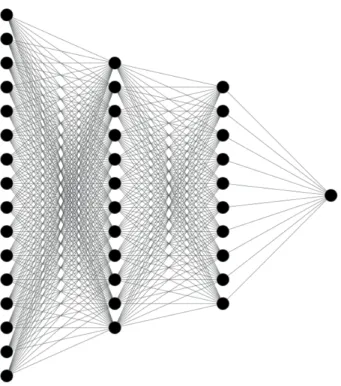
Multilayer Perceptron (MLP) ([10],[48],[55]) is a set of functions which filter the input data in several steps. MLP (see Fig. 2.6 ) is similar to SLFN but with more hidden layers. Every hidden layer consists of nodes that will determine whether the information (i.e., input data from the previous layer) will continue to the next layer. This type of neural network shows a high degree of connectivity, and its weights define its strength. Usually, an MLP is used for supervised tasks where adjustment of weights takes place via several iterations between the input and the output layers through backpropagation.
Figure 2.6 MLP with two hidden layers (the graph was created in NN-SVG).
One way to train an MLP is to use a sequential data feeding process called batch learning. Batch learning is a process during which the neural network adjusts the
synaptic weights after the presentation of all the samplesJ={x(i),d(i)}N
i=1in the training process, where: x(i)is the multi-dimensional input vector and d(i) is the
response vector of the supervised problem at instancei where the error function at
instancei is:
e(i)=d(i)−y(i) (2.22)
2.3.4 Convolutional Neural Network
Convolutional neural network (CNN) ([26],[29],[40]) is a type of neural network that exploits spatial correlations between neurons. CNN has the ability to share the so-called tied weights and equivariant representations properties. More specifically, sparse connectivity can be achieved by using a kernel smaller than the sample input to create a new filtered representation of the given signal. Based on this property, CNN reduces the amount of memory required during training. The second advan-tage that CNN has is the use of tied weights. Tied weights are shared among the inputs since the same amount of weights are applied to the inputs at each layer.
CNN topology varies according to the number of the main building blocks which are: the convolution layer, the pooling layer, and the fully connected layer. An ex-ample of a CNN architecture can be seen in Fig. 2.7.
Figure 2.7 Example of a basic CNN architect (the graph was created in NN-SVG)
The main advantage of CNN is its ability to extract features from the multi-dimensional input signal which is usually expressed as a tensor or matrix. This pro-cess creates linear activations that run via a non-linear activation function (e.g., rec-tified linear activation function (ReLU), Leaky ReLU, etc). Then a pooling layer
based on a summary statistic related to the local outputs (e.g., max-pooling) will convert the local output. The last step of the process is the connection to the fully connected layers that will perform the classification (or regression) task. This task is based on discrete time series inputs, which formulate the (forward) convolution layer calculation as follows:
yil+1,jl+1,d= H i=1 W j=1 D d=1 fi,j,d×xill+1+i,jl+1+j,d (2.23)
whereH,W, andD are the row, columns and depth dimension of the input tensor
x ∈Hl×Wl×Dl
respectively. f∈Hl×Wl×Dl
is the filter bank, and the indexing (il+1+i,jl+1+j,d)refers to the iterative local convolution of the filter bank on the suggested input for thel-layer. The last step is the use of fully connected layers.
2.3.5 Long Short-Term Memory
Prediction of sequential representations, such as time series, is a common objective in finance. The presence of temporal behavior of time series needs to be taken into consideration when it comes to model selection. A model which can effectively
man-age these dependencies is long- short-term memory neural (LSTM) network ([25],
[34]). LSTM belongs to the family of recurrent neural networks (RNN) introduced
in[50], which have feedback loops to help identify patterns in the data. LSTM is
an extension of RNN where the difference lies in the fact an LSTM contains sev-eral internal gates that filter the input information more effectively. The motivation for choosing LSTM is its ability to create connections through time and account for the problem of vanishing (or exploding) gradients. Instead of just applying element-wise non-linear input transformations, LSTM units contain processes which take into consideration the sequential nature of time series. The primary function that explains LSTM’s output is:
ht= f(ht−1,xt;η) (2.24)
wherehandxare the state and the input at timet andηare the shared parameters
for a transition function f at time t. LSTM cell is equipped with gates that will
σg. The first pass is the forget gate vector fit: fi(t)=σg j Wif,jh(jt−1)+ j Uif,jx(jt)+bif (2.25) where x(it) andh(it) are the current input and hidden state vectors of celli at time
t, respectively. The corresponding weight matrices to these vectors are Wf and
Uf for the forget gate vector withbf the bias term. The next pass is related to the information that is going to be saved to the so-called "cell state". The cell state can
be divided in two parts the input vector and at anhlayer as follows:
Ci(t)= fi(t)Ci(t−1)+gi(t)t anh j WiC,jh(jt−1)+ j UiC,jx(jt)+biC (2.26)
where g(t)is the input gate:
gi(t)=σg
j
Wig,jh(jt−1)+ j
Uig,jx(jt)+big (2.27)
The last part is the filtered output. More specifically, the LSTM output/hidden state
will be formulated by the output gate vectoroi(t), which can be calculated as follows:
oi(t)=σg
j
Wio,jh(jt−1)+ j
Uio,jx(jt)+bio (2.28) and the final outputhi(t)is equal to:
hi(t)=oi(t)∗t anh(Ci(t)). (2.29)
An example of the internal operations of an LSTM can be seen in Fig. 2.8
2.4 Feature Engineering
Feature engineering is the field of study that deals with data analysis and data trans-formation. This study facilitates the process of extracting information relevant to the
problem/task under consideration. There are two main categories for feature
Figure 2.8 LSTM internal structure which shows how the information flows through gates.
Both categories require in-depth knowledge of data analysis and model development. More specifically, the former case refers to the process that features a set of vector representation which converts raw data into informative signal based on experts’ opinion, whereas in the latter case a model (e.g., neural network) will extract itself the transformed representations.
Since the problem under consideration in the present thesis focuses on financial data (i.e., the mid-price prediction based on high-frequency data), relevant features/ -factors are related to financial concepts. More specifically, these features will be LOB features, technical indicators, quantitative analysis, econometrics, and fully auto-mated financial processes. The following list of features is by no means exhaustive, demonstrating only a few exemplary cases.
2.4.1 Limit Order Book Features
LOB is an ordering mechanism for the trading activity of the submitted limit and market orders. This trading activity creates a complex system in which relevant
indicators/features should capture its dynamics. The work presented in[38]is an
example of capturing LOB dynamics by handcrafted feature development. LOB features extraction is based on the prediction of mid-price. There are three main categories of feature set whose description can be seen in Table. 2.2
Table 2.2 LOB feature sets (obtained from [P1])
Feature Set Description Details
Basic u1={Pias k,Vias k,Pib i d,Vib i d}ni=1 10(=n)-level LOB Data Time-Insensitive u2={(Pas ki −Pib i d),(Pias k+Pib i d)/2}ni=1 Spread & Mid-Price
u3={Pnas k−P1as k,P1b i d−Pnb i d,|Pias k+1−Pias k|,|Pib i d+1−Pib i d|}ni+1 Price Differences u4= 1 n n i=1P as k i , 1 n n i=1P b i d i , 1 n n i=1V as k i , 1 n n i=1V b i d i
Price & Volume Means u5= n i=1(P as k i −Pib i d), n i=1(V as k i −Vib i d) Accumulated Differences Time-Sensitive u6= d Pas k i /d t,d Pib i d/d t,dVias k/d t,dVib i d/d t n
i=1 Price & Volume Derivation u7=
λ1
Δt,λ2Δt,λ3Δt,λ4Δt,λ5Δt,λ6Δt
Average Intensity per Type u8= 1λ1 Δt>λ 1 ΔT ,1λ2 Δt>λ 2 ΔT ,1λ3 Δt>λ 3 ΔT ,1λ4 Δt>λ 4 ΔT ,1λ5 Δt>λ 5 ΔT ,1λ6 Δt>λ 6 ΔT
Relative Intensity Comparison u9={dλ1/d t,dλ2/d t,dλ3/d t,dλ4/d t,dλ5/d t,dλ6/d t} Limit Activity Accelaration
These three sets of handcrafted features provide useful insight regarding the evo-lution of price rate changes, or volume rate changes, but they are limited in terms of other LOB characteristics. Several additional factors/features should also be consid-ered, such as volatility estimation, price trends, volume imbalance, etc.
2.4.2 Technical Analysis
Technical analysis is a trading universe where traders make investment predictions based on the idea that stock price is the primary source of information. The cen-tral component of technical analysis is the utilization of charts of volume and price trends. Several indicators developed through the years (e.g., candlestick charts ex-ist since 1600) and fuse with other methods, such as statex-istics. Some examples of technical indicators are:
Average Directional Index
Average directional index (ADX) indicator[56]developed in order to identify the
strength of a current trend. ADX is calculated as follows:
T R=max(Ht−Lt,|Ht−C Lt−1|,|Lt−C Lt−1|) (2.30)
(+DM) =Ht−Ht−1 (2.31)
T R14=T Rt−1−(T Rt−1/14) +T R (2.33) (+DM14) = (+DLt−14)−((+DLt−14)/14) + (+DM) (2.34) (−DM14) = (−DLt−14)−((−DLt−14)/14) + (−DM) (2.35) (+DI14) =100×((+DM14)/(+T R14)) (2.36) (−DI14) =100×((−DM14)/(−T R14)) (2.37) DId i f f 14=|(+DM14)−(−DM14)| (2.38) DIs u m14=|(+DM14) + (−DM14)| (2.39) DX =100×((DId i f f 14)/(DIs u m14)) (2.40) ADX = (ADXt−1×13) +DX)/14 (2.41)
where: TR is the true range, Ht is the current 10-block’s highest MB price, Lt is
the current 10-block’s lowest MB price,C Lt is the previous 10-block’s closing MB
price,(+DM)is the positive Directional Movement (DM),(−DM)is the negative
DM, T R14 is the TR based on the previous 14-blocks,T Rt−1 is the previous TR
price, (+DM14) is DM based on the previous 14 (+DM) blocks, (−DM14) is the
DM based on the previous 14(−DM)blocks,(+DMt−14)is the (+DM) of the
pre-vious 14 +DM blocks, DId i f f
14 is the directional indicator (DI) of the difference between(+DM14) and(−DM14), DIs u m14 is the DI of the sum between(+DM14)
and(−DM14),DX is the directional movement index andADXt−1is the previous
average directional index.
Parabolic Stop and Reverse
are two main modules for its calculation, the Rising SAR and the Falling SAR, and they are calculated as follows:
• Rising SAR
E P=HH i g h
5 (2.42)
SAR=SARt−1+AFt−1(E Pt−1−SARt−1) (2.43)
• Falling SAR
E P=LLow
5 (2.44)
SAR=SARt−1−AFt−1(E Pt−1−SARt−1) (2.45)
where AF is the acceleration factor, and E P the extreme point with highest high
(HH i g h
5) and lowest low (LLow5) for the last five 10-MB blocks.
Linear Regression Line
Linear regression line (LRL) is a basic statistical method that provides information for a future projection wherein trading is used to capture overextended price trends. The basic calculation steps are as follows:
PV =c1+c2×M Bp r i c e s (2.46) c2=r×(s t dPV/s t dM B p r i c e s) (2.47) r = 10 i=1(M Bp r i c e s(i)−M Bp r i c e s)(PV(i)−PV) 10 i=1(M Bp r i c e s(i)−M Bp r i c e s) 2(10 i=1(PV(i)−PV) 2 (2.48) c1=PV −c2×M Bp r i c e s (2.49)
wherePV are the predicted values, r is the correlation coefficient, andM Bp r i c e s and
2.4.3 Quantitative Analysis
Quantitative analysis ([1],[2]) belongs to a trading universe where a decision is made based on mathematical models and statistics. This type of analysis can effectively be used not only for pattern identification in massive datasets but also to mitigate investment risks. One of the goals of the thesis is to use quantitative analysis for pattern recognition. Examples of features that utilize mathematical concepts and statistics follow:
Autocorrelation and Partial Correlation
Autocorrelation and partial correlation [11], [23]are key features in the develop-ment of time series analysis. Under the assumption of stationary stochastic pro-cesses, their local behavior is:
• Autocorrelation
rX,k= E[(xi−μ)(xi+k−μ)] E[(xi−μ)2]E[(x
i+k−μ)2]
(2.50) where xi andxi+k are the time series of lagkat time instancei,μ=E[xi] =
∞
−∞x p(x)d x andσ2x=E[(xi−μ)2] =
∞
−∞(x−μ)2p(x)d x are the constant mean and constant variance, respectively.
• Partial Correlation
– For the general case of an autoregressive modelAR(p), we have:
xi+1=φ1xi+φ2xi−1+...+φpxi−p+1+ξi+1 (2.51) of lag 1 up to pfollows: <xixi+1>= p j=1 (φj<xixi−j+1>) (2.52) <xi−1xi+1>= p j=1 (φj<xi−1xi−j+1>) (2.53) <xi−k+1xi+1>= p j=1 (φj<xi−k+1xi−j+1>) (2.54)
<xi−p+1xi+1>= p
j=1
(φj<xi−p+1xi−j+1>) (2.55)
by diving withN−1 and autocovariance of zero separated periods (where
the autocovariance function is even), all the lag periods above will be: ri=
p
j=1
φjrj−1 (2.56)
where ri,i = 1, 2, ...,k, ...,p for the matrix operations RRRΦΦΦ = rrr, RRR ∈
p×p, ΦΦΦ ∈ p×1 and rrr ∈ p×1. The symmetric and full rankΦΦΦ are
as follows: ˆΦΦΦ=RRR−1rrr.
– Yule-Walkerequations calculation for a lagged interval 1ip:
ˆ ΦΦΦ= RRR(i)−1rrr(i)= ⎡ ⎢ ⎢ ⎢ ⎢ ⎢ ⎢ ⎢ ⎣ ˆ φ1 ˆ φ2 ... ˆ φi ⎤ ⎥ ⎥ ⎥ ⎥ ⎥ ⎥ ⎥ ⎦ (2.57) Cointegration
Investigation of time-series equilibrium[22],[32]can be tested through the cointe-grated hypothesis. Utilizing the cointegration test will help ML traders avoid the problem of spurious regression. For this reason an Engle-Granger (EG) test is uti-lized for the multivariable case of LOB ask (At) and bid (Bt) times series. The for-mulation of the EG test for the ask and bid LOB prices are as follows:
• At andBt ∼I(d), whereI(d)represents the order of integration
• Cointegration equation based on the error term: ut=At−αBt, where
ordi-nary least squares (OLS) is performed for the estimation ofα
• EG Hypothesis: u(t)∼I(d),d=0
2.4.4 Econometrics
Econometrics ([46], [51],[59]) is the field of study that covers topics related to fi-nancial applications and assumptions under the scope of statistics and mathemat-ics. This field is vast and covers methods from regression and probability theory to asymptotic theory and volatility estimation. These topics are directly connected to high-frequency financial data, which come with variation in prices, known in the financial literature as volatility. Since the thesis deals with this type of data, some features will be presented in this section as examples of feature engineering under econometric theory.
Volatility Measures
Features based on volatility measures estimate either the integrated variance (IV), that is, the process
IVt=
t
0
σ2
sds (2.58)
or, more generally, the quadratic variation (QV) [X,X]t = t 0 σ2 sds+ 0<s≤t (ζsdNs)2. (2.59)
Here,X is the logarithmic price of a given asset. Assuming thatXt follows an Itô
semimartingale; that is, Xt=X0+ t 0 bsds+ t 0 σsdWs+ t o ζsdNs, (2.60)
where b is locally bounded,σis cádlág and predictable, andWt is a standard Wiener
process,ζ is a thin (i.e., finite) process mapping the jump size, andN is the counting
process associated to the jump times ofX.Δndefines the time elapsed between two
adjacent observations; specifically, assuming that the observations are equidistant in time:Δn=nt. Since calendar time is not present, then:Δn= n1.
• Realized variance


![Figure 3.1 Experimental Setup Framework based on an Anchored Forward cross-validation format ([P1]).](https://thumb-us.123doks.com/thumbv2/123dok_us/9938008.2486616/54.748.90.635.388.723/figure-experimental-setup-framework-anchored-forward-validation-format.webp)
![Table 4.3 Results based on Z-score Normalization ([P1]) Labels RR Ac c u rac y RR P r ec i s i on RR Recal l RR F 1](https://thumb-us.123doks.com/thumbv2/123dok_us/9938008.2486616/61.748.152.615.452.732/table-results-based-score-normalization-labels-rr-recal.webp)
![Table 4.5 List of the first 10 best features for the 5 sorting methods ([P2])](https://thumb-us.123doks.com/thumbv2/123dok_us/9938008.2486616/68.748.250.474.90.974/table-list-first-best-features-sorting-methods-p.webp)
