1
HUMAN RESOURCES MANUAL
A Manual that Documents Policies, Procedures and Guidelines for the
Management of Human Resources and Moderating the Behaviour of
Employees of Kyambogo University
APPROVED BY THE UNIVERSITY COUNCIL
ON
6TH NOVEMBER 2014
2
FOREWORD BY THE CHAIRMAN OF THE UNIVERSITY COUNCIL
The purpose of this Human Resource Manual is to document and communicate the University policies and procedures on human resource management and to encourage fair and consistent treatment of employees at Kyambogo University. It provides written guidelines to be used for management of the university’s most valuable asset, that is, the human resources. The policies and guidelines herein are intended to create order and consistency in the day-to-day operations of Kyambogo University. The University Council encourages responsible and productive working relationships and respect for the personal integrity and growth of all staff members. This manual is approved by the Council as an effort towards achieving that goal.The policies and procedures contained in this manual shall replace and supersede any previous or existing human resource policies, procedures, regulations, or practices. The University Council which I am privileged to serve as Chairperson believes wholeheartedly in the policies and procedures described herein and I encourage all stakeholders to internalize and make reference to the manual while handling human resource issues.
This document may not cover every contingency and condition that may arise during employment and/or the management of human resources. I encourage every staff member to support the human resource management programme of the University by letting the Directorate of Human Resources know whenever implementation problems arise. Employees can also help by suggesting improvements in the administration of these policies and procedures. As revisions become necessary, the Directorate of Human Resources, through the Vice Chancellor, should notify the relevant Committee of Council so that the relevant areas are amended and stakeholders are notified of the amendments.
Management must ensure that copies of this manual are available to line managers and all members of staff.
Prof. John Okedi
3
INTRODUCTORY REMARKS OF THE VICE CHANCELLOR
This Human Resource Manual has been prepared in pursuance of the vision and mission of Kyambogo University. It represents the best effort of staff, Management and Council to formulate policies and guidelines that underscore and concretize the human resource goals of the University. The level of staff morale and staff productivity depends on human resource policies that are well conceived, clearly stated, and consistently implemented. Kyambogo University aims to achieve fairness in our treatment of all members of the University community. We believe this manual gives us the necessary framework for accomplishing this aim.
This manual outlines policy guidelines and procedures approved by the University Council on recruitment, promotion, retention, career development and training of staff, salaries and welfare, performance management, and disciplinary procedure, among others. It is hoped that this manual provides a user-friendly guide for the officers responsible for human resource management, line managers and staff about their responsibilities and entitlements as employees of Kyambogo University. However, there may be some aspects of human resource management that are not covered and it is hoped that with time the manual will be reviewed and identified gaps will be filled.
The manual is the result of the efforts of many stakeholders in the University: the staff associations, Directorate of Human Resources, the Management Team, the Chairperson and Members of the Establishment and Administration Committee of Council, and the Chairperson and Members of the University Council. On behalf of Management, I wish to express my sincere gratitude to all those members of staff and Council for their effort in enabling the production of this manual.
Additionally, we acknowledge the contributions of the various sister universities and other organisations, such as Makerere University, Uganda Management Institute, Mbarara University of Science and Technology, Nkumba University, Uganda Martyrs University and Gulu University, for sharing their experiences and materials with us.
I hope that that all members of Kyambogo University community will use this manual to make their human resources management practices and behaviours compliant with the approved guidelines.
Prof. Eli Katunguka-Rwakishaya AG. VICE CHANCELLOR
4
TABLE OF CONTENTS
FOREWORD BY THE CHAIRMAN OF THE UNIVERSITY COUNCIL……….2
FOREWORD BY THE CHAIRMAN OF THE UNIVERSITY COUNCIL ... 2
INTRODUCTORY REMARKS OF THE VICE CHANCELLOR... 3
TABLE OF CONTENTS ... 4
DEFINITIONS ... 11
PREAMBLE ... 15
Mandate of the University ... 15
Vision ... 15 Mission ... 16 Core Values ... 16 CHAPTER ONE: ... 17 INTRODUCTION ... 17 1.1 INTRODUCTION ... 17
1.2 PURPOSE OF THE MANUAL ... 17
1.3 HUMAN RESOURCES PHILOSOPHY ... 18
1.4 HUMAN RESOURCE POLICY ... 18
1.5 ACCESSIBILITY OF THE MANUAL ... 19
1.6 INTERPRETATION ... 19
1.7 IMPLEMENTATION ... 20
1.8 REVISION OF THE MANUAL ... 20
1.9 COMMENCEMENT ... 20
CHAPTER TWO ... 21
EMPLOYMENT ... 21
2.1 INTRODUCTION ... 21
2.2 HUMAN RESOURCE PLANNING ... 21
2.3 HUMAN RESOURCE CONTROL ... 22
2.4 TERMS OF EMPLOYMENT ... 22
2.5 PERMANENT TERMS OF EMPLOYMENT ... 23
2.6 EMPLOYMENT OF RETIRED ADMINISTRATIVE STAFF ... 23
2.7 CONTRACT TERMS OF EMPLOYMENT ... 23
2.8 PART-TIME TERMS OF EMPLOYMENT ... 24
2.9 TEMPORARY TERMS OF EMPLOYMENT ... 25
2.10 CASUAL TERMS OF EMPLOYMENT ... 25
2.11 HONORARY EMPLOYMENT TERMS ... 26
2.12 VISITING SCHOLARS ... 26 2.13 CATEGORIES OF EMPLOYEES ... 26 2.13.2 Academic Staff... 27 2.13.3 Administrative Staff ... 27 2.13.4 Support Staff ... 28 2.14 SECONDED STAFF ... 28 2.15 VOLUNTEERS ... 28 2.16 INDUSTRIAL TRAINEES ... 28 CHAPTER THREE ... 30 RECRUITMENT ... 30
5
3.1 PURPOSE OF RECRUITMENT ... 30
3.2 RECRUITMENT CRITERIA ... 30
3.2.1 Eligibility for Appointment on Basis of Age ... 30
3.2.2 Minimum Qualifications for Administrative Staff ... 30
3.2.3 Minimum Qualifications for Support Staff ... 31
3.2.4 Minimum Qualifications for Academic Staff ... 31
3.2.5 Appointment of Teaching Staff after Retirement ... 32
3.3 RECRUITMENT PROCEDURE ... 33 3.3.7 Job Applications... 35 3.4 SELECTION PROCESS ... 36 3.4.1 Short-listing... 36 3.4.2 Interviewing ... 36 3.4.3 Reference Check ... 37 3.5 EMPLOYMENT FORMALITIES ... 37
3.5.2 Reporting for Duty ... 38
CHAPTER FOUR ... 39
DEPARTMENTAL AND FACULTY APPOINTMENTS, PROMOTIONS AND APPRAISAL COMMITTEES... 39
CHAPTER FIVE ... 43
PROBATIONARY APPOINTMENT ... 43
5.1 PURPOSE ... 43
5.2 POLICY ... 43
5.3 EXTENSION OF PROBATIONARY PERIOD... 45
5.4 TERMINATION OF APPOINTMENT DURING PROBATIONARY PERIOD ... 45
5.5 CONFIRMATION ... 45
CHAPTER SIX ... 47
DEPLOYMENT AND TRANSFER ... 47
6.1 PURPOSE ... 47 6.2 POLICY ... 47 CHAPTER SEVEN ... 48 REMUNERATION... 48 7.1 PURPOSE ... 48 7.2 SALARY ... 48
7.2.1 General Rules on Payment of Salaries ... 48
7.2.2 Deductions from an Employee’s Salary ... 50
7.2.3 Salary Advance ... 51
7.2.4 Salary Arrears ... 51
7.2.5 Salary Adjustment ... 51
7.2.6 Salary adjustment on promotion ... 52
7.2.7 Assessment of salary on attainment of higher qualifications ... 52
7.3 STARTING SALARIES ON FIRST APPOINTMENT ... 52
7.4 ANNUAL SALARY INCREMENTS ... 53
7.4.1 General ... 53
7.4.2 Incremental Date ... 54
7.4.3 Salary Increments Deferred, Withheld and Stopped... 54
7.4.5 Effect of Leave without Pay on Incremental Dates ... 55
7.5 GRADING AND REGRADING OF JOBS ... 56
6
PROMOTION ... 57
8.1 DEFINITION AND PURPOSE ... 57
8.2 POLICY ... 57
8.3 PROMOTION PROCEDURE ... 59
8.4 CRITERIA FOR PROMOTION OF ACADEMIC STAFF ... 60
8.5 General ... 60
8.6 Promotion of Academic Librarians ... 62
CHAPTER NINE ... 64
TERMINATION OF SERVICE ... 64
9.1 PURPOSE ... 64
9.2 GENERAL PROVISIONS ... 64
9.3 RESIGNATION ... 65
9.4 Procedure for Resignation ... 66
9.5 Submission to the Board ... 67
9.6 Return of University Property ... 67
9.7 TERMINATION BY THE EMPLOYER BY NOTICE OR PAYMENT IN LIEU OF NOTICE ... 67
9.8 DISMISSAL ... 68
(d) Professional and or ethical misconduct ... 69
(e) Criminal Conviction ... 69
9.9 PROCEDURE FOR TERMINATING OR DISMISSING AN EMPLOYEE ... 69
9.10 RETIREMENT ... 69
9.10.1 Purpose ... 69
9.10.2 Retirement policy ... 70
9.10.3 Notice of mandatory Retirement ... 70
9.11 RETIREMENT ON MEDICAL GROUNDS... 70
9.12 EXPIRY OF CONTRACT ... 71
9.13 TERMINATION DUE TO REDUNDANCY ... 71
9.14 EXIT INTERVIEW ... 71
CHAPTER TEN... 72
ALLOWANCES ... 72
10.1 GENERAL... 72
10.2 TRAVEL ALLOWANCES ... 73
10.2.3 Night Allowance in Uganda and Away from Officer’s Station ... 73
10.3 NIGHT ALLOWANCE OUTSIDE UGANDA ... 74
10.4 SAFARI DAY ALLOWANCE IN UGANDA ... 75
10.5 SAFARI DAY ALLOWANCE OUTSIDE UGANDA ... 75
10.6 OUT OF POCKET ALLOWANCE ... 76
10.7 WARM CLOTHING ALLOWANCE ... 76
10.8 MILEAGE ALLOWANCE ... 76
10.10 LUNCH AND DINNER ALLOWANCE ... 77
10.12 DISTURBANCE ALLOWANCE ... 77
10.13 SETTLING-IN ALLOWANCE ... 77
10.14 EXTRA DUTY ALLOWANCES ... 78
10.14.1 HEADSHIP ALLOWANCE ... 78 10.14.2 CARETAKER ALLOWANCE... 78 10.14.3 ACTING ALLOWANCE ... 78 10.15 DUTY ALLOWANCE ... 80 10.16 HONORARIA... 81 10.17 SITTING ALLOWANCE ... 82
7
10.18 OVERTIME ALLOWANCE... 82
10.19 EXTRA LOAD ALLOWANCE ... 83
10.20 ENTERTAINMENT ALLOWANCE ... 83
10.21 WORKMAN’S COMPENSATION ... 83
10.22 FUEL ALLOCATION ... 83
10.23 SALARY TOP-UP ... 84
10.24 STAFF BENEFIT ON ADMISSION AND SPONSORSHIP OF BIOLOGICAL CHILDREN ... 85
CHAPTER ELEVEN ... 87
CONDUCT OF UNIVERSITY EMPLOYEES... 87
11.1 PURPOSE ... 87
11.2 GENERAL CODE OF CONDUCT ... 87
11.3 CODE AND PERSONAL APPEARANCE ... 89
11.4 TREATMENT OF SUBORDINATES ... 89
11.5 INSUBORDINATION ... 89
11.6 Representation of Kyambogo University... 89
11.17 PROFESSIONAL CODE OF CONDUCT ... 89
11.18 SPOUSE AND FAMILY RELATIONSHIPS ... 90
11.19 TIME MANAGEMENT AND EXECUTION OF DUTIES ... 90
11.20 MANAGEMENT OF UNIVERSITY PROPERTY ... 90
11.21 OFFICIAL WORKING HOURS ... 90
11.22 MISCONDUCT AND DISCIPLINARY PROCEDURE ... 91
11.23 Gross Misconduct ... 93
11.24 DISCIPLINARY PROCEDURE ... 94
11.25 NATURAL JUSTICE... 95
11.26 STAFF ON CRIMINAL PROCEEDINGS ... 96
11.27 INTERDICTION OR SUSPENSION ... 96
11.28 APPEALS PROCEDURE ... 97
11.29 DISCIPLINARY ACTIONS ... 98
11.29.1 Removal from Office ... 98
11.29.2 Retirement in Public Interest ... 98
11.29.3 Dismissal ... 98
11.29.4 Termination ... 98
11.29.5 OTHER FORMS OF DISCIPLINARY ACTION ... 99
11.30 RIGHT OF APPEAL ... 100
11.31 FACING CRIMINAL CHARGES ... 100
CHAPTER TWELVE ... 102
LEAVE ... 102
12.2 TYPES OF LEAVE ... 104
12.3 ANNUAL LEAVE ... 104
12.4 APPROVAL OF ANNUAL LEAVE ... 106
12.5 RECALLING AN EMPLOYEE FROM LEAVE ... 106
12.6 LEAVE ROSTER ... 106
12.7 APPROVAL FOR CARRYING LEAVE FORWARD ... 107
12.8 SICKNESS DURING ANNUAL LEAVE ... 108
12.9 LEAVE ENTITLEMENT FOR EMPLOYEES WHO ARE ON INTERDICTION OR SUSPENSION OR REMAIN UN-DEPLOYED PENDING ASSIGNMENT OF OTHER DUTIES 108 12.10 COMPASSIONATE LEAVE... 109
12.11 SPECIAL LEAVE OF ABSENCE ... 109
8 12.13 STUDY LEAVE ... 111 12.14 SABBATICAL LEAVE ... 112 12.15 CONSULTANCY LEAVE ... 112 12.16 SICK LEAVE ... 113 12.17 MATERNITY LEAVE... 114 12.18 PATERNITYLEAVE ... 114 12.19 FORCED LEAVE ... 115 12.20 PUBLIC HOLIDAYS... 115 CHAPTER THIRTEEN ... 117 COMMUNICATION ... 117 13.1 PURPOSE ... 117 13.2 POLICY ... 117
13.3 ROLE OF MANAGEMENT IN COMMUNICATION ... 118
13.4 COMMUNICATION ON BEHALF OF THE UNIVERSITY ... 118
13.5 ROLE OF EMPLOYEES IN COMMUNICATION ... 118
13.6 DISPATCH AND RECEIPT OF CORRESPENDENCE ... 119
13.7 UNIVERSITY ANNUAL REPORT ... 120
CHAPTER FOURTEEN ... 122
RECORDS MANAGEMENT ... 122
14.1 MEANING ... 122
14.2 RECORDS MANAGEMENT PROCEDURES ... 122
14.3 ACCESS TO PERSONAL RECORDS ... 124
14.4 TRANSFER OF PERSONAL RECORDS... 124
14.5 PRESERVATION AND DISPOSAL OF RECORDS ... 124
14.6 TRANSFER OF CUSTODY OR OWNERSHIP OF RECORDS ... 125
CHAPTER FIFTEEN ... 126
PERFORMANCE MANAGEMENT ... 126
15.1 PURPOSE ... 126
15.2 PERFORMANCE MANAGEMENT POLICY ... 126
15.3 PROCEDURE ... 126
15.4 STAFF PERFORMANCE APPRAISAL ... 127
15.5 RECOGNIZING AND REWARDING PERFORMANCE... 129
15.6 MANAGING POOR PERFORMANCE ... 129
15.7 PERFORMANCE CONTRACTS FOR TOP MANAGERS ... 130
15.7.1 General ... 130
15.7.2 Procedure ... 131
15.7.3 Key Outputs and Targets ... 132
15.7.4 Performance Monitoring ... 132
15.7.5 Annual Performance Assessment ... 133
15.7.6 Filling the Performance Report ... 133
15.7.7 ASSESSMENT CRITERIA FOR ALL UNIVERSITY EMPLOYEES ... 133
15.7.8 Format of Performance Contract /Agreement ... 134
15.7.9 COMMITMENTS... 134
15.7.10 Reporting Format ... 135
15.7.11 REWARDS AND SANCTIONS ... 135
9
STAFF TRAINING AND DEVELOPMENT ... 136
16.1 PURPOSE ... 136
16.2 POLICY ... 136
16.3 STAFF DEVELOPMENT COMMITTEE ... 138
16.4 APPLICATION PROCEDURE... 139
16.5 TYPES OF TRAINING AND DEVELOPMENT ACTIVITIES ... 140
16.5.1 General ... 140
16.5.2 Long-term Staff Development Leading to an Award ... 140
16.5.3 Induction Training Programmes ... 141
16.5.4 Job-related Training ... 141
16.5.5 Management Development Programmes ... 141
16.6 ELIGIBILITY FOR SPONSORSHIP ... 141
16.7 BONDING OF UNIVERSITY EMPLOYEES ... 143
16.8 PROMOTION AFTER TRAINING ... 143
16.9 EMPLOYEES TAKING UP FULL-TIME TRAINING WITHOUT UNIVERSITY SPONSORSHIP ... 143
16.10 RULES ON STAFF DEVELOPMENT ... 144
16.11 LIVING ALLOWANCE FOR EMPLOYEES ON STAFF DEVELOPMENT ... 145
CHAPTER SEVENTEEN ... 146
INTERNSHIP ... 146
CHAPTER EIGHTEEN... 148
MEDICAL CARE ... 148
18.1 MEDICAL TREATMENT IN UGANDA ... 148
18.2 MEDICAL TREATMENT ABROAD ... 149
18.3 MEDICAL INSURANCE ... 150
18.4 HIV / AIDS ... 150
18.5 TRAVEL INSURANCE... 151
18.6 RISKS AND HAZARDS INSURANCE ... 151
CHAPTER NINETEEN... 152
STAFF HOUSINGPOLICY ... 152
19.1 Introduction ... 152
19.2 ALLOCATION OF UNIVERSITY HOUSES ... 154
19.3 CONVERTING UNIVERSITY HOUSES INTO OFFICE SPACE ... 155
CHAPTER TWENTY ... 156
FINANCIAL SERVICES AND COOOPERATIVE SERVICES ... 156
20.1 SALARY LOANS ... 156
20.2 EMPLOYEES’ COOPERATIVE SAVING SCHEMES ... 156
CHAPTER TWENTY ONE ... 157
RECREATIONAL FACILITIES... 157
CHAPTER TWENTY TWO ... 159
COUNSELING AND SPIRITUAL SERVICES ... 159
10
22.2 SPIRITUAL SERVICES ... 159
CHAPTER TWENTY THREE... 160
BENEFITS AND GRATUITY ... 160
23.1 NATIONAL SOCIAL SECURITY FUND (NSSF) ... 160
23.2 IN-HOUSE TERMINAL BENEFITS SCHEME ... 160
23.3 GRATUITY FOR CONTRACT EMPLOYEES ... 160
23.4 ELIGIBILITY FOR GRATUITY OR TERMINAL BENEFITS... 160
CHAPTER TWENTY FOUR ... 161
SPECIAL ENTITLEMENTS TO SOME UNIVERSITY EMPLOYEES ... 161
CHAPTER TWENTY FIVE... 162
EMPLOYEE SAFETY ... 162
25.1 POLICY ... 162
25.2 OBLIGATIONS OF THE UNIVERSITY ... 162
25.3 OBLIGATIONS OF THE EMPLOYEE ... 162
25.4 SMOKE-FREE WORKPLACE ... 163
25.5 COMPENSATION ... 163
CHAPTER TWENTY SIX ... 165
EMPLOYEE RELATIONS ... 165
26.1 GENERAL... 165
26.2 THE NATIONAL UNION OF EDUCATIONAL INSTITUTIONS (NUEI)... 165
26.3 KYAMBOGO UNIVERSITY ACADEMIC STAFF ASSOCIATION (KYUASA) . 165 26.4 KYAMBOGO UNIVERSITY SENIOR ADMINISTRATIVE STAFF ASSOCIATION (KYUSASA) ... 165
26.5 DISPUTE RESOLUTION ... 165
26.6 STAFF GRIEVANCES COMMITTEE ... 165
CHAPTER TWENTY SEVEN... 168
11
DEFINITIONS
In this Human Resource Manual, unless the context otherwise requires the following words, phrases or terms will have the meaning shown against them:
Allowances
An allowance is a payment in cash additional to salary payable to a member of staff to facilitate the proper execution of an assignment or duty. The allowance is not assignable from one officer to another, in whole or in part.
Appointment
Means the formal engagement of an employee in the service of Kyambogo University, in accordance with the Council regulations.
Increment
Means the increase in salary granted to an employee on merit until the top of the salary scale is reached.
Industrial Training
Means the attachment of a student to an organisation for purposes of the student gaining hands on experience and knowledge.
Leave
means a period officially granted to a member of staff to be off duty for a specific number of working days.
Misconduct
Means a breach of the terms and conditions of service and/ or the service regulations, professional, ethical or other law in force at the time.
Occupation category
Means a group of jobs within a career path with similar or related tasks varying in degrees of complexity.
University Council
Means the Council set up under section 23 of the Universities and Other Tertiary Institutions Act as the supreme policy making organ of the University.
Vice Chancellor
Means the Vice Chancellor of Kyambogo University who is the Chief Executive Officer of the University as provided for under section31 of the Act.
Abandonment of Duty Means abscondment or absence from duty without permission for a continuous period of twenty one (21) working days. Same meaning as abscondment
Abscondment Means absence from duty without permission for a continuous period of twenty one (21) working days.
Academic Department Means a unit under a faculty or school or institute which runs its own academic programmes as approved by Council.
12
Act Means the Universities and Other Tertiary Institutions Act
Appointments Board Means the Appointments Board of Kyambogo University as defined under Section 50 of the Act.
Basic Salary Means the salary exclusive of allowances.
Casual worker Means a person employed to perform unclassified tasks on a day to day ad-hoc basis.
Appointing Authority Means the Chancellor or the Appointments Board with the powers to appoint employees of the University as provided for under the Universities and other Tertiary Institutions Act of 2001, as amended, or a body or person to whom these powers have been delegated. Chancellor Means the Chancellor as defined under Section 30 in the Universities
and Other Tertiary Institutions Act 2001
Child Means a son or daughter of an officer (including a lawfully adopted child of the officer or his or her spouse) who either:-
(a) Has not attained his or her 18th birthday and is dependent upon the employee engaged;
or
(b) Is unmarried and in the opinion of the university is dependent upon the employee by reason of physical or mental
incapacity.
or
(c) Is unmarried, above 18 years but below 25 years but in the view of the university is still dependant on the employee. Conflict of Interest Means a situation where an employee is called upon to make a
decision between his or her personal interest and that of public interest.
Consolidated Salary Means the basic salary plus allowances indicated in the letter of appointment and reflected on the pay slip.
Contract Employment Means employment in the service of the University for a specific, prescribed period under such terms and conditions as shall be agreed upon and prescribed in a service agreement entered into between an employee and the University.
Contract Gratuity Means the terminal benefits an employee on contract will receive upon completion of the respective period of service expressed as a percentage of the employee’s annual salary.
Dean Means a person elected and / or appointed and designated by Council as Dean/Director or Head of a Faculty, Institute or School in
13
accordance with the procedure prescribed in the Act.
Wage Payment or remuneration for labour or services to an employee on an hourly, daily or weekly basis.
Employee Means a person employed by the University under contractual, permanent, temporary, probationary, or casual terms.
Employee on permanent terms
Means an employee who has satisfactorily completed the prescribed probationary period and has been confirmed in service and notified in writing to that effect.
Established Position Means the approved and declared job position as stipulated in the job categories under Section 2 of this Manual.
Faculty/ School/ Institute
Means an academic unit comprising academic or research departments/units.
Family Member Means an employee, his or her spouse and the child who is registered with the University
Grievance Means a complaint concerning an issue arising from an employee’s work, workplace and/or work environment within the University. Gross Misconduct Means a breach of the terms and conditions of service and/ or the
service regulations, professional, ethical or other law in force at the time as determined by the Appointments Board.
Gross neglect of duty Means neglect of duty to a level construed by the Appointments Board as severe.
Dangerous illness of an employee
Means that condition that may incapacitate or lead to death of an employee or render the employee a threat to himself or herself, the public and the environment or be transmittable to workmates and clients.
Head Means a person appointed and designated by Appointments Board or Council as being accountable for an administrative or academic unit. Home Means a place of origin as stated by the employee on the employee
record form at the time of appointment.
Honorarium Honorarium is an allowance payable to an employee who has done a special piece of work that requires special talent or professional skill or and which involves additional responsibilities.
Human Resource Manual
Means this Manual which is a collection of University human resource policies and guidelines developed to assist the day to day management of human resources.
Over time Means any additional hours worked in a day that is over and above the normal hours an employee is expected to work.
14 Plagiarism
Means the unauthorised use or close imitation of the language and thoughts of another author and the representation of them as one’s own original work.
Probation Means a prescribed period for which an employee has to serve prior to being appointed on permanent terms.
Promotion An appointment to a higher office, accompanied with higher rank, responsibility and salary.
Resignation Means termination of service with the University at will by an employee after giving due notice as required by this manual. Retirement Means permanently leaving service of the University at the age of
sixty (60) years or on medical grounds by an employee who has been on permanent terms of employment.
Spouse Means a husband or wife of an employee.
Staff Means all persons appointed by the University in the academic, administrative and support categories.
Suspension Means a situation where an employee is caused to stay off duty temporarily pending investigations into the cause of the suspension. Teaching Means lecturing, teaching, drawing course outlines, setting course
works and marking, setting and marking examinations, supervision, research, guidance and interaction with students.
Term Means, in relation to an employee on contract, the period of service with the University as stipulated in his or her contract.
Top Management Committee
Means the informal committee set up by the Vice-Chancellor to advise him/ her on administrative matters.
University Means Kyambogo University.
University Secretary Means the Secretary to the University Council (who is also the Accounting Officer).
Volunteer Means an individual who is authorised to render services to the University without pay.
15
PREAMBLE
Kyambogo University was established in 2003 by an Act of Parliament as a public University to provide quality higher education. In order to achieve this objective, the University employs a work force whose terms and conditions of services are determined by the provisions of the Kyambogo University Human Resources Manual.
This manual embodies the Terms and Conditions of Service of Kyambogo University and shall apply to all staff of the University except where they are at variance with the laws of Uganda or otherwise provided in this manual.
The University Council reserves the right to amend this Manual or any part thereof as may be deemed necessary.
Any issues arising out of the interpretation or application of this Manual shall be referred to the Vice Chancellor whose decision shall be final.
Mandate of the University
The mandate of Kyambogo University is stated in Section 24(2) of the Universities and Other Tertiary Institutions Act, 2001 (as amended) as:
(a) The provision of higher education, promotion of research and advancement of learning. (b) Dissemination of knowledge and giving opportunity of acquiring higher education to all
persons including persons with disabilities wishing to do so regardless of race, political opinion, colour, or sex and
(c) The provision of accessible physical facilities to the users of the Public University. Vision
16 Mission
To advance and promote knowledge and development of skills in science, technology and education and in such other fields having regard to quality, equity, progress and transformation of society.
Motto
Knowledge and Skills for Service Core Values
Kyambogo University in the pursuit of its mission will be guided by the following core values: a) Quality: Ensuring high quality of output and service delivery.
b) Equity: ensuring equal opportunity for all in all its programmes.
c) Integrity: promotion of high sense of moral and ethical standards in all its dealings with stakeholders and the public.
d) Professionalism: Professionalism is to be observed in all dealings and execution of the University’s mandate.
17
CHAPTER ONE:
INTRODUCTION
1.1 INTRODUCTION
1.1.1 This Manual will be cited as the Kyambogo University Human Resources Manual as approved by the University Council.
1.1.2 The Human Resources Manual shall constitute the University's Terms and Conditions of Service for all categories of its employees. It shall complement and be read together with the employment contract and other University policies and regulations made thereunder and all relevant laws of Uganda that may be in force at any given time. 1.1.3 In case of a conflict between the Law and this Manual, the Law shall prevail.
1.1.4 For avoidance of doubt the Terms and Conditions of service for members of staff of Kyambogo University of 2005 are hereby repealed.
1.1.5 The manual is subject to the provisions of the Constitution of the republic of Uganda, the Employment Act 2006, Universities and Other Tertiary Institutions Act, and other labour legislation in force in Uganda. In the event where any of these regulations may not be in conformity with the existing legislation of Uganda, the provisions of such National Legislation shall prevail.
1.1.6 This manual summarizes all major human resources policies and procedures which are currently in force in Kyambogo University.
1.2 PURPOSE OF THE MANUAL
1.2.1 The purpose of this Manual is to define the rights and obligations of the University Council as the Employer, the rights and obligations of the employees of Kyambogo University and to serve as a reference framework for the Management of the Human Resources in the University.
1.2.2 The manual is intended to serve as a reference guide to all employees on the human resources policies and procedures of Kyambogo University as well as the rationale and principles of how they should be implemented and enforced.
18
1.3
HUMAN RESOURCES PHILOSOPHY1.3.1 Kyambogo University recognizes the contributions of its employees and treats each individual employee fairly in all matters, with a uniform application of the following human resources philosophies:
(a) Human resources are best allocated to achieve optimum productivity and efficiency. (b) Pay and benefits offered are fair, equitable and competitive.
(c) Employees are always encouraged to equip themselves for the present job and future development of Kyambogo University.
(d) Rewards are based on merit.
(e) Two-way communications between employees and the management are promoted as a means of building mutual understanding and trust.
(f) Workplace safety is given top priority to protect human health and enable employees to deliver their best performance.
(g) The protection of human rights in employment is supported, as guided by relevant internationally accepted principles such as those in the Universal Declaration of Human Rights and other relevant national and international legislations.
(h) Employees’ freedom of speech and association are respected as long as they are within the legal boundaries.
1.4 HUMAN RESOURCE POLICY
1.4.1 It is the policy of Kyambogo University to recruit the best qualified people and to maintain a pool of human resources according to the human resource plan of the University.
1.4.2 It is also the policy of Kyambogo University to promote competent employees to fill vacancies so that employees are provided with opportunities to widen their exposure and further their career development within Kyambogo University.
19
1.4.3 An employee shall not be denied employment opportunity on the basis age, sex, marital status, pregnancy, family status, disability, race, nationality or religion; all job applicants are treated fairly and equitably.
1.4.4 Kyambogo University is an equal opportunity employer and appointment to all positions in the University service is based on the principle of MERIT.
1.4.5 Employment is offered only to the best qualified applicants with reference to their merits and abilities to meet the requirements of the jobs irrespective of whether they are referrals or direct applicants.
1.4.6 All appointments into the service of Kyambogo University shall be effected by the Director Human Resources with authority of the Appointments Board.
1.4.7 The University Council shall approve establishment of all staff positions and shall be responsible for all appointments through the Appointments Board except as provided for otherwise in the Act.
1.5 ACCESSIBILITY OF THE MANUAL
1.5.1 The Director of Human Resources shall make the Manual accessible to all employees of the University.
1.5.2 A copy of the Manual shall be availed in the office to each Head of Department or Faculty Dean who shall in turn make it accessible to all employees for reference.
1.5.3 Copies of the Human Resource manual shall be availed at the reference section of the University Library.
1.5.4 A soft copy shall be uploaded on the university intranet for reference by all University employees.
1.5.5 The university management shall also provide copies of Human resource manual in a form that can be accessed and used people with visual impairment.
1.6 INTERPRETATION
1.6.1 For purposes of enforcing the provisions of this Manual, its interpretation shall be the responsibility of Vice Chancellor with advice from the Director of Human Resources.
20
1.6.2 Where a dispute arises regarding the interpretation of the Manual, appeals shall be made to the Vice Chancellor in the first instance and in the second instance to the Appointments Board and University Council, and final recourse shall lie with the Staff Tribunal.
1.7 IMPLEMENTATION
1.7.1 The overall implementation of this Manual is vested in the Directorate of Human Resources in conjunction with line managers and supervisors at all levels.
1.7.2 The role of staff in the implementation process is to observe all the human resource policies and procedures as stipulated hereunder.
1.8
REVISION OF THE MANUAL
1.8.1 This Manual may be reviewed from time to time under the following procedures and/ or circumstances:
1.8.2 A member of staff or any organ of the University may communicate in writing the need for revision or addition to any part of the Manual to the Director of Human Resources, who shall communicate the same to Top Management.
1.8.3 Top Management shall submit the recommendations to the Establishment and Administration Committee for consideration, who upon deliberation and consideration shall also make a further recommendation to the University Council.
1.8.4 The University Council upon deliberation and consideration shall pass a resolution to amend the Human Resource Manual accordingly.
1.8.5 The amended Human Resource Manual shall be circulated to members of the staff as provided for under section 1.5. of this manual
1.9 COMMENCEMENT
21
CHAPTER TWO
EMPLOYMENT
2.1 INTRODUCTIONThis chapter provides for the University policy and guidelines on, terms of employment, human resource planning and control and categories of employment.
2.2 HUMAN RESOURCE PLANNING
2.1.1 The aims of HR planning at Kyambogo University are:
(a) To ensure that the university acquires and retains the optimum number of employees with the required skills, expertise and competence;
(b) To exercise effective control of staffing and the associated cost; and
(c) To assist in optimum resources allocation so that potential HR surplus or shortage can be anticipated and alleviated as much as possible.
2.1.2 A Human Resource Plan is a design that identifies current and future human resource needs of the University to achieve its goals. It serves as a link between human resource management and the overall strategic plan of the University.
2.1.3 The Human Resource Plan sets out the number of posts by level/position and by Division, Department and Faculty as well as the number of positions that are filled or expected to be filled and vacant during the financial year.
2.1.4 Heads of Division/Department and Faculty Deans are required to conduct a thorough review of the operations, structure and staff of their Divisions, Departments and Faculties each year, and furnish recommendations of Human Resource plan for the following financial year to the Directorate of Human Resources.
2.1.5 The Human Resources Directorate is responsible for reviewing the recommendations and compiling an integrated Human Resource plan for the financial year.
2.1.6 The Human Resource Plan shall be within the limits provided by the establishment approved for each department.
22
2.1.7 Posts in the University are created by the University Council on the recommendation of the Establishment and Administration Committee.
2.1.8 Appointments and promotions are strictly made in line with the criteria established by Council.
2.1.9 The number of established posts in each department shall be reviewed by Management within a period of five years and any change submitted to the University Council for approval.
2.3 HUMAN RESOURCE CONTROL
2.1.10 In order to optimize human resources utilization and to maintain cost effectiveness, stringent HR control should be exercised. Recruitment should only be carried out in accordance with operational needs and approved the Human Resource Plan.
2.1.11 Whenever an employee leaves the University service, the Head of Department should assess the human resources of his Department to determine whether a replacement is necessary.
2.1.12 Where a replacement is required, internal transfer or promotion shall be considered before pursuing external recruitment.
2.4 TERMS OF EMPLOYMENT
Appointment of an employee in the service the University shall be on any of the following terms: (a) Permanent terms of employment;
(b) Contract terms of employment; (c) Part-time terms of employment; (d) Casual terms of employment; (e) Honorary terms of employment; (f) Temporary terms of employment; (g) Adjunct terms of employment
23
2.5 PERMANENT TERMS OF EMPLOYMENT
2.5.1 Appointment on permanent terms refers the type of employment where an individual is offered an opportunity to serve the University in a specified position up to the mandatory retirement age of 60 years, subject to other provisions contained in this Manual.
2.5.2 Notwithstanding paragraph 2.5.1, the university may terminate the services of a person employed on permanent terms at any time in accordance with this manual and the laws of Uganda.
2.6
EMPLOYMENTOF RETIRED ADMINISTRATIVE STAFF
2.6.1 It is University policy not to employ retired administrative and support staff but when it is necessary to do so, a retired staff may be employed on contract terms under the following circumstances:-
(a) The post to be filled requires special skills; and
(b) The only suitable candidate available for the post is the pensioner.
2.6.2 A retired staff employed on local contract terms will be eligible to receive a gratuity in respect of his or her contract service and in accordance with the terms of appointment. 2.6.3 The salary payable to a retired staff employed on contract terms shall be a salary
attached to the post.
2.7 CONTRACT TERMS OF EMPLOYMENT
2.7.1 Appointment on contract terms shall be the type of employment in which a specific period of employment and terminal gratuity is defined in the letter of offer.
2.7.2 Subject to the provisions of this Manual, an employee may change status from permanent terms to contract terms, and vice-versa through application and consideration for approval by the Appointments Board.
2.7.3 All new appointments at the age of fifty five (55) years and above shall be on contract terms.
2.7.4 Non-nationals shall be appointed on contract terms for a period not exceeding two years which may be renewed depending on good performance.
24
2.7.5 The position of Graduate Fellow shall be a training position and such appointments shall be on non-gratuitable contract terms.
2.7.6 The Vice Chancellor and the Deputy Vice Chancellors shall be appointed on five year contractual terms and shall be eligible for appointment for one more term upon satisfactory performance, as provided for under Section 31 and 32 of the Universities and Other Tertiary Institutions Act 2001 as amended.
2.7.7 All administrative staff in M3 salary scale shall be appointed on five-year contractual terms and may be eligible for appointment for one more term.
2.7.8 A member of the Senior Administrative Staff in who possesses special and or rare skills may be offered a two year contact after reaching the mandatory retirement age of 60 years.
2.7.9 Upon expiry of the first term of employment, for a staff in paragraphs 2.7.6, 2.7.7, and 2.7.8 such positions shall be advertised.
2.7.10 Teaching staff at the rank of Lecturer and above may be employed on contract after retirement if their services are still required in the University.
2.7.11 A contract of employment may be renewed by the Appointments Board upon satisfactory performance following a formal performance appraisal.
2.7.12 An employee appointed on contract terms shall only be allowed to undertake short term training not exceeding three (3) months duration.
2.8 PART-TIME TERMS OF EMPLOYMENT
2.8.1 Appointment on Part-time Terms shall be the type of employment where the working hours of an employee per week are specified.
2.8.2 Part time employees shall be paid a wage on the basis of hours worked at rates approved by the Council.
2.8.3 All part time staff shall only be entitled to the benefits specified in their appointment letters. Specifically, part time employees shall not be entitled to terminal benefits or gratuity.
25
2.8.4 Notwithstanding the provisions in paragraph 2.7.3, a part-time employee shall be entitled to the employer’s ten percent contribution to NSSF.
2.9 TEMPORARY TERMS OF EMPLOYMENT
2.9.1 Temporary employment refers to a short term administrative contract of employment not exceeding six months.
2.9.2 The Vice Chancellor may, following a request from a line department, authorise temporary administrative appointments for a period not exceeding six months.
2.9.3 A person appointed on temporary terms of employment shall be eligible for one more term not exceeding six months.
2.9.4 Administrative appointments shall be brought to the attention of the appointments Board for ratification in a period not exceeding two months from the date of appointment.
2.10 CASUAL TERMS OF EMPLOYMENT
2.10.1 Casual employment refers to the type of employment where an individual is engaged to perform defined tasks on a day to day basis and whose remuneration is on a piece rate or time rate basis. Casual staff shall be employed to perform defined tasks on an ad-hoc basis and remunerated accordingly.
2.10.2 A Dean or Head of Department/ Section may initiate requests for employment of casual workers depending on the operational needs of the faculty/department/section.
2.10.3 Requests for engagement of casual employees shall be addressed to the Director Human Resources who shall, in consultation with the University Secretary and the Vice Chancellor assess and approve the request.
2.10.4 The responsible head of department shall maintain a record of proof that a casual worker performed the duties for which he or she was engaged.
2.10.5 The wage rate for causal employees shall be determined by the University Council as part of the annual budgeting process.
26
2.10.7 The University shall reserve the right to cancel casual employment with or without notice basing on operational needs of the University.
2.11 HONORARY EMPLOYMENT TERMS
2.11.1 Honorary employment refers to the type of employment which attracts no remuneration from the University and is only extended to persons of academic and professional distinction as determined by Council.
2.11.2 Honorary employees shall not be paid a regular salary, but may be paid allowances and honoraria for specific assignments authorised by the Vice Chancellor in consultation with the University Secretary.
2.12 VISITING SCHOLARS
2.12.1 A visiting scholar is a scholar from another institution who visits Kyambogo University to teach, lecture, or perform research on a topic he or she is valued for.
2.12.2 A visiting scholar seconded by his or her mother institution shall be subject to this Manual but where the provisions of this Manual contradict the Memorandum of Understanding (MoU), the MoU shall take precedence.
2.12.3 A visiting scholar shall be appointed by the Appointments Board for a period not exceeding two years, renewable upon satisfactory performance provided that his or her services are still needed.
2.13 CATEGORIES OF EMPLOYEES 2.13.1 General
2.13.1.1 Employees of the University shall comprise of the following categories as stipulated in the Universities and other Tertiary Institutions Act, 2003, as amended:
(a) Academic staff (b) Administrative staff (c) Support staff
(d) Others as may be determined by the University Council.
2.13.1.2 Unless otherwise stated in the Universities and Other Tertiary Institutions Act, all categories of university employees shall be appointed by the Appointments Board.
27
2.13.2 Academic Staff
2.13.2.1 Academic staff refers employees of the University who teach and/or carry out research as well as library staff designated as such.
2.13.2.2 Academic staff shall include the following: (a) Professor;
(b) Associate Professor; (c) Senior Lecturer; (d) Lecturer;
(e) Assistant Lecturer; (f) Graduate Fellow; (g) Research Fellow; (h) Senior Research Fellow
(i) Library staff designated Academic.
(j) Technicians and Senior Technicians involved in teaching
2.13.2.3 In accordance with the Universities and Other Tertiary Institutions Act, the University Council may designate other staff as academic staff.
2.13.3 Administrative Staff
2.13.3.1 Administrative staff refers to University employees in salary scales M1-M7 who render administrative services to fulfil the mission of the University.
2.13.3.2 Administrative staff shall include:
(a) Heads of Administrative Departments;
(b) All non-teaching staff in salary scales M1-M7. (c) Library staff designated as administrative; and
28 2.13.4 Support Staff
Support staff refers to University employees in salary scale M10-M15 who render support services to the University.
2.14 SECONDED STAFF
2.14.1 The University Council may by special arrangement with an organ of government or the private sector or an international institution offer employment to a suitable person on secondment terms from those organs or bodies.
2.14.2 Such terms of service for the seconded member of staff will be subject to negotiations between the two parties and/or a Memorandum of Understanding the signed by the two parties.
2.15 VOLUNTEERS
2.15.1 A volunteer is a qualified person who is not a University employee but who is authorised in writing by the Director of Human Resources upon application and approval of the University Secretary or the Vice Chancellor to render services to the University in a specified department or unit for a specific period of time not exceeding one year.
2.15.2 Notwithstanding paragraph 2.15.1 above, the University may enter into a Memorandum of Understanding with another institution or organisation in which the terms of service of a volunteer may vary.
2.15.3 A volunteer shall not receive salary from the University but may be paid an allowance as may be approved by the University Secretary.
2.16 INDUSTRIAL TRAINEES
2.16.1 An industrial trainee or intern is a student or trainee authorized in writing by the Director Human Resources with the approval of the University Secretary or the Vice Chancellor to work in the University in order to gain work experience or satisfy requirements for a qualification.
2.16.2 The University may accept a student for attachment to any of its units for training purposes.
29
2.16.3 The period of attachment may not exceed six months.
2.16.4 A student seeking opportunity for internship shall apply to the Director of Human Resources through their respective institutions.
2.16.5 The application for attachment shall indicate the programme of study, the duration of attachment, and the department or unit where he or she would like to be deployed. 2.16.6 Upon acceptance of the application, an intern shall be informed in writing by the
Director Human Resources.
2.16.7 Each intern shall be allocated mentor who shall oversee and support the intern’s learning and performance during the internship period.
2.16.8 Industrial trainees or interns are not University employees and as such they shall not be paid a salary but may be paid an allowance.
2.16.9 Upon completion of the internship period, an intern shall prepare and submit, to the Director of Human Resources, a report indicating among other things the intern’s learning experience, challenges encountered during the internship period and suggestions for improving learning among interns.
2.16.10 Management may develop further guidelines for managing internship attachments in the University.
30
CHAPTER THREE
RECRUITMENT
3.1 PURPOSE OF RECRUITMENT3.1.1 The purpose of recruitment in Kyambogo University is to acquire, in a cost effective manner, the optimum number of high quality employees for the operations and development of the University.
3.1.2 In order to appoint the most appropriate persons for the positions, it is crucial that potential candidates are drawn from a wide pool and equal opportunities are ensured for all candidates.
3.1.3 The following guidelines seek to ensure transparency and fairness throughout the recruitment process and maximize the diversity of applicants.
3.2 RECRUITMENT CRITERIA
3.2.1 Eligibility for Appointment on Basis of Age
The University shall observe age limits for appointment of employees on permanent terms as follows:
Category of Staff Age Limit
(a) Assistant Lecturer: Below the age of forty (40) years; (b) All other academic staff: Below the age of fifty five (55) years; (c) All administrative staff
below the M3 salary scale:
Below the age of fifty five (55) years;
(d) All support staff: Below the age of fifty five (55) years.
NB. All Graduate Fellows shall be appointed on contract terms and a person may not be appointed to the position of Graduate Fellow if he or she has attained 35 years of age.
3.2.2 Minimum Qualifications for Administrative Staff
3.2.2.1 The minimum qualification for employment as an administrative staff in the University service shall be a Bachelor’s degree from a recognized institution.
31
3.2.2.2 Minimum qualifications for each post shall be specified in the job description and person specification of the post in question.
3.2.3 Minimum Qualifications for Support Staff
3.2.3.1 The minimum qualification for employment as a support staff in the service of the University shall be an Ordinary Certificate of Education (UCE) or its equivalent. 3.2.3.2 Minimum qualifications for each post in the support staff category shall be specified in
the job description and person specifications of the post in question. 3.2.4 Minimum Qualifications for Academic Staff
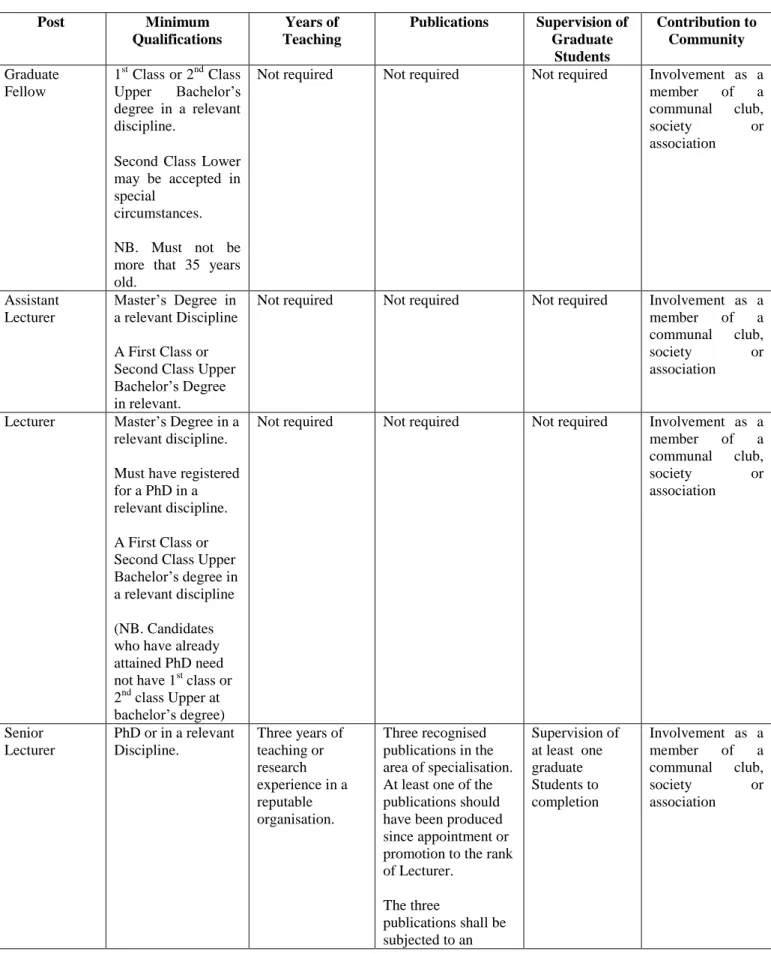
3.2.4.1 The minimum qualifications for appointment of teaching staff shall be as follows:
SN POST MINIMUM REQUIREMENTS
1 Graduate Fellow At least a Second Class Upper Division Bachelor’s Degree in a relevant discipline.
2 Assistant Lecturer (a) At least a Master’s degree in a relevant Discipline. (b) First Class or Second Class Upper Division
Bachelor’s Degree in a relevant discipline.
3 Lecturer (a) At least a Master’s degree in a relevant Discipline. (b) Second Class Upper Division Bachelor’s Degree in a
relevant discipline.
(c) Should be registered for PhD in a relevant discipline. (d) Candidates who have already attained a PhD or
doctorate need not have a first class or second class bachelor’s degree.
4 Senior Lecturer (a) Must have a PhD in a relevant Discipline.
(b) Must have published at least three articles in peer reviewed journal or at least three book chapters one book with an ISBN Number since last promotion. (c) Three journal articles or book chapters shall be
vetted.
(d) Should have contributed to community service.
5 Associate Professor (a) Must have a PhD in a relevant Discipline.
32
SN POST MINIMUM REQUIREMENTS
reviewed journals, or three book chapters or one book with ISBN Number, since last promotion. (c) Three journal articles or book chapters shall be
vetted.
(d) Should have supervised at least two graduate students to completion.
(e) Should have contributed to community service. 6 Professor (a) Must have a PhD in a relevant Discipline.
(b) Must have published at least ten articles in peer reviewed journals, or ten book chapters (five of which should have been after the last promotion) or two books with ISBN Number.
(c) Five journal articles shall be vetted.
(d) Should have supervised two graduate students to completion, one of whom should be at PhD level. (e) Should have contributed to community service.
3.2.4.2 In special circumstances the appointments Board may appoint Graduate Fellows and assistant lecturers who do not have a first class or second class honours degree.
3.2.5 Appointment of Teaching Staff after Retirement
3.2.5.1 Lecturers, Senior Lecturers, Associate Professors and Professors who have reached the mandatory retirement age of sixty (60) years and whose services are still needed by the University may appointed on contract terms.
3.2.5.2 Each employment contract referred to in paragraph (3.2.5.1) above shall not exceed two years.
3.2.5.3 The letter of appointment offering a contract to a retired teaching staff shall specify the performance targets of the person being offered the contract.
3.2.5.4 The age limit for employment of retired teaching staff on contract terms shall be as follows:
33
Category Upper Age limit
1 Lecturer Not above 66 years
2 Senior Lecturers Not above 68 years 3 Associate Professor Not above 72 years
4 Professor Not above 74 years
3.2.6 Age Limits for Appointment of Graduate Fellows
A person who has attained the age of 35 years shall not be eligible for appointment as a Graduate Fellow.
3.3 RECRUITMENT PROCEDURE 3.3.1 General
3.3.1.1 The Director of Human Resources shall maintain an up-to-date record of the number of posts, their classification and the scales of pay attached thereto as approved by the University Council.
3.3.1.2 Subject to the provisions of these Manual, the Directorate of Human Resources shall determine by 1st April of every year the actual number of vacancies that will occur during the next financial year and prepare a recruitment plan.
3.3.1.3 Appointment in the University service shall be subject to availability of:- (a) A vacancy in the approved staff establishment; and
(b) Funds in the approved budget estimates.
3.3.1.4 Generally, one or more of the following recruitment approaches may be adopted by the Appointments Board to identify interested and suitable candidates.
3.3.2 Advertising the Post
3.3.2.1 Advertising the post helps communicate clearly and openly to the public the available vacancy, the requirements of the position and the selection criteria which apply. 3.3.2.2 The methods for advertising the post may include:
34
(b) Advertising on the University website; (c) Advertising on the University Notice Board; (d) Other media such as recruitment websites. 3.3.3 Executive Search
3.3.3.1 Recruitment consultants may be used to tap into their specialized skills in testing and identifying potential candidates and reduce the time burden on the Appointments Board.
3.3.3.2 In using executive search, the following points shall be considered:
(a) Good reputation, extensive recruitment experience and a proven track record;
(b) The consultant should show a commitment to diversity and equality issues, and demonstrate how such commitment is reflected in its practice and approach;
(c) Precise job descriptions and person specifications should be agreed between the consultant and the Board.
3.3.4 Referrals
3.3.4.1 Referral is one of the widely used methods for identifying potential candidates in both the public and private sectors.
3.3.4.2 Possible referral sources may include reputable scholars, senior executives of universities, and other persons of high repute in public and private organizations.
3.3.4.3 Candidates identified through referrals shall be subjected to selection process of the Appointments Board.
3.3.5 Internal Candidates
3.3.5.1 Given that having continuity can be beneficial to the operation of the University, internal candidates with the relevant technical expertise and experience shall be recommended by Management for consideration by the Appointments Board when the position falls vacant.
35
3.3.5.2 It shall be a University policy to first internally advertise a vacancy and failure to obtain a qualified candidate, the position shall then be filled through external advertisement. 3.3.5.3 Internal candidates, just like external candidates, shall be evaluated on the basis of
merit and shall be subjected to the same criteria of selection. 3.3.6 Initiation of Recruitment Process
3.3.6.1 When a position falls vacant, the Head of Department shall write formally to the Director Human Resources to initiate recruitment.
3.3.6.2 Where the responsible Head of Department is satisfied that there is no qualified candidate from within the department to fill the vacancy, they shall recommend that the vacancy be advertised.
3.3.6.3 The job advertisements must contain sufficient details about the position advertised, the job descriptions, address and method of submission of application, closing date of submission, statement about the conditions of service and any other as may be approved by the Appointments Board.
3.3.7 Job Applications
3.3.7.1 All persons seeking employment with the University shall do so through a written application addressed to the Director Human Resources or as may be advised by the Appointments Board depending on the type of employment sought.
3.3.7.2 All job applications shall be received by the Directorate of Human Resources.
3.3.7.3 In the case of academic departments the applications shall be forwarded to the relevant Department for the department’s recommendation on short-listing.
3.3.7.4 In the case of administrative departments, applications shall be processed by the Directorate of Human Resources in consultation with the Head of the user Department.
36 3.4 SELECTION PROCESS
The selection process of Kyambogo University shall comprise the following steps: 3.4.1 Short-listing
3.4.1.1 The short-listing criteria shall focus on the factual requirements of the person specifications.
3.4.1.2 In short-listing candidates for interview, the following factors shall be considered: (a) Academic, professional and technical qualifications;
(b) Job knowledge and technical competence; (c) Relevant work experience;
(d) Leadership and management experience;
3.4.1.3 Subject to the provisions of this manual, during the short-listing process there shall be no discrimination on the grounds of age, sex, marital status, family status, sexual orientation, disability, race, nationality or religion in any circumstances. All candidates shall be assessed fairly and equally irrespective of the above characteristics.
3.4.1.4 The University may administer written and/or practical tests to determine suitable candidates.
3.4.2 Interviewing
3.4.2.1 A job interview is a process of interaction between the job applicant and the employer in which a job applicant is evaluated by the University to determine whether or not the applicant is suitable for the job position.
3.4.2.2 During the interviews, interviewers shall only ask questions that relate directly to the job requirements. Where it is necessary to assess whether personal circumstances will affect job performance, interviewers should discuss these objectively.
3.4.2.3 Assessment of the candidates and due recommendation of the interviewers shall be properly documented after interviews.
37
3.4.2.4 All documents containing personal data a job of applicant shall be retained by the Director Human Resources for further handling, irrespective of whether the applicant is appointed or not.
3.4.3 Reference Check
3.4.3.1 The Board may conduct a reference check as the final stage of the selection process and all offers of employment shall only be finalised subject to the receipt of satisfactory references.
3.4.3.2 If a candidate is found to have provided false information or misrepresented any information or not disclosed any material facts in his or her application, it shall be deemed to be sufficient grounds for the University to withdraw the offer or terminate his or her service summarily, as the case may be.
3.4.3.3 When a suitable candidate is identified, the Directorate of Human Resources will determine the entry point of a prospective employee on the approved salary scale basing on the candidate’s previous experience.
3.4.3.4 The Appointments Board may delegate some stages of the recruitment process to Management, but in any case all appointments must be approved by the Board.
3.5 EMPLOYMENT FORMALITIES 3.5.1 Due Diligence and Background Check
3.5.1.1 Prior to offer of appointment, the Director Human Resources will ensure that the candidates are lawfully employable in Uganda and hold a valid passport or other valid identity documents that are acceptable.
3.5.1.2 Candidates are required to certify their qualifications and working experience by producing the original copies of their academic and professional credentials, reference letters from previous employers and other relevant documentation.
3.5.1.3 Before assumption of duty candidates shall be required to provide both an original and a certified copy of the birth certificate, passport or any other nationally recognised document.
3.5.1.4 Management and the Board shall conduct due diligence to confirm the validity of all information provided by the candidate prior to and during the job interview.
38
3.5.1.5 Misrepresentation of oneself and use of forged documents before and during the recruitment and selection process shall result in the disqualification.
3.5.2 Reporting for Duty
3.5.2.1 On the first day of employment, a new employee shall report to the Directorate Human Resources to complete the engagement formalities and attend a brief induction before they report for duty to the designated Department.
3.5.2.2 Each Head of Department shall arrange for a new employee’s job induction once he or she has reported for duty.
3.5.2.3 In addition, a new employee will be invited to attend a Staff Orientation Program conducted by the Human Resources Directorate to help him or her better understand the mission, objectives and organization structure of Kyambogo University, as well as its rules and regulations, and code of conduct.
3.5.2.4 A new employee shall not access the University payroll until he or she has produced written evidence that he or she has officially left the service of the previous employer.
39
CHAPTER FOUR
DEPARTMENTAL AND FACULTY APPOINTMENTS, PROMOTIONS
AND APPRAISAL COMMITTEES
4.1 INTRODUCTION
4.1.1 Departmental and Faculty Appointments, Promotions and Appraisal Committees shall be responsible for the appointment, promotions and appraisal of teaching and technical staff in the teaching units.
4.1.2 In addition to the joint appraisal of the Departmental or Faculty Appointments, Promotions and Appraisal Committees, the Head of Department and the faculty dean shall provide their independent assessment of each employee under their supervision. 4.2 DEPARTMENTAL COMMITTEE
4.2.1 In each teaching Department there shall be a committee known as the Departmental Appointments, Promotions and Appraisal Committee.
4.2.2 The Departmental Appointments, Promotions and Appraisal Committee shall consist of at least 5 senior members of staff of the Department, appointed by authority of the Vice Chancellor.
4.2.3 The Committee shall consider applications for appointment and promotions as well as appraisal reports for all staff in the department.
4.2.4 Where a department is understaffed and lacks quorum, it may co-opt qualified members of staff from a related discipline.
4.2.5 Only persons whose ranks are higher or equivalent to the rank of the person being considered for appointment or promotion, shall constitute the Committee.
4.2.6 The terms of reference for the Departmental Appointments and Promotions Committee shall be as follows:
(a) To receive and consider applications for appointment and promotions to teaching positions in the Department using approve University guidelines;
40
(b) To make recommendations to the Faculty Committee on applications for appointment and promotions of staff in the department;
(c) To receive and consider performance appraisal reports on all members of staff in the Department.
(d) To advise management on matters of employment and human resource management in the Department.
4.2.7 The quorum for the Departmental Appointments and Promotions Committee shall be three (3) members.
4.2.8 Where the Head of Department is a candidate, or where two or more members of the Departmental Committee are being considered, the Dean shall assume the Chair of the Committee meeting called for that purpose.
4.2.9 Where the Department cannot form a Committee due to lack of eligible staff members, the Committee shall co-opt members from related fields to assess the application. 4.2.10 The task of the Committee shall be to scrutinize all applications for appointment and
review employees for promotion.
4.2.11 The Committee shall also evaluate employees annually and submit its recommendations to the Appointments Board through the relevant Dean.
4.2.12 The decisions of the Departmental Appraisal Committee shall be communicated to the Faculty Appraisal Committee with a copy to the Director Human Resources by the Chairperson in form of minutes which should bear the signatures of all members who attend the meeting.
4.3 FACULTY APPOINTMENT, PROMOTION AND APPRAISAL COMMITTEE 4.3.1 In each Faculty, School or Institute there shall be a Committee known as the Faculty
Appointments, Promotions and Appraisal Committee which shall be chaired by the Dean/Director.
4.3.2 The Faculty Appointments, Promotions and Appraisal Committee shall be made up of at least one representative from each Departmental Committee.
41
4.3.3 The minimum number of members of the committee shall be five including the heads of Department and the Dean/Director.
4.3.4 The Vice Chancellor may appoint a senior member of staff to be a member of the Faculty Appointments, Promotions and Appraisal Committee.
4.3.5 Only senior members of staff (Senior Lecturer and above) whose ranks are higher or equivalent to the person being considered for appointment or promotion, shall constitute the Committee.
4.3.6 The quorum for the Faculty Appraisal Committee shall be not less than two thirds of the entire membership.
4.3.7 The Terms of Reference of the Faculty Appointments, Promotions and Appraisal Committee shall be:
(a) To receive recommendations from Departmental Appointments, Promotions and Appraisal Committees and make recommendations to Management on issues of appointment, promotions and appraisal of staff in the faculty using approved University guidelines;
(b) To advise Management on matters of staffing and human resource management in the Faculty.
(c) To handle any other matter in the faculty as may be requested by the Dean or Management.
4.3.8 Decisions of the Faculty Committee shall be communicated by the committee chair to the Appointments Board through Management in the form of minutes which shall bear signatures of all the members who shall have attended the meeting.
4.3.9 The Director of Human Resources may attend Departmental and Faculty committee meetings to give guidance on University Human Resource policy.
4.3.10 Where a Faculty, School or Institute is understaffed and cannot constitute an Appraisal Committee due to lack of eligible staff members, the Committee shall co-opt qualified senior staff from related fields to assess the application.
4.3.11 Where a Dean/Director is the candidate, the Committee shall appoint a Chairperson from among the members present to assess the application.
42
4.3.12 In case of controversy within a Department or Faculty or lack of clarity about a recommendation of the Committee, the relevant Dean/Director/Head may be invited to appear before the Appointments Board to assist in res