Utilities Undergrounding Program
U
TILITIES
U
NDERGROUNDING
P
ROGRAM
O
VERSIGHT
C
OULD BE
I
MPROVED BY
E
NHANCED
T
RACKING OF
P
ROJECT
C
OSTS AND
T
IMELINES
J
ANUARY
2015
Audit Report
Office of the City Auditor
City of San Diego
January 15, 2015
Honorable Mayor, City Council, and Audit Committee Members City of San Diego, California
Transmitted herewith is a performance audit report on the City of San Diego’s Utilities
Undergrounding Program. This report was conducted in accordance with the City Auditor’s Fiscal Year 2014 Audit Work Plan, and the report is presented in accordance with City Charter Section 39.2. The Results in Brief are presented on page 1. Audit Objectives, Scope, and Methodology are presented in Appendix B. Management’s responses to our audit recommendations are presented after page 45 of this report.
We would like to thank staff from Transportation & Stormwater Department, and San Diego Gas & Electric for their assistance and cooperation during this audit. All of their valuable time and efforts spent on providing us information is greatly appreciated. The audit staff members responsible for this audit report are Shawneé Pickney, Shoshana Aguilar, Chris Kime, and Kyle Elser.
Respectfully submitted,
Eduardo Luna City Auditor
cc: Scott Chadwick, Chief Operating Officer
Stacey LoMedico, Assistant Chief Operating Officer
Tony Heinrichs, Deputy Chief Operating Officer, Infrastructure/Public Works Kris McFadden, Director, Transportation & Stormwater
Rick Gardner, Project Management Manager, San Diego Gas & Electric Gail Granewich, City Treasurer
Rolando Charvel, City Comptroller
Andrea Tevlin, Independent Budget Analyst Mary Lewis, Chief Financial Officer
Jan Goldsmith, City Attorney
OFFICE OF THE CITY AUDITOR
Table of Contents
Results in Brief
1
Background
5
Audit Results
13
Finding 1: The Project Tracking Invoice Could Be More
Comprehensive and Detailed to Improve Oversight of
Project Costs
13
Finding 2: Project Scheduling Timelines Could Be More
Up-To-Date, Complete, and Consistent
25
Finding 3: Project Oversight and Monitoring Could Be
Improved With Periodic Reporting and Utilization of a
Project Management System
31
Conclusion
38
Recommendations
40
Appendix A: Definition of Audit Recommendation Priorities
42
Results in Brief
The Utilities Undergrounding Program (UUP) is a public-private endeavor between the City of San Diego (City), San Diego Gas and Electric (SDG&E), AT&T, Cox, and Time Warner Cable to underground utility lines. The UUP’s progress is contingent upon improving the quality of cost and scheduling information and analysis. Project success depends on: 1) the management of costs to ensure that expenditures do not exceed funding; 2) having a reliable schedule that defines when and how long work will occur; and 3) analyses of cost and scheduling variances between planned and actual cost and time activities. The UUP currently conducts monthly coordination meetings with utility companies to discuss utility undergrounding project status updates. However, we found that cost and time information pertaining to the utility undergrounding projects could be improved by developing a formalized system of project tracking that sufficiently captures, monitors, and analyzes project data.
The primary objective of this audit was to determine whether the City is effectively managing costs and achieving efficiencies for the UUP. This audit report has three findings and six recommendations. First, we found that the project tracking invoice should be more
comprehensive and detailed to improve oversight of project costs. Second, project scheduling timelines should be more up-to-date, complete, and consistent. Third, project oversight and monitoring should be improved with periodic reporting and utilization of a project management system.
FINDING 1
According to the FY 15 Adopted Budget, the City is spending approximately $60.6 million in surcharge funds on utility
undergrounding activity. Given this expense, it is important that the UUP have a comprehensive, accurate, and sound financial picture of how utility undergrounding projects are progressing. Each month SDG&E submits a Project Tracking Invoice to the UUP for
reimbursement of project costs based on amounts by project phase. However, the Job-To-Date (JTD) amounts included in the Project Tracking Invoice are not itemized to show project costs such as labor, materials, equipment and overhead. This lack of cost specificity is not conducive to analyzing project costs, particularly overhead costs.
SDG&E maintains cost information that would enable the City to better manage and monitor costs by project phase. This information can be used to identify opportunities for cost savings, determine if costs are reasonable, and monitor project progress in relation to cost. We found that the Project Tracking Invoice that SDG&E submits monthly to the UUP for payment does not include all of the information necessary for the UUP to adequately monitor project costs.
We also found that supporting detail was missing for a small number of transactions reviewed. It is important to note that if project costs cannot be verified, the UUP cannot determine if project costs are reasonable and necessary.
In order to improve oversight of project costs, the UUP should formally request that the Project Tracking Invoice include detailed accounting information for all project phases. The information should include estimated costs, bid amounts, percentage completion, and itemized direct and overhead costs. Additionally, the UUP should periodically conduct a verification of a sample project
reimbursements for direct and overhead costs to the SDG&E recorded costs to determine the accuracy of costs based on supporting documentation maintained by SDG&E.
FINDING 2
Communities can be impacted by utility undergrounding
construction for extended periods of time, often more than a year. Undergrounding projects can inconvenience neighborhoods due to the noise and physical obstructions that accompany digging
trenches in the roadways and removing wooden utility poles from in front of homes and businesses. It is important that the UUP: 1) have reliable scheduling data; and 2) have established guidance for project timelines to evaluate project efficiency.
Based on our review of the UUP and SDG&E utility undergrounding construction project data, we found that project scheduling information was outdated and incomplete. Specifically, estimated start and finish dates in the Project Tracking Invoice were not updated to match the information contained in SDG&E’s project management system. Also, actual start and finish dates for projects and their phases were not included, although the information is available for entry within SDG&E’s system.
We also found that the City needs to reconcile the project completion guidelines established in the Municipal Code’s Underground Utilities Procedural Ordinance, Section 61.0509, and Council Policy 600-08, Underground Conversion of Utility Lines by Utility Company. While both include timelines for completing undergrounding projects, the timeline requirements are inconsistent. Stronger timelines would minimize disruptions and produce the intended improvements that residents and businesses expect.
To better track project progress, the UUP needs to request and receive more detailed and reliable scheduling data from SDG&E. The scheduling data should include estimated and actual project start and finish dates that match the dates that SDG&E uses in its own internal project management software. Additionally, the City should clearly and consistently define utility undergrounding project completion expectations in its policies and the Municipal Code. FINDING 3
In addition to having more cost detail and project timeline information, the Utilities Undergrounding Program (UUP) could improve oversight by analyzing its performance of completing utility undergrounding projects in a cost-effective and timely manner. Performance evaluations include: 1) analyzing cost and schedule variance to determine the cause of a difference between estimated and actual performance after project completion; and 2) forecasting project performance based on the actual performance of projects to date. A project management information system provides a standard tool for entities to capture, store, and distribute information to stakeholders about project costs, project progress, and performance. During our review, we found that the UUP does not have a reporting system robust enough to accurately track and compile project status information. Additionally, we found that the City is not exercising its existing oversight mechanism to monitor utility undergrounding projects. Specifically, the UUP is not reporting to City Council with the frequency that Council Policy 600-08 requires.
In order to improve project oversight and monitoring, the UUP should use project management software. The UUP should also comply with Council Policy 600-08 requiring twice yearly utility undergrounding reports to City Council. The reports should include an evaluation of the variance between planned and actual
scheduling and cost activities.
The Transportation and Storm Water Department agreed with all six recommendations.
Background
The City of San Diego (City) has a goal of converting every residential overhead utility line in San Diego to underground service over the next 54 years. The City’s Utilities Undergrounding Program (UUP) reports relocating an average of 15 miles of overhead utility lines underground each year. Overhead utilities include power, cable, and telephone lines. The City’s undergrounding program is one of the most ambitious and unique arrangements in the state of California. The Transportation and Storm Water Department (TSWD) manages the City’s UUP, which is under the Right of Way Coordination Division. The UUP works primarily with San Diego Gas and Electric (SDG&E) and also coordinates with AT&T, Cox, and Time Warner Cable to complete the undergrounding construction process. Undergrounding construction includes SDG&E and subcontractor crews digging trenches in the roadways in front of homes and businesses, installing new utility lines in the trenches, and removing wooden poles that are no longer needed. Undergrounding projects consist of the following project phases: trenching, cabling, cutover, and overhead removal from service. SDG&E bills the City by project phase. Exhibit 1 shows the phases for undergrounding construction projects.
Exhibit 1
Undergrounding Project Phases
Source: OCA analysis, based on information provided by the UUP.
Exhibits 2 and 3 show two of the undergrounding project phases: trenching and overhead removal from service.
Trenching
• SDG&E crews and subcontractors dig trenches in City streets. Conduit, which is tubing for electric wire, is laid.
• Trenches are covered.
Cabling
• Crews run cables through the conduit.
• Crews install transformer boxes and equipment pedestals.
Cutover
• Overhead lines are powered down and underground lines are energized to residential and business customers.
Overhead Removal from
Service
• Crews remove now obsolete wooden utility poles.
• City commences Capital Improvement Program work such as the installation of concrete light poles.
Exhibit 2
Undergrounding Trenching
Source: OCA.
Exhibit 3
Overhead Pole Removal from Service
The UUP is responsible for coordinating and overseeing SDG&E’s undergrounding activity, administering the underground surcharge fund, monitoring program revenues and expenditures, and
producing the undergrounding master plan. The UUP also conducts public outreach and manages the associated Capital Improvement Program (CIP) work such as street repaving, installation of new streetlights, curb ramps, and underground connections to traffic signals. SDG&E handles the utility undergrounding project design, subcontracting, and construction management.
Utilities Undergrounding is a 100 Year Endeavor, and the Memorandum of Understanding Expires in Seven Years
SDG&E has been undergrounding utility lines in the City since 1970 in compliance with the California Public Utilities Commission (CPUC) Rule 20A. In 2003, the City began to actively manage utility
undergrounding projects with the ratification of the Memorandum of Understanding (MOU) between the City and SDG&E, and the City expects to move all lines underground in the coming five decades. According to the program’s most recent report to the City Council in early 2014, 374 total miles have been completed, and 1,065 miles of utility lines remain as of January 17, 2014. The most recent master plan estimates that all construction will be complete by 2067.
The MOU is the primary document that describes the funding process for utility undergrounding. The MOU states that SDG&E can manage undergrounding construction, though the City could assume the responsibility for construction management if desired. The MOU, which funds most undergrounding in the City, and the associated electric franchise agreement with SDG&E both expire in 2021. The UUP budget and funding mechanism are described in the following sections. Municipal Code §61.0500 and Council Policy 600-08 provide additional guidance for the program, though according to the City Attorney’s Office, adherence to a Council Policy is not legally required for non-City entities such as SDG&E unless it is mandated by contract. Electric Surcharge Revenue
Funds the UUP
The UUP has seven full time equivalent positions assigned to the program, with a budgeted expenditure of approximately $60.6 million in FY 2015. A project engineer is responsible for managing the program on a daily basis. Exhibit 4 summarizes the UUP’s
Underground Surcharge Fund revenues and expenditures for FY 2013 to 2015.
Exhibit 4
Underground Surcharge Fund
FY 2013 Actual FY 2014 Budget* FY 2015 Adopted
Beginning Balance and Reserves $48,493,997 $54,798,169 $59,045,860
Electric Surcharge Revenue – SDG&E $47,754,494 $48,791,916 $50,392,739
Interest Earnings $267,298 $300,000 $200,000
Total Revenue and Reserves $96,515,789 $103,890,085 $109,638,599
Total Operating Expense $38,778,102 $49,092,936 $50,592,739
Total CIP Expenditure of Prior Year Funds $2,826,927 $10,000,000 $10,000,000
Total Expense $41,605,029 $59,092,936 $60,592,739
Total Balance and Reserves $54,910,760 $44,797,149 $49,045,860
*Current fiscal year balances and reserves are estimates of carryover from the previous fiscal year. Source: City of San Diego FY 2015 Adopted Budget.
Utilities Undergrounding Has Two Primary Funding Sources
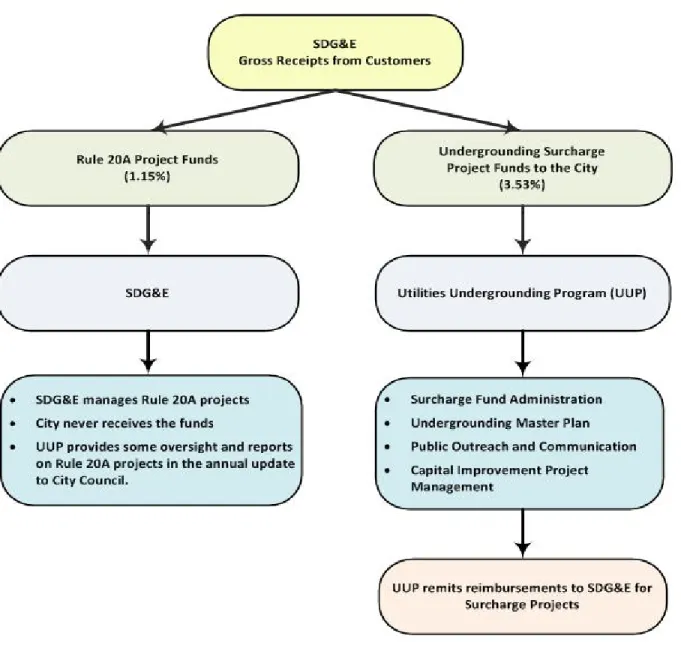
Utilities undergrounding is funded by two revenue sources: Rule 20A and an undergrounding surcharge fee, displayed in Exhibit 5. The first funding source is a requirement of the CPUC Rule 20A, that all utilities must spend a percentage of revenue to underground its utility lines in the general public interest. In 2002, the City and SDG&E updated their franchise agreement, which requires SDG&E to devote 1.15 percent of gross receipts to undergrounding to comply with Rule 20A. In calendar year 2013, the Rule 20A spending obligation was approximately $13 million. SDG&E manages these projects, and the City never receives the funds. However, the UUP does supply some oversight and has reported on Rule 20A projects in its annual update to the City Council. Additionally, the UUP incorporates Rule 20A project information into the master plans for each council district and oversees City capital improvements work such as conversion of overhead streetlights and traffic signals.
The second funding source for the City’s undergrounding work is derived from a 3.53 percent surcharge fee based on gross receipts from SDG&E customers within the City of San Diego. The surcharge funds were the focus of our review. The collection and remittance to the City of the undergrounding surcharge fee on ratepayers’ SDG&E utility bills began in 2003. It has increased the amount of available funding for utilities undergrounding. From surcharge funds, the City receives about $49 million per year for undergrounding projects. SDG&E manages the construction work and bills the City for reimbursement, which the City remits from the surcharge fund to
SDG&E. The City also uses the surcharge fund to cover CIP work, such as street repaving for all undergrounding projects, and to fund other undergrounding program expenses. The City’s $49 million surcharge fee and SDG&E’s additional $13 million for Rule 20A provide
approximately $62 million in total undergrounding dollars per year. Exhibit 5 diagrams the utilities undergrounding funding streams and responsibilities.
Exhibit 5
Diagram of Utilities Undergrounding Funding Streams and Responsibilities
SDG&E Submits Invoices to the City that Track Project Timelines and Costs
SDG&E submits a Project Tracking Invoice to the City monthly. This invoice serves to request payment for SDG&E’s undergrounding expenses and to provide construction project phase cost and
timeline information to the UUP. It includes information for estimated project phase start and finish dates, estimated costs, bid amounts, percentage completion, and job-to-date costs for each phase of a utility undergrounding project. The Project Tracking Invoice is sent as an Excel spreadsheet, shown in Exhibit 6.
SDG&E manually inputs data to the Project Tracking Invoice from their SAP accounting system and internal project tracking system, which is known as Distribution Planning and Scheduling System (DPSS). DPSS includes scheduled start and completion dates and actual completion dates.
Exhibit 6
Example of March 2014 Project Tracking Invoice
Source: City of San Diego Utilities Undergrounding Program.
Audit Results
Finding 1: The Project Tracking Invoice Could
Be More Comprehensive and Detailed to
Improve Oversight of Project Costs
According to the FY 15 Adopted Budget, the City is spending approximately $60.6 million in surcharge funds on utility undergrounding activity. Given this expense, each month it is important that the Utilities Undergrounding Program (UUP) have a comprehensive, accurate, and sound financial picture of how utility undergrounding projects are progressing. San Diego Gas and Electric (SDG&E) submits a Project Tracking Invoice to the UUP for
reimbursement of project costs based on amounts by project phase. However, the Job-To-Date (JTD) amounts included in the Project Tracking Invoice are not itemized to show project costs such as labor, materials, equipment and overhead. This lack of cost specificity is not conducive to analyzing project costs, particularly overhead costs. SDG&E maintains cost information that would enable the City to better manage and monitor costs by project phase. This information can be used to identify opportunities for cost savings, determine if costs are reasonable, and monitor project progress in relation to cost. We found that the Project Tracking Invoice that SDG&E submits monthly to the UUP for payment does not include all of the information necessary for the UUP to adequately monitor project costs.
We also found that supporting detail was missing for a small number of transactions reviewed. It is important to note that if project costs cannot be verified, the UUP cannot determine if project costs are reasonable and necessary.
In order to improve oversight of project costs, the UUP should formally request that the Project Tracking Invoice include detailed accounting information for all project phases. The information should include estimated costs, bid amounts, percentage completion, and itemized direct and overhead costs. Additionally, the UUP should periodically conduct a verification of a sample project
reimbursements for direct and overhead costs to the SDG&E recorded costs to determine the accuracy of costs based on supporting documentation maintained by SDG&E.
The Project Tracking Invoice is Missing Information Necessary to Analyze Project Costs
Currently SDG&E submits a monthly Project Tracking Invoice to the UUP for reimbursement of project costs. However, the financial information provided does not include all of the information necessary for the UUP to identify opportunities for cost savings, determine reasonableness, and monitor project progress in relation to cost. Based on our review, the Project Tracking Invoice did not include the following for all project phases:
Estimated Costs;
Bid Amounts;
Percentage Completion; and
Itemized Job-To-Date Costs.
An example of the cost data currently entered into the Project Tracking Invoice is provided in Exhibit 7. As displayed below,
estimated costs, bid amounts, and percentage completion (indicated by Cnst %) were not included for all project phases. Also, JTD totals for project phases were aggregate amounts. For example, Work Order Number 2848470 JTD costs totaled approximately $3.4 million. However, the Project Tracking Invoice does not provide a breakdown of applicable cost elements for the $3.4 million such as labor,
materials, transportation, equipment, and overhead. Exhibit 7
Cost Information the Project Tracking Invoice Currently Provides
Project Phase Information is Not Comprehensive for Estimated Costs, Bid Amounts, and Percentage Completion
In order to monitor costs, project management guidelines
recommend that entities create a plan that identifies the resources, including labor, materials, overhead, and other budgetary items, needed to complete each phase of a project. According to the Project Management Body of Knowledge (PMBOK), part of the identification of resources includes developing an estimate of cost for all resources that will be charged to a project.1
Generally for the projects reviewed, estimate and bid amount information provided were not complete. Specifically, we found that the March 2014 Project Tracking Invoice contained estimated costs for 85 percent of the phases. The Project Tracking Invoice contained bid amounts for only 43 percent of the phases. According to SDG&E, two of the five projects audited were not bid but rather constructed by SDG&E in-house crews and bid amounts would not be included for in-house construction. Nevertheless, the subcontractor bid or SDG&E estimate should be included in the Project Tracking Invoice. SDG&E also notes that the bid amount only includes direct cost of the subcontractor.
Cost estimating methods may include an analysis of what the project should cost, based on the responsive bids from vendors.
PMBOK also indicates that in order to control project costs, entities should monitor work performed against funds expended. Percent completion can be used to measure against percent paid to determine if costs are reasonable compared to project progress. In order to monitor work performed, accurate percentage completion information by phase is critical. However, SDG&E provided
percentage completion information for only 51 percent of the phases within the March 2014 Project Tracking Invoice.
The Project Tracking Invoice Does Not Itemize Direct and Overhead Costs
Based on our review, JTD costs within the Project Tracking Invoice were lump sum amounts and did not provide any breakdown of direct or overhead costs. None of the JTD costs in the Project Tracking Invoice were itemized. Itemized costs will provide the UUP with better information for analysis of project costs.
According to construction guidelines, construction project costs are typically itemized as:
Direct Costs: costs that can be specifically identified with a construction job including:
1. Labor – Hourly pay and salary, vacation and sick time, payroll taxes, etc;
2. Equipment – Depreciation, maintenance and repair costs, fuel and oil, etc;
3. Permanent Materials and Supplies – inventory, spoilage, loss, and theft, etc;
4. Subcontracts – payments made to subcontractors; and 5. Nonpermanent Materials and Supplies – permits, fees,
licenses, and miscellaneous costs.
Overhead Costs: costs that cannot be attributed readily to a part of the final project including:
1. The project management costs; and
2. Other Project Expenses – utilities, telephone, warehouse costs, etc.
We requested from SDG&E supporting documentation, inclusive of direct and overhead JTD costs, for a judgmental sample of five projects listed in the March 2014 Project Tracking Invoice with JTD costs of approximately $30 million provided by SDG&E as of June 2014.2 The accounting detail generated by SDG&E, shown in Exhibit
8 is itemized by direct and overhead charges.
Exhibit 8
Itemized Job-To-Date Costs Billed Within Five Project Sample
Category Job-to-Date Cost Percentage of Total
SDG&E Subcontractor Charges $15,305,479 51.0%
SDG&E Overhead Charges $11,959,009 39.8%
SDG&E Labor $1,393,673 4.6%
SDG&E Materials $857,922 2.9%
SDG&E Transportation $518,329 1.7%
Credits ($1,518)
Total $30,032,894 100%
Source: OCA analysis, based on data from SDG&E as of June 2014.
As shown in Exhibit 9, approximately 60 percent are direct costs, which include subcontractor, labor, materials, and transportation. The remaining 40 percent of costs within the sample are overhead charges.
Exhibit 9
Percentage of Job-To-Date Costs by Category for Five Utilities Undergrounding Projects
Source: OCA analysis, based on data from SDG&E as of June 2014.
Direct charges include SDG&E subcontractor charges, SDG&E Transportation, SDG&E Materials, and SDG&E Labor.
SDG&E Does Not Provide Itemized Detail for Overhead Costs in the Project Tracking Invoice
Based on our review, we found that SDG&E did not provide itemized detail for overhead costs in the Project Tracking Invoice. The lack of transparency for overhead charges is not conducive to analyzing costs. Detailed disclosure of overhead costs is needed to manage and monitor project costs and to perform value engineering studies. For the $30 million billed in our five project sample, approximately $12 million (approximately 40 percent) was overhead cost. SDG&E used over 40 overhead cost pools to distribute overhead expense to the utility undergrounding JTD costs in July 2014, some of which are summarized in Exhibit 10. The largest billings were for:
Engineering Electric Distribution;
Pension and Benefits;
Incentive Compensation Plan;3 Vacation and Sick;
Contract Administration Labor; and
Department Overhead Electric Distribution.
3 According to SDG&E’s 2014 Incentive Compensation Plan Summary, participation in one plan year does not
Exhibit 10
Overhead Cost Pool for Five Project Sample with Total Billed Costs of $30 Million4
Overhead Cost Pool
Job-to-Date Cost Total Overhead Percentage of
Engineering Electric Distribution $5,081,450 41.0%
Pension & Benefits $2,321,257 18.7%
Incentive Compensation Plan $1,212,206 9.8%
Vacation & Sick $944,249 7.6%
Contract Administration $820,288 6.6%
Department Overhead Electric Distribution $634,415 5.1%
Payroll Tax $572,811 4.6%
Capital Administrative & General $361,905 2.9%
Public Liability & Property Damage $169,837 1.4%
Worker's Compensation $77,152 0.6% Purchasing $66,240 0.5% Small Tools $63,189 0.5% Warehouse $44,190 0.4% Exempt Materials $25,073 0.2% Shop Order $5,929 0.0% Total $12,400,192 100.0%
Source: OCA analysis, based on data from SDG&E as of July 2014.
Certain overhead costs such as designers, engineers, contract
administrators and inspectors could be accounted for on a direct cost basis.
However, SDG&E has resisted this approach in the past, stating, “The city agreed to pay overheads. All labor related overheads, including salaries (a component of which is bonuses) are allocated fairly to all labor company wide. These types of costs do not lend themselves to direct assignment to activities. Therefore, these costs are ‘pooled’ and applied to all work based on a cost driver, e.g. direct labor. This is an effective and appropriate practice that fairly distributes the costs on an appropriate causal effect.”
As seen in Exhibit 11 the guidance on direct and overhead cost development and reimbursement is not prescriptive on the
treatment of these costs nor is the Memorandum of Understanding (MOU) definitive on the treatment. The Federal Code of Regulations,
Part 645, pertains to Utilities, the Federal Acquisition Regulation contains guidance in Part 31 on government contracts with
commercial organizations and the MOU is the agreement between SDG&E and the City governing the UUP.
Exhibit 11
Guidance Regarding the Treatment of Direct and Overhead Cost Development and Reimbursement Is Not Prescriptive
Federal Code of
Regulations Federal Acquisition Regulation
Memorandum of Understanding with
SDG&E
Section Part 645- Utilities, section
645.117(b)-Direct Labor Costs Part 31.105-(d)(3)-Construction and Architect-Engineer Contracts Section 10 Treatment of Direct and Overhead Costs
Salaries and wages, at actual or average rates, and related absences paid by the utility to
Individuals for the time worked on a project are reimbursable when supported by adequate records. This includes labor associated with preliminary engineering, construction engineering, right-of-way, and force account construction.
Costs incurred at the job site incident to performing the work, such as the cost of superintendence, timekeeping and clerical work, engineering, utility costs, supplies, material handling, restoration and cleanup, etc., are allowable as direct or indirect (overhead) costs, provided the accounting practice used is in accordance with the contractor’s
established and consistently followed cost accounting practices for all work.
The City will compensate SDG&E for all reasonable charges and costs incurred, including but not limited to labor charges customarily charged to third parties such as associated overheads, subcontractors, materials, supplies, permits, and other directly related costs of any such projects.
Source:OCA analysis, based on the Federal Code of Regulations, Federal Acquisition Regulation, and the Memorandum of Understanding between the City and SDG&E.
As recently as July 18, 2014, the UUP requested that SDG&E provide a detailed breakdown of overhead charges, beginning with the May 2014 invoice, and that SDG&E track costs of design, contract
administration and inspection on a project-specific basis. The SDG&E response, dated September 12, 2014, was to reiterate their practice to pool charges for Local Engineering and other routine activities and distribute them among the appropriate projects. SDG&E stated that this method is approved by the California Public Utilities Commission and used by SDG&E in the ratemaking process.5
In order to evaluate if the overhead costs are reasonable and to gain a better understanding of the specific components of the overhead charges, the UUP should obtain itemized JTD accounting details for all project phases in the monthly Project Tracking Invoice. It would also benefit the UUP to request the accounting detail for direct costs since SDG&E does not currently itemize direct costs in the Project Tracking Invoice.
If greater detail for the direct and overhead costs were included on the Project Tracking Invoice, the UUP would have itemized
information needed to:
Determine what cost elements are contributing to the overall project expenses;
Complete an analysis to determine if there are project phases that the City could perform in-house for less than SDG&E reimbursement; and
Gain some assurance that SDG&E is billing the City for costs that are reasonable.
Exhibits 12 and 13 together provide an example of the cost
information that should be included in the Project Tracking Invoice in the future.
5The 2012 General Rate Case application, approved by CPUC in 2013, includes prepared direct testimony on
behalf of SDG&E in which it is stated, “Indirect capital costs are applied consistently and uniformly to work done within a given category, such as Electric Distribution, for both collectible and non-collectible jobs.” This
Exhibit 12
Line Item from Current Project Tracking Invoice
Source: Data from the March 2014 Project Tracking Invoice, Utilities Undergrounding Program.
Exhibit 13
Recommended Cost Information to Include in the Project Tracking Invoice for Each Project Phase
Source: OCA analysis based on data from the March 2014 Project Tracking Invoice and DPSS System.
Given that: 1) utility undergrounding projects are funded through a ratepayer surcharge in which there is a public interest; and 2) the City has a duty to the public to account for the proper expenditures of the funds consistent with its public agreements with the utility, the UUP should request more accounting detail and SDG&E should provide it. The lack of transparency and the complexity of the costs SDG&E reports are not conducive to analyzing and monitoring project costs.
SDG&E Provided Accounting Detail for Most Direct Costs Reviewed, but Supporting Detail Was Missing for a Small Number of Charges
Based on financial reports SDG&E provided, we reviewed supporting documentation for 63 direct costs from our sample of five utility undergrounding projects. The 63 direct cost items totaled
approximately $2.2 million, or about seven percent of the $30 million total costs.
Of the $2.2 million there was a total of eight items (representing 13 percent of the total direct cost items reviewed) with no supporting or sufficient documentation. Two of the eight items totaled a credit of $15,042.53. The remaining six items were charges in the amount of $14,299.68. The charges and credits each represent less than one percent of the $2.2 million sampled. The eight items are displayed in Exhibit 14.
Exhibit 14
Direct Costs with No Supporting Documentation
Source: OCA analysis, based on data SDG&E provided.
While the total amount of direct costs without supporting
documentation may be a small portion of total project costs, it is still noteworthy that SDG&E billed the UUP for costs that could not be verified. According to the UUP, it relies on SDG&E to ensure that projects are appropriately billed for work completed and inspected. While SDG&E uses SAP software to house accounting data, we observed that SDG&E staff must navigate through multiple SDG&E departments in order to provide and confirm information. Although SDG&E states that decentralization is a method that ensures that no one department retains too much control of data and records, we found that such decentralization sometimes translated into errors and omissions in information, such as project dates, within SDG&E’s own systems.
If costs cannot be verified, the UUP cannot determine if the costs are reasonable and necessary. To that end, the UUP should exercise its right to periodically audit SDG&E business records and verify the costs of the undergrounding program per Section 12 of the MOU. Recommendation #1 The Transportation and Storm Water Department in conjunction
with the Chief Operating Officer should formally request that the Project Tracking Invoice prepared by SDG&E include detailed accounting information for all project phases and should include:
Estimated costs
Bid amounts Percentage completion
Direct Cost categorization to include:
o SDG&E subcontractor costs o SDG&E labor costs
o SDG&E
materials costs
o SDG&E transportation costs Overhead cost categorization to include at a minimum the compiled
overhead pool costs for:
o Engineering Electric Distribution o Incentive Compensation Plan o Contract Administration o Pension & Benefits
o Purchasing and
Warehouse (Priority 2)
Recommendation #2 The Transportation and Storm Water Department should
periodically, but no less than annually, conduct a verification of a sample of Utilities Undergrounding Program project
reimbursements for direct and overhead costs to the SDG&E recorded costs to determine the accuracy of the costs based on the supporting documentation maintained by SDG&E. (Priority 2)
Finding 2: Project Scheduling Timelines Could
Be More Up-To-Date, Complete, and Consistent
Communities can be impacted by utility undergrounding
construction for extended periods of time, often more than a year. Undergrounding projects can inconvenience neighborhoods due to the noise and physical obstructions that accompany digging
trenches in the roadways and removing wooden utility poles from in front of homes and businesses. It is important that the Utilities Undergrounding Program (UUP): 1) have reliable scheduling data; and 2) have established guidance for project timelines to evaluate project efficiency.
Based on our review of the UUP and San Diego Gas and Electric (SDG&E) utility undergrounding construction project data, we found that project scheduling information was outdated and incomplete. Specifically, estimated start and finish dates in the Project Tracking Invoice were not updated to match the information contained in SDG&E project management system. Also, actual start and finish dates for projects and their phases were not included, although the information is available for entry within SDG&E’s system.
We also found that the City needs to reconcile the project completion guidelines established in the Municipal Code’s Underground Utilities Procedural Ordinance, Section 61.0509, and Council Policy 600-08, Underground Conversion of Utility Lines by Utility Company. While both include timelines for completing undergrounding projects, the timeline requirements are inconsistent. Stronger timelines would minimize disruptions and produce the intended improvements that residents and businesses expect.
To better track project progress, the UUP needs to request and receive more detailed and reliable scheduling data from SDG&E. The scheduling data should include estimated and actual project start and finish dates that match the dates that SDG&E uses in its own internal project management software. Additionally, the City should clearly and consistently define utility undergrounding project completion expectations in its policies and the Municipal Code. Project Scheduling
Timelines are Outdated
As part of the project management process, entities should create a plan that defines each phase of a project. Each project phase should include estimated dates that approximate the amount of time needed to complete the work. Phases should also include updates of
the actual progress, which did not exist in the Project Tracking Invoice.
In order to test if dates were updated in the March 2014 Project Tracking Invoice, we reviewed a sample of five utility
undergrounding projects from the March 2014 Project Tracking Invoice to compare estimated finish dates in the invoice against estimated project finish dates in SDG&E’s Distribution Planning and Scheduling System (DPSS). We reviewed 26 project phases in our five project sample with estimated finish dates prior to Calendar Year (CY) 2014. We compared the dates entered for these phases with the estimated finish dates found in the DPSS system as of July 2014. The estimated finish dates in the March 2014 Project Tracking Invoice should have matched the estimated finish dates in the DPSS system. However, we found that none of the 26 phases reviewed in the Project Tracking Invoice matched the estimated completion dates in DPSS. As shown in the examples in Exhibit 15, the updated
estimated finish dates were never transferred to the Project Tracking Invoice. In the following two examples, the differences between the two finish dates were for more than three years and almost a year, respectively.
Exhibit 15
Comparison of Estimated Finish Dates in the Project Tracking Invoice and DPSS System
Project Scheduling Timelines are Incomplete
We found that the March 2014 Project Tracking Invoice does not contain actual start and finish dates, although this information is available for entry in the DPSS system. We reviewed a sample of five utility undergrounding projects from the March 2014 Project Tracking Invoice to compare estimated finish dates in the invoice against actual project finish dates in SDG&E’s DPSS system.
For the five projects in our sample, we reviewed project phases that were 100 percent completed, of which there were ten. As shown in Exhibit 16, we found that the DPSS system shows actual completion dates more than a year later than the Project Tracking Invoice’s estimated finish dates for six of the ten phases. Three of the projects were completed in seven months or less from the estimated
completion date. Exhibit 16
Estimated vs. Actual Finish Dates for Completed Phases in Five Project Sample
Source: OCA analysis of a sample of projects from the March 2014 Project Tracking Invoice and DPSS System Data.
Without current and complete information, the UUP cannot determine which phases are anticipated, in progress, complete or late. As a result, the UUP is unable to collect timeline data that can provide the public with more realistic timeframes for utility undergrounding progress in their neighborhood.
Exhibit 17 shows what information should be included in the Project Tracking Invoice in the future: estimated and actual start dates and estimated and actual finish dates.
Exhibit 17
Recommended Scheduling Information to Include in the Project Tracking Invoice
Source: OCA analysis of March 2014 Project Tracking Invoice and DPSS System.
Project Scheduling Timelines in Council Policy and the Municipal Code are Inconsistent
In addition to improving the timeliness and completeness of information in the Project Tracking Invoice, the City needs to reconcile the policies that establish guidelines for undergrounding project completion. Currently, Council Policy 600-08 and Chapter Six of the Municipal Code measure project completion differently. For example, according to Council Policy 600-08, all Underground Conversion Districts shall be completed at a date 30 months to the day from the date that the City Council resolution establishes the yearly underground allocation list.
The Municipal Code provides a different timeline than the Council Policy. Section 61.0509(a) of the Municipal Code requires that the City Manager, in consultation with all affected utility companies, establish a district schedule for the underground conversion of all poles, overhead wires and associated structures within the district. Section 61.0509(c) specifies that the schedule shall require final completion of the underground conversion no earlier than 18 months and no later than 24 months from the date of service of the schedule by the City Manager.
Chapter Six of the Municipal Code also indicates that the district schedule may provide for project interim and final deadlines including:
The latest date upon which all affected Utility Companies must complete all trenching, conduit, and substructure construction work; and
The latest date by which all poles, overhead wires, and associated overhead structures must be removed by all Utility Companies and Affected Persons.
According to the City Attorney’s Office, Council Policy 600-08 is not binding on private parties such as SDG&E unless it is contractually mandated. The Memorandum of Understanding (MOU) incorporates Council Policy 600-08 only to the extent that it describes the type of work that is considered an allowable expenditure and not as it refers to the timelines and milestone provisions. Municipal Code §61.0500 also does not reference Council Policy 600-08. According to the City Attorney’s Office, private parties are obligated to follow provisions of the Municipal Code.
The City Should Review, Reconcile, and Amend the Municipal Code to Define Project Timeline Expectations
While the Council Policy and the Municipal Code have different timelines for project completion, the MOU between the City and SDG&E states that the City will determine and prioritize projects. However, as previously discussed, the City has not established clear project timeline expectations. Typically, timeline expectations are addressed in construction contracts prior to beginning projects. However, the City does not have a construction contract with SDG&E. Given that 1) The City is responsible for determining and prioritizing projects per the MOU ; and 2) there are differing project completion timeframes in the Council Policy and Municipal Code, it is imperative that the City review, reconcile, and amend the Municipal Code to clearly define project timeline expectations since SDG&E is obligated to adhere to the provisions therein.
Recommendation #3 The Transportation and Storm Water Department in conjunction with the Chief Operating Officer should formally request that the Project Tracking Invoice prepared by SDG&E include for all project phases: (Priority 2)
Estimated Start and Finish Dates that match the dates SDG&E uses in its own internal project management software; and
Actual Start and Finish Dates that match the dates SDG&E uses in its own internal project management software.
Recommendation #4 The Transportation and Storm Water Department in conjunction with the City Attorney’s Office should review, reconcile, and amend the Municipal Code and Council Policy to ensure consistency as needed and provide project timeline expectations. (Priority 2)
Finding 3: Project Oversight and Monitoring
Could Be Improved With Periodic Reporting
and Utilization of a Project Management
System
In addition to having more cost detail and improving project timeline information, the Utilities Undergrounding Program (UUP) could improve oversight by analyzing completion of utility
undergrounding projects in a cost-effective and timely manner. Performance evaluations include: 1) analyzing cost and schedule variance to determine the cause of a difference between estimated and actual performance after project completion; and 2) forecasting project performance based on the actual performance of projects to date. A project management information system provides a standard tool for entities to capture, store, and distribute information to stakeholders about project costs, progress, and performance. During our review, we found that the UUP does not have a reporting system robust enough to accurately track and compile project status information. Additionally, we found that the City is not exercising its existing oversight mechanism to monitor utility undergrounding projects. Specifically, the UUP is not reporting to City Council with the frequency that Council Policy 600-08 requires.
In order to improve project oversight and monitoring, the UUP should use project management software. The UUP should also comply with Council Policy 600-08 requiring twice yearly utility undergrounding reports to City Council. The reports should include an evaluation of the variance between planned and actual
The UUP Lacks a Proper Project Management Information System that Centralizes Project Data
As part of the project management process, it is recommended that entities control schedules and costs so that projects can be
completed within the approved budget and expected timeframe. The Project Management Body of Knowledge (PMBOK) indicates that project schedule and cost controls include:
Determining the current status of the project schedule;
Determining if the project schedule has changed;
Managing the actual changes as they occur;
Monitoring work performed against funds expended;and
Ensuring that cost expenditures do not exceed the authorized funding, by period and in total for the project. For implementation of these controls to occur, actual start and finish dates, detailed costs by project phase, and accurate information regarding percent completion by phase is critical. As previously noted, we found that the UUP and San Diego Gas and Electric (SDG&E) do not comprehensively track this data. We also found that the UUP does not complete schedule and cost analyses with the information that is available.
For example, we analyzed Estimated versus Job-To-Date (JTD) costs in the March 2014 Project Tracking Invoice for the 117 phases that were 100 percent complete. As seen in Exhibit 18, the total JTD cost of these phases was approximately $136 million while estimated costs were approximately $128 million, an approximately $8 million difference. Exhibit 19 shows a breakdown of the cost variance between estimated and JTD costs.
Exhibit 18
Estimated vs. Job-To-Date Costs for Completed Phases in the March 2014 Project Tracking Invoice
N=117
Source: OCA analysis based on data from the March 2014 Project Tracking Invoice. $136,265,257 $127,638,645 $8,626,612 $- $20,000,000 $40,000,000 $60,000,000 $80,000,000 $100,000,000 $120,000,000 $140,000,000 $160,000,000
Exhibit 19
Cost Overruns for Underground Utilities Projects as of March 2014
Cost Overruns Count Sum
<$9,999 44 -$15,293,069 $10,000 to $99,999 25 $976,492 $100,000 to $999,999 42 $12,135,983 $1,000,000 to $1,999,999 4 $6,415,694 >$2,000,000 2 $4,391,512 Total 117 $8,626,612
Source: OCA analysis based on data from the March 2014 Project Tracking Invoice and DPSS System
According to SDG&E, prior to October 2013, cost estimates were too low. SDG&E designers were aware of the discrepancy and attempted to account for it by increasing cost estimates by 20 to 40 percent. However, the practice still produced low estimates.In October 2013, unit prices were adjusted within SDG&E’s system. While SDG&E identified the low estimates in this case, stronger UUP oversight could improve future estimates and overall project planning. The UUP is Not Measuring
and Analyzing the Reasons for Cost and Scheduling Variance
The UUP is not using a project management system that can help automate the planning, compilation, analysis, and distribution of data related to the City’s undergrounding projects. Currently, the UUP is not tracking and analyzing the reasons for cost and scheduling overruns which is key to monitoring costs and evaluating project efficiency.
The California Uniform Construction Cost Accounting Commission (Commission) provides common practice on how public projects shall be identified and given special project codes, generally referred to as project or work order numbers, that enable public agencies to segregate direct cost, indirect cost, and overhead.6
6 The Commission makes a distinction between indirect and overhead cost, which we have not made in this
Capturing these cost elements allows entities to properly estimate, track, and
compare estimated versus actual cost elements in the completion of a public project. The Commission also requires that public agencies have a manual or automated system that records, accumulates, and periodically reports the following cost elements: personnel, materials, supplies and subcontracts, equipment, and overhead incurred in completing all public projects.
PMBOK also recommends the usage of project management software for monitoring costs and scheduling. PMBOK notes that project management software allows entities to track planned dates versus actual dates and forecast the effects of changes to the project schedule.
As seen in Exhibit 20, the UUP does not have a reliable project management tracking system. Instead, it relies on information from multiple sources to create reports that are provided to utility undergrounding stakeholders. The sources of information used are not reliable because the information is either outdated or retrieved from systems without complete information.
Exhibit 20
Multiple Data Sources for Utilities Undergrounding Project Status
Source: OCA analysis based on data from the March 2014 Project Tracking Invoice, DPSS System, Interviews with UUP Staff and Project Management Literature.
Project management software has the capability to help plan, organize, and manage resources. The project tracking system does not have to be a part of the public agency’s fiscal system but should capture the major costs and have the capacity to collect information that can be readily and accurately distributed to relevant
stakeholders.
As seen in Exhibit 21, improvements to the UUP project
management system can enhance its ability to manage projects and provide more accurate reporting on project status to stakeholders. Exhibit 21
Enhancements to Project Management Software Could Improve Monitoring
Source: OCA analysis based on data from the March 2014 Project Tracking Invoice, DPSS System, Interviews with UUP Staff and Project Management Literature.
Currently, the UUP relies on the institutional knowledge of the UUP staff and incomplete scheduling and cost information in its planning efforts. Should the institutional knowledge leave the department, there is no system in place that would allow the UUP to seamlessly continue its operations. The UUP would benefit from exploring options for project management information systems that provide access to an automated tool.
Project Monitoring Could be Improved with Periodic Reporting
In addition to exploring project management software options for providing administrative oversight to utility undergrounding projects, the UUP would benefit from implementing existing oversight mechanisms. During our review, we found that the UUP is not reporting undergrounding project progress to City Council with the frequency required in Council Policy 600-08. According to Council Policy 600-08,
Not later than January 31st and June 30th of each year, City
staff shall report to City Council the status of all allocated underground conversion projects, as well as the status of expenditures and underground conversion account status. However, the UUP has reported to City Council only 50 percent of the time between 2009 and 2013. Additionally, at its disposal, the City can require SDG&E to publically report on the status of utility undergrounding projects. Per the MOU, at least quarterly, at the written request of the City, SDG&E will provide a detailed analysis of expenditures and participate in City Council meeting to report on the4 status of undergrounding projects.
Oversight of the UUP can be strengthened with a project
management data system that has the ability to properly compile and record data, automate scheduling and cost reports, and analyze scheduling and cost variances. With accurate data, the UUP can provide the public with realistic expectations regarding the completion of utility undergrounding projects. With increased reporting to the City Council, both the UUP and the City Council can make informed decisions for the proper planning and monitoring of utility undergrounding projects.
Recommendation #5 The Transportation and Storm Water Department should utilize project management software to improve Utilities
Undergrounding Program oversight.(Priority 2)
Recommendation #6 The Transportation and Storm Water Department should comply with Council Policy 600-08 for twice yearly utility
undergrounding reports to City Council and include:
Scheduling analysis including, at minimum, an evaluation of project timeliness in comparison to the timelines prescribed in the Municipal Code; and
Cost variance analyses including, at minimum, an evaluation of project actual costs in comparison to project estimates. (Priority 2)
Conclusion
The Utilities Undergrounding Program (UUP) has a goal of converting every residential overhead utility line in the City of San Diego over the next 54 years. For FY 2015, the City has budgeted approximately $60 million on utility undergrounding. Given the time and costs invested in completing utility undergrounding projects, it is essential that the UUP: 1) have a comprehensive, accurate, and sound financial picture of how projects are progressing; 2) have reliable scheduling data and established guidance for project timelines to evaluate project efficiency; and 3) analyze its performance of completing utility undergrounding projects in a cost-effective and timely manner. To that end, we have identified areas where the UUP can improve its oversight of project costs and scheduling.
First, in order to monitor and increase transparency regarding the costs associated with utility undergrounding projects, the UUP needs more detailed accounting information included in the monthly Project Tracking Invoice that SDG&E submits to the UUP for payment. The Project Tracking Invoice should be updated to include at
minimum:
Estimated costs;
Bid amounts;
Percentage completion; and
Itemized direct and overhead cost information. This increased detail, along with the UUP conducting periodic verifications of SDG&E project costs, would assist the UUP and the City with its public duty to properly account for the expenditures of the UUP, which is funded through a ratepayer surcharge.
Second, in order to complete utility undergrounding projects in a timely manner, the UUP needs more detailed and reliable scheduling information included in the monthly Project Tracking Invoice. All project phases in the Project Tracking Invoice should include both estimated and actual start and finish dates that match the data in SDG&E’s own internal project management software. Additionally, the City should review, reconcile, and amend Chapter Six of the Municipal Code and Council Policy 600-08 as necessary to ensure that utility undergrounding timeline expectations for all stakeholders are consistent and clearly defined. Since scheduling information is used for coordination, missing information and unclear project timeframe
expectations can hinder coordination efforts and increase the likelihood of disruption and delays.
Additionally, the UUP could improve its oversight by controlling costs and schedules to ensure utility undergrounding projects can be completed within approved budgets and expected timeframes. To do so, the UUP needs a project management information system that can automate the planning, compilation, analysis, and distribution of data related to the City’s utility undergrounding projects. Lastly, the UUP should report to City Council on the status of utility
undergrounding projects with the frequency required by City Council Policy 600-08. By increasing its oversight and control of costs and schedules, the City and the UUP can make informed decisions for the proper planning and monitoring of utility undergrounding projects. Although the City has been undergrounding lines since 1970, approximately 1,000 miles of overhead utility lines remain to be undergrounded. Given the long-term nature of this conversion project, it is in the City’s best interest to enhance its oversight of utility undergrounding projects. By increasing transparency with more detailed project information, the UUP can provide stakeholders with realistic expectations regarding the completion of utility
Recommendations
Recommendation #1 The Transportation and Stormwater Department in conjunction with the Chief Operating Officer should formally request that the Project Tracking Invoice include detailed accounting information for all project phases and should include:
Estimated costs
Bid amounts
Percentage completion
Direct Cost categorization to include;
o SDG&E subcontractor costs o SDG&E labor costs
o SDG&E materials costs o SDG&E transportation costs
Overhead cost categorization to include at a minimum the compiled overhead pool costs for;
o Engineering Electric Distribution o Incentive Compensation Plan o Contract Administration o Pension & Benefits
o Purchasing and Warehouse (Priority 2)
Recommendation #2 The Transportation and Stormwater Department should periodically, but no less than annually, conduct a verification of a sample of Utilities Undergrounding Program project reimbursements for direct and overhead costs to the SDG&E recorded costs to determine the accuracy of the costs based on the supporting documentation maintained by SDG&E. (Priority 2)
Recommendation #3 The Transportation and Storm Water Department in conjunction with the Chief Operating Officer should formally request that the Project Tracking Invoice prepared by SDG&E include for all project phases:
Estimated Start and Finish Dates that match the dates SDG&E uses in its own internal project management software; and
Actual Start and Finish Dates that match the dates SDG&E uses in its own internal project management software. (Priority 2)
Recommendation #4 The Transportation and Storm Water Department in conjunction with the City Attorney’s Office should review, reconcile, and amend the Municipal Code and Council Policy to ensure consistency as needed and provide project timeline expectations. (Priority 2)
Recommendation #5 The Transportation and Storm Water Department should utilize project management software to improve Utilities Undergrounding Program oversight. (Priority 2)
Recommendation #6 The Transportation and Storm Water Department should comply with Council Policy 600-08 for twice yearly utility undergrounding reports to City Council and include:
Scheduling analysis including, at minimum, an evaluation of project timeliness in comparison to the timelines prescribed in the Municipal Code; and
Cost variance analyses including, at minimum, an evaluation of project actual costs in comparison to project estimates. (Priority 2)
Appendix A: Definition of Audit
Recommendation Priorities
DEFINITIONS OF PRIORITY 1, 2, AND 3
AUDIT RECOMMENDATIONS
The Office of the City Auditor maintains a priority classification scheme for audit recommendations based on the importance of each recommendation to the City, as described in the table below. While the City Auditor is responsible for providing a priority classification for recommendations, it is the City Administration’s responsibility to establish a target date to implement each recommendation taking into considerations its priority. The City Auditor requests that target dates be included in the
Administration’s official response to the audit findings and recommendations.
Priority
Class7 Description
1
Fraud or serious violations are being committed.
Significant fiscal and/or equivalent non-fiscal losses are occurring. Costly and/or detrimental operational inefficiencies are taking place.
2
The potential for incurring significant fiscal and/or equivalent non-fiscal losses exists.
The potential for costly and/or detrimental operational inefficiencies exists.
3 Operation or administrative process will be improved.
Appendix B: Audit Objectives, Scope, and
Methodology
Objectives In accordance with the Office of the City Auditor’s FY 2014 Work Plan, we conducted a performance audit of the City of San Diego’s Utilities Undergrounding Program (UUP). With a focus on utility
undergrounding surcharge projects, the objectives of this audit were to:
1. Identify the documents that govern the City’s UUP and the relationship between the City and San Diego Gas and Electric (SDG&E);
2. Determine whether the City is achieving efficiencies and maintaining quality control for the UUP;
3. Determine whether the City is effectively managing costs for the UUP and ensuring that SDG&E is correctly billing the City; and
4. Determine whether the City has adequate internal controls that deter high risk fraud activities.
Scope and Methodology To identify the documents that govern the UUP and to support the completion of our other objectives, we conducted interviews with UUP program staff, Development Services Department staff, a member of the Utilities Undergrounding Advisory Committee, the City Attorney’s Office, SDG&E, and others. We also reviewed the following documents:
Memorandum of Understanding between the City and SDG&E;
Electric Franchise Agreement between the City and SDG&E;
City Municipal Code and Council Policies;
Pertinent safety, environmental, and labor regulations and laws;
Construction industry practices and standards; and
Other relevant laws, guidelines, plans, and reports. To determine whether the City is achieving efficiencies and
maintaining quality control for the UUP, we used the Lean Six Sigma process improvement SIPOC table to identify program Suppliers, Inputs, Processes, Outputs, and Customers. We also used the Lean Six Sigma responsibility assignment matrix, the RACI, to review roles for
Responsibility, Accountability, Consultation, and Information. Additionally, we assessed the UUP’s inspection procedures for undergrounding work in the public right of way and inspection of private electrical services affected by undergrounding.
To determine whether the City is effectively managing program costs we selected the following judgmental sample of five undergrounding projects to review:
Bay Ho Project 6DD;
Bay Ho Project 6I;
North Encanto Project 4N;
Paradise Hills North Project 4Z; and
Sherman Heights Project 8G.
We selected projects that use a range of subcontractors and SDG&E crews to complete construction, projects that include change orders, and projects at various stages of completion. The projects also represent a range of geographic locations.
To analyze project phases for all active projects, we relied on the March 2014 Project Tracking Invoice. We reviewed data for these projects ranging from their inception to July 2014, with a focus on June and July 2014 Job-To-Date costs.
We also examined UUP reports to City Council, SDG&E billing documents, and SDG&E data on direct and overhead project costs. We studied construction industry practices for billing overhead costs and reviewed SDG&E’s cost allocation process for costs not directly attributable to an individual undergrounding project.
The application of appropriate knowledge, processes, skills, tools, and techniques can have a significant impact on project success. The Project Management Institute publishes a Project Management Body of Knowledge (PMBOK) guide that provides a global standard for project management. The PMBOK identifies the generally recognized good practices to monitor and control construction timeframes and costs. Throughout this report we rely on PMBOK and other sources when identifying how the UUP should manage project schedules and costs.
We also assessed the controls in place to prevent fraud, specifically evaluating SDG&E’s vendor selection process.
We conducted this performance audit in accordance with Generally Accepted Government Auditing Standards. These standards require that we plan and perform the audit to obtain sufficient, appropriate evidence to provide a reasonable basis for our findings and
conclusions based on our audit objectives. We believe that the evidence obtained provides a reasonable basis for our findings and conclusions based on the audit objectives.
DATE: TO:
FROM: SUBJECT:
January 13,2015
CITY OF SAN DIEGO
MEMORANDUM
Eduardo Luna, City Auditor
Kris McFadden, Director, Transportation & Storm Water Department
Management Response to Performance Audit of the Utilities Undergrounding Program
The Transportation & Storm Water Department has reviewed the Audit report titled "Performance Audit of the Utilities Undergrounding Program" dated January 2015. The Audit's primary objective was to determine whether the City is effectively managing costs and achieving efficiencies for the Utilities Undergrounding Program. The report provides recommendations to improve the oversight of the Program through enhanced tracking of project cost and timeline. Below is the Department's response to the report's findings and recommendations.
Finding 1: The Project Tracking Invoice Could Be More Comprehensive and Detailed to Improve Oversight of Project Costs
Finding 2: Project Scheduling Timelines Could Be More Up-To-Date, Complete, and Consistent
Finding 3: Project Oversight and Monitoring Could Be Improved With Periodic Reporting and Implementation of a Project Management System
Recommendation #1: The Transportation & Storm Water Department should formally request that the Project Tracking Invoice include detailed accounting information for all project phases and should include:
• Estimated costs • Bid amounts
Page 2
Response to Audit Report Dated January 2013 January 13,2015
• Percentage completion
• Direct Cost categorization to include; o SDG&E subcontractor costs o SDG&E labor costs
o SDG&E materials costs o SDG&E transportation costs
• Overhead cost categorization to include at a minimum the overhead pool costs for; o Engineering Electric Distribution
o Incentive Compensation Plan o Contract Administration o Pension & Benefits
o Purchasing and Warehouse
Response: Agree. See attached letter. In compli