Supporting information
Positive electrode passivation by side discharge products in Li-O
2batteries
Tatiana Zakharchenko,1,2 Anna Kozmenkova,3 Valerii Isaev,2,1 Daniil Itkis,1,2 Lada V. Yashina2,1 1N.N. Semenov Federal Research Center for Chemical Physics, Kosygina Street 4, 119991 Moscow, Russia
2Lomonosov Moscow State University, Leninskie gory 1 bld. 3, 119991 Moscow, Russia. 3N. D. Zelinsky Institute of Organic Chemistry, Leninsky prosp. 47, 119991 Moscow, Russia
Number of pages: 6 Number of figures: 7 Number of tables: 1
Figure S1. Voltammograms of a glassy carbon electrode in O2 saturated 0.1 M LiClO4 in DMSO with various anodic limits: (a) above the oxidation potential of Li2CO3; (b) below the Li2CO3 oxidation potential; (c) above the oxidation potential of Li2CO3 for pre-passivated electrode. Potential sweep rate was 100 mV/s.
Figure S2. Voltammograms of a glassy carbon electrode in O2 saturated 0.1 M LiClO4 in TEGDME (a) and MeCN (b) with high anodic limits. Potential sweep rate was 100 mV/s.
Figure S3. Relative cathodic charge per a cycle vs. a total cathodic charge transferred during previous cycles for GC electrode in 0.1 M LiClO in corresponding solvent.
−2 −1 0 1 −1 −0.5 0 0.5 −2 −1 0 1 −1 −0.5 0 0.5 −2 −1 0 1 −1 −0.5 0 0.5 1 1.5 2 2 4 6 10 Cycle number 1-45 cycles 1 59 56 67 Cycle number Potential, V vs. Ag+/Ag C u rr e n t d e n s ity , m A /c m 2 a b c −3 −2 −1 0 1 2 −0.2 −0.1 0 0.1 0.2 0.3 0.4 −2 −1 0 1 2 −0.3 −0.2 −0.1 0 0.1 0.2 0.3 Potential, V vs. Ag+/Ag C u rr e n t d e n s ity , m A /c m 2 TEGDME (16.6) MeCN (14.1) a b 0 10 20 30 40 50 0 0.2 0.4 0.6 0.8 1 GBL pyridine MeCN Σ Qc, mC/cm2 Q c (n ) / Q c (1 st cycle)
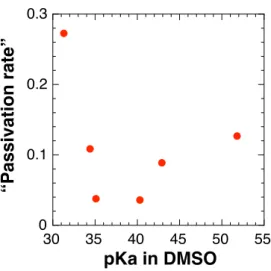
Figure S4. Passivation rate of the GC electrode vs. solvent pKa in DMSO. Superoxide diffusion coefficient in DMA, DMF and pyridine
To measure diffusion coefficient, we used RRDE, where superoxide species were generated at the disc and detected at the ring.1–3 Unfortunately, for low donor number solvents ring current was too small to register it accurately. For this reason, the diffusion coefficient was measured for high donor number solvents: DMA, DMF and pyridine. Prior to measurements, we measured voltammograms at 50 mV/s, which are shown in Fig. S5.
Figure S5. RRDE voltammograms of a GC disk/Pt ring electrode in O2 saturated 0.1 M LiClO4 in pyridine (a), DMA (b), DMF (c) at 1800 rpm. Potential sweep rate was 50 mV/s.
In all cases disk cathode current reaches its maximum at potential around -1.4 V. This potential was taken for the ring current transient measurements. Initial disk potential (before ORR was initiated) was chosen for each solvent individually as listed in Table 1. We used the following equation (S1) for transit time ts (from the disk to the ring):4
𝑡! = 𝐾 $#"% ! "𝜔$% , (S1) 30 35 40 45 50 55 0 0.1 0.2 0.3 pKa in DMSO “Pa s s iv a ti o n r a te ” –2 –1.5 –1 –0.5 0 0.5 1 –0.2 –0.1 0 0 0.08 0.16 –2 –1.5 –1 –0.5 0 0.5 1 –0.2 –0.1 0 0 0.1 −2 −1.5 −1 −0.5 0 0.5 1 –0.09 –0.06 –0.03 0 0.03 0 0.02 0.04 Id , m А Ir /N o , m А Ed, vs. Ag+/Ag a b c
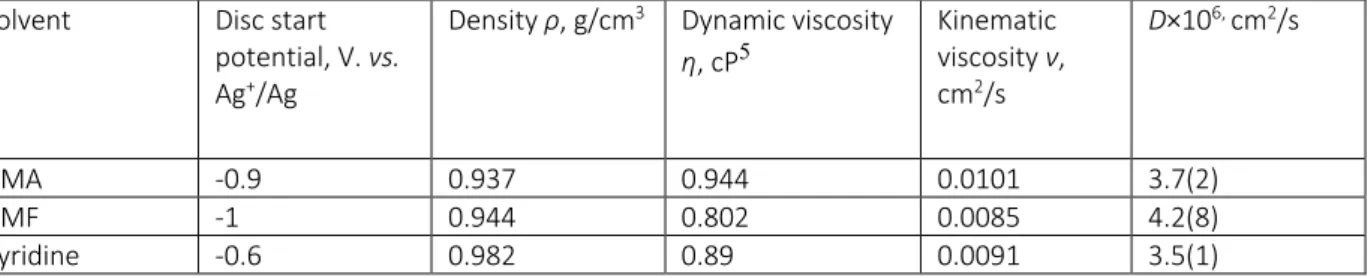
where K is a constant depending on the RRDE’s geometry: K = 43.1[log(r2/r1)]2/3 in our case (for ts reported in seconds and ω - rotation speed in rpm), 𝜈 – electrolyte kinematic viscosity. Viscosity of electrolytes was estimated as viscosity of pure solvents and listed in Table S1.
Table S1. Initialdisk potential in transient measurements, properties of pure solvents and diffusion coefficient of
superoxide ions in a 0.1 M LiClO4 in corresponding solvent.
Solvent Disc start
potential, V. vs.
Ag+/Ag
Density ρ, g/cm3 Dynamic viscosity
η, cP5 Kinematic viscosity ν, cm2/s D×106, cm2/s DMA -0.9 0.937 0.944 0.0101 3.7(2) DMF -1 0.944 0.802 0.0085 4.2(8) Pyridine -0.6 0.982 0.89 0.0091 3.5(1)
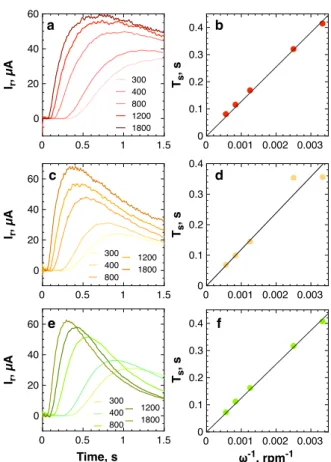
The transit time was measured under various electrode rotation rate of 1800, 1200, 800, 400 and 300 rpm. Current transients are shown in Fig. S6a,c,e. It should be noted that in the absence of passivation the ring signal should, after a while, reach a constant value. In our case we observed that the ring current reaches a maximum and then decreases. This is associated with the passivation of the disk surface by Li2O2 and side products and, accordingly, a decreased flow of superoxide from the disk to the ring. We neglect the passivation process in the initial part of the transient curve assuming that the superoxide species reaching ring during this time period are formed by ORR at the initially clean disk surface. D values were calculated from the slope of the ts
vs.ω-1 (see Fig. S6b,d,f). Diffusion coefficient happens to be the same within the error range for all three solvents as expected from the fact that the dynamic viscosity of these solvents is close to each other’s.
Figure S6. Capacitively corrected ring current time transients registered after disk potential step and transit time against inverse rotation speed for 0.1 M LiClO4 in pyridine (a,b), DMA (c,d) and DMF (e,f).
Figure S7. Passivation rate of the GC electrode vs. electrolyte solvent viscosity References
(1) Zakharchenko, T. K.; Sergeev, A. V.; Bashkirov, A. D.; Neklyudova, P.; Cervellino, A.; Itkis, D. M.; Yashina, L. V. Homogeneous Nucleation of Li2O2 under Li-O2 Battery Discharge. Nanoscale 2020. https://doi.org/10.1039/c9nr08493b.
(2) Gittleson, F. S.; Jones, R. E.; Ward, D. K.; Foster, M. E. Oxygen Solubility and Transport in Li– Air Battery Electrolytes: Establishing Criteria and Strategies for Electrolyte Design. Energy & Environmental Science2017, 10 (5), 1167–1179. https://doi.org/10.1039/c6ee02915a.
0 0.5 1 1.5 0 20 40 60 0 0.001 0.002 0.003 0 0.1 0.2 0.3 0.4 ω-1, rpm-1 Ir , µA 0 0.5 1 1.5 0 20 40 60 Time, s 0 0.001 0.002 0.003 0 0.1 0.2 0.3 0.4 0 0.5 1 1.5 0 20 40 60 Тs , s 0 0.001 0.002 0.003 0 0.1 0.2 0.3 0.4 а b 300 400 800 1200 1800 300 400 800 1200 1800 Тs , s Ir , µA Ir , µA Т, s s c d e f 300 400 800 1200 1800 0 2 4 6 8 10 12 0.0 0.1 0.2 0.3 ‘Pa s s iv a ti o n r a te ’ Viscosity, cP
(3) Herranz, J.; Garsuch, A.; Gasteiger, H. A. Using Rotating Ring Disc Electrode Voltammetry to Quantify the Superoxide Radical Stability of Aprotic Li–Air Battery Electrolytes. The Journal of Physical Chemistry C2012, 116 (36), 19084–19094. https://doi.org/10.1021/jp304277z. (4) Bruckenstein, S.; Feldman, G. A. Radial Transport Times at Rotating Ring-Disk Electrodes. Limitations on the Detection of Electrode Intermediates Undergoing Homogeneous Chemical Reactions. Journal of Electroanalytical Chemistry1965, 9 (5–6), 395–399.
https://doi.org/10.1016/0022-0728(65)85037-9.