Moving towards Solution Business: Challenges for Internal Communication – A Pilot Study
Harri Ryynänen*, Lappeenranta University of Technology, [email protected] Risto T. Salminen, Lappeenranta University of Technology, [email protected] Olli Pekkarinen, Lappeenranta University of Technology, [email protected]
Abstract
The study concentrates on examining internal communication-related challenges when a company is changing from a traditional industrial material supplier to a customer-oriented solution provider. The phenomenon is approached through the concepts of internal
communication and solution business. The qualitative single case study includes empirical evidence from a large multinational supplier of metal-based components and systems and integrated systems for construction and engineering industry. The study offers insights into the change process of a solution provider as well as internal communication -related challenges during the process.
Moving towards Solution Business: Challenges for Internal Communication – A Pilot Study
Introduction
In the recent years, companies have been evolving from offering something to the markets to creating offerings with the markets (Vargo and Lusch, 2004). Thus, the marketing of separate goods and/or services has changed into providing complete solutions (Sawhney, 2006). Traditional product providers face a substantial number of challenges when moving towards solution business. Thus gaining profit through delivering complex solutions has shown to be quite a challenge (Tuli, Kohli and Bharadwaj, 2007). Communication has been recognized to be a one of these challenges (Brax, 2005; Cova and Salle, 2007).
Despite the growing interest towards solution business, the internal communication-related challenges when moving towards solution business are quite under-researched. The present paper concentrates on contributing to internal communication (Scholes, 1997; Cornelissen, 2004) and solution business (Sawhney, 2006; Tuli, Kohli and Bharadwaj, 2007; Helander and Möller, 2006; Cova and Salle, 2007) literature streams. We define the studied phenomenon as the internal communication-related challenges in the change process from a traditional goods and/or service provider to a solution provider. The purpose of this pilot study is to achieve preliminary understanding of the studied phenomenon and to create a definite research setting for the further study. The phenomenon is approached with the following research question:
what internal communication -related challenges does a manufacturer face when moving towards solution business? The study is a qualitative case study (Miles and Huberman, 1994; Yin, 2008). The case company has been selected to represent an actor operating in business-to-business markets, which has recently developed its organization towards solution type of business.
As a result of the study, the process of moving towards solutions business is identified. Furthermore, the internal communication-related challenges of the studied case are described and positioned within each phase of the change process to a solution provider. First, the role of internal communication in the supplier organization is discussed. After that, a description of the solution business and the research setting is made. In the third section, the preliminary findings are discussed. Finally, conclusions and some future research directions are
introduced.
Role of internal communication in a supplier organization An extensive part of today’s business areas are affected by great changes, such as globalization, increased business cycle effects, technological advances, geographical
movement of labour-intensive projects, and changing towards a more customer-oriented way of doing business. This constant change sets a great challenge for the internal communication of companies. Thus, internal communication is regarded as a crucial value-producing process for organizations, and it is one of the prime management issues to manage in companies (e.g. Zahay and Peltier 2008; Ahmed and Rafig 2003). The role of internal communication is perceived to affect even the corporate brand (Camp 1996; Cleaver 1999; De Chernatony and Segal-Horn 2003).
Previous studies have shown that the competent management of customer-related knowledge intra-organizationally is a prerequisite for successful management of customer relationships (e.g. Möller and Rajala, 1999). Since the marketing activities are increasingly spread out among several organizational units, such as multifunctional teams and account management systems, the role of internal communication is emphasized. At the same time, the emphasized role of internal communication has led to the increase of communication methods and
channels (Bovée, Thill and Schatzman, 2003). A variety of technology-based communication systems (e.g. intranets, customer relationship management systems) have been made to intensify internal communication and knowledge transfer. However, usually the employees fail to use the technology in the intended fashion (Peters and Fletcher, 2004). Furthermore, there are several internal communication-related challenges in the organizations, for example the lack of taking into account the cultural differences (Mounter, 2003) and managers’ incompetence to evaluate their effectiveness as communicators (Quirke 1996; Crampton, Hodge and Mishra 1998).
The role of internal communication in the change management has also been recognized (Daly, Teague and Kitchen, 2003). Previous studies show, that up to 70 per cent of change programmes fail (Patterson, 2000; Beer and Nohria, 2000). Incompetent internal
communication is seen as the principle reason for such failure (Murdoch, 1997). Furthermore, Harshman and Harshman (1999) have noted that communication within the organization is a key factor in influencing how well the organization performs during the change program. The following communication-related issues are recognized to affect to the change program; the company size, structure, corporate cultures, ownership, trust and corporate policies (Daly, Teague and Kitchen, 2003; Proctor and Doukakis, 2003).
Solution business
The concept of customer solution has been an object of great interest during the recent years, and thus it has generated quite extensive amount of studies concerning the issue (e.g.
Stremersch, Wuyts and Frambach 2001; Sawhney, 2006; Sawhney, Wolcott, and Arroniz, 2006). Tuli, Kohli, and Bharadwal (2007, p.5) have defined the concept of customer solution as “a solution is a set of customer-supplier relational process comprising customer
requirements definition, customization and integration of goods and/or services and their deployment, and post-deployment customer support, all of which are aimed at meeting
customers’ business needs”. We can perceive that a customer solution is not just a customized bundle of goods and services that is exchanged for a price – it is more like an ongoing,
relational process of defining, meeting, and supporting a customer’s evolving needs. The focus on the relational process is also consistent with the service-dominant (S-D) logic that argues for a shift from product-centric to process-centric thinking (Vargo and Lusch, 2004; Tuli, Kohli, and Bharadwaj, 2007). By the changed focus, companies have been evolving from offering something to the markets, to create an offering with the markets, in another words companies are co-creating their offers with their customers.
Gaining profit through delivering complex solutions, instead of goods or services, has proved to be quite a challenge (Tuli, Kohli and Bharadwaj, 2007). Olivia and Kallenberg (2003) note that there are three successive hurdles when moving towards a more service-dominant way to do business: first, the lack of trust in the economic potential of the service, second, the
thought that service is beyond the scope of the company’s competencies, and finally, the failure in deploying a successful service strategy. Furthermore, a gap in analytic thinking between the headquarters and the operational managers forms an internal barrier when moving towards solution business (Matthyssens and Vandenbempt, 2008). In addition, Brax
(2005) has found that when a traditional manufacturer is becoming a service provider, the company meets several challenges. The recognized challenges are classified under the following six categories: marketing, production, delivery, product-desing, communication, and relationship challenges. The communication-related challenges include lack of feedback from the customers, and shortcomings in communication both externally as well as internally.
Research setting
Despite the fact that there are an extensive number of studies concerning internal
communication, solution business, and change management, these studies are substantially fragmented. The studied phenomenon in the specific context (a large multinational supplier of metal-based components and systems to construction and engineering industry) is still quite under- researched. There are studies focusing on the role of internal communication during organizational change (e.g. Daly, Teague, and Kitchen, 2003; Proctor and Doukakis, 2003) and studies about a goods-dominant company becoming a service-dominant solution provider (e.g. Olivia and Kallenberg, 2003; Brax, 2005; Matthyssens and Vandenbempt, 2008). However, it seems that there is a research gap concerning the challenges relating to the internal communication during this change process. Thus, the research setting is relevant to study both theoretically as well as managerially.
As there is only limited prior knowledge in the challenges of internal communication when a company is moving towards solution business, the case study methodology was selected as the main research approach for the present study (Yin, 2008; Eisenhardt, 1989). In addition, according to Yin (2008), the need to understand complex social phenomena supports also the choice of the case methodology. According to Dubois and Araujo (2007) and Yin (2008), the case selection is the most important methodological decision. The case company in this study is a supplier of metal-based components, systems and integrated systems to construction and engineering industry. The net sales of the focal company were almost 4,000 million euros in 2008. There are around 15,000 employees working in 26 countries across Europe, which makes the internal communication challenging. The focal company fits extremely well for the case, as it has transformed from a traditional industrial material supplier to a
customer-oriented solution provider during the last six years. Basically the change towards solution business started in the beginning of 2003.
The primary empirical data collection for this qualitative study was made through thematic interviews. As the selection of informants is a critical choice (Halinen and Törnroos 2005), the informants were chosen on the basis of possessing a wide understanding of the studied change process. The interviews covered four top-level directors. The interviews lasted from an hour up to two hours and they were recorded as well transcribed. To form a more in-depth overview of the case, annual reports, CEO presentations, company brochures, and company’s web pages were used as a secondary data source. The data was analyzed by using the content analysis method, which reduces and rationalizes qualitative material to identify core
consistencies and meanings (Patton, 2002).
Findings
Analysis started with outlining the change process from a traditional manufacturer to a solution provider (Figure 1). Based on our empirical findings, the change process seems to follow three phases: Drafting, Changing, and Managing. In the drafting phase, the company is
outlining, among others, what the new strategy (solution business) would require and mean in their business. The changing phase starts after the decision to move towards the new strategy is made. It contains, among others, organizational changes, changes in business networks and retraining employees. The managing phase can be considered as time after the first solution. The phase includes, among others, operational and tactical decisions, improving
communication, managing knowledge and controlling network. Next, the found phases and challenges within the phases in the case company are discussed briefly.
Old business
model Drafting Changing Managing
Idea of solution business Early 2003 Decision towards solution business Summer 2003 Starting to build the first solution
April 2004
Figure 1. Timeline for the strategy change in the case company
The change process started with the drafting phase in early 2003. The impetus to the change was an industry analysis made by the focal company. The core team of five persons started to study solution business and what it could mean in the focal company. The first challenge was to determine what solution business would and would not be for the company. In addition, this drafting phase included, among others, selling the solution business idea to the top management of the company.
The decision to move towards solution business was made in summer 2003, which started the
changing phase. At this phase, the number of persons included in the change started to grow rapidly. It was clear in the very beginning that the knowledge and competencies that the focal company held were not sufficient. Thus, from this point on, massive recruitment of employees started. In addition, during 2004–2008, the case company made 14 acquisitions to receive the needed knowledge and resources. The changing phase included both learning the new way of doing business, as well as learning out the old traditions.
The creation of the first solution in April 2004 started the managing phase. Here the focus is changing away from the strategic level towards the tactical and operational levels. The managing phase includes, among others, acquiring knowledge, learning, managing the change, and finding the best practices. For example, the co-creation of a solution may require extensive amount of intra- and inter-organizational actors, and thus the efficient
communication coordination is required.
For the focal company’s internal communication, this kind of change process is a substantial challenge. One of the main challenges for internal communication during the change seemed to be achieving enough knowledge about the solution business in order to make the change. For example, the Chief Strategy Officer stated:
“Traditionally there have been lots of good workers in the company, but when starting to make this kind of a jump, it requires a huge amount of new forces to the house”
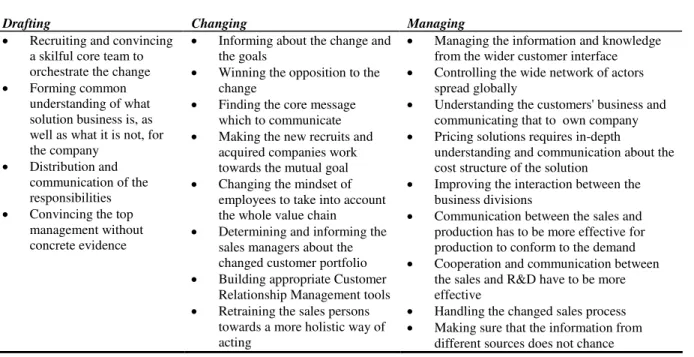
The data analysis raised several internal communication -related challenges from the data. The challenges were collected and categorized under the recognized phases of the change process, see the Table 1. The table shows, that the nature of these challenges changed substantially during the change process.
Table 1. Internal communication -related challenges in the case company when moving towards solution business
Drafting Changing Managing
• Recruiting and convincing a skilful core team to orchestrate the change
• Forming common
understanding of what solution business is, as well as what it is not, for the company
• Distribution and communication of the responsibilities • Convincing the top
management without concrete evidence
• Informing about the change and the goals
• Winning the opposition to the change
• Finding the core message which to communicate • Making the new recruits and
acquired companies work towards the mutual goal • Changing the mindset of
employees to take into account the whole value chain • Determining and informing the
sales managers about the changed customer portfolio • Building appropriate Customer
Relationship Management tools • Retraining the sales persons
towards a more holistic way of acting
• Managing the information and knowledge from the wider customer interface • Controlling the wide network of actors
spread globally
• Understanding the customers' business and communicating that to own company • Pricing solutions requires in-depth
understanding and communication about the cost structure of the solution
• Improving the interaction between the business divisions
• Communication between the sales and production has to be more effective for production to conform to the demand
• Cooperation and communication between
the sales and R&D have to be more effective
• Handling the changed sales process • Making sure that the information from
different sources does not chance
Conclusions
Based on the empirical findings, it can be said that many of the internal communication -related challenges when moving towards solution business are very similar to those
mentioned in the previous literature (Matthyssens and Vandenbempt, 2008; Brax, 2005; Cova and Salle, 2007). However, it seems that the previous literature has a shortage of discussion of the challenges of internal communication during the change process to a solution provider. To that shortage, the present and the following study offers interesting findings. One of the key findings shows that the solutions are not sold to the buying section of the customer, but to the upper management, where the whole benefit of the solution is understood. Therefore, among others, the customer interface diversifies, and thus the role of internal communication
becomes more important. By focusing on the internal communication, the customer perceives a consistently interacting solution provider.
The results of the study suggest that depending on the phase of the change process, the internal communication –related challenges varies. By taking into account these challenges and the phase of the change process, a company can predict the challenges that may appear. In addition, the company can prepare to the challenges before those actually appears. Thus, a company can improve their internal communication more efficiently, which will support their success when moving towards solution business. Although many of these challenges can also be found in the traditional business, solution type of business emphasizes these challenges. We propose that the change process (Figure 1) and the challenges (Table 1) should be studied more thoroughly by using the pilot study approach and its findings. In the following study, the knowledge and experiences of the present study will be used to gain a more in-depth
understanding of the studied phenomenon. In addition, more empirical evidence will be collected and the number of case companies will be increased. As a result of the whole research entity (the pilot study and the following study), there will be a model of the change process from a traditional industrial material or/and services supplier to a solution provider, and the internal communication -related challenges in it.
References
Ahmed, P.K. & Rafig, M., 2003. Internal marketing issues and challenges. European Journal of Marketing 37 (9), 1177–1186.
Beer, M. and Nohira, N., 2000. Cracking the code of change. Harvard business review 78 (3), 133-141
Bovée, C.L., Thill, J.V. & Schatzman, B.E., 2003. Business communication today, Seventh edition, Upper Saddle River, Prentice-Hall.
Brax, S., 2005. A Manufacturer Becoming Service Provider – Challenges and a Paradox. Managing Service Quality 15 (2), 142-155.
Camp, L., 1996. Latest thinking on optimization of brand use in financial marketing. Journal of Brand Management 3 (4), 241-247.
de Chernatony, L. and Segal-Horn, S., 2003. The criteria for successful service brands. European Journal of Marketing 37 (7/8), 1095-1118.
Cleaver, C., 1999. Brands as the catalyst. Journal of Brand Management 6 (5), 309-312. Cornelissen, J., 2004. Corporate Communications Theory and Practice, Sage, London. Cova, B. and Salle, R. 2007. Introduction to the IMM special issue on “Project marketing and marketing of solutions” A comprehensive approach to project marketing and the marketing of solutions. Industrial Marketing Management 36, 138 – 146.
Crampton, S., Hodge, J. & Mishra, J., 1998. Employee perceptions of the relationship
between communication and productivity: a field study. Journal of Business Communication 30, 5-28.
Daly, F., Teague, P., and Kitchen, P., 2003. Exploring the role of internal communication during organizational change. Corporate Communications: An International Journal 8 (3), 153-162.
Dubois, A. and Araujo, L., 2007. Case research in purchasing and supply management: Opportunities and challenges. Journal of Purchasing and Supply Management 13 (3), 170– 181.
Eisenhardt, K. M., 1989. Building theories from case study research. Academy of Management Review 14 (4), 532-550.
Halinen, A. and Törnroos, J-A., 2005. Using case methods in the study of contemporary business networks. Journal of Business Research 58, 1285–1297.
Harshman, E.F. and Harshman, C.L., 1999. Communicating with employees: Building on an ethical foundation. Journal of Business Ethics 19 (1), 3-19.
Helander, A. and Möller, K., 2006. System supplier’s customer strategy. Industrial Marketing Management 36, 719-730.
Matthyssens, P. and Vandenbempt, K., 2008. Moving from basic offerings to value-added solutions: Strategies, barriers and alignment. Industrial Marketing Management 37, 316-328. Miles, M., B. and Huberman, A., M. 1994. Qualitative data analysis, Sage Publications, Thousand Oak.
Mounter, P., 2003. Global internal communication: a model. Journal of Communication Management 7 (3), 265-268.
Murdoch, A., 1997. Human re-engineering. Management Today, 6-9.
Möller, K. and Rajala, A., 1999. Organizing Marketing in Industrial High-Tech Firms. Industrial Marketing Management 28, 521-535
Olivia, R. and Kallenberg, R., 2003. Managing the transition from products to services. International Journal of Service Industry Management 14 (2), 160-172.
Patterson, P., 2000. Courting employees. Best’s review 100 (12), 6-9
Patton, M.Q., 2002. Qualitative research & evaluation methods, Sage, London.
Peters, L. & Fletcher, K., 2004. A Market-Based Approach to Understanding Communication and Teamworking: A Multi-Disciplinary Literature Review. Academy of Marketing Science Review 2004 ( 2), 1-37.
Proctor, T. and Doukakis, I., 2003. Change management: the role of internal communication and employee development. Corporate Communications: An International Journal 8 (4), 268-277.
Quirke, B., 1996. Communication Corporate Change, McGraw-Hill, London.
Sawhney, M., 2006. Going Beyond the Product: Defining, Designing, and Delivering Customer Solutions. In: Lusch, R.F. and Vargo, S.L. (Eds.), 2006. The Service-dominant Logic of Marketing: Dialog, Debate, and Directions, M.E.Sharpe, Armonk, New York, pp. 365–380.
Sawhney, M., Wolcott, R. C., and Arroniz, I., 2006. The 12 different ways for companies to innovate. MIT Sloan Management Review 47, 75-81.
Scholes, E., 1997. Handbook of internal communication, Gower, Aldershot.
Smythe, J., 1996. The changing role of internal communication in tomorrow’s company. Managing Service Quality 6 (2), 41-44.
Stremersch, S., Wuyts, S. and Frambach, R.T., 2001. The Purchasing of Full- Service Contracts: An Exploratory Study within the Industrial Maintenance Market. Industrial Marketing Management 30 (1), 1–12.
Tuli, K.R., Kohli, A.K. and Bharadwaj, S.G., 2007. Rethinking Customer Solutions: From Product Bundles to Relational Processes. Journal of Marketing 71 (39), 1–17.
Vargo, S.L. and Lusch, R.F., 2004. Evolving to a New Dominant Logic for Marketing. Journal of Marketing, 68 (1), 1–17.
Yin, R., 2008. Case study research, Fourth edition, Sage Publications, Beverly Hills.
Zahay, D.L. & Peltier, J., 2008. Interactive strategy formation: Organizational and entrepreneurial factors related to effective customer information systems practices in B2B firms. Industrial Marketing Management 37, 191-205.