PROGRAM EVALUATION OF ONLINE FOUNDATIONAL MATH COURSES
Marty-Jean Bender
Department of Educational Technology University of Hawai‘i at Manoa
Plan B Paper May 2008
______________________________________________
Faculty Advisor: Ellen Hoffman
______________________________________________ Department Chair: Catherine P. Fulford
Acknowledgements
First, I am thankful for the students who participated in these pilot courses; they taught me, while I was teaching them. Next, a big thank you goes to my advisor for her expertise and guidance in making an overwhelming task become manageable. Finally, a special, heartfelt thanks and my gratitude go to the screening committee of this first cohort for the Online Educational Technology program as they believed in this late-in-life learner, and granted me the chance to succeed.
Introduction Online Math Program Evaluation Bender, M.-J.
Abstract
This is a mixed-methods program evaluation of the computer-based Math 22–PreAlgebra and Math 23–Practical Algebra pilot courses taught at Maui Community College, Fall 2006, that were designed to meet the needs of non-traditional students unable to attend during the traditional Monday-Friday, 8am-5pm class timeframe. Computer-assisted instruction (CAI) via Plato Interactive Mathematics was the basis for these Internet-based, asynchronous math courses. Cell phone and email were used for student– instructor communication. An anonymous student survey was used to answer the key evaluation questions which are:
• What aspects of technology worked well and which didn’t work well? • What modifications are desirable or necessary?
Data were collected through a student survey, instructor input, and MCC math and campus information. Based on the results of the evaluation, recommendations regarding future course implementations were generated.
Table of Contents
ACKNOWLEDGEMENTS... II ABSTRACT...III TABLE OF CONTENTS ...IV LIST OF TABLES ... VII LIST OF FIGURES... VIII
INTRODUCTION...1
REVIEW OF RELATED LITERATURE……….……….…. 4
Delivery………4
Value, Quality, and Success………. 6
Evaluation……….9
Local Background………...10
Student Success Attributes……… .13
Application……….……… 14
METHODOLOGY……… 15
Background Regarding These Pilot Courses………..15
Research Questions……… 17 Methods………..17 Research Design……….………… 18 Population……….…..18 Instrumentation………...…19 Procedures……….. 20
Introduction Online Math Program Evaluation Bender, M.-J. Data Analysis……….…… 21 Limitations………. 22 Summary/Discussion………. 22 RESULTS……….………. 23 Exit Survey………. 23
Student Information Section……….…...23
Logistical Information Section………..……..26
Course Information Section……….…... 28
Attitudinal Information Section………...30
Attitudes Toward Math……….. 30
Positive and Negative Reactions……… 31
Learning Experience……….………..31
Instructor Assessment……….32
Overall Assessment……… 32
Final Grades………... 34
FINDINGS, CONCLUSIONS AND IMPLICATIONS……….……….. 37
What Worked………. 37
What Didn't Work……….. 38
Software Issues………38
Personal Technology Issues………39
Communication Issues……… 39
Best Fit………... 39
Recommendations……….. 42
For the Future………. 43
Epilogue………..45 RERERENCES……….. 46 APPENDIXES………... 49 A: Survey……….………….. 49 B: Course Information………...57 C: Syllabus……….……… 59 D: Self-selection Tool……… 62 E: Content Alignment ………... 63
Introduction Online Math Program Evaluation Bender, M.-J.
List of Tables
Table 1: Foundational Math Sequencing within the State of Hawaii..………... 11 Table 2: Student Exit Survey Content.……….. 20 Table 3: Plato Math Pilot Grade Comparison to All Other Math Deliveries Combined... 36
List of Figures
Figure 1: Total Number of Semester Credits Taken (including online math)... 25
Figure 2: Student Ages (in years)………... 26
Figure 3: Years Since Previous College Math Taken ………... 26
Figure 4: Program Access Locations ……… 27
Figure 5: Technical Problems..……….. 29
Figure 6: Course Tools Used and Not Used...………... 30
Figure 7: Tool Assessment – Ease of Use and Feelings Regarding...………30
Figure 8: Positive Assessments Regarding Participant Needs & Program.………... 33
Figure 9: Negative Assessments Regarding Participant Needs & Program...…………... 33
Introduction Online Math Program Evaluation Bender, M.-J.
Introduction
This mixed-methods study is a program evaluation of the computer-based Math 22 – Pre Algebra and Math 23 – Practical Algebra pilot courses taught at Maui Community College during the Fall 2006 semester. These computer-based courses were designed to meet the needs of non-traditional students who cannot attend class during the traditional Monday through Friday, 8 am to 5 pm time frame. Within the three years prior to this pilot implementation, there were no distance-education offerings for remediation-level math courses offered at any campus within the University of Hawaii system. To fill this gap, the Rural Development Project (RDP) undertook the responsibility for the initial design and the implementation of these pilot distance education courses, then turned further implementation over to the Math Department.
Maui Community College (MCC) students who were required to complete the foundational (developmental) math classes Math 22 or Math 23 were eligible to take these pilot online courses. The students self-selected this delivery modality over the other three delivery methods available: traditional face-to-face classroom, innovative
classroom, and lab-based. These online courses used computer-assisted instruction (CAI) for an asynchronous math delivery tool. Cell phone and email were used for student– instructor communication. The course consisted of one mandatory face-to-face orientation and training meeting, completion of the required Plato lessons, a weekly comment emailed to the instructor, and proctored mid-term and final exams.
Evaluation of this course will assist in future course planning within the Math Department. One factor in the determination of course continuance is faculty and
departmental acceptance of the credibility of online education (Ulmer, Watson, & Derby, 2007). MCC math faculty members have previously expressed mixed opinions as to the worth and validity of this online modality, so these results may help to clarify acceptance. It is important a new program such as this be evaluated rather than just adopted as
convenient, or easier, or as part of the latest trend. Evaluation of this program is key to future offerings through faculty acceptance.
To carry out the evaluation, data were collected through a student culminating survey, instructor compiled data from the duration of the course, and general MCC campus information. The study used a mixed qualitative and quantitative approach as recommended by Gaide (2005) with information from the online students collected through an online, anonymous student survey (see Appendix A). Additional data included collective class grades from each of these two classes, plus comparative collective grades from the other delivery methods in these same two courses within the MCC campus. All grades were reported confidentially. Grades have been documented to verify similarity to the other delivery methods of these courses. Evaluation of the student survey provided demographic data on the respondents as well as course-related information and student opinions.
The basic questions for evaluation were:
• What aspects of technology worked well and didn’t work well? • What modifications are desirable or necessary?
Introduction Online Math Program Evaluation Bender, M.-J.
The expectation is that the evaluation data will help a number of stakeholder groups. The school administration and Math Department administration will be able to assess whether or not to continue to offer these courses in this modality, and if so, how to better adapt them. Faculty who will or might be asked to teach this course will have suggestions as well as the knowledge of what was done in the pilot. The counselors will have the input of what students thought of this new delivery aiding them in how to best advise future students. Students will benefit as the course can either be further improved or eliminated, as recommended by the results. Recommendations regarding future course implementations have been based on the student data and input of the instructor. With other modality choices also offered, it is anticipated this evaluation will be of great assistance in determining how to allocate human and physical resources within the Math Department at MCC.
Review of Related Literature
Adults returning to college face distinct issues. Many of these non-traditional students are single parents seeking retraining, adults also working full-time, and most have been out of the education field for a number of years (Bichelmeyer & Molenda, 2006). Additionally, many students entering college are not ready for college-level courses. The National Center for Education Statistics (NCES) cites that nearly half of all post-secondary students entering college need at least one remedial course as reported by Karp, Bailey, Hughes, & Fermin (2005). Clearly, further study regarding the educational gap between high school graduation capabilities and college entry requirements needs to be explored. This gap needs to be closed in order for college students to get the maximum benefit from their college-level opportunities.
Delivery
In 2006, QMark Research & Polling was commissioned by the Hawaii
Association of Independent Schools and the University of Hawaii to conduct a research study “to obtain reliable information on the knowledge, usage, needs, unmet needs, and barriers to utilization of technology…for post-secondary education” (p. 1). This
unpublished study by QMark confirmed that there was statewide interest in Internet-based (online) courses as an alternative to traditional daytime-classroom course delivery. One of the QMark findings was that 66% of those surveyed found classes taken over the Internet were either “very” or “somewhat” appealing, and 81% of those cited
Literature Review Online Math Program Evaluation Bender, M.-J. interest, preference for face-to-face classroom interactions, no computer or Internet access, and not being computer literate as their reasons. Based on these criteria, a need was demonstrated by a significant portion of the population for an asynchronous, distance-learning-delivered foundational math pilot (Holden & Westfall, 2006).
Specific to math, research shows that computer-assisted instructional (CAI) math deliveries are highly effective methods for learning math (Fouts, 2000; Handle &
Herrington, 2003; Kulik, 2002; Maag, 2004). Kulik & Kulik (1991) reported in the meta-analysis of findings from 254 controlled evaluation studies, that there are reductions in instructional time associated with computer-based learning (CBI), on the average using one-third less instructional time. Time efficiency is especially critical for non-traditional students needing to balance home life, employment, as well as college. Additionally, CBI has been shown to have a small but significant positive effect on student attitudes toward instruction and a positive effect on student attitudes toward the computer (Aivazidis, Lazaridou, & Hellden, 2006; Kulik & Kulik, 1991). Any learning advantage to help a student succeed in their coursework is worth consideration, and particularly important when considering non-traditional learners who face additional obstacles.
Prior to selection as the content delivery mode for these online classes, CAI was evaluated for its advantages and disadvantages (Fouts, 2000; Handle & Herrington, 2003; Kulik & Kulik, 1991; Kulik, 2002; Maag, 2004). Full-motion video and audio in
multimedia delivery allow the full spectrum of instructional strategies. Students can control the pace of their learning, repeating when necessary, and can receive immediate feedback for learning reinforcement. The primary weakness reported was a lack of
instructor interaction. The other negative consideration was CAI development costs. As there are a number of companies successfully producing CAI in mathematics, RDP deemed development cost was not a necessary expense and consideration.
Value, Quality, and Success
“Many educators are looking at the way Internet-based learning can provide flexibility and convenience. Internet-based learning can overcome some traditional barriers such as time and place” (Burgess, 2003, p. 2). MCC had been investigating alternative delivery methods for math remediation, and requested that an online delivery method be developed for the foundational math courses and offered Fall 2006. MCC is an example of a trend cited by Pajo & Wallace (2001).
The use of the Web for delivery of distance courses is a major development that is changing the way knowledge is imparted to the widest audience inside and outside the classroom. These technological innovations are profoundly influencing university practices and policies and may even be fundamentally altering our conceptualizations of education. (p. 2)
As student growth continues in Hawaii and nationally as well, higher education institutions need to adapt to the technology-oriented nature of their student body and reinvent themselves with realigned processes and practices. “In the information-based economy of the 21st century, higher education is now part of a highly competitive global marketplace” (Bishop, 2005, p. 206).
Technology and the advent of the World Wide Web (WWW) have opened up opportunities for students to participate in post-secondary education (National
Postsecondary Education Cooperative [NPEC], 2004). In a study of six universities which have demonstrated expertise and leadership in distance education, Phipps &
Literature Review Online Math Program Evaluation Bender, M.-J. Merisotis (2000) concluded that Internet-based distance education has become the most prevalent and the fastest growing delivery method, with its asynchronous delivery feature being considered the largest attraction. This popularity is confirmed locally with the Fall 2007 Distance Learning statistics showing 39% of the 1,212 Distance Education courses offered by MCC taken via Internet, compared to 33% using Cable TV, and 28% with Interactive Television (ITV) through Hawaii Interactive Television System (HITS) or Skybridge (MCC Institutional Research Office, 2007).
Convenience, however, cannot substitute for quality in education, so it was important to look at the effectiveness of online education in addition to its convenience. “Can online courses match traditional face-to-face (F2F) courses in academic quality and rigor? Can online courses achieve the same learning objectives as F2F courses?”
(Kassop, 2003, p.1). These are the key questions to be asked of distance education. Kassop adamantly believes in the worth of online education as he states, “Not only is the answer to these questions a resounding “yes,” but there are many ways that online courses may actually surpass traditional F2F classes in quality and rigor” (p. 1). Belief in these areas of excellence was key to pursuing this online pilot. It is expected that within this pilot the following areas reflect this high level of quality and rigor:
• Student-centered learning • Immediate feedback
• Geared to lifelong learning • On-demand interaction & support services • Enriched course materials • Flexibility
Defining success is the initial threshold. At times the different stakeholders have differing perceptions of what constitutes success. Phipps & Merisotis (2000) in their
Quality on the Line consolidation of important benchmarks at various institutions determined 24 benchmarks they identified as essential to quality Internet education. These benchmarks were considered in the design of this pilot program. While it is
appropriate to examine carefully this new approach to presenting the content, it must also be remembered that many face-to-face classes are now utilizing similar technology to a lesser degree. The line of demarcation is becoming fuzzier with the acceptance and adoption of technology within the face-to-face environment. Still, the bottom line is education, be it distance or face-to-face, and many educational success attributes can be measured using similar tools whether the modality is face-to-face or distance based (Zhao, Lei, & Yan, 2005).
Student perception of success is also important. Studies differ on how students view computer-based learning. Whether they perceive computers as “tools for
empowerment” (Thornburg, 2000, p. 9), or as less favorable than face-to-face interactions (Rodriguez, Ooms, Montanez, & Yan, 2005), it is individual. Just as courses’ quality and assessment of success differs with individual instructors, student assessment of quality and success differs as well. General trends can be gathered, but no definitive answer can be provided, as each learning experience is perceived individually, based on what each student brings to the experience in the way of preconceptions, expectations, and abilities. Studying the components of satisfaction and quality of online learning experiences will assist, however, in understanding “the needs of students, support students in online courses, and promote successful learning experiences” in developing effective online learning experiences (Rodriguez, et al., 2005, p. 17).
Literature Review Online Math Program Evaluation Bender, M.-J. Care must be taken in introducing new learning technologies in order to continue to support those students not willing or ready to participate (Willems, 2005). MCC has addressed this limitation by offering these same courses in multiple modes, including traditional face-to-face, innovative classroom, lab-based, as well as this online delivery.
Evaluation
Accreditation criteria are now expected to contain both quantitative and qualitative data in demonstrating student achievement. Tucker (2004) used multiple assessment strategies in comparing the effectiveness of distance education and traditional campus learning, concluding there is no significant difference in achievement. While awaiting far-ranging research results on educational technology as planned by the U.S. Department of Education (www.nationaledtechplan.org) there is value to be found in individual program evaluation (Roblyer & Knezek, 2003). It is important a new program be evaluated rather than just adopted as convenient, or easier, or as part of the latest trend.
The professional image and educational efficacy of this field is at risk because we have collectively failed to study what we do. Practice and credibility will only improve through direct evaluation by practitioners. Anyone who practices
experiential learning can and should be an evaluator of its programs. (Priest, 2001, p. 39)
Evaluation of this program is key to future offerings. One factor in this determination of course continuance is faculty and departmental acceptance of the credibility of online education (Ulmer, Watson, & Derby, 2007). MCC faculty have previously expressed mixed opinions as to the worth and validity of this online modality. As with the Ulmer, Watson, & Derby study, the differences in acceptance at MCC appear
to be closely related to whether a faculty member actually has experience with distance education. Ulmer, et al, also support the belief that some faculty members hold a
preconceived idea that distance education will compromise educational quality in spite of the overall positive rating of the effectiveness of distance education. Some faculty may perceive distance education as a hindrance due to their lack of experience with the media. It further is speculated by Ulmer, et al. that experienced distance education faculty felt that their involvement with distance education denigrated them with their colleagues. Not feeling valued within the department may have affected opinions on the quality and effectiveness of distance education. Experienced distance education faculty tended to promote and recommend distance education, whereas non-experienced faculty expressed a negative viewpoint. Additionally, some academic disciplines may be more adaptable to distance education than others. Since distance education also holds advantages for faculty and institutions, cautious yet steady progress to include distance education in curriculum offerings is likely to continue (Ulmer, et al., 2007).
Local Background
The Rural Development Project (RDP) located at Maui Community College (MCC) provides workforce development training in ongoing programs on Maui as well as statewide. One such training program assisted participants to get their Associates of Arts (AA) degree in compliance with the No Child Left Behind legislation. When assessing student progress it was discovered that most of the participants did not place into college-level (any 100-level) math, and required from one to four foundational (developmental) math courses as remediation prior to qualifying for college math. How
Literature Review Online Math Program Evaluation Bender, M.-J. many courses each student required depended on his or her Compass math placement exam, as well as the requirements of the specific community college (see Table 1). This was not an isolated finding. The Compass math test results at MCC from 2004-2005 showed 84% of the 2,107 new students tested were placed into foundational math courses. The following year, 83% of the 1,784 students tested in 2005-2006 also placed into foundational math courses. Only 16-17% placed into college-level math courses (Maui Community College Annual Assessment 2004-2005: The Learning Center, 2005; MCC Annual Assessment 2005-2006: TLC, 2006).
Table 1: Foundational Math Sequencing within the State of Hawaii Math 1B or MTHN1,2– Basic Math Math 22– Pre-Algebra Math 23– Practical Algebra Math 24 – Elementary Algebra I Math 25 – Elementary Algebra II Math 1xx – College level math MCC sequence X ! X ! X ! X All other Hawaii community college sequence X ! X ! X ! X ! X
Further, the RDP participants had difficulty fulfilling their Quantitative or Logical Reasoning (math) degree requirement due to a combination of scheduling and
fear/avoidance issues. While the fear and/or avoidance issues are not addressed by this study, scheduling issues were one of the primary needs prompting development of online math pilot courses. Confirmation of the finding of statewide interest in online delivery was shown by the registration experience for these pilot courses at MCC. These online sections were the first sections at MCC filled to capacity, beginning two months prior to
the beginning of the term, and remained filled to capacity through the end of the week five registration count period following the start of the semester, with additional unfulfilled requests for entry. While college-level courses are offered by distance-education methods, within the three years prior to this Fall 2006 pilot program, there were no distance-education offerings for foundational math courses (Math 22, 23, 24, or 25) offered within the University of Hawaii system.
The high degree of statewide interest in an online course was confirmed by conversations with the participants of the RDP program. Synchronous distance learning deliveries were an obstacle, as they conflicted with work or other non-deferrable events. Features desired by these non-traditional learners corresponded with the previously discussed advantages of CAI in math. Skybridge, HITS, and the MCC cable-television channels were determined to not be viable delivery methods, for their airtime was already filled to capacity. Delivering a class via WebCT was not considered a sustainable
program due to upcoming system-wide course management software changes. CAI delivery was determined to be the most advantageous delivery method as well as providing the most sustainable program. Plato Interactive Mathematics became the program of choice as an Internet-based, asynchronous math delivery tool, commercially developed, maintained, and updated (Van Meer, 2003). In order to mitigate the identified issue of student-instructor interaction, the pilot utilized cell phone and email access, 24-hours a day, 7-days a week. Additionally, on lessons where students had difficulty, a video-streamed Internet-based library of additional help lessons was created by the instructor and made available for student use, again on a 24-7 basis.
Literature Review Online Math Program Evaluation Bender, M.-J. Costs to implement the pilot were minimal. Computer access was available on MCC campus for students not having private access to a computer with Internet access. Course development was funded by a Department of Labor grant received by The Rural Development Project. Curriculum development was funded through purchase of a commercially developed product by each student. This cost included the student’s purchase of the individual usage license for the Plato program, which additionally came with an online and print-media textbook. Cost was equivalent to the face-to-face
classroom textbook cost.
Student Success Attributes
Factors Muse (2003) found contribute to student success or failure were: • Computer skills • Study environment • External locus of control • Computer confidence
• Web skills • Motivation
These considerations were used to evaluate success factors in guiding participants into or away from this online modality for future offerings (Powell, Conway & Ross, 1990).
With four different delivery modalities available at MCC, how do students choose which mode is best for their personal needs? Since frequently students do not meet with a counselor as is recommended to decide, the decision is primarily left to each individual. Student considerations regarding their need for flexibility, their self-motivation, and their comfort and ability with computers need to enter into the decision considerations
(Willems, 2005). However, in concurrence with Willems (2005) who asserts that clear communication of expectations is the most important factor in minimizing negative
impacts on students, several additional communication steps were required for
prospective student participants. Students who were interested in this computer-based pilot were required to obtain counselor approval, through either a phone or in-person interview. The counselors communicated the additional course expectations for this pilot delivery option including self-directed learning and computer-use willingness prior to completing registration. Following the counselor interview, all students were assigned to review the informational Website (http://www.hawaiirdp.org/martyjean/) created for the purpose of assisting students in assessing whether this course delivery would be a good fit to meet their personal needs and learning styles. All students were also required to attend one of three mandatory training and orientation meetings or for those at the remote sites, to view the video recording of one of these sessions.
Application
As program developer, then instructor, and finally evaluator of this pilot program, the feedback from each of these rolls has been shared with the MCC Math Department to assist with the ongoing departmental adaptations necessary to meet student needs while maintaining educational continuity and standards. As pointed out by Heinecke, Milman, Washington, & Blasi (2001), the evaluator needs to keep their eye on “not only the technology itself, but rather some interaction of technology, context, teaching, content, and learning” (p.109). Therefore, the development and instructional components were submitted to the Math Department in February 2007 with this evaluation following in May 2008. Technology may allow teaching and learning to occur in new ways, providing alternatives for those who do not fit into the traditional education mold.
Methodology Online Math Program Evaluation Bender, M.-J.
Methodology
Distance education is one means for solving accessibility issues for higher education students throughout Hawaii. To fill the void of foundational math courses available other than on-campus, daytime, face-to-face courses, one institution’s solution was to develop a pilot program of computer-based distance education pre-requisite math courses. This mixed-methods research study is a program evaluation of the computer-based Math 22 – Pre Algebra and Math 23 – Practical Algebra pilot courses taught at MCC, Fall 2006.
Background Regarding These Pilot Courses
When entering a program at the community college, students enrolling at MCC are required to take the statewide math placement Compass test to determine appropriate math placement. Following registration and prior to beginning this pilot’s coursework, students whose tests scores were older than one year were asked to take Compass test once again in order to have current placement information to use as a Pre-Test.
Students then began the coursework provided by Plato Interactive Mathematics computer-based instructional software. While course content was delivered via this computer-assisted instruction (CAI), in order to keep students involved, on-task, and continuing to progress, it was recognized that a level of student-instructor involvement was mandatory to maximize student success (Kitsantas & Chow, 2007; Palmer, 2005). Therefore, weekly student-teacher email communication was required from the student, and the instructor offered weekly email feedback. More frequent email or phone
RDP developed this series of online foundational math courses, with this
investigator as the course developeras well as the instructor for the pilot courses offered Fall 2006. Math 22 was offered with optional Basic math curriculum to be accessed in addition to the Math 22 curriculum by student request. Math 23 and Math 24 curriculum were determined to be so similar, that the curriculum of the two courses were merged and offered as Math 23 since that was the course offered at the MCC campus. The same course would meet the Math 24 requirements if offered statewide, due to the merging of the content. Math 25 was offered for student registration, but as it was not a requirement for MCC students, the only inquiries were from other campuses. Registration was limited to MCC students who were not required to complete Math 25, so this pilot course was dropped. Students were permitted to move at their own speed through the curriculum, with some students completing both Math 22 and Math 23 curriculum within a single semester.
Students were provided with suggested course completion timelines (see Appendix B). Lesson options included: additional Basic Math lessons, Math 22 lessons, and Math 23 lessons. Student goal choices were: Basic Math + Math 22 lessons, Math 22 lessons only, Math 23 lessons only, or Math 22 + Math 23 lessons (see Table 1). Math 25 was dropped. Lessons could be loaded on as many personal computers as the student needed, as the license was connected to an individual’s log-in, thus activating the appropriate lessons and recording the usage and results. Campus computers pre-loaded for student convenience were located in The Learning Center (TLC), Laulima 108, and Ka Lama Computer Lab. In addition to the CAI-delivered content, a few lessons were
Methodology Online Math Program Evaluation Bender, M.-J. supplemented with instructor-created streaming video segments. The non-proctored evaluations of the CAI lessons made up almost one third of the final class grade. Course grade was a combination of the computer-based lesson evaluation section scores (30%), a proctored mid-term exam (30%), a proctored final exam (30%), and student participation as displayed by their weekly update communication with the instructor (10%).
Research Questions
Because this study is an evaluation, the primary purpose is to determine whether the newly implemented math project worked and how to improve it. In addition, there is a specific focus on the use of technology. Evaluation questions include:
• What aspects of technology work well and which don’t work well? • What modifications are desirable or necessary?
Although not directly part of this course evaluation, attention is also given to determining if there are identifiable student characteristics that could be used to guide future
placement.
Methods
The purpose of this study is to conduct a program evaluation of the computer-based Math 22 and Math 23 pilot courses taught at Maui Community College during the Fall 2006 semester. This study is based on an evaluation framework proposed by Shadish, Cook, and Leviton (1991, as cited in Heineke, 2001). The areas they recommend examining include:
1. Social programming: Issues include program improvement, program retention.
2. Knowledge use: Issues include use of results, likelihood of result use. 3. Valuing: Issues include worth of program, justification of worth. 4. Knowledge construction: Issues include source and validity of findings,
examination of oversimplification possibilities, and justification for prioritization of findings.
5. Evaluation practice: defining a feasible evaluation, worth of observations and data acquired, facilitating result usage.
In exploring these key issues, the intent is to look at multiple affective and subjective factors rather than solely relying on test scores as the primary outcome measures.
Within this framework, attention is given to the critical issues identified by Phipps & Merisotis (2000) as important in evaluating an online course.
• student demand • student retention • student satisfaction • student achievement • financial efficiency • faculty satisfaction Research Design
This is a mixed-methods program evaluation. Data were provided in the form of a student culminating survey, instructor compiled data from the duration of the course, and general MCC campus information. Data were collected following the completion of the course from the students, instructor, as well as campus-wide data from MCC.
Population
Students at Maui Community College (MCC) are one sub-population of the statewide population of students needing foundational math courses, Math 22 and Math
Methodology Online Math Program Evaluation Bender, M.-J. 23/24 to meet degree program educational requirements. MCC students include Maui County residents who are able to be present on campus as well as remote residents from the island of Molokai, the island of Lanai, and the distant Maui community of Hana. Students required to complete foundational math courses were allowed to self-select their course delivery mode from traditional face-to-face classroom, innovative classroom, lab-based, and this computer-based pilot course. Combined class-size was capped at 30, which was over-ridden to a total of 40 plus a waiting list. Those registering for the computer-based pilot and attending, either in person or via video recording, a mandatory training and orientation meeting became the sample for this study. Students were all pre-placed into the math course based on scores from the Compass math assessment tool and then those individuals self-selected this computer-based distance education modality. Due to this self-selection process, it was expected these classes would reflect student diversity through some mixture of on-site, remote-access, traditional, and non-traditional students.
Instrumentation
The survey instrument for this program evaluation contained a total of 33 questions including demographic information as well as a combination of Likert-scaled and open-ended questions. The survey was designed by the instructor, who is also the researcher, with input from the Math Department as well as a variety of survey consultants.
The online tool chosen for this study was SurveyMonkey. This selection was based on Gaide’s (2005) comparison online survey products. While tabulating responses anonymously, this tool records when a participant responds, allowing the creator to send follow-up messages to those who have not responded, thus enabling a higher return rate.
The online link to the survey was distributed to each student in the study sample via an emailed message. Results were gathered regarding student, logistical, course, and opinion information (see Table 2).
Table 2: Student Exit Survey Content
Procedures
Following completion of the final exam, students were asked to repeat the Compass test to document attainment of course content as a Post-Test, but this after-completion request could not be made mandatory. A month after the course was completed and final grades posted, the emailed request to take the survey was distributed.
Students were advised that the survey responses were anonymous, and that the survey tool recorded which students had and had not returned the survey. All students who registered for these pilot sections of Math 22 and Math 23 during Fall 2006 were part of the survey distribution, including all who dropped the course at any point after the
Student Information Logistical Information Course Information Opinion Information • age • gender • college math history
• computer & online usage • job hours • family situation • math affinity • non-completion reasons • access locations • face-to-face orientation importance • change in math affinity • computer use • personal reactions • tools used • tool non-use reasons • aspects liked • aspects not liked • individual’s value of this delivery method • suggestions • learning experience • final expected grade
Methodology Online Math Program Evaluation Bender, M.-J. first orientation meeting, which occurred just prior to the first day of the semester. In order to evaluate different viewpoints, feedback was encouraged from both participants who did and those who did not complete the pilot.
To increase survey participation, three follow-up messages and one phone call requesting participation were made as necessary during a four-week result-gathering period to let each participant know their input was valued. “The recipient must have a clear understanding of why the survey is being conducted and must feel that his or her participation is essential to an outcome such as course or program improvement” (Gaide, 2005, p. 6).
Course content was assigned in accordance with Math Department content
articulation requirements thus did not require comparison between delivery modalities. Data Analysis
Survey responses were received from one or more remote-site participants, non-traditional students, and students who dropped or did not complete the course.
To confirm student success was within similar parameters, student semester grades for these computer-based courses were compared with the combined grades from all the other course delivery modalities. There was no attempt to rank course delivery methods.
Grading bias for this pilot is minimal as only 10% of the final grade had any subjective nature (student participation) while 90% of the grade was based on objective scores from the CAI lesson evaluations and proctored exams. Grading bias in the other course delivery modes for these math courses is unknown.
responses to the demographic, experiential, and evaluation areas of the survey, as well as to assess how well student needs were met. Student responses and instructor input were combined to create a list of recommendations for future course offerings and to offer input on criteria for participants.
Limitations
The survey was administered following completion of all course work and after grades were posted, thus did not influence grading in any way. Students’ knowledge of their grades might have influenced the student responses positively or negatively,
however having “why” responses follow preference questions attempted to minimize this possible affect.
Summary/Discussion
In December 2006 the instructor reported final course grades through Banner and in January 2007 administered the online survey. Having been granted human subjects approval (see Appendix F), this information was used to evaluate this computer-based Math 22 and Math 23 pilot program. The expectation is that the data will help determine how well these pilot courses served the needs of students, and how well the technology components worked. Based on the input of the student data and the instructor,
Results Online Math Program Evaluation Bender, M.-J.
Results
In order to evaluate this pilot program, three components were considered; the quantitative and qualitative results from the exit survey, the quantitative results from class grades, and the qualitative input from the instructor.
Exit Survey
The exit survey was distributed to 43 students who were registered in either Math 22 or Math 23 on the first day of the semester, including students who dropped during the first week. 34 surveys (79%) were returned, however one was discarded, as the return address was not identifiable, leaving 33 survey participants. Within the survey, there were four areas of data collection:
• Student Information • Course Information • Logistical Information • Opinion Information
Twenty-one students completed Math 22 while twenty-three completed Math 23. This included four students who registered for both Math 22 and Math 23, with one dropping Math 23 and the other three successfully completing both courses.
Student Information Section
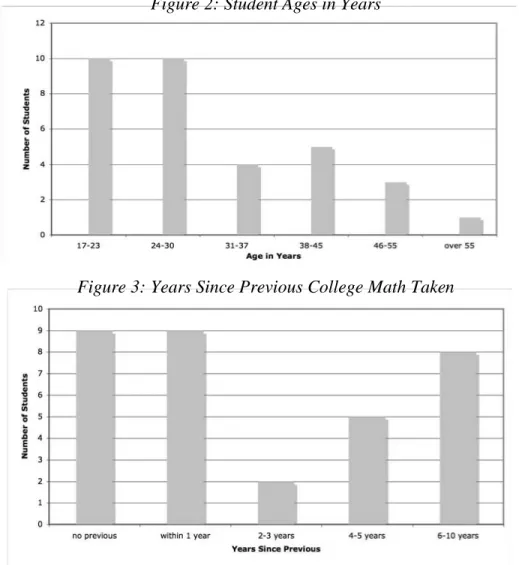
Student information included age, gender, college math history, online usage, job commitment hours, family consistency, and math affinity. The class consisted of a broad mix of students. Over half the students took only one or two courses, under six credits, including these pilot math courses (see Figure 1). Over 90% of the students were female. One third of the students were 38 or older, and 60% were 30 years old or younger. While
it had been expected that the majority of students would be 24 years or older as returning, non-traditional students, in fact a high number of traditional college students also
registered for the class (see Figure 2).
Although many students may have been older than the typical college freshman, three-fourths of them had taken a college class within the previous year. However, over half had taken no college math previously or it was taken six to ten years prior (see Figure 3). Almost 60% had never taken any online classes, and of those who had taken online classes, none of those classes previously taken online were math.
Almost 90% of the class also had a job commitment of sixteen or more hours in addition to going to school. Almost 30% worked a full-time 40-hour-a-week or more work schedule in addition to school. Additionally, almost 60% of the class had the additional responsibility of children, with half of these students also being single parents.
As might be expected for an online computer-based class in which students self-selected delivery mode, 90% of the students described themselves as somewhat or very comfortable with using computers. Surprisingly since these courses are computer-based, 10% described themselves as somewhat uncomfortable with computers. This was somewhat unexpected as in order to register for the class, students had to meet with a counselor to receive a course admission override, and it had been anticipated that only computer-comfortable students would choose this delivery method. During this meeting, the requirements as well as the advantages of online delivery were reviewed (see
Appendix B). Students were provided with course description and course expectations. Additionally, at the mandatory training and orientation meeting each student attended, the
Results Online Math Program Evaluation Bender, M.-J. syllabus containing contact information, how to start and proceed, plus a suggested
calendar timeline was handed out and discussed as a group (see Appendix C). Another handout given and discussed, again contained the self-assessment questions and expectations taken directly from the informational Website developed to provide information regarding this new delivery method to guide counselors and prospective students as they determined an appropriate fit (see Appendix D). Students who did not feel they met these criteria were encouraged to drop the class in favor of another delivery mode. Both the counselor and the training meeting instructor advised students to browse carefully through the informational Website (http://www.hawaiirdp.org/martyjean/) regarding this class. The Website included this self-assessment, advantages of this delivery, and a video clip plus slides of the actual program.
The class was fairly evenly divided between those who perceived themselves as ‘good’ or ‘okay’ in math (48%) and those who felt they were not good at math (52%). The division was similar between those who liked math (42%) and those who did not (58%).
Figure 2: Student Ages in Years
Figure 3: Years Since Previous College Math Taken
Logistical Information Section
Why did these students choose this new online delivery mode instead of one of the other three delivery modes? 73% stated they chose online delivery because of time and/or location constraints. Other reasons mentioned included not wanting to feel dumb in front of peers and class availability, plus two reasons that were refuted in the orientation as fallacies: they thought it would be easier, and they thought it would save time. Those that dropped the class, received an F, or an incomplete, attributed their lack of success to
Results Online Math Program Evaluation Bender, M.-J. work demands, it being harder than they expected working without an in-person
instructor, illness of a child, lack of responsibility, or falling behind.
Among the sites available to work on these lessons, most of the class (88%) worked on their lessons at home, with 18% accessing at work, 18% on campus at MCC, in addition to 30% having universal access via their laptop anywhere an Internet connection was available (see Figure 4). When the student was limited to choosing the site where most work was done, 75% indicated home, 3% at work, 15% on campus, and 9% at varying locations via their laptop.
It is clear from student comments throughout the survey that some students ignored or did not absorb a large portion of information presented at the training and orientation meeting. Yet almost all (91%) of those surveyed said the face-to-face orientation was somewhat or very important to success in this course, and 71% agreed it gave a clear idea of what the course would be like. Technical problems prevented students on Molokai and Lanai from live participation, but each was provided with a DVD recording of the
meeting. Those remote students advised the instructor that they never watched the DVD, which explains some of the lack of understanding.
Course Information Section
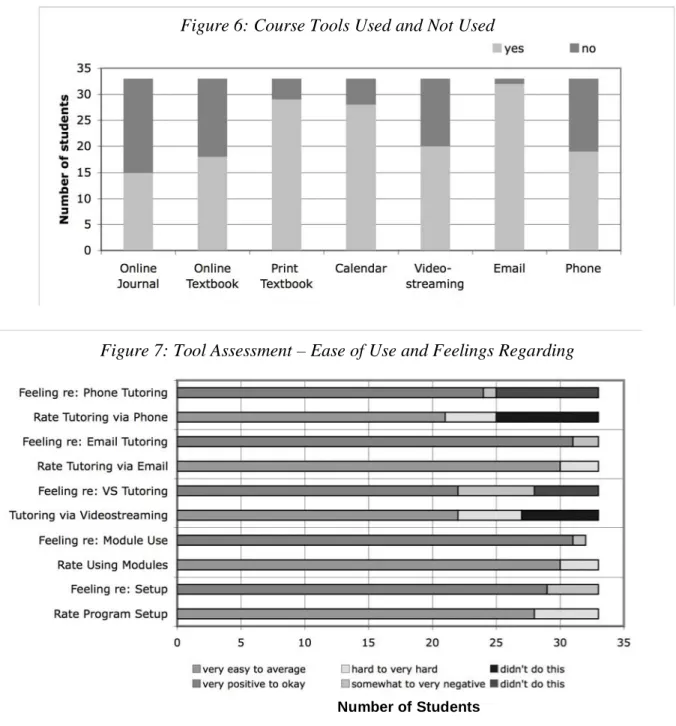
As anticipated, getting students to begin the program lessons proved a large hurdle to overcome. In spite of detailed instructions, initial setup was very challenging for some. Using the video-streamed tutoring (at www.hawaiirdp.org for Lessons 2.1, 2.2, 2.3) and using phone tutoring was also difficult for some. 12-15% of the students rated these three technical areas combined as being difficult or very difficult. Only 9% felt actually using the program or using email was difficult or very difficult. Some students (18%) did not try to use the video-streamed tutoring lessons and about a fourth (24%) of the class did not try phone tutoring.
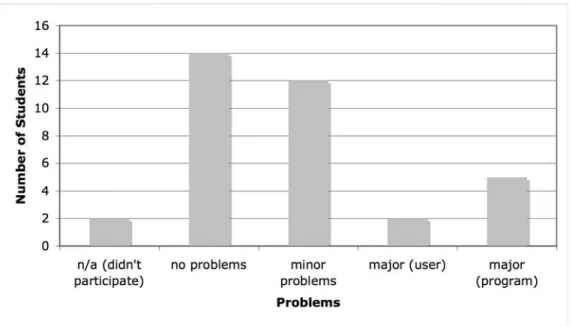
Student feelings about how they liked these same tools paralleled their use, however they felt slightly more positive about the tools even if they found them difficult to use. As an example, 9% found using the program modules difficult or very difficult to use, but only 3% felt somewhat or very negative about using these modules. Almost 80% of the class had no technical problems or very minor problems that were resolved easily, like inserting the wrong CD, Internet connectivity, or a technical support easy-answer
question. There was another 6% who had major computer issues impacting their success in the course, but these issues were beyond the scope of the instructor or Plato technical support. This included computer virus issues, computer crashes, and software conflicts. 15% felt they had major issues that were not resolved, such as inability to connect from home and inability to view streamed videos (see Figure 5).
There were a number of tools available for students use. Understanding which tools were used and why other tools were not used helps define what to include in the future.
Results Online Math Program Evaluation Bender, M.-J. About half of the students used the online note taking journal and the online textbook. 12% did not use their hard copy textbook, and surprisingly, 6% did not use either textbook. Other tools not used include the recommended calendar timeline (15% did not use), video-streamed tutoring tool (39% responded they did not use this tool in apparent conflict with a previous use question where only18% responded that they did not use the video-streamed tutoring), phone (42% did not use it to contact instructor), and 3% did not use email to contact the instructor (see Figure 6). Reasons given for non-use included not feeling it was needed, the online tool didn’t work consistently, preference for paper tool over online tool, computer difficulties using the tool, did not know how, and never got around to it. All respondents except one felt email was helpful and effective for them. The one person who did not agree stated they received an error message when emailing the instructor. Unfortunately this person did not call or otherwise notify the instructor so that the problem could be addressed (see Figure 7).
Figure 6: Course Tools Used and Not Used
Figure 7: Tool Assessment – Ease of Use and Feelings Regarding
Number of Students Attitudinal Information Section
Attitudes Towards Math
The majority (61%) of the participants surveyed remained unchanged regarding their affinity for math following this class. 12% found that they preferred face-to-face instruction better, however 27% found they liked math better using this online program
Results Online Math Program Evaluation Bender, M.-J. over the traditional face-to-face delivery. The class was split whether they would have chosen this class if they knew at the beginning what they knew by the end, with two thirds feeling they would have still taken it while one third would have not taken it. Suggestions to improve the class predominantly centered around improving the technical issues regarding accessing the program and/or the separate online testing program.
Positive and Negative Reactions
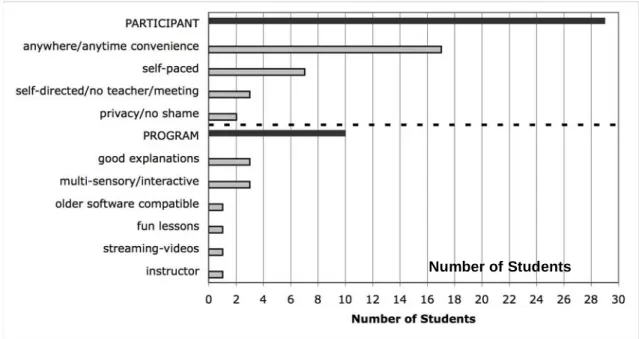
What was liked most about the class was predominately (75%) about personal preferences rather than the program itself, with almost all including reference to anywhere/anytime convenience or self-paced design. Multi-sensory presentation and interactive nature with good explanations were the product features most liked. About the same quantity of comments were shared for the negative aspects of the class, however there was little agreement on what the negative issues were. Comments were equally divided between personal preferences and product issues (see Figure 8). The most disliked feature was not having an in-person instructor for asking questions. Suggestions for improvement of the class predominantly centered around improving the technical issues regarding access of the program and/or the supplemental online testing program (see Figure 9).
Learning Experience
In evaluating the learning experience, over three-fourths of the respondents felt they learned more than they expected to (see Figure 10). Under 10% felt the method didn’t make a difference one way or the other, while 14% felt they learned less. A few felt strongly that they learned more in this online class using Plato Interactive Mathematics
than in a traditional face-to-face class, and about the same number felt exactly the opposite. Many of the respondents liked the delivery method, while the same few individuals who preferred the face-to-face mode better were also the ones who did not like this delivery method.
Instructor Assessment
The majority of the class (83%) found the instructor helpful, with the balance feeling the instructor was not an influence in the class at all (6%), or was not helpful enough (11%). Half of the survey participants added instructor comments that ranged from “no problem with instructor,” “helpful,” “very available,” to “great,” and stating that the instructor was not a factor in their perception of any difficulties with this class. The one criticism was the instructor did not know the technical information, which was addressed in the syllabus as handled by the Plato technical support department. 94% responded that the decision to take another Plato-based math class would not be influenced by having a different instructor either. One student’s response summarized what should always be the classroom experience: “The instructor was good; I expect all to be good.”
Overall Assessment
The student comments shared reflected one student’s assessment, “This method is certainly not for everyone.” Overall, they stated they liked the tool, liked the freedom, but had trouble with self-discipline, were upset by the technical issues, and didn’t like having to go to campus for the proctored exams. Most shared positive reactions, such as “this should be offered all the time,” “add more math levels,” and “it’s a great learning tool.”
Results Online Math Program Evaluation Bender, M.-J.
Figure 8: Positive Assessments Regarding Participant Needs & Program
Number of Students
Figure 9: Negative Assessments Regarding Participant Needs & Program
Figure 10: Learning Experience Evaluation
Final Grades
The lowest level of math is Basic Math. This would include the four mathematical operations of addition, subtractions, multiplication, and division, as well as signed numbers, fractions, and percent. Math 22, Pre Algebra, reviews all of this except the four basic mathematical operations before going into beginning algebra with some elementary geometry concepts. Math 23, Practical Algebra, reviews signed numbers and much of the beginning algebra content before moving into more advanced concepts including
inequalities, graphing, factoring, and quadratic equations (see Appendix E). When students first enter MCC, in order to place students into appropriate math level courses,
Results Online Math Program Evaluation Bender, M.-J. prior to these courses. For this pilot, students were asked to take the Compass test again during the first week of class and again at the conclusion of the class, but only a few did so. It was therefore not possible to see if at the completion of the course taken they demonstrated their learning by placing into the next level through exam placement.
Nine of the students who were placed into Math 22 actually Compass-tested into Basic Math. They were given over-rides to take Math 22. Five of these dropped the class, and the other four passed with one B, two Cs, and one D. A student who Compass-tested into Math 22 was given an over-ride to take Math 23 and passed with a C. Another student without any placement information at all was placed into Math 23 and received an F. Overall, the passing rate of students in these new online delivery classes was very similar to the combined rates for the other three delivery modes. This study was not designed to compare the delivery methods looking for the most “successful.” It is questionable whether such a determination can be made, since it is clear from this study as well as others, that a method that is very suitable for one student is equally un-suitable for another. The intent in looking at final grades is as a control for instructor difference, verifying this instructor’s grading gave results in the same range for these courses when compared to the average of all the other modalities. Indeed, the passing rates are very similar for both Math 22 and Math 23 (see Table 3).
Table 3: Plato Math Pilot Grade Comparison to All Other Math Deliveries Combined (Innovative Classroom, Lab-based, & Traditional Face-to-Face)
Findings, Conclusions, Implications Online Math Program Evaluation
Bender, M.-J.
Findings, Conclusions and Implications
The instigating issue that brought about the development of this online math remediation program was accessibility for non-traditional students. Before deciding the success of this program, it is appropriate to compare the motivation of those original students to these participating students. The data shows clearly that this sample population is also non-traditional as defined by Bichelmeyer & Molenda (2006), with 70% being older than traditional college students, 88% working sixteen or more hours weekly with almost 30% working full time, and almost 60% being single parents. The motivation for these participants is also similar, with 73% choosing this modality because of time and/or location constraints, or in other words, accessibility.
The high rate of survey participation (79%) is attributable to the students’ belief that their opinions would be important in determining the continuance of these online classes as predicted by Gaide (2005). The students were advised at the outset of the class that they would be asked for their input, and the survey plus follow-up phone conversations reiterated this same message.
What Worked
As anticipated, those highly motivated, self-disciplined students found the benefits of this program met their needs well. Three were able to save a semester of time by completing both courses compressed into one semester. Students found the flexibility of accessing the lessons at a variety of locations met the needs of their busy and varied lives. The additional bonus of using the same book and software for both classes was a further
savings. The ability to ‘test out’ of lessons allowed students to spend their time more efficiently on the content that was new or difficult for them. The multi-sensory approach of CAI worked well for many students, duplicating the findings of Aivazidis, Lazaridou, & Hellden (2006) and Kulik & Kulik (1991). They could hear, see, and manipulate the content facilitating learning and retention. Reviewing lessons or parts of lessons allowed their lesson quizzes (the ‘Evaluate’ module) to be improved with retakes. Removing the stigmatic component of peer-pressure was an asset for some students.
For those who met the entry criteria of self-discipline and comfort with computer use, this was a helpful and efficient modality as predicted by Muse (2003).
What Didn’t Work Software Issues
Technology difficulties were the biggest problems. Internet Explorer issued an update during the semester that would not run this program’s software. Several students upgraded before the incompatibility was understood, causing many hours of frustration and difficulty in resolving. A patch to fix the problem was not available until following the completion of the course. There were also a number of small issues contributing to the impression that the software was “buggy.” This was not a surprise finding, as Plato was due to rollout a major update for Fall 2007, within a few months of this program’s completion. The new version is expected to eliminate many, if not all, of these
complaints as it will migrate from lessons run on disks loaded on local computers to a Web-based delivery allowing broader computer access. Older computers, as well as those using Macintosh and Linux operating systems will then have equal program access. An
Findings, Conclusions, Implications Online Math Program Evaluation
Bender, M.-J.
integrated testing program is also due to be incorporated with the new rollout, thus eliminating the problematic Test-Check software supplied by a third-party vendor. Personal Technology Issues
Some issues with technology were on the participants’ side, not on the program’s side. Internet connectivity, other software incompatibilities, and computer virus attacks could still continue to be issues, as with any use of Internet/computer-based learning. Any modality has “blockers” that could interfere with accessing learning, so while it is necessary to work on minimizing the impact, it is doubtful that it will totally be resolved. Communication Issues
Communication of expectations is another area that still could use improvement. Although key information was published in the course descriptions, in the syllabus, on the informational Website, emailed directly to each student, and discussed in the face-to-face meeting, comments from the survey indicate critical information necessary for successful completion was not comprehended. This is an ongoing issue in many face-to-face classes as well. While concurring with Willems (2005) regarding the importance of clear communication of expectations for student success, it was found to be difficult to insure those expectations were actually heard, understood and believed in spite of student assurance that they understood.
Best Fit
Finding the best fit for students with regard to the choice of learning modality seemed to be a key component in this pilot. For students who accurately self-analyzed themselves as having the self-motivation to self-schedule the time necessary and who
possessed a willingness to use computer-based technology, the course was successful. For those who thought it would be “easier” than other delivery modalities despite what they were told at the orientation and training meeting, and those who lacked the self-discipline to set their own “class time,” they found this course frustrating and disappointing. While this is not surprising, it does reflect that better screening and matching of learning modalities to student needs would be of benefit. Where and how does this screening take place? Counselors were one intervention, the Website was another, and the orientation and training meeting was a third. Development of an online pre-screening tool might help identify which modality might be a student’s best fit. Many schools offer such a tool, however it is still up to the student whether to heed the advice supplied. At some point the participants need to accept their own responsibility for listening to the advice and instructions already provided. At the community college level these are adult participants and while guidance is needed to make informed choices to maximize their learning success and receive the most educational value for their money, they are entitled to explore options they deem worthwhile even if it is not in their
customary comfort zone. Making the selection of modalities based only on the criteria of convenience, however, is clearly not enough to insure success.
Tools
Choice of tools used by each student differed substantially. The choices made also appear to have influenced the success of the student. It is not difficult to understand that the students who used neither the online or hardcopy textbook did not fare as well as those who did, if for no other reason than the additional media would help retention. Use
Findings, Conclusions, Implications Online Math Program Evaluation
Bender, M.-J.
of one of the textbooks would be mandatory for optimal success. Another mandatory tool would be the course calendar found as part of the syllabus. Keeping up with or going faster than the calendar minimum requirements would ensure completion of all content. Emailed weekly contact from each student was a requirement to keep communication open as well as being a reminder to stay on task as recommended by Kitsantas & Chow (2007) and Palmer (2005). . This should remain a requirement, and in fact be broadened by the addition of required specific content sections to include:
• Lessons covered this week (allows comparison to calendar for appropriate pacing)
• What concept was easiest (student can articulate what was done)
• What concept was most difficult and what was difficult/confusing about it (student is aware of what they may need to review at a later time)
• What help the student would like and suggestions as to when/how to
accomplish this help (advising instructor of how to provide tutoring or other assistance in a way most helpful for the individual)
• Personal input (information that might be pertinent for the instructor, such as a trip without connectivity, an illness, loss of Internet at home, computer issues, etc)
Some students were reticent to contact the instructor for assistance, yet the survey showed they want an amount of interaction, and indeed this communication is beneficial for creating the teamwork and rapport necessary for optimal learning.
The online journal was an optional tool in lieu of a handwritten journal that would allow access to notes wherever and whenever the student accessed their lessons. This access advantage plus allowing printing for hard-copy reference was over-weighed by technical problems that deleted entries unpredictably, losing student notes. This issue should be rectified with the new rollout of the Plato product.
Other optional tools, intended to be used as needed, included video-streamed tutorials on lessons needing additional help, plus email and phone tutoring. These video lessons walked through homework problems, so although each lesson was approximately an hour long, the student could watch part or skip sections, avoiding the need to view it in its entirety. Other synchronous tools such as Skype and Elluminate should be considered for tutoring with any future online iteration. Some students were content to skip difficult concepts or get just the general idea rather than using the optional tools and aiming for mastery. While providing these tools for students who need them is necessary, it will always be up to the individual student to utilize the tools when needed.
Recommendations
Another trial using the updated Plato Web-based software could offer a comparison to see if all technology issues have been successfully addressed or whether another product should be considered, as this was the biggest drawback for these online courses. Creation of a computer lab having the ability for two-way synchronous teleconferencing via Polycom, Skybridge, or Hawaii Interactive Television System (HITS) would be an asset for including in the orientation and training session the remote sites such as Hana and Lahaina on the island of Maui, plus Lanai and Molokai that are MCC’s non-Maui
Findings, Conclusions, Implications Online Math Program Evaluation
Bender, M.-J.
island sites, and for future offerings statewide or beyond. This could also be used for tutoring sessions if desired. Since the students on Lanai and Molokai could not participate in the live face-to-face meeting, it started them with a disadvantage that was not
overcome.
Saying “no” to a student is not an easy thing for a teacher as their focus is to be encouraging to students. However, in particular for this self-directed, less instructor-controlled learning situation, saying “yes” may actually do the student a disservice. If a student does not meet the criteria for registration, including following the registration timeline, getting the registration over-ride by meeting with a counselor, purchasing their book/software license in a timely manner, logging-in by the assigned date, etc., then that student will probably not have the skills to be successful with this delivery style. If they do not follow instructions to get into the class, they most likely won’t follow them during the class either. Being more rigid in following registration guidelines may therefore be a good screening tool.
For the Future
Although students were encouraged at the orientation and training meeting to exchange contact information in order to have potential “study buddies,” few students did this. While not wanting to add additional work and burden for the students, an optional weekly chat-room or discussion board posting might facilitate this connectivity. This aspect needs to be explored further as studies show positive effects from support groups.
Not using the ‘Explore’ module could be considered. It is supposed to provide real-world application for concepts within that lesson. While it might be “required,” it