PCC COMPASS Placement Test Review Packet 48
Math Review
The Math Review is divided into two parts:I. The first part is a general overview of the math classes, their sequence, basic content, and short quizzes to see if you are prepared to take a particular class. – page 50
II. The second part is a refresher of some basic topics for those who know how but lost their fluency over the years. – page 88
PCC COMPASS Placement Test Review Packet 49
.
Portland Community College
SEQUENCE OF MATH COURSES
MATH 10 - Fundamentals of Arithmetic2cr/2hr
MATH 20 - Basic Math
4cr/4hr MATH 30 - Business Math 4cr/4hr
MATH 61 – 62 - 63
Intro to Algebra Part I. Part II, & Part III
(Optional sequence) 3cr/4hr (each)
MATH 70 - Introduction to Intermediate Algebra
(Optional course – consult a Math advisor)
4cr/5hr
MATH 111B
College Algebra for
Business, Life Science, & Social Science Majors 5cr/5hr
MATH 111C
College Algebra for Engineering, Math & Science Majors
5cr/5hr MATH 105 Exploration in Mathematics 4cr/4hr MATH 231 Elements of Discrete Math I 4cr/4hr MATH 232 Elements of Discrete Math II 4cr/4hr MATH 241
Calculus for Business, Life Science & Social Science
Majors 4cr/4hr MATH 112 Elementary Functions (Trigonometry) 5cr/5hr
MATH 251 (Lec & Lab)
Calculus I 4cr/6hr
MATH 252
then
MATH 253
Calculus II & Calculus III 5cr/5hr (each) MATH 243 Statistics I 4cr/4hr MATH 244 Statistics II 4cr/4hr MATH 211 Foundations of Elementary Math I 4cr/4hr MATH 212 Foundations of Elementary Math II 4cr/4hr MATH 213 Foundations of Elementary Math III
4cr/4hr MATH 256 Differential Equations 5cr/5hr MATH 254 Vector Calculus 5cr/5hr MATH 261
Applied Linear Algebra 5cr/5hr
MATH 93
Graphing Calculator (Optional may be taken
During any term ) 1cr/1hr
EFFECTIVE PREREQUISITE SEQUENCE Prepared by
Victoria Valentine Sylvania Math Department - 5/08
MATH 60 – Introductory Algebra
1st Term then
MATH 65 – Introductory Algebra
2nd Term 4cr/5hr (each) or MATH 95 Intermediate Algebra 4cr/5hr MATH 91 -92 Intermediate Algebra Part I & Part II (Optional sequence)
3cr/4hr each
PCC COMPASS Placement Test Review Packet 50
Math Review – Part I
On the previous page you found a flow chart of the math sequence. The placement test will determine where you enter the sequence. Your educational goal will determine where you will exit the sequence. Please see an advisor for that.
In the following pages the topics are listed that are covered in each class.
TOPICS
covered in PCC Math Classes
To be successful studying the topics covered in these courses, students should be appropriately prepared by:
1. Taking the prerequisite math course within the last three years with a passing grade of A or B, or within the last one year with a passing grade of C, or 2. Placing into the course by taking the COMPASS placement test.
MTH 20 – Basic Math
Fractions, Decimals, Integers addition, subtraction, multiplication, division, Order of operations
Ratio and Proportion
Percent percents decimals fractions
Measurements Metric system American system Geometry
Statistics
Place value, rounding, inequalities, exponents, power of ten
PCC COMPASS Placement Test Review Packet 51
MTH 60 – Introductory Algebra I
I. Integer arithmetic
a.The four basic operations of addition, subtraction, multiplication, and division
b. Absolute value, exponents, order of operations II. One variable linear equations and inequalities
III. Application (i.e. word/story) problems with formulas IV. Graphing lines
a. Finding and interpreting slope b. Finding and interpreting intercepts c. Interpret relationships between variables d. Modeling with linear equations
MTH 65 – Introductory Algebra II
1. Systems of linear equations in two variables a. Graphing method
b. Substitution method c. Addition method d. Applications
2. Working with algebraic expressions
a. Add, subtract, multiply, and divide by a monomial b. Factoring polynomials
3. Solving quadratic equations
a. Square Root Property (includes – simplify and approximate numeric square roots)
b. Factoring Property c. Quadratic Formula
d. Graphing (includes – interpret vertex, axis of symmetry and vertical/horizontal intercepts)
e. Applications 4. Relations and functions
a. Function notation b. Evaluate
PCC COMPASS Placement Test Review Packet 52
MTH 70 – Review of Introductory Algebra
1. Solving equations A. Linear equations B. Quadratic equations C. Rational equations D. Radical equations 2. Graphing A. Linear functions B. Quadratic functions 3. Simplifying expressions A. Polynomial expressions B. Rational expressions 4. Function concepts A. Domain B. Range C. Function notation D. Graph reading
MTH 95 – Intermediate Algebra
1. Applications and Modeling A. Linear functions B. Quadratic functions C. Exponential functions 2. Graphing A. Linear functions B. Quadratic functions C. Exponential functions 3. Solve equations and inequalities
A. Symbolically B. Numerically C. Graphically 4. Function concepts A. Domain B. Range C. Inverses D. Compositions E. Transformations
PCC COMPASS Placement Test Review Packet 53
MTH 111 – College Algebra (MTH 111B or MTH 111C)
1. Graphing and solving equations and applications involving: A. Polynomial functions B. Rational functions C. Exponential functions D. Logarithmic functions 2. Functions Operations A. Inverses of functions B. Compositions of functions C. Transformations of functions
MTH 112 – Elementary Functions (Trigonometry)
1. Right triangle trigonometry
2. Law of Sines and Law of Cosines and their applications 3. Solutions to trigonometric equations
4. Applications A. Vectors
B. Parametric equations
C. Polar coordinates and graphs D. Complex numbers
MTH 211 – Foundations of Elementary Math I
1. Topics for Math 211: A. Problem solving
B. Set Theory – union, intersection, complement, Venn Diagrams C. Historic Numeration Systems
D. Whole Number Operations – properties, algorithms, models, non-decimal bases.
PCC COMPASS Placement Test Review Packet 54 2. Topics for Math 212:
A. Fractions, Decimals, Percents – operations, models, algorithms, problem solving.
B. Real Number System
C. Probability – modeling, multistage experiments, methods of counting.
D. Introductory Statistics – data, graphs, averages 3. Topics for Math 213:
A. Introductory Geometry – curves, angles, congruence, constructions, 3-dimensional.
B. Transformational Geometry – translation, rotation, reflection, tessellations
C. Measurement Concepts – length, area, volume D. Metric System – meter, gram, liter, Celsius
MTH 241 – Calculus for Business, Life Science, and
Social Science
1. Evaluating limits of functions 2. Continuity of functions
A. Continuity at a point B. Intervals of continuity
C. Removable and essential discontinuities
D. Viewing practical situations in terms of a continuous function 3. Differentiation
A. Definition of a derivative function
B. Rules for finding the derivatives of algebraic, exponential, and logarithmic functions
C. Implicit differentiation D. Logarithmic differentiation E. Higher order derivatives 4. Applications of differentiation
A. Graphing
B. Extrema problems C. Business applications
PCC COMPASS Placement Test Review Packet 55
5. Integration
A. Definition of the definite integral and the indefinite integral B. Techniques for evaluating the indefinite integral and the definite integral
C. Applications of integration in problems related to business D. Approximate integration
E. Solving differential equations
MTH 243 – Statistics I
1. Describe Data
A. Construct and interpret graphical displays B. Calculate and interpret numerical summaries 2. Produce Data
A. Experiments and observational studies B. Randomization C. Sampling design 3. Probability A. Randomness B. Probability models C. Random variables 4. Sampling Distributions
A. Counts and proportions B. Sample means
5. Estimation
A. Confidence interval for a population mean B. Sample size
MTH 251 – Calculus I
1. Limits 2. Differentiation 3. Applications to Differentiation 4. Numerical IntegrationPCC COMPASS Placement Test Review Packet 56
MTH 252 – Calculus II
Skills:
1. Use of summation signs
2. Limit of summations as n→∞ 3. Use of Reimann sums to find area
4. Interpret Reimann sum as definite integral 5. Fundamental Theorem of Calculus
6. Power rule for integration 7. Constant of integration 8. The Trapezoid rule 9. Simpson’s rule Applications:
1. The area between two graphs using either dx or dy 2. Volume using Disks and Washers, shells or slicing 3. Area of surface of revolution
4. Arc Length 5. Work required 6. Water pressure
MTH 253 – Calculus III
1. Powerful integrating techniques including A. By parts B. Special Powers C. Trigonometric substitutions D. Quadratics E. Partial fractions F. Trapezoid rule G. Simpson’s rule 2. Improper Integrals
A. How to deal with “holes”, vertical tangents and disjoint functions.
3. Limits of Indeterminate Forms A. L’Hopital
B. Reciprocal rule C. Logarithmic Process
PCC COMPASS Placement Test Review Packet 57
4. Sequences and series A. Limits
B. Convergence and divergence C. Power series
5. Polar coordinates 6. Parametric equations
ARE YOU PREPARED?
The mini quizzes on the following pages are meant to serve only as an indicator of a few of the math skills that you are expected to know at the beginning of each course. Do not use these problems as a study guide thinking that they will adequately prepare you for the course.
These example problems are merely representative of some of the most important
concepts that are taught in the prerequisite courses.
The courses will offer little or no time for any type of review; they assume that you
are prepared to do the work the first day of class.
Below is a sample of some skills you should have BEFORE entering
MTH 20 – Basic Math
You MAY NOT use a calculator.
1. Without using a calculator, can you complete these problems in 45 seconds? 6 x 4 9 x 6 7 x 8 9 x 9 0 x 6
6 x 9 8 x 10 9 x 4 6 x 7 7 x 2 9 x 0 6 x 2 4 x 7 8 x 9 9 x 7
PCC COMPASS Placement Test Review Packet 58
6 x 5 8 x 9 8 x 4 3 x 6 8 x 8 12÷4 56÷8 72÷9 40÷5 36÷6
NOTE: If you miss more than 5 problems, then you should consider taking the previous math course – ABE 0750 or ALC 60, 61, 62, 63.
2. Without using a calculator, can you get at least 8 correct answers on the following problems? a) 20 x 30 b) 25 + 4 + 125 c) 872 - 431 d) 4984 ÷8 e) 68 x 34 f) 17575 ÷25 g) 305 x 27 h) 5843 - 2338 i) 4590 ÷15 j) 45 + 2,341 + 8 + 124
3. Without using a calculator, can you get at least 4 correct answers on the following problems?
a) Find the change from a $20 bill after purchasing 2 records at $6 each, and 1 pair of earrings that cost $3.
b) A computer screen consists of small rectangular dots called pixels. How many pixels are there on a screen that has 600 rows with 800 pixels in each row?
c) Before going back to college, David buys 4 shirts at $59 each and 6 pairs of pants at $78 each. What is the total cost of the purchase?
d) Portland community college is constructing new dorms. Each dorm room has a small kitchen. If someone buys 85 microwave ovens at $90 each, what is the total cost of the purchase?
e) Hershey Chocolate USA makes small, fun-size chocolate bars. How many 20-bar packages can be filled with 8,110 bars? How many bars will be left over?
PCC COMPASS Placement Test Review Packet 59
Answers
QUESTION 2: a) 600 b) 154 c) 441 d) 623 e) 2,312 f) 703 g) 8,235 h) 3,505 i) 306 j) 2,518 QUESTION 3: a) $5 b) 480,000 PIXELS c) $704 d) $7,650 e) 405 Packages with 10 bars left overHow many of these problems can you miss and still succeed in MTH 20? Ideally, NONE.
These problems are just a sample of the larger number of skills that you should be familiar with BEFORE taking this course.
If some of these ideas are not familiar to you, you should consider enrolling in one of the previous math courses (ABE 0750 or ALC 60, 61, 62, or 63).
Below is a sample of some skills you should have BEFORE entering
MTH 60 – Introductory Algebra I
You MAY NOT use a calculator.
1.Without using a calculator, can you get at least 16 correct answers on the following problems?
a) Round 6.8449 to the nearest
hundredth. b) Round
995 .
PCC COMPASS Placement Test Review Packet 60
c) Round 37,328 to the nearest
hundred.
d) Change 0.625 to a fraction
e) Write 70% as a fraction and
reduce to the lowest terms. f) Change 5 2 to a decimal. g) Multiply: 3 2 2 16 9 x h) Divide: 10 3 2 1 ÷
i) Find the average of 4 1 10 , 8 , 5 . 12 , 4 1 7
j) Perform the indicated operations. 7−3⋅2+10÷5
k) Subtract: 8.3−.973
l) Perform the indicated operations. 18÷2(3)+22 −5
m) List these numbers from smallest to largest: ,0.555,0.583 12 7 , 9 5
n) Solve the proportion: x 1 . 1 4 5 . 2 =
o) How many inches equal 2 yd? p) Change 72 mg to grams. q) If 1 km is approximately 0.6 miles,
how many miles in 18 km?
r) Find the area of a circle whose diameter is 6 cm.
s) Find the perimeter of this figure: t) Find the volume of this figure: 16 m 10 m 10m 18 in 8 m 25 m 5 in
PCC COMPASS Placement Test Review Packet 61
2. Without using a calculator, can you get at least 4 correct answers on the following problems?
a) A family’s monthly income is $1,200. It is spent as follows: 20% on food, 35% on rent, 17% on utilities, 8% on automobile, and the rest on miscellaneous expense. What dollar amount is spent on miscellaneous expenses?
b) A TV is priced to sell at $585. What is the sale price if the sale sign says “
3
1 off”?
c) A machinist needs a bar that is
8 3
in. thick. If she cuts off
32 3
in. thick, how thick is the bar?
d) A teacher assigns problems 96 to 128 that are multiples of 8. Which problems should the students do?
e) Find the unit price if the total cost of a 5-lb. steak is $21.
Answers
Question 1: a) 6.84 b) 8.0 c) 37,300 d) 8 5 e) 10 7 f) 0.4 g) 2 3 h) 6 1 I) 2 1 9 j) 3 k) 7.327 l) 26 m) 12 7 , 583 . 0 , 9 5 , 555 . 0 n) 1.76 o) 72 inches p) 0.072 g q) 10.8 mi r) 2 cm 26 . 28 s) 44 m t) 3 in 250 , 2 Question 2: a) $240 b) $390 c) in. thick 32 15 d) 96, 104, 112, 120, 128 e) $4.20 per lbHow many of these problems can you miss and still succeed in MTH 60? Ideally, NONE.
PCC COMPASS Placement Test Review Packet 62
These problems are just a sample of the larger number of skills that you should be familiar with BEFORE taking this course.
If some of these ideas are not familiar to you, you should enroll in the previous course (MTH 20 or ALC 60, 61, 62, or 63)
Below is a sample of some skills you should have BEFORE entering
MTH 65 – Introductory Algebra II
You MAY NOT use a calculator.
b) Evaluate 2 7x−x , when x=−2 d) Solve for x: ) 7 x ( 6 3 ) 2 x ( 5 − = − −
f) Solve for x and graph on a number line. ) x 5 ( 2 x 6 2− ≥ −
h) Find the slope and the y-intercept of the line when 2x−y=6
j) Write an equation for the following graph.
l) Graph the inequality on a rectangular coordinate system.
y < x 1 3
4 −
a) Perform the indicated operations: 5 ) 2 ( ) 3 ( 2 18÷ − − − 3− c) Simplify: ) 3 5 2 ( 3 ) 1 4 12 ( 2− + − 2− + x x x x e) Solve for x: 2 1 5 10 1 2 − = + x x f) Solve for W: W 2 L 2 P= +
i) Given two points on a line, find the slope and indicate whether the line rises, falls, is horizontal, or is vertical.
) 4 , 3
(− and (−5,−2)
k) Given the slope, −2, and a point passing through(−1,4), write an equation in the point-slope form and slope-intercept form.
PCC COMPASS Placement Test Review Packet 63
This is a graph of Frank’s body temperature from 8 a.m. to 3 p.m.
Let x represent the number of hours after 8 a.m. and y equal Frank’s temperature (in F) at time x.
m) What is the y-intercept? What does this mean about Frank’s temperature at 8 a.m.?
n) During which period of time is Frank’s temperature decreasing?
o) Estimate Frank’s minimum temperature during the time period shown. How many hours after 8 a.m. does this occur? At what time does this occur?
p) How many grams of an alloy that is 80% gold should be melted with 40 grams of an alloy that is 50% gold to produce an alloy that is 70% gold?
q) Vikki has $200 to spend on clothing. She buys a skirt for $68. She would like to buy some sweaters that sell for $15.50 each. How many sweaters can she buy and stay within her budget?
r) The pressure of water on an object below the surface is proportional to its distance below the surface. If a submarine experiences a pressure of 25 pounds per square inch 60 feet below the surface, how much pressure will it experience 330 feet below the surface?
Answers
a) b) c) d) e) f)
g) h) Slope =2, y-intercept = ( ) i) Slope = 3, rises
j) k) Point-slope form: y – 4 = - 2(x + 1) and slope-intercept form: y = - 2x + 2
l)
PCC COMPASS Placement Test Review Packet 64
n) Frank’s temperature is decreasing during the time from 8:00 a.m. to 11:00 a.m. o) Frank’s minimum temperature is ≈98.6 F. This occurs about 3 hours afterwards
and the time would be 11:00 a.m.
p) Eighty grams of an alloy that is 80% gold should be melted with 40 grams of an alloy that is 50% gold to produce an alloy that is 70% gold.
q) Vikki can buy at most eight sweaters.
r) A submarine will experience a pressure of 137.5 pounds per square inch 330 feet below the surface.
How many of these problems can you miss and still succeed in MTH 65? Ideally, NONE.
These problems are just a sample of the larger number of skills which you should be familiar with BEFORE taking this course
If some of these ideas are not familiar to you, you should consider enrolling in the previous course (MTH 60 or ALC 60, 61, 62, or 63)
Below is a sample of some skills you should have BEFORE entering
MTH 70 – Review of Introductory Algebra
Part I
Work with positive and negative real numbers, fractions, and the order of operations. a) 100÷4×5 b) 6 4 3 ) 4 )( 3 ( 2 + − − − − c) + ÷ 8 3 3 1 3 2
PCC COMPASS Placement Test Review Packet 65 Part II 1. Simplify expressions: a) 3(2x2 −3xy+y)−(y−x2 +2xy) b) 12−2(x−2) c) 3 2 6 5 2 9 27 − y x y x 2. Factor: a) x2 −5x−14 b) 6a2b3 −3a2b 3. Solve for x: a) 3x−
(
x+4)
−5=5(x−4)−4 b) 3x−5y+6=0 c) x2 −5x−14=0 4. Evaluate expressions: Ifx=−3, evaluate −x2 −2x−15. Graph by HAND and on your GRAPHING CALCULATOR* a) 4x+3y=−12
b) y=6x2 +90x−600
6. Find the equation of the line passing through 2 given points:
) 7 , 1 ( ) 1 , 2 ( − − −
7. Solve a first-degree inequality in one variable: Given:8−5x≥3x+9, solvefor x
8. Given f(x)=−3x+2 a) Evaluate f(−2) b) Solve for xif f(x)=−2
Answers
Part I a) 125 b) 2 3 c) 17 16PCC COMPASS Placement Test Review Packet 66 Part II 1. a) 7x2 −11xy+2yb)16−2x c) 24 9 27 x y 2. a) (x−7)(x+2) b) 3a2b(2b2 −1) 3. a)x=5 b) 3 6 5 − = y x c) x=7, x=−2 4. −4 5. a) b) 6. y=2x−5 7. x≤− − ≥x 8 1 or 8 1 8. a) f(−2)=8 b) 3 4 = x
*Students with no graphing calculator experience should enroll concurrently in MATH 93.
MATH 70 IS AN OPTIONAL COURSE CONSULT A MATH ADVISOR
How many of these problems can you miss and still succeed in MTH 70? a) If you missed any of the problems in Part I you should consider enrolling in MTH 60.
b) If you missed several of the problems in Part II, MTH 70 is the course for you. These topics will be reviewed in MTH 70. c) If you missed none of the problems, enroll in MTH 95.
PCC COMPASS Placement Test Review Packet 67
Below is a sample of some skills you should have BEFORE entering
MTH 95 – Intermediate Algebra
You MAY NOT use a calculator, except where indicated.
1. Work with positive and negative real numbers, and the order of operations. Simplify 2 3 ) 3 )( 4 ( 5+ − − − − 2. Simplify expressions: a) 3(2x2 −3xy+y)−(y−x2 +2xy) b) 53 72 8 12 b a b a − −
3. Expand and collect like terms: a) (3x−5)(6x+7) b) 2 ) 3 2 ( x− 4. Factor: a) x2 −5x−14 b) 6a2b3 −3a2b 5. Solve for x: a) 3x−(x+4)−5=5(x−4)−4 b) 3x−5y+6=0 c) x2 −5x−14=0 6. Evaluate expressions: If x=−3, evaluate x2 −2x−1
7. Graph by HAND and on your GRAPHING CALCULATOR* a) 4x+3y=−12
b) y= x2 −5x−14
8. Find the equation of the line passing through 2 given points:
) 7 , 1 ( ) 1 , 2 ( − − −
PCC COMPASS Placement Test Review Packet 68
9. Solve a system of equations by all of the following methods: substitution, elimination by addition (linear combinations), and graphically.
Given: − = + − = + 2 4 3 3 2 y x y x
10: Solve a first degree inequality in one variable: Given: 8−5x ≥ 3x+9, solve for x
Answers
1. -2 2. a) 7x2 −11xy+2y b) 9 8 2 3 b a 3. a) 18x2 −9x−35 b)4x2 −12x+9 4. a) (x−7)(x+2) b) 3a2b(2b2 −1) 5. a) x=5 b) 3 6 5 − = y x c) x=7, x=−2 6. 14 7. a) b) 1 2 -1 -2 -3 -4 -5 -6 1 2 -1 -2 -3 -4 -5 -6 x y Figure 1: 4x+3y=−12 Figure 2: y=x2−5x−14 1 2 3 4 5 6 7 8 9 10 -1 -2 -3 -4 5 10 15 20 -5 -10 -15 -20 -25 -30 x y 8. y=2x−5 9. x=−2, y =1 10. x≤−1/8 or −1/8≥ x* Students with no graphing calculator experience should enroll concurrently in MTH 93.
PCC COMPASS Placement Test Review Packet 69
How many of these problems can you miss and still succeed in MTH 95? Ideally, NONE.
These problems are just a sample of the larger number of skills that you should be familiar with BEFORE taking this course.
If some of these ideas are not familiar to you, you should consider enrolling in one of the prerequisite courses (MTH 65 or MTH 70 or ALC 60, 61, 62, or 63).
Below is a sample of some skills you should have BEFORE entering
MTH 111 – College Algebra (MTH 111B or MTH 111C)
1. What is the equation of a line with slope
2 1
− =
m which passes through the point
(6,−4)?
2. Write each of these inequalities using interval notation: a) 2< x≤7 b) x>1 c) 5>x≥−3
3. Find the x-intercepts, the y-intercepts and the vertex of y= x2 −8x+7 then graph
the equation.
4. Simplify these exponential expressions: a) 2 7 3 5 5 2 3 8 2 − − − − y z y x z y x b) 2 1 5 3 6 5 4 1 3 2 − z x y x
5. Given the points (0,2) and (2,18), find the equation for an exponential function of the
form t
b a t
f( )= ⋅ which passes through both points.
PCC COMPASS Placement Test Review Packet 70
7. Given the function y= f(x)in Figure 1, find the domain and range of the function.
What is the value of f(1)? Estimate the horizontal and vertical intercepts.
1 2 3 4 5 -1 -2 -3 -4 -5 1 2 3 4 5 -1 -2 -3 -4 -5 x y Figure 1: y= f
(
x)
8. Given 3 ) (x x x f = − and x x xg( )=3 +2, evaluate the composition
5 2 ) (f g
9. Find the value of f(g(2)) from the table below. For the function h, which
function type best describes its graph: linear; quadratic, or exponential? x f(x) g(x) h(x) 1 3 -1 0.5 2 0 3 2 3 -5 7 4.5 4 -14 11 8
PCC COMPASS Placement Test Review Packet 71
Answers
1. 1 2 1 − − = x y 2) (a)(2,7] (b) (1,∞) (c)[
−3,5)3. x-intercepts: (1,0), (7,0) y-intercept: (0,7) Vertex: (4,−9)
Figure 2: = 2 −8 +7 x x y 1 2 3 4 5 6 7 8 9 10 -1 -2 2 4 6 8 10 -2 -4 -6 -8 -10 x y 4. (a) 16164 x z (b) 12 1 10 3 8 1 x z y 5. t t f( )=2⋅3 6. 2 5 ) ( 1 = + − x x f 7. Domain: (−∞, 3] Range: (−∞, 4] (1)f =2
Horizontal intercept is (1,0) Vertical intercept is ≈(0,1.8)
8. 6 5 2 ) ( = g f 9. f(g(2))=−5, his quadratic
How many of these problems can you miss and still succeed in MTH 111B or MTH 111C?
Ideally, NONE.
These problems are just a sample of the larger number of skills that you should be familiar with BEFORE taking this course.
If some of these ideas are not familiar to you, you should enroll in the prerequisite course (MATH 95).
PCC COMPASS Placement Test Review Packet 72
Below is a sample of some skills you should have BEFORE entering
MTH 112 – Elementary Functions (Trigonometry)
You MAY use a calculator. 1. Find the inverse function for x
x
f( )=23− .
2. If an initial sample of 50 mg of a radioactive substance decays to 40 mg in 235 years, find the half-life of the substance.
3. Solve ln x + ln (x−2)=3.
4. On January 1, 1995, a park ranger estimates that there are 65 wolves in a wilderness area and that the wolf population is growing at an annual rate of 2.3%. When will there be 100 wolves in the area?
5. Draw a graph of a 5th degree polynomial with a negative leading coefficient, three
single zeroes and a double zero. 6. Graph 9 4 ) ( 2 2 − − = x x x
g and label all asymptotes and intercepts.
7. Given h(x)=2x3 −5x2 −14x+8, a) find intervals where h is increasing and intervals
where h is decreasing. Solve for x if h(x)=10.
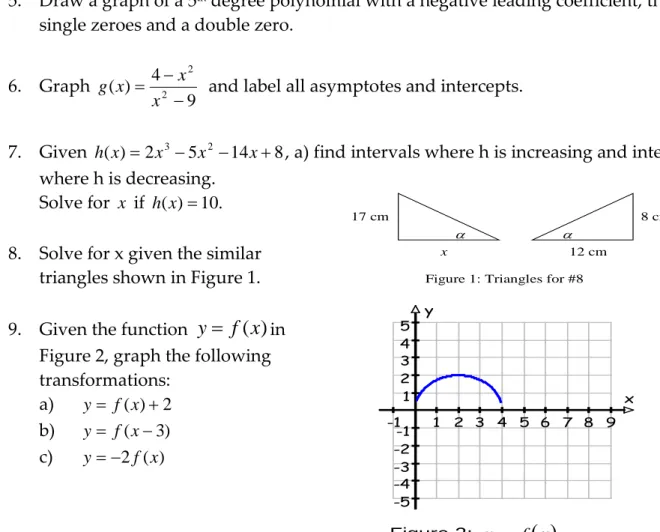
8. Solve for x given the similar triangles shown in Figure 1. 9. Given the function
y
=
f
(
x
)
inFigure 2, graph the following transformations: a) y= f(x)+2 b) y= f(x−3) c) y=−2f(x) Figure 2: y = f
( )
x 1 2 3 4 5 6 7 8 9 -1 1 2 3 4 5 -1 -2 -3 -4 -5 x yFigure 1: Triangles for #8
α α
x 12 cm
8 cm 17 cm
PCC COMPASS Placement Test Review Packet 73
10. From a common location, Car A heads north at 55 mph at the same time as Car B heads east at 45 mph. Assuming the roads are straight, how far apart are the two cars after 20 minutes?
Answers
1. f x 2 x 1 log 3 ) ( = − −2. The half life is almost 730 years (≈729.977)
3. x≈5.592
4. There will be 100 wolves in December of 2013. 5. Figure 3: A Solution to #5 1 2 3 -1 -2 -3 1 2 3 4 5 -1 -2 -3 -4 -5 x y Figure 4: 9 4 2 2 − − = x x y 1 2 3 4 5 -1 -2 -3 -4 -5 1 2 3 4 5 -1 -2 -3 -4 -5 x y 3 − = x x=3 1 − = y x-int.:
(
±2,0)
y-int.: − 9 4 , 0 7. a) h is increasing on (−∞,−0.907)∪(2.573,∞) h is decreasing on (−0.907, 2.573) b) h(x)=10 when x≈−1.565, −0.152, or 4.216 8. x=25.5cmPCC COMPASS Placement Test Review Packet 74 9. 1 2 3 4 5 6 7 8 9 -1 1 2 3 4 5 -1 -2 -3 -4 -5 x y Figure 5: y=f( )x+2 1 2 3 4 5 6 7 8 9 -1 1 2 3 4 5 -1 -2 -3 -4 -5 x y Figure 6: y=f(x−3) 1 2 3 4 5 6 7 8 9 -1 1 2 3 4 5 -1 -2 -3 -4 -5 x y Figure 7: y=−2f( )x
10. The cars are approximately23.688 miles apart in 20 minutes.
How many of these problems can you miss and still succeed in MTH 112? Ideally, NONE.
These problems are just a sample of the larger number of skills that you should be familiar with BEFORE taking this course.
If some of these ideas are not familiar to you, you should consider enrolling in one of the prerequisite courses (MTH 111B or MTH 111C)
Below is a sample of some skills you should have BEFORE entering
MTH 211 – Foundations of Elementary Math I
You MAY use a calculator.
1. The temperature at 10:00 pm in West Yellowstone was 5 degrees below zero. By 3:00am the temperature had dropped 8 degrees. What was the temperature at 3:00am?
a)−3 b) 3 c) 12 d) −13 e)13
2. What is the equation of a line with slope
2 1
− which passes through the point
) 4 , 6 ( − ? a) 2 1 4 6x+ y=− b) 1 2 1 − − = x y c) 2x−4y=2 c) 2 1 6 − = x y
PCC COMPASS Placement Test Review Packet 75
3. A roast is to be cooked 20 minutes per pound. If the roast weighs 6 pounds and the cook wants it to finish cooking by 5:30pm, what is the latest time he can begin cooking the roast?
a) 11:30am b) 2:30pm c) 3:30pm d) 4:00pm e) 4:10pm 4. If x+2y=6, then 2x+4y=?
a) 6 b) 8 c) 9 d) 10 e) 12
5. Les saved $8 on the purchase of a tire whose regular price was $40. What percent of the regular price did he save?
a) 5% b) 8% c) 12% d) 20% e) 32%
6. The acceleration A that results when force F is applied to a body of mass M can be calculated from the formula F = MA. What is the value of A if M = 1200 and F = 90,000? a) 75 b) 750 c) 7500 d) 1,080,000 e) 108,000,000 7. If 4 =8, then x−1=? x a) 2 1 1 − b) 3 2 − c) 2 1 − d) 2 1 e) 1
8. Consider the problem: “Frank’s average speed riding a bicycle is 4 miles per hour less than twice Liz’s. If Frank’s average speed is 12 miles per hour, what is Liz’s average speed?”
If s represents Liz’s average speed riding a bicycle, which of the following equations can be used to solve the problem.
a) 4−2s=12 b) 2s+4=12 c)2s−4=12
PCC COMPASS Placement Test Review Packet 76
9. If a=−2, then the value of 4a2 −2a+3 is
a) −65 b) −17 c) 15 d) 23 e) 71 10. If 3 x y= and 4 1 =
x , then what is the value of y?
a) 64 1 b) 16 1 c) 12 1 d) 4 1 e) 4 3
11. Given the function y= f(x)in Figure 1, find the domain and range of the function.
What is the value of f(1)? Estimate the horizontal and vertical
intercepts. 1 2 3 4 5 -1 -2 -3 -4 -5 1 2 3 4 5 -1 -2 -3 -4 -5 x y Figure 1: y= f(x)
Answers
1. d 2 b 3. c 4. e 5. d 6. a 7. c 8. c 9. d 10. a 11. Domain:(
−∞,3]
, Range:(
−∞,4]
, f(1)=2.Horizontal intercept is 1, vertical intercept is 1.8.
How many of these problems can you miss and still succeed in MTH 211? Ideally, NONE.
These problems are just a sample of the larger number of skills that you should be familiar with BEFORE taking this course.
If some of these ideas are not familiar to you, you should enroll in the prerequisite course (MTH 95).
PCC COMPASS Placement Test Review Packet 77
Below is a sample of some skills you should have BEFORE entering
MTH 241 – Calculus for Business, Life Science, and
Social Science
You MAY use a calculator.
1. Solve forx: 0 8 2 3 2 2 ≥ − + + x x x x 2. Solve forx: 5 3 2 4< x+
3. What is the domain, range, and graph of the function
> < − = = 0 , 1 0 , 1 ) ( x if x if x x f y
4. Solve the system: = + − + = 0 7 4 18 y x x y
5. Solve for x: logx(2x+3)=2
6. Solve for x: e1n(x+4) =7
7. If $2600 is invested for 6.5 years at 6% interest compounded quarterly, find: a) The compounded amount b) The compounded interest 8. If f(x)=4x and g(x)= x2 + 6x−1, find: a) ) 2 ( ) (f − g x b)(fg)(−0.5) c) (1) x g f
9. Find the effective interest rate equivalent to an annual rate of 6 percent compounded continuously.
10. Give the domain, range, and sketch the graph of the function:
2 )
( = −
= f x x
PCC COMPASS Placement Test Review Packet 78
Answers
1. x<−4 or −3≤x≤0 or x>2[
3,0]
(2, ) ) 4 , (−∞ − − +∞ 2. ∞ + − − −∞ − > − < ) , 2 3 ( ) 2 27 , ( 2 3 2 27 x or x 3. Domain: (−∞,0)∪(0,∞) Range:[
1,∞) 4.{
(−1,6), (−10,−3)}
5. x=3 6. x=3 7. a) $3829.04 b) $1229.04 8. a) x x x 12 4 2 2 − − b) 23.5 c) x x 24 4 2 + 9. 6.18% 10. Domain:[
2,∞) Range:[
0,∞).How many of these problems can you miss and still succeed in MTH 241? Ideally, NONE.
These problems are just a sample of the larger number of skills that you should be familiar with BEFORE taking this course.
If some of these ideas are not familiar to you, you should consider enrolling in one of the prerequisite courses (MTH 111B or MTH 111C).
PCC COMPASS Placement Test Review Packet 79
Below is a sample of some skills you should have BEFORE entering
MTH 243 – Statistics I
1 If , c b a z = − solve for a 2. If =3, n m z solve for n3. Using mental math only (no calculator, no pencil & paper), evaluate:
a) , n c b a− when a=14, b=13, c=8, and n=4 b) ) 1 ( p np np x − − when , 100 , 16 = = n x and p=.2 c) 8 1 4 1 2 1 − +
4. Refer to the scatter plot in Figure 1. a) Find the slope of the line. b) Write an equation of the line.
PCC COMPASS Placement Test Review Packet 80
5. Use your calculator to evaluate: (round each result to 3 significant digits) a) 423 ) 537 )(. 463 (. 96 . 1 463 . ± b) (−1−1.71)2 (.2)+(0−1.71)2 (.3)+(1−1.71)2(.5) c) 8 4500 000 , 55 800 , 51 − d) 2 2 1 2 1 ) (x e x f = − π at x=0 6. Given f(x)=x−20, find:
a) the x- and y- intercepts of the graph of y= f(x)
b) f −1(−4)
7. A nicotine patch or a placebo patch was randomly assigned to each of 240
smokers who expressed a desire to quit. Here are the numbers who had quit and not quit smoking after 8 weeks of wearing the patches.
Smoking after 8 weeks Yes No Nicotine Patch 64 56 Placebo Patch 96 24
a) What proportion of the subjects in the study quit smoking after 8 weeks?
b) What proportion of the nicotine patch users quit after 8 weeks?
Answers
1. a=b+cz 2. 2 2 2 3 m z n= 3. a) 4 1 b) −1 c) 8 5 4. a) The slope is 7 3b) The equation is: 2 7 3
+
= x
PCC COMPASS Placement Test Review Packet 81
c) The mean weekly production increases at a rate of
7 3
units per week per year on the job.
5. a) .415, .511 b) 2.60 c) –2.01 d) .399
6. a) (20, 0), (0, -20) b) 16 7. a) . 333 approx b) .467 approx. How many of these problems can you miss and still succeed in MTH 243?
Ideally, NONE.
These problems are just a sample of the skills that you should be familiar with BEFORE taking this course.
If some of these ideas are not familiar to you, you should enroll in one of the prerequisite courses (MTH 111B or MTH 111C).
Below is a sample of some skills you should have BEFORE entering
MTH 251 – Calculus I
You MAY NOT use a calculator. 1. Simplify the expression
h x h x )2 2
( + −
so h does not appear in the denominator. 2. Answer each question in reference to the function
) (x f
y= shown in Figure 1.
a) What is the value of f(2)?
b) Evaluate the expression
) 4 ( 0 ) 4 ( ) 0 ( − − − − f f
3. Given the functions f(x)= x+2 and g(x)=4−x2, find
the functions (g f)(x) and (f g)(x).
4. Find the vertical and horizontal asymptotes of
1 2 ) ( 2 − + = x x x f 1 2 3 4 5 6 -1 -2 -3 -4 -5 -6 1 2 3 4 5 6 7 8 -1 -2 -3 -4 x y Figure 1: y= f( )x
PCC COMPASS Placement Test Review Packet 82
5. Given the function g(x)=−x2 +3, find the equation of the line that intersects The
graph of g(x)at x=0and x=4
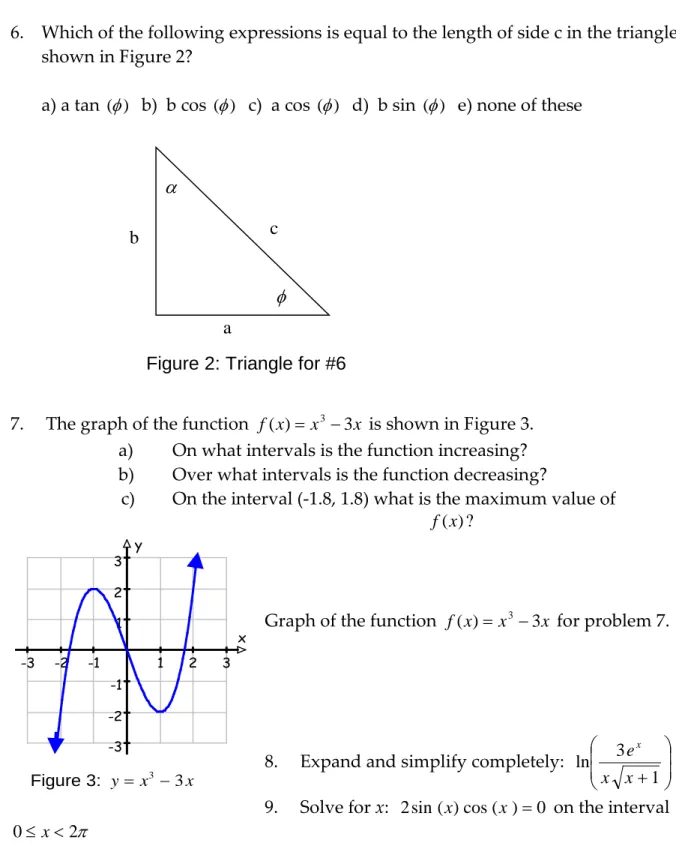
6. Which of the following expressions is equal to the length of side c in the triangle shown in Figure 2?
a) a tan (φ) b) b cos (φ) c) a cos (φ) d) b sin (φ) e) none of these
Figure 2: Triangle for #6
b c
a
φ α
7. The graph of the function f(x)=x3 −3x is shown in Figure 3.
a) On what intervals is the function increasing? b) Over what intervals is the function decreasing?
c) On the interval (-1.8, 1.8) what is the maximum value of f(x)?
Graph of the function f(x)= x3 −3x for problem 7.
8. Expand and simplify completely: +1 3 ln x x ex
9. Solve for x: 2sin(x)cos(x)=0 on the interval
π 2 0≤x< Figure 3: y= x3 −3x 1 2 3 -1 -2 -3 1 2 3 -1 -2 -3 x y
PCC COMPASS Placement Test Review Packet 83 10. Simplify: 3 15 8 2 + + + x x x 11. Find the inverse function of
4 ) ( + = x x x f
Answers
1. 2x+h, for h≠0 2. a) f(2)=2 b) 1 3. (g f)(x)=−x2 −4x and (f g)(x)=−x2 +6 4. Vertical:{
x=1, x=−1}
Horizontal: y=0 5. y=−4x+3 6. e 7. a) (−∞,−1)∪(1,∞) b) (−1,1) c) 2 8.( )
( )
ln(
1)
2 1 ln 3 ln + x− x − x+ 9. 2 3 , , 2 , 0 π π π 10. x+5, for x≠−3 11. x x x f − = − 1 4 ) ( 1How many of these problems can you miss and still succeed in MTH 251? Ideally, NONE.
These problems are just a sample of the larger number of skills that you should be familiar with BEFORE taking this course.
If some of these ideas are not familiar to you, you should enroll in one of the prerequisite courses (MTH 111C or MTH 112).
PCC COMPASS Placement Test Review Packet 84
Below is a sample of some skills you should have BEFORE entering
MTH 252 – Calculus II
You MAY NOT use a calculator. 1. LIMITS: a) 2 0 if ( ) ) ( ) ( lim f x x h x f h x f h = − + → b) 2 4 lim 2 2 − − → x x x c) xlim→2+ x−1 x −2 d) 3 6 2 lim 2 − + ∞ + → x x x e) ∞ − −∞ + = → 5,[3, ) ) 3 , ( , 13 ) ( if ) ( lim 2 3 x x x f x f x f)
( )
θ π θlim→ − csc g) t tlim→−∞e h)( )
x x ln lim 0+ → i) y( )
y 1 tan lim − ∞ → 2. DERIVATIVES: Find dx dy a) x x y=4 + 1 b) y= (2x −1) 6 (3x+4)5 c) y=ln(3x2+2x) d) y=cos(5x)−sin2(x) e) x2 +3xy−5y2 =93. A DISCONTINUITY exists for what values of x? a) 2 7 1 3 2 + − + x x x b) cot(x) 4. GIVEN: 4 3 2 3 6 1 12 1 ) (x x x x f = + −
a) What are the CRITICAL VALUES?
PCC COMPASS Placement Test Review Packet 85
5. Find the local extrema of ( ) 1 1n2( )
x x x
g = −
6. For what x-values is there a local maximum or minimum of if
3 2 1 x x y = −
7. What will be the RATE OF CHANGE in the area of a circle when the diameter is 20 feet if the radius is decreasing 1/10 foot per second?
Answers
1. a) 2x b) 4 c) ∞ d) 3 1 e) 4 f) ∞ g) 0 h) −∞ i) 2 π 2. a) 2 3 2 1 2 x x − b) 6 5 ) 4 3 ( ) 21 2 ( ) 1 2 ( 3 + + − x x x c) 6x+23x2 +2x d) −5 sin(5x)−2sin(x)cos(x)
e) x y y x 3 10 3 2 − + 3. a) 2 57 7± − b) kπ 4 a) 4 33 3 3 , 0 − ± b) −3< x<2 5. − 3 2 / 3 2 1 , e
e is a local minimum point
6. A local maximum occurs at x= 3
A local minimum occurs at x=− 3
7. sec ft 2 2 π − = dt dA
PCC COMPASS Placement Test Review Packet 86
How many of these problems can you miss and still succeed in MTH 252? Ideally, NONE.
These problems are just a sample of the larger number of skills that you should be familiar with BEFORE taking this course
If some of these ideas are not familiar to you, you should enroll in the prerequisite course (MTH 251)
Below is a sample of some skills you should have BEFORE entering
MTH 253 – Calculus III
You MAY NOT use a calculator.
1. Graph and find the area between the curves 2 2 and
4 x y x
y= = .
2. Simplify the expression
(
( )
)
n f
n f +1
for each function. a)
( )
2 2 1 7 5 3 − + ⋅ = n n n f b)( )
1 + = n n n f3. Evaluate each improper integral. a)
∫
∞ − 1 e dx x b)∫
1∞ 1+ 2 2 t dt4. Evaluate each limit; use L'Hopital's Rule where appropriate.
a)
( )
x
x
xsin
lim
∞ → b)( )
2lim
t tt
e
− ∞ → c)
∞ →θ
θ
θ5
tan
3
lim
5. Find the velocity, speed and acceleration at t =1 if s=2t3 −5t
6. Determine the interval(s) over which the function
( )
14 8 2 5 3 2 3 + − − = t t t t g is decreasing.PCC COMPASS Placement Test Review Packet 87 7. Integrate: a)
∫
x dx x cos 1 b)∫
tanxsec2xdx c)∫
e3ln( )x dx 8. Find:∑
= 10 1 k k9. Which of the following
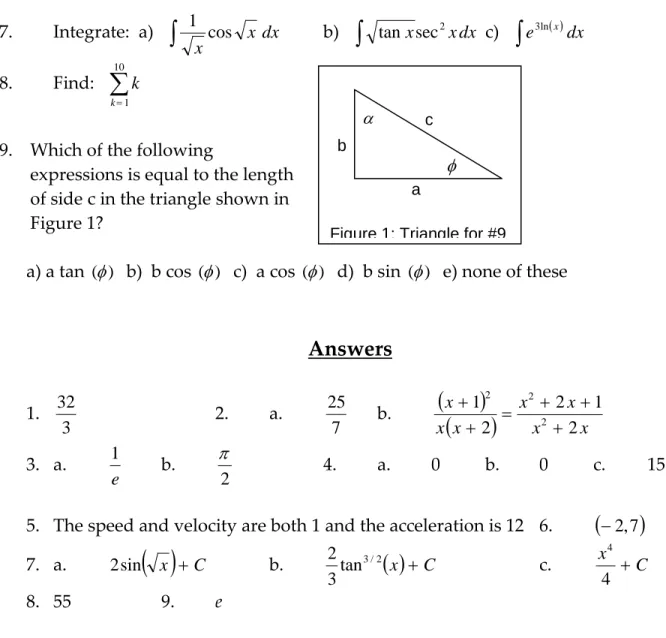
expressions is equal to the length of side c in the triangle shown in Figure 1?
a) a tan (φ) b) b cos (φ) c) a cos (φ) d) b sin (φ) e) none of these
Answers
1. 3 32 2. a. 7 25 b.(
(
)
)
x x x x x x x 2 1 2 2 1 2 2 2 + + + = + + 3. a. e 1 b. 2 π 4. a. 0 b. 0 c. 15 5. The speed and velocity are both 1 and the acceleration is 12 6.(
−2,7)
7. a. 2sin
( )
x +C b. tan3/2( )
x +C 3 2 c. x +C 4 4 8. 55 9. eHow many of these problems can you miss and still succeed in MTH 253?
Ideally, NONE.
These problems are just a sample of the larger number of skills that you should be familiar with BEFORE taking this course.
If some of these ideas are not familiar to you, you should enroll in the prerequisite course (MTH 252).
Figure 1: Triangle for #9 b
c
a
φ
PCC COMPASS Placement Test Review Packet 88
Math Review – Part II
Refreshing your Math
Please note that the following information is meant for review only. If the material or part of it is unfamiliar to you, it is recommended that you take the corresponding math class. Under each topic you will find the math class in which that particular material is taught.
Multiplication can be symbolized in different ways. For example: 5 • 2, 5 x 2, or (5)(2).
The use of “x” is not useful for algebra and will therefore not be used here. The other two variations will be used interchangeably. If variables are used multiplication is assumed if no sign appears. For example: 3a or ab.
Integers
(Math 20) Definitions
Integers are counting numbers, their negative counterparts, and zero:
The distance of a number from zero is called the absolute value. The absolute value is always positive: |5| = 5 and |-5| = 5
PCC COMPASS Placement Test Review Packet 89 Multiplying, Dividing, Adding, and Subtracting Integers
Examples: 12 ÷ 4 = 3 -2 • (-3) = 6 8 ÷ (-2) = -4 -5 • 6 = 30 4 + 9 = 13 -6 + (-11) = -17 9 + (-7) = 2 -14 + 6 = -8 9 – 12 = 9 + (-12) = -3 -14 – 7 = -14 + (-7) = -21 15 – (-3) = 15 + 3 = 18 -4 – (-5) = -4 + 5 = 1 Practice Problems: 1. 10 • (-7) 2. -8 • (-5) 3. -3 • (-15) 4. (-1)(15) 5. (0)(-8) 6. 80 ÷ (-10) 7. -63 ÷ 7 8. -81 ÷ (-9) 9. 0 ÷ (-5) 10. -7 ÷ 0 11. -3 + (-8) 12. 10 + (-4) 13. 5 + (-9) 14. -7 + 2 15. -6 + 8 16. 8 – 13 17. -7 – 10 18. 12 – (-4) 19. -5 – (-1) 20. -9 – (-9) Answers to Practice Problems:
1. -70 2. 40 3. 45 4. -15 5. 0 6. -8 7. -9 8. 9 9. 0 10. undefined 11. -11 12. 6 13. -4 14. -5 15. 2 16. -5 17. -17 18. 16 19. -4 20. 0
PCC COMPASS Placement Test Review Packet 90
Fractions
(Math 20) Definitions Numerator Fraction = DenominatorWhen the numerator is smaller than the denominator we call the fraction proper. If the numerator is greater than the denominator we call the fraction improper. Improper fractions can be written as mixed numbers, which is as an addition of a whole number and a proper fraction. For example:
2
3is a proper fraction; 4
3is an improper fraction and can be written as a mixed number: 1 1
3
Whole Numbers such as 5 can be written as 5
1
The reciprocal of a fraction has the numerator and denominator switched. For example:
3 2 is the reciprocal of 2 3 Mixed Numbers
Mixed numbers can be converted to improper fractions like this:
4 3 5 4 19 3
5 5 5
• +
= =
Improper fractions can be converted to mixed numbers by dividing with remainder:
19 5÷ =3 R 4 which translates into 34 5
Simplifying Fractions
When simplifying fractions we divide the numerator and the denominator by a common factor. Like this:
28 28 4 7 48 48 4 12 ÷ = = ÷
PCC COMPASS Placement Test Review Packet 91
This can also be done in several steps: 28 28 2 14 14 2 7
48 48 2 24 24 2 12
÷ ÷
= = = =
÷ ÷
At the end of a calculation fractions should always be simplified. Multiplying, Dividing, Adding, and Subtracting Fractions
Examples: 5 9 45 3 3 20• =60 =4 5 15 5 7 35 7 3÷ 7 = •3 15= 45=9 2 1 2 7 1 3 14 3 17 3 7 3 7 7 3 21 21 21 • • + = + = + = • • or or and 1 3 1 4 5 9 1 3 3 3 20 1 4 4 • • = = • 1 3 5 15 5 7 1 7 7 3 7 3 15 3 3 9 • ÷ = • = = • 5 1 5 4 1 3 20 3 17 6 8 6 4 8 3 24 24 24 • • − = − = − = • • Practice Problems: 1. 3 5 4 11• 2. 2 3 5 7 − • 3. 7 3 9 5 − •− 4. 5 14 21 25 − • − 5. 9 5 6 • 6. 1 3 5÷4 7. 2 3 5 4 − ÷ 8. 7 5 10 9 − ÷− 9. 8 2 15÷5 10. 4 4 5 − ÷
PCC COMPASS Placement Test Review Packet 92 11. 2 1 3+4 12. 1 3 5 10 − +− 13. 7 1 9 6 − + 14. 5 1 8 12 − − 15. 5 3 12 10 − −
Answers to Practice Problems: 1. 15 44 2. 6 35 − 3. 21 45 4. 2 15 5. 15 71 2 = 2 6. 4 15 7. 8 15 − 8. 72 132 50 = 50 9. 4 11 3= 3 10. 1 5 − 11. 11 12 12. 1 2 − 13. 11 18 14. 17 24 15. 43 60
Order of Operations
(Math 20)When evaluating numerical expressions we follow the Order of Operations:
Example 1: 2 2
25 (2 4) 4 2 1 Evaluate inside of parantheses first. 25 6 4 2 1 Evaluate exponents next.
25 36 4 2 1 Divide first since the division is further left than the multiplication 2
− + ÷ • + = − ÷ • + = − ÷ • +
= 5 9 2 1 Multiply.
25 18 1 Subtract first since the subtraction is further left than the addition. 7 1 Add. 8 − • + = − + = + =
1. Evaluate the inside of the parentheses or other grouping symbols first. Grouping symbols include also brackets, absolute value, square roots, and complex numerators and denominators.
2. Evaluate exponents.
3. Multiply or divide, whichever comes first as you read left to right. 4. Add or subtract, whichever comes first as you read left to right.
PCC COMPASS Placement Test Review Packet 93
Example 2:
2
2
5 1
25 (2 8) ( 8) • ( ) Evaluate inside of parantheses first.
3 2
5 1
25 ( 6) ( 8) • ( ) Evaluate exponents next.
3 2
5 1
25 36 ( 8) • ( ) Divide first since the division is further left than t
3 2 − − ÷ − − + = − − ÷ − − + = − ÷ − − + 3 1 he multiplication. 9 5 1
25 • ( ) Multiplication next by first simplifying the fractions.
2 3 2 3 5 1 25 • ( ) Multiply. 2 1 2 15 1 25 Subtrac 2 2 = + − + = + − +
= − + t first since the subtraction is further left than the addition.
25 15 1
The common denominator is 2.
1 2 2 50 15 1 2 2 2 35 1 Add. 2 2 36 2 = − + = − + = + = Simplify. 18 = Practice Problems: 1. 2 10 (9 2 2)− − • ÷ +5 3 2. 2 1 2 5 3− ÷ •3 3 −2 3. 2 4 3 23 7 5 8 4 5 4(4 1) + • − • + • − − 4. 2 2 25 36 3− ÷ • +2 24 2 3 (5 ( 6))÷ • − • − 5. 2 2 2 (36 4− ÷ •2 2) − − −( 5 30 2 3 40)÷ • + 6. 10 15 36 48 30 3 27 45 36 24 − ÷ − ÷ •
Answers to Practice Problems: 1. 8 2. 23 111 2 = 2 3. 25 121 2 = 2 4. 75 5. 300 6. 27 63 4 4 − = −
PCC COMPASS Placement Test Review Packet 94
Solving Linear Equations
(Math 60) Definitions
A variable is a place holder for a number. It is represented by a letter. Example: x, y, a, b
A term is a number, variable, or a combination of both if multiplied together. Different terms are separated by addition and subtraction.
Example: In the expression 5 + 7x – 7(x+2) the terms are 5 and 7x, and -7(x+2).
Like terms are terms that have the same variables with the same exponents. In an equation like terms can be combined.
Example: 7x and 2x are like terms, 8x and 4x2are not like terms. Distributive property: a(x+y) = ax + ay
Example: 2(3x-4) = 6x – 8 The Golden Rule of Algebra
The objective for solving equations or inequalities is to isolate the variable on one side of the equation or inequality. To achieve that we can do a combination of the following operations (“something” can be a number, variable, or a combination of both):
• Add something to both sides.
• Subtract something from both sides. • Multiply something to both sides. • Divide both sides by something. • Square both sides.
• Take the square root of both sides.
What you do to one side of an equation or inequality you have to do to the other side of the equation or inequality as well.
PCC COMPASS Placement Test Review Packet 95
In case of an inequality, if multiplied or divided by a negative number the sign will turn around (for instance from < to >).
Example 1:
2 8 7 2
2 8 7 7 2 7 subtracting 7 from both sides to bring variables to the same side 5 8 2 combining like terms
5 8 8 2 8 adding 8 to both sides to isolate v
x x x x x x x x x − = + − − = + − − − = − − + = + ariable
5 10 combining like terms 5 10
dividing both sides by 5 to isolate variable 5 5 2 simplify fractions x x x − = − = − − − = − Example 2: 7 ( 1) 8( 4) 3(7 12) 3 7 1 8 32 21 36 3 distributing
14 31 21 39 simplifying like terms
14 31 21 21 39 21 subtracting 21 from both sides to bring variables to the sam
a a a a a a a a a a a a a a a − − + − < + + − + + − < + + − < + − − < + − e side
7 31 39 combining like terms
7 31 31 39 31 adding 31 to both sides to isolate variable 7 70 combining like terms
7 70 7 7 a a a a − − < − − + < + − < − >
− − dividing both sides by 7, turning around the inequality sign 10 simplify fractions
a
− > −
Practice Problems:
Solve each equation or inequality. 1. 5x – 3 + 2x = 15 + 3x + 2 2. 9b – 8 + 8b > 17 + 2b + 5 3. 41y – 53 + 38y = 46 + 73y + 81 4. 4 + 7a – 11 = 24a – 6 – 13a 5. 2 + 8z – 5 < 8z – 9 – 4z 6. 54 + 79k – 91 = 34k – 37 + 45k 7. 15 – 3(b+7) = 2(b+2) 8. 23(x+1) + 7(2x–1) = 43x – 6(x–2) 9. 4n – 7(n–5) +10 < 8 – 15(n+2) – 6x 10.54x + 6(7x–4) ≥ 7(8x+7) – 9(4x–8x) Answers to Practice Problems:
1. x = 5 2. b > 2 3. y = 30 4. 1 4 x= − 5. 3 2 x< −
6. all real numbers 7. x = -2
PCC COMPASS Placement Test Review Packet 96 9. 67 18 x< − 10. 73 4 x≥
Graphing Lines
(Math 60) DefinitionsA line is the graphic representation of a linear equation in two variables. Example: The linear equation y = 2x + 1 can be graphically represented as:
−4 −3 −2 −1 1 2 3 4 −4 −3 −2 −1 1 2 3 4 x y y = 2x+1
The slope is a measure of how steep the line is.
The x-intercept is the intersection of the line and the x-axis. The y-intercept is the intersection of the line and the y-axis.
If the line is in the form y = mx + b we call it the slope-intercept form. With m representing the slope and b representing the y-intercept (0,b).
If the line is in the form ax + bx = c we call it the standard form.
We get the slope-intercept form from the standard form by solving for y.
We get the standard form from the slope-intercept form by subtracting mx from both sides (add if m is negative) and multiply by the common denominator (if there are fractions).
PCC COMPASS Placement Test Review Packet 97
To graph a line in slope-intercept form we make a table of values by choosing several values for x and solving the equation for y respectively.
Example: For the equation 1 1 2
y= − x− we choose 0, 2, and -2 for our x values (2 was
chosen so the fraction simplifies easily). We then substitute these values for x and solve for y. In the case of x=2 this is how:
Finding the other points the same way we get the following table:
x y
0 -1 2 -2 -2 0
Graphing each of those points and connecting the dots, we get the following graph:
−4 −3 −2 −1 1 2 3 4 −4 −3 −2 −1 1 2 3 4 x y y = -1/2*x-1
To graph a line in standard form we make a table of values by choosing 0 for x and solving the equation for y, and then choosing 0 for y and solving the equation for x. Example: For the equation x+2y= −2 we choose 0 for x and y and then solve for the
other variable respectively. For x=0 this is how:
Finding the other points the same way we get the following table:
x y 0 -1 -2 0 1 1 2 1 (2) 1 2 2 1 2 1 1 2 y x y y y y = − − = − − = − − = − − = − 2 2 0 2 2 2 2 2 2 1 x y y y y y + = − + = − = − = − = −
PCC COMPASS Placement Test Review Packet 98
Graphing each of those points and connecting the dots, we get the following graph:
−4 −3 −2 −1 1 2 3 4 −4 −3 −2 −1 1 2 3 4 x y
Finding the Slope and Intercepts
If the equation appears in slope-intercept form y = mx + b then m represents the slope and b is the y-intercept (0,b).
Another way of finding the slope is by using two points from the line and the slope formula: 2 1 2 1 y y m x x − = −
The y-intercept can also be found by choosing 0 (zero) for x and solving for y. The x-intercept can be found by choosing 0 (zero) for y and solving for x. Example: In the example of 1 1
2
y= − x− we know the slope is 1
2
− and the y-intercept is (0,-1). We find the x-intercept by choosing 0 for y and solving for x:
1 0 1 2 1 2(0) 2( 1) 2 1 0 2( ) 2(1) 2 0 2 0 2 2 x x x x x x x x = − − = − − = − − = − − + = − − + = − So the x-intercept it (-2,0).
PCC COMPASS Placement Test Review Packet 99
Practice Problems:
Graph each line and find its slope and intercepts. 1. y = x – 1 2. y = -3x – 4 3. 1 2 3 y= x+ 4. 2x + 3y = 5 5. x – y = -2 6. 3x – y = 4 Answers to Practice Problems:
1. m=1 x-intercept: (1,0) y-intercept: (0,1) −4 −3 −2 −1 1 2 3 4 −4 −3 −2 −1 1 2 3 4 x y 2. m=-3 x-intercept: ( 4 3 − ,0) y-intercept: (0,-4) −4 −3 −2 −1 1 2 3 4 −4 −3 −2 −1 1 2 3 4 x y 3. m= 1 3 x-intercept: (-6,0) y-intercept: (0,2) −4 −3 −2 −1 1 2 3 4 −4 −3 −2 −1 1 2 3 4 x y 4. m= 2 3 − x-intercept: (5 2,0) y-intercept: (0, 5 3) −4 −3 −2 −1 1 2 3 4 −4 −3 −2 −1 1 2 3 4 x y
PCC COMPASS Placement Test Review Packet 100 5. m= 1 x-intercept: (-2,0) y-intercept: (0,2) −4 −3 −2 −1 1 2 3 4 −4 −3 −2 −1 1 2 3 4 x y 6. m=3 x-intercept: (2 3,0) y-intercept: (0,-2) −4 −3 −2 −1 1 2 3 4 −4 −3 −2 −1 1 2 3 4 x y
Laws of Exponents
(Math 65)When simplifying expressions with exponents we follow these laws:
0
(
)
1
1 (
0)
(
)
m n m n m m n n m n mn m m m m ma a
a
a
a
a
a
a
a
a
a
a
ab
a b
+ − −=
=
=
=
=
≠
=
Examples: 1. x5x3 = x5+3 = x8 2. 6 6 14 8 14 8 1 h h h h h − − = = =PCC COMPASS Placement Test Review Packet 101 3.
( )
3 4 3 4 12 8 =8• =8 4.(
)
(
)
(
)
(
)
2 4 7 13 5 12 2 4 6 7 2 13 12 5 5 6 2 5 2 2 5 25 0 2 2 5 25 2 2 5 25 2( 2) 2(5) 2(25) 4 10 50 10 50 4 5 5 5 5 5 1 5 5 5 5 x y z y x y z x z x y z x y x y x y x y x y − − + − − − − − − = = = • = = = = Practice Problems: Simplify: 1. 52•54 2. x113 x 3. (a4)5 4. c–7 5. (yz3)6 6. 73 44 752 3 7 x x x • 7.( )
3 2 3 5 10 a b a b 8.(
)
2 7 2 3 4 4 4 s t st 9. 32103 4124 53133 64 3 3 x y z x z xy y z • • 10. 4 38 31 4 512 2510 3 46 2 4 a b c a c a c b c − − − − − − − − − • • Answers to Practice Problems:1. 56 2. x8 3. a20 4. 17 c 5. y6z18 6. 7x2 7. a b 8. 411 32s t 9. x z811 y 10. 4c214 a b
PCC COMPASS Placement Test Review Packet 102
Functions
(Math 60, 65, 95, 111)
Consider a function f(x). Then x is the input and f(x) the output. All eligible inputs make up the domain. All outputs make up the range.
Unless otherwise noted the domain is usually all real numbers. The two most common exceptions are:
1. If the function contains a fraction the domain will be restricted because the denominator cannot be zero. The function has a vertical asymptote at that point. 2. If the function contains an even root the domain will be restricted because the
radicand has to be greater or equal to zero.
To find the range it is often helpful to graph the function by solving f(x) for as many x as needed to see what the function looks like.
Example1: For the function f(x) = 2x+1 the domain is all real numbers and so is the range.
Example 2: For the function ( ) 3
5 2
f x x
=
+ the domain is restricted by the fact that 5x+2 cannot be zero. 5x+2=0 when 2
5
x= − . Therefore the domain is all real numbers with the
exception of 2
5
− . We can write that mathematically in different ways: 1. Domain: , 2 2, 5 5 −∞ − ∪ − ∞ 2. Domain: 2 | 5 x x ≠ −
We there for have a vertical asymptote 2
5
x= − .
To find the range we graph the function. We will start by choosing 0, 1, -1, 2, -2 for x and solve f(x). For x=2 this is how:
3 ( ) 5 2 3 (2) 5(2) 2 3 12 f x x f = + = + =
PCC COMPASS Placement Test Review Packet 103
Finding the other points the same way we get the following table:
x y 0 3 1.5 2= 1 3 0.4 7 = -1 -1 2 3 0.25 12= -2 3 0.4 8 − = −
If we put everything we have so far in a picture we get:
−4 −3 −2 −1 1 2 3 4 −4 −3 −2 −1 1 2 3 4 x y
It can be helpful to choose a few more points and we will find this graph:
−4 −3 −2 −1 1 2 3 4 −4 −3 −2 −1 1 2 3 4 x y
Knowing that we have a vertical and a horizontal asymptote we can see from here that the range is