Better Schools, Less Crime?
David Deming
∗October 2009
Abstract
I estimate the eect of attending a rst-choice middle or high school on young adult criminal activity, using data from public school choice lotteries in Charlotte-Mecklenburg school district (CMS). Seven years after random assignment, lottery win-ners have been arrested for fewer and less serious crimes, and have spent fewer days incarcerated. Lottery winners attended schools that were higher quality according to measures of peer and teacher inputs, as well as revealed preference, and the gain was roughly equivalent to switching from one of the lowest ranked schools to one at the district average. The reduction in crime persists through the end of the sample pe-riod, several years after enrollment in the preferred school is complete. The eects are concentrated among African-American males whose ex ante characteristics dene them as high risk. As a result the CMS lottery assignment system, which gave priority to disadvantaged applicants, probably reduced crime relative to a simple lottery like those implemented by many U.S. charter schools.
∗Harvard Kennedy School, 79 JFK St., Cambridge MA 02139 (email: [email protected]). I would
like to thank Lawrence Katz, Susan Dynarski, Brian Jacob, and Sandy Jencks for reading drafts of this paper and providing essential guidance and feedback. I beneted from the helpful comments of Josh An-grist, Amitabh Chandra, Roland Fryer, Alex Gelber, Josh Goodman, Bridget Long, Jens Ludwig, Erzo Luttmer, Juan Saavedra, Bruce Western, Tristan Zajonc and seminar participants at the Center for Ed-ucation Policy Research (CEPR) series at Harvard University, the American EdEd-ucation Finance Assoca-tion (AEFA) meetings, the Center for the Developing Child at Harvard University, and the University of Michigan. Special thanks to Tom Kane, Justine Hastings and Doug Staiger for generously sharing their lot-tery data, and to Eric Taylor and Andrew Baxter for help with matching the student and arrest record les. I gratefully acknowledge funding from the Julius B. Richmond Fellowship at the Center for the Developing Child and the Multidisciplinary Program on Inequality and Social Policy at Harvard. Web: http://www.people.fas.harvard.edu/∼deming/.
1 Introduction
Can improvement in the quality of public schools be an eective crime prevention strat-egy? Criminal activity begins in early adolescence, and peaks when most youth should still be enrolled in secondary school (Wolfgang, Figlio and Sellin 1987; Farrington et al. 1986; Sampson and Laub 2003; Levitt and Lochner 2001). Crime is concentrated among minority males from high poverty neighborhoods (Freeman 1999; Pettit and Western 2004; Raphael and Sills 2006). An inuential literature on neighborhood eects links criminal activity to neighborhood disadvantage through peer interaction models (Sah 1991; Glaeser, Sacer-dote and Scheinkman 1996), or processes of socialization and collective ecacy (Sampson, Raudenbush and Earls 1997).
Still, schools may be a particularly important setting for the onset of criminal behavior.1 Urban schools in high-poverty neighborhoods have high rates of violence and school dropout, and struggle to retain eective teachers (Lankford, Loeb and Wycko 2002; Murnane 2008; Cook, Gottfredson and Na 2009). Only 35 percent of inmates in U.S. correctional facilities earned a high school diploma or higher, compared to 82 percent of the general population (Bureau of Justice Statistics 2003). The best existing empirical evidence of the link between education and crime comes from Lochner and Moretti (2004), who use changes in compulsory schooling and child labor laws to estimate the eect of additional years of schooling on criminal activity. But the intensive margin of school quality is potentially more relevant for policy. In a human capital framework, low-skilled youth will engage in crime early in life because of low anticipated returns to schooling (Lochner 2004). If increased quality raises the return to investment in schooling, youth will stay in school longer, earn higher wages as adults, and commit fewer crimes.2 Yet there is little evidence of the eect of school quality 1Since most public schools' assignment zones are dened by neighborhood, disentangling the separate
inuences of neighborhoods and schools is dicult. Jacob and Lefgren (2003) nd that contemporaneous school enrollment leads to decreases in property crime but increases in violent crime, although their sample is not representative of large urban school districts.
2Additional compulsory schooling might accomplish the same goal, but the range of options for
policy-makers is limited. The minimum school leaving age is already 18 in 18 states, and enforcement of truancy laws is sporadic (Oreopoulos 2006). Also, the population of never takers (i.e. youth who would drop out of school at the same age regardless of the law) might be particularly important.
on crime.3
In this paper I link a long and detailed panel of administrative data from Charlotte-Mecklenburg school district (CMS) to arrest and incarceration records from Charlotte-Mecklenburg County and the North Carolina Department of Corrections (NCDOC). In 2002, CMS imple-mented a district-wide open enrollment school choice plan. Slots at oversubscribed schools were allocated by random lottery. School choice in CMS was exceptionally broad-based. Ninety-ve percent of students submitted at least one choice, and about forty percent chose a non-guaranteed school. Youth at higher ex ante risk for crime were actually more likely to choose a non-guaranteed school, allaying concerns about cream-skimming that might complicate the external validity of the ndings (Epple and Romano 1998).
I estimate the causal eect of winning the lottery to attend a rst-choice school on criminal activity through 2009, seven years after random assignment. Across various schools and for both middle and high school students, I nd consistent evidence that winning the lottery reduces adult crime.4 The eect is concentrated among African-American males and youth who are at highest risk for criminal involvement. If I weight crimes by the best available estimate of their cost to society, attendance at a rst choice school saves society at least $14,000 in criminal victimization costs per applicant, again with greater eects for youth who are at higher risk for crime. Lottery winners also attend school longer and show immediate improvements on school-based behavioral outcomes such as absences and suspensions. However, there is no detectable impact on test scores for any youth in the sample.
The pattern of eects is consistent with an increase in school quality that keeps youth enrolled in school longer and raises the opportunity cost of crime. Dierences between lottery winners and losers emerge around age 18 and persist to age 20 and beyond in both the middle 3Economic models of crime focus largely on changes in costs and benets of crime for individuals on the
margin of work and criminal activity (Becker 1968; Ehrlich 1973; Grogger 1998; Freeman 1999). A notable exception is Lochner (2004), who examines the onset of criminal behavior in a life-cycle model of schooling, crime and work. A recent paper by Weiner, Lutz and Ludwig (2009) nds a signicant decline in homicide following school desegregation.
4Youth age 16 and above are considered adult by the criminal justice system in North Carolina. I do
and high school samples. Thus nearly all of the reduction in crime occurs after enrollment in the preferred school is complete. The changes in peer and teacher quality experienced by lottery winners are roughly equivalent in magnitude to moving from one of the worst schools in the district to a school of average quality. Since nearly all of the lottery applicants stayed in CMS, winners and losers attended schools with similar budgets and governance structures. There were no additional community level interventions, such as in the Harlem Children's Zone (Dobbie and Fryer 2009). In sum, a treatment of between one and four years of enrollment in a higher quality public school led to large and persistent reductions in young adult criminal activity.
I also nd strong evidence of heterogeneous treatment eects. I exploit the richness of pre-lottery administrative data and estimate the probability that a youth will be arrested in the future as a function of demographics, prior academic performance, behavior in school, and detailed neighborhood characteristics. The eect on crime of winning admission to a preferred school is strongly increasing in this ex ante prediction. For the highest risk youth, I estimate a reduction of over $55,000 in criminal victimization costs per year enrolled in the preferred school. Thus societal welfare gains from targeting resources to these youth might be substantial (Donohue and Siegelman 1998). Although random assignment of slots to oversubscribed schools is an ideal research design, it may be suboptimal from a welfare perspective if treatment eects can be predicted on the basis of observable characteristics (Bhattacharya and Dupas 2008). I simulate the eect of allocating slots based on ex ante crime risk rather than at random, and I nd that this would reduce the social cost of crime by an additional 27 percent. While this allocation method is controversial (and in the case of race, illegal), it was executed at least in part by CMS, which gave a priority boost in the lottery to applicants who met an income standard based on eligibility for free or reduced price school lunches. I estimate that this priority boost lowered crime by 12 percent, relative to a lottery without priority groups such as the ones typically administered by US charter schools.
Hoxby 2000). It also adds to the literature on the longer-term impacts of schooling inter-ventions (see e.g. Krueger and Whitmore 2001; Garces, Thomas and Currie 2002; Beleld et al. 2006; Deming 2009; Deming et al. 2009). One consistent nding that emerges from this literature is the lack of connection between contemporaneous test score impacts and im-pacts on later outcomes of direct interest. Since most programs (and increasingly, teachers) are evaluated on the basis of test scores, this lack of connection is troubling. The results suggest that behavioral measures may be equal in importance to test scores as predictors of long-term success, particularly for the high-risk males who are most aected by school choice in this setting. Indeed, in a setting that is most similar to the one here, Cullen, Jacob and Levitt (2006) nd no impact of school choice on test scores but some benets on behavioral outcomes, including self-reported criminal activity. Deming et al. (2009) nd that high school lottery winners in CMS from low-performing neighborhood schools are more likely to graduate from high school and attend college, again with little or no impact on test scores. Taken together, the results here and in other studies suggest that looking only at test score gains may miss important benets of interventions, particularly for disadvantaged youth. Finally, this paper adds to the body of empirical evidence that links early education to future criminality (Garces, Thomas and Currie 2002; Lochner and Moretti 2004; Beleld et al. 2006; Weiner, Lutz and Ludwig 2009).
Although more research is needed to disentangle the relative contributions of neighbor-hoods and schools, this paper provides some evidence that schooling exerts a particularly strong inuence on criminal behavior. The Moving to Opportunity (MTO) Demonstration found mixed impacts on crime (Ludwig, Duncan and Hirscheld 2001; Kling, Ludwig and Katz 2005). MTO changed both neighborhoods and schools, although the change in mea-sured school quality was not particularly large (Sanbonmatsu et al. 2006). Similarly, Jacob (2004) nds no independent impact on academic outcomes of moving out of high-density public housing. In contrast, the CMS open enrollment plan can be thought of as a pure school mobility experiment. Lottery winners continue to live in the same neighborhoods as lottery losers, and yet the reduction in crime persists even after schooling is largely complete.
The policy alternative to open enrollment in CMS was a traditional neighborhood schools model. Considering only the direct eect on lottery winners, I estimate that the implemen-tation of school choice led to a reduction of about $35 million in criminal victimization costs and another $685,000 in incarceration, under relatively conservative assumptions. Further-more, these gures do not consider the private benets to lottery winners. However, any welfare calculation must also account for the possible negative externality imposed by lottery winners on their new peers. Estimates from the literature suggest such spillovers are likely to be small in relation to the treatment eects, and ambiguous in sign depending on the nature of peer eects (Angrist and Lang 2004; Hoxby and Weingarth 2006; Carrell and Hoekstra 2008; Imberman, Kugler and Sacerdote 2009).5 Furthermore, many high risk applicants to non-guaranteed schools were automatically admitted. If the eects estimated here also hold in this degenerate lottery sample, the reduction in crime would be substantially larger. Still, because of the large one-year change in student assignments in CMS, extrapolations of the eects estimated here to other settings should be viewed with caution.
2 Data Description and Institutional Details
2.1 Data
With over 150,000 students enrolled in the 2008-2009 school year, Charlotte-Mecklenburg is the 20th largest school district in the nation. The CMS attendance area encompasses all of Mecklenburg County, including the entire city of Charlotte and several surrounding cities. Since the mid 1990s, the North Carolina Department of Public Instruction (NCDPI) has required all districts to submit a set of end-of-year (EOY) les that include demographic information, attendance and behavioral outcomes, yearly test scores in math and reading 5Carrell and Hoekstra (2008) estimate the negative externality caused by children from families that are
exposed to domestic violence and nd that adding one of these children to a class of 20 causes each other child to commit 0.093 more infractions. Importantly, they nd that the spillover eects on misbehavior are larger for low-income peers, which implies that concentrations of troubled students will generate more disruption. Since the net eect of open enrollment in CMS was to distribute high-risk children across more schools than what would have happened in a pure neighborhood schools model, the total externality eect
for grades 3 through 8, and subject-specic tests for higher grades. This reporting system ensures that variables are consistently coded across years and that students are tracked longitudinally from kindergarten through 12th grade. Internal CMS les obtained under a data use agreement also include identifying information such as name and date of birth, and students' exact addresses in every year, which I use to create detailed geographic identiers. For more details on the nature and quality of the CMS administrative data, see the Data Appendix.
I match CMS administrative data to arrest records from the Mecklenburg County Sheri (MCS).6 I obtain these arrest records directly from the MCS website, which maintains an online searchable database that covers arrests in the county for the previous three years, counting from the day the website is accessed.7 The data include all arrests of adults (age 16 and over in North Carolina) that occurred in the county, even if they were handled by another agency. The unit of observation is the arrest, but criminals are tracked across incidents using a unique identier that is established with ngerprinting. Each observation includes the exact nature of the charges, information about arrest processing (such as the arresting agency, whether there was an outstanding warrant, and the bond amount), and current address. Critically, each observation includes the name and date of birth of the criminal.
The match was done using full name and date of birth, and was exact in about 87 percent of cases. I obtained the remaining matches using an algorithm that assigns potential matches a score based on the number and nature of dierences.8 I conducted a number of checks to assess the quality of the match. First, since each arrest is given a unique identication number that is assigned consecutively in the order it was processed, I can calculate the 6Since CMS is a unied school district, the geographic coverage of the school administrative data and
the arrest records is identical.
7The web address is http://arrestinquiryweb.co.mecklenburg.nc.us/. I obtained the data by writing a
script that loops over arrest numbers in consecutive order and copies the relevant information into a text le. See the Data Appendix for details.
8As a specication check I ran the partial match algorithm a number of dierent ways, and I also estimated
all the results in the paper using exact matches only. This made little dierence. See the Data Appendix for details.
fraction of arrest numbers that are missing from the data. Counting from the rst day that the data were collected, this fraction is only 3.2 percent, and there are no large gaps. This suggests that nearly every arrest processed by MCS is present in the data.9 Figure 1 plots the age prole of arrests in Mecklenburg County by type of oense. The Federal Bureau of Investigation (FBI) collects data on eight dierent index crimes for the Uniform Crime Reporting (UCR) Program, which covers law enforcement agencies across the country. Index property crimes are burglary, motor vehicle theft and felony larceny. Index violent crimes include murder/manslaughter, rape, robbery and aggravated assault.10 The last category I include is felony drug oenses, which (based on weight) range from possession with intent to distribute all the way up to tracking. Index property and violent crimes peak at ages 17 and 18 respectively, which is consistent with other cohort studies of crime and delinquency (Wolfgang, Figlio and Sellin 1987; Farrington et al. 1986; Sampson and Laub 2003). Interestingly, drug felony arrests do not peak until the early to mid twenties, and decline much more slowly with age than other categories of crime.
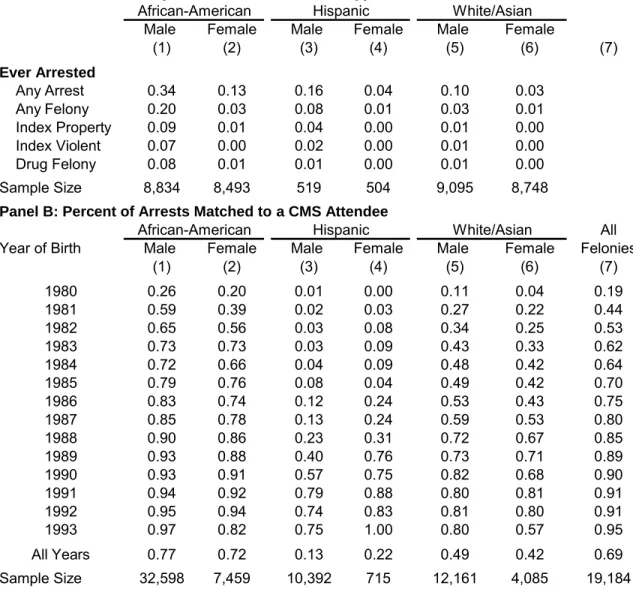
In the top panel of Table 1, I examine arrest rates of CMS attendees overall and by demographic group. I use six school cohorts of data, corresponding to students in grades 6 through 11 in 2002 and age 17 to 23 in 2009. The rst and second rows show the fraction of CMS attendees who have a criminal record, and who have at least one felony arrest respectively, by race and gender. Not surprisingly, arrest rates vary dramatically, from about 34 percent for African-American males to about 3 percent for White or Asian females. Rows three through ve show arrest rates by type of crime. African-American males are about six times more likely than white males to have at least one felony arrest, and about thirteen times more likely to be arrest for an index violent crime.
In the bottom panel of Table 1, I examine the percentage of arrests that are successfully matched to a CMS student by birth year and demographic group. Unmatched arrests could be students who were enrolled in private school, youth who travel to Mecklenburg County 9Most of the missing arrests have been expunged, and there is a slight increase in the number of expunged
arrests in earlier years.
from elsewhere to commit crimes, or poor data quality. Match rates are highest for African-Americans (who are more likely than whites to attend public school) and for more recent birth years.11 Since the CMS data only go back to the 1996-1997 school year, any student who left the district before that would not be matched. Since most criminals are high school dropouts, this is likely to result in fewer matches for the earliest birth cohorts. However, the weighted average match rate by birth year for the lottery sample exceeds 85 percent overall and 90 percent for African-American males. This high match rate is strong evidence of the quality of the data. It also highlights the important role that public school policies might play in city crime rates.
Since the CMS open enrollment plan began in 2002, some older members of the sample could have been arrested prior to 2006, when the arrest data begin. To address this issue, I also obtained historical arrest records directly from MCS for members of the lottery sample only.12 Finally, I add incarceration records from the MCS jail system and the North Carolina Department of Corrections (NCDOC). These county jail and state prison records are consis-tently available beginning only in 2006, and they were collected only for African-American male members of the lottery sample.13 The data include number of days incarcerated, but probation and parole records are not included. See the Data Appendix for more details on the collection and coding of the arrest and incarceration data.
2.2 Policy Context and Open Enrollment in CMS
From 1971 until 2001, CMS schools were forcibly desegregated under a court order. Students were bused all around the district to preserve racial balance in schools. After several years of legal challenges, the court order was overturned, and CMS was instructed that it could 11Illegal aliens who are arrested by Immigration and Naturalization Services (INS) in North Carolina are
often processed in Charlotte before they are sent to Atlanta and deported. This, along with the transient nature of the Charlotte's rising Latino population, accounts for the very low match rate among Latino arrestees.
12These data were recorded in almost exactly the same format as the more recent arrest records, although
I cannot check their quality as easily.
13The data are limited to African-American males because I was unable to automate the collection process
no longer decide student assignments on the basis of race. In December of 2001 the CMS School Board voted on a policy of district-wide open enrollment for the 2002-2003 school year. School boundaries were redrawn as contiguous neighborhood zones, and children who lived in each zone received guaranteed access to their neighborhood school. The one-year change in student assignments was dramatic about 40 percent of students at the middle and high school level were assigned to a dierent school than in the previous year. Because the inner city of Charlotte is dense and highly segregated, African-American and poor students were even more likely to be reassigned.
The open enrollment lottery took place in the spring of 2002. CMS conducted an exten-sive outreach campaign to ensure that choice was broad-based, and 95 percent of parents submitted at least one choice (Hastings, Kane and Staiger 2008). Parents could submit up to three choices (not including their neighborhood school). Students were guaranteed access to their neighborhood school, and admission for all other students was subject to grade-specic capacity limits that were set by the district beforehand but were unknown to families at the time of the lottery (Hastings, Kane and Staiger 2008). When demand for slots among non-guaranteed applicants exceeded supply, admission was allocated by random lotteries according to the following strictly ordered priority groups:
1. Students that attended the school in the previous year and their siblings.
2. Free or reduced price lunch eligible (i.e. low income, FRPL) students applying to schools where less than half of the previous year's school population was FRPL. 3. Students applying to a school within their own choice zone.14
Applicants were sorted by priority group according to these rules and then assigned a random lottery number. Slots at each school were rst lled by students with guaranteed access, and then remaining slots were oered to students within each priority group in order of their 14CMS divided schools into 4 choice zones and guaranteed transportation for students who applied to a
school within their zone. This included magnet schools. The zones were constructed so that there was an even mix of mostly white suburban and mostly black inner city schools in each zone. In practice, this priority group was rarely used since very few students applied outside their choice zone.
lottery numbers. CMS administered all of the lotteries centrally and applied an algorithm known as a rst choice maximizer (Abdulkadiroglu and Somnez 2003). While this type of mechanism is not strategy-proof, Hastings, Kane and Staiger (2008) nd little evidence of strategic choice by parents.
I begin with the full sample of middle and high school applicants. Since nearly all rising 12th graders received their rst choice, I restrict the analysis sample to grades 6 through 11. Next I exclude the ve percent of students who were not enrolled in any CMS school in the previous year. These students were much less likely to be enrolled in CMS in the following fall. Since previous enrollment was xed at the time of the lottery, this restriction does not bias the results. The analysis sample consists of 21,132 high school students and 22,896 middle school students. About sixty percent of these students chose (and were automatically admitted to) their neighborhood school rst. Of the remaining sample, about 75 percent were in lottery priority groups where the probability of admission was either zero or one. Even though these students chose a non-guaranteed school, there is no random variation in admission to exploit. The nal lottery sample consists of 1,891 high school students and 2,320 middle school students.
Under busing schools were racially balanced, but the surrounding neighborhoods re-mained highly segregated. Thus the redrawing of school boundaries led to concentrations of minority students in some schools. Students who were assigned to these schools attempted to get out of them. Figure 2 displays the strong correlation between the racial composition of a school's neighborhood zone and the percent of students assigned to it who choose not to attend. Table 2 presents the average characteristics of lottery applicants compared to all CMS students. Column 1 shows control means and Column 2 shows coecients from regres-sions of observable characteristics of students on an indicator for whether the student listed a non-guaranteed school as their rst choice. Unlike many other instances of school choice, applicants to non-guaranteed schools are more disadvantaged than students who choose their neighborhood school. They are nearly twice as likely to be nonwhite and free or reduced price lunch eligible. Applicants to non-guaranteed schools also score about 0.4 standard
de-viations lower on both math and reading exams, and have been suspended and absent more days in the previous school year. Column 3 includes neighborhood school xed eects, to assess the nature of within-school selection. Column 4 presents control means and Column 5 presents estimates where the sample is restricted to neighborhood schools where 60 percent or more of the assigned students are African-American or Latino.
Although applicants to non-guaranteed schools are more disadvantaged across schools, they are relatively similar on observables within the schools from which most of the lot-tery sample comes. Column 5 shows that, even with predominately minority schools, non-guaranteed applicants have test scores that are very similar to students who chose the neigh-borhood school. Furthermore, even within these high minority schools, applicants to non-guaranteed schools are absent and suspended more often. Column 6 looks only at students who were in non-degenerate lotteries (where the probability of admission was neither zero nor one). We see that applicants in the lottery sample have slightly higher test scores (about 0.1 standard deviations). However, this is largely because of the priority boost given to economically disadvantaged applicants, many of whom were automatically admitted and thus not subject to randomization.15 Overall, the lottery sample is more disadvantaged than the average CMS student, but quite representative on observables of the students who attend high minority schools. Still, since lottery applicants had dierent preferences than their peers who chose to stay in the neighborhood school, they may dier on unobserved dimensions.
3 Empirical Strategy
If lottery numbers are randomly assigned, the winners and losers of each lottery will on average have identical observed and unobserved characteristics. Thus with sucient sample size, a simple comparison of mean outcomes between winners and losers would identify the causal eect of winning each individual lottery. However, the sample here is not large enough 15Because of the separate priority group assigned to FRPL students who apply to non-FRPL schools,
most schools either had lotteries for them and denied everyone else, or automatically admitted them and had lotteries for non-FRPL students.
to estimate the eect of winning each individual lottery. Instead, following Cullen, Jacob and Levitt (2006), I estimate ordinary least squares regressions of the form:
Yij =δ·W inLotteryij +βXij + Γj +εij (1)
Yij is the outcome variable of interest for student i in lottery j. W inLotteryij is an
indicator variable equal to 1 if student i had a winning random number in lottery j. Xij is a
vector of covariates included only for balance, Γj is a set of lottery (i.e. choice by grade by
priority group) xed eects, and εij is a stochastic error term. I consider only rst choices
here, so the number of observations is equal to the number of students in the lottery sample. In principle I could estimate a nested model that incorporates multiple choices. However, in practice nearly every student who did not receive their rst choice was either automatically admitted to their second choice (if it was not oversubscribed) or automatically denied since all the slots were already lled.
Lottery xed eects are necessary to ensure that the probability of admission to a rst-choice school is uncorrelated with omitted variables in the error term. If, for example, savvy parents had some prior knowledge about the chance of admission, they might (all else equal) apply to schools where the probability of acceptance was higher. Thus comparing winners and losers across dierent lotteries might lead to a biased estimate. In the specication in equation (1), the δ coecient gives the weighted average dierence in outcomes between
winners and losers across all lotteries, with weights equal to the number of students in the lottery times p·(1−p) where p is the probability of admission (Cullen, Jacob and Levitt,
2006). Thus δ represents the intention-to-treat (ITT) eect of winning admission to a
rst-choice school for students in priority groups with non-degenerate lotteries. I cannot estimate the eect of attending a school for students with guaranteed access.
If the lotteries were conducted correctly, there should be no dierence between winners and losers on any characteristic that is xed at the time of application. I test this directly by estimating equation (1) with pre-treatment covariates such as race, gender and prior
test scores as outcomes. The results are in the Appendix. For both the middle and high school samples, the dierences between winners and losers are small and no more likely to be statistically signicant than what is expected by chance. This is strong evidence that initial assignment was random. Even with proper randomization, however, the estimates could still be biased by selective attrition if leaving CMS or Mecklenburg County is correlated with winning the lottery. More than 95 percent of lottery applicants in the spring of 2002 were enrolled in a CMS school the following fall, and there was no dierence by lottery status. Still, since high school dropout rates are extremely high for crime-prone youth, selective attrition is a serious concern for outcomes that come from the CMS administrative data. Students who drop out of school and are subsequently arrested in Mecklenburg County, however, are included in the data. Thus the main issue is selective migration. If lottery losers are more likely to leave Charlotte, they may commit crimes in other jurisdictions. This would bias estimates downward. On the other hand, lottery winners may perform better in school and be more likely to leave the county to go to college, for example. This would bias the estimates upward.
Still there are a few reasons to think that selective migration is not much of a concern here. First, the population of crime-prone youth is not very mobile. Attrition in grades K through 8 (where dropout is less of an issue) is negatively correlated with other predictors of crime and is much lower than average among future criminals.16 Second, CMS assigns a withdrawal code to students who leave the district, and lottery status is uncorrelated with the code for out-of-county transfers. Additionally, the NCDOC state prison data includes information on county of arrest. Less than one percent of the sample spent time in state prison for oenses committed outside of Mecklenburg County, and there is no dierence between lottery winners and losers.
16Ninety-one percent of future felons who were enrolled in CMS in 4th grade were still enrolled four years
3.1 Predictors of Crime and Heterogeneous Treatment Eects
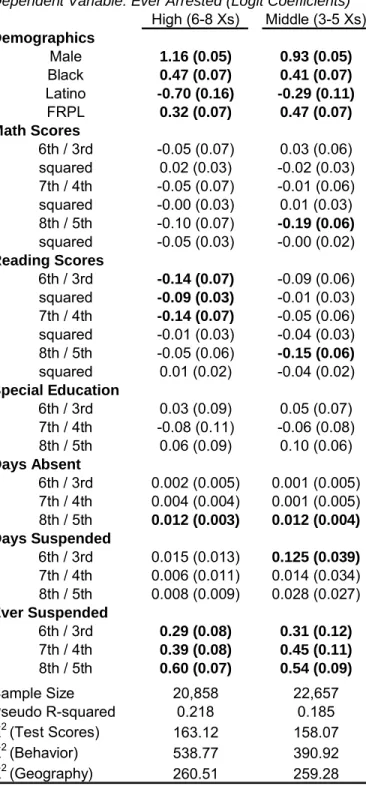
Many members of the lottery sample are probably not at high risk for criminal oending. Likewise, it is has been shown that a small percentage of high-rate oenders are responsible for a large share of crimes (Wolfgang, Figlio and Sellin 1987; Freeman 1999). To test for heterogeneous treatment eects, I exploit the unusually long and rich panel of administrative data from CMS. Students with adult arrest records can be tracked all the way back to kindergarten in some cases, with yearly information on test scores and behavior and detailed neighborhood measures. I combine all of the individual correlates of criminal behavior into a single index and plot the treatment as a function of this ex ante crime risk. I estimate the probability that a student will have at least one arrest as a function of demographic variables, yearly math and reading test scores, absences, out of school suspensions, and special education classications. For the high school sample I use data from grades 6 through 8, and grades 3 through 5 for the middle school sample.17 I allow for second order polynomials in all of the continuous measures. Finally, I include neighborhood school zone by census tract xed eects, using each student's exact address in the year prior to open enrollment. See the Appendix for more details on the estimation and for regression coecients from this prediction.
These prior measures are strong predictors of future criminality.18 Figure 3 plots the density of predicted criminality for all CMS students in grades 6 to 11, then for African-American males overall and from the seven lowest-performing schools (dened by average test scores) in the district. The distribution shifts rightward noticeably for these high risk subgroups. To test for the possibility of heterogeneous treatment eects, I rank male youth according to their arrest risk and split the sample into ve equally sized quintiles. I then estimate specications like equation (1) with a full set of interactions between lottery status 17In North Carolina, standardized End-of-Grade (EOG) tests in math and reading are administered for
grades 3-8 only. While additional years of data would improve the precision of the estimates, it would also increase the percentage of respondents with missing data.
18The pseudo R-squared from the regression is about 0.23, compared to 0.24 when high school graduation
is the dependent variable. Joint tests for the signicance of each type of coecient yield chi-squared values of 147 for test scores, 471 for behavior, and 249 for neighborhood xed eects.
and indicator variables for each quintile: Yij =δ·[(1 +W inLotteryij)· 5 X q=1 I(q <cPr(arrest|Xij)< q)] +βXij + Γj+εij (2)
The main eects by risk quintile (i.e. whether their predicted probability of arrest is between the lower bound q and the upper bound q for each quintile q) and the interactions
between each quintile and the win lottery indicator variable allow me to test the hypotheses that lottery winners and losers are equal overall and within each quintile, and that the arrest risk quintile main eects are statistically dierent. I rst estimate equation (2) for the main crime outcomes and plot the treatment eects and associated condence intervals against each risk quintile. I then estimate simpler models where the rst through fourth quintiles are pooled but the lottery is allowed to have a dierent eect on the top quintile high risk youth. In Tables 3 through 8, I include only the predicted probability of arrest [Pr(c arrest|Xij)] in
the Xij vector, in lieu of individual controls such as race, prior test scores and neighborhood
xed eects.19 Results with additional covariates are nearly identical.
3.2 The Eect of Winning the Lottery on Measures of Enrollment
and School Quality
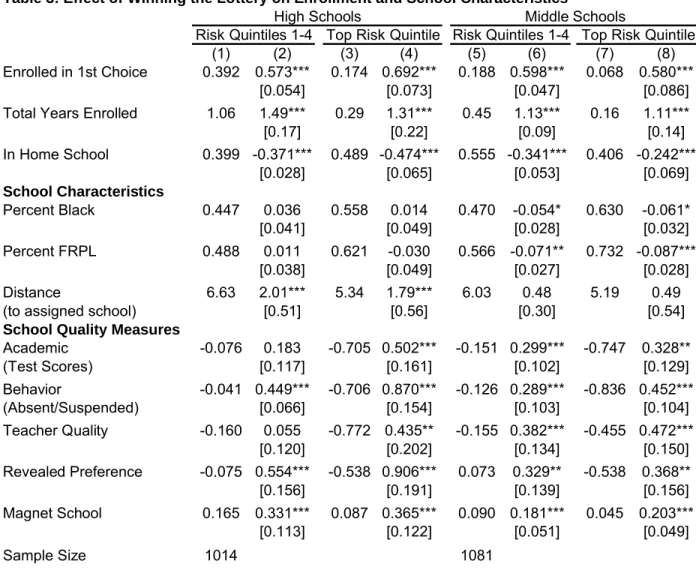
Table 3 presents the eect of winning the lottery on enrollment and school characteristics for male applicants. Columns 1 through 4 present results for high school lottery applicants; columns 5 through 8 show the same for middle school applicants. The coecients come from a regression like equation (2), but with the lowest four risk quintiles pooled together and a separate estimate for the top risk quintile. The odd numbered columns present control means for the estimates in each row. Below each estimate, and in subsequent tables, I report standard errors that are clustered at the individual lottery (i.e. choice by grade by 19Controlling for the predicted arrest probability serves to balance the control and treatment groups at
priority group) level. The rst row shows the eect of winning the lottery on attendance at a student's rst choice school on the 20th day of the 2002 school year. The rst stage is strong - lottery winners in all groups are over 55 percentage points more likely than losers to attend their rst choice school. The coecient is less than one mainly because some lottery losers successfully enroll in their rst choice anyway. Some students moved into the school's neighborhood zone in the summer of 2002, after losing the lottery. Some lotteries were for special programs within schools, so a student might have been denied admission to the special program but accepted to the regular school. Finally, some students may have been admitted at the beginning of the school year when lottery winners did not enroll. As we can see from the control means, enrollment among lottery losers is more common in the lower risk quintiles.
The second row shows the eect of winning the lottery on total years enrolled in the rst choice school. The treatment consisted of 1 to 1.5 additional years of enrollment on average, although notably from a much lower baseline for the top risk quintile. This suggests that the treatment dose was proportionally much larger for high risk youth. The third row shows the eect of winning the lottery on attendance at the student's neighborhood school, which is highly negative for all groups. Rows four through six show the eect of winning the lottery on the racial and family income composition of the school and on distance to assigned school. High school lottery winners attend schools that are demographically very similar to the schools attended by lottery losers, while middle school winners attend schools that are less African-American and higher income on average. All lottery winners travel farther to attend their rst choice school, but the distance is greater for high school students.
The remaining rows of Table 3 show the eect of winning the lottery on various mea-sures of school quality. I normalize each of these meamea-sures to have mean zero and standard deviation one (separately for the middle and high school samples), to make them compara-ble to each other. Overall, lottery winners attend schools that are better on nearly every dimension. In general, the gain in quality for high risk youth is modestly larger than for the overall sample and starts from a much lower baseline, as indicated by the control means in
each odd-numbered column. The rst measure is average peer test scores in the year prior to the lottery. It is calculated as the average of the prior school year's standardized math and reading scores for students in the same grade, with sample members excluded from the cal-culation. The second measure is calculated the same way, but is the standardized average of absences and out-of-school suspensions for the student's peers in the year prior to the lottery (I reverse the sign so that a positive coecient means fewer absences and suspensions). For high risk youth in both samples, the gains in average peer behavioral outcomes are larger than gains in peer test scores.
The third measure of school quality is a standardized composite of two teacher charac-teristics that have been shown to aect student performance - the percentage of novice (less than three years experience) teachers in a school, and a coarse measure of teacher ability based on the competitiveness of the undergraduate college they attended.20 Lottery winners attend schools that rate signicantly higher on these measures of teacher quality. The gains are particularly large (over 0.4 standard deviations) for the highest risk youth.
The fourth measure of school quality is an indicator of revealed preference for each school, based on the choices made by all the students in CMS in the year of the open enrollment plan. I estimate a conditional logistic regression that predicts the probability that students will choose each school (separately for the middle and high school samples), controlling for a polynomial in distance from each student's address to each school, plus home school xed eects. The school-level residual from this regression is interpretable as an indicator of revealed preference.21 Including distance and home school xed eects controls for the fact that some schools might be more highly demanded because they are located in denser parts of the district. Since lottery schools are oversubscribed by denition, it is not surprising that 20I calculate the percentage of teachers in each school that attended a college considered at least very
competitive by Barron's Prole of American Colleges, 2009. About 30 percent of teachers in CMS met this standard. Other measures were available, such as the percentage of teachers with advanced degrees, but I did not include them since most evidence suggests they do not aect student performance (e.g. Gordon, Kane and Staiger 2006).
21See Long (2004) for a more detailed explanation of the conditional logit setup for college choice, and
Hastings, Kane and Staiger (2008) for a richer specication of preferences in this setting that uses all 3 choices and allows for substitution patterns, in a mixed logit framework.
winners are enrolled in more highly demanded schools. The eect is about twice as large for high school winners, and again is slightly larger for high risk youth in both groups. Finally, we can see that lottery winners are more likely to be enrolled in magnet schools, particularly at the high school level. Magnet school enrollment comprises a larger share of the treatment in the high school sample, mostly due to the opening of a new magnet high school (Philip Berry Academy of Technology, a career academy that focuses on vocational and technical education) in the 2002-2003 school year.
In sum, lottery winners attend schools that are signicantly better on several observable dimensions of quality. If school quality were normally distributed through CMS, then winning the lottery leads to average quality gains of around 0.3 standard deviations, with larger eects for high risk youth. Based on the control means in Table 3, lottery losers from the rst four risk quintiles attend schools that are slightly worse than the district average, and winners attend schools that are slightly better. Measured quality gains are larger for high risk youth, and winning the lottery gets them into schools that are closer to the district average.
For the main results in the paper, I report ITT estimates of the eect of winning the lottery. Since few school choice plans can prevent children from enrolling if they move into the neighborhood, or force lottery winners to attend their chosen school, the ITT estimate is best thought of as a policy eect. Later I present results using the lottery as an instrumental variable for several of the rst stage outcomes in Table 3. Because a non-trivial fraction of lottery losers still manage to enroll, these estimates are not generalizable to all lottery applicants. Instead, they are local average treatment eects (LATEs) for students who comply with their lottery status (Angrist, Imbens and Rubin 1996).
4 Results
4.1 Crime
Not all crimes are equal. Serious violent crimes such as murder, rape and armed robbery exact a heavy burden on their victims, so an estimate of the average eect of winning the lottery on crime should weigh these crimes more heavily. I measure crime severity in two ways. First, I use estimates of the victimization cost of crimes produced by Miller, Cohen and Wiersema (1996). These estimates, which were also used in an analysis of the of the Moving to Opportunity Demonstration by Kling, Ludwig and Katz (2005), consider tangible costs such as lost productivity and medical care, as well as intangible costs such as impact on quality of life, and are extremely high for fatal crimes.22 To avoid the estimates being driven entirely by a few murders, I also report results with the cost of murder trimmed to twice the cost of rape, following Kling, Ludwig and Katz (2005). The second measure of severity weighs crimes by the expected punishment resulting from a successful conviction. In 1994 the state of North Carolina enacted the Structured Sentencing Act. Under structured sentencing, felony convictions are grouped into classes based on severity. This information is combined with the oender's prior record and other circumstances to determine a range of possible sentence lengths available to the judge. I group felony charges according to their class and assign the midpoint of the range of sentences for each of them. While both measures place a very high weight on murder, for example, the sentence weighted measure is better able to capture criminal intent.23 I also examine the eect of winning the lottery on total days incarcerated in the county jail and state prison systems. These data are only available 22The estimated social cost of murder is $4.3 million in 2009 dollars. The next costliest crime is rape, at
about $125,000. Miller, Cohen and Wiersema (1996) do not include social cost estimates for drug crimes. Following Kling, Ludwig and Katz (2005), I assign costs to drug crimes according to felonies of equivalent standing. If instead I set the cost of drug crimes to zero, the estimates fall by about 25% in the high school sample but are unaected for middle schools. This comes mostly from a large dierence in the incidence of drug tracking charges across treatment and control high school students (there were 16 drug tracking charges in this sample, of which 14 occurred in the control group).
23For example, the dierence between manslaughter and aggravated assault often comes down to luck (i.e.
whether the bullet hit a critical organ or just missed it). The social cost measure would treat these two outcomes very dierently, whereas the expected sentence length for these two crimes is very similar.
for African-American male members of the sample, from 2006 to the present. Since most high school sample members were already age 20 or above by 2006, I am missing prison time served during the peak criminal oending ages of 18 to 19. Incarceration data is likely to be much more complete for the middle school sample, however.
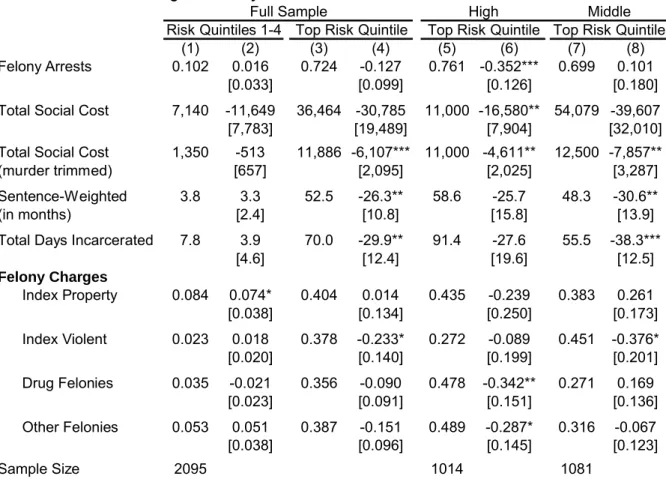
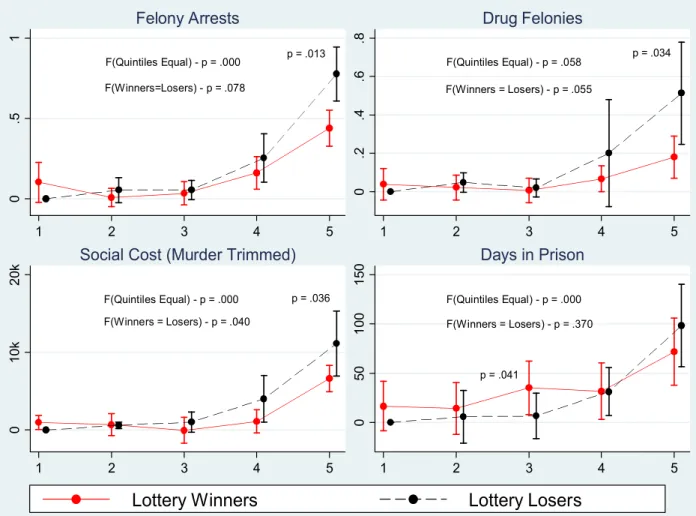
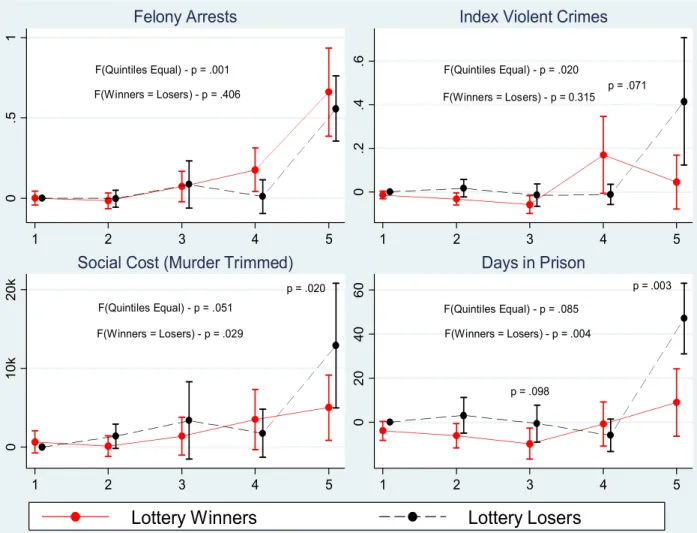
The main results of the paper are in Figures 4 and 5 and in Table 4. I rst estimate equa-tion (2) for selected crime outcomes and plot the point estimates and 90 percent condence intervals by arrest risk quintile in Figures 4 and 5, for the middle and high school samples respectively. Each graph plots the coecients from a model like equation (2), with a full set of lottery status by risk quintile interactions. The p-values from F-tests for equality of eects overall (and for each quintile, when statistically signicant) and equality of quintiles (in levels) are displayed on each graph. In Figure 4, we see that winning the lottery leads to fewer felony arrests overall (p=.078), and the eect is concentrated among the highest risk youth (0.76 felony arrests for lottery losers, 0.41 for winners, p=.013). Similarly, the trimmed social cost of crime is lower overall for lottery winners (p=.040), but the eect is concentrated among the top risk quintile youth ($11,000 for losers, $6,389 for winners, p=.036). In Figure 5, we see that the concentration of eects in the top risk quintile is even more pronounced for the middle school sample. The social cost of arrested crimes is $12,500 for middle school lottery losers and $4,643 for winners (p=.020), and the eect for days incarcerated is similarly large and concentrated among high risk youth (55.5 days for losers, 17.2 for winners, p=.003). For each of the eight outcomes in Figures 4 and 5, the level of crime committed by the top risk quintile is over twice that of the fourth quintile, and we can reject equality of quintiles at the 10 percent level for all eight outcomes.24
Table 4 shows regression results from a modied version of equation (2) where the rst four risk quintiles are pooled, but the eect is allowed to vary for the top risk quintile.25 In the rst four columns I report estimates with the high and middle school samples pooled, 24Although I do not report the test statistics, equality of the 4th and 5th risk quintiles among lottery
losers is rejected for all 8 outcomes in Figures 4 and 5.
25The models are estimated with the rst through fourth risk quintile youth included, but I do not include
with separate coecients (from the same regression) for quintiles 1-4 and quintile 5. I rst report results for the main outcomes of interest number of felony arrests, social cost of arrested crimes, sentence-weighted crimes, and days incarcerated. In the last four rows I show results by type of felony charge. The odd numbered columns contain control means for each outcome, and the even-numbered columns show coecients and standard errors, below in brackets.
Overall, winning the lottery led to an estimated reduction in the social cost of arrested crimes of over $30,000 for the top risk quintile, and over $11,000 for risk quintiles 1-4. Since more murders were committed by the control group than the treatment group (5 versus 1 in the combined high and middle school samples), the estimates are large and negative but relatively imprecise. When the cost of murder is trimmed, the eect becomes smaller but more precise. Winning the lottery led to a negative but insignicant drop of about $500 per male applicant in the rst through fourth risk quintiles, but a decrease of over $6,000 per male applicant in the highest risk quintile. The eect for high risk males is large (over half of the control mean) and statistically signicant at the one percent level. The results are of similar size and signicance for the alternative measure of crime severity. High risk lottery winners commit crimes with a total expected sentence of about 26 months, relative to about 52 months for lottery losers. Finally, high risk lottery winners spend about 40 days in prison, compared to 70 days for lottery losers. Both the sentence-weighted and days incarcerated measures are statistically signicant at the ve percent level.
Columns 5-6 and 7-8 show the top quintile results only, for the high and middle school samples respectively. Although the results for the main outcomes are similar, the pattern of eects by felony charges is dierent in each sample.26 High school lottery winners are arrested for fewer of every type of charge, but the eect is largest for drug felonies (about two-thirds of the control mean). There is no overall eect on felony arrests or charges for high risk middle school lottery winners, but they commit many fewer index violent crimes 26If someone is arrested once on seven counts of burglary, for example, this is seven charges but one arrest.
Often there will be an outstanding warrant for an arrestee and they are processed at the same time on charges stemming from multiple incidents.
(0.075 compared to 0.451 for losers). Since these crimes have the highest social cost and are punished most severely, the eects for social cost, sentence-weighted crimes, and days incarcerated are larger and more precisely estimated for the middle school sample.
Winning the middle school lottery leads to substitution from more to less serious crimes, while winning the high school lottery leads to fewer (primarily drug) arrests overall.27 Even though the eects are driven by high risk youth in both middle and high schools, the middle school sample appears more crime prone overall. The average number of felony arrests is about 0.7 in the top risk quintile for both samples, yet high school students have had many more years to accumulate arrests (and the average social cost of crimes is actually higher for the middle school sample). This is consistent with a developmental view of criminality, where delaying the onset of criminal oending among adolescents alters their future trajectory and prevents very serious crimes in the peak oending years (Mott 1993; Nagin and Tremblay 1999).
4.2 Dynamics of Criminal Behavior
I nd strong evidence that winning the lottery to attend a rst choice middle or high school reduces young adult criminal activity. The eects are concentrated almost entirely among high risk youth. One possible explanation for the results is that attendance at a rst choice school entails longer bus rides to and from school, incapacitating youth during the high crime hours after school. More generally, winning the lottery could prevent crime by remov-ing high risk youth from criminogenic peers or neighborhoods (e.g. Sampson, Moreno and Gannon-Rowley 2002; Kling, Ludwig and Katz 2005). Prominent models of criminal conta-gion treat individual crime as a function of contemporaneous exposure to crime-prone peers (Sah 1991; Glaeser, Sacerdote and Scheinkman 1996; Ludwig and Kling 2007). Depending on the student's grade, the treatment consists of between one and four years of guaranteed enrollment in their rst choice public school. Yet the arrest data continue for seven years 27This is supported by estimates where the dependent variable is dichotomous. High school lottery winners
after randomization, several years after enrollment in the rst choice school would have been complete. Therefore, both incapacitation and contagion models would predict a strong initial eect that fades over time. If, for example, drug market activity is concentrated within in a few schools, we might expect large dierences in criminality in the high school years that diminish as enrollment in the treatment school ends and lottery winners and losers return to the same neighborhoods.
On the other hand, attending a better school might generate decreases in crime that persist long after enrollment is complete. In a human capital framework, increased school quality would raise the marginal productivity of investment in schooling. Youth who are given the opportunity to attend a better school would stay enrolled longer and acquire more skills, which would translate into a higher expected wage in the labor market. Higher wages raise the opportunity cost of crime and incarceration, lowering the optimal amount of crime committed (Lochner 2004). To the extent that skills acquired in school have a persistent eect on wages, reductions in crime would also be persistent. Alternatively, peer networks formed in middle or high school could have a persistent inuence on adult criminality without aecting wages or employment directly. Although there is much evidence that social network formation is particularly important in the teenage years (e.g. Evans, Oates and Schwab 1992; Haynie 2001; Sacerdote 2001), there is little available evidence on the persistence into adulthood of criminal ties formed in adolescence. Finally, attending a better school might decrease the probability of arrest conditional on crime.28
A key limitation of this analysis is that I do not observe juvenile crime. This lack of early data could mask big dierences in juvenile oending in the early years of the treatment. As an alternative, Table 5 shows the eect of winning the lottery on school disciplinary outcomes such as absences and suspensions, as well as test scores and course-taking. Because nearly all of the impacts on crime come from the highest risk youth, I report results for the highest 28Although I cannot provide any direct evidence on this, Lochner and Moretti (2004) nd that the
rela-tionship between schooling and incarceration in the Census is similar to the relarela-tionship between schooling and self-reported crime, at least for white males. This suggests that higher levels of schooling do not greatly alter the probability of arrest conditional on crime.
risk quintile only, although the model is estimated with all male members of the sample. The rst two rows show results for unexcused absences in the rst two school years after the treatment, and the next two rows show the same thing but for out-of-school suspensions.29 Overall, lottery winners in both samples spend slightly more days in school. All four point estimates (2 samples, 2 years) for absences are negative, although only the 2003 middle school results are statistically signicant. The eect for high school suspensions in 2003 is relatively large (a reduction of 3.7 from a baseline of 9.5 in the control group), but the other eects are small and not distinguishable from zero.
One diculty with interpreting eects on absences and suspensions is that schools may dier in their discipline policies. If, for example, a higher-quality school maintains order by strictly enforcing rules, lottery winners might be more likely than losers to get suspended for equivalent behavior. This is particularly likely to be an issue in middle school, where suspensions are more common and more likely to be issued to otherwise well-behaved children as a deterrent to future bad behavior (Kinsler 2009). More directly, schools that succeed in keeping crime-prone youth in school longer may invest more resources in monitoring their behavior, whereas bad schools might simply allow them to drop out. I provide some limited evidence on this point by drawing from a detailed disciplinary incident le maintained by CMS beginning in the 2006 school year. The le contains information on the date and nature of each disciplinary infraction, as well as the resulting punishment. Because the data are only available beginning in 2006, I cannot look at incidents for the high school sample at all or for any of the treatment years in the middle school sample. I nd that, conditional on still being enrolled in a CMS school, high risk middle school lottery winners are about 14 percentage points less likely to be involved in an incident where the punishment was long-term suspension, expulsion, or police involvement.
In contrast to the results for crime and disciplinary outcomes, I nd no evidence of impacts on test scores. For the middle school sample, the test score measures are results 29Absence due to school suspension is considered an excused absence, so there is no overlap between the
from standardized math and reading exams administered yearly for grades 3-8. High schools administer a set of end-of-course (EOC) exams in subjects such as Algebra I, Geometry, Biology and English. However, they are not taken by all students or even in the same grade in many cases, and so selection into test-taking may compromise interpretation of the results. The one exception is English I, which is taken in 9th grade by almost all students, so I include it as the only high school test score measure. The results are never distinguishable from zero and imprecisely estimated. Still, I can rule out even modest test score gains (greater than 0.1 standard deviations) from winning the lottery. Finally, I examine impacts on two measures of course-taking - whether a student was enrolled in remedial math (dened as less than Algebra I by 9th grade, which is the latest year a student can take the exam and graduate on time), and total math credits accumulated on EOC exams in 9th and 10th grade.30 High risk lottery winners in high school are much less likely to be enrolled in remedial math (19 percentage points from a control group baseline of 37 percent). However, there is no decrease in remedial math among lottery winners in the middle school sample.31 The impact on math credits is positive but imprecise in both samples.
The school quality-earnings hypothesis outlined earlier predicts that high risk youth will stay enrolled in school longer and accumulate more human capital. Table 6 tests this pre-diction by examining the eect of winning the lottery on enrollment, grade progression, and grade attainment for high risk youth. The school enrollment measures classify respondents as enrolled if they are present in CMS in the year that they would have been in each grade if they progressed on time. For example, rising 6th grade lottery applicants would be enrolled in 9th grade in the 2005-2006 school year, so if they are still enrolled in CMS at the end of 2006 they are counted, even if they are not in grade 9.32 In the rst four rows of Table 6, we see that high risk middle school lottery winners are signicantly more likely to be enrolled in 30I examine math courses because they have been shown to aect subsequent earnings (Goodman 2009). 31During this time, CMS was toughening its high school course requirements, which may explain the
control group baseline dierence between the high school and middle school sample (37 percent in remedial courses for high school versus 21 percent for middle school).
32For each measure, I exclude members of the lottery sample who had already reached a particular grade
CMS in their 10th grade year. The dierence is large - 59 percent of lottery losers compared to 77 percent of winners are still enrolled in the 10th grade year. The eect on 11th grade enrollment is about half the size (9 percentage points) but imprecisely estimated, and there is no impact on persistence into the 12th grade year. Is this dierence in enrollment large enough to explain the impacts on crime? To test this, I estimate a regression of the trimmed social cost measure on similarly constructed grade enrollment dummies, a set of covariates and neighborhood xed eects using high risk youth from the full (not only lottery) sample. Then I multiply the estimated social cost of crime for each level of grade enrollment by the estimates in Table 6. If the cross-sectional relationship holds in the lottery sample, this rough calculation suggests that increased enrollment alone can explain about one-third of the total impact on crime for high risk middle school youth. Perhaps because 10th grade is around the time youth turn 16 and are legally permitted to leave school, enrollment beyond the grade 10 year is associated with a relatively large decline in crime. In contrast to the results for middle school, I nd no impact on enrollment for high risk high school youth.
Next I measure grade progression by counting students as on track if they have advanced at least one grade for every year since the lottery and are not enrolled in an alternative school for students with behavior problems. The pattern here is exactly the opposite as the results for enrollment. High school lottery winners are more likely to be on track for 9th, 10th and 11th grade. The estimates are of similar size in absolute terms (between 12 and 14 percentage points) but grow in relative terms, as lottery losers increasingly fall behind or enroll in alternative schools. The eect fades to insignicance by 12th grade, however. In contrast, there is no eect on on track enrollment for high risk middle school lottery winners.
Finally, I classify students' end outcomes into one of ve mutually exclusive and collec-tively exhaustive categories graduated from CMS, still enrolled in 2009, veried dropout, transfer and no show. Students who stop showing up for school are counted in one of the last three categories, but there is considerable uncertainty across those categories. First, students are coded as dropouts only at age 16 and above. Second, transfers (even out-of-state) show
up subsequently in the Mecklenburg county arrest data. These classications are particularly problematic for high risk youth, who graduate at very low rates and sometimes disappear from CMS well before the legal age of school leaving. Overall, there is no eect on high school graduation. The base rates of dropout, transfer and no show status show the degree of disadvantage in this high risk population. The graduation rate in the high school sample is only about 25 percent. It is currently only about 10 percent in the middle school sample, although some students who are still enrolled may subsequently graduate. To illustrate the unreliability of coding in the last three categories, I display in Column 5 the average social cost of crimes for members of the sample who are put in each category. Strikingly, despite the fact that some of the transfers are probably real, they are still arrested for over $11,000 of crimes in Mecklenburg County. Additionally, a bit less than 10 percent of the middle school sample never appears in any high school grade but subsequently appears in the arrest data. Because any intervention aimed at high school students would miss them altogether, this suggests that high school might be too late for the highest risk youth.
Overall, I nd some impact on enrollment and grade progression outcomes that fades by the end of high school. I also nd modest reductions in absences and suspensions, and a relatively large decrease in serious disciplinary incidents. However, high risk lottery winners in both samples are no more likely to graduate from a CMS high school, and there is no measurable impact on test scores. Compared to the large reductions in crime estimated earlier, impacts on other outcomes are modest, and they do not generally persist beyond 11th grade. Although I do not report the results here, there is more evidence of attainment and graduation impacts for the lower risk quintiles in the sample. This is consistent with Deming et al. (2009), who examine the eect of winning the high school lottery on college attendance, but also nd impacts on high school graduation for males from low-performing neighborhood schools.
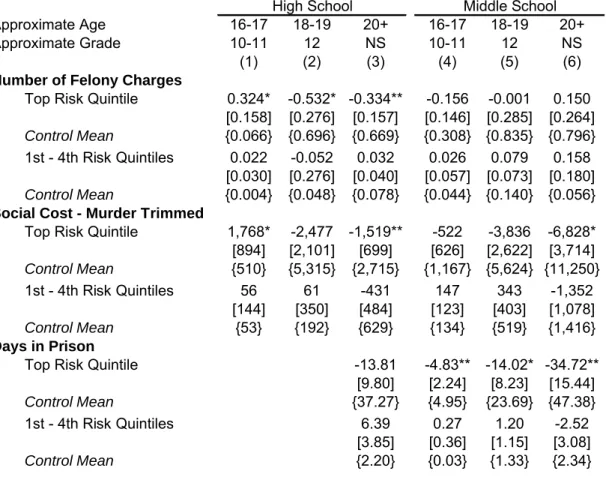
To examine the impact of winning the lottery on crime over time, I separate the data into three periods. Table 7 presents results for three of the main outcomes in Table 4, separated into the years when applicants are ages 16-17 (roughly 10th-11th grade), 18-19 (12th grade
to 1 year after high school), and 20 and older (post-high school). Because lottery applicants began the 2002-2003 school year in dierent grades, not all entering grades appear in each category at all, or for the same amount of time. For this reason I scale the estimates and control means so that the treatment eects for each period are per-two-years, and comparable in size to each other. Standard errors are in brackets below the estimates, followed by control means for each period in curled brackets.
For both high school and middle school applicants, the eects of winning the lottery are driven almost entirely by reductions in crime at age 18 and beyond. High school lottery winners are arrested for about 0.5 fewer felony charges at age 18-19 and 0.33 fewer charges at age 20 and above, but are actually more likely to be arrested at age 16-17. The patterns and eect sizes are similar for the social cost outcome. In the middle school sample, the reduction in social cost of arrested crimes is negative in every period for high risk youth, but largest in the age 20+ category. Similarly, the eect on days incarcerated grows with time and is very large (nearly 35 fewer days incarcerated) in the age 20+ category. This may help to explain the positive (though insignicant) increase in crime in period 3 the most serious oenders, who come disproportionately from the control group, are incarcerated. Despite this, the eect on social cost is largest in period 3, because this is when most of the murders happened. The patterns are similar for the other crime outcomes in Table 4. Data on incarceration are unfortunately unavailable for earlier periods in the high school sample. While the estimates are too imprecise to make strong statements, the pattern of results is most consistent with a school quality explanation and less consistent with incapacitation or criminal contagion. Although I do not report the results here, I nd no signicant dierence in high school characteristics for middle school lottery winners, nor do I nd any dierence in neighborhood relocation between control and treatment groups (and very few youth in either group move to another home in the years they are enrolled in CMS). Thus, once the treatment is complete, lottery winners and losers attend similar schools. After high school ends, they live in similar neighborhoods and compete in the same labor markets. Yet large dierences in crime and incarceration persist into early adulthood. The eect of winning
the lottery is largest at ages when most youth are mixing schooling, crime and work in some combination (Grogger 1998). If attending a better school increased the wages of lottery winners or their ability to nd work, this might lead to a decrease in crime that persists after the treatment is complete. Still, I do not directly observe employment or wages, and there are other explanations that are consistent with this pattern of results. Any explanation where crime or misbehavior committed early in life exerts a particularly strong inuence on later criminality (either by raising the cost of legitimate activities, or through the formation of long-lasting peer groups) would also lead to the patterns we observe.
In both samples combined, about 80 percent of students have already dropped out of school by the time they are arrested for their rst felony. Furthermore, even among the remaining 20 percent, students with arrest records are often absent and/or suspended for long stretches of time before an arrest occurs. Thus it is plausible that keeping students enrolled longer, or maintaining a stronger attachment to school, reduces the overall amount of crime committed by delaying the onset of criminality through the peak period of oending (Mott 1993; Nagin and Tremblay 1999).
4.3 The Eect of School Quality on Crime
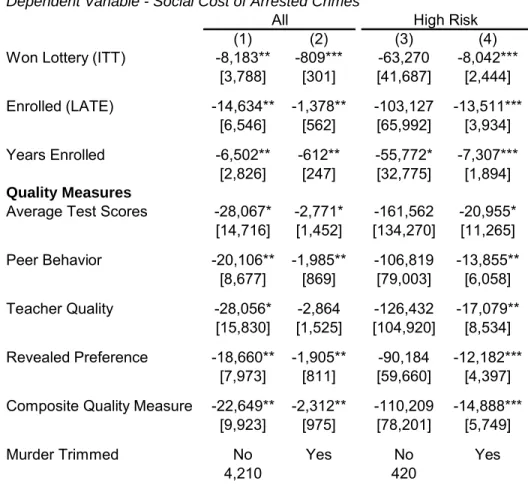
All the results so far have been ITT estimates of the eect of winning the lottery. In Table 8, I use the lottery to instrument for measures of enrollment and school quality. The rst two columns present results for the full sample of middle school and high school males, and the second two columns restrict the sample to lottery applicants in the top risk quintile. The odd numbered columns have social cost of arrested crimes as the outcome, and the even numbered columns show the same but with murder trimmed. In the second row I scale up the eect of winning the lottery by actual enrollment in the rst choice school. In Table 3 we saw that a relatively high fraction of lottery losers still managed to enroll. Therefore, the estimates in Table 8 are LATEs for youth who comply with the treatment, and do not
generalize to the full sample.33 Since the average rst stage eect on enrollment in Table 3 was around 0.55, the IV estimate is a bit less than double the ITT estimate. The third row shows the per-year eect on crime of enrollment in a rst choice school. The estimate is particularly large for high risk youth - each year of enrollment saves society over $55,000 in criminal victimization costs for arrested crimes.
Next I use the lottery to instrument for the measures of school quality described in Table 3. Each measure is normalized to have mean zero and standard deviation one. The last outcome is a normalized average of the other four quality measures. Overall, the magnitudes are relatively similar across dierent measures of quality. In the full sample, a one standard deviation in school quality leads to a reduction of between $18,000 and $28,000 ($1,900 and $2,800 when murder is trimmed) in the social cost of arrested crimes. Unfortunately, the measures of peer and teacher inputs and revealed preference are too collinear to distinguish the eects of each of them separately.34 For high risk youth, the estimates are much larger, around $100,000 (or $15,000 with murder trimmed) for a one standard deviation increase in school quality.
5 Discussion and Policy Implications
The nding that most of the eect of attending a better school on crime comes from the highest risk youth has important policy implications. Since criminal involvement can be predicted using covariates that are readily available to the school district, resources could be targeted very eciently toward these youth. While any reasonable social welfare function would also value other outcomes that I cannot measure here, it is important to note that 33The IV estimates are only valid if the monotonicity assumption (no deers - i.e. no applicant would
have enrolled if they lost or not enrolled if they won) holds (Angrist, Imbens and Rubin 1996). The group of compliers is a latent type, since we cannot directly observe who among the complier lottery losers would have enrolled if they had won (and vice versa for winners). Empirically, observed compliers are drawn from the middle of the distribution of arrest risk (Pr(c arrest|Xij)= .237) relative to the lottery loser always-takers
(cPr(arrest|Xij)= .161) and the lottery winner never-takers (Pr(c arrest|Xij)= .302).
34Controlling for one of the other quality measures in the regressions in Table 8 leads to highly imprecise
![Table 2: Selection into the Lottery Sample (1) (2) (3) (4) (5) (6) Male 0.51 -0.01 -0.01 0.50 0.00 -0.00 [0.01] [0.01] [0.01] [0.01] African-American or Latino 0.40 0.27*** 0.13*** 0.73 0.03 0.04 [0.01] [0.03] [0.03] [0.03]](https://thumb-us.123doks.com/thumbv2/123dok_us/1706121.2737360/50.918.155.755.137.505/table-selection-lottery-sample-male-african-american-latino.webp)