On the Complexity of Computing Treebreadth
Guillaume Ducoffe, Sylvain Legay, Nicolas Nisse
To cite this version:
Guillaume Ducoffe, Sylvain Legay, Nicolas Nisse. On the Complexity of Computing
Tree-breadth. Veli M¨
akinen; Simon J. Puglisi; Leena Salmela. 27th International Workshop on
Combinatorial Algorithms, IWOCA 2016, Aug 2016, Helsinki, Finland. Springer International
Publishing, 27th International Workshop on Combinatorial Algorithms (IWOCA 2016),
pp.3-15, 2016, Combinatorial Algorithms.
<
http://iwoca2016.cs.helsinki.fi/
>
.
<
10.1007/978-3-319-44543-4 1
>
.
<
hal-01354996
>
HAL Id: hal-01354996
https://hal.inria.fr/hal-01354996
Submitted on 22 Aug 2016
HAL
is a multi-disciplinary open access
archive for the deposit and dissemination of
sci-entific research documents, whether they are
pub-lished or not.
The documents may come from
teaching and research institutions in France or
abroad, or from public or private research centers.
L’archive ouverte pluridisciplinaire
HAL
, est
destin´
ee au d´
epˆ
ot et `
a la diffusion de documents
scientifiques de niveau recherche, publi´
es ou non,
´
emanant des ´
etablissements d’enseignement et de
recherche fran¸
cais ou ´
etrangers, des laboratoires
publics ou priv´
es.
On the complexity of computing treebreadth
?Guillaume Ducoffe1,2, Sylvain Legay3, and Nicolas Nisse2,1
1 Univ. Nice Sophia Antipolis, CNRS, I3S, UMR 7271, 06900 Sophia Antipolis, France 2
Inria, France
3
LRI, Univ Paris Sud, Universit´e Paris-Saclay, 91405 Orsay, France
Abstract. During the last decade, metric properties of thebagsof
tree-decompositions of graphs have been studied. Roughly, thelengthand the
breadthof a tree-decomposition are the maximum diameter and radius
of its bags respectively. Thetreelengthand thetreebreadthof a graph are the minimum length and breadth of its tree-decompositions respectively.
Pathlengthandpathbreadthare defined similarly for path-decompositions.
In this paper, we answer open questions of [Dragan and K¨ohler, Algo-rithmica 2014] and [Dragan, K¨ohler and Leitert, SWAT 2014] about the computational complexity of treebreadth, pathbreadth and pathlength. Namely, we prove that computing these graph invariants is NP-hard. We further investigate graphs with treebreadth one, i.e., graphs that admit a tree-decomposition where each bag has a dominating vertex. We show that it is NP-complete to decide whether a graph belongs to this class. We then prove some structural properties of such graphs which allows us to design polynomial-time algorithms to decide whether a bipartite graph, resp., a planar graph, has treebreadth one.
1
Introduction
Tree-decompositions [20] aim at decomposing graphs into pieces, calledbags, or-ganized in a tree-like manner (formal definitions are postponed to Section 1.3). Roughly, the width of a tree-decomposition is the maximum size of its bags. A lot of work has been dedicated to compute tree-decompositions with small width since such decompositions can be efficiently exploited for algorithmic pur-poses [4]. Computing the corresponding graph invariant, thetreewidthof a graph
G(i.e., the minimum width among all tree-decompositions ofG), is NP-hard [2] and no constant-approximation algorithm is likely to exist [22]. Moreover, real-life networks generally have a large treewidth [11]. These drawbacks motivated the study of other optimization criteria for tree-decompositions.
In particular, the metric properties of the bags have been studied. Roughly, the lengthand thebreadth of a tree-decomposition are the maximum diameter and radius of its bags respectively. The corresponding graph parameters are the
treelength[13] and the treebreadth[14] respectively. Recent studies suggest that some classes of real-life networks – including biological networks and social net-works – have bounded treebreadth [1]. This metric tree-likeness can be exploited
?
This work is partially supported by ANR project Stint under reference ANR-13-BS02-0007 and ANR program “Investments for the Future” under reference ANR-11-LABX-0031-01.
in algorithms. For instance, bounded treebreadth graphs admit a PTAS for the
Traveling Salesmanproblem [18]. They also admit compact distance labeling
schemes [12]. Furthermore, the diameter and the radius of bounded treebreadth graphs can be approximated up to an additive constant in linear time [9]. In contrast to the above result, we emphasize that under classical complexity as-sumptions the diameter of general graphs cannot be approximated up to an additive constant in subquadratic time, that is prohibitive for large graphs [8].
On the computational side, it is known that computing the treelength is NP-hard [19]. However, contrary to the treewidth, there exists a 3-approximation algorithm for computing the treelength [13]. In [14], a 3-approximation algorithm for computing the treebreadth is presented but the computational complexity of this problem is left open. Note that, because treelength and treebreadth differ by at most a factor 2 [14], any polynomial-time algorithm for computing the treebreadth, or anα-approximation algorithm for someα <3/2, would improve the 3-approximation algorithm for treelength [13].
Apath-decompositionof a graph is a tree-decomposition where the bags are organized according to a path structure. Treelength and treebreadth have their “path counterpart”, namely the pathlength and the pathbreadth. In [15], they have been shown to be useful in the design of approximation algorithms for bandwidth and line-distortion. A 2-approximation (resp., a 3-approximation) algorithm is given for computing the pathlength (resp., the pathbreadth) but the computational complexity of both problems is left open.
The main contributions of this paper are to answer the open problems of [14] and [15]. Namely, we prove that computing the treebreadth, pathlength and pathbreadth of graphs are all NP-hard problems.
1.1 Related work.
In contrast with treewidth [5], deciding whether a graph has treelength at most
kis NP-complete for every fixedk≥2 [19]. However, the reduction used for tree-length goes through weighted graphs and then goes back to unweighted graphs using rather elegant gadgets. It does not seem to us these gadgets can be easily generalized in order to apply to the treebreadth.
Relationship between treewidth and treelength (and so, treebreadth) has been investigated in [10]. The two parameters are uncomparable in general graphs. For instance, cycles have treewidth at most two but treelength dn/3e, while cliques have treewidth n−1 but treelength equal to one [13]. However, they differ by at most a constant ratio in the graphs with bounded genus and bounded isometric cycles [10]. Hence we are also motivated in this work to better understand the structure of tree-decompositions with small width for bounded genus graphs, and to improve their computation.
Recently, theminimum eccentricity shortest-path problem – close to
the problem of computing the pathlength and pathbreadth – has been proved NP-hard [16]. Let us point out that for every fixed k, it can be decided in polynomial time whether a graph admits a shortest-path with eccentricity at mostk [16]. Our results will show the situation is different for pathlength and pathbreadth.
1.2 Our contributions.
On the negative side, we prove in Section 2 that computing the treebreadth is NP-hard. More precisely, we first prove that recognizing graphs with treebreadth one is NP-complete. The latter may be a bit surprising since in comparison, graphs with treelength one are exactly the chordal graphs [19], and so, they can be recognized in linear time. Our reduction has distant similarities with the one for treelength. However, it does not need any detour through weighted graphs. Then, we show that the problem of deciding whether a graph has treebreadth one is polynomially equivalent to the problem of deciding whether a graph has treebreadth at mostk, for every fixedk≥1.
Next, we show that deciding if a graph has pathlength at most 2 is NP-hard even in the class of graphs with pathlength at most 3. We also show that deciding if a graph has pathbreadth at most 1 is NP-hard even in the class of graphs with pathbreadth at most 2. Hence, for any >0, the pathlength and the pathbreadth cannot be approximated within a factor 3
2−and 2−respectively
unlessP =N P.
On the positive side, we present polynomial-time algorithms for deciding whether a graph has treebreadth at most one, in the class of bipartite graphs and in the class of planar graphs. Precisely, we prove that a bipartite graph has treebreadth one if and only if it can be clique-decomposed in tree-convex
bipartite graphs [21]. Furthermore, while the planar graphs of treebreadth one are quite specific (in particular, we prove that they have treewidth at most 4), the algorithm is intricate and relies on structural properties of graphs with treebreadth one.
Due to lack of space, several proofs are only sketched or even omitted. They can be found in our technical report [17].
1.3 Definitions and notations
Graphs in this study are finite, simple, connected and unweighted. Given a graph
G= (V, E), the set NG(v) denotes the set of neighbors ofv ∈V in G.
Further-more, let NG[v] =NG(v)∪ {v}. The distance distG(u, v) between two vertices
u, v∈V inGis the minimum length (number of edges) of a path betweenuand
v inG. We will omit the subscript when no ambiguity occurs.
A tree-decomposition (T,X) of G is a pair consisting of a tree T and of a familyX = (Xt)t∈V(T)of subsets ofV indexed by the nodes ofT and satisfying:
– S
t∈V(T)Xt=V;
– for any edgee={u, v} ∈E, there existst∈V(T) such thatu, v ∈Xt;
– for anyv∈V,{t∈V(T)|v∈Xt}induces a subtree, denoted by Tv, of T.
The setsXtare calledthe bagsof the decomposition. For anyt∈V(T), the
diam-eterof the bagXtequals maxv,w∈XtdistG(v, w). We emphasize that the distance
is the one inG(not inG[Xt]). TheradiusofXtequals minv∈V maxw∈XtdistG(v, w).
We point out that the vertex v in previous definition does not necessarily be-long toXt. Thelengthof (T,X) is the maximum diameter of its bags, while the
Thetreelength and the treebreadthof G, respectively denoted bytl(G) and
tb(G), are the minimum length and breadth of its tree-decompositions, respec-tively. Pathlength and pathbreadth are defined similarly in the case of path decompositions, that is, whenT is a path. It has been observed in [14, 15] that the four above parameters are contraction-closed invariants.
A tree-decomposition is calledreduced if no bag is included in another one. Starting from any tree-decomposition, a reduced tree-decomposition can be ob-tained in polynomial time by contracting any two adjacent bags with one con-tained in the other until it is no more possible to do that. Note that such a process does not modify the width, the length nor the breadth of the decomposition.
In the following we will make use of the well-known Helly property in our proofs: any family of pairwise intersecting subtrees in a tree has a nonempty intersection.
2
Hardness of treebreadth, pathlength and pathbreadth
The main result of this section is the NP-completeness of deciding whether
tb(G)≤k, for any fixedk≥1. We first prove that the problem is NP-complete for k = 1. Then, we show that the problem of deciding the treebreadth of a graph is polynomially equivalent to the problem of recognizing graphs with tree-breadth one. Using similar techniques, we prove that computing pathlength, resp., pathbreadth, is NP-hard.
We start by a structural result on graphs with treebreadth one which will be a key lemma used throughout the paper. A tree-decomposition (T,X) of a graph is a star-decompositionif for eacht∈V(T),Xt⊆N[v] for somev ∈Xt.
That is, star-decompositions are similar to decompositions of breadth one, but the dominator of each bag has to belong to the bag itself. Lemma 1 shows that both definitions are actually equivalent.
Lemma 1. For any graph Gwithtb(G)≤1, every reduced tree-decomposition
of Gof breadth one is a star-decomposition.
Proof. Let (T,X) be any reduced tree-decomposition ofG of breadth one. We will prove it is a star-decomposition. To prove it, let Xt ∈ X be arbitrary and
letv ∈V be such that maxw∈XtdistG(v, w) = 1, which exists because Xt has
radius one. We now show that v ∈ Xt. Indeed, since the subtree Tv and the
subtrees Tw, w ∈ Xt, pairwise intersect, then it comes by the Helly Property
that Tv∩ Tw∈XtTw 6= ∅ i.e., there is some bag containing {v} ∪Xt. As a
result, we have thatv∈Xtbecause (T,X) is a reduced tree-decomposition. The
latter implies that (T,X) is a star-decomposition becauseXtis arbitrary. ut
We then show the main result of this section.
Theorem 1. Deciding whether a graph has treebreadth one is NP-complete.
In order to prove Theorem 1, we reduce the following particular instance of
author also proposed a reduction from Chordal Sandwichin order to prove
that computing treelength is NP-hard. However, we will need different gadgets than in [19], and we will need different arguments to prove correctness of the reduction.
Problem 1 (Chordal Sandwich with nK2).
Input: graphs G1 = (V, E1) and G2 = (V, E2) such that E1 ⊆ E2, |V| is
even and the complementary ¯G2ofG2 induces a perfect matching.
Question: Is there a chordal graphH = (V, E) such thatE1⊆E⊆E2 ?
Perhaps surprisingly, the restriction on the structure of ¯G2 is a key element
in our reduction. Indeed, we will need the following technical lemma whose proof can be found in [17].
Lemma 2. LetG1= (V, E1),G2= (V, E2)such thatE1⊆E2andG¯2is a
per-fect matching. Suppose that hG1, G2iis a yes-instance of Chordal Sandwich
with nK2.
There exists a tree-decomposition(T,X)ofG1with|X |=|V|/2+1bags such
that for every{u, v}∈/E2,Tu∩Tv=∅and there are two adjacent bagsBu∈Tu
andBv∈Tv such that Bu\u=Bv\v.
Proof of Theorem 1. The problem is in NP. To prove the NP-hardness, let
hG1, G2i be any instance of Chordal Sandwich with nK2. Let G0 be the
graph constructed from G1 as follows. First, a clique V0 of 2n = |V| vertices
is added to G1. Vertices v ∈ V are in one-to-one correspondance with vertices
v0 ∈ V0. Then, for every {u, v} ∈/ E
2, u and v are respectively made adjacent
to all vertices in V0\v0 and V0\u0. Finally, we add a copy of the gadget Fuv,
depicted in Figure 1(a), and the verticessuv andtuv are made adjacent to the
four verticesu, v, u0, v0.
We will provetb(G0) = 1 if and only ifhG
1, G2iis a yes-instance ofChordal
Sandwich with nK2.
In one direction, assumetb(G0) = 1, let (T,X) be a star-decomposition ofG0
(which exists by Lemma 1). We prove that the triangulation ofG1obtained from
this star-decomposition is the desired chordal sandwich. Let H = (V,{{u, v} |
Tu∩Tv 6= ∅}). H is a chordal graph such that E1 ⊆ E(H). To prove that hG1, G2i is a yes-instance of Chordal Sandwich with nK2, it suffices to
prove that Tu ∩Tv = ∅ for every {u, v} ∈/ E2. We claim that it is implied
by Tsuv ∩Ttuv 6= ∅. Indeed, assume Tsuv ∩Ttuv 6= ∅ and Tu∩Tv 6= ∅. Since
suv, tuv ∈N(u)∩N(v),Tu, Tv, Tsuv, Ttuv pairwise intersect, there is a bag with
u, v, suv, tuv by the Helly property. The latter contradicts that (T,X) is a
star-decomposition because no vertex dominates the four vertices. Hence the claim is proved. So, let us prove thatTsuv∩Ttuv 6=∅. By contradiction, ifTsuv∩Ttuv =∅
then every bag B onto the path between Tsuv and Ttuv must contain cuv, xuv.
SinceN[cuv]∩N[xuv] ={suv, tuv}and (T,X) is a star-decomposition, it implies
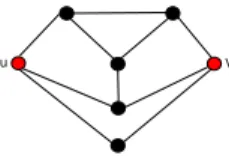
s t x y w z c uv uv uv uv uv uv uv cuv suv wuv tuv zuv yuv xuv suv tuv suv wuv tuv wuv
(a) GadgetFuv(top) with a star-decomposition of Fuv (bottom). 1 2 3 4 t u1u u u 2 3 4 v1u u u 2 3 4 u1v u u 2 3 4 u1u u v 2 3 4 u1u v u 2 3 4 u1u2u3u4 V' s1 t1 Yt, e 1 u1u2u3u4 V' s2 t2 Yt, e 2 u1u2u3u4 V' s3 t3 Yt, e 3 u1u2u3u4 V' s4 t4 Yt, e 4 t t t t 1 2 3 4 T1 Yt , e 1 1 Yt , e22 Yt , e33 Yt , e44 T C 1 1 T C 2 2 T C 3 3 T C 4 4
(b) A subtree of the star-decomposition of G0
(bottom) obtained from an internal bag with degree four of (T,X) (top). SubtreesTiare star-decompositions of the gadgetsFuivi.
Fig. 1.
adjacent bags Bs∈Tsuv, Bt∈Ttuv such thatBs⊆N[suv] and Bt⊆N[tuv]. In
particular,Bs∩Btmust intersect the path (yuv, wuv, zuv) becauseyuv∈N(suv)
and zuv ∈ N(tuv). However, N[suv]∩N[tuv]∩ {yuv, wuv, zuv} = ∅, that is a
contradiction. As a result,Tsuv∩Ttuv 6=∅and so,Tu∩Tv=∅for any{u, v}∈/E2.
Conversely, assume thathG1, G2iis a yes-instance of Chordal Sandwich with nK2. Since ¯G2 is a perfect matching by the hypothesis, let (T,X) be as
stated in Lemma 2. We will modify (T,X) in order to obtain a star-decomposition ofG0. To do so, we will use the fact that there are|V|/2 =nedges inE(T) and
the properties stated by Lemma 2. Indeed, this implies that there is a one-to-one mapping α:E(T)→E( ¯G2) between the edges of T and the non-edges ofG2.
Precisely, for any edge e = {t, s} ∈ E(T), let α(e) = {u, v} ∈ E( ¯G2) be the
non-edge ofG2 such thatu∈Xt, v∈Xs andXt\u=Xs\v.
Intuitively, the star-decomposition (T0,X0) ofG0 is obtained as follows. For
any t ∈ V(T) with incident edges e1,· · ·, ed, we first replace Xt by a
path-decomposition (Yt,e1,· · ·, Yt,ed). Then, for any edgee={t, s} ∈E(T), an edge is
added betweenYt,eandYs,e. Finally, the center-bag of some star-decomposition
of the gadgetFα(e)is made adjacent toYt,e(see Figure 1(b) for an illustration).
More formally, lett∈V(T) ande∈E(T) incident tot, and let{u, v}=α(e). Let Yt,e = V0∪Xt∪ {suv, tuv} (note thatYt,e is dominated by u0 ∈ V0). Let
e1,· · ·, edbe the edges incident totinT, in any order. For 1≤i < d, add an edge
betweenYt,ei andYt,ei+1. For any edgee={t, s} ∈E(T), add an edge between
Yt,eand Ys,e. Finally, add the star-decomposition (Te,Xe) for the gadgetFα(e)
as depicted in Figure 1(a) and add an edge between its center andYt,e.
The resulting (T0,X0) is a star-decomposition ofG0, hencetb(G0) = 1. ut
We next show that computing the treebreadth is polynomially equivalent to the recognition of graphs with treebreadth one.
Lemma 3. For every graphG, for every positive integerr, there exists a graph
G0
Proof. LetGhave verticesv1, v2, . . . , vn, and letr >0. The graphG0ris obtained
from Gby adding a cliqueU ={u1, u2, . . . , un} so that for every 1≤i≤n,ui
is adjacent to all vertices inBG(vi, r) ={x∈V(G)|distG(vi, x)≤r}.
Iftb(G)≤rthen we claim that given a tree-decomposition (T,X) ofGwith breadth at mostr, one obtains a star-decomposition ofG0
rby adding the clique
U in every bag in X. Indeed, for every bag Xt ∈ X, by the hypothesis there
is vi ∈ V(G) such that maxx∈XtdistG(vi, x) ≤ r, hence Xt∪U ⊆ NG0r[ui].
Conversely, iftb(G0r)≤1 then we claim that given a star-decomposition (T0,X0)
ofG0
r, one obtains a tree-decomposition ofGwith breadth at mostrby removing
every vertex of the cliqueU from every bag in X0. Indeed, for every bagX0
t ∈ X0, by the hypothesis there is y ∈ X0
t such that Xt0 ⊆ NG0
r[y]. Furthermore,
y∈ {ui, vi}for some 1≤i≤n, and so, sinceNG0
r[vi]⊆NG0r[ui] by construction,
X0
t\U ⊆NG0
r(ui)\U ={x∈V(G)|distG(vi, x)≤r}. ut
Lemma 4. For every graphG, for every positive integerr, there exists a graph
G0 computable in polynomial time such that tb(G)≤1 if and only iftb(G0)≤r. Proof. For every{u, v} ∈E(G), letFr
uv be obtained fromFuv in Figure 1(a) by
adding an edge{suv, tuv}then subdividing each edger−1 times. The graphG0
is obtained fromGby substituting each edge{u, v} ∈E(G) with a distinct copy ofFr
uv then identifyingu, v withsuv, tuv.
Iftb(G)≤1 then let us modify a star-decomposition (T,X) of Gin a tree-decomposition (T0,X0) of G0 of breadth at most r. Clearly, every bag inX has
radius at mostrinG0. Furthermore, let (Tuv,Xuv) be the star-decomposition of
Fuv in Figure 1(a), with three leaf-bags and one central bag. It can be modified
in a tree-decomposition of Fr
uv byi)adding in each bag containing both
end-vertices of an edge inFuvther−1 vertices inFuvr that result from its subdivision,
andii)adding a new leaf-bag with{u, v}and ther−1 vertices that result from its subdivision. Finally, let (T0,X0) be obtained from (T,X) by adding an edge
between some bag inTu∩Tvand the central bag ofTuv for every{u, v} ∈E(G).
Since (T0,X0) has breadthr,tb(G0)≤r.
Conversely, if tb(G0) ≤ r then we claim that given a tree-decomposition
(T0,X0) of G0 of breadth at most r, one obtains a tree-decomposition of G of
breadth one by removing every vertex of V(G0)\V(G) from the bags in X0.
Before proving the claim, observe that no vertex in V(G0)\V(G) can be at
distance at mostr from three vertices inV(G), and in case it is at distance at mostrfrom two verticesu, v∈V(G) then{u, v} ∈E(G). Therefore, in order to prove the claim it suffices to prove that u=suv andv =tuv are in a common
bag ofX0 for every {u, v} ∈E(G). The latter can be proved by elaborating on
the same arguments as for Theorem 1. ut
From Lemmas 3, 4 and Theorem 1, it follows that:
Theorem 2. For any fixed k≥1, deciding whether a graph G has treebreadth
at mostk is NP-complete.
To conclude this section, we consider pathlength and pathbreadth. Due to lack of space, the proofs are postponed in [17].
Theorem 3. For any > 0, the pathlength (resp., the pathbreadth) cannot be approximated within a factor 32− (resp.,2−) unlessP =N P.
3
Graphs with treebreadth one: some polynomial cases
In this section, we investigate further the class of graphs with treebreadth one. It strictly contains chordal graphs and dually chordal graphs, well-studied graph classes in algorithmic graph theory [7]. We first show some useful lemmas that somehow state that we can restrict our study on graphs without clique-separator. Then, we show that the problem of recognizing graphs with treebreadth one can be solved in polynomial time in the class of bipartite graphs and in the class of planar graphs.
LetG= (V, E) be a connected graph. Recall that a setS⊂V is aseparator
if G\S is disconnected. It is called a clique-separator if S induces a complete graph. Afull componentforS is any connected componentC ofG\Ssuch that
N(C) = S. If C is a full component for S then we call the induced subgraph
G[C∪S] a block. Finally,S is aminimal separator if there exist at least two full components forS.
Our objective is to prove that if a graphGhas treebreadth one then so do all its blocks. In fact, we will prove a slightly more general result:
Lemma 5. Let G = (V, E), S be a separator and W be the union of some
connected components of G\S. If tb(G) = 1 andW contains a full component forS, thentb(G[W∪S]) = 1.
Proof. Let (T,X) be a star-decomposition ofG. We remove vertices inV\(W∪S) from bags inX, that yields a tree-decomposition (T,X0) ofG[W ∪S]. We will
prove that (T,X0) has breadth one (but is not necessarily a star-decomposition).
Indeed, letX0
t∈ X0. By construction, Xt0 ⊆XtwithXt∈ X. Letv∈Xtsatisfy
Xt⊆NG[v]. Ifv∈Xt0, then we are done. Else, since for allx /∈S∪W, N(x)∩
(S∪W)⊆S (becauseS is a separator by the hypothesis), we must have that
Xt⊆S. LetA⊆W be a full component forS, that exists by the hypothesis, let
TAbe induced by the bags intersectingA. SinceTA and the subtreesTx, x∈Xt
pairwise intersect — because for allx∈Xt,x∈Sand so,xhas a neighbour inA
—, then by the Helly property there is a bag inX containingXtand intersecting
A. Furthermore, anyu∈V dominating this bag must be either inS or inA, so, in particular there isu∈A∪S such that Xt⊆N[u]. ut
The converse of Lemma 5 does not hold in general (see Fig. 2), yet there are interesting cases when it does.
u V
Lemma 6. Let G= (V, E) with a minimal clique-separator S and A be a full component. Then,tb(G) = 1if and only iftb(G[A∪S]) = 1andtb(G[V\A]) = 1.
The proof of Lemma 6 is deferred to [17]. Recall that computing the clique-minimal-decomposition of a graph Gtakes O(nm)-time, where m denotes the number of edges [3]. By doing so, one replaces a graph G with the maximal subgraphs ofGthat have no clique-separator,a.k.a. atoms. So, in the following we will only consider graphs without a clique-separator,a.k.a.,prime graphs.
3.1 Bipartite graphs
Bipartite graphs with treebreadth one are an interesting subclass of their own since they contain the convex bipartite graphs and the chordal bipartite graphs (i.e., bipartite graphs with no induced cycle of length at least six). In this section, we present a linear-time algorithm that decides whether a prime bipartite graph has treebreadth one, and computes a corresponding decomposition if any. Since the clique-decomposition of a given bipartite graph can be computed in linear time, this proves combined with Lemma 6 that it can be decided in linear time whether a bipartite graph has treebreadth one.
More precisely, we show that prime bipartite graphs with treebreadth one coincide with tree-convex bipartite graphs, a generalization of convex bipar-tite graphs [21]. A biparbipar-tite graph is called convex if it admits a tree-decomposition where the bags are the close neighbourhoods of any one side of its bipartition. By definition, tree-convex graphs have treebreadth one. The following lemma is a converse of this result.
Lemma 7. LetG= (V0∪V1, E)be a prime bipartite graph with treebreadth one.
There is (T,X) a star-decomposition of G such that either X = {N[v0] |v0 ∈
V0}, orX ={N[v1]|v1∈V1}.
Proof. Let (T,X) be a star-decomposition of Gminimizing |X |. Suppose there is some v0 ∈ V0, there is t ∈ V(T) such that Xt ⊆ NG[v0] (the case when
there is some v1 ∈V1, there ist∈V(T) such thatXt⊆NG[v1] is symmetrical
to this one). We claim that for every t0 ∈ V(T), there is v0
0 ∈ V0 such that
Xt0 ⊆NG[v00]. By contradiction, letv0∈V0, v1∈V1, lett, t0∈V(T) be such that
Xt⊆NG[v0], Xt0 ⊆NG[v1]. By connectivity of the treeTwe may assume w.l.o.g.
that {t, t0} ∈ E(T). Moreover, N
G(v0)∩NG(v1) = ∅ because G is bipartite.
Therefore, Xt∩Xt0 ⊆ {v0, v1}, and in particular if Xt∩Xt0 = {v0, v1} then
v0, v1are adjacent inG. However, by the properties of a tree-decomposition this
implies that Xt∩Xt0 is a clique-separator (either an edge or a single vertex),
thus contradicting the fact that Gis prime.
Letv0∈V0 be arbitrary. We claim that there is a unique bagXt, t∈V(T),
containing v0. Indeed, any such bag Xt must satisfy Xt ⊆ NG[v0], hence the
subtreeTv0 can be contracted into a single bag
S
t∈Tv0Xtwithout violating the property for the tree-decomposition to be a star-decomposition. As a result, the uniqueness of the bagXtfollows from the minimality of|X |. SinceXtis unique
As shown in [21], tree-convex graph recognition can be reduced to hyper-tree recognition, that can be done in linear time [7]. Altogether, we obtain the following characterization of bipartite graphs with treebreadth one.
Corollary 1. A bipartite graph has treebreadth one if and only if every of its
atoms is tree-convex, which can be decided in linear time.
3.2 Planar graphs
In this section, we sketch a quadratic algorithm to recognize prime planar graphs of treebreadth one. Combined with Lemma 6, this shows that planar graphs of treebreadth one can be recognized in quadratic time. Our algorithm also allows to compute a corresponding decomposition in cubic time. Since the full analysis is lengthy, all proofs in this section are deferred to [17].
Our work in this section brings more insights on tree-decompositions with small width for planar graphs. Indeed, we prove the following.
Lemma 8. For every planar graphG,tb(G)≤1implies tw(G)≤4.
The algorithm is recursive. GivenG= (V, E), we search for a specific vertex, called a leaf-vertex, whose closed neighborhood must be a leaf-bag of a star-decomposition if tb(G) = 1. Basing on Lemma 5 and a delicate case-by-case analysis of the structure of star-decompositions, we define three types of leaf-vertices (e.g., see Figure 3). A vertex v is aleaf-vertex if one of the following conditions hold.
Type 1. N(v) induces anavbv-path for someav, bv ∈V \ {v}, denoted byΠv,
of length at least 3 and there isdv∈V \ {v}such thatN(v)⊆N(dv).
Type 2. N(v) induces a path, denoted byΠv= (av, bv, cv), of length 2.
Type 3. N(v) consists of two non adjacent vertices av and cv, and there is
bv∈(N(av)∩N(cv))\ {v}. av cv dv v av cv bv v av cv bv v
Type 1 Type 2 Type 3
Fig. 3.The three kinds of leaf-vertices.
Ideally, we would like to removevfromGand apply recursively our algorithm onG\v. However, in some casetb(G\v) = 1 while tb(G)>1 (see Fig. 2). So, we must also add edges between vertices that must be in a common bag of a star-decomposition of Giftb(G) = 14. The choice of the edges to add is made
4 We aim at turning the separator N(v) into a clique. However, we cannot do that
more difficult by the need for the resulting graphG0to stay prime and planar in
order to apply our algorithm recursively onG0. To show that tb(G) = 1 if and
only if the resulting graph has treebreadth one also requires tedious lemmas.
Theorem 4. Recognizing planar graphs of treebreadth one can be done in quadratic
time. Moreover, a star-decomposition (if any) can be computed in cubic time. Sketch proof. LetG= (V, E) be a prime planar graph. We can assume |V| ≥8 and G has no star-decomposition with two bags (both cases are treated sep-arately by exhaustive search). In such case, tb(G) = 1 implies there exists a leaf-vertexv, that can be found in linear time.
IfG\vis prime then we provetb(G) = 1 if and only iftb(G\v) = 1, except in the special case when v is of Type 2 or 3 and |(N(av)∩N(cv))\v| ≤ 2.
Furthermore, we prove for the latter case that av, cv must have two common
neighboursuv, bv inG\v (else, tb(G)>1) and G0, obtained fromGby adding
the edges {v, uv},{v, bv}, is planar and prime, and it satisfies tb(G) = 1 if and
only iftb(G0) = 1. So, we call the algorithm either onG0 or onG\v5.
The most difficult situation is whenG\v contains a clique-separator. This case is reduced to the one whenvis of Type 2, there is an edge-separator (bv, uv)
ofG\v, and{av, uv}∈/E. Then, we aim at applying the algorithm recursively
onG0, obtained fromG\vby adding the edge{a
v, cv}. However,tb(G0) = 1 does
not implytb(G) = 1 in general. We prove it is the case ifuv, cv are nonadjacent
orN(uv)∩N(av) does not disconnect av fromuv inG\(cv, v).
Else, we compute a plane embedding ofG, and a vertexx∈N(av)∩N(uv)
such that:v, cv and all other common neighbours of av, uv are in a same region R, bounded by (av, x, uv, bv). We wish to create anavuv-path inV\Rby adding
edges inN(bv)∩N(x). In doing so, we go back to the previous subcase as now
N(av)∩N(uv) is no more a avuv-separator ofG\(cv, v). However, we have to
ensure that it is possible to add such a path in V \ R, and that its addition does not affect the value of treebreadth for the graph. We prove it is the case unlessV ⊆ R(in which case we apply the algorithm recursively onG0, obtained
from Gby identifyingbv with x), or if there is a leaf-vertexl ∈N(bv)∩N(x).
Furthermore, in the latter case we replacev with l in the above analysis,i.e.,l
becomes the actual leaf-vertex to be considered.
Additional properties are needed in order to prove the algorithm terminates,
and that it does so in a linear number of steps. ut
Conclusion. We conclude this paper by some questions that remain open. First, it would be interesting to know the complexity of deciding the treebreadth of planar graphs. Second, all the reductions presented in this paper rely on con-structions containing large clique or clique-minor. We left open the problem of recognizing graphs with tree-breadth one in the class of graphs with bounded treewidth or bounded clique-number. More generally, is the problem of comput-ing the treebreadth Fixed-Parameter Tractable when it is parameterized by the treewidth or by the size of a largest clique-minor?
5 Whenvis of Type 1 we call the algorithm onG0
, obtained fromG\vby contracting the internal nodes ofΠvto an edge, in order to obtain a quadratic complexity.
References
1. M. Abu-Ata and F. Dragan. Metric tree-like structures in real-world networks: an empirical study. Networks, 67:49–68, 2016.
2. S. Arnborg, D. Corneil, and A. Proskurowski. Complexity of finding embeddings in ak-tree.SIAM Journal on Algebraic Discrete Methods, 8(2):277–284, 1987. 3. A. Berry, R. Pogorelcnik, and G. Simonet. An introduction to clique minimal
separator decomposition. Algorithms, 3(2):197–215, 2010.
4. H. Bodlaender. Treewidth: Characterizations, applications, and computations. 5. H. Bodlaender. A linear-time algorithm for finding tree-decompositions of small
treewidth. SIAM J. Comput., 25(6):1305–1317, 1996.
6. H. Bodlaender, M. Fellows, and T. Warnow. Two strikes against perfect phylogeny.
InICALP’92, Vienna, Austria, pages 273–283.
7. A. Brandst¨adt, F. Dragan, V. Chepoi, and V. Voloshin. Dually chordal graphs.
SIAM Journal on Discrete Mathematics, 11(3):437–455, 1998.
8. S. Chechik, D. Larkin, L. Roditty, G. Schoenebeck, R. Tarjan, and V. Vas-silevska Williams. Better approximation algorithms for the graph diameter. In
ACM SODA’14, pages 1041–1052. SIAM.
9. V. Chepoi, F. Dragan, B. Estellon, M. Habib, and Y. Vax`es. Diameters, centers, and approximating trees ofδ-hyperbolic geodesic spaces and graphs. InSCG ’08, pages 59–68, New York, NY, USA. ACM.
10. D. Coudert, G. Ducoffe, and N. Nisse. Diameter of Minimal Separators in Graphs. Research Report RR-8639, Inria Sophia Antipolis ; I3S ; INRIA, Nov. 2014. 11. F. de Montgolfier, M. Soto, and L. Viennot. Treewidth and hyperbolicity of the
internet. InNetwork Computing and Applications (NCA), 2011 10th IEEE
Inter-national Symposium on, pages 25–32, Aug 2011.
12. Y. Dourisboure, F. Dragan, C. Gavoille, and Y. Chenyu. Spanners for bounded tree-length graphs. Theor. Comput. Sci., 383(1):34–44, 2007.
13. Y. Dourisboure and C. Gavoille. Tree-decompositions with bags of small diameter.
Discrete Mathematics, 307(16):2008–2029, 2007.
14. F. Dragan and E. K¨ohler. An approximation algorithm for the tree t-spanner prob-lem on unweighted graphs via generalized chordal graphs.Algorithmica, 69(4):884– 905, 2014.
15. F. Dragan, E. K¨ohler, and A. Leitert. Line-distortion, bandwidth and path-length of a graph. InAlgorithm Theory–SWAT 2014, pages 158–169. Springer, 2014. 16. F. Dragan and A. Leitert. On the minimum eccentricity shortest path problem.
InAlgorithms and Data Structures – WADS, pages 276–288. Springer, 2015.
17. G. Ducoffe, S. Legay, and N. Nisse. On computing tree and path decompositions with metric constraints on the bags. Technical Report RR-8842, 2016.
18. R. Krauthgamer and J. Lee. Algorithms on negatively curved spaces. InFOCS’06, pages 119–132. IEEE, 2006.
19. D. Lokshtanov. On the complexity of computing treelength. Discrete Applied
Mathematics, 158(7):820–827, 2010.
20. N. Robertson and P. Seymour. Graph minors. II. algorithmic aspects of tree-width.
Journal of algorithms, 7(3):309–322, 1986.
21. C. Wang, T. Liu, W. Jiang, and K. Xu. Feedback vertex sets on tree convex bipartite graphs. InCOCOA 2012, Banff, AB, Canada, pages 95–102, 2012. 22. Y. Wu, P. Austrin, T. Pitassi, and D. Liu. Inapproximability of treewidth and