
A Domain-based Feature Generation and Convolution
Neural Network Approach for Extracting Adverse Drug
Reactions from Social Media Posts
Faculty of Engineering and Technology
Master Program of Computing
Author:
Supervisor:
Feras Odeh
Dr. Adel Taweel
Committee:
Dr. Adel Taweel
Dr. Adnan Yahya
Dr. Majdi Mafarja
Dr. Radi Jarrar
This Thesis was submitted in partial fulfillment of the
requirements for the Master’s Degree in Computing from the
Faculty of Graduate Studies at Birzeit University, Palestine
A Domain-based Feature Generation and Convolution Neural Network Approach for Extracting Adverse Drug Reactions from Social Media Posts
By Feras Odeh
Approved by the thesis committee
Dr. Adel Taweel, Birzeit University
Dr. Adnan Yahya, Birzeit University
Dr. Majdi Mafarja, Birzeit University
Dr. Radi Jarrar, Birzeit University
Date Approved: February 27, 2018
Contents
Abstract i List of Figures i List of Tables ii 1 Introduction 1 1.1 Introduction . . . 1 1.2 Problem Statement . . . 2 1.3 Motivation . . . 31.3.1 Why Social Media Posts ADR Detection is important . . . 3
1.3.2 Challenges of ADR Detection in Tweets . . . 3
1.3.3 Why Domain Specific Features . . . 4
1.3.4 Why Convolution Neural Networks . . . 4
1.4 Research Questions . . . 4 1.5 Research Methodology . . . 5 1.6 Hypothesis . . . 6 1.7 Thesis Objective . . . 6 1.8 Thesis Organization . . . 6 2 Background 7 2.1 Machine Learning . . . 7 2.1.1 Supervised learning . . . 7 2.1.1.1 Classification . . . 8 2.1.2 Unsupervised learning . . . 9 2.1.3 Deep learning . . . 9 2.1.4 Semi-supervised learning . . . 10 2.1.5 Reinforcement learning . . . 10 2.2 Backpropagation . . . 10 2.3 Word Embedding . . . 11
2.4 Convolutional Neural Networks (CNNs) . . . 11
2.4.1 Types of layers . . . 11
2.4.2 Convolution Layer . . . 12
2.4.4 Fully-connected layers . . . 13
2.4.5 Softmax Layer . . . 13
3 Literature Review 14 3.1 Text Mining Based Methods . . . 14
3.2 Machine Learning Based Methods . . . 15
3.3 Deep Learning-Based Methods . . . 18
3.3.1 Convolution Neural Networks (CNN) . . . 18
3.4 Comparison . . . 20
3.5 Conclusion . . . 21
4 Proposed Method 22 4.1 Introduction . . . 22
4.2 New Word Representation . . . 22
4.3 Domain Features Identification & Importance . . . 23
4.4 Preprocessing . . . 24 4.5 Features Categorization . . . 24 4.6 Features Extraction . . . 25 4.7 Model Architecture . . . 30 4.7.1 Kim Model . . . 30 4.7.2 SemVec Model . . . 30
4.7.2.1 Feature Input Layer . . . 32
4.7.2.2 Convolution Layer . . . 32
4.7.2.3 Max Pooling Layer . . . 32
4.7.2.4 Dense Layers . . . 33
4.7.2.5 Sigmoid Layer . . . 33
4.8 Model Weights Comparison . . . 33
4.9 SemVec Use Case . . . 34
5 Evaluation and Results 37 5.1 Evaluation Methodology . . . 37
5.1.1 Datasets Selection . . . 37
5.1.1.1 Twitter ADR Corpus . . . 38
5.1.1.2 ADE Corpus . . . 38
5.1.1.3 SemEval-2015 Task 10 Dataset . . . 38
5.2 Evaluation Methodology . . . 39
5.2.1 Metrics . . . 40
5.2.2 Experiment Design . . . 42
5.2.3 Training, Learning and Test Sets . . . 42
5.2.4 Experiment Settings . . . 42
5.2.5 Baselines . . . 43
5.3 Results and Analysis . . . 44
5.3.2 Comparison between SemVec, Word2Vec and untrained
embed-dings on Twitter ADR Dataset . . . 48
5.3.3 Comparison between SemVec and untrained embeddings on Twit-ter ADR Dataset on Kim Model . . . 49
5.3.4 ADE Dataset Results . . . 51
5.3.5 SemEval 2015 Dataset Results . . . 54
5.3.6 Grid Search . . . 55
5.3.7 Adding features Effect . . . 55
5.3.8 Contribution of features . . . 59
5.3.9 Error Analysis . . . 60
5.3.10 Summary of results and discussions . . . 62
6 Conclusion 64 6.1 Introduction . . . 64
6.2 Contributions . . . 64
6.3 Discussion . . . 65
6.4 Limitations and Assumptions . . . 65
6.5 Future work . . . 66
Appendix A Twitter Dataset Results 67 A.1 Accuracy . . . 68
A.2 F-score . . . 69
A.3 Precision . . . 70
A.4 Recall . . . 71
Appendix B Grid Search Results 72 B.1 Hyper Parameters Results . . . 73
Abstract
The recent popularity of the social media networks including forums, blogs, and micro-blogging networks changed the way patients share their health experiences and treatment options. Such forums offer valuable, unsolicited, uncensored information on drug safety and side effects directly from patients. However, it is very challenging to extract useful information from such forums due to several factors such as grammati-cal and spelling errors, colloquial language, and post length limitation. Furthermore, due to the sensitivity of the domain for adverse drug reactions (ADR) detection, it is more critical to identify correct ADRs (i.e., achieve higher classification precision) than identifying non-precise ones.
The aims of this thesis are: (i) to develop a new approach for ADR classification in twitter posts called Semantic Vector(SemVec); (ii) to explore natural language process-ing (NLP) approaches for generatprocess-ing domain features from text, and utilizprocess-ing them for ADRs detection; and (iii) to improve convolution neural network (CNN) ADR classifi-cation precision by incorporating domain features.
This thesis proposes a dynamic and pluggable model, named SemVec, for represent-ing words as a vector of both domain and morphological features. Based on the problem domain, domain features can be added or removed to generate an enriched word rep-resentation with domain knowledge. SemVec represents each post as a matrix of word vectors, which is fed into CNN. SemVec is scalable, can be applied to other domains by employing relevant natural language processing methods and domain lexicons. The proposed method was evaluated on Twitter (ADR) dataset. Results show that SemVec improves the precision of ADR detection by 13.43% over other state-of-the-art deep learning methods with a comparable recall score.
List of Figures
2.1 Machine learning subfields [20] . . . 8
2.2 CNN architecture for text classification [79] . . . 12
2.3 convolution layer(Kernels=filters) [22] . . . 12
2.4 max pooling layer [22] . . . 13
3.1 AZDrugMiner Framework [43] . . . 15
3.2 Text Processing Module [62] . . . 16
3.3 Two steps drug comments classification process[54] . . . 17
3.4 Kim’s model architecture with two channels for an example sentence. [35] 18 3.5 Literature review comparison . . . 21
4.1 Features Layer. . . 23
4.2 Kim [35] CNN model architecture. [80] . . . 31
4.3 Kim [35] CNN architecture weights. . . 32
4.4 SemVec CNN architecture weights. . . 33
4.5 SemVec model architecture. . . 34
4.6 SemVec use case . . . 35
5.1 Sample tweets from Twitter dataset. [66] . . . 38
5.2 Sample posts from ADE dataset. . . 39
5.3 Accuracy comparison . . . 46
5.4 ADR F-score comparison . . . 46
5.5 ADR Precision comparison . . . 47
5.6 ADR Recall comparison . . . 47
5.7 Kim Model Accuracy . . . 50
5.8 Kim Model ADR F-score . . . 50
5.9 ADR Precision comparison . . . 51
5.10 ADR Recall comparison . . . 52
5.11 Adding features effect on model accuracy . . . 57
5.12 Adding features effect on model ADR F-score . . . 57
5.13 Adding features effect on model ADR precision . . . 58
5.14 Adding features effect on model ADR recall . . . 58
List of Tables
2.1 Example of datasets . . . 9
4.1 Features Samples. (* denotes an ADR domain specific words/sentences) 26 4.2 SentiWordNet Lexicon Sample . . . 27
4.3 Subjectivity Lexicon Sample . . . 28
5.1 Data set statistics for SemEval 2015[59] . . . 39
5.2 Virtual machine specifications . . . 42
5.3 Experiment settings. . . 43
5.4 ADR classification results on the Twitter datasets. . . 45
5.5 ADE data set results comparison . . . 52
5.6 SemEval 2015 competition results with SemVec [59] . . . 53
5.7 Grid search results . . . 56 5.8 Leave-one-out classification scores showing how accuracies, ADR F-scores,
Chapter 1
Introduction
This chapter introduces the thesis. It describes the problem statement, motivations, goal, objectives, and organization of the thesis.
1.1
Introduction
In the United States, the fourth leading cause of death is adverse drug reactions(ADRs) ahead of diabetes, HIV, and car accidents. Each year, many injuries caused by ADRs[37]. Although new drugs should pass clinical tests in order to be marketed, many ADRs are discovered in post-approval phase as they happen to certain groups of people in certain conditions and they may take a long time to expose. To record ADRs, the US food and drug administration (FDA) has developed a database for collecting ADRs which monitors drugs safety during drug post-approval phase. Although Spontaneous ADR reporting systems can capture a set of drug ADRs, it has a set of recognized limita-tion, such as difficulty to determine ADR-drug relationship and it only captures a small fraction of ADRs.
The recent development of the social media networks including forums, blogs, and microblogging networks change the way we gather diseases and treatment options. It is now much easier for a patient to share his health experiences with others. In a recent survey, The Pew Research center found that 59% of all adult Internet users have used the Internet for seeking information about any of 15 health topics such as disease or treatment. Furthermore, 23% of social network users have followed their friends’ personal health experiences[2]. Such social media posts offer valuable, unso-licited, uncensored information on drug safety and side effects directly from patients. So, several researchers have proposed different methods for extracting ADRs from social media [66, 41, 28, 8, 81, 33, 54, 62].
ADRs extraction research can be classified into three categories:1) text mining based methods, which utilize text mining techniques for extracting ADRs such as [77, 31, 43], 2) machine learning based methods, which use machine learning algorithms for extract-ing ADRs such as [49, 73, 62, 54, 33, 81], 3) deep learnextract-ing based methods which utilize deep learning methods for extracting ADRs such as [28, 41, 8]. These works show that
convolution neural network(CNN) can improve ADRs extraction performance. Also, it shows that domain features can be also effective in extracting ADRs, but will the combination of domain features and CNN improve ADRs classification performance?
This thesis tackles this question by proposing a new approach for ADRs detection in Twitter posts that combines domain features and CNN. In this approach, each word in a tweet is represented as a row vector of discrete features. These features include domain-specific and morphological features, employing those with domain semantic relevance and common meaningful use. This approach is dynamic, which means domain features are changeable, i.e. can be added or removed based on the problem domain. After representing each word as a row vector, each tweet is represented as a matrix of word vectors that is fed into CNN. In addition, we propose a new CNN network architecture with a single convolution layer, a single max pooling layer, two fully connected layers and finally a sigmoid activation function.
In the evaluation, our work is evaluated on Twitter ADR dataset from Arizona State University. Also, our work is compared with both: a method that uses features engineering and methods that use deep learning and CNN for ADR extraction. The results show that our approach better ADR classification precision with comparable recall compared to other methods.
1.2
Problem Statement
Adverse Event Reporting System (AERS) like systems are a major source of ADR infor-mation. These systems monitor drugs safety during the post-approval phase. Moreover, it relies on collecting ADRs from pharmaceutical companies, health-care professionals, and consumers spontaneous reports [24].
In some incidents, ADRs spontaneous reporting systems failed in protecting the public from drugs’ risks as effectively as it might. The 2004 withdrawal of Rofecoxib (Vioxx) because of an increased risk of serious cardiovascular side effects was a key incident in raising such concerns[46].
Lately, a new type of social networks and forums emerged. Twitter, Ask a Pa-tient, DailyStrength, PatientsLikeMe, and Yahoo Health and Wellness are such type of forums which provide patients the ability to report drug side-effects and share their health experiences and medications. Although the accuracy of this information may be questionable, such forums offer valuable information on drug safety and side effects directly from patients. However, it is challenging to extract ADRs from such forums due to several factors such as spelling and grammatical errors, colloquial language, dis-tinguish real experience from news post, etc. This process requires deep statistical and linguistic methods to filter and extract useful findings [25].
This thesis aims to develop a new approach for ADR classification in twitter posts called Semantic Vector(SemVec). The approach uses domain-specific semantic features to improve convolution neural network(CNN) precision. SemVec can utilize different types of semantic features such as polarity, sentiment, subjectivity and domain-specific features. SemVec experiment results show that domain features have a clear impact on
improving system classification precision and can achieve high scores even in unbalanced datasets.
1.3
Motivation
1.3.1 Why Social Media Posts ADR Detection is important
Spontaneous ADR reporting systems have a set of recognized limitations, such as it only captures a small fraction of adverse events [46]. It is also difficult to determine if an ADR is related to a particular drug, as the reports may contain other factors such as other drug exposures[60]. To overcome these limitations, social media and health forum posts can be used to extract drug side-effects from patient posts. Such forums offer valuable, unsolicited, uncensored information on drug safety and side effects directly from patients.
1.3.2 Challenges of ADR Detection in Tweets
Twitter is one of the largest social media networks that has 330 millions monthly active users and 500 millions of daily tweets1. Unlike other social media sites, such as Face-book, Twitter allow developers to access tweets of all users or filter them by subject-for example drug name- which can be very useful for research. However, extracting ADRs from Twitter based data sources present various NLP challenges. Leaman et al. [38] have shown that systems exposed to social media posts frequently under perform others that do not expose to social media posts due to misspellings, use of idiomatic, ambigu-ous and sarcastic expressions and presence of novel/creative phrases. Twitter posts, on the other hand, presents additional challenges related to tweet length constraints. These challenges are as follows [66]:
• Users express their own views about specific medications in their posts. It is hard to identify such posts unless the user explicitly states that this is his own view or someone else experience.
• Challenges related to the presence of normal misspellings particularly in drug names (e.g., ‘Seroquil’, ‘Numbb’, ‘Effexer’, ‘Bfore’). Sometimes these errors can-not be detected which may lead to incorrect posts classification.
• Twitter post length constraint and disconnected sentences. These limitations may lead to posts missing some critical information which may cause inaccurate classification results.
• Data imbalance and noise. In this thesis, the used datasets contain far more negative ADR instances than positive ADR instances. In certain cases, classifier performance could be significantly affected by Data imbalance [29].
1
• Users use ambiguous/non-standard terms to express ADRs (e.g.: ‘look like a zom-bie’, ‘ton of weight’). These non-standard terms are hard to identify and requires special dictionaries.
• ADR detection is more critical than other classification tasks. In such critical tasks, precision is more important than recall.
• Some tweets are news or re-tweet from someone else post. In these cases, the classifier should verify that this post describes a user experience and not a re-tweet or news.
1.3.3 Why Domain Specific Features
Feature engineering is the process of creating or extracting features using domain knowl-edge to generate a representation that enables classification [19]. For example, in the text classification domain, all distinct terms present in a text corpus can be considered as features. Feature engineering process is often guided by domain knowledge [19]. In the medical domain, for example, terms related to diseases such as ADR, symptoms, and medications are manually defined by experts. The use of domain-specific features will generate a vector representation that includes the domain semantic which will guide the classifier learning process by focusing on only important domain-related features.
1.3.4 Why Convolution Neural Networks
Convolution Neural Networks (CNN)s are widely used in image classification and com-puter vision. CNN is composed of a set of layers with filters that convolve over to local features [40]. CNNs are directly responsible for the major breakthroughs in image classification. Today CNNs are the core of several computer vision systems such as self-driving cars and automated photo tagging.
Recently, Researchers have shown that CNN can be applied effectively to different NLP tasks and can achieve excellent results. For example Yih et al. have applied CNN in semantic parsing [78], Shen et al. have applied CNN in search query retrieval [68] and other traditional NLP tasks [17].Moreover, CNN is applied to text classification, relation extraction, and sentiment analysis. Kim[35] have done a series of experiments with CNNs for sentence-level classification tasks. The model was trained using pre-trained word vectors.
1.4
Research Questions
CNN has achieved promising results in various NLP task. Therefore, using CNN in the task of ADRs extraction or identification from tweets or free social text may improve ADRs extraction performance compared to using other classification algorithms like support vector machine(SVM). This research is trying to answer the following questions:
• What is the effect of using domain-specific and morphological features in CNN on model performance(including precision, recall, accuracy)?
• Does domain-specific features require a special CNN network model?
• What is the importance of each domain-specific feature?
• How to choose domain-specific features?
1.5
Research Methodology
In this study, we follow a scientific approach by conducting a research to observe the influence of domain specific features on ADR detection precision in Twitter posts. This thesis aims to construct a concise vector representation of words and use it as input to a convolution neural network. SemVec uses a set of domain specific and non do-main specific features to represent each word in the post. In contrast to word2vec [47] which represents each word with a long vector from 50 to 300 embedding dimension, SemVec can represent a word with a short vector of 12 dimensions and also achieves high performance scores. Our research objectives are:
• To conduct a literature review to identify research gaps and identify research limitations.
• To collect relevant data sources that can be used in our experiment.
• To collect tweets that are medically related to use them in building word embed-ding model using pre-training.
• Developing new word representation layer for CNN using semantic features. This new word representation consists of a set of domain specific features. The used features are from different categories including polarity features, domain-specific features and syntactic features.
• Developing new CNN model for text classification.
• In order to examine the performance of the proposed approach, we compare classification metrics of the positive class (instances contain ADRs) with Sarker multi-corpus training method [66], Huynh et al. CNN method [28], Huynh et al. RCNN method [28],Huynh et al. CRNN method [28],Huynh et al. CNNA method [28],Term-matching based on an ADR lexicon(TM) [58] implemented by [28],Maximum-Entropy classifier with n-grams and TFIDF weightings(ME-TFIDF) [81], Maximum-Entropy classifier with mean word embeddings(ME-WE) [81] implemented by [28].
• To analyze experiment results in order to compare it with other approaches and find strength and weakness in our approach.
1.6
Hypothesis
We hypothesized that using domain-specific features and CNN in classifying Twitter posts will improve classification precision based on our evaluation methodology.
1.7
Thesis Objective
This thesis aims are:
• To develop a new approach for ADR classification in twitter posts.
• To explore natural language processing (NLP) approaches for generating domain features from text, and utilizing them for ADRs detection.
• To improve CNN ADR classification performance by incorporating domain and morphological features.
1.8
Thesis Organization
This thesis is structured as follows:
• Chapter 2: Background. Provides a general background of the concepts needed to understand the rest of the thesis.
• Chapter 3: Literature review. Reviews related works in tweets ADR classifi-cation.
• Chapter 4: Proposed method. Proposes a new method for tweets classification based on CNN and feature generation which improves tweets ADR classification accuracy.
• Chapter 5: Evaluation and results. Examines the performance of our ap-proach, and compares it with the state of the art methods.
• Chapter 6: Conclusion and Future Work. Represents conclusions of thesis and future work.
Chapter 2
Background
This chapter provides a general background of the concepts needed to understand the rest of the thesis. It covers basic concepts of deep learning and more specifically CNN.
2.1
Machine Learning
Recently, machine learning has been widely used in multiple fields, including computer science, medicine, sports, etc.. So many applications and services have been using machine learning technology to solve problems. For example, email services use machine learning to filter spam messages, classify emails into important or not and recommend ads. Another machine learning technology that is widely used in social media sites is face recognition. Face recognition technology is capable of identifying persons in a given digital photograph. Today, Facebook uses face recognition to automatically suggest tags for friends in images [20].
Machine learning can be defined as ”a mechanism for pattern search and building intelligence into a machine to be able to learn, implying that it will be able to do better in the future from its own experience” [20]. So machine learning programs utilize example data or past experience to optimize model performance. In machine learning, the model is defined based on some parameters, then this computer program is executed to optimize model parameters using the training data or past experience(the learning process). Machine learning models can be classified into predictive, descriptive or both. Predictive models make future predictions while descriptive ones gain knowledge from data [9]. As shown in figure 2.1, machine learning algorithms can be classified into five subfields. The following subsections describe each subfield.
2.1.1 Supervised learning
Supervised learning is the most common form of machine learning. In supervised learn-ing, labeled training data is used. The algorithm produces a model from training data that can be used to predict unseen data labels [39]. During training, the goal of machine learning algorithms is to minimize the error between output scores and actual scores. To
Figure 2.1: Machine learning subfields [20]
calculate error, an objective function is used to measure the distance between predicted scores and actual scores. In order to minimize error, neural nets adjust its internal parameters (also known as weights). Weights are real numbers that define the function which maps inputs to outputs. Typically, deep learning systems contain millions of weights along with millions of labeled instances [39].
To effectively optimize the weight vector, a gradient vector is computed. Using a gradient vector, the learning algorithm can detect decreases or increases in error amount when changing weights which helps in optimizing weight vector values. The most used gradient optimization algorithm is called stochastic gradient descent (SGD) [39].
2.1.1.1 Classification
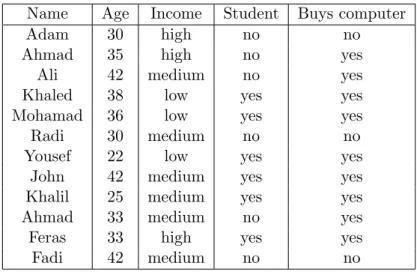
Classification is the process of classifying unseen data to a set of predefined classes. A classification algorithm uses a set of labeled training data to build a classification model. Then this classification model is used to predict unseen instances classes [44]. Several applications use classification to solve diverse problems including mail classification into spam or non-spam and cells classification into malignant or benign [70]. Table 2.1 shows an example dataset used for binary classifying customers who will buy computer and who will not. The attribute set includes properties of each customer such as his
name, age, income and student or not. These attribute set contains both discrete and continuous features. However, in classification problems the class label must be a discrete attribute [70].
Name Age Income Student Buys computer
Adam 30 high no no
Ahmad 35 high no yes
Ali 42 medium no yes
Khaled 38 low yes yes
Mohamad 36 low yes yes
Radi 30 medium no no
Yousef 22 low yes yes
John 42 medium yes yes
Khalil 25 medium yes yes
Ahmad 33 medium no yes
Feras 33 high yes yes
Fadi 42 medium no no
Table 2.1: Example of datasets
2.1.2 Unsupervised learning
In some machine learning problems, we have input data but we do not have specific output variables(examples are unlabeled). The main goal for unsupervised learning is to find hidden patterns and modeling underlying structure in the data. In such problems, there are no correct answers and there is no teacher. Hence, the accuracy of the resulting structure cannot be evaluated[20, 14].
2.1.3 Deep learning
Deep learning is a subfield of machine learning that unifies machine learning with AI. Deep learning works on large amounts of data which can be considered as an advance-ment to artificial neural networks [20].In deep learning, The core building block of a standard neural network is called neurons. Neurons can be seen as processors producing a sequence of activation. Neurons can be activated in different ways such as weighted connections from previously active neurons or through sensing the environment. Typ-ically, connected neurons have weights that neural network adjusts during training to optimize learning using Backpropagation algorithm as described in section 2.2. Based on problem complexity, the desired behavior may require a series of deep layers and long stages of training [67].
Models with few layers(Shallow models) have been around since 1960. Due to its computation costs, Deep neural networks with multiple layers were difficult to imple-ment in practice until early 2000 [67]. The recent drop in hardware prices, increase in processing power, and the advancement of machine learning algorithms are the main
reasons for the booming in deep learning [22].
Deep networks add more layers and more neurons to each layer to represent complex functionality. In classification problems, deep learning algorithms amplify input object discriminative features in higher layers and dismiss irrelevant features. For example, in image classification tasks, each layer in a deep neural network detects a specific feature. The first layer detects image edges, motifs are detected in the second layer. Furthermore, motifs are assembled into larger parts in the third layer which matches familiar object parts. Finally, subsequent layers combine parts from previous layers which allow the network to detect objects [39].
The key feature of deep learning is the ability of each layer to detect features au-tomatically without human intervention. Deep learning has achieved state of the art results in image recognition, speech recognition as well as other machine learning sub-fields [39]. Interestingly, deep learning has achieved promising results in various NLP tasks such as sentiment analysis and machine translation [39].
2.1.4 Semi-supervised learning
Semi-supervised learning is a subfield of machine learning that uses both large amount of unlabeled data and a small amount of labeled data to create a better model. Semi-supervised learning can reduce the cost associated with labeling a full training set, as labeled data often requires a skilled human agent(e.g. to label tweet for ADR and no-ADR). Instead, it uses unlabeled data which is relatively inexpensive to acquire [20].
2.1.5 Reinforcement learning
Reinforcement learning is a subfield of machine learning where a software agent tries to solve a problem by maximizing rewards for its actions and minimizing penalties. After a set of runs, the agent should learn the best sequence of actions that maximize the reward [20].
2.2
Backpropagation
Backpropagation, short for ”backward propagation of errors”, is an algorithm to adjust neural network weights to minimize error by calculating each neuron error contribution after processing a batch of data networks using gradient descent. The calculation of the gradient proceeds backward through the network, as the final layer gradient of weights is being calculated first then proceed through layers until the first layer gradient is calculated at last. The backward flow of the error allows more efficient computation of the gradient compared to calculating each layer gradient separately [39]. Because backpropagation is considered an efficient algorithm, it is widely used to train deep neural networks for image recognition, speech recognition, and text classification [39].
2.3
Word Embedding
The first building block for any NLP task is the word or sentence representation. Re-cently, a set of algorithms were introduced that provide representations of words in a vector space model by grouping similar words. One of those popular algorithms is word2vec introduced by Mikolov et al.[47]. Word2vec is a shallow, two-layer neural net-work pre-trained on large amounts of unstructured text data to produce a high-quality vector, typically of several hundred dimensions, representations of words. One inter-esting feature of word2vec it that the produced representation of word encodes many linguistic regularities and patterns. Surprisingly, using word2vec we can represent many of these relations as equations. For example, the result of this equation:
vec(\M adrid”)−vec(\Spain”) +vec(\F rance”)
is closer to vec(“Paris”) than to any other word vector [47]. Word2vec is widely used in deep learning text classification and relation extraction tasks as shown in chapter 3.
2.4
Convolutional Neural Networks (CNNs)
Convolutional Neural Networks (CNN) is a type of neural networks that is able to process complex forms of data such as multiple arrays. Images and audio; signals and sequences; and video are all samples of data represented in the form of multiple arrays [39].
Figure 2.2 shows the general CNN architecture for text classification. CNN typically is composed of series of stages. The first stages are usually composed of convolution and pooling layers which numbers may vary based on the method. The later stages consist of a set of fully connected layers [39, 22].
Inside each convolutional layer, units are organized in feature maps which are con-nected to previous layers through a set of filters(weights). The result of this convolution is then passed through a rectified linear unit(ReLU) layer(non-linearity) -other activa-tion funcactiva-tions may be used such as softmax-. As shown in Figure 2.2, each sentence is represented as a matrix with word representations-such as word2vec- as rows. Each sentence matrix is then fed into a convolution layer which applies a filter to it and generates a feature map. Feature maps then fed into max pooling layer which extracts the most useful features and then fed it into fully connected layers which classify this sentence.
Recently, several researchers applied CNNs to different NLP tasks including text classification, relation extraction, and sentiment analysis. Kim[35] has done a series of experiments with CNNs for sentence-level classification tasks. The model was trained on top of pre-trained word vectors.
2.4.1 Types of layers
CNN is composed of a set of different layers in a hierarchy. Generally, it contains a convolution layer followed by pooling layers. The following subsections describe those
Figure 2.2: CNN architecture for text classification [79]
Figure 2.3: convolution layer(Kernels=filters) [22]
layer and how they are used in text classification.
2.4.2 Convolution Layer
The convolution layer is the core building block of a CNN. As shown in figure 2.3, it applies a convolution operation to the input and passing the output of this operation to the next layer. In Kim model [35] the convolution layer uses three region sizes: 3,5 and 7 words each one of them has 2 filters. Each filter has a width of the word vector dimension. So this will produce 3-gram if the filter size is 3 or 5-gram if the filter size is 5, etc... Filters apply convolution operation on the sentence matrix in order to generate (variable-length) feature maps. A feature ci is generated from a window of
words Xi:i+h−1 by
ci =f(w·xi:i+h−1+b)
2.4.3 Pooling Layer
This layer is usually used to reduce both feature maps and network parameters dimen-sions. The most commonly used strategies are max pooling and average pooling. After using a max pooling layer of 2*2 size and stride of 2, feature maps of size 16*16 is reduced to 8*8 [22]. Figure 2.4 shows the operation of a max pooling layer.
Figure 2.4: max pooling layer [22]
2.4.4 Fully-connected layers
Fully-connected layers perform the same functionality of tradition neural network. It follows the last convolution and pooling layer and allows the network to feed forward a vector into another vector of different length or into different categories [39].
2.4.5 Softmax Layer
This is usually the final layer in a CNN architecture, a softmax receives the feature vector from the previous layer and uses it to perform binary classification. The softmax equation is: Li =−log eyi Pk k=1eyk !
Chapter 3
Literature Review
This chapter reviews the most commonly used text mining techniques in social media ADR extraction. The work done on ADRs can be classified into three main categories as follows:
3.1
Text Mining Based Methods
Due to the public nature of Twitter posts, multiple researchers have conducted studies on how to extract ADEs from tweets. Jiang and Zheng[31] have developed a compu-tational approach for extracting ADRs from Twitter data. In order to automatically extract ADRs from twitter posts, the authors have developed a data processing pipeline to extract ADRs from Twitter posts. The data pipeline consists of three main steps: collecting and pre-processing tweets, using machine learning to classify personal experi-ence tweets, Detecting ADRs from tweet text using the MetaMap software. In order to classify tweets which contains personal experience, the authors use a machine learning classifier. Natural language Toolkit(NLTK)[11] was used to extract sentiment and pro-nouns features which were used later in machine learning methods. The authors tested three different ML methods: Naive Bayes, Support Vector Machine, and Maximum En-tropy which demonstrated the best performance. Although Twitter can be considered as a valuable ADRs source, The 140 characters limitation on user tweets limits the amount of information that can be posted and afterward extracted from each tweet.
Leaman et al.[38] have proposed a more sophisticated approach for mining the re-lationships between ADRs reported by patients and drugs. The proposed method used Java sentence breaker to split user comments into sentences and then tagged for part-of-speech using Hepple tagger[26]. After handling spelling errors, the authors measure string similarity to compare the individual tokens using Jaro-Winkler [76]. Finally, a normalized score was calculated by summing the similarities of the individual tokens for both original tokens and stemmed ones, and the higher of the two scores is the final score. To evaluate their system the authors manually annotate a set of user comments posted on DailyStrength [38].
Figure 3.1: AZDrugMiner Framework [43]
by Liu and Chen[43]. The analytical framework (AZDrugMiner) is composed of a collection of machine learning methods to extract ADRs. As shown in Figure 3.1, AZ-DrugMiner contains different components. To collect the data a crawler was developed to download medical posts from patient forums. In data pre-processing, step AZDrug-Miner cleans text and detect sentence boundary. To split each post into sentences, the authors used an open source OpenNLP tool[4]. After pre-processing, medical entity extraction step starts. In this step, Metamap[3] Java API maps post’s text to UMLS[5]. In order to detect whether an ADR is associated with a drug in a sentence, an entity relation extraction method is needed. To help increase the precision of the extracted re-lation, a kernel-based machine learning method was used to extract ADRs from patient forums[42]. To reduce noise and duplication, the authors used a post source classifi-cation to filter whether an ADR reports is based on reporter experiences or not. The authors claim that no previous patient social media research addresses this issue and to solve it they develop a machine learning classifier to classify reports based on patient experience[42].
To evaluate AZDrugMiner, the authors used a manually annotated dataset which shows promising performance. To further improve AZDrugMiner system other kernel functions such as SubTree Kernel and Standard tree kernel could be used. Moreover, to improve relation detection performance multiple kernel function can be combined[42].
Sarker et al.[66] have proposed an approach for classifying Twitter posts that utilizes multi-corpus to improve classification performance. The authors have used three data sets two of them are annotated posts from social media while the third one contains annotated clinical report sentences. The proposed method generates a feature vector from a large set of semantic features (i.e: sentiment, polarity, and topic) from short text nuggets.
3.2
Machine Learning Based Methods
Nikfarjam et al.[49] have proposed a new machine learning based method for extracting ADRs from user’s social media named ADRMine. The authors collected a set of drug related user posts from DailyStrength and Twitter sites. After data collection, user posts were annotated by two expert annotators. After data collection, an exhaustive list of
Figure 3.2: Text Processing Module [62]
ADRs and corresponding UMLS IDs were compiled. In order to extract ADRs from social media posts, CRFsuite[51] (a CRF[72] classifier implementation by Okazaki) was used. The CRF classifier was trained on a set of annotated ADR posts. By achieving an F-score of 0.82, the authors claim that ADRMine results outperform several baseline systems in extracting ADRs[49].
A most recent study conducted by Wang[73] extends Nikfarjam et al.[49] work by us-ing different word representations(K-means clusters and Brown clusters) [16][71]. Word clusters were generated using a set of unlabeled tweets (some contains ADRs). Word clusters were constructed using Brown clustering tools [13] and Stanford GloVe tool [1] as described in[71]. Study results show that the proposed system significantly outper-forms the other participating system in this study.
A different approach for extracting ADRs from posts in online healthcare forums was proposed by Sampathkumar et al.[62]. The proposed method consists of the following three modules:
• Information Retrieval Module[62]: in order to collect data, the authors built a crawler to extract data Medications and Steadyhealth websites.
• Text Processing Module[62]: in this module, a data processing pipeline was built from a collection of Natural Language Processing (NLP) tools as shown in Figure 3.2.
• Information Extraction Module[62]: used to identify entities and extract possible relationships between them. It consists of two sub-modules: Named Entity
Recog-Figure 3.3: Two steps drug comments classification process[54]
nition (NER) module and Relationship Extraction (RE) sub-module. To extract a drug and ADR association the authors used Hidden Markov Model(HMM) which is a supervised machine learning method.
Patki et al.[54] proposed a novel probabilistic model for drug categorization based on user comments. As shown in figure 3.3, the proposed approach is composed of two steps: first, classify whether a comment is an ADR or not, and then check whether all drug comments shows a red flag or not. In the binary classification step, the authors used a manually annotated set of user comments to train classifiers. Two machine learning algorithms were used: Multinomial Naive Bayes (MNB) and Support Vector Machines (SVM). Finally, in order to classify drugs into a normal or black box, the authors developed a probabilistic model based on the hypothesis that a black box drug should have more ADRs than a normal one. Although the results of classifying single comments into ADRs and non-ADRs are promising, the overall classification of drugs is marginal.
Jonnagaddal et al.[33] have proposed a binary classifier using linear SVM to au-tomatically classify ADR-assertive Twitter posts. The proposed method pre-processes each tweet to remove unnecessary characters such as hashtags, username, etc.. After pre-processing, the system extracts various features including syntactic, lexicon, polar-ity and topic modeling based features. Moreover, the system extracts a set of lexicon features generated using pattern matching.
pro-Figure 3.4: Kim’s model architecture with two channels for an example sentence. [35]
duces a weighted average of four classifiers: concept-matching classier; a maximum entropy (ME) classier with TFIDF weighting scheme; an ME classier based with naive Bayes (NB) log-count ratios as feature values; and an ME classier with word embedding features. The final classifier is an ensemble of the previously mentioned classifiers and the overall score is defined as the weighted mean of output from these classifiers.
3.3
Deep Learning-Based Methods
Deep learning has recently shown interesting results in various NLP tasks. In this section, we show a review of work done in this area related to our problem.
3.3.1 Convolution Neural Networks (CNN)
Convolution Neural Networks (CNN)s are extensively used in computer vision and image classification. CNNs are directly responsible for the major breakthroughs in image classification.
Recently, several researchers applied CNNs to different NLP tasks including text classification, relation extraction, and sentiment analysis. Kim[35] has done a series of experiments with CNNs for sentence-level classification tasks. The model was trained on top of pre-trained word vectors.
Kim suggested model is shown in figure 3.4. In this model, each word is represented by k-dimensional word vector obtained from word2vec tool 1. A sentence of length n words in this model is represented as a matrix Rn∗k-k stands for word representation
dimension- of word vectors. In order to produce a new feature from sentence matrices, a convolution operation with multiple filter widths is applied to a window of h (h represents filter size) words to produce a new feature. For example, a feature ci is
generated from a window of wordsXi:i+h−1 by
ci =f(w·xi:i+h−1+b)
In this equation, f is a nonlinear such as the hyperbolic tangent and b ∈ R is a bias term. After applying this filter to each possible set of word window a feature map is
1
produced[35]
ci = [c1, c2, ..., cn−h+1]
After getting the feature maps a max pooling over time is applied in order to capture the feature with the highest value - the most important feature - for each feature map. The final results of the authors work show that a simple CNN with one layer convolution performs very well. Moreover, the author found that unsupervised pre-trained word vectors are a corner block component in deep learning for NLP[35].
Johnson and Zhang[32] have proposed a CNN model without the need for pre-trained word vectors. The authors were able to directly apply CNN to high dimensional text data instead of low dimensional word vectors like word2vec or GloVe. In this paper, the authors have applied convolutions to one-hot vectors. Moreover, in order to reduce the parameters which the network has to learn, the authors have proposed a space-efficient input data representation (bag-of-words-like).
Dos Santos and Gatti[63] have proposed a new approach for sentiment analysis of Twitter messages using CNNs. In order to perform sentiment analysis, the proposed method exploits character to sentence-level information. The neural network takes a sentence as input. By passing this sentence word representation matrix through a sequence of layers the system is able to extract more complex features. Moreover, this system is able to extract features from both character-level and sentence level. Moreover, it consists of two convolutional layers to handle variable size words and sentences.
Sahu et al.[61] proposed a new approach for relation extraction using CNNs and feature generation. The proposed model takes a sentence as an input and outputs all possible relation types as probability vector. It is based on Kim[35] model architecture. The authors used generated features in the first layer in addition to word embedding and used multiple filters in all possible continuous n-grams in the sentence.
Huynh et al.[28] have proposed two new neural network models, Convolutional Re-current Neural Network (CRNN) by concatenating reRe-current neural network to convo-lution neural network and Convoconvo-lutional Neural Network with Attention (CNNA) by adding attention weights into CNN.
Lee et al. [41] have proposed a semi-supervised CNN model for tweets classification into ADR and non-ADR. The proposed model uses several semi-supervised CNN models built from different types of unlabeled data. In the second phase, CNN is trained with annotated ADE data. The output layer uses a linear classifier that can classify if a tweet contains an ADR or not.
Sulieman et al. [69] have examined if using semantic features and word context enhances patient portal messages classification performance. The authors have con-structed a different set of features such as a bag of phrases, a bag of words, word embeddings, and graph representation. The authors have trained a random forest and logistic regression classifiers, and CNN with softmax output. Researchers have found that using semantic features such as word2vec and graph representation improve clas-sification accuracy of portal messages.
Akhtyamova and Alexandrov [8] have conducted a study which uses CNN with word2vec to classify ADRs in tweets. The authors have done unsupervised word
em-beddings learning from different datasets including GoogleNews, Wikipedia, and Diego lab. Results show that using CNN+GoolgeNews corpus improves ADR F-score.
To reduce training CNN computational costs, Prusa and Khoshgoftaar [57] have proposed a new character level representations of sentences. In this method, each char-acter is given an integer value. Each charchar-acter in the sentence is then replaced by the corresponding integer value. This sequence of integer values is then replaced by its equivalent binary representation which creates a vector of 0s and 1s.
3.4
Comparison
ADR detection research can be classified based on vector representation into sentence level representation and word level representation. Sarker et al. [66] proposed method generates a feature vector for each sentence from a large set of semantic features (i.e: sentiment, polarity, and topic) from short text nuggets, whereas our approach generates a vector of domain features for each word. On the other hand, word level approaches generate a representation for each word. Wang [73] proposed a method that uses a word level representation, Brown clusters, and k-means clusters, that are generated from unlabeled generic and drug-related tweets, while our approach uses word clusters as a feature in word representation. Other word level methods use CNN for ADR and text classification. For instance, Johnson and Zhang [32] have proposed a method which represents words as one-hot vectors. While Johnson and Zhang [32] used one-hot vectors on the word level, Prusa [57] represented each character in the sentence as a binary vector of 0s and 1s. However, our approach represents each word as a vector of domain features. Figure 3.5 shows a diagram of previously described methods.
One of the popular algorithms that are used with CNN for text classification tasks is word2vec introduced by Mikolov et al.[47]. Word2vec is a shallow, two-layer neural network pre-trained on large amounts of unstructured text data that produces high-quality vectors, typically of several hundred dimensions, representations of words. While word2vec utilizes a word’s local context window, Pennington et al. [55] proposed a different model that combines the advantages of local context window and global matrix factorization methods. Both of these models fail to provide a good representation for rare words, which can be a domain word that can clearly affect performance. While our model utilizes lexicons and dictionaries to handle rare and domain words.
Many researchers have used word2vec and GloVe to extract ADRs from social me-dia posts [28, 8]. While Kim [35] was the first to introduce a CNN model that uses word2vec and GloVe for short text classification. Huynh et al [28] have proposed three new neural network models CRNN, RCNN and CNNA with word2vec as input layer. Experiment results show that CNN architecture achieves the best results in ADR classi-fication. Akhtyamova and Alexandrov [8] trained word2vec on GoogleNews, Wikipedia, and Diego lab. CNN achieved better results when using word2vec trained on Google-News. Compared to our approach, word2vec is unsupervised machine learning algorithm that requires a huge amount of unlabeled data to learn word representation. While our approach is supervised and so no unlabeled data is required. Further, our approach is
Figure 3.5: Literature review comparison
dynamic as some features can be added or removed based on the given task and word representation contains semantic and domain features that word2vec alike systems do not have.
3.5
Conclusion
The findings from this review reveal a lack of methods that explore the effect of combin-ing domain, semantic and morphological features with CNN. Indeed, some studies used domain and semantic features but with SVM and other machine learning algorithms. Added to this, another study tried to improve CNN performance by using domain fea-tures and word2vec but for relation extraction task. On the other hand, multiple studies used CNN with different word representations-i.e. GloVe and word2vec- for ADR clas-sification but none of them explored the effect of domain features on CNN. Hence, direction for the research discussed in this thesis is extracted from Kim, or those who have improved Kim’s method, in the domain of ADR classification and Sarker and Sahu their collaborators in the domain of ADRs features engineering. However, none of these methods explored the effect of domain, semantic, and morphological features on CNN. This is considered in further detail in the next chapter as the part of the discussion of the proposed method.
Chapter 4
Proposed Method
This chapter proposes a new approach for text classification that is called Semantic Vec-tor (SemVec). SemVec uses domain-specific features and CNN-section 1.3.4 describes why CNN- to improve tweets ADR classification performance. For example, in order to classify tweets into two categories which are: tweets without drug side effects and tweets which may contain ADRs, SemVec uses feature engineering to extract features related to the medical domain. Furthermore, SemVec can be applied to different text classification problems in different domains as well.
4.1
Introduction
Many text classification approaches rely on feature engineering [19]. Feature engineering process is often guided by domain knowledge. In the medical domain, for example, terms related to diseases such as ADR, symptoms, and medications are manually defined by experts [19].
SemVec is a new approach that utilizes domain-specific features to improve CNN networks ADR classification performance. In this approach, SemVec proposes a new word representation using domain-specific features instead of using word2vec [47] or GloVe [55] word embedding representation. Moreover, SemVec proposes a new CNN network model for text classification that best fit the proposed word representation.
4.2
New Word Representation
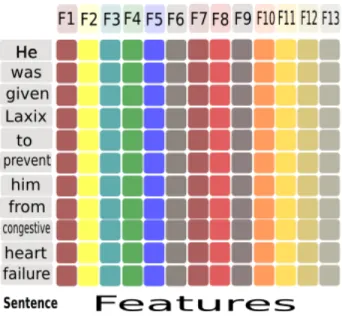
As shown in figure 4.1, SemVec represents each word in each sentence as a row vector of features. For example, the word He is represented as a vector of feature values:
x=f11⊕f21⊕f31⊕f41⊕f51⊕f61f71⊕f81⊕f91⊕f101 ⊕f111 ⊕f121 ⊕f131
Here ⊕ is concatenation operation so x ∈ R1×13. It is worth noting that each feature
can be represented by one or more dimensions in the resulting word vector. Moreover, the sentence is represented as a matrix of words X features. In order to have a unified
Figure 4.1: Features Layer.
number of matrix rows, we get the max number of words and zero pad any matrix that has a smaller number of words. So, each matrix has a length of 32 rows-max number of sentence words in all corpus-.
4.3
Domain Features Identification & Importance
SemVec utilizes domain specific features to improve ADR classification performance. Moreover, as SemVec is a dynamic and pluggable method, it can be applied to other domains other than ADR domain by using that domain specific features. In order to apply it to new domains, a set of the new domain features need to be used. Besides the new domain features, some of the features proposed in this thesis 4.6 can also be used. Feature engineering process is often guided by domain knowledge. All unique terms present in a text corpus can be considered as features [19]. In the medical domain, for example, terms related to diseases such as ADR, drug names, symptoms, and med-ications can be considered as domain-features. In sentiment analysis tasks, language features such as good words, bad words, and emotion words can be also considered as domain-features. Moreover, emotion icons in social media text can also be considered as a domain feature in sentiment analysis as they express users’ emotions and feelings. Features importance can be measured by multiple methods. The first one is to check if this feature already exists in this corpus and how it is distributed among classes. Does this feature split the dataset into the desired classes? Or it is equally found in all classes? A feature that only exists in the desired class instances can be considered as a high-quality feature. The empirical method can be used also to measure the effect of each feature. The leave-one-out technique, where researchers remove one feature from
the generated matrix, can help measure the effect of a single feature on classification performance although it can be not precise but can give an indication of feature effect.
4.4
Preprocessing
The first step before performing any feature extraction is to perform standard prepro-cessing. We use lowercasing, tokenization and stemming or part of speech tagging based on the feature type. Stop words are not removed from the sentences to have the whole sentence represented as a matrix. Porter stemmer is used for stemming words [56]. NLTK python library is used for part of speech tagging and tokenization1. In this the-sis, some special social media text preprocessing were performed. In particular, Twitter user names were removed by removing any word starting with at (@) char, remove hashtags and URLs to other websites.
4.5
Features Categorization
In this thesis, SemVec was applied to a twitter ADR dataset and an additional medical reports domain dataset. A set of features related to the medical domain was extracted which can be classified into six categories. This section lists these categories with a list of included features. Features will be described in more details in the next section. Features categories are as follows:
• Sentiment/Opinion Features: this category indicate how positive, negative, and neutral the words are[10]. We used 4 sentiment features in this thesis. These features can be applied to other datasets-for sentiment analysis tasks-. This cat-egory includes the following features:
– Opinion Lexicon Negative Words(F1)
– Opinion Lexicon Positive Words(F2)
– SentiWordNet v3.0 Lexicon Word Positive Score(F3)
– SentiWordNet v3.0 Lexicon Word Negative Score(F4)
• Subjectivity Features: this category includes any word express an emotion, evaluation, opinion, stance, and speculation [75]. This feature can be applied to other datasets. This category includes the following feature:
– Subjectivity Lexicon (F5)
• Domain Specific Features: represents the features that are related to a specific domain. In this thesis, we use one feature from the medical domain. This category includes the following feature:
– ADR Lexicon (F6)
• Polarity Features: these feature set tries to capture when there is an in-crease/decrease in a good/bad thing. This category includes the following fea-tures:
– More Good Lexicon (F7)
– More Bad Lexicon (F8)
– Less Good Lexicon (F9)
– Less Bad Lexicon (F10)
• Word Complexity Features: these features are based on text statistics such as word length and word order. This category includes the following features:
– Word Length (F11)
– Word Order (F12)
• Other Features: this represents other features that may be created using unsu-pervised learning algorithm or any other type of algorithm. This category includes the following features:
– Word Clusters (F13)
4.6
Features Extraction
SemVec represents each word with a vector of features. Based on the problem domain, additional features can be added or removed. The following list shows these features and how they are represented in SemVec:
• Opinion Lexicon Negative Word (F1): this feature represents a list of nega-tive English language opinion words. This list contains also a list of ADR mention words. Hu and Liu [27] proposed a list of negative opinion words that can be used in sentiment analysis. The list contains 4817 negative words. Table 4.1 shows a sample of Opinion Lexicon Negative Words. The following steps show how to extract this feature:
– Every word in the sentence is first stemmed using Porter stemming algo-rithm [56].
– Then,this word is matched against the stemmed list of negative opinion words.
– If the word exists in this NEGATIVE list of words we set its assigned value toW otherwise, it is set to 0. W is a positive integer that represents this feature weight.
• Opinion Lexicon Positive Word (F2): this feature represents a list ofpositive English language opinion word. Hu and Liu [27] proposed a list of positive opinion words that can be used in sentiment analysis. Table 4.1 shows a sample of Opinion Lexicon Positive Words. The following steps show how to extract this feature:
Feature Samples
Opinion Lexicon Negative Word
abnormal* annoying aggressive sue suicidal* zombie ache* addict* allergic*
Opinion Lexicon Positive Word
abundance adequate awesome fascinating ADR Lexicon infection vascular* fecal fat increased* luteinizing hormone decreased*
ulcer gastrojenunal* high feeling* More Words enhance augment increase amplify Less Words drop fewer slump fall down Good Words beneficial improve advantage resolve Bad Words complication risk adverse* chronic* bleeding* morbidity Word Cluster2 000110 who’ve 1987 0001110 sshe 43 0001110 ser-ueberwacher 43 0001110 shhe 47 0001110 testasterisk 47
– Every word in the sentence is first stemmed using Porter stemming algo-rithm [56].
– Then,this word is matched against the stemmed list of positive opinion words.
– If the word exists in this NEGATIVE list of words we set its assigned value toW otherwise, it is set to 0. W is a positive integer that represents this feature weight.
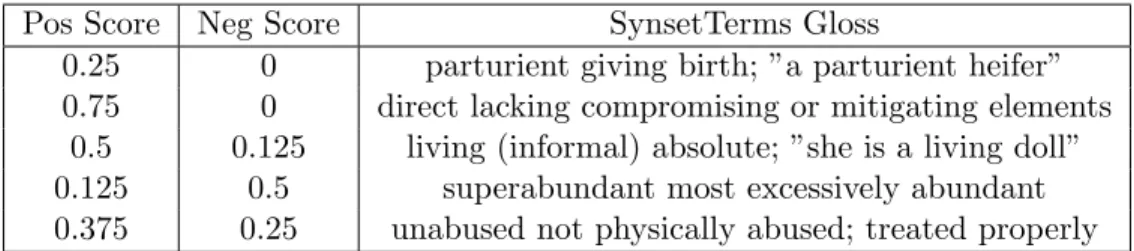
• SentiWordNet Lexicon Positive Word(F3): this feature represents apositive English languagesentiment word. Baccianella et al. [10] proposed the SentiWord-Net v 3.0 which contains 118,000 English words associated with positive sentiment score between 0 and 1. Table 4.2 shows a sample of SentiWordNet Lexicon. The following steps show how to extract this feature:
– Every word in the sentence is tagged by part of speech tagger.
– Then,this word is matched against the SentiWordNet list by part of speech tag and text matching.
– If the word exists in SentiWordNet, SemVec sets its value is calculated by the following equation:
x=W ∗SentiW ordN etpositivescore
W is a positive integer that represents this feature weight.
– If the word does not exist in SentiWordNet, SemVec sets its value to 0.
Pos Score Neg Score SynsetTerms Gloss
0.25 0 parturient giving birth; ”a parturient heifer” 0.75 0 direct lacking compromising or mitigating elements
0.5 0.125 living (informal) absolute; ”she is a living doll” 0.125 0.5 superabundant most excessively abundant 0.375 0.25 unabused not physically abused; treated properly
Table 4.2: SentiWordNet Lexicon Sample
• SentiWordNet Lexicon Negative Word (F4): this feature represents a neg-ative English language sentiment word. Baccianella et al. [10] proposed the Sen-tiWordNet v 3.0 which contains 118,000 English words associated with negative sentiment score between 0 and 1. Table 4.2 shows a sample of SentiWordNet Lexicon.The following steps show how to extract this feature:
– Every word in the sentence is tagged by part of speech tagger.
– Then,this word is matched against the SentiWordNet list by part of speech tag and text matching.
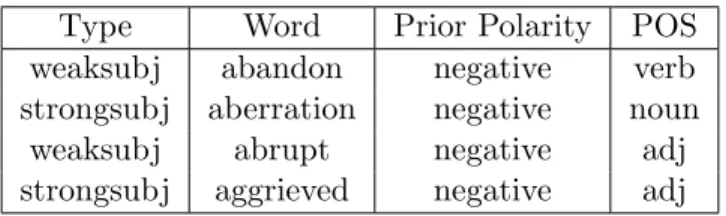
Type Word Prior Polarity POS weaksubj abandon negative verb strongsubj aberration negative noun weaksubj abrupt negative adj strongsubj aggrieved negative adj
Table 4.3: Subjectivity Lexicon Sample
– If the word exists in SentiWordNet, SemVec sets its value by the following equation:
x=W ∗SentiW ordN etnegativescore
W is a positive integer that represents this feature weight.
– If the word does not exist in SentiWordNet, SemVec sets its value to 0.
• Subjectivity(F5): this feature represents theEnglish languagesubjectivity value of words. Wilson et al.[75] have proposed a list of words with there subjectivity strength (weak and strong) and their polarity (negative, positive and neutral). Table 4.3 shows a sample of Subjectivity Lexicon. The following steps show how to extract this feature:
– Every word in the subjectivity list is read and given a score according to strength and polarity. If it is strong (encoded to 1) or weak (encoded to 0.5) and its polarity can be positive (encoded to 1) or negative (encoded to -1) or neutral (encoded to 0). The final score for each word is calculated as follows:
subjectivityscore=type∗polarityscore
– If the word exists in subjectivity list , SemVec sets its value by the following equation:
x=W ∗subjectivityscore
W is a positive integer that represents this feature weight.
– If the word does not exist in subjectivity list, SemVec sets its value to 0.
• ADR Lexicon (F6): this feature represents a drug side effect(ADR). It incor-porates ADR domain knowledge to the classifier by performing pattern matching with ADR lexicon. Sarker et al. [66] have built this ADR lexicon. It includes a total of 13,699 ADR mentions from different resources. Table 4.1 shows a sample of ADR Lexicon. The following steps show how to extract this feature:
– Every word in the sentence is tagged by part of speech tagger.
– For each sentence, we create word-level 1-gram, 2-gram, 3-gram, and 4-gram.
– Then, resulting word-level n-gram are matched against the ADR lexicon and counter of how many matches per sentence is saved.
– If the word-level n-gram sentence exists in ADR lexicon, SemVec calculates its value by the following equation:
x=W ∗count(ADRinsentence)
W is a positive integer that represents this feature weight.
Each word in the matching sentence will receive the value calculated by the above equation. Otherwise, it is set to 0.
• More Good (F7), More Bad (F8), Less Good(F9), Less Bad(F10): Niu et al. [50] have proposed these four polarity features. More Good feature indicates more positive information in the sentence. This represents how a change happens: for example, reducing headache is considered as a positive outcome; on the other hand, increasing headache, is considered as a negative outcome. These features try to find out when there is an increase/decrease in a good/bad thing. A collection of good, bad, more and less words were used which was created by Sarker et al. [64]. In order to extract these features, a window of four words on each side of each feature word. If a Good word was found in this window, then a more-good feature is activated. Similar process were followed to activate other features. Table 4.1 shows a sample of negative, positive, less, and more words.
– Every word in the sentence is tagged by part of speech tagger.
– For each word we define a max boundary and min boundary of words. Min and Max boundaries are windows of words of size 4.
– Then, if a more good, more bad, less good, less bad word occurs within the min and max boundary this word is given a score of W1for more good,W2
for more bad,W3for less good andW4for less bad. Otherwise, it is set to
0. W1, W2, W3, and W4are positive integers that represent each feature weight
• Word Length (F11): this feature represents each word number of characters. for example: word: 4, amazing: 7, do: 2 ,etc. This feature defines how complex each word is and how complex the sentence is. The following equation shows how to calculate this feature:
x=W ∗length(word)
W is a positive integer that represents this feature weight.
• Word Order (F12): this feature represents the order number of this word in the sentence. For example in the following sentence:
I like this movie very much.
– order(I)= 1
– order(like)= 2
– order(movie)= 4
– order(very)= 5
– order(much)= 6
The following equation shows how to calculate this feature:
x=W ∗order(word)
W is a positive integer that represents this feature weight.
• Word Clusters (F13): this feature is proposed by Brown et al. [13] in this feature hierarchical word clusters are generated from a huge set of unlabeled tweets via Brown clustering [13]. This produces a base set of 1,000 clusters which includes clusters for happinesses and sadness words and emotions, etc. Table 4.1 shows a sample of word clusters. The following equation shows how to calculate this feature:
x=wordclusterkey(word)
4.7
Model Architecture
Regular Neural Nets receive a single vector input, and then a series of hidden layers transform it to generate the final class scores. Each hidden layer is composed of a set of neurons. Neurons in one layer function independently of other neurons in other layers and each neuron in any layer is connected to all neurons of the previous layer [7]. The last layer is the output layer which represents the class scores.
CNN uses convolving filters that are applied to local features [40]. The first CNN for text classification approach was proposed by Kim [35].
SemVec proposes a new CNN model for text classification. The new model improves classification results in terms of accuracy and precision. In this thesis, we compared the following network models:
4.7.1 Kim Model
Kim [35] has proposed a CNN network model for text classification. Figure 4.2 shows Kim CNN model architecture. The proposed model takes complete tweet as an input and classifies it into either positive or negative class. More information about this model can be found at [35].
4.7.2 SemVec Model
In this thesis, we propose a new CNN model for text classification. Figure 4.5 outlines the main layers in the proposed model. It only contains a single convolution layer with one filter of size 2(by experiment). All the properties of SemVec model was found through grid search experiments 5.3.6. The following describe the differences between our proposed model and Kim model:
Figure 4.2: Kim [35] CNN model architecture. [80]
• In this model, each word is represented with 13 discrete features instead of using word embeddings.
• SemVec model uses a single convolution layer instead of three convolution layers used in Kim’s model, one max pooling layer instead of three max pooling layers.
• SemVec model uses a filter size of 2(by experiment) instead of whole word embed-ding size in Kim model.
• SemVec model uses two fully connected layer of 128 and 1 respectively while Kim model does not use them.
• SemVec model uses Sigmoid activation function in the last layer instead of Softmax layer used by Kim model.
Figure 4.3: Kim [35] CNN architecture weights.
4.7.2.1 Feature Input Layer
In this model, each word is represented with 13 discrete features as described in section 4.2.
4.7.2.2 Convolution Layer
In Kim [35] model, the convolution layer uses three filter sizes: 3,5 and 7 each one of them has 2 filters as described in section 2.4.2. On the other hand, SemVec model uses one filter size of 2 found by grid search as in section 5.3.6.
4.7.2.3 Max Pooling Layer
In this layer, we apply a max operation to find the most useful feature in the generated feature map from the previous layer. SemVec max pooling window size is equal to 2*2 found by grid search as in section 5.3.6.
Figure 4.4: SemVec CNN architecture weights.
4.7.2.4 Dense Layers
SemVec model has 2 fully connected layers. The first layer includes 128 neurons and the second one has one neuron. A non linearity Relu activation function connects the layers together found by grid search as in section 5.3.6.
4.7.2.5 Sigmoid Layer
In the final layer, a sigmoid receives the feature vector from the previous layer and uses it to perform binary classification. The sigmoid equation is:
S(x) = 1 1 +e−x
found by grid search as in section 5.3.6.
4.8
Model Weights Comparison
As shown in figure 4.4 and 4.3, SemVec uses only 68,449 weights compared to 2,768,051 for Kim [35] model. So, Kim model uses 40x more weights than SemVec to train CNN network for text classification task. This clearly impact network training time.
Figure 4.5: SemVec model architecture.
4.9
SemVec Use Case
SemVec can be used in post-market drug monitoring. In this phase, patients may share ADRs on social media sites which they do not report for governmental drug monitoring systems such as AERS. It is vital to capture these ADRs as some of them can be critical and may cause a drug withdrawal. This thesis proposes a system that can capture ADRs from a live Twitter stream as shown in figure 4.6.
The system listens for live twitter steam filtered by a list of predefined drugs. The second step is to use trained SemVec model to
![Figure 2.1: Machine learning subfields [20]](https://thumb-us.123doks.com/thumbv2/123dok_us/368460.2540585/16.918.206.709.144.579/figure-machine-learning-subfields.webp)
![Figure 3.2: Text Processing Module [62]](https://thumb-us.123doks.com/thumbv2/123dok_us/368460.2540585/24.918.212.716.148.500/figure-text-processing-module.webp)
![Figure 3.3: Two steps drug comments classification process[54]](https://thumb-us.123doks.com/thumbv2/123dok_us/368460.2540585/25.918.295.623.152.503/figure-two-steps-drug-comments-classification-process.webp)
![Figure 3.4: Kim’s model architecture with two channels for an example sentence. [35]](https://thumb-us.123doks.com/thumbv2/123dok_us/368460.2540585/26.918.293.629.146.290/figure-kim-s-model-architecture-channels-example-sentence.webp)

![Figure 4.2: Kim [35] CNN model architecture. [80]](https://thumb-us.123doks.com/thumbv2/123dok_us/368460.2540585/39.918.252.698.152.634/figure-kim-cnn-model-architecture.webp)