January 2010, Volume 32, Issue 11. http://www.jstatsoft.org/
Bayesian Functional Data Analysis Using
WinBUGS
Ciprian M. Crainiceanu
Johns Hopkins University
A. Jeffrey Goldsmith
Johns Hopkins University
Abstract
We provide user friendly software for Bayesian analysis of functional data models using
WinBUGS 1.4. The excellent properties of Bayesian analysis in this context are due to: (1) dimensionality reduction, which leads to low dimensional projection bases; (2) mixed model representation of functional models, which provides a modular approach to model extension; and (3) orthogonality of the principal component bases, which contributes to excellent chain convergence and mixing properties. Our paper provides one more, essen-tial, reason for using Bayesian analysis for functional models: the existence of software.
Keywords: MCMC, mixed effects, covariance, smoothing.
1. Introduction
Functional data analysis (FDA) is an area of research concerned with the statistical analysis of functions. It is closely related to multivariate data analysis because functions are highly multivariate objects. The main distinction between FDA and multivariate analysis is the intrinsic ordering of observations; for example in time for time series or space for images. FDA
is under intense methodological development (Chiou, M¨uller, and Wang 2003; James 2002;
James, Hastie, and Sugar 2001; M¨uller and Stadtm¨uller 2005; Ramsay and Silverman 2006;
Yao, M¨uller, and Wang 2005b; Yao and Lee 2006, are just a few examples of fundamental contributions in this area). Two comprehensive monographs of FDA with applications to
curve and image analysis areRamsay and Silverman(2005,2006).
FDA was extended to multilevel functional data (see e.g.,Baladandayuthapani, Mallick, Hong,
Lupton, Turner, and Carroll 2008; Di, Crainiceanu, Caffo, and Punjabi 2009; Guo 2002;
Morris, Vanucci, Brown, and Carroll 2003;Morris and Carroll 2006;Crainiceanu, Staicu, and Di 2009b;Staicu, Crainiceanu, and Carroll 2009). In this paper we will use theDiet al.(2009) approach to modeling multilevel functional data. This approach uses functional principal component bases to reduce data dimensionality and accelerate the associated algorithms,
which is especially useful in moderate and large data sets.
A close inspection of various types of functional models reveals that they can all be viewed
as mixed effects models (James et al. 2001; James 2002; Morris and Carroll 2006; Di et al.
2009). Inferential methods for functional models range from using frequentist BLUP methods
(Yao et al. 2005b; Yao and Lee 2006) to expectation maximization algorithms (James et al.
2001; James 2002) to Bayesian simulations (Morris et al. 2003; Morris and Carroll 2006;
Crainiceanuet al. 2009b). However, Bayesian posterior inference has not become one of the
standard inferential tools for functional data. Crainiceanuet al. (2009b) speculated that
Possible reasons for the current lack of Bayesian methodology in functional analy-sis could be: (1) the connection between functional models and joint mixed effects models was not known; and (2) the Bayesian inferential tools were perceived as unnecessarily complex and hard to implement.
In this paper we will further clarify the connection between functional and mixed effects
mod-els. We will also disprove (2) by providing a simple combination of R(R Development Core
Team 2009) andWinBUGS1.4 (Spiegelhalter, Thomas, Best, and Lunn 2003) programs that make Bayesian simulations relatively painless. Arguing the necessity for Bayesian methods in general exceeds the scope of our paper; we defer instead to some excellent monographs de-scribing the methodological and computational research conducted over the last 10–20 years
(see e.g.,Carlin and Louis 2008;Congdon 2003;Gelman, Carlin, Stern, and Rubin 2003;Gilks,
Richardson, and Spiegelhalter 1996, and the citations therein for a good overview). Instead, we will argue that the excellent properties of Bayesian analysis in the context of functional data analysis are due to: (1) dimensionality reduction, which leads to low dimensional pro-jection bases; (2) mixed model representation of functional models, which provides a modular approach to model extension; and (3) orthogonality of the principal component bases, which contributes to excellent chain convergence and mixing properties.
The paper describes methods and software for a variety of functional models. Section 2 is
focused on the functional principal component analysis of functional data observed at one visit.
Section3is concerned with functional regression, that is regression where either the covariate
or the outcome is a function. Section 4 is focused on the multilevel functional principal
component analysis of data observed at multiple visits. Relevant features of theWinBUGS1.4
programs are described throughout the paper, the entireWinBUGS1.4 programs are provided
in the Appendices. Rand WinBUGS1.4 programs are in the fileBayes_FDA.zip.
2. Single-level modeling of functional data
Consider, for illustration, data from the Sleep Heart Health Study (SHHS). SHHS is a
multi-center study of sleep disrupted breathing, hypertension and cardiovascular disease (Quan,
Howard, Kiley, Nieto, and O’Connor 1997). Here, we focus on modeling a particular
charac-teristic of the spectrum of the Electroencephalograph (EEG) data, the proportion ofδ-power.
For more details on the definition and interpretation ofδ-power (see e.g.,Crainiceanu, Caffo,
and Punjabi 2009a;Di et al. 2009;Crainiceanu et al. 2009b). In our context, it is sufficient
to know that percent δ-power is a summary measure of the spectral representation of the
EEG signal; in this paper we use percentδ-power calculated in 30-second intervals. Figure1
Time (hours) since sleep onset Fraction of δδ power 0 1 2 3 4 0.2 0.4 0.6 0.8 1
Figure 1: Percentδ-power since sleep onset (time = 0). Data shown are for the first 4 hours
of sleep of 3 subjects (dotted lines) at the baseline visit. The average over 3,040 subjects is
the black solid line.
the baseline visit. The x axis represents time in hours since sleep onset and the y axis
rep-resents the estimated proportion of δ-power. Observations are shown in adjacent 30-second
intervals with missing observations indicating wake periods. For interpretation, δ-power
cor-responds to low-frequency neuronal firing and a higher value of an observation corcor-responds to lower frequency average neuron firing in a particular interval. Data are shown from sleep onset, when neuronal firing tends to contain higher frequencies, which corresponds to lower
percentδ-power. As subjects go through deeper stages of sleep, neuronal firing slows down
and contains more lower frequencies, which corresponds to higher values of percentδ-power.
Please note the increase in average percent δ-power in the first 30-35 minutes of sleep. As
time from sleep onset passes, the subject-specific percentδ-power functions become more and
more de-synchronized; this results in a flattening of the population average, even though the variability of the subject-specific curves around the population curve does not change. The
SHHS contains more than 3,000 subjects with baseline and visit 2 sleep EEG data.
In this section, we describe Bayesian methods for the analysis of a sample of curves observed at one visit. The basic idea is to decompose each subject specific curve into a population average, a subject-specific deviation from the population average and measurement error. The subject-specific deviations are modeled by projecting them on a small number of eigenvectors of the covariance matrix of the sample of curves. Using the mixed model formulation of the underlying model we obtain the joint posterior distribution of all parameters given the
data. The parameter space includes all subject-specific functions and their individual scores. Methods in this section can be applied to sparse or dense functional data.
2.1. Functional principal component analysis
We focus on the first hour of sleep EEG data for 500 subjects. Denote the observed EEG
fraction of δ-power by Wi(t), for subject i = 1, . . . , I = 500, at the 30-second interval t =
1, . . . , T = 120. In this data set 14% of observations are missing because wake periods are removed. Wake periods are contiguous, have random lengths and appear at random times.
LetXi(t) be the true EEG fraction ofδ-power and assume thatWi(t) is the functional proxy
forXi(t) and that they are related via the following functional measurement error model
Wi(t) =µ(t) +Xi(t) +i(t) (1)
wherei(t) is a white noise process andXi(t) is a realization of a mean-zero stochastic process
with covariance operator KX(t, s) = cov{Xi(t), Xi(s)}. Using methods method of moments
(MoM) and smoothing Di et al. (2009), we obtain a smooth estimatorKbX(t, s) and its
cor-responding eigenfunctions, ψk(·), k= 1, . . . , T. Table 1provides the first 10 eigenvalues and
associated levels of variance explained for KbX(t, s) indicating that more than 95% of the
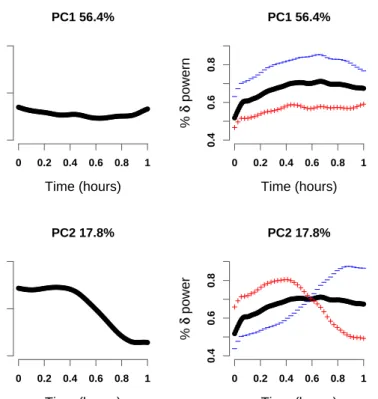
observed functional variability is associated with the first 6 eigenfunctions. Figure2 displays
the first two eigenfunctions (left panels) and the deformations from the population mean in the positive and negative directions of the eigenfunctions.
Staicu et al. (2009) and Crainiceanu et al. (2009b) point out that choosing the number of eigenfunctions corresponds to step-wise testing for zero variance components. They propose using a Restricted Likelihood Ratio Test (RLRT) for this zero variance. The null distribution
can be easily approximated using methods introduced byGreven, Crainiceanu, K¨uchenhoff,
and Peters(2008) based on the null distribution derived inCrainiceanu and Ruppert (2004) andCrainiceanu, Ruppert, Claeskens, and Wand (2005).
We will retain the firstK= 10 eigenfunctions and consider the case whenµ(t) = 0. This can
be achieved by replacingWi(t) by Wi(t)−µˆ(t), where ˆµ(t) =PIi=1Wi(t)/I. The functional
model (1) becomes
Wi(t) = PKk=1ξikψk(t) +i(t); ξik ∼ N(0, λk); i(t)∼N(0, σ2),
(2)
which is a mixed effects model. We now show how to implement this model inWinBUGS.
To completely specify the Bayesian model, one needs to provide prior distributions for all
model parameters. We used independent Gamma(10−3,10−3) priors for σ2, σk2 for k =
Eigenvalues
1 2 3 4 5 6 7 8 9 10
Var 0.99 0.31 0.18 0.10 0.06 0.04 0.03 0.02 0.02 0.01
% Var 56.4 17.8 10.3 5.4 3.3 2.2 1.4 1.2 1.0 0.6
Sum % Var 56.4 74.2 84.5 90.0 93.3 95.5 96.9 98.1 99.1 99.8
Table 1: Estimated eigenvalues for the percentδ power using data for the first hour of sleep
●●●●●●●●●●●●●●●●●●●●●●●●●●●●●●●●●●●●●●●●●●●●●●●●●●●●●●●●●●●●●●●●●●●●●●●●●●●●●●●●●●●●●●●●●●●●●●●●●●●●●●●●●●●●●●●●●●●●●●●● Time (hours) % δδ power deviation 0 0.2 0.4 0.6 0.8 1 −0.2 0 0.2 PC1 56.4% ●● ●●● ●●●●●●●●●●●●●●●●●●●●●●●●●●●●●●●●●●●●●●●●●●●●●●●●●●●●●●●●●●●●●●●●●●●●●●●●●●●●●●●●●●●●●●●●●●●●●●●●●●●●●●●●●●●●●●●●●●● Time (hours) % δδ powern 0 0.2 0.4 0.6 0.8 1 0.4 0.6 0.8 −− −−−−−−− −−−−−−−−−−−−−−−−−−−−−−−−−−−−−−− ++++++ ++++++++++++++++++++++++++++++++++ PC1 56.4% ●●●●●●●●●●●●●●●●●●●●●●●●●●●●●●●●●●●●●●●●●●●●●●●●●●●●●●●●●●●●●●●●●●●●●●●●●●●●●●●●●●●●●●●●●●●●●●●●●●●●●●●●●●●●●●●●●●●●●●●● Time (hours) % δδ power deviation 0 0.2 0.4 0.6 0.8 1 −0.2 0 0.2 PC2 17.8% ●●● ●●●● ●●●●●●●●●●●●●●●●●●●●●●●●●●●●●●●●●●●●●●●●●●●●●●●●●●●●●●●●●●●●●●●●●●●●●●●●●●●●●●●●●●●●●●●●●●●●●●●●●●●●●●●●●●●●●●●●● Time (hours) % δδ power 0 0.2 0.4 0.6 0.8 1 0.4 0.6 0.8 −− −−−−−−−−−− −−−−−− −−−− −−−− −−−− −−−−−−−−−− ++++ +++++ +++++++++++++ +++++ + ++ ++++++++++ PC2 17.8%
Figure 2: Left panels: First and second eigenvectors, ψ1(t) and ψ2(t), for the first hour of
sleep percent δ power data on 500 subjects. Right panels: The positive (“+” sign) and
neg-ative (“−” sign) deformation from the population mean in the direction of the corresponding
eigenfunction.
1, . . . , K = 10. The parameterization of the Gamma(a, b) distribution is chosen so that
its mean isa/b= 1 and its variance isa/b2= 103. These choices are reasonable as the MoM
estimators ofσ2 andλK=10 were 6.7·10−3 and 1.16·10−2, respectively (see e.g.,Crainiceanu,
Ruppert, Carroll, Adarsh, and Goodner 2007, for a thorough discussion on Gamma priors). In Bayesian models, the estimates of the variance components are known to be sensitive to
the prior specification; seeGelman(2006). Alternative to gamma priors are discussed by, for
example, Gelman (2006) and Natarajan and Kass (2000). These have the advantage of
re-quiring less care in the choice of the hyperparameters. However, we find that with reasonable care, the conjugate gamma priors can be used in practice. Nonetheless, exploration of other prior families for functional data analysis would be well worthwhile, though beyond the scope of this paper.
2.2. WinBUGS program for the single-level exposure model
We now describe theWinBUGSprogram that follows closely the description of the Bayesian
functional principal component analysis (FPCA) model (2). We provide the entire program
in the AppendixA. While the program was designed for the SHHS data, it can be used for
in the other examples in this paper and changes will be described, as needed.
Model (2) describes the core components (likelihood and shrinkage assumptions) of FPCA
and is specified inWinBUGSas follows
for (i in 1:N_subj) {for (t in 1:N_obs) {W[i,t]~dnorm(X[i,t],tau_eps) X[i,t]<-xi[i,1]*psi[t,1]+xi[i,2]*psi[t,2]+xi[i,3]*psi[t,3]+ xi[i,4]*psi[t,4]+xi[i,5]*psi[t,5]+xi[i,6]*psi[t,6]+ xi[i,7]*psi[t,7]+xi[i,8]*psi[t,8]+xi[i,9]*psi[t,9]+ xi[i,10]*psi[t,10]} for (k in 1:dim.space) {xi[i,k]~dnorm(0,tau_lambda[k])} }
This part of the program describes a double loop over the subjects, for (i in 1:N_subj),
and over the number of observations within subjects,for (t in 1:N_obs). The number of
subjects,N_subj, is a constant in the program and is equal to 500. The number of observations
within subject,N_obs, is also a constant and is equal to 120, which corresponds to the number
of 30-second intervals in one hour. Note that, in general, the number of observations for each subject is smaller than 120 due to missing observations. However, missing observations are treated as random and are estimated like all the other unknowns in the model.
The first statement specifies that the Wi(t), the observed percent EEG δ-power, has a
nor-mal distribution with mean Xi(t), the true percent EEG δ-power, and precision τ = σ−2.
The second statement provides the structure of the conditional mean function,Xi(t). Here
psi[t,k] denotes the kth eigenfunction evaluated at time t, ψk(t). All eigenfunctions are
obtained from the diagonalization procedure of the smooth estimator KbX(t, s) of KX(t, s)
and are treated as data. Also, xi[i,k] corresponds to ξik in model (2), which is the score
of the subject i-specific function on the kth eigenfunction, ψk(t). Thus, xi[,] is a I ×K
dimensional matrix of random parameters, whose joint posterior distribution is the main
tar-get of inference. The third statement specifies thatξik fori= 1, . . . , I, the scores of subjects
on principal componentk, have a normal distribution with mean 0 and componentk-specific
precision τk,λ = λ−k1. The matrices W[,] and psi[,] are I ×T and T ×K dimensional,
respectively, are obtained outsideWinBUGS and are entered as data. The software
accom-panying this paper contains an auxiliaryR program that calculates these matrices and uses
theR2WinBUGS package (Sturtz, Ligges, and Gelman 2005) to callWinBUGSfrom R. The
formulae for X[i,t] could be shortened using the inner product function inprod. However,
depending on the application, computation time can be 5 times longer wheninprod is used.
The model continues with the prior specifications for the precision parameters, τk = σ−k2.
These parameters were already estimated as the eigenvalues of the method of moments
esti-matorKbX(t, s) and could be embedded as constants. Here, we estimate them again by using
uninformative gamma priors.
for (k in 1:dim.space)
{tau_lambda[k]~dgamma(1.0E-3,1.0E-3) lambda[k]<-1/ll[k]}
Iteration number λλ1 100 500 900 0.9 1.1 1.3 Iteration number λλ3 100 500 900 0.18 0.22 0.26 Iteration number X3 (( 10 )) 100 500 900 0 0.04 0.08 0.12 Iteration number X5 (( 50 )) 100 500 900 −0.06 −0.02 0.02
Figure 3: 1,000 un-thinned draws from the posterior distributions for two variance
com-ponents, λ1 and λ3, and two subject-specific deviations, X3(·) and X5(·), evaluated at two
different time points,t= 10 and t= 50, respectively.
● ● ● ● ● ● ● ● ●● ● ● ● ● ● ● ●● ● ● ● ● ● ●●● ● ● ● ● ● ●● ● ● ● ● ●● ● ●● ● ● ●● ● ● ● ● ●●● ● ● ● ● ● ● ● ● ● ●●●● ● ● ●● ● ● ● ● ● ● ● ●● ● ● ●● ● ● ●● ● ● ● ● ● ● ● ●● ● ●● ● ● ● ● ● ● ● ● ● ● ● ● ● ● ● ● ● ●● ● Time (hours) % δδ power 0 0.2 0.4 0.6 0.8 1 0.4 0.5 0.6 0.7 0.8 ● ● ● ● ● ● ● ● ●● ● ● ● ● ● ● ●● ● ● ● ● ● ●●● ● ● ● ● ● ●● ● ● ● ● ●● ● ●● ● ● ●● ● ● ● ● ●●● ● ● ● ● ● ● ● ● ● ●●●● ● ● ●● ● ● ● ● ● ● ● ●● ● ● ●● ● ● ●● ● ● ● ● ● ● ● ●● ● ●● ● ● ● ● ● ● ● ● ● ● ● ● ● ● ● ● ● ●● ● ● ● ● ● ● ●● ● ● ● ● ● ●●● ●● ● ● ● ● ● ● ● ● ● ● ● ● ● ● ● ● ● ● ●● ● ● ● ● ● ● ● ●● ● ● ● ● ● ● ●● ● ● ● ● ● ● ● ●● ● ● ● ●● Time (hours) % δδ power 0 0.2 0.4 0.6 0.8 1 0.4 0.5 0.6 0.7 0.8 ● ● ● ● ● ●● ● ● ● ● ● ●●● ●● ● ● ● ● ● ● ● ● ● ● ● ● ● ● ● ● ● ● ●● ● ● ● ● ● ● ● ●● ● ● ● ● ● ● ●● ● ● ● ● ● ● ● ●● ● ● ● ●● ● ● ● ● ● ● ● ● ● ● ● ●●● ● ● ● ● ● ● ● ● ● ● ● ● ● ● ● ● ● ● ● ● ● ● ● ● ● ● ● ● ● ● ● ● ● ● ● ●● ● ● ● ● ● ●●● ● ● ● ● ● ● ● ● ● ●● Time (hours) % δδ power 0 0.2 0.4 0.6 0.8 1 0.4 0.5 0.6 0.7 0.8 ● ● ● ● ● ● ● ● ● ● ● ●●● ● ● ● ● ● ● ● ● ● ● ● ● ● ● ● ● ● ● ● ● ● ● ● ● ● ● ● ● ● ● ● ● ● ● ● ●● ● ● ● ● ● ●●● ● ● ● ● ● ● ● ● ● ●● ●● ● ● ●●●● ● ● ●●● ● ● ● ● ● ● ● ● ● ● ● ● ● ● ● Time (hours) % δδ power 0 0.2 0.4 0.6 0.8 1 0.4 0.5 0.6 0.7 0.8 ●● ● ● ●●●● ● ● ●●● ● ● ● ● ● ● ● ● ● ● ● ● ● ● ●
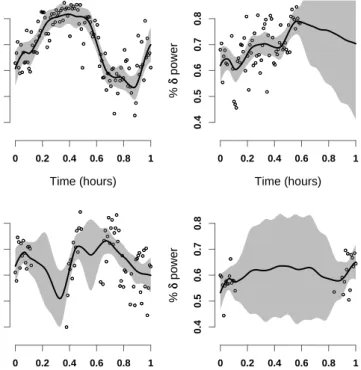
Figure 4: Estimated subject-specific means with 95% point-wise credible intervals for the
2.3. Results
We obtained 1,500 simulations, discarded the first 500 as burn-in and used the remainder
1,000 for inference. For I = 500 subjects andT = 120 grid points for each function the total
computation time was 4.8 minutes (Dual Core Processor 3GHz, 8Mb RAM PC). This number of simulations was enough for our purposes because convergence and mixing of the chains was
excellent. Indeed, Figure 3 displays the un-thinned histories for 4 chains corresponding to
two variance components and two subject-specific deviations from the population mean. The independence-like behavior of the chains is due to the orthogonality of the functional basis,
ψk(·).
Chain properties, such as convergence and mixing are crucial in Bayesian analysis based on posterior simulations. Indeed, if the chain does not converge or converges very slowly to the target distribution then inferences based on these chains may be unreliable. Poor mixing may be due to a variety of factors, all of them undesirable: inadequate model parameterization, unidentifiable or nearly unidentifiable models, poor performance of simulation algorithms, wrong implementation, etc. Poor mixing is one of the most haunting problems of modern Bayesian computational problems, with hundreds of papers dedicated to improving mixing behavior. In practice, we found that convergence of chains is best illustrated by running multiple chains from over-dispersed initial values with respect to the target distribution and visually inspect when chains have converged. A more formal approach would be to monitor the
Gelman and Rubin statisticGelman and Rubin (1992). In our case convergence is basically
instantaneous and simply removing the first 500 simulations as burn-in is more than enough. Mixing is typically assessed by visual inspection, by calculating the autocorrelation function or the Monte Carlo error. Visual inspection of chains indicated that our chains are very close to independence sampling.
The orthogonality of the principal component basis, the data reduction and the mixed model representation of functional models make Bayesian analysis particularly appealing for func-tional data analysis.
Bayesian posterior simulations provide the joint posterior distribution of all parameters given
the data. Note that the subject-specific functional random effects, Xi(t) = PkK=1ξikψk(t),
are explicit functions of the model parameters, ξik; thus, one can obtain the joint posterior
distribution of all Xi(t), for every t. Figure 4 displays the data (black dots) for 4 subjects
together with the posterior means (solid black line) and 95% point-wise credible intervals
(shaded areas) of the subject-specific mean,µ(t) +Xi(t). Constructing credible or confidence
intervals is considered to be technically difficult but important; using the Bayesian methods in this paper this can be done relatively easily for data sets with a large number of subjects. We are not aware of any other published result that allows this.
3. Functional regression models
In this section, we describe Bayesian analysis of three types of functional regression. First, we introduce the classical functional regression model where an outcome is regressed on a functional predictor. This is done by adding a regression model to the functional models
introduced in Section2, where the outcome is regressed on the functional scores and other
covariates. The regression and the functional model are fitted jointly, which correctly accounts for the uncertainty of functional estimators. Second, we introduce the Bayesian penalized
B-splines model to estimate the functional coefficient. This is an alternative to the classical functional regression model that uses a large number of principal components to estimate the subject-specific functions and a spline penalty to control the amount of smoothing of the functional parameter. This method avoids the typical discussions about choosing the right number of principal components. Third, we introduce the case when functional scores are regressed on other covariates. This is done by adding a regression model to the functional
models introduced in Section 2, where the outcome is one of the functional scores and the
regressors are other covariates. Models are fitted jointly to correctly incorporate the variability of the unknowns.
3.1. Classical functional regression model
A particularly useful class of models that describe associations between non-gaussian outcomes
and functional data is the class of generalized functional linear models (GFLM, M¨uller and
Stadtm¨uller 2005; Cardot, Ferraty, and Sarda 1999, 2003; Reiss and Ogden 2007; Ramsay and Silverman 2006,2005). For the ith subject the data are [Yi,Zi,{Wi(tim), tim∈ [0,1]}],
where Yi is the continuous or discrete outcome,Zi is a vector of covariates, andWi(tim) is a
random curve in L2[0,1] observed at time tim, which is the mth observation, j = 1, . . . , Mi,
for the ith subject, i = 1, . . . , n. We assume that Wi(t) is a proxy observation of the true
underlying functional signal Xi(t) and that Wi(t) = µ(t) +Xi(t) +i(t), where µ(t) is the
population average and i(t) is a mean zero white noise process with variance σ2. We also
assume that the distribution of Yi is in the exponential family with linear predictor ϑi and
dispersion parameter a, denoted here by EF(ϑi, a). The linear predictor is assumed to have
the following form
ϑi =
Z 1
0
Xi(t)β(t)dt+Ztiγ, (3)
whereβ(·)∈L2[0,1] is a functional parameter and the main target of inference. Note that if
{ψk(·), k≥1}is an orthonormal basis inL2[0,1] then bothXi(·) andβ(·) have unique
repre-sentationsXi(t) =Pk≥1ξikψk(t),β(t) =Pk≥1βkψk(t) and equation (3) can be rewritten as
ϑi =Pk≥1ξikβk+Ztiγ.Thus, conditional on the eigenfunctionsψk(t),k= 1, . . . , K, and on
the number of eigenfunctions,K, the standard functional regression model can be re-written
as the following mixed effects model
Yi ∼ EF(ϑi, a); ϑi = Pk≥1ξikβk+Ztiγ; Wi(t) = PKk=1ξikψk(t) +i(t); ξik ∼ N(0, λk); i(t)∼N(0, σ2). (4)
The first line of model (4) describes the distribution of the outcome, where EF(ϑi, a) is
an exponential family distribution with linear predictorϑi and dispersion parameter a. The
second line describes the structure of the linear predictor which contains the functional scores,
ξik, and other covariates, Zi, as regressors. The scores ξik are not directly observable, but
can be estimated from the functional exposure model described in the third line and the
distributional assumptions in the fourth line. The difference between model (4) and a standard
generalized linear mixed model (GLMM) is that in a GLMM the random effects are random
parameters for known regressors. In model (4) the random effects are the regressors in the
µ β1 β2 β3
Mean −0.25 0.14 −0.16 0.30
St. Dev. 0.09 0.09 0.16 0.21
Table 2: Estimated functional effects for sleep EEG normalized δ-power on Hypertension.
Results shown for 500 subjects and first hour of sleep.
Changes to the program
We provide the entire program in the AppendixB. For illustration, consider the case where
a binary outcome is regressed on the functional scores on the first three eigenfunctions. That is, the functional predictor has the form
ϑi =µ+ξi1β1+ξi2β2+ξi3β3. (5)
This additional regression level is included in the WinBUGSprogram by simply adding the
following code describing the logistic model for the outcome to theWinBUGScode described
in Section2.2
for (i in 1:N_subj) {Y[i]~dbern(pY[i])
logit(pY[i])<-mu+beta[1]*xi[i,1]+beta[2]*xi[i,2]+beta[3]*xi[i,3]}
One also needs to specify the prior distributions forµ, β1, β2, β3. This is done as
for (j in 1:3){beta[j]~dnorm(0,1.0E-2)} mu~dnorm(0,1.0E-2)
Extending this regression model to include more scores or other covariates is straightforward
by simply adding terms tologit(pY[i]).
Results
We applied the functional regression model for regressing hypertension status, a binary vari-able, on the scores of the first three principal components. We used model the functional
model (4) with the particular form of the linear predictor given in (5). We used the first hour
of normalized EEG δ-power for 500 subjects as functional predictors. Table 2 provides the
posterior mean and standard deviation of the parametersµ,β1,β2 andβ3.
3.2. Functional regression using penalized B-splines
An important approach to GFLMs uses a penalized spline expansion for the coefficient
func-tion (O’Sullivan 1986; Cardot et al. 2003; Cardot and Sarda 2005; Ruppert, Carroll, and
Wand 2003; Wood 2006). As in Section 3.1, assume that for the ith subject we observe
[Yi, Zi,{Wi(tim), tim∈[0,1]}] whereWi(t) is a measured-with-error proxy for the true
subject-specific functionXi(t), thatYi∼EF(ϑi, a), and that the linear predictorϑihas the form given
in (3). Rather than expressingβ(·) in terms of the eigenfunctions ψk(t), we use a cubic
B-spline basis{φl(t) : 1≤l≤L} with equally spaced knots, so that β(t) =PL
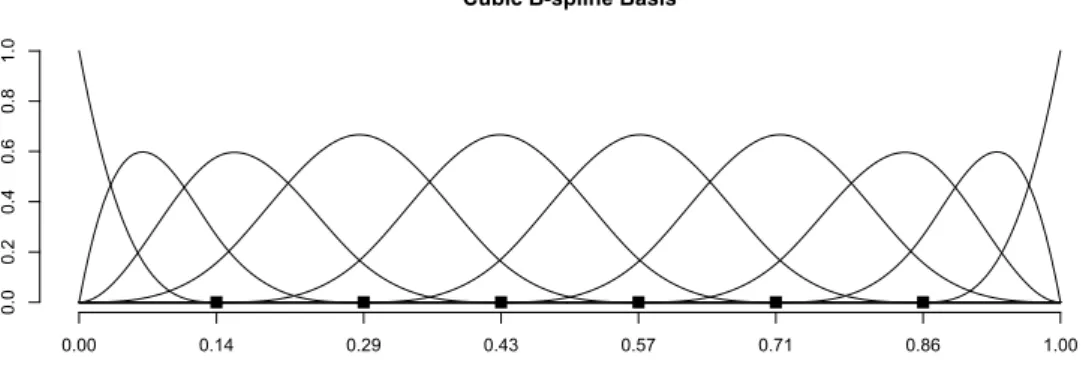
Cubic B-spline Basis 0.0 0.2 0.4 0.6 0.8 1.0 0.00 0.14 0.29 0.43 0.57 0.71 0.86 1.00
Figure 5: Cubic B-spline basis with 10 functions and 6 equally spaced knots, with knots
marked by solid squares.
spline bases could be used, but the parameters of the B-spline have good mixing properties in
a Bayesian posterior simulation context. Given the truncation lag K and the identifiability
constraintL≤K, the linear predictor has the form
ϑi = Z 1 0 { K X k=1 ξikψk(t)}{ L X l=1 βlφl(t)}dt+Ziγ = ξiJ β>+Ziγ,
where ξi = [ξi1, ..., ξiK]>, β = [β1, ..., βL]> and J is a K×L dimensional matrix with the
(k, l)th entry equal to R01ψk(t)φl(t)dt. These integrals are computed by numeric integration
and are fixed for the purpose of this paper. WinBUGS loads the matrixJ as data.
In this paper we use B-splines, which are a flexible basis commonly used in smoothing
ap-plications; Figure 5 shows a cubic B-spline basis with 10 functions and 6 equally spaced
knots. Smoothness on β(t) is typically induced by assuming a random walk prior on the βl,
l= 1, . . . , L parameters (Brezger, Kneib, and Lang 2005;Lang and Brezger 2004). We use a first order random prior
βl+1∼N(βl, σβ2), l= 1, . . . , L−1,
where β1 is treated as a fixed unknown parameter. A second order random walk prior is
βl+2∼N(2βl+1−βl, σ2β), l= 1, . . . , L−2,
whereβ1andβ2 are treated as a fixed unknown parameter. Both priors are easy to implement
in WinBUGSand we choose to use the first order random walk prior.
Thus, the functional regression model using penalized B-splines has the mixed model repre-sentation Yi ∼ EF(ϑi, a); ϑi = ξiJ β>+Ziγ; Wi(t) = PKk=1ξikψk(t) +i(t); ξik ∼ N(0, λk); i(t)∼N(0, σ2); βl+1 ∼ N(βl, σ2β), l= 1, . . . , L−1. (6)
Changes to the program
We provide the entire program in the AppendixC. We describe the changes in theWinBUGS
program to account for the different parameterization ofϑi. Here, we choose K = L = 10;
straightforward changes to the code below allow for larger values of both. First, we use the following code to define the functional predictor for each subject:
logit(pY[i])<-mu[i] mu[i]<-mp+eta[i] eta[i]<-xi[i,1]*gamma[1]+xi[i,2]*gamma[2]+xi[i,3]*gamma[3]+ xi[i,4]*gamma[4]+xi[i,5]*gamma[5]+xi[i,6]*gamma[6]+ xi[i,7]*gamma[7]+xi[i,8]*gamma[8]+xi[i,9]*gamma[9]+ xi[i,10]*gamma[10]
Here, gamma is the L×1 vector Jβ>. This vector is updated once per iteration, and is
computed outside the loop over subjects in the following code:
for(l in 1:L){ gamma[l]<-J[l,1]*beta[1]+J[l,2]*beta[2]+J[l,3]*beta[3]+ J[l,4]*beta[4]+J[l,5]*beta[5]+J[l,6]*beta[6]+ J[l,7]*beta[7]+J[l,8]*beta[8]+J[l,9]*beta[9]+ J[l,10]*beta[10] }
The first order random walk prior is specified as
for (l in 2:L)
{beta[l]~dnorm(beta[l-1],taubeta)} beta[1]~dnorm(0,1.0E-6)
taubeta~dgamma(1.0E-3,1.0E-3)
Results
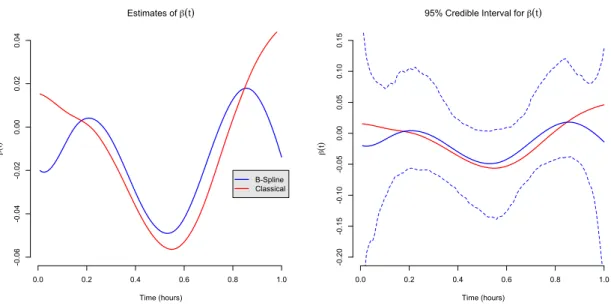
Figure 6 shows the estimate of the functional coefficient β(t) in the linear predictor (3)
us-ing the penalized B-spline approach (blue solid line); for reference, we also plot the estimate
from the classical functional regression model presented in Section 3.1 (red solid line). In
the Bayesian context obtaining credible intervals for the functional parameter is
straightfor-ward by simply monitoring β. Figure 6 displays the pointwise 95% credible interval for the
estimated coefficient function, indicating that in this example there is not much evidence of statistical significance. Also, the classical and the penalized spline regression provide similar
results, but this need not be the case in general (Goldsmith, Feder, and Crainiceanu 2010).
3.3. Regression with functional scores as outcomes
In this section, we focus on models that regress functional scores on other covariates. This type of models are important to identify and quantify predictors of observed principal directions
Estimates of β(t) Time (hours) β ( t ) 0.0 0.2 0.4 0.6 0.8 1.0 -0 .0 6 -0 .0 4 -0 .0 2 0.00 0.02 0.04 B-Spline Classical
95% Credible Interval for β(t)
Time (hours) β ( t ) 0.0 0.2 0.4 0.6 0.8 1.0 -0 .2 0 -0 .1 5 -0 .1 0 -0 .0 5 0.00 0.05 0.10 0.15
Figure 6: The left panel shows two estimates of the functional coefficient β(t), one from
the classical functional regression model (red solid line) and the other from the Penalized B-Spline approach (blue solid line). The right panel also shows the estimated functions and
the pointwise 95% credible interval forβ(t) using the Penalized B-spline approach.
on the k0th eigenfunction, φk0(t). We regress ξik0 on the covariate vector Zi, which could
include the scores on other eigenfunctions. The full model is
ξik0 ∼ N(Z t iγ, λk0); Wi(t) = PKk=1ξikψk(t) +i(t); ξik ∼ N(0, λk)k6=k0; i(t) ∼ N(0, σ2). (7)
The main difference between this model and model (2) is that the scores ξik0 are shrunk
towardsZtiγ instead of 0.
Changes to the program
We provide the entire program in the AppendixD. For illustration, consider the case where
a the functional scores on the first eigenfunction is regressed on age and body mass index (BMI). That is,
Ztiγ=µ+ ageiγ1+ BMIiγ2.
This additional level is included in theWinBUGSprogram by simply adding the following code
describing the logistic model for the outcome to theWinBUGScode described in Section2.2
for (i in 1:N_subj)
{xi[i,1]~dnorm(m_xi[i],ll[1])
m_xi[i]<-mu+gamma[1]*age[i]+gamma[2]*BMI[i]}
In this case there were 1 missing age and 41 missing BMI values. We added an imputation model for age and BMI by adding the following code
γ1 (age) γ2 (BMI)
Mean 0.016 0.021
St. Dev. 0.005 0.007
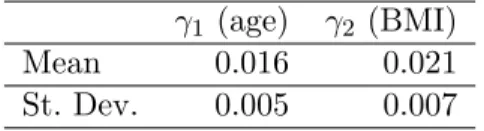
Table 3: Estimated effects of age and BMI on the first principal component scores. Results shown for 500 subjects and first hour of sleep.
for (i in 1:N_subj)
{age[i]~dnorm(mu_X[1],tau[1]) BMI[i]~dnorm(mu_X[2],tau[2])}
This is theWinBUGSrepresentation of the simple Gaussian imputation priors agei ∼N(µX,1, τ1)
and BMIi ∼N(µX,2, τ2). More complex imputation priors could be set up, but this exceeds
the scope of this paper.
One also needs to specify the prior distributions forµ, γ1, γ2, µX,1, µX,2, τ1, τ2. This is done as
mu~dnorm(0,1.0E-2) for (l in 1:2)
{gamma[l]~dnorm(0,1.0E-2)
mu_X[l]~dnorm(m_prior[l],1.0E-3) tau[l]~dgamma(1.0E-3,1.0E-3)}
Herem_prior[l]is a 2-dimensional vector containing the sample means of the observed age and BMI values, respectively.
Results
We used the first hour of normalized EEGδ-power for 500 subjects as functional predictors
and we regressed the first principal component scores on age and BMI. Table 3 provides
the posterior mean and standard deviation of the parameters γ1 and γ2. Results indicate
that higher age and BMI are positively associated with higher scores on the first principal
component. A closer look at Figure2shows that the first principal component is negative and
is, roughly, a vertical shift. We conclude that higher age and BMI are significantly associated
with lower EEG percentδ-power in the first hour of sleep.
4. Multilevel modeling of functional data
The number of data sets where functional data is observed at multiple visits or within clusters is increasing. For example, the SHHS contains EEG data at two visits for thousands of subjects.
In this section, we describe Bayesian methods for the analysis of a sample of curves ob-served at multiple visits. The basic idea is to decompose each curve into a population aver-age, a visit-specific deviation from the population averaver-age, a subject-specific deviation from the visit-specific mean, a subject/visit specific deviation from the subject-specific mean and measurement error. The subject-specific and the subject/visit specific deviations are mod-eled by projecting them on the eigenvectors of the covariance matrices of the subject- and
subject/visit-specific processes, respectively. Using the mixed model formulation of the un-derlying model we obtain the joint posterior distribution of all parameters given the data. The parameter space includes all subject-specific and subject/visit-specific functions and their in-dividual scores. Methods in this section can be applied to sparse or dense multilevel functional data.
4.1. Multilevel functional principal component analysis
For illustration consider the sleep EEG percent δ-power for the first hour of sleep of 500
subjects who have two visits, roughly 5 years apart. Denote the observed sleep EEG fraction
of δ-power by Wij(t), for subject i= 1, . . . , I = 500 at visit j = 1, J = 2, at the 30-second
intervalt = 1, . . . , T = 120. In this data set 18% of observations are missing because wake
periods are removed.
We assume thatWij(t) is a proxy observation of the true underlying subject-specific functional
signal Xi(t), and that
Wij(t) =µ(t) +ηj(t) +Xi(t) +Uij(t) +ij(t).
Hereµ(t) is the overall mean function, ηj(t) is the visitj specific shift from the overall mean
function, Xi(t) is the subject i specific deviation from the visit specific mean function, and
Uij(t) is the residual subject/visit specific deviation from the subject specific mean. To ensure
identifiability we assume thatXi(t),Uij(t), andij(t) are uncorrelated, thatPjηj(t) = 0 and
thatij(t) is a white noise process with variance σ2. Given the large sample size of the SHHS
data, we can assume that µ(t) and ηj(t) are estimated with negligible error by W··(t) and
W·j(t)−W··, respectively. HereW··(t) is the average over all subjects,i, and visits,j, ofWij(t)
andW·j(t) is the average over all subjects,i, of observation at visitjofWij(t). We can assume
that these estimates have been subtracted fromWij(t), so thatWij(t) =Xi(t)+Uij(t)+ij(t).
Eigenvalues and eigenvectors in MFPCA
We use MFPCA (Di et al. 2009) to obtain the parsimonious bases that capture most of
the functional variability of the space spanned by Xi(t) andUij(t), respectively. MFPCA is
based on the spectral decomposition of the within- and between-visit functional variability covariance operators. We summarize here the main components of this methodology. Denote
by KTW(s, t) = cov{Wij(s), Wij(t)} and KBW(s, t) = cov{Wij(s), Wik(t)}for j6=k the total
and between covariance operator corresponding to the observed process,Wij(·), respectively.
Denote by KX(t, s) = cov{Xi(t), Xi(s)} the covariance operator of the Xi(·) process and
by KU(t, s) = cov{Uij(s), Uij(t)} the total covariance operator of the Uij(·) process. By
definition,KBU(s, t) = cov{Uij(s), Uik(t)}= 0 forj6=k. Moreover,KBW(s, t) =KX(s, t) and
KTW(s, t) =KX(s, t) +KU(s, t) +σ2δts, where δts is equal to 1 whent=sand 0 otherwise.
Thus, KX(s, t) can be estimated using a method of moments estimator of KBW(s, t), say
b
KBW(s, t). Fort6=sa method of moment estimator ofKTW(s, t)−KBW(s, t), sayKbU(s, t), can
be used to estimate KU(s, t). To estimate KbU(t, t) one predicts KU(t, t) using a bivariate
thin-plate spline smoother ofKbU(s, t) for s 6=t. This method was proposed for single-level
FPCA (Yao and Lee 2006) and shown to work well in the MFPCA context (Diet al. 2009).
Once consistent estimators of KX(s, t) and KU(s, t) are available, the spectral
theorem (see Indritz 1963, Chapter 4) provides the following convenient spectral
decompo-sitions KX(t, s) = P∞k=1λ(1)k ψk(1)(t)ψ(1)k (s), where λ(1)1 ≥ λ(1)2 ≥ . . . are the ordered
eigen-values and ψk(1)(·) are the associated orthonormal eigenfunctions of KX(·,·) in the L2 norm.
Similarly, KU(t, s) =P∞l=1λ(2)l ψl(2)(t)ψ(2)l (s), where λ(2)1 ≥ λ(2)2 ≥. . . are the ordered
eigen-values and ψl(2)(·) are the associated orthonormal eigenfunctions of KU(·,·) in the L2 norm.
The Karhunen-Lo`eve (KL) decomposition (Karhunen 1947; Lo`eve 1945) provides the
fol-lowing infinite decompositions Xi(t) = P∞k=1ξikψ(1)k (t) and Uij(t) = P∞l=1ζijlψl(2)(t) where
ξik = R1 0 Xi(t)ψ (1) k (t)dt, ζijl = R1 0 Uij(t)ψ (2)
l (t)dt are the principal component scores with
E(ξik) = E(ζijl) = 0, Var(ξik) = λ(1)k , Var(ζijl) = λ(2)l . The zero-correlation assumption
between the Xi(·) and Uij(·) processes is ensured by the assumption that cov(ξi, ζijl) = 0.
These properties hold for every i, j, k, and l. For simplicity we will refer to ψ(1)k (·), ψl(2)(·)
and λ(1)k ,λ(2)l as the level 1 and 2 eigenfunctions and eigenvalues, respectively.
For the SHHS example the estimated eigenvalues of KbX(·,·) andKbU(·,·) are provided in
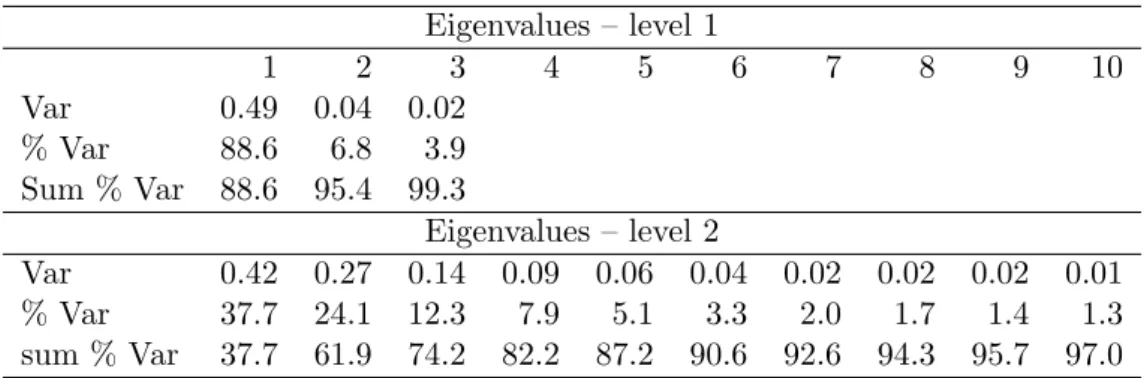
Ta-ble4. The Level 1 and 2 labels to refer to theXandU processes, respectively. Approximately
99% of the subject-specific process variability is explained by the first 3 principal components whereas as many as 12 components are necessary to explain the same percentage of variability for the subject-visit-specific variability. The within-subject between-visit correlation can be estimated as b ρW = P k≥1bλ (1) k P k≥1λb (1) k + P l≥1bλ (2) l .
In the SHHS example considered in this paper ρbW = 0.33.
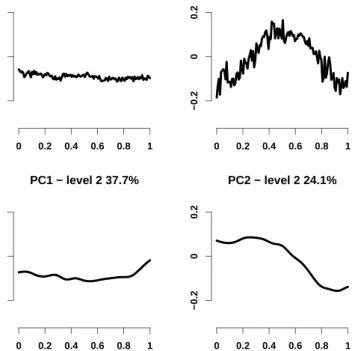
Figure7displays the first two eigenvectors for the Level 1 (top panels) and 2 (bottom panels)
processes. The first eigenvalues at both levels capture mainly vertical shifts. The second eigenvalue at the first level is roughly centered around zero. Subjects who are positively
loaded on this component will tend to have: (1) a lower sleep EEG δ-power proportion than
the population average in the first 10 and last 10 minutes of the first hour of sleep; and (2) a
higher sleep EEGδ-power proportion than the population average between minutes 20 and 40.
This eigenfunction is not smooth, most likely because of the sample size and small proportion of variation explained. One could easily smooth it using any reasonable scatterplot smoother.
Eigenvalues – level 1 1 2 3 4 5 6 7 8 9 10 Var 0.49 0.04 0.02 % Var 88.6 6.8 3.9 Sum % Var 88.6 95.4 99.3 Eigenvalues – level 2 Var 0.42 0.27 0.14 0.09 0.06 0.04 0.02 0.02 0.02 0.01 % Var 37.7 24.1 12.3 7.9 5.1 3.3 2.0 1.7 1.4 1.3 sum % Var 37.7 61.9 74.2 82.2 87.2 90.6 92.6 94.3 95.7 97.0
Table 4: Estimated eigenvalues for the percentδ power using data for the first hour of sleep
% δδ power deviation 0 0.2 0.4 0.6 0.8 1 −0.2 0 0.2 PC1 − level 1 88.6% 0 0.2 0.4 0.6 0.8 1 −0.2 0 0.2 PC2 − level 1 6.8% Time (hours) % δδ power deviation 0 0.2 0.4 0.6 0.8 1 −0.2 0 0.2 PC1 − level 2 37.7% Time (hours) 0 0.2 0.4 0.6 0.8 1 −0.2 0 0.2 PC2 − level 2 24.1%
Figure 7: Top panels: First and second eigenvectors at level 1,ψ(1)1 (t) andψ(1)2 (t). Bottom
panels: First and second eigenvectors at level 1, ψ(2)1 (t) andψ(2)2 (t).
Here, we work directly with the eigenvalue shown in Figure7. The second eigenvalue at the
second level is also roughly centered around zero. Subject-visits that are positively loaded
on this component will tend to have: (1) a higher sleep EEG δ-power proportion than the
subject-specific average in the first 25 minutes of the first hour of sleep; and (2) a lower sleep
EEGδ-power proportion than the subject-specific average between in the last 10 minutes of
the first hour of sleep.
Estimating the scores in the MFPCA
Conditional on the eigenfunctions and truncation lags K and L, the model for observed
functional data can be written as a linear mixed model. Indeed, by assuming a normal
shrinkage distribution for scores and errors, the model can be rewritten as
( Wij(t) = PkK=1ξikψk(1)(t) +PLl=1ζijlψl(2)(t) +ij(t); ξik ∼ N{0, λ (1) k }; ζijl∼N{0, λ (2) l }; ij(t)∼N(0, σ2). (8)
This model, like the other models in this paper, are especially well suited for Bayesian
infer-ence; the implementation in WinBUGS is simple, as we show in the following section. The
properties of the mixing chains remain outstanding for the same reasons: orthogonality of the principal component bases, data reduction and mixed model representation of functional models.
4.2. WinBUGS program for the multilevel exposure model
We provide the entire program in the AppendixE. TheWinBUGSprogram for the multilevel
functional model has a similar structure with the one for the single level functional model
presented in Section2.2. Model (8) describes the core components (likelihood and shrinkage
assumptions) of MFPCA and is specified inWinBUGSas follows
for (i in 1:N_subj) {for (t in 1:N_obs) {W_1[i,t]~dnorm(m_1[i,t],taueps) W_2[i,t]~dnorm(m_2[i,t],taueps) m_1[i,t]<-X[i,t]+U_1[i,t] m_2[i,t]<-X[i,t]+U_2[i,t] X[i,t]<-xi[i,1]*psi_1[t,1]+xi[i,2]*psi_1[t,2]+xi[i,3]*psi_1[t,3] U_1[i,t]<-zi[i,1,1]*psi_2[t,1]+zi[i,2,1]*psi_2[t,2]+ zi[i,3,1]*psi_2[t,3]+zi[i,4,1]*psi_2[t,4]+zi[i,5,1]*psi_2[t,5]+ zi[i,6,1]*psi_2[t,6]+zi[i,7,1]*psi_2[t,7]+zi[i,8,1]*psi_2[t,8]+ zi[i,9,1]*psi_2[t,9]+zi[i,10,1]*psi_2[t,10] U_2[i,t]<-zi[i,1,2]*psi_2[t,1]+zi[i,2,2]*psi_2[t,2]+ zi[i,3,2]*psi_2[t,3]+zi[i,4,2]*psi_2[t,4]+zi[i,5,2]*psi_2[t,5]+ zi[i,6,2]*psi_2[t,6]+zi[i,7,2]*psi_2[t,7]+zi[i,8,2]*psi_2[t,8]+ zi[i,9,2]*psi_2[t,9]+zi[i,10,2]*psi_2[t,10]} for (k in 1:dim.space_b) {xi[i,k]~dnorm(0,ll_b[k])} for (l in 1:dim.space_w) {zi[i,l,1]~dnorm(0,ll_w[l]) zi[i,l,2]~dnorm(0,ll_w[l])}}
This part of the program describes a double loop over the subjects, for (i in 1:N_subj),
and over the number of observations within subjects,for (t in 1:N_obs). The number of
subjects,N_subj, is a constant in the program and is equal to 500. The number of observations
within subject,N_obs, is also a constant and is equal to 120, which corresponds to the number
of 30-second intervals in one hour. As in the single-level case, missing observations are treated
as random and are estimated like all the other unknowns in the model. Even thoughN_obsis
a constant in the program, the number of observations per subject varies. Observations that
are missing are simply included asNA in the program.
The first four statements specify that the functionsWij(t), the observed percent sleep EEG
δ-power, have a normal distribution with mean mij(t) = Xi(t) +Uij(t), the true percent
EEG δ-power, and precision τ = σ−2. Here W_1[i,t] and W_2[i,t] are the WinBUGS
representation of Wi1(t) and Wi2(t), respectively. Similarly, U_1[i,t] and U_2[i,t] are
U-processes could be achieved using triple-indexing. For example one could use U[1,i,t]
and U[2,i,t] instead of U_1[i,t] and U_2[i,t]; this would be especially useful for more than two visits. However, our implementation works well and proved to be helpful during debugging.
The fifth statement provides the structure of the subject-specific process, Xi(t), where the
kth level 1 eigenfunction evaluated at timet,ψk(1)(t), ispsi_1[t,k]. In this case we only used
the first three eigenfunctions because together they explain more than 99% of the functional
variability at the subject-level. All eigenfunctions are obtained from the diagonalization
procedure of the smooth estimatorKbX(t, s) ofKX(t, s) and are treated as data; the first two
eigenfunctions are displayed in the top panels of Figure 7. Also, xi[i,k] corresponds to ξik
in model (8), which is the score of the subjecti-specific mean function,Xi(t), on thekth level
1 eigenfunction, ψk(1)(t). Thus, xi[,] is aI ×K dimensional matrix of random parameters,
whose joint posterior distribution is one of the targets of inference. In our example,I×K=
500×3 = 1,500.
The sixth and seventh statements specify the structure of the subject-visit-specific deviations,
Ui1(t) and Ui2(t), from the subject specific mean, Xi(t). Here psi_2[t,k] denotes the kth
level 2 eigenfunction evaluated at time t, ψ(2)k (t). In this case we used the first ten
eigen-functions because together they explain more than 97% of the functional variability at the subject-visit level. All eigenfunctions are obtained from the diagonalization procedure of the
smooth estimatorKbW(t, s) of KW(t, s) and are treated as data; the first two eigenfunctions
are displayed in the bottom panels of Figure7. Also,zi[i,l,j]corresponds toζijl in model
(8), which is the score of the subjecti, visitjdeviation,Uij(t), from the subject-specific mean,
Xi(t), on thelth level 2 eigenfunction,ψ
(2)
k (t). Thus,zi[,,]is aI×L×J dimensional matrix
of random parameters, whose joint posterior distribution is one of the targets of inference. In
our example,I×L×J = 500×10×2 = 10,000.
The assumptionsξik ∼N{0, λ(1)k }in model (8) are specified as xi[i,k]~dnorm(0,ll_b[k]),
wherell_b[k] are the precision parameters τk(1) = 1/λ(1)k and are estimated from the data.
Here the dimension of the level 1 space is K = 3, is denoted as dim.space_b and is loaded
as data in the program. The assumptions ζijl ∼ N{0, λ(2)l } in model (8) are specified as
zi[i,l,1]~dnorm(0,ll_w[l]) and zi[i,l,1]~dnorm(0,ll_w[l]), where ll_w[k] are the
precision parametersτk(2)= 1/λ(2)k and is a parameter that is estimated from the data. Here
the dimension of the level 2 space isL= 10, is denoted asdim.space_wand is loaded as data
in the program. The parametersλ(1)k ,λ(2)k σ2 are jointly estimated with the other parameters
of the model. Thus, we need to specify priors for the variance parameters as
for (i in 1:dim.space_b) {ll_b[i]~dgamma(1.0E-3,1.0E-3) lambda_b[i]<-1/ll_b[i]} for (i in 1:dim.space_w) {ll_w[i]~dgamma(1.0E-3,1.0E-3) lambda_w[i]<-1/ll_w[i]} taueps~dgamma(1.0E-3,1.0E-3) sigma_sq_eps=1/taueps
● ● ● ● ● ● ● ● ●● ● ● ● ● ● ● ●● ● ● ● ● ● ● ●● ● ● ● ● ● ●● ● ● ● ● ●● ● ●● ● ● ●● ● ● ● ● ●●● ● ● ● ● ● ● ● ● ● ●●●● ● ● ●● ● ● ● ● ● ● ● ●● ● ● ●● ● ● ●● ● ● ● ● ● ● ● ●● ● ●● ● ● ● ● ● ● ● ● ● ● ● ● ● ● ● ● ● ●● ● % δδ power 0 0.2 0.4 0.6 0.8 1 0.4 0.5 0.6 0.7 0.8 ● ● ● ● ● ● ● ● ●● ● ● ● ● ● ● ●● ● ● ● ● ● ● ●● ● ● ● ● ● ●● ● ● ● ● ●● ● ●● ● ● ●● ● ● ● ● ●●● ● ● ● ● ● ● ● ● ● ●●●● ● ● ●● ● ● ● ● ● ● ● ●● ● ● ●● ● ● ●● ● ● ● ● ● ● ● ●● ● ●● ● ● ● ● ● ● ● ● ● ● ● ● ● ● ● ● ● ●● ● ● ● ● ● ● ● ● ● ● ● ●● ●●● ●● ● ● ● ● ● ● ● ● ● ● ● ● ● ● ● ● ● ● ●● ● ● ● ● ● ● ● ● ● ● ●● ● ● ● ●● ● ● ● ● ● ● ● ● ● ● ● ● ●● 0 0.2 0.4 0.6 0.8 1 0.4 0.5 0.6 0.7 0.8 ● ● ● ● ● ● ● ● ● ● ●● ●●● ●● ● ● ● ● ● ● ● ● ● ● ● ● ● ● ● ● ● ● ●● ● ● ● ● ● ● ● ● ● ● ●● ● ● ● ●● ● ● ● ● ● ● ● ● ● ● ● ● ●● ● ● ● ● ● ● ● ● ● ● ● ●● ● ● ● ● ● ● ● ● ● ● ● ● ● ● ● ● ●● ● ● ● ● ● ● ● ● ● ● ● ● ● ● ● ● ● ● ●● ● ● ● ● ● ●● ●● ● ● ● ● ● ● ● ● ●● Time (hours) % δδ power 0 0.2 0.4 0.6 0.8 1 0.4 0.5 0.6 0.7 0.8 ● ● ● ● ● ● ● ● ● ● ● ●● ● ● ● ● ● ● ● ● ● ● ● ● ● ● ● ● ●● ● ● ● ● ● ● ● ● ● ● ● ● ● ● ● ● ● ● ●● ● ● ● ● ● ●● ●● ● ● ● ● ● ● ● ● ●● ●●● ● ●●●● ● ● ●●● ● ● ● ● ● ● ● ● ● ● ● ● ● ● ● Time (hours) store_subjects_v1[subj, ] 0 0.2 0.4 0.6 0.8 1 0.4 0.5 0.6 0.7 0.8 ●●● ● ●●●● ● ● ●●● ● ● ● ● ● ● ● ● ● ● ● ● ● ● ●
Figure 8: Estimated subject-specific means with 95% pointwise credible intervals for the
EEG normalized δ-power in the first hour of sleep of the first visit for 4 subjects from the
SHHS. The model used was the multilevel model (8).
An alternative would be to use the method of moment estimators ofλ(1)k and use this estimator
as data. This is a robust approach that works well in practice, but is not used in this paper.
The matrices W_1[,] and W_2[,] are I ×T, psi_1[,] is T ×K, and psi_2[,] is T ×L
dimensional, respectively; they are obtained outsideWinBUGSand are entered as data.
4.3. Results
We obtained 1,500 simulations, discarded the first 500 as burn-in and used the remainder
1,000 for inference. For I = 500 subjects, J = 2 visits and T = 120 grid points for each
function the total computation time was 10.2 minutes (Dual Core Processor 3GHz, 8Mb RAM
PC). Figure8displays the posterior mean and 95% pointwise credible intervals for the same 4
subjects from Figure4at the first visit, using the multilevel model (8) instead of the single level
model (2). For the subject in the bottom left panel of Figure4 we display the more detailed
inference permitted by the multilevel analysis. Figure 9 displays the sleep EEG percent δ
-power for this subject at visit 1 and 2 (top two panels) together with the posterior mean and
95% pointwise credible intervals. The bottom left panel in Figure 9 displays the posterior
mean and pointwise 95% credible intervals for the subject specific deviation from the
visit-specific mean,Xi(t). The posterior mean of Xi(t) is positive everywhere indicating that this
● ● ● ● ● ● ● ● ● ● ● ●● ● ● ● ● ● ● ● ● ● ● ● ● ● ● ● ● ●● ● ● ● ● ● ● ● ● ● ● ● ● ● ● ● ● ● ● ●● ● ● ● ● ●●● ● ● ● ● ● ● ● ● ● ●● % δδ power 0 0.2 0.4 0.6 0.8 1 0.4 0.5 0.6 0.7 0.8 ● ● ● ● ● ● ● ● ● ● ● ●● ● ● ● ● ● ● ● ● ● ● ● ● ● ● ● ● ●● ● ● ● ● ● ● ● ● ● ● ● ● ● ● ● ● ● ● ●● ● ● ● ● ●●● ● ● ● ● ● ● ● ● ● ●● ● ● ● ● ●● ● ● ● ●●● ● ● ● ● ● ● ● ● ●●● ● ● ● ● ●● ● ● ● ● ● ● ● ● ●●● ● ●● ● ● ● ●● ●● ● ● ● ● ● ● ● ● ● ● ● ● ● ● ●● ●● ● ● ● ● ●● ● ● ● ●● ● ● ● ● ● ● ● ●● ● ● ● ● ● ● ● ● ● ●● ● ● ●● ● ● ●● ● ● ● ● ● ● ● ● ● 0 0.2 0.4 0.6 0.8 1 0.4 0.5 0.6 0.7 0.8 ● ● ● ● ●● ● ● ● ●●● ● ● ● ● ● ● ● ● ●●● ● ● ● ● ●● ● ● ● ● ● ● ● ● ●●● ● ●● ● ● ● ●● ●● ● ● ● ● ● ● ● ● ● ● ● ● ● ● ●● ●● ● ● ● ● ●● ● ● ● ●● ● ● ● ● ● ● ● ●● ● ● ● ● ● ● ● ● ● ●● ● ● ●● ● ● ●● ● ● ● ● ● ● ● ● ● 0.0 0.2 0.4 0.6 0.8 1.0 −0.2 −0.1 0.0 0.1 0.2 Time (hours) % δδ power 0.0 0.2 0.4 0.6 0.8 1.0 −0.2 −0.1 0.0 0.1 0.2 Time (hours)
Figure 9: Top panels: First and second visit EEG normalizedδ-power data for the subject
shown in the bottom left panel of Figure 8. Also shown are the posterior means and 95%
credible intervals using the multilevel model (8). Bottom left panel: Posterior mean and 95%
pointwise credible interval for the subject-specific deviation process, Xi(t). Bottom-right
panel: Posterior means of the subject-visit-specific deviation processes, Ui1 (black solid line)
andUi2 (gray solid line).
of these differences is statistically significant as all credible intervals cross zero. The bottom
right panel in Figure 9 displays the posterior means of the subject-visit-specific deviations,
Ui1(t) and Ui2(t), from the subject-specific mean, µ(t) +ηj(t) +Xi(t). The black solid line
corresponds to the random functional effect at the first visit, Ui1, and the gray solid line
corresponds to the random functional effect at the first visit,Ui2. Pointwise credible intervals
are available for these processes, as well, but were omitted in the plot to avoid cluttering.
5. Interface with and processing in
R
We have used R to define the data, initial values and parameters and the R2WinBUGS
package (Sturtzet al. 2005) to call and run the WinBUGSpart of the program. R was also
used to do output checking and processing as well as plotting. Once theWinBUGS code is
written and debugged, the user can simply use theRinterface to perform analyses or set up
6. Discussion
This paper is a compilation of examples of Bayesian functional data analysis implemented in
WinBUGS. This provides a transparent, easy to use, reproducible alternative to frequentist
software such asFDA(Ramsay, Wickham, Graves, and Hooker 2009) maintained by J.
Ram-say, PACE (Yao, M¨uller, and Wang 2005a) maintained by H.G. M¨uller, and the R package
nlmeODE (Tornoe 2007) maintained by C.W. Tornoe. There are at least three reasons for
providing WinBUGScode for the Bayesian analysis of functional data. First, for regression
models such as those introduced in Section 3, Bayesian analysis provides a natural platform
for joint modeling. This can be especially useful when functional data are sparse or func-tional scores are predicted with sizeable error. Second, these examples could provide the
starting point for the implementation of more complex models for realistic data; our
Win-BUGS programs would require only minimal changes to include random effects, smooth
uni-or multi-variate components, and missing uni-or miss-measured data. Third, these programs provide an alternative platform that could be used to confirm results of frequentist software. While, at this time, our programs are the only ones that can handle smooth penalized
re-gression (Section 3.2) and multilevel FPCA (Section 4), this will probably change with new
versions of frequentist software.
Acknowledgments
Crainiceanu’s research was supported by Award Number R01NS060910 from the National Institute Of Neurological Disorders And Stroke. The content is solely the responsibility of the author and does not necessarily represent the official views of the National Institute Of Neurological Disorders And Stroke or the National Institutes of Health.
References
Baladandayuthapani V, Mallick BK, Hong MY, Lupton JR, Turner ND, Carroll RJ (2008). “Bayesian Hierarchical Spatially Correlated Functional Data Analysis with Application to
Colon Carcinogenesis.”Biometrics,64(1), 64–73.
Brezger A, Kneib T, Lang S (2005). “BayesX: Analyzing Bayesian Structured Additive
Regres-sion Models.”Journal of Statistical Software,14(11), 1–22. URLhttp://www.jstatsoft.
org/v14/i11/.
Cardot H, Ferraty F, Sarda P (1999). “Functional Linear Model.” Statistics & Probability
Letters,45(1), 11–22.
Cardot H, Ferraty F, Sarda P (2003). “Spline Estimators for the Functional Linear Model.”
Statistica Sinica,13(3), 571–591.
Cardot H, Sarda P (2005). “Estimation in Generalized Linear Models for Functional Data via
Penalized Likelihood.”Journal of Multivariate Analysis,92(1), 24–41.
Carlin BP, Louis TA (2008). Bayesian Methods for Data Analysis. 3rd edition. Chapman &
Chiou JM, M¨uller HG, Wang JL (2003). “Functional Quasi-likelihood Regression Models with
Smooth Random Effects.”Journal of the Royal Statistical Society B,65(2), 405–423.
Congdon P (2003). Applied Bayesian Modelling. John Wiley & Sons, Chichester, England.
Crainiceanu CM, Caffo BS, Punjabi NM (2009a). “Nonparametric Signal Extraction and Measurement Error in the Analysis of Electroencephalographic Activity During Sleep.”
Journal of the American Statistical Association,104(486), 541–555.
Crainiceanu CM, Ruppert D (2004). “Likelihood Ratio Tests in Linear Mixed Models with
One Variance Component.”Journal of the Royal Statistical Society B,66(1), 165–185.
Crainiceanu CM, Ruppert D, Carroll RJ, Adarsh J, Goodner B (2007). “Spatially Adaptive
Penalized Splines with Heteroscedastic Errors.” Journal of Computational and Graphical
Statistics,16(2), 265–288.
Crainiceanu CM, Ruppert D, Claeskens G, Wand MP (2005). “Likelihood Ratio Tests of
Polynomial Regression Against a General Nonparametric Alternative.”Biometrika,92(1),
91–103.
Crainiceanu CM, Staicu AM, Di C (2009b). “Generalized Multilevel Functional Regression.”
Journal of the American Statistical Association. To appear.
Di C, Crainiceanu CM, Caffo BS, Punjabi NM (2009). “Multilevel Functional Principal
Com-ponent Analysis.”Annals of Applied Statistics,3(1), 458–488. Online access 2008.
Gelman A (2006). “Prior Distributions for Variance Parameters in Hierarchical Models.”
Bayesian Analysis,1(3), 515–533.
Gelman A, Carlin JB, Stern HA, Rubin DB (2003). Bayesian Data Analysis. 2nd edition.
Chapman & Hall/CRC, New York.
Gelman A, Rubin DB (1992). “Inference from Iterative Simulation Using Multiple Sequences.”
Statistical Science,7(4), 457–472.
Gilks WR, Richardson S, Spiegelhalter DJ (1996). Markov Chain Monte Carlo in Practice.
Chapman & Hall/CRC, New York.
Goldsmith AJ, Feder J, Crainiceanu CM (2010). “Penalized Functional Regression.”
Manuscript.
Greven S, Crainiceanu CM, K¨uchenhoff H, Peters A (2008). “Restricted Likelihood Ratio
Testing for Zero Variance Components in Linear Mixed Models.”Journal of Computational
and Graphical Statistics,17(4), 870–891.
Guo W (2002). “Functional Mixed Effects Models.” Biometrics,58(1), 121–128.
Indritz J (1963). Methods in Analysis. Macmillan & Collier-Macmillan, New York.
James GM (2002). “Generalized Linear Models with Functional Predictors.” Journal of the
James GM, Hastie TG, Sugar CA (2001). “Principal Component Models for Sparse Functional
Data.”Biometrika,87(3), 587–602.
Karhunen K (1947). “ ¨Uber lineare Methoden in der Wahrscheinlichkeitsrechnung.”
An-nales Academiæ Scientiarum Fennicæ, Series A1: Mathematica-Physica, Suomalainen Tiedeakatemia,37, 3–79.
Lang S, Brezger A (2004). “Bayesian P-Splines.” Journal of Computational and Graphical
Statistics,13(1), 183–212.
Lo`eve M (1945). “Functions Aleatoire de Second Ordre.”Comptes Rendus de l’Acad´emie des
Sciences,220.
Morris JS, Carroll RJ (2006). “Wavelet-Based Functional Mixed Models.” Journal of the
Royal Statistical Society, B,68(2), 179–199.
Morris JS, Vanucci M, Brown PJ, Carroll RJ (2003). “Wavelet-Based Nonparametric Modeling
of Hierarchical Functions in Colon Carcinogenesis.” Journal of the American Statistical
Association,98(463), 573–583.
M¨uller HG, Stadtm¨uller U (2005). “Generalized Functional Linear Models.” The Annals of
Statististics,33(2), 774–805.
Natarajan R, Kass RE (2000). “Reference Bayesian Methods for Generalized Linear Mixed
Models.”Journal of the American Statistical Association,95(449), 227–237.
O’Sullivan F (1986). “A Statistical Perspective on Ill-Posed Inverse Problems.” Statistical
Science,1(4), 505–527.
Quan S, Howard B, Kiley CIJ, Nieto F, O’Connor GT (1997). “The Sleep Heart Health Study:
Design, Rationale, and Methods.”Sleep,20, 1077–85.
Ramsay JO, Silverman BW (2005). Applied Functional Data Analysis. Springer-Verlag, New
York.
Ramsay JO, Silverman BW (2006). Functional Data Analysis. Springer-Verlag, New York.
Ramsay JO, Wickham H, Graves S, Hooker G (2009).fda: Functional Data Analysis.R
pack-age version 2.1.3, URLhttp://CRAN.R-project.org/package=fda.
RDevelopment Core Team (2009).R: A Language and Environment for Statistical Computing.
RFoundation for Statistical Computing, Vienna, Austria. ISBN 3-900051-07-0, URLhttp:
//www.R-project.org/.
Reiss PT, Ogden RT (2007). “Functional Principal Component Regression and Functional
Partial Least Squares.”Journal of the American Statistical Association,102(479), 984–996.
Ruppert D, Carroll RJ, Wand MP (2003). Semiparametric Regression. Cambridge University
Press, Cambridge, UK.
Spiegelhalter DJ, Thomas A, Best NG, Lunn D (2003).WinBUGSVersion 1.4 User Manual.
Staicu AM, Crainiceanu CM, Carroll RJ (2009). “Fast Methods for Spatially Correlated Multilevel Functional Data.” Manuscript.
Sturtz S, Ligges U, Gelman A (2005). “R2WinBUGS: A Package for Running WinBUGS
from R.” Journal of Statistical Software,12(3), 1–16. URL http://www.jstatsoft.org/
v12/i03/.
Tornoe CW (2007). nlmeODE: Non-Linear Mixed-Effects Modelling in nlmeUsing
Differ-ential Equations. R package version 0.3-1, URL http://CRAN.R-project.org/package=
nlmeODE.
Wood S (2006).Generalized Additive Models: An Introduction withR. Chapman & Hall/CRC,
New York.
Yao F, Lee TCM (2006). “Penalized Spline Models for Functional Principal Component
Analysis.”Journal of the Royal Statistical Society B,68(1), 3–25.
Yao F, M¨uller HG, Wang JL (2005a). “Functional Data Analysis for Sparse Longitudinal
Data.”Journal of the American Statistical Association,100(470), 577–590.
Yao F, M¨uller HG, Wang JL (2005b). “Functional Linear Regression Analysis for Longitudinal
A. Code for functional principal component analysis
See Section2.1for model description.
model { for (i in 1:N_subj) { for (t in 1:N_obs) { W[i,t]~dnorm(m[i,t],taueps) m[i,t]<-xi[i,1]*E[t,1]+xi[i,2]*E[t,2]+xi[i,3]*E[t,3]+ xi[i,4]*E[t,4]+xi[i,5]*E[t,5]+xi[i,6]*E[t,6]+ xi[i,7]*E[t,7]+xi[i,8]*E[t,8]+xi[i,9]*E[t,9]+ xi[i,10]*E[t,10] } for (k in 1:dim.space) { xi[i,k]~dnorm(0,ll[k]) } } for (k in 1:dim.space) {ll[k]~dgamma(1.0E-3,1.0E-3) lambda[k]<-1/ll[k]} taueps~dgamma(1.0E-3,1.0E-3) }
1. N_subj is the number of subjects, in this case equal to 500, and is loaded as data 2. N_obsis the number of observations within subjects, and is loaded as data. The program
is set up to allow for different numbers of observations per subject with missing data
being loaded as NA
3. W[i,t] is the observed realization of the subjecti specific function at the timet. The
matrixW[,]isN_subj×N_obs, is loaded as data and may contain missing observations.
4. m[i,t] is the smooth mean of W[i,t] and is an unknown whose joint distribution is simulated.
5. taueps is the precision of the error process due to imperfect observation of W[i,t]
around its smooth mean m[i,t]. This is a parameter of the model that is estimated.
6. xi[i,k] is the score of the ith subject on the kth eigenfunction, E[,k]. The matrix
xi[,] is N_subj×K dimensional and contains parameters whose posterior joint
7. E[t,k] is the kth eigenfunction evaluated at the time t. The matrixE[,] is N_obs×K
dimensional, does not contain any missing observation and is loaded as data.
8. dim.space is the dimension of the eigenspace used for projection and is loaded as data.
In this case dim.space is equal to 10
9. ll[k] are the precisions of the scores xi[i,k], are unknown parameters that are esti-mated from the data.
10. lambda[k] are the variances of the scoresxi[i,k] and are equal to 1/ll[k]
11. All precision priors are Gamma priors with mean 1 and variance 1000
B. Code for functional regression analysis
See Section3.1for model description.
model { for (i in 1:N_subj) { Y[i]~dbern(pY[i]) logit(pY[i])<-mp+beta[1]*xi[i,1]+beta[2]*xi[i,2]+beta[3]*xi[i,3] for (t in 1:N_obs) { W[i,t]~dnorm(m[i,t],taueps) m[i,t]<-xi[i,1]*E[t,1]+xi[i,2]*E[t,2]+xi[i,3]*E[t,3]+ xi[i,4]*E[t,4]+xi[i,5]*E[t,5]+xi[i,6]*E[t,6]+ xi[i,7]*E[t,7]+xi[i,8]*E[t,8]+xi[i,9]*E[t,9]+ xi[i,10]*E[t,10] } for (j in 1:dim.space) { xi[i,j]~dnorm(0,ll[j]) } } for (i in 1:dim.space) {ll[i]~dgamma(1.0E-3,1.0E-3) lambda[i]<-1/ll[i]} for (l in 1:3) {beta[l]~dnorm(0,1.0E-2)} mp~dnorm(0,1.0E-2) taueps~dgamma(1.0E-3,1.0E-3) }