Available online at http://www.iaeme.com/IJCIET/issues.asp?JType=IJCIET&VType=7&IType=1 Journal Impact Factor (2016): 9.7820 (Calculated by GISI) www.jifactor.com
ISSN Print: 0976-6308 and ISSN Online: 0976-6316
© IAEME Publication
ASSESSMENT OF LIQUEFACTION POTENTIAL OF
SOIL USING MULTI-LINEAR REGRESSION
MODELING
Abdullah Anwar and Yusuf Jamal
Assistant Prof., Civil Engineering Department, Integral University, Lucknow, Uttar Pradesh (226022), India
Sabih Ahmad
Associate Professor, Civil Engineering Department, Integral University, Lucknow, Uttar Pradesh (226022), India,
M.Z. Khan
Professor and Head, Civil Engineering Department, I.E.T. Sitapur Road, Lucknow, Uttar Pradesh (226022), India
ABSTRACT
The Standard Penetration Test (SPT) is the most widely used in-situ test throughout the world for subsurface geotechnical investigation and this procedure have evolved over a period of 100 years. Estimation of the liquefaction potential of soils is often based on SPT test. Liquefaction is one of the critical problems in the field of Geotechnical engineering. It is the phenomena when there is loss of shear strength in saturated and cohesion-less soils because of increased pore water pressures and hence reduced effective stresses due to dynamic loading. In the present study, SPT based data were analysed to find out a suitable numerical procedure for establishing a Multi-Linear Regression Model using IBM-Statistical Package for the Social Sciences (IBM SPSS Statistics v20.0.0) and MATLAB(R2010a) in analysis of soil liquefaction for a particular location at a site in Lucknow City. A Multi-Storeyed Residential Building Project site was considered for this study to collect 12 borehole datasets along 10 km stretch of IIM road, Lucknow, Uttar Pradesh (India). The 12 borehole datasets includes 06 borehole data up to 22m depth and other 06 borehole data up to 30m depth to further analyse the behavior of different soil properties and validity of the established Multi-Linear Regression Model. Disturbed soil sample were collected upto 22m and 30m depth in every1.5m interval to determine various soil parameters. In recent years, various researchers have expressed the need for location based specific study of seismic soil properties and analysis of Liquefaction in Soils.
Keywords: Liquefaction, Multi-Linear Regression Modeling, MATLAB, SPSS, SPT, CSR, CRR.
Cite this Article:
Abdullah Anwar, Sabih Ahmad, Yusuf Jamal and M.Z. Khan, Assessment of Liquefaction Potential of Soil Using Multi-Linear Regression Modeling, International Journal of Civil Engineering and Technology, 7(1), 2016, pp. 373-415.1. INTRODUCTION
Liquefaction had been studied extensively by researchers all around the world right after two main significant earthquakes in 1964. Since than a number of terminologies, conceptual understanding, procedures and liquefaction analysis methods have been proposed. A well-known example is the 1964 Niigata (Japan) and 1964 Great Alaskan Earthquake in which large scale soil liquefaction occurred, causing wide spread damage to building structures and underground facilities [1]. Development of liquefaction evaluation started when Seed and Idriss (1971) [2] published a methodology based on empirical work termed as “simplified procedure”. It is a globally recognized standard which has been modified and improved through Seed (1979) [3], Seed and Idriss (1982) [4], Seed et al. (1985)[5] ,National Research Council (1985) [6], Youd and Idriss(1997) [7], Youd et al. (2001) [8]; Idriss and Boulanger(2006) [9]. Liquefaction of loose, cohesionless, saturated soil deposit is a subject of intensive research in the field of Geo-technical engineering over the past 40 years. The evaluation of soil liquefaction phenomena and related ground failures associated with earthquake are one of the important aspects in geotechnical engineering practice. It will not only cause the failure on superstructure, but also the substructure instability and both lead to catastrophic impact and severe casualties. For urban cities with alarmingly high population, it becomes necessary to develop infrastructural facilities with several high rise constructions. It is one of the primary challenge for Civil Engineers to provide safe and economical design for structures, particularly in earthquake prone areas. The in situ data are used to estimate the potential for “triggering” or initiation of seismically induced liquefaction. In the context of the analyses of in situ data, the assessment of liquefaction potential are broadly classified as:
1. Deterministic (Seed and Idriss 1971; Iwasaki et al. 1978; Seed et al. 1983; Robertson and Campanella 1985; Seed and De Alba 1986; Shibata and Teparaksa 1988; Goh 1994; Stark and Olson 1995; Robertson and Wride 1998; Juang et al. 2000, 2003; Idriss and Boulanger 2006) [10-21]
2. Probabilistic (Liao et al. 1988; Toprak et al. 1999; Juang et al. 2002; Goh 2002; Cetin et al. 2002, 2004; Lee et al. 2003; Sonmez 2003; Lai et al. 2004; Sonmez and Gokceoglu 2005) [22-30]
The deterministic method provides a “yes/no” response to the question of whether or not a soil layer at a specific location will liquefy. However, performance-based earthquake engineering (PBEE) requires an estimate of the probability of liquefaction (PL) rather than a deterministic (yes/no) estimate (Juang et al. 2008) [31]. Probability of Liquefaction (PL) is a quantitative and continuous measure of the severity of liquefaction. Probabilistic methods were first introduced to liquefaction modeling in the late 1980s by Liao et al. (1988) [22]. In recent years, innovative computing techniques such as artificial intelligence and machine learning have gained popularity in geotechnical engineering. For example, Goh (1994) [16] and Goh (2002) [25] introduced the artificial neural networks for liquefaction potential, Cetin et al. (2004) [27] and Moss et al. (2006) [32] applied the Bayesian updating method for probabilistic assessment of liquefaction, and Hashash (2007)[33] used the genetic algorithms for geomechanics. An important advantage of artificial intelligence techniques is that the nonlinear behavior of multivariate dynamic systems is computed efficiently with no a priori assumptions regarding the distribution of the data.
Various researchers, like Raghukanth and Iyengar [34], Rao and Satyam [35], Sitharam and Anbazhagan [36], Hanumanthrao and Ramana [37], Maheswari et al. [38], Shukla and Choudhury [39] and few others showed the need for location based study for seismic soil properties and analysis of Liquefaction in Soils. In view of the above, for the present study, a site of Lucknow city is chosen for assessment of liquefaction in soil. As per Indian Seismic Design Code (CRITERIA FOR EARTHQUAKE RESISTANT DESIGN OF STRUCTURES) IS 1893 (Part 1): 2002 [40], Lucknow city is located in Seismic Zone III, and a moderate intensity (5.5 to 6.5) Earthquake may occur which may lead to liquefaction of some typical soil sites. Liquefaction occurs due to rapid loading during seismic events where there is not sufficient time for dissipation of excess pore-water pressures by natural drainage. Rapid loading situation increases pore-water pressures resulting in cyclic softening in fine-grained materials. The increased pore water pressure transforms granular materials from a solid to a liquefied state thus shear strength and stiffness of the soil deposit are reduced. Liquefaction is observed in loose, saturated, and clean to silty sands. The soil liquefaction depends on the magnitude of earthquake, peak ground acceleration, intensity and duration of ground motion, the distance from the source of the earthquake, type of soil and thickness of the soil deposit, relative density, grain size distribution, fines content, plasticity of fines, degree of saturation, confining pressure, hydraulic conductivity of soil layer, position and fluctuations of the groundwater table, reduction of effective stress, and shear modulus degradation [41]. Liquefaction-induced ground failure is influenced by the thickness of non-liquefied and liquefied soil layers. Measures to mitigate the damages caused by liquefaction require accurate evaluation of liquefaction potential of soils. The potential for liquefaction to occur at certain depth at a site is quantified in terms of the factors of safety against liquefaction (FS). Seed and Idriss (1971) [10] proposed a simplified procedure to evaluate the liquefaction resistance of soils in terms of factors of safety (FS) by taking the ratio of capacity of a soil
element to resist liquefaction to the seismic demand imposed on it. Capacity to resist liquefaction is computed as the cyclic resistance ratio (CRR), and seismic demand is computed as the cyclic stress ratio (CSR). FS of a soil layer can be calculated with the help of several in-situ tests such as standard penetration test (SPT), cone penetration test (CPT), shear wave velocity (Vs) test etc. SPT-based simplified empirical procedure is widely used for evaluating liquefaction resistance of soils. Factors of safety (FS) along the depth of soil profile are generally evaluated using the surface level peak ground acceleration (PGA), earthquake magnitude (Mw), and SPT data, namely SPT blow counts (N), overburden pressure (σv), fines content (FC), clay content, liquid limits and grain size distribution.
A soil layerwith FS<1 is generally classified as liquefiable and with FS>1 is classified as nonliquefiable [10]. A layer may liquefy during an earthquake, even for FS>1.0. Seed and Idriss (1982) [42] considered the soil layer with FS value between 1.25 and 1.5 as non-liquefiable. Soil layers with FS greater than 1.2 and FS between 1.0 and 1.2 are defined as non-liquefiable and marginally liquefiable layers (MLL), respectively.
2. STUDY AREA and NEED FOR STUDY
Lucknow (26.8°N 80.9°E) is the capital city of the state of Uttar Pradesh, India. It is the 2nd largest city in north, east and central India after Delhi. It is the world’s 74th fastest growing city and also the largest city in Uttar Pradesh. It continues to be an important centre of government, education, commerce, aerospace, finance, pharmaceuticals, technology, design, culture, tourism, music and poetry. The city stands at an elevation of approximately 123 metres (404 ft) above sea level and covers an area of 2,528 square kilometers (976 sq mi). The climate of Lucknow district is predominantly subtropical in nature. Hot atmosphere during the months of May and June and heavy rainfalls during the months of June, July and August are the typical characteristics of Lucknow. Real estate is one of the many booming sectors of the Lucknow’s economy. Lucknow is one of the fastest growing city in construction industry. As per Seismic Zonation Map of India[40], Lucknow city comes under seismic zone III, where an earthquake of magnitude between 5.5 and 6.5 can be expected as shown in fig.1. Recently, on 25th April 2015, Lucknow experienced an earthquake whose recorded intensity was approximately of 5 intensity as reported by Geological Survey of India in Lucknow. Though Lucknow has not yet experienced any disastrous earthquake for a long time, the possibility of one cannot be ruled out.
The Lucknow city falls in Zone III on the seismological ratings and lies on the Faizabad faultline, which has a seismic gap of about 350 years. “Experts say that Faizabad fault, which has been under stress for long now, could spell a major disaster in future, when an earthquake does occur”. As the Indian plate continues to move north towards the Eurasian plate, the Indian subcontinent is bound to experience more earthquakes. The movement of the Indian plate had been restricted by the Eurasian plate, and now the former is slowly going under the Eurasian plate. The movement results in earthquakes as the rocks cannot sustain the stress for too long. The Indian plate is likely to slip by 5.25 metre when an earthquake does occur along the Faizabad fault. “Experts believe that such a slip equates to an earthquake of 8.0 on Richter Scale”. Gomati basin and the Ganga basin have soft, alluvial soil, and an earthquake could prove even more damaging for this area. There is a greater chance of liquefaction of soil resulting in buildings sinking into the ground. On the other hand, this alluvial cushion has also protected the region, as slight tremors and shocks are absorbed by it.
In a Disaster Risk Management Programme chalked out by the Ministry of Home Affairs in association with United Nations Development Programme, 38 Indian cities have been identified in Zone III and above. Six cities of Uttar Pradesh (UP) also feature on this list that includes Lucknow, Kanpur, Agra, Varanasi, Bareilly, Meerut. For the present study, the area of IIM Road, in Lucknow city bounded between latitude of about 19 1 ’N to 18 ’N and longitude of about 19 1 ’ to 18 ’ is chosen
Figure 1 Uttar Pradesh State Disaster Management Plan for Earthquake (Source: Uttar Pradesh State Disaster Management Plan For Earthquake, March 2010 )
Figure 2 Seismic Zonation Map of India (Source : www.mapsofindia.com)
Figure 3 Site Location (IIM Road, Lucknow)
OBJECTIVE OF THE STUDY
Site investigation and estimation of physical soil characteristics are essential parts of a geotechnical design process. Evaluation of soil properties beneath and adjacent to the structures at a specific region is of importance in terms of geotechnical considerations since behavior of structures is strongly influenced by the response of soils due to loading. Due to difficulty in obtaining high quality undisturbed soil samples and cost & time involved their in, the software based modeling may probably help in assessing the factor of safety relevant to location based assessment of soil liquefaction which is being proposed herewith.
The main objectives of the study were:
a) Assessment of Liquefaction Potential of Soil using the SPT bore hole data for a particular site in Lucknow. b) To develop a reliability based Multi-Linear Regression Model to evaluate the liquefaction potential of soil at a
particular alignment of a site in Lucknow.
c) To validate the Multi-Linear Regression Model on comparing the modeled factor of safety to the actual site factor of safety in the assessment of soil liquefaction for a particular site in Lucknow
3. IN-SITU TEST
3.1 STANDARD PENETRATION TEST (SPT)
In this study, we use the data obtained by Standard Penetration Test. Estimation of the liquefaction potential of saturated granular soils for earthquake design is often based on SPT tests. The test consists of driving a standard 50mm outside diameter thick walled sampler into soil at the bottom of a borehole, using repeated blows of a 63.5kg hammer falling through 760 mm. The SPT ‘N’ value is the number of blows required to achieve a penetration of 300
Table 1 Correlations relating SPT blow counts for silts & clays and for Sands & Gravels, from Peck et al. (1953)
Table 2 Estimated values of Soil friction and cohesion based on uncorrected SPT blow counts, from Karol (1960)
3.2 STANDARDIZED SPT CORRECTIONS
In Skempton (1986) [45], the procedures for determining a standardized blow count were presented, allowing hammers of varying efficiency to be accounted for. This corrected blow count is referred to as ‘‘N60’’ because the original SPT hammer had about 60 percent efficiency, being comprised of a donut hammer, a smooth cathead, and worn hawser rope, and this is the ‘‘standard’’ to which other blow-count values are compared. Trip release hammers and safety hammers typically exhibit greater energy ratios (ER) than 60 percent (Skempton, 1986). N60 is given as
where, N60 is the SPT N-value corrected for field procedures and apparatus, m is the hammer efficiency, CB is the borehole diameter correction, CS is the sample barrel correction, CR is the rod length correction, and N is the raw
S . No . Blows/Ft (NSPT) Sands and Gravels Blows/Ft (NSPT) Silts and Clay
1 0-4 Very Loose 0-2 Very
Soft
2 4-10 Loose 2-4 Soft
3 10-30 Medium 4-8 Firm
4 30-50 Dense 8-16 Stiff
5 Over 50 Very Dense 16-32 Very
Stiff 6. _ _ Over 32 Hard S . No .
Soil Type SPT Blow Counts Undisturbed Soil Cohesion (psf) Friction Angle (◦) 1. Cohes ive S oil Very Soft <2 250 0 2. Soft 2-4 250-500 0 3. Firm 4-8 500-1000 0 4. Stiff 8-15 1000-2000 0 5. Very Stiff 15-30 2000-4000 0 6. Hard >30 >4000 0 7. Cohes i on les s S oil Loose <10 0 28 8. Medium 10-30 0 28-30 9. Dense >30 0 32 10. In te rm e d iat e S oil Loose <10 0 28 11. Medium 10-30 0 28-30 12. Dense >30 0 32
SPT N-value recorded in the field. Robertson and Wride (1997) [46] have modified Skempton’s chart and added additional correction factors to those proposed by Liao and Whitman (1986) [47]. This chart is reproduced in Table 3. The overburden stress corrected blow count, (N1)60, provides a consistent reference value for penetration resistance. This has become the industry standard in assessments of liquefaction susceptibility (Youd and Idriss, 1997) [48]. Robertson and Wride (1997) defined (N1)60 as :
where, N is the raw SPT blow-count value, CN = (Pa/σ'vo) 0.5
(with the restriction that CN ≤ 2)is the correction for effective overburden stress (Liao and Whitman,1986), Pa is a reference pressure of 100 kPa, σ'vo is the vertical effective stress, CE = ER/60% is the correction to account for rod energy, ER is the actual energy ratio of the drill rig used in percent, CB is a correction for borehole diameter, CS is a correction for the sampling method, CR is a correction for length of the drill rod.
Factors Equipment Variables Term Corrections
Overburden Pressure _ CN (Pa/σ'vo)0.5 (but CN ≤ 2)
Energy Ratio Donut Hammer CE 0.5-1.0 Safety Hammer 0.7-1.2 Automatic Hammer 0.8-1.5 Borehole Diameter 65-115mm CB 1.0 150mm 1.05 200mm 1.15 Rod Length 3-4m CR 0.75 4-6m 0.85 6-10m 0.95 10-30m 1.0 >30m <1.0
Sampling Method Standard Sampler CS
1.0
Sampler without liners 1.1-1.3
Table 3 Recommended Corrections for Standard Penetration Test (SPT) blow count values, taken from Robertson and Wride (1997), as modified from Skempton (1986)
(Source: Subsurface Exploration Using the Standard Penetration Test and the Cone Penetrometer Test by J. DAVID ROGERS, Environmental & Engineering Geoscience, Vol. XII, No. 2, May 2006, pp. 161–179 )
4. METHODOLOGY
In the present research, SPT based datasets on different soil parameters were analysed to find out suitable numerical procedure for establishing a Multi-Linear Regression Model using MATLAB(R2010a) and IBM- Statistical Package for the Social Sciences (IBM SPSS Statistics v20.0.0) in analysis of soil liquefaction at a particular location of a site in Lucknow City. A Multi-Storeyed Residential Building Project site was considered for this study to collect 12 borehole datasets along 10 km stretch of IIM road, Lucknow, Uttar Pradesh (India). The 12 borehole datasets includes 06 borehole data up to 22m depth and other 06 borehole data up to 30m depth to further analyse the behavior of different soil properties and validity of the established Multi-Linear Regression Model. Disturbed soil sample were collected up to 22m and 30m depth in every1.5m interval to determine various soil parameters. The different soil parameters includes particle size analysis, grain size distribution, water content, Atterberg’s limit, bulk density, dry density, specific gravity, void ratio, shear strength parameters and uniformity coefficient etc. Excel Spreadsheets (v 2007) was used to input of over 200 data for the above said different soil parameters including the SPT-N values and Ground Water Table at different locations on the site. The soil at the site were found to be alluvial
visualization, and programming. The results obtained from modeled CRR is then compared and analysed with the calculated value of CRR (based on Boulanger & Idriss) of the soil at varying depth. Seismic soil liquefaction was evaluated for this site in terms of the factors of safety against liquefaction (FSLiq) along the depths of soil profiles for peak ground acceleration of 0.30g and earthquake magnitude of 7.5 on Richter scale. The evaluated factor of safety against liquefaction (FSLiq) (based on Boulanger & Idriss) is compared to the modeled factor of safety against liquefaction (FSLiqMod) to observe its reliability in the assessment of liquefaction potential of soil.
5. ASSESSMENT OF LIQUEFACTION POTENTIAL OF SOIL (USING SPT)
5.1. Calculation of Cyclic Shear Stress Ratio (CSR)The expression for CSR induced by earthquake ground motions formulated by Idriss and Boulanger (2006) [49] is as follows :
0.65 is a weighing factor to calculate the equivalent uniform stress cycles required to generate same pore water pressure during an earthquake;amax is the maximum horizontal acceleration at the ground surface; vo and 'vo are total vertical overburden stress and effective vertical overburden stress, respectively, at a given depth below the ground surface; rd is depth-dependent stress reduction factor; MSF is the magnitude scaling factor and Kσ is the overburden correction factor.
Stress reduction coefficient (rd) is expressed as a function of depth (z) and earthquake magnitude (M):
where, z is depth (in metre); M is the Magnitude of earthquake
The above equations were appropriate for depth, z ≤ 3 m. However, for depth, z > 34m the following expression is used:
The magnitude scaling factor, MSF, is used to adjust the induced CSR duringearthquake magnitude M to an equivalent CSR for an earthquake magnitude, M = 7.5
Idriss (1999) [50] re-evaluated the MSF relation which is given by:
where; M is the Magnitude of the earthquake . The MSF should be less than equal to 1.8, i.e. MSF≤ 1.8
Boulanger and Idriss (2004) [51] found that overburden stress effects on the Cyclic Resistance Ratio (CRR). The recommended K curves are expressed as follows:
The coefficient Cis expressed in terms of (N1)60
where, (N1)60 is the overburden stress corrected blow count
5.2. Calculation of Cyclic Resistance Ratio (CRR)
Determination of cyclic resistance ratio (CRR) requires fines content (FC) of the soil to correct updated SPT blow count (N1)60 to an equivalent clean sand standard penetration resistance value (N1)60cs. Idriss and Boulanger (2006) [49] determined CRR value for cohesionless soil with any fines content using the following expression:
Subsequent expressions describe the way parameters in the above equation are calculated as:
where,
Δ(N1)60 is the correction for fines content in percent (FC) present in the soil and is expressed as:
(N1)60 is the overburden stress corrected blow count; N60 is the SPT ‘N’ value after correction to an equivalent 60% hammer efficiency (because the original SPT (Mohr) hammer has about 60% efficiency, and this is the “standard” to which other blowcount values are compared) and CN is the Overburden Correction Factor for Penetration resistance.
5.3. Determination of Factor of Safety (FS
Liq)
The factor of safety against liquefaction (FSLiq) is commonly used to quantify liquefaction potential. The factor of safety against liquefaction (FSLiq) can be defined by
If the Cyclic Stress Ratio (CSR) caused by an earthquake is greater than the Cyclic Resistance Ratio (CRR) of the in-situ soil, then liquefaction could occur during the earthquake and vice-versa. Liquefaction is predicted to occur when FS ≤ 1.0, and liquefaction predicted not to occur when FS > 1. The higher the factor of safety, the more resistant against liquefaction [52]. Both CSR and CRR vary with depth, and therefore the liquefaction potential is evaluated at corresponding depths within the soil profile.
5.4. SPT N-value Corrections
To calculate liquefaction potential corrected SPT-N values are used. Value correction was adopted as given by IS: 2131-1981 [53].
5.4.1. Correction for Overburden Pressure
N-value obtained from SPT test is corrected as per following equation:
Figure 4 Correction due to overburden Pressure It can also be calculated using the relationship:
σ'z= effective overburden pressure in kN/m
2 .
5.4.2. Correction for Dilatancy
The values obtained in overburden pressure (N1) shall be corrected for dilatancy if the stratum consist of fine sand and silt below water table for values of N1 greater than 15 as under [55]:
6. STATISTICAL PACKAGE FOR THE SOCIAL SCIENCES (IBM SPSS STATISTICS)
MODELING
The study was conducted to produce a Multi Linear Regression Model in terms of Cyclic Resistance Ratio (CRR) for soil profile using SPSS. SPSS abbreviated as Statistical Package for the Social Sciences (IBM SPSS Statistics v20.0.0), a predictive statistical analysis software is used for this purpose at a particular location of a site in Lucknow City. The parameters involved in CRR model for soil profile along its depth (z) are fine content (FC), water content (w), bulk density (ϒ) and Cyclic Stress Ratio (CSR).
7. MATLAB ANALYSIS
The present study was aimed to examine the reliability of CRR model, developed in SPSS environment, by computing, visualizing and comparing its results to the calculated value of CRR(based on Boulanger & Idriss) of the soil at varying depth. MATLAB is a high-level language and interactive environment for numerical computation, visualization, and pro-gramming. MATLAB is used to analyze data, develop algorithms, and create models and applications. The language, tools and built-in math functions enable to explore multiple approaches and reach a solution faster than with traditional programming languages, such as C/C++ or Java. (Anon., 1994-2015) [56]. MATLAB was used to provide with a convenient environment for performing many types of calculations and implementation of numerical methods. The results obtained from modeled CRR (computed in MATLAB) is then compared and analysed with the calculated value of CRR (based on Boulanger & Idriss). Further, modeled factor of safety against liquefaction (FSLiqMod) is calculated and its compared to the computed value of factor of safety against liquefaction (FSLiq) (based on Boulanger & Idriss) to study the reliability of model in the assessment of soil liquefaction.
8. RESULTS AND DISCUSSION
This study refers to the prediction of liquefaction potential of soil by conducting Standard Penetration Test (SPT), to develop a Multi Linear Regression Model in terms of Cyclic Resistance Ratio (CRR) and to examine its reliability in the assessment of liquefaction potential of soil at a particular site in Lucknow. To meet the objectives twelve boreholes sets (BH-1, BH-2, BH-3, BH-4, BH-5, BH-6, BH-7, BH-8, BH-9, BH-10, BH-11 and BH-12) were analyzed, field and laboratory tests were conducted for the prediction of liquefaction potential. The water table at
varying depth and earthquake magnitude of (M= 7.5) value were considered. In the assessment of Liquefaction Potential “YES” represents the Liquefiable Layer whereas “NO” represents the Non-Liquefiable Layer.
Table 4 Water Table and Earthquake Magnitude
Parameter BH-1 BH-2 BH-3 BH-4 BH-5 BH-6 BH-7 BH-8 BH-9 BH-10 BH-11 BH-12 Depth of water table (m) 4.100 4.600 4.600 4.750 4.670 4.350 4.100 4.600 4.600 4.750 4.700 4.670 Earthquake magnitude (Rector scale) 7.5 7.5 7.5 7.5 7.5 7.5 7.5 7.5 7.5 7.5 7.5 7.5
Table 5 IS Soil Classification (IS: 1498-1970)
Symbol Soil Description
SP Poorly graded sand
SM Silty sand
ML Very fine sand
CL Silty clay with low plasticity CI Sandy clay with medium plasticity CH Silty clay with high plasticity
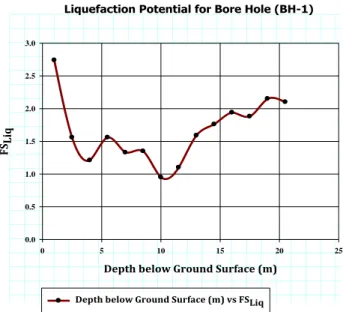
7.1. ASSESSMENT OF LIQUEFACTION ASSESSMENT USING SPT Bore Hole (BH-1)
Table 6: Study about liquefaction potential for Water Table at 4.100m
S.No. Depth (Z)
m SPT N value CSR CRR FSLiq Status
1. 1.00 11 0.084 0.23 2.74 No 2. 2.50 4 0.083 0.13 1.56 No 3. 4.00 1 0.082 0.10 1.22 No 4. 5.50 7 0.096 0.15 1.56 No 5. 7.00 7 0.105 0.14 1.33 No 6. 8.50 8 0.111 0.15 1.35 No 7. 10.00 9 0.115 0.11 0.95 Yes 8. 11.50 11 0.117 0.13 1.10 MLL 9. 13.00 13 0.119 0.19 1.59 No 10. 14.50 15 0.119 0.21 1.76 No 11. 16.00 17 0.118 0.23 1.94 No 12. 17.50 17 0.117 0.22 1.88 No 13. 19.00 19 0.116 0.25 2.15 No 14. 20.50 19 0.114 0.24 2.10 No
Liquefaction Potential for Bore Hole (BH-1)
Depth below Ground Surface (m)
0 5 10 15 20 25 FSLiq 0.0 0.5 1.0 1.5 2.0 2.5 3.0
Depth below Ground Surface (m) vs FSLiq
Figure 5 Graph of FSLiq vs Depth (z) for Bore Hole (BH-1) Bore Hole (BH-2)
Table 7 Study about liquefaction potential for water table at 4.600
S.No. Depth (Z) m
SPT N
value CSR CRR FSLiq Status
1. 1.00 11 0.084 0.23 2.74 No 2. 2.50 4 0.083 0.13 1.57 No 3. 4.00 3 0.082 0.11 1.34 No 4. 5.50 9 0.090 0.17 1.88 No 5. 7.00 10 0.101 0.17 1.68 No 6. 8.50 10 0.107 0.17 1.58 No 7. 10.00 11 0.112 0.13 1.16 MLL 8. 11.50 13 0.115 0.14 1.20 MLL 9. 13.00 14 0.116 0.20 1.72 No 10. 14.50 15 0.117 0.21 1.79 No 11. 16.00 16 0.116 0.21 1.81 No 12. 17.50 19 0.116 0.26 2.24 No 13. 19.00 19 0.114 0.25 2.19 No 14. 20.50 20 0.113 0.26 2.30 No
Depth below Ground Surface (m) 0 5 10 15 20 25 FSLiq 0.0 0.5 1.0 1.5 2.0 2.5 3.0
Depth below Ground Surface (m) vs FSLiq
Liquefaction Potential for Bore Hole (BH-2)
Figure 6 Graph of FSLiq vs Depth (z) for Bore Hole (BH-2) MLL = Marginally Liquefiable Layer
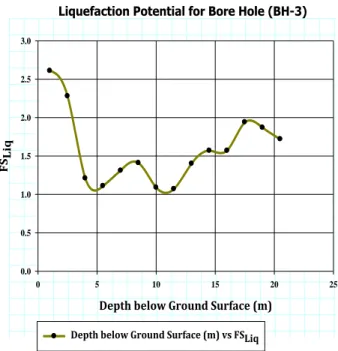
Bore Hole (BH-3)
Table 8 Study about liquefaction potential for water table at 4.600
S.No. Depth (Z) m SPT N value CSR CRR FSLiq Status
1. 1.00 12 0.084 0.22 2.61 No 2. 2.50 10 0.083 0.19 2.28 No 3. 4.00 1 0.082 0.10 1.22 No 4. 5.50 2 0.090 0.10 1.11 MLL 5. 7.00 6 0.099 0.13 1.31 No 6. 8.50 9 0.106 0.15 1.41 No 7. 10.00 11 0.110 0.12 1.09 MLL 8. 11.50 11 0.112 0.12 1.07 MLL 9. 13.00 12 0.114 0.16 1.40 No 10. 14.50 15 0.114 0.18 1.57 No 11. 16.00 16 0.114 0.18 1.57 No 12. 17.50 20 0.113 0.22 1.94 No 13. 19.00 20 0.112 0.21 1.87 No 14. 20.50 18 0.110 0.19 1.72 No
Depth below Ground Surface (m) 0 5 10 15 20 25 FS Liq 0.0 0.5 1.0 1.5 2.0 2.5 3.0
Depth below Ground Surface (m) vs FSLiq
Liquefaction Potential for Bore Hole (BH-3)
Figure 7 Graph of FSLiq vs Depth (z) for Bore Hole (BH-3) Bore Hole (BH-4)
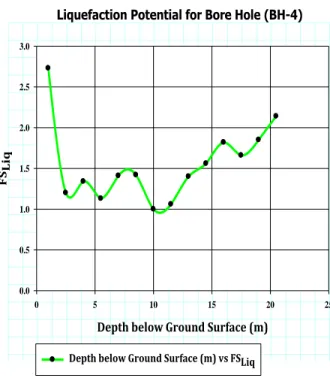
Table 9 Study about liquefaction potential for water table at 4.750
S.No. Depth (Z)
m SPT N value CSR CRR FSLiq Status
1. 1.00 11 0.084 0.23 2.73 No 2. 2.50 1 0.083 0.10 1.22 No 3. 4.00 3 0.082 0.11 1.34 No 4. 5.50 1 0.088 0.10 1.13 MLL 5. 7.00 7 0.099 0.14 1.41 No 6. 8.50 8 0.105 0.15 1.42 No 7. 10.00 9 0.110 0.11 1.00 Yes 8. 11.50 11 0.113 0.12 1.06 MLL 9. 13.00 11 0.114 0.16 1.40 No 10. 14.50 13 0.115 0.18 1.56 No 11. 16.00 16 0.115 0.21 1.82 No 12. 17.50 15 0.114 0.19 1.66 No 13. 19.00 17 0.113 0.21 1.85 No 14. 20.50 19 0.112 0.24 2.14 No
Depth below Ground Surface (m) 0 5 10 15 20 25 FS Liq 0.0 0.5 1.0 1.5 2.0 2.5 3.0
Depth below Ground Surface (m) vs FSLiq
Liquefaction Potential for Bore Hole (BH-4)
Figure 8 Graph of FSLiq vs Depth (z) for Bore Hole (BH-4) Bore Hole (BH-5)
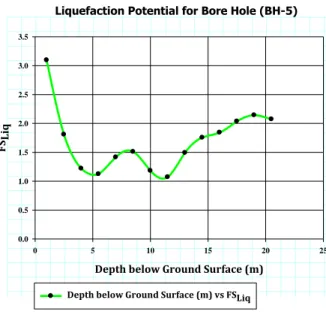
Table 10 Study about liquefaction potential for water table at 4.600
S.No. Depth (Z) m
SPT N
value CSR CRR FSLiq Status
1. 1.00 12 0.084 0.25 2.97 No 2. 2.50 10 0.083 0.15 1.81 No 3. 4.00 1 0.082 0.10 1.22 No 4. 5.50 2 0.089 0.10 1.12 MLL 5. 7.00 6 0.099 0.14 1.41 No 6. 8.50 9 0.106 0.16 1.51 No 7. 10.00 11 0.11 0.13 1.18 MLL 8. 11.50 11 0.112 0.12 1.07 MLL 9. 13.00 12 0.114 0.17 1.49 No 10. 14.50 15 0.114 0.20 1.75 No 11. 16.00 16 0.114 0.21 1.84 No 12. 17.50 20 0.113 0.23 2.03 No 13. 19.00 20 0.112 0.24 2.14 No 14. 20.50 18 0.111 0.23 2.07 No
Depth below Ground Surface (m) 0 5 10 15 20 25 FSLiq 0.0 0.5 1.0 1.5 2.0 2.5 3.0 3.5
Depth below Ground Surface (m) vs FSLiq Liquefaction Potential for Bore Hole (BH-5)
Figure 9 Graph of FSLiq vs Depth (z) for Bore Hole (BH-5) Bore Hole (BH-6)
Table 11 Study about liquefaction potential for water table at 4.350
S.No. Depth (Z) m
SPT N
value CSR CRR FSLiq Status
1. 1.00 11 0.084 0.23 2.73 No 2. 2.50 4 0.083 0.13 1.57 No 3. 4.00 3 0.082 0.11 1.34 No 4. 5.50 9 0.093 0.17 1.82 No 5. 7.00 9 0.103 0.16 1.55 No 6. 8.50 10 0.109 0.17 1.56 No 7. 10.00 11 0.114 0.13 1.14 MLL 8. 11.50 13 0.116 0.14 1.20 MLL 9. 13.00 14 0.117 0.20 1.71 No 10. 14.50 16 0.118 0.22 1.86 No 11. 16.00 17 0.117 0.23 1.96 No 12. 17.50 19 0.116 0.26 2.24 No 13. 19.00 19 0.115 0.25 2.17 No 14. 20.50 20 0.114 0.26 2.28 No
Depth below Ground Surface (m) 0 5 10 15 20 25 FSLiq 0.0 0.5 1.0 1.5 2.0 2.5 3.0
Depth below Ground Surface (m) vs FSLiq
Liquefaction Potential for Bore Hole (BH-6)
Figure 10 Graph of FSLiq vs Depth (z) for Bore Hole (BH-6) Bore Hole (BH-7)
Table 12 Study about liquefaction potential for water table at 4.100
S.No. Depth (Z) m
SPT N
value CSR CRR FSLiq Status
1. 1.00 5 0.0840 0.1400 1.67 No 2. 2.50 8 0.0830 0.1900 2.28 No 3. 4.00 11 0.0820 0.2000 2.43 No 4. 5.50 13 0.0970 0.2400 2.47 No 5. 7.00 15 0.1070 0.2700 2.52 No 6. 8.50 11 0.1130 0.1900 1.68 No 7. 10.00 12 0.1160 0.1900 1.63 No 8. 11.50 15 0.1180 0.2300 1.94 No 9. 13.00 14 0.1190 0.2000 1.68 No 10. 14.50 17 0.1180 0.2400 2.03 No 11. 16.00 20 0.1180 0.3000 2.54 No 12. 17.50 21 0.1160 0.3200 2.75 No 13. 19.00 23 0.1150 0.2200 1.91 No 14. 20.50 20 0.1130 0.1700 1.50 No 15. 22.00 19 0.1110 0.1600 1.44 No 16. 23.50 21 0.1090 0.1700 1.56 No 17. 25.00 21 0.1070 0.2400 2.24 No 18. 26.50 23 0.1060 0.2700 2.54 No 19. 28.00 22 0.1040 0.2400 2.30 No 20. 29.50 25 0.1030 0.3000 2.91 No
Liquefaction Potential for Bore Hole (BH-7)
Depth below Ground Surface (m)
0 5 10 15 20 25 30 35 FSLiq 0.0 0.5 1.0 1.5 2.0 2.5 3.0 3.5
Depth below Ground Surface (m) vs FSLiq
Figure 11 Graph of FSLiq vs Depth (z) for Bore Hole (BH-7) Bore Hole (BH-8)
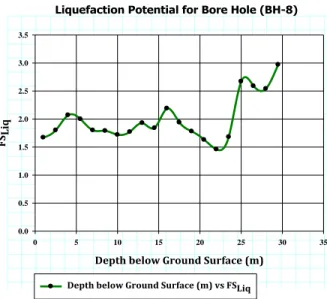
Table 13 Study about liquefaction potential for water table at 4.600
S.No. Depth (Z) m SPT N value CSR CRR FSLiq Status
1. 1.00 5 0.0840 0.1400 1.67 No 2. 2.50 6 0.0830 0.1500 1.80 No 3. 4.00 9 0.0820 0.1700 2.07 No 4. 5.50 10 0.0900 0.1800 2.00 No 5. 7.00 11 0.1000 0.1800 1.80 No 6. 8.50 12 0.1060 0.1900 1.79 No 7. 10.00 13 0.1100 0.1900 1.72 No 8. 11.50 14 0.1130 0.2000 1.77 No 9. 13.00 16 0.1140 0.2200 1.93 No 10. 14.50 16 0.1140 0.2100 1.84 No 11. 16.00 19 0.1140 0.2500 2.19 No 12. 17.50 18 0.1130 0.2200 1.94 No 13. 19.00 22 0.1120 0.2000 1.78 No 14. 20.50 21 0.1100 0.1800 1.63 No 15. 22.00 20 0.1090 0.1600 1.46 No 16. 23.50 22 0.1070 0.1800 1.68 No 17. 25.00 23 0.1050 0.2800 2.67 No 18. 26.50 23 0.1040 0.2700 2.59 No 19. 28.00 23 0.1020 0.2600 2.54 No 20. 29.50 25 0.1010 0.3000 2.97 No
Depth below Ground Surface (m) 0 5 10 15 20 25 30 35 FSLiq 0.0 0.5 1.0 1.5 2.0 2.5 3.0 3.5
Depth below Ground Surface (m) vs FSLiq
Liquefaction Potential for Bore Hole (BH-8)
Figure 12 Graph of FSLiq vs Depth (z) for Bore Hole (BH-8) Bore Hole (BH-9)
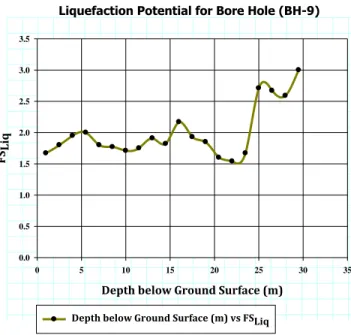
Table 14 Study about liquefaction potential for water table at 4.600
S.No. Depth (Z)
m SPT N value CSR CRR FSLiq Status
1. 1.00 5 0.0840 0.1400 1.67 No 2. 2.50 6 0.0830 0.1500 1.80 No 3. 4.00 9 0.0820 0.1600 1.95 No 4. 5.50 10 0.0900 0.1800 2.00 No 5. 7.00 11 0.1000 0.1800 1.80 No 6. 8.50 12 0.1070 0.1900 1.77 No 7. 10.00 13 0.1110 0.1900 1.71 No 8. 11.50 14 0.1140 0.2000 1.75 No 9. 13.00 16 0.1150 0.2200 1.91 No 10. 14.50 16 0.1150 0.2100 1.82 No 11. 16.00 19 0.1150 0.2500 2.17 No 12. 17.50 18 0.1140 0.2200 1.93 No 13. 19.00 22 0.1130 0.2100 1.85 No 14. 20.50 21 0.1120 0.1800 1.60 No 15. 22.00 20 0.1100 0.1700 1.54 No 16. 23.50 22 0.1080 0.1800 1.67 No 17. 25.00 23 0.1070 0.2900 2.71 No 18. 26.50 23 0.1050 0.2800 2.67 No 19. 28.00 23 0.1040 0.2700 2.59 No
Depth below Ground Surface (m) 0 5 10 15 20 25 30 35 FSLiq 0.0 0.5 1.0 1.5 2.0 2.5 3.0 3.5
Depth below Ground Surface (m) vs FSLiq
Liquefaction Potential for Bore Hole (BH-9)
Fig. 13: Graph of FSLiq vs Depth (z) for Bore Hole (BH-9)
Bore Hole (BH-10)
Table 15 Study about liquefaction potential for water table at 4.750
S.No. Depth (Z)
m SPT N value CSR CRR FSLiq Status
1. 1.00 5 0.0840 0.1400 1.67 No 2. 2.50 6 0.0830 0.1500 1.80 No 3. 4.00 9 0.0820 0.1600 1.95 No 4. 5.50 10 0.0890 0.1700 1.91 No 5. 7.00 11 0.0990 0.1800 1.81 No 6. 8.50 12 0.1060 0.1900 1.79 No 7. 10.00 13 0.1110 0.1900 1.71 No 8. 11.50 14 0.1140 0.2000 1.75 No 9. 13.00 16 0.1150 0.2200 1.91 No 10. 14.50 16 0.1160 0.2100 1.81 No 11. 16.00 19 0.1150 0.2600 2.26 No 12. 17.50 18 0.1150 0.2300 2.00 No 13. 19.00 22 0.1140 0.3200 2.80 No 14. 20.50 21 0.1120 0.1900 1.69 No 15. 22.00 20 0.1110 0.1700 1.53 No 16. 23.50 22 0.1090 0.1900 1.74 No 17. 25.00 23 0.1080 0.3000 2.77 No 18. 26.50 23 0.1060 0.2800 2.64 No 19. 28.00 23 0.1050 0.2700 2.57 No 20. 29.50 25 0.1040 0.3200 3.07 No
Depth below Ground Surface (m) 0 5 10 15 20 25 30 35 FSLiq 0.0 0.5 1.0 1.5 2.0 2.5 3.0 3.5
Depth below Ground Surface (m) vs FSLiq
Liquefaction Potential for Bore Hole (BH-10)
Figure 14 Graph of FSLiq vs Depth (z) for Bore Hole (BH-10) Bore Hole (BH-11)
Table 16 Study about liquefaction potential for water table at 4.700
S.No. Depth (Z) m SPT N value CSR CRR FSLiq Status
1. 1.00 5 0.0840 0.1400 1.67 No 2. 2.50 6 0.0830 0.1500 1.80 No 3. 4.00 9 0.0820 0.1700 2.07 No 4. 5.50 10 0.0890 0.1800 2.02 No 5. 7.00 11 0.0990 0.1800 1.82 No 6. 8.50 12 0.1060 0.1900 1.79 No 7. 10.00 13 0.1100 0.1900 1.73 No 8. 11.50 14 0.1130 0.2000 1.76 No 9. 13.00 16 0.1140 0.2200 1.93 No 10. 14.50 16 0.1140 0.2200 1.93 No 11. 16.00 19 0.1140 0.2600 2.28 No 12. 17.50 18 0.1130 0.2300 2.03 No 13. 19.00 22 0.1120 0.2100 1.88 No 14. 20.50 21 0.1110 0.1800 1.62 No 15. 22.00 20 0.1090 0.1700 1.56 No 16. 23.50 22 0.1080 0.1800 1.67 No 17. 25.00 23 0.1060 0.2900 2.74 No 18. 26.50 23 0.1050 0.2800 2.67 No 19. 28.00 23 0.1030 0.2600 2.52 No
Depth below Ground Surface (m) 0 5 10 15 20 25 30 35 FSLiq 0.0 0.5 1.0 1.5 2.0 2.5 3.0 3.5
Depth below Ground Surface (m) vs FSLiq
Liquefaction Potential for Bore Hole (BH-11)
Figure 15 Graph of FSLiq vs Depth (z) for Bore Hole (BH-11) Bore Hole (BH-12)
Table 17 Study about liquefaction potential for water table at 4.670
S.No. Depth (Z) m SPT N value CSR CRR FSLiq Status
1. 1.00 5 0.0840 0.1400 1.67 No 2. 2.50 6 0.0830 0.1500 1.80 No 3. 4.00 9 0.0820 0.1600 1.95 No 4. 5.50 10 0.0890 0.1800 2.02 No 5. 7.00 11 0.0990 0.1800 1.81 No 6. 8.50 12 0.1060 0.1900 1.79 No 7. 10.00 13 0.1100 0.1900 1.73 No 8. 11.50 14 0.1130 0.2000 1.76 No 9. 13.00 16 0.1140 0.2200 1.93 No 10. 14.50 16 0.1140 0.2100 1.84 No 11. 16.00 19 0.1140 0.2500 2.19 No 12. 17.50 18 0.1130 0.2200 1.94 No 13. 19.00 22 0.1120 0.2000 1.78 No 14. 20.50 21 0.1100 0.1800 1.64 No 15. 22.00 20 0.1090 0.1700 1.55 No 16. 23.50 22 0.1070 0.1800 1.68 No 17. 25.00 23 0.1060 0.2900 2.73 No 18. 26.50 23 0.1040 0.2700 2.59 No 19. 28.00 23 0.1030 0.2600 2.52 No 20. 29.50 25 0.1020 0.3000 2.94 No
Depth below Ground Surface (m) 0 5 10 15 20 25 30 35 FSLiq 0.0 0.5 1.0 1.5 2.0 2.5 3.0 3.5
Depth below Ground Surface (m) vs FSLiq
Liquefaction Potential for Bore Hole (BH-12)
Figure 16 Graph of FSLiq vs Depth (z) for Bore Hole (BH-12)
7.1. ASSESSMENT OF LIQUEFACTION POTENTIAL USING MULTI-LINEAR REGRESSION MODELING
Multi Linear Regression Model in terms of Cyclic Resistance Ratio (CRR) for soil profile was developed using SPSS (IBM SPSS Statistics v20.0.0) at a particular location of a site on IIM road in Lucknow, Uttar Pradesh (India). The parameters involved in CRR model for soil profile along its depth (z) are fine content (FC), water content (wc), bulk density (ϒ) and cyclic stress ratio (CSR).
7.1.1. MULTI-LINEAR REGRESSION MODEL
Model Summaryb Model R R Square Adjusted R Square Std. Error of the Estimate Change Statistics Durbin-Watson R Square Change F Change df1 df2 Sig. F Change (p-value) 1 .878a .771 .628 .0205641536 .771 5.398 5 8 .018 1.490
a. Predictors: (Constant), Cyclic Shear Stress, Fine Content, Depth, Water Content, Bulk Density b. Dependent Variable: Cyclic Resistance Ratio
The p-value defined as the probability value is computed using the test statistic, that measure the support (or lack of support) provided by the sample for the Null Hypothesis (Ho). Since p-value is less than the level of significance (α= 0.0 ) for the developed Multi-Linear Regression Model, i.e; (0.018 < 0.05), hence the Null Hypothesis (Ho) is rejected and Alternate Hypothesis (H1) is accepted resulting the developed model to be strongly accepted. The term ‘R’ is defined as Multiple Coefficient of Correlation. The value of R= 0.878 signifies that 87.8% changes are due to the factors considerd in Regression Modeling. The Coefficient of Determination (R2) is used to identify the strength of relationship. The Coefficient of Determination is defined as the ratio of Explained Variation to Total Variation. The value of R2 = 0.771 signifies that the strength of relationship for the developed model is 77%.
ANALYSIS OF VARIANCE (ANOVA)a
Model Sum of Squares df Mean Square F Sig. (p-value)
Regression .011 5 .002 5.398 .018b
Residual .003 8 .000
The t-test shows the test of difference between the predicted value and the observed value. Smaller difference shows the fall in the t-test values resulting in rise of p-value thus improving the fitness of parameters in the developed model.
7.1.2. DISCRIMINANT TEST FOR OUTLIERS IN THE MULTI-LINEAR REGRESSION MODEL
a. Summary of Canonical Discriminant Functions
Eigenvalues
Function Eigenvalue % of Variance Cumulative % Canonical
Correlation
1 2.395a 100.0 100.0 .840
a. First 1 canonical discriminant functions were used in the analysis.
Wilks' Lambda
Test of Function(s) Wilks' Lambda Chi-square df Sig.
1 .295 11.612 5 .041
b. Classification Statistics
Classification Processing Summary
Processed 14
Excluded
Missing or out-of-range group
codes 0
At least one missing
discriminating variable 0
Used in Output 14
Classification Function Coefficients
CRR Mod .00000 1.00000 Depth -9.586 -8.917 Fine Content 20.790 21.470 Water Content -37.584 -37.108 Bulk Density 16734.253 17048.437
Cyclic Shear Stress -38937.170 -40042.473
(Constant) -12886.153 -13375.574
Fisher's linear discriminant functions
Coefficientsa
Model Unstandardized Coefficients
Standardized
Coefficients t-test Sig.
(p-value)
Collinearity Statistics
B Std. Error Beta Tolerance VIF
1. (Constant) -.011 .757 -.014 .989 Depth .005 .002 .935 2.465 .039 .199 5.037 Fine Content .001 .001 .445 .866 .412 .109 9.215 Water Content -.002 .005 -.312 -.521 .617 .080 12.530 Bulk Density .029 .494 .058 .059 .955 .029 34.596
Cyclic Shear Stress 1.085 1.407 .433 .772 .463 .091 11.006
7.1.3. CORRELATION TEST FOR PARAMETERS IN THE MULTI-LINEAR REGRESSION MODEL
liquefaction (FSLiq) (based on Boulanger & Idriss) is compared to the modeled factor of safety against liquefaction (FSLiqMod) to observe the reliability of CRR model in evaluation of liquefaction potential for a particular location and to validate the outcomes.
Bore Hole (BH-1
Table 18 Study about liquefaction potential for Water Table at 4.100m
Liquefaction Potential for Bore Hole (BH-1)
Depth below Ground Surface (m)
0 5 10 15 20 25 FSLiq 0.0 0.5 1.0 1.5 2.0 2.5 3.0
Depth below Ground Surface (m) vs FSLiqCal Depth below Ground Surface (m) vs FSLiqMod
Figure 17 Graph of FSLiq vs Depth (z) for Bore Hole (BH-1)
S.No Depth (Z) m CRRcal CRRMod FSLiq FSLiqMod
Status Calculated Modeled 1. 1.00 0.23 0.1671 2.74 1.4040 No No 2. 2.50 0.13 0.1804 1.56 1.5160 No No 3. 4.00 0.10 0.1156 1.22 1.4098 No No 4. 5.50 0.15 0.1221 1.56 1.2718 No No 5. 7.00 0.14 0.1638 1.33 1.3763 No No 6. 8.50 0.15 0.1777 1.35 1.4935 No No 7. 10.00 0.11 0.1332 0.95 1.1583 Yes MLL 8. 11.50 0.13 0.1387 1.10 1.1855 MLL MLL 9. 13.00 0.19 0.1723 1.59 1.4478 No No 10. 14.50 0.21 0.1906 1.76 1.6016 No No 11. 16.00 0.23 0.2220 1.94 1.8657 No No 12. 17.50 0.22 0.2333 1.88 1.9608 No No 13. 19.00 0.25 0.2387 2.15 2.0056 No No 14. 20.50 0.24 0.2454 2.10 2.0619 No No
Bore Hole (BH-2)
Table 19 Study about liquefaction potential for water table at 4.600
Liquefaction Potential for Bore Hole (BH-2)
Depth below Ground Surface (m)
0 5 10 15 20 25 FSLiq 0.0 0.5 1.0 1.5 2.0 2.5 3.0
Depth below Ground Surface (m) vs FSLiqCal Depth below Ground Surface (m) vs FSLiqMod
Figure 18 Graph of FSLiq vs Depth (z) for Bore Hole (BH-2)
S.No Depth (Z)
m CRRcal CRRMod FSLiq FSLiqMod
Status Calculated Modeled 1. 1.00 0.23 0.1744 2.74 1.4903 No No 2. 2.50 0.13 0.1850 1.57 1.5816 No No 3. 4.00 0.11 0.1631 1.34 1.3944 No No 4. 5.50 0.17 0.1370 1.88 1.1712 No MLL 5. 7.00 0.17 0.1553 1.68 1.3276 No No 6. 8.50 0.17 0.1712 1.58 1.4634 No No 7. 10.00 0.13 0.1653 1.16 1.4132 MLL No 8. 11.50 0.14 0.1764 1.20 1.5073 MLL No 9. 13.00 0.20 0.2079 1.72 1.7766 No No 10. 14.50 0.21 0.2173 1.79 1.8569 No No 11. 16.00 0.21 0.2188 1.81 1.8704 No No 12. 17.50 0.26 0.2261 2.24 1.9326 No No 13. 19.00 0.25 0.2301 2.19 1.9670 No No 14. 20.50 0.26 0.2361 2.30 2.018 No No
MLL = Marginally Liquefiable Layer
Bore Hole (BH-3)
Table 20 Study about liquefaction potential for water table at 4.600
Liquefaction Potential for Bore Hole (BH-3)
Depth below Ground Surface (m)
0 5 10 15 20 25 FSLiq 0.0 0.5 1.0 1.5 2.0 2.5 3.0
Depth below Ground Surface (m) vs FSLiqCal Depth below Ground Surface (m) vs FSLiqMod
Figure 19 Graph of FSLiq vs Depth(z) for Bore Hole (BH-3)
S.No. Depth (Z)
m CRRcal CRRMod FSLiq FSLiqMod
Status Calculated Modeled 1. 1.00 0.22 0.1826 2.61 1.6016 No No 2. 2.50 0.19 0.1912 2.28 1.6770 No No 3. 4.00 0.10 0.1643 1.22 1.4416 No No 4. 5.50 0.10 0.1044 1.11 1.1600 MLL MLL 5. 7.00 0.13 0.1533 1.31 1.3445 No No 6. 8.50 0.15 0.1712 1.41 1.5016 No No 7. 10.00 0.12 0.1264 1.09 1.1491 MLL MLL 8. 11.50 0.12 0.1339 1.07 1.1955 MLL MLL 9. 13.00 0.16 0.2009 1.40 1.7618 No No 10. 14.50 0.18 0.2076 1.57 1.8208 No No 11. 16.00 0.18 0.2163 1.57 1.8974 No No 12. 17.50 0.22 0.2215 1.94 1.9432 No No 13. 19.00 0.21 0.2272 1.87 1.9928 No No 14. 20.50 0.19 0.2340 1.72 2.0530 No No
Bore Hole (BH-4)
Table 21 Study about liquefaction potential for water table at 4.750
Liquefaction Potential for Bore Hole (BH-4)
Depth below Ground Surface (m)
0 5 10 15 20 25 FSLiq 0.0 0.5 1.0 1.5 2.0 2.5 3.0
Depth below Ground Surface (m) vs FSLiqCal
Depth below Ground Surface (m) vs FSLiqMod
Figure 20 Graph of FSLiq vs Depth(z) for Bore Hole (BH-4)
S.No. Depth (Z)
m CRRcal CRRMod FSLiq FSLiqMod
Status Calculated Modeled 1. 1.00 0.23 0.1692 2.73 1.4712 No No 2. 2.50 0.10 0.1889 1.22 1.6423 No No 3. 4.00 0.11 0.1607 1.34 1.3974 No No 4. 5.50 0.10 0.1027 1.13 1.1670 MLL MLL 5. 7.00 0.14 0.1561 1.41 1.3574 No No 6. 8.50 0.15 0.1680 1.42 1.4610 No No 7. 10.00 0.11 0.1231 1.00 1.1187 Yes MLL 8. 11.50 0.12 0.1361 1.06 1.2044 MLL MLL 9. 13.00 0.16 0.2023 1.40 1.7591 No No 10. 14.50 0.18 0.2130 1.56 1.8525 No No 11. 16.00 0.21 0.2204 1.82 1.9164 No No 12. 17.50 0.19 0.2256 1.66 1.9616 No No 13. 19.00 0.21 0.2306 1.85 2.0056 No No 14. 20.50 0.24 0.2378 2.14 2.0682 No No
Bore Hole (BH-5)
Table 22 Study about liquefaction potential for water table at 4.600
Liquefaction Potential for Bore Hole (BH-5)
Depth below Ground Surface (m)
0 5 10 15 20 25 FSLiq 0.0 0.5 1.0 1.5 2.0 2.5 3.0 3.5
Depth below Ground Surface (m) vs FSLiqCal
Depth below Ground Surface (m) vs FSLiqMod
Figure 21 Graph of FSLiq vs Depth (z) for Bore Hole (BH-5)
S.No. Depth (Z)
m CRRcal CRRMod FSLiq FSLiqMod
Status Calculated Modeled 1. 1.00 0.25 0.1762 2.97 1.5456 No No 2. 2.50 0.15 0.1903 1.81 1.6697 No No 3. 4.00 0.10 0.1628 1.22 1.4285 No No 4. 5.50 0.10 0.1053 1.12 1.1831 MLL MLL 5. 7.00 0.14 0.1550 1.41 1.3599 No No 6. 8.50 0.16 0.1701 1.51 1.4925 No No 7. 10.00 0.13 0.1265 1.18 1.1501 MLL MLL 8. 11.50 0.12 0.1349 1.07 1.2045 MLL MLL 9. 13.00 0.17 0.2019 1.49 1.7710 No No 10. 14.50 0.20 0.2101 1.75 1.8429 No No 11. 16.00 0.21 0.2181 1.84 1.9135 No No 12. 17.50 0.23 0.2233 2.03 1.9591 No No 13. 19.00 0.24 0.2287 2.14 2.0062 No No 14. 20.50 0.23 0.2359 2.07 2.0696 No No
Bore Hole (BH-6)
Table 23
Study about liquefaction potential for water table at 4.350
Liquefaction Potential for Bore Hole (BH-6)
Depth below Ground Surface (m)
0 5 10 15 20 25 FSLiq 0.0 0.5 1.0 1.5 2.0 2.5 3.0
Depth below Ground Surface (m) vs FSLiqCal
Depth below Ground Surface (m) vs FSLiqMod
S.No. Depth (Z)
m CRRcal CRRMod FSLiq FSLiqMod
Status Calculated Modeled 1. 1.00 0.23 0.1707 2.73 1.4468 No No 2. 2.50 0.13 0.1830 1.57 1.5512 No No 3. 4.00 0.11 0.1655 1.34 1.4022 No No 4. 5.50 0.17 0.1415 1.82 1.5215 No No 5. 7.00 0.16 0.1595 1.55 1.3521 No No 6. 8.50 0.17 0.1748 1.56 1.4814 No No 7. 10.00 0.13 0.1323 1.14 1.1605 MLL MLL 8. 11.50 0.14 0.1397 1.20 1.2043 MLL MLL 9. 13.00 0.20 0.2074 1.71 1.7574 No No 10. 14.50 0.22 0.2158 1.86 1.8289 No No 11. 16.00 0.23 0.2204 1.96 1.8679 No No 12. 17.50 0.26 0.2295 2.24 1.9451 No No 13. 19.00 0.25 0.2344 2.17 1.9866 No No 14. 20.50 0.26 0.2413 2.28 2.0446 No No
Bore Hole (BH-7)
Table 24 Study about liquefaction potential for water table at 4.100
Liquefaction Potential for Bore Hole (BH-7)
Depth below Ground Surface (m)
0 5 10 15 20 25 30 35 FSLiq 0.0 0.5 1.0 1.5 2.0 2.5 3.0 3.5
Depth below Ground Surface (m) vs FSLiqCal
Depth below Ground Surface (m) vs FSLiqMod
Figure 23 Graph of FSLiq vs Depth(z) for Bore Hole (BH-7)
S.No. Depth (Z)
m CRRcal CRRMod FSLiq FSLiqMod
Status Calculated Modeled 1. 1.00 0.1400 0.1575 1.67 1.3236 No No 2. 2.50 0.1900 0.1264 2.28 1.5225 No No 3. 4.00 0.2000 0.1365 2.43 1.6641 No No 4. 5.50 0.2400 0.1804 2.47 1.8593 No No 5. 7.00 0.2700 0.1831 2.52 1.5584 No No 6. 8.50 0.1900 0.1910 1.68 1.6049 No No 7. 10.00 0.1900 0.2020 1.63 1.6979 No No 8. 11.50 0.2300 0.2169 1.94 1.8225 No No 9. 13.00 0.2000 0.2271 1.68 1.9084 No No 10. 14.50 0.2400 0.2310 2.03 1.9413 No No 11. 16.00 0.3000 0.2368 2.54 1.9897 No No 12. 17.50 0.3200 0.2351 2.75 1.9752 No No 13. 19.00 0.2200 0.2123 1.91 1.7839 No No 14. 20.50 0.1700 0.2174 1.50 1.8270 No No 15. 22.00 0.1600 0.2235 1.44 1.8781 No No 16. 23.50 0.1700 0.2284 1.56 1.9191 No No 17. 25.00 0.2400 0.2840 2.24 2.3868 No No 18. 26.50 0.2700 0.2911 2.54 2.4462 No No 19. 28.00 0.2400 0.2956 2.30 2.4841 No No 20. 29.50 0.3000 0.3013 2.91 2.5319 No No
Bore Hole (BH-8)
Table 25 Study about liquefaction potential for water table at 4.600
Liquefaction Potential for Bore Hole (BH-8)
Depth below Ground Surface (m)
0 5 10 15 20 25 30 35 FS Liq 0.0 0.5 1.0 1.5 2.0 2.5 3.0 3.5
Depth below Ground Surface (m) vs FSLiqCal Depth below Ground Surface (m) vs FSLiqMod
Figure 24 Graph of FSLiq vs Depth (z) for Bore Hole (BH-8)
S.No. Depth (Z)
m CRRcal CRRMod FSLiq FSLiqMod
Status Calculated Modeled 1. 1.00 0.1400 0.1635 1.67 1.4345 No No 2. 2.50 0.1500 0.1703 1.80 1.4940 No No 3. 4.00 0.1700 0.1370 2.07 1.2018 No MLL 4. 5.50 0.1800 0.1498 2.00 1.3137 No No 5. 7.00 0.1800 0.1571 1.80 1.3784 No No 6. 8.50 0.1900 0.1645 1.79 1.4426 No No 7. 10.00 0.1900 0.1784 1.72 1.5648 No No 8. 11.50 0.2000 0.1869 1.77 1.6393 No No 9. 13.00 0.2200 0.1953 1.93 1.7135 No No 10. 14.50 0.2100 0.2051 1.84 1.7990 No No 11. 16.00 0.2500 0.2124 2.19 1.8636 No No 12. 17.50 0.2200 0.2154 1.94 1.8894 No No 13. 19.00 0.2000 0.2137 1.78 1.8749 No No 14. 20.50 0.1800 0.2176 1.63 1.9086 No No 15. 22.00 0.1600 0.2235 1.46 1.9606 No No 16. 23.50 0.1800 0.2325 1.68 2.0397 No No 17. 25.00 0.2800 0.2860 2.67 2.5084 No No 18. 26.50 0.2700 0.2946 2.59 2.5839 No No 19. 28.00 0.2600 0.2996 2.54 2.6284 No No 20. 29.50 0.3000 0.3074 2.97 2.6968 No No
Bore Hole (BH-9):
Table 26: Study about liquefaction potential for water table at 4.600
Liquefaction Potential for Bore Hole (BH-9)
Depth below Ground Surface (m)
0 5 10 15 20 25 30 35 FS Liq 0.0 0.5 1.0 1.5 2.0 2.5 3.0 3.5
Depth below Ground Surface (m) vs FSLiqCal
Depth below Ground Surface (m) vs FSLiqMod
Figure 25 Graph of FSLiq vs Depth (z) for Bore Hole (BH-9)
S.No. Depth (Z)
m CRRcal CRRMod FSLiq FSLiqMod
Status Calculated Modeled 1. 1.00 0.1400 0.1649 1.67 1.4339 No No 2. 2.50 0.1500 0.1722 1.80 1.4974 No No 3. 4.00 0.1600 0.1340 1.95 1.1649 No MLL 4. 5.50 0.1800 0.1430 2.00 1.2433 No No 5. 7.00 0.1800 0.1618 1.80 1.4071 No No 6. 8.50 0.1900 0.1696 1.77 1.4751 No No 7. 10.00 0.1900 0.1833 1.71 1.5937 No No 8. 11.50 0.2000 0.1932 1.75 1.6804 No No 9. 13.00 0.2200 0.2018 1.91 1.7552 No No 10. 14.50 0.2100 0.2069 1.82 1.7992 No No 11. 16.00 0.2500 0.2168 2.17 1.8849 No No 12. 17.50 0.2200 0.2213 1.93 1.9248 No No 13. 19.00 0.2100 0.2193 1.85 1.9073 No No 14. 20.50 0.1800 0.2244 1.60 1.9516 No No 15. 22.00 0.1700 0.2294 1.54 1.9947 No No 16. 23.50 0.1800 0.2380 1.67 2.0700 No No 17. 25.00 0.2900 0.2916 2.71 2.5353 No No 18. 26.50 0.2800 0.2988 2.67 2.5980 No No 19. 28.00 0.2700 0.3042 2.59 2.6453 No No 20. 29.50 0.3100 0.3133 3.00 2.7247 No No
Bore Hole (BH-10)
Table 27 Study about liquefaction potential for water table at 4.750
Liquefaction Potential for Bore Hole (BH-10)
Depth below Ground Surface (m)
0 5 10 15 20 25 30 35 FSLiq 0.0 0.5 1.0 1.5 2.0 2.5 3.0 3.5
Depth below Ground Surface (m) vs FSLiqCal
Depth below Ground Surface (m) vs FSLiqMod
Figure 26 Graph of FSLiq vs Depth (z) for Bore Hole (BH-10)
S.No. Depth (Z)
m CRRcal CRRMod FSLiq FSLiqMod
Status Calculated Modeled 1. 1.00 0.1400 0.1628 1.67 1.4033 No No 2. 2.50 0.1500 0.1646 1.80 1.4189 No No 3. 4.00 0.1600 0.1080 1.95 1.3170 No No 4. 5.50 0.1700 0.1219 1.91 1.3697 No No 5. 7.00 0.1800 0.1545 1.81 1.4336 No No 6. 8.50 0.1900 0.1633 1.79 1.4578 No No 7. 10.00 0.1900 0.1769 1.71 1.5252 No No 8. 11.50 0.2000 0.1862 1.75 1.6048 No No 9. 13.00 0.2200 0.1946 1.91 1.6777 No No 10. 14.50 0.2100 0.2054 1.81 1.7709 No No 11. 16.00 0.2600 0.2143 2.26 1.8470 No No 12. 17.50 0.2300 0.2177 2.00 1.8767 No No 13. 19.00 0.3200 0.2284 2.80 1.9691 No No 14. 20.50 0.1900 0.2192 1.69 1.8897 No No 15. 22.00 0.1700 0.2251 1.53 1.9408 No No 16. 23.50 0.1900 0.2341 1.74 2.0177 No No 17. 25.00 0.3000 0.2873 2.77 2.4768 No No 18. 26.50 0.2800 0.2984 2.64 2.5412 No No 19. 28.00 0.2700 0.3009 2.57 2.5942 No No 20. 29.50 0.3200 0.3093 3.07 2.6667 No No
Bore Hole (BH-11)
Table 28 Study about liquefaction potential for water table at 4.700
Liquefaction Potential for Bore Hole (BH-11)
Depth below Ground Surface (m)
0 5 10 15 20 25 30 35 FS Liq 0.0 0.5 1.0 1.5 2.0 2.5 3.0 3.5
Depth below Ground Surface (m) vs FSLiqCal
Depth below Ground Surface (m) vs FSLiqMod
Figure 27 Graph of FSLiq vs Depth (z) for Bore Hole (BH-11)
S.No. Depth (Z)
m CRRcal CRRMod FSLiq FSLiqMod
Status Calculated Modeled 1. 1.00 0.1400 0.1625 1.67 1.4253 No No 2. 2.50 0.1500 0.1650 1.80 1.4471 No No 3. 4.00 0.1700 0.1143 2.07 1.3947 No No 4. 5.50 0.1800 0.1247 2.02 1.4012 No No 5. 7.00 0.1800 0.1398 1.82 1.4123 No No 6. 8.50 0.1900 0.1665 1.79 1.4602 No No 7. 10.00 0.1900 0.1796 1.73 1.5755 No No 8. 11.50 0.2000 0.1888 1.76 1.6565 No No 9. 13.00 0.2200 0.1980 1.93 1.7369 No No 10. 14.50 0.2200 0.2110 1.93 1.8507 No No 11. 16.00 0.2600 0.2176 2.28 1.9089 No No 12. 17.50 0.2300 0.2194 2.03 1.9247 No No 13. 19.00 0.2100 0.2156 1.88 1.8915 No No 14. 20.50 0.1800 0.2206 1.62 1.9354 No No 15. 22.00 0.1700 0.2255 1.56 1.9784 No No 16. 23.50 0.1800 0.2355 1.67 2.0656 No No 17. 25.00 0.2900 0.2864 2.74 2.5125 No No 18. 26.50 0.2800 0.2942 2.67 2.5810 No No 19. 28.00 0.2600 0.2993 2.52 2.6251 No No 20. 29.50 0.3100 0.3071 3.04 2.6936 No No
Bore Hole (BH-12)
Table 29 Study about liquefaction potential for water table at 4.670
Liquefaction Potential for Bore Hole (BH-12)
Depth below Ground Surface (m)
0 5 10 15 20 25 30 35 FSLiq 0.0 0.5 1.0 1.5 2.0 2.5 3.0 3.5
Depth below Ground Surface (m) vs FSLiqCal
Depth below Ground Surface (m) vs FSLiqMod
Figure 28 Graph of FSLiq vs Depth (z) for Bore Hole (BH-12) CONCLUSION
In the present research study, the following conclusions are drawn based on the results and discussion of location based liquefaction potential evaluation :
S.No. Depth (Z)
m CRRcal CRRMod FSLiq FSLiqMod
Status Calculated Modeled 1. 1.00 0.1400 0.1642 1.67 1.4405 No No 2. 2.50 0.1500 0.1712 1.80 1.5021 No No 3. 4.00 0.1600 0.1034 1.95 1.2610 No No 4. 5.50 0.1800 0.1146 2.02 1.2872 No No 5. 7.00 0.1800 0.1587 1.81 1.3921 No No 6. 8.50 0.1900 0.1662 1.79 1.4576 No No 7. 10.00 0.1900 0.1796 1.73 1.5756 No No 8. 11.50 0.2000 0.1907 1.76 1.6725 No No 9. 13.00 0.2200 0.1989 1.93 1.7449 No No 10. 14.50 0.2100 0.2062 1.84 1.8089 No No 11. 16.00 0.2500 0.2139 2.19 1.8759 No No 12. 17.50 0.2200 0.2180 1.94 1.9120 No No 13. 19.00 0.2000 0.2161 1.78 1.8953 No No 14. 20.50 0.1800 0.2179 1.64 1.9116 No No 15. 22.00 0.1700 0.2261 1.55 1.9831 No No 16. 23.50 0.1800 0.2353 1.68 2.0641 No No 17. 25.00 0.2900 0.2880 2.73 2.5261 No No 18. 26.50 0.2700 0.2959 2.59 2.5954 No No 19. 28.00 0.2600 0.3045 2.52 2.6714 No No 20. 29.50 0.3000 0.3111 2.94 2.7290 No No