Commonsense Knowledge
Acquisition and Applications
Niket Tandon
Dissertation zur Erlangung des Grades
des Doktors der Ingenieurwissenschaften (Dr.-Ing.) der Naturwissenschaftlich-Technischen Fakult¨aten
der Universit¨at des Saarlandes
Saarbr¨ucken August, 2016
Day of Colloquium 19/08/2016
Dean of the Faculty Uni.-Prof. Dr. Frank-Olaf Schreyer
Examination Board
Chair of the Committee Prof. Dr. Dietrich Klakow Supervisor and Reviewer Prof. Dr. Gerhard Weikum Reviewer Henry Lieberman, HDR Reviewer Dr. Jilles Vreeken Academic Assistant Dr. Luciano Del Corro
Abstract
Computers are increasingly expected to make smart decisions based on what humans consider commonsense. This would require computers to understand their environment, including properties of objects in the environment (e.g., a wheel is round), relations between objects (e.g., two wheels are part of a bike, or a bike is slower than a car) and interactions of objects (e.g., a driver drives a car on the road).
The goal of this dissertation is to investigate automated methods for acqui-sition of large-scale, semantically organized commonsense knowledge. This goal poses challenges because commonsense knowledge is: (i) implicit and sparse as humans do not explicitly express the obvious, (ii)multimodal as it is spread across textual and visual contents, (iii)affected by reporting bias as uncommon facts are reported disproportionally, (iv) context dependent and thus holds merely with a certain confidence. Prior state-of-the-art methods to acquire commonsense are either not automated or based on shallow representations. Thus, they cannot produce large-scale, semantically organized commonsense knowledge.
To achieve the goal, we divide the problem space into three research directions, making up the core contributions of this dissertation:
• Properties of objects: acquisition of properties like hasSize, hasShape, etc. We develop WebChild, a semi-supervised method to compile semantically organized properties.
• Relationships between objects: acquisition of relations likelargerThan,partOf, memberOf, etc. We develop CMPKB, a linear-programming based method to compile comparative relations, and, we develop PWKB, a method based on statistical and logical inference to compile part-whole relations.
• Interactions between objects: acquisition of activities likedrive a car,park a car, etc., with attributes such as temporal or spatial attributes. We develop Knowlywood, a method based on semantic parsing and probabilistic graphical models to compile activity knowledge.
Together, these methods result in the construction of a large, clean and se-mantically organized Commonsense Knowledge Base that we call WebChild KB.
Kurzfassung
Von Computern wird immer mehr erwartet, dass sie kluge Entscheidungen treffen k¨onnen, basierend auf Allgemeinwissen. Dies setzt voraus, dass Computer ihre Umgebung, einschließlich der Eigenschaften von Objekten (z. B. das Rad ist rund), Beziehungen zwischen Objekten (z. B. ein Fahrrad hat zwei R¨ader, ein Fahrrad ist langsamer als ein Auto) und Interaktionen von Objekten (z. B. ein Fahrer f¨ahrt ein Auto auf der Straße), verstehen k¨onnen.
Das Ziel dieser Dissertation ist es, automatische Methoden f¨ur die Erfassung von großmaßst¨ablichem, semantisch organisiertem Allgemeinwissen zu schaffen. Dies ist schwierig aufgrund folgender Eigenschaften des Allgemeinwissens. Es ist: (i) implizit und sp¨arlich, da Menschen nicht explizit das Offensichtliche ausdr¨ucken, (ii) multimodal, da es ¨uber textuelle und visuelle Inhalte verteilt ist, (iii) beeintr¨achtigt vom Einfluss des Berichtenden, da ungew¨ohnliche Fak-ten disproportional h¨aufig berichtet werden, (iv) Kontextabh¨angig, und hat aus diesem Grund eine eingeschr¨ankte statistische Konfidenz.
Vorherige Methoden, auf diesem Gebiet sind entweder nicht automatisiert oder basieren auf flachen Repr¨asentationen. Daher k¨onnen sie kein großmaßst¨abliches, semantisch organisiertes Allgemeinwissen erzeugen.
Um unser Ziel zu erreichen, teilen wir den Problemraum in drei Forschungsrich-tungen, welche den Hauptbeitrag dieser Dissertation formen:
• Eigenschaften von Objekten: Erfassung von Eigenschaften wiehasSize,hasShape, usw. Wir entwickelnWebChild, eine halb¨uberwachte Methode zum Erfassen semantisch organisierter Eigenschaften.
• Beziehungen zwischen Objekten: Erfassung von Beziehungen wielargerThan, partOf, memberOf, usw. Wir entwickeln CMPKB, eine Methode basierend auf linearer Programmierung um vergleichbare Beziehungen zu erfassen. Weiter-hin entwickeln wirPWKB, eine Methode basierend auf statistischer und logis-cher Inferenz welche zugeh¨origkeits Beziehungen erfasst.
• Interaktionen zwischen Objekten: Erfassung von Aktivit¨aten, wie drive a car, park a car, usw. mit temporalen und r¨aumlichen Attributen. Wir en-twickeln Knowlywood, eine Methode basierend auf semantischem Parsen und probabilistischen grafischen Modellen um Aktivit¨atswissen zu erfassen.
viii
Als Resultat dieser Methoden erstellen wir eine große, saubere und semantisch organisierte Allgemeinwissensbasis, welche wirWebChild KB nennen.
Dedication
I dedicate this dissertation to my Gurus, Shri Krishna Dutt Nagar and Ms. Meena Tandon; and to my wife, Anjali Tandon. They have been the latent driving force throughout my Ph.D.
Acknowledgements
First and foremost, I would like to thank my supervisor, Gerhard Weikum, for giving me the opportunity to carry out this research, and providing matchless guidance. I would consider my career a success if I can emulate during my entire career half of the elegance, simplicity, vision, and enthusiasm he has displayed in the course of my doctoral work.
I would like to thank the additional reviewers and examiners of my dissertation, Henry Lieberman, and Jilles Vreeken. I am grateful to Dietrich Klakow and Luciano Del Corro for being part of my defense committee.
I am very grateful to Gerard de Melo for being an excellent close-collaborator, whose humility became my platform to come forward, and whose research excel-lence became my propeller to explore the insights.
I would like to thank all of my additional collaborators for their stimulating discussions and ideas. This includes Fabian Suchanek, Denilson Barbosa, Marcus Rohrbach, Anna Rohrbach, Jacopo Urbani, Abir De, Aparna Varde, Ekaterina Shutova, and Sreyasi Nag Chowdhury. I would also thank my Masters students for providing me opportunities to learn more- including Charles Hariman, Ali Shah, Cuong Xuan Chu, Shilpa Garg, and Jana Kohlhase. My colleagues and friends at my department constituted a helpful, easy, and stimulating environ-ment for research, I hope to be able cross roads with them again.
Last but not least, I would like to thank my family and relatives for their constant support throughout the years.
Contents
1 Introduction 1
1.1 Motivation . . . 1
1.2 Contributions . . . 7
1.3 Outline . . . 9
2 Background and Related Work 11 2.1 Commonsense Knowledge . . . 11
2.2 Commonsense Knowledge Bases (KBs) . . . 13
2.3 Commonsense KB Construction . . . 16
2.4 Applications of Commonsense KBs . . . 29
3 Commonsense on Object Properties 31 3.1 Introduction . . . 31 3.2 Methodology . . . 36 3.3 Relation Ranges . . . 40 3.4 Relation Domains . . . 44 3.5 Computing Assertions . . . 48 3.6 Results . . . 50 3.7 Discussion . . . 56
4 Commonsense on Relationships: Comparisons 61 4.1 Introduction . . . 61
4.2 KB Construction . . . 65
4.3 Results . . . 74
4.4 Discussion . . . 77
5 Commonsense on Relationships: Part-Whole 81 5.1 Introduction . . . 81
5.2 KB Construction . . . 86
5.3 Results . . . 91
5.4 Discussion . . . 94
xiv Contents 6 Commonsense on Interactions 97 6.1 Introduction . . . 97 6.2 Semantic Parsing . . . 105 6.3 Graph Inference . . . 108 6.4 Taxonomy Construction . . . 110 6.5 Results . . . 112 6.6 Discussion . . . 120
7 Resulting KB: WebChild KB & Applications 123 7.1 WebChild KB statistics . . . 123
7.2 Commonsense on Object Properties: Set Expansion . . . 124
7.3 Commonsense on Relationships: Image Classification. . . 126
7.4 Commonsense on Interactions: Scene Search . . . 127
7.5 Discussion . . . 130
8 Conclusions and Outlook 131 8.1 Summary . . . 131
8.2 Outlook . . . 132
List of Figures 133
List of Tables 135
1 Introduction
Figure 1.1: Humans possess a superior understanding of scene semantics, includ-ing the objects in the scene, their relationships and interactions, e.g., the rock and its color, the human and his body parts, and the rock climbing activity.
1.1 Motivation
Machines need human-like commonsense knowledge for natural interactions. With the advancements in science, autonomous robots are no longer a fantasy. A robot will be expected to understand the world around it and interpret novel scenes. For instance, the robot is expected to interpret a scene of a person doing rock climbing, as humans would; see Figure 1.1. The robot would need to know a variety of semantics in the scene; that the climber is a human and the human has hands, the rock is usually brown and the mountain is larger than the human. To go rock climbing, you must read the route. You might need a rope and water. You are probably adventure loving if you go rock climbing.
Such commonsense knowledge is different from encyclopedic knowledge. Over the last decade, we have seen the rise of large knowledge collections driven by Big
2 CHAPTER 1. INTRODUCTION
Data on the Web, most notably Wikipedia and online databases. Prominent ex-amples include Freebase (Bollacker et al., 2008), YAGO (Suchanek et al., 2007), and DBpedia (Auer et al., 2007). The strength of these knowledge bases (KBs) is in taxonomic and factual knowledge: named entities grouped into semantic classes and relationships between entities. However, they are ignorant regard-ing commonsense knowledge because while encyclopedic knowledge concerns in-stances of classes (e.g., Alain Robert, a professional rock climber), commonsense knowledge concerns classes and general concepts (e.g., rock climber in general).
Commonsense knowledge concerns general concepts but English words are typ-ically polysemous and thus have more than one meaning orsense. For example, the conceptplant can have multiple senses describingan industrial plant ora liv-ing organism. We will denote words in italics and senses in typewriter font. WordNet (Fellbaum and Miller, 1998) is a lexical database of English words (nouns, adjectives, verbs, adverbs) that distinguishes and enumerates the differ-ent senses of a word. These sense enumerations reflect the frequency of usage of a sense in text (McCarthy et al., 2007). We denote a WordNet sense of a wordw aswsn where the part of speech tag prefix (nfor noun, afor adjective, vfor verb, r for adverb) appears as subscript, and WordNet sense number s (1≤ s ≤ 59)
as superscript. WordNet groups these senses into a unique set of synonyms, called a synset such that all word senses in a synset express the same meaning. For example, in the following synset: (plant1n, works8n, industrial plant1n), all the senses have the same definition or gloss (buildings for carrying on industrial labor) [e.g.] they built a large plant to manufacture automobiles.
Commonsense concepts are not limited to WordNet concepts because WordNet is updated infrequently and new concepts or word phrases emerge continuously, e.g.,nuclear power plant, while WordNet only containspower plant. We will call such emerging concepts asextended phrases (see Definition 1.1.1).
1.1. MOTIVATION 3
Definition 1.1.1 - Extended phrase.
A phrase (noun phrase, adjectival phrase, verb phrase) that is not present in WordNet, but whose head-word is present in WordNet as a sense hspos, is called an extended phrase. Extended phrases are a
specialization or sub-class (called, hyponym in WordNet) of hspos. An
extended phrase is either:
pos=n extended noun phrase, or extended adjectival phrase
, e.g., nuclear power plant, thermal power plant pos=v extended verb phrase
, e.g., operate a power plant
In the example of the extended phrasenuclear power plant, its head-noun power plant is present in WordNet (power plant1n) and thus, nuclear power plant is a specialization of power plant1n.
It is crucial to distinguish word senses from words or phrases in order to remove ambiguity. For example, if we observe the following text: “plant is green”, and encode this information in the form of a triple hplant is greeni, where a triple
holds the left argument (subject), right argument (object) and a relationship connecting them (relation). This triple has two very different interpretations depending on the context: hplant1n hasQuality green3ai, and, hplant2n hasColor green1ai1. These different interpretations can only become clear if the left and
right arguments and the relation, connecting them is disambiguated, i.e. words are mapped to senses.
Commonsense knowledge relations can be divided into (at least) three kinds of knowledge about the world/ environment:
1. Properties of objectsin the environment including, for instance, the shape, size, color of an object and the emotion it evokes;
1The glosses of these senses are:
plant1n: industrial plant . . .,
plant2
n: a living organism . . .,
green1a: of the color between blue and yellow . . .,
4 CHAPTER 1. INTRODUCTION
2. Relationships between objectsin the environment including, for instance, class hierarchy, part-whole and comparisons;
3. Interactions between objects in the environment including, for instance, an activity in which an object participates.
Let us consider the running example about rock climbing to elicit these three kinds of commonsense. The fact that rock is usually brown hrock hasColor
browni and a rock climber is adventure-loving hrock climber evokesEmotion ad-venturei is commonsense on properties. The fact that the climber is a human hclimber subClassOfhumaniand a human has handshhand physicalPartOf
hu-mani, and the mountain is larger than a human hhuman isSmallerThan
moun-taini is commonsense on relationships. The fact that you must read the route before you go rock climbinghrock climbing hasPrevread the routei and that you might need a ropehrock climbing hasParticipantropeiand waterhrock climbing
hasParticipant wateriis commonsense on interactions.
We can organize this knowledge in a Knowledge Base (KB); a KB stores a collection of facts, typically in a triple format hsubject relation objecti.
Con-sider two triples from the KB: hrock climbing hasPrev read the routei and hrock climbing hasPrev study the pathi. Ideally we should organize the knowledge in
such a way that we can tell that these two triples are similar. This entails dis-ambiguating the arguments and the relation. Such a KB that organizes triples semantically is called asemantically organized KB.
Goal: Our goal is to automatically construct a large-scale, semantically orga-nized KB possessing these three kinds of commonsense. As an input source of information, we have large volumes of multimodal data including text, images and videos. We want to extract the three kinds of commonsense relations from the input sources, filter the noise, and organize this knowledge in a semantically organized KB containing disambiguated relations and arguments (concepts). .
The objective of this dissertation is to investigate automated methods for robust acquisition of semantically organized commonsense of the formhw1 r w2i,
where w1 and w2 are either a WordNet sense or an extended phrase; and are
connected by a refined relation r. The types of commonsense we investigate are:
• Properties of objects: Here, w1 is a noun sense/ extended noun phrase, w2 is an adjective sense, andr is a refinedhasPropertyrelation such ashasShape, hasSize,hasColor, evokesEmotion, e.g., hrock hasColor browni,hmountain hasSize hugei.
1.1. MOTIVATION 5
• Relationships between objects: Here, w1 is a noun sense/ extended noun phrase, w2 is a noun sense/ extended noun phrase and r is a refined
rela-tion including comparative and part-whole relations, e.g., hrock climber isSmallerThan mountaini, hrock physicalPartOf mountaini.
• Interactions between objects: Here,w1is a verb sense/ extended verb phrase,
w2 is a verb sense/ extended verb phrase, or a noun sense/ extended noun phrase andris a refined relation that characterizes a human activity such as its temporal sequencing, or the involved participants and location, e.g.,hrock climbing hasAgent rock climberi, hrock climbing hasLocation mountaini,
hrock climbing hasPrev read the routei.
Challenges: Mining commonsense from data is a difficult task. Challenges like input noise arise in mining any kind of knowledge, including encyclopedic knowledge. However, commonsense knowledge extraction has its unique set of challenges:
• Implicit and sparse: Humans do not explicitly express the obvious, e.g., the information that a rock is hard, is possibly only implicitly available.
• Multimodal: Commonsense is spread across textual and visual contents. For example, the information that a rock is brown can be mined directly from images using image-processing techniques.
• Affected by reporting bias: Uncommon facts are often reported dispropor-tionally more than common facts; therefore, frequencies are not an indicator of validity.
• Context dependent: Commonsense knowledge is culture and location specific and thus holds true merely with a certain confidence, e.g., green apples are uncommon in India or that Indians wear white dress in a death funeral as opposed to a wedding.
• Evolving with new concepts: The environment is dynamic and new objects and new ways of interactions continuously coming into existence.
Prior work and its limitations: Commonsense knowledge acquisition has been a long-standing goal in AI and the problem has received a lot of attention. Prior work includes the seminal projects Cyc (Lenat, 1995) and WordNet (Fellbaum and Miller, 1998) that rely on ontologists, linguists and domain experts. As the knowledge is manually compiled, it is high quality but costly (Cyc is an effort of 15 years), small in size (Cyc contains less than a million triples), and not updated (the last version of Cyc is more than a decade old).
6 CHAPTER 1. INTRODUCTION
There are several automated or semi-automated systems for commonsense ac-quisition including ConceptNet (Speer and Havasi, 2012), and the work by Tan-don et al. (2011) and Lebani and Pianta (2012). ConceptNet is a huge collection of commonsense triples, but the vast majorities are instances of generic relations like isA, conceptuallyRelatedTo, partOf, or derivedFrom. The more spe-cific relations like adjectivePertainsTo or usedFor have only few instances. Tandon et al. (2011) (referred as SR for their Specificity Ranking method) auto-matically compiled millions of triples of the form hnoun relation adjectivei by
mining N-gram corpora, but the relations are still fairly generic such as hasA, hasProperty, or capableOf. Lebani and Pianta (2012) proposed encoding ad-ditional lexical relations for commonsense knowledge into WordNet, but their approach is inherently limited by relying on human input and also focuses on simple relations like usedForand partOf.
The very recent work on commonsense acquisition from visual data has been limited in scale due to the processing time and limited in accuracy due to the challenges in automated image processing. NEIL (Chen et al., 2013) analyzes images on the Web to acquire commonsense knowledge relations likepartOf and visual attributes of concepts like isVisuallySimilarTo. However, extracting commonsense from visual content requires automatic and accurate detection of objects, their attributes, poses, and interactions, which cannot be solved robustly. These visual analysis systems do not fully leverage the power of text jointly with the image. A recent system, LEVAN (Divvala et al., 2014), mines commonsense knowledge from images and text jointly. Given a concept (e.g., hill), LEVAN trains detectors for a wide variety of actions, interactions and attributes involving the concept (e.g., hill walking). LEVAN mines relevant n-grams in text that are associated with the given concept. This enables it to capture intra-concept variance. To avoid training detectors for arbitrary abstract bigrams, LEVAN assumes that only visually salient bigrams will provide any meaningful object detection accuracy.
None of these knowledge resources hasrefined relations likehasShape,hasSize, hasTaste, evokesEmotion, or physicalPartOf, memberOf, comparatives, or large-scale knowledge about humanactivities. None has produced large amounts of semantically organized knowledge. Thus, state-of-the-art commonsense KBs still have severe limitations:
• The prominent approaches are not automated and hence costly and limited in scale.
• Semantically different kinds of commonsense relations are conflated into a single generic relation, e.g., hasProperty, instead of refined relations like
1.2. CONTRIBUTIONS 7
hasShape, hasSize, hasTaste, evokesEmotion, orpart-whole relation, in-stead of refined relationships likephysicalPartOf,memberOf,substanceOf. • The arguments of the triples are merely words with ambiguous meaning. There is no distinction between words and their different senses, e.g., am-biguous properties such as hot can refer to temperature, taste, or emotion but state-of-the-art approaches would conflate this.
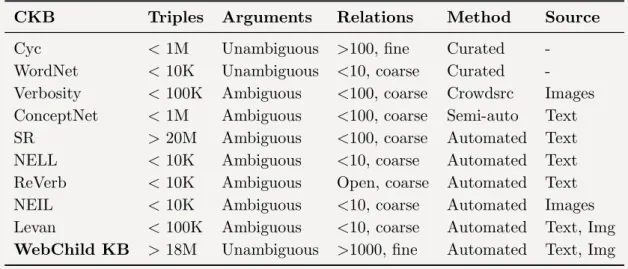
To summarize, prior work cannot address our research objectives because prior work has largely followed small-scale manual approaches. The resulting Com-monsense KBs (CKBs) are coarse-grained with ambiguous arguments. Further, prior work has largely been limited to textual data. Acquisition of commonsense knowledge from visual data leveraging both text and visuals is very recent and small-scale only. Table 1.1 positions this dissertation (our resulting CKB is called WebChild KB) against related work.
Table 1.1: Positioning the dissertation against related work
CKB Triples Arguments Relations Method Source
Cyc <1M Unambiguous >100, fine Curated
-WordNet <10K Unambiguous <10, coarse Curated
-Verbosity <100K Ambiguous <100, coarse Crowdsrc Images
ConceptNet <1M Ambiguous <100, coarse Semi-auto Text
SR >20M Ambiguous <100, coarse Automated Text
NELL <10K Ambiguous <10, coarse Automated Text
ReVerb <10K Ambiguous Open, coarse Automated Text
NEIL <10K Ambiguous <10, coarse Automated Images
Levan <100K Ambiguous <10, coarse Automated Text, Img
WebChild KB >18M Unambiguous >1000, fine Automated Text, Img
1.2 Contributions
We overcome the limitations of the state-of-the-art and provide new research di-rections for the construction of commonsense KBs. Our approaches are scalable and automated, and rely on text by building robust methods that can capture implicit signals in text. Our approach can leverage visual data due to the recent advances in image processing, and handle the noise coming from these computer
8 CHAPTER 1. INTRODUCTION
vision systems. We provide robust triple disambiguation methods that simulta-neously disambiguate the arguments and classify the triple to a refined relation. Our overriding approach is to automatically extract triples from Web-scale data using Information Extraction techniques. Starting with these noisy, am-biguous and unorganized triples, our task is to clean, disambiguate and organize them. We propose methods for joint disambiguation of the arguments of the triple and classification of the triple to a refined relation. Finally, we organize these disambiguated triples, resulting in a large-scale commonsense KB. Our methods can make use of data of multiple modalities.
The contributions of this dissertation are:
• Bigger commonsense KB: we propose scalable methods that lead to a large-scale, high accuracy (more than 80%) Commonsense KB (WebChild KB) containing hundreds of thousands of concepts and thousands of refined rela-tions between these concepts. There are ca. 18 million triples in WebChild KB.
• Cleaner commonsense KB: we propose disambiguation methods capable of disambiguating both arguments of a triple.
• Richer commonsense KB: our methods classify the triples to a refined relation, thereby not conflating semantically different relations.
• From multimodal sources: our methods leverage both textual and visual contents. We mine knowledge from textual data like Web pages, as well as from visual contents like Flickr images, and movies.
• Using automated techniques: all of our methods are automated with no hu-man intervention. Our methods are scalable, allowing scalability of up to a billion Web pages.
These contributions are reflected in various publications during the course of this doctoral work:
1. AAAI 2016 (Tandon et al., 2016): Introduces semantic part-whole com-monsense
2. WI 2015 (Chen et al., 2015): Introduces guided training of word2vec CBOW model with commonsense
3. CIKM 2015 (Tandon et al., 2015a): Introduces semantically organized ac-tivity commonsense
4. CMU LTI-SRS Symposium 2015 (Rajagopal and Tandon, 2015): Proposes the integration of encyclopedic and commonsense knowledge.
1.3. OUTLINE 9
5. ACL 2015 (Shutova et al., 2015): Introduces visual tags for selectional preferences
6. CVPR 2015 (Rohrbach et al., 2015): Introduces audio descriptions as a source of rich visual semantics
7. WWW 2015 (Tandon et al., 2015b): Introduces activity commonsense as semantic frames from movie scripts
8. AAAI 2014 (Tandon et al., 2014b): Performs Open Information Extraction and semantic organization over 850 million web pages
9. WSDM 2014 (Tandon et al., 2014a): Semi-supervised modeling for seman-tically organized commonsense acquisition
10. COLING 2012 (Tandon et al., 2012): Better scoring model of commonsense facts using random walks
1.3 Outline
This dissertation is organized based on the exploration of the three research questions, as follows:
• Chapter 2 gives background and reviews general related work on common-sense knowledge and its acquisition.
• Chapter 3 discusses the first question about property commonsense.
• Chapters 4, 5 refer to the second question about commonsense on relation-ships.
• Chapter 6 refers to the third question about activity commonsense.
• Chapter 7 discusses the resulting commonsense KB, called WebChild KBand its various use-cases.
2 Background and Related Work
This chapter provides a definition of commonsense knowledge, contrasting it with other types of knowledge most notably encyclopedic knowledge. We discuss an overview of commonsense knowledge bases (KBs). We then discuss the state-of-the-art commonsense KB acquisition methods.
2.1 Commonsense Knowledge
Commonsense knowledge has been vaguely defined as a collection of facts that even a child possesses. The original definition of commonsense knowledge by John McCarthy is that “a program has common sense if it automatically deduces for itself a sufficiently wide class of immediate consequences of anything it is told and what it already knows”. While these definitions are informative, they do not highlight the kinds of concepts that make up commonsense knowledge.
More concretely, commonsense knowledge is the knowledge about the generic class of objects in the world rather than the instances of a class. The world is made up of physical objects and abstract concepts. These objects interact in the environment, physically (e.g., hydrogen and oxygen make up water) or abstractly (e.g., some objects and interactions evoke emotions).
Commonsense knowledge is location and culture dependent (Anacleto et al., 2006) and can be opinionated with varying modalities of frequency (Trummer et al., 2015). Thus, commonsense facts can be associated with a context metadata and a confidence score. Definition 2.1.1 provides a broad yet concrete definition of commonsense knowledge. The specific definitions of domain and range depend on the nature of the relation and will be introduced in the appropriate chapters, e.g., Definition 3.1.2 for hasPropertyrelations.
12 CHAPTER 2. BACKGROUND AND RELATED WORK
Definition 2.1.1 - Commonsense knowledge.
Commonsense knowledge is a collection of relations r such as hasProperty, hasPart, usedFor, evokesEmotion. r is a subset of the cartesian product of the domain dom(r) and rng(r).
The domain dom(r), of r, is the set of concepts comprising of either noun phrases or verbal phrases (depending on the specific nature of r) but excludes instances, e.g., for the relation r=evokesEmotion, singer is a valid domain element whereas the instance Beyonce Knowles is invalid.
Therng(r), ofr, is the set of concepts comprising of either noun phrases, adjectival phrases or verbal phrases (depending on the specific nature of
r) but excludes instances.
Often, commonsense does not hold universally; thus, every commonsense fact is accompanied by a confidence score 0 ≤ Θ ≤ 1 and optional metadata.
2.1.1 Commonsense knowledge vs. encyclopedic knowledge
Another way to understand commonsense knowledge is by contrasting it against encyclopedic knowledge. These two distinct types of knowledge are often con-flated incorrectly.Encyclopedic knowledge embodies facts about instances of classes, e.g., specific person, specific location. These facts span across various dimensions like ency-clopedic knowledge of instances: hAlbert Einstein isA physicisti, relationships across instances: hAlbert Einstein wasMarriedTo Elsa Einsteiniand interactions
or events involving these instances: hAlbert Einstein marriedIn January 1903i.
Thus, the domain of encyclopedic knowledge relations is an instance (or Named Entity), while the range can be a Named Entity, concept or a literal.
Commonsense knowledge embodies facts about classes and concepts (not in-stances of classes). These facts span across various dimensions like properties of concepts hbook hasProperty solidi, relationships across concepts hhand partOf
a researcheri and interactions or activities involving these concepts hresearcher
publishes research papersi. Thus, the domain of commonsense knowledge
rela-tions is a subset of all concepts and extended phrases, while the range is a subset of all concepts and extended phrases.
2.2. COMMONSENSE KNOWLEDGE BASES (KBS) 13
Encyclopedic relations are functional i.e. ∀a, b, c:f(a, b)∧f(a, c) =⇒ b =c
as well as non-functional (the right argument admits a set of values for the same left argument). On the contrary, commonsense relations are nearly al-ways non-functional because they generalize the properties of the instances, e.g., while the encyclopedic fact might be hNicolas Sarkozy hasHeight shorti
or hAbraham Lincoln hasHeight talli; the commonsense counterpart would be
hpresident canHaveHeight short,talli thus making it set-valued. In general, as one moves towards the root of the concept hierarchy, the concepts become more generic and their attributes can admit many possible values while the nodes towards the leaf are more specific, with specific attributes.
Typically, encyclopedic knowledge can be obtained explicitly from Web text like Wikipedia and news corpora. However, commonsense knowledge is present across multimodal documents, including text, images, and video. Table 2.1 sum-marizes the key differences between commonsense and encyclopedic knowledge.
Table 2.1: Contrasting commonsense and encyclopedic knowledge domain relation type source Encyclopedic instances majority functional text
Commonsense concepts majority non-functional multimodal
2.2 Commonsense Knowledge Bases (KBs)
In order to build intelligent applications, knowledge must be represented and stored in a formal machine-readable representation. Such a representation of knowledge enables the intelligent applications to reason, i.e. find implicit conse-quences of its explicitly represented knowledge. We discuss the different types of representations of knowledge followed by a discussion on storing this knowledge and pre-requisites for reasoning upon it.
2.2.1 Commonsense knowledge representation
Knowledge representation is concerned with how knowledge can be represented symbolically in a formalized machine-readable format and reasoned. The primary challenge in commonsense knowledge representation is the tradeoff between ex-pressive power, compactness and efficiency. Due to this trade off, commonsense
14 CHAPTER 2. BACKGROUND AND RELATED WORK
knowledge representation has received a lot of attention in the AI community even prior to the 90s, see Dahlgren et al. (1989).
Knowledge representation approaches are broadly classified into two categories. The first category is based on the hypothesis that predicate calculus can unam-biguously capture commonsense facts. Reasoning over these predicates amounts to verifying logical consequences. The second category is derived from human memory and human execution of tasks like puzzle solving. Semantic networks and frames are two popular representations. Semantic networks are based on network shaped cognitive structures while a Frame is an abstract description of a category (e.g., an event), organized in a hierarchy with the slots containing data values for the semantics. Reasoning over these is performed using methods that process hierarchical structures.
Both representations have pros and cons but it is possible to arrive at the best of both worlds. The first category leads to precise reasoning but can be very complex to design. The second category lacks precise semantic characterization but given their human-centered origins, they are more appealing and effective from a practical viewpoint. Hayes (1979) showed that frames could be given semantics by relying on first-order logic. Consequently, this research led to the development of Description Logic (DL) based representation. A characteristic feature of DL is their ability to represent relationships beyondisA, these relations are called roles (Baader et al., 2008). DL models concepts, roles and individuals, and their relationships. The fundamental modeling concept of a DL is the axiom - a logical statement relating roles and concepts.
2.2.2 Storing commonsense knowledge
Knowledge base: A knowledge base (KB) is defined as a collection of facts, typically in a triple formathsubject predicateobjecti, representable as a graph.
Commonsense knowledge can be stored and indexed in a commonsense KB in this format. A triple in such a commonsense KB holds the left argument ( sub-ject), right argument (object) and a relationship connecting them (predicate). Optionally, metadata like triple confidence and context can be stored using reifi-cation techniques that assign a unique ID to a triple and use the triple as the left argument and hasConfidence as the relation and the confidence value as the right argument.
There are two different classifications of KBs, schema-based and schema-free, based on whether the KB has a restricted and canonicalized, or, unrestricted and not canonicalized relations. In schema-based KBs, relations (and typically the arguments) are canonicalized and restricted, and hence uniquely identifiable. In
2.2. COMMONSENSE KNOWLEDGE BASES (KBS) 15
schema-free KBs, relations (and typically arguments) are not canonicalized and not restricted. There has been recent work on canonicalizing schema-free KBs (Gal´arraga et al., 2014). Schema-based KBs allow reasoning over the relations (as they are canonicalized) while reasoning is typically not well-defined in schema-free KBs.
Schema-free KBs: Schema-free approaches are well suited for large coverage but lack semantics. It is very difficult to reason over schema-free KBs due to the ambiguity in the meaning of the concepts and relations. There are well-defined reasoning algorithms and architectures for commonsense knowledge. To leverage these reasoners, it is essential to have a schema-based commonsense KB.
Schema-based KBs: The ideal representation for a (schema-based) common-sense KB is an object model (often called an ontology in the AI community) with concepts and relations. The predicates or relations are canonicalized, and the left and right arguments of the triples are mapped to an ontology. Such an ontology enables reasoning over the commonsense KB (Davis and Marcus, 2015). Commonsense KBs can be connected to ontologies containing generic concepts that describe very general concepts that are same across all domains. Such an ontology is also called an upper level ontology. There are several upper level ontologies (refer Mascardi et al. (2007)), most notably Cyc ontology (300K concepts) with 12K concepts mapped to WordNet, and, SUMO (20K terms and 60K axioms) with all the terms mapped to WordNet.
Reasoning over schema-based commonsense KBs: For logical reasoning,isA relation, organizing concepts in a hierarchy, is very valuable. WordNet is a can-didate as a commonsense ontology. WordNet is an unparalleled lexical database, the most used lexical resource in computational linguistics. WordNet is con-nected to all prominent upper level ontologies, making it a preferred choice as an ontology.
Is WordNet truly an ontology? Although WordNet was not intended to be an ontology initially, it was eventually transformed as the organization of nouns in WordNet bore many similarities to an ontology (Miller and Hristea, 2006). Every noun begins with a single unique beginner: entity. In a reasonable ontology, all terms are expected to conform to the membership relation of set theory and would not contain instances. The confounding of classes and instances in WordNet was resolved manually in WordNet version 2.1. This made WordNet a suitable ontology that can be used for commonsense reasoning.
16 CHAPTER 2. BACKGROUND AND RELATED WORK
WordNet is a closed vocabulary lexical database with infrequent updates and thus limited concepts. Nevertheless, a large majority of upper level ontology concepts are already present in WordNet. Although WordNet is rich in isA relations, it contains a very small number of sparsely populated commonsense relations so it cannot be a substitute of a commonsense KB but could function as a reasonable ontology for the commonsense KB.
2.3 Commonsense KB Construction
The larger task of commonsense KB construction involves commonsense KB ac-quisition, completion and reasoning. Commonsense KB acquisition task involves populating a schema-free or schema-based commonsense KB with commonsense knowledge triples using curated, semi-automated or automated techniques over unimodal or multimodal data. A usual follow-up task after commonsense KB acquisition is commonsense KB completion. The populated commonsense KB can then be used to mine commonsense rules using inductive logic programming (Blanco et al., 2011).
We can classify commonsense KB acquisition methods into four classes, irre-spective of the modality of the input data or whether the commonsense KB is schema-free or schema-based:
(i) In curated approaches, commonsense knowledge triples are created manually by experts or even non-experts using knowledge authoring tools.
(ii) In collaborative approaches, triples are created manually by an open group of volunteers. Typically, these are game-based acquisition methods.
(iii) In automated approaches, either the method for extraction is semi-automated or an semi-automated extraction method is used over a fixed-schema dataset.
(iv) In automated approaches, triples are extracted automatically from unstruc-tured text via machine learning and natural language processing techniques.
2.3.1 Curated
The goal of curated commonsense KB is to codify millions of pieces of common-sense knowledge in machine-readable form. Typically, the assertions in a curated commonsense KB do not have a confidence score.
2.3. COMMONSENSE KB CONSTRUCTION 17
Cyc: The pioneering work in this direction is Cyc. The Cyc project started in early 1980s up until 2000s. Cyc contains a KB (Cyc KB), and a collection of Cyc inference engines. Cyc KB is coded in a formal predicate calculus like syntax language (CycL). Cyc assumes that each assertion should be considered true in only certain contexts. Thus, all assertions are organized into more than 20,000 micro-theories whose assertions share the same set of assumptions.
The acquisition process of Cyc is that hundreds of thousands of facts and rules have been formally codified by ontologists skilled in CycL. Additionally, Cyc contains domain specific knowledge, e.g., defense domain, for which Cyc relies on subject matter experts. According to Cyc’s documentation, the number of facts entered by a subject matter expert is about 25 facts per hour. To overcome the size limitations, we will later see an extension of Cyc that uses a game-based interface and Wikipedia to automatically acquire more knowledge.
While Cyc has been ahead of its times, it is not clear whether the 15 years of curated knowledge acquisition process was successful. It is not clear what fraction of commonsense knowledge (concepts and not instances) does Cyc contain, and what fraction deals with specialized applications such as defense, terrorism or medical records. There have been conflicting reports about the usability of Cyc from practitioners. Reports suggest that a large collection of Cyc has usability problems including problems in understandability and portability to other sys-tems. Conesa et al. (2008) further report that the Microtheory Taxonomy (MT) in ResearchCyc is very difficult to use due to its organization. Some reasons provided by them are:
• “There are over 20,000 MTs in Cyc with the taxonomical structure of MTs being as deep as 50 levels in some domains.
• Many redundant sub-type relationships make it difficult to determine its tax-onomical structure.
• Some MTs are very sparse but it is very difficult to discard them. • Some MTs do not follow a standard representation of knowledge.”
WordNet: A much smaller and less formally represented commonsense KB is WordNet. WordNet is aligned to several external knowledge sources due to its popularity. Cyc is partially aligned to WordNet while other ontologies like SUMO are mapped to WordNet. WordNet is carefully handcrafted, containing more than 155,000 words organized in over 117,000 synsets, e.g., biologist, scientist, animal, dog.
18 CHAPTER 2. BACKGROUND AND RELATED WORK
linguistic or commonsense relationships. These relations include isA i.e. (hy-per/hypo)nyms that connect generic nouns and verbs (hyper to more specific respective nouns and verbs (hypo), part-whole relations substance meronym, member meronym, and part meronym. Nouns and adjective synsets are sparsely connected by attribute relation.
WordNet is limited in the coverage of concepts, number of relations and num-ber of assertions. Concepts are ever emerging, e.g., hybrid cars, but WordNet would not keep up with such emergence. The number of relations in WordNet is limited, and the small set of relations present, are very sparse. For instance, there are only 1200part-whole relation triples.
VerbNet: VerbNet (Kipper et al., 2006) is a manually curated linguistic re-source for English verbs. It provides complimentary linguistic and potentially commonsense semantics to WordNet verbs. For each verb class, VerbNet lists relevant thematic roles, semantic restrictions on the arguments, and syntactic frames. For example, for the verbshoot, VerbNet lists multiple candidate senses, and for the first of these, shoot1vn, it provides, among others, the following syn-tactic frame:
Agent.animate V Patient.animate PP Instrument.solid
This would match “He shot the man with a gun”. Here, several roles are accom-panied by a semantic constraint, known as aselectional restriction. A selectional restriction such as animate for the patient requires that this patient be a living being when used in the given syntactic frame.
ImageNet (visual contents based): ImageNet (Deng et al., 2009) is a man-ually curated image database organized according to the WordNet noun synset hierarchy, in which each node of the hierarchy is depicted by hundreds and thou-sands of images. ImageNet has an average of over five hundred images per WordNet noun synset. ImageNet is manually curated.
ImageNet can be directly used to populate the commonsense relationappearsLike. This is a useful relation in multimodal analysis for applications like robotic en-gines (Saxena et al., 2014).
Manually curated approaches produce a very high quality KB. However, they can be very costly especially if the task requires experts. These approaches tend to have a low coverage because humans are known to be bad to recalling facts, especially when they are as obvious as commonsense. These approaches take a very long time to develop, e.g., Cyc could gather only hundreds of thousands of facts over more than 15 years.
2.3. COMMONSENSE KB CONSTRUCTION 19
2.3.2 Collaborative
In collaborative approaches, users individually or collectively play games and produce useful computation as a side effect (Von Ahn, 2006), including mining generic or domain-specific commonsense knowledge. In this sub-section, we re-view a non-game based interface (OMCS) and two popular games: a two player game Verbosity and a single player game Virtual Pet, all aiming to collect com-monsense.
Collaborative approaches offer several advantages. Collaborative approaches have a faster acquisition rate and higher coverage than curated approaches. A specialized audience is not required for commonsense elicitation. The quality of aggregated assertions is very high because the assertions from different players have the ensemble effect.
Verbosity: Verbosity considers two players: a narrator and a guesser. Given a word (concept), the narrator can offer some clues (short assertion phrases) to help the guesser guess the secret word. For example, if the secret word is laptop, the narrator might prompt the guesser: “it has a keyboard”. Such an acquisition typically brings out the most salient aspects of a concept. Verbosity also allows a single player to play the game with a “bot” partner. The bot uses the collected data when it is in the role of an automated narrator.
Virtual pet game: In the Virtual Pet Game (Kuo et al., 2009), players teach their pets simple facts in order to raise the intelligence of their virtual pets. Vir-tual Pets Game outperforms non-game based acquisition in collection speed and quantity. That is, fewer contributors used lesser time to collect more common-sense knowledge.
OMCS: The Open Mind Common Sense (OMCS) project is designed to col-lect commonsense knowledge statements in English with supplementary projects providing extensions to several other languages. OMCS contains nearly a million statements from more than 15000 volunteers that led to more than 100K asser-tions. The strength of the project lies in the ensemble effect of the statements, and the challenge is user engagement.
OMCS uses a carefully designed interface to collect statements from the users. In the first version, there were 25 different commonsense settings, each setting with its own user interface, where the volunteer is presented a short story, e.g., “Bob had cold and Bob went to the doctor”, encouraging a volunteer to enter com-monsense knowledge like “Bob was sick”, “the doctor prescribed him medicine”.
20 CHAPTER 2. BACKGROUND AND RELATED WORK
In another version, volunteers can select a concept and fill predefined templates associated with the concept. For example, given the template “can be used to”, the volunteer could fill the left and right slots with “a pen” and “write” respec-tively.
Visual contents based: Visual Genome (Krishna et al., 2016) is a recent, crowdsourced KB that connects structured image concepts to text. A scene graph models the commonsense assertions from an image in a graph connecting concepts to attributes, their spatial relations and their interactions. The graph representation has an advantage over natural language because it abstracts ob-ject interactions of arbitrary complexity.
Collaborative approaches have greater efficiency of collecting commonsense statements than manually curated approaches. Like the curated approaches, the relations are pre-defined, leading to a schema-based KB. However, collaborative approaches face the challenges of user engagement and maintaining a large user base for redundancy, especially when the task (collecting commonsense) is so simple and underwhelming. Further, the statements tend to be noisy and are not canonicalized.
2.3.3 Semi-automated
In semi-automated approaches, we review ConceptNet, a semantic network repre-sentation of the commonsense knowledge collected primarily from OMCS projects and some other external resources like Wikipedia.
Semi-automated approaches have the advantage that they achieve high preci-sion due to manual intervention at the beginning. Semi-automated approaches have a faster acquisition rate and higher coverage than curated approaches but with substantially lower precision.
ConceptNet: The pioneering semi-automated commonsense acquisition project is ConceptNet (Liu and Singh, 2004; Lieberman et al., 2004; Havasi et al., 2007; Speer and Havasi, 2012). It is one of the largest repositories of commonsense assertions, covering commonsense relations including properties of objects, e.g., hasProperty; their relationships, e.g., madeOf; as well as their interactions, e.g., motivatedByGoal. ConceptNet contains 1.6 million assertions over 30,000 con-cepts. In the ConceptNet graph, the nodes denote concepts and the edges (multi graph) denote commonsense relations between concepts. Syntactically, the con-cepts are either noun phrases, verbs, prepositional phrases, or adjectival phrases.
2.3. COMMONSENSE KB CONSTRUCTION 21
ConceptNet is constructed in three stages. (i) Triple extraction using semi-structured OMCS via lexico-syntactic patterns and argument type-constraints. (ii) Normalization of arguments by stripping determiners and modals, e.g.,falling off a bike tofall off bike. (iii) Handcrafted relaxation rules to increase coverage, e.g., IsA (apple, red fruit) imply propertyOf (apple, red).
ConceptNet supports several contextual commonsense reasoning functionali-ties. This includes three node-level functionalities, including contextual neigh-bors, analogy, and projection. In addition, there are four document-level func-tionalities: topic-summary, disambiguation and classification, concept identifica-tion, and emotion sensing.
ConceptNet includes a rare functionality: explicit negative assertions. Every assertion has a confidence/ reliability score (multiple agreements) and a param-eter of polarity. The polarity paramparam-eter has a value of either 1 or -1, where negative values indicates a negative statement, e.g., from the OMCS statement “people do not want to be hurt” to people desires be hurt, polarity -1.
The distinction between commonsense and encyclopedic knowledge is unclear in ConceptNet-5 (latest version of ConceptNet). The partOf relation is addi-tionally populated with Wikipedia and DBpedia’s geo-knowledge, e.g., hBerlin
partOf Deutschlandi. ConceptNet-5 is expanded to several languages, in addi-tion to English.
Other approaches include Lebani and Pianta (2012), who studied relations like hasSize, hasShape, etc., assigning their instances to word senses. However, it solely relied on human elicitation for 50 nouns, and is not suited for automation at large scale.
Compared to WordNet and Cyc, ConceptNet has the advantage of having a simpler, less formal and more pragmatic contextual reasoning because Concept-Net deals with knowledge that may not hold universally. On the other hand, WordNet is optimized for lexical categorization and taxonomic word similarity, Cyc is designed for formalized logical inference.
2.3.4 Semi-automated pattern-based
Another line of semi-automated approaches leverages handcrafted patterns over an open corpus, providing more automation and higher coverage. We review the work by Pasca (2014b) that employs semi-automated pattern-based approach to extract commonsense. Other related methods include DART (Clark and Harri-son, 2009). These methods differ in the input corpora, manually specified extrac-tion patterns and ranking, typically based on an informaextrac-tion theoretic measure like mutual information.
22 CHAPTER 2. BACKGROUND AND RELATED WORK
Pasca (2014b) extract commonsense knowledge from Google query log us-ing manually specified targeted patterns. For example, their pattern: why [is|was|were] [a|an|the|nothing] subj rel+obj matches the querywhy are (cars)subj (made of steel)rel+obj.
As the patterns are fairly generic and the extractions are noisy, their scor-ing function is an inverted document frequency like measure: score(F, C) =
LowBound(W ilson(N+, N)), where the fact is F, and C is a class (subject).
The score measures specificity as the lower bound of the Wilson score interval (Brown et al., 2001) where N+ is the number of supporting queries, and N− is the number of queries where the fact is extracted for a different class (subject). While most of these methods acquire coarse-grained relationships, there is little prior work on acquiring fine-grained commonsense relations. Almuhareb and Poesio (2004) proposed patterns like “<object> is a/the <attribute> of
<subject>”, e.g., “brown is a color of dogs” to find more specific properties, but even on the Web this method yields very low recall (Baroni and Zamparelli, 2010) as commonsense relations are not as explicit in text.
Pattern-based methods provide higher coverage but lower precision than cu-rated methods as the input corpus is orders of magnitude larger and automated methods inevitably attract noise. Commonsense relations are not as explicit in text, and it is difficult to enumerate all the potential subtle patterns by hand. To overcome these limitations, typically automated methods are employed, that we discuss next.
2.3.5 Automated
In automated techniques, the resulting commonsense KBs are either schema-free or schema-based. Schema-free techniques focus on recall, while schema-based re-strict on a smaller set with higher precision. Schema-free commonsense KBs have ambiguous interpretations of triple arguments and the relations are not canoni-calized while Schema-based commonsense KBs have canonicanoni-calized relations and may have disambiguated arguments.
2.3.5.1 Schema-free
The most popular schema-free methods to extract knowledge are Open Infor-mation Extraction (OpenIE) based, including shallow syntactic parsing based (e.g., TextRunner (Yates et al., 2007), ReVerb (Fader et al., 2011a), R2A2 (Et-zioni et al., 2011)) or deep syntactic parsing based systems (e.g., ClausIE (Corro and Gemulla, 2013), Weltmodell (Akbik and Michael, 2014), KNext (Schubert,
2.3. COMMONSENSE KB CONSTRUCTION 23
2002)). These systems do not discriminate between encyclopedic and common-sense knowledge. They do not have a notion of entities and concepts primarily because the arguments are ambiguous. The relations in the extracted triples are phrases and hence the relations are open. We discuss these methods assuming that it is possible to tell apart encyclopedic and commonsense triples.
Shallow syntactic parsing methods: TextRunner extracts all possible hnoun phrase verb phrase noun phrasei triples from text using a three-stage archi-tecture. TextRunner uses a chunker to identify noun phrases and subsequently identifies normalized verb phrase relations between noun phrases, heuristically discarding non-essential modifiers. A Naive Bayes classifier, trained over a small subset of extractions that satisfy handcrafted heuristic constraints, is used to retain meaningful extractions. Finally, a redundancy-based assessor evaluates each retained extraction using a probabilistic model of redundancy.
ReVerb is a follow-up architecture to TextRunner, providing robustness over the relational phrase expression errors. A syntactic constraint on relational phrases avoids meaningless relational phrases by enforcing that the relational phrase is contiguous, begins with a verb, and ends with a preposition. A lexical constraint on relational phrases is then introduced to avoid rare and meaningless relational phrases by thresholding on the number of distinct argument support. ReVerb searches for the longest sequence of words around a verb that satisfies the syntactic and lexical constraint. It then finds the nearest noun phrases to the left or right of each such relational phrase. Finally, a logistic regression classifier, trained on five features based on aforementioned heuristic constraints, estimates confidence score for the extraction.
R2A2 uses multiple supervised classifiers to identify the arguments that go beyond just noun phrases. The supervised classifiers detect the left bound and the right bound of each argument. The classifiers use several heuristic features, e.g., whether the second argument was followed by an independent clause or verb phrase. R2A2 is the best-performing shallow syntactic parsing based OpenIE extractor.
Deep syntactic parsing methods: Among the deep syntactic parsing based OpenIE systems, we discuss ClausIE, Weltmodell and KNext. ClausIE post-processes the dependency parse output to find all possible clauses in a sentence that respect the seven rules to construct clauses in an English sentence. The quality of ClausIE is bounded by the accuracy of the parser. It is significantly slower than the shallow parsing systems due to dependence on the parser but
24 CHAPTER 2. BACKGROUND AND RELATED WORK
has higher quality and higher coverage including indirect triples, e.g., “the ball and the wheel are round” to hthe ballis roundi and hthe wheel is roundi.
Weltmodell applies the dependency output based OpenIE system by Akbik and L¨oser (2012) over Google syntactic books n-grams. Using heuristic rules over typed dependencies, Weltmodell collect subjects, passive subjects, particles, direct and prepositional objects of the verb. The confidence on the extracted facts is computed using PMI. Weltmodell does not discriminate between classes and named entities as arguments (an important distinction for commonsense knowledge), and is limited to single word arguments.
While ClausIE and Weltmodell can elicit explicit assertions, KNext has focused on implicit general possibilistic propositions from parse trees. General implies the open relations and possibilistic implies that the assertions are possible. For example, given the sentence “the dog got into the car through the open window”, they can infer that “it is possible for a dog to enter a car”, “cars probably have windows”, and “windows can be open”. KNext starts with general phrase struc-ture patterns to match the parse tree in bottom-up fashion. For each successfully matched sub-tree, the system first abstracts the interpretations of each essential constituent of it, e.g., “an open window at the rare end of the car” would be abstracted to “a window”. Subsequently, compositional interpretive rules help combine all abstracted interpretations and finally derive a general possibilistic proposition.
The OpenIE systems do not discriminate between encyclopedic and common-sense knowledge. This is partially because the arguments and relations are not canonicalized. These systems are typically not designed to construct and orga-nize a commonsense KB (or even a KB), rather their goal is to acquire triples for a use-case like question answering. The shallow syntactic parsing methods typically have low precision while deep syntactic parsing methods do not scale.
2.3.5.2 Schema-based
Schema-based methods populate a predefined relation. The schema-based meth-ods to extract commonsense knowledge are either pattern-based or reasoning/learning-based. Pattern-based methods start with a small set of seeds to induce patterns that are used to extract more facts. While pattern-based methods provide a high recall, their precision is rather low due to the semantic drift and unreliabil-ity of patterns and facts. Learning and reasoning-based methods perform joint reasoning over the pattern-based methods style extraction.
2.3. COMMONSENSE KB CONSTRUCTION 25
Pattern-based methods: Pattern-based methods are based on the pattern-fact duality paradigm (Brin, 1998) that good seed facts lead to good patterns for a relation, and good patterns help to extract good facts. Pattern ranking and fact ranking are the two important ingredients in these methods. Typically, corpus based statistics is used to model these scoring functions. The choice of seeds also plays a role in the quality of the extracted facts (see Tandon (2011) for an overview).
While pattern-based methods have been very popular in encyclopedic knowl-edge harvesting, Tandon et al. (2011) extend ConceptNet using a pattern-based method. They automatically compile millions of triples of the form h noun re-lation adjective i by mining n-gram corpora. Large n-gram corpora are a good source for Information Extraction (Tandon and De Melo, 2010) despite a small context of usually maximum five words.
Their system requires a small number of high-quality seed assertions from ConceptNet to induce the extraction patterns, with a scoring model that rewards patterns with high seed support and high specificity. They limit the iterations to only one cycle from seed assertions to patterns and from patterns to new assertions because pattern-based methods are known to be prone to semantic drift. While they gathered millions of commonsense knowledge assertions, the relation arguments were surface forms and the relations were fairly generic such as hasA, hasProperty, or capableOf, and the precision was rather low.
Pattern-based methods suffer from low precision and several extensions are proposed, e.g., Tandon et al. (2012). The sources of these errors are either the input source (e.g., noisy Web collections) or the patterns that can be too generic for commonsense relations like hasProperty, e.g., “X is Y”.
Reasoning-based methods: While Pattern-based methods elicit the explicit or subtly implicit knowledge in text; reasoning-based methods can bring out the implicit assertions. In these methods, inductive learning helps to generalize and eventually enlarge the KB by generating rules from some existing facts to gener-alize to more knowledge. These methods also use rules to prune out potentially false assertions that violate the constraints. For example, if we add a constraint that “a fruit can have only one color”, and so far we accumulate several colors of a fruit, then, we may be able to eliminate the false hypotheses by means of constraint violation.
NELL (Carlson et al., 2010) is a learning agent whose task is to acquire knowledge (mostly encyclopedic but also some commonsense knowledge likepart whole relations) from the Web in a continuous manner. NELL takes an initial
26 CHAPTER 2. BACKGROUND AND RELATED WORK
ontology as input that defines categories and their binary relations, with some seed categories and relations. NELL learns extraction/inference models and uses the models to extract/infer new knowledge by expanding the domain and range of these relations automatically from the Web and inferring new relations among them to update the initial ontology. Then, a coupled morphological classifier learns a set of binary L2-regularized logistic regression models per category or relation. Beliefs from the KB are used as training instances, and mutual exclu-sion relationships are used to identify negative instances. Finally, a rule learner learns a set of probabilistic Horn clauses, which are used to infer new relation instances from other already-known relation instances.
While NELL has acquired large amounts of knowledge (and some commonsense knowledge), the coverage of the system is rather low. Moreover, these systems are computationally very expensive and thus do not scale to the Web.
Learning-based methods: Parallel to pattern-based and reasoning-based meth-ods, learning-based methods are used to acquire more knowledge, starting from a smaller set of known positive and negative examples. Statistical relation learning is a family of algorithms used to acquire more knowledge and validate existing knowledge. These methods associate assertions based on their similarity (either in the latent space or in a graph) and propagate similar labels to similar asser-tions. While these methods consider that the correctness of all triples is condi-tionally independent given the graph or the latent space, another member of this family of algorithms, namely Markov Logic Network (Richardson and Domin-gos, 2006) drops the independence assumption. Given a set of constraints, the Markov Logic framework optimizes for a set of assignments such that the joint assignment satisfies the constraints.
AnalogySpace (Speer et al., 2008) can generate the analogical closure of a KB through dimensionality reduction. Each concept subject S in a triple hS P
Oi is viewed as a vector over P + O. The vector is full of noise as the triples are extracted using a semi-automated method. Thus, AnalogySpace reduces the dimension of the vectors and then compares these vectors to infer more knowledge. Consider an example, suppose AnalogySpace knows that anewspaper has information while it does not know that anything about a magazine, then, given the proximity of newspaper and a magazine in the dimensionality reduced space, it can infer that amagazine also contains information.
The learning-based methods are a powerful tool, but can be computationally expensive for very large graphs. Efficient optimization algorithms are an active area of research to increase scalability.
2.3. COMMONSENSE KB CONSTRUCTION 27
KB verification: Directly extracting commonsense knowledge from vision poses challenging problems in vision like object and attribute detection. Instead of extracting commonsense from images, visual verification of the knowledge in the KB might be more robust. That is, commonsense may be gathered from a high-level semantic understanding of a visual scene, and a low-high-level pixel information can be avoided.
The task of verifying relation phrases (Vedantam et al., 2015) is to validate an existing acquired assertion by analyzing the frequency of its occurrence in text. For factual knowledge, redundancy is a very reasonable assumption. Since commonsense knowledge is oftentimes implicit in text, it is not clear whether frequency based textual verification is robust. Many high frequency relations occur in text but are not true in the real world, e.g., hpelican pierce breasti.
Conversely, many relations occur in text with low frequency but are true in the real world, e.g., hchimpanzee eats ice-creami. However, such facts are evident in images and visuals.
Given the recent advancement in analyzing images, new methods extract com-monsense knowledge from images (Sadeghi et al., 2015) directly. However, these methods suffer from coverage issues as images only contain visual attributes and are less robust due to the noise that comes along the vision analysis systems. Vedantam et al. (2015) study the plausibility of a commonsense assertion using visual cues and verifying a commonsense triple from image. They predict the plausibility of interactions or relations between a pair of concepts by grounding commonsense assertions in the visual space and evaluating the similarity between assertions using the visual features. This is an active ongoing research area. 2.3.5.3 Visual contents based methods
Commonsense knowledge finds applications in the vision community thereby in-stilling interest to acquire it. Image recognition benefits by modeling common-sense context in images. Commoncommon-sense knowledge also benefits action classifi-cation systems for tasks like zero-shot affordance for human-object interactions, i.e. whether a given activity/ action can be performed by an object. Typically, external knowledge or handcrafted commonsense KBs are used for this purpose (Zhu et al., 2014). However, commonsense is also implicitly present in images prompting recent progress to mine commonsense from images.
Recent systems mine commonsense knowledge either directly from images or jointly with text. Given a concept (e.g., hill), LEVAN (Divvala et al., 2014) trains detectors for a wide variety of actions, interactions and attributes involv-ing the concept (e.g., hill walkinvolv-ing). LEVAN mines relevant n-grams in text
28 CHAPTER 2. BACKGROUND AND RELATED WORK
that are associated with the given concept, thereby capturing intra-concept vari-ance. To avoid training detectors for visually non-salient activity concepts like abstract bigrams, LEVAN assumes that only visually salient bigrams will pro-vide any meaningful object detection accuracy. In another line of work, Johnson et al. (2015) build a scene graph representation for image retrieval which mod-els attribute and object relations. Their system is trained on mechanical turk annotated scene graphs grounded to images. In an image, the system can elicit commonsense about the concepts, their attributes and interactions.
NEIL (Chen et al., 2013) analyzes images of the web to acquire common-sense knowledge relations like partOf and visual attributes of concepts using object and scene detectors to infer an object’s visual attributes (color, shape) andpartOfrelationships. To start, NEIL queries Google image search with some seeds (surface forms of concepts, e.g.,jaguar or scenes like parking lot). The re-sults can be noisy, and thus NEIL first clusters the image rere-sults based on their visual appearance and then trains object/scene detectors. After training these detectors, at test time NEIL detects the objects in an image and records the visual attributes, e.g., hobject hascolor yellowi. Thus, it infers object-attribute relations and scene-attribute relations. Further, NEIL infershtail partOfjaguari
and hjaguar found near treei using bounding box techniques.
Lin and Parikh (2015) acquire visual commonsense from images and use it to answer textual fill-in-the-blank and visual paraphrasing questions. They imagine a scene as the underlying context and model visual commonsense in the context of a scene.
Extracting commonsense from visual content requires automatic and accurate detection of objects, their attributes, poses, and interactions. However, these are challenging, not completely solved problems in computer vision. Oftentimes, the visual analysis systems do not fully leverage the power of text jointly with the image, e.g., NEIL does not leverage the surrounding text that could prove useful.
In summary, we reviewed several commonsense KB construction methods and while each has its own novelty, none of them is complete, semantically orga-nized, multimodal and automated. While curated KBs are costly and small, crowdsourced KBs are small and difficult to drive. Semi-automated approaches can scale well but there is not enough structured data and manually specified ex-traction patterns attract exex-traction noise. Automated approaches are typically not semantically organized, noisy and derived from either text or images but not multimodal.
2.4. APPLICATIONS OF COMMONSENSE KBS 29
2.4 Applications of Commonsense KBs
Commonsense knowledge finds applications across a variety of domains (Lieber-man et al., 2004). We provide a brief overview of applications in NLP, computer vision and robotics that leverage commonsense knowledge.
NLP: There has been phenomenal progress across various disciplines of NLP. Natural Language Understanding (NLU) is a growing field within this landscape (Winograd, 1972). Bar-Hillel (1960), in as early as 1960, outlined the importance of commonsense knowledge for NLP, especially disambiguation.
While distributional similarity provides a sparse, noisy neighborhood that has been useful for query expansion, commonsense knowledge provides low dimen-sional, high quality dense vectors. Expansion of concepts using relations like isA, part-whole, hasPropertyetc. has been shown to outperform other query expansion methods (Hsu et al., 2006).
Another line of commonsense knowledge application has been in event predic-tion by gathering commonsense from manually written procedural scripts (Reg-neri et al., 2010).
Great advancements in NLP have been made through word vector statistics and linguistic analysis. However, more intelligent NLP systems would require commonsense knowledge f