ALBANIA SMALL BUSINESS CREDIT
AND ASSISTANCE PROGRAM
FIRST QUARTERLY REPORT
MARCH 1, 2002 TO MAY 31, 2002
Submitted by:
Chemonics International Inc.
For:
Albania Small Business Credit and Assistance Program Contract Number 182-C-00-02-00102-00
Submitted to: United States Agency for International Development JUNE 2002 CHE M O NICS CHE M O NICS CHE M O NICS CHE M O NICS
Contents
1. HIGHLIGHTS OF ACHIEVEMENTS TO DATE 2. SPECIFIC ACTIVITIES
Physical Project Installation (PHASE ONE, Activity One) Develop Year One Work Plan (PHASE ONE, Activity Two)
Review and Select Key Target Clusters (PHASE ONE, Activity Three) Finalize Grant Agreements with PSHM: (PHASE ONE, Activity Four) Finalize Agreement and Subcontract with RDA (PHASE ONE, Activity Five) Hire Local CI Staff (PHASE ONE, Activity Six)
Evaluate the RDA Structure, Staffing, Training Capability and Physical Facilities (PHASE TWO, Activity One)
Determine Training Needs in Selected Clusters (PHASE TWO, Activity Two) Develop Loan Guarantee Concept (PHASE THREE, Activity One)
3. ANTICIPATED ACTIVITIES FOR NEXT QUARTER 4. QUARTERLY FINANCIAL UPDATE
5. ANNEXES:
I. Report on ASBCA Team Visits to RDAs
II. Clustering Workshop – PowerPoint Presentation III. Review of Cluster Models Identified by RDAs
ALBANIA SBCA QUARTERLY REPORT: MARCH – MAY 2002
3
Albania Small Business Credit and Assistance (SBCA) Program
Quarterly Report for period March to May 2002
Submitted by Chemonics International Inc.Contract 182-C-00-02-00102-00
Start Date: March 1, 2002 Completion Date: April 30, 2004
1. HIGHLIGHTS OF ACHIEVEMENTS TO DATE
The project became fully operational in mid-April once the project office had been set up and the staff had been hired. The Grant and Technical Assistance Agreements and Grant Manual have been agreed between PSHM and CI. Six potential loans through PSHM have been identified. The first year work plan has been completed and approved by USAID. The CI team has undertaken an initial assessment of the RDA structure and individual RDAs. The selection of key target clusters has been initiated through the holding of a workshop attended by RDA directors, PSHM representatives, and CI staff. The subcontract agreement with the RDA National Coordination Center will be completed in mid June.
2. SPECIFIC ACTIVITIES
This section describes our completion of, or progress to date in carrying out, the activities proposed in the Work Plan:
PHASE ONE—PROJECT INSTALLATION Activity One: Physical Project Installation
· The CI team arrived in Tirana on March 20, 2002.
· A former CI employee assisted the CI team in start-up and identification of potential office locations and staff.
· The COP left Albania on March 29 and returned on April 8.
· Office premises were rented and the project started its operations in mid-April.
· Office equipment and furniture, ordered in March, were delivered during April and May.
· Bank accounts (Lek and USD) were opened at the American Bank of Albania.
· The CI accounting system has been installed, and the first SBCA accounting reports were sent to CI before the end of April.
· Telephone lines were finally installed at the end of May after pressuring Albtelecom with support from USAID.
Benchmark: Office installed
· Completed work plan and Gantt chart submitted and approved by USAID Tirana by mid-April.
· Performance-based Management Task Schedule submitted to USAID Washington.
Benchmark: Work Plan finalized
Activity Three: Review and Select Key Target Clusters
· An introductory workshop on clustering (see Powerpoint presentation in Annex II) was held for RDA Directors and PSHM senior staff on May 16 by the COP.
· Ten sectors, one for each RDA, were selected for review. The RDAs submitted “cluster models” to the SBCA project office by May 23, and the revised models are attached in Annex III.
· The 10 cluster models were reviewed and modified, and the revised versions were distributed to the RDAs. The RDAs will identify clients and potential SBCA clients and return the results by June 7.
· A short-term clustering specialist, Bill Kedrock, arrived in Albania on June 7 and will:
q Review and build upon the overall results of the RDA cluster research and
refine the methodology for ongoing cluster analysis
q Develop the rationale for the selection of clients that will receive credit and
technical assistance from the SBCA project
q Refine the cluster data submitted by RDAs
q Design and conduct a follow-on workshop with RDA directors and PSHM
representatives to discuss the cluster results and reinforce the direction of future work
q Identify and refine the project focus
Activity Four: Finalize Grant Agreement with PSHM
· Due diligence visits were made to PSHM offices in April to review PSHM management information and systems.
· PSHM will be using new MIS software “Globus Desktop 1.2 Emerge” that will allow them to produce the reports required under the subcontract agreements.
· The SBCA bank and loan accounts will be maintained separately from other PSHM activities.
· The Grant and Technical Assistance Agreements have been agreed between CI and PSHM and are now awaiting approval from the USAID Contracting Officer.
· A joint training workshop was conducted by PSHM at the SBCA projects office on May 17 to introduce RDA directors to PSHM loan application requirements.
· The first six loans, totaling USD96, 000, have been agreed between CI and PSHM and will be made once the grant agreements have been approved by the USAID
ALBANIA SBCA QUARTERLY REPORT: MARCH – MAY 2002
5
Activity Five: Finalize Agreement and Subcontract with RDA
· A letter of intent was signed between CI and the RDA’s National Coordination Centre (NCC) on March 28.
· Regular discussions between CI and the NCC took place in April and May 2002 and fixed price subcontract has been drafted for presentation to NCC.
· Individual Work Orders will be issued by CI to NCC for work which will be completed by RDAs (an illustrative work order is attached to the draft RDA agreement).
Activity Six: Hire Local CI Staff
· Using the Nexus network and responses to advertisements in local newspapers, interviews were held for the positions of business development specialists, translator and driver.
· Three business development specialists, a driver, translator and office manager/accountant have been hired.
Benchmark: Local staff contracted
PHASE TWO— IMPLEMENT TRAINING PROGRAM
Activity One: Evaluate RDA Structure, Staffing, Training Capability and Physical Facilities
· Preliminary visits to each of the ten RDAs were made in April and May resulting in the report attached as Annex I.
· An overall assessment of the RDAs was completed, and each RDA was evaluated on a scale of 1 to 5.
· The most immediate RDA equipment needs are generators and batteries to allow a continuous supply of electricity for normal everyday activities and especially for training sessions.
Benchmark: RDA resources and training capability reviewed Activity Two: Determine Training Needs in Selected Clusters
· The fishing sector, one of the likely target clusters, has been reviewed in some detail.
· A visit to the Eurofish anchovy processing plant in Lezhe with PSHM, RDA and CI staff resulted in gaining access to fishermen at the port of Shengjin.
· Preliminary interviews held with the Shengjin fishermen enabled us to assess their possible credit and training needs.
PHASE THREE: IMPLEMENT CREDIT GUARANTEE PROGRAM Activity One: Develop Loan Guarantee Concept
· Interviews have been held with a number of banks. The American Bank of Albania has guarantee schemes with Land o’ Lakes, and an IFCA short term guarantee specialist has been identified and will be in Albania in August, 2002.
3. ANTICIPATED ACTIVITIES FOR THE NEXT QUARTER
· Sign grant agreement with PSHM.
· Follow-on workshop on clustering and selection of target clusters
· Finalize subcontract with RDA
· Review, adapt and develop RDA training curriculums
· Refine loan product of greater than $5,000
· Develop loan criteria and submit to USAID for approval
· Initiate lending program through PSHM
· Further study of the fishing sector including interviews with fishermen in Durres and Vlora
· Implementation of an Accounting and Costing system for RDAs
· Kick-off Event in July 2002
· Project promotional brochures will be completed in June and July
· Web site development will commence in June and a technical strategy session will be held at Chemonics home office in June
· Joint workshop will be held with IFDC, PSHM, RDA and CI to introduce business associations to the SBCA Project and explore areas for future cooperation.
4. POTENTIAL PROBLEMS
The present office has problems with a leaking roof, which, if it cannot be repaired
satisfactorily by the landlord, may result in the Project having to move to new offices. This could result in some down-time and loss of efficiency by this project if this should occur.
5. QUARTERLY FINANCIAL UPDATE:
Line Items Cost-to-Date Budget Estimate Estimated Cost to
Complete Albania SBC-CLIN#1-Esti. Cost $69,352.96 $2,839,286.00 $2,769,933.04 Albania SBC-CLIN#2-Grants $0.00 $227,746.00 $227,746.00 Albania SBC-CLIN#3-Grant-Loan $0.00 $2,000,000.00 $2,000,000.00
ALBANIA SBCA QUARTERLY REPORT: MARCH – MAY 2002
7
6. Man-Month Summary:
Name Arrival/Departure Date
(Expat/TCN)
Hire/Termination Date (Local)
Person Days to Date
Projected Person Dates
Jeffrey Houghton (Chief of Party – TCN)
March 20, April 8, 2002-April 30, 2004
17 740 Ronald Ivey (Senior
Project Manager – Expat) March 20, 2002-March 28,2002 7.5 24 Marisa Cebulski (Project
Administrator – Expat) March 20, 2002-April 5, 2002 15 16 William Taylor
(Procurement Agent – Expat)
April 30,2002 .38 4
Lilit Yoo (Editor – Expat) March 17,2002 .06 - Arjana Xhafa (Business
Development Specialist – Local)
April 22, 2002 - 630
Ines Dika (Business Development Specialist – Local)
April 12, 2002 - 630
Altin Muka (Driver – Local)
March 28, 2002 - 780
Erald Kanini (Admin Assistant / Translator – Local)
March 27, 2002 - 714
Klodian Deliallisi (Office
Manager – Local) March 1, 2002 - 720 ANNEXES:
I. Report on SBCA Team Visits to RDAs
II. Clustering Workshop – Powerpoint Presentation III. Review of Cluster Models Identified by RDAs
ANNEX I
ALBANIA SBCA QUARTERLY REPORT: MARCH – MAY 2002
9
ALBANIA SMALL BUSINESS CREDIT AND ASSISTANCE PROGRAM
Report on SBCA Team Visits to the Albanian
Regional Development Agencies
April/March 2002
Contents
1. INTRODUCTION AND BACKGROUND ...11
2. RDA ACTIVITIES ...11
2.1 Past Activities ...11
2.2 Main Products And Services...12
2.3 Current Activities...12
3. DONOR PROJECTS ...12
4. PRELIMINARY ASSESSMENT...12
5. ANNEXES...15
5.1 Durrës Business and Economy Promotion Center (BEPC) – Trip Report ..15
5.2 Shkodra Regional Development Agency – Trip Report ...17
5.3 Fier Regional Development Agency – Trip Report...19
5.4 Gjirokastra Regional Development Agency – Trip Report ...21
5.5 Vlora Regional Development Agency – Trip Report ...23
5.6 Kruja Regional Development Agency – Trip Report ...25
5.7 Korça Regional Development Agency – Trip Report...27
5.8 Elbasan Regional Development Agency – Trip Report...28
5.9 Berati Regional Development Agency – Trip Report...31
ALBANIA SBCA QUARTERLY REPORT: MARCH – MAY 2002
11
1.
INTRODUCTION AND BACKGROUND
At present, there are ten RDAs across Albania. They located in Shkodra, Kruja, Tirana, Elbasan, Vlora, Korça, Gjirokastra, Durrës Business Economic and Promotion Center (BEPC), Berat and Fier. RDAs are organized under a National Coordination Center (NCC) that was established in December of 1999. The goal of the NCC is to support the common mission of the RDAs in Albania: to contribute to the social and economic development of respective regions through development projects. The NCC coordinates the activities of RDAs at national level and encourages new partnerships by creating opportunities for stakeholders to work together.
Part of the SBCA’s role is to strengthen the Regional Development Agencies (RDAs) network. In order to assess the current state of the individual RDAs, each RDA was visited by an SBCA team over the period from April 16th to May 3rd , 2002.
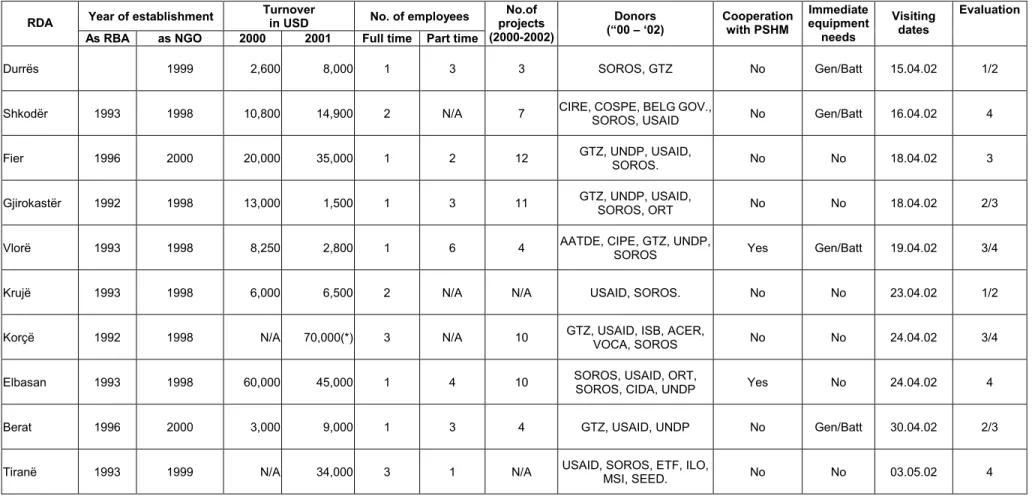
This report records the results of these visits. A table summarizing the results of the assessment is shown in Table 1. Brief trip reports on each of the RDA visits are included in the Annexes in Section 5.
RDAs were established as independent non-profit Foundations, during the period 1998-2000. Seven of them are successors of the Regional Business Agencies that were established back in 1992-93 under the EU-Phare Program. In 1993, the seven RDAs became responsible to the SME foundation, which was established in November of that year. The RDAs in Berat and Fier were established by the
UNDP/UNIDO in 1996. These are also the last agencies to join the SME Foundation. The RDA in Durrës was established by the GTZ in December 1999. The current RDA Coordination Center was established in 1999. Most of the RDAs offices are located close to the center of the cities. Generally, they have enough space but limited equipment and few employees. Each RDA has adopted its own fee structure, which depends mainly on market demand.
2. RDA
ACTIVITIES
RDAs have developed their own skills and experience across a variety of sectors and aim to share their expertise through designing and implementing projects, which encourage various stakeholders to work together on improving their living and working environment. RDAs work with local authorities, SMEs and NGOs to promote dialogue, good governance and to build the capacities needed to bring about real and sustainable development in their respective regions.
2.1 Past Activities
In the past RDAs have focused their activities in three main areas:
§ The building of democratic institutions and promotion of good governance.
§ The developing of civil society and strong advocacy;
2.2 Main Products And Services
The main services that the RDAs offer are as follows:
§ Consultancy
§ Feasibility studies
§ Investment and financial support
§ Training § Information § Legal services § Advocacy support § Business planning 2.3 Current Activities
Current efforts of RDAs are focused on the following activities:
§ SME development and economic development.
§ Cross Border cooperation (this activity involves mostly those RDAs that are located close to the Albanian border).
§ Democratic institutional building and good governance related to the economic development.
§ NGO support and development.
§ Investment.
§ Development and Civil Society advocacy.
3. DONOR
PROJECTS
RDAs are awarded projects through successful participation in bids either directly or through the National Coordination Center. However, revenues for specific RDAs are different. The RDAs Main Donors for the years 2000-2002 were:
§ GTZ, German Technical Cooperation;
§ USAID, United States Agency for International Development;
§ ISB, Institute of Contemporary Studies;
§ ACER, Albanian Center for Economical Research;
§ PAPA, Public Administration Project in Albania;
§ VOCA, Volunteers in Overseas Cooperative Assistance;
§ IFDC, International Fertilizer Development Center;
§ SNV, Netherlands Development Organization;
§ MSI, Management Systems International; and
ALBANIA SBCA QUARTERLY REPORT: MARCH – MAY 2002
13
change as we find out more about each RDA. However we have attempted to evaluate the RDAs on a scale of 1 to 5 as follows:
1. Serious problems, should consider alternative options including relocation and staff change.
2. Poor, but could survive with considerable technical assistance. 3. Satisfactory but needs technical assistance.
4. Good, but still would benefit from technical assistance 5. Very good, sustainable without technical assistance
The two RDAs, which need the most attention, are the ones in Durrës and Kruja, both of which were scored ½. The highest scores of (4) were given to Elbasan, Shkodër and Tirana.
The most urgent equipment needs are to help solve the electricity problem, through the acquisition of generators, batteries (inverters) at Berat, Durrës, Shkodër and Vlorë. Regular views of RDAs will be made as a result of future visits and contacts.
Table 1: SUMMARY RDA ASSESSMENT APRIL–MAY 2002 Year of establishment Turnover in USD No. of employees RDA
As RBA as NGO 2000 2001 Full time Part time
No.of projects (2000-2002) Donors (“00 – ‘02) Cooperation with PSHM Immediate equipment needs Visiting dates Evaluation
Durrës 1999 2,600 8,000 1 3 3 SOROS, GTZ No Gen/Batt 15.04.02 1/2
Shkodër 1993 1998 10,800 14,900 2 N/A 7 CIRE, COSPE, BELG GOV., SOROS, USAID No Gen/Batt 16.04.02 4
Fier 1996 2000 20,000 35,000 1 2 12 GTZ, UNDP, USAID, SOROS. No No 18.04.02 3
Gjirokastër 1992 1998 13,000 1,500 1 3 11 GTZ, UNDP, USAID, SOROS, ORT No No 18.04.02 2/3
Vlorë 1993 1998 8,250 2,800 1 6 4 AATDE, CIPE, GTZ, UNDP, SOROS Yes Gen/Batt 19.04.02 3/4
Krujë 1993 1998 6,000 6,500 2 N/A N/A USAID, SOROS. No No 23.04.02 1/2
Korçë 1992 1998 N/A 70,000(*) 3 N/A 10 GTZ, USAID, ISB, ACER, VOCA, SOROS No No 24.04.02 3/4
Elbasan 1993 1998 60,000 45,000 1 4 10 SOROS, USAID, ORT, SOROS, CIDA, UNDP Yes No 24.04.02 4
Berat 1996 2000 3,000 9,000 1 3 4 GTZ, USAID, UNDP No Gen/Batt 30.04.02 2/3
5. ANNEXES
5.1 Durrës Business and Economy Promotion Center (BEPC) – Trip Report Visiting date: 15 April, 2002
Personnel:
Andrea Xhavara, Executive Director Pjerin Kiri, marketing specialist (part time) Donika Benja, finance specialist (part time) Agim Carcani, computer specialist (part time)
Durres Business and Economy Promotion Center (BEPC), was established in December 1999 with the assistance of the GTZ (German Technical Cooperation). BEPC is a foundation, a legal entity and a private not-profit making organization. The Agency is registered and the agency’s legal framework has been developed by Ms. Xhavara.
The main activities of BEPC:
BEPC is specialized in trainings; preparation of business-plans, consulting services and it cooperates closely with different Institutions and Organizations.
Office spaces and equipment:
BEPC owns two small offices in separate locations. It owns two computers, one photocopier, one fax machine and one telephone. The office has also access to the Internet. Training courses are usually held in the Civil Society Development Center.
Current fee structure:
Fees for services depend on the nature of the service and market demand. Usually, they charge 20-USD/per training hour. The head of the BEPC mentioned the experience of Swiss Contact where 70% of the amount is paid by the Swiss Contact and 30% by the participant. According to his view, this is the best way to charge for the training sessions.
Turnover for the period 2000-2002:
The average turnover for the last two years is 2,600 USD. For the first half of 2002 the turnover is 8,000 USD.
The most promising sectors in the Region are:
Exports, manufacturing, trade and services are the most important sectors. While the competition among small business enterprises is high, large business have already monopolized the market.
Projects
BEPC is currently involved in a 4-month project funded by Soros Foundation that is targeted to women. The project is titled “Women in Business” and as the name suggests, it aims at involving women in business. This project has been expanded also into seven other RDAs. The other current project is the one financed by the ILO. The aim of the project is to get women involved in business. Training courses organized by them provide practical methods to organize and manage a business, increase profits and improve employee productivity. It is worth mentioning that during this time, BEPC has had a good cooperation with the GTZ and other German Institutions.
BEPC was involved in the implementation of a German credit line (lending up to 150,000 USD). The total amount of credit line is 19 million DM. The aim of this credit line was to help business start-ups. Lending was done through KfW (German Development Bank) and Italian-Albanian Bank. The project stopped due to a lack of cooperation between two Banks. Now FEFAD Bank is involved in implementation of the credit lines but it does deal with business start-ups.
Cooperation with the PSHM
BEPC has a good cooperation with the PSHM. BEPC clients that need credits are directed to PSHM and also the PSHM staff participates in the training events organized by the BEPC. BEPC has established good contacts with BESA Foundation, an organization that was initially established and co-funded by the EBRD and the SOROS Foundation to support small business enterprises.
BEPC aims to be transformed into a developed center of information and professional qualification from managers and SME employees.
Current Donors:
ALBANIA SBCA QUARTERLY REPORT: MARCH – MAY 2002
17
5.2 Shkodra Regional Development Agency – Trip Report Visiting date: 16 April 2002
Personnel:
Gjenarin Shantoja, Executive Director Antonina Shantoja, Finance Assistant Artela Poli, Computer Specialist (part time)
Shkodra RDA was established in January 1993. From 1993 to 1998 it was part of the SME Foundation. From 1998- it has operated as an independent NGO.
It specializes in training, the preparation of business-plans, marketing, finance, costing, computer courses and consulting services. It cooperates with other Institutions and Organizations.
RDA aims to be transformed into a developed center for information and consultancy in the region.
The main activities of the Agency are:
1. Market research,
2. Providing assistance in taxation field. 3. Providing assistance in loan applications. 4. Contributing to SME strategy development 5. Providing Social and economic surveys. Projects
1. RDA is currently involved in a 4-year Belgian project. The aim of the project is to repatriate Albanian emigrants by giving them a donation of around 3,000 USD each, which is used to start a business. This project is in cooperation with CIRE (Coordination of Initiatives for the Foreigners) in Brussels and Shkodra RDA. The project has been expanded in other regions such as Berat and Tirana; Shkodra RDA is responsible for the project. Until now they have 30 returnees, 7 out of 8 persons, who are located in Shkodra region, have opened successful businesses.
2. Another current project is the SOROS project for women. The project is “Women in business”, and aims to introduce women business life. This project has been expanded in 7 RDAs.
3. Another project where Shkodra RDA was also involved is the COSPE (Italian Cooperation for the Emergency Countries) project. The aim of the project was to teach basic ideas to women, on how to open a new business. They operate with 8 groups of women, 4 in each group. Those women were trained in different fields. Some of them have now their own businesses. In the initiation phase these women were granted 400.000 L, to start their business. The business plans were prepared by the RDA.
4. RDA was involved in the USAID project of World Vision. The aim of the project was to train people on how to start a business. They trained 12 people.
5. Financed by CARE program and in cooperation with Shkodra RDA, 32 NGOs got trained in the North- Albania, Kukës region.
6. RDA was involved in the training of “The Business Incubators” financed by the World Bank. They trained 10 people.
Cooperation with PSHM. There is a good cooperation between the two Agencies. RDA clients that need credits are directed to PSHM and also the PSHM staff participates in training organized by RDA.
Turnover for the period 2000-2002:
The turnover for the year 2000 was 10,800 USD and 14,900 USD for 2001. For the first half of 2002 the turnover will be 16 000 USD.
The most promising sectors in the Region are: Agro-business,
Food processing,
Medical and aromatic herbs, and Construction materials.
The level of competition is high in the construction materials, wood processing and alcoholic drinks sector.
Current fee structure:
Fees for services depend on the nature of the service and market demand. Usually, preparation of business plans account for the highest fees that range from 200,000 to 350,000 Lek.
Office space and equipment:
RDA owns two adjoining offices. One is used mainly for training purposes and the other as an office. It has three computers, one laptop, two photocopiers (damaged), and two fax machines.
Current Donors:
US Embassy, CIRE (Coordination of Initiatives for the Foreigners), SOROS Foundation, Care International, COSPE (Italian Cooperation for the Emergency Countries)
ALBANIA SBCA QUARTERLY REPORT: MARCH – MAY 2002
19
5.3 Fier Regional Development Agency – Trip Report Visiting date: 18 April 2002
Personnel:
Dhimitraq Marko, Executive Director
Tomas Merkuri, Chief of Development of the Fieri Municipality (volunteer) M. Gjika, Financier (part time)
The Fieri RDA was established in 1996 under the program “ Private Sector Development and Employment Opportunities Creation in Albania”, financed by UNDP. On 11 January 2000, the agency was registered as a Foundation and is now operating as an NGO. The aim of the Agency is to encourage social-economical development on the region, by coordinating the efforts of the Local and Central Governments and other relevant actors.
The RDA expanded its activity all over the Fier Municipality including: Patos, Mallakastër, Lushnjë, Roskovec and other regions.
Projects
1. Project on “Increasing Local Government Capacity to Prepare the Regional Economic Development Profile”. This project was financed by UNDP (2,000 USD) and implemented in cooperation with the RDA of Elbasan.
2. In cooperation with the Institution of Contemporary Studies (ICS), the agency has carried out 106 surveys and 3 focus group discussions in the rural areas of the region, about the projects implemented by the ADF (Albanian Development Fund). The total budget of this project was 1000 $.
3. Training on “Practical Problems Concerning the Public Balance Sheet”. The training was organized in cooperation with the Institutional Development Society and financed by GTZ. Total budget of the project was 5000 $.
4. Project on “Increasing Managerial Capacity of Local Business Through Training, In Order to Increase the Possibility of Applying for Micro-credit Lines”. This project was financed by OSFA (SOROS program) and with a total budget of 9000 USD. As part of this activity, 45 people were trained.
5. In cooperation with ICS, the agency implemented a survey involving 4200 telephone interviews about media network. The total budget of this project was 700 USD.
6. Project on “Rehabilitation of Elementary School, Zhupan Fier”. This project was implemented in cooperation with USAID (Mercy Corps International). Total budget of this project was 25,000 USD.
7. Project on “Reduction of Corruption in Albania During the Election Period”. This project was financed by USAID with a total budget of 2,700 $.
8. Project on “Strengthening Capacity and Sustainability of Albanian NGOs”. A five-month project that is funded by, and in cooperation with the Albanian National Training and Technical Assistance Resource Center (ANTTARC).
9. Project on “Increasing Skills Development Opportunities”. This project was implemented in cooperation with the Swiss Contact. The total budget of the project was 500 USD.
10. Project on “Extending of Organic Agriculture in Albanian Conditions and Increasing the Managerial Skills of Entrepreneurs in Agriculture”. During the project, 30 people were trained. The project was financed by SOROS program with a total amount of 7,800 $.
11. Development of a database in Microsoft Access and provision of training to CAFOD. The total budget of this project was 2000 USD.
12. Project on “Business Planning and Control”. This project was financed by the GTZ with a total budget of 1,000 USD.
Current fee structure:
According to GTZ fees, trainers are paid 60 DM per day + 60 DM per preparation day. Office space and equipment:
RDA owns one 29m² office, three computers, one photocopier, and one telephone and a fax machine.
Turnover for the period 2000-2002:
The average turnover for the year 2000 was 20,000 USD while in 2001 it was 35,000 USD. For the first half of 2002 the turnover is approximately 10,000 USD.
RDA aims to be transformed into a developed center of information and consultancy for the region, to be capable of providing technical assistance and carrying out feasibility studies. Current Donors:
UNIDO, UNDP, USAID, GTZ, SOROS Foundation, ANTTARC (Albanian National Training and Technical Assistance Resources Center).
ALBANIA SBCA QUARTERLY REPORT: MARCH – MAY 2002
21
5.4 Gjirokastra Regional Development Agency – Trip Report Visiting date: 18 April 2002
Personnel:
Hulusi Kokalari, Executive Director
Aurela Berberi, Finance Assistant (part time) Fredi Makri, Trainer (part time)
RDA of Gjirokastra is a consultative and training Institution. RDA was created as a non-profit organization (NGO). It has started its activity in early 1992. Its mission is to foster the SME economic development in the region providing business knowledge, high-level quality training and services to the business community. In 1998, the RDA was registered as a Foundation with the main objective of becoming a leading consulting and training center on business management and training public officers for development programs in southern region.
Gjirokastra RDA operates in five districts: Tepelena, Përmet, Gjirokastra, Delvina and Saranda. It covers all the South Albanian territory with a population up to 250,000 inhabitants.
The main activities and projects of the Agency include the following:
1. Development of a database for schools twining, between the schools in southern Albania and the schools in Western Europe. (Financed by PHARE-EU Program 1992)
2. Renovation of classrooms in the high schools of the region (Peace Corps volunteers, 1993).
3. Preparation of tourism development environment in Southern Albania. (Ministry of Tourism and GTZ)
4. Preparation of business plans for SME, during the period 1992-2000. (Ministry of Tourism and GTZ)
5. Market research of Southern Albania. (Ministry of Tourism and GTZ) 6. Computer courses. (Financed by GTZ)
7. Marketing, costing, motivation courses, business and taxation law. (Financed by GTZ) 8. Start –up your business, improve your business. (Financed by GTZ-ILO).
9. Business courses for NGO-s, “Women in Action”. (Financed by ORT /USAID) 10. Training courses for women. (Financed by SOROS)
11. During November-December 1999, RDAF in co-operation with ISB (Contemporary Study Institute) and ACER (Albanian Center of Economical Research), the agency has carried out the following studies:
- The study on the law on public servants (presented to the Parliament in December 1999)
- Estimation of the potential for urban micro-credits in southern regions.
- Study for the Balkan Stability Pact entitled: “The Free Market Initiative for the South-Eastern Europe”.
- Entrepreneurship and Business Management Training Opportunity for the Unemployment and Poor Women” in the region. This project was financed by the ORT/USAID in June-July 2000.
Turnover for the period 2000-2002:
The average of turnover for the year 2000 was 13,000 USD and for the year 2001, 1,500 USD. For the first half of 2002 the turnover is 8,685 USD.
The most promising sectors in the Region are as follows: 1. Mineral water and
2. Soft drinks industry, 3. Tourism,
4. Agro-business, 5. Food processing,
6. Medical and aromatic herbs.
The level of competition in the industry of water processing and soft drinks production is high.
Current fee structure:
One training course (10 to 12 persons): 2500 – 3000 USD. Business plans preparation: 2-3% of the investment cost. Consulting: 10 USD per hour
Training courses sponsored by SOROS Foundation: free. Training courses sponsored by UNDP: 95 $ /person/hour.
Training courses sponsored by GTZ: 30 DM (25 DM paid by GTZ and 5 DM charged to the client).
Total number of training courses conducted by the agency is 43 with a total number of 375 trainees.
Office spaces and equipment:
RDA owns one 26m² office, 8 computers, three inverters, one photocopier (damaged), and one fax machine. RDA aims to be transformed into a developed center of information and consultancy for the region. There is an idea to open a branch office in Saranda.
Current Donors:
ALBANIA SBCA QUARTERLY REPORT: MARCH – MAY 2002
23
5.5 Vlora Regional Development Agency – Trip Report
Visiting date: 3 May 2002
Personnel:
Ylldize Brahimi, Executive Director Evelina Sotirovski, Trainer (part time) Jani Sotiri, Market research expert (part time) Adnand Shakaj, Credit officer (part time) Ivana Mone, Accounting expert (part time) Nevila Kocollari, Consultant (part time) Anila Gjini, Program officer (part time)
Vlora RDA is a consultative and training Institution. It has started the activity in early 1992. Since 1998, Vlora RDA has been registered as a foundation and is now operating as an NGO. The aim of the Agency is to encourage social-economic development in the region.
The mission of the Agency is “to contribute as co-leader by working alongside the local business community, international donors, central and local authorities and NGOs, to improve the business climate and encourage economic development in the region through the implementation of join-effort coordination programs.
RDA aims to be transformed into a Regional Center of information and consultancy by providing technical assistance and conducting feasibility studies.
The main activities of the Agency are:
1. Providing assistance in technical standards. 2. Providing assistance in taxation field.
3. Providing assistance in marketing and finance. 4. Preparing business plans and feasibility studies. 5. Providing assistance in loan applications. 6. Providing assistance in economic policy. 7. Providing assistance in SME sector.
8. Providing assistance in Public Administration and Local Government.
9. Providing assistance in urban studies. 10. Prepare Social and economic survey. 11. Anti-corruption strategy.
12. Public advocacy. 13. NGO-s sector
14. Marketing surveys for SME.
15. Provisions of consultations and advice’s per client. 16. Provision of consultancy for existing SME.
Projects:
1. “Women in business”. This project is financed by SOROS program. 2. “Anti-Corruption ”, USAID project.
3. “Ethic Codes” project financed by AATDE- CIPE. Turnover for the years 2000-2002:
The estimated turnover for the year 2000 was 8,250 USD and for the year 2001 2,800 USD. The turnover for the first half of 2002 is 13,048 USD.
The most promising sectors in the region are:
1. Agro business 2. Tourism
3. Fishing and fish processing Current fee structure:
Preparation of business plans and feasibility studies. (1.2% of the investment capital) Technical assistance and procurement of machinery and equipment 5,000 Lek. Business accounting: 10,000 Lek
Preparation of legal documents: 5,000 Lek Business consultancy: 100 Lek/hour.
Assistance in organization and staging of local trade fairs: 1,500 Lek Business training: 100 Lek
Training courses on different application software: 200 Lek Office space and equipment:
RDA rents one office, 70 m² with three rooms, two computers, one photocopier, a telephone and a fax machine.
Current Donors:
ALBANIA SBCA QUARTERLY REPORT: MARCH – MAY 2002
25
5.6 Kruja Regional Development Agency – Trip Report Visiting date: 23 April 2002
Personnel:
Bashkim Dema, Executive Director Fisnik Hoxha, Deputy Director Jonida Karaj, Office Manager
Kruja RDA, was established in June 1993 under the EU-Phare Program. In 1998 the agency was registered as a Foundation and now operating as NGO. The aim of the Agency is to encourage social-economical development on the region.
Kruja RDA supports and assists the business community in the region. Its mission is to support the development of the SME sector.
The mission of the Agency is “to contribute as co-leader, working alongside the local business community, international donors, central and local authorities and NGOs, to improve the business climate and encourage economic development in the region through the implementation of join-effort coordination programs.
The main activities of the Agency are: 1. Consultancy
2. Feasibility studies
3. Investment and financial support 4. IT Training
5. Taxation services 6. Business plans
No list of projects provided
Turnover for the period 2000-2002:
The average turnover for the year 2000 was 6000 USD and in 2001, 6500 USD. Most promising sectors in the region are:
1. Agro business
2. Handicraft manufacturing Current fee structure:
Preparation of business plans and feasibility studies: (1.2 % of the investment capital). Technical assistance and procurement of machinery and equipment: 5000 Lek
Business accounting: 10,000 Lek
Preparation of legal documents: 5,000 Lek. Business consultancy 100 Lek/ hour. Courses in computer applications 200 Lek.
This fee structure is not always applicable. Office space and equipment:
RDA owns, one 60m² office, (two rooms), eight computers, one photocopier, a telephone and a fax machine.
Current Donors:
ALBANIA SBCA QUARTERLY REPORT: MARCH – MAY 2002
27
5.7 Korça Regional Development Agency – Trip Report Visiting date: 24 April 2002
Personnel:
Aurel Grabocka , Executive Director Maksim Sotiri, Director
Mirela Tako, Marketing manager Daniela Manosopi, Assistant They hire 15 part time experts.
Korça RDA foundation is an independent non-profit foundation established on April 1998. The main goal of the agency is to help SMEs and the local government to develop the region. The main activities of the Agency are:
1. Consultancy 2. Feasibility studies
3. Investment and financial support 4. Training 5. Information 6. Legal services 7. Advocacy support 8. Business plan Projects:
1. Feasibility study for the Transportation industry in Albania in cooperation with EUROCONSULTANTS, Greece 5000 Euro. Jan- May 2000.
2. Feasibility study for the garment industry in Albania in cooperation with EUROCONSULTANTS, Greece 4000 Euro. Jan- April 2000
3. Regional profile of Korça and Bitola (FYROM) in process of implementation. 4. 13000 USD. January – May 2001.
5. “Korça, Gateway to Albania”. Economic geographic, and cultural tourist guide for Korça. Financed by US Democracy Department of the US Embassy with a total budget of 16,000 USD. July 2000 – February 2001.
6. NGO Fair and Catalogue – financed by “Dorkas Aid” Albania. This catalogue is an information book on cooperation between the NGO-s. A round table and the fair organized with the participation of all the NGO-s. 7000 USD, August – September, 2001.
7. Consulting for “Dorkas AID” Albania, monitoring the projects set up by Dorkas. Total budget: 5,000 USD March-April 2002.
8. Guide to the Korça Region. Economic, geographic, cultural and tourist guide of the Korça region. Financed by regional council of Korça. Total budget 500,000 Lek (current project).
9. Consulting for HUMANET, the opening of a new office for micro-credits in Korça, branch of HUMANET Greece. Total budget: 7,800 Euro. March - June 2002.
Services provided:
1. Consulting for the City Hall of Korça: Feasibility study for the Industrial Area of Korça and the Rehabilitation of the Old Bazaar. April – September 1999.
2. Consulting for the local Government and the Prefecture on the Cross Border Cooperation programs.
3. “Business without Borders”. Cross Border Project with the Regional Council of Korça and the City Hall of Ohrid (FYROM). August 1999 – August 2000.
4. Six Business plans with the approved budget: 900,000 USD and 80 new work places created in 1999-2002.
5. Advocacy support for associations. Preparation of the legal framework for different agencies.
6. RDA is a partner and has subscribed to the coalition of the Albanian Civil Society in the fight against corruption.
Current fee structure:
Prices are set up according to the request and after a market research of RDA in order to follow the rates of all agencies. The price for the preparation of a business plans is 500,000 Leke + 2% from the requested amount.
This fee structure is not always applicable. Office space and equipment:
RDA owns, two 70m² offices, four computers, one photocopier, and one telephone and fax machine.
Turnover for the years 2000 – 2002:
The average turnover for the years 2000 – 2002 is, 70,000 USD, 32,800 Euro, 500,000 Lek Current Donors:
GTZ, USAID, ISB (Institute for Contemporary Studies), ACER (Albanian Center for Economical Research), PAPA (Public administration Project in Albania), VOCA (Volunteer oversees Cooperative assistance), IFDC, SNV, MSI (Management Systems International), SOROS Foundation.
4.1 Elbasan Regional Development Agency – Trip Report Visiting date: 24 April 2002
Personnel:
ALBANIA SBCA QUARTERLY REPORT: MARCH – MAY 2002
29
Elbasan RDA was established in 1993 under the EU-Phare program. On July 1998 the RDA was founded as a non-governmental, non-profit and non-political organization and now operates as a NGO.
The aim of Elbasan RDA is to contribute as co-leader, working alongside with the regional and local business community, NGOs, central and local government and international donors, to improve the business climate, strengthening the civil society and encouraging social-economic development in the region through the implementation of the joint effort coordination programs, and to act as a cross-sector resources center.
The main activities of the Agency are: 1. Business Counseling.
2. Professional Training 3. IT Training
4. International Procurement 5. Technical assistance
6. Capacity building in local and central government 7. Assistance in NGO sector
Office spaces and equipment:
Elbasan RDA owns a 100 m² office, 5 computers, 3 printers, 1 photocopier, 1 projector, 1 telephone, and a fax machine.
Current fee structure: To be defined.
160 USD fees – per training day? Turnover for years 2000-2002
2000 60,000 USD ? 2001 45,000 USD ?
The most promising sectors in region are: Construction industry Agro-business Wood-processing Wholesale Projects
During 1998 and 1999, the RDA received support from the GTZ, to conduct a series of training courses for potential and existing entrepreneurs. During August –September 1999, the agency cooperated with UNIDO on training of the local business centers’ staff in Berat and Fier, as trainers and business advisers.
In September 1999, the agency received funding as part of the NGO “Development and Sustainability Program”, a project financed by ORT, USAID.
From December 1999, until March 2000, the agency conducted a project entitled ‘Strengthening the Capacity of Regional and Local Government for Data Collection. Analysis and Information Management’. The project was financed by UNDP.
May 2001, the RDA was involved together with the Municipality of Elbansan in the project “Strengthening Capacities of Local Government in Organization and Functioning of Local Government”.
During the period June-August 2001, the agency conducted the project “Strengthening Capacities of Business Associations for Development and Sustainability and Business Management”.
Since November 2001, the agency is implementing two projects: (i) “Strengthening Capacities of the Social Economic Development Offices within the Seven Municipalities of the Elbasan Region and Regional Council of Elbasan”, which is supported by CIDA; and (ii) “Strengthening Capacities of Business Organizations, Local Government, Financial Institutions, University, Tax Offices and other Stakeholders within the region in Improving the Regional Business Climate”, which is financed by OSFA/Soros.
Current Donors:
ALBANIA SBCA QUARTERLY REPORT: MARCH – MAY 2002
31
5.8 Berati Regional Development Agency – Trip Report Visiting date: 30 April 2002
Personnel:
Qamile Gishti, Executive Director Anila Lundra, IT Consultant (part time).
Ilir Tare, Market Research Specialist (part time). Engjell Gishti, Social Works Specialist (part time).
Berati RDA was established in 1996 under the program “Private Sector Development and Employment Opportunities Creation in Albania”, that is financed by the UNDP. In March 2000, the RDA was registered as a Foundation and is now operating as an NGO. The aim of the Agency is to encourage social-economic development in the region, by coordinating the efforts of Local and Central Governments as well as other actors.
The main activities of the Agency are:
1. Providing technical assistance in local and regional projects.
2. Providing assistance in demographic movements of population (education, medical care, etc).
3. Providing research studies for local television channels. 4. Implementing of donor-funded projects.
5. Providing special support to the SME sector. 6. Providing assistance to credit applicants.
7. Presenting credit applicants to different banks. The agency has considerable experience in ‘micro-credit’ schemes.
During 1999, the agency has provided assistance to 170 successful clients while in 2000, to 237 clients.
The agency has had a good cooperation with GTZ in the following fields:
§ Conducting training courses on topics like “Start up your business”, “Women in Business”, “Protection of Women Status”, “Public Accounting”, etc.
§ Assistance in creating a unique data network to all entrepreneurs operating in Berat. § Providing technical assistance and preparing business plans for different clients. § Supporting private initiatives for unemployment reduction in rural areas.
§ Cooperating with Shkodra RDA on the project “Improve Your Business”. Number of people trained by the Agency in year 2000 was 30 while in 2001, over 150 persons. As a result, 34 new jobs were created.
The agency has constantly put efforts in improving the qualification and background of its staff. To this purpose, they have participated in different training courses and workshops. Turnover for the period 2000-2002:
The most promising sectors in the Region are:
1. Agro-business. In the agro-business the most important are olive and fig processing. 2. Tourism. In the tourism sector the most important activities are: ancient buildings
restoration and the handcraft industry.
Current fee structure:
Fees for services depend on the nature of the service and market demand. Usually, preparation of business plans account for the highest fees that range from 350,000 to 500,000 Lek.
Office spaces and equipment:
RDA owns, one 25 m² office, three computers, one photocopier, one telephone set and a fax machine.
RDA aims to be transformed into a developed center for information and consultancy for the region, in order to be capable of providing technical assistance and carrying out feasibility studies.
Current Donors:
GTZ (German Foundation for Development), UNDP (United Nations Development Program), UNIDO (United Nations Industrial Development Organization).
ALBANIA SBCA QUARTERLY REPORT: MARCH – MAY 2002
33
5.9 Tirana Regional Development Agency – Trip Report Visiting date: 3 May 2002
Personnel:
Ilir Rëmbeci, Executive Director Lauresha Grezda, consultant. Genta Çarçani, part time assistant.
Regional Development Agency of Tirana serves as the National Coordination Center (NCC) for the Regional Development Agencies (RDAs). It was established in December 1999. The association is a non-political, non-profit making organization, which represents the national network of RDAs. There are presently 10 RDAs. Based in the Tirana RDA office, the NCC works to support the common mission of the RDAs in Albania.
The National Co-ordination Center works closely with the Directory of Trade and Competition, within the Ministry of Economic Co-operation and Trade, on developing a national SME strategy paper for Albania. The RDAs have conducted research, brought together the business community and provided valuable feedback to central government on the needs and opinions of business people.
The main activities of the Agency are:
1. Market research,
2. Surveys and questionnaires,
3. Assisting in business financing for SME 4. Business associations promotion
5. Contributing to SME strategy development 6. Policy making.
Projects:
The main projects for 2001 were:
1. Social Services in Bathore Kamëz and the Promotion of Female Entrepreneurship financed by SOROS Foundation.
2. During the year 2001, 11 000 USD were earned by consultancy provided directly to business and NGO’s. This includes business plans, feasibility studies, cost analyses and IT training.
In the course of 1998-99, through the sponsorship offered by the GTZ project, the RDAs have trained over 2500 people throughout Albania. 60% of training has been conducted in the private sector and 40% in the public institutions. More than 240 business persons have had the opportunity to train overseas in co-operation with the RDA partnership organizations GTZ in Germany, ILO in Turin, Italy, EOMMEX in Athens, Greece.
Starting from September 2001 RDA network is implementing the project “Working for women’s entrepreneurship through training & skills development in Albania” financed by SOROS.
Turnover for the years 2000-2002:
Turnover for the year 2001 was 34 000 USD, and for the year 2002 was 50 000 USD.
The most promising SME projects that the RDA is currently working are:
1. A consulting company owned and financed by an American citizen (HR consulting) 2. An Albanian conglomerate (business planning for a new production line in food
processing)
3. Expectations to work with SEED as a subcontractor.
Current fee structure:
Fee for services depend on the nature of the service and on market demand.
Usually the highest prices come from the preparation of business plans. Charging for a business plans vary from 350.000 to 500.000 L.
Office spaces:
RDA owns, one office of 130 m2, eight computers, two printers, one photocopier, one overhead projector, one car, one telephone and one fax.
The most promising sectors they are working in are: - Food processing
- Services industry
- Agro-industry (green houses) - Wood- processing
The RDAs level of cooperation with PSHM is modest. They have oriented clients based on their needs, to different finance institutions. RDA has considerable experience with the BESA micro-credit foundation.
Current Donors.
ANNEX II
CLUSTERING WORKSHOP – PowerPoint Presentation
CH E M O N I C S
CH E M O N I C S
ALBANIA SMALL BUSINESS AND CREDIT ASSISTANCE PROGRAM
Clustering Workshop
Tirana 16 May 2002
CLUSTERS DEFINITION
Clusters:
Critical masses in one place of linked
industries and institutions – from
suppliers to universities to government
agencies – that enjoy unusual
competitive success in a particular field.
ALBANIA SBCA QUARTERLY REPORT: MARCH – MAY 2002
37
3
IDENTIFYING REGIONAL
INDUSTRIAL CLUSTERS
• Regional industrial clusters are groups of industries
that are independent, complementary or competitive and which can play crucial roles in shaping the health of a regional economy.
• By joining a cluster the individual firm generates
additional cluster growth, which increases the cluster’s attractiveness to other firms.
4
CLUSTER IDENTIFICATION
Cluster identification could be placed into one of two classes:
– Multivariate clustering algorithms (MVC) based clusters have stronger internal linkages between the industries within a given cluster.
– Principal components factor analysis (PCFA) clusters display stronger linkages with the larger economy (i.e. external to the cluster) than MVC.
Consensus clustering. The consensus clustering method is about the nature of inter industry relationships and identifying a region’s clusters.
5
CLUSTER ANALYSIS:
• is based on the recognition that individual businesses do not exist in isolation in a regional economy (Bergman et al., 1996).
• offers an expanded view of both the competitive characteristics of individual industries as well as that of the region as a whole.
• offers the possibility of integrating non-export as well as export-based industries into regional growth strategies1.
• offers guidance to policy makers in the identification of:
1. State or regional competitive advantage;
2. The resources necessary to support this advantage; and 3. The specific policy initiatives that can sustain that
advantage2.
1 - (Doeringer and Terkla, 1995) 2 - (Kaufman 1994)
THE ECONOMIC BASIS OF
CLUSTERS
A useful distinction to make in the context of
industrial cluster analysis is between
localization
and
urbanization
economies.
– Localization economies are the reductions in a firm’s
unit production costs that the firm realizes, e.g. the firm may gain access to a pool of trained labor thereby lowering its search costs.
– Urbanization economies represent the second type of
agglomeration economies. These arise from the concentration of general, rather than specific, economic activity. Here the productivity gains experienced by firms occur via the more general advantages of locating in an agglomeration of related industries.
ALBANIA SBCA QUARTERLY REPORT: MARCH – MAY 2002
39
7
HOW ARE CLUSTERS
DEFINED IN PRACTICE?
There are two sets of issues: whether clusters should be
based on a top-down versus a bottom-up view of industrial
specialization.
– Top-Down clusters are first identified at the national
level, and then the regional economy is examined to determine which national clusters are present in the
local region1.
– Bottom-Up approach is focused on what is currently in
the regional economy, but without an external reference/benchmark, the approach cannot provide insights as to what is not, but perhaps should be, in the regional economy.
1 - (Latham, 1976; Harrigan, 1982)
8
SPATIAL BOUNDARIES
Spatial boundariesrelates to the potential mismatch between the actual boundaries of the markets each cluster operates in and the jurisdictional boundaries.
In reality, the boundaries for a cluster may cross the boundaries of a single jurisdiction. This implies more than simply having an export orientation where the cluster’s market is mainly beyond the region’s border.
Although identifying the geographical nature of the cluster’s export market is important, another issue is to determine the boundaries over which the inter-industry cluster linkages operate.
9
EVALUATION OF CLUSTERS
An evaluation focuses on several different
characteristics of the cluster identification
methods. Attention is first directed at the
size
of the clusters, then the focus shifts to the
internal linkage
characteristics followed by
an analysis of external linkages between the
clusters defined by each method and the rest
of the economy.
CLUSTER EXAMPLE:
The ketchup cluster in Tirana
C O L L E C T O R S Processing and packaging company C O N S U M E R S Tomato producing farmers S A L E S M E N Transporters / Carriers
ALBANIA SBCA QUARTERLY REPORT: MARCH – MAY 2002
41
11
CLUSTER EXAMPLE:
The fish processing cluster in Lezha
C O L L E C T O R S Processing plant and packaging company CONSUMERS (Home & Export)
Fishermen Transporters / Carriers
12
THE COMPETITIVENESS
DIAMOND
Firm Strategy and Industry Structure
Firm Strategy and Industry Structure
Factors
Factors DemandDemand
Related and supported industries (Cluster) Related and supported industries (Cluster) Govt. Govt.
13
START WITH DEMAND: LEARN ABOUT
CONSUMERS AND MARKETS …
Strategy, Structure and Rivalry Strategy, Structure and Rivalry Factors Factors
• Direct contact with sophisticated and demanding consumers.
• Size and segmentation of local demand.
• Number of independent buyers. • The speed of growth.
• How fast the home market gets saturated.
• Internet savvy customers. • Mobile local buyers.
• Ability to monitor and respond to trends.
• Direct contact with sophisticated and demanding consumers.
• Size and segmentation of local demand.
• Number of independent buyers. • The speed of growth.
• How fast the home market gets saturated.
• Internet savvy customers. • Mobile local buyers.
• Ability to monitor and respond to trends.
The Cluster
The Cluster
Govt.
Govt.
Source:J. E. Austin Associates
BASIC
• Climate • Fertile land • Location proximity • Availability of basic inputs • Stable and healthy ecological
conditions • Labor force.
ADVANCED
• Knowledge resources. • Access to capital resources. • Infrastructure: availability of ports. • Research capability.
• Tele-density.
• Management and technology. BASIC
• Climate • Fertile land • Location proximity • Availability of basic inputs • Stable and healthy ecological
conditions • Labor force. ADVANCED
• Knowledge resources. • Access to capital resources. • Infrastructure: availability of ports. • Research capability.
• Tele-density.
• Management and technology.
… ALSO IMPROVE PRODUCTION
FACTORS …
Strategy, Structure and Rivalry Strategy, Structure and Rivalry Demand Demand The Cluster The Cluster Govt. Govt.ALBANIA SBCA QUARTERLY REPORT: MARCH – MAY 2002
43
15
• Company and strategies.
• The quality of sustained commitment of capital and resources.
• Industry cooperation. • The level of domestic rivalry. • Possibility of new business formation. • The nature of dialogue with labor. • Fairness of local competition. • Parastatals and monopolies. • Leadership characteristics. • Company and strategies.
• The quality of sustained commitment of capital and resources.
• Industry cooperation. • The level of domestic rivalry. • Possibility of new business formation. • The nature of dialogue with labor. • Fairness of local competition. • Parastatals and monopolies. • Leadership characteristics.
• Protection.
• Quality of firm level strategy. • Reactive vs. Proactive. • Hi-end vs. low-end. • Price vs. differentiation. • Distribution channels. • E-commerce.
• Number of competing firms.
• Commodities vs. specialized products. • Use cluster linkages.
• Protection.
• Quality of firm level strategy. • Reactive vs. Proactive. • Hi-end vs. low-end. • Price vs. differentiation. • Distribution channels. • E-commerce.
• Number of competing firms.
• Commodities vs. specialized products. • Use cluster linkages.
… THEN IMPROVE STRATEGY
Demand Demand The Cluster The Cluster Govt. Govt. Factors Factors
Source:J. E. Austin Associates
16
Albanian Fish Processing Diamond
Strategy
Factors Demand Cluster
+ Family of sardines growing in marine waters
+ Reasonable proximity to European markets
- Relatively high transport costs to European markets + Low-cost labor - Low harvesting capacity + Good basic skills +/- Seasonal production / seasonal imports
+/- Processing technology is up to date
+ Investment in supplier training + Investment in special equipment e.g. nets + Investment in worker training
B A S IC – L OW /M E D IU M A D V A NC ED – M EDI U M
+ High Quality products strategy + Identifiable wholesalers + Investment in producers and suppliers through contracts, training + Investment in equipment and training + Owner’s ability to identify market needs
+ Efficient scale of operations HIGH
- Fishing sector is inefficient - Local quality standards are not rigorous
+ EU standards are rigorous +/- Producers are capable of high quality
- Poor quality of local packaging and lack of local capacities for labeling.
+/- Cluster production improving slowly, links just beginning
LO
W
- Good internal and external demand, for quality fish
- Domestic market is limited + Large external market for quality products
DOMESTIC – LOW EXTERNAL – MEDIUM
17
CLIENT CLASSIFICATION
Standard Industry Classification (SIC) Codes
03 FISHING INDUSTRIES AND TRAPPING
INDUSTRIES
031 Fishing Industries
0311 Salt Water Fishing Industry 0312 Inland Fishing Industry 032 Services incidental to fishing industry 033 Trapping
CLIENT CLASSIFICATION
Standard Industry Classification (SIC) Codes
10 FOOD INDUSTRIES
101 Meat and poultry Products
1021 Fish Products 102 Fish Products
103 Fruits and Vegetables 104 Dairy Products
105 Flour, Prepared Cereal Food and Feed 106 Vegetable Oil Mills
107 Bakery Products
108 Sugar and sugar confectionary industry 109 Other Food Products Industries
1061 Vegetable Oil Mills 1071 Biscuits (cookies) 1072 Bread, etc.
ALBANIA SBCA QUARTERLY REPORT: MARCH – MAY 2002
45
ANNEX III
ALBANIA SMALL BUSINESS CREDIT AND ASSISTANCE PROGRAM
REVIEW OF
CLUSTER MODELS IDENTIFIED BY
REGIONAL DEVELOPMENT AGENCIES
ALBANIA SBCA QUARTERLY REPORT: MARCH – MAY 2002
47 Contents
1. REVIEW OF CLUSTER MODELS...48
1.1 Cluster model prepared by the Berati RDA...48
1.2 Cluster model prepared by the Durrësi RDA...48
1.3 Cluster model prepared by the Elbasani RDA...48
1.4 Cluster model prepared by the Fieri RDA ...48
1.5 Cluster model prepared by the Gjirokastra RDA...48
1.6 Cluster model prepared by the Shkodra RDA ...48
1.7 Cluster model prepared by the Tirana RDA ...49
1.8 Cluster model prepared by the Vlora RDA...49
1.9 Cluster model prepared by the Kruja RDA...49
2. CLUSTER DIAGRAMS ...50
2.1 Fig Processing Cluster Model...50
2.2 Wood Processing Cluster Model ...51
2.3 Fish Processing Cluster Model ...53
2.4 Medicinal Plants Processing and Spices Cluster Model ...54
2.5 Ornamental Plants and Fruit Tree Seedlings Cluster Model ...55
2.6 Bee Products Processing Cluster ...56
2.7 Alcoholic Products Processing Cluster...57
1.
REVIEW OF CLUSTER MODELS
1.1 Cluster model prepared by the Berati RDAThe identified clusters for the wine production and tomato processing are based upon the simple model presented at the clustering workshop. Further details are needed to properly identify the clustering process. As to the cluster model on the fig and olive oil processing, it does not make it clear whether or not the fig collecting company really exists. Is it a company or a company department? (See the revised cluster model below.)
1.2 Cluster model prepared by the Durrësi RDA
This model is not acceptable. Duralumin is an imported commodity. It comes in Albania as a ready-to-use material to build glass windows and doors. Therefore, it is not a production business and cannot be identified as a cluster. It also falls outside of the companies assisted by ASBiC Project. Durresi RDA needs to identify another cluster model.
1.3 Cluster model prepared by the Elbasani RDA
Elbasani RDA has identified a cluster model for wood processing. The cluster outline needs further improvement in order to make it easier to understand. (See the revised cluster model below.)
1.4 Cluster model prepared by the Fieri RDA
Fieri RDA has identified a cluster model for cut flowers, ornamental plants and fruit-tree seedlings. The second box “Consultant Experts” should be renamed “Marketing Specialists” and should be moved to the box “Farmers that produce flowers, ornamental plants and fruit tree seedlings”. “Transporters” are exporters also. (See the revised cluster model below.)
1.5 Cluster model prepared by the Gjirokastra RDA
Gjirokastra RDA has identified a cluster model for honey and other related products. This is one of the two best models presented and need no further adjustments at this point.
ALBANIA SBCA QUARTERLY REPORT: MARCH – MAY 2002
49
1.7 Cluster model prepared by the Tirana RDA
Tirana RDA has identified a cluster model for alcoholic drinks production. This model is the second of the two best models presented and need no adjustments.
1.8 Cluster model prepared by the Vlora RDA
Vlora RDA has identified a cluster model for fish processing. The following comments can be made with regard to this model: (1) the components of “Wholesalers” and “Export” should be placed under the “Processing and Packaging Company”. From the Wholesalers, processed fish is taken to retailers and then consumers. (See the revised cluster model below.)
1.9 Cluster model prepared by the Kruja RDA
Kruja RDA has identified a cluster model for Craft industry. The model is not consequent enough and does not follow the cluster model. Therefore, it needs to be better identified.
2. CLUSTER
DIAGRAMS
2.1 Fig Processing Cluster Model
Fig collectors Fig growers W H O L E S A L E R S
Local producers of jars, tins, caps, labels, etc.
Retailers of fresh fruits and vegetables
1.1 Processing factories
Canned marmalade, jam, etc. Dried figs.
Consumers
Local producers of plastic wrapping material, paper and cardboard, labels, etc.
Retailers of processed/canned foods (groceries)
Consumers
ALBANIA SBCA QUARTERLY REPORT: MARCH – MAY 2002
51
2.2 Wood Processing Cluster Model
Prepared by Elbasani RDA and ASBiC Project Office.
Export (Timber & Boules)
THE FOREST (Wood Logs) SAWMILLS (timber) Furniture Distribution of Sawdust and Wood Residues Retailers Construction companies Handicraft Doors and
Windows
Others (Paper producers, etc.)
ALBANIA SBCA QUARTERLY REPORT: MARCH – MAY 2002
53
2.3 Fish Processing Cluster Model
Prepared by Vlora RDA and ASBiC Project Office Packaging
Export
Quality control Processing
Fish P