Shoulder
Flexion/Extension
Supinenote. Pronate hand during Shoulder Extension to line up with Lateral Epicondyl (supination/pronation will not
affect extension)
Head of Humerus Bisect Rib Cage Bisect Humerus toward Lateral Epicondyl 0-180
Shoulder Abduction
Supine Acromeum Bisect Sternal Notch Bisect Humerus & Antecubital Fossa 0-180Shoulder
Internal/External
Rotation
Supine Need a towel; Palm Down Olecranon Process Perpendicular to Floor/Ceiling Bisect Ulna toward Ulnar Styloid 0-70
Elbow
Flexion/Hyperextension
Supinenote. No Overpressure on Extension;
towel under distal humerus; palm up Lateral Epicondyle Mid Humerus to Acromium Radiostyloid 0-140
Forearm
Supination/Pronation
Seated Elbow flexed 90 & Supported Lateral to Ulnar Styloid IN LINE/parrallel to HumerusRests on Dorsal Surface of Forearm, Proximal to
Styloid Process 0-80
Wrist
Flexion/Extension
SeatedElbow flexed 90 & Supported; During Flexion keep fingers straight &
Extension bent
Triquetrum = lateral bump on wrist (proximal to 5th metacarpal)
Lateral Border of Ulna; Ulnar Styloid and
Olecranon Lateral Border of 5th Metacarpal 0-75
Wrist Radial/Ulnar
Deviation
SeatedNeutral Wrist to Start; Overpressure = grap hand and go through motion only in
that plane (no flex/ext)
Capitate = divot off 3rd metacarpal Dorsal Midline of Forearm Midline of 3rd Metacarpal 0-35
MCP Joint 2-5 Flexion
Seated Through MCP Joint Metacarpal Proximal Phalanx 0-90MCP Joint 2- 5
Extension
Seated Through MCP Joint Metacarpal ?MCP Joint 2-5
Abduction
Seatednote. Middle Finger = Center, but do not acctually use this during
measurement
Through MCP Joint Metacarpal Proximal Phalanx 0-20
PIP Joint Flexion
Seated Stabilize Proximal Phalanx; Do notusually do extension. Through PIP Joint Proximal Phalanx Middle Phalanx 0-100
DIP Flexion
Seated Stabalize at Middle Phalanx Through DIP Joint Middle Phalanx Distal Phalanx 0-90DIP Extension
Seated Easier on Palmer Side 0 = only have hyperextensionL
a
b
1
L
a
b
2
Motion
Position
Stabilization
Axis of Rotation
Stationary Arm
Movable Arm
Normal Values
1st CMC Flexion*
SeatedSeated Elbow Flexed, Palm Up, Wrist & Elbow Supported; Requires MATH =
measure beginning angle & measure when they stop & subtract - - stops when you have to abduct to go further
CMC Joint Through Radius 1st Metacarpal 0-15
1st CMC Extension*
SeatedSeated Elbow Flexed, Palm Up, Wrist & Elbow Supported; Requires MATH =
measure beginning angle & measure when they stop & subtract
CMC Joint Through Radius 1st Metacarpal 0-20
1st CMC Abduction
Seated Seated with Wrist in Neutral RadioStyloid for Thumb 2nd Metacarpal 1st Metacarpal 0-70Opposition
Seated Finger Tips - to - Finger Tips; Pads - to- Pads1st MCP Joint Flexion
Seated Stabilize Metacarpal MCP ? ? 0-501st IP Flexion
Seated IP Joint Proximal Phalanx Distal Phalanx 0-80TMJ Opening
Short Sitting with Good Posture Stabilize back of neck to prevent patient from extending neckScreen Test: Fit 3 Knuckles in Mouth - -
35-50mm
TMJ Protrusion
Short Sitting with Good Posture Ruler flat, starting at top teeth 6-9 mmTMJ Lateral Deviation
Short Sitting with Good PostureRight deviation = mandible moving to the R (and vice versa);
account for starting position of teeth 10-12 mm
L
a
b
3
C-Spine Flexion
T&L spinesupported on back of chair
Stabilize to prevent flexion
of T&L spine External auditory meatus Perpendicular to the floor Align with base of the nose.
0-50 (can apply
overpressure)
C-spine Extension
Sitting, with T&L spine supported on back of chairStabilize to prevent flexion of T&L spine NO
OVERPRESSURE --> for flex/ext can use a tape measure
from chin to sternal notch
External auditory meatus Perpendicular or parallel to the
floor Align with base of the nose.
0-70
C-spine Sidebending
Sitting, with T&L spine supported on back of chair
Stabilize to prevent flexion of T&L spine. Bring patient's head
laterally toward the shoulder. Measure BOTH sides --> measure from mastoid process to acromion
Over the spinous process of the c7 vertebrae
With the spinous processes of the thoracic spine, so it is perpendicular to the ground
Bisecting the Back of the Head
Right & Left
0-45 (can apply
overpressure)
C-spine Rotation
Sitting, with T&L spine supported on back of chairStabilize to prevent flexion of T&L spine. Take pt's chin and rotate toward a shoulder (In horizontal plane). Measure BOTH
sides --> measure from chin to acromion
Over the center of the cranial aspect of the head
Parallel to an imaginary
line between the two
acromial processes
Align with the tip of the
nose
0-70 (can apply
overpressure)
L
a
b
6
Motion
Position
Stabilization
Axis of Rotation
Stationary Arm
Movable Arm
Normal Values
Trunk Flexion
Standing, with PT's foot inside patient's feet - - NO ShoesPatient bends to touch floor. Stop bending when patient
starts to anterior tilt.
Measure distance from tip of patient's middle digit to the
ground - Block pelvic tilt
N/A
Trunk Sidebending
Standing, with PT's foot inside patient's feet. Keep arms relaxed -- NO ShoesStop the test when pelvis begins to laterally tilt or when heel comes off floor.
Patient should bend as far to one side as possible. Measure distance from tip of patient's middle digit to the ground - Do
NOT let hand slide down thigh
N/A
Trunk Rotation
Seated with feet on floor. No back support -- NO ShoesStabilize pelvis to prevent rotation. Patient's arms
crossed on chest.
Over the center of the cranial aspect of the head
Parallel to an imaginary line between the two prominent tubercles on ASIS. Need to
palpate!
With an imaginary line between the two acromial processes.
0-60
Schober technique
(Flexion/Extension)
Standing, with PT's foot inside patient's feetMark a spot directlly inbetween PSIS. Mark another spot 15 cm above
1st mark
Patient bends forward without Ant. Tilt. Measure the distance
between the points.
For flexion- keep tape measure directly on skin. For extension, just measure the distance, not
necessary on the skin.
Flexion: Males = 6.7 cm Females = 5.8 cm Extension: 1.6 cm
Forward Bending
Standing
(PT foot
between pt)
N/A
C7-S1 Distance
(Flexion/Extension)
Standing, with spine in neutral positionStabilize the pelvis to prevent anterior tilting
*Use a pencil to mark C7 and S1. Align a tape measure between the
two processes and note the distance
Have patient bend forward (Flexion ROM). Record the
second distance.
The difference between the two distances is the amount of flexion
that is present.
N/A
Lumbar Distance
N/A
Thoracic Distance
**there should be significantly less thoracic
motion
L
a
b
8
Backward Bending
& Female 1.6 cmC7-S1 Distance
Lumbar Distance
Standing; Cervical - Thoracic - Lumbar Spine in 0-deg of lateral flex &rotation
Stabilize the pelvis to prevent posterior tilting (the end ROM occurs when the pelvis beings to
tilt post.) - use tape measure
Instructions: 1. Place a mark on the Right and Left PSIS - use a ruler to locate and mark a midline point on the sacrum at the level of the PSIS & make a mark 15cm above the mark on the sacrum.
2. Align the tape measure between the superior and inferior marks on the spine -
ask pt to bend backward as far as they can.
3. At the end ROM, note the distance between the superior and inferior marks. The ROM is the difference between 15cm and the length measure at the end of the
motion.
N/A
Motion
Position
Stabilization
Axis of Rotation
Stationary Arm
Movable Arm
Normal Values
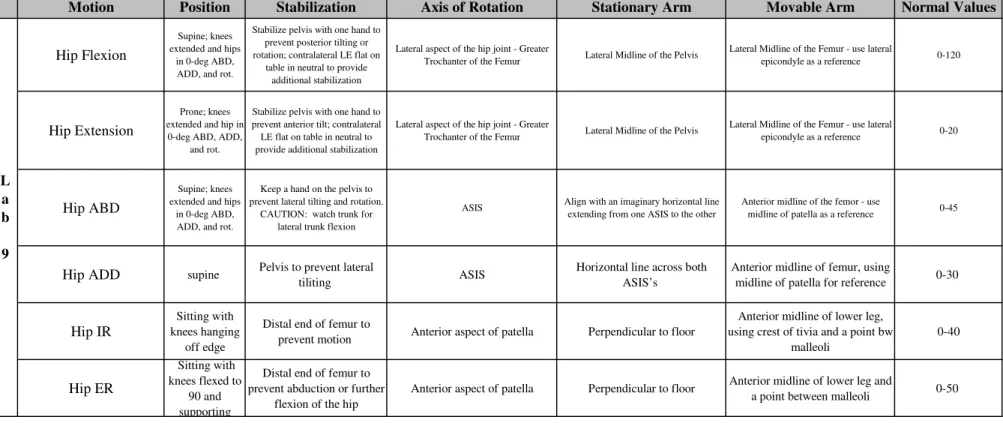
Hip Flexion
Supine; knees extended and hips
in 0-deg ABD, ADD, and rot.
Stabilize pelvis with one hand to prevent posterior tilting or rotation; contralateral LE flat on
table in neutral to provide additional stabilization
Lateral aspect of the hip joint - Greater
Trochanter of the Femur Lateral Midline of the Pelvis
Lateral Midline of the Femur - use lateral
epicondyle as a reference 0-120
Hip Extension
Prone; knees extended and hip in
0-deg ABD, ADD, and rot.
Stabilize pelvis with one hand to prevent anterior tilt; contralateral LE flat on table in neutral to provide additional stabilization
Lateral aspect of the hip joint - Greater
Trochanter of the Femur Lateral Midline of the Pelvis
Lateral Midline of the Femur - use lateral
epicondyle as a reference 0-20
Hip ABD
Supine; knees extended and hips
in 0-deg ABD, ADD, and rot.
Keep a hand on the pelvis to prevent lateral tilting and rotation.
CAUTION: watch trunk for lateral trunk flexion
ASIS Align with an imaginary horizontal line extending from one ASIS to the other
Anterior midline of the femor - use
midline of patella as a reference 0-45
Hip ADD
supine Pelvis to prevent lateraltiliting ASIS
Horizontal line across both ASIS’s
Anterior midline of femur, using
midline of patella for reference 0-30
Hip IR
Sitting with knees hanging
off edge
Distal end of femur to
prevent motion Anterior aspect of patella Perpendicular to floor
Anterior midline of lower leg, using crest of tivia and a point bw
malleoli 0-40
Hip ER
Sitting with knees flexed to 90 and supportingDistal end of femur to prevent abduction or further
flexion of the hip
Anterior aspect of patella Perpendicular to floor Anterior midline of lower leg and
a point between malleoli 0-50
L
a
b
9
Knee Flexion
Supine abduction and adduction of hipLateral epicondyle of femur of femur, in line with greater trochanter
lateral malleolus and fibular head as reference
0-150
Knee Hyperextension
Ankle Dorsiflex with
Knee Flexed
Sitting with knee flexed to 90 and neutral
foot
Stabilize the tibia and fibula to prevent knee motion and
hip rotation
Lateral aspect of lateral malleolus Lateral midline of fibula Parallel to lateral aspect of 5
th
metatarsal 0-12
Ankle Dorsiflex with
Knee Extended
Ankle Plantarflexion
Sitting with knee flexed to
90
Tibia and fibula to prevent knee flexion and hip
rotation
Lateral aspect of lateral malleolus Lateral midline of fibula Lateral aspect of 5th metatarsal 0-50
Tarsal Joint Inversion
2nd Metatarsal
Sitting with knee flexed to
90 and leg supported
Tibia and fibula to prevent medial rotation and
extension of knee
Anterior aspect of ankle between malleoli
Anterior midline of lower leg, using tibial tuberosity for
reference
Anterior midline of 2nd metatarsal
0-Tarsal Joint Inversion
Metatarsal Head Plane
Sitting with knee flexed to
90 and leg supported
Stabilize the heel to prevent dorsiflexion of ankle/inversion of subtalar
join
Lateral aspect of 5th metatarsal head
parallel to anterior midline of lower leg
Plantar aspect of 1-5 metatarsal
heads 0-37
L
a
b
1
0
Motion
Position
Stabilization
Axis of Rotation
Stationary Arm
Movable Arm
Normal Values
Tarsal Joint Eversion
2nd Metatarsal
Sitting with knee flexed to
90 and leg supported
Tibia and fibula to prevent lateral rotation and
adduction of hip
Anterior aspect of ankle midway between malleoli
Anterior midline of lower leg, using tibial tuberosity for
reference
Anterior midline of 2nd
metatarsal
0-Tarsal Joint Eversion
Metatarsal Head Plane
Sitting with knee flexed to
90 and leg supported
Calcaneus and Talus to prevent plantarflexion and eversion of
subtalar joint
Medial aspect of 1st metatarsal head
Parallel to the anterior midline of the lower leg
Plantar aspect from the 1st to 5th
metatarsal heads 0-15
Subtalar Eversion
Prone, foot hanging off the end of the
table
Tibia and fibula Posterior aspect of andle midway between
malleoli Posterior midline of the lower leg Posterior midline of the calcaneus 0-5
Subtalar Inversion
Prone, foot hanging off the end of the
table
Tibia and fibula Posterior aspect of andle midway between
malleoli Posterior midline of the lower leg Posterior midline of the calcaneus 0-5
1st MTP Joint Flexion
Supine or sitting with knee fleced to
90
metatarsals Dorsal aspect of the MTP joint Dorsal midline of the metatarsal Dorsal midline of the proximal phalinx 0-30
1st MTP Joint
Extension
Supine or sitting with knee fleced to
90
metatarsals Dorsal aspect of the MTP joint Dorsal midline of the metatarsal Dorsal midline of the proximal phalinx 0-50
Hallux Valgus
Leg Length
L
a
b
1
1