An IoT-Oriented Data Placement Method with Privacy
Preservation in Cloud Environment
Xiaolong Xua,b,c, Shucun Fua,b, Lianyong Qid,∗, Xuyun Zhange, Qingxiang Liua,b, Qiang Hef, Shancang Lig
aSchool of Computer and Software, Nanjing University of Information Science and
Technology, Nanjing, China
bJiangsu Engineering Center of Network Monitoring, Nanjing University of Information
Science and Technology, Nanjing, China
cState Key Laboratory for Novel Software Technology, Nanjing University, Nanjing, China dSchool of Information Science and Engineering, Qufu Normal University, China eDepartment of Electrical and Computer Engineering, University of Auckland, New
Zealand
fFaculty of Information and Communication Technologies, Swinburne University of
Technology
gComputer Science and Creative Technologies Department, University of the West of
England
Abstract
IoT (Internet of Things) devices generate huge amount of data which require
rich resources for data storage and processing. Cloud computing is one of the most popular paradigms to accommodate such IoT data. However, the privacy
conflicts combined in the IoT data makes the data placement problem more
complicated, and the resource manager needs to take into account the resource
efficiency, the power consumption of cloud data centers, and the data access
time for the IoT applications while allocating the resources for the IoT data.
In view of this challenge, an IoT-oriented Data Placement method with privacy
preservation, named IDP, is designed in this paper. Technically, the resource
utilization, energy consumption and data access time in the cloud data
cen-ter with the fat-tree topology are analyzed first. Then a corresponding data
placement method, based on the Non-dominated Sorting Genetic Algorithm II
∗Corresponding author
Email addresses: [email protected](Xiaolong Xu),[email protected](Shucun Fu),
[email protected](Lianyong Qi),[email protected](Xuyun Zhang),
[email protected](Qingxiang Liu),[email protected](Qiang He),
(NSGA-II), is designed to achieve high resource usage, energy saving and
effi-cient data access, and meanwhile realize privacy preservation of the IoT data.
Finally, extensive experimental evaluations validate the efficiency and effective-ness of our proposed method.
Keywords: IoT, data placement, privacy, energy consumption, cloud
1. Introduction
Nowadays, Internet of Things (IoT) has been used in many areas including
transportation, nursing, monitoring, etc., where smart devices equipped with
sensors are connected together via the Internet to efficiently collect data from physical environment [1] [2] [3]. IoT devices produce large amount of real-time
5
data, which is stored for analysis and processing to guarantee the service
re-quirements of IOT applications [4]. However, due to the storage limitation of
IoT devices, IoT data requires being placed on the remote data centers for
fur-ther processing. Generally, data placement is divided into random placement
and planned placement. In random placement, the sensors are scattered
ran-10
domly, otherwise the sensors are deployed selectively for certain objectives in
planned placement [5].
Cloud computing provides elastic and on-demand resources for IoT-oriented
data placement. Compared to the IoT devices, cloud data centers (CDCs) have much more physical resources including storage resources, computing resources
15
and communication resources [6] [7] [8]. Deploying IoT data on CDCs alleviates
resource limitation of the IoT devices in a great deal. When allocating the cloud
resources to accommodate IoT data, the resources are provided in the form of
virtual machines (VMs). The resource managers monitor current cloud resource
usage and map the VMs to physical hosts [9]. From the perspective of resource
20
management, the resource utilization needs to be taken into consideration to
avoid the overload or underload of CDCs.
However, with the cloud computing widespread used to support the IoT
the energy consumption of CDCs greatly increased. Moreover, the expenditure
25
of electricity in CDCs has a serious impact on the emission of carbon
diox-ide which plays an important part in ecological balance. Therefore, to reduce carbon emission and realize sustainable development of cloud computing, it is
of great importance to layout the IoT data on the cloud in an energy-efficient
manner.
30
On the other hand, the collected IoT data stored on the cloud is in need
of security [10] [11] [12]. If the IoT data contains private information such as
healthcare, finance, etc., when placing the data with privacy conflicts combined
on the same CDC, the data owners’ privacy is easy to be invaded [13] [14] [15].
Data encryption is the straightforward way to deal with it, but it may cost
35
much more time and energy without a legitimate placement method [16] [17].
Hence, it is necessary to satisfy the privacy constraints for IoT-oriented data placement.
Energy-efficient network architecture has been investigated for IoT
appli-cations [18], but it neglects the resource utilization of CDCs, access time and
40
privacy for IoT data placement. With the observation above, it is still a
chal-lenge to realize IoT data placement to optimize the resource utilization, energy
consumption and access time, while satisfying the privacy constraints. In view
of this challenge, an IoT-oriented data placement method with privacy
preser-vation in cloud environment is proposed this paper.
45
The main contributions of this paper include the following:
(1) Analyze the resource utilization, energy consumption and access time of CDCs and build a corresponding systematic model while satisfying the privacy
constraints of IoT data.
(2) Employ Non-dominated Sorting Genetic Algorithm II (NSGA-II) to
im-50
prove the average resource utilization of CDCs and reduce the energy
consump-tion of CDCs while considering the privacy preservaconsump-tion in cloud environment.
(3) Conduct adequate experimental evaluation and comparison analysis to
validate the efficiency and effectiveness of our proposed method.
The rest of this paper is organized as follows. In Section 2, formalized
concepts, a systematic model of privacy in data placement, resource utilization,
energy consumption and access time of CDCs is presented. Section 3 elaborates
the proposed data placement method. Section 4 illustrates the comparison analysis and performance evaluation. Section 5 summarizes the related work,
and Section 6 concludes the paper and presents the future work.
60
2. Preliminary Knowledge
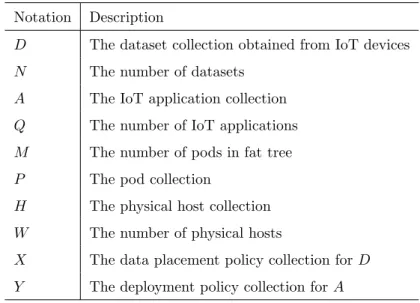
Table 1: Key Notations and Descriptions
Notation Description
D The dataset collection obtained from IoT devices
N The number of datasets
A The IoT application collection
Q The number of IoT applications
M The number of pods in fat tree
P The pod collection
H The physical host collection
W The number of physical hosts
X The data placement policy collection forD
Y The deployment policy collection forA
In this section, we present a system model that closely approximates the
storage environment for the datasets collected from the IoT devices in fat-tree
constructed CDC. Some key notations and descriptions used in the paper are
listed in Table 1.
65
2.1. System Model
We focus on the IoT-oriented data placement in the cloud environment that
is a cloud platform providing elastic resources for storing the datasets from the
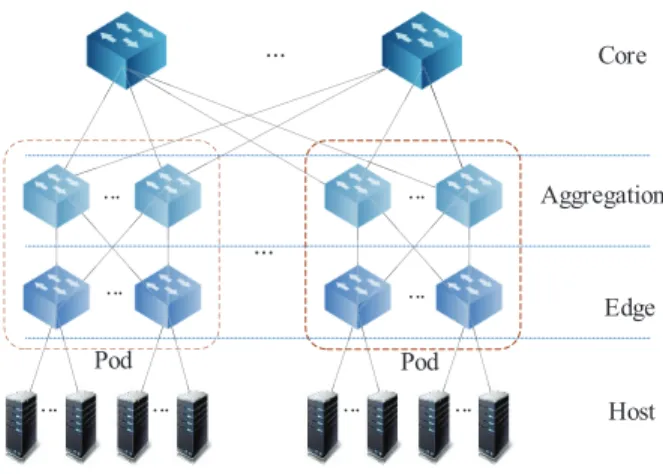
... ... ... ... ... ... ... ... ... ... Pod Pod Core Aggregation Edge Host
Figure 1: Fat-tree topology in CDCs.
as D = {d1, d2, . . . , dN}, that need to be deployed in the CDC. And there 70
areQ IoT applications, denoted as A= {a1, a2, . . . , aQ}, running in the data
center which requires multiple datasets from D for processing support. The
CDC employs the fat-tree topology to organize the physical hosts and switches, as illustrated in Fig. 1. Through fat-tree topology, the CDC achieves timely
processing of loads, avoids network hotspots by multiple links at the core layer,
75
and eliminates overload by reasonably diverting traffic within pods.
In the fat-tree topology, the switches are classified as three layers, including
the core, aggregation and the edge. The switches in the aggregation and edge
layer are divided to several pods, denoted asP = {p1, p2, . . . , pM}. According
to the rules of fat-tree topology, the number of the aggregation switches is
80
equal to the number of the edge switches in each pod, and they are both set
to M22. Besides, the number of core switches is set to M2, and the number of ports of each switch is set to M2. The physical hosts are connected to the edge servers and suppose the CDC consists of W physical hosts, denoted as
H= {h1, h2, . . . , hW}.
85
Let X = {x1, x2, . . . , xN} be the placement policy for the datasets in D, where xn ∈ H(n={1,2, . . . , N}) is the host which the dataset dn is placed on. Let Y ={y1, y2, . . . , yQ} be the deployment policy for the application set
A, where yq ∈ H(q={1,2, . . . , Q}) is the host which the application aq is deployed on.
90
2.2. Resource Utilization Model
In the CDC, the applications and datasets are hosted by VMs. In a cloud
platform, there are multiple VM instances created for resource provisioning.
The resource requirements of the datasets and the capacity of the hosts both could be quantified by the number of VM instances. Letcw be the capacity of
95
thew-th hosthwandλn be the requirements of the datasetdn.
The resource utilization is a key metric for the resource managers to manage
the CDCs. According to the data placement policy inX, the resource
utiliza-tion of each host could be detected by detecting the resource usage of the VM
instances. Letuw(X) be the resource utilization withX, which is calculated by
uw(X) = 1 cw N X n=1 θn·In,w(X), (1)
where θn is the requested amount of VM instances for dn, and f =In,w is a
binary variable to judge whetherdn is placed on hw, which is measured by
In,w(X) = 1, if w=xn, 0, Otherwise. (2)
Then the overall resource utilization of the CDC refers to the resource usage
status of all the occupied hosts. The amount of occupied hosts, denoted as
λ(X), is calculated by λ(X) = W X w=1 Fw(X), (3)
whereFw(X) is a binary flag to judge whetherhwis occupied which is calculated
by lq,n= 1,if aq needs to accessdn, 0,Otherwise (4)
Then the average resource utilization of the CDC is calculated by
U(X) = 1 λ(X) W X w=1 uw(X). (5)
2.3. Data Access Model
The IoT applications need to access and analyze the stored IoT data deployed
in the cloud platforms. Generally, the IoT applications are also deployed in the
cloud, thus while considering data placement for the IoT datasets, the access
100
time for the IoT applications to obtain the datasets should be taken into account.
Letlq,nbe the flag to judge whetheraq needs to accessdn, which is measured
by lq,n= 1,if aq needs to accessdn, 0,Otherwise, (6)
wherelq,n= 1 meansaq needs to accessdn, while lm,n= 0 meansaq need not
to accessdn.
Denote gq,n as the access frequency for aq to get dn during the execution
period, and then the total access time in this period is calculated by
K= Q X q=1 N X n=1 lq,n·gq,n. (7)
In the fat-tree topology, the access time of the datasets for the IoT appli-cations is closely relevant to the distributed loappli-cations among the datasets and
the IoT applications. Let ES(h) be the edge switch which a physical host h
connect to. LetP od(h) be the pod whereES(h) locates. The data access time
in the fat tree could be classified as four conditions: 1) the applicationaq and
the dataset dn are deployed in the same host, i.e., xn =yq. 2) the hosts for
accommodatingaq anddnare different and they both connect to the same edge
switch, i.e.,xn 6=yq, andES(xn) =ES(yq). 3) the hosts for accommodatingaq anddn are connected to different edge switches, but they are in the same pod,
i.e.,ES(xn) 6=ES(yq). andP(xn) =P(yq). 4) the hosts for accommodating aq and dn are not in the same pod, i.e., P od(xn) 6= P od(yq). Based on the above analysis and the fat-tree topology, the data access timetq ,n(X) foraq to
accessdn is calculated as tq,n(X) = 0,if xn=yq, 2ρn
bSE ·lq,n,if xn6=yq, ES(xn) =ES(yq),
(2ρn
bSE + 2
ρn
bEA)·lq,n,if ES(xn)6=ES(yq), P(xn) =P(yq),
(2ρn bSE + 2 ρn bEA+ 2 ρn bAC)·lq,n,if P(xn)6=P(yq), (8)
whereρn is the data size ofdn, bSE is the bandwidth between hosts and edge
switches,bEAis the bandwidth between edge switches and aggregation switches,
105
andbAC be the bandwidth between aggregation switches and core switches.
Then the average data access timeT(X) can be calculated by
T(X) = 1 K N X n=1 Q X q=1 tq,n(X)·gq,n. (9)
2.4. Energy Consumption Model
In this paper, we mainly focus on the energy consumption for data placement
and access generated by the physical hosts, the VMs and the switches.
All the running hosts consume the baseline energy during the tracked
execu-tion periodRin the CDC. Such baseline energy consumption forH is denoted
asBEHost, calculated by BEHost(X) = W X w=1 R·αw·Fw(X), (10)
whereαw is the baseline energy consumption rate ofhw.
110
The running VMs also consumes energy consumption, denoted as AEV M
which is calculated by AEV M(X) = W X w=1 N X n=1 θn·In,w(X)·R·η, (11) whereη is the power rate for the running VM instances.
The energy consumption produced by the unused resource units, i.e., VM
instances, also generate a certain amount of energy consumption, which is
cal-culated by SEV M(X) = W X w=1 (cw− N X n=1 θn·In,w(X))·R·τ. (12)
Then the total energy consumption for all the VM instances in the CDC is
calculated by
EV M =SEV M(X) +AEV M(X). (13)
In fat-tree topology, the total amount of switches in the topology is 5 4M
2
and from the access time model, the number of switches each dataset passes
while invoking the IoT data from the cloud could be detected. The number of
switches foraq accessingdn is calculated by
δq,n(X) = 0,if xn=yq, 1,if xn6=yq, ES(xn) =ES(yq), 3,if ES(xn)6=ES(yq), P(xn) =P(yq), 5,if P(xn)6=P(yq).
(14)
In this way, the energy consumption produced by switches, denoted as
Eswitch, is calculated by Eswitch= 5 4k 2·R·β+ Q X q=1 N X n=1 lq,n·gq,n(X)·tq,n(X)·δq,n(X)·γ, (15)
where β is the baseline power rate for each switch and γ is the power rate of
each port.
Hence, the total energy consumption, denoted asE(X), is calculated by
E(X) =BEHost+EV E+ESwitch. (16)
2.5. Data privacy Model
There are several attributes in each IoT dataset. And some attributes of
115
different datasets have privacy conflicts as once these attributes are stored in
the same physical host, the combined privacy in these datasets will be leaked
with meaningful probability.
We model the privacy conflicts of the datasets by a graph G = (D, E),
where D is the set of datasets,E represents the conflicting relations between
120
two datasets inDand (dn, dn0)∈Erepresents there is a privacy conflict between dn anddn0.
Then the conflicting datasets ofdn is obtained by
cdn={dn0|(dn, dn0)∈E, n0={1,2, ..., N}}. (17)
In this paper, to realize privacy preservation for the IoT datasets in cloud,
the privacy-conflict datasets inCDncould not be deployed withdn in the same
host. For thus we can obtain the conflicting location set ofxn, which is measured
by
cln={xj|xj∈cdn, j={1,2, ...,|cdn|}}. (18) 2.6. Problem Definition
In this paper, we focus on the data placement problem for IoT datasets in
cloud environment, with fixed deployment policy for the IoT applications, to
125
improve the resource utilization, reduce energy consumption and optimize the
data access time while taking into account the data privacy constraints.
Then, the formalized problem is be defined as:
maxU(X), minT(X), minE(X). (19)
s. t. xn ={1,2, ..., W}, (20) N X n=1 θn·fn,w≤cw, (21) xn ∈/ cln. (22)
3. An IoT-Oriented Data Placement Method with Privacy Preserva-tion
An IoT-oriented data placement method with privacy preservation is
pro-130
posed in this section. NSGA-II can find the global optimal solution in the
feasible solution quickly and accurately compared with the traditional genetic
algorithm. Thus, NSGA-II is adopted to solve the multi-objective
optimiza-tion problem in this paper. First, the placement strategies for IoT datasets are
encoded and fitness functions are given for the optimization problem. Second,
thefast non-dominated sorting approach and thecrowded-comparisonoperation
are used in selection. Then, thecrossover and mutation operation of traditional
genetic algorithm (GA) are adopted. Finally, the overview of our method is described in detail.
3.1. Encoding
140
In the GA, the gene represents the value of each decision variable. In this
paper, a gene reflects the data placement strategy for a IoT dataset. A group
of genes make up a chromosome which denotes a set of placement strategies of
IoT datasets collection D. There are various methods to encode genes in
ge-netic algorithms, including binary encoding, Gray code encoding, real encoding,
145
integer encoding, etc. We need to adaptively select different encoding methods according to the actual situation in different application scenarios. In this
pa-per, as the strategy of data placement for each IoT dataset is an integer, the
integer coding method is used and data placement strategies for IoT datasets
are numbered as 0,1,2, . . . ,etc.
150 ... .. .. .. .. .. .. .. .. .. .. .. .. .. .. .. .. ............. 0 1 2 3 w ... W 0 3 W ... 1 x1 x2 x3 ... xN ...
Compute-optimized host Storage-optimized host
Figure 2: An encoding example of data placement for datasets.
As IoT applications need to access the placed IoT datasets in CDCs, two
types of VM instances which are the computation-intensive optimized VM
in-stances and the storage-optimized VM inin-stances are employed in this paper. The
datasets can only be placed on storage-optimized VM instances. Fig. 2 shows an
example of data placement for IoT datasets. In Fig. 2, the blue shaded hosts
rep-155
resent computation-intensive optimized VM instances and the unshaded hosts
in computation-intensive optimized VM instances, and the IoT datasets have
been chosen to be placed in those storage-optimized VM instances according to
the encoding result of placement strategies.
160
3.2. Fitness Functions
The fitness function is a criterion for judging the merits of solutions in GA,
each individual represents a solution of problems and all solutions form the
sets called population. The fitness functions in this paper are given by Eq.(5), Eq.(9) and Eq.(16) which represent the average resources utilization, the average
165
access time and the energy consumption. These fitness functions are indicators
to measure the performance of CDCs.
The average resource utilization of hosts used is a fitness function which is
calculated according to the coding result of data placement strategies for IoT
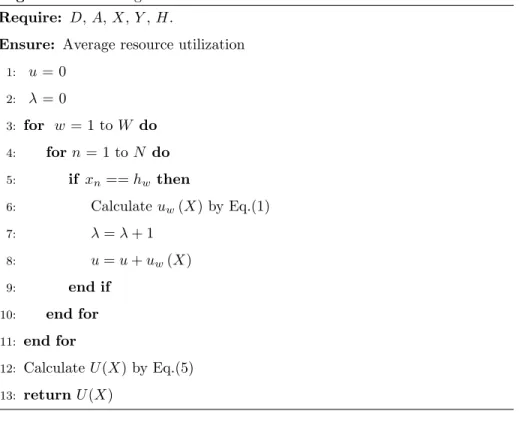
datasets. Algorithm 1 specifies the process of calculating the average resources
170
utilization of hosts used. In this algorithm, the inputs are IoT datasets
collec-tionD, IoT applications collection A, and the coding result of data placement
strategies. We first calculate the resource utilization of each host used according
to the input data placement strategy (Lines 3 to 6), then the average resource utilization of employed hosts is obtained (Line 12).
175
The average access time of IoT applications is another fitness function which
is calculated according to the coding result of data placement strategies for IoT
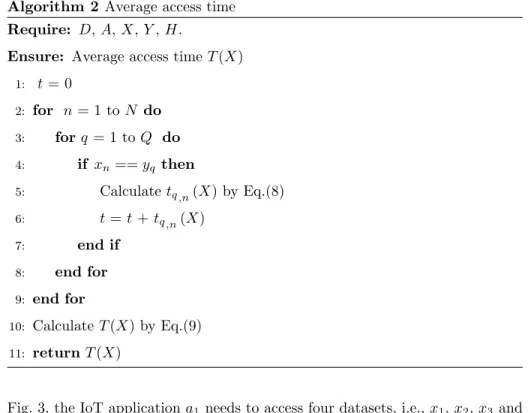
datasets and fat-tree topology of the CDC. Algorithm 2 specifies the process of
calculating the average data access time of IoT applications. In this algorithm,
a fat-tree network topology is employed to construct the cloud data center
ar-180
chitecture. IoT applications and datasets share the same type of switch based
on the assigned host seats. The access time of each application is calculated
(Lines 2 to 5), then we get the average data access time (Line 10).
The energy consumption is the last fitness function. This function is cal-culated according to the coding result of data placement strategies for IoT
185
datasets, as well as the number of hosts and switches employed. Algorithm 3
Algorithm 1Average resources utilization Require: D,A,X,Y,H.
Ensure: Average resource utilization
1: u= 0 2: λ= 0 3: for w= 1 toW do 4: forn= 1 to N do 5: if xn==hw then 6: Calculate uw(X) by Eq.(1) 7: λ=λ+ 1 8: u=u+uw(X) 9: end if 10: end for 11: end for 12: CalculateU(X) by Eq.(5) 13: returnU(X)
the total energy consumption includes the basic energy consumption of hosts,
the energy consumption of the working VMs, and the energy consumption of
switches. We first calculate the basic energy consumption of hosts according
190
to the coding result of data placement strategies (Lines 1 to 8). Secondly, the
energy consumption of the working VMs according to the resource requirements of IoT datasets is calculated, then calculate the energy consumption of switches
(Lines 9 to 14). Finally, the total energy consumption is obtained (Line 15).
The constraints in this paper are considering the capacity of each host and
195
privacy constraints between IoT datasets. The constraints are given in Eq.(20),
Eq.(21) and Eq.(22). Different datasets with privacy conflicts are stored in
the same physical host will be leaked with meaningful probability. Thus, the
selected strategies must be required to satisfy the privacy constraints. IoT
datasets should be placed separately if they are privacy conflicted.
200
Algorithm 2Average access time Require: D,A,X,Y,H.
Ensure: Average access timeT(X)
1: t= 0 2: for n= 1 toN do 3: forq = 1 toQ do 4: if xn==yq then 5: Calculate tq ,n(X) by Eq.(8) 6: t =t +tq ,n(X) 7: end if 8: end for 9: end for 10: CalculateT(X) by Eq.(9) 11: returnT(X)
Fig. 3, the IoT applicationa1 needs to access four datasets, i.e.,x1,x2,x3and
x4. The IoT applicationa1is placed on the hosth4and IoT datasetsx1,x2and
x3 are placed on the hostsh1,h2 andh3, respectively. Suppose x4 has privacy
conflicts withx1, x2 and x3, and consequently x4 must be placed on the host 205
h5 to meet the privacy constraints.
a
1x
1x
2x
3x
4ed
1h
1h
2h
3h
4h
5Algorithm 3Energy consumption Require: D,A,X,Y,H.
Ensure: Energy consumptionE(X)
1: for w= 1 toW do
2: Calculate BEHost by Eq.(10)
3: forn= 1 to N do 4: if xn==hw then 5: Calculate EV M by Eq.(13) 6: end if 7: end for 8: end for 9: forn= 1 toN do 10: forq = 1 toQdo 11: Calculateδq ,n(X) by Eq.(14)
12: CalculateEswitch by Eq.(15)
13: end for
14: end for
15: CalculateE(X) by Eq.(16)
16: returnE(X)
3.3. Genetic Operation
NSGA-II is a multi-objective genetic algorithm without finding a solution
that maximizes or minimizes each objective. Generally, there are multiple sets
of solutions in multi-objective optimization problems. Each group of solutions
210
we called non-dominated solution, these non-dominated solutions are inferred
to as Pareto frontier. Every non-inferior solution is a chromosome composed of
genes. According to the data placement model presented in the section 2, our goal is to find out the optimal solutions for data placement.
3.3.1. Initialization
215
In the initial stage of genetic operation, the parameters should be determined
in advance, including the size of populationZpop, the number of iterationsGen,
the crossover probability ξc and the mutation probability ξm. In this paper,
each chromosome consists of placement strategies for all of datasets, it is
de-noted byXα ={x1, x2, ..., xN|1 ≤ α ≤ Zpop}, where Xα represents the α-th 220
chromosome in the population andN represents the total number of datasets.
Two populationsSj and Oj of sizeZpop are randomly generated and they are mixed together to form a populationLj with a population size of 2Zpop.
3.3.2. Selection
The populationLjwith a population size of 2Zpopin initialization generates
225
the multiple non-dominated layers (Vi, i= 1,2, . . .) using fast non-dominated sorting approach.
At the same time, all individuals in the non-dominated layer are calculated
for the crowding-distance. The selection operation is to pick out some of the
chromosomes from the population, carry out crossover and mutation operations,
as well as generate a new population with better fitness. The selection method in
NSGA-II is based on thecrowded-comparison operator. the crowding-distance
of data placement strategy is calculated by:
cdα=cdUα+cd T α+cd E α =|U α+1 −Uα−1|+|Tα+1−Tα−1|+|Eα+1−Eα−1|, (23)
wherecdαrepresents the crowding-distance ofα-th data placement strategySα,
cdU
α, cdTα, cdEα represents the objective functions, respectively. Uα+1 represents the value of (α+ 1)-th data placement strategy to the objective functionU(X).
230
According to the non-dominated rank and the crowding distance, we select
the best individuals to form the parent population. The data placement
strate-gies for IoT datasets selected meets the constraints of privacy preservation.
3.3.3. Crossover and Mutation
The crossover is to combine the two parental chromosomes in the population,
235
0 3 ... 5 x1 x2 ... xN ci 2 4 ... 6 x1 x2 ... xN cj 0 4 6 x1 x2 ... xN cI 2 x22 3 5 x1 x2 ... xN cJ ... ...
Figure 4: An example of crossover operation.
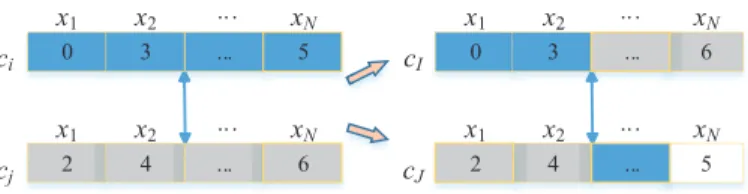
operation. As shown in Fig. 4, we firstly select a crossover point afterx2in the
chromosome and then swap genes of two parental chromosomes on both sides
of crossover point, then complete the crossover operation.
0 3 ... 5
x
1x
2...
x
N ck 0 7 ... 6x
1x
2...
xN
cKFigure 5: An example of mutation operation.
The mutation is to slightly modify some of the genes in a chromosome to
240
produce a well-fitness individual as well as avoid early convergence. Fig. 5
shows an example of the standard mutation that each gene is changed with
equal probability,x2 and xN are mutated with the same mutation probability. After crossover and mutation operation, the data placement strategy generated
still meets the constraints of privacy preservation.
245
3.3.4. Method Overview of IDP
In this paper, the optimized goal is to improve the resource utilization,
re-duce energy consumption and optimize the data access time while taking the
data privacy constraints into account. The data placement problem is defined
as a multi-objective problem, and the NSGA-II is used to obtain the optimal
250
data placement strategy. Firstly, the data placement strategies for datasets are
Algorithm 4IoT-oriented Data Placement method Require: D,A,X,Y,H.
Ensure: Optimal datasets placement strategyX*
1: G= 1
2: whileG≤Gendo
3: Lj=Sj+Oj
4: V =Fast Non-dominated Sort (Lj)
5: Sj = Ø
6: i = 1
7: while sum(Sj)< Zpop do
8: crowded-comparison(Vi) by Eq.(23)
9: Sj+ =Vi
10: i=i+ 1
11: end while
12: Oj =crossover and mutation operation(Sj)
13: G=G+ 1
14: end while
15: returnX*
data placement problems. Then, the fast non-dominated sorting approach is
used to generate multiple non-dominated layers for individuals and pretreat the
population to better distinguish the merits of individuals. Crowding distance
255
computation is used to identify individuals with better fitness.
The overview of IDP we proposed is shown in Algorithm 4. The inputs of the
Algorithm 4 are IoT datasets collectionD. The algorithm starts from the first iteration (Line 1). Two populationsPj andOj of sizeZpop are randomly
gener-ated and form a populationLj with a population size of 2Zpop. The initialized
260
population Lj is divided into multiple non-dominated layers (Lines 3 and 4).
The selection operation follows two rules. (1): The individual with higher level
of non-dominated layers is prioritized; (2): The individual with better crowding
The excellent individuals are selected to fill in a new population of sizeZpopby
265
crowding distance (Lines 7 to 10). Then the offspring population is generated
after the traditional crossover and mutation (Line 12). The offspring popula-tion is merged with the parent populapopula-tion and iterated again until the algorithm
stops (Lines 2 to 14). Finally, the optimal placement strategies are output (Line
15).
270
4. Experimental Evaluation
In this section, we conduct extensive simulations to evaluate the performance
optimization of the data placement method. Specifically, we first briefly
intro-duce our simulation setup including simulation dataset and comparative
meth-ods. Then, we evaluate the influence of the dataset scale on the performance
275
of resources utilization and the energy consumption. Finally, we illustrate the
evaluation results on our proposed data placement method.
4.1. Simulation Setup
Table 2: Parameter Settings
Parameter Value
The number of tasksQ 40
The time of running periodR 24h
The number of hostsW 3456
The baseline energy consumption rate ofw-th hostαw 342W
The active energy consumption rate for each VMη 23W
The number of pods involved in fat-tree topologyM 288
The bandwidth between severs and edge switches bSE 50M The bandwidth between switches in fat-tree topology bEA andbAC 100M
The idle energy consumption rate for each switch β 100W
In our simulation, the fat-tree topology is employed to create a CDC with
288 pods, including 144 core switches, 288 aggregations switches and 288 edge
280
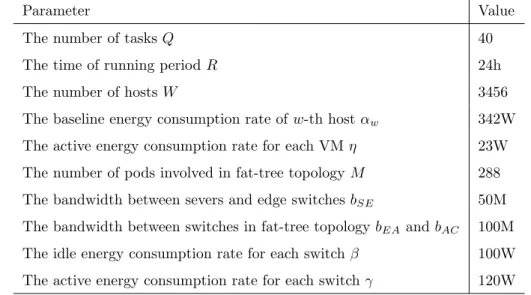
switches. Six scales of datasets are applied for experimenting the proposed IDP method which are {200, 400, 600, 800, 1000, 1200}. The specified parameter settings in this experiment are illustrated in Table 2.
To conduct the comparison analysis, we propose some other basic data
place-ment methods in addition to our IDP method. The data placeplace-ment problem in
285
this paper is similar to the packing problems. Traditional algorithms are mainly
used to solve the packing problems, including the First Fit Decreasing (FFD)
and Best Fit Decreasing (BFD) algorithms [19]. Hence, we will compare our
method with them .
Benchmark: In this method, the IoT datasets are placed in the order of the
290
hosts. When the former host is full, the datasets left are placed on the next host. When the datasets have privacy conflicts, they are not placed on the same
hosts. This process is repeated until all datasets have been placed.
First Fit Decreasing-Privacy Reservation (FFD-PR): The IoT datasets
are sorted in descending order according to the dataset requests first. Then the
295
sorted datasets are placed on the hosts. If the left resources of current host are
insufficient for the resource requirement of a dataset, the dataset is placed on
the host with enough resource next to this host. Specially, when placing each
dataset, the privacy-preservation are considered. This process is repeated until
all datasets have been placed.
300
Best Fit Decreasing- Privacy Reservation (BFD-PR): The IoT datasets and the hosts are both sorted in descending order according to the dataset
re-quest and the space of hosts first. Then the sorted datasets are placed on the
sorted hosts. If the left resources of the host are insufficient for the resource
re-quirement of the dataset, the dataset is placed on the host with enough resource
305
next to this host in optimal principle. Specially, when placing each dataset, the
privacy-preservation are considered. This process is repeated until all datasets
have been placed.
on a PC machine with 2 Intel Core i5-6500U 3.20GHz processors and 8GB RAM.
310
The corresponding evaluation results are detailedly depicted in the following
sections.
4.2. Performance evaluation on IDP
Our proposed method tends to achieve a trade-off between multiple
objec-tives, which are improving the average resources utilization of hosts, optimizing
315
the average data access time and reducing the energy consumption. We con-ducted 50 experiments in the case of convergence for each dataset scale and
get multiple sets of results. In order to pick out a relatively best solution, we
use Simple Additive Weighting (SAW) and Multiple Criteria Decision Making
(MCDM) to construct the utility function, which is measured by [19]:
320 V0(ci) =1 3 · U(ci)−Umin(X) Umax(X)−Umin(X)+ 1 3· Tmax(X)−T(ci) Tmax(X)−Tmin(X) +1 3· Emax(X)−E(c i) Emax(X)−Emin(X), (24)
whereU(ci),T(ci) andE(ci) represent the fitness of three objective functions
with the data placement strategyci, respectively. Umax(X) andUmin(X)
rep-resent the maximum and minimum fitness for the resource utilization,Tmax(X)
andTmin(X) represent the maximum and minimum fitness for the access time,
Emax(X) and Emin(X) represent the maximum and minimum fitness for the
325
energy consumption. IfUmax(X) =Umin(X), let U(ci)−Umin(X)
Umax(X)−Umin(X)= 1.
Anal-ogously, if Tmax(X) = Tmin(X) and Emax(X) = Emin(X), we adopt the
same calculation manner.
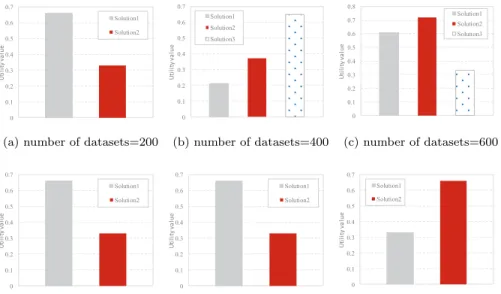
It is intuitive from Fig. 6 that the multiple sets of solutions are generated
in each dataset scale, the solutions are calculated with SAW and MCDM
re-330
spectively and we obtain a relatively goal solution. Fig. 6a shows that goal
solution is solution-1 when the dataset scale is 200. Fig. 6b illustrates that goal
solution is solution-3 when the dataset scale is 400. Based on Fig. 6c, the goal
solution is solution-2 when the dataset scale is 600. When the dataset scale
is 800, based on Fig. 6d, the goal solution is solution-1. Fig. 6e shows that
澳 0 0.1 0.2 0.3 0.4 0.5 0.6 0.7 U ti li ty v a lu e Solution1 Solution2
(a) number of datasets=200
澳 0 0.1 0.2 0.3 0.4 0.5 0.6 0.7 U ti li ty v a lu e Solution1 Solution2 Solution3 (b) number of datasets=400 澳 0 0.1 0.2 0.3 0.4 0.5 0.6 0.7 0.8 U ti li ty v a lu e Solution1 Solution2 Solution3 (c) number of datasets=600 澳 0 0.1 0.2 0.3 0.4 0.5 0.6 0.7 U ti li ty v a lu e Solution1 Solution2 (d) number of datasets=800 澳 0 0.1 0.2 0.3 0.4 0.5 0.6 0.7 U ti li ty v a lu e Solution1 Solution2
(e) number of datasets=1000
澳 0 0.1 0.2 0.3 0.4 0.5 0.6 0.7 U ti li ty v a lu e Solution1 Solution2 (f) number of datasets=1200 Figure 6: Comparison of utility value with different scales of datasets by the generated solu-tions of IDP.
goal solution is solution-1 when dataset scale is 1000. Fig. 6f shows that goal
solution is solution-2 when dataset scale is 1200. The experiments prove that
utility function can obtain a relatively balanced solution for arbitrary scale of
IoT datasets.
4.3. Comparison analysis
340
In this subsection, we focus on evaluating the performance of our method
and making comparison with multiple methods under the same configuration.
The resource utilization and the energy consumption are two main metrics of
the resource usage in CDCs. Furthermore, the number of employed hosts is
closely related to the resource utilization and the average data access time is
345
relevant to the energy consumption. The corresponding results are shown in
澳 1 2 3 4 5 6 7 8 9 10 200 400 600 800 1000 1200 N um b er of e m p loy ed p hy si ca l hos ts Number of datasets Benchmark FFD-PR BFD-PR IDP 10²
Figure 7: Comparison of the number of employed physical hosts with different dataset scale by Benchmark, FFD-PR, BFD-PR and IDP.
4.3.1. Comparison of the number of employed hosts
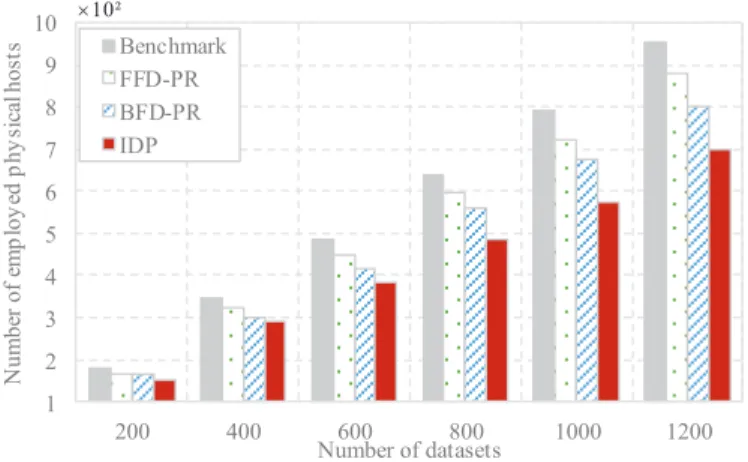
In Fig. 7, we first compare the number of employed hosts of four data
place-ment methods. Based on Fig. 7, it is indicated that IDP employs fewer physical
350
hosts than the other basic method. With the increase of dataset scale, the
number of employed hosts of IDP is increasing, but the increasing is in a more
gentler way than other methods.
4.3.2. Comparison of resource utilization
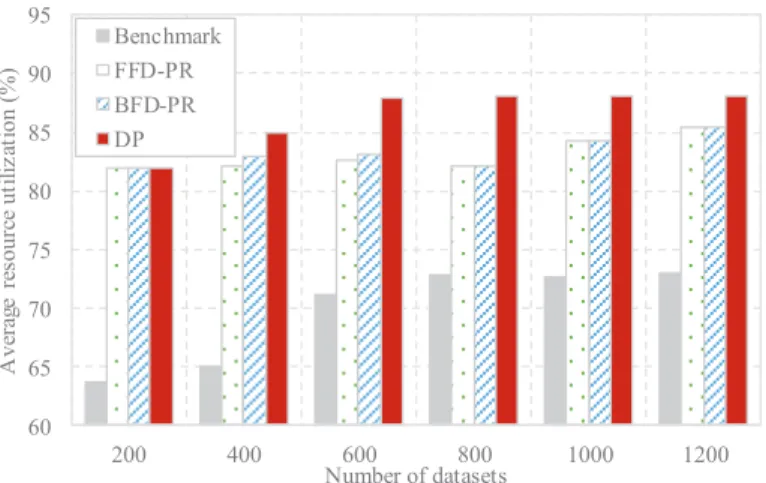
Then we compare the average resource utilization of four data placement
355
methods in Fig. 8. We find that with the increase of dataset scale, our proposed
method IDP can achieve better average resource utilization and maintain the
utility at a high level. This confirms our intuition: The increase of datasets
means that one host can actually be placed with more datasets (less space
wasted). Therefore, the resource utilization can be improved.
360
4.3.3. Comparison of average data access time
Then the average data access time is compared in Fig. 9. From Fig. 9, IDP
cost fewer average data access time than the comparison method. However, with
澳 60 65 70 75 80 85 90 95 200 400 600 800 1000 1200 A ve ra ge re sour ce u ti li z at ion (%) Number of datasets Benchmark FFD-PR BFD-PR DP
Figure 8: Comparison of average resource utilization with different dataset scale by Bench-mark, FFD-PR, BFD-PR and IDP.
This may be because the hosts seem to be more fully utilized with the increase
365
of datasets, which means that in reality we do not need to employ too datasets
in a limited host.
4.3.4. Comparison of energy consumption
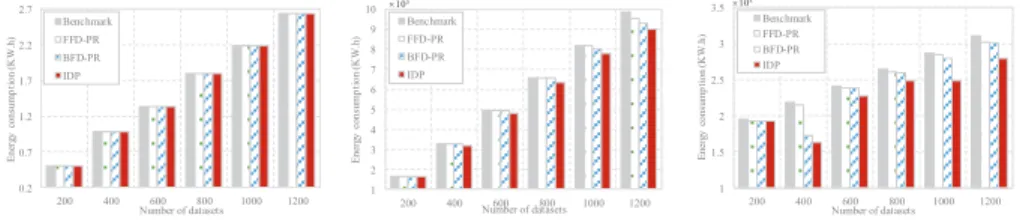
From section 2, the energy consumption is composed with the VM energy
consumption, the host energy consumption and the switche energy consumption.
370
In Fig. 10, we first compare this three-energy consumption with different dataset
scale. Based on Fig. 10a, we find that with the increase of dataset scale, all
these methods have the increase of baseline energy consumption of VMs but
in the approach level. Fig. 10b illustrates IDP has less energy consumption of
active hosts. This may be because IDP employed fewer physical hosts. Fig. 10c
375
indicates IDP has less energy consumption of switches for the reason of less
average data access time IDP taking.
Then the comparison of total energy consumption is conducted in Fig. 11,
which is intuitive that IDP obtains a better performance on the energy
con-sumption. With the increasing of dataset scale, the difference between IDP
380
澳 5 5.5 6 6.5 7 7.5 8 8.5 9 9.5 10 200 400 600 800 1000 1200 A ve ra ge a cc es s t im e (s ) Number of datasets Benchmark FFD-PR BFD-PR IDP 10²
Figure 9: Comparison of average data access time with different dataset scale by Benchmark, FFD-PR, BFD-PR and IDP. 澳 0.2 0.7 1.2 1.7 2.2 2.7 200 400 600 800 1000 1200 E ne rg y c ons um p ti on (K W .h) Number of datasets Benchmark FFD-PR BFD-PR IDP
(a) The energy consumption of VMs 澳 1 2 3 4 5 6 7 8 9 10 200 400 600 800 1000 1200 E ne rg y c ons um p ti on (K W .h ) Number of datasets Benchmark FFD-PR BFD-PR IDP 10³
(b) The energy consumption of hosts 澳 1 1.5 2 2.5 3 3.5 200 400 600 800 1000 1200 E ne rg y c ons um p ti on (K W .h ) Number of datasets Benchmark FFD-PR BFD-PR IDP 10³
(c) The energy consumption of switches
Figure 10: Comparison on specific energy consumption with different dataset scale by Bench-mark, FFD-PR, BFD-PR and IDP.
affected by the amount of hosts and switches.
5. Related Work
In recent years, with the development of IoT, large volume of data streams
from billions of interconnected heterogeneous devices are emitted for the
re-385
quirements of processing in real time [20] [21] [22] [23]. Cloud computing which
has comparative advantages for data processing is of great benefit to process
澳 2 4 6 8 10 12 14 16 200 400 600 800 1000 1200 E ne rg y c ons um p ti on (K W .h ) Number of datasets Benchmark FFD-PR BFD-PR IDP 10³
Figure 11: Comparison of total energy consumption with different dataset scale by Benchmark, FFD-PR, BFD-PR and IDP.
Due to the direct impact of data placement in cloud environment on data
access and data storage, there are multiple methods to improve the utilization
390
efficiency of cloud resources [28] [29] [30] [31] [32]. Hajisami et al. [28] proposed
a reconfigurable solution based on C-RAN, which can be dynamically and
effec-tively adapt to the fluctuation of user demand to reduce the waste of resources
and improve the efficiency of resource utilization. Guo et al. [29] simulated the
resource allocation problem as a Vector Bin Packing Problem (VBPP) and
de-395
signed a resource allocation strategy that minimizes the number of servers used
to maximize resources utilization rate. Fan et al. [30] proposed a VM-container
hybrid hierarchical resource scheduling mechanism to alleviate resource utiliza-tion efficiency issues, dividing tasks into different levels and formulating initial
scheduling strategies for different levels of tasks. Agarwal et al. [31] presented
400
a system named Volley which can analyze the logs of datacenter requests and
output migration recommendations to address data placement problem. Yu et
al. [32] proposed the sketch-based data placement (SDP) to lower the overhead
and keep the benefits of the data placement.
Energy consumption which is generated by the management of resources in
405
al. [33] proposed an elastic resource deployment framework called Elastic-Net to
solve the user demand fluctuations while minimizing energy consumption in the
cloud. Aksanli et al. [34] introduced an online job migration algorithm between data centers to reduce overall energy consumption based on assessments of the
410
advantages of short-term green energy forecasting for data center scale. Access
time is another key factor. Jiao et al. [35] proposed an optimization approach by
leveraging graph cuts to optimize multi-objective data placement across clouds
for socially aware services.
More and more attentions have been paid on data security [36] [37]. Several
415
works have been investigated for the privacy preservation in the cloud
environ-ment [38] [39]. Some were discussed about separating private data from public
data and placing them in trusted private cloud and untrusted public cloud
respectively [40] [41] [42] [43] [44] [45]. Zhou et al. [41] presented a set of tech-niques for privacy-aware data retrieval by splitting data and storing on hybrid
420
cloud. Huang et al. [42] proposed a scheme to achieve image data privacy over
hybrid cloud efficiently and proposed a one-to-one mapping function for image
encryption. Wang et al. [43] described several methods about protecting data
security in hybrid cloud and discussed an authentication intercloud model.
Abr-ishami et al. [44] presented a scheduling algorithm to protect data privacy while
425
minimizing the cost and satisfy the users limitation. Stout et al.[45] surveyed
the shortcomings and challenges of securing IoT devices and their interactions
with cloud and enterprise applications.
Currently, an energy efficient network architecture for IoT applications has been proposed [18]. The method is robust, however, to the best of our
knowl-430
edge, the existing work has not taken the privacy in data placement into
consid-eration. With the observations above, it is still a challenge to realize IoT data
placement to optimize the resource utilization, energy consumption and
access-ing time, while takaccess-ing the data privacy into account. In view of this challenge,
an IoT data placement method with privacy preservation in cloud environment
435
6. Conclusion and Future Work
The existing works of IoT data placement in cloud environment have not
taken privacy into account. In this paper, an IoT-oriented data placement
method with privacy preservation in cloud environment is proposed. We
con-440
struct a systematic model of resource utilization, energy consumption and access
time of CDCs when deploying the IoT data of privacy conflict in the cloud
envi-ronment. The proposed method is designed to improve the average resource
uti-lization of CDCs and access performance while reduce the energy consumption of CDCs based on the Non-dominated Sorting Genetic Algorithm II
(NSGA-445
II). Through adequate experimental evaluation and comparison analysis, the
efficiency and effectiveness of our proposed method are validated.
For future work, we will adjust and extent our method to implement the
IoT data placement in exact physical environment. accodingly, the privacy
preservation strategy will be improved on the privacy constraints of the
real-450
time IoT data.
7. Acknowledgement
This research is supported by the National Science Foundation of China
under grant no. 61702277, no. 61872219 and no. 61772283. Besides, this work is
also supported by The Startup Foundation for Introducing Talent of NUIST, the
455
open project from State Key Laboratory for Novel Software Technology, Nanjing
University under grant no. KFKT2017B04, the Priority Academic Program Development of Jiangsu Higher Education Institutions (PAPD) fund, Jiangsu
Collaborative Innovation Center on Atmospheric Environment and Equipment
Technology (CICAEET), and the project “Six Talent Peaks Project in Jiangsu
460
References
[1] Q. Fan, N. Ansari, Application aware workload allocation for edge
computing-based iot, IEEE Internet of Things Journal 5 (3) (2018) 2146–
2153.
465
[2] H. Yan, X. Li, Y. Wang, C. Jia, Centralized duplicate removal video storage
system with privacy preservation in iot., Sensors 18 (6) (2018) 1814.
[3] R. H. Jhaveri, N. M. Patel, Y. Zhong, A. K. Sangaiah, Sensitivity analysis
of an attack-pattern discovery based trusted routing scheme for mobile
ad-hoc networks in industrial iot, IEEE Access (2018) 1–1.
470
[4] T. Wang, M. Z. A. Bhuiyan, G. Wang, M. A. Rahman, J. Wu, J. Cao, Big
data reduction for a smart citys critical infrastructural health monitoring,
IEEE Communications Magazine 56 (3) (2018) 128–133.
[5] T. Wang, J. Zeng, Y. Lai, Y. Cai, H. Tian, Y. Chen, B. Wang, Data
collection from wsns to the cloud based on mobile fog elements, Future
475
Generation Computer Systems.
[6] Z. Wu, L. Tian, P. Li, T. Wu, M. Jiang, C. Wu, Generating stable
bio-metric keys for flexible cloud computing authentication using finger vein,
Information Sciences.
[7] M. Su, L. Zhang, Y. Wu, K. Chen, K. Li, Systematic data placement
opti-480
mization in multi-cloud storage for complex requirements, IEEE
Transac-tions on Computers 65 (6) (2016) 1964–1977.
[8] L. Yang, Z. Han, Z. Huang, J. Ma, A remotely keyed file encryption scheme
under mobile cloud computing, Journal of Network & Computer
Applica-tions 106.
485
[9] S. Mustafa, K. Bilal, S. U. R. Malik, S. A. Madani, Sla-aware energy
effi-cient resource management for cloud environments, IEEE Access 6 (2018)
[10] K. Wang, H. Yin, W. Quan, G. Min, Enabling collaborative edge computing
for software defined vehicular networks, IEEE Network PP (99) (2018) 1–6.
490
[11] X. Chen, J. Li, X. Huang, J. Ma, W. Lou, New publicly verifiable databases with efficient updates, IEEE Transactions on Dependable Secure
Comput-ing 12 (5) (2015) 546–556.
[12] T. Wang, Y. Li, W. Fang, W. Xu, J. Liang, Y. Chen, X. Liu, A
compre-hensive trustworthy data collection approach in sensor-cloud system, IEEE
495
Transactions on Big Data PP (99) (2018) 1–1.
[13] J. Cheng, R. Xu, X. Tang, V. S. Sheng, C. Cai, An abnormal network
flow feature sequence prediction approach for ddos attacks detection in big
data environment, CMC: Computers, Materials & Continua 55 (1) (2018)
095–119.
500
[14] L. Xiong, Y. Shi, On the privacy-preserving outsourcing scheme of
re-versible data hiding over encrypted image data in cloud computing, CMC:
Computers, Materials & Continua 55 (3) (2018) 523–539.
[15] X. Xie, T. Yuan, X. Zhou, X. Cheng, Research on trust model in
container-based cloud service, CMC: Computers, Materials & Continua 56 (2) (2018)
505
273–283.
[16] K. He, J. Chen, R. Du, Q. Wu, G. Xue, X. Zhang, Deypos: Deduplicatable
dynamic proof of storage for multi-user environments, IEEE Transactions on Computers 65 (12) (2016) 3631–3645.
[17] C. Esposito, A. De Santis, G. Tortora, H. Chang, K.-K. R. Choo,
510
Blockchain: A panacea for healthcare cloud-based data security and
pri-vacy?, IEEE Cloud Computing 5 (1) (2018) 31–37.
[18] P. Sarwesh, N. S. V. Shet, K. Chandrasekaran, Energy-efficient network
ar-chitecture for iot applications, in: Beyond the Internet of Things, Springer,
2017, pp. 119–144.
[19] X. Xu, W. Dou, X. Zhang, J. Chen, Enreal: An energy-aware resource
allocation method for scientific workflow executions in cloud environment,
IEEE Transactions on Cloud Computing 4 (2) (2016) 166–179.
[20] C. Wu, E. Zapevalova, Y. Chen, F. Li, Time optimization of multiple
knowl-edge transfers in the big data environment, CMC: Computers, Materials &
520
Continua 54 (3) (2018) 269–285.
[21] L. Atzori, A. Iera, G. Morabito, The internet of things: A survey, Computer
networks 54 (15) (2010) 2787–2805.
[22] T. Qiu, A. Zhao, F. Xia, W. Si, D. O. Wu, Rose: Robustness strategy for
scale-free wireless sensor networks, IEEE/ACM Transactions on
Network-525
ing PP (99) (2017) 1–16.
[23] T. Qiu, R. Qiao, D. O. Wu, Eabs: An event-aware backpressure scheduling
scheme for emergency internet of things, IEEE Transactions on Mobile
Computing PP (99) (2018) 1–1.
[24] F. Tao, Y. Cheng, L. Da Xu, L. Zhang, B. H. Li, Cciot-cmfg: cloud
com-530
puting and internet of things-based cloud manufacturing service system,
IEEE Transactions on Industrial Informatics 10 (2) (2014) 1435–1442.
[25] M. Aazam, E.-N. Huh, Fog computing: The cloud-iot\/ioe middleware paradigm, IEEE Potentials 35 (3) (2016) 40–44.
[26] V. C. Emeakaroha, N. Cafferkey, P. Healy, J. P. Morrison, A cloud-based
535
iot data gathering and processing platform, in: Future Internet of Things
and Cloud (FiCloud), 2015 3rd International Conference on, IEEE, 2015,
pp. 50–57.
[27] A. Botta, W. De Donato, V. Persico, A. Pescap´e, Integration of cloud
computing and internet of things: a survey, Future Generation Computer
540
[28] A. Hajisami, T. X. Tran, D. Pompili, Dynamic provisioning for high
en-ergy efficiency and resource utilization in cloud rans, in: Mobile Ad Hoc
and Sensor Systems (MASS), 2015 IEEE 12th International Conference on, IEEE, 2015, pp. 471–472.
545
[29] L. Guo, P. Du, A. Razaque, M. Almiani, A. Al Rahayfeh, Energy
sav-ing and maximize utilization cloud resources allocation via online
multi-dimensional vector bin packing, in: Software Defined Systems (SDS), 2018
Fifth International Conference on, IEEE, 2018, pp. 160–165.
[30] C. Fan, Y. Wang, Z. Wen, Research on improved 2d-bpso-based
vm-550
container hybrid hierarchical cloud resource scheduling mechanism, in:
Computer and Information Technology (CIT), 2016 IEEE International
Conference on, IEEE, 2016, pp. 754–759.
[31] S. Agarwal, J. Dunagan, N. Jain, S. Saroiu, A. Wolman, H. Bhogan, Volley:
Automated data placement for geo-distributed cloud services.
555
[32] B. Yu, J. Pan, Sketch-based data placement among geo-distributed
dat-acenters for cloud storages, in: Computer Communications, IEEE
INFO-COM 2016-The 35th Annual IEEE International Conference on, IEEE,
2016, pp. 1–9.
[33] A. Hajisami, T. X. Tran, D. Pompili, Elastic-net: Boosting energy efficiency
560
and resource utilization in 5g c-rans, arXiv preprint arXiv:1710.00731.
[34] B. Aksanli, J. Venkatesh, I. Monga, T. S. Rosing, Renewable energy
pre-diction for improved utilization and efficiency in datacenters and backbone
networks, in: Computational Sustainability, Springer, 2016, pp. 47–74.
[35] L. Jiao, J. Lit, W. Du, X. Fu, Multi-objective data placement for
multi-565
cloud socially aware services, in: INFOCOM, 2014 Proceedings IEEE,
[36] J. Cui, Y. Zhang, Z. Cai, A. Liu, Y. Li, Securing display path for
security-sensitive applications on mobile devices, CMC: Computers, Materials &
Continua 55 (1) (2018) 017–035.
[37] W. Quan, Y. Liu, H. Zhang, S. Yu, Enhancing crowd collaborations for
soft-ware defined vehicular networks, IEEE Communications Magazine 55 (8)
(2017) 80–86.
[38] X. Wu, C. Zhang, R. Zhang, Y. Wang, J. Cui, A distributed intrusion
detection model via nondestructive partitioning and balanced allocation
for big data, CMC: Computers, Materials & Continua 56 (1) (2018) 61–72.
[39] T. Wang, J. Zhou, M. Huang, M. Bhuiyan, A. Liu, W. Xu, M. Xie,
Fog-based storage technology to fight with cyber threat, Future Generation
Computer Systems 83.
[40] J. Shen, C. Wang, T. Li, X. Chen, X. Huang, Z. H. Zhan, Secure data
uploading scheme for a smart home system, Information Sciences 453.
[41] Z. Zhou, H. Zhang, X. Du, P. Li, X. Yu, Prometheus: Privacy-aware data
retrieval on hybrid cloud, in: INFOCOM, 2013 Proceedings IEEE, IEEE,
2013, pp. 2643–2651.
[42] X. Huang, X. Du, Achieving big data privacy via hybrid cloud, in:
Com-puter Communications Workshops (INFOCOM WKSHPS), 2014 IEEE
Conference on, IEEE, 2014, pp. 512–517.
[43] J. K. Wang, X. Jia, Data security and authentication in hybrid cloud
com-puting model, in: Global High Tech Congress on Electronics (GHTCE),
2012 IEEE, IEEE, 2012, pp. 117–120.
[44] H. Abrishami, A. Rezaeian, G. K. Tousi, M. Naghibzadeh, Scheduling in
hybrid cloud to maintain data privacy, in: Innovative Computing
Technol-ogy (INTECH), 2015 Fifth International Conference on, IEEE, 2015, pp.
[45] W. M. Stout, V. E. Urias, Challenges to securing the internet of things, in:
Security Technology (ICCST), 2016 IEEE International Carnahan