Proceedings of the Society for Computation in Linguistics
Proceedings of the Society for Computation in Linguistics
Volume 3 Article 20
2020
Assessing the ability of Transformer-based Neural Models to
Assessing the ability of Transformer-based Neural Models to
represent structurally unbounded dependencies
represent structurally unbounded dependencies
Jillian K. Da CostaUniversity at Buffalo, [email protected] Rui P. Chaves
University at Buffalo, [email protected]
Follow this and additional works at: https://scholarworks.umass.edu/scil
Part of the Computational Linguistics Commons, Psycholinguistics and Neurolinguistics Commons, and the Syntax Commons
Recommended Citation Recommended Citation
Da Costa, Jillian K. and Chaves, Rui P. (2020) "Assessing the ability of Transformer-based Neural Models to represent structurally unbounded dependencies," Proceedings of the Society for Computation in Linguistics: Vol. 3 , Article 20.
DOI: https://doi.org/10.7275/3sb6-4g20
Available at: https://scholarworks.umass.edu/scil/vol3/iss1/20
This Paper is brought to you for free and open access by ScholarWorks@UMass Amherst. It has been accepted for inclusion in Proceedings of the Society for Computation in Linguistics by an authorized editor of
Assessing the ability of Transformer-based Neural Models
to represent structurally unbounded dependencies
Jillian K. Da Costa School of Management University at Buffalo, SUNY
Rui P. Chaves Department of Linguistics University at Buffalo, SUNY
Abstract
Filler-gap dependencies are among the most challenging syntactic constructions for com-putational models at large. Recently,Wilcox et al.(2018) andWilcox et al. (2019b) pro-vide some epro-vidence suggesting that large-scale general-purpose LSTM RNNs have learned such long-distance filler-gap dependencies. In the present work we provide evidence that such models learn filler-gap dependencies only very imperfectly, despite being trained on mas-sive amounts of data. Finally, we compare the LSTM RNN models with more modern state-of-the-art Transformer models, and find that these have poor-to-mixed degrees of success, despite their sheer size and low perplexity.
1 Introduction
A flurry of recent work has shown that mod-ern large-scale and general-purpose Long Short-Term Memory (LSTM) Recurrent Neural Net-works (RNN) achieve impressive results as com-putational psycholinguistic models of human lan-guage processing, such as Linzen et al. (2016), Gulordava et al. (2018), Linzen and Leonard (2018),van Schijndel and Linzen(2018), Futrell et al. (2018), and Wilcox et al. (2019a)), to list only a few. Some of this work has focused on long-distance dependencies like (1), involving a linkage between awh-phrase and a gap. This is one of the phenomena that Markovian language models have always been inherently bad at.
(1) I knowwhoithe gardener reported the butler
said the hostess believed her aunt suspected you delivered a challengeto i at the party.
(Wilcox et al.,2019b)
However, such long-distance dependencies are accompanied by morphosyntactic constraints which have not previously been tested, in particu-lar, agreement constraints like those in (2).
(2) a. It was the lawyer who I think you said was/*were upset.
b. It was the lawyers who I think you said *was/were upset.
c. They wondered which lawyer I think you said was/*were upset.
d. They wondered which lawyers I think you said *was/were upset.
There are two different dependencies at work in the these examples. One is between the filler phrasewhoand the gap (i.e. the missing subject of the embedded verb) and another between the head nounlawyer(s) and the wh-phrase adjacent to it. It is not possible to claim that LSTM RNN models have learned English filler-gap dependencies with-out showing that the associated morphosyntactic constraints have also been learned. At the time of this writing, LSTM RNNs are no longer the state-of-the-art English language models. Transformer (attention-based) models have obtained lower test-time perplexity. In the present work we focus on whether any of these neural language models have truly learned long-distance agreement (filler-gap) dependencies like those in (1) and (2).
The structure of the paper is as follows. First we show that the same general-purpose LSTM RNN models that Wilcox et al. (2019b) have claimed to successfully cope with filler-gap dependencies have not learned the morphosyntactic constraints associated to such constructions, illustrated in (2). Next, we compare these results with those of three more recent transformer-based architectures that have obtained better perplexity results, namely Transformer-XL (Dai et al.,2019), BERT (Devlin et al.,2018), XLNet (Yang et al.,2019), and Ope-nAI GPT-2 (Radford et al.,2019).1
1All our materials, code, and analysis are available at
https://github.com/RuiPChaves/Transformers-FillerGap-dependencies.
189
Proceedings of the Society for Computation in Linguistics (SCiL) 2020, pages 189-198. New Orleans, Louisiana, January 2-5, 2020
We acknowledge that these models are not di-rectly comparable, and that the present results should be taken with some caution because the architectures are different (transformer vs. recur-rent), as are the training objectives (masked lan-guage modeling vs. non-masked lanlan-guage mod-eling), evaluation methods (use of sentences pre-fix + sufpre-fix vs. only prepre-fix for language models), and the training datasets. Nonetheless, we argue that such a preliminary comparison is useful in that is sheds some light on how well extremely large neural models of English cope with perhaps of the most historically vexing syntactic phenom-ena in computational linguistics. As we shall see, there is a wide range of variation in how accurately the models cope with filler-gap dependencies, with LSTM RNNs fairing among the worse. Our re-sults are consistent with those reported by Gold-berg (2019), which suggest that BERT is better than LSTM RNNs at English subject-verb agree-ment (Marvin and Linzen,2018).
2 LSTM RNNs
Wilcox et al.(2019b) found evidence suggesting that LSTM RNNs can maintain filler-gap depen-dencies across up to at least four clausal bound-aries like the one in (1). Two models were used for these experiments. One wasGulordava et al. (2018), henceforth the Gulordava model, which was trained on 90 million tokens of En-glish Wikipedia, and has two hidden layers of 650 units each. The second model was Jozefowicz et al.(2016), henceforth theGoogle model, which was trained on the One Billion Word Benchmark (Chelba et al.,2013), has two hidden layers with 8196 units each, and uses the output of a character-level Convolutional Neural Network as input to the LSTM. One of the trademark properties of filler-gap dependencies is that the morphosyntac-tic properties imposed on the gap site are pre-served by the filler phrase, as already illustrated in (2). Here, the plural noun must be matched with the plural verb form and the singular noun with the singular verb. In what follows we examine how well these dependencies are learned by the Gulor-dava and Google models.
2.1 Experiment 1: agreement in clefts
Following basically the same experimental ap-proach asWilcox et al.(2018), we created 20 cleft items using a2⇥2⇥4factorial design, for a total
1 2 3 4 google gulorda va vpl vsg vpl vsg vpl vsg vpl vsg 10 12 14 16 18 10 12 14 16 18 sur pr isal subj npl nsg
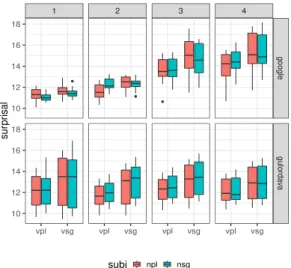
Figure 1: Surprisal of the gap-agreeing verb in ‘it’ clefts across 4 levels of embedding (LSTM RNNs) of 320 sentences. All the conditions for an item are illustrated in (3). Like Wilcoxet al., we ex-tracted the softmax activation of the critical verbs
were/was, given the prefix sentence, using basi-cally the same code asWilcox et al.(2018), made available athttps://osf.io/zpfxm/.
(3) a. It was the lawyer(s) who I think was/were ... [Nsg/pl,LEVEL1,Vsg/pl]
b. It was the lawyer(s) who I think you said was/were ...
[Nsg/pl,LEVEL2,Vsg/pl]
c. It was the lawyer(s) who I think you said you thought was/were ...
[Nsg/pl,LEVEL3,Vsg/pl]
d. It was the lawyer(s) who people believe I think you said you thought was/were ... [Nsg/pl,LEVEL4,Vsg/pl]
Finally, we converted the softmax values into sur-prisal (i.e. the negative log probability), following Wilcox et al. (2019b). See see Hale (2001) and Levy(2008) for more discussion.
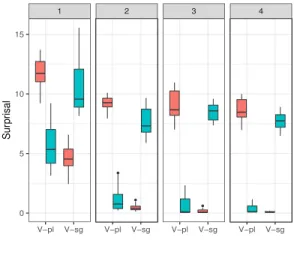
The results were rather weak, as shown by Fig-ure1. Had the RNNs succeeded at this task, then the conditions where the noun and verb agree (i.e. Npl-Vpland Nsg-Vsg) would be lower in surprisal
than the conditions where the agreement is mis-matched (i.e. Npl-Vsg and Nsg-Vpl). This was
generally not the case in either model. Finally, in the larger Google model surprisal increased with the level of embedding, so that the correct verb form is more unexpected in level 4 than the incor-rect verb forms in levels 1 and 2.
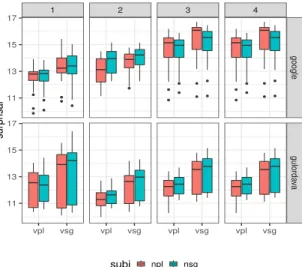
1 2 3 4 google gulorda va vpl vsg vpl vsg vpl vsg vpl vsg 11 13 15 17 11 13 15 17 sur pr isal subj npl nsg
Figure 2: Surprisal of the gap-agreeing verb in ‘which’ interrogatives across embedding levels (LSTM RNNs) There is a general increase of surprisal as clausal embedding increases, which in our view may simply reflect the fact that multiple occur-rences of embedded declarative clauses under verbs of indirect discourse are rare. Overall, the results suggest that these models have not learned the morphosyntax of filler-gap dependencies.
2.2 Experiment 2: agreement in indirect interrogatives
In order to assess if these results are specific to the cleft construction, we converted the 20 items into embedded interrogatives, effectively inverting the order of thewh-phrase and the agreeing nominal head, as (4) illustrates.
(4) a. Someone wondered which lawyer(s) I think was/were ...
[Nsg/pl,LEVEL1,Vsg/pl]
b. Someone wondered which lawyer(s) I think you said was/were ...
[Nsg/pl,LEVEL2,Vsg/pl]
c. Someone wondered which lawyer(s) I think you said you thought was/were ... [Nsg/pl,LEVEL3,Vsg/pl]
d. Someone wondered which lawyer(s) who people believe I think you said you thought was/were ...
[Nsg/pl,LEVEL4,Vsg/pl]
The outcome was the same, as Figure 2 illus-trates, suggesting that our results are robust and not specific to the type of filler-gap construction
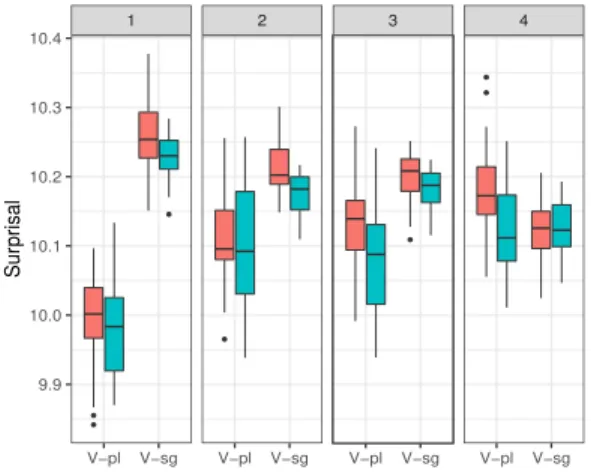
1 2 3 4 V−pl V−sg V−pl V−sg V−pl V−sg V−pl V−sg 9.6 9.8 10.0 10.2 Sur pr isal FillerCondition N−pl N−sg
Figure 3: Surprisal of the gap-agreeing verb in ‘it’ clefts across embedding levels (Transformer-XL) chosen. We conclude that the Gulordava and Google models have not truly learned the mor-phosyntax of filler-gap dependencies. In what fol-lows we examine how more recent transformer-based models fair at the same tasks.
3 Transformer-XL
Transformer-XL (Dai et al., 2019) has 24 mil-lion parameters, an average attention span of 640 tokens, and 16 10-word transformer layers. Transformer-XL is supposed to learn dependen-cies that are about 80% longer than those learned by RNNs but as Figure 3 shows, it did only marginally better than the Google and the Gulor-dava models when processing the same agreement in clefts dataset from Experiment 1.
In fact, only in embedding level 1 was the sur-prisal of agreeing N-V pairs statistically lower than their non-agreeing counterparts (for Npl-Vpl
vs. Nsg-Vpl we havet =-2.39, p = 0.021, and
for Nsg-Vsgvs. Npl-Vsgwe havet=-1.83,p= 0.068). For all other levels of embedding there
was no statistical difference in surprisal (p >0.4),
except for level 3 where Npl-Vplvs. Nsg-Vpl(t=
-2.13,p = 0.039). The model does equally bad on the indirect interrogatives dataset from Experi-ment 2, as Figure4illustrates.
3.1 Experiment 3: Filler-gap surprisal in subject-inverted interrogatives
For completeness, we also tested Transformer-XL’s ability to maintain a filler-gap dependency without the interacting factor of subject-verb 191
1 2 3 4 V−pl V−sg V−pl V−sg V−pl V−sg V−pl V−sg 9.9 10.0 10.1 10.2 10.3 10.4 Sur pr isal FillerCondition N−pl N−sg
Figure 4: Surprisal of gap-agreeing verb in ‘which’ in-terrogatives across embedding levels (Transformer-XL) agreement. We created 20 items, in a2⇥2⇥4
design, for a total of 320 sentences, as illustrated in (5). We extracted the softmax value of the masked post-gap region item (below, the preposi-tionat). This experiment serves as the counterpart of the experiments inWilcox et al.(2019b) show-ing LSTM RNNs can maintain filler-gap depen-dencies across up to at least four clausal bound-aries (diacritic ‘*’ not included in the input).
(5) a.*What did we talk about it at the party? [WH-NOGAP,LEVEL1]
b. What did we talk about at the party? [WH-GAP,LEVEL1]
c. Did we talk about it at the party? [NOWH-NOGAP,LEVEL1] d.*Did we talk about at the party?
[NOWH-GAP,LEVEL1]
The results confirm that Transformer-XL has a poor representation for filler gap dependencies, as seen in Figure5. Already at one level of embed-ding the surprisal of the (ungrammatical) nowh-gap condition is lower than the grammatical nh-gap counterpart, whereas it should be the other way around. In levels 2 through 4 there is no sta-tistical difference between any of the four condi-tions.
3.2 Experiment 4: Filler-gap surprisal in uninverted indirect interrogatives
In order to determine if the results of Experi-ment 3 scale to other filler-gap constructions, we
9.5 9.7 9.9 10.1 10.3
nwh−gap nwh−ngap wh−gap wh−ngap Conditions
Sur
pr
isal
Figure 5: Surprisal of the post-gap region in inverted interrogatives at embedding level 1 (Transformer-XL) constructed non-inversion counterparts of the 20 items, illustrated in (6). As before, we extracted the softmax activation of the critical verbs at the end of the item, after the sentence prefix is pro-cessed. The results were similar in that in no level of embedding the correct surprisal pattern was ob-served. See the materials for details.
(6) a. People wondered what we talked about it at ... [WH-NOGAP,LEVEL1]
b. People wondered what we talked about at ... [WH-GAP,LEVEL1]
c. People wondered if we talked about it at ... [NOWH-NOGAP,LEVEL1]
d. People wondered if we talked about at ... [NOWH-GAP,LEVEL1]
We conclude that the English Transformer-XL model does much worse than the English LSTM RNNs in coping with filler-gap dependencies.
4 BERT
Google’s Bidirectional Encoder Representations from Transformers (BERT) is a transformer-based model that learns bidirectional encoder word rep-resentations via a masked language model training objective, using 340 million parameters, 768 hid-den layers, 24 transformer blocks, and 1020 word context windows.
Using the same agreement in filler-gap depen-dencies dataset used in Experiment 1, we probe whether BERT assigns relative probability to plu-ral and singular verb forms in such a way that this consistent with the agreement information of the 192
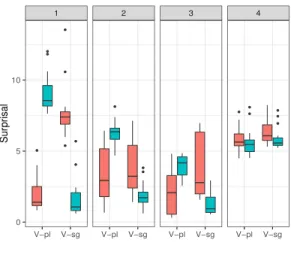
1 2 3 4 V−pl V−sg V−pl V−sg V−pl V−sg V−pl V−sg 0 5 10 Sur pr isal FillerCondition N−pl N−sg
Figure 6: Surprisal of the gap-agreeing verb in ‘it’ clefts across 4 levels of embedding (BERT)
nominal antecedent at the top of the filler-gap de-pendency. LikeGoldberg(2019) andWolf(2019), we masked the verb and then extracted the softmax values for bothwasandwere, as shown in (7).
(7) a. It was the lawyer(s) who I think [MASK] upset. [Nsg/pl,LEVEL1]
b. It was the lawyer(s) who I think you said [MASK] upset. [Nsg/pl,LEVEL2] c. It was the lawyer(s) who I think you
said you thought [MASK] upset. [Nsg/pl, LEVEL3]
d. It was the lawyer(s) who people believe I think you said you thought [MASK] up-set. [Nsg/pl,LEVEL4]
The results are much better than those obtained by LSTM RNNs on the same items, as Figure6 illus-trates. The surprisal of the agreeing conditions is systematically lower than that of the non-agreeing conditions in all embeddings (allps<0.0001).
In the next experiment, the 20 items were con-verted thewhichinterrogative counterparts, analo-gously to Experiment 2 above, where the agreeing verb were masked, as seen in (8).
(8) a. Someone wondered which lawyer(s) I think [MASK] upset. [Nsg/pl,LEVEL1]
b. Someone wondered which lawyer(s) I think you said [MASK] upset. [Nsg/pl, LEVEL2]
c. Someone wondered which lawyer(s) I think you said you thought [MASK] up-set. [Nsg/pl,LEVEL3] 1 2 3 4 V−pl V−sg V−pl V−sg V−pl V−sg V−pl V−sg 0 5 10 Sur pr isal FillerCondition N−pl N−sg
Figure 7: Surprisal of the gap-agreeing verb in ‘which’ questions across embedding levels (BERT)
d. Someone wondered which lawyer(s) who people believe I think you said you thought [MASK] upset. [Nsg/pl, LEVEL4]
The results are in Figure7, and are only weak in embedding level 4, where neither condition is sta-tistically different in the V-sg (t= 0.91,p=0.36)
nor in the V-pl (t= 1.93,p= 0.06) conditions. If BERT’s ability to maintain filler-gap depen-dencies in memory is too superficial and eager, then it may ignore the presence of a local subject, and not recognize that a subject gap is grammatri-cally impossible, as in (9).
(9) a.*It was the boys who I think she/he were lost [Npl, Vpl, LEVEL1]
b.*It was the boy who I think we/they was lost. [Nsg, Vsg, LEVEL1]
For example, if the model attempts to linkboys
to the copula verb in (9a) despite the local sub-ject pronoun, then the surprisal ofwereshould be higher than that of was. Similarly, if the model attempts to linkboyto the copula verb in (9b) de-spite the local subject pronoun, then the surprisal of was should be lower than that of were. The presence of the pronoun makes the subject gap im-possible, and BERT should be sensisitive to that.
We therefore inserted a pronoun in the gap site of the 20 items used in the experiment immedi-ately above, and made sure the verb agreed with the fronted phrase, not the pronoun. What we found was a complete reversal of the surprisal val-ues. As Figure8shows, BERT suspends the filler-193
1 2 3 4 V−pl V−sg V−pl V−sg V−pl V−sg V−pl V−sg 0 5 10 15 Sur pr isal FillerCondition N−pl N−sg
Figure 8: Surprisal of the (dis)agreeing verb in ‘it’ clefts across 4 levels of embedding (BERT)
gap linkages in the copula of examples like (9). We conclude that BERTs processing of filler-gap dependencies is not trivially shallow.
As in Experiments 3 and 4 above, we also ex-amined BERT’s ability to maintain a filler-gap de-pendency without the interacting factor of subject-verb agreement. Using the same items as in§3.1 and§3.2, illustrated in (10), we extracted the soft-max value of the masked post-gap region item (be-low, the prepositionat).
(10) a.*What did we talk about it at the party? [WH-NOGAP,LEVEL1]
b. What did we talk about at the party? [WH-GAP,LEVEL1]
c. Did we talk about it at the party? [NOWH-NOGAP,LEVEL1]
d.*Did we talk about at the party? [NOWH-GAP,LEVEL1]
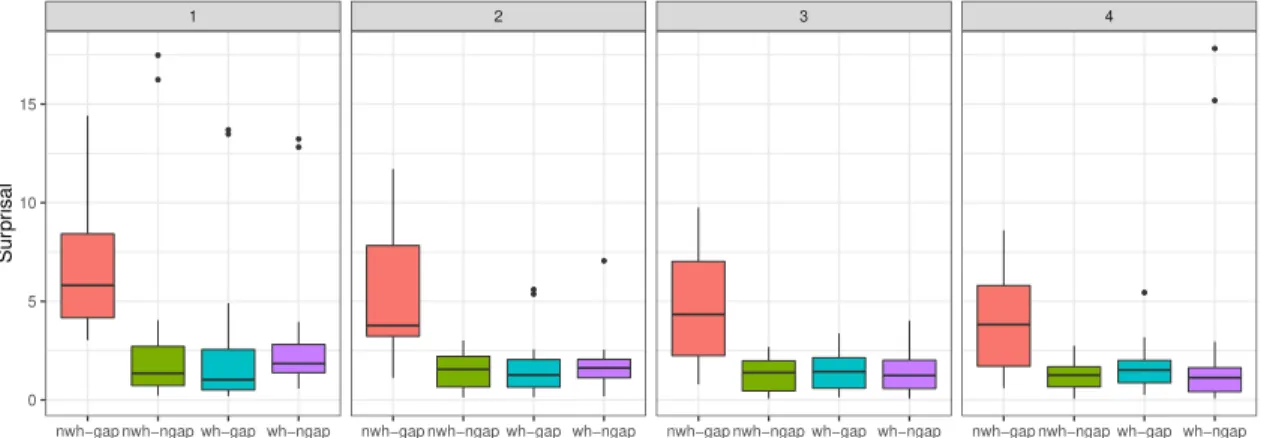
As Figure 9 shows, BERT is able to repre-sent the filler gap dependency up to four levels of clausal embedding. Surprisal is highest when there is a gap but nowh-phrase, and lower when (i) there is no gap and nowh-phrase and (ii) when there is a gap and a wh-phrase. The low sur-prisal obtained for the case where there is no gap andwh-phrase is more difficult to interpret, since the model’s input has access to information about clausal boundaries. In that sense, the surprisal is lower than one would expect.
BERT faired equally well with the uninverted indirect interrogative counterparts of (5), shown in
(11), which were identical to the items used in Ex-periment 4 above; see§3.2.
(11) a.*People wondered what we talked about it at the party. [WH-NOGAP,LEVEL1]
b. People wondered what we talked about at the party. [WH-GAP,LEVEL1]
c. People wondered if we talked about it at the party. [NOWH-NOGAP,LEVEL1]
d.*People wondered if we talked about at the party. [NOWH-GAP,LEVEL1]
BERT’s masked language objective has an ad-vantage over RNN models in that it has access to input after the masked critical item, e.g. the string
the party in (5). We therefore ran a2⇥2⇥4
variant of Experiment 6 in which the masked crit-ical items were adverbs likeyesterday,repeatedly,
again, andthen, in sentence-final position: (12) a.* What did we talk about it yesterday?
[WH-NOGAP,LEVEL1]
b. What did we talk about yesterday? [WH-GAP,LEVEL1]
c. Did we talk about it yesterday? [NOWH-NOGAP,LEVEL1]
d.* Did we talk about yesterday? [NOWH-GAP,LEVEL1]
The results were radically different, as the sur-prisal was essentially inverted as shown in Figure 10. This pattern remained the same in deeper em-bedding levels, suggesting that BERT’s ability to maintain filler-gap dependencies is brittle.
Finally, we also ran a variant of this experi-ment where the 20 items were converted into em-bedded interrogatives, without inversion. Again, the masked critical items were the adverbs in sentence-final position:
(13) a.* People wondered what we talked about it repeatedly.
[WH-NOGAP,LEVEL1]
b. People wondered what we talked about repeatedly.
[WH-GAP,LEVEL1]
c. People wondered if we talked about it re-peatedly.
[NOWH-NOGAP,LEVEL1]
1 2 3 4
nwh−gap nwh−ngap wh−gap wh−ngap nwh−gap nwh−ngap wh−gap wh−ngap nwh−gap nwh−ngap wh−gap wh−ngap nwh−gap nwh−ngap wh−gap wh−ngap 0 5 10 15 Sur pr isal
Figure 9: Surprisal of the post-gap region in subject-inversion interrogatives across embedding levels (BERT) 1
nwh−gap nwh−ngap wh−gap wh−ngap
20 30 40 50 Condition Sur pr isal
Figure 10: Surprisal of the sentence-final adverb in subject-inversion interrogatives, embedding 1 (BERT)
d.* People wondered if we talked about repeatedly.
[NWH-GAP,LEVEL1]
Now, the condition with the highest surprisal was nwh-ngap, suggesting that the model does not ex-pect sentence-final adverbs to follow pronouns in the absence of a filler-gap dependency. The first level of embedding is shown in Figure11. BERT’s modelling of filler-gap dependencies is better than all other models surveyed so far but still brittle.
5 XLNet
XLNet (Yang et al., 2019) is like BERT in that it uses a masked model training objective and learns bidirectional contexts. Although XLNet is claimed to achieve better results than BERT in a number of tasks, we found that it performed worse in the same experiments ran on BERT, failing to provide clear evidence that filler-gap dependencies
1
nwh−gap nwh−ngap wh−gap wh−ngap
10 20 30 40 Condition Sur pr isal
Figure 11: Surprisal of the sentence-final adverb in un-inverted indirect interrogatives at embedding 1 (BERT) are attended to. For example, XLNet did much worse with clefts items, like those illustrated in (8). As can be seen in Figure12, there is a signifi-cant overlap across subject-verb agreeing and non-agreeing conditions. Had the model learned about agreement in filler-gap dependencies, the surprisal of V-pl (were) in the N-pl condition should be sig-nificantly lower than that of V-pl in the N-sg con-dition. Similarly, the surprisal of V-sg in the N-pl condition should be significantly higher than that of V-sg (was) in the N-sg condition.
Similarly poor results were found for the in-terrogative subject-agreement items, like those in (7), as Figure 13 indicates. As in the case of Transformer-XL, there is little evidence that the model attends to filler-gap dependencies at all.
6 GPT-2
Unlike Google’s BERT, the OpenAI GPT-2 model uses the same training objective as LSTM RNNs. 195
1 2 3 4 V−pl V−sg V−pl V−sg V−pl V−sg V−pl V−sg 0 5 10 15 Sur pr isal FillerCondition N−pl N−sg
Figure 12: Surprisal of the gap-agreeing verb in ‘it’ clefts across 4 levels of embedding (XL-Net)
It is therefore possible to simply take the soft-max activation of the word of interest after the sentence is processed. Preliminary evaluations on subject-verb agreement data byWolf(2019) indi-cate that an earlier version of GPT-2 was worse than BERT on theLinzen et al.(2016) dataset but better in the more complex Marvin and Linzen (2018) dataset. In what follows, we report our findings for the more recent 345 million parameter version of GPT-2, hf.GPT-2 medium.
We begin with the 20 cleft items from Experi-ment 1, illustrated in (3), and repeated in (14). As before, we extracted the softmax activation of the wordswasandwereacross all conditions and con-verted the values to surprisal.
(14) a. It was the lawyer(s) who I think was/were ... [Nsg/pl,LEVEL1,Vsg/pl]
b. It was the lawyer(s) who I think you said was/were ...
[Nsg/pl,LEVEL2,Vsg/pl]
c. It was the lawyer(s) who I think you said you thought was/were ...
[Nsg/pl,LEVEL3,Vsg/pl]
d. It was the lawyer(s) who people believe I think you said you thought was/were ... [Nsg/pl,LEVEL4,Vsg/pl]
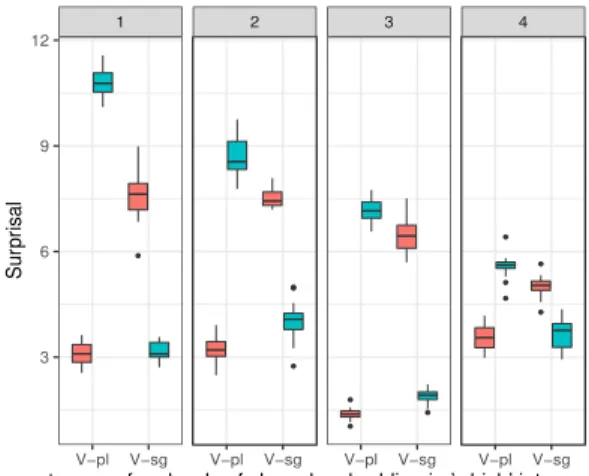
The GPT-2 medium results are shown in Figure 14, and are clearly superior to BERT’s. For all levels of embedding, the agreeing conditions re-ceived statistically lower surprisal than that of the non-agreeing conditions. Notice how the differ-ential across the conditions tends to diminish with
1 2 3 4 V−pl V−sg V−pl V−sg V−pl V−sg V−pl V−sg 4 8 12 16 Sur pr isal FillerCondition N−pl N−sg
Figure 13: Surprisal of the gap-agreeing verb in ‘which’ questions across embedding levels (XLNet)
1 2 3 4 V−pl V−sg V−pl V−sg V−pl V−sg V−pl V−sg 3 6 9 Sur pr isal FillerCondition N−pl N−sg
Figure 14: Surprisal of the gap-agreeing verb in ‘it’ clefts across 4 levels of embedding (GPT-2)
deeper clausal embeddings, suggesting that the de-pendency is lost in deeper embeddings.
The dataset from Experiment 2 – consisting of
whichembedded interrogative like those in (4), re-peated here as (15) – yielded virtually the same results, as shown in Figure15. This suggests that GPT-2 small is cross-constructionally robust up four levels of clausal embedding.
(15) a. Someone wondered which lawyer(s) I think was/were ...
[Nsg/pl,LEVEL1,Vsg/pl]
b. Someone wondered which lawyer(s) I think you said was/were ...
[Nsg/pl,LEVEL2,Vsg/pl]
c. Someone wondered which lawyer(s) I think you said you thought was/were ... 196
1 2 3 4 V−pl V−sg V−pl V−sg V−pl V−sg V−pl V−sg 3 6 9 12
erb agreement across four levels of clausal embedding in ’which’ interrogativ
Sur
pr
isal
FillerCondition N−pl N−sg
Figure 15: Surprisal of the gap-agreeing verb in ‘which’ questions across levels of embedding (GPT-2)
[Nsg/pl,LEVEL3,Vsg/pl]
d. Someone wondered which lawyer(s) who people believe I think you said you thought was/were ...
[Nsg/pl,LEVEL4,Vsg/pl]
For completeness, we also examined GPT-2’s ability to maintain a filler-gap dependency with-out the interacting factor of subject-verb agree-ment in both clefts and interrogatives, analogously to what was done in Experiments 3 and 4. The same items were used, and as in the LSTM RNN and Transformer-XL cases we extracted the soft-max activation of the word at the end of the item, after the prefix string is processed.
As Figure16shows, GPT-2 medium performed moderately well for the 20 cleft items (same data as Experiment 3), though the results were not as strong as BERT’s. One major difference is that the surprisal of the wh-gap condition was system-atically higher than that of the nwh-ngap condi-tion. Ideally, the two should overlap. The rela-tively high surprisal of the wh-ngap condition is arguably due to the model maintaining expecta-tions that the gap is further downstream in the sen-tence. Still, the results overall suggest that the filler-gap dependency is attended do.
The subject inversion counterpart of the 20 items (same data as Experiment 4) led to results closer to BERTs, whereby the surprisal of the wh-gap condition overlapped with that of nwh-nwh-gap condition (all p > 0.3), as seen in Figure 17.
In both of these experiments, the results were the same in subsequent embeddings.
1
nwh−gap nwh−ngap wh−gap wh−ngap 4 6 8 10 12 14 Conditions Sur pr isal
Figure 16: Surprisal of the post-gap region in unin-verted indirect interrogatives in embedding 1 (GPT-2)
1
nwh−gap nwh−ngap wh−gap wh−ngap 6
8 10 12
Conditions across four levels of clausal embedding
Sur
pr
isal
Figure 17: Surprisal of the post-gap region in inverted interrogatives across in embedding 1 (GPT-2)
7 Discussion
Filler-gap dependencies still pose challenges for general-purpose large-scale state-of-the-art neural architectures. We show LSTM RNNs fair very poorly, despite the results ofWilcox et al.(2018) andWilcox et al.(2019b). More modern models like Transformer-XL and XLNet do even worse.
However, BERT and GPT-2 perform rather well, although not without some mixed results. For example, the performance differs significantly across different kinds of filler-gap dependency, which suggests that the models are somewhat brit-tle even though they are extremely large, and trained on enormous amounts of data.
References
Ciprian Chelba, Tomas Mikolov, Mike Schuster, Qi Ge, Thorsten Brants, Phillipp Koehn, and Tony Robin-son. 2013. One billion word benchmark for mea-suring progress in statistical language modeling. CoRR.
Zihang Dai, Zhilin Yang, Yiming Yang, William W. Cohen, Jaime Carbonell, Quoc V. Le, and Rus-lan Salakhutdinov. 2019. Transformer-XL: Atten-tive language models beyond a fixed-length context. ArXiv:1901.02860v3, arxiv.org/pdf/1901. 02860.pdf.
Jacob Devlin, Ming-Wei Chang, Kenton Lee, and Kristina Toutanova. 2018. BERT: Pre-training of deep bidirectional transformers for language under-standing. ArXiv:1810.04805, http://arxiv. org/abs/1810.
Richard Futrell, Ethan Wilcox, Takashi Morita, and Roger Levy. 2018. RNNs as psycholinguistic sub-jects: Syntactic state and grammatical dependency. Yoav Goldberg. 2019. Assessing BERT’s syntactic
abilities. Unpublished ms.
https://arxiv.org/pdf/1901.05287. pdf.
Kristina Gulordava, Piotr Bojanowski, Edouard Grave, Tal Linzen, and Marco Baroni. 2018. Colorless green recurrent networks dream hierarchically. In Proceedings of NAACL, pages 1195–1205.
John T. Hale. 2001. A probabilistic Earley parser as a psycholinguistic model. InProceedings of NAACL-2001, Pittsburg, PA, pages 159–166. ACL.
Mohit Iyyer, John Wieting, Kevin Gimpel, and Luke Zettlemoyer. 2018. Adversarial example genera-tion with syntactically controlled paraphrase net-works. InProceedings of NAACL-HLT 2018, pages 1875–1885, New Orleans, Louisiana. Association for Computational Linguistics.
Robin Jia and Percy Liang. 2017. Adversarial exam-ples for evaluating reading comprehension systems. InProceedings of the 2017 Conference on Empiri-cal Methods in Natural Language Processing, pages 2021–2031, Copenhagen, Denmark. Association for Computational Linguistics.
Jason Jo and Yoshua Bengio. 2017. Measuring the ten-dency of CNNs to learn surface statistical regulari-ties.CoRR, abs/1711.11561.
Rafal Jozefowicz, Vinyals Oriol, Mike Schuster, Noam Shazeer, and Yonghui Wu. 2016. Exploring the lim-its of language modeling.CoRR.
Roger Levy. 2008. Expectation-based syntactic com-prehension.Cognition, 3(106):1126–1177.
Tal Linzen, Emmanuel Dupoux, and Yoav Goldberg. 2016. Assessing the ability of LSTMs to learn syntax-sensitive dependencies. Transactions of the Association for Computational Linguistics, 4:521– 535.
Tal Linzen and Brian Leonard. 2018. Distinct patterns of syntactic agreement errors in recurrent networks and humans. In Proceedings of the 40th Annual Conference of the Cognitive Science Society, pages 692–697. Cognitive Science Society, Austin, TX. Rebecca Marvin and Tal Linzen. 2018. Targeted
syn-tactic evaluation of language models. In Proceed-ings of the 2018 Conference on Empirical Methods in Natural Language Processing, pages 1192–1202, Brussels, Belgium. Association for Computational Linguistics.
Alec Radford, Jeff Wu, Rewon Child, David Luan, Dario Amodei, and Ilya Sutskever. 2019. Language models are unsupervised multitask learners. Marten van Schijndel and Tal Linzen. 2018.
Model-ing garden path effects without explicit hierarchi-cal syntax. In Tim Rogers, Marina Rau, Jerry Zhu, and Chuck Kalish, editors,Proceedings of the 40th Annual Conference of the Cognitive Science Soci-ety, pages 2600–2605. Cognitive Science Society, Austin, TX.
Ethan Wilcox, Roger Levy, and Richard Futrell. 2019a. Hierarchical representation in neural language mod-els: Suppression and recovery of expectations. In Proceedings of Blackbox NLP at ACL, page pp.10. Ethan Wilcox, Roger P. Levy, Takashi Morita, and
Richard Futrell. 2018. What do rnn language mod-els learn about filler-gap dependencies? In Proceed-ings of the Workshop on Analyzing and Interpreting Neural Networks for NLP.
Ethan Wilcox, Roger P. Levy, Takashi Morita, and Richard Futrell. 2019b. What syntactic structures block dependencies in RNN language models? In Proceedings of the 41st Annual Meeting of the Cog-nitive Science Society (CogSci).
Thomas Wolf. 2019. Some additional experiments extending the tech report “Assessing BERT’s Syn-tactic Abilities” by Yoav Goldberg. Unpublished ms.
huggingface.co/bert-syntax/ extending-bert-syntax.pdf.
Zhilin Yang, Zihang Dai, Yiming Yang, Jaime Car-bonell, Ruslan Salakhutdinov, and Quoc V. Le. 2019. Xlnet: Generalized autoregressive pretraining for language understanding. arxiv.org/abs/ 1906.08237.