
1.1
Introduction
Modern point process theory has a history that can trace its roots back to Poisson in 1837. However, much of the modern theory, which depends heavily on measure theory, was devel-oped in the mid 20th century. Three lectures is not nearly enough time to cover all of the theory and applications. My goal is to give a general introduction to the topics I find instruc-tive and those that I find useful for spatial modeling (at least from the Bayesian framework). Several good texts books are out there for further study. These include, but not limited to, Daley and Vere-Jones (2003), Daley and Vere-Jones (2008), Møller and Waagepetersen (2004) and Illian et al. (2008). Most of my material comes from Møller and Waagepetersen (2004), Illian et al. (2008), Møller, Syversveen, and Waagepetersen (1998) and Møller and Waagepetersen (2007). Most theorems and propositions will be stated without proof. One may think of a spatial point process as a random countable subset of a space S. We will assume that S ⊆Rd. Typically,S will be a d-dimensional box or all of
Rd. However, it could also be Sd−1, the (d−1)-dimensional unit sphere.
As an example, we may be interested in the spatial distribution of weeds in a square kilometer field. In this case we can assume S = [0,1]2 ⊂
R2. As another example, we may be interested in the distribution of all major earthquakes that occurred during the last year. Then S =S2 ⊂
R3.
In many instances, we may only observe points in a bounded subset (window) W ⊆ S. For example we may be interested in the spatial distribution of a certain species of tree in the Amazon basis. For obvious reasons, it is impractical to count and note the location of every tree, and so we may concentrate our efforts to several square windowsWi = [wi0, wi1]2,
wi1 > wi0,Wi∩Wj =∅, j 6=i and W =∪iWi ⊂S.
The definition of a spatial point process includes both finite and countable processes. We will restrict attention to point processes, X whose realizations, x, are locally finite subsets of S.
Definition 1 Let n(x) denote the cardinality of a subset x ⊆ S. If x is not finite, set
n(x) = ∞. Let xB = x∩B for B ⊆ S. Now, x is said to be locally finite if n(xB) < ∞
whenever B is bounded.
Hence, X takes values in the space
Nlf ={x⊆S:n(xB)<∞, ∀ boundedB ⊆S}.
Elements ofNlf are calledlocally finite point configurations and will be denoted byx, y, . . .,
while ξ, η, . . . will denote singletons inS.
Before continuing, we will provide the formal definition of a point process. Assume S is a complete, separable metric space (c.s.m.s.) with metricd and equip it with the Borel sigma algebra B and let B0 denote the class of bounded Borel sets. Equip Nlf with the sigma
algebra
Nlf =σ({x∈Nlf :n(xB) =m}:B ∈ B0, m ∈N0).
That is Nlf is the smallest sigma algebra generated by the sets
{x∈Nlf :n(xB) =m}:B ∈ B0, m∈N0
where N0 =N∪ {0}.
Definition 2 A point process X defined on S is a measurable mapping defined on some probability space (Ω,F,P) taking values in (Nlf,Nlf). This mapping induces a distribution
PX of X given by PX(F) =P({ω∈Ω :X(ω)∈F}), forF ∈ Nlf. In fact, the measurability
of X is equivalent to the number, N(B), of points in B ∈ B being a random variable.
In a slight abuse of notation we may write X ⊆ S when we mean X ∈ B and F ⊆ Nlf
when we mean F ∈ Nlf. When S ⊆ Rd the metric d(ξ, η) =||ξ−η|| is the usual Euclidean distance.
1.1.1 Characterizations of Point Processes
There are three characterizations of a point process. That is the distribution of a point process X is completely specified by each characterization. The three characterizations are by its finite dimensional distributions, its void probabilities and its generating functional.
Definition 3 The family of finite-dimensional distributions of a point processX on c.s.m.s.
S is the collection of the joint distributions of (N(B1), . . . , N(Bm)), where (B1, . . . , Bm)
ranges over the bounded borel sets Bi ⊆S, i= 1, . . . , m and m∈N.
Theorem 1 The distribution of a point process X on a c.s.m.s. S is completely determined by its finite-dimensional distributions.
In other words, if two point processes share the same finite-dimensional distributions, then they are equal in distribution.
Definition 4 A point process on S is called asimple point process if its realizations contain no coincident points. That is N({ξ})∈ {0,1} almost surely for all ξ ∈S.
The void probabilities of B ⊆S isv(B) = P(N(B) = 0).
Theorem 2 (R´enyi, 1967) The distribution of a simple point process X on S is uniquely determined by its void probabilities of bounded Borel sets B ∈ B0.
The probability generating functional plays the same role for a point process as the prob-ability generating function plays for a non-negative integer-valued random variable. For a point process, X, the probability generating functional is defined by
GX(u) =E exp Z S lnu(ξ)dN(ξ) =E " Y ξ∈X u(ξ) #
for functions u : S → [0,1] with {ξ ∈ S : u(ξ) < 1} bounded. As a simple example, for B ∈ B0 takeu(ξ) = tI(ξ∈B) with 0≤t ≤1. ThenGX(u) = E
tN(B)
, which is the probability generating function forN(B).
Theorem 3 The distribution of a point process X on S is uniquely determined by its gen-erating functional.
For the remaining lectures we assume X is a simple point process with S ⊆Rd, with d≤3
typically.
1.2
Spatial Poisson Processes
Poisson point processes play a fundamental role in the theory of point processes. They possess the property of “no interaction” between points or “complete spatial randomness”. As such, they are practically useless as a model for a spatial point pattern as most spatial point patterns exhibit some degree of interaction among the points. However, they serve as reference processes when summary statistics are studied and as a building block for more structured point process models.
We start with a space S ⊆ Rd and an intensity function ρ : S → [0,∞) that is locally
integrable: R
Bρ(ξ)dξ < ∞ for all bounded B ⊆ S. We also define the intensity measure by
µ(B) =RBρ(ξ)dξ. This measure is locally finite: µ(B)<∞ for boundedB ⊆S anddiffuse: µ({ξ}) = 0, for all ξ ∈S.
We first define a related process, the binomial point process:
Definition 5 Let f be a density function on a set B ⊆ S and let n ∈ N. A point process
X consisting of n independent and identically distributed points with common density f is called a binomial point process of n points in B with density f:
X ∼binomial(B, n, f).
Now we give a definition of a (spatial) Poisson process.
Definition 6 A point processX onS ⊆Rdis aPoisson point processwith intensity function
ρ (and intensity measure µ) if the following two properties hold:
• for any B ⊆ S such that µ(B) < ∞, N(B) ∼ Pois(µ(B))—the Poisson distribution with mean µ(B).
• For any n ∈N and B ⊆S such that 0< µ(B)<∞
[XB |N(B) = n]∼binomial B, n, ρ(ξ) µ(B) ,
that is, the density function of the binomial point process is f(·) =ρ(·)/µ(B).
We write
X ∼Poisson(S, ρ).
Note that for any bounded B ⊆S, µdetermines the expected number of points in B: E(N(B)) =µ(B).
So, if S is bounded, this gives us a simple way to simulate a Poisson process on S. 1) Draw N(B)∼Pois(µ(B)). 2) Draw N(B) independent points uniformly on S.
Definition 7 If X ∼Poisson(S, ρ), then X is called a homogeneous Poisson process if ρ is constant, otherwise it is said to be inhomogeneous. If X ∼ Poisson(S,1), then X is called the standard Poisson process or the unit rate Poisson process on S.
Definition 8 A point process X on Rd is stationary if its distribution is invariant under
translations. It is isotropic if its distribution is invariant under rotations about the origin.
The void probabilities of a Poisson process, for bounded B ⊆S, are v(B) =P(N(B) = 0) = exp(−µ(B))µ
0(B)
0! = exp(−µ(B)), since N(B)∼Pois(µ(B)).
Proposition 1 Let X ∼Poisson(S, ρ). The probability generating functional of X is given by GX(u) = exp − Z S (1−u(ξ))ρ(ξ)dξ .
We now prove this for the special case whenρ is constant. Consider a bounded B ⊆S. Set u(ξ)≡1 for ξ∈S\B. Then
E exp Z S lnu(ξ)dN(ξ) = E " Y ξ∈X u(ξ) # =E{E[u(x1)· · ·u(xn)|N(B) = n]} = ∞ X n=0 exp(−ρ|B|)(ρ|B|)n n! Z B · · · Z B u(x1)· · ·u(xn) |B|n dx1, . . . , dxn = exp(−ρ|B|) ∞ X n=0 Z B ρu(ξ)dξ n /n! = exp −ρ Z B [1−u(ξ)]dξ = exp −ρ Z S [1−u(ξ)]dξ . where the last equality holds since u≡1 on S\B.
There are two basic operations for a point process: thinning and superposition.
Definition 9 A disjoint union ∪∞
i=1Xi of point processes X1, X2, . . . is called a
Definition 10 Let p : S → [0,1] be a function and X a point process on S. The point process Xthin ⊆X obtained by includingξ∈X in Xthin with probabilityp(ξ), where the points
are included/excluded independently on each other, is said to be an independent thinning of
X with retention probabilities p(ξ).
Proposition 2 If Xi ∼Poisson(S, ρi), i= 1,2, . . ., are mutually independent andρ=Pρi
is locally integrable, then with probability one, X = ∪∞
i=1Xi is a disjoint union and X ∼
Poisson(S, ρ).
That X ∼Poisson(S, ρ) is easy to show using void probabilities: P(N(B) = 0) = PXNi(B) = 0 =P(∩(Ni(B) = 0)) = Y i P(Ni = 0) = Y i exp(−µi(B)) = exp(−µ(B)).
Proposition 3 Let X ∼ Poisson(S, ρ) and suppose it is subject to independent thinning with retention probabilities pthin and let ρthin(ξ) = pthin(ξ)ρ(ξ). Then Xthin and X\Xthin are
independent Poisson processes with intensity functions ρthin(ξ) and ρ−ρthin(ξ), respectively.
The density of a Poisson process does not exist with respect to Lesbesgue measure. However the density does exist with respect to another Poisson process under certain conditions. And if the space S is bounded, the density of any Poisson process exists with respect to the unit rate Poisson process. We need the following proposition in order to define the density of a Poisson process.
Proposition 4 Let h : Nlf → [0,∞) and B ⊆ S. If X ∼ Poisson(S, ρ) with µ(B) < ∞,
then E[h(XB)] = ∞ X n=0 exp(−µ(B)) n! Z B · · · Z B h({xi}ni=1) n Y i=1 ρ(xi)dx1, . . . dxn. (1)
In particular, when h({xi}ni=1) = I({xi}in=1∈F) for F ⊆Nlf we get
P(XB ∈F) = ∞ X n=0 exp(−µ(B)) n! Z B · · · Z B I({xi}ni=1 ∈F) n Y i=1 ρ(xi)dx1, . . . dxn. (2)
Definition 11 If X1 and X2 are two point processes defined on the same space S, then
the distribution of X1 is absolutely continuous with respect to the distribution of X2 if and
only if P(X2 ∈ F) = 0 implies that P(X1 ∈ F) = 0 for F ⊆ Nlf. Equivalently, by the
Radon-Nikodym theorem, if there exists a function f :Nlf →[0,∞] so that
P(X1 ∈F) =E[I(X2 ∈F)f(X2)], F ⊆Nlf. (3)
We call f a density for X1 with respect to X2.
Proposition 5 Let X1 ∼Poisson(Rd, ρ1) and X2 ∼ Poisson(Rd, ρ2). Then the distribution
of X1 is absolutely continuous with respect to the distribution of X2 if and only if ρ1 =ρ2.
Thus two Poisson processes are not necessarily absolutely continuous respect to one an-other. The next proposition gives conditions when the distribution of one Poisson process is absolutely continuous with respect to another.
Proposition 6 Let X1 ∼ Poisson(S, ρ1) and X2 ∼ Poisson(S, ρ2). Also suppose µi(S) <
∞, i= 1,2so thatS is bounded and thatρ2(ξ)>0wheneverρ1(ξ)>0. Then the distribution
of X1 is absolutely continuous with respect to X2 with density
f(x) = exp [µ2(S)−µ1(S)]
Y
ξ∈x
ρ1(ξ)
ρ2(ξ)
for finite point configurations x⊂S with 0/0 = 0.
The proof of this follows easily from Proposition 4. We need to show that with thisf, (3) is satisfied. But this follows immediately from (1). Now for bounded S the distribution of any Poisson process,X ∼Poisson(S, ρ1), is absolutely continuous with respect to the distribution
of the unit rate Poisson process. For we always have thatρ2(ξ)≡1>0 wheneverρ1(ξ)>0.
1.3
Spatial Cox Processes
As mentioned above, the Poisson process is usually too simplistic to be of much value in a statistical model of point pattern data. However, it can be used to construct more complex and flexible models. The first class of model is the Cox process. We will spend the remaining time today discussing the Cox process, in general. Tomorrow we will discuss several specific Cox processes. Cox processes are models for aggregated or clustered point patterns.
A Cox process is a natural extension of a Poisson process. It is obtained by considering the intensity function of a Poisson process as a realization of a random field. These processes were first studied by Cox (1955) under the name doubly stochastic Poisson processes.
Definition 12 Suppose that Z = {Z(ξ) : ξ ∈ S} is a non-negative random field such that with probability one, ξ → Z(ξ) is a locally integrable function. If [X | Z] ∼ Poisson(S, Z), then X is said to be a Cox process driven by Z.
Example 1 A simple Cox process is the mixed Poisson process. Let Z(ξ)≡Z0 be constant
on S. Then [X | Z0] ∼ Poisson(S, Z0) (homogeneous Poisson). A special tractable case
is when Z0 ∼ G(α, β). Then the counts N(B) follows a negative binomial distribution. It
should be noted that for disjoint boundedA, B ⊂S, N(A)andN(B)are positively correlated.
Example 2 Random independent thinning of a Cox process X results in a new Cox process
Xthin. SupposeX is a Cox process driven by Z. Let Π ={Π(ξ) :ξ ∈S} ⊆[0,1]be a random
field that is independent of both X and Z. Let Xthin denote the point process obtained by
independent thinning of the points in X with retention probabilities Π. Then Xthin is a Cox
process driven by Zthin(ξ) = Π(ξ)Z(ξ). This follows immediately from the definition of a Cox
process and the thinning property of a Poisson process.
TypicallyZ is not observed and so it is impossible to distinguish a Cox process X from the Poisson process X |Z when only one realization of X is available. Which of the two models is most appropriate (whetherZ should be random or deterministic) depends on
• prior knowledge. In the Bayesian setting, one can incorporate prior knowledge of the intensity function into the model. See Example 1 above.
• if we want to investigate the dependence of certain covariates associated with Z. The covariates can then be treated as systematic terms, while unobserved effects may be treated as random terms.
• It may be difficult to model an aggregated point pattern with a parametric class of inhomogeneous Poisson processes (for example, a class of polynomial intensity func-tions). Cox processes allow more flexibility and perhaps a more parsimonious model. For example, the coefficients in the polynomial intensity functions could be random, as opposed to fixed.
The properties of a Cox processXare easily derived by conditioning on the random intensity Z and exploiting the properties of the Poisson process X |Z.
The intensity function ofX isρ(ξ) = E[Z(ξ)]. If we restrict a Cox processX to a setB ⊆S, with|B|<∞, then the density ofXB =X∩B with respect to the distribution of a unit-rate
Poisson process is, for finite point configurations x⊂B,
π(x) =E " exp |B| − Z B Z(ξ)dξ Y ξ∈x Z(ξ) # .
For a bounded B ⊆S, the void probabilities are given by
v(B) =P(N(B) = 0) =E[P(N(B) = 0|Z)] = E exp − Z B Z(ξ)dξ . Foru:S →[0,1], the generating functional is
GX(u) = E exp − Z S (1−u(ξ))Z(ξ)dξ .
1.3.1 Log Gaussian Cox Processes
We now consider a special case of a Cox process that is analytically tractable. LetY = lnZ be a Gaussian random field inRd. A Gaussian random field is a random process whose finite dimensional distributions are Gaussian distributions.
Definition 13 (Log Gaussian Cox process (LGCP)) Let X be a Cox process on Rd
driven by Z = exp(Y) where Y is a Gaussian random field. Then X is said to be a log Gaussian Cox process.
The distribution of (X, Y) is completely determined by the mean and covariance function m(ξ) = E(Y(ξ)) and c(ξ, η) = Cov(Y(ξ), Y(η)).
The intensity function of a LGCP is
ρ(ξ) = exp(m(ξ) +c(ξ, ξ)/2).
We will assume that c(ξ, η) = c(||ξ−η||) is translation invariant and isotropic with form c(||ξ−η||) =σ2r(||ξ−η||/α)
where σ2 >0 is the variance andr is a known correlation function with α >0 a correlation parameter.
The function r : Rd → [−1,1] with r(0) = 1 for all ξ ∈ Rd is a correlation function for a
Gaussian random field if and only if r is a positive semidefinite function: X
i,j
aiajr(ξi, ξj)≥0
for all a1, . . . , an ∈R and ξ1, . . . , ξn ∈Rd and n∈N.
A useful family of correlation functions is thepower exponential family: r(||ξ−η||/α) = exp(−||ξ−η||δ/α) δ∈[0,2].
The parameter δ controls the amount of smoothness of the realizations of the Gaussian random field and typically fixed based (hopefully) on a priori knowledge. Special cases are theexponential correlation functionwhenδ= 1, thestable correlation functionwhenδ= 1/2 and theGaussian correlation function when δ= 2.
We will discuss Bayesian modeling of LGCPs along with a fast method to simulate a Gaussian field in Lecture 3. 0 100 200 300 400 500 0 100 200 300 400 500 Stable Correlation ● ● ● ● ● ● ● ● ● ● ● ● ● ● ● ● ● ● ● ● ● ● ● ● ● ● ● ● ● ● ● ● ● ● ● ● ● ● ● ● ● ● ● ● ● ● ● ● ● ● ● ● ● ● ● ● ● ● ● ● ● ● ● ● ● ● ● ● ● ● ● ● ● ● ● ● ● ● ● ● ● ● ● ● ● ● ● ● ● ● ● ● ● ● ● ● ● ● ● ● ● ● ● ● ● ● ● ● ● ● ● ● ● ● ● ● ● ● ● ● ● ● 0 100 200 300 400 500 0 100 200 300 400 500 Exponential Correlation ● ● ● ● ● ● ● ● ● ● ● ● ● ● ● ● ● ● ● ● ● ● ● ● ● ● ● ● ● ● ● ● ● ● ● ● ● ● ● ● ● ● ● ● ● ● ● ● ● ● ● ● ● ● ● ● ● ● ● ● ● ● ● ● ● ● ● ● ● ● ● ● ● ● ● ● ● ● ● ● ● ● ● ● ● ● ● ● ● ● ● ● ● ● ● ● ● ● ● ● ● ● ● ● ● ● ● ● ● ● ● ● ● ● ● ● ● ● ● ● ● ● ● ● 0 100 200 300 400 500 0 100 200 300 400 500 Gaussian Correlation ● ● ● ● ● ● ● ● ● ● ● ● ● ● ● ● ● ● ● ● ● ● ● ● ● ● ● ● ● ● ● ● ● ● ● ● ● ● ● ● ● ● ● ● ● ● ● ● ● ● ● ● ● ● ● ● ● ● ● ● ● ● ● ● ● ● ● ● ● ● ● ● ● ● ● ● ● ● ● ● ● ● ● ● ● ● ● ● ● ● ● ● ● ● ● ● ● ● ● ● ● ● ● ● ● ● ● ● ● ● ● ● ● ● ● ● ● ● ● ● ● ● ● ● ● ● ● ● ●
2
Aggregative, Repulsive and Marked Point Processes
2.1
Aggregative Processes
The identification of centers of clustering is of interest in many areas of applications including archeology, mining, forestry and astronomy. For example, young trees in a natural forest and galaxies in the universe form clustered patterns. In clustered patterns the point density varies strongly over space. In some regions the density is high and other regions it is low. The definition of a cluster is subjective. But here is one definition:
Definition 14 A clusteris a group of points whose intra-point distance is below the average distance in the pattern as a whole.
This local aggregation is not simply the result of random point density fluctuations. There exists a “fundamental ambiguity between heterogeneity and clustering, the first correspond-ing to spatial variation of the intensity function λ(x), the second to stochastic dependence amongst the points of the process...[and these are]...difficult to disentangle” Diggle (2007). Clustering can occur by a variety of mechanisms which cannot be distinguished based on statistical approaches below. Subject specific knowledge is also required. For example, the objects represented by the points were originally scattered completely at random in the region of interest, but remain only in certain subregions that are distributed irregularly in space. For example, plants with wind dispersed seeds which germinate only in areas of with suitable soil conditions. As another example, the pattern results from a mechanism that involves parent points and daughter points, where the daughter points are scattered around the parent points. An example was given above: young trees cluster around parent trees, the daughters arise from the seeds of the parent plant. Often, the parent points are unknown or even fictitious.
We begin we the most general type of clustering process
Definition 15 Let X be a finite point process on Rd and conditional on X associate with each x∈X a finite point process Zx of points ‘centered’ atxand assume that these processes
are independent of one another. Then Z =∪x∈XZx is an independent cluster process. The
data consist of a realization ofY =Z ∩W in a compact windowW ⊆S ⊆Rd, with|W|<∞.
Note that there is nothing in the definition that precludes the possibility that x ∈ X lies outside ofW. In any analysis, we would want to allow for this possibility to reduce bias from
edge effects. Also, the definition is flexible enough in that characteristics of the daughter clustersZx, x∈X, such as the intensity or spread of the cluster, are allowed to be randomly
and spatially varying.
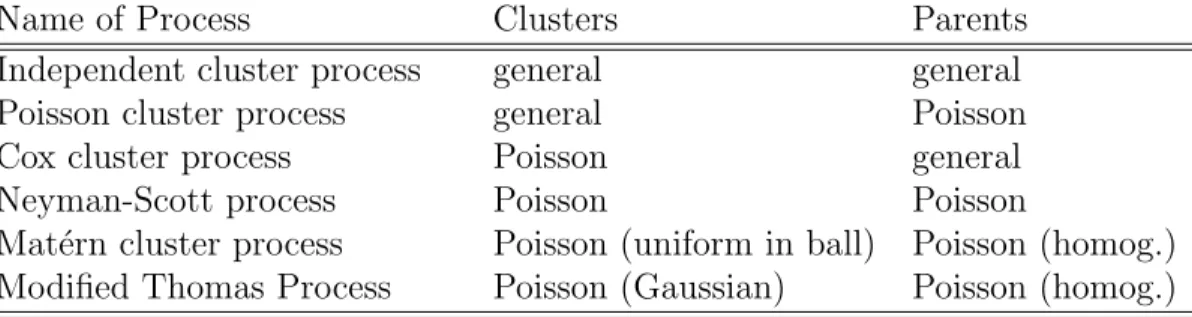
However, in order to make any type of statistical inference, we will require that the distri-bution of Y is absolutely continuous with respect to the distribution of a unit rate Poisson process onS compact and of positive volume. Table 2 summarizes standard nomenclature for various cluster processes—all of which are special cases of the independent cluster process.
Name of Process Clusters Parents
Independent cluster process general general Poisson cluster process general Poisson
Cox cluster process Poisson general
Neyman-Scott process Poisson Poisson
Mat´ern cluster process Poisson (uniform in ball) Poisson (homog.) Modified Thomas Process Poisson (Gaussian) Poisson (homog.)
Table 2: Nomenclature for independent cluster processes.
2.1.1 Neyman-Scott Processes
Definition 16 A Neyman-Scott process is a particular case of a Poisson cluster process (the daughter clusters are assumed to be Poisson).
We will now consider the case when a Neyman-Scott process becomes a Cox cluster process. LetCbe a homogeneous Poisson process of cluster centers (the parent process) with intensity λ > 0. Let C ={c1, c2, . . .}, and conditional on C associate with each ci a Poisson process
Xi centered at ci and that these processes are independent of one another. The intensity
measure ofXi is given by
µi(B) =
Z
B
αf(ξ−ci;θ)dξ
where α > 0 is a parameter and f is the density function of a continuous random variable in Rd parameterized by θ. We further assume that α and θ are known. By the
superposi-tion property of independent Poisson processes, X =∪iXi is a Neyman-Scott process with
intensity
Z(ξ) = X
ci∈C
αf(ξ−ci;θ).
Further, by the definition of a Cox process, X is also a Cox process driven by Z(ξ) = X
ci∈C
This process is stationary and is isotropic iff(ξ) only depends on||ξ||. The intensity function of the Cox process then
ρ(ξ) = E[Z(ξ)] = αλ. (4)
Example 3 (Mat´ern cluster process) A Mat´ern cluster process is a special case of a Neyman-Scott process (and also of a Cox cluster process) where the density function is
f(ξ−c;θ) = dr
d−1
Rd , for r =||ξ−c|| ≤R.
That is, conditional on C and ci ∈ C, the points xi ∈ Xi are uniformly distributed in the
ball b(ci, R) centered at ci of radius R. Here θ=R.
Example 4 (Modified Thomas process) A modified Thomas process is also a special case of a Neyman-Scott process (and also of a Cox cluster process) where the density function is f(ξ−c;θ) = 2πσ2−d/2exp − 1 2σ2||ξ−c|| 2 . That is ξ ∼Nd(c, σ2I). Here θ=σ2.
Both of these examples can be further generalized by allowing R and σ2 to depend on c.
The Neyman-Scott can be generalized in one other way.
Definition 17 Let X be a Cox process on Rd driven by
Z(ξ) = X
(c,γ)∈Y
γf(ξ−c)
where Y is a Poisson point process on Rd×(0,∞)with a locally integrable intensity function
λ. Then X is called a shot noise Cox process (SNCP).
The SNCP is different from a Neyman-Scott process in two regards. 1) γ is random and 2) the parent process Y is not homogeneous.
Now, the intensity function of X is given by ρ(ξ) =E[Z(ξ)] =
Z
γf(ξ−c)λ(c, γ)dcdγ. (5)
Theorem 4 (Slivnyak-Mecke) Let X ∼Poisson(S, ρ). For any function h : S×N`f → [0,∞) we have E " X ξ∈X h(ξ, X \ξ) # = Z S E[h(ξ, X)]ρ(ξ)dξ.
Consult Møller and Waagepetersen (2004) for a proof.
2.1.2 Edge effects
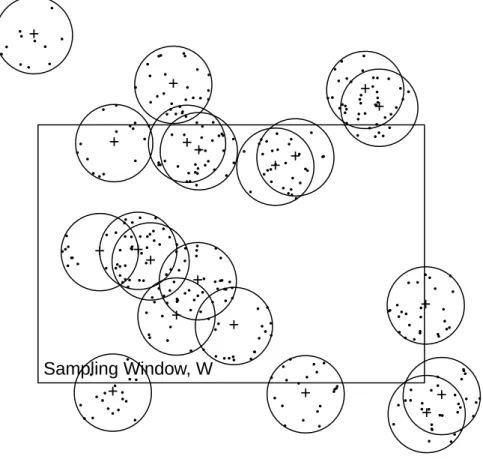
Edge effects occur in these aggregative processes when the sampling window W is a proper subset of the space of interest S. In this case it can happen that the parent process has points outside of the sampling window and that this parent point has daughter points that lie within W. This causes a bias in estimation of the intensity function. One way to reduce the bias, when modeling, is to increase the search for parents outside the sampling window W. For example, if we are using a Mat´ern cluster process with a radius of R, then we can increase our search outside ofW by this radius.
2.2
Repulsive Processes
Repulsive processes occur naturally in biological applications. For example, mature trees in a forest may represent a repulsive process as they compete for nutrients and sunlight. Locations of male crocodiles along a river basin also represent a repulsive process as males are territorial. Repulsive process are typically modeled through Markov point processes. The setup for Markov point processes will differ slightly than the setup for the point processes we have studied thus far.
Consider a point process X on S ⊂Rd with density f defined with respect to the unit rate
Poisson process. We will require |S| < ∞ so that f is well-defined. The density is then concentrated on the set of finite point configurations contained in S (I am not sure why):
Nf ={x⊂S :n(x)<∞}.
(Contrast this with Nlf = {xB ⊂ S : n(xB) < ∞, for all bounded B ⊆ S}, where xB =
+ + + + + + + + + + + + + + + + + + + + ● ● ● ● ● ● ● ● ● ● ● ● ● ● ● ● ● ● ● ● ● ● ● ● ● ● ● ● ● ● ● ● ● ● ● ● ● ● ● ● ● ● ● ● ● ● ● ● ● ● ● ● ● ● ● ● ● ● ● ● ● ● ● ● ● ● ● ● ● ● ● ● ● ● ● ● ● ● ● ● ● ● ● ● ● ● ● ● ● ● ● ● ● ● ● ● ● ● ● ● ● ● ● ● ● ● ● ● ● ● ● ● ● ● ● ● ● ● ● ● ● ● ● ● ● ● ● ● ● ● ● ● ● ● ● ● ● ● ● ● ● ● ● ● ● ● ● ● ● ● ● ● ● ● ● ● ● ● ● ● ● ● ● ● ● ● ● ● ● ● ● ● ● ● ● ● ● ● ● ● ● ● ● ● ● ● ● ● ● ● ● ●● ● ● ● ● ● ● ● ● ● ● ● ● ● ● ● ● ● ● ● ● ● ● ● ● ● ● ● ● ● ● ● ● ● ● ● ● ● ● ● ● ● ● ● ● ● ● ● ● ● ● ● ● ● ● ● ● ● ● ● ● ● ● ● ● ● ● ● ● ● ● ● ● ● ● ● ● ● ●●● ● ● ● ● ● ● ● ● ● ● ● ● ● ● ● ● ● ● ● ● ● ● ● ● ● ● ● ● ● ● ● ● ● ● ● ● ● ● ● ● ● ● ● ● ● ● ● ● ● ● ● ● ● ● ● ● ● ● ● ● ● ● ● ● ● ● ● ● ● ● ● ● ● ● ● ● ● ● ● ● ● ● ● ● ● ● ● ● ● ● ● ● ● Sampling Window, W
Figure 1: Edge effects for a Mat´ern process. Parent process is homogeneous Poisson with a constant rate of 20 in a 20×20 square field. The cluster processes are homogeneous Poisson centered at the parents (+) with a radius of 3 and a constant rate of 10.
Now, by Proposition 4, for F ⊆Nf P(X ∈F) = ∞ X n=0 exp(−|S|) n! Z S · · · Z S I({x1, . . . , xn} ∈F)f({x1, . . . , xn})dx1. . . dxn.
An example we have already seen is when X ∼ Poisson(S, ρ), with µ(S) = R
sρ(ξ)dξ < ∞. Then f(x) = exp(|S| −µ(S))Y ξ∈x ρ(ξ), (see Proposition 6).
In most cases, especially for Markov point processes, the density f is only known up to a normalizing constant: f =ch, where h:Nf →[0,∞) and the normalizing constant is
c−1 = ∞ X n=0 exp(−|S|) n! Z S · · · Z S h({x1, . . . , xn})dx1. . . dxn.
Markov models (and Gibbs distributions) originated in statistical physics where c is called the partition function.
2.2.1 Papangelou Conditional Intensity
As far as likelihood inference goes, Markov point process densities are intractable as the nor-malizing constant is unknown and/or extremely complicated to approximate. However, we can resort to MCMC techniques to compute approximate likelihoods and posterior estimates of parameters using the following conditional intensity.
Definition 18 The Papangelou conditional intensity for a point process X with density f
is defined by
λ∗(x, ξ) = f(x∪ {ξ})
f(x) , x∈Nf, ξ∈S\x,
where we take a/0 = 0 for a≥0.
The normalizing constant for f cancels, thus λ∗(x, ξ) does not depend on it. For a Pois-son process, λ∗(x, ξ) = ρ(ξ) does not depend on x either (since the points are spatially independent).
Definition 19 We say that X (or f) is attractive if
λ∗(x, ξ)≤λ∗(y, ξ) whenever x⊂y
and repulsive if
λ∗(x, ξ)≥λ∗(y, ξ) whenever x⊂y.
2.2.2 Pairwise interaction point processes
In the above discussion, f is a quite general function where all the x ∈ X can interact. However, statistical experience has shown that often a pairwise interaction is sufficient to model many types of point pattern data. Thus we restrict attention to densities of the form
f(x) =cY
ξ∈x
g(ξ) Y
{ξ,η}⊆x
h({ξ, η}) (6)
where h is an interaction function. That is h is a non-negative function for which the right hand side of (6) is integrable with respect to the unit rate Poisson process.
The range of interaction is defined by
R = inf{r >0 :∀ {ξ, η} ⊂S, h({ξ, η}) = 1 if ||ξ−η||> r}.
Pairwise interaction processes are analytically intractable because of the unknown normal-izing constant c. There is one exception: the Poisson point process where h({ξ, η})≡1, so that R = 0.
The Papangelou conditional intensity, for f(x)>0 and ξ /∈x, is given by λ∗(x, ξ) =g(ξ)Y
η∈x
h({ξ, η}).
By the definition of a repulsive process, f is repulsive if and only if h({ξ, η}) ≤ 1. Most pairwise interaction processes are repulsive. For the attractive case, when h({ξ, η})≥1 for all distinct ξ, η ∈S, f is not always well defined (one must check that it is).
Now we consider a special case where g(ξ) is constant and h({ξ, η}) = h(||ξ−η||). In this case, the pairwise interaction process is called homogeneous.
Example 5 (The Strauss Process) A simple, but non-trivial, pairwise interaction pro-cess is the Strauss process with
where we take 00 = 1. The interaction parameter γ ∈ [0,1] and R > 0 is the range of interaction. The density of the Strauss process is
f(x)∝βn(x)γsR(x) where β >0 and sR(x) = X {ξ,η}⊆x I(||ξ−η|| ≤R)
is the number of pairs of points in x that are a distance of R or less apart.
There are two limiting cases of the Strauss process. When γ = 1 we have
f(x)∝βn(x)
which is the density of a Poisson(S, β) (with respect to the unit rate Poisson). When γ < 1 the process is repulsive with range of interaction R. When γ = 0 points are prohibited from being closer than the distance R apart and is called a hard core process.
● ● ● ● ● ● ● ● ● ● ● ● ● ● ● ● ● ● ● ● ● ● ● ● ● ● ● ● ● ● ● ● ● ● ● ● ● ●● ● ●● ● ● ● ● ● ● ● ● ● ● ● ● ● ● ● ● ● ● ● ● ● ● ● ● ● ● ● ● ● ● ● ● ● ● ● ● ● ● ● ● ● ● ● ● ● ● ● ● ● ● ● ● ● ● ● ● ● ● ● ● ● ● ● ● ● ● ● ● ● ● ● ● ● ● ● ● ● ● ● ● ● ● ● ● ● ● ● ● ● ● ●● ● ● ● ● ● ● ● ● ● ● ● ● ● ● ● ● ● ● ● ● ● ● ● ● ● ● ● ● ● ● ● ● ● ● ● ● ● ● ● ● ● ● ● ● ● ● ● ● ● ● ●
Table 3: Realizations of Strauss processes on S = [0,1]2. Here β = 100, R = 0.1 and
γ = 1.0, 0.5, 0.0 from left to right. Processes generated from the function rStrauss in the R package spatstat by Adrian Baddeley.
2.3
Marked Processes
Let Y be a point process onT ⊆Rd. Given some space M, if a random ‘mark’ m
ξ ∈ M is
attached to each point ξ∈Y, then
is called amarked point process with points in T andmark space M. Marks can be thought of as extra data or information associated with each point in Y.
Example 6 We have already encountered a marked point process, although we did not iden-tify it as such. In Definition 17, we defined the SNCP. In that definition Y was considered a Poisson point process on Rd×(0,∞). However, we can also consider it a marked point
process with points in Rd and mark space M= (0,∞).
Definition 20 (Marked Poisson processes) Suppose that Y is Poisson(T, ρ), where ρ
is a locally integrable intensity function. Also suppose that conditional on Y, the marks
{mξ : ξ ∈ Y} are mutually independent. Then X = {(ξ, mξ) :ξ ∈ Y} is a marked Poisson
process. If the marks are i.i.d. with common distribution Q, then Q is called the mark distribution.
Now we will discuss three marking models: 1) independent marks, 2) random field model and 3) intensity-weighted marks.
The simplest model for marks is the independent marks model. In this model, the marks are i.i.d. random variables and are independent of the locations of the point pattern. If X ={(ξ, mξ) :ξ∈Y} then the density of X can be factorized as
π(X) = π(Y)π(m).
The random field model, a.k.a. ‘geostatistical marking’ is the next level of generalization. In the random field model, the marks are assumed to be correlated, but independent of the point process Y. The marks are derived from the random field:
mξ =Z(ξ)
for some (stationary) random fieldZ such as the Gaussian random field.
The next level of generalization is to assume that there is correlation between the point density and the marks. An example of such a model is the intensity-weighted log-Gaussian Cox model. Y is a stationary LGCP driven byZ. Each pointξ ∈Y is assigned a mark mξ
according to
mξ=a+bZ(ξ) +ε(ξ)
whereε(ξ) are i.i.d. N(0, σ2
ε) anda and b are model parameters. Whenb >0 the marks are
large in areas of high point density and small in areas of low point density. When b <0 the marks are small in regions of high point density and large in regions of low point density. When b = 0 the marks are independent of the point density.
3
Simulation and Bayesian Methods
3.1
Fast Simulation for LGCPs
The following is adapted from Møller, Syversveen, and Waagepetersen (1998). Recall that a Gaussian random field is completely specified by its finite dimensional distributions. There-fore, to simulate a stationary Gaussian random field, we discretize it to a uniform grid and define the appropriate finite dimensional Gaussian distribution on this grid. Consider for a moment a Gaussian random field Y on the unit square S = [0,1]2. We discretize the unit
square into an M ×M grid I with cells Dij = [(i−1)/M, i/M]×[(j −1)/M, j/M] where
the center of cell Dij is given by (ci, cj) = ((2i+ 1)/(2M),(2j + 1)/(2M)) and we then
approximate the Gaussian random field{Y(s)}s∈[0,1]2 by its value Y((ci, cj)) at the center of
each cell Dij. This is easily extended to rectangular lattices.
Now take the lexicographic ordering of the indices i, j: k = 2M i+M(2M j−1) and thus Yk = Y((ci, cj)). Let Y = (Y1, . . . , YM2)T (hopefully without any confusion). Now the
problem is to simulate Y ∼NM2(0,Σ) (w.l.o.g. we can assume the mean of the stationary
GRF is 0). Here Σ has elements of the formC(||(ci, cj)−(c0i, c
0
j)||) = σ2r(||(ci, cj)−(c0i, c
0
j)||/α)
(or some other valid isotropic covariance function).
Easy, correct? Well in theory this is simple if Σ is a symmetric positive definite matrix. We take the Cholesky decomposition of Σ, say GGT, where G is lower triangular, simulate M2
normal mean 0, variance 1 random variates, x = (x1, . . . , xM2)T, and set Y =Gx. We may
also need to evaluate the inverse of Σ as well as its determinant.
However, for many grids, M can be moderately large, say 128. Then Σ is a 1282 ×1282 matrix and it gets even worse if we need to simulate a GRF on a bounded S ⊂ Rd where
d ≥ 3. The Cholesky decomposition is an expensive operation O(n3) and if M is too large
we may not even have enough RAM in our computers to compute it.
Now consider Σ to be symmetric non-negative definite, and for simplicity consider simulation of a Y on [0,1] (Note that we are in one-dimensional Euclidean space now). The following method (Rue and Held, 2005) will work for any hyperrectangle in any Euclidean space, with a few minor modifications.
Let’s first assume that M = 2n for some positive constant n. First, we note that Σ is a
Toeplitz matrix. Next, we embed Σ into a circulant matrix of size 2M×2M by the following procedure. Extend [0,1] to [0,2] and map [0,2] onto a circle with circumference 2 and extend the grid fromI with M cells toIext with 2M cells. Let dij denote the minimum distance on
2M ×2M.
You may be wondering at this point, why extend the matrix and make it 4 times as large when we the original matrix was too unwieldy. The answer to this is that there is a relationship between the eigenvalues and eigenvectors of a circulant matrix and the discrete Fourier transform. Thus we can use the fast Fourier tranform (FFT) to compute the eigenvalues and eigenvectors of a circulant matrix and, once these are in hand, can perform all of necessary matrix operations. In particular we will be able to draw a value fromNM(0,Σ) by drawing
fromN2M(0,Σext) and taking the firstM values.
Definition 21 A M ×M matrix C is circulant if and only if it has the form
C = c0 c1 c2 · · · cM−1 cM−1 c0 c1 · · · cM−2 cM−2 cM−1 c0 · · · cM−3 .. . ... ... · · · c1 c2 c3 · · · c0 .
We call c= (c0, c1, . . . , cM)T the base of C. (actually any row or column of C will suffice as
the base).
Let λ be any eigenvalue of C with associated eigenvector e. Then Ce = λe. This can be written row by row as M difference equations,
j−1 X i=0 cM−j+iei+ M−1 X i=j ci−jei =λej, for j = 0, . . . , M −1 =⇒ M−1−j X i=0 ciei+j+ M−1 X i=M−j ciei−(M−j) =λej. (7)
This system of M linear difference equation have constant coefficients, and so like with systems of linear differential equations with constant coefficients we guess that the solution has the form ej ∝ρj for some complex scalar ρ. Now (7) can be written as
M−1−j X i=0 ciρi+ρ−M M−1 X i=M−j ciρi =λ.
Now choose ρ such thatρ−M = 1, then
λ =
M−1
X
i=0
and
e = √1
M(1, ρ, ρ
2, . . . , ρM−1
)T,
where we have included the factor √M so that e is orthonormal: eTe = 1. Now, since
ρM = 1 and ρ is complex, we have that the M roots of 1 are {exp(2πıj/M), j = 0, . . . , M} where ı=√−1. Thus, the M eigenvalues are
λj = M−1
X
i=0
ciexp(−2πı ij/M), j = 0, . . . , M −1
with corresponding eigenvectors
ej =
1 √
M (1,exp(−2πı j/M),exp(−2πı j2/M), . . . ,exp(−2πı j(n−1)/M))
T
, for j = 0, . . . , M −1.
Letω = exp(−2πı/M) and let
F = (e0|e1|. . .|eM−1) = 1 √ M 1 1 1 · · · 1 1 ω1 ω2 · · · ωM−1 1 ω2 ω4 · · · ω2(M−1) .. . ... ... · · · 1 ωM−1 ω2(M−1) · · · ω(M−1)(M−1)
be the discrete Fourier transform matrix and define Λ = (λ0, λ1, . . . , λM−1).
F is unitary matrix: F−1 =FH where FH is the complex conjugate transpose of F and
Λ =√Mdiag(Fc).
One can verify that C = FΛFH by direct calculation. Thus, any circulant matrix can be
diagonalized by some Λ.
SinceF is the discrete Fourier transform (DFT) matrix,F v can be calculated by taking the DFT of some vector v and FHv is calculated by taking the inverse DFT (IDFT) of v. Now if M can be factorized into small primes, the fast Fourier transform (FFT) can be used and F v can be computed inO(nlnn) operations.
LetXext be a vector of 2M i.i.d. N(0,1) random variables. Then,Yext is equal in distribution
to Σ1ext/2Xext. Now, diagonalize Σext = FΛFH, which in turn implies Σ
1/2 ext = FΛ1/2FH and that Yext d = Σ1ext/2Xext =FΛ 1/2 FHXext.
So we computeFHX
ext = IDFT(Xext). Compute Λ1/2 =
q√
MDFT(c). Letb = Λ1/2FHX
ext,
then b= q√
MDFT(c)IDFT(Xext) where denotes elementwise mulitplication. Finally
take Yext d = Σ1ext/2Xext = DFT(b) = DFT q√ MDFT(c)IDFT(Xext) . Y is then obtained by taking the first M elements of Yext.
This is much faster than trying to compute the Cholesky decomposition of Σ when the number of elements is large. When we wish to simulate a GRF in R2, then we extend
covariance matrix by wrapping it around a torus to define the distances. We end up with a block circulant matrix and we use the 2D-DFT. For simulation of a GRF inR3, the extended
covariance matrix is a nested block circulant matrix and we use the 3D-DFT.
3.2
Bayesian modeling of a LGCP
Now back to LGCP. Suppose we have a realizationx of a spatial point patternX inS ⊂R2
for which we wish to estimate the intensity function. We will assume that a LGCP model is appropriate for the data. The intensity we wish to estimate is Z(ξ) = exp(Y?(ξ) + µ)
where Y? is a stationary mean zero GRF. Let Y(ξ) = Y?(ξ) +µ. Assume that µ is known as well as the σ2 and α in the isotropic covariance function c(·) =σ2r(·/α). The first order
of business is to write down the density of the process with respect to a unit rate Poisson: π(x|Y, µ)∝exp − Z S exp(Y(ξ))dξ Y xi∈x exp(Y(xi)).
After discretizing onto a fine grid and then extending we can write the log density as ln[π(x|Y =y)]∝ X
(i,j)∈Iext
(−Aijexp(yij) +nijyij)
where Aij is the area of cell Dij and nij is the number of points of x contained in cell Dij
and yij is the value of the Gaussian process at the center of cellDij. We set Aij =nij = 0 if
(i, j)∈/ I (thus (i, j)∈Iext\I). As shown in Møller, Syversveen, and Waagepetersen (1998),
it is computationally more efficient to work with Σ−1/2W
ext where Wext ∼ Nd(0, I) where
d= (2M)2. Now [W |x] has log density ln[π(w|x)]∝ −1/2||w||2+ X (i,j)∈Iext −Aijexp((Σ1/2w)ij) +nij((Σ1/2w)ij) .
Since this posterior does not have a form which can be easily sampled from, we must resort to MCMC. We need to update w which is an extremely long vector. Using the Metropolis-Hastings algorithm mixes very slowly, so instead Møller, Syversveen, and Waagepetersen
(1998) proposed the use of the Metropolis adjusted Langevin algorithm (MALA), suggested initially by Besag (1994) and further studied Roberts and Tweedie (1997).
MALA requires the gradient of the posterior (which is strictly log-concave). Let the gradient of the posterior of w be denote∇(w),
∇(w)≡ ∂ln [π(w|x)] ∂w =−w+ Σ 1/2 n ij −exp(Σ1/2w)Aij (i,j)∈Iext.
MALA is specified in two steps. First, if w(t) is the current draw, we propose a new draw
ω(t+1) from the an independent multivariate normal distribution with meanm(w(t)) = w(t)+ (h/2)∇(w(t)) and common variance h. Second, with probability
1∧π(ω
(t+1) |x) exp(−||w(t)−m(ω(t+1))||2/(2h))
π(w(t)|x) exp(−||ω(t+1)−m(w(t))||2/(2h))
w(t+1)=ω(t+1), otherwise w(t+1)=w(t).
We can also assign priors to µ, σ2 and α. The full conditionals of these parameters do not
have closed form and so we must use the Metropolis-Hastings algorithm to update these parameters.
3.3
Bayesian Analysis of Cluster Processes & the Spatial Birth
and Death Process Algorithm
We will use the notation from last lecture and assume that X is a finite point process on Rd and conditional on X we associate with each ξ ∈ X a finite point process Yξ of points
centered onξ and that these processes are independent of one another. ThenY =∪ξ∈XYξ is
an independent cluster process. We will assume that the parent process X is not observed. To simplify the exposition, we will assume that the processes X and Y are both only found on a bounded subset S of Rd and that we observe the process Y on all of S. This avoids
edges effects.
Assume that each Yξ is a Poisson process with known intensity h(·;ξ). The observed data
will be denoted y = {y1, y2, . . .}. We will also assume that some of the points in y don’t
cluster with other points and that these points follow a homogeneous Poisson process with intensity. Then the intensity function forY, conditional onX =x={x1,· · · , xn}, is given
by λ(· |x) = + n X i=1 h(·;xi),
and the conditional density of Y givenx with respect to a unit rate Poisson is π(y|x) = exp Z S [1−λ(η|x)]dη Y η∈y λ(η;x).
The goal of the analysis is to estimate λ(· | x). However, x is not observed and are latent data and so must be estimated. To this end, we need to estimate the posterior ofX giveny:
π(x|y)∝π(y|x)π(x) =π(x) exp Z S [1−λ(η|x)]dη Y η∈y λ(η;x),
whereπ(x) is the prior density forX. For concreteness, let’s assume thatX ∼Poisson(S, ρ) (not necessarily homogeneous).
The posterior Papangelou conditional intensity is
λ∗X|Y(x|y, ξ) =λ∗X(x, ξ) exp − Z S h(s|ξ)ds Y η∈y 1 + h(η;ξ) λ(η|x)
Standard MCMC algorithms (such as Metropolis-Hastings) will not work for this problem as not only are the locations ofxrandom, but the number of pointsn(X) is random as well. RJMCMC (Green, 1995) is one option (there are at least four algorithms that are possible). However, we will only discuss one, developed by Preston (1977).
The spatial birth and death process (Preston, 1977; Møller and Waagepetersen, 2004) is a continuous time Markov process whose transitions are either births or deaths which can be used to simulate spatial point processes.
3.3.1 The Spatial Birth and Death Algorithm
We wish to construct a spatial birth-and-death process to simulate a latent parent point process X from its posteriorπ(x|y), given it offspring, or daughters. If the birth and death rates satisfy the detailed balance equation (Preston, 1977)
π(x|y)b(x, ξ) =π(x∪ {ξ} |y)d(x∪ {ξ},{ξ}), (8) then the chain is time reversible and that the spatial birth-and-death process has a unique equilibrium distribution π(x|y) to which it converges in distribution from any initial state (with a few extra conditions imposed on the total birth and death rates discussed below). In (8) b(x, ξ) is the birth rate for adding a new point ξ to the current configuration, x, of the point process X, and d(x, ξ) denotes the death rate for removing a point ξ from x. A
common strategy is to assume a constant death rate and use a birth rate proportional to the posterior Papangelou conditional intensity. However, the total birth rate (see below) may be difficult to compute and their may be a large number of terms in the product. An alternative birth rate, suggested by van Lieshout and Baddeley (2002), is given by
b(x, ξ) =λ∗X(x, ξ) " 1 +X η∈y h(η;ξ) # .
To satisfy the detailed balance equation, the death rate for removing ξ fromx∪ {ξ}is
d(x∪ {ξ}, ξ) = exp R Sh(s;ξ)ds Q η∈y h 1 + hλ((ηη;|xξ)) i " 1 +X η∈y h(η;ξ) e # .
The total birth rate is given by
B(x) = Z S b(x, ξ)dξ = Z S λ∗X(x, ξ) " 1 +X η∈y h(η;ξ) # dξ
and the total death rate is
D(x) = X
ξ∈x
d(x, ξ).
The conditions on the total birth rate and total death rate are that the birth rate must be bounded above by a constant B and the death rate must be bounded below by a constant D ≥ 0. The total birth rate B(x) may be difficult to compute here as well as it may be difficult to integrate λ∗X(x, ξ) w.r.t. ξ over S. Thus, we resort rejection sampling. If λ∗X(x, ξ)≤λ uniformly inxandξ andh(η;ξ)≤H uniformly inη andξ, then the total birth rate is bounded: B(X)≤λ " |S|+1 X η∈y Z S h(η;ξ)dξ # ≤λ|S| 1 + n(y)H ≡B.
The total death rate is bounded below byn(x)(1 +H/)−n(y)(see van Lieshout and Baddeley
(2002)).
Suppose that we can integrateh(η;ξ) over S easily. This is the case for the Mat´ern process and the modified Thomas process. Let
B =λ " |S|+1 X η∈y Z S h(η;ξ)dξ # .
If the current state isx, after an exponentially distributed waiting time with rateB+D(X), a death of a point in x occurs with probability D(X)/[B +D(x)]. If a death is to occur, the point, ξ, is deleted from x with probability d(x, ξ)/D(X). A birth is proposed with complementary probability B/[B+D(x)]. Sample a candidate ξ from the mixture density
λ B " 1 +X η∈y h(η|ξ) # (9)
and accept the candidate ξ as a new point in the parent process with probability λ∗X(x, ξ)
λ .
To draw a candidate ξ from (9) note that we can rewrite it as λ|S| B 1 |S| + X η∈y λR Sh(ξ|η)dξ B h(ξ|η) R Sh(ξ |η)dξ .
Therefore, with probability λ|S|/B we draw a point uniformly over S and with probability λRSh(η|ξ)dξ/(B) we draw a pointξ fromh(ξ |η)/RSh(ξ |η)dξ
References
Besag, J. E. (1994). Discussion of the paper by grenander and miller. Journal of the Royal Statistical Society, Series B 56, 591–592.
Cox, D. R. (1955). Some statistical models related with series of events. Journal of the Royal Statistical Society, Series B 17.
Daley, D. J. and Vere-Jones, D. (2003). An Introduction to the Theory of Point Pro-cesses, Volume I: Elementary Theory and Methods. 2 edition. Springer.
Daley, D. J. and Vere-Jones, D. (2008). An Introduction to the Theory of Point Pro-cesses, Volume II: General Theory and Structure. 2 edition. Springer.
Diggle, P. J. (2007). Spatio-temporal point processes: methods and applications. In Finkenstad, B., Held, L., and Isham, V., editors, Statistical Methods for Spatio-temporal Systems, pages 1–45. Chapman & Hall/CRC.
Green, P. J. (1995). Reversible jump markov chain monte carlo computation and bayesian model determination. Biometrika 82, 711–732.
Illian, J., et al. (2008). Statistical Analysis and Modelling of Spatial Point Patterns. John Wiley & Sons.
Møller, J., Syversveen, A. R., and Waagepetersen, R. P. (1998). Log gaussian cox pro-cesses. Scand. J. Statist. 25, 451–482.
Møller, J. and Waagepetersen, R. P. (2004). Statistical Inference and Simulation for Spatial Point Processes. Chapman and Hall/CRC.
Møller, J. and Waagepetersen, R. P. (2007). Modern statistics for spatial point processes.
Scandinavian Journal of Statistics 34, 643–684.
Preston, C. J. (1977). Spatial birth-and-death processes. Bulletin of the International Statistical Institute 46, 371–391.
Roberts, G. O. and Tweedie, R. L. (1997). Exponential convergence of langevin diffu-sions and their approximations. Bernoulli 2, 341–363.
Rue, H. and Held, H. (2005).Gaussian Markov Random Fields. Chapman & Hall/CRC. van Lieshout, M. N. M. and Baddeley, A. J. (2002). Extrapolating and interpolating spatial patterns. In Lawson, A. B. and Denison, D. G. T., editors, Spatial Cluster Modelling, chapter 4, pages 61–86. Chapman & Hall/CRC.
![Table 1: Realizations of LGCPs on S = [0, 512] 2 with m(ξ) = 4.25, σ 2 = 1 and α = 0.01.](https://thumb-us.123doks.com/thumbv2/123dok_us/457239.2553229/10.918.134.801.656.852/table-realizations-lgcps-s-m-ξ-σ-α.webp)
![Table 3: Realizations of Strauss processes on S = [0, 1] 2 . Here β = 100, R = 0.1 and γ = 1.0, 0.5, 0.0 from left to right](https://thumb-us.123doks.com/thumbv2/123dok_us/457239.2553229/18.918.133.804.546.752/table-realizations-strauss-processes-s-β-left-right.webp)