Mishra, Nishikant (2012) A novel case-based reasoning
approach to radiotherapy dose planning. PhD thesis,
University of Nottingham.
Access from the University of Nottingham repository: http://eprints.nottingham.ac.uk/29347/1/575531.pdf
Copyright and reuse:
The Nottingham ePrints service makes this work by researchers of the University of Nottingham available open access under the following conditions.
· Copyright and all moral rights to the version of the paper presented here belong to
the individual author(s) and/or other copyright owners.
· To the extent reasonable and practicable the material made available in Nottingham
ePrints has been checked for eligibility before being made available.
· Copies of full items can be used for personal research or study, educational, or
not-for-profit purposes without prior permission or charge provided that the authors, title and full bibliographic details are credited, a hyperlink and/or URL is given for the original metadata page and the content is not changed in any way.
· Quotations or similar reproductions must be sufficiently acknowledged.
Please see our full end user licence at:
http://eprints.nottingham.ac.uk/end_user_agreement.pdf A note on versions:
The version presented here may differ from the published version or from the version of record. If you wish to cite this item you are advised to consult the publisher’s version. Please see the repository url above for details on accessing the published version and note that access may require a subscription.
A Novel Case-Based Reasoning
Appraoch to Radiotherapy Dose
Planning
by
Nishikant Mishra
Thesis submitted to The University of
Nottingham for the degree of Doctor of
The University of
Nottingham
Information Services
Ethos - Thesis for digitisation
Thesis details: Mishra, Nishikant
A novel case-based reasoning approach to radiotherapy
dose planning
Please exclude the following sectionsl pages:
Abstract
In this thesis, novel Case-Based Reasoning (CBR) methods were developed to be included in CBRDP (Case-Based Reasoning Dose Planner) -an adaptive decision support system for radiotherapy dose planning. CBR is an artificial intelligence methodology which solves new problems by retrieving solutions to previously solved similar problems stored in a case base. The focus of this research is on dose planning for prostate cancer patients. The records of patients successfully treated in the Nottingham University Hospitals NHS Trust, City Hospital Campus, UK, were stored in a case base and were exploited using case-based reasoning for future decision making. After each successful run of the system, a group based Simulated Annealing (SA) algorithm automatically searches for an optimal/near optimal combination of feature weights to be used in the future retrieval process of CBR.
A number of research issues associated with the prostate cancer dose planning problem and the use of CBR are addressed including: (a) trade-off between the benefit of delivering a higher dose of radiation to cancer cells and the risk to damage surrounding organs, (b) deciding when and how much to violate the limitations of dose limits imposed to surrounding organs, (c) fusion of knowledge and experience gained over time in treating patients similar to the new one, (d) incorporation of the 5 years Progression Free Probability and success rate in the decision making process and (e) hybridisation of CBR with a novel group based simulated annealing algorithm to update knowledge/experience gained in treating patients over time.
The efficiency of the proposed system was validated using real data sets collected from the Nottingham University Hospitals. Experiments based on a leave-one-out strategy demonstrated that for most of the patients, the dose plans generated by our approach are coherent with the dose plans prescribed by an experienced oncologist or even better. This system may play a vital role to assist the oncologist in making a better decision in less time; it incorporates the success rate of previously treated similar patients in the dose planning for a new patient and it can also be used in teaching and training processes. In addition, the developed method is generic in nature and can be used to solve similar non-linear real world complex problems.
Acknowledgements
I would like to thank my supervisor, Professor Sanja Petrovic for all the advice and support she gave me throughout my doctoral study. This research would not have been possible without her learned guidance as well as confidence shown by her in me, which has helped me quite a lot.
I am very grateful of Dr. Santhanam Sundar and the staff of the Department of Oncology at Nottingham University Hospitals NHS, City Hospital Campus, UK, for their valuable advice and support. I really appreciate their participation and time they took out of their busy schedule to help us with this research work.
I would also like to thank my family, who in their own ways always supported me. Furthermore, special thanks to Professor M. K. Tiwari, Indian Institute of Technology (lIT) Kharagpur, India for his encouragement, inspiration and giving a dream. I also would like to acknowledge the support of Rupa Jagannathan, Dr Vikas Kumar, my brothers Prashant Kumar and Dr. Manish Kumar for always having an open door to discuss.
Finally, I would like to thank my colleagues in the School of Computer Science, University of Nottingham for their support throughout the doctoral study.
Dedicated to
My dear mother, Smt. Shobha Mishra and father, Shri Bijay
Kumar Mishra
Contents
List of Tables
List of Figures
1. Introduction
1.1 Background 1.2 Motivation 1.3 Research Objectives 1.4 Layout ofthe Thesis 1.5 Dissemination of Results1.5.1 Journal Papers 1.5.2 Conference Papers 1.5.3 Book Chapters
1.5.4 Seminars and Workshops
2. Case-Based Reasoning (CBR)
2.1 Introduction
2.2 What is Case-Based Reasoning?
2.3 Methodology and Research Issues in CBR 2.3.1 Case-Based Reasoning Framework 2.3.2 Case Representations
2.3.3 Retrieval 2.3.4 Adaptation 2.3.5 Maintenance
2.4 Case-Based Reasoning for Healthcare Systems 2.5 Conclusion 09 10 11 11 12 14 15 19 19 20 21 21 23 23 23 25 25 26 28 31 33 34 38
3.
The Radiotherapy Planning Problem
403. I Introduction 40
3.2 Issues of Radiotherapy Planning Problems and Classification 43 of Problems
3.2.1 Beams Configuration 46
3.2.2 Wedge Configuration 47
3.2.3 Movement of Organs and Outline of the Treatment 48 Volume
3.2.4 Comparison of Treatment Methods 49
3.2.5 The Dose Planning Problem 50
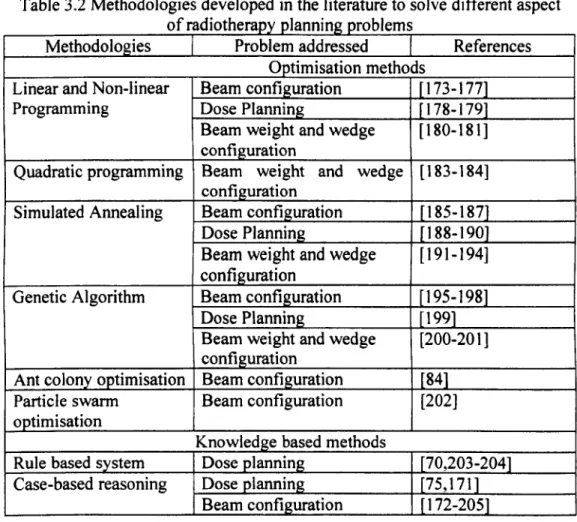
3.3 Existing Approaches 51
3.4 Conclusion 54
4. A Novel Case-Based Reasoning Approach to
56Radiotherapy Planning
4.1 Introduction 56
4.2 Prostate Cancer Dose Planning 57
4.3 Solution Methodology 61
4.3.1 Representation of a Case 62
4.3.2 Retrieval Process 63
4.3.3 A Novel Fusion Technique Based on the Dempster- 65 Shafer Rule
4.3.4 Repair/ Adaptation Mechanism 76
4.4 Simulated Annealing Based Dynamic Feature weight 79 Learning Mechanism
4.5 Experimental Results 79
4.6 Concision 83
5. A Knowledge-Light Adaptation in Case-Based
90Reasoning for Radiotherapy Planning
5.1 Introduction 90
5.2 Non-Linearity of Dose Planning Problem 92 5.3 Knowledge-Light Adaptation in Case-Based Reasoning 93
5.3.1 Similarity Measure 95
5.3.2 Cases Difference Vector 97
5.3.3 Adaptation Method Based on Local Linear Regression 98 5.3.4 Adaptation Method Which Combines Cases Difference 100
and Gradients in a Vector
5.4 An Illustrative Example 106
5.5 Experimental Results 108
5.6 Conclusion III
6. An Adaptive Case-Based Reasoning System for Dose
113Planning in Prostate Cancer Radiotherapy
6.1 Introduction 113
6.2 A Novel Trade-off Method for Retrieval Process 114
6.2.1 Group Based Trade-off Method 116
6.3 Group Based Simulated Annealing Adaptive Feature Weight 119 Learning Mechanism
6.4 Experimental Results 121
6.5 Conclusion 127
7. Conclusions and Future Research Work
1297.1 Contribution 13 1
7.2 Limitations 135
7.3 Applicability to Other Domains 137
Appendix A
Medical Dictionary140
Appendix B
eBRDP Software Reference Manual143
List of Tables
2.1 CBR in medicine 35
3.1 Issues of radiotherapy planning problem raised in the literature 46 3.2 Methodologies developed in the literature to solve different 53
aspect of radiotherapy planning problems
4.1 Total dose limits for rectum 61
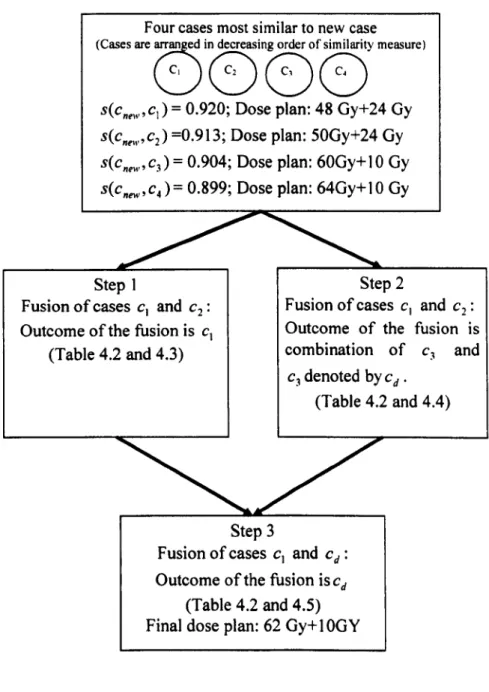
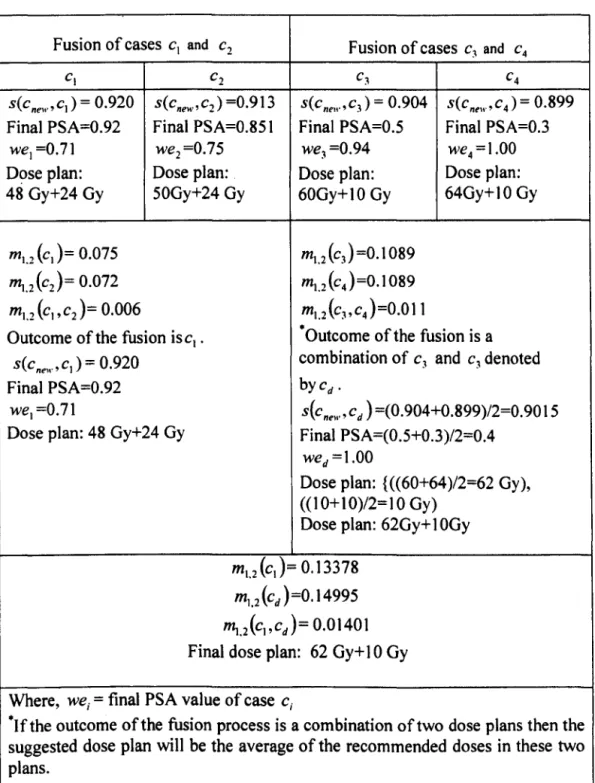
4.2 Example of a fusion of four cases 72
4.3 Fusion of cases Cl and Cz 73
4.4 Fusion of cases C3 and C 4 74
4.5 Fusion of Cl andcd 75
4.6 An example of calculation of dose limit after the fusion 77 4.7 Weights obtained by Simulated Annealing based weight 87
learning mechanism
5.1 An example of nonlinear nature of the radiotherapy planning 91 problem
5.2 An example of non-uniform gradient nature of the 92 radiotherapy planning problem
5.3 An example of the calculation of dose limits 、 ョ セ キ N ォ G 100
k
=
1,2,3,45.4 An example of the calculation of the gradient in phase I of the 103 treatment
5.5 Case cnew 107
5.6 Case cnewsim 107
5.7 Case Cl 107
5.8 Case c2 108
5.9 Calculation of dose limits d"ew.k' k
=
I, 2, 3, 4 1085.10 Results of the proposed methodology compared with the other 110 methods
5.11 Comparative results of different types of trade-off functions III 6.1 Illustration of the triplet id of cases in the case base 117 6.2 Comparison of the proposed methodology and our earlier CBR 123
approaches
List of Figures
1.1 Structure of the thesis 3.1 A linear accelerator
3.2 A close-up view of multi-leaf collimator
16 45 45
4.1 Prostate cancer dose planning 58
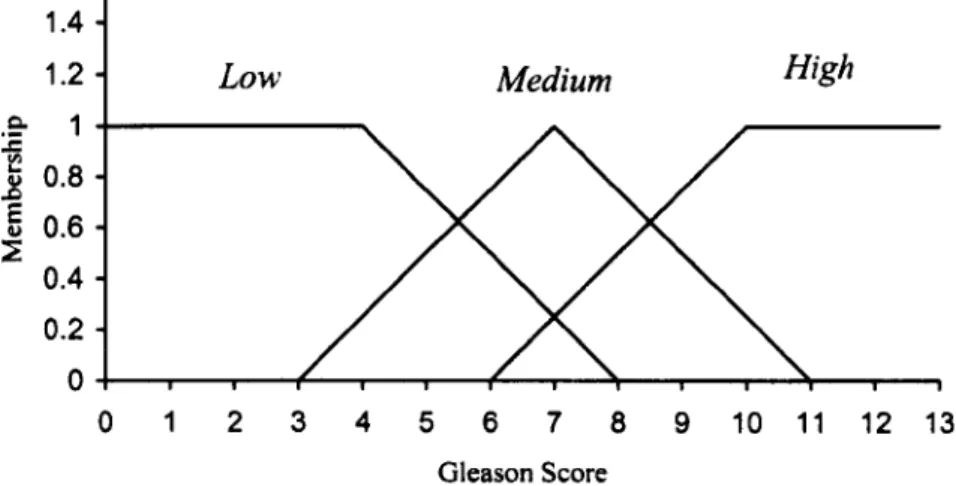
4.2 Proposed cancer dose planning process 59 4.3 Architecture of the proposed CBR system 61 4.4 Membership function of fuzzy sets low, medium and high 63
Gleason score
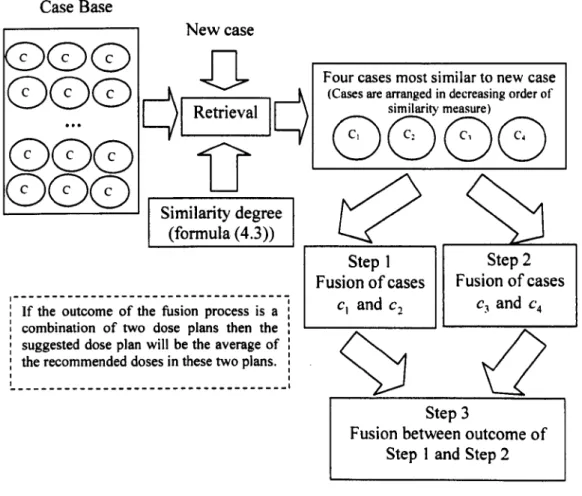
4.5 Mapping of PS A values to corresponding weights 68 4.6 Architecture of the proposed fusion technique 69
4.7 Flow chart of fusion of four cases 71
4.8 A demonstration of the repair mechanism 79
4.9 Flow chart of leave-one-out strategy 84
4.10 Success rate of the CBR system with different number of 85 retrieved cases
4.11 Convergence trend of the Simulated Annealing based 88 weight learning mechanism
5.1 Flow chart of adaptation method which combines cases 105 difference and the gradient in a vector
6.1 Illustration of range of values set for trade-off parameters 118 6.2 Architecture of the proposed knowledge-light adaptation in 119
CBR
6.3 Convergence trend of the group based and simple SA 124 weight learning algorithm
CHAPTER 1
Introduction
In this thesis, novel case-based reasoning approaches to radiotherapy dose planning problems are presented. The problem of dose planning for prostate cancer at the Nottingham University Hospitals NHS, City Hospital Campus, UK are investigated. The proposed case-based reasoning framework is generic in nature and can be used to solve similar complex non-linear real world problems. In this chapter, research background, motivation, research objectives and layout of the thesis are described.
1.1 Background
Cancer is a class of disease, caused by abnormal and uncontrolled proliferation of cells. It can spread to other parts of the body either directly or through the blood or the lymph. Lymph is a clear fluid that travels through the lymphatic system and one of its functions is to carry cells that defend the body against both infectious diseases and foreign materials. Cancer is an environmental disease with 90-95% of its cases attributed to environmental factors and 5-10% due to genetics [1]. The common environmental factors related to cancer deaths are: tobacco (25-30%), diet and obesity (30-35%), infections (15-20%), radiation (10%), stress and lack of physical activity (5-10%) [1]. There are more than 100 different types of cancers. It is generally named after the organ or the type ofthe cell in which it started. For example, cancer that begins in the prostate (a small gland of the male reproductive system) is called prostate cancer.
In a survey, it was found that 12.7 million new cases of cancer are diagnosed around the world every year and this number is expected to increase to 26 million by 2030 [2]. The UK has one of the highest cancer rates (22nd ), about
267 in 100,000 people in this country are diagnosed with cancer each year. One in four (27%) of all deaths in the UK are caused by cancer. There were 156.723 cancer deaths in the UK in the year 2008 [3]. The four most common cancers in the UK are breast cancer, colon cancer. prostate cancer and lung cancer. Prostate cancer is the most common form of cancer among the male population. In 2008, there were 37,051 new cases of prostate cancer diagnosed in the UK, which is around 101 men every day or one man every 15 minutes [4].
1.2 Motivation
Radiotherapy planning is a complex and time consuming process. In the earlier days, oncologists used to spend a large amount of time to generate a treatment plan using their past experience. A poorly constructed treatment plan may have an overdose to the normal cells and/or a under dose to the cancer cells. The planning process has drawn considerable attention from both practitioners and academics over the past few decades and led to the development of several software systems such as Helax-TMS, eMS Xio and Oncentra MasterPlan. Most of the existing software systems are generic in their nature. However, different hospitals usually follow different ways of treatment while respecting the recommended guidelines of the UK standard. For example, in the Nottingham University Hospital oncologists usually use a fixed number of beams (i.e. four beams) in prostate cancer treatment. The radiotherapy problem
can be described as an optimisation problem. However, due to the large size of the search space of the problem it is difficult to achieve approximate global optimality using existing software. The main goal of all the developed optimisation methods is to attain a uniform tumoricidal dose and to minimise the side effects ofthe treatment. However, success rate of the treatment is often overlooked. It is very difficult to develop a mathematical model which would judge the success rate of the plan before the treatment. This can be predicted to
some extent from the past experience of the oncologist.
Researchers investigated different knowledge based methods such as rule-based reasoning, case-rule-based reasoning or hierarchical organisation of knowledge to capture the expertise and experience of oncologists in treating previous patients. They tried to mimic the way an oncologist plans the treatment. However, the developed knowledge-based methods are generally static in nature. In real life, oncologists cautiously learn from their past experience.
The lack of academic and industrial research in provision of adaptive methods for the radiotherapy planning problem which learn over time has inspired this PhD research. Radiotherapy dose planning process followed in the Nottingham University Hospital was investigated and various mode ling issues were identified. In particular, the following issues were addressed:
-How to make a trade-off between the benefits of delivering a higher dose of radiation and the risk to surrounding organs.
-How to incorporate the experience of an oncologist to decide when and how much to violate limitations on the dose limits.
-How to fuse knowledge and experience in treating patients similar to new ones.
-How to include the 5 years Progression Free Probability and the success rate in the decision making process.
-How to update knowledge/ experience in treating patients over time.
1.3 Research Objectives
In this thesis, CBRDP (Case-Based Reasoning Dose Planner), an adaptive decision support system, was developed for radiotherapy dose planning problems. During its development the radiotherapy dose planning problem, as well as the methods which currently exist to solve them, were thoroughly investigated. The thesis aims to address the following research objectives:
(a) To investigate the complex radiotherapy dose planning problems, in particular focusing on the problem of determining the most appropriate dose plan for prostate cancer in the two stage treatment process.
(b) To explore the use of various existing methods in addressing the radiotherapy planning problems.
(c) To investigate the non-linear nature of the radiotherapy dose planning problem and to explore current 'state-of-the-art' case-based reasoning methods to resolve them.
(d) To model a complex radiotherapy dose planning problem followed in the Nottingham University Hospital, UK and to explore the relevance of this model to other problems in the literature.
(e) To study and investigate the oncologists' decision making process for radiotherapy dose planning. This will also include the trade-off between
(f) To develop an adaptive novel case-based reasoning method for radiotherapy dose planning problems which can also be used to solve a wide variety of similar non-linear optimisation problems.
In addition to the aforementioned objectives, the development of the CBRDP also addresses these additional objectives:
(a) To investigate the issues related to the dose planning problems and its representation and generalisation so that it can be applied to a wide range of similar future problems.
(b) To develop a novel method for case retrieval and adaptation to imitate the decision making process of the human expert.
(c) To integrate the CBR system with a meta-heuristic search method to develop an adaptive decision support system.
1.4 Layout of the Thesis
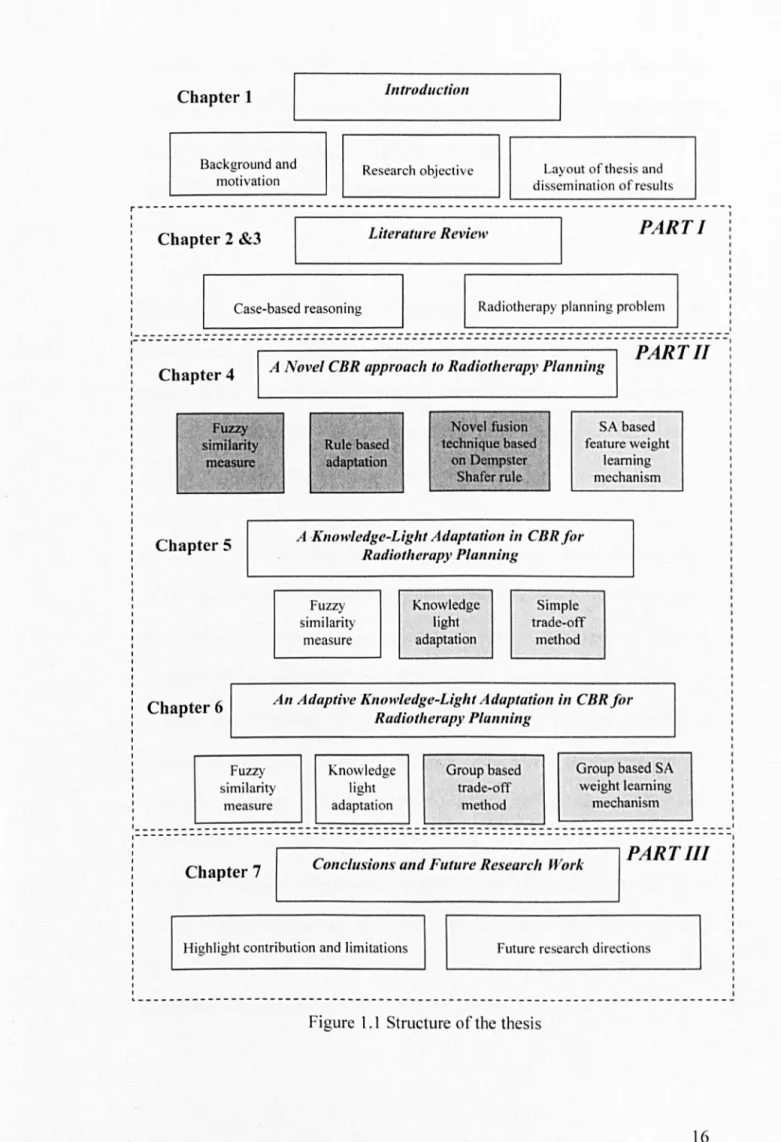
This thesis is organised into seven chapters including this introduction chapter. The entire thesis is divided into three parts as shown in Figure 1.1. In part I, 'state-of-the-art' case-based reasoning and radiotherapy planning problems are described. In part 11, a Dempster-Shafer rule based CBR, a knowledge-light adaptation and an adaptive knowledge-light adaptation in CBR for radiotherapy planning are described. In part Ill, conclusions and future research work are described. Contribution of each chapter is highlighted in grey colour. The outline of the content of each chapter in this thesis is summarised below:
Chapter 1
Background and motivation
ill1rodllctioll
Research objective Layout of th es is and
di sse mination of re ults
イ M M M M M M M M M M M M M M M M M M M M M M M M M M M M M M M M M M M M M M M M M M M M M M M M M M M M M M M M M M M M M M M M M M M M M M M M M M M M セ
I I
Chapter 2 &3 Literature Review
PART I
Case-based reasoning Radioth erapy planning probl em
I
:================::=========================:===============================:1
PART 11
Chapter 4 A Novel CBR approach to Radiotherapy Plallning
Fuzzy similarity measure Chapter 5 Rule based adaptation Novel fusion technique based on Dempster Shafer rule SA based feature weight learning mechanism
A -Knowledge-Light Adaptation ill CBR for Radiotherapy Pla""ing Fuzzy similarity measure Knowledge light adaptation Simple trade-off method
Chapter 6 An Adaptive Knowledge-Light Adaptation ill CBR for
Radiotherapy Pla""ing Fuzzy similarity measure Knowledge light adaptation , Group based trade-off method Group based SA weight learning mechanism 1 _ _ _ _ _ _ - - - _ _ _ _ _ _ _ _ _ _ _ _ _ _ _ _ _ _ _ _ _ _ _ _ 1
--- ---- ---1
PART III
Chapter 7 Conclusio/ls and Future Research Work
Highlight contribution and limitations Future re sea rch directions
Chapter 2 'Case-Based Reasoning ': In this chapter, an overview of case-based
reasoning is given. The steps of the CBR system are described along with the key areas of the research, This chapter also discusses the literature related to the application of case-based reasoning to real world problems, particularly in healthcare,
Chapter 3 'Radiotherapy Planning Problem ': A brief overview of the
radiotherapy planning process is presented in this chapter, A comprehensive review of the 'state-of-art' radiotherapy planning problems is also presented, The existing literature is classified based on two criteria: types of problems addressed and the methods used to solve them.
Chapter 4 'A Novel Case-Based Reasoning Approach to the Radiotherapy Planning Problem ': The radiotherapy dose planning problem to prostate cancer
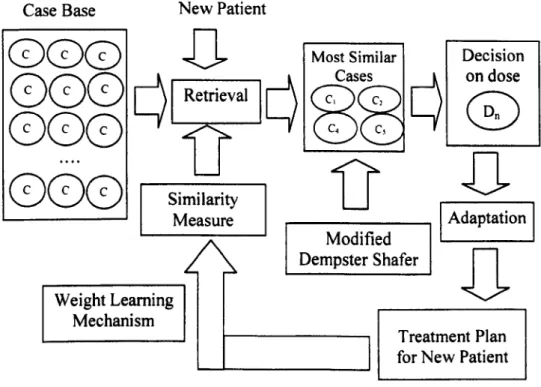
discussed in this chapter is presented as an optimisation problem. A novel Dempster-Shafer case-based reasoning approach is developed to capture the expertise and experience of the oncologist in the dose planning process. An attempt has been made to incorporate the success rate of the treatment in the dose planning process along with the side effects of the treatment. For each new patient, four cases most similar to the new case are retrieved and combined using a modified Dempster-Shafer rule. In the fusion process, cases having a better success rate are given more importance than cases having a worse success rate. Also, the proposed CBR method is enriched with a Simulated Annealing based feature weights learning mechanism.
Chapter 5 'A Knowledge-Light Adaptation in Case-Based Reasoning for Radiotherapy Planning: In this chapter, firstly, the non-linear nature of the
dose planning problem is discussed. Thereafter, a knowledge-light adaptation in case-based reasoning method is proposed to make a trade-off between the benefit and risk of the treatment. For each new patient. a case having a similar difference vector and gradient is retrieved as the new case and the dose limits of different volume percentages of the rectum, which surrounds the prostate, are calculated. Thereafter, based on calculated dose limits, the doses in phases I and 11 of the treatment are determined. The retrieval process is enriched by incorporating the 5 years Progression Free Probability and the success rate of the treatment in the similarity measure.
Chapter 6 'An Adaptive Knowledge-Light adaptation in case-based reasoning for Radiotherapy Planning ': In this chapter, a novel group based trade-off
method is proposed to ease the decision making process of the oncologist. The novel trade-off method makes a compromise between the benefit of the radiation and retrieves the case most similar to the new case, Firstly, cases are divided into different groups and trade-off is made by relaxing the constraints. Thereafter, knowledge-light adaptation is used to calculate the dose in phases I and 11 of the treatment. After each run of the system the feature weights are updated automatically using a group based Simulated Annealing approach.
Chapter 7 'Conclusions and Future Research Work': In this chapter, both a
conclusion and a discussion about the effectiveness of the developed methods are presented. Firstly, an analysis of how the research objectives mentioned in
the introduction chapter were achieved is given. Secondly. some suggestions are given for continuation of the work presented in this thesis.
1.5 Dissemination of Results
The research described in this thesis has been disseminated through conferences, seminars and research publications in both medical and artificial intelligence fields. Below is a list of all the publications and the conferences/seminars which have been attended:
1.5.1 Journal Papers
[5] S. Petrovic. N. Mishra and S. Sundar. A novel case based reasoning approach to radiotherapy planning. Expert Systems with Applications, 38 (9),
10759-10769, 2011.
This paper introduces a modified Dempster-Shafer rule which is used in the fusion of multiple cases retrieved in the retrieval process. The weights corresponding to each features used in the retrieval process are updated using a Simulated Annealing based weight leaning mechanism.
[6] N. Mishra, S. Petrovic, and S. Sundar. A Self-Adaptive Case-Based Reasoning System for Dose Planning in Prostate Cancer Radiotherapy, Accepted for publication in Medical Physics Journal.
In this paper, a novel trade-off method is addressed to make a compromise between the risk and the benefit of the radiation and to retrieve the case most similar to the new case. A group based Simulated Annealing approach to determine the importance (weights) of different clinical parameters used in the retrieval process is introduced.
1.5.2 Conference Papers
[7] A. Cox, N. Mishra, I. Sayers, S. Petrovic and S. Sundar, A decision aid for radiotherapy dose selection in prostate cancer based on non-linear Case Based Reasoning, UK Radiation Oncology Conference, Manchester, UK , 11 th - 13th April,2011
In this paper, the 5 years Progression Free Probability and success rate of the treatment in dose planning process is incorporated.
[8] N. Mishra, S. Petrovic and S. Sundar, A knowledge-light nonlinear case-based reasoning approach to radiotherapy planning, in Proceedings of the 21st
International Conference on Tools with Art(ficial Intelligence (ICT AI), Newark Liberty International Airport Marriott Newark (NYC Metropolitan Area), New Jersey, USA, 2-5 November, 2009, pp. 776-783.
This paper introduces a knowledge-light adaptation in case-based reasoning to detennine the dose limits of different volume percentages of the rectum.
[9] N. Mishra, S. Petrovic and S. Sundar, A non-linear case based reasoning approach to radiotherapy dose planning, in Proceedings of the 35th annual
Operational Research Applied to Health Services (ORAHS) Leuven, Belgium, 12-17 July, 2009,24,2009
A case-based reasoning approach which takes into consideration the trade-off between risk and benefit of the proposed radiation is proposed in this paper.
[10] N. Mishra, S. Petrovic and S. Sundar, A Novel Case Based Reasoning Approach to Radiotherapy Planning, in Proceedings of the 18th Triennial
Conference of the International Federation of Operational Research Societies (IFORS'08), Sandton, South Africa. 13-1 8 j オ セ カ N 2008. 66,2008.
This article introduces a modified Dempster-Shafer rule based CBR approach to radiotherapy dose planning problems.
1.5.3 Book Chapters
[11] N. Mishra, S. Petrovic and S. Sundar, Self-adaptive case based reasoning for dose planning in radiotherapy, in the book of the 36th annual Operational
Research Applied to Health Services (ORAHS), 18-23 July, 2010,28-46,2010.
In this article a group based Simulated Annealing approach is proposed to determine the weights corresponding to each feature used in the retrieval process.
1.5.4 Seminars and workshops
"A novel cased-based reasoning approach to radiotherapy treatment planning" presented at the workshop on LANeS Healthcare Modelling PhD Symposium, Cardiff University, 18th_ 20th January, 2009.
"A non-linear case-based reasoning approach to radiotherapy dose planning" presented at the Automated Scheduling, Optimization and Planning Research
Group, School of Computer Science, University of Nottingham, 16th October, 2009.
"A case-based reasoning approach to dose planning in Radiotherapy" presented at the Automated Scheduling, Optimization and Planning Research Group, School of Computer Science, University of Nottingham, 3rd July, 2008.
"A novel case-based reasoning approach to radiotherapy planning" presented at the workshop on Radiotherapy Planning and Scheduling, Coventry University,
CHAPTER 2
Case-Based Reasoning (CBR)
2.1
Introduction
Case-Based Reasoning is a knowledge based reasoning paradigm in which new problems are solved using the solutions of similar problems that have previously been resolved [12-13]. It is influenced by a cognitive model of human problem solving techniques. In the cognitive model, humans learn from their day-to-day experiences and store the empirical knowledge in the form of episodic memory. New problems are compared with the past experience based on psychological knowledge [14-15]. Thereafter, the most similar past experience is recalled and reused with small modifications according to the requirements of new problems.
2.2
What
is Case-Based Reasoning?
In case-based reasoning, previously solved problems and their solutions are stored as cases in a data base known as a case base. For each new problem, cases similar to the new case are retrieved from the case base. I f the new problem is the same as the extracted case, the solution of the new case is directly copied from it; otherwise it is revised using domain knowledge, so that the retrieved solution becomes relevant in the context of the new problem. Finally, if information gained from the new problem is useful for future reasoning then it is stored in the case base for future use. The aforementioned
steps make up the basic framework of a vast variety of different CBR approaches and are described in this chapter.
Case-based reasoning has a number of advantages as well as disadvantages over other problem solving techniques. The main advantages and disadvantages can be summarized as follows:
The main advantages of the CBR system are:
i. Case-based reasoning is easy to understand. During reasoning it cites actual cases solved in the past. Citing actual cases makes the explanation easier.
ii. Case-based reasoning helps to produce a solution to a new problem quickly by avoiding unnecessary time to derive the solution from scratch.
Ill. It can capture ill-defined problems without a complete understanding of
the complex system and can predict the solution for new problems, based on what has been worked in the past.
IV. Case-based reasoning increases competency over time. It helps the
reasoner to avoid mistakes by remembering mistakes that have occurred in the similar scenarios.
v. Cases in the case base help the reasoner to focus on the important parts of a problem by pointing out important features of a problem.
VI. It can handle unexpected or missing inputs by assessing their similarity
to stored cases or by reusing relevant cases.
VB. It is self-adaptive in nature. New knowledge in the form of new cases,
The main disadvantages of case-based reasoning are:
1. Case-based reasoning relies only on previously solved cases without
validation in the new situations [12].
ii. Maintenance of the case base is a tedious task. Sometimes it is hard to design and develop a good quality case base.
Ill. Knowledge acquisition (reasoning) is a problem when dealing with
domains where cases are either unavailable or are only available in limited amounts.
IV. Sometimes it is hard to implement a CBR system in a dynamic
problem domain.
v. In case-based reasoning, explanations of the solution are not always straightforward as in rule-based systems. Sometimes it is difficult to give explanations for all of the reasoning steps.
2.3 Methodology and Research Issues in CBR
In the literature, a large number of models have been suggested to address real world problems. The detailed description of the basic principle of case-based reasoning and its history could be found in the work of Kolonder (1993) [12]. This subject field is vast and in this chapter the author will attempt to focus on those models and research issues that are relevant only to the application of case-based reasoning in radiotherapy dose planning.
2.3.1 Case-Based Reasoning Framework
Based on their execution process, case-based reasoning systems can be divided into two categories: problem-solving CBR and interpretive CBR [12]. In the
problem solving CBR, the solution of the new problem is proposed based on the most similar retrieved case(s). It is generally used where solutions cannot be determined in advance, such as radiotherapy dose planning problems, whereas in interpretive CBR, the case base is used to justify the prescribed solution.
The overall framework of a CBR approach comprises four activities: Retrieve, Reuse, Revise and Retain [15]. In the retrieve stage, a case (or cases) which is (or are) most similar to the new case is (are) retrieved. In the reuse stage, the retrieved case is used to generate a solution for the new case. However, sometimes a solution generated by the reuse stage is incomplete or not fit for the new case. In this situation, the solution generated in the reuse step has to be revised to better fit the new problem and that is referred to as the revise stage.
It compensates the differences between a retrieved case and a new case. Finally, in the retain stage, if the new solution is useful for future problem solving then it is stored in the case base for future use.
2.3.2. Case Representations
The performance of a CBR system, especially in a complex problem domain, depends heavily on case representation. In knowledge based reasoning, the decision is usually based on: problem features and how they are linked. However, in CBR, the decision is based on the problem features only [12]. A case usually consists of two major parts: problem parameters which describe the conditions under which similar case(s) should be retrieved and the solution to the problem. Each case describes knowledge relevant to a particular problem
instance. Cases can be classified according to their characteristics into three categories: abstract/ concrete. partial/ complete and related/ isolated [16].
Abstract/ Concrete: cases correspond to generalized or concentrated infonnation.
Partial/Complete: is generally used where knowledge is inconsistent or suffers from stochastic interference. A case in the case base is divided into different sub-units and each sub-unit consists of different knowledge.
Related/Isolated: cases in the case base may be linked to each other in the fonn of a hierarchy or relationship network or are independent from each another. The structure of the case affects the retrieval and revise steps of case-based reasoning. The accuracy and search time of the CBR system usually increases as the number of problem parameters increases. Cases nonnally contain all the necessary infonnation so that the system perfonnance is not degraded by the presence of erroneous, incomplete, or irrelevant infonnation. ]t is argued by the researchers that the search time can be minimized by a good choice of case representation. A good case representation must be Predictive. Abstract. Concrete. and Useful [12, 17, 18].
Predictive: Cases should contain all the infonnation that was taken into account in the decision (solution) making process.
Abstract: stored infonnation should be generic and applicable to all possible future problems.
Concrete: the problem parameters should not be too abstract. A case cannot be recognized as being similar to the cases in the case base without extensive inference.
Cases are usually represented as vectors of attribute value pairs. These attributes may have different measurement units with different scales. They can be numeric, symbolic, boolean, or object-based. The complexity of the structure increases as the complexity of the problem domain increases. Also, sometimes information! knowledge collected from decision makers is imprecise. To manage the above difficulties in this thesis, a fuzzy membership function based representation method is used.
2.3.3 Retrieval
When a new problem arrives, a case based system first looks for a good case (or cases) in the case base [12]. A good case is the case most similar to the new problem and has the potential to make relevant predictions about the new problem. The retrieval process generally uses a similarity measure to rank the cases in the case base; often the highest ranked case is retrieved for further calculation. The success of a CBR system depends primarily on the similarity measure calculation. With an efficient similarity measure, we can obtain a good ordered list of similar cases. In the literature, many approaches such as Nearest Neighbour (NN), k Nearest Neighbour (k-NN), and Induction Algorithms based similarity measures have been developed. The choice depends heavily on the nature ofthe problem.
The Nearest Neighbour (NN) similarity measure is generally used for problems that can be characterized by feature vectors. Cases are represented as points in the feature space. One of the most common nearest neighbour distances used in the NN method is:
n
D(cpcR )
=
Lsim(f/ ,j,/) (1.1 );=1
where,
n = number of problem features in each case
sim
=
distance functionf/
=
value of feature i in the input case c,f/
=
value of feature i in the retrieved case eRThe similarity is often calculated using the Euclidian distance between the
points.
The NN methods can be extended by assigning weights to the problem features. Weights assigned to the problem features in the similarity measure represent their relative importance.
n
D(c/,cR )
=
Lw;simU;' ,//) (1.2);=1
where, Wj is the weight of feature i.
Sometimes, for a large data base it is very expensive to compare sequentially each and every case in the case base. Zhang et al. [19] proposed an indexing based NN method and restricted the search to a subset of the case base. However, this approach raises several problems. It usually does not give good results in constraint satisfaction problems that typically have a wide range of related constraints. In order to overcome the above limitation, Bomer [20] proposed a structural similarity measure approach to assess the similarity between cases. Firstly, cases are represented by graphs, where problem features are represented by nodes and relations between them are denoted by edges.
Thereafter, similarity between the graphs is calculated and the most similar cases were retrieved.
For complex systems such as medical diagnosis, sometimes a single retrieved case is not sufficient to predict the solution of a new case. Wettschereck et al. [21] proposed the k Nearest Neighbour (k-NN) method, retrieved a set of nearest cases and used a voting system to determine which case will be passed on to the next steps.
Some CBR systems use induction algorithms such as ID family [22] and AQ family [23] for case retrieval. In the induction algorithm, cases in the case base are ranked using the decision tree method. The induction algorithm based retrieval process is faster but it needs to be adjusted when new cases are added to the case base and furthermore it is usually not suitable in dynamic domains. Aarnodat and Plaza [25] divided the case retrieval process into two categories: syntactical and semantical. In the syntactical method, the similarity measure is usually calculated based on the superficial knowledge of the system and is generally used in domains where explicit knowledge is difficult to elicit; whereas the retrieval process based on the semantic method employs deep and complex knowledge to compare feature values including their relative weights. In the literature, usually a case most similar to the new case is retrieved for future decision making processes. However, sometimes the extraction of one similar case may lose important information contained in other similar cases [24]. Further, if the case base contains opinions of more than one decision maker, there may be a chance that different decision makers have different opinions about a solution for a similar situation. Moreover, the existing retrieval mechanisms extract a case taking into account the similarity measure.
In real life, decision makers sometimes make a trade-off between the different decision making parameters. Keeping the above criteria in mind, in this thesis a novel group based trade-off method is proposed in Chapter 6. In Chapter 3, four cases similar to the new case are retrieved and combined using a modified a Dempster-Shafer rule.
2.3.4 Adaptation
In case-based reasoning, old solutions are used as an inspiration for new problems. However, a new problem is rarely the same as the retrieved most similar case and its solution needs to be adapted to fit the new problem. Adaptation usually takes into account the prominent differences between a new case and the retrieved most similar case. It is the most difficult part of the CBR system. It is generally performed in two steps: figuring out what needs to be adapted and carrying out the adaptation.
In the simple problem domain where the difference between the past and the current problem is unimportant, adaptation focuses only on the parts of the solutions that can be reused for the new problem. In the complex domain, adaptation focuses not only on the parts of the solutions that can be reused for the new problem, but also on how the difference between the past and the current problems will affect this reuse [26].
In general, there are two types of adaptation [12]:
Structural adaptation: adaptation rules are applied directly to the retrieved
Derivational adaptation: in this method, all the algorithms, methods and rules used in the past are stored in the memory along with the solution. The stored
information is further explored in the context of the new problem.
For a complex problem, a CBR system may need both types of adaptation. Usually structural adaptation rules work well to adapt a poorly understood problem and derivational adaptation is applicable to problems that are well understood [12].
Watson and Marir [27] classified adaptation techniques in a more detailed way as follows:
Null Adaptation: A retrieved most similar solution is reused without any modification. It is useful for problems involving complex reasoning but having simple solutions [28].
Parameter Adjustment: is a structural adaptation technique where differences between the feature vectors of past and current problems are used to modify the retrieved the most similar solution [29].
Critic-Based adaptation: rules are generated to identify the problem features which are not compatible with the new problem or violate some domain constraints. Rules are generally elicited from the domain expert or learnt by using expert knowledge [30].
Reinstantiation: is used to instantiate features of an old solution with new features that must be present in the new solution because they are mentioned in the problem description [31].
Derivational Rep/ay: is the process of implementing the previously derived methods or rules to generate the solution in the new problem instance [32].
Model-Guided Repair: is the process of using a casual model of the problem domain to guide the adaptation by repairing elements of the old solutions which are infeasible in the current problem [33].
Case Based Substitution: uses other cases to suggest appropriate adaptations to the current problem [34-36].
Adaptation is an important step of case-based reasoning and usually requires a lot of domain knowledge. In this thesis knowledge-light adaptation is proposed for the case-based reasoning system.
2.3.5 Maintenance
The success of a CBR also depends on the technologies used in the reasoning process and its maintenance. A good CBR system must be maintained intelligently, systematically and automatically. In the literature, most of the work in CBR maintenance refers to maintenance of the cases in the case base. However, retrieval and adaptation are important steps of the CBR system and must be taken into consideration while carrying out the maintenance.
Smyth [37] has divided CBR maintenance into two categories: efficiency directed maintenance and competence directed maintenance. The efficiency directed maintenance focuses on the minimisation of computational costs associated with retrieval, adaptation and storage of cases in the case base. The computational cost depends on the size of the case base. Addition of new case or new knowledge in the case base not only increases the success rate of the CBR system but also increases its computational cost. A number of methods have been developed to determine the saturation point [38-40]. It is the point where the addition of more knowledge into the knowledge base increases the
computational cost of the system only. The competence directed maintenance focuses on the reasoning outcomes and on the quality of the cases in the case base. In experiments, it has been found that the size of the case base does not provide accurate information about the distribution of cases in the case base in terms of features values [41]. The outcome and quality of the CBR system depends on the size, density and distribution of the cases in the case base. The density and distribution of the cases in the case base can be determined by a similarity measure. Some of the cases in the dense region may be redundant and have less influence on the reasoning process compared with those in spare regions [42]. If cases in the dense region have a large number of different solutions, outcomes of the CBR system will be inconsistent.
2.4 Case-Based Reasoning for Healtbcare Systems
In recent years, CBR has emerged as a most vibrant and rapidly growing area for problem solving in the health domain. The earliest research in this area was focused on the modelling of medical expertise, particularly for diagnosis, treatment planning and follow up care. However, over the last decade it has been successfully implemented for all health sciences applications including nursing, human biology, genetics, proteomics and phylogenetics as shown in Table 2.1. There are over 250 research articles published in this area which focus on the CBR method. It has been observed that one third of the research articles were published in the last three to four years. This area is expected to grow continuously as healthcare research is growing.
Table 2.1 CBR in Medicine
Problem System name Application domain References addressed
Diagnosis SHRINK Psychiatry [43]
and decision CASEY Heart failure [44]
support MEDIC Dyspnoes [45]
systems BOLERO Pneumonia [46]
FLORENCE Health care planning [47]
MNAOMIA Psychiatry [78]
SCINA Detection of coronary [48]
heart disease [49]
CARE-PARTNER Stem cell transplantation [50] AUGUSTE Alzheimer's disorders [51 ] ExpressionCBR Cancer diagnosis [52]
Fungi-PAD Object recognition [53]
KASIMIR Oncology [54]
Type-I diabetes Breast cancer [55]
Dermatology Diabetes treatment [56] Bronchiolitis Dermatology treatment [57]
SISAIH Bronchiolitis [58]
RHENE Fraud detection in [59]
healthcare
Classification PROTOS Audiological disorders [60]
systems MACRAD Image analysis [61 ]
IMAGECREEK Image analysis [62]
CTS Image analysis [63]
PHYLSYST Phylogenetic classification [64]
GeneCBR Cancer classification [65]
Hep2-PAD Image classification [66-67]
ADHD Neuropsychiatric [68]
Planning ALEXIA Hypertension [69]
systems ROENTGEN Radiation therapy [70]
CAMP Daily menu planning [71-72]
T-IDDM Diabetes treatment [73]
SIDSTOU Tourette syndrome [74]
Dempster-Shafer rule Prostate cancer [75] based CBR
Tutoring ICONS Antibiotics therapy for [76]
systems intensive care
CADI Cardiac auscultation [77]
Kolodner and Kolodner [43] proposed SHRINK, a case based system for psychiatric diagnosis and treatment. In the developed system, past solved psychiatric cases were stored in the case base and demonstrated how they could be used in teaching clinical reasoning. Later, Bichindaritz [78] extended the SHRINK idea and proposed MAHAOMIA, a CBR system for diagnosing and treating psychiatric eating disorders. In the developed system, an electronic data base was created to store the past patients' records such as: medical history of the patients, environment, symptoms, diseases, prescribed tests and treatments procedures. For each new patient or new disease episode, the system retrieved and displayed the most similar patients or disease episodes, degree of similarities and differences in relation to the current case and prescribed past successful treatments. Based on the extracted case it also recommended a diagnosis and treatment process for a new patient.
Bareiss et al. [79] built a CBR medical diagnosis software, PROTOS, to diagnose audiological or hearing disorders. The main task of the developed software was to classify a new patient into one of the 15 predefined categories based on 58 distinct diagnosis features. Koton [45] developed CASEY, case based medical diagnosis software to diagnose cardiac patients by comparing them with earlier cardiac patients stored in the case base. The similarity measure designed by him was based on both quantitative features (like heart rate) and qualitative features (like high or low arterial pressure or the presence or absence of a particular disease). Diagnosis of a new patient was presented by a graph showing the causality among the measures and states of the patient. It also demonstrated the comparison between the retrieved past most similar cases and the present case.
In real life, generally it takes up to two days in a laboratory to analyze the bacteria responsible for bacterial infections in a hospital Intensive Care Unit (lCU). In order to diagnose the problems quickly, Koton [44] and Heindl et al. [80] developed a case-based reasoning system ICONS. In the case base they stored all details of past ICU patients, who received antibiotic therapy. When a new infection arises, ICONS retrieved the most similar cases from the case base based on the following information: location of infection, way in which the infection was acquired, and condition of the patient. Based on the retrieved similar or prototypical case, it predicted the root cause of the problem and potential solution.
Petot et al. [71] developed CAMP, a CBR system for nutrition planning. The main objective of the system was to plan daily menus to meet individual nutrition requirements. They stored the list of all available repositories in the case base. Thereafter, integrated case-based reasoning and rule based reasoning methods were used to meet the multiple design constraints of the recipe.
Beddoe et al. [81] developed CABAROST for nurse rostering problems. The cases in the case base represent previous examples of constraint violations in schedules and the repair methods used in the past. The similarity between the constraint violations of the new problem and the cases in the case base was calculated based on the cases' structural and feature information. Firstly, they retrieved the cases identical to the current problem in terms of structural and feature information. Thereafter, a memetic algorithm was used to search for optimal sequences of repairs suggested by the retrieved cases.
Berger [70] proposed a CBR system to generate a radiotherapy treatment plan for a new patient using the past case (patient) that best matched the geometrical
similarity and the treatment constraints but no results were reported about the effectiveness ofthe developed system.
Song et al. [75] proposed a Dempster-Shafer rule based CBR approach for prostate cancer dose planning problems. In the developed CBR system, they retrieved four cases which were most similar to a new case and combined them using the Dempster-Shafer rule to suggest a dose for the treatment. However, if the dose limits imposed to the rectum are violated, then simple adaptation rules are used to rectify that. With this approach, the dose limits for different volume percentages of the rectum were assumed to be fixed.
Schlaefer and Dieterich [82] proposed a CBR approach to determine the beam configuration in robotic radiosurgery for prostate cancer. The role of case based reasoning was to propose
a
range of parameter values that determined the beam configuration based on previous treatments. These ranges of parameter values were passed to the optimisation technique to determine the beam configuration for a new treatment efficiently.2.5 Conclusion
This chapter has described the general framework of case-based reasoning approaches. The key issues of the case-based reasoning approach namely case representation, retrieval adaptation and case based maintenance, have each been described in detail.
The application of CBR systems to a wider variety of healthcare problems was divided into four categories [228]: diagnosis problems, classification problems, planning problems and tutoring problems. A detailed description of developed decision support systems and their application domain has been given. The use
of a CBR system for the problem of radiotherapy dose planning is virtually unexplored. Two approaches, that of Berger [70] and Song et al. [75], have been cited in the literature. The authors drew positive conclusions about the success of the CBR system for dose planning problems but provided little insight into the applicability of this approach.
This thesis therefore attempts to apply many of the lessons learnt from the application of CBR approach to healthcare, law, management and finance related problems to dose planning in prostate cancer.
CHAPTER 3
The Radiotherapy Planning Problem
3.1 Introduction
Cancer is characterised by the abnonnal and uncontrolled growth of cells. It is generally diagnosed by Computerized Tomography (CT) scans, Magnetic Resonance Imaging (MRI), nuclear medicine scans, biopsy and histopathology reports. A CT scan is a computerized (axial) tomography scan which uses a series of X-rays to create detailed images of the inside of the body. However, it cannot distinguish between nonnal and pathological cells. It can only be distinguished by the MRI. Sometimes, to judge the possible involvement of metastatic growth, nuclear medicine scans are prescribed by the oncologist. The aforementioned tests are diagnostic procedures and do not give conclusive evidence of malignant cancer. Biopsy and histopathology report are good ways to confinn this. Depending on the type, size, stage and location of the cancer, Chemotherapy, Honnonal Therapy, Surgery and Radiotherapy are usually used to treat the cancer. In chemotherapy, cancer is treated with drugs called antineoplastic drugs. In honnonal therapy, a special type ofhonnone is used to kill the cancer cells. The honnone is a special type of chemical released by one tissue to influence the physiology of another tissue. In surgery, cancer cells are physically removed. Radiotherapy uses X-rays or Gamma rays to kill the cancer cells. It is often used to treat all stages of the cancer, or in cases where surgery fails.
X-rays or Gamma rays used in radiotherapy treatment kill not only the cancer cells but also damage the cells through which they traverse. The cells do not die immediately, but after weeks or even months. Sometimes cells are reproduced before being eliminated from the organ. The rate of recovery of normal tissues is higher in comparison with cancer cells The radiation is generally delivered in a number of fractions (usually 1.8 to 2 Gy per day, five days in a week) over a period of one or several weeks. It allows normal tissues to regenerate during the treatment. In the early days of radiotherapy, X-rays were used. However, due to a lack of sufficient penetration they are generally used for skin cancer and other superficial lesions and avoided in the case of deep seated tumours such as prostate cancer. The introduction of megavoltage X-ray machines facilitate sufficient penetration to deal with seated tumours. Radiotherapy treatment can be divided into three categories, namely external beam radiotherapy, brachytherapy or sealed source radiotherapy and systemic radioisotope therapy or unsealed source radiotherapy. The division is made based on the position of radiation sources used in the treatment. In external radiotherapy, radiation is delivered from a source located outside the body. In brachytherapy, sealed radioactive material is placed precisely in the area of the treatment. In the systemic radioisotope therapy, radioisotopes are placed inside the body by infusion or oral ingestion. Further, the external beam radiotherapy can be divided into three categories, namely conventional external beam radiotherapy, 3-Dimensional Conformal Radiotherapy (3DCRT) and Intensity-Modulated Radiotherapy Treatment (lMRT). In the conventional external beam radiotherapy, rays are delivered via a two-dimensional beam using linear accelerator machines. Firstly, a treatment plan is designed and calibrated using
a simulator. The simulator is a special type of calibrated diagnostic X-ray machine. Thereafter, prescribed radiation is delivered to the patient from different directions using a single beam. This technique is very simple and reliable. However, it is not applicable to the high-dose treatments that prostate cancer requires. The sensitivity of the surrounding organs limits the prescribed dose to such an extent that tumour control may not be easily achievable. The above-mentioned intricacy of conventional external beam radiotherapy can be overcome in the 3-Dimensional Conformal Radiotherapy, where mUltiple radiation beams are shaped to fit the profile of the target from the beam's eye view. It helps medical physicists to reduce the toxicity of the surrounding
organs while allowing a higher dose of radiation to the cancer cells. Intensity-Modulated Radiotherapy (IMRT) is the next generation of 3DCRT, which enables a precise conformal radiation dose distribution to the cancer cells by controlling the intensity of radiation within a given area. In IMRT, multi-leaf collimators are used to modulate the beam, by uncovering specific parts of the beam and blocking the remaining parts. It can modulate and shape the beam in such a way that the prescribed dose can be delivered even in the concave target volumes whilst sparing the other healthy tissues near the cancer cells. The levels of this step function provide medical physicists different degrees of freedom to achieve the prescribed dose distributions in the body.
The treatment plans are generally designed by three groups of specialists: oncologists, medical physicists and computer scientists/operational researchers. Oncologists are doctors who outline the tumour volume and the organs at risk. Medical physicists model the deposition of radiation in the volume outlined by the oncologist. Operational researchers and computer scientists have an
important role in the treatment planning usmg optimisation and artificial intelligence techniques to help medical physicists and oncologists to achieve the desired goal.
A treatment plan can be generated by forward planning or by inverse planning. In forward planning, the medical physicist enters all treatment parameters such as the beam intensity, number of beams and direction of beams into the planning software and the dose distribution is calculated. If the dose distribution is unacceptable, the task is repeated until a desired dose distribution is achieved. This process is based on a trial-and-error process and there is no guarantee that the best possible dose distribution will be found. Hence, this process is not suitable for complicated anatomical situations. In inverse planning, the medical physicists know how much energy is to be deposited to tissues and they want to know the optimal/near-optimal combination of treatment parameters. IMRT is an inverse planning process which enables the oncologist to have better control of the radiation, i.e. limit the amount of radiation to be received by cancer cells and normal organs and determine the optimal combination of other planning parameters that adhere to the prescribed bounds.
3.2
Issues
of Radiotherapy
Planning
Problems
and
Classification of Problems
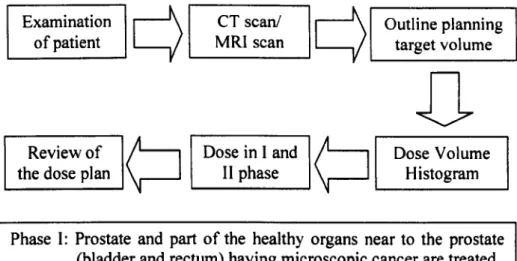
The main goal of the planning process is to kill all the cancer cells without impairing the remaining body, particularly the organs lying close to the tumour cells. The treatment process includes imaging, treatment planning, plan confirmation and treatment. In imaging, the patient is scanned using a eT scan, nuclear scans or MRI scans. Thereafter, the oncologist outlines the tumour
volume, the Planning Target Volume (PTV) and Organs at Risk (OARs) on these images. PTV is an extension of the tumour volume containing tumours cells and the surrounding area to which the cancer has spread. Once the tumour volume is identified, the medical physicist and oncologist work together and produce a treatment plan. The treatment plan specifies the prescribed total amount of radiation dose, number, size and shape of radiation beams, number of wedges and the configuration and beam intensity profile for each beam. The suggested plan is reviewed and confirmed by viewing the Dose Volume Histogram (DVH). DVH presents the simulated radiation distribution within a volume of interest which would result from a proposed radiation treatment plan. The final prescribed plan is passed to the treatment department. The suggested radiation is delivered by a linear accelerator with a multi-leaf collimator equipped in the head of the treatment unit as shown in Figure 3.1. Beams of radiation are generated by a linear accelerator. Once beams are formed they travel through the gantry. The gantry of the linear accelerator can be rotated around the patient to deliver the radiation from different angles. The head of the gantry contains multiple metal leaves which can shape the radiation beam by blocking portions of the beam as shown in Figure 3.2. Shaping the beam helps to reduce the levels of radiation to the sensitive regions, while delivering a higher dose of radiation to the tumorous regions.
Figure 3.1 A linear accelerator [83]
Figure
3.2
A close-up view of multi-leaf collimator[83]
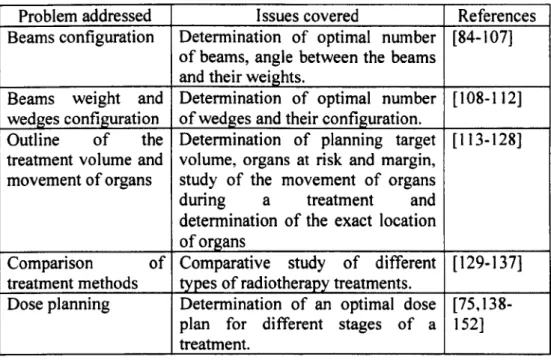
Many problems in the area of radiotherapy planning can be solved by using operational research techniques. A detailed summary of the radiotherapy planning problems as reported in the literature is given in Table 3.1.
Table 3.1 Issues of the radiotherapy planning problem raised in the literature
Problem addressed I ssues covered References
Beams configuration Determination of optimal number [84-107] of beams, angle between the beams
and their weights.
Beams weight and Determination of optimal number [108-112] wedges configuration of wedges and their configuration.
Outline of the Determination of planning target [ 113-128] treatment volume and volume, organs at risk and margin,
movement of organs study of the movement of organs during a treatment and determination of the exact location of organs
Comparison of Comparative study of different [129-137] treatment methods types of radiotherapy treatments.
Dose planning Determination of an optimal dose [75,138-plan for different stages of a 152] treatment.
3.2.1 Beams Configuration
The determination of beams configuration is an important step of the radiotherapy planning process. It might be possible to kill all the cancer cells with a single beam of radiation. However, the use of a single beam can damage the normal cells of the critical organs. It is always necessary to select the optimal/near-optimal number of beams and their orientation (angle between the beams) so that the prescribed dose can be delivered to the targeted cancer cells, while sparing the nearby organs. In traditional radiotherapy, a limited number of beams is used and fixed manually by the medical physicists based on their past experience. IMRT uses multiple beams, which increases the complexity of the treatment plan. Hence, the determination of the optimal beams configuration is a difficult and tedious task. A significant body of research to determine the optimal values of beams configuration has been described in the literature. Pugachev and Xing [86] suggested a Simulated Annealing (SA)
approach to determine beam orientation in lMRT planning. Firstly, the quality of each single beam of unit intensity in the absence of other beams is calculated and stored in beam's-eye-view metrics (BEVD). Thereafter, a SA algorithm was employed to search an optimal set of beam orientations, taking into account the BEVD scores of different incident beam directions. During the calculation of the quality of each possible beam orientation, they did not consider any interaction between the beams. Li et at. [84] suggested a Particle Swarm optimisation algorithm to determine the beam orientation while taking into account the interaction between the beams in lMRT planning for prostate and head-and-neck cancer. Mohan et al. [153] proposed a fast Simulated Annealing algorithm to determine the number of beams in lMRT for prostrate cancer. The aforementioned approaches optimise the number of beams and their orientation separately but they are related to each other. As the input of one problem is the output of another problem, the solution of one problem affects the solution of the other. In order to overcome the above intricacy, Schreibmann et at. [87] proposed a hybrid multi-objective evolutionary algorithm to determine the optimal number of beams and their orientations simultaneously.
3.2.2 Wedge Co